Introduction
The American guava fruit fly Anastrepha striata (Schiner) is distributed from the southern USA (Texas) to Brazil (Weems, Reference Weems1982; Jiron and Hedström, Reference Jiron and Hedström1988; Hernández-Ortiz and Aluja, Reference Hernández-Ortiz and Aluja1993). In Mexico, it is the third most economically important fruit fly species (Aluja, Reference Aluja1994) and has been found in the tropical regions of both coastal plains in the Balsas Depression. It is also present in highland locations of Aguascalientes and southern Zacatecas states over an area of ≈ 20,000 ha (Hernández-Ortiz, 1992) where fruit flies infest guava orchards. In these areas, farmers are interested in applying the sterile insect technique (SIT); the SIT has already been used successfully in Mexico to control Anastrepha ludens (Loew) and Anastrepha obliqua (Macquart) (Rull Gabayet et al., Reference Rull Gabayet, Reyes Flores, Enkerlin Hoeflich, McPheron and Steck1996; Reyes et al., Reference Reyes, Santiago, Hernández and Tan2000).
The SIT requires that large numbers of the target pest be reared. In 2005, in the Moscafrut Facility at Metapa de Dominguez, Chiapas, Mexico, a laboratory strain (LS) of A. striata was established (during eight generations) with flies from infested fruits of guava (Psidium guajava L.; Myrtaceae). The larval diet was prepared with torula yeast-casein (TYC), sugar and corncob fractions (E. Hernández, unpublished results), and furcellaran light-green spheres were used for egg collection (Hernandez et al., Reference Hernandez, Artiaga, Flores and Barnes2004).
The flies undergo changes during colonization and mass-rearing; there are two strong selection pressures. First, in the laboratory, oviposition takes place on screens and not on fruits (Hart and Miyabara, Reference Hart and Miyabara1968; Prokopy and Boller, Reference Prokopy and Boller1970; Cayol, Reference Cayol, Aluja and Norrbom2000). The second selection pressure is the artificial diet fed to the larvae (Cayol, Reference Cayol, Aluja and Norrbom2000). Moreover, the temperature, humidity and light in mass-rearing facilities are usually constant, differing from the variable natural environment (Ochieng'-Odero, Reference Ochieng'-Odero1994; Artiaga-López et al., Reference Artiaga-López, Hernández, Domínguez-Gordillo, Moreno, Orozco-Dávila and Barnes2004).
Over generations in artificial conditions, A. striata has undergone changes and adapted to them – larval and pupal weights decreased and larval recovery and adult emergence increased (E. Hernández, unpublished results). Similarly, during the colonization of Bactrocera invadens Drew, Tsuruta & White, pupal recovery increased (Ekesi et al., Reference Ekesi, Nderitu and Chang2007); the same observation has been made for pupal weight, demographic parameters and mating attributes during the colonization of Ceratitis capitata (Wiedemann) (Liedo et al., Reference Liedo, Salgado, Oropeza and Toledo2007). Larval recovery and female fecundity exhibited the same trend during the colonization of A. obliqua, (Hernández et al., Reference Hernández, Toledo, Artiaga-López and Flores2009).
Therefore, laboratory-reared flies may be different from wild flies. The aims of this study were to characterize the demographic, rearing and quality control parameters of an artificially reared colony of A. striata and to identify which differences arose as a consequence of establishing a laboratory colony under artificial conditions.
Materials and methods
Experimental design
Three strains of A. striata were compared: wild strain (WS), LS maintained on a TYC diet (eight generations) and LS maintained on a starter-gel (SG) diet (first generation) (Fay, 1988; Hernandez et al., 2010). Rearing, quality and demographic parameters of the flies were compared using the values of the quality control parameters (larval recovery, pupation at 24 h, larval and pupal weights, and adult emergence) following the procedures described by FAO/IAEA/USDA (2003), Hernandez et al. (Reference Hernandez, Artiaga, Flores and Barnes2004) and Rivera et al. (Reference Rivera, Hernández, Toledo, Salvador and Silva2007).
Wild strain (WS)
Flies were obtained as larvae from infested fruits of guava collected during 2008 near Tapachula, Chiapas, Mexico (16°15′13″N, 92°07′35″W). Infested fruits were placed in plastic trays (60 × 45 × 10 cm), taken to the laboratory and stored for 4 days at 28 ± 1 °C. During this holding period, most of the larvae reached physiological maturity. The fruits were sliced and the larvae were removed, counted and weighed. WS larvae were placed in containers (15 × 10 × 8 cm) with vermiculite to promote pupation and development so as to mature within 14 days. The environmental conditions were 26 ± 1 °C and 75 ± 5% relative humidity (RH). Two days before emergence, the pupae from each strain were separated from the pupation substrate with a sieve (mesh 14) and placed separately in mass-rearing egging cages.
LS on TYC diet
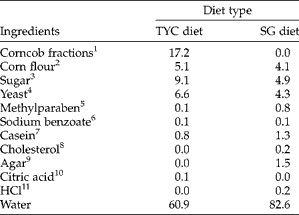
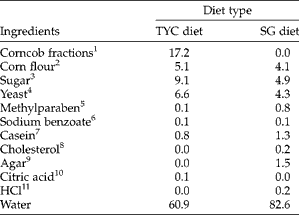
During 2005, LS were established from 8000 flies obtained from infested guava fruits collected from the place mentioned above. The strain was established and maintained for eight generations in the laboratory of the Development Methods Department, Programa Moscafrut SAGARPA-IICA, located in Metapa de Dominguez, Chiapas, Mexico. The diet described by Hernández et al. (unpublished results) was used for larval development, and furcellaran light-green spheres were used for egg collection (Hernandez et al., Reference Hernandez, Artiaga, Flores and Barnes2004). The larval diet was prepared by mixing the ingredients (Table 1) for 5 min, and then the diet was poured into trays in layers that were 3 cm deep.
Composition (% by weight) of the diets for larval development of Anastrepha striata
TYC, Torula yeast-casein, SG, Starter-gel.
1 Corncob fractions 100, Mt Pulaski Products Inc., Chicago, IL, USA.
2 Maíz Industrializado del Sureste, S. A. de C. V., Arriaga, Chiapas, Mexico.
3 Ingenio Huixtla, Chiapas, Mexico.
4 Lake States Div., Rhinelander Paper Co., Rhinelander, WI, USA.
5 Mallinckrodt Specialty Chemicals Co., St Louis, MO, USA.
6 Cia. Universal de Industrias, S.A. de C.V. Cd. de México, México.
7 Casec, Novartis Farmacéutica, S.A. de C.V. Cd. de México, México.
8 Química Meyer, Cd. de México, México.
9 Agarmex, Tlalnepantla, Edo. de México, Mexico.
10 Anhidro acidulante FNEUM, Mexana, S. A. de C. V., Morelos, Mexico.
11 Mallinckrodt Baker, S. A. de C. V., Xalostoc, Edo. de México, Mexico.
LS on SG diet
To establish the LS, flies were obtained from the seventh generation of the LS maintained on the reference diet. The changes due to feeding on an artificial diet during the first generation were evaluated. The SG diet was prepared by dissolving agar in hot water and pouring it into a 4-litre-capacity blender. Then, the ingredients described in Table 1 were added and mixed for 30 s. Hydrochloric acid was added and mixed for 30 s more, and the mixture was poured into a Petri dish (90 × 10 mm) to obtain circular fine layers of 90 × 2 mm.
SG diet
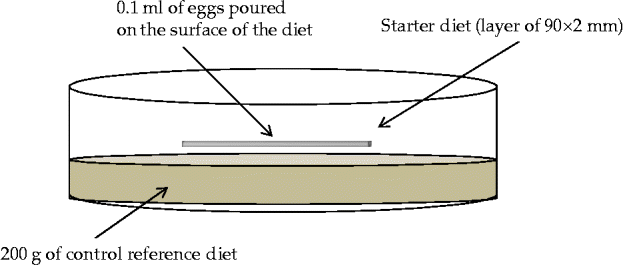
As the SG diet consisted of a thin layer, it was placed on the TYC diet as shown in Fig. 1. For each experimental unit, 200 g of diet were used.
(colour online) Starter diet for Anastrepha striata

Eggs seeded on the larval diet surface
Eggs (0.1 ml) were poured onto the surface of the SG diet. Upon hatching, the neonate larvae fed on the SG diet, which was totally consumed in 4 days; after that, the second-instar larvae fed on the control reference diet (Fig. 1).
Rearing and quality parameters
To estimate the values of parameters that characterized the strains, adults (250 males and 250 females) were put into Plexiglas cages (30 × 30 × 40 cm) and fed ad libitum with a mixture of sucrose and enzymatic yeast hydrolysate (3:1) (ICN Biomedicals, Costa Mesa, California, USA). Water was provided in a plastic bottle with a vertical strip of filter paper. The adults were kept at 26 ± 1 °C, 75% RH and 14 h light–10 h dark photoperiod. Light was provided by white fluorescent tubes (75 W) placed 60 cm above the cages; light intensity was ≈ 300 lux inside the cages. As some females copulated as early as 6 days old, the collocation and revision of oviposition devices were initiated the next day.
The oviposition devices for collecting eggs consisted of spheres (Boller, Reference Boller1968). These were prepared by dissolving 22.7 g of furcellaran (Burtonite 44C powder; Tic Gums, Inc., Belcamp, Maryland, USA) in 1 litre of boiling water. Then, 1.6 ml of green food colouring (McCormick México, S.A. de C.V., Cd. de México, México) and 5.6 g guava flavour powder (Frisco; Kraft Foods de México, S.A. de C.V. Cd. de México, México) were added. The mixture was poured into spherical plastic templates (4 cm diameter), and the solidified spheres were wrapped with Parafilm (American National Can Company, Neenah, Wisconsin, USA). Each day 10 spheres were suspended in the cages; after 24 h, the spheres were removed, unwrapped, cut into thin slices and dissolved in water (22–24 °C) using a bubbling system (aquarium air pump, airflow 3 litres/min, 4.5 psi, 110 V, 50/60 Hz). The water was decanted, and the eggs from each daily collection were counted and placed on pieces of black cloth over a moist sponge in a Petri dish (150 × 25 mm). The eggs were placed in an incubator (Lindberg/Blue M; Stabil-Therm, Asheville, North Carolina, USA) for 72 h at 28 ± 1 °C; egg hatch was estimated by counting the eggs and larvae from a sample observed under a stereoscopic microscope.
Eggs that were previously disinfected with chlorine at 100 ppm were seeded onto the larval diet surface in each tray when 50% of the eggs had hatched. During the first 2 days, the trays with the egg-seeded diet were kept at 29 ± 1 °C and 90% RH for the completion of egg hatch. Subsequently, the trays with diet and larvae were kept at 26 ± 1 °C and 85–90% RH for 8 days until the completion of larval development. After 10 days, larvae were separated from the diet by diluting it with water and pouring the mixture through a sieve (mesh 14). To reduce excess humidity, newly recovered larvae were mixed with fine vermiculite (Strong-Lite fine; Sungro Horticulture, Seneca, Illinois, USA), separated with a sieve, counted and weighed. Pupation was initiated without substrate (naked) at 21 ± 1 °C and 70% RH. After 24 h, pupae were covered with vermiculite and transferred to a second room held at 25 ± 1 °C and 80% RH and kept there for 14 days for the completion of the maturation process. One day before adult emergence, the pupae were separated from the vermiculite using a sieve (mesh 18) and then counted, weighed and placed inside egging cages in which the adults of the next generation would emerge.
To estimate the rearing and quality parameter values of each strain, a sample of 0.1 ml of eggs was taken from 12 independent batches from the same generation, with each being considered a replicate. The recovery and quality parameter values were estimated using the samples taken. The maximum egg hatch was estimated by counting the empty chorions in three samples of 100 eggs incubated for 120 h. Larval recovery was defined as the percentage of eggs seeded that developed into mature larvae; pupal recovery was defined as the percentage of larvae that transformed into pupae. Both recovery values were calculated according to the method of Rivera et al. (Reference Rivera, Hernández, Toledo, Salvador and Silva2007). Mean weights of larvae and pupae were estimated by counting the total number of individuals in three samples of 1 g each. Adult emergence was estimated for one sample of 100 pupae in containers (140 mm high × 80 mm diameter) and included only normal adults that had emerged at 5 days. Flight ability was estimated using one sample of 100 pupae, including only adult flyers (FAO/IAEA/USDA, 2003; Hernández et al., Reference Hernández, Flores-Breceda, Sosa-Iturbe, de la and Ezquivel2005).
Demographic analysis
For each strain, 30 couples from 12 independent batches of newly emerged adults were placed in glass cages (27 dm3, one side of each cage covered with screen mesh). The flies were provided with water and food (as described above).
Every day for 140 days, four 4 cm-diameter furcellaran spheres (as described above) were hung from the top of each cage as oviposition devices. Spheres were replaced every 24 h and then dissected to count the number of eggs laid in them. The pre-oviposition period was the time in days from adult emergence to the first oviposition and the oviposition period was the number of days during which females laid eggs. Data on daily survival (number and proportion of females alive per day) and fecundity (eggs/female per day) were used to estimate the values of the following demographic parameters: (1) life expectancy (e 0) (mean duration of life for an emerged adult); (2) net reproductive rate (R o) (number of offspring produced by a female during its entire life time expressed as female eggs per female); (3) intrinsic rate of increase (r m) (rate of daily population increase per capita); and (4) generation time (T G) (mean age at reproduction in days of a cohort of females). The values of all parameters were estimated according to the methodology described by Carey (Reference Carey1993). All tests were carried out under environmental conditions of 26 ± 1 °C and 75 ± 5% RH.
Data analysis
Data on egg hatch, larval and pupal recovery, adult emergence and flight ability were analysed after arc-sine transformation (Underwood, Reference Underwood2005) and then subjected to ANOVA and means separation with the Tukey honestly significant difference (HSD) procedure (P≤ 0.05) using the JMP version 5.01 statistical software (SAS Institute, 2003).
Data on pre-oviposition and oviposition periods, longevity, fecundity, larval weight, e 0, R o, r m and T G were also subjected to ANOVA followed by means separation with the Tukey HSD procedure (P≤ 0.05) using the JMP version 5.01 statistical software (SAS Institute, 2003).
Parameter generation was considered as the dependent variable (Y) and coefficients of regression were calculated with independent variables (X): larval recovery, pupation at 24 h, larval weight, pupal weight and adult emergence, using the JMP version 5.01 statistical software (SAS Institute, 2003).
Results
Rearing and quality parameters
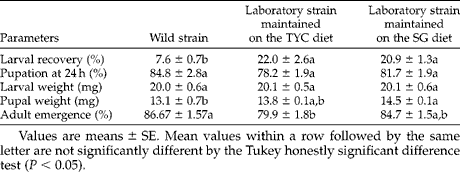
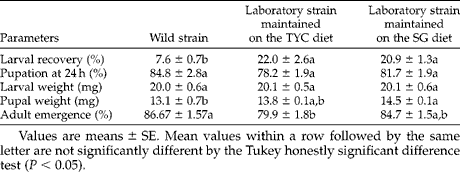
The WS exhibited the lowest larval recovery (F= 21.06; df = 2, 33; P< 0.001) (Table 2), while the means obtained for the LS maintained on the TYC diet and the LS maintained on the SG diet were not significantly different from each other.
Recovery and quality parameters of three strains of Anastrepha striata
TYC, Torula yeast-casein, SG, Starter-gel.
Values are means ± SE. Mean values within a row followed by the same letter are not significantly different by the Tukey honestly significant difference test (P< 0.05).
Pupation at 24 h ranged from 78.2 to 84.8%, but no significant differences were observed between the WS and the LS and the means obtained for the LS maintained on the TYC diet and those obtained for the LS maintained on the SG diet (F= 2.20; df = 2, 33; P= 0.133) (Table 2).
Larval weights were not significantly different among the WS, LS maintained on the TYC diet and LS maintained on the SG diet (F= 0.006; df = 2, 33; P= 0.994) (Table 2). The same result was obtained for pupal weight (F= 3.11; df = 2, 33; P= 0.006) (Table 2).
Differences in adult emergence were significant, with the highest mean being obtained for the WS and the lowest for the LS maintained on the TYC diet (F= 4.47; df = 1, 33; P= 0.019). However, no difference was observed between the LS (Table 2).
Demographic analysis
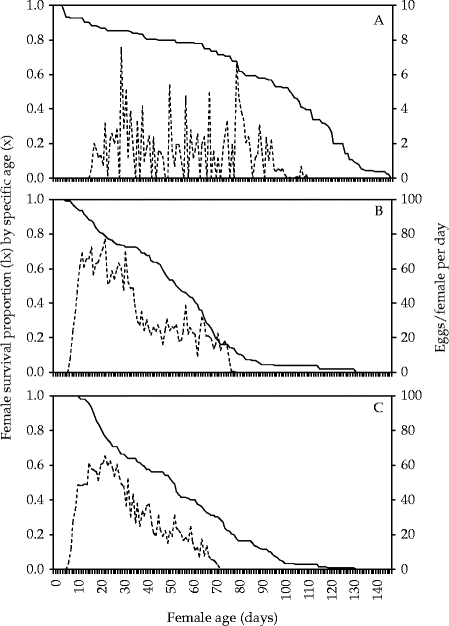
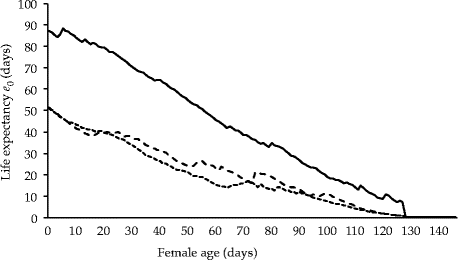
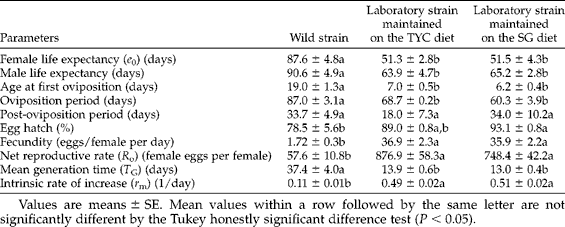
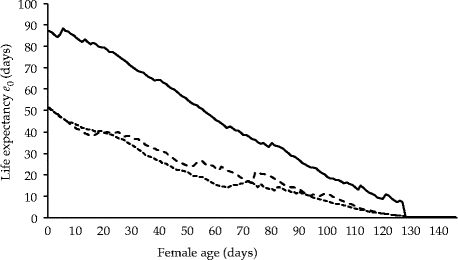
The survival proportion indicated that 50% of females of the WS lived for more than 97 days, while 50% of females of the LS maintained on the TYC diet and of the LS maintained on the SG diet lived for only 53 and 46 days, respectively (F= 21.93; df = 2, 15; P< 0.001) (Fig. 2). Life expectancy at 50 days was significantly different, with mean values of 55, 21 and 24 days being obtained for the WS, LS maintained on the TYC diet and LS maintained on the SG diet, respectively (F= 49.38; df = 2, 15; P< 0.001) (Fig. 3). e 0 of the three strains at 100 days was not significantly different, and it was estimated to be 19, 7 and 11 days for the WS, LS maintained on the TYC diet and LS maintained on the SG diet, respectively (F= 2.27; df = 2, 15; P= 0.144) (Fig. 3). e 0 was the highest (87 days) for females of the WS and lowest for females of the LS maintained on the TYC diet (51 days) (F= 26.47; df = 2, 15; P< 0.001); the value of the latter was not significantly different from that obtained for females of the LS maintained on the SG diet. e 0 in males exhibited the same trend (F= 12.63; df = 2, 15; P= 0.0006) (Table. 3).
Survival proportion (—) and fecundity (- - -) of Anastrepha striata: (A) wild strain, (B) laboratory strain maintained on the Torula yeast-casein diet, and (C) laboratory strain maintained on the Starter-gel diet
Life expectancy (e 0) of Anastrepha striata: wild strain (—), laboratory strain maintained on the Starter-gel diet (– – –), and laboratory strain maintained on the Torula yeast-casein diet (- - -)
Demographic parameters of three strains of Anastrepha striata
TYC, Torula yeast-casein, SG, Starter-gel.
Values are means ± SE. Mean values within a row followed by the same letter are not significantly different by the Tukey honestly significant difference test (P< 0.05).
The age at first oviposition was highest for the WS (F= 71.58; df = 2, 15; P< 0.001); there was no significant difference between the means of the LS maintained on the TYC diet and those of the LS maintained on the SG diet. The same pattern was exhibited by the oviposition period, for which the highest mean was observed for the WS and the lowest for the LS maintained on the SG diet (F= 23.05; df = 2, 15; P< 0.001). The differences among the values for the post-oviposition period were not significant (F= 1.36; df = 2, 15; P= 0.285) (Table 3).
There were major differences in fecundity, expressed as the number of eggs/female per day, among the strains. The WS had very low fecundity. The LS had the highest fecundity during the first 60 oviposition days, with little fluctuation during the first 20 days (Fig. 2). This trend was confirmed by the mean values of fecundity – 1.72, 36.9 and 35. 9 eggs/female per day for the WS, LS maintained on the TYC diet and LS maintained on the SG diet, respectively, that were significant (F= 115.27; df = 2, 15; P< 0.001) (Table 3). The highest egg hatch (%) was observed for the LS maintained on the SG diet and the lowest for the WS (F= 5.08; df = 2, 15; P= 0.021) (Table 3).
The R o was very low for the WS (57 female eggs per female) (F= 110.11; df = 2, 15; P< 0.001), but the LS achieved much higher values – 876 female eggs per female on the TYC diet and 748 female eggs on the SG diet (Table 3).
The mean T G of the WS (37 days) was significantly longer than that of the LS (13 days) (F= 34.21; df = 2, 15; P< 0.001) (Table 3).
The r m for the WS had the lowest value (0.11 per day) (F= 146.54; df = 2, 15; P< 0.001); the LS had much higher rates, 0.49 per day on the TYC diet and 0.51 per day on the SG diet (Table 3).
Discussion
Laboratory colonization and adaptation of fruit flies can be a long and difficult process (Rössler, Reference Rössler1975; Leppla et al., Reference Leppla, Huettel, Chambers, Ashley, Miyashita, Wong and Harris1983; Ekesi et al., Reference Ekesi, Nderitu and Chang2007; Hernández et al., Reference Hernández, Toledo, Artiaga-López and Flores2009). The population undergoes changes as the insects are forced through an artificial selection pressure and may require several generations to adapt to the artificial conditions (Mangan, Reference Mangan, Anderson and Leppla1992; Hernández et al., Reference Hernández, Toledo, Artiaga-López and Flores2009). In the LS, we observed a reduction in the age at first oviposition, which according to Hernández et al. (Reference Hernández, Toledo, Artiaga-López and Flores2009) corresponds to the first significant change during colonization. Such a reduction has also been found in Bactrocera cucurbitae (Coquillett) by Miyatake (Reference Miyatake1998) after comparing G45 in LS and WS females under selection regimens.
Daily egg production during the complete oviposition period for the WS in this study was 1.7 eggs per female, while Hernandez et al. (Reference Hernandez, Artiaga, Flores and Barnes2004) reported 11 eggs/female per day (using the same green furcellaran spheres described by Boller (Reference Boller1968)) after quantifying fecundity only during the first 10 days of the oviposition period. This parameter represents the second significant difference – egg production increased after the strain was selected and adapted to the artificial conditions; the LS exhibited a daily production of about 36 eggs per female.
The third significant change was a decrease in e 0. According to our results, A. striata had a short e 0 (51 days) under laboratory conditions, while the WS had a e 0 of 87 days.
Our results revealed that the larval weight of the WS of A. striata did not differ from that of the LS, but pupal weight was higher for the LS maintained on the SG diet than for the WS. The pupal weight of C. capitata has also been found to increase significantly through colonization (Liedo et al., Reference Liedo, Salgado, Oropeza and Toledo2007). Kaspi et al. (Reference Kaspi, Mossinson, Drezner, Kamensky and Yuval2002) demonstrated that a higher protein level in the larval diet resulted in larger flies. By contrast, Hernández et al. (Reference Hernández, Toledo, Artiaga-López and Flores2009) found that the larval and pupal weights of A. obliqua decreased during colonization and mass-rearing.
There were indications that A. striata became adapted to artificial rearing conditions – the LS had higher R o and r m and lower mean T G than the WS. High r m and low T G reflect demographic parameters that predict optimal age-specific allocation of resources to growth, maintenance and reproduction. This translates into an increase in fecundity early in adult life and a reduction in the oviposition period, consequently decreasing the T G. These qualities have also been observed for B. cucurbitae (Miyatake, Reference Miyatake1998) and Anastrepha serpentina (Wiedemann) (Pinson et al., Reference Pinson, Tejada, Toledo, Enkerlin, Celedonio-Hurtado, Valle, Pérez and Liedo2006). For these species, colonization resulted in a strain with high fecundity concentrated in a short oviposition period. The selection pressure in these cases may have been due to the artificial rearing selecting for the use of eggs produced by females that matured early; we therefore excluded females that exhibited slow development. Exclusion of females with slow development tends to result in populations with high fecundity concentrated in a short oviposition period; perhaps, there exists a genetic trade-off between early fecundity and longevity in a population.
The differences between the WS and LS of A. striata, and the absence of differences between the LS maintained on the TYC diet and the LS maintained on the SG diet, indicated that the changes were the result of selection during manipulation in the colonization process and not that of any effect of the artificial larval diet. Leppla et al. (Reference Leppla, Huettel, Chambers, Ashley, Miyashita, Wong and Harris1983) observed that when flies kept on host fruit were switched to an artificial diet, selection for pupal yield decreased. In the present study, we did not find the same effect when the artificial diet was changed.
Our results revealed differences between the WS and the LS, with the latter as a population that had been selected and adapted to artificial rearing conditions. The high value obtained for fecundity indicates a high potential for establishing the colony under mass-rearing conditions, but the low values of some other production parameters in comparison with those of A. obliqua indicate that they need to be improved. In additional studies, we plan to start a colony with a large number of wild flies so as to have a high probability of selecting flies exhibiting higher egg production and larval survival.
Acknowledgements
The authors are grateful to Y. Margoth García for assistance in the rearing procedures. This research was funded by the FAO/IAEA (contract no. 13023/R0, 2005–2010) and the Campaña Nacional Contra Moscas de la Fruta, Programa Moscamed-Moscafrut (SAGARPA-IICA).