The ritual of lament-singing for the deceased is an important part of Albanian funerary practices. As suggested in the lyrics quoted above, women in Albania are leading voices in funerary rituals. The solace they provide by singing next to the body is an integral part of the lament tradition. The process of mourning is an extension of Albania’s rich musical heritage, a process that belongs exclusively to women. Lamentation is not only a grieving process but also a way to celebrate the life of the deceased. But how did it come about in a patriarchal society that women—who are often confined to their houses—were given responsibility to celebrate an important family event? The community I focus on is located in the region of Gjirokastër, in southern Albania. In this article, I focus on how women in the region have preserved lament songs for many years, and argue that despite challenges such as the devaluing of the tradition by men, conservative laws against women’s freedom, and lack of education for women, this tradition is still alive.
The Albanian tradition of organising ceremonies to honour the dead is ancient. At the beginning of the grieving process, people respond to the sad turn of events with loud cries and screams that eventually transform into performance as these actions take on theatrical properties. The act of singing laments is widespread, across many countries, as illustrated in the works of Caraveli-Chaves (Reference Caraveli-Chaves1980) and Seremetakis (Reference Seremetakis1991) in Greece; Tolbert (Reference Tolbert1990, Reference Tolbert, Coakley and Shelemay2007) in Karelia; McLaren (Reference McLaren2008) in China; and Köchümkulova (Reference Köchümkulova, Theodore, Daukeyeva and Elmira2015) in Kyrgyzstan. Foundational work by Sugarman (Reference Sugarman1997) on Prespa-Albanian songs determined that gender categorisations and contradictions were associated with music practice, while research by Alexiou (Reference Alexiou2002) studied the laments of Greece and their socio-cultural context. Anthropologists Emile Durkheim (Reference Durkheim1961:442–449) and Marcel Mauss (Reference Mauss1921:425–434) presented pioneering work focusing on laments as a need for social attachment rather than as an expression of pain and grief, while Elizabeth Tolbert argues that “the lamenters create an intersubjective understanding of emotional pain by expressing the inexpressible, by rendering the isolation of individual mourning into an intensely communal experience” (Reference Tolbert, Coakley and Shelemay2007:148). As this study will show, lamenting, through expression of grief and pain, confers musical authenticity on women and gives them significance within a patriarchal society.
While living in Albania as a child, I understood that Albanians respect and reify differences between men’s and women’s singing. They do not create barriers to singing, and the distinctive qualities of male and female sound are widely appreciated by non-specialists and musicians alike. Lamentation provides a unique way to highlight the contrast between the two genders. Women preserve this rich tradition, linking the past generation to the next generation in a continual chain. The word vaj or vajtim (mourning) is often used to indicate a personal feeling reflecting one’s inner state. The word zija or të mbash zi (to keep or be in the black) is often mistranslated as “mourning,” but zija is actually part of the grieving period, indicating not only the psychological and inner state but also a time when women adorn themselves in black. Grief never leaves women. Women dress in black from the moment the beloved passes until the moment they themselves die. Black stockings, dresses, and headscarves are part of daily life for Albanian women in mourning. Lamentations of death are thought to immortalise the deceased by creating a sonic picture through which other’s support gives strength and hope to grievers.
Before presenting my case studies, I will first discuss data collection methodology and its challenges during my fieldwork; my personal, local connections allowed me to navigate various obstacles. I will also present the existing scholarly work that forms the foundation for this research. Next, I will provide a brief overview of the tradition of lamentation and discuss how laments from southern Albania contrast with those from elsewhere in the country. Finally, I will discuss the results of my own interviews, case studies of lament lyrics and musical form, adding my personal experience while attending and recording a funerary lament.
Fieldwork and Methodology
Gjirokastër and the surrounding region (containing almost ninety villages) is one of the largest cities in southern Albania.Footnote 3 It is a centre for polyphonic singing, and the primary location for this study. Its musical environment permeates and shapes the daily lives of its citizens, and because it is also home to Albania’s largest national folk festival, musicians often congregate there. I was born in the city and spent the first nine years of my life there. Even after I moved away, Gjirokastër remained our family home and we returned regularly. I would spend vacations there and participate in every important celebration. As part of a musical family (both of my parents were professional musicians), I had a close relationship with the area’s music and traditions from a young age. Although the first lessons I took were in Western classical music, traditional music was part of everyday life. By the age of eighteen, I had participated in many music festivals organised in the city. While these events differed in style and nature, the underlying musical form remained the same: polyphonic signing. Songs from southern Albania and northern Greece have many similarities, so I did not appreciate the unique form and function of those in Gjirokastër while I lived in Greece. However, this changed when I moved to the United States for graduate studies. While I was living in the U.S. alone and very far from home, feelings of nostalgia and melancholy became an almost daily experience. YouTube became a lifeline, since I could play hours of songs recorded in and around Gjirokastër. As I learned forms that I was not familiar with, I realised that the variety of multipart singing practices in southern Albania is extraordinary. Studying the influence of the music emanating from the “City of Laments” became not only a personal decision because of my origins, but also because of the unique genre that I wanted to bring to a broader audience.
To better understand traditional laments and their use, I returned to Gjirokastër in the summer of 2017. I collected data for this study over four months of fieldwork during successive summers in 2017, 2018, and 2019. I conducted participant-observation, taking part in several funeral rituals. Additionally, I conducted interviews with women lamenters, members of folk groups, ethnomusicologists, directors of different festivals, and several instrumental musicians. During my stay, I travelled to villages across the border in Greece, which proved very useful, as these visits provided data on similarities and differences in the lament music styles. On several occasions, I faced discrimination as a female researcher and had to navigate those obstacles in pursuit of information. Some contacts were unsure why I was asking questions and why I was interested in the music which they considered to be “dying.” Having local contacts helped me overcome challenges that otherwise would have proved daunting. Local friends and family members assisted me when I travelled to different villages and conducted interviews. My grandmother introduced me to her best friend, Andro, who proved to be one of my most valuable informants because of her experience and ability to remember old lyrics and melodies. She sang and recited laments to me that she had created to grieve the loss of her father. She also remembered and sang laments she had heard from her own grandmother. The personal stories my informants shared, the photos they allowed me to take, and the awkward moments we experienced while recounting stories of losses and nostalgia played a catalytic role in shaping this article.
Theoretical Perspectives
This article is an ethnographic analysis of laments in relation to women’s position in a patriarchal society. It seeks to understand emotional expressiveness and a community’s sense of belonging. My personal experience as a native Albanian and my experience in the field led me to understand perspectives that unwrapped the elaborate funerary ritual. My research lies at the intersection of gender studies and studies of collective memory. Scholars in disciplines such as anthropology, sociology, linguistics, and psychology have turned their attention to the performance associated with laments, death, and grief. Studies by anthropologists Hertz (Reference Hertz1960), and Goody (Reference Goody1974) provide important information on the ritual of death as a concept; Margaret Alexiou (Reference Alexiou2002[1974]) provides comprehensive coverage of the study of laments and their socio-cultural contexts in Greek tradition; and James Wilce (Reference Wilce2008) analyses laments across the world and explores their lasting power.
Because I am interested in how women have preserved laments through the centuries, my article focuses on gender roles and how patriarchal society has influenced women’s practices. Jane Sugarman’s brilliant analyses (Reference Sugarman1989, Reference Sugarman1997) linking musical sound with social structures among the Prespa Albanian community have proved essential for understanding lamentations in Gjirokastër. She writes how, “through singing, they are temporarily able to mold their individual selves into the form of a cultural ideal” (Reference Sugarman1989:193). It is women’s role to cry over the deceased, and the lament singers all become one, linked together by expression of grief. A woman’s role as a housekeeper is a deeply embedded concept, considered important but lacking in social power. Through singing laments, women suddenly gain significant power, but how can lamentation confer power to them? Clearly, the women of southern Albania actively participate in a tradition that has survived societal challenges across time. To better understand the role of lament in their lives, one must understand the factor of gender, and how gender-related behaviour can be differentiated. Tullia Magrini’s edited volume (Reference Magrini2003) exploring the relationship between music and gender in the Mediterranean provided helpful insights on how the women, as bearers of laments in a patriarchal society, take a central place. Works by Ellen Koskoff (Reference Koskoff, Zaimont, Gottlieb, Polk and Rogan1991, Reference Koskoff and Cusick2014) have also been fundamental in understanding the studies of anthropologists and ethnomusicologists.
Tradition goes hand in hand with memories that are transmitted in both oral and written ways. All those I interviewed used the words “memory” and “tradition” frequently. To delve deeper into the relationship between these two words, I identify memory as both individual and collective, and highlight the distinctions separating tradition from nostalgia. According to Halbwachs (Reference Halbwachs1980:36–37), individual consciousness is assembled through social structures and institutions. The term “individual memory” is used not only to identify the recollection of memories created from the community but also for personal memories that may be performed, felt, or remembered. Shelemay argues that the “collective memories of the past and realities of the present are further welded together in the transmission process itself” (Reference Shelemay1998:26).
The Concept of Music and Gender in Albania
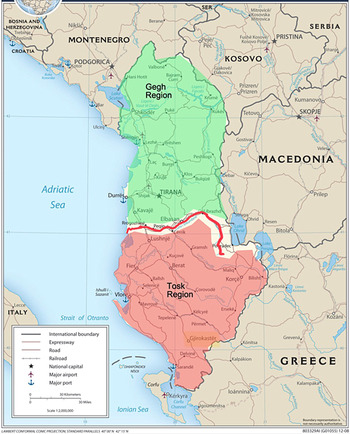
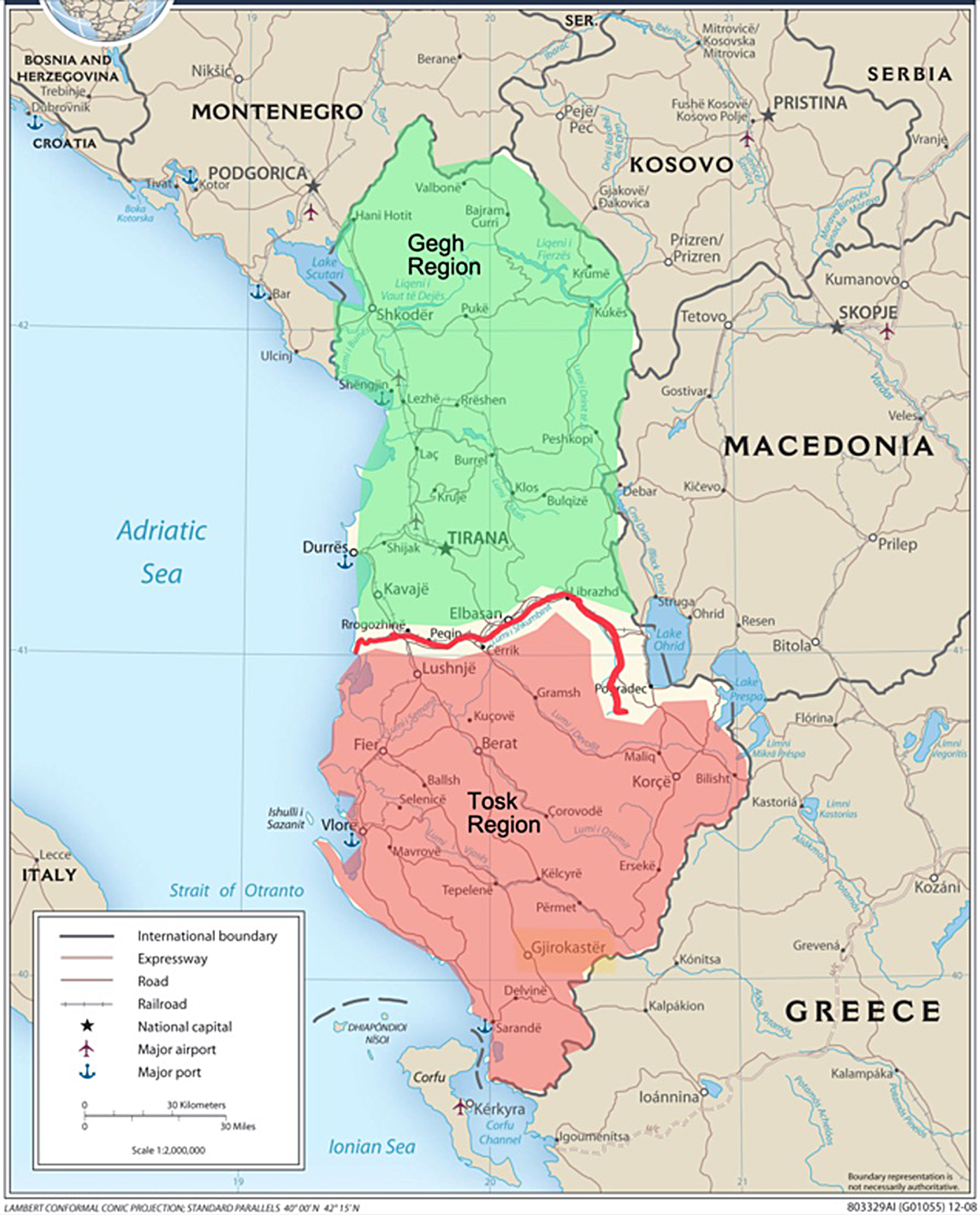
Albania or Shqipëria (Land of the Eagles) is located in the southeastern part of Europe. It shares its border with Montenegro and Kosovo to the north, northern Macedonia to the east, and Greece to the south, with the Ionian and Adriatic seas to the west. The Shkumbini River divides Albania into two central regions: the northern Geghëri, and the southern Toskëri (Figure 1). The two regions feature unique performances and styles of music. Natural geographic features of these regions influence and increase the difference between their musical styles. While monophonic singing has emerged in the north, the southern part of Albania has developed many vocal traditions (Sugarman, Leotsakos, and Prela Reference Sugarman, Leotsakos and Prela2001). Southern Albania is also home to a Greek minority. Up to 1949, Albania and northwestern Greece (Epirus) held territories on both sides of the Albanian-Greek border, in which villages spoke both Albanian and Greek languages (King Reference King2018:81). This heterogeneous population influenced musical style. One of the prominent multi-vocal singing traditions in southern Albania today is the polyphonic singing with a continuous drone (iso) sung to a single vowel, which is reminiscent of Byzantine music (Shetuni Reference Shetuni2011:33–34). The polyphonic songs with four-voices are characteristic of the southern region, and specifically of Labëria. The first voice, marrës (taker of the melody), leads the opening melody and serves as the group leader. The second voice, kthyes (turner), has a small part that cues the rest of the group to join and follow the line introduced by the first voice. The third voice, hedhës (launcher), begins after the turner’s cue, and the fourth voice adds the drone. Every polyphonic song of this region is based on the sustained bejne iso (“they do the drone”) (Sugarman Reference Sugarman1997:68–73). The iso is essential in keeping the tonal centre of the song and follows the melody. Because polyphonic songs in general are performed without instruments, the iso provides a form of accompaniment and is frequently compared to the harmony of goat bells (Pistrick Reference Eckehard2015:21–22). In southern Albania, shepherds place bells with different sounds around goats’ necks. The bell around the dominant goat has a low, sonorous sound that can be heard from far away and helps the goat leads others. The other goats wear different-sized, higher-pitched bells. The sounds of nature blend together with the bells of the moving herd, creating a special sound that can be heard far away. The polyphonic music of southern Albania imitates this unique and special blending of voices.
Map of Albania, where Shkumbini river divides the country into two regions: The northern part is the region of Geghs, and the south is the region of Tosks.
Singing is an integral part of everyday activities in Albania. Song performances are associated with special occasions such as birthdays, weddings, and funerals, as well as with mundane activities such as meeting friends in a kafene (coffee shop). The music from southern Albania can further be categorised by age and gender. The different styles are named to make this classification explicit: grarishte (women’s style), djemurishte (young men’s style), and pleqrishte (old men’s style) (Sugarman, Leotsakos, and Prela Reference Sugarman, Leotsakos and Prela2001). Genres such as lullabies and lament songs belong primarily to women’s music, and are sung solo, in unison, or polyphonically by a group. “Without us [women] the laments would not have survived,” said one of my interlocutors. Women in Albanian society are the protectors and sentinels of laments. Although they have to hide their bodies, they are expected to express emotion and be more superstitious than men. Therefore, they lead communal expressions of emotions, such as happiness, pain, love, and suffering (Pistrick Reference Eckehard2015:64–65). How long have women been the keepers of the lament tradition? Some scholars have traced lamentations back to Homeric epics and Greek tragedies (Wilce Reference Wilce2008:62–65), and it can be argued that laments from that ancient time defined the role of women within society. Female public lamentation occurs frequently in The Iliad where mourning in public symbolises “a moment of power” (Muich Reference Muich2010:38–40)Footnote 4.
Mourning and Laments Throughout Albania
In northern Albania, communal grieving is called gjama and consists of four different stages. In the first, the group of gjematarëve (mourners) starts the gjama at a distance of 500 to 1000 metres away from the body of the deceased (Tirta Reference Tirta1996:15–31; Reference Tirta2004:218–222). They remove zhugnat (big/heavy funeral clothes) and scream the vocable hou or ho, adding the name of the deceased. After this, they move closer to the body, beating their chests, until someone indicates that the next stage should begin. Next, they approach the body even more closely, and scratch their faces, sprinkling the drops of blood on their fingers in the direction of the dead. At last, they run towards the body; they kneel and remain in that position until someone from the family approaches and says “ua shpërblefshim me të mira” (best rewards) (Tole Reference Tole2011:20–21).
The mourning rituals from southern Albania are completely different. There are different styles of laments in this region connected to polyphonic singing with a sustained drone. In the region of Toskeri, people cry in two different ways: “e qara me botë” (crying with the world) and “e qara me ligje” (crying with words). Musicologist Vasil Tole argues that the first cry appears to be the surviving remnant of a very ancient death ritual; it is linked with the earth and hence with the human being as a particle of the earth (Reference Tole2010:48–49),Footnote 5 but my interlocutors did not connect the word “botë” to the earth or to an earthen vessel. Rather, they described the friends and neighbours who would join the family of the deceased after hearing the loud screams, and how all would scream together. Hence, “the world” signified the entire community that grieved.
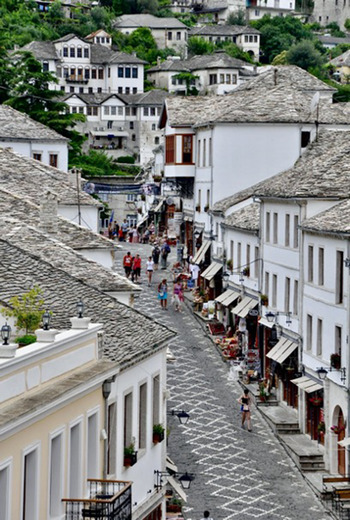
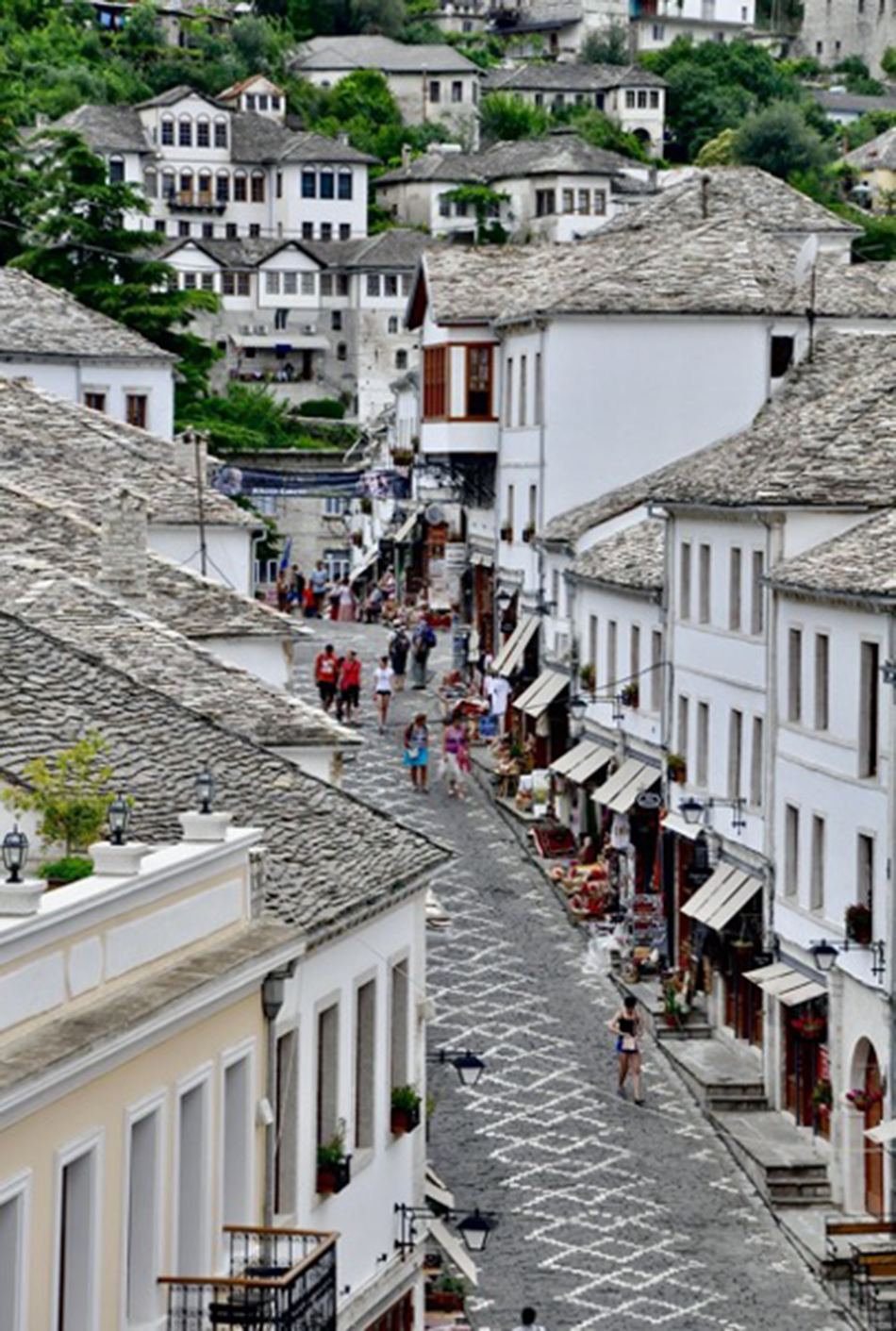
Gjirokastër city (Figure 2) is particularly connected to “e qara me botë.” Women start screaming out loud from the house where the deceased rests. One sings and the rest follow with the vocables oi- and -i. The result is a devastating and heartbreaking sound. “I was always afraid of this sound,” one of my interviewees told me. “E qara me ligje” is another form located in the southern region. In this form, cries and shouts transform into musical and poetic mourning. Women take turns creating elegies for the deceased, and the resulting improvised amalgamation forms the cornerstone of lamentation in Gjirokastër. However, at a given moment, only one woman sings; the others stay silent, although sometimes they may add sounds, such as ah- oh nene. When the lead singer finishes, she concedes her place to another, and the rotation can continue for many hours, until all the singers are completely exhausted. One of my interviewees recalled, “We stop when our voice is completely gone. We would not have any moment of silence.” This report demonstrates the long hours of wailing and singing at a typical funeral. As Seremetakis mentions in her research of laments in Mani, silence is not considered an appropriate social answer to death (Reference Seremetakis1991:101).
Part of the Old Town of Gjirokastër. Photo by the author. This part of the city is called Pazari i Vjetër. Here people of the town are sitting in kafene (coffee shops) and singing polyphonic music.
Lamentation is an essential social tradition. Crying helps mourners accept feelings of separation and loss. Laments are an attempt to communicate between the living and the dead (Caraveli-Chaves Reference Caraveli-Chaves1980; Danforth Reference Danforth1982). Naxhi Kasoruho, the artistic director of the National Folk Festival, recalled in interview that the city of Gjirokastër was the “City of Laments,”Footnote 6 a description used to bother him. How could this beautiful city have such an “insulting” description? He later understood that the description was not of the city itself, but due to the fact that, on Sunday mornings, all households in the city opened their windows, and some could hear women mourning people who had died. He continued, “I experienced the same tradition when I was a kid. When I was passing through sokak (pathways), I listened to the songs from early morning, but this ritual never bothered me. I listened to the songs with respect. Those women with the long black headscarves, they appeared to me as saints dressed in black.”
Case Studies of Gjirokastër Laments
I was not allowed to attend funerals when I was young. My grandmother used to declare: “Funerals are not for kids.” When I asked a few years later why not, she said that children would be traumatised by the dead body, and by the pain they would see their loved ones experiencing. My grandmother’s reason also seems somewhat rooted in tradition. “The entire community would come to say goodbye. The better the lament, the easier the journey of the deceased would be,” one of my interviewees commented. Through these conversations, the importance of laments to women became clear to me. Albanian women consider such rituals to be the most pious: everyone mourns in order to give the best farewell to the deceased. This high level of emotional connection cannot be expected of kids. I was eight years old when I attended my first funeral. My uncle had passed away, and my mother agreed to take me with her to his farewell service. It was a cold December day and the women in my family were crying, and dressed in black. My aunt cut her hair short, and she did not stop crying and moaning—in Albanian tradition, grievers cut their hair short as a sign of respect for the dead and to express their pain. Such acts of deep sorrow cannot be adequately explained to a child, who cannot be expected to comprehend such intricacies.
Three years ago, I returned to Albania to attend my cousin’s funeral. His loss was unexpected, as he was in his mid-fifties and had never had any health issues. I went inside the house, and was led to a small room. The men were inside the odaja e madhe (big room), as it is only for men. The women were together in another room. The coffin was open, and chairs were arranged in a circle around it. My cousin’s mother was in the centre, standing above her son’s head. She looked at me with reddened eyes and summoned me: “No parent should bury their child, my sweet child. The child needs to bury the parent. What is the reason for me to live now? I was living with him in this house, but now the house will be empty. My life is empty.” And then, she started singing:
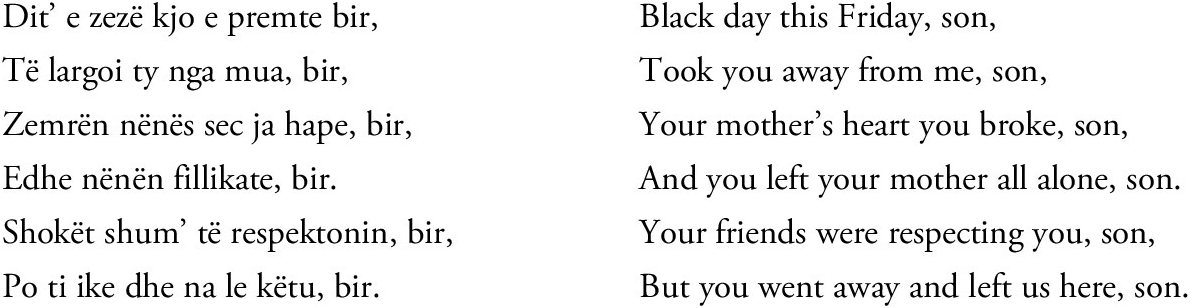
I found it very hard to ask permission to record the lamenting, even though I was part of the family. The atmosphere was heavy and sorrowful, and I am grateful to them for letting me record the proceedings. I was sad about the loss of a family member. Listening and analysing the recordings later was emotionally treacherous. The mourning and laments reminded me of every moment of the funeral, and listening to the tapes brought to my attention small details that I had missed as an observer. The words the mother expressed to her dead son demonstrated the close relationship between the living and the dead. She spoke to him directly, as if he could hear her. The women of the family sang, wailed, and lamented, standing next to the body. No one could go into the centre of the room without the mother’s permission. I approached only when my aunt asked me to. I noted the hierarchy governing where women sat. The mother of the deceased remained directly above her son’s head. To the right of the mother sat her son’s wife and daughters. To the left were other close family members, such as sisters and aunts. This hierarchy broke only when one of the women stepped away to take a break, or if others needed help of some kind. The female mourners moved their bodies rhythmically, beat their chests, pulled their hair and their cheeks. This tradition has deep roots. Although many years have passed, and many changes have occurred in the death ritual, women still perform it in a similar way.
Music Analysis
Laments are easily identified by their distinct sound; the voice in combination with lyrics plays a crucial role in the identification of the genre. In the case just cited, the lyrics symbolise the close relationship between the lamenter and the deceased. Repetitive notes in the melody (Figure 3) symbolise the singer’s unceasing pain. The word bir (son) is sung one octave higher throughout the song, and is clearly so painful for the singer that she only whispers or mumbles that word. The high pitch is mixed with a moan, and she often runs out of breath.
Transcription of lament, recorded by the author in 2017. The mother of the deceased was crying over his body. Next to her was her daughter, who was joining her mother in the minims (half notes).

Lamentation as a genre involves improvisation. Although the melody stays almost identical across different verses, the rhythm, the duration of notes, and a few notes all change from verse to verse, giving the song a more improvisatory feeling (Figure 4). Standard laments are characterised by descending melodies, ascending minor seventh intervals, portamenti on stressed syllables, and glissandi from high to low. We can see these characteristics in the two examples below. In Figure 3, the melody contains intervals of ascending minor thirds and major seconds. It has four measures that expand into different variations as the lament progresses, similarly to the form of the standard lament, which uses eight-syllable phrases in a trochaic metre. The use of the pentatonic mode is characteristic of both southern Albanian and Greek Epirot folk music, and is predominant in laments, with few exceptions. During fieldwork, I only came across laments with minor pentatonic scales (Aeolian mode), but the genre can involve a variety of different scales and modes (Tole Reference Tole2010:49–50).
Improvisatory version of lament.

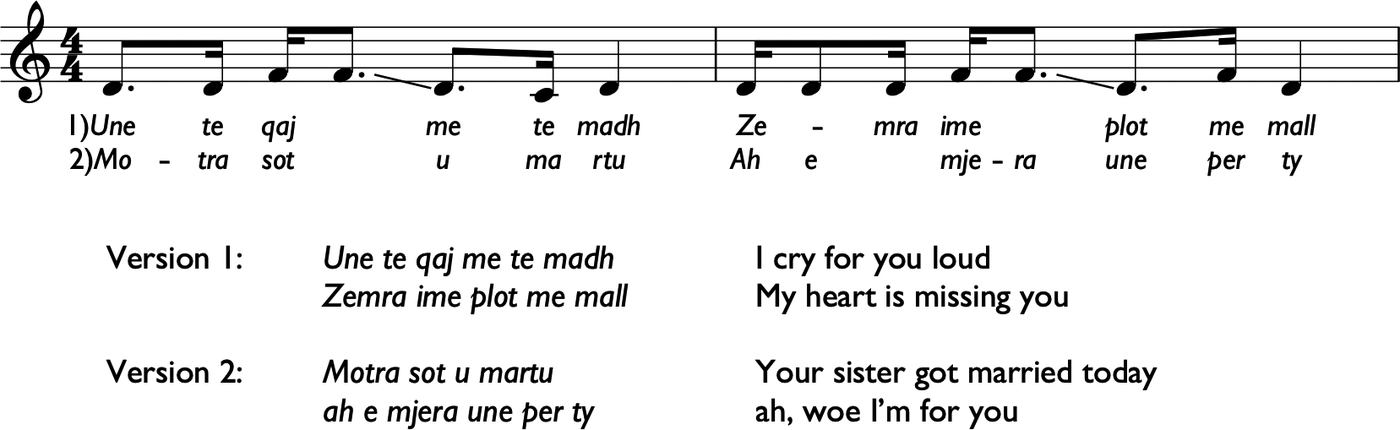
My interlocutors often mentioned that lamenters might use the same melody for different lyrics, in order to get their sorrow and pain “out.” Depending on their personal experiences, the occasion, and their emotional inner self, the songs they sing might turn to laments (Auerbach Reference Auerbach and Koskoff1989). As Figures 5 shows, the melody is similar, but the lyrics change from sorrow to a description of daily life. Improvised laments are not restricted to death but can be sung at any private moment of grief. Women can lament loneliness, health, or “bad luck,” and since laments are a product of their mental state, they can freely address their pain and frustration. Figure 5 illustrates how a lamenter is able to keep the same melody but change the lyrics on the spot to reflect her emotions.
An example of two different laments following the same melodic line, transcribed by the author.

Women: Bearers of Laments
Marjanthi lost her husband, Thoma Spiri, when she was forty-two. Unlike many of her friends, she did not have an arranged marriage. After her husband passed away, she had to take care of her family, raising two sons. She was already taking care of her mother. It has been almost forty years since the day she lost her husband, yet she still wears black clothes. She never participates in festivities, she never sings happy songs, and never dances, even when the entire family celebrates a big occasion. Every Sunday, for all those years, she has walked to the graveyard and cleaned her husband’s grave. She stays by the grave for multiple hours and laments him. “There were a few times when crying in the cemetery, I heard people saying to me: ‘Woman, your moans and your songs are not going to bring back your husband.’ Sometimes it felt that I was doing something wrong, but then I could feel how happy he might have been around my song. That is why I never stopped singing for him.” In spite of these discouragements, she continues to lament for her husband.
Anna Caraveli-Chaves (Reference Caraveli-Chaves1980:130–132) observes that men’s attitudes towards women and lamentation pose a significant problem in Greek communities. Men can be rude and sometimes mock the tradition. For many men, showing and expressing emotions is a sign of weakness. Research in other societies shows that it is more shameful for men to weep over the dead than it is for women (Schieffelin Reference Schieffelin1976:172–196). Similarly, in Gjirokastër, male crying is discouraged. Although they might tear up silently, men do not cry out loud. My grandfather would tell me, “Burrat nuk dijnë te qajnë. Kjo eshte punë e grave,” meaning, “Men don’t know what crying is. That is a woman’s job.” He listened to many women crying, but lamenting, for him, was a unique language. To appreciate it would have required an understanding of its technique that my grandfather, as a man, did not have. Men view lamentation as a standard gender separation and as a representation of the gender dichotomy. Although both women and men can participate in festivities and sing folk songs, lamenting firmly belongs to women’s repertoire and practice.
“I was lucky to have a husband who cared for me and asked my opinion. Some of my friends would be even afraid to talk to their husbands,” Marjanthi told me while sipping coffee. “I never missed anything while he was alive.” Albanian men are considered independent, their mistakes are ignored or excused, and they do not answer to their wives. Therefore, they never fear that their actions could bring dishonour to their family. However, one cannot say the same for women. Woman’s role in southern Albania is to be a good housewife, a good daughter-in-law, a good mother (Auerbach Reference Auerbach and Koskoff1989:28–29). She should be devoted to her family. Her mistakes could bring a bad reputation to the entire household. Therefore, women have to be extremely careful about how they represent themselves outside the walls of their home. Even the architecture of houses in Gjirokastër provides evidence of women’s status. The doors and walls of the yards are very tall, so that no one can see the women when they gather there every day for muhabet (“chatting”) over coffee.
During lamentations, women are free to express their feelings without fear because this is, in a sense, their moment. Over time, the songs Marjanthi sings for her husband have changed. Her life can be separated into two parts. One part she calls the first years, and her lyrics at that time expressed grief and rage that her husband had departed. Then, when her anger subsided, she described how her laments changed. They began to describe daily life without him, or sometimes even referred to good news, albeit still in the context of a lament. The following is a lament she remembers singing on the day of her son’s wedding:

As Steven Feld says, “having a good cry” functions as catharsis and is used to eradicate negative and destructive feelings (Reference Feld1990:257). However, laments in Gjirokastër are not only a musical genre to express grief, but also a uniting tradition among women. All women grieve together. “When a mother loses her child, the only thing she cares about is expressing her pain. The only thing the rest of us care about is to support that poor woman and provide everything we can,” my interlocutor continued.
In difficult moments like grief, women create lyrics to ease their pain by expressing sorrow, supporting their friends and each other. Expressing the same pain draws lamenters together. Bonds and friendships grow stronger and more vigorous. Lyrics represent the soul of the deceased as a messenger relaying words of comfort to relatives. In the following snippet, a fellow lamenter, while mourning the loss of her friend’s husband, asks the departed soul to meet her own deceased son and remind him of her motherly love.

Laments surround the lives of the mourners of Gjirokastër. They want to share their pain. At the end of our interview Marjanthi remarked, “Many times I wished I also had a daughter to sit together, go to the grave together, and grieve together.”
Laments: A Mother’s Gift to her Daughter
In Gjirokastër, lamentation is a tradition passed orally from mother to daughter. It is usually older women who teach their daughters the art. The interviews I conducted show that there is always a motherly figure to introduce new lamenters to grieving and prepare them to be the next link in the transmission chain. Daughters memorise texts from traditional laments and then incorporate the lyrics into other popular melodies or create simple new melodies.
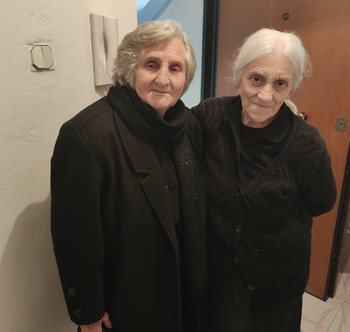
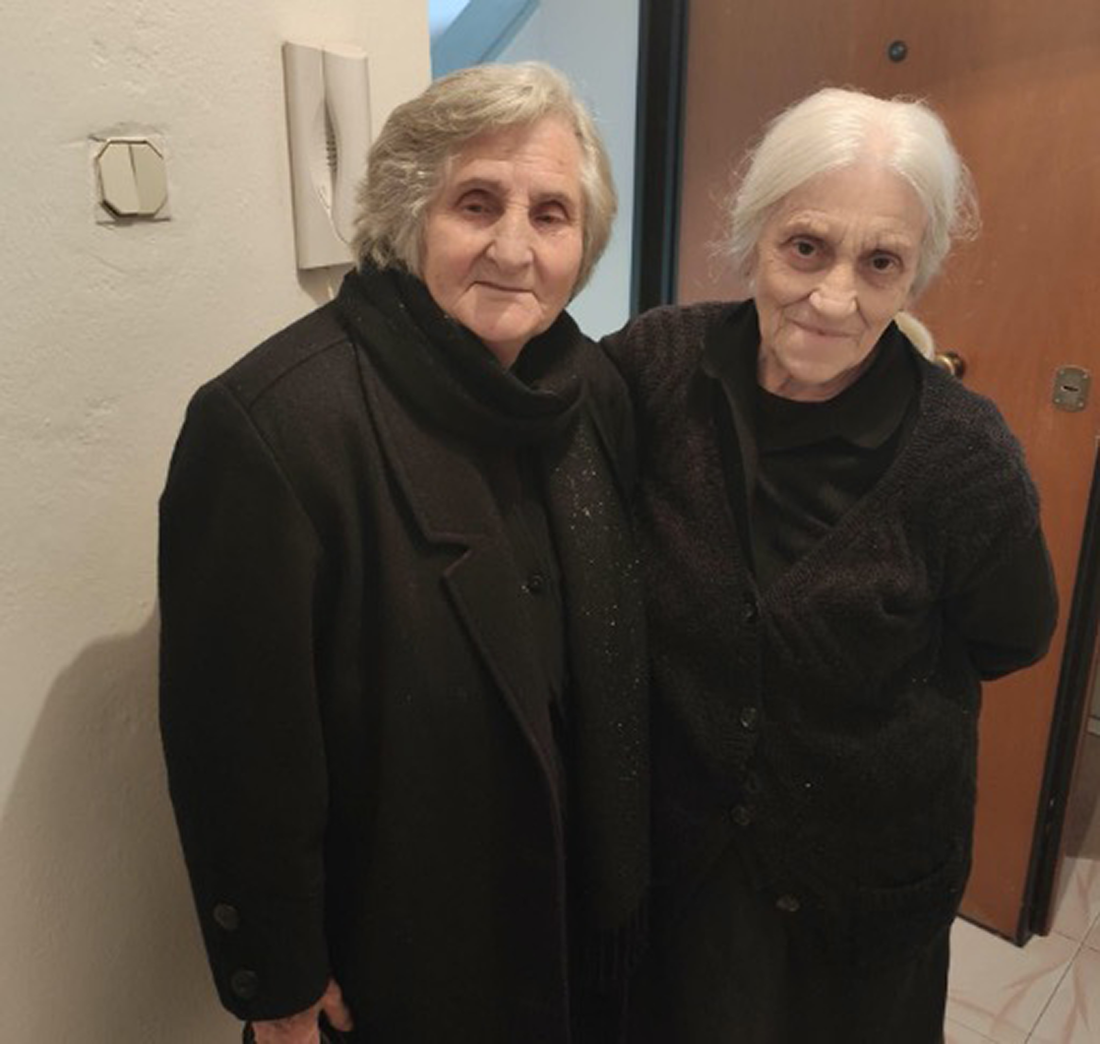
In Kyrgyz society, it is considered shameful for grown-up girls or married women not to sing laments when a family member passes away (Köchümkulova Reference Köchümkulova, Theodore, Daukeyeva and Elmira2015:198–199). The same holds true in southern Albania, as Andro Kocollari explained. “I did not know how to lament,” she said, while drinking coffee at my grandmother’s friend Andro Kocollari’s house (Figure 6). “When my poor father died, everyone around me knew how to cry. I couldn’t. I was doing o-iii and keeping the iso but, actually, no words would come to me. But some other women, oh! what can I say, when they were lamenting, you would not be able to keep in your tears.” Daughters with good voices and musical skills, who are poetic, and have good memories are always trained and asked to stay close to their mothers at funerals. They are expected to remember and be part of the group, even if they don’t know the deceased personally. Girls who do not have the skills help other lamenters keep the drone going.
Marjanthi Spiri and her best friend Andro Kocollari, friends and neighbours for over forty years. They continue to visit each other every week. They share their good and bad moments and always have been on each other’s side. We can see that this generation does not wear a black headscarf. The photo was taken by the author in December 2018.
Another reason why mothers teach daughters to sing laments involves efficiency. Mourning at such an artistic level, when women are in great pain, requires a tremendous spiritual power. Obviously, lamenters tire and need a break. During breaks, they leave their place to their daughters. Andro told me that she saw women lamenters stand up numerous times and give their seats to their daughter or granddaughter. Sometimes, the person lamenting might even faint, from stress or lack of food, water, or sleep. Whatever the reason, the lamentation needs to continue. No one would dare stop the women from singing, and no physical limitation would result in mourning without laments.
Lamentation is required even for unsuccessful marriages. I was surprised by the answers my interviewees gave to my questions about this practice. Men replied that a woman should respect her man, even if she doesn’t have a good relationship with him or his family. If she did not sing, then she would harm the reputation of her family, and that was unacceptable. In this strictly male-dominated society, marriage forces women to coexist with her husband and his family until death. However, women’s replies to my questions revealed interesting differences. They told me that if a woman doesn’t love her husband, then she is still forced to sing, out of fear of gossip: “cfare do thote bota?” (what are people going to say?). Feelings of shame and fear are instilled in women from an early age in Gjirokastër, as the honour of the woman represents the honour of her future husband and his family. Although I will not further analyse the idea of shame, it should be noted that the roots of guilt, shame, and fear are fundamental in Greece, where a woman’s shame is closely related to male honour (Herzfeld Reference Herzfeld1982).
“Sometimes we would say lyrics that only we knew what that meant,” I was told. Only the lamenters and their good friends understood the truth behind the words they wailed. I was wondering what kind of code this might be, until I heard these lyrics:

These lyrics have a double meaning: a stranger might think the singer means that she was unlucky for losing her husband (“at the church” implies a funeral service), but her close friends would understand that she is referring to her bad luck in choosing the wrong husband.
Giving Birth to Heroes through Laments
For Balkan countries that were under foreign subjugation for more than a century, music became a means to provide condolence and strength, and therefore was linked to the social situation (Shehan Reference Shehan and Koskoff1989:45–46). “When you have invaders, then you have elegies,” Fitim Caushi told me. An extensive collection of elegies was created in response to military conflicts and the consequences of living with occupiers. In these elegies, a tragic character prevails. Today’s lamenters take inspiration from these elegies, and their lyrics not only reflects on historical events but also makes the deceased a protagonist of these events. The purpose of such lyrics is also motivational, aiming to inspire the present generation to the same heroic actions as those of their ancestors (Alexiou Reference Alexiou2002:126). According to lamenters, a hero sacrifices himself for the community; his love for his country makes the sacrifice worthwhile, and the people will always remember him as a hero. These laments express how the family wants their community to remember the deceased. Therefore, to remember the deceased is a responsibility that falls on the shoulders of Albanian women, and one of the purposes of these laments is to commit the dead to communal memory.
Fitim told me that, “lament lyrics, at a high level, can be divided into two stages. In the first, the lyrics focus on how important the person was, what great sacrifices they made, and how family and communities are better because of them. In the second, the lyrics change the tone from gratitude to wishful thoughts and prayers for the deceased as their soul takes up the journey.” Such a structure underscores how a loss of life is also a loss to the community and, therefore, it is not only the family who mourns but also the entire neighbourhood. Sometimes the lyrics are inspired by famous elegies, with hyperbole and heavy sentiments. They mark how the family wants the lost family member to live in the communal memory.
Traditionally, the choice of lyrics was a matter of honour. The more elaborate the praises for the deceased, the greater the honour brought to the family. Therefore, the onus of creating lyrics that live forever in the memory is on the women. Sometimes, families go as far as hiring professional lament singers to ensure that the life of the deceased was celebrated and remembered. These professionals are women with the talent to wail and create elegies on the spot. Since communities are small, they might already know the deceased, and can create melodies with lyrics full of emotion. It might happen that the lamenter has never met the deceased (Vyshka and Çipi Reference Vyshka and Çipi2010:243). Still, the role of lamenters is to keep the lamentation organised and to stimulate other women’s laments—melodies that would break the hearts of all who heard. “Their cries would make even the sky cry!” I was told. The talent of knitting the right lyrics, with the right combination of melody and background drone, is an essential part of the Gjirokastër lament tradition. Some of the extraordinary lamenters have included Mare Bixhilin, Llambrini Gorecin, Lenë Dhimgjoka, Afroviti Gjoka, Marë Boçia, and Lelo Mërkuri (Tole Reference Tole2011:99).
In 1985, when Albania’s leader Enver Hoxha passed away, the music directors of Gjirokastër received instructions from the government to collect the best laments and lamenters to sing in his honour. Naxhi Kasoruho, my interviewee, was director at the Department of Cultural Studies and Development at that time. He took his recorder and visited almost all the villages in the area. “The region of Labëria was strongest,” he reported. They called the women to Hoxha’s house in Gjirokastër, where massive crying started. “Qaven me bote e me ligje!” (They cried with world and words!). It was a special and unique ceremony, even though the leader’s body was in Tiranë. “Women, only women knew how to cry. God gave them talent to cry and deal with pain,” Kasoruho concluded.
Conclusion
The practice of lamenting a loss, which includes wailing and crying from a distance, maintaining hierarchies, and singing in polyphony, has two distinct purposes, each with equal significance. First, it is personal, as it helps alleviate pain and brings solace to the family of the deceased. Second, it constructs an image of the deceased by which the society will remember him or her. Heroes are created through singing about their heroic acts, and songs carry words of bravery and kindness to the entire community. Naturally, such an effective way of expression is now an integral part of mourning in every family of southern Albania.
Tears and wails of agony have never been associated with the men of Albania’s patriarchal society. Crying is ridiculed, mocked, and considered a sign of weakness. Moreover, even the participation of men in the grieving process is discouraged. In a society that maintains strong boundaries of freedom for women and limits their interaction outside their houses, women have become the bearers of this significant tradition. When they cry, they express their emotions freely; when they grieve, it brings peace to the family; when they sing laments, it brings honour to the family. As my interviewees told me, the act of lamenting is a language that is not known to Albanian men; only women know how to use it.
Women will mourn by crying and singing lament songs out loud, expressing their sorrow for loved ones who have passed away. Screams and loud cries will often announce a tragic event that has happened in the village. All the women around a house will join the chief mourner and follow her songs. Women who lose their husbands will mourn for the rest of their lives. They will only wear black clothes and never participate in festivities. It appears that even several years after a loss, a festive mood expressed by a widow would still bring a bad reputation to her family. Therefore, women continue to live their lives in a way that represents a continuation of grieving. Women impart their knowledge to their daughters by participating in funerary rituals together. While this adds another aspect to the mother-daughter bond, it also creates an emotional channel through which the knowledge of lament rituals is transmitted to the next generation. It is this unbreakable chain that has kept the tradition alive to this day in southern Albania.
Acknowledgements
I would like to thank my interlocuters for allowing me to be part of their world and trusted me with their experiences and knowledge. I am grateful to my advisor Dr.Tanya Merchant for her valuable feedback, Dr. Gavin Douglas who helped me on the early stages of this draft, the anonymous peer reviewers and the editors for the very helpful comments. This research was made possible by the support of Onassis Foundation, Greece, and University of California Santa Cruz.
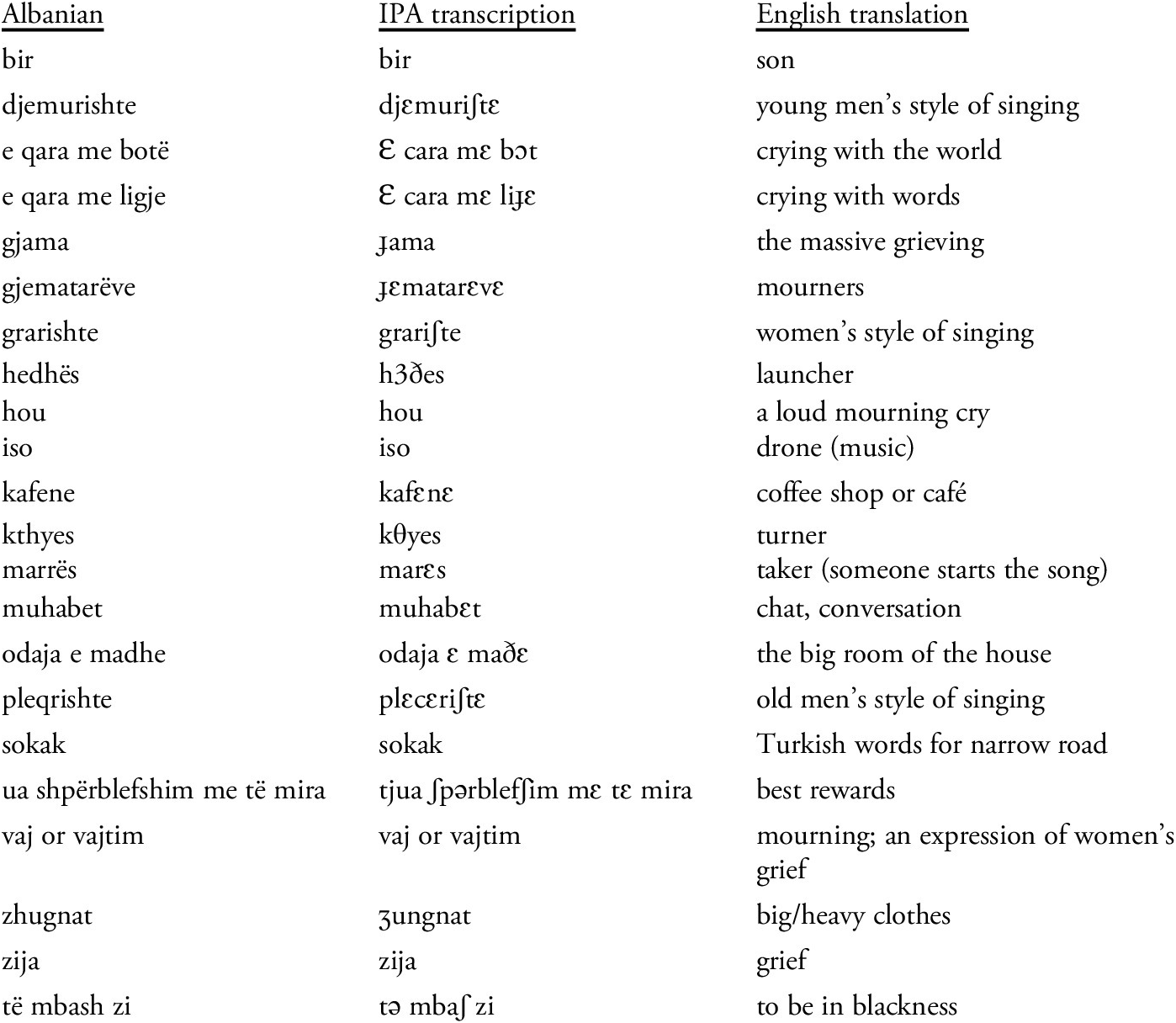
Glossary