





Talent development in specialised music programmes
This study examines how care ethics inform leadership practices within specialist programmes for musically gifted children. Worldwide, a wide range of institutions and communities provide advanced tuition for children exceptionally gifted in music (for further discussion on musical giftedness, see further McPherson, Reference MCPHERSON2016). Giftedness in music is conceptualised in different ways across the literature. While some approaches emphasise exceptional musical aptitude or potential, others view giftedness as a developmental process shaped by the interaction of abilities, motivation, educational opportunities and sociocultural influences (Gagné, Reference GAGNÉ2010; Subotnik et al., Reference SUBOTNIK, OLSZEWSKI-KUBILIUS and WORRELL2011). As a result, specialist music programmes vary not only in their educational provisions but also in how giftedness is identified, interpreted and supported. Opportunities for access and support vary considerably – from free education and high-quality instrument loans to costly programmes in prestigious music institutions serving exceptionally gifted students.
Approaches to access, identification and differentiation also differ: some programmes offer enrichment, grade skipping, acceleration or ability-based grouping opportunities (e.g., studying alongside similarly advanced peers), while others use systematic assessments of musical and/or academic ability for admission. In addition, some avoid using the terms ‘gifted’ or ‘talented’ for reasons of egalitarianism, anti-elitism and anti-ableism. Consequently, the global landscape of gifted music education encompasses (1) diverse educational and community-based provisions, (2) varying degrees of differentiation and (3) differing conceptualisations of giftedness within and beyond music.Footnote 1
For many gifted music students who display significant potential, educational opportunities are often linked to elevated hopes for early career achievement. Achievement and excellence, in essence, become the primary driving forces of the student’s educational journey (e.g., López-Íñiguez & Westerlund, Reference LÓPEZ-ÍÑIGUEZ, WESTERLUND and Hendricks2023). Within such programmes, two contrasting traditions or even ‘opposing forces’ coexist: (1) community-based, recreational learning and (2) the conservatoire model, mirroring professional musicianship (Westerlund et al., Reference WESTERLUND, LAES and LÓPEZ-ÍÑIGUEZ2025). The autonomy of these institutions often operating with limited external oversight can perpetuate tensions between institutional prestige and student-centred care (López-Íñiguez & McPherson, Reference LÓPEZ-ÍÑIGUEZ and MCPHERSON2025). Indeed, within such settings, demanding standards and strict training techniques may often overshadow a more child-centred approach that places the student’s needs and wishes at the centre of the talent development process.
Research across high-ability domains, including elite sports, highlights similar tensions between serving societal needs for excellence and supporting individual flourishing (Kjær et al., Reference KJÆR, BJÄRSHOLM, FAHLSTRÖM and LINNÉR2022; Matthews et al., Reference MATTHEWS, BARKER-RUCHTI, COATES, LANG and HARDWICKE2026). These range from a focus on the individual serving society’s need for talented professionals through to respecting the personal aspirations that make an individual happy, regardless of societal expectations. Although literature in music has shown that a focus on societal contributions might give meaning to a musician’s life (e.g., Westerlund & Karttunen, Reference WESTERLUND and KARTTUNEN2024), this does not necessarily align with what makes all gifted individuals flourish (see further, Dai & Chen, Reference DAI and CHEN2013; Persson, Reference PERSSON2014; Van de Vijver & Mathijssen, Reference VAN DE VIJVER and MATHIJSSEN2023). In contemporary music education, leaders in organisations where highly specialised musical learning takes place are expected to support both the musical and personal development of the gifted children enrolled in their programmes.
Care ethics in specialised music programmes
In the hierarchical master-apprentice, conservatoire-based music education system, the concept of care suggests that programme leaders and teachers will engage with and value gifted students, not only for their musical potential to become highly skilled musicians but also for their human right to live as complete individuals in and outside of music who experience a meaningful life that encompasses a focus on a balanced future. Central to Western-based pledges for student achievement, excellence and success is, however, the exclusive emphasis on the quality and results of education, which prioritises students’ aptitude, potential and dedication to learn as measurable elements over their health, wellbeing and rounded development (see further, López-Íñiguez & Westerlund, Reference LÓPEZ-ÍÑIGUEZ, WESTERLUND and Hendricks2023). Indeed, research from the last two decades has discussed diverse inequalities and unfairness related to the power hierarchies in conservatoire-based settings where highly gifted and motivated students study (e.g., Bull, Reference BULL2021; Gaunt, Reference GAUNT2009; Perkins, Reference PERKINS2013; Pozo et al., Reference POZO, PÉREZ-ECHEVERRÍA, LÓPEZ-ÍÑIGUEZ and TORRADO2022; Saeetre et al., Reference SÆETRE, CARLSEN and HOLM2025; Wagner, Reference WAGNER2015).
A core challenge for music education institution leaders is to ensure top-quality education for children in their programmes to help them pursue any professional path they might choose, while also implementing practices that support each child’s overall development, health and happiness. In music education, an imbalance can arise when the institutional focus is primarily on students’ performance, especially when this takes precedence over properly addressing the unique individual needs of the children enrolled in specialised programmes. As Ciulla (Reference CIULLA2009) observes, within the framework of care ethics, leadership ‘like the professions … [must] serve the interests of others in an un-self-interested fashion’. (p. 3).
A care ethics approach to becoming and being socially responsible towards gifted children requires that leaders address student needs through a first-person approach – ‘I must care’ – rather than the more detached approach ‘action can be provided by others or when problems arise’. A proactive, caring mindset drives leaders to deliberately engage in being with and doing for the students for whom they are responsible (Noddings, Reference NODDINGS2013). In the context of this study – specialist music education programmes for highly gifted students – we define care ethics as the awareness of educational/performing events coupled with an emotional empathy and compassion for the welfare of gifted students. This refers to the social responsibility of accepting their special needs and the vulnerability of their position. Recent scholarship has also highlighted forms of musical vulnerability experienced by young learners, including their receptivity to educational relationships and susceptibility to environmental pressures (MacGregor, Reference MACGREGOR2024). Thus, care ethics is viewed as a relational approach to understanding morality that focuses on the real needs of those with whom we have connections (Held, Reference HELD2006; Tronto, Reference TRONTO1993, Reference TRONTO2013).
Within educational contexts, the care ethics approach seeks to shift ethical considerations away from detached regulations and ethical guidelines towards practical deeds – the tangible application of relational ethics in teaching. This concept has its origins in feminist research, specifically emerging from Gilligan’s (Reference GILLIGAN1977) writings, and highlights the activities an individual undertakes to assist another’s development, thereby demonstrating a relational foundation for civic duty. In the sphere of talent cultivation, these actions may serve a protective and rehabilitative function aimed at dismantling obstacles or aiding recovery following setbacks, as well as a proactive function involving the provision of tools and the establishment of conditions that foster both individual progression and general welfare.
To expand the individual, smaller-scale impact that single actors can have on caring for others, Tronto (Reference TRONTO2010) explored the concept of caring institutions, in which an organisation’s vision and mission are supported at all levels of management. Tronto argues that good care in an institutional context has three central foci: ‘the purpose of care, a recognition of power relations’ and tailoring care approaches to meet each individual’s needs (p. 158). Moreover, she emphasised the nuances of ‘needs interpretation’ within the social sphere of caregiving. One could contend that, when considering musically gifted children, this understanding of needs shifts. It exists between supporting their rigorous training through a singular focus on achieving high-pressure (pre-)professional levels of performances and nurturing their comprehensive growth in all aspects of their lives to safeguard their wellbeing and their rights as young individuals.
To address this disparity, the research reported here sought to construct a profile of the educational practices and policies enacted in specialised music programmes that promote and enhance care-oriented visions and practices, within a care ethics framework that considers the whole child – understood as the holistic/rounded development of children in all areas of life besides and beyond musical competence (see Roth, Reference ROTH2024). Our report is part of a large-scale, international mapping exercise aimed at surveying the approaches, policies and practices of specialist gifted music education programmes worldwide. Our research focused on two distinct aspects:
-
1. the types and emphases of specialised programmes for gifted music students worldwide (see López-Íñiguez & McPherson, Reference LÓPEZ-ÍÑIGUEZ and MCPHERSON2025); and
-
2. the types of policies and practices that embody caring approaches to educating gifted children (as reported in this article).
The main findings of the first part of the study included a broad spectrum of critical issues and approaches to specialised music education for gifted children that range from a focus on serving the children to a focus on children serving the system. For the second part of the study reported here, we attempted to explore these findings further by extending conceptual understandings on how care is reflected more broadly within music education settings (see further Hendricks, Reference HENDRICKS2023). The study therefore attempts to document the scope and breadth of caring practices currently available in traditional conservatoire-based specialist music programmes for the gifted internationally.
Methods
Study design
This study forms part of a multi-year, externally funded project on care ethics in gifted music education worldwide. As part of the project, a comprehensive survey was conducted with programme leaders from institutions serving musically gifted children and adolescents.
Invitations were sent to 227 institutions across 51 countries, identified through public lists, online searches, professional societies and academic networks. Institutions were included if they had accessible contact information; approximately two-thirds had English-language websites. For others, research assistants translated content to enable contact.
Institutions were invited via email and later sent a survey link (available in English, Spanish and Chinese), followed by up to four reminders. Sixty-eight institutions (29.5%) from 25 countries/statesFootnote 2 (49% of the international demographic) participated. Data were pseudonymised, and non-English responses were translated before analysis.
In total, 81 institutional leaders (41 women and 40 men) administering 68 specialist programmes for gifted minors (aged ≤ 17; typically considered minors in OECD countries) responded. Of these institutions, 46 were Higher Education and 22 were specialist schools or pre-college programmes. Although most participating programmes were situated within classical and traditional conservatoire setting, some institutions also reported provision in other musical domains, including jazz, popular music, improvisation and composition.
Because our analysis focused on common themes across programmes rather than national comparisons, the findings should be interpreted within differing educational ecologies. In some countries, publicly funded specialist music schools and pre-college conservatoire pathways are available, whereas in other contexts access depends more heavily on private tuition, scholarships or institutional resources. Likewise, some participating institutions operated within systems that emphasise broad educational participation, while others reflected highly selective conservatoire traditions. These contextual differences may partly explain variations in how leaders conceptualised giftedness, excellence and care.
Materials for data collection
The authors developed an open-ended survey through a critical, iterative process spanning several weeks. Questions explored organisational practices and policies, support for teachers and parents, counselling provision for students and how care was conceptualised and enacted in gifted education (see Appendix for specific questions).
Procedures
Data collected from the survey comprised two major types of information. The first part (reported in López-Íñiguez & McPherson, Reference LÓPEZ-ÍÑIGUEZ and MCPHERSON2025) sought to understand (1) the characteristics, access criteria and missions of specialised programmes for musically gifted children worldwide; (2) the leaders’ profiles, visions and motivations; and (3) the overall support (or lack of it) towards the programmes, and the challenges and tensions related to gifted students.
Findings from Part 1 show that surveyed programmes varied widely in scope, offerings and attention to the needs of gifted children. Differences between these specialist programmes and other forms of formal education emerged into two groups. The first emphasised institutional prestige, traditions and service to the broader cultural and societal context (i.e., gifted children serving the system). The second prioritised the holistic development of each child beyond talent in music (i.e., the system serving each child).
Based on findings reported in Part 1, we then proceeded to analyse the second part of the survey, which forms the basis of this study, to obtain information from the programme leaders about the specific gifted music education programme offered at their institution (see Appendix for access to the specific survey questions). Specifically:
-
1. Policies and practices supporting a caring approach for gifted students.
-
2. Challenges that support or impede the enactment of these policies and practices.
-
3. Criteria for selecting and training teachers, including professional development related to care and talent development.
-
4. Specific policies for interacting with parents/caregivers of gifted children.
-
5. Counselling services available to gifted students.
Data analysis
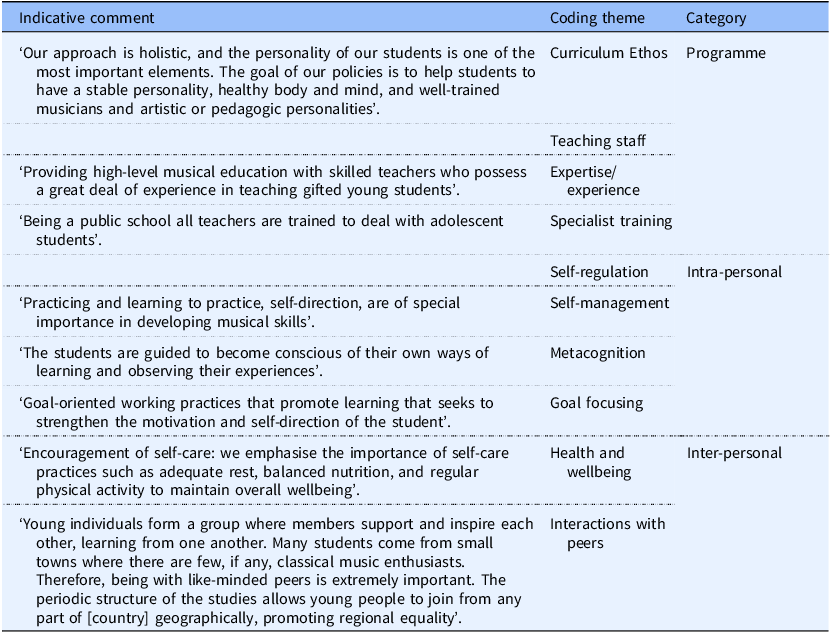
The study adopted an iterative approach to qualitative data analysis, integrating both deductive and inductive techniques to identify recurring themes regarding care in specialised music education within the data.Footnote 3 The analysis unfolded through a series of steps: (1) open coding; (2) organising open codes into analytical categories; (3) establishing categories based on the interpretation of various datasets that reveal consistent patterns of meaning and 4) revisiting and refining these categories as new insights emerged from repeated readings of the datasets. Categories were designed to be responsive, exhaustive, mutually exclusive, conceptually coherent in their level of abstraction and sensitive to the phenomenon under study (see Merriam & Tisdell, Reference MERRIAM and TISDELL2016). Table 1 presents examples of indicative comments, their coding themes and derived categories.
Abbreviated examples of indicative comments from programme leaders and their corresponding coding themes and categories from the analytic procedure

Table 1. Long description
A table comparing indicative comments with coding themes and categories in specialized music education. The table has three columns: Indicative comment, Coding theme, and Category. It contains six rows of data. Row 1: Indicative comment, ‘Our approach is holistic, and the personality of our students is one of the most important elements. The goal of our policies is to help students to have a stable personality, healthy body and mind, and well-trained musicians and artistic or pedagogic personalities.’; Coding theme, Curriculum Ethos; Category, Programme. Row 2: Indicative comment, ’’; Coding theme, Teaching staff; Category, ’. Row 3: Indicative comment, ‘Providing high-level musical education with skilled teachers who possess a great deal of experience in teaching gifted young students.’; Coding theme, Expertise/experience; Category, ’. Row 4: Indicative comment, ‘Being a public school all teachers are trained to deal with adolescent students.’; Coding theme, Specialist training; Category, ’. Row 5: Indicative comment, ‘Practicing and learning to practice, self-direction, are of special importance in developing musical skills.’; Coding theme, Self-regulation; Category, Intra-personal. Row 6: Indicative comment, ‘The students are guided to become conscious of their own ways of learning and observing their experiences.’; Coding theme, Self-management; Category, Intra-personal. Row 7: Indicative comment, ‘Goal-oriented working practices that promote learning that seeks to strengthen the motivation and self-direction of the student.’; Coding theme, Metacognition; Category, Intra-personal. Row 8: Indicative comment, ‘Encouragement of self-care: we emphasise the importance of self-care practices such as adequate rest, balanced nutrition, and regular physical activity to maintain overall wellbeing.’; Coding theme, Goal focusing; Category, Intra-personal. Row 9: Indicative comment, ‘Young individuals form a group where members support and inspire each other, learning from one another. Many students come from small towns where there are few, if any, classical music enthusiasts. Therefore, being with like-minded peers is extremely important. The periodic structure of the studies allows young people to join from any part of [country] geographically, promoting regional equality.’; Coding theme, Health and wellbeing; Category, Inter-personal. Row 10: Indicative comment, ’’; Coding theme, Interactions with peers; Category, ’.
This study sought to establish abstractions across different cases, recognising that the specific details of each case may logically differ. The goal was to formulate a general explanation that encompasses all related individual cases (see Yin, Reference YIN2014). To ensure the credibility, internal validity and consistency of the data analysis, an interpretivist-constructivist perspective was employed, which included independent peer review of a portion of the data. The transferability of the analysis is facilitated by the provision of adequate descriptive data in the sections that follow.
Ethics
Ethical approval was obtained from the Uniarts Helsinki Ethical Review Committee on April 28, 2023, in accordance with standards for humanities and social and behavioural research. Data translation and transcription used pseudonymisation to remove geospatial, institutional and personal identifiers, ensuring GDPR compliance. Alphanumeric codes were assigned to participants but removed from published excerpts. Participation was voluntary, and informed consent was obtained from all respondents.
Findings
Overview
The analyses reported here attempted to interpret the large amount of information obtained from the programme leaders according to the three categories shown in Figure 1:
Categorisation of programme leaders’ perspectives on whole-child care.

Programme: ethos, curriculum emphasis, curricular content, provisions, resources, equity, diversity, inclusion, incentives and teaching staff;
Inter-personal: interactions with teachers, parents/caregivers, peers, community, and communication channels, feedback/assessment, mentoring, public outreach; and
Intra-personal: interest and valuing of music studies, basic psychological needs (sense of competence, relatedness with others and autonomy), self-regulation skills (e.g., confidence, self-discipline, time management), health and wellbeing, and moral/ethical grounding.
Programme characteristics and provisions and curriculum emphasis
For the programme leaders surveyed, overall goals varied from offering ‘[a] solid foundation to enable entry to the [prestigious higher education programme]’, to ‘focus[ing] on artistic expression’, or a holistic vision in which ‘the personality of our students is one of the most important elements’.
For many leaders, caring for students was linked to institutional prestige, since their countries were ‘so proud of our programme and our gifted students’, and ‘audiences attend our concerts because we are recognised, and this is important for the young musicians’. Some even suggested that gifted children owe something to society: ‘they need to be devoted to mankind and humble and thankful for [their] talent’, and ‘understand that their exceptional talent is also an obligation to make things [in the world] in a better way … They will be the leaders of tomorrow and they should inspire all good things through music, to be an example and to bring people close to art’.
The idea of expanded professionalism, though challenging, was a focus for many programmes:
We want our students to have a broad idea of their profession and what music has to offer society. It’s not always easy to open this type of student’s mind because they are so focused on practicing their instrument alone.
Many of the leaders emphasised student success and excellence: ‘most of our kids, about 80%, are successful in entrance exams for prestigious international higher music education institutions’, ‘many students performed as soloists in leading concert halls internationally’, and they are ‘extremely hardworking’ with an ‘exceptional commitment’. The long tradition of excellence was also highlighted: ‘for almost 90 years, our students have been the brightest academic musicians, not only in [country], but also in the world’. Attending competitions was also valued, with leaders noting care for students who ‘receive first prizes at competitions’.
The notion of indoctrination appeared as leaders acknowledged their ‘sense of responsibility for each of the students to work hard and meet the expectations set by their teachers/mentors’. The dedication expected of students was captured in comments such as:
There is a global idea that through practicing music one may develop and correct mistakes and disadvantages of his character and behaviour. The discipline of working and the respect of the musical text is something that is not always part of our being and to achieve musical goals, we have to make a transcendent effort.
Finally, some leaders expressed concern about decreasing enrolment: ‘[our] biggest moral dilemma is the continuous decrease in the number of new students enrolling in the programme’, highlighting the need for a ‘better follow-up of alumni’.
Curricular content
Leaders highlighted the curricular intensity of their programmes, offering a wide range of enrichment activities (e.g., weekly lessons and masterclasses, concerts, competitions and intensive ‘holiday’ camps). They also emphasised extension activities, noting that ‘students should receive a comprehensive musical curriculum, including ear training, music theory, private lessons, and ensemble’ or ‘Alexander technique, chamber music, early music, orchestras of different levels, interdisciplinary projects, mental health, electronic music, improvisation’.
Another key focus was suitability of repertoire, ensuring that ‘the musical pieces selected are age-appropriate, challenging and diverse, catering to the individual strengths and developmental stages of each student’. Leaders stressed exposing gifted students to diverse repertoires to ‘learn about different styles, backgrounds and interpretation’, while maintaining sound quality and fidelity to the score: ‘Respect for the composer’s text, effort to have the quality of sound in first place, before speed!’.
Provisions and resources
Some leaders noted the importance of a dedicated, high-quality physical environment, referencing ‘great concert halls’, ‘technical and acoustic standards’ and buildings that ‘offers many opportunities to meet in the spacious foyer, the bistro, the student bar’, along with lounges and cafeterias for social activities. Additional resources were also valued, such as attending ‘[external] concerts’ or seeking ‘links and sources to listen and learn’.
Some programmes faced resource limitations, including the quality of their instruments, building maintenance or financial constraints affecting programme delivery and scholarships for the most worthy prospective or needy students. This led in some cases to an ‘outdated curriculum’ an inability to fully engage with the local community and challenges in inviting ‘world-class musicians for master classes’.
The participants also highlighted the importance of mixed-ability settings: ‘We have special programmes where the underage [gifted] students learn amongst other underage students of different ability’.
Counselling and support were common, though varied: 36.7% of institutions offered mental/physical wellbeing, 42.6% provided career coaching and 20.6% helped students manage heavy workloads. Only 14.7% offered all three options, while 26.5% provided broader support, including appointments with teachers or leaders to discuss any difficulties. Some programmes offered consultations before enrolment, peak performance coaching ‘for students to discuss emotional challenges related to performance anxiety, peer pressure, or other concerns’, peer-to-peer support and/or information sessions on mental health and career counselling: ‘we help students learn how to deal with issues like stress’, or ‘we integrate psychological and career counselling’.
Safeguarding was also highlighted with some programmes actively reviewing anti-bullying policies and protecting students’ physical, psychological and moral rights. Some existing policies required ‘underage students [to] live with their families or with a legal guardian’. Preventive measures included ensuring ‘the correct assessment of problematic situations’, attending ‘any violation of the beneficiary’s rights in an appropriate manner’, hiring ‘non-teaching staff who follow up with students to ensure that there are no issues that might prevent them from reaching their full potential’ and prioritising child welfare. Leaders recognised that there was ‘a long way to go’ regarding ‘counselling and safeguarding measures’, sometimes making this a major institutional focus for improving the curriculum.
Equity, diversity, inclusion
A few leaders described specific policies on diversity and inclusion, providing ‘opportunities to those who may not have access to [the gifted programme] outside’, offering ‘provincial youth training’, promoting ‘respect for diverse cultures and perspectives’ and ensuring a ‘greater social variety of students’ by reaching ‘students from all over the country’.
Some also emphasised equity measures, such as discontinuing enrolment ‘if it appears the programme is not the right fit for [a student]’, or ensuring that ‘certain young individuals do not experience favoritism’. In these institutions, a sense of equality was important, with concert opportunities earned through diligence and merit and offered equitably to all students.
Incentives
A small number of institutions mentioned incentives for good behaviour or success, including: ‘We reward pro-social behaviour with specific stipends for students who show exemplary behaviour’, and ‘we promote healthy competition and create high incentives [for winning]’.
Some programmes offered scholarships, with one noting that ‘every student is granted a 100% tuition scholarship, which helps the families of the youngest students in particular, since in most cases, they have to cover the expenses related to commuting from their hometown’.
Teaching staff
Many programmes required prospective staff to demonstrate an artistic career showcasing ‘outstanding musical ability’ and ideally active experience as an excellent performer. Some institutions noted that it would be a ‘bonus if, besides the solo instrument, the teacher has spread their experience across multiple musical disciplines (orchestra, chamber, modern/pop, improvisation, composition, etc.)’.
Success and recognition were also valued, with evidence such as ‘competition winning evidence’ or ‘major honors’, reflecting the importance of teachers being ‘famous’, ‘internationally recognised’, having a ‘reputation as a top-class teacher’ and a good ‘track record of successful students’. Some were hired based on recommendations ‘from esteemed staff’, or via an interview or a video performance of ‘15–20 minutes showcasing [their] artistic abilities’.
Staffing posed challenges, particularly regarding pedagogical qualifications. Approaches ranged from ‘our institution doesn’t count pedagogical attributes very highly, only artistic ones…it’s not my opinion, but I cannot change it’ to requiring a ‘certificate of gifted education obtained by a minimum of two years through an official body’. Many required a bachelor’s or master’s degree in music, with a doctorate considered a ‘nice extra’. Professional development certificates or specific method qualifications (e.g., pedagogy, Suzuki, Dalcroze) and/or prior experience ‘working with children’ or ‘in music education settings’ were valued by some. Only one institution specifically required a certificate on gifted education. A few employed students as teachers, describing the programme as a ‘seedbed [giving] work to current students’. Two institutions mandated a ‘police check’ or criminal record clearance.
Teachers were expected to exhibit personal characteristics and traits such as leadership, teamwork, proactivity, a desire to serve, effective communication and the ability to inspire. They were also selected for industry knowledge of the ‘labor market’, including the ability to ‘leverag[e] their network [of] new students to the institution’, teach all levels and ages and showcase extensive repertoire knowledge.
Regarding professional development, 12 programmes (17.6%) offered development courses for teachers, while only 2 (2.9%) provided gifted education courses due to ministry mandates or certification requirements. Another 10 (14.7%) offered sporadic courses on pedagogy, child development, learning styles, compassionate teaching, improvisation, safeguarding, health, care and prevention of harassment and bullying. Ten institutions (14.7%) mentioned providing occasional ‘seminars, staff meetings’ or ‘lectures with experts’. They highlighted the desire to expand professional development, describing it as ‘one of our greatest dilemmas’ and noting opportunities might be offered if teachers ‘would be interested in any extra training’.
Inter-personal elements
Interactions with teachers
Leaders emphasised the importance of inspiring musician-teachers: ‘We have high-quality teaching staff [who] are excellent musicians and our young students get a lot of inspiration for their life out of the[ir] lessons’. Regarding pedagogical and human qualities, teachers should ensure that ‘students [are] in the right hands with the main teacher’ who ‘challenge students in a safe way’. Several challenges were also noted, such as ‘we need to support staff to better accommodate different learning styles’, or that the language skills of ‘certain famous teachers are really poor’. Caring practices depended on the professor: ‘some do pay attention to these aspects, and some do not, and there is nothing I can do [so] we need to improve our mentoring structures’.
Ethical-relational qualities were highlighted, including a ‘good work ethic’, ability ‘to connect with the children and their families [through] constructive discussions’, being ‘approachable and aware of the students’ emotional state’, adopting a ‘student-centred approach [which] is wished for here’ or ‘being able to adjust teaching methods to the various students [and offer] personalised attention to cater to their unique needs and learning styles’. Positive personal attributes mentioned included enthusiasm, passion, sense of responsibility, caring, patience, flexibility, humility, structure, empathy, stability, easygoing nature, social intelligence, compassion, encouragement, responsibility, innovation and creativity.
Teachers were expected to set high standards, ‘coach[ing] to the highest standards, both technical and musical skills’, being ‘assertive and demanding’, ‘able to frame and exploit talents at all different ages’ and ‘placing high expectations on students’.
Interactions with parents/caregivers
Twenty (29.4%) institutions had policies for interacting with parents/guardians of gifted children (7 formal and 13 informal), 10 (14.7%) cooperated more informally and 38 (55.9%) had no specific action. Some leaders sought to increase parental engagement: ‘want and should increase this more’. Concerns included intrusive parents ‘who excessively intervene in school operations’ and conflict between students that ‘often present relatively challenging ethical problems to resolve’, requiring ‘early intervention with parents [and] choosing which of the directors can best relate to what parents and teachers’. Supporting adults was demanding: ‘It is challenging to involve parents in a healthy way’, and ‘We should have better caregivers during weekends for residential/boarding schools, but their fees are ridiculous’.
Activities to engage with parents included more or less regular workshops, talks, parents’ evenings, support for the Parents’ Association and scholarships for parental participation. Leaders emphasised engaging parents and caregivers ‘in a professional manner, addressing any concerns or questions they might have regarding their child’s progress, while respecting the privacy and confidentiality of the students’. Oversight included attending ‘musical initiation classes’, following a student’s charter and requesting parental permission ‘for things such as concert tours and similar events’, ‘overnight stays and other practical arrangements’ or to ‘display their name and/or surnames publicly’. For distant families, some programmes assigned a legal guardian, peer-to-peer support and/or a special needs tutor. Overall, parents were encouraged to ‘maintain a positive, collaborative relationship’ for the wellbeing of their gifted students.
Interactions with peers
Leaders noted that ‘peer competition is a big issue’, highlighting early interventions for conflicts, such as helping ‘students in solving their issues or minor conflicts with their peers’ through ‘regular classroom communication with classmates’. Group music-making was valued: programmes aimed to ‘provide chamber music or vocal choirs, because when the young talents meet peers, we think that is the best way to learn and to build their personality’. One leader expressed:
Young individuals form a group where members support and inspire each other, learning from one another. Many students come from small towns where there are few, if any, classical music enthusiasts. Therefore, being with like-minded peers is extremely important. The periodic structure of the studies allow young people to join from any part of [country] geographically, promoting regional equality.
Socialisation across ages and levels was emphasised: ‘We organise opportunities to meet graduate students in joint classes or matinees, so that specialised education students feel part of the university community and, perhaps, already have a peek at their future as graduate students’. Gifted students benefited from ‘workshops, excursions to spend time together and to visit new cultures … this will become very important for them to succeed in this profession’.
Interactions with the community
Cooperation with external stakeholders was a form of caring for students, fostering ‘a willingness to explore creativity and develop confidence in performing in safe ways’ and ‘enhancing musical and artistic diversity in cooperation with other actors in the area’, including ‘the college and the local music school, [where] there are always good ‘matches’ to perform’. Cooperation helped gifted students ‘striv[e] for learning by doing in situations where young meet older as ‘colleagues’’ and be ‘well supported, have friends, and [help] the families function well’. Leaders emphasised creating safe, engaging surroundings:
Sometimes gifted children are not very social, or they get bored easily, so there is an effort to give them surroundings that make them feel safe, happy, with interesting activities, to fill their brain with moving ideas, to learn not to be just competitive but to enjoy playing with/for others.
Special educational arrangements were valued, such as helping students ‘take advantage of special study arrangements [so that] they can have more time for their instrument’ and ‘stay a lot of time busy on the instrument [by] reducing general subjects to 3-4’. Partnerships with (music) universities were praised: ‘one of the highlights of our programme is the strong partnership we have established with the prestigious [university]’, enabling enrolment for very young and highly gifted children, ‘even as young as 2- and 3-year-olds’.
Communication
Regular communication channels included semester- or yearly-based newsletters, info meetings, emails, private WhatsApp/Line groups, phone calls, progress discussions and opportunities for parents to provide feedback to the institution. Leaders emphasised ‘constant monitoring and a coordinated follow-up of their overall development’, recognising the need for improved systems: ‘creation of [a] evaluation/feedback system that is more holistic for the educational process [and] the form of examination could be different’ and ‘is offered only in special modules’.
Mentoring included ‘private tutoring [on] a weekly basis’ that was ‘available for students who need extra help [or] have questions outside of the usual class time’. This was provided by ‘the faculty and staff’, or ‘a professional musician or older student’ who could offer ‘guidance, support, and encouragement both musically and personally’.
Public outreach was also a focus, organising projects and concerts with a social dimension: ‘concerts for kids or seniors, teaching underserved populations, projects with other school kids, benefit concerts e.g. for refugees, local communities, charitable causes’ fostering ‘a sense of social responsibility, empathy and connection’.
Intra-personal elements
Interest and valuing
Student-centredness was seen as a way of caring for gifted students, fostering a ‘search for the most suitable and individual solutions’ through a ‘tailored curriculum’ that supports ‘a growth mindset’, enabling them to ‘articulate their own motivations and goals’ and become ‘self-responsible human beings in a safe and versatile environment’. One leader mentioned a ‘learner charter that seeks to create a child-centred learning environment in which the needs of learners are paramount’.
Care was also expressed through love for music itself, as leaders highlighted the importance of ‘developing a great love’ or ‘pure life for music’, and a ‘strong sense of musicality which lasts a lifetime’. Such experiences helped gifted students ‘develop emotionally when they can find out what is their favourite way to make music [and] try different experiences with their beloved music’. For some, music offered a form of refuge: ‘an escape from the many stresses found within reality. Our programme allows students a temporary ‘break’ from the outside world, where they can focus purely on music and unlocking their artistry’.
Psychological needs
Basic psychological needs centred on autonomy and competence, supported by offering students choice of language in their feedback and assessment methods and by ‘encourag[ing] self-reflection and growth, [and setting] personal development goals’, to ‘develop an artistic inquisitive mindset’. Leaders emphasised helping students make informed educational choices, ‘to show clearly the opportunities and possible disadvantages that studying at a higher education institution can offer and to guide them so that they can make a calm choice when the time comes’.
Self-regulation
Developing confidence and self-regulation were recurring themes. Leaders sought to ‘foster a healthy and constructive atmosphere of respect, and acceptance where students of all ages and levels feel safe to express themselves and take risks’. Self-discipline was highlighted through ‘life skills such as discipline, perseverance, resilience, organisation, and time management’ and ‘goal-oriented working practices that promote learning … to strengthen the motivation and self-direction’. Expectations were high but tempered by empathy, with the aim of helping students ‘believe in music and themselves’. Time management was also highlighted: students ‘[should be] practicing and learning to practice [since] self-direction is of special importance in developing musical skills’.
Health and wellbeing
Some programmes aimed to prioritise health and wellbeing by ‘anchor[ing] the programme to the psychological and social aspects involved in training young talents’ and ‘recogniz[ing] mental and health problems early, [so that] we can intervene quickly and effectively, continuing to do better and better’. A few organised ‘meetings to talk about wellbeing and balancing music, school, friends and other hobbies’.
However, leaders also recognised significant gaps: ‘we are unable to provide those [but] very much in need’, ‘we need to better care of students’ workload balance’ or ‘we are thinking that we should offer coaching, anxiety, medication, and mind control’. Some noted that while the institution ‘takes into account the double workload of the students, but no general measures are taken in the musical training’.
Pressure was acknowledged as inherent to selectivity: ‘being chosen into a highly selective group brings pressure for many [therefore, we set] clear rules, schedules, and transparent criteria for the requirements of studying’. Coaching groups were considered important for students’ emotional security. Programmes supported coping and resilience through ‘support during challenges’, helping students understand that ‘failure is always part of the music profession’ and learn to ‘accept all their success and also failure’. Mental training, body awareness and self-care were also emphasised: ‘we emphasise the importance of self-care practices such as adequate rest, balanced nutrition, and regular physical activity to maintain overall wellbeing’ and ‘integrity, developing healthy habits and lifestyle’.
Moral and ethical grounding
Leaders also discussed moral and ethical grounding as part of caring for gifted students: ‘when caring for gifted/talented music learners, we must nurture moral integrity’ and ‘develop a nurturing community that safeguards these sensitive and exceptional kids’. The importance of a moral compass was expressed through institutional values such as: ‘four pillars (eagerness, trust, togetherness, and development) that should be visible, palpable and practised by teachers and students’. Some programmes held ‘joint events [with] moral guidelines, supervisors and special care for the safety of minors’ and ‘incorporate discussions on ethics in music, such as intellectual property rights and the historical context of compositions, to foster a sense of moral responsibility’. Ethical values such as ‘honesty, integrity, and respect in all aspects of musical practice and performance, including interactions with peers, teachers, and audiences’ were central to these efforts.
Discussion
In this study, we focused on assessing how some of the world’s most prestigious programmes enact caring practices towards their gifted music students. A number of themes emerged from the comments provided by the 81 programme leaders.
This study reveals a persistent paradox between institutional care for gifted students and systemic pressures that position children as symbols of institutional success. Our findings highlight that ‘care’ was understood by these leaders in different ways, ranging from a focus on producing talented musicians vs a focus on developing the whole child. The large number of comments obtained were analysed and then grouped into three distinct categories; those related to the programme, inter-personal relationships and intra-personal factors. An uneven distribution occurred, whereby most comments were in the first two groups (programme, inter-personal), with fewer detailing how the programme leaders saw each child’s growth outside the music programme (intra-personal).
We took particular note of the number of comments focused on the programme itself. Almost all of the leaders expressed great pride in their programme and what it offered their young, gifted students. However, they also recognised a range of external pressures, priorities and challenges that impacted on how they organised and managed their gifted music programmes. Expectations from their institution, parents and the community to train the students so they can take their place as future professional musicians were seen by many of the programme leaders as their highest priority. This often led to a feeling that the child serves the institution with funding and support for the programme resting on how well the institution could showcase the talents of their young musicians in ways that reaffirmed the institution’s prestige and success at developing talented musicians. In explaining their situation, many of the programme leaders highlighted the long tradition of providing elite-level training at their institution. Simultaneously, they also recognised the resulting resistance within their institution to modifying a programme that many within it believed was already successful.
A particular challenge evident in most of the institutions concerned hiring suitable staff. Most institutions stressed the need to hire ‘expert’ musicians of the highest calibre who were not only high-level performers but also successful in raising talented students capable of competing internationally. Importantly, however, we read fewer comments on the need for staff to possess recognised teaching qualifications to ensure they had the skills needed to understand how to teach gifted students, and in particular the type of caring approaches that would ensure their students’ health, wellbeing and moral/ethical grounding. Very few of the programmes required teacher certification or formal pedagogical qualifications or even provided ongoing professional development of their staff in ways that would minimise the types of problems that often occur in highly charged learning environments.
Our analysis of programme leaders’ comments suggests they were often less aware of each individual child’s needs, responding mainly when students faced musical or personal problems. Common themes included performance anxiety and emotional difficulties, which can arise when students lack resilience to cope with setbacks or pressure. Comments also highlighted a workload imbalance, including periods of low motivation and stress from managing extensive practice and multiple tasks, leaving little time for leisure. A few leaders mentioned bullying, either within the programme or at school. Overall, leaders’ awareness of students’ everyday personal and emotional needs appeared limited, with most attention focused on performance outcomes rather than each child’s broader wellbeing.
Relatively few comments from leaders showed a full awareness of each child’s personal needs in their programme. While leaders recognised the importance of catering to individual students and cited examples such as counselling and support services, far fewer addressed children’s psychological needs, emotional stability or overall wellbeing. Learning priorities were often viewed through the lens of the programme leader – and likely the teaching staff – rather than the child. Contemporary education research questions this approach, emphasising learning as a two-way, negotiated process between child and teacher (Hattie & Clarke, Reference HATTIE and CLARKE2019; Hattie & Donoghue, Reference HATTIE and DONOGHUE2016; Hattie & Zierer, Reference HATTIE and ZIERER2018; see in music López-Íñiguez & Pozo, Reference LÓPEZ-ÍÑIGUEZ, POZO, Pozo, Pérez Echeverría, López-Íñiguez and Torrado2022; McPherson & Hattie, Reference MCPHERSON, HATTIE and McPherson2022; Pozo et al., Reference POZO, PÉREZ-ECHEVERRÍA, LÓPEZ-ÍÑIGUEZ and TORRADO2022). Key elements include clearly defined learning intentions, aligned success criteria and feedback that guides progress and encourages students to take ownership of their learning. In this model, students become active participants, shaping their own development and defining their goals and future priorities, rather than simply responding to externally imposed expectations.
On another level, our findings are similar to what we have observed in other talent domains (e.g., sport), where policies are being developed to provide a better balance between performance, high pressure and wellbeing (Dohsten et al., Reference DOHSTEN, BARKER-RUCHTI and LINDGREN2020). Increasingly, their approach focuses on developing a shared commitment across an institution or organisation that is built on balance and sustainability. The best examples include efforts to develop international awareness through policies and regulations defined by peak bodies for the particular sport, which are then used to underpin practices and priorities within individual organisations, leaders, coaches and even family members who support the young athlete. Within music, there is much to do in order to articulate policies and practices that would better serve young children who are gifted for music. As noted by Noddings (Reference NODDINGS2002, Reference NODDINGS2013), power dynamics must be considered when creating and implementing policies grounded in an ethics of care. Regarding talent development in music, any policies devised for specialised music schools within conservatoires, public schools and universities should strive to foster a culture grounded in care ethics by creating practices that allow young people to integrate their needs and interests in ways that support them as whole persons within their specific contexts (see further Reinert & Debebe, Reference REINERT and DEBEBE2022).
Tronto (Reference TRONTO2012) introduced the idea of relational responsibility, which, when applied to gifted music education, offers an approach to navigating the conflict between an exclusive focus on talent development in gifted students and a distributed responsibility for civic life among all stakeholders. When relational responsibility extends beyond individual people to institutions, it becomes apparent at broader systemic scales and, for that reason, relates to policy.
It is often the case, also, that the most elite and prestigious gifted music programmes are becoming increasingly professionalised, in ways similar to elite sport talent development programmes (Roth, Reference ROTH2024). Within such programmes, catering for the whole child can all too often become a secondary afterthought in the minds of leaders, and in the missions of these specialised programmes, thus sustaining a ‘deep sleep’ mentality that is characteristic of music conservatoires in most OECD countries (e.g., Pozo et al., Reference POZO, PÉREZ-ECHEVERRÍA, LÓPEZ-ÍÑIGUEZ and TORRADO2022).
Drawing on these findings and the broader research project, we urge all those who support musically gifted children to prioritise each child’s social, emotional and psychosocial development, so they can realise their full potential. The wellbeing and holistic development of the child, across all areas of life, must be the foremost concern. A clear call to action is needed to guide the future development of gifted young students in specialist music and talent programmes worldwide. International bodies such as the International Society for Music Education (ISME), International Federation of Musicians (IFM), Association of European Conservatoires (AEC), College Music Society (CMS) and Young Music Talents in Europe (YMTE) share responsibility to develop policies that guide how gifted children can be better supported in highly specialised programmes. Their efforts can draw on the growing literature in gifted education, the work of networks such as the World Council for Gifted and Talented Children, the National Association for Gifted Children and the European Council for High Ability, and insights from other skill-based domains, including athletics and sport, to promote sustainable, child-centered approaches in music talent development.
Based on our findings, four priorities emerge for policy and practice. First, specialist music programmes should explicitly incorporate student wellbeing, safeguarding and holistic development into mission statements and programme evaluation frameworks. Second, teacher recruitment and professional development should include preparation in child development, gifted education, care ethics and safeguarding, rather than focusing primarily on artistic achievement. Third, institutions should establish systematic counselling, mentoring and workload-monitoring structures to support students’ psychological wellbeing. Fourth, parents and caregivers should be recognised as educational partners through structured communication and support mechanisms. Together, these measures would help shift specialist music education towards a more sustainable balance between excellence and care.
Conclusion
This study highlights the tension between developing musical talent and supporting the holistic wellbeing of gifted children in specialist programmes worldwide. A central finding is that many leaders appeared more focused on programme success, musical achievement and commitment to excellence than on systematically addressing the individual, social, emotional and developmental needs of the gifted children enrolled in their programmes. While programme leaders expressed pride in their institutions and a strong commitment to excellence, fewer explicitly addressed the intra-personal needs of individual students.
Although many findings may apply to all young musicians, gifted children are particularly vulnerable in conservatoire settings, facing heightened pressures and emotional strain linked to their exceptional potential and sensitivities (see López-Íñiguez & McPherson, Reference LÓPEZ-ÍÑIGUEZ and MCPHERSON2025). Policies and practices should integrate care ethics, relational responsibility and student-centred approaches to foster flourishing and protect wellbeing, while sustaining musical development. Teachers and parents likewise need guidance and professional learning to understand and support the unique needs of gifted children. Future research should explore how these principles are enacted across gifted students’ developmental stages and cultural contexts.
Supplementary material
The supplementary material for this article can be found at https://doi.org/10.1017/S0265051726100990
Data availability statement
Data are not available in any open data repository. A selection of the pseudonymised datasets generated for this study is available on request to the corresponding author.
Acknowledgements
Our sincere thanks go to each leader involved in this study and to the institutions that fostered and encouraged their staff’s participation. We also acknowledge the valuable assistance of various associations and individual colleagues who played a crucial role in creating the rather concise map of educational ecosystems that cater to gifted and talented students on a global scale.
Financial support
This study was funded by the first author’s large-scale research grant, The Politics of Care in the Professional Education of Children Gifted for Music (2022–2027), funded by the Research Council of Finland (Ref. 348591).
Competing interests
The authors declared no potential conflicts of interest with respect to the research, authorship and/or publication of this article.
Guadalupe López-Íñiguez is a Spanish researcher and musician based at the University of the Arts Helsinki, Finland. She holds a PhD in the psychology of music education and a master’s degree in cello performance. Her research expertise includes constructivism and conceptual change, giftedness and talent, employability and careers, wellbeing, performance optimisation, and theories of emotion and motivation. She is currently leading the project ‘The Politics of Care in the Professional Education of Children Gifted for Music’ (2022–2027), funded by the Research Council of Finland.
Gary Edward McPherson is an Australian music educator, academic and musician, who has served as the Ormond Chair of Music at the Melbourne Conservatorium of Music. McPherson’s research primarily focuses on exploring the factors that influence the development of musical proficiency during childhood, later performance excellence and the motivators of music participation in individuals of all ages and musical skill levels. Much of his research has been informed by his interest in the formation of musical abilities and identity in developing musicians.


 Open access

