INTRODUCTION
This study is a cross-linguistic investigation of children's interpretation of disjunction (English or, Mandarin huozhe) in sentences with the temporal conjunction before (English before, Mandarin zai … zhiqian). The interpretation of disjunction in sentences with this temporal conjunction differs in English and Mandarin, at least for adult speakers. Therefore, a comparison of child learners of these languages provides an interesting testing ground for theories about the emergence of meaning in language acquisition. If children are uniquely guided by the adult input, then English-speaking children and Mandarin-speaking children should assign different interpretations to sentences in which disjunction appears with the temporal conjunction before, since adult speakers of these languages assign different interpretations to such sentences. On the other hand, if children acquiring both languages are guided by both a learnability constraint on the acquisition of semantic representations and by logical principles, then they should initially assign a conjunctive interpretation to disjunction in sentences with the temporal conjunction before regardless of the interpretation assigned by adults. On this scenario, Mandarin-speaking children are expected to differ from Mandarin-speaking adults in interpreting the relevant sentences. Instead, they are expected to adopt the same interpretation that is characteristic of English-speaking children (and adults).
To frame the present study, we begin with a discussion of the interpretation of disjunction in sentences containing certain negative logical words like ‘not’ and ‘none’. This is followed by a discussion of the interpretation of disjunction in sentences with the words ‘every’ and ‘before’ which do not have a negative cast. We then introduce the relevant cross-linguistic differences in how sentences with ‘before’ and disjunction are interpreted, and we present the learnability constraint – the Semantic Subset Maxim – we believe may be operative for children as they are acquiring the meanings of these sentences. We review previous research on children's interpretation of disjunction in various languages. The findings of previous studies indicate that children are guided by both the Semantic Subset Maxim and by logical principles in their interpretation of disjunction in sentences with negative operators like ‘not’ and ‘none’, and with the universal quantifier ‘every’. However, the present study is the first cross-linguistic investigation of the acquisition of the interpretation of disjunction in sentences with before. This study assesses the extent to which children across languages adhere to the same learnability constraint and logical principles in interpreting such sentences.
Downward entailment and the conjunctive interpretation of disjunction
The class of expressions called downward entailing (DE) operators encompasses a wide range of parts of speech in human languages. For example, the negative operator ‘not’, the determiner ‘none’ and the preposition ‘without’ are all downward entailing operators. They are also all negative expressions. However, the class of DE expressions also includes non-negative expressions like the universal quantifier ‘every’ and the temporal conjunction ‘before’. Despite syntactic and semantic differences among these expressions, they form a natural class in human languages because they have several properties in common. First, they license inferences from general terms (e.g. ‘Romance language’) to more specific terms (e.g. ‘French’). Consider the statement ‘John did not learn a Romance language’. This statement contains negation (‘not’) and the general term ‘Romance language’. If this statement is true, then it logically follows that the statement ‘John did not learn French’ is also true, where the general term ‘Romance language’ has been replaced by the specific term ‘French’. The temporal conjunction ‘before’ also validates inferences from general terms to specific terms, so if the statement ‘Dinosaurs lived before modern mammals’ is true, then it must also be true that ‘Dinosaurs lived before foxes’. Most words, even those which appear to form a natural class with downward entailing operators in terms of their semantic class or part of speech, do not license inferences from sets to their subsets. For example, although ‘every’ licenses an inference from a set to a subset (e.g. ‘Every Romance language is easy to learn’ licenses the inference ‘French is easy to learn’), other quantifiers like ‘some’, ‘most’ or ‘few’ do not (‘Some Romance languages are easy to learn’ does not necessarily mean that ‘French is easy to learn’). The licensing of inferences from sets to their subsets is the defining property of downward entailing operators.
A second diagnostic property of downward entailing operators is that they license the conjunctive interpretation of disjunction (English or). Consider the English sentence ‘John does not like broccoli or cauliflower’. This sentence contains the downward entailing operator not and the disjunction operator or. The sentence is understood to entail that John does not like broccoli and that John does not like cauliflower. The conjunctive interpretation of disjunction arises because the English disjunction operator or is assigned the truth conditions associated with inclusive disjunction (inclusive-or). Ordinary statements with inclusive-or are true in three circumstances, just as in classical logic. In classical logic, a statement of the form ‘P or Q’ is true if (i) P is true (but Q is not), or (ii) Q is true (but P is not), or (iii) both P and Q are true. This means that ‘P or Q’ is false in just one circumstance: when neither P nor Q is true.
When ‘or’ is negated, the truth conditions for inclusive-or are reversed. So ‘not (P or Q)’ is true in the one circumstance in which ‘P or Q’ is false, namely when neither P nor Q is true. This relationship is captured in one of de Morgan's laws of propositional logic, where the symbol ‘¬’ stands for ‘not’, the symbol ‘∨’ stands for ‘or’, and the symbol ‘∧’ stands for ‘and’:
(1) ¬(P ∨ Q) → ¬P ∧ ¬Q
In natural languages, as in logic, the conjunctive interpretation of disjunction is assigned when disjunction is negated. Even more generally, the conjunctive interpretation of disjunction is assigned whenever disjunction appears in the scope of a downward entailing operator. For example, ‘or’ generates a conjunctive interpretation in sentences with ‘none’ and ‘without’, as illustrated in (2).
(2)
(a) None of the students took maths or biology
→ None of the students took maths and none of the students took biology
(b) I left the restaurant without my purse or my camera
→ I left the restaurant without my purse and I left the restaurant without my camera
The expressions ‘none’ and ‘without’ clearly contain negation as part of their meanings. In view of the logical relationship between negation and disjunction, it makes sense that these operators trigger the conjunctive interpretation of disjunction. However, other downward entailing operators do not require a negative meaning in order to license the conjunctive interpretation of disjunction. The expressions ‘every’ and ‘before’ are two such cases. Example (3) illustrates that ‘every’ licenses the conjunctive interpretation of disjunction. For this downward entailing expression, a different logical process is responsible for the conjunctive interpretation of disjunction, as compared to negative expressions like ‘none’ and ‘without’.
(3) Every passenger who ate chicken or beef became ill
→ Every passenger who ate chicken became ill and every passenger who ate beef became ill
The expression ‘every’ yields the conjunctive interpretation of disjunction because of the set relations that it creates when it is in construction with a noun phrase that contains disjunction, such as ‘every passenger who ate chicken or beef’. In this noun phrase, ‘or’ is used to partition the universally quantified superset ‘every passenger’ into two subsets ‘passengers who ate chicken’ and ‘passengers who ate beef’. The quantificational expression ‘every passenger who ate chicken or beef’ refers to the entirety of the partitioned superset of passengers. This superset necessarily includes (i) passengers who ate chicken, (ii) passengers who ate beef, and (iii) any passengers who ate both chicken and beef. In other words, the conjunctive interpretation of disjunction arises in (3) because all three circumstances associated with inclusive-or must be true in order to guarantee the truth of the universally quantified statement. The linguistic behaviour of ‘every’ contrasts with the negative downward entailing expressions ‘not’, ‘none’ and ‘without’. When ‘or’ appears in the scope of these expressions, a statement is true only in the event that both of the disjuncts are false.
The conjunctive interpretation of disjunction also arises in sentences with ‘before’, as in (4).
(4) Jane arrived at the pool before Mary or Sue
→ Jane arrived at the pool before Mary and Jane arrived at the pool before Sue
This interpretation arises for reasons similar to the ones just outlined for the universal quantifier. This is because the temporal concept before introduces a ‘covert’ universal quantifier which quantifies over the points-in-time that make up events (Anscombe, Reference Anscombe1964; Heinamaki, Reference Heinamaki1972). That is, if an event A is said to occur before an event B, then at least one point-in-time in event A must have taken place before every point-in-time in event B. The ‘covert’ universal quantifier in the semantics of before is the source of the conjunctive interpretation of disjunction. Example (4) can be used to illustrate. Event A is expressed in the main clause ‘Jane arrived at the pool’. Event B is expressed in the before-clause ‘Mary arrived at the pool or Sue arrived at the pool’. Since event B is a disjunction of events, event B contains two subevents, one denoting Mary's arrival and the other denoting Sue's arrival. For (4) to be true, some point-in-time in event A must have preceded every point-in-time in the subevents that comprise event B. So, Jane's arrival must have preceded every point-in-time in the subevent of Mary's arrival, and Jane's arrival must have preceded every point-in-time in the subevent of Sue's arrival. This is why the temporal conjunction before licenses the conjunctive entailment of disjunction.Footnote 1
Cross-linguistic differences in downward entailment properties
For the conjunctive interpretation of disjunction to arise in a sentence containing a downward entailing operator and disjunction, disjunction must be interpreted within the scope of the DE operator. In natural languages, as opposed to classical logic, assigning scope to two logical operators can be ambiguous. This gives rise to some interesting cross-linguistic differences in scope assignment. To illustrate, let us again use the example of negation.
In some languages, like English, disjunction is interpreted within the scope of negation in both simple negative sentences, such as (5a), and in complex negative sentences, as in (5b). As a consequence of this uniform scope relationship, disjunction receives a conjunctive interpretation in both simple and complex sentences.
(5)
(a) John does not like broccoli or cauliflower
→ ‘John does not like broccoli and John does not like cauliflower’
(b) I do not think John likes broccoli or cauliflower
→ ‘I do not think John likes broccoli and I do not think John likes cauliflower’
Languages which behave like English in this respect include German, French, Greek, Romanian, Bulgarian and Korean (Szabolcsi, Reference Szabolcsi, Kenesei and Siptar2002).
In other languages, including Mandarin, the conjunctive interpretation of disjunction only arises in complex sentences, where negation appears in a higher clause than the clause that contains disjunction, as illustrated in (6).
(6) Wo bu renwei ta xihuan xilanhua huozhe huayecaiI not think he like broccoli or cauliflower‘I do not think he likes broccoli or cauliflower’→ ‘I do not think he likes broccoli and I do not think he likes cauliflower’
When negation and disjunction appear in the same clause, however, as in (7) below, the disjunction operator tends to be interpreted as taking scope over negation. So in Mandarin, the translation of ‘John does not like broccoli or cauliflower’ can mean ‘It is broccoli or cauliflower that John doesn't like (I'm not sure which one)’. Note that the notion of scope under consideration does not refer to the linear order of words in sentences. Negation precedes disjunction in the Mandarin example (7), but disjunction is interpreted as taking scope over negation.
(7) Ta bu xihuan xilanhua huozhe huayecaiHe not like broccoli or cauliflower‘He does not like broccoli or cauliflower’→ ‘It is broccoli or cauliflower that he doesn't like (I'm not sure which one)’
Languages which allow disjunction to be interpreted as taking scope over negation in simple negative sentences include Hungarian, Japanese, Russian, Serbo-Croatian, Slovak and Polish (Goro & Akiba, Reference Goro, Akiba, Chand, Kelleher, Rodriguez and Schmeiser2004a; Reference Goro, Akiba and Otsu2004b; Szabolcsi, Reference Szabolcsi, Kenesei and Siptar2002).
Due to the ‘inverse scope’ relation allowed between disjunction and negation in languages like Mandarin, disjunction typically implies exclusivity (e.g. ‘It is either broccoli or cauliflower (but not both) that he doesn't like’). This interpretation of disjunction arises because hearers compute an implicature. Briefly, the implicature arises because the operator ‘or’ and the operator ‘and’ form a scale based on information strength. On the scale containing ‘and’ and ‘or’, statements with ‘and’ are stronger than the corresponding statements with ‘or’, where a term α is ‘stronger’ than another term β if α asymmetrically entails β. Since the truth conditions assigned to ‘P and Q’ are a subset of the truth conditions of ‘P or Q’, statements with ‘and’ asymmetrically entail the corresponding statements with ‘or’, which are true in a wider range of circumstances. Following the Gricean conversational maxim of quantity (which entreats speakers to make their contributions as informative as possible), hearers generally assume that if a speaker uses ‘or’, he or she is not in a position to use the stronger term ‘and’ to describe the situation under consideration (Grice, Reference Grice, Cole and Morgan1975). Hearers therefore remove the truth conditions associated with ‘and’ from the meaning of ‘or’, yielding the exclusive-or reading of disjunctive statements (Horn, Reference Horn and Lappin1996).
This account of the interpretive differences between languages supposes that the basic meaning of disjunction in all human languages is inclusive-or. In languages in which disjunction takes scope over negation, the exclusive-or reading of disjunction is derived by a pragmatic implicature. On the other hand, in languages in which negation takes scope over disjunction, the entailment relations are reversed, such that statements with ‘or’, e.g. ‘not (P or Q)’ are stronger than the corresponding statements with ‘and’, ‘not (P and Q)’. So in these languages there is no implicature of exclusivity. To recap, the behaviour of disjunction in simple negative sentences differs across languages because the scope relations between disjunction and negation differ across languages. When negation takes scope over disjunction, as in English, the interpretation that is assigned conforms to de Morgan's laws. When disjunction takes scope over negation, as in Mandarin, the interpretation of disjunction includes an implicature of exclusivity. As noted, English and Mandarin do not differ in the interpretation of disjunction when negation appears in a higher clause than the clause that contains disjunction. It seems that when negation and disjunction are separated by a clause boundary, disjunction is prevented from taking scope over negation in human languages.
We can now ask whether languages differ in the behaviour of disjunction in sentences with the universal quantifier. In answering this question it is important to point out that the conjunctive interpretation of disjunction only arises in the restrictor of the universal quantifier, the noun phrase it is in construction with (e.g. ‘Every [passenger who ate chicken or beef]Restrictor became ill’).Footnote 2 When disjunction occurs in the restrictor, it is part of the constituent headed by ‘every’. There do not seem to be differences in how sentences of this kind are interpreted in English-type and Mandarin-type languages (at least in the Mandarin-type languages we have reviewed: Mandarin, Japanese and Hungarian). In the restrictor of ‘every’, the conjunctive interpretation of disjunction arises in both types of languages.
This brings us to the issue underpinning the present study: how disjunction is interpreted across languages in sentences with before. As discussed earlier, the conjunctive interpretation of disjunction arises in sentences with before because before generates a covert universal quantifier. It turns out that there are cross-linguistic differences in how disjunction is interpreted in relation to this covert universal quantifier. In languages like English, the universal quantifier introduced by before takes scope over disjunction, so that at least one point-in-time in the event mentioned in the main clause must precede every point-in-time in both events mentioned in the ‘before’ clause. However, in some other languages, including Mandarin, disjunction is interpreted as taking scope over the universal quantifier introduced by before. So, the truth conditions are such that at least one point-in-time in the event mentioned in the main clause must precede every point-in-time in at least one of the subevents mentioned in the ‘before’ clause. To illustrate, consider the Mandarin example in (8), where disjunction (huozhe) can scope over zai … zhiqian ‘before’:
(8) Jian zai Mali huozhe Su zhiqian dao-le shuichibianJane at Mary or Sue before arrive-asp pool-side‘Jane arrived at the pool before Mary or Sue’→ ‘It is before Mary or Sue that Jane arrived at the pool’
The cross-linguistic differences between English and Mandarin are reminiscent of the observation that languages differ in scope relations between negation and disjunction. In short, due to scope ambiguities, languages can differ in the interpretation of disjunction in sentences with two different downward entailing expressions, negation and before. Cross-linguistic differences like these provide a prime testing ground for theories of language acquisition, and in particular for a model of language acquisition based on the theory of Universal Grammar (UG).
We can ask how children interpret disjunction in simple sentences with downward entailing operators in languages like English and Mandarin, in which the interpretations of logical expressions differ for adults. If children's interpretations are the same as those of adults, then children learning English would be expected to assign the conjunctive interpretation to disjunction in simple sentences with a DE operator, whereas children learning Mandarin would be expected to allow disjunction to scope over a DE operator in simple sentences. However, a UG-based model of language acquisition anticipates that differences can arise between children's grammatical hypotheses and those of adults. On the UG-based model, children are thought to draw on innate logical concepts in assigning meanings to expressions in the local language. For example, the meaning of disjunction (inclusive-or), as well as knowledge that certain expressions are downward entailing are thought to be innate logical concepts that children bring to the task of language development (Crain, Goro & Thornton, Reference Crain, Goro and Thornton2006; Crain, Gualmini & Pietroski, Reference Crain, Gualmini, Pietroski, Carruthers, Laurence and Stich2005; Crain & Thornton, Reference Crain, Thornton, Traxler and Gernsbacher2006). It is possible on this model that children may be constrained to making a single hypothesis about how to interpret two logical expressions at the earliest stages of development. If this is the case then children learning English and Mandarin would be expected to make similar semantic hypotheses to each other, and possibly different hypotheses to those made by adults speaking their respective languages.
Hypothesised constraint on children's acquisition of semantic interpretations
It is possible that when presented with sentences in which two scope assignments are available, children adhere to a learnability maxim on the acquisition of semantic representations. We will call this the semantic subset maxim (SSM). This maxim is based on a learnability principle, the semantic subset principle (SSP) introduced by Crain, Ni and Conway (Reference Crain, Ni, Conway, Clifton, Frazier and Rayner1994) to solve the learnability problem that would arise if the same kind of sentence is assigned more than one meaning in some languages, but only a single meaning in other languages. When first introduced, the principle was defined as follows:
if the interpretative component of Universal Grammar makes two interpretations, A and B, available for a sentence S, and if interpretation A makes S true in a narrower range of circumstances than interpretation B does, then interpretation A is hypothesized before B in the course of language development (Crain et al., Reference Crain, Ni, Conway, Clifton, Frazier and Rayner1994: 455).
We will adopt the Semantic Subset Maxim to explain children's default preferences among interpretive options, rather than using the more categorical terminology of the Semantic Subset Principle. Differences between languages in the scope assignments they give to logical operators are difficult to define categorically. That is, even if a language displays a preference for a particular scope assignment between two operators (like negation and disjunction), the reverse scope assignment remains theoretically available to speakers (and can normally be elicited with enough contextual or prosodic manipulation). Nonetheless, we believe the SSP can be adapted to the study of scope phenomena, as the SSM.
We suggest that when languages differ in the preferred scope assignment between two operators, it is not necessary to conclude that one class of languages allows only interpretation A, and another class of languages allows both interpretations A and B. Rather, within any given language, a sentence S containing two logical operators will always have two available interpretations, A and B. The child's task is to determine which of these interpretations is preferred in the local language. Faced with this ambiguity, the Semantic Subset Maxim enjoins children to initially favour the scope relationship that makes the sentence true in the narrowest range of circumstances, the subset reading. Children who then witness cases in which the sentence is true on a wider set of interpretations, the superset reading, can easily add these interpretations to their grammar. Proceeding in this way ensures that children follow the most efficient path in aligning their grammatical system with that of other members of the linguistic community, including preferences for resolving scope ambiguities. That is, if children initially favour the subset interpretation, and their language favours the superset interpretation, then children will receive clear and compelling evidence from the linguistic input informing them that the subset reading is not operative in most circumstances. Based on the evidence, children can move quickly to align their preferences with those of adult speakers. On the other hand, if children initially favour the superset reading, then the majority of the input they receive will be consistent with that interpretation, including input from speakers who strongly prefer the subset reading. It would therefore take children considerably longer to align their preferences with those of the adults around them on this scenario.
We have chosen the word ‘maxim’ to replace ‘principle’ since what is represented is a default preference for the subset reading, not the absolute presence or absence of an interpretation. A principle prevents a child from making an error from which he or she could not recover in the absence of negative evidence. A maxim, as we are using it, merely encourages children to proceed in a certain way to allow them to converge on the correct adult preferences as rapidly and effortlessly as possible. The maxim encourages children to adopt the scopal interpretation that provides them with the most efficient means for aligning their preferences with those of adults for various semantic interpretations of sentences.
Let's consider how the SSM would work in the case of sentences containing disjunction and a DE operator like negation. As we have seen, if negation takes scope over disjunction, then a conjunctive interpretation of disjunction arises. This interpretation will make a sentence like ‘John does not like broccoli or cauliflower’ true in a narrower range of circumstances than an interpretation in which disjunction scopes over negation. That is, on the conjunctive interpretation the only circumstance that will make the sentence true is if John likes neither vegetable in question. On the alternative interpretation, in which disjunction takes scope over negation, there are three logical circumstances which will make the sentence true: (i) if John does not like broccoli, but likes cauliflower; (ii) if John does not like cauliflower, but likes broccoli; (iii) if John likes neither vegetable (although, as previously discussed, circumstance (iii) is usually discarded by hearers through the application of a pragmatic implicature). The SSM would thus predict that children across languages will initially interpret a sentence like ‘John does not like broccoli or cauliflower’ to mean John likes neither vegetable, regardless of the adult scope preferences in that language. Children who hear sentences like ‘John does not like broccoli or cauliflower’ in situations in which John ate one of the vegetables in question can then expand their scope preferences to include the wider interpretation.
Note that this prediction can only be made if we also assume that children possess certain logical concepts. That is, children must assign disjunction the meaning of inclusive-or, and they must know that negation is a downward entailing operator that triggers a conjunctive interpretation of disjunction in its scope. Consequently, evidence in support of the prediction is also evidence that children do indeed possess these logical concepts. We turn now to a brief review of previous research in this area to see how the predictions of the SSM bear out.
Previous child research on downward entailment relations
In 2002, Crain, Gardner, Gualmini and Rabbin showed that three- to five-year-old English-speaking children, like adults, consistently assign a conjunctive interpretation to disjunction when it appears in the scope of negation. They presented two types of test sentences to thirty children. In both, negation preceded disjunction. However, in one sentence type negation was in a structurally ‘higher’ position than disjunction (e.g. ‘The girl who stayed up late will not get a dime or a jewel’). This results in a conjunctive interpretation for adult speakers, so the meaning is ‘The girl who stayed up late will not get a dime and the girl who stayed up late will not get a jewel’. In the second sentence type, negation appeared in an embedded clause such that it was not structurally ‘higher’ than disjunction (e.g. ‘The girl who did not go to sleep will get a dime or a jewel’). This type of sentence does not result in a conjunctive interpretation for adults, so the meaning is ‘The girl who did not go to sleep will get a dime or the girl who did not go to sleep will get a jewel’. Children were tested using a truth value judgement task, in which a story was acted out in front of them and then one of the two types of test sentence was used to describe the events of the story. Children were asked whether they agreed or disagreed with the test sentence. In the story corresponding to the two test sentences above, two girls were waiting for the tooth fairy. At the end of the story, it turned out that the girl who stayed up late (i.e. the girl who did not go to sleep) got a jewel. This context made the test sentences false if disjunction was assigned the conjunctive interpretation, but it made them true if disjunction was assigned ‘disjunctive’ truth conditions. The child subjects were sensitive to this feature of the context. They judged sentences like ‘The girl who stayed up late will not get a dime or a jewel’ to be false 92% of the time, and they judged sentences like ‘The girl who did not go to sleep will get a dime or a jewel’ to be true 87% of the time. This result was replicated by Gualmini and Crain in Reference Gualmini and Crain2005 (Gualmini, Reference Gualmini2005; Gualmini & Crain, Reference Gualmini and Crain2005), and has also been shown to hold in child English for the operator none (Gualmini & Crain, Reference Gualmini, Crain, Skarabela, Fish and Do2002).
What about children learning a language in which disjunction can be interpreted as taking scope over negation in simple negative statements? Goro and Akiba (Reference Goro, Akiba, Chand, Kelleher, Rodriguez and Schmeiser2004a; Reference Goro, Akiba and Otsu2004b) tested thirty three- to six-year-old Japanese-speaking children on sentences like ‘The pig did not eat the carrot or the pepper’ in contexts in which it turned out that the pig in question did not eat a carrot, but did eat a pepper. Whereas English speakers judge such sentences to be false in this context, Japanese adults judged the corresponding Japanese sentences to be true. This is because the interpretation of the sentence by Japanese speakers allows disjunction to take scope over negation. So the sentence corresponding to ‘The pig did not eat the carrot or the pepper’ can be paraphrased as ‘It is either a carrot or a pepper that the pig did not eat’. Since the pig did not eat a carrot, Japanese-speaking adults judged the sentence to be true. However, the Japanese-speaking children that were tested by Goro and Akiba differed markedly from adults. Children judged such sentences to be false 75% of the time. Four of the oldest children were effectively adults and consistently accepted the test sentences. When the results of these four children were removed, the rejection rate for the remaining twenty-six children was 87%. It appears then that Japanese-speaking children initially compute a conjunctive interpretation for disjunction in simple negative sentences, unlike Japanese-speaking adults.
These findings support the prediction of the SSM that when presented with sentences containing negation and disjunction, children across languages initially compute the conjunctive interpretation of disjunction (the narrower interpretation). The findings also support the hypothesis that children across languages draw upon possibly innate universal logical concepts about the meaning of disjunction and its interaction with downward entailing operators. To further test this hypothesis, other studies have looked at how children learning different languages respond to disjunction in sentences with downward entailing operators other than negation. Some work has been done in English and Mandarin on children's interpretation of disjunction in the restrictor of the universal quantifier, which, as we have discussed, gives rise to a conjunctive interpretation in both languages. For example, a sentence like ‘Every troll who ordered French fries or onion rings got mustard’ entails that ‘Every troll who ordered French fries got mustard and every troll who ordered onion rings got mustard’. It has been shown that three- to five-year-old English-speaking and Mandarin-speaking children consistently reject sentences of this type in contexts in which, for example, only trolls who ordered French fries got mustard. Moreover, children learning both languages distinguish between sentences in which disjunction occurs in the downward entailing restrictor of ‘every’ and sentences in which it occurs outside the restrictor like ‘Every ghostbuster will choose a cat or a pig’. Both English-speaking and Mandarin-speaking children consistently accept sentences like this in contexts in which, for example, ghostbusters choose cats or pigs, but not both (Boster & Crain, Reference Boster and Crain1993; Chierchia, Guasti, Gualmini, Meroni, Crain & Foppolo, Reference Chierchia, Guasti, Gualmini, Meroni, Crain, Foppolo, Noveck and Sperber2004; Gualmini, Meroni & Crain, Reference Gualmini, Meroni, Crain and Weisgerber2003; Su & Crain, Reference Su, Crain and Otsu2009). These findings are in line with the hypothesis that children across languages draw upon innate universal logical concepts about the meaning of disjunction and its interaction with downward entailing operators.
Even stronger support for the innateness hypothesis could come from investigations of children's interpretation of disjunction in sentences with a non-negative downward entailing operator where there are cross-linguistic differences in interpretation. This is the case for the temporal conjunction before. Therefore, the present study investigates how English-speaking and Mandarin-speaking children interpret or and huozhe in the scope of before and zai … zhiqian respectively.
PREDICTIONS
Recall that in an English sentence, the downward entailing operator before licenses a conjunctive interpretation of disjunction, as in (4), repeated here as (9).
(9) Jane arrived at the pool before Mary or Sue
→Jane arrived at the pool before Mary and Jane arrived at the pool before Sue
By contrast, in Mandarin, disjunction can take scope over a downward entailing operator like zai … zhiqian so that a conjunctive interpretation does not arise, as in (8), repeated here as (10).
(10) Jian zai Mali huozhe Su zhiqian dao-le shuichibianJane at Mary or Sue before arrive-asp pool-side‘Jane arrived at the pool before Mary or Sue’→ ‘It is before Mary or Sue that Jane arrived at the pool’
The difference between the two languages is, however, not as clear-cut as in the case of negation and disjunction. That is, a Mandarin speaker may also compute the conjunctive interpretation of disjunction in the scope of zai … zhiqian, just as in English. Nonetheless, the interpretation with disjunction taking scope over zai … zhiqian is much more accessible to Mandarin-speakers in sentences like (10) than the corresponding reading for English speakers in sentences like (9). This is shown in our ‘Results’ section where we present a comparison of Mandarin- and English-speaking adults' rates of acceptance of sentences like (9) and (10) in different contexts. When disjunction is interpreted as taking scope over zai … zhiqian in sentences like (10), the reading that results for Mandarin-speakers engages an implicature of exclusivity (e.g. ‘It is either before Mary or before Sue (but not before both) that Jane arrived at the pool’). Such a reading is, at best, a faint possibility in English, and requires a particularly marked prosodic contour in which there is a long pause before disjunction.
In spite of the differences in adult usage between the two languages in question, on a UG-based account of language acquisition we expect children learning either English or Mandarin to draw upon innate universal logical concepts about the meaning of disjunction and its interaction with downward entailing operators, and to be guided in their scope assignment by the SSM. Similarly to the case of negation, when disjunction appears in a sentence with the DE operator before, a conjunctive interpretation of disjunction will make the sentence true in a narrower range of circumstances than a reading in which disjunction takes scope over before. So if children adhere to the SSM they should initially hypothesize that a sentence like ‘Jane arrived at the pool before Mary or Sue’ means Jane arrived before both other girls. This model predicts that, across languages, children will initially assign wide scope to before, and adhere to the logical set relation principle dictated by the covert universal quantifier in its semantics. We should thus see children computing the conjunctive interpretation of disjunction in sentences with before in English, and in sentences with zai … zhiqian in Mandarin. The present study was designed to evaluate this prediction.
There are several caveats to this prediction. As we have seen, the conjunctive interpretation of disjunction in the scope of a downward entailing operator like before arises for two reasons. First, the basic meaning of disjunction must be inclusive-or. The truth conditions associated with inclusive disjunction are then considered simultaneously in assessing the truth of the before statement. Second, the conjunctive interpretation of disjunction is due to the fact that the semantics of the temporal conjunction before includes a covert universal quantifier. For children to compute the conjunctive interpretation of disjunction, therefore, they must first have grasped the semantics of before.
Previous research indicates that three- to five-year-old children should be able to meet these two requirements. Although it was once debated whether children might only interpret disjunction exclusively (e.g. Braine & Rumain, Reference Braine and Rumain1981), recent studies have shown that three- to six-year-old children do access an inclusive reading of ‘or’ when it is presented in a context that is felicitous to this reading, such as the prediction mode, in which a test sentence is presented to children before events play out (Chierchia et al., Reference Chierchia, Guasti, Gualmini, Meroni, Crain, Foppolo, Noveck and Sperber2004; Crain, Gualmini & Meroni, Reference Crain, Gualmini and Meroni2000; Gualmini, Crain & Meroni, Reference Gualmini, Crain, Meroni, Howell, Fish and Keith-Lucas2000). An example of the prediction mode would be a story in which a mouse visits a fruit shop and a puppet has to guess what the mouse will buy. The puppet predicts ‘I think the mouse will buy the apple or the grapes’. The child is asked to reward the puppet if the puppet's prediction turns out to be correct. When disjunction is used in the prediction mode, it is easier for language users to access the inclusive reading (the one in which, if the mouse buys both the apple and the grapes, the puppet is right).
We also know from previous research that children tend to start using juxtaposition to indicate temporal relations around age two, and begin using conjunctions like ‘before’ around age 2 ; 6–3 ; 0, although not consistently in the correct contexts (Clark, Reference Clark2003). Previous studies in this area have mainly focused on how clause ordering affects children's processing of ‘before’, as opposed to their processing of ‘after’. This issue is not relevant to our study; however, the results of this work can give us an indication of when children grasp the semantics of ‘before’. The results reported in the literature vary dependent on the task used and the type of test sentences, and in some cases children have been shown to have problems accessing the full meaning of ‘before’ between the ages of three and four. However, by 4 ; 6 they tend to perform various comprehension tasks quite well (Amidon & Carey, Reference Amidon and Carey1972; Clark, Reference Clark1971; Reference Clark2003; Crain, Reference Crain1982; French & Brown, Reference French and Brown1977; Johnson, Reference Johnson1975; Kavanaugh, Reference Kavanaugh1979; Stevenson & Pollitt, Reference Stevenson and Pollitt1987; Trosborg, Reference Trosborg1982). We turn now to our study, which was designed to assess our prediction, while controlling for each child's grasp of the semantics of disjunction and the conjunction before or zai … zhiqian.
STUDY
Participants
We tested twenty-four English-speaking children between the ages of 3 ; 4 and 5 ; 1 (13 boys, 11 girls, mean age 4 ; 4) and twenty Mandarin-speaking children between the ages of 4 ; 6 and 5 ; 4 (8 boys, 12 girls, mean age 4 ; 7). The English-speaking children were recruited from two daycare centres at Macquarie University in Australia and all had English as their sole home language. The Mandarin-speaking children were recruited from the kindergarten at Beijing Language and Culture University in China and all had Mandarin as their sole home language. In addition we tested twenty English-speaking undergraduate students at Macquarie University (aged 18–27, mean age 21), and twenty Mandarin-speaking postgraduate students at Beijing Language and Culture University (aged 25–30, mean age 27).
Methodology
The children performed three tasks. The first was a pre-test assessing their knowledge of the meaning of the word before in isolation. We call this the Before Pre-Test. The second was a control task assessing their knowledge of the meaning of disjunction in isolation. We call this the Disjunction Control task. The third was a test task assessing their knowledge of the semantics of sentences in which before and disjunction occur together. We call this the Before-Or Test task. The adults were only given the Disjunction Control task and the Before-Or Test task. We outline the three tasks below.
Before Pre-Test
To check the children's comprehension of before (Mandarin zai … zhiqian) as a conjunction we used an act-out task similar to those used in previous studies in this area (e.g. Amidon & Carey, Reference Amidon and Carey1972; Crain, Reference Crain1982; Johnson, Reference Johnson1975). We introduced the children to a felt picture board and a number of felt animals, and explained they could make a picture by placing the animals on the board. We established that the children knew the names of all the animals by presenting them with each felt object and asking them to name it. We used the name the children gave us for each animal in the rest of the task. Once the animals had been named, we directed the children's actions by asking them to put on one animal before another one. There were four test sentences in English with clause ordering (main vs. subordinate) counterbalanced so that each child was given two directives in which the correct order of actions was also the order of mention, as in (11), and two directives in which the correct order of actions was the reverse of the order of mention, as in (12a). In Mandarin, subordinate clauses must always precede main clauses so children were only tested on two directives in which the correct order of actions was the reverse of the order of mention, as in (12b).
(11) ‘Could you put on the elephant (Y) before you put on the tiger (X)?’
(12)
a. ‘Before you put on the giraffe (X), could you put on the butterfly (Y)?’
b. Zai fang changjinglu zhiqian, ni neng ba hudie fangshangqu ma?at put giraffe before you can ba butterfly put-on part‘Before you put on the giraffe, could you put on the butterfly?’
Children were also given two filler directives using the temporal conjunction ‘after’. These ‘after’ fillers were included to provide variety in the task and to break up patterns of response to the ‘before’ test sentences. In Mandarin, in both of the ‘after’ directives the correct order of actions was also the order of mention: ‘After you put on the X, could you put on the Y?’. In English, one ‘after’ directive was like this, while in the other the correct order of actions was the reverse of the order of mention: ‘Could you put on the Y after you put on the X?’. It should be noted that this study was not designed to assess how children respond to temporal conjunctions in sentences in which order of mention mirrors order of actions versus those in which it does not. The different possible orders in English were simply included to present a balanced range of ‘before’ and ‘after’ sentences to the children.
Temporal conjunctions like ‘before’ and ‘after’ trigger a discourse presupposition, a background belief that must be shared by both the speaker and hearer for the utterance to be considered appropriate in context. For example, in the sentence ‘Before he had breakfast, Frank worked for an hour’, it is presupposed that Frank did have breakfast. In this discussion we are setting aside non-veridical uses of ‘before’ like ‘The firemen arrived before the house burned down’, in which the event in the before-clause does not actually occur. Non-veridical uses of ‘before’ are not relevant here as all test sentences we used were presented in veridical contexts. That is, in the Before-Or Test task (presented later in this ‘Methodology’ section) children were asked to respond after the fact to events in the ‘before’ clause that had already clearly taken place. Because it has been shown that children's non-adult responses in some tasks can be due to difficulty processing discourse presuppositions that are not adequately supported by the context (Crain, Reference Crain1982; Gualmini, Reference Gualmini2005), we aimed to satisfy pragmatic felicity requirements on the use of ‘before’ and ‘after’ in our task by always establishing with the child their intention to move an object before issuing a command to do so. We did this by asking the child what animal they would like to put on the board before each directive. The object they intended to move was then incorporated into the subordinate clause of the following test sentence (i.e. the clause containing ‘before’). For example, for a child who expressed a desire to move the giraffe, (12a) would be felicitous. This is because we have satisfied the presupposition triggered by the use of ‘before’ (in this case, the presupposition that the child does in fact intend to put the giraffe on the board). The directives using a temporal conjunction were interspersed with other filler directives without temporal conjunctions (e.g. ‘Put the flamingo next to the tree’). In total, English-speaking children responded to twelve items in this task (4 test directives using ‘before’, 2 filler directives using ‘after’ and 6 filler directives without temporal conjunctions), while Mandarin-speaking children responded to eight items (2 test directives using ‘before’, 2 filler directives using ‘after’ and 4 filler directives without temporal conjunctions).
Disjunction Control task
The Disjunction Control task was designed to test whether children had an inclusive reading of disjunction. This was important for two reasons. First, as discussed, children could only be expected to access the conjunctive interpretation of disjunction in sentences with before in the Before-Or Test task (presented below) if their underlying interpretation of disjunction were inclusive. Second, if children showed an exclusive interpretation of disjunction in sentences with before in the Before-Or Test task, we would know whether this was because the children were allowing disjunction to scope over before or whether this was because they interpreted disjunction exclusively. To administer this control we used a truth value judgement task. This research technique is designed to investigate which meanings children can and cannot assign to sentences (Crain & Thornton, Reference Crain and Thornton1998). The task involves two experimenters – one acting out stories with toy characters and props, and the other playing the role of a puppet who watches the stories alongside the child. At the end of each story, the puppet explains to the child subject what he thinks happened in the story. The child's task is to decide whether the puppet said the right thing or not. If the child informs the puppet that he was wrong, then the child is asked to explain to the puppet what really happened.
Because disjunction can be subject to a scalar implicature in many positive sentential contexts, its reading often appears to be exclusive-or. However, the inclusive reading of disjunction is demonstrated when a conjunctive interpretation arises in negative sentences. As discussed, this occurs across languages when negation occurs in a higher clause to disjunction. This task thus consisted of four test sentences containing negation in a higher clause to disjunction. Four guessing game stories for our puppet were devised. In these stories, the puppet made a prediction about what he thought would happen in the story before the events played out. He was then asked to hide his eyes. After the events of the story, the puppet repeated his prediction and the child was asked to tell the puppet whether he had been right or not. Because our test sentences contained negation, a positive lead-in to the test sentence was used to satisfy felicity conditions on the use of negation (Gualmini, Reference Gualmini2005; Musolino & Lidz, Reference Musolino and Lidz2006). An example story is given below with the relevant test sentence in English and Mandarin given in (13).
Lifting competition story
experimenter: Here are four things to lift – a shoe, a feather, a flower pot, and a truck – and two animals – a lion and a lamb – who would like to try to lift these things. [To the Puppet]: What do you think the lion will lift?
puppet:
(13)
a. We might see the lion lifting the shoe, but we won't see him lifting the feather or the truck
b. Women keneng hui kandao shizi juqi xiezi, danshi women bu hui kanda ta juqi yumao huozhe kachewe possibly will see lion lift shoe but we not will see he lift feather or truck‘We might see the lion lifting the shoe, but we won't see him lifting the feather or the truck’
experimenter: [To the Puppet]: OK, hide your eyes. [To the child]: Let's see what happens. [The lion lifts the shoe and the truck]
puppet: Was I right? I said maybe we would see the lion lifting the shoe, but we wouldn't see him lifting the feather or the truck.
In two of our four stories, the puppet's prediction was correct. In the other two, the puppet's prediction was incorrect. To balance the stimulus set, one of these incorrect predictions was false because the character in question did in fact act on the first disjunct mentioned in the test sentence. We will call this the ‘1st disjunct false’ sentence. The other incorrect prediction was false because the character in question acted on the second disjunct (e.g. in the story outlined above, the lion did lift the truck). We will call this the ‘2nd disjunct false’ sentence. Each test sentence was followed by a filler sentence which did not contain negation or disjunction. For example in the lifting competition, the puppet was asked to make a prediction about the lamb (‘Maybe we'll see the lamb lifting the feather’). In total, the children responded to eight items in this task. The test sentences and fillers were administered in a fixed pseudo-random order.
Before-Or Test task
For the Before-Or Test task, we also used a truth value judgement task. The task consisted of four test stories and one control story. Each story was about a race with three participants. In each race, one participant came first, one second and one last. At the end of the race, the participants were placed on a three-tiered podium to reflect the order in which they had come (first, second or third), serving as a reminder to the child of the events of the story. After each of the four test stories, the puppet produced a test sentence, such as (14). We will call these the ‘before-or test sentences’. The before-or test sentences were delivered using a natural prosodic contour without pausing before disjunction.
(14)
a. The dog reached the finish line before the turtle or the bunny
b. Xiaogou zai wugui huozhe tuzi zhiqian paodao-le zhongdiandog at turtle or rabbit before reach-asp finish line‘The dog reached the finish line before the turtle or the bunny’
Two of the four before-or test sentences described contexts in which the referent of the subject NP (e.g. the dog) came first. We will call this the First-Place condition. The other two test sentences described contexts in which the referent of the subject NP came second. We will call this the Second-Place condition. We expected that if children computed a conjunctive interpretation of disjunction, they should judge (14) to be a true description of stories in the First-Place condition, but a false description of stories in the Second-Place condition. On the other hand, if children allowed disjunction to take scope over before, then they should judge (14) to be a true description of stories in both conditions (i.e. when the dog came first, before both other participants, as well as when the dog came second, before only one other participant).
It was important to ensure that child subjects were actually processing both disjuncts when judging the before-or test sentences. To verify this, we ordered the disjuncts so that if the children made a false judgement in the Second-Place condition we could be sure they were responding to the full test sentence. That is, the first disjunct always referred to the participant who had come last, while the second disjunct referred to the participant who had come first. For example, in our swimming race story, a horse, a duck and a dolphin each had to swim to a shell at the end of a pool. The dolphin came first in this race, the duck second and the horse last. After the story, the puppet said: ‘[The duck]2nd place got his shell before [the horse]3rd place or [the dolphin]1st place’. Children could only reject this statement if they processed both disjuncts, and they computed a conjunctive interpretation: it was not true that the duck got his shell before the horse and before the dolphin. On the flip side, children might agree with the puppet's statement for two reasons – either they allowed disjunction to take scope over ‘before’ (it was true that the duck either came before the horse or before the dolphin), or they simply only processed the first disjunct (it was also true that the duck got his shell before the horse). Our fifth control story was used to make sure that any ‘true’ judgements in the Second-Place condition stories were genuinely due to children allowing disjunction to take scope over before. The control story was identical to the test stories in that three participants took part in a race, but at the end of the story the control sentence uttered by the puppet contained ‘and’ instead of ‘or’, as given in (15). We will call this the ‘before-and control sentence’. In the relevant story, Tigger came first, followed by a pig, and then an elephant. To successfully reject the before-and control sentence, children had to be processing both disjuncts. This control item introduces a new operator (‘and’) to the testing paradigm. Although this may be seen as a drawback, using ‘and’ allowed us to determine whether or not children were processing both disjuncts by eliciting a rejection from the child subjects. That is, if children were processing both disjuncts, they were expected to reject the control item. Children's rejections are stronger evidence of knowledge than their acceptances, as children can also accept test sentences if they are confused, or don't understand a sentence. It was important to administer a control trial requiring rejection, in the event that a child allowed ‘or’ to scope over ‘before’ and, therefore, accepted all the before-or test sentences.
(15)
a. The pig jumped to the finish line before the elephant and Tigger
b. Xiaozhu zai daxiang he tiaotiaohu zhiqian tiaodao-le zhongdianpig at elephant and Tigger before jump-to-asp finish line‘The pig jumped to the finish line before the elephant and Tigger’
The four before-or test sentences and the one before-and control sentence were each followed by a filler sentence which contained neither before nor disjunction or conjunction (e.g. ‘In that race, the turtle fell over’). So, in total, the children responded to ten items in this task. The fillers allowed us to balance the total number of true and false statements, and check whether the children had been paying attention to the stories. The order of before-or test sentences was counterbalanced for English-speaking children: half the children heard the stories in the First-Place condition first, and half heard the stories in the Second-Place condition first. However, this was found to have no effect on their answers, so the order of test sentences was fixed for the Mandarin-speaking children. These children all heard the stories in the First-Place condition first, followed by the ones in the Second-Place condition. The before-and control sentence was always administered last.
Testing procedure
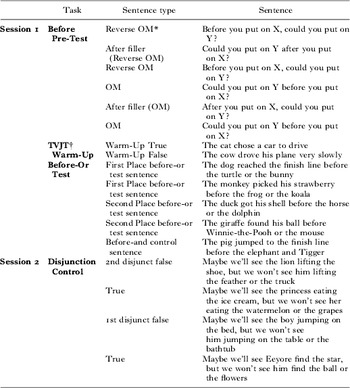
The children were tested individually over two sessions in a quiet corner of their daycare centre or kindergarten. In the first session, each child began with the Before Pre-Test, followed by a truth value judgement warm-up task, in which our puppet made several statements about a story which were obviously true or obviously false. This let the children know the puppet could say something wrong and familiarized them with the task. After the warm-up story, the children were given the Before-Or Test task. In the second session, children were given the Disjunction Control task. The full order of presentation (without filler sentences) is given, using English as an example, in Table 1.
Order of presentation of task sentences in English

note: * OM=Order of Mention, †TVJT=Truth Value Judgement Task.
Results
We coded each subject's initial response to the test sentences. Self-corrections were accepted only if the test sentence had not been repeated. If children changed their answer after the test sentence was repeated, this was coded as a ‘mismatch’ answer.
Nine English-speaking children were excluded from the final analysis because they failed more than one test item in the Before Pre-Test (2 children), they failed more than one filler item in either the Before-Or Test task or Disjunction Control task (2 children), they failed the before-and control sentence in the Before-Or test task (2 children), or they gave a mismatched answer to this control item (3 children). The remaining fifteen children ranged in age from 3 ; 4 to 5 ; 1 (9 girls, 6 boys, mean age 4 ; 4). All twenty Mandarin-speaking children (who were slightly older than the English-speaking children) successfully passed the Before Pre-Test, as well as all fillers and the before-and control sentence in the Before-Or test task.
Before Pre-Test results
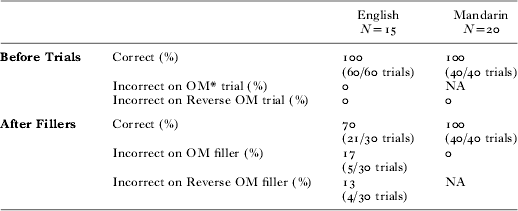
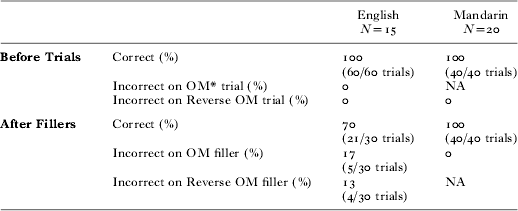
In English the Before Pre-Test consisted of four ‘before’ trials for each child (a total of 60 trials over the 15 children). The fifteen English-speaking children retained in the dataset made no errors on any ‘before’ trial (although six of these children did make one or more errors on the ‘after’ filler sentences).
In total, the percentage of correct responses to ‘before’ trials on this task in English was 100% (60/60 trials). We took this as evidence that the English-speaking children had an adequate knowledge of the semantics of ‘before’ to perform the test task. The fact that six children made errors on the ‘after’ fillers in this task was not considered grounds to exclude them from analysis of the Before-Or Test task, as this task relies on an understanding of the semantics of ‘before’, not ‘after’. It is possible that the greater number of ‘before’ trials in the English version of the Before Pre-Test biased some children to responding to all trials as a request to perform one action ‘before’ another one. There was no noticeable divide in ages between the children who made errors on the ‘after’ fillers and those who did not (the children who made ‘after’ errors were mostly younger children, 3 ; 4–4 ; 3, but also included some older children, 4 ; 8–4 ; 10), and the errors were equally spread over the two types of filler (those in which the correct order of actions was also the order of mention, and those in which it was the reverse of the order of mention).
In Mandarin, this task consisted of two ‘before’ trials for each child (a total of 40 trials over 20 children). None of the Mandarin-speaking children made any errors on this task, either on the ‘before’ trials or the ‘after’ fillers. In total, the percentage of correct responses to ‘before’ trials on this task was 100% (40/40 trials). We took this as evidence that the Mandarin-speaking children had an adequate knowledge of the semantics of zai … zhiqian to perform the test task. Table 2 summarizes these results across languages. Rates of error for the different ‘before’ trial types and ‘after’ filler types are given for completeness. However, as previously noted, this study was not designed to compare children's responses to these different orderings. Rather, we were interested in overall correct responses to ‘before’ trials.
Before Pre-Test results across languages
note: * OM=Order of Mention.
Disjunction Control task results
The Disjunction Control task consisted of two true trials and two false trials for each child and adult subject in both languages. In English this resulted in a total of thirty true trials and thirty false trials for the fifteen children, and forty true trials and forty false trials for the twenty adults. The English-speaking children responded correctly to their true trials 100% (30/30 trials) of the time, and they rejected their false trials 83% (25/30 trials) of the time. The reasons the children gave for their rejections were always clearly related to the conjunctive interpretation of disjunction under negation. For example, in response to the test sentence ‘We might see the lion lifting the shoe, but we won't see him lifting the feather or the truck’, a representative justification from a child aged 4 ; 6 is given in (16):
(16)
child: look, he lifted these [showing shoe and truck]
puppet: was I right or was I wrong?
child: wrong
puppet: can you tell me why?
child: cause he lifted the truck
Only one child (aged 4 ; 1) accepted both false trials and was thus potentially not computing a conjunctive interpretation of disjunction under negation. However, in examining this child's answers more closely, it is clear he was correcting the puppet on these trials, but was incapable of then making a judgement about whether the puppet had been right or wrong. This was most likely due to some confusion over the positive lead-in used in this task (in which the puppet was always right). An example of this child's answer to the sentence ‘We might see the lion lifting the shoe, but we won't see him lifting the feather or the truck’ is given in (17).
(17)
child: yes, I saw him lifting the truck AND the shoe
puppet: I guessed maybe we'd see the lion lifting the shoe but we wouldn't see him lifting the feather or the truck
child: but he lifted the truck too
puppet: so did I get it right or wrong?
child: I don't know … maybe right
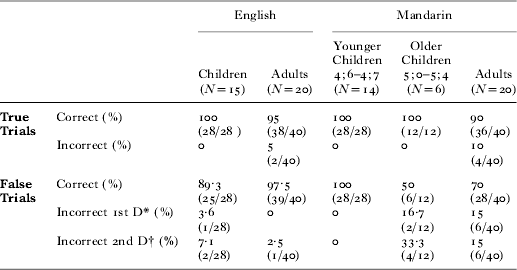
This child had no problem judging the puppet right or wrong in the Before-Or Test task (in which no positive lead-in was used), and thus was not excluded from analysis in the Before-Or Test task. However, if this child's answers are removed from the analysis of the Disjunction Control task (reducing the total number of trials to 28 true and 28 false over the 14 remaining children), the child rejection rate of false trial sentences rises to 89% (25/28 trials). The few errors the English-speaking children did make on false trials were made by three separate children, and occurred on both ‘1st disjunct false’ and ‘2nd disjunct false’ trials. There was thus no noticeable pattern of errors in response to the different types of false trial. The disjunction control task was included to check that children had an inclusive reading of disjunction, in the event that a child accepted the Second-Place before-or test sentences. However, the three children in question rejected all their Second-Place before-or test sentences. So, their incorrect responses in the disjunction control task were probably due to a lapse in concentration, rather than being indicative of an underlying exclusive meaning of disjunction. A Wilcoxon signed rank test showed the children's response patterns across the true and false trials in this task to be significantly different (Z=3·6, p<0·001).
The English-speaking adults accepted their true test sentences 95% of the time (38/40 trials), and rejected their false test sentences 97·5% of the time (39/40 trials). The rates in this task are thus highly comparable between children and adults. A Mann–Whitney test showed no significant difference between children's and adult's responses in this task to true trials (Z=1·2, p=0·633) or false trials (Z=1·4, p=0·458). We take this as evidence that the English-speaking children had an inclusive reading of disjunction. The English-speaking child and adult responses in this task are given in columns three and four of Table 3.
Disjunction control results across languages

notes: * 1st D=1st disjunct false; †2nd D=2nd disjunct false.
In Mandarin, both the twenty children and the twenty adults responded to a total of forty true trials and forty false trials in this task. The Mandarin-speaking children correctly accepted their true trials 100% (40/40 trials) of the time, and they rejected their false trials 85% (34/40 trials) of the time. The reasons the children gave for their rejections were always clearly related to the conjunctive interpretation of disjunction under negation. For example, in response to the test sentence Women keneng hui kandao tuzi chi baicai, danshi women bu hui kandao ta chi qingjiao huozhe caomei ‘We might see the bunny eating the cabbage, but we won't see him eating the green pepper or the strawberry’, in a context in which the bunny ate the cabbage and the strawberry, a representative justification from a child aged 4 ; 7 is given in (18):
(18)
puppet: Wo shuodui-le ma?
‘Am I right?’
child: Budui
‘No’
puppet: Weishenme?
‘Why?’
child: Yinwei tuzi chi-le caomei [pointing to the strawberry]
‘Because the bunny ate the strawberry’
The six acceptances of false trials all came from older children, aged five or over (5 ; 0–5 ; 4). This would seem to reflect development towards a possibly more adult-like interpretation of these sentences, as the twenty Mandarin-speaking adults who performed this task showed unexpected variability in their interpretation of the false test sentences: they only rejected these 70% of the time (28/40 trials), while they only accepted the true test sentences 90% of the time (36/40 trials). It would seem that though the majority of Mandarin-speaking adults typically access the conjunctive interpretation of disjunction under negation in a higher clause, others continue to interpret disjunction as they would when it occurs with negation in the same clause (i.e. they allow disjunction to scope over negation). This result is somewhat puzzling given that we expect negation in a higher clause to trigger a conjunctive interpretation of disjunction across the world's languages. We think that the variability in the Mandarin adults' responses in the Disjunction Control task could be due to our use of the verb ‘see’ (Mandarin kandao) in the higher clause of the relevant test sentences. The adults may have interpreted the verb ‘see’ as forming a single complex with the verb of the lower clause (e.g. ‘see lift’). This could have happened because Mandarin does not use complementizers or mark nominative and accusative case, so the cues to clause boundaries are greatly reduced for Mandarin speakers. When other verbs, such as ‘think’ (Mandarin renwei), occur in the higher clause, the Mandarin speakers we have questioned do access the conjunctive interpretation of disjunction in a lower clause (see example sentence (6)).
Given the clear-cut difference in the Chinese children's data by age in this task, we decided to divide the children into two groups: a younger group of fourteen children (4 ; 6–4 ; 7) who responded to twenty-eight true trials and twenty-eight false trials in total, and an older group of six children (5 ; 0–5 ; 4) who responded to twelve true and twelve false trials in total. The younger group correctly accepted their true trials 100% (28/28 trials) of the time, and they rejected their false trials 100% (28/28 trials) of the time. The older group accepted their true trials 100% of the time (12/12 trials), but only rejected their false trials 50% of the time (6/12 trials). For the other 50% of the time (6/12 trials), they accepted their false trials. These acceptances occurred on both ‘1st disjunct false’ and ‘2nd disjunct false’ trials, so was not due to a difficulty with a single type of false trial. A Wilcoxon signed rank test showed the younger Mandarin children's response patterns across the true and false trials in this task to be significantly different (Z=3·7, p<0·001), providing clear evidence that these children had an inclusive reading of disjunction. The younger children's responses were also compared to adult responses in this task using a Mann–Whitney test. No significant difference was found between the two group's responses to true trials (Z=1·76, p=0·341) or false trials (Z=2·64, p=0·051), although the difference in the two group's responses to false trials approaches significance due to the unexpected acceptances of false trials by Mandarin adults. The results are given in columns five to seven of Table 3.
Before-Or Test results
The Before-Or Test task consisted of two First-Place before-or test sentences and two Second-Place before-or test sentences for each child and adult subject, as well as one before-and control sentence for each child. The before-and control sentence was designed to check that children were listening to the end of the puppet's statements and processing both disjuncts. Any child who failed to correct the puppet on the before-and control sentence was excluded from analysis, as we could not be sure these children were responding to both disjuncts in the before-or test sentences. All results reported below are for children who successfully rejected the before-and control sentence.
To code the children's answers to the before-or test sentences, a number of response categories were identified. In addition to clear true or false judgements of the puppet's statements (i.e. in which the children's first answer was to say ‘yes’ or ‘no’ in agreement or disagreement with the puppet's statement), children also occasionally responded to First-Place before-or test sentences by identifying the character whom the winner of the race had come immediately before. This answer was classified as ‘Immediate Before’. It was further classified as being accompanied by a true or false judgement, or by no judgement at all. In response to the Second-Place before-or test sentences, children also occasionally gave an ‘Immediate Before’ answer, or they answered by identifying the character who had won the race. This answer was classified as ‘First Place’, and again was further classified as being accompanied by a true or false judgement, or no judgement at all. To calculate the overall rates of true and false judgements, we combined the following answer categories. For the First-Place before-or test sentences, true judgements comprised true answers, and ‘Immediate Before’ answers accompanied by a true judgement. A representative ‘Immediate Before’ answer from an English-speaking child aged 4 ; 10 in response to the First-Place before-or test sentence ‘The dog reached the finish line before the turtle or the bunny’ is given in (19):
(19)
child: um, the bunny rabbit.
puppet: did I get it right?
child: yeah
For the Second-Place before-or test sentences, false judgements comprised false answers, ‘First Place’ answers accompanied by a false judgement, as well as one ‘Immediate Before’ answer accompanied by a false judgement (as these answers were considered corrections of the puppet's original statement either by telling the puppet who had actually come first in the story or by telling him who the character in question had actually come before). A representative ‘First Place’ answer from an English-speaking child aged 3 ; 10 in response to the Second-Place before-or test sentence ‘[The giraffe]2nd place found his ball before [Winnie-the-Pooh]3rd place or [the mouse]1st place’, is given in (20):
(20)
child: um the mouse
puppet: do you think I'm right or I'm wrong?
child: wrong
puppet: wrong? What happened?
child: um the mouse, the mouse found the green ball
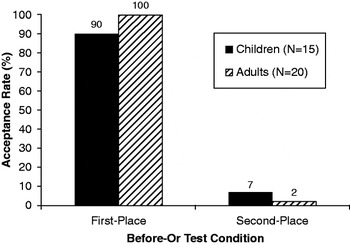
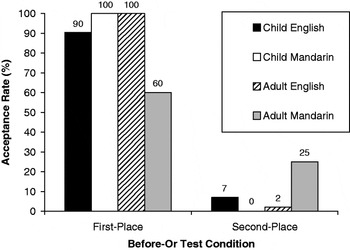
In English there were thirty First-Place trials and thirty Second-Place trials over the fifteen children, and forty First-Place trials and forty Second-Place trials over the twenty adults. Using the coding categories outlined above, the English-speaking children accepted their First-Place before-or test sentences 90% of the time (27/30 trials), and rejected their Second-Place before-or test sentences 93% of the time (28/30 trials). Two children did fail to reject a Second-Place before-or test sentence on one of their two Second-Place trials. One gave an ‘Immediate Before’ answer, but no judgement could be elicited. The other gave a ‘First Place’ answer, accompanied by a true judgement. Both of these children correctly answered all items in the Disjunction Control task, so it is perhaps possible that these two children were allowing disjunction to scope over ‘before’ on one of their two trials. However, the overall pattern of results across children clearly shows that English-speaking children have a preference to assign ‘before’ wide scope and compute the conjunctive interpretation of disjunction. A Wilcoxon signed rank test showed the difference between the children's responses in the two conditions to be significant (Z=3·49, p<.001). The children's justifications for their rejections typically showed they understood the test sentences as meaning that the referent of the subject NP had come first. For example, one child aged 4 ; 4 responded as follows to the Second-Place before-or test sentence ‘[The giraffe]2nd place found his ball before [Winnie-the-Pooh]3rd place or [the mouse]1st place’:
(21)
child: no
puppet: no? can you help me?
child: the mouse found his ball first
The twenty English-speaking adults tested accepted their First-Place before-or test sentences 100% of the time (40/40 trials) and rejected their Second-place before-or test sentences 97·5% of the time (39/40 trials). A Mann–Whitney test comparing child and adult responses in this task showed no significant differences in either the First-Place condition (Z=1·66, p=0·521) or the Second-Place condition (z=0·859, p=0·681). The comparison of English-speaking child and adult acceptance rates to the two types of trial is given in Figure 1.
Child and adult acceptance rates in English Before-or Test task.

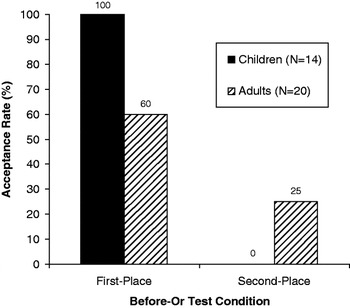
In Mandarin, there were forty First-Place trials and forty Second-Place trials over the twenty children and over the twenty adults. Overall, the Mandarin-speaking children accepted their First-Place before-or test sentences 100% of the time (40/40 trials), and rejected their Second-Place before-or test sentences 70% of the time (28/40 trials). Looking at the results by group, the fourteen younger Mandarin-speaking children accepted their First-Place before-or test sentences 100% of the time (28/28 trials), and rejected their Second-Place before-or test sentences 100% of the time (28/28 trials). A Wilcoxon signed rank test showed the difference between these younger children's responses in the two conditions to be significant (Z=3·74, p<0·001). These children's justifications for their rejections typically showed they understood the test sentences as meaning that the referent of the subject NP had come first. For example, the response of one child aged 4 ; 6 to the Second-Place before-or test sentence Wugui zai xiaoma huozhe yu zhiqian nadao-le beike ‘[The turtle]2nd place got his shell before [the horse] 3rd place or [the fish] 1st place’ is given in (22):
(22)
puppet: Wo shuodui-le ma?
‘Am I right?’
child: Budui
‘No’
puppet: Weishenme?
‘Why?’
child: Yinwei yu xian nadao-le beike
‘Because the fish got his shell first’
The six older Mandarin-speaking children, on the other hand, accepted their First-Place before-or test sentences 100% of the time (12/12 trials), and also accepted their Second-Place before-or test sentences 100% of the time (12/12 trials). This was the pattern we anticipated if children allowed disjunction to take scope over zai … zhiqian. The older children's results need to be considered alongside their responses to false trials in the Disjunction Control task. This task was designed to check whether our child subjects had an inclusive reading of disjunction. A child with an inclusive reading of disjunction should have rejected the false trials in the Disjunction Control task, showing that they accessed the conjunctive interpretation of disjunction under negation in a higher clause. Recall that the older group of Mandarin-speaking children only rejected their false trials in the Disjunction Control task 50% of the time (6/12 trials), and accepted these trials the other 50% of the time (6/12 trials); and their acceptances were not linked to one particular type of false trial. This pattern of results appears random, which could suggest that the six older children simply did not understand the disjunction control sentences. However, we feel this is unlikely given the fact that the younger children had no difficulty in responding to exactly the same sentences in the Disjunction Control task, and very consistently correctly accessed the conjunctive interpretation of disjunction under negation. Rather, we feel that the older children's pattern of results suggests a transition phase to a more adult-like interpretation of these sentences, in which disjunction can sometimes scope over negation, even in a higher clause. So this data, combined with the fact that the older children accepted the First-Place before-or test sentences in the Before-Or Test task, is taken as evidence that these children did have an underlying inclusive reading of disjunction. In other words, their performance on the Second-Place before-or test sentences cannot be attributed to them simply interpreting disjunction exclusively. If this were the case they should have accepted the false test sentences in the Disjunction Control task more consistently, and they should have rejected the First-Place test sentences in the Before-Or Test task.
The twenty Mandarin-speaking adults tested accepted their First-Place before-or test sentences 60% of the time (24/40 trials) and rejected their Second-Place before-or test sentences 75% of the time (30/40 trials). These results for Mandarin-speaking adults contrast clearly with English-speaking adults (as can be seen in Figure 3 below). In Mandarin, the conjunctive interpretation of disjunction is not the only reading in sentences with zai … zhiqian. Disjunction can also take scope over zai … zhiqian for adult speakers, making a Second-Place condition sentence true. In addition, for Mandarin adults, First-Place condition sentences may be false if a scalar implicature is computed. That is, when a speaker allows disjunction to scope over before then there are three truth conditions that make a sentence like ‘A came before B or C’ true: (i) if A came before B, but not C; (ii) if A came before C, but not B; (iii) if A came before A and B. First-Place condition sentences were presented in context (iii) and were thus logically true. However, as discussed in the ‘Introduction’, hearers who calculate a scalar implicature will assume that if a speaker uses ‘or’, he or she is not in a position to use the stronger term ‘and’ to describe the situation under consideration. Hearers therefore remove the truth conditions associated with ‘and’ from the meaning of ‘or’. That is, they remove condition (iii) from the truth conditions under consideration, and will thus reject a First-Place condition sentence. Indeed, the Mandarin-speaking adults who accepted the before-or test sentences in the Second-Place condition, rejected them in the First-Place condition, and justified their rejection by saying that the puppet should have used a conjunctive statement (e.g. The dog reached the finish line before the turtle and the bunny) rather than a disjunctive one. An example of a Mandarin-speaking adult's response to a before-or test sentence in the First-Place condition (in which the dog reached the finish line first) is given in (23):
(23)
puppet: Xiaogou zai wugui huozhe tuzi zhiqian paodao-le zhongdian
‘The dog reached the finish line before the turtle or the bunny’
adult: Budui, xiaogou shi zai wugui he tuzi zhiqian paodao zhongdian de, suoyi yao yong ‘he’
‘No, the dog actually reached the finish line before both the turtle and the bunny, so ‘and’ should be used here'
As we have seen, the older group of Mandarin-speaking children behaved much like these Mandarin-speaking adults in that they judged the Second-Place before-or test sentences to be true. The fact that the older children also accepted the First-Place before-or test sentences is not surprising, as it has been shown that children are less likely than adults to compute scalar implicatures, especially in certain tasks like the truth value judgement task (Gualmini, Crain, Meroni, Chierchia & Guasti, Reference Gualmini, Crain, Meroni, Chierchia and Guasti2001; Guasti, Chierchia, Crain, Foppolo, Gualmini & Meroni, Reference Guasti, Chierchia, Crain, Foppolo, Gualmini and Meroni2005). It is thought this is not because children lack the notion of information strength, but because they lack the computational resources needed to mentally construct an alternative representation of the sentence under consideration and then compare the relative information strength of this alternative sentence to the test sentence (Gualmini et al., Reference Gualmini, Crain, Meroni, Chierchia and Guasti2001).
A Mann–Whitney test comparing the younger Mandarin-speaking children's responses with adult responses in this task showed a significant difference in the First-Place condition (Z=3·06, p<0·05), although not in the Second-Place condition (Z=2·43, p=0·09). The comparison of the younger Mandarin-speaking children's and adult acceptance rates to the two before-or test sentence conditions is given in Figure 2.
Younger child and adult acceptance rates in Mandarin Before-or Test task.

Comparing the English and Mandarin results
The comparison of the English-speaking and younger Mandarin-speaking children's and adults' results across languages is given in Figure 3. The crucial finding was that the English-speaking children and the younger Mandarin-speaking children overwhelmingly accepted First-Place condition before-or test sentences (90% of the time in English, 100% of the time in Mandarin), and rejected Second-Place condition before-or test sentences (93% of the time in English, 100% of the time in Mandarin). This shows that both groups of children were computing a conjunctive interpretation for disjunction in the scope of before and zai … zhiqian respectively. A multivariate ANOVA comparing the effect of age and language on acceptance rates in the two test conditions shows a significant age by language interaction for both the First-Place condition (F=13·93, p<0·001) and the Second-Place condition (F=6·79, p<0·05). In other words, children across both language groups behaved similarly to each other, while adults differed. Strikingly, younger Mandarin-speaking children's responses were more like the responses of English-speaking children and adults than like those of Mandarin-speaking adults. At age five, Mandarin-speaking children begin to adopt more adult-like interpretations of the sentences tested.
Child and adult acceptance rates across languages in the Before-or Test task.

Discussion
The present study asked how children interpret disjunction in the downward entailing environment of the temporal conjunction before. In particular, our interest was to see whether the same cross-linguistic patterns of interpretation that have been observed in negative DE environments would also be found in sentences with before. We identified a cross-linguistic difference in how disjunction is interpreted in sentences with before in English and with zai … zhiqian in Mandarin. In English, a conjunctive interpretation of disjunction arises in sentences like ‘The dog reached the finish line before the bunny or the turtle’, because disjunction is interpreted in the scope of before. We suggested that this interpretation is triggered by the presence of a covert universal quantifier in the semantics of before. The universal quantifier establishes the logical set relations from which the conjunctive interpretation of disjunction is derived. In an English sentence of the form A before B, disjunction splits event B into two subevents. For event A to have occurred before event B, it must have occurred before every point-in-time in event B which includes every point-in-time in both of the subevents.
In Mandarin Chinese, by contrast, disjunction takes scope over before. This means the logical relation between the subsets of event B and event A are different. In Mandarin, for event A to have occurred before event B all that is required is for A to have occurred before every point-in-time in at least one of the subevents of B, but not necessarily before both of these subevents. Hence, the conjunctive interpretation of disjunction is not the unique reading that is assigned in adult Mandarin.
In view of the observed differences between adult English and adult Mandarin, we sought to determine whether or not English- and Mandarin-speaking children assign the same scope relations that are attested by adult speakers. If so, then English-speaking children would be expected to compute the conjunctive interpretation of disjunction in sentences with before, while Mandarin-speaking children would be expected to show a mix of both the conjunctive and non-conjunctive interpretation of disjunction in sentences with zai … zhiqian. By contrast, if children across languages are guided in their assignment of scope relations by the Semantic Subset Maxim, and adhere to the basic logical relation dictated by the semantics of before (essentially universal quantification), then they would be expected to compute the conjunctive interpretation of disjunction in sentences with before across languages, disregarding the scope relations used by adult speakers of the target language, at least initially.
Our data support the hypothesis that children adhere to the SSM and are guided by universal logical principles governing the interpretation of disjunction in the scope of downward entailing operators such as before. That is, when children are presented with a sentence containing two logical operators, hypothetically there are always two available interpretations. The SSM predicts that when faced with this ambiguity, children will initially prefer the interpretation that makes the sentence true in the narrowest range of circumstances, the subset reading. Proceeding in this way allows children to align their scope preferences with those of adults as quickly as possible. Children are presented with exactly this kind of situation when acquiring the semantic representations of sentences like ‘The dog reached the finish line before the turtle or the bunny’. Interpretation A of such a sentence would be ‘The dog reached the finish line before the turtle and before the bunny’. This makes the sentence true in a narrower range of circumstances than interpretation B: ‘The dog reached the finish line before the turtle or before the bunny’ (which could be true if the dog reached the finish line before one other participant or before both other participants). The SSM thus predicts that both English-speaking and Mandarin-speaking children should start with interpretation A, the conjunctive interpretation of disjunction. When Mandarin-speaking children realize that their language does allow a wider set of interpretations for sentences like ‘The dog reached the finish line before the turtle or the bunny’, they can easily add interpretation B to their grammar.
As we have seen, both English-speaking and younger Mandarin-speaking children do clearly and consistently interpret sentences like ‘The dog reached the finish line before the turtle or the bunny’ to mean that the dog reached the finish line first (before the turtle and before the bunny). They accepted such before-or sentences as descriptions of First-Place condition stories, and they rejected the same sentences as descriptions of Second-Place condition stories. They normally corrected the puppet in the Second-Place condition by pointing out who really had come first. This behaviour was in line with how English-speaking adults interpret such sentences, but was quite different to how Mandarin-speaking adults interpret such sentences. When Mandarin-speaking children reach age five they begin to allow disjunction (huozhe) to take scope over zai … zhiqian like Mandarin adults. It is likely that the evidence required to switch the children's interpretation of these sentences does not come from exposure to before-or sentences in the input alone, as these sentences are very rare, as far as corpus counts indicate. For example, in a survey of 224,797 parental utterances in seven English corpuses on the CHILDES database (the MacWhinney corpus, the Brown corpus (Adam, Eve and Sarah), and the New England corpus (Folders 14, 20 and 32)), we found only two instances of the requisite construction (e.g. from the MacWhinney corpus). In a survey of 80,625 adult utterances in four Chinese corpuses (the Beijing 1 corpus, the Beijing 2 corpus (Folders F2 and F3), and the Chang corpus) we found no instances of the requisite construction. It is possible, however, that Mandarin children accumulate the evidence for a reading in which disjunction scopes over zai … zhiqian from other construction types in which disjunction scopes over a downward entailing operator like negation. We are not committed to a particular type of evidence from the input triggering the observed change in scope interpretations for children. What is indisputable is that eventually Mandarin children do switch from their initial scope assignment.
Before adopting our interpretation of the findings, we will discuss several alternative ways to account for the data we found. One possibility that deserves consideration is that young children merely fail to distinguish between the meanings of ‘or’ and ‘and’. Suppose that the English-speaking and younger Mandarin-speaking children in our study interpreted the before-or test sentence ‘The dog reached the finish line before the turtle or the bunny’ as equivalent in meaning to ‘The dog reached the finish line before the turtle and the bunny’. If so, then they would also be expected to accept such sentences in the First-Place condition and reject them in the Second-Place condition. Although we did not control directly for children's understanding of ‘or’ as opposed to ‘and’, it has been shown that English-speaking children aged 3 ; 2–5 ; 9 do distinguish between these two logical connectives. In a study by Gualmini et al. (Reference Gualmini, Crain, Meroni, Howell, Fish and Keith-Lucas2000), children consistently rewarded a puppet with a coin 86% (24/28 trials) of the time following the puppet's statement ‘If a giraffe or a penguin is on the stage, then I get a coin’ in contexts in which only a giraffe or only a penguin appeared on the stage in question. Adult controls rewarded the puppet 90% of the time. By contrast, in the same contexts, the children did not reward the puppet 76% (32/42 trials) of the time when it said ‘If a giraffe and a penguin are on the stage, then I get a coin’. Adult controls did not reward the puppet 92% of the time in the same contexts. Given these results, it is reasonable to infer that the children in our study, too, knew the difference between ‘or’ and ‘and’.
Another possible explanation of our results should be considered. This alternative account maintains that young children are simply incapable of assigning inverse scope to two logical operators. This could arise either because they lack the grammatical competence to compute the inverse scope reading, or because they lack the requisite computational resources. In either case, if children are initially incapable of assigning inverse scope to two logical operators, then we would also expect both English-speaking and Mandarin-speaking children to interpret before as taking scope over disjunction, and thus to accept our before-or test sentences in the First-Place condition and reject them in the Second-Place condition.
Children's preference for assigning scope in line with the surface syntactic position of two logical operators has been dubbed the isomorphism effect in the literature (e.g. Musolino, Crain & Thornton, Reference Musolino, Crain and Thornton2000). The isomorphism effect has typically been investigated using sentences with operators like ‘not’ and ‘every’ (e.g. ‘Every horse didn't jump over the fence’). These sentences can have two readings. The first reading is referred to as the ‘surface scope’ reading, according to which none of the horses in question jumped over the fence. The second reading is referred to as the inverse scope reading, according to which at least one horse fails to jump over the fence. The term ‘surface scope’ is unfortunate, however, as it does not make clear whether scope is being assigned on the basis of the linear order of the logical operators or on the basis of the hierarchical precedence of these operators. In English, which is the language in which most of the work on children's scope preferences has been done, linear and hierarchical precedence are simply confounded. For example, the universal quantifier ‘every’ both precedes negation in linear order in the sentence ‘Every horse didn't jump over the fence’, and it is ‘higher’ in the syntactic structure. However, a study done comparing English with Dravidian, in which linear and hierarchical precedence are not confounded, has shown that children tend to assign scope based on structural considerations, and not on the basis of linear order (Lidz & Musolino, Reference Lidz and Musolino2002). We will thus use the term ‘structural scope’ rather than ‘surface scope’ in our discussion.
Early work investigating children's scope preferences showed that four- to five-year-old children experience difficulty accessing the inverse scope reading of sentences like ‘Every horse didn't jump over the fence’ (Lidz & Musolino, Reference Lidz and Musolino2002; Musolino et al., Reference Musolino, Crain and Thornton2000). However, later work on the isomorphism effect raised the possibility that children assigned structural scope in earlier studies because they were unable to accommodate certain pragmatic infelicities in the stories they were presented with. Gualmini (Reference Gualmini2005) demonstrated that, when experimental conditions were modified to make it more felicitous to use negation with the universal quantifier (by clearly setting up the focus of the test stories to be whether, for example, all of the horses could make it over the fence), English-speaking children aged 3 ; 0–5 ; 7 were able to access the inverse scope interpretation of sentences like ‘Every horse didn't jump over the fence’. These results have been replicated by Conroy, Lidz and Musolino (Reference Conroy, Lidz and Musolino2009) for English-speaking children aged 4 ; 5–5 ; 2, and Mandarin-speaking children have also been shown to access the inverse scope reading of similar sentences in Mandarin (Zhou & Crain, Reference Zhou and Crain2009). Given these more recent results on the isomorphism effect it is unlikely that the younger children in our study were simply incapable of accessing the inverse scope readings of our test sentences. Therefore, to account for our data showing that children around age four, across languages, initially assign wide scope to before in our before-or sentences, we need to identify a mechanism that initially guides children in their scope assignment preferences.
We have suggested here that the necessary mechanism is provided by the Semantic Subset Maxim. The SSM accounts nicely for our data, and avoids the criticism that has been levied against its precursor, the Semantic Subset Principle. In its original formulation, the SSP required there to exist two classes of languages, one class of languages with a unique ‘narrow’ interpretation of some sentence-type, and another class of languages with both the ‘narrow’ interpretation and another ‘wide’ interpretation of the same sentence. It has been questioned whether this type of learnability problem arises across languages (Musolino, Reference Musolino2006). The SSM avoids this controversy, since it applies to cases of scope ambiguities that occur whenever two logical operators interact in a sentence. We assume that, in such cases, there probably is no language that only allows a ‘narrow’ scope interpretation, and that both scope readings are available at all stages of acquisition, in view of the evidence from research showing that context can be manipulated to allow even young children to access either scope relation, even if one is highly preferred. The SSM instead reformulates the driving idea behind the SSP to assign default preferences for certain interpretive options that are available within all languages, but preferences that are found to differ across languages. Sentences containing two logical operators are ambiguous. In order to communicate most efficiently with adult language users, the child's task is to determine which of these interpretations is preferred in the local language. As formulated, the SSM anticipates a specific trend in children's scope assignment, rather than a categorical presence or absence of a reading. Nevertheless, the SSM predicts that children who are presented with a scope ambiguity will have a strong tendency to initially assign the ‘narrower’, ‘stronger’ meaning first.
The SSM should also apply to sentences containing the logical operators ‘every’ and ‘not’. In the case of a sentence like ‘Every horse didn't jump over the fence’, the narrow interpretation is ‘None of the horses jumped over the fence’ and the wider interpretation is ‘Not every horse jumped over the fence’ (which could be true if only one horse failed to jump over the fence or if all the horses failed to jump over the fence). The prediction would thus be that children across languages should initially assign a ‘none’ interpretation to such sentences. However, as we have seen, studies have shown that children do not only initially access the narrow interpretation of such sentences. Rather, both English- and Mandarin-speaking children have been shown to access both interpretations of sentences like ‘Every horse didn't jump over the fence’ in felicitous contexts (Gualmini, Reference Gualmini2005; Zhou & Crain, Reference Zhou and Crain2009). We would like to suggest that the data collected on these sentences to date has, nonetheless, shown that children do have a preference for assigning the ‘none’ interpretation. It is only if measures are taken to modify the context in which the sentences are presented to favour the wider interpretation that children are pushed to access this reading.
In conclusion, our cross-linguistic data provide clear evidence that, regardless of adult preferences, children prefer to initially assign a ‘narrow’ scope reading to sentences with two logical operators. In addition, the data clearly show that, once scope has been assigned, children conform to logical principles by computing a conjunctive interpretation of disjunction in the scope of the covert universal quantifier contained in the semantics of before. This work extends previous work in the domain of children's interpretation of disjunction in the scope of negative downward entailing environments to a wider cross-section of downward entailing operators. It appears that even in universally quantified downward entailing linguistic environments, children adhere to logical principles. This suggests that there may exist a deep semantic relationship between disjunction and downward entailing operators in general, and that children exploit this relationship as a linguistic universal during the language acquisition process. Further child acquisition evidence from languages in which disjunction can take scope over DE operators like before (e.g. Hungarian, Japanese or Danish) will serve to clarify this hypothesis.