Implication
Jeneponto, in South Sulawesi, Indonesia, is known to be the hottest and driest regency of the area. Under these conditions, fat-tailed sheep and Kacang goats are faced with high environmental temperatures and water scarcity. However, these animals are raised by small herders using same management strategies, as the farmers do not recognize the characteristic differences between these two species. Therefore, this study was designed to elucidate these differences, especially in their water balances and thermoregulation abilities. Understanding these characteristics is needed to boost the small herder incomes and to improve the rural farmer livelihood in this region.
Introduction
Environmental stress because of high temperature and/or water restriction has long been recognized as an important constraint for animal production in many parts of Indonesia. In South Sulawesi, Indonesia, Jeneponto is well known as one of the hottest and driest regions with an annual rainfall of less than 200 mm over 63 rainy days per year. Moreover, the daily temperature fluctuates between 17°C and 42°C. This climate may have both direct and indirect negative effects on animal production. However, the population of sheep and goats is denser than other regions. It appears that these two species of small ruminants have been well adapted to thrive in the harsh environment of Jeneponto, including the climate conditions as well as nutrient and water availability. This observation seems to conflict with numerous comparative studies that have suggested that goats are superior to sheep in thermoregulation, digestion, water balance and adaptive abilities (El Nouty et al., Reference El Nouty, Hassan, Taher, Samak, Abo-Ellezz and Salem1988; Silanikove, Reference Silanikove1992; Silanikove, Reference Silanikove2000a).
The determination of daily water exchange between animals and their environment is important for estimating water requirement as well as for evaluating their adaptability and productivity (Silanikove, Reference Silanikove2000a and Reference Silanikove2000b). The strategies used by these two species to adapt to the physical conditions of Jeneponto are intriguing. It is possible that the two species have the same level of water economy and less thermal discomfort. However, it is unknown whether sheep and goats use the same physiological strategies to counteract the climatic condition of Jeneponto. Therefore, this study was conducted to elucidate water balances and thermoregulation strategies used by sheep and goats under sunlight exposure and restricted water availability.
Material and methods
Five shorn fat-tailed sheep ewes (S) between 2 and 3 years and five Kacang goat does (G) between 1.5 and 2 years were used in this study. At the commencement of the study, the body weights of S and G were 26.98 ± 1.3 and 16.92 ± 1.14 kg, and at the end of the study their body weights were 26.65 ± 1.74 and 15.30 ± 1.25 kg, respectively. Both species originated from Jeneponto Regency, South Sulawesi, Indonesia.
The animals were individually placed in specifically constructed cages that had food and water containers in the cages, as well as feces–urine separators beneath the cages. The animals were fed chopped native grass and had access to a urea–molasses multi-nutrient block (UMMB; Food and Agriculture Organization, 2007) ad libitum throughout the experiment. All animals were orally dosed with an antihelminthic and intramuscularly injected with vitamin B-complex as well as a high dose of vitamin A shortly after being placed in the cages.
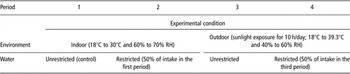
The experiment was conducted during the dry season. Table 1 shows that there were four treatment periods of 10 days each. Before collecting data for each period, the animals were allowed to acclimatize to the treatment conditions until the daily intakes of food and water were approximately constant, and a steady-state body temperature was obtained. It was assumed that a steady state was achieved when rectal temperature and respiratory rate remained constant for at least 1 h (within a range of 0.2°C and 10 respirations/min, respectively).
Environmental condition and water availability during four consecutive periods of experiment of 10 days each

RH = relative humidity.
Total water intake was calculated daily as the sum of daily consumed water, water contained in ingested food (preformed water) and metabolic water. The preformed water from native grass and UMMB was determined separately by drying the samples at 80°C for 48 h, and then cooling them in desiccators for 8 h to achieve a constant weight as well as to determine the content of fecal water.
The metabolic water from digestible organic matter (protein, carbohydrates and fat) was estimated for each animal on the last 5 days for each period. The amount of metabolic water was calculated by multiplying the amount of each digestible organic matter (protein, carbohydrates and fat) by factors of 0.41, 0.60 and 1.07, respectively, and by calculating the sum of these values (Brody, Reference Brody1945).
Evaporative water loss was estimated by subtracting the sum of fecal and urinary water loss from the total daily water intake. Evaporation from the drinking water in the vessel and ingested grass was corrected daily.
Urine and fecal outputs of each animal were monitored three times a day for each period, whereas a 10% pooled sample of urine and feces was collected each day. Dried food and fecal samples were finely ground to pass a 1 mm screen and were stored in sealed polyethylene containers for subsequent analysis. The organic matter content of the food or feces was calculated by subtraction of the ash content from the known weight of the food or feces sample; the ash content was determined by ignition of samples for 6 h at 550°C. Crude protein, fat and carbohydrate (fiber- and nitrogen-free extracts) contents of the food and feces were determined using the procedures of the proximate analysis (Association of Official Analytical Chemists, 1990).
Rectal temperatures and respiration rates were monitored four times each day at 0600, 1100, 1400 and 1600 h. Rectal temperatures were measured using a digital thermometer (accuracy ±0.1°C) inserted at a ±5 cm depth into the rectum. The respiration rates were determined by counting flank movements over a set period of time with the aid of a stopwatch.
Plasma volume was determined on the last day of each period at 1600 h using the dilution technique of Evan Blue, in accordance with the procedures previously described by Williams et al. (Reference Williams, Thornberry and Nicol1991).
The research was arranged as a factorial experiment of 2 × 4 with five replications and one factor as repeated measures; the first factor was species (S and G) and the second factor was period (four measurement periods). The analysis of variance for data and Duncan's multiple range test for significant differences of mean values were performed by using the computer statistical package ‘SYSTAT for Windows version 6’ (SPSS Inc., Chicago, USA; Wilkinson, Reference Wilkinson1996).
Results
Physiological parameters
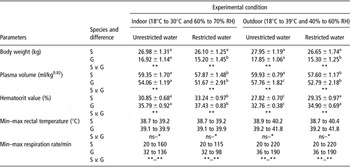
The effects of sunlight exposure and water restriction on several physiological parameters, including plasma volume, hematocrit value, rectal temperature and respiration rates, are shown in Table 2.
The effects of sunlight exposure and water restriction on body weight, plasma volume, respiration rate and rectal temperature of S and G

S = fat-tailed sheep; G = Kacang goats; RH = relative humidity.
Means with different superscript letters at the same variable within the same row of S or G are significantly different at P < 0.05; S v. G differences at *P < 0.05 and **P < 0.01.
Direct exposure to sunlight did not significantly change body weights of S and G that had restricted or unrestricted water availability. The reduction of water intake significantly decreased the body weights of G in both environmental conditions (P < 0.05), but the decrease in body weight of S was not significant.
The plasma volume of S was not significantly altered by direct exposure to sunlight either when water availability was restricted or when unrestricted. Direct exposure to sunlight significantly increased the plasma volume in G that were given unrestricted access to water (P < 0.05), but the increase was not significant when water access was restricted.
S maintained a more constant plasma volume compared with G. The plasma volume in G increased significantly when the maximum air temperature was increased to 39°C. The plasma volume of both species decreased significantly when access to drinking water was reduced to 50% of the ad libitum level.
Although there were no significant differences in the minimum rectal temperature between S and G, the maximum rectal temperature of G was significantly higher than S (P < 0.01) in all experimental conditions. In contrast, increasing respiration rates to the maximum level in all experimental conditions were higher in S than in G (P < 0.01).
Organic matter intake and digestibility
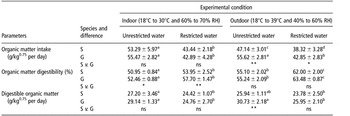
Table 3 shows that under control conditions without a heat load or a reduction in the access to drinking water, S and G showed the same level of organic matter consumptions, with G exhibiting better digestibility than S. When the animals were exposed to heat, however, S had significantly lower organic matter consumption than G, whereas both species had significantly higher digestibility when exposed to heat than under the control conditions. When access to water was restricted, both species reduced their organic matter consumptions; however, the digestibility of G was significantly higher than S (P < 0.01). In all experimental conditions, G digested more organic matter, especially under conditions of heat stress (P < 0.01).
The effects of sunlight exposure and water restriction on the intakes and digestibility of organic matter of S and G
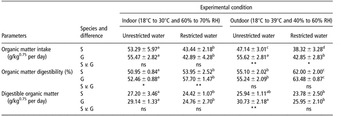
S = fat-tailed sheep; G = Kacang goats; RH = relative humidity.
Means with different superscript letters at the same variable within the same row of S or G are significantly different at P < 0.05; S v. G differences at *P < 0.05 and **P < 0.01.
Water balance
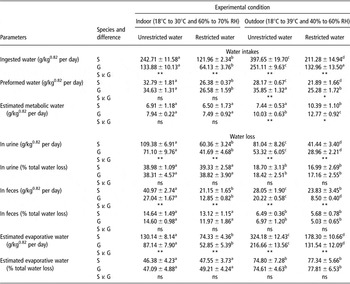
Table 4 shows that in all experimental conditions, the total daily water intake of S was significantly higher than G. Both species increased water consumption when the daily maximum air temperature increased to 39°C.
Effects of sunlight exposure and water restriction on water balance of S and G

S = fat-tailed sheep; G = Kacang goats; RH = relative humidity.
Means with different superscript letters at the same variable within the same row of S or G are significantly different at P < 0.05; S v. G differences at *P < 0.05 and **P < 0.01.
In all experimental conditions, the loss of water (g/kg0.82 per day) through urination, defecation and evaporation by S was markedly higher compared with G (P < 0.01). However, the proportions of total water loss by urination, defecation and evaporation were comparable between both species. These proportions changed when the maximum air temperature was increased (from 30°C to 39°C), but did not change when drinking water was reduced to 50% of the ad libitum level.
Fecal water loss
The fecal water loss accounted for the smallest fraction of total water loss in S and G compared with the other mechanisms of water loss. The amount of fecal water loss was higher in S than in G when expressed as g/kg0.82 per day. However, both species had comparable proportions of total water loss under all experimental conditions. At a maximum air temperature of 30°C, the proportion of the fecal water losses of both species ranged between 12% and 15% of the total water loss, whereas at a maximum air temperature of 39°C the proportion of fecal water loss decreased significantly to 5% to 7% (P < 0.01). Therefore, the proportion of fecal water loss was significantly affected by the increase in the maximum air temperature, but was not significantly affected when water consumption was restricted. In all experimental conditions, the feces produced by G were drier than those produced by S.
Urinary water loss
In all experimental conditions, the urinary water loss of S, expressed in g/kg0.82 per day, was significantly higher than that of G. Both species showed a significant reduction in urinary water loss when the daily maximum air temperature increased from 30°C to 39°C or when water consumption was reduced. However, the proportion of urinary water loss of the total water loss was comparable between the two species.
Evaporative water loss
Evaporation was the major mechanism of water loss under all experimental conditions and was significantly higher in S than in G (P < 0.01). Both species showed a significant increase (P < 0.01) in water lost by evaporation, which increased up to 2.5 times when the daily maximum air temperature increased from 30°C to 39°C.
When the proportion of the total water loss was considered, the water lost through evaporation was not significantly affected by water availability (P > 0.05), and was not significantly different between S and G. Both species had a significant increase (P < 0.01) in the proportion of water lost through evaporation, which changed from 46% to 49% under indoor conditions to 75% to 78% under outdoor conditions. On the other hand, the proportion of water lost through urination and defecation was markedly reduced when the indoor and outdoor conditions were compared (P < 0.01), which changed from 38% to 39% to 17% to 19% for urination, and from 12% to 15% to 5% to 7% for defecation, respectively.
Discussion
The body weight and plasma volume of S were maintained more constantly at a higher level than G when the daily maximum air temperature was 39°C. The results from S are inconsistent with a study by Silanikove (Reference Silanikove1987), which showed that the blood plasma volume increased under heat stress in Merino sheep. The results from Silanikove (Reference Silanikove1987) are consistent with the general trend noted in ruminants, where an increase in plasma volume is in proportion to an increase in water turnover (Silanikove, Reference Silanikove1992 and Reference Silanikove2000b). Therefore, these inconsistencies may be explained by the higher water turnover observed in S, and suggest that the basal conditions (control) are heat stressful. These results may also reflect physiological differences between breeds adapted to semi-xeric condition (Merino) and breeds adapted to hot tropical environments (S of Jeneponto).
In G, alterations in plasma volume were apparently in proportion to the thermoregulatory requirement. This response seems to be similar to those found in desert-adapted goats (El Nouty et al., Reference El Nouty, Hassan, Taher, Samak, Abo-Ellezz and Salem1988; Silanikove, Reference Silanikove2000a). We hypothesize that this is a strategy of G having smaller body size compared with S as a mechanism for coping with the high environmental temperature.
A significant increase in plasma volume in G should occur concomitantly with an increase in the total amount of body water (TBW), as the plasma is a component of the extracellular fluid. Previously, Taymour et al. (Reference Taymour, Kamar, Gabr and El-Masry1984) showed that heat stress increased TBW of the goats by about 8%, which is comparable with the increased plasma volume observed in our current study.
Accordingly, our present results indicate that heat load may also increase TBW in G, whereas it was relatively stable in S. Therefore, G seem to be more tolerable to higher heat storage and body temperature than S, and this may be beneficial to the animals for the prevention of water loss.
In this study, S and G showed different mechanisms for the dissipation of excessive heat because of an increase in air temperature. The basic mechanism for cooling is the evaporation of water from the respiratory tract (panting) and body surface (sweating; Silanikove, Reference Silanikove2000b; Robertshow, Reference Robertshow2004). The present results showed that in addition to an increase in body temperature, an increase in air temperature resulted in a remarkable increase in the respiration rate of both species. S had an 11-fold increase in the respiration rate compared with the basal conditions. In G, however, a 5- to 6-fold increase was observed compared with basal conditions. An increase in the respiration rate leads to an increase in the ventilation rate, which causes an increase in heat loss from the respiratory passage (Joshi et al., Reference Joshi, Aravindam, Singh and Bhattacharyya1977). Both species apparently used panting and sweating as a mechanism for cooling, and S used panting as the main evaporative cooling system, which is consistent with the general pattern for this species (Silanikove, Reference Silanikove2000b). On the other hand, G used sweating as the main evaporative cooling system (Dmi'el, Reference Dmi'el1986; Baker and Nijland, Reference Baker and Nijland1993). Reduced sweating during dehydration and/or excessive heat storage resulted in increased body temperature and selective brain cooling (Dmi'el, Reference Dmi'el1986; Bakernd and Mijland, Reference Baker and Nijland1993), which most likely relates to the thermolability observed in G from the present experiment.
Moreover, the increase in the respiration rate observed in S may have more homeostatic relevance, in addition to the higher daily total water exchange, for the dissipation of excessive heat and the maintenance of a lower body temperature compared with G.
An increase in ambient temperature resulted in reduced feed intake, which was most likely due to the metabolic rate of S, as noted by Silanikove (Reference Silanikove1992). This may be attributable to a reduction in thyroid secretion as well as gut motility, which leads to an increase in gut fill (Abdullah and Falconer, Reference Abdullah and Falconer1977). Therefore, it is reasonable to hypothesize that the appetite reduction of S under heat load may be primarily due to an elevation in body temperature. In addition, it may also be related to an increase in gut fill and a slower passage rate of digested material in the gastrointestinal tract.
In addition, a reduction in feed intake by S occurred simultaneously with an increase in water consumption. However, under this condition, G appeared to maintain a constant consumption of both food and water.
There is a positive relationship between digestibility and ambient temperature, which would be expected from the slower rate of passage (Christopherson and Kennedy, Reference Christopherson and Kennedy1983). Under heat stress, both species showed a similar increase in their digestibility. However, because S had a lower intake of organic matter than G, the digested organic matter was also lower. As a consequence, it may have resulted in a lower metabolic rate, heat production and body temperature in S than in G.
Previous studies have shown that the water content in the rumen tends to increase when water consumption increases, and the water turnover rate accelerates in goat (Silanikove, Reference Silanikove1989), sheep (Degen and Shkolnik, Reference Degen and Shkolnik1978), cows (Silanikove and Tadmore, Reference Silanikove and Tadmore1989) and swamp buffalo (Chaiyabutr et al., Reference Chaiyabutr, Buranakarl, Muangcharoen, Loypetjra and Pichaichanarong1987). The increased water content in the rumen was used to counterbalance water losses from the systemic fluid during dehydration.
The reductions in the plasma volume of S and G resulted from water restriction in either the indoor or outdoor conditions, and suggested that the release of vasopressin increased. An increase in vasopressin levels would suppress food intake (Purohit et al., Reference Purohit, Ghosh and Taneja1972; Meyer et al., Reference Meyer, Langhans and Scharrer1989) and increase water re-absorption from the kidneys (Molony et al., Reference Molony, Reeves, Hebert and Androli1987; Sand et al., Reference Sand, Nonoguchi and Knepper1987) as well as from the last part of the gut (Robertson, Reference Robertson1984).
Under control conditions, S and G had a total water exchange of approximately 280 and 175 ml/kg0.82 per day, respectively. When S and G were exposed to heat load, their daily water exchange increased to 430 and 295 ml/kg0.82, respectively, which showed that the water balance increased to a higher level than under the control conditions. These results could be attributed to the remarkable water economy exhibited by G as compared with S, which may have to do with the origin of the goats. Silanikove (Reference Silanikove2000a) suggested that goats originated from and adapted to hot and dry areas of the world, and that their water economy may be more efficient than other ruminants.
As expected, the daily total water consumption in both species increased at the daily maximum air temperature of 39°C. However, in relation to the organic matter intake and digestibility, the additional water (metabolic water and preformed water) in S was reduced, whereas in G these additional water amounts were relatively stable. Both species had a reduction in urinary and fecal water losses as well as in the amount of water per 100 g of fecal dry matter. In contrast, the water lost by evaporation remarkably increased.
The above discussion indicates that a simple physiological mechanism does not explain the remarkable tolerance of sheep and goats to heat stress and to low water availability. Sheep and goats that live in the harsh environment of Jeneponto may be able to withstand and adapt to the conditions because of their own mechanisms of heat and water balances.
The results clearly showed that under sunlight exposure with unrestricted water availability, S and G increased their maximum rectal temperatures from 39.2°C to 40.2°C and from 39.9°C to 41.8°C, respectively. Thermoregulatory strategies of S for maintenance of a lower rectal temperature mostly depend on increasing respiration rate as the main mechanism for dissipating excessive heat load. On the other hand, G apparently used sweating as the main cooling mechanism. Moreover, G seems to be more tolerable to a higher heat storage and body temperature than S, as there was a significant increase in plasma volume. This may be beneficial to the animals for the prevention of water loss. In all experimental conditions, the daily total water exchanges (ml/kg0.82 per day) of S were higher than G. As a percentage of the daily total water exchange, however, the water losses through urination (38% to 39%), defecation (12% to 15%) and evaporation (46% to 49%) by S and G were not significantly different. Under conditions of sunlight exposure, the water lost through urination and defecation was decreased to 17% to 19% and 5% to 7%, respectively, whereas the loss through evaporation increased to 75% to 78%.
Conclusion
S and G have developed different homeostatic mechanisms of thermoregulation and water balance to cope heat stress with or without concomitant scarcity of water. Different mechanisms may have an important impact on production management for improving productivity in the harsh environment of Jeneponto. The sheep with its own mechanism required more water compared with that of the goat. It may be beneficial for both species to lower their heat loads during the warmest hours of the day, thereby reducing the detrimental impact of thermal stress, such as by changing the time of feeding to the late afternoon.
Acknowledgements
This work was supported by a grant from the Ministry of National Education – Directorate General of Higher Education – Indonesia.