Wanton violence is an unfortunately common and often intentional feature of civil war. Each year thousands of civilians are killed by both government and insurgent forces. Moreover, massacres, mass rape and torture, abductions, and other wartime atrocities destabilize conflict areas, send rural peasants streaming into urban areas and across international borders, contribute to deteriorating public health conditions, and degrade the productive capacity of the ‘conflict state’. What influence does such violence have on the process and outcome of civil war? Studies of motives for the victimization of civilians are now common, positing both strategic and organizational causes for insurgent brutality. Regardless of the motive, civilian victimization reshapes the conflict environment and in so doing alters the conflict's trajectory. Surprisingly, scholars have only recently begun to systematically evaluate how the specific strategies of violence chosen by actors influence the process, duration, or eventual outcome of civil wars.Footnote 1
This lack of attention is problematic. First, understanding the relationship between anti-civilian violence and war outcomes could help to shed light on the motives for its use. Researchers often invoke assumptions about the strategic benefits of anti-civilian violence, but these assumptions have rarely been subjected to systematic empirical scrutiny. Second, research on civil war processes and outcomes is incomplete without examining how the specific strategies chosen by conflict actors alter a conflict's trajectory. Few empirical studies have investigated the impact of specific forms of violence on war outcomes.Footnote 2 Given these observations, there exists a clear need to examine explicitly whether and to what extent civilian targeting affects civil war processes and outcomes.
In this article we examine the manner in which victimization influences the likelihood of the most common outcome of post-Cold War insurgencies: negotiated settlement. We link victimization to the bargaining process that is embedded within conflict and demonstrate how violence influences the likelihood of the conflict ending in negotiated settlement. We argue that victimization improves the insurgents’ bargaining position by revealing to the regime information about rebel resolve and the likely costs of the conflict. Our theory also highlights the limits of anti-civilian violence in achieving successful settlement. At particularly high magnitudes, civilian victimization scuttles negotiations because the instability and speedy erosion of regime authority it creates in affected areas represent rapid shifts in the distribution of power between the actors. Empirically, we find support for the hypothesized curvilinear relationship.
In the following pages we first review the literature on the causes of civilian victimization, highlighting the debate between organizational and strategic perspectives. Our focus on conflict outcomes is pertinent to this debate because much of the strategic violence literature adopts the perspective that violence is instrumental in achieving the user's goals but fails to examine this assumption systematically. Hence, while our theory focuses on the relationship between civilian targeting and conflict outcomes, it has implications for research on the motives for anti-civilian violence. We then present our theory, which draws both on recent rationalist approaches to victimization and the conflict bargaining literature. Subsequently, we describe our research design and present our findings. The final section discusses the implications of our findings and offers concluding remarks.
Structure, Strategy, and Efficacy
Recent theories on the causes of violence against civilians broadly break into two categories: organizational and strategic. The former asserts that victimization stems from underlying conditions within the group or conflict state or originates from the organizational structures that such conditions produce. Notably, Weinstein locates violence in the initial conditions of the conflict state, where the types of resources available to a group largely determine the types of troops drawn to the movement.Footnote 3 Groups with access to large material resource endowments attract opportunistic recruits, who are more likely to engage in looting and wanton violence. Beardsley and McQuinn similarly argue that access to lucrative resources incentivizes violence and reduces the group's regard for the interests of the local population.Footnote 4 Other scholars have put forward similar explanations, suggesting that in the post-Cold War world victimization is linked to the appearance of greedy rebels, efforts to signal loyalty to foreign financiers, and the inability of groups relying on external or illicit resources to police their troops sufficiently well.Footnote 5
Echoing Hannah Arendt, an alternative perspective views violence as instrumental.Footnote 6 Unlike organizational and structural theories, which view the mistreatment of civilians as a by-product of elements of the conflict environment, strategic perspectives explicitly tie the motivations for violence to its anticipated influence on conflict processes. Violence is thus a component of a belligerent's military strategy. For example, attacks on civilians are often intended to achieve process-oriented objectives such as disrupting regime control, controlling target populations, eliminating potential threats, or generating material resources.Footnote 7 Insurgents may also victimize civilians in order to improve their bargaining position relative to the regime, thereby increasing their ability to achieve concessions from it.Footnote 8
While the rationalist paradigm on civilian targeting rests on the belief that violence benefits those who employ it, the effectiveness of such violence has not yet been demonstrated empirically. Few studies have directly assessed the effect of anti-civilian violence on conflict processes, and the few that have offer contradictory conclusions. Kocher, Pepinsky, and Kalyvas find that during the Vietnam War indiscriminate bombing by the United States Air Force promoted rather than deterred Viet Cong control of targeted hamlets.Footnote 9 Yet, Lyall finds that indiscriminate Russian attacks on Chechen villages effectively suppressed insurgent activities in targeted areas.Footnote 10 Similarly, little research has addressed more general questions about the influence of victimization on war outcomes. The analysis of the Second Anglo-Boer War carried out by Downes suggests that mass violence can contribute to victory under certain conditions.Footnote 11 Similarly, Pape provides evidence that anti-civilian suicide terror tactics can succeed in driving out foreign occupiers.Footnote 12 Other studies argue that terror tactics largely fail to achieve insurgent goals, and one notable study concludes that terrorism is simply not strategic.Footnote 13
These contradictory findings call for additional scrutiny into the manner in which civilian targeting influences the trajectory and outcome of insurgencies. This assessment is not only relevant to understanding why and when rebellions end but also to validating core assumptions of strategic theories of violence. We focus below on how strategies of violence influence war bargaining and, therefore, the probability of negotiated settlement. We focus on conflict bargaining both because of the intuitive appeal of the bargaining framework in analyses of conflict processes and because of the frequency of negotiated settlements among post-Cold War insurgency outcomes.
Bargaining in Civil War
Following recent research we conceptualize civil war duration and outcome as products of an iterative bargaining process between governments and rebels.Footnote 14 In line with these works, we focus on factors that shape the bargaining process and so the time to specific conflict outcomes. Violence dynamics – including intentional attacks on civilians – shape conflict bargaining and influence war outcomes by revealing previously private information about the actors and producing insights into the likely costs of the conflict.Footnote 15 We adopt a stylized model of civil war dynamics in which war consists of iterated rounds of conflict and bargaining. Given that we focus on war trajectory and outcome, we assume that the contest is already under way and both sides have committed to some period of combat. Following a round of combat there are four potential outcomes: (1) the two sides agree on the division of the disputed good, and the fighting stops; (2) the rebels are defeated militarily, and the conflict ends; (3) the rebels prevail over the regime, and the conflict ends; (4) both sides survive and enter a new round of conflict.Footnote 16 In line with this rationale, we explain war outcomes by examining jointly the features that promote the likelihood of a successful settlement and those that increase the likelihood that one party is eliminated from the conflict militarily.
The decision calculus through which conflict actors determine whether to settle or continue to fight at each time point has been usefully modeled as a function of the expected payoff from possible war outcomes.Footnote 17 Conflict actors evaluate the (a) probability of victory versus defeat, (b) returns from victory relative to costs of defeat, (c) rate at which they expect to absorb conflict costs, and (d) expected duration over which they will bear these costs. Actors are expected to continue fighting so long as the expected value of eventual victory exceeds the expected accumulated costs of the conflict between the present time and the end of the conflict. Conversely, a negotiated settlement is expected when the payoff for concessions in the present (assumed to be less than victory but greater than defeat) exceed the anticipated accumulated war costs until victory.
This iterative bargaining approach offers insight into the factors that shape the willingness of belligerents to choose a settlement over continued conflict at each time point. Previous research using this approach suggests that the factors that reduce an actor's probability of victory, reduce the payoffs for victory, increase the rate of cost absorption, or increase the time to victory should also increase the likelihood of negotiated settlement.Footnote 18 Thus, even if an actor believes it can eventually win the contest, the costs of the war and its expected duration may make concessions the more profitable alternative. Assessing the likelihood of any given war outcome, therefore, requires examining factors that alter actors’ expectation of the conflict's costs and duration.
Expectations of cost, duration, and outcome are fraught with asymmetric information and the inability of factions to make credible commitments, both of which confound conflict bargaining and so shape the duration and outcome of conflict.Footnote 19 Each actor holds private information regarding its capabilities, resolve, and the minimum concessions it is willing to accept to discontinue fighting. The intersection of these reservation points yields a bargaining space in which a negotiated resolution to civil war is possible. However, both sides have incentives to misrepresent their strength, resolve, and reservation points in anticipation of a better deal. Battlefield outcomes as well as the strategies employed inform a belligerent about the nature of its adversary and its demands, thus shaping belligerents’ expectation of the costs of ongoing conflict relative to the price of concessions. If battlefield interactions suggest a long and costly conflict, the actor's incentive to settle should increase. However, given the asymmetric nature of insurgency, battlefield interaction alone may not accurately signal the total costs associated with the conflict or the group's resolve. Other violent events – such as terrorism or civilian victimization – function as useful channels through which the regime evaluates the expected cost and duration of the conflict.
While conflict interactions and victimization yield information about expected conflict costs and actors’ resolve, changes in the conflict environment may still undermine the parties’ ability to commit credibly to a peaceful settlement. Specifically, rapid shifts in the power distribution or an increased expectation of potential gains from fighting may undermine the achievement of a negotiated settlement if an actor believes future gains outweigh the concessions it would receive today.Footnote 20 In the subsequent section we discuss how civilian victimization influences the war bargaining process.
Victimization and Conflict Processes
In this section we address three aspects of the relationship between civilian targeting and conflict processes. First, we address the important connection between process-oriented goals and broader political objectives. We argue that the latter are contingent on the former, and illustrate how insurgents often employ anti-civilian violence in order to achieve process-oriented goals. Second, we focus on two specific features of civilian victimization's influence on the bargaining process: expected conflict costs and duration. Attacks on civilians impose both direct and indirect costs on the regime, both of which raise the costs of war to the regime. Anti-civilian violence also signals insurgent resolve, revealing to the regime that the war is likely to be long and brutal.Footnote 21 We argue that the likelihood of negotiated settlement increases as the regime's expectations of the likely costs and duration of the conflict increase. Third, we discuss the limits of anti-civilian violence in achieving a negotiated solution. At particularly high magnitudes violence can rapidly weaken regime control over the conflict space. This means that it can potentially create substantial (if temporary) shifts in the distribution of power between the state and the rebels. As power shifts, the likelihood of settlement declines. In this sense, rising violence produces cross-pressures on the attainment of negotiated outcomes to civil war.
Process and Outcome
Civil conflicts are typically marked by severe capability asymmetries that favor the status quo power (the government) over the challenger (the insurgents). In order for rebels to obtain their ultimate political objectives (i.e., secession or regime overthrow), they must generate the military capacity effectively to challenge and potentially to defeat the regime. However, they must first attain a series of process-oriented goals that make the attainment of larger political goals possible. In this sense, insurgent objectives resemble a hierarchy of needs. As in Maslow's hierarchy of human needs, in which ‘self actualization’ is only achieved following the attainment of food and security,Footnote 22 the ability of insurgents to achieve political goals such as victory or concessions from the regime is predicated on their ability to mount a continually robust and costly challenge to the government. The rebels’ ability to challenge and punish the regime requires the acquisition of material resources such as military hardware, medical supplies, food, and the means of transportation. Furthermore, rebels must recruit troops, deter dissent, and institutionalize resource extraction in order to sustain the movement. Failure to accomplish these process goals often results in the movement's collapse. These tasks, therefore, do not simply serve as one-time objectives but rather represent continuous goals.
Attacks on civilians are instrumental in generating resources, shaping civilian behaviors, liquidating opponents or civilians suspected of disloyalty, and dismantling or diminishing regime governance structures.Footnote 23 As such, victimization helps to promote insurgents’ process-oriented goals.Footnote 24 Furthermore, to the extent that victimization abets the achievement of process goals, we argue that it enhances insurgents’ ability to achieve political objectives. Importantly, the manner in which insurgents choose to achieve these goals has implications for war outcomes. As we discuss below, the pursuit of these goals both imposes costs on the regime and signals insurgent resolve.
Victimization represents only one strategy by which insurgents can accomplish these goals. Alternatively, rebels can slowly build control, support, and a base of resources via community networks and grassroots mobilization. They may also slowly expel government forces and extend control over territory by more conventional attacks, but only once they have established stable recruitment and resource extraction practices. After consolidating control over territory, rebels may eventually establish political institutions and engage in public service provision. However, these strategies are time consuming, and their success often depends on factors beyond the group's control. For example, the extension of control over territory by nonviolent means often requires weak extant state control, a supportive population, or access to sanctuary in a sympathetic bordering state. While insurgents may have some influence over these factors, it is often weak or requires the accumulation of significant resources and time to develop. By contrast, victimization is less costly and can be employed more rapidly.Footnote 25 Moreover, attacks on civilian targets can provide distinct benefits absent from less brutal strategies. Hence, while other strategies might accomplish the same goals, they do not necessarily carry the same consequences for conflict outcomes. We discuss these benefits in detail below.
Costs and Resolve
According to the bargaining approach discussed above, actors update their willingness to continue fighting as conflict reveals information about the expected costs of war. As expected costs increase, the incentive to continue the war declines. As such, previous studies find that more costly wars arrive at negotiated conclusions more rapidly than those that are less costly.Footnote 26 As with other war costs, we expect increasing levels of civilian victimization to reduce the regime's desire to continue the war by elevating the expected costs of continued conflict over the value of concessions. Previous research notes the potential role that attacks on civilians play in conflict bargaining.Footnote 27 Yet, these studies have not explicitly worked out the theory of the mechanisms through which victimization shapes bargaining or how it differs from other violent strategies. Rather, they largely assume that victimization functions as a supplement to conventional violence. Yet, not all war costs are the same. Rebels and states absorb different costs in different ways. How violence inflicts costs and the ability of actors to absorb them are important aspects of the bargaining process.
A striking feature of civilian targeting is that it allows insurgents to distribute conflict costs asymmetrically. Acts of terror, sabotage, massacres, and assassination heap costs on the regime, while allowing the rebels to shield themselves from the costs of direct engagement with the government. By imposing costs yet undercutting the adversary's ability to levy costs in return, victimization exerts a unique ‘power to hurt.’Footnote 28 This characteristic is central to the war bargaining process. The ability to force an opponent to yield is jointly defined by both the power to impose costs on the adversary and to bear costs in return.Footnote 29 As such, the ability to absorb costs or to limit the adversary's ability to impose them is as important as the ability to impose costs on an adversary. A superior power to hurt thus improves an actor's bargaining position. As the status quo actor, the regime disproportionately bears the costs of victimization. Rebels typically have little infrastructure and their economic activities are often explicitly tied to the conflict. Moreover, civilian expectations of the provision of goods and security are lower for insurgents than for the government. Indeed, rebels at times use indiscriminate attacks on civilians to signal the regime's inability or indifference to protecting civilian populations.Footnote 30 Reliance on victimization as a strategy for achieving first-order goals, therefore, benefits insurgents by disproportionally shifting costs to the regime while limiting the costs the regime can impose in return.
The asymmetric nature of victimization costs also requires the regime to divert resources away from strictly military endeavors and toward burdens outside the immediate conflict zone. The indirect costs of victimization are often high. Following rebel massacres the state must not only devote resources toward protecting vulnerable populations and stabilizing areas of rebel attacks, but it must also absorb significant indirect costs from the population displacement such violence creates. Internally displaced persons (IDPs) flee active conflict areas and fill camps and slums in already crowded urban areas. Their presence strains local infrastructure and rapidly causes a deterioration in local public health conditions, a situation that is exacerbated when rebels intentionally target public services and health infrastructure.Footnote 31 Moreover, IDP populations often serve as focal points for antigovernment activity and a source of resources for rebels.Footnote 32 Victimization also produces significant asymmetric economic costs. American and British bombings during the Second World War crippled German productive capacity, in part by depopulating industrial cities.Footnote 33 Similarly, Malayan Communist terrorism against plantation laborers severely damaged the colony's rubber industry.Footnote 34 Other studies find that protracted terrorist campaigns can impose significant costs on the economies of small and developing countries.Footnote 35 Because insurgents often thrive on war economies, the costs of economic destruction fall most heavily on the regime.
Furthermore, attempts to contain rebel activity and stabilize conflict zones may inadvertently produce more violence. Kalyvas argues that as an actor's control weakens violence becomes more indiscriminate.Footnote 36 Thus, any government gains may be countered with increased rebel victimization. The Viet Cong worked with brutal effectiveness to undermine government efforts to shore up stability and impose order.Footnote 37 Similarly, the expansion of government services in regions of rebel activity often contributes to increased insurgent violence.Footnote 38 Development projects and other public services often become the targets of rebel attacks, as do the civilians that utilize them.Footnote 39
Victimization likewise shapes the government's expectations regarding the rebels’ resolve in continuing the conflict, and, as such, their assessment of the ultimate time to and cost of victory. Victimization signals that rebels are willing to continue the war by any means necessary, indicating that even if the regime prevails the war will likely be nasty, brutish, and long. Indeed, recent research suggests that extremist groups resort to terrorism as part of an attrition strategy.Footnote 40 In order to succeed in a war of attrition, insurgents must demonstrate not only that they are able to impose costs, but also that they are resolute and capable of continuing the fight over the longer term. Consequently, as the magnitude of violence increases, it signals not only a costly war but also a protracted, brutal conflict. Taken together, these two features of victimization should raise the regime's willingness to offer concessions and thus end the conflict.Footnote 41
Credibility and Victimization
We argued above that increases in anti-civilian violence should increase the likelihood that the regime offers concessions that sufficiently satisfy the rebel's political demands, thus halting the conflict. Successful resolution requires the credible commitment of both belligerents. However, particularly high levels of victimization can undermine the ability of each side to commit to a negotiated settlement. This occurs because changes in the strategic environment and uncertainty about the future distribution of power can undermine negotiated solutions, resulting in the continuation of war.
Conflict bargaining research shows that rapid changes in the distribution of power contribute to bargaining breakdown.Footnote 42 Bargaining fails in the context of shifts in the power distribution because the temporarily weak actor must make concessions that extend over several periods during which the distribution of power is shifting in its favor. As its capabilities rise over this period it becomes increasingly likely to renege on the concessions, leading to the resumption of war. In the context of bargaining between the rebels and the government, uncertainty over the probability of insurgent collapse hinders successful negotiations.Footnote 43 Insurgents are initially uncertain about their probability of survival and may accept a modest offer from the regime. However, if the group is able to survive this initial period of uncertainty and increasingly believes that the rebellion will endure, it becomes less likely to accept the initial settlement offer and will hold out for a larger future payoff or gamble on victory. Alternatively, rapid shifts in the distribution of power during civil wars can create incentives for the weakening side to reject concessions and continue to fight in an attempt to forestall continued adverse shifts in the distribution of power.Footnote 44 In either case, shifting power undercuts the likelihood of settlement.
This observation has implications for the role of victimization in conflict bargaining. Power shifts occur in the context of civil wars as a result of intervention by external powers, the depletion of resources, successful recruitment campaigns, decisive battles, economic decline resulting from combat, or the rapid disintegration of one side's military forces or command and control structures. Moderate levels of victimization may slowly diminish power asymmetries between rebels and the state, but significant spikes in the magnitude of such violence potentially shift the distribution of power in favor of the insurgents. Specifically, intense campaigns of anti-civilian violence conducted over a short period effectively undermine regime control over territory and populations and destabilize the conflict zone. Indeed, attacks on civilians are often explicitly intended to create instability, erode regime control, and alter the balance of power in affected areas.Footnote 45 In Vietnam the National Liberation Front (NLF) directed its cadres to liquidate ‘tyrants and traitors’ in areas where the party was weak. This strategy was aimed at ‘breaking the enemy's control and weakening [its] prestige,’ after which NLF forces would be better able to assert administrative power over hamlets and villages.Footnote 46 Similarly, RENAMO victimized civilians in order to destabilize areas suspected of loyalty to the regime.Footnote 47 A similar pattern emerged during the Spanish Civil War as victimization was most extreme in areas that had previously shown significant political support for the adversary.Footnote 48 The intention of such victimization is to degrade regime control, eliminating or driving out enemy supporters, and undermining neutral civilians’ acceptance of regime authority.Footnote 49 Given the zero-sum nature of civil warfare, any loss of state control represents a reciprocal gain for insurgents. This occurs regardless of whether the group can effectively govern the territory it seizes from the regime.Footnote 50 Arendt is likely correct that while violence disrupts power, it is incapable of replacing it.Footnote 51 However, disruption is the principal strategic aim for insurgents and a critical step toward victory because it helps shift the distribution of power away from the state.
These shifts entail two related consequences for the likelihood of locating a successful negotiated resolution to the conflict. First, the erosion of regime power and the subsequent opportunities it creates leads insurgents to reevaluate their expected gains and to revise downward the likelihood of defeat. Violence-induced instability may, therefore, undermine an actor's ability to commit credibly to a negotiated solution. In this sense, the dynamic resembles bargaining in the shadow of shifting power.Footnote 52 In a related manner, in the wake of a destabilizing victimization campaign, the temporarily weakened state may choose to fight rather than accept a weaker bargaining position in an effort to arrest or impede adverse shifts in the power distribution.Footnote 53 In both cases, bargaining collapses because one or both parties cannot commit credibly to a peaceful settlement.
The above arguments suggest that attacks on civilians benefit insurgents by improving their bargaining position. The combination of the costs imposed by victimization and its ability to signal a long and brutal war increases regime willingness to offer sufficient concessions to the rebels. However, we also expect that particularly high levels of insurgent violence have the potential to undermine successful settlement by contributing to shifts in the distribution of power and changing expectations of rebel durability. These changes undercut the ability of the actors to commit credibly to negotiated settlement. Therefore, we anticipate a curvilinear relationship between civilian victimization and the likelihood of the termination of war with a durable settlement. From this discussion we generate our central hypothesis:
HYPOTHESIS 1: Victimization exerts a curvilinear relationship on the likelihood of civil war ending in settlement, such that the likelihood of settlement is high at moderate levels of insurgent violence and low at low and high levels of violence.
Data and Research Design
Victimization and Outcomes
To test our expectations on the role of violence against civilians on conflict outcomes, we draw on detailed data on both civil war conflict events and civil war termination. As we note above, war outcomes are intimately related to the dynamics of the conflict that occur over time. Changes often occur rapidly during conflicts as belligerents respond to conditions on the battlefield, fluctuations in the balance of power, the entry of foreign forces, and other dynamic features of the conflict environment. Our argument focuses on the manner in which conflict dynamics, namely the level of anti-civilian violence, alter the likelihood of a settlement. Given that violence is not uniform over time, our analysis requires finer grained data than the annual dyadic or conflict-level data commonly used in studies of civil war.
We rely on two datasets from the Uppsala Conflict Data Program v1.0 (UCDP). Our violence data come from the UCDP Geocoded Events Dataset (GED), which provides events-level data on conflict violence for African insurgencies between 1989 and 2010.Footnote 54 The GED relies on a variety of media, nongovernmental organization (NGO), international nongovernmental organization (INGO), and governmental reports to collect information on the actions of conflict actors.Footnote 55 We aggregate these data to produce monthly values for rebel and government violence against civilians and the number of government and rebel troops killed in battle.Footnote 56 Our unit of analysis is consequently the dyad-month. We merge these monthly events data with UCDP's Dyadic Conflict Termination Dataset, which codes the date of the termination of the conflict dyad as well as how it ended according to a typology of war outcomes.Footnote 57 This typology distinguishes between negotiated settlements, rebel victory, government victory, and cessation due to ‘low activity’ (fewer than twenty-five battle deaths per year). Insurgencies often become inactive and later reignite into open conflict. In order to address this issue we use a thirty-six-month window to account for reemergent dyads within the dataset and consider any conflicts that recur during this period as extensions of the same conflict. When a conflict reemerges after a thirty-six-month break we code it as a new conflict. This coding scheme removes brief periods of inactivity and temporary ceasefires, allowing us to make a better evaluation of the factors that contribute to durable war termination.Footnote 58
To capture the effect of Rebel Victimization of civilians on the likelihood of settlement we use events data from the GED on civilian deaths attributed to each insurgent group. This measure explicitly captures the number of intentional and direct civilian deaths caused by rebel actions in each month and excludes unintentional deaths via collateral damage or indirect casualties occurring as a byproduct of war (such as famine or illness).Footnote 59 For instance, an event in which rebels attacked a village and executed members of the town council or one in which insurgents detonate a car bomb in a busy market place are included. However, civilians killed in the crossfire between rebel and government troops during a street battle would not be included, nor would the peasants who died as a result of disease because their local health clinic was destroyed during a rebel attack. While these types of violence play a significant role in civil conflicts, the victimization measure used here helps ensure that we are accounting for purposeful violence committed by rebels against civilians, which is the focus of our theory. These data are among the most advanced and nuanced quantitative data on conflict violence available to scholars and represent a significant improvement over previous studies that relied on more aggregate casualty measures.
Our argument implies a cumulative effect for violence. Victimization campaigns are implemented over time, and it is these campaigns to which the government responds in reevaluating its prospects for victory, the war's expected duration, and the value of ultimate victory. To account for this, we construct our variable as the cumulative total of rebel violence against civilians occurring over the previous six months of the conflict.Footnote 60 Because of the notable positive skew in the deaths count we transform the variable by adding 1 and then taking the natural log of the value. Our discussion also suggests that violence exerts a curvilinear effect on the likelihood that the government offers sufficient concessions to the rebels, so we include the squared value of the rebel victimization variable.
Control Variables
We also include a number of relevant controls. First, we account for Government Victimization of civilians. Research on the influence of indiscriminate state violence on conflict outcomes is inconclusive. On the one hand, heavy-handed repression may create backlash against regime goals, thereby increasing the bargaining stance of the rebels.Footnote 61 On the other hand, some evidence indicates that mass violence successfully deters rebels and can eventually end rebellion.Footnote 62 We code Government Victimization identically to Rebel Victimization.Footnote 63 Battlefield costs also shape conflict outcomes. Past studies largely focused on battlefield costs, but have not demonstrated a strong relationship between conflict casualties and a negotiated settlement, which may be due in part to past data restrictions.Footnote 64 Thus we include separate variables to account for the numbers of Government Troop Deaths and Rebel Troop Deaths accrued during the previous six-month period. These values are constructed from the GED and are log-transformed.
Characteristics of insurgency may also impact the duration and outcome of the war. Territorial Control indicates whether rebels exerted at least moderate control over some areas of the state. We also include a measure of Central Control, which indicates the leadership's ability to enforce at least moderate control over their troops. Fighting Capacity indicates a strong ability on the part of the rebels to engage the government's army on the battlefield and achieve battle victories. Each measure is a binary indicator and is coded from the Non-State Actor dataset.Footnote 65
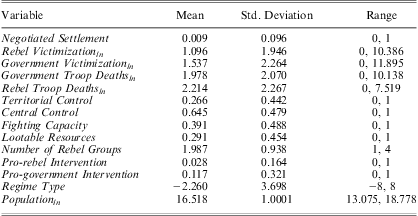
We also control for specific aspects of the conflict environment. Access to Lootable Resources may improve insurgents’ bargaining capability by allowing them to generate higher levels of wealth via looting than they otherwise would receive, which can be converted into war material to sustain the movement. So we include a binary measure accounting for the presence of resources such as drugs or gemstones in the conflict area.Footnote 66 The presence of multiple actors in a conflict may complicate the bargaining process, making successful resolution less likely,Footnote 67 and, therefore, we count the Number of Rebel Groups operating within the same conflict space. Similarly, interventions by external states influence the trajectory of conflicts by increasing the number of actors or by altering a conflict's power balance.Footnote 68 We include dichotomous measures representing both Pro-rebel Intervention and Pro-government Intervention taken from the PRIO/Uppsala Armed Conflict Dataset (ACD).Footnote 69 We include a measure of the state's Regime Type because political institutions shape the willingness and ability of government leaders to offer concessions to conflict adversaries. We use the twenty-one-point Polity IV autocracy–democracy scores.Footnote 70 Lastly, we control for Population Size. The values are lagged one year, log-transformed, and taken from the Correlates of War National Material Capabilities dataset.Footnote 71 All variables used in this analysis are included in Table 1.
Descriptive Statistics

Model
Our sample includes more than 4,000 dyad-month observations, representing 112 insurgent–government pairings in thirty-nine conflicts occurring within twenty-eight African countries between 1989 and 2010. Eighty-eight of these pairings ended during the evaluation period while twenty-four were ongoing and are, therefore, censored. Of the ‘terminated’ dyads, forty (45 percent) ended in either a durable (lasting more than thirty-six months) ceasefire or formal peace agreement, illustrating the frequency of settlement as a civil war outcome.
Our theory concerns not only the eventual outcome of civil conflicts but also the duration until the observed outcome. As we have argued, higher levels of civilian victimization by insurgents should pressure the government to offer a set of concessions that appeases insurgents and resolves the conflict more quickly. To test this argument we adopt a competing risks approach that explicitly accounts for multiple possible conflict outcomes. Our data contain four mutually independent potential outcomes: negotiated settlement, rebel victory, government victory, and protracted inactivity.Footnote 72 Importantly, dyad termination in one manner during a conflict period necessarily precludes termination of the same dyad by another manner. Therefore, we adopt Fine and Gray's competing risk approach, which models the subdistribution hazard, or subhazard, of an event of interest.Footnote 73 This model has two specific advantages. Similar to the Cox proportional hazard model, the Fine and Gray competing risks model is semiparametric, which means that it does not require us to make assumptions regarding the functional form of the baseline hazard. Moreover, this approach estimates the cumulative incidence function (CIF) for a specific event, allowing a direct evaluation of the likelihood of negotiated settlement in the presence of the competing risk of alternative outcomes.Footnote 74
Results and Discussion
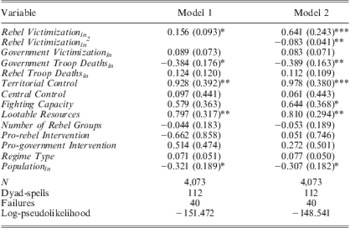
We report the results of our competing risks analysis for negotiated settlements in Table 2. The coefficients presented in the table show the impact of the covariates on the cumulative incidence of negotiated settlement. A positive coefficient suggests that increasing a predictor raises the likelihood of a conflict dyad terminating in a negotiated settlement in the following time period. Model 1 includes only the log-transformed value of Rebel Victimization in order to determine whether there is a general relationship between insurgent terror and the likelihood of a negotiated outcome. The results in Model 1 show a positive and marginally significant relationship between the level of victimization and the probability of a conflict terminating in a settlement. This result is telling as it suggests that as insurgents rely more heavily on one-sided violence the likelihood of leveraging sufficient concessions from the regime to terminate the conflict in a negotiated settlement increases. However, we also argued that there are limits on the effectiveness of violence in achieving a negotiated settlement, because high levels of violence may undermine the bargaining process. Model 2 accounts for this potential curvilinear effect. In this model, the sign of the coefficient for the Rebel Victimization variable is positive and statistically significant. However, the coefficient for Rebel Victimization 2 is negatively signed and statistically significant. This result provides support for the nonlinear argument expressed in our hypothesis: while low to intermediate levels of violence increase the likelihood of a negotiated settlement, increasingly high levels of violence reduce the probability of settlement.Footnote 75 Consequently, in terms of the ability to leverage a settlement, violence reaches a point of diminishing returns and then becomes counterproductive.
Regression Estimates for Negotiated Settlement

***p ≤ 0.01, **p ≤ 0.05, *p ≤ 0.10, two-tailed test. Robust standard errors in parentheses.
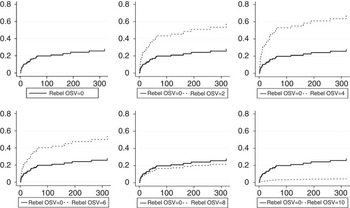
Figure 1 shows the cumulative incidence functions (CIFs) for the variable of interest based on the results from Model 2.Footnote 76 Simply put, the figures illustrate the risk that a negotiated settlement (y-axis) occurs before time t (x-axis) for given levels of Rebel Victimization. Each panel plots the CIF of settlement for increasing values of the Rebel Victimization variables. The first panel shows the CIF for rebel groups engaging in no civilian victimization during the previous six-month window. This is used as a reference point for the subsequent panels. Each subsequent panel adds the specified values of the victimization variable. As the figure illustrates, increasing victimization initially increases the likelihood of a conflict ending in a negotiated settlement but then becomes counterproductive as violence levels reach particularly high levels. At t = 60 months – roughly the median conflict duration in the sample – the risk of a conflict ending in settlement is approximately 17 percent for insurgents who had not engaged in civilian victimization during the previous six months. The second and third panels show the CIFs when violence reaches twice and four times the mean of the logged violence variable. According to the figures, the probability of the conflict ending in a negotiated settlement increases significantly as violence intensifies. The risk of settlement occurring within the same period increases to approximately 45 percent when violence levels are roughly twice the mean value of the logged victimization variable (∼7 deaths) and to approximately 52 percent when violence approaches four times the mean value (∼55 deaths). The three panels in the lower row illustrate the diminishing returns of violence we hypothesized above. As Rebel Violence approaches six times its mean value (∼400 deaths), the influence of killing on settlement declines. At this level of violence, the risk of settlement by t = 60 is approximately 40 percent, a notable decline from its peak, but still high relative to the probability observed for groups that used no violence in the previous six months. Interestingly, the probability of settlement by this time point for groups killing upwards of 400 civilians is approximately the same as for those killing fewer than ten civilians, suggesting the declining marginal utility of one-sided violence in producing negotiated settlement. The utility of violence continues to decline as the magnitude increases and becomes seriously counterproductive to the attainment of settlement as it approaches the upper bound of the variable. At eight times the sample mean (∼3,000 deaths), the likelihood of settlement is barely more than in the absence of victimization altogether. Approaching the maximum level of violence observed in the sample (∼20,000 deaths), the probability of settlement by t = 60 falls below what would have been expected had the group completely refrained from violence during the previous six-month period.
Cumulative Incidence Functions for negotiated settlement Note: CIFs for specified log-transformed values of Rebel Victimization; x-axis represents conflict time; y-axis represents the incidence of termination by negotiated settlement. Estimations include the respective squared victimization term. Other variables held at mean values.

The control variables also yield several results worth a brief discussion. First, we find that government victimization has no statistically significant influence on the likelihood of settlement. In part, this is not surprising given that states willing to engage in mass violence against the population are likely unwilling to make concessions to rebels in the first place. However, the limited influence of state violence is interesting because it fails to support key elements of the ‘backlash’ hypothesis common in much of the terrorism literature.Footnote 77 This is intriguing given the apparent returns to insurgents engaging in violence. The result, therefore, highlights the differing influence of similar strategies employed by different actors. This disparity deserves greater attention in future research.
Second, the results for the battlefield death variables are also intriguing. While past research suggests that rising expected costs should encourage the regime to offer concessions, our results suggest that greater losses of state troops actually reduce the likelihood of a negotiated settlement. In both models the variable accounting for government troop losses is negative and attains conventional levels of statistical significance. While seemingly counterintuitive, this result is largely consistent with the argument that shifts in the distribution of power undermine conflict bargaining. As increasing government troop deaths shift the balance of power in the rebels’ favor they become less likely to accept concessions from the state. However, we do not report a significant effect for rebel battle deaths. The variable is positive in both models, but never reaches significance.
Third, some group-level and conflict-level characteristics likewise appear to influence conflict outcomes. Rebels who wrest territory from the regime and consolidate control are more likely to achieve a negotiated settlement. In both models, the variable accounting for rebel control over conflict territory is positive and statistically significant. The influence of aggregate rebel fighting capabilities is less clear. The variable that is a proxy for the rebels’ military strength is positive in both models, but only achieves marginal levels of statistical significance in the second. While we might expect a more robust effect for rebel military capabilities in influencing bargaining, it is important to note that we have also controlled for the group's ability to hold territory and its ability to impose battlefield costs on the regime. These variables may, therefore, dampen the influence of this more aggregate capabilities measure. The variable accounting for the presence of a strong central command is positively correlated with settlement but fails to achieve statistical significance. The variable representing the presence of resources that can be looted is positive and significant in both models; and so it appears to increase the likelihood that the conflict ends in a negotiated settlement. This somewhat surprising result is perhaps due to the fact that rebels with access to loot can more easily fund their organization through the extraction and exploitation of resources. Neither the number of insurgent groups in the conflict nor the presence of pro-rebel or pro-regime interveners exerts a significant effect on the likelihood of negotiated settlement. Rather surprisingly, the institutional arrangement of the conflict state appears to have little influence on the time to negotiated settlement. At least according to the results presented here, conflicts in more democratic states are no more likely to terminate via negotiated settlement than those in more autocratic states. Lastly, the population variable has a marginal influence on reducing the likelihood of settlement. This effect obtains because a large population represents a large pool of resources which both sides can use to carry on the conflict.
In order to ensure transparency and to assess the more general applicability of our theoretical claims, we also conducted analyses to determine the effect of rebel violence on the other distinct conflict outcomes: insurgent victory, insurgent defeat, and long-term low intensity. Given our arguments regarding the role of violence in shifts in the distribution of power, we might expect that the inverse relationship between particularly high levels of violence and negotiated settlement stems from a parallel increase in a group's durability or its likelihood of ultimate victory. That is, insurgents would be expected to trade settlement for ongoing conflict if they believed that they could achieve more by continuing to fight than by settling.
In the interests of space, we report these results in Appendix 1. These results largely compliment our argument. First, in the equations modeling the probability of rebel defeat, the logged rebel victimization variable is negative and statistically significant. Yet, the coefficient for the quadratic term is significant and positive. This implies a curvilinear relationship between victimization and the probability of insurgent defeat in which rising violence initially reduces the likelihood of rebel defeat but then becomes counterproductive. However, the influence of the quadratic is nearly imperceptible in the CIF plots, suggesting that strength of the relationship lies in the negative influence of victimization on the probability of insurgent defeat. The results are statistically weaker in the equations modeling the probability of rebel victory and likelihood of long-term inactivity. In the rebel victory model employing only the logged rebel victimization variable the term's coefficient is negative and attains conventional significance levels. In the model incorporating the squared violence term, the results imply a curvilinear relationship in which violence initially reduces the likelihood of victory but then increases it. However, these results offer less in the way of statistical significance. They suggest that as rebel attacks on civilians increase, the probability of rebel victory likewise increases. Finally, in the long-term inactivity model both the violence variable and its quadratic term fail to approach statistical significance. Taken together these results underscore one of our core arguments: violence brings perverse benefits to those groups that employ it. At the least, increasing violence serves to reduce the likelihood that insurgents suffer defeat at the hands of the regime and seemingly increases the probability of victory. Moreover, these results are consistent with our proposition that the declining probability of negotiated settlement at high magnitudes of violence results from the corresponding shifts in the distribution of power it can create.
Conclusion
Scholars of political violence have increasingly turned their attention toward civilian victimization perpetrated by non-state actors during civil wars. Most research has focused on the sources of violence but has largely ignored its consequences. However, a more complete understanding of the motives for violence entails an appreciation of the anticipated effect of that strategy. While strategies often fail to produce the outcomes actors anticipate, the rationalist violence paradigm asserts that victimization is instrumental and is employed in order to achieve specific outcomes. Given the number of recent works with arguments built on this assumption, a need exists for more research into the implications and impact of civilian victimization.
Our analysis represents an initial effort to examine the impact of violence on conflict processes and war outcomes. Importantly, we find that civilian victimization does influence the duration and outcome of civil wars. Specifically, attacks on civilians increase the likelihood that insurgents achieve concessions from the regime. Moreover, while high levels of violence undermine successful negotiations, violence may still benefit insurgents if it contributes to a shift in the distribution of power in the insurgent's favor. This finding provides compelling support for previous studies that linked the motives for insurgent violence to strategies of conflict bargaining, though they had failed to evaluate the empirical relationship between violence and bargaining outcomes systematically.Footnote 78 These results are, however, at odds with recent terrorism research that suggests attacks on civilians are ineffective in advancing extremists’ political goals.Footnote 79 These divergent findings may result from the different scopes of the analyses (terrorist groups versus insurgent groups), different geographic considerations (global versus African conflicts), or different units of analysis (campaign level versus dyad-month). At the least, our findings call for greater attention from scholars of violence dynamics into the ways in which violent strategies influence both the process and outcome of domestic conflicts.
Our results also have implications beyond academia. From an ethical standpoint our results are rather discouraging, and we express some concern that our results imply that violence is an effective strategy through which rebels can achieve their goals. On a normative level, we do not believe that any group can legitimately argue that the ends of violence (for example, war resolution or survival) justify victimization as the means to achieve them. Yet, our results clearly show that victimization does pay perverse dividends to groups that employ it as a war strategy. While the result is morally unsettling, it represents an empirical pattern that deserves careful scrutiny, not least by policymakers. Regardless of the palatability of the finding, it should benefit practitioners and scholars by offering insight into the motives that drive brutality against civilians. By extension, these insights may help policymakers and activists develop and implement strategies to help mitigate the costs war imposes on vulnerable civilian populations.
The finding that civilian victimization benefits insurgents offers two conflicting recommendations for policymakers. First, leaders may read it as an indictment of negotiating with violent groups. After all, making concessions to violent groups may encourage violence if resorting to attacks on civilians moves insurgents closer to their goal. In this sense, our results might suggest that governments should resist negotiations with violent groups, thereby avoiding rewarding radicals for their bad behavior. In our view, this approach would be misguided. As our results demonstrate, high levels of victimization may thwart peace negotiations, but they do not adversely influence the survivability of the group or its prospects for victory. Indeed, we find the opposite. If negotiations break down violent insurgents may simply stay the violent course and attempt to victimize their way to victory or use it as a means of resisting defeat – the Lord's Resistance Army has become quite adept at the latter during the decades of its brutal existence. If this is the case, resisting negotiations with violent groups may cause more harm than good.
A second potential policy consequence of this research is that regimes should enter more rapidly into political negotiations with insurgents. Engaging violent groups early on may preempt the incentive for anti-civilian violence and reduce the costs of war to both the state and the civilian population. We recognize, however, that most states facing an insurgency are reluctant to engage in such negotiations, especially in the early stages of conflict. Previous research suggests that a narrow window of opportunity for successful peace negotiations emerges relatively early during conflict, but if this window closes the rebellion is likely to persist.Footnote 80 Coupled with our findings, this observation creates strong incentives for the international community to work quickly to encourage and support negotiations between the parties. Early engagement in the bargaining process – including efforts by international mediators – has the potential to save lives, both by more rapidly resolving the conflict and by providing alternative avenues through which insurgents can leverage concessions from the regime. Future research should both continue to explore the implications of civilian victimization as well as examine the most effective strategies for reducing violence and protecting vulnerable populations during civil wars.