Introduction
Since the late 2000s, many studies have addressed the political, institutional and legal dimensions of energy security in the European Union (EU) (e.g. Correlje and van der Linde Reference Correlje and van der Linde2006; Aalto Reference Aalto2007; Youngs Reference Youngs2009; Umbach Reference Umbach2010; Proedrou Reference Proedrou2012). In particular, with regard to security of gas supply – the major area of concern – there is a common understanding that establishing the internal energy market (IEM) and developing the EU’s external energy policy have challenged the traditional institutional structure underpinning the European politics of energy security, consisting mainly of a combination of national champions and bilateral foreign policy. However, when it comes to identifying the actual effects of these forces, the situation is less clear. Usually, European energy security is placed between “multilateral governance and geopolitics” (Westphal Reference Westphal2006) and “geopolitics and the market” (Youngs Reference Youngs2009), or between multilateral and bilateral diplomacy and national manoeuvres and common energy policy (e.g. Kirchner and Berk Reference Kirchner and Berk2010; Proedrou Reference Proedrou2012). Only recently have conceptual efforts been made to analyse the current dynamics more precisely (e.g. Herranz-Surrallés Reference Herranz-Surrallés2016). An important branch of this research has focussed on the crucial “states-markets nexus” and the interplay between government and transnational actors as ways to conceptualise the emerging equilibrium in the politics of European energy security (Keating et al. Reference Keating, Kuzemko, Belyi and Goldthau2012; Aalto and Korkmaz Temel Reference Aalto and Korkmaz Temel2014; Aalto Reference Aalto2015).
The main aim of this article is to contribute to this conceptual and empirical debate and to connect it with the broader study of the transformation of western European states (e.g. Caporaso Reference Caporaso1996; Majone Reference Majone1997) by focussing on security of gas supply and liquefied natural gas (LNG) in southern Europe and adopting the concept of forms of state. This article’s first section develops and extends the model of the catalytic state (Weiss Reference Weiss1998, Reference Weiss2010) to the energy-security realm. It highlights the main features of the catalytic state and argues that this model, which emphasises the active role of governments in a liberalised market structure and their wide participation in a networked pattern of energy diplomacy, is better equipped than the regulatory state model to capture the equilibrium emerging from the development of the IEM and the EU’s external energy policy. The second section discusses and clarifies the research design and the main hypotheses that emerge from the conceptual discussion and the operationalisation of the catalytic state model. The article’s third section uses the case of LNG development in France, Italy and Spain to illustrate the merits of this model. In particular, it analyses the politics of LNG in these three countries, with special emphasis on the 2000s, when important transformations emerged in line with the catalytic state hypothesis.
The study is designed according to what Odell (Reference Odell2001, 163) calls a “preliminary illustration” of a new concept: the limited goal of the empirical analysis is to place “concrete flesh on the bare bones of an abstract idea in order to help readers see its meaning more clearly”. In this regard, the comparative qualitative analysis adds the granularity necessary to locate the catalytic state model, as an ideal-typical state forms, in concrete historically and nationally specific empirical contexts (Clift Reference Clift2014, 183). In other words, the primary and limited goal of this article is to clarify and refine the concept of the catalytic state in the realm of energy security and to demonstrate its contribution to our understanding of current European energy security politics. However, the catalytic state hypothesis also offers interesting insights for the study of the transformation of western European states in the wake of liberalisation, privatisation and European integration. First, the gas sector – along with other public utilities such as electricity or telecommunication – was one of the empirical foci used in Majone’s (Reference Majone1996a, Reference Majone1997) seminal works to illustrate the rise of the regulatory state. Thus, it is an important area in which to challenge the widely accepted generalisability of the regulatory state. In particular, this article points out that specific features of the gas industry, especially its international dimension and strategic relevance for governments, limit the applicability of this model to this crucial element of EU energy security. Second, by adopting the concept of the catalytic state to understand the recent transformations in the gas sector, the article connects the emerging literature on European energy security to two other important traditions: the international business literature assessing state-company relationships and the role of governments and state diplomacy in companies’ internationalisation (e.g. Colli et al. 2014) and the comparative research on the varieties of capitalism across countries (e.g. Schmidt Reference Schmidt2009). In particular, by studying the “rise” of the catalytic state in different cases, the article also offers insights into the varieties of catalytic states for future research – mirroring the existing literature on the varieties of regulatory states in the EU (e.g. Lodge Reference Lodge2002) – and into the effectiveness of state policy under the catalytic state model. Both issues will be discussed further in the conclusions, along with some broader theoretical implications of the conceptual and empirical analysis for research on the transformation of western European states and energy governance in the EU.
Conceptual framework
Forms of state and energy security in Europe
The concept of forms of state has traditionally been used – especially by the transformationalist branch of globalisation literature (Held et al. Reference Held, McGrew, Goldblatt and Perraton1999) – to understand the transformations of the state and of the interactions among state and market actors in the wake of complex changes in the ideational, institutional and market structures in which they operate (e.g. Clift Reference Clift2014). In the realm of energy policy, this concept was initially adopted in research into the oil sector. With regard to producer states, the characteristics of the rentier state have been widely studied (e.g. Beblawi and Luciani Reference Beblawi and Luciani1987). With regard to consumer countries, Randall (Reference Randall2005) described the United States (US) experience using the term associative state. In an associative state, energy companies are in private hands and pursue their own direct, short-term commercial interests. The government works with and for the companies and supports their business activities abroad. Nevertheless, the government does not just serve the oil industries, but rather seeks to balance the companies’ commercial interests with the country’s long-term interests in energy security. The model of the associative state is closely related to the peculiar history of the US oil sector and the “guiding principles” behind the US domestic approach to economic and energy governance (Sovacool and Sidorstov Reference Sovacool and Sidorstov2013). Unlike in western Europe, these factors prevented the development of something like a “US National Oil Company” (Wälde Reference Wälde2008).
With regard to the European gas sector, the models of positive state (or interventionist state) and regulatory state have already been applied to highlight some important transformations in the energy governance of the EU member states (Majone Reference Majone1996a, Reference Majone1996b, Reference Majone1997). Gas, along with other public utilities, such as electricity, railways, etc., was the quintessence of the post-WWII European positive state: public ownership, long-term planning, centralisation of the decision-making process and direct government intervention in the industrial organisational structure were the norm. Western European governments considered these sectors so strategically important that the state needed to retain the power to protect the public interest against powerful private interests. Progressive liberalisation and privatisation and the establishment of new market-oriented methods of regulation in these sectors confirmed the “rise” of the regulatory state in Europe (Majone Reference Majone1996a). In the energy realm, this process had begun by the late 1980s, with the emergence of the market paradigm in energy policy (Helm Reference Helm2005) and the launch of the IEM project by the European Commission. The process continued with the diffusion of the market paradigm in Europe and the three EU energy legislative packages (1998, 2003 and 2009) that implemented the IEM in the gas and electricity sectors promoting the unbundling of energy networks, third-party access (TPA) to infrastructures and regulation by independent authorities (Boussena and Locatelli Reference Boussena and Locatelli2013; Talus Reference Talus2013). With these changes, the focus shifted from command and control policy instruments to rulemaking and enforcing, from governments to independent regulatory authorities and from “old” guiding principles (defending and promoting the public interests) to “new” ones (avoiding and preventing market failures).
To be sure, both models – the positive and the regulatory state – capture important features of the post-WWII European organisation of energy governance and of its recent transformation. However, both models have been used to describe the general modes of national economic governance and cannot account for all the peculiarities of the energy sector, especially in the area of security of supply. Their focus is mainly on domestic policymaking, whereas security of supply has an important external and foreign policy dimension (e.g. Duffield Reference Duffield2015). In addition, both models neglect the role of energy companies in international energy markets and the crucial relationships between them and national governments.
With regard to the traditional politics of security of gas supply in western Europe, the partner state model can take into account this external dimension.Footnote 1 According to this model, national governments create and protect national champions at home and use bilateral diplomacy and foreign policy to support those champions’ negotiations with producer states and their companies abroad. In this model, the patterns of energy diplomacy were easily captured by the so-called “triangular diplomacy” framework (Stopford and Strange Reference Stopford and Strange1991), because the most important agreements in the gas sector were the outcome of government-to-government, government-to-company and company-to-company negotiations. Western European governments in particular were at the centre of all the agreements for infrastructure development: they actively supported the construction of international pipelines and LNG terminals with state-backed finance, negotiating long-term contracts with producers and creating gas demand at the national level to match the rigid structure of supply from abroad (Stern Reference Stern1990; Estrada and Kare Reference Estrada and Kare1995; Hayes and Victor Reference Hayes2006).
On the other hand, the model of the regulatory state has been extended to cover the external “governance dimension” of the European energy policy, which parallels the market-oriented approach pursued internally by the European Commission with the IEM (Herranz-Surrallés Reference Herranz-Surrallés2015, 912). In particular, scholars have referred to this dimension as the “external” face of the EU regulatory state (Goldthau and Sitter Reference Goldthau and Sitter2014, Reference Goldthau and Sitter2015; Andersen, Goldthau and Sitter Reference Andersen, Goldthau and Sitter2016). According to this perspective – in line with the market approach to energy policy (e.g. Goldthau and Witte Reference Goldthau and Witte2010) – rather than negotiating ad hoc bilateral deals for specific projects, or supporting particular energy companies, the goal of public authorities is to set up, ex ante (mainly) multilateral governance structures that prevent market failures, lower transaction costs and set rules and standards for market exchanges. The empirical manifestation of the external face of the EU regulatory state is based on a variety of multilateral governance structures. These structures range from legally binding treaties, such as the Energy Charter Treaty and the Energy Community Treaty, to less institutionalised regional initiatives, such as the Inogate, the Eastern Partnership, the Baku Initiative, etc. The European Commission has used them to promote stable and predictable legal frameworks and/or transnational dispute resolution mechanisms to support energy companies in upstream and midstream activities beyond EU borders, and to push producer and transit countries to align their domestic energy governance with EU principles, rules and standards (e.g. Prange-Gstöhl Reference Prange-Gstöhl2009; Padgett Reference Padgett2011; Goldthau and Sitter Reference Goldthau and Sitter2014).
Catalytic versus regulatory state
The model of the regulatory state – extended to include its “external” face – correctly points to both the shift from state to market and from bilateralism to multilateralism that occurred in the domestic and external governance of the European gas sector in the last two decades. However, it neglects important aspects of the current situation. First, although EU member states have liberalised and privatised, or partially privatised, their energy sectors, they have continued to pay special attention to national energy business. In order to respond to traditional concerns over security of supply – aggravated by the Russian-Ukrainian disputes and the instability in the Middle East and north Africa – or to achieve other goals in the area of industrial or foreign policy, European governments have continued to develop their bilateral energy diplomacy. They have also continued to adopt – along with new market-based policy instruments – more direct measures of state intervention, including ownership and planning. On the other hand, since the mid-2000s, the European Commission has also begun to develop a more direct approach to energy security, engaging bilaterally specific producers or transit states and more actively supporting infrastructural projects with financial and diplomatic assistance (notably in the case of the so-called Southern Gas Corridor). In fact, even the defenders of the “EU as a regulatory state” approach admit that when it comes to security of gas supply, the European Commission is only “mostly” a liberal actor (Goldthau and Sitter Reference Goldthau and Sitter2014, 1468).
Focussing on the level of the EU member states, the final result of these processes can be better described by the concept of the catalytic state. Similar to the regulatory state, the catalytic state is committed to the new methods of energy governance and is concerned with avoiding and preventing market failures. However, in a more specific sense, its actions are oriented towards supporting market actors and facilitating their efforts to realise specific investment projects by combining market-based incentives and more direct forms of intervention. The idea that the state acts as a “facilitator” to promote and support market actors in order to realise specific goals emphasises the role of governmental agents as strategic actors in a liberalised market environment (Schmidt Reference Schmidt2009; Colli et al. 2014). According to this perspective, liberalisation and privatisation do not necessarily imply a linear shift from direct government action (faire) to market action (laissez-faire), or only the emergence of forms of faire-faire, with private actors taking on the state’s former responsibility and public authorities relegated to setting guidelines and incentives for market actions. Indeed, in many cases, states have adopted a wider set of instruments and have begun to engage in faire-avec policies by collaborating with market actors to pursue their objectives (Colli et al. 2014).
The idea of the catalytic state, first introduced by Lind (Reference Lind1992), was developed by Weiss to stress the crucial role that states still have in the face of globalisation, liberalisation and the spread of regional, supranational governance structures (Weiss Reference Weiss1998, Reference Weiss2010). According to Weiss, states have lost many of their traditional instruments for controlling economic activities; however, they are not only engaged in setting the stage for markets to operate by providing rules and institutions but also have been able to develop new strategies to pursue their goals more actively. In particular, catalytic states seek to achieve their goals less by relying on their own resources than by working with a wider range of actors – that is, the catalytic state tries to balance the loss of some of its power by forging coalitions with other (state and nonstate) actors to realise its objectives (Weiss Reference Weiss1998, 209–210). These strategies include new forms of government-company cooperation and the establishment of national and transnational public-private partnerships or consortia to promote policy implementation (Weiss Reference Weiss1999, Reference Weiss2010). Such institutional arrangements are becoming more and more common in the energy realm, where new modes of public involvement in ownership are replacing the traditional forms of public ownership (Haney and Pollitt Reference Haney and Pollitt2013; Pollitt Reference Pollitt2016). The latter tended to take the form of a large state-owned company or local municipal utility that were 100% owned by the central government or local authorities, whereas the new modes of public involvement take many different forms, from partly privatised companies to hybrid types of ownership at national and local levels.
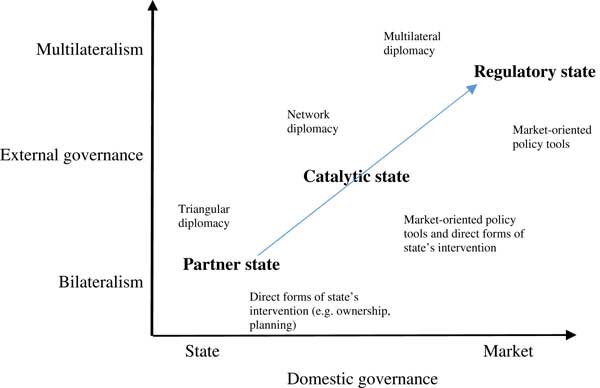
Drawing on Weiss, Hocking (Reference Hocking1999) uses the notion of “catalytic diplomacy” or “network diplomacy” to reconceptualise the new practice of diplomacy in the present international economic environment, characterised by the growing liberalisation of commercial and trade relations and the fragmentation of the state. That is, states have lost powers in favour of markets and supranational and subnational layers of governance, and governments are increasingly involved in bargaining relationships at different levels, with a greater number of both private and public actors, in order to pursue their policy goals. Accordingly, not only is the catalytic state characterised by a faire-avec approach, which combines market-oriented policy tools with direct forms of state intervention and new modes of public involvement in ownership, but it also embraces a specific practice of network diplomacy (Figure 1).Footnote 2 This pattern of diplomacy is different from both the (mainly) multilateral ex ante diplomacy of the regulatory state and Susan Strange’s triangular diplomacy framework. Triangular diplomacy rests on classical, bilateral government-to-government and company-to-government interactions. It does not take into account the relevance of the supranational level (e.g. the EU) or the complex negotiations involving networks of actors that transcend domestic-international frontiers. Domestically, with the growing public awareness of environmental issues and sustainable development, the local level has become especially important: subnational actors and nongovernmental organisations (NGOs) are now important players in gas infrastructure localisation, along with governments and energy companies. Energy companies’ involvement in local politics for large infrastructure energy projects is not new, but the nature of this participation is quite different in the new environment. In the past, the national champions were usually regarded as a branch of the state, committed to the country’s modernisation and development, whereas current private companies lack this public perception and must devote more attention to building positive relationships with local communities.
Partner state, catalytic state, regulatory state and European energy security.
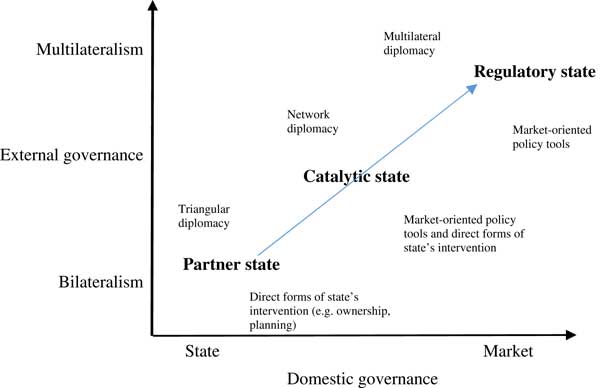
In other words, in the catalytic state, the new political-diplomatic layers – supra- and subnational – coexist with components of energy diplomacy that are more traditional, that is, government-to-government and government-to-company negotiations. In particular, governments continue to depend on energy companies for the practical realisation of their energy security agendas, and they must balance the interests of the companies with their own political interests. However, in the liberalised and competitive European market structure, these relationships are becoming more complex than in the partner state tradition. Governments are losing their long-term strategic connection to a national champion, and they should be prepared to support different energy companies actively on an ad hoc basis if those companies’ projects are consistent with the government’s energy strategy. That is to say, in the partner state, the relationships between public authorities and energy companies were mutually supportive – the government protected the domestic market (e.g. by establishing monopolies) and supported the internationalisation of national champions with the aim of ensuring energy security, whereas in the catalytic state governments are indirectly supportive. Energy companies are interested in backing government strategies if they can expect sufficient financial returns and political and diplomatic support. Owing to their huge financial burdens and risks, large infrastructure energy projects, such as pipelines or LNG facilities, cannot be developed without political and institutional commitments (Walker Reference Walker2000). In the partner state, the contributions of public authorities to the implementation of such projects were related to their capacity to create demand at the national level, which, along with state-backed financing, constituted a sufficient guarantee for the operators. In the regulatory state, the capacity and credibility of public authorities as rulemakers and enforcers provide the necessary legal stability and the adequate regulatory incentives to guarantee private operators and finance projects. Nonmajoritarian institutions, that is, independent regulatory agencies, are particularly important in the logic of the regulatory state because they are supposed to address the policy commitment problem and enhance the long-term credibility of public authorities vis-à-vis market actors (e.g. Majone Reference Majone1996b; Gilardi Reference Gilardi2002). Rulemaking and enforcing and regulatory incentives are also important in the catalytic state, but governments must play a more active and strategic role in facilitating the implementation of projects by engaging in political negotiations at the EU, international and local levels, adopting forms of state intervention that are more direct and/or creating partnerships with market actors. The establishment of public-private partnerships are important not only for spreading risks among market and state actors – a traditional function of these policy instruments (e.g. Skelcher Reference Skelcher2005) – but also to signal to the companies involved the political commitment of public authorities towards specific projects.Footnote 3 This is an important issue, considering the significant political implications, domestic and foreign, of the energy business. On the other hand, by cooperating with public authorities, companies can increase their legitimacy in the perception of local communities, speed up authorisation processes and/or reduce the political and legal risks.
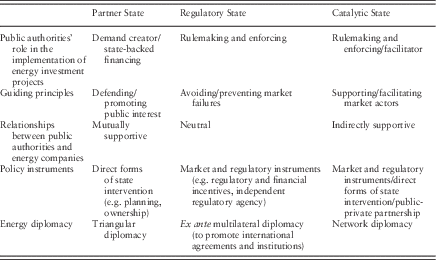
In summary, the model of the catalytic state and the related network diplomacy framework provide an alternative set of criteria to those offered by the regulatory state and the traditional practice of the partner state to understand the reconfiguration in the states-markets nexus in European energy security (Table 1).
Partner state, regulatory state, catalytic state and European energy security politics
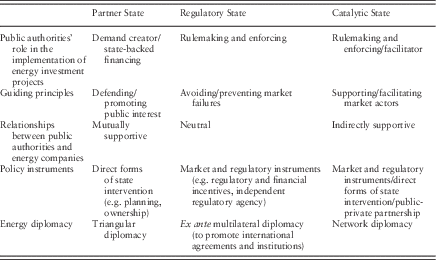
Source: Author.
Research design and hypotheses
The model of the catalytic state aims to illustrate some important new tendencies that have emerged in European energy security politics. It recognises that crucial changes have led to a reconfiguration in the traditional states-markets nexus described by the partner state but also that they are not properly addressed by the application of the regulatory state to the energy realm. It is worth noting, however, drawing from Caporaso, that each state form illustrated in the previous section has to be considered less a discrete category and more an emphasis, that is, “something to be accented rather than something to sort into categories” (Caporaso Reference Caporaso1996, 31). This perspective has traditionally characterised the adoption of the forms of state concept. Forms of state should not be considered as settled realities, but as ideal-typical characterisation of an emergent process of transformation (Clift Reference Clift2014, 172; see also Jessop Reference Jessop2002). For example, in challenging the regulatory state hypothesis, in her works on industrial policy, Weiss clarified that the regulatory-oriented state and the developmental-oriented state must of course be considered in terms of broad ideal types: “all states in reality combine both features” while “the purpose of the ideal type is to highlight and magnify those features which tend to predominate” (Weiss Reference Weiss1999, 81). Similarly, to demonstrate the “rise” of the catalytic state in the next section, this article emphasises some important tendencies in line with this ideal type rather than dispute the regulatory state model in its entirety. However, taken together, the conceptual and empirical analyses weaken the regulatory state model as a “general statement of tendency” (Weiss Reference Weiss1999, 80).
Three hypotheses in particular, derived from the previous section’s conceptual analysis, will be discussed because they contribute to showing the merits of the catalytic state model. First, as we saw, an important dimension of this model is regarding the way in which governments combine market-oriented instruments with more traditional tools of direct state intervention. That is to say, governments have liberalised, privatised and de-monopolised their gas sector. They have also established national independent regulatory authorities to oversee energy markets and have designed the regulatory and financial system of incentives to support investments in energy infrastructures and promote competition. In the LNG and gas sector, the main element of this system is the TPA regime. The first gas directive (1998) on the IEM provided for two different options: negotiated and regulated TPA. The second directive (2003) obliged all member states to adopt the regulated TPA model overseen by independent regulatory authorities. However, in accordance with the IEM project, the new regulatory framework also includes provisions to avoid market failures, which are mainly related to the rules on TPA exemption, granted by the national regulatory authorities (and verified by the European Commission). According to these rules, developers of new LNG terminals – which could not be implemented if the usual market rules were applied – can request a TPA exemption, preventing access (under certain conditions and for a specific period of time) to the facility by those who do not own the physical infrastructure. Exemptions are granted on the grounds of the contribution of the investments in providing “public goods” – that is, improving security of supply and boosting competition in the gas market. Findings in line with the catalytic state hypothesis should show that governments apply these instruments but also that, in order to achieve their goals and facilitate market actors, they combine those tools with traditional instruments of direct state intervention (e.g. ownership and planning) and/or promote public-private partnership to support specific projects. More precisely, under the catalytic state model, we expect that rather than playing a marginal role in the new liberalised context, direct state intervention and new modes of public involvement in ownership are the “normal” strategies in LNG development.
The second hypothesis in line with the catalytic state model is related to the emergence of networked patterns of energy diplomacy. In this case, the empirical analysis should focus on the coexistence of new political-diplomatic layers – supra- and subnational – along with the traditional components of energy diplomacy: government-to-government and government-to-company negotiations. With regard to the supranational level, it is important to look at the way in which national governments try to “upload” their energy security agendas in Brussels and influence the European Commission’s energy diplomacy towards specific countries or regions. With regard to the subnational level, it is important to assess not only whether governments are involved in designing the regulatory framework concerning localisation procedures, but whether they play a more active role in mediating between energy companies and local actors. This role is important owing to the shift from the traditional national champions to the new privatised (or partially privatised) energy companies and the growing public awareness of environmental issues.
Finally, the third hypothesis is regarding the transformation in the relationships between governments and energy companies. According to the catalytic state model, in the last two decades western governments have lost their privileged partnership and “mutually supportive” relationships with their national champions. This, obviously, does not mean that they have stopped supporting the former incumbents, often still in state hands, but they have opened their domestic markets to competition and are ready to support different companies if their strategies are consistent with the government’s energy security agenda. This new “indirectly supportive” pattern of relationships can be traced empirically by looking at the way in which national governmental agents have used direct forms of intervention and diplomacy to back energy companies other than the former national champions and have tried to facilitate their investment projects at home and abroad.
With regard to the case studies, the selection of France, Italy and Spain is justified on a substantive ground and theoretically, for their relevance to the specific set of hypotheses advanced in the article.Footnote 4 These countries occupy the first (Spain), second (France) and third (Italy) places for the volume of annually installed LNG-receiving capacity in the continental EU market, with 68.9, 34.7 and 14.8 bcm/year, respectively. They represent more than 70% of the total European LNG import capacity and can contribute to improving the diversification of EU gas supplies (European Commission 2016). To be sure, debate on EU energy security and LNG has also recently involved other countries, especially Lithuania and Poland, where LNG is regarded as one way to reduce their dependency on Moscow (e.g. Mišík and Prachárová Reference Mišík and Prachárová2016). However, LNG capacity in these countries accounts for less than 5% of the total EU installed capacity. Besides, in both cases, LNG development is a very recent phenomenon (Lithuania opened its first terminal in 2014 and Poland in 2015), and both countries are outside the scope of the traditional debate on the transformation of the state in western Europe. By contrast, the selection of France, Italy and Spain is theoretically important for a number of reasons. First, they make it possible to trace the historical trajectory of LNG politics from the original model to the catalytic state. Indeed, LNG in Europe originally developed in the 1970s–1980s in the Mediterranean Basin, with France, Italy and Spain as the main importing countries and Algeria and Libya as the main exporting countries. More importantly, the main pattern of LNG development was similar in these countries and resembled the traditional practices of the partner state and triangular diplomacy. The main promoters and developers of the projects were the gas monopolists Gaz de France (GDF) in France, Ente Nazionale Idrocarburi (ENI)-Snam in Italy and Enagas in Spain. These national champions negotiated with the producers and their national companies (the Algerian Sonatrach and the Libya National Oil Company), backed by state diplomacy in Madrid, Rome and Paris (e.g. Ghilès Reference Ghilès1995; Naylor Reference Naylor2000). Another common feature of early LNG politics was the centralisation of the decision-making processes in the hands of national governments and the lack of opposition from local authorities and communities. LNG facilities were generally regarded as important symbols of modernisation and opportunities for local industrial development. Second, gas developments and recent reforms in energy governance in France, Italy and Spain have been traditionally analysed through the lens of the regulatory state (e.g. Majone and La Spina Reference Majone and La Spina2000; Finon and Midttun Reference Finon and Midttun2004; Thatcher Reference Thatcher2007; Federico, Vives and Fabra Reference Federico, Vives and Fabra2008), and thus this study can offer new perspectives for framing policy dynamics in these western European countries. Finally, these three cases are interesting theoretically because, although from an institutional point of view they are traditionally grouped among the “state-influenced market economies”, they also have different features (Colli et al. 2014). France is the ideal type of directive state acting in a positive, enhancing manner in economic policymaking. Italy, on the other hand, is stylised as a capitalism “state-led by misdirection”, stressing the predominantly hindering effects of state action (Schmidt Reference Schmidt2012). In Spain, originating from an authoritarian corporatist capitalism, the state has done more to hinder than to enhance the economy over the long term (although Spain has generally outperformed Italy). Italy and Spain are also characterised by a regionalised institutional structure (a “compound polity”), whereas France is an example of a “simple polity”, with highly centralised political power (Schmidt Reference Schmidt2009). All in all, the three cases present important differences that make it possible to study the “varieties” of catalytic states. That is to say, although the article hypothesises that the move towards the catalytic state is a common tendency in European energy politics, it also expects that institutional and ideational differences can affect the pace and timing of this movement and the effectiveness of states’ faire-avec policies. In particular, we can expect that in a “compound polity”, the subnational dimension of energy security will be more pronounced, both in a positive way (with enhancing effects on state strategy) and in a negative way (with hindering effects). On the other hand, we can expect more resistance to the emerging trends in France, with its highly centralised structure and stronger tradition of state direction.
The empirical evidence: the new politics of LNG and the “rise” of the catalytic state
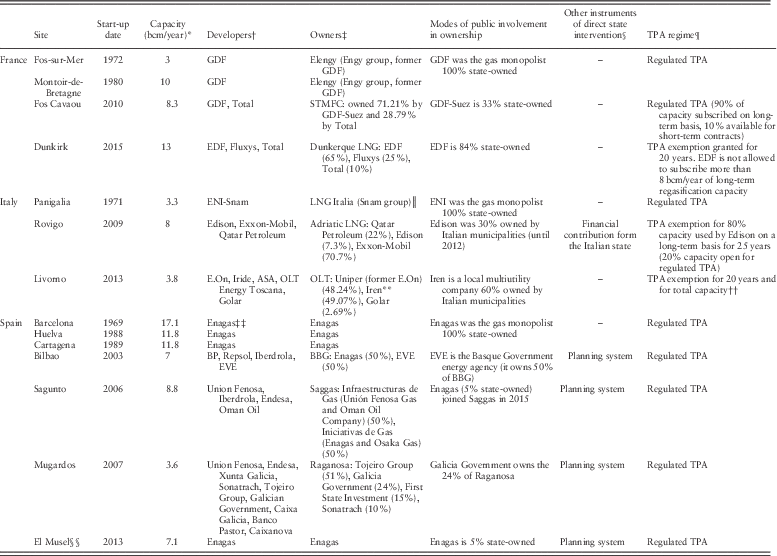
The original model of LNG development – with its patterns of domestic politics, government-company relations and bilateral energy diplomacy – began to change in the mid-1990s, first in Spain and Italy and later in France, where the opening of domestic energy markets was slower. However, it has been especially during the 2000s that national governments have enacted new measures to promote LNG in a market environment characterised by an expected growing gas demand, concerns for security of gas supply and the implementation of the IEM provisions. In France and Italy, several projects were considered, but in the end only two new terminals in each country were built (at Fos Cavaou and Dunkirk in France and at Rovigo and Livorno in Italy) (Table 2). LNG thus remained a minor component in Italy’s security of gas supply, accounting in the 2000s for about 5–10% of total gas imports. In France, pipeline imports were predominant as well, although during the 2000s LNG accounted for about 25–30% of total gas imports. On the other hand, in Spain, four new terminals were completed at Bilbao, Sagunto, Mugardos and El Musel (Table 2), and LNG continued to be a major component of the country’s gas supply, accounting for about the 60–70% of total gas imports (this situation changed slightly after 2011, when the Medgaz pipeline connecting Spain with Algeria started operations).
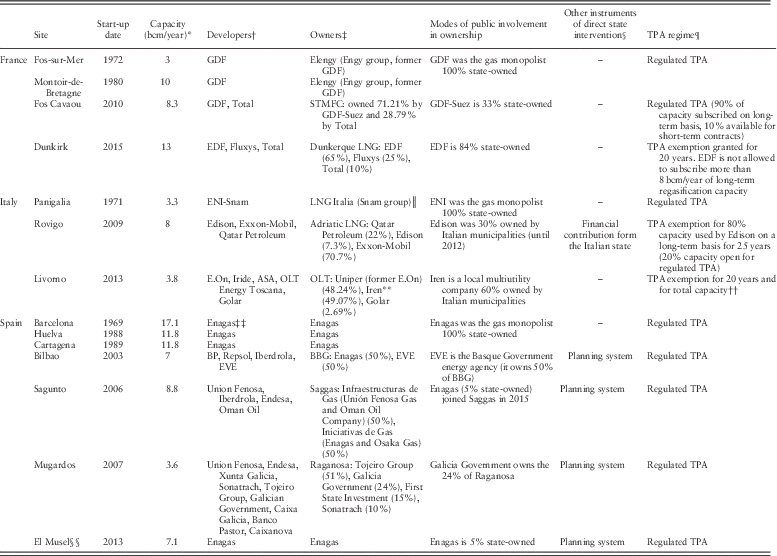
Liquefied natural gas (LNG) terminals in France, Italy and Spain: main features, developers, ownership and policy instruments
Note: TPA=third-party access; STMFC=Société du Terminal Méthanier de Fos Cavaou; OLT=Offshore LNG Toscana; BBG=Bahia de Bizkaia Gas; EVE=Ente Vasco de la Energia.
* Send out nominal capacity in 2015 [Groupe International des Importateurs de Gaz Naturel Liquéfié (GIIGNL) 2016].
† Companies involved in the early stages of the terminal’s development (GIIGNL Reports, various years).
‡ Ownership in 2015 (GIIGNL 2016).
§ Only for new LNG projects.
¶ King and Spalding (2015).
║ In 2012 Snam, previously owned by ENI, became the Italian Independent Transmission System Operator (30% owned by the Italian state).
** Iren was established, in 2010, after a fusion between Iride and Enìa (both controlled by Italian municipalities).
†† In 2014 the developers renounced to third-party access (TPA) exemption.
‡‡ In 2012 Enagas became the Spanish Independent Transmission System Operator (5% owned by the Spanish state).
§§ Construction completed in 2013 but mothballed.
Source: Author.
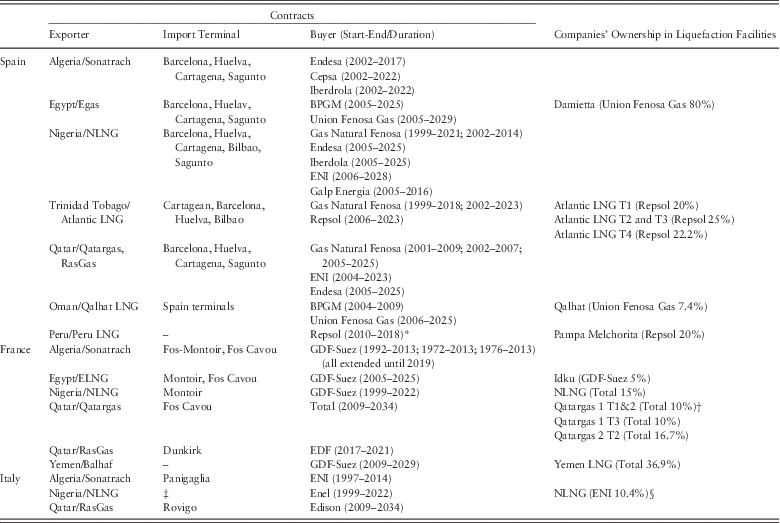
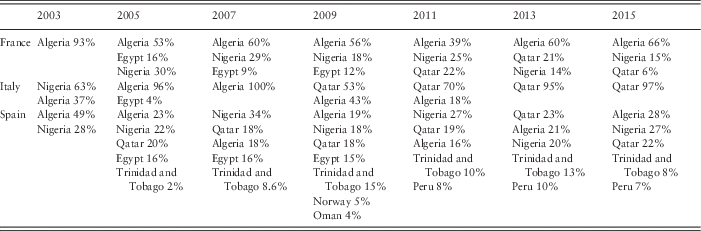
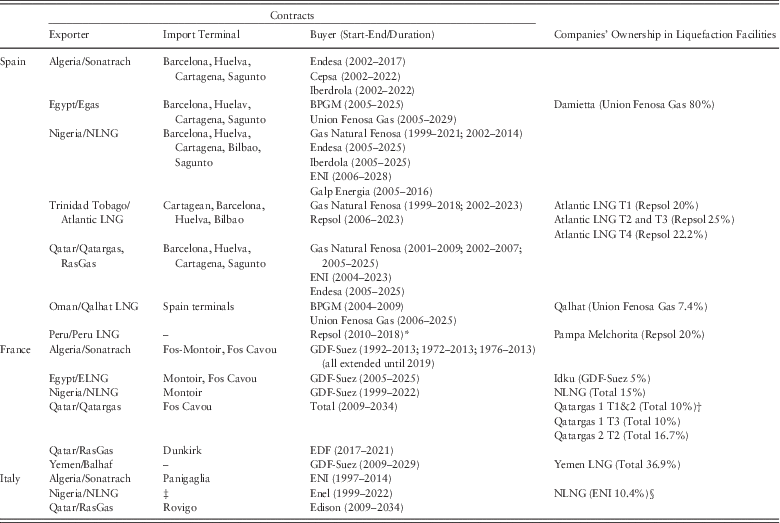
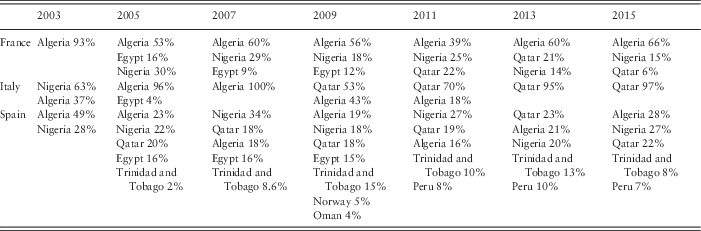
In many cases, the new terminals were developed by a different set of companies than the traditional gas incumbents (Table 2). In addition, in all three countries, they were realised by combining regulatory incentives with direct forms of state intervention and new modes of public involvement in ownership (Table 2). In this period, new LNG supplies also arrived, supported by the international activism of old and new players involved in the French, Italian and Spanish markets, who, backed by national governments, signed medium- and long-term contracts with different exporters and, in some cases, took part in liquefaction facilities abroad while pursuing integrated business strategies along the entire LNG value chain (Table 3). Especially in Spain, the final result was an increased diversification of suppliers, although Algeria remained the main LNG exporter to France and basically Qatar replaced Algeria as the dominant LNG supplier to Italy (Table 4). More importantly in all three cases, the politics of LNG departed from the traditional partner state model and moved towards that of the catalytic state. In the next subsections, this trend is illustrated by highlighting common emerging patterns among the three cases in accordance with this model. In addition to examining the realised LNG projects, the analysis also includes the projects discussed but not finalised.
Long- and medium-term contracts signed by companies operating in Spain, France and Italy and companies’ shares in liquefaction facilities abroad (only extra European Economic Area)
Note: LNG=liquefied natural gas; NLNG=Nigerian LNG project; ELNG=Egypt LNG project.
* In 2013, Repsol sold its stake in Peru LNG as well as its LNG sale contracts to Shell.
† Swap deal between Enel and GDF (LNG sent to Montoir-de-Bretagne and then delivered to Enel at various delivery points across Europe).
‡ Total has a 5% share in Abu Dhabi LNG at Das Island.
§ Through its participation in Union Fenosa Gas (ENI has the 50% share of the company) ENI is involved in Egypt and Oman. ENI has also other important shares in liquefaction facilities in Africa (70% of the Area 4 LNG in Mozambique and 13.6% in Angola LNG), Australia and Indonesia (ENI 2015).
French, Italian and Spanish main liquefied natural gas (LNG) suppliers (% of total LNG supply)
Source: Author’s elaboration from BP Statistical Review of World Energy (various issues).
Combining policy instruments and promoting public-private partnerships
As anticipated, since the mid-1990s, LNG development in Spain has interacted with the ongoing reforms in the domestic energy markets and has been favoured by the steady growth in energy demand. In particular, liberalisation and privatisation of the Spanish electricity and gas sectors anticipated EU reforms and received a boost with the appointment of the centre-right government of José María Aznar in 1996. The Aznar government completed the privatisations of the main Spanish energy companies initiated under the socialist government of Felipe González. The privatisation of Enagas, initiated in 1994, was completed in 1998. The same year also saw the completion of the privatisation of the electricity company Endesa (which began in 1988), whereas the oil company Repsol’s privatisation was completed in 1997 (it began in 1989). With Royal Decrees 1377/1996 and 2033/1996, the Spanish gas market was also opened to competition, and LNG importing terminals were subject to regulated TPA to encourage the access of new players into the domestic market. Subsequently, in 1998, the Spanish government issued Law 34/1998, the so-called Hydrocarbon Law, which further liberalised the gas sector but also limited individual company ownership of Enagas to a maximum of 5% (voting rights were limited to 3%), with an exclusion for the state-owned holding company Sociedad Estatal de Participaciones Industriales (SEPI) (SEPI holds a 5% of Enagas). At the beginning of the 2000s, other measures were taken to support investments in gas infrastructure: measures to guarantee a reasonable profitability for new LNG terminals, a national mandatory plan for infrastructure development and measures to facilitate the localisation procedures of LNG facilities (García Reference García2006; Honoré Reference Honoré2011).
As a result of this new institutional framework and market environment, three new importing terminals – envisaged in the 2002–2011 national mandatory plan (Mityc 2002) – were rapidly built at Bilbao (2003), Sagunto (2006) and Mugardos (2007). However, in contrast to previous projects, the main developers and operators in these cases were not Enagas but wider consortia (Bahia de Bizkaia Gas, at Bilbao and Reganosa at Mugardos) and joint ventures (Saggas at Sagunto) involving Spanish (Enagas, Repsol, Iberdrola, Endesa and Union Fenosa) and nonSpanish companies (Table 2).Footnote 5 Among the latter, there were both major international oil companies, such as British Petroleum (BP) and the national oil companies of producer states (Sonatrach and Oman Oil). Regional governments (Xunta Galicia, the Galician government, and Ente Vasco de la Energia) and banks (Caixa Galicia, Banco Pastor and Caixanova) were also involved in the projects. The LNG terminals were developed through (local) public-private partnerships with the participation of regional governments, particularly in the cases of Mugardos and Bilbao (Table 2). On the other hand, in the case of Sagunto, public involvement in ownership was realised only later when, in 2015, Enagas took shares in the Saggas joint venture. In 2013, Enagas also completed a fourth terminal – envisaged in the new national mandatory plan issued in 2006 to renew the previous plan (Mityc 2006) – in Asturias at El Musel. Owing to declining gas demand, however, the opening of this terminal was mothballed the same year.
Rather than Spanish LNG developing from the TPA exemptions – the LNG terminals were subjected to regulated TPA – it mainly resulted from a combination of new modes of public involvement in ownership and planning. The planning system in particular represented a crucial measure: although it was possible to develop LNG infrastructure outside this system, nobody has chosen to do so because of the higher risks in developing these facilities outside of it [International Energy Agency (IEA) 2009a].
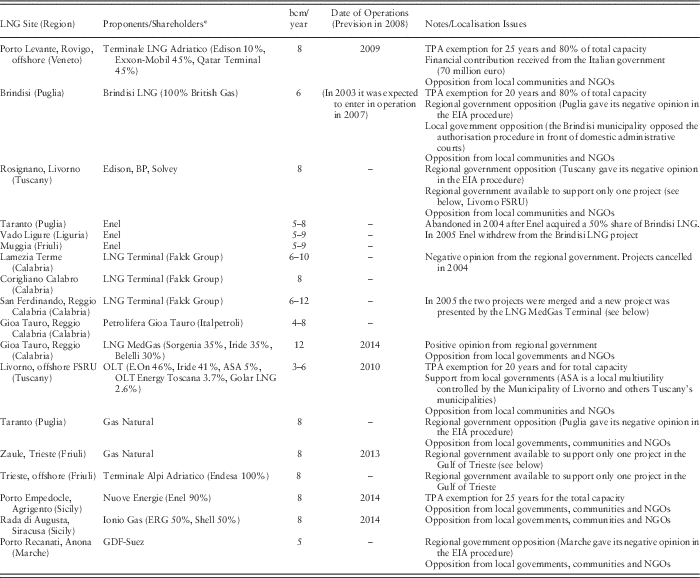
In Italy, as in Spain, LNG development interacted with reforms enacted in the 2000s aimed at liberalising national energy markets and improving the diversification of supply (in this period the former gas and electricity monopolists ENI and Enel were also partially privatised, although the Italian state still owned about 30% of these companies). At the beginning of the new millennium, the centre-left government of Giuliano Amato issued Legislative Decree No. 164/2000 to implement Directive 98/30/EC and provided a system of incentives to guarantee investment returns in the construction of new LNG terminals. Next, in 2000, the government authorised the construction of two new LNG terminals that were proposed by new entrants in the Italian gas market. First, an offshore terminal was to be built in the North Adriatic Sea off the coast of Ravenna. This project was proposed in 1998 by the Italian Edison – at that time controlled by the French Électricité de France (EDF) and some Italian municipal utilities (EDF will acquire the 99.4% of share of Edison in 2012) – in a joint venture with Exxon-Mobil. The Ravenna offshore terminal also received its environmental impact assessment (EIA) in 2003 with the consent of the regional authorities involved (Emilia Romagna and Veneto). Second, an onshore terminal was to be built by British Gas in the Puglia region near Brindisi. The centre-right government of Silvio Berlusconi, appointed in 2001, embraced this strategy. The new government enacted Law No. 273/2002 that allowed exemption for 20 years from TPA for new LNG-receiving terminals. Law No. 273/2002 also granted a special financial contribution of 70 million Euros to the Ravenna terminal, as it was regarded as a strategic project for the Italian security of gas supply. Finally, in 2004, another law was enacted by the government (Law No. 239 of 23 August 2004), which provided for a simplification of the authorisation procedure for the terminals’ construction and increased investor incentives.
In 2006, the new centre-left government of Romani Prodi confirmed Italian support for LNG expansion. LNG development was now framed not only as an answer to the security of supply concerns – which had increased in the wake of the first Russian-Ukrainian gas crisis – but also as a wider industrial strategy for the country. According to the Ministry of Infrastructure, at least 11 LNG terminals were required in Italy, of which four were to be given higher priority by accelerating their authorisation and localisation procedures.Footnote 6 This support, along with the reforms ongoing at the national level to implement the IEM and the new regulatory framework, incentivised LNG development. In the second part of the 2000s, in a market environment characterised by expected growing gas demand, the number of projects increased drastically (Table 5). Projects for new terminals were presented by different categories of companies: private Italian petroleum companies (e.g. Falck, Petrolifera Gioa Tauro), Italian utilities (e.g. Enel, Edison and Sorgenia), European utilities (e.g. Endesa, British Gas, E.ON, Gas Natural and GDF-Suez), oil majors (e.g. Exxon-Mobil, Shell and BP) and producers’ national companies pursuing an integrated business model, as in the case of the Rovigo offshore terminal that had Qatari participation. In the case of the Livorno terminal, a Floating Storage Regasification Unit, presented by Offshore LNG Toscana, regional and local governments also took part in the project through the utilities they controlled: Iride (a multiutility mainly owned by Italian municipalities) and Azienda Servizi Ambientali (ASA) (a local multiutility controlled by the municipality of Livorno and other Tuscan municipalities) (Table 5). Iride also took part in the LNG MedGas project at Gioia Tauro. The Livorno project in particular was similar to the (local) public-private partnerships established in Spain for the Mugardos and Bilbao LNG terminals. Exemption from TPA was allowed for the most advanced projects (Rovigo, Brindisi, Livorno and Porto Empedocle) (Table 5). However, many problems arose with the localisation processes, with many LNG terminals being strongly opposed by regional and local governments, local communities and NGOs on environmental grounds (Table 5). In the end, the only two projects to be realised were the Ravenna and Livorno offshore terminals (see below).
Projects for liquefied natural gas (LNG) terminals in Italy (2001–2009): main features and localisation issues
Note: TPA=third-party access; NGOs=nongovernmental organisations; EIA=environmental impact assessment; FSRU=Floating Storage Regasification Unit; OLT=Offshore LNG Toscana.
* Proponents/shareholders as March 2009 [Autorità per l’Energia Elettrica e il Gas (AEEG) 2009].
At the start of the 2000s, in contrast to the Spanish and Italian cases, in France – where the opening of domestic energy markets was slower – only one proposal for a new LNG terminal, at Fos Cavaou, had been advanced as a joint venture (Société du Terminal Méthanier de Fos Cavaou) between the traditional state-owned incumbent, GDF, and the French oil major Total. This situation changed somewhat after the mid-2000s. In 2005, the centre-right government led by Dominique de Villepin issued a new national energy strategy (Law no. 2005-781, 13 July 2005) that focussed on LNG to diversify gas supplies and improve energy security (as increasing gas demand was expected, especially in the electricity sector). In 2006, the government also promoted the merger of GDF with Suez to create a global energy player, but the French state remained in control of the new company, acquiring a 35% share of GDF-Suez.
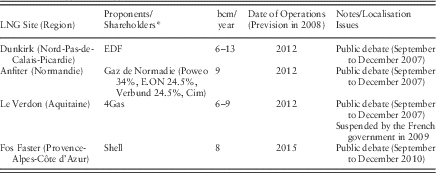
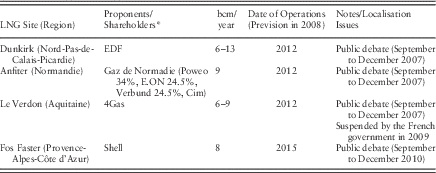
After the government called for new LNG development and the clarification of the regulatory framework for investors – with Law 9 in August 2004, the government implemented directive 2003/55/EC and granted TPA exemption for new LNG facilities – between 2006 and 2009, four new projects were presented by the former electricity incumbent EDF (with 85% still owned by the French state), private French utilities (Poweo), a local French company (Cim), European utilities (the German E.On, the Austrian Verbund and the Dutch company 4Gas) and international oil majors (Shell) [Commission de Régulation de l’énergie (CRE) 2007, 2008a, 2009] (Table 6).
Projects for liquefied natural gas (LNG) terminals in France (2006–2009): main features and localisation issues
Note:
* Proponents/shareholders as 2009.
Source: CRE (2007, 2008a, 2009) and https://www.debatpublic.fr/.
By 2008, it was already clear that not all the new projects presented would be completed because the forecasted demand did not support all the planned investment (CRE 2008b). However, according to French law, a public debate procedure was launched for the localisation process of these new terminals (Table 6). Meanwhile, the GDF-Total project at Fos Cavaou moved ahead; it received final approval from local authorities and began operations in 2010 under the regulated TPA regime, although 90% of the capacity was dedicated for long-term subscription including to GDF-Suez, Total and EDF (the regulated TPA regime was also applied to the other existing terminals operated by GDF). The same year, the developer of the Dunkirk terminal, EDF, asked for and obtained the full exemption from TPA as a way to favour the planned investment. In 2011, the Belgian Fluxys and the French Total joined EDF in the construction of the Dunkirk terminal and a joint company, Dunkerque LNG, owned by EDF (65%), Fluxys (25%) and Total (10%) was established. In 2011, President Sarkozy reiterated the state’s commitment to the terminal’s construction. It was completed in 2015 with the first LNG cargo arriving in summer 2016. On the other hand, progressively the other projects encountered problems and were abandoned (see below).
In all of the cases examined, LNG developments confirm the first expectation of the catalytic state hypothesis about the prevailing strategies in this sector. Governments have combined market-based tools with traditional instruments of direct state intervention (e.g. ownership and planning) and/or promoted public-private partnerships to support specific projects and achieve their energy security goals (see Table 1). In particular, rather than playing a marginal role in the new liberalised context, governments have been crucial to facilitate projects implementation; direct state intervention and new modes of public involvement in ownership have become common practices in Spain, Italy and France. These findings support the emergence of a faire-avec approach rather than laissez-faire or faire-faire, but they also support the expectation that this approach is sensitive to specific national contexts. As we saw in Spain and Italy (“compound polities”), the new modes of public involvement in ownership have directly involved regional and local governments (in the Mugardos, Bilbao and Livorno LNG projects, for example), whereas in France the national government and state-owned companies have remained crucial in establishing partnerships with private actors as well.
Emerging patterns of network diplomacy
The Spanish LNG strategy – for a country that still remained poorly connected with the European network – was effective in ensuring adequate gas supplies and infrastructure for the growing domestic demand. In 2009, the national regasification capacity was 58 bcm/year, compared with a natural gas demand of about 35 bcm (IEA 2009a). The Spanish strategy was also effective in promoting the diversification of suppliers beyond the traditional Mediterranean focus, due to the international activities of a variegated set of companies operating in the domestic market that had negotiated and signed medium- and long-term contracts with producer companies (Table 3). The new geography of supply was supported by the Spanish government through bilateral engagements, especially with Nigeria, Latin American and new Mediterranean LNG players such as Egypt (e.g. Escribano Reference Escribano2014). In Egypt (2005), Oman (2006) and Peru (2010), Spanish companies also took shares in liquefaction facilities (Table 3). Internationally, the Spanish government also took action at the EU level to shift the sole focus of EU external energy policy from Russia to the neglected Mediterranean and African producers (e.g. Pérez and Vaquer i Fanés Reference Pérez and Vaquer i Fanés2008; Escribano Reference Escribano2014). This diplomatic action continued after the war in Eastern Ukraine. On the other hand, Spain has also continued to reassert its commitment to improving its security of supply through “bilateral actions” and by strengthening trade relations with producers (Ministry of Foreign Affairs 2015).
The same combination of bilateral diplomacy with actions oriented to refocus the EU energy security agenda can be traced in the Italian and French cases. In the second part of the 2000s, the Italian government worked to include an energy policy dimension into the Union for the Mediterranean, in parallel with its traditional bilateral energy relations with north African producers, including new LNG producers such as Egypt, where the former gas incumbent, ENI, had a stake in regasification facilities through Union Fenosa Gas (Frappi and Varvelli Reference Frappi and Varvelli2010; Coticchia et al. Reference Coticchia, Giacomello and Sartori2011).Footnote 7 Similarly, once appointed, the new government of Matteo Renzi – along with Spain – took action at the EU level to include a reference to the Mediterranean dimension of EU energy security in the framework of the Energy Union. However, the new Italian government also continued to support, using bilateral diplomacy, ENI’s internationalisation activities in the Mediterranean and in Africa, where the company was involved in LNG and energy business (Politi Reference Politi2014).
The internationalisation of French companies in the LNG business was also supported by government diplomacy and foreign policy. During the 2000s, new long-term contracts were signed with Egypt and Qatar by GDF-Suez and Total (another contract had been signed by GDF in 1999 to import LNG from Nigeria) (Table 3). French companies, especially Total, also took part in overseas liquefaction ventures, mainly in Nigeria and Qatar (Table 3). In this period, not only did French President Sarkozy try to re-orient the focus of EU foreign policy towards the Mediterranean region – notably with the launch of the Union for the Mediterranean – he also further strengthened France’s relations with Qatar and Nigeria (e.g. Oxford Business Group 2009; Alao Reference Alao2011; Melly and Darracq Reference Melly and Darracq2013). French-Qatari relations were also strengthened under French President François Hollande (in June 2016, a new medium-term contract was signed by EDF to import gas from Qatar).Footnote 8
The subnational dimension of LNG politics is the second new political-diplomatic layer. Along with the supranational (EU) layer, the subnational dimension illustrates the emergence of networked patterns of energy diplomacy. In Spain, the participation of regional governments promoted the rapid implementation of new terminals and helped avoid local opposition or delays in infrastructure development.Footnote 9 Regional governments were involved not only in the realisation of the projects, in partnership with private actors, but also in the national mandatory planning process, another element that sped up the subsequent implementation of the LNG infrastructure (García Reference García2006; Honoré Reference Honoré2011). By contrast, in Italy – the other “compound polity” – the situation was very different. The decision-making power of subnational actors on energy matters had been enhanced with the Italian constitutional reform of 2001. According to the Italian environmental law, regional and local governments have only a consultative role in the EIA procedure, but they have other important tasks related to LNG terminal localisation (e.g. deciding on economic and/or environmental compensation for local communities where LNG terminals and facilities were to be built) and their opposition could halt or create delays in investment plans. Against this background – and owing to the diffuse local opposition to the projects (Table 5) – the national government not only enacted several measures to reform and speed up the authorisation procedures, but also took action directly to mediate compromises between regional and local actors and energy companies in the context of the so-called “conference of services”. In the case of the Ravenna terminal, for example, while engaging at the international level with Qatar to facilitate its realisation, the national government also successfully mediated compromises on environmental compensation between Edison and the local governments opposing the onshore sections of the project (in particular, the Province of Rovigo and other municipalities). However, on many other occasions, government involvement was unable to resolve the problems and overcome local opposition. At the end of the decade, the other terminals were still lacking the necessary permits and were encountering several hurdles. In 2012, British Gas decided to abandon the project at Brindisi, and in subsequent years, although some projects (Falconara Marittima, Gioa Tauro, Porto Empedocle and Zaule) eventually obtained all the necessary authorisations, the perspective of an increasing gas demand in Italy had disappeared and many companies decided to postpone investment plans.
In Italy, unlike Spain, subnational actors have mainly had hindering effects on state policy. However, it is worth noting that the only projects that were eventually realised were those developed with the contribution of local governments through their municipal utilities – that is, Ravenna and Livorno. Thus, the result seems to be more of a mixed one, with both hindering and enhancing effects. It is also worth noting, however, that the Ravenna and Livorno projects were the only two “offshore” terminals, a factor that may have reduced local opposition.
In France, when the new LNG projects were subject to public debates, it was the first time in history that similar procedures had been launched for projects that were also sponsored by private investors. This situation created problems because it was generally difficult for local communities “to agree on the development of LNG terminals sponsored by private operators, sometimes from other countries” (CRE 2008b, 33). Indeed, the projects encountered widespread local opposition.Footnote 10 Energy companies proposed changes to the original plans in response to local concerns and negotiated environmental and social compensation schemes with local actors. Governmental agents tried to mediate compromises between companies and local actors, but the project at Le Verdon in particular faced significant opposition. In this case, in line with its tradition of centralised decisionmaking, the French government took action directly and decided, in August 2009, to suspend the LNG project (Courtois Reference Courtois2009). The other planned terminals, at Fos Faster (Shell) and Anfiter (Gaz de Normandie), were halted because of the uncertain prospects of domestic gas demand.
The above-mentioned internal and external dynamics in Spain, Italy and France support the second hypothesis concerning the “rise” of the catalytic state. In line with the network diplomacy framework, new political-diplomatic layers – supra- and subnational – have emerged alongside the more traditional components of energy diplomacy: government-to-government and government-to-company negotiations (see Table 1). In particular, the EU level has become a common reference point for national governments seeking to re-orient EU external action towards their individual energy security agendas. Similarly, especially in Spain and Italy (“compound polities”), but also in France, while negotiating at the EU and international level, governmental agents were also actively involved – although with different degrees of effectiveness – in facilitating project implementation and mediating between energy companies and local actors.
Indirectly supporting energy companies
As anticipated, national governments have continued to back the former incumbents and support their expansion abroad in the LNG supply chain, departing from the regulatory state’s logic, which assigns public authorities a “neutral” role in energy affairs (see Table 1). However, in order to achieve their energy security objectives, they have also granted support to other energy companies, both domestically and abroad. In the new liberalised market environment, the “mutually supportive” relations between governments and national champions have changed and a national champion’s commercial strategies may differ from its country’s energy security agenda.
In Italy, the government’s efforts to promote diversification of supplies and LNG have been opposed by ENI (Luciani and Mazzanti Reference Luciani and Mazzanti2006; Skalamera Reference Skalamera2015). With the ENI’s opposition to the Italian LNG strategy, the government had simply lost its traditional instrument to implement its energy security agenda. As we saw, the government has tried to promote the construction of new LNG terminals by enacting new laws and regulations. However, LNG projects require the ability to make multibillion US dollar investments in uncertain market conditions and, in the Italian case, in a context characterised by very problematic localisation procedures. In other words, the actual implementation of LNG projects required a large balance sheet – and specific technical knowledge and expertise – available to ENI but not always available to the new entrants in the Italian gas market. In the late-1990s, the government supported the plans of the former electricity incumbent Enel, which, wanting to secure direct gas supply for its gas power plants, was seeking LNG sources abroad (Shepherd and Ball Reference Shepherd and Ball2006). Enel, backed by the Italian government, signed a 20-year contract for 3.5 bcm/year with the developer of the Nigerian LNG project (Table 3). The company’s intention was to build a new regasification facility and start supplying the Italian market by the beginning of the 2000s. However, despite the government’s support, Enel was unable to realise its plan because of the strong local opposition the company encountered during the localisation process for the terminal’s construction (Enel also had to sign an LNG-pipeline swap deal with the French GDF to market the LNG contracted from Nigeria).
After the experiences of failure with Enel’s regasification projects, the Italian government turned to support the third-largest company active in the domestic market – that is, Edison (in 2009, Edison surpassed Enel to become the second-largest company for imports of natural gas in Italy and ENI’s main competitor). At that time, Edison was owned by several municipal utilities and the French EDF. As we saw, in 2002, the government granted a financial contribution to the Ravenna offshore LNG terminal promoted by Edison, Exxon-Mobil and Qatar Petroleum on energy security grounds. With its capacity of 8 bcm/year, it would cover about the 10% of total national consumption. In the following years, the Italian government also supported the Ravenna LNG project by engaging in political negotiations with Qatar and strengthening its diplomatic ties with Doha. This process began under the centre-left government of Romano Prodi and was strengthened under the centre-right government of Silvio Berlusconi (e.g. Ministry of Foreign Affairs 2009). It is worth noting that during this period, Italian governments also supported two new pipeline projects, Interconnector Greece-Italy (IGI) Poseidon and Galsi, promoted by Edison to supply the Italian market from Algeria and Azerbaijan, although ENI refused to participate and lobbied against these projects (Luciani and Mazzanti Reference Luciani and Mazzanti2006). Finally, in the same period, the Italian government also enacted several measures to reduce ENI’s market power in the national market, such as antitrust ceilings, compulsory gas release programmes and mandatory pipeline upgrades (Honoré Reference Honoré2013). ENI’s share of total gas imports to the country declined from 87% in 2000 to 40% in 2011, whereas Edison’s share in the same years increased from 1.5 to 18% (Autorità per l’Energia Elettrica e il Gas 2004, 2011). Rome’s support for Edison’s activities and internationalisation continued after 2012, when the company was totally acquired by the French EDF.
In Spain, the energy market’s liberalisation paved the way for the emergence of an important new private player, Gas Natural. This company was created in 1992 by the merging of various regional companies and different gas pipeline shares from the Spanish oil company Repsol, which at that time owned 45% of Gas Natural (in subsequent years, Repsol reduced its participation to 30%). In 1994, Gas Natural purchased 90% of Enagas and became the largest company in the Spanish gas market. At the end of the 1990s, its market share was about 70% and it supplied about 85% of Spain’s natural gas (IEA 2009a). In this period, Gas Natural’s commercial strategy and the government’s energy security agenda largely overlapped. Madrid acted at the international level to support Gas Natural’s negotiations with Sonatrach, Algeria and Morocco for the construction of the Gazoduc-Maghreb-Europe pipeline, which was completed in 1997 (Hayes Reference Hayes and Victor2006). However, the government was also concerned about the low level of supply diversification and competition in the domestic market. In this context, LNG became the favoured option both for the government’s energy security strategy and for newcomers, especially electricity utilities, wishing to compete with Gas Natural and bypass the difficulties of accessing Enagas pipelines. In addition, as we saw, the government supported several companies through domestic measures – that is, the mandatory planning system – and diplomatic actions. The Spanish LNG strategy was effective both in promoting diversification of suppliers and in allowing electricity companies entering the gas market to secure their own gas supplies. In turn, this strategy – along with other government provisions to limit Gas Natural’s dominant position (Honoré Reference Honoré2011) – resulted in a decline in Gas Natural’s market share, from about 70% at the beginning of the 2000s to about 45% at the end of the decade, and in a parallel increase in the share of gas imports by other companies, such as Iberdrola and Endesa (IEA 2009a; IEA 2014).
Unlike Italy and Spain, in France, a stronger continuity with the past practice of the partner state and its “mutually supportive” relations between state-owned national champions and the country’s energy security strategy has been at work, even in the new liberalised market environment. With the GDF-Suez merger, a global energy player was created. This move was important in light of the increasing role that natural gas was acquiring in the national energy mix and owing to the traditional marginal position that GDF had played in the French energy system, mainly dominated by EDF and oil companies (e.g. Finon Reference Finon1996). Domestically, although the government implemented all the EU provisions on the IEM, it preserved the dominant position of GDF-Suez, constraining “the ability for other market players to supply the French natural gas market” (IEA 2009b, 68). GDF-Suez was also involved in the new French LNG strategy. It promoted the first facility built at Fos Cavaou in the post-liberalisation era. The only relevant change with regard to the previous period concerns the involvement of the other French energy national champion, EDF, in the LNG and gas business and the participation – with minority shares – of other companies in the realisation of the LNG terminals (Total at Fos Cavaou and Fluxy and Total at Dunkirk). Both GDF-Suez and EDF were also supported by government diplomacy in their negotiations with producer countries and their companies. Moreover, both companies still seem to be the main policy instrument used by the French government to implement its energy security strategy.
Overall, with regard to the third hypothesis – the transformation of the relationships between governments and energy companies from “mutually supportive” to “indirectly supportive” patterns (see Table 1) – the findings are mixed. The Spanish and Italian governments granted political and diplomatic support to companies other than the traditional incumbents. This enabled those governments to pursue national energy security goals, which the traditional actors did not fully support. In France, on the other hand, national energy security and the strategy of a “national champions” have remained aligned. However, this dynamic, rather than shedding doubt on the catalytic state hypothesis, confirms the expectation that the move towards this state model is not uniform and is significantly influenced by ideological and institutional differences in the EU member states.
Conclusions
This article’s conceptual and empirical analysis has demonstrated the contribution of the catalytic state model to understanding the emerging equilibrium in the politics of European energy security. In particular, the model helps avoiding the shortcomings of a simplistic distinction between politics and economics and between bilateral and multilateral diplomacy in energy governance. The study has also shown the merits of the catalytic state model with respect to the regulatory state. However, it is worth noting that, although tendencies in line with the catalytic state hypothesis have been confirmed in all the three cases, the move towards this model – as well as the effectiveness of faire-avec policies – has been affected, as expected, by the different national institutional contexts and trajectories. France’s centralised structure and strong tradition of state direction have resulted in minor changes with respect to the original partner state model, even if in this case the traditional practice of economic management has also been adapted to the EU’s emerging multi-layered political and diplomatic environment and the new forms of public involvement in ownership. In Italy and Spain, on the other hand, transformations have been more evident. As “compound polities”, Italy and Spain have also highlighted the possibilities and limitations of subnational governments under the catalytic state model. In Spain, the capacity of central government to involve subnational governments in the planning system, along with regional participation in (local) public-private partnerships to implement LNG projects, have been instrumental in achieving the government’s policy goals. In Italy, unlike Spain, subnational governments have mainly had hindering effects on state strategy – with the notable exception of the Livorno LNG project which resembles the Spanish (local) public-private partnerships – and central government has been only partially able to engage local actors positively. Italy seems to confirm its tradition of misdirection and its mixed record with regard to state involvement in economic sectors under the catalytic state model. Overall, the study confirms the importance of focussing further on the “varieties” of catalytic state and of exploring further the factors that can explain the pace, timing and degree of movement towards this model, as well as the hindering or enhancing effects of different states’ institutional features.
Finally, this study has broad implications because it reflects on some limits of the regulatory state model as a “general statement of tendency” (Weiss Reference Weiss1999, 80) in the transformation of western European states. As anticipated, natural gas is one of the traditional public utilities sectors where the rise of the regulatory state has been observed. Findings in accordance with those described in this article regarding the LNG have also been found in the pipeline sector, the other major component of the gas business (e.g. Prontera Reference Prontera2015, 2017). Moreover, faire-avec policies, government support for companies’ internationalisation, new forms of government-company cooperation and new modes of (national and local) public involvement in ownership have also been recently described in the telecommunications, electricity and railway industries (e.g. Colli et al. 2014; Di Giulio Reference Di Giulio2016; Di Giulio and Moro Reference Di Giulio and Moro2016). Interestingly, all of these studies point to the emergence of hybrid configurations and policy mixes in which elements of the positive and regulatory state are interrelated and used to restructure states’ direct intervention rather than to bring about their retreat (Di Giulio Reference Di Giulio2016). On the other hand, however, it is also important to recall the peculiarities of the gas sector, such as its strategic relevance for governments and its infrastructural and foreign policy dimensions that affect its domestic and external governance. Large infrastructures with significant local and environmental effects are common in this industry, and concerns about security of supply have traditionally pushed consumer governments to back energy companies in negotiations with producers. Recently, such concerns led the EU to develop a specific EU-level external energy action. In other words, although some findings of this study are similar to those of recent research in other utilities sectors, the catalytic state model, with its focus on network diplomacy and the combination of new and old diplomatic practices, seems especially suitable for describing the emerging political dynamics in this policy area and challenging the regulatory state – including the perspectives that have considered its “external” face (e.g. Goldthau and Sitter Reference Goldthau and Sitter2014, Reference Goldthau and Sitter2015) – in EU energy security governance. In this case, however, it is also interesting to consider some additional implications that arise from the challenge to the regulatory state hypothesis. Two points are worth noting here. The first point is regarding the “characteristic institutions” (Majone Reference Majone1997) of the current model of governance in the gas sector. Hybridisation and hybrid institutions – exemplified by public-private partnerships and new modes of public involvement in ownership – rather than independent agencies and tribunals – are emerging as crucial features of the current model. Hybrid institutions, in turn, present specific problems of accountability, which differ from those of the traditional nonmajoritarian institutions (e.g. Skelcher Reference Skelcher2005, Reference Skelcher2010). This issue deserves more attention, especially as energy security is a policy area that, because of its international and strategic dimensions, has already revealed problems for parliamentary scrutiny in EU member states (e.g. Herranz-Surrallés Reference Herranz-Surrallés2017). Second, under the catalytic state model and the related faire-avec approach, a discretionary policy style still seems to be very important in contrast to the “rule-bound” and “legalistic” style of the regulatory state (Majone Reference Majone1997). The main difference with the partner state tradition of energy governance is that in the current EU’s multi-layered political and diplomatic environment, governments’ room for manoeuvre – even for states with a centralised structure and a strong tradition of state direction such as France – is constrained by the need to negotiate with wider actors’ networks, which transcend domestic-international frontiers. That is to say, a negotiated-discretionary policy style seems to have replaced the previous practices in the realm of energy security, and the ability of national governmental agents to forge coalitions with other state and nonstate actors in order to realise their objectives is becoming crucial for policy effectiveness.
Acknowledgements
The author thanks the editor and the four anonymous reviewers of the Journal of Public Policy for their helpful comments on earlier versions of this article. The article also benefitted greatly from a research period the author spent at the Oxford Institute for Energy Studies, and the author is grateful to Jonathan Stern and all the members and staff of the Institute for their support and advice.