Introduction
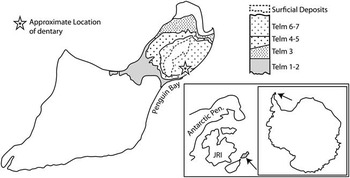
Isla Marambio, Antarctic Peninsula, is the most important locality for Palaeogene fossil fishes in Antarctica. Its taxonomically and ecologically diverse fauna stands in marked contrast to that of the Recent, which is highly endemic and taxonomically restricted. Palaeogene fishes of Antarctica are known primarily from the Eocene of the La Meseta Formation of Isla Marambio. The La Meseta comprises an array of neoselachians, chimaeroids, and teleosts (Eastman & Grande Reference Eastman and Grande1989, Reference Eastman and Grande1991, Ward & Grande Reference Ward and Grande1991, Jerzmanska Reference Jerzmanska1991, Long Reference Long1992, Reference Long1994, Cione & Reguero Reference Cione and Reguero1998, Eastman Reference Eastman2000, Kriwet Reference Kriwet2005) that span almost the entire Eocene record from roughly 54.2 Ma in Telm 2 to 34.2 Ma in Telms 6 & 7 (Marenssi Reference Marenssi2006, Ivany et al. Reference Ivany, Lohmann, Hasiuk, Blake, Glass, Aronson and Moody2008). Several fragmentary Eocene teleost fish specimens were identified as Gadiformes or cods (Grande & Eastman Reference Grande and Eastman1986, Jerzmanska & Swidnicki Reference Jerzmanska and Swidnicki1992, Kriwet & Hecht Reference Kriwet and Hecht2008) and an additional specimen is attributed to the Notothenioidei (Balushkin Reference Balushkin1994), the dominant element of the Recent fauna. Here we describe an isolated partial right teleost dentary (BAS D.515.2) collected by W.N. Croft in 1946. The specimen was recovered from the ‘Fossil Penguin’ locality, D.515, described by Croft in Marples (Reference Marples1953) and again mentioned by Simpson (Reference Simpson1971). However, the approximate latitude and longitude provided in those publications do not correspond to the locality description and are therefore not provided here. The approximate locality was described by Croft in Marples (Reference Marples1953, p.2) as roughly half a mile north-east of the eastern headland of Penguin Bay, on the ‘150 ft terrace-like coastal feature’ that dominates the eastern side of the island (Fig. 1). Accordingly, this places the specimen in the uppermost part of the La Meseta Formation, more probably Telm 7 than Telm 6 (Sadler Reference Sadler1988).
Map of Antarctica with detail of Isla Marambio (Seymour Island) showing locality BAS D.515.2 (star). Telms redrawn from Sadler (Reference Sadler1988, fig. 1).

Institutional abbreviations
AMNH = American Museum of Natural History, FMNH = Field Museum of Natural History, OU = Ohio University, UF = University of Florida, Gainesville.
Comparative materials
Fossil specimens, FMNH PF10656, FMNH PF10657, FMNH PF10672, FMNH PF10673, recent specimens, Notothenioidei, Bovichtus diacanthus OU JTE-BDIA-2, Chaenocephalus aceratus OU JTE-CAC-1, Champsocephalus gunnari OU JTE-CGU-2, Cottoperca trigloides OU JTE-04-04-4, Eleginops maclovinus OU JTE-EMA-E, Lepidonotothen nudifrons OU JTE-LNU-65, Lepidonotothen squamifrons OU JTE-LSQ-1, Notothenia coriiceps OU JTE-NCO-04-04-3, Pagothenia borchgrevinki OU JTE-PBO-2, Parachaenichthys charcoti OU JTE-PCHAR-1, Pogonophryne scotti OU JTE-PSC-1, Pseudochaenichthys georgianus OU JTE-PsGEO-1, Trematomus bernacchii OU JTE-TBE-1, Trematomus newnesi OU JTE-TNE-28. Gadiformes, Macruronus novaezelamdiae OU OUVC-MNO-2, Merluccius cf. albidus UF20063, Merluccius gayi UF20483, UF26963, Merluccius productus AMNH 46427, AMNH 47586.
Systematic palaeontology
OSTEICHTHYES (Huxley, 1880)
ACTINOPTERYGII (Cope, 1887)
TELEOSTEI (sensu Patterson & Rosen, 1977)
PARACANTHOPTERYGII (sensu Patterson & Rosen, 1989)
ANACANTHINI (sensu Patterson & Rosen, 1989)
GADIFORMES (sensu Cohen, 1984)
GADOIDEI (sensu Endo, 2002)
MERLUCCIIDAE (Gill, 1884)
Referred specimen
British Antarctic Survey (BAS) D.515.2, partial right dentary.
Age and distribution
Telm 7, Late Eocene (sensu Sadler Reference Sadler1988).
Diagnosis
Specimen is determined to belong to Merluccidae based on long lower jaw, no osteological evidence of barbels, well developed sharp teeth. Additional features include a trench instead of a canal for the mandibular nerve.
Description
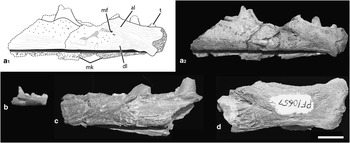
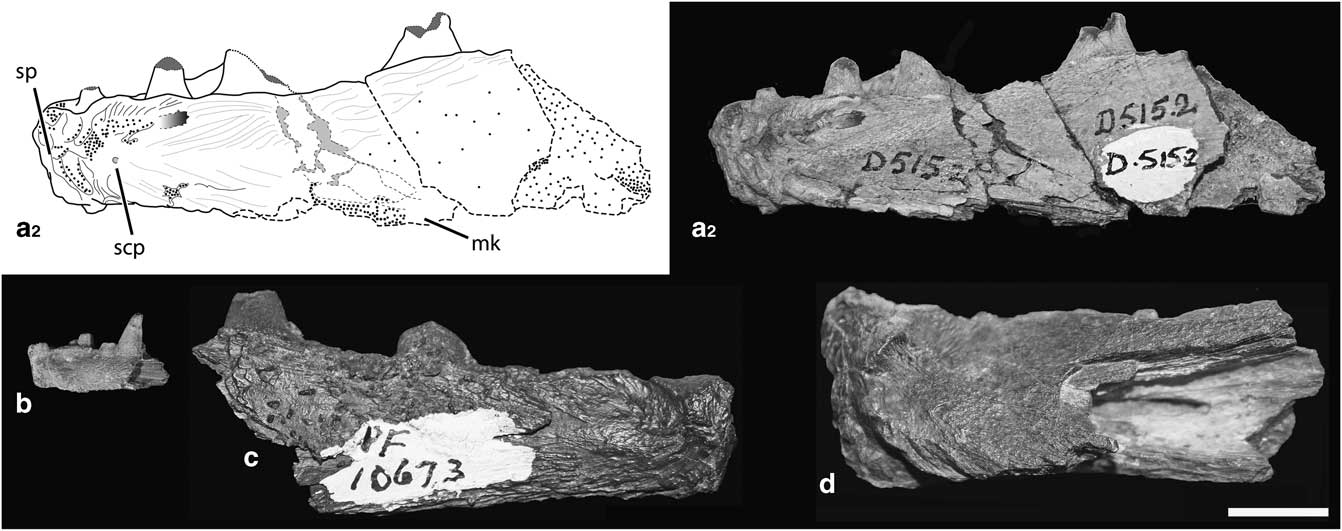
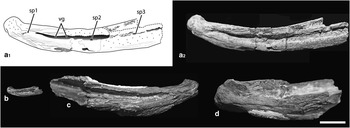
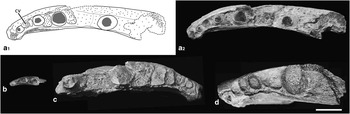
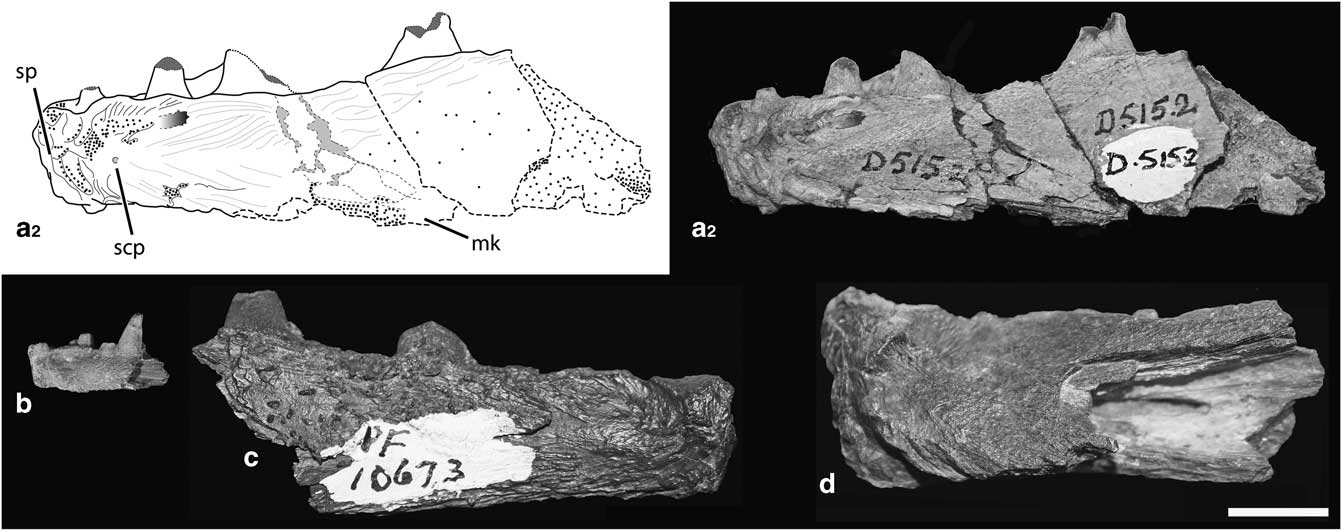
The dentary fragment, which forms the focus of this study, is just under 6 cm long from the symphysis to the distal fractured surface and is estimated to be roughly half the actual total length of the dentary. At its widest point the dentary is 1.05 cm. The dentary is narrowest at the symphysis. The lateral surface is convex and the medial surface is flat. There is a v-shaped sculpting on the lateral surface of the dentary beneath the first and third preserved teeth (Fig. 2a1 & a2). The mental foramen is posterior to the apex of the sculpting, which projects as ascending and descending limbs (thus increasing the depth of the dentary from anterior to posterior). The ascending limb is fractured and partially covers the lateral aspect of the tooth row. The descending limb is short but complete. The most posterior aspect of the dentary is fractured anterior to the position of the expected lateral incision, which marks dorsal and ventral processes for the anguloarticular. In medial view (Fig. 3a1 & a2), the symphyseal process is smooth on the narrow articular facet and irregular lingual to the articular facet. The dorsal aspect of the medial surface ascends slightly to flank the fourth preserved tooth. There is a small sensory canal pore beneath the first preserved tooth. No distinct medial incision is present. A median keel is continuous with the medial surface, offset from the lateral surface by a deep ventral groove and is fractured ventrally. The deep ventral groove is consistent with the position of a mandibular sensory canal and there are three recognizable pores present within the groove (Fig. 4a1 & a2). In occlusal view (Fig. 5a1 & a2), the dentary possesses a single row of sharp, ankylosed teeth set upon robust bony pedestals. For four teeth, only bases and a portion of the crowns, preserved without their apices, are present. Teeth are largest posteriorly and longer anteroposteriorly than labiolingually. Between each tooth is a deep cavity that is marked by several small pores. The cavities of absent teeth are round, but anteriorly they are crowded and appear more oval.
Fossil dentaries from Isla Marambio in lateral view. a1. line drawing, and a2. photograph of BAS D.515.2 (right side). b. FMNH PF10656 (right side). c. FMNH PF 10673 (left side). d. FMNH PF 10657 (right side). al = ascending limb, dl = descending limb, mf = mental foramen, mk = median keel, t = teeth. Scale bar: 1 cm.

Fossil dentaries from Isla Marambio in medial view. a1. line drawing, and a2. photograph of BAS D.515.2 (right side). b. FMNH PF10656 (right side). c. FMNH PF 10673 (left side). d. FMNH PF 10657 (right side). mk = median keel, scp = sensory canal pore, sp = symphyseal process. Scale bar: 1 cm.
Fossil dentaries from Isla Marambio in ventral view. a1. line drawing, and a2. photograph of BAS D.515.2 (right side). b. FMNH PF10656 (right side). c. FMNH PF 10673 (left side). d. FMNH PF 10657 (right side). scp1-3 = ventral sensory canal pores 1–3, vg = ventral groove. Scale bar: 1 cm.

Fossil dentaries from Isla Marambio in occlusal view. a1. line drawing, and a2. photograph of BAS D.515.2 (right side). b. FMNH PF10656 (right side). c. FMNH PF 10673 (left side). d. FMNH PF 10657 (right side). c = tooth cavity. Scale bar: 1 cm.

Discussion
BAS D.515.2 is unlike the dentary of macrourid gadiforms, which are known in abundance from otoliths in the Eocene of Antarctica (Kriwet & Hecht Reference Kriwet and Hecht2008). BAS D.515.2 resembles the dentary fragments previously described by Grande & Eastman (Reference Grande and Eastman1986, p. 129, fig. 5d–i; see also Figs 2–5) and together they represent a growth series of the same taxon, which is consistent with the description of “Mesetaichthys” (Jerzmanska & Swidnicki Reference Jerzmanska and Swidnicki1992). Given that we were able only to compare dentaries in the absence of associated skeletal material, we are unable to justify formalizing this name, but future work, including additional collection and comparison of other skeletal elements, may allow this.
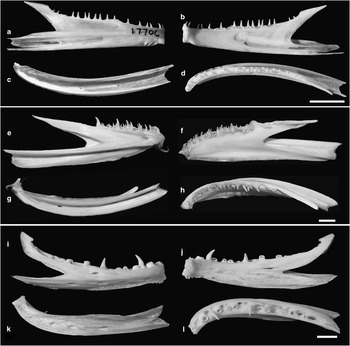
“Mesetaichthys” grew to a massive size but the morphology of its jaw and the relative position of the largest tooth bases in those jaws was maintained during its growth. All specimens of “Mesetaichthys” have v-shaped sculpting (present in modern gadiforms, but not in modern notothenioids, Fig. 6) with an ascending limb that flanks the tooth row (Fig. 2). Among modern gadiforms, the v-shaped sculpting is more anterior along the dentary in gadids than in merlucciids (Fig. 6). Teeth of “Mesetaichthys” are tall with straight crowns, as in Merluccius Rafinesque, 1810 (Fig. 6a & b), not posteriorly curved crowns as in the notothenioid Dissostichus Smitt, 1898 (Fig. 6i & j). A median keel is observed in gadiforms such as Gadus and Merluccius, and the keel is separated from the lateral surface by a deep sensory groove marked by pores of sensory canals (Fig. 6a–c & e–g). There are more sensory pores in Gadus L., 1758, than in Merluccius and “Mesetaichthys”. A median keel is absent in most notothenioids, except for Cottoperca trigloides (Foster, 1801). In all notothenioids, however, including C. trigloides, there is a completely walled sensory canal, not a deep groove (Fig. 6k). The occlusal view of “Mesetaichthys” shows a single row of large, sharp, ankylosed teeth set upon robust bony pedestals, consistent with the type-1 tooth replacement found in Merluccius. Type-1 tooth replacement is the primitive attachment mode for actinopterygians and it is characterized by complete ankylosis of the tooth to the attachment bone (Fink Reference Fink1981). The anteriormost tooth bases are oval, crowded, and aligned in single row. Some notothenioids have a single row of teeth, but the majority of taxa have multiple rows of teeth. Several gadids also have multiple tooth rows. Merlucciids, such as Merluccius have a single-to-offset tooth row (Fig. 6d).
Right dentaries of a merluccid, Merluccius gayi, specimen UF 1770C, in a. lateral, b. lingual, c. ventral and d. occlusal views. Right dentaries of a gadid, Gadus morhua, specimen JTE GMO 4, in e. lateral, f. lingual, g. ventral, and h. occlusal views. Right dentaries of a nototheniid, Dissostichus eleginoides, specimen JTE DEL 04-04-6, in i. lateral, j. lingual, k. ventral, and l. occlusal views. Scale bar: 1 cm.

In conclusion, the suite of similarities that the dentaries of our specimen and “Mesetaichthys” show to the dentary of Merluccius comprises our rationale for assigning these specimens collectively and definitively to the Merlucciidae. Our new dentary, from a large merlucciid, supports the notion that there was a considerable biomass of bony fish in the productive, cool temperate marine palaeoenvironment then occurring at the position of Isla Marambio. This biomass supported large and diverse populations of sharks (Case Reference Case1992), an element missing from Antarctic waters today.
Acknowledgements
We thank the following people and their institutions for assistance with specimens: R. Arrindall, B. Brown, M. Stiassny, American Museum of Natural History; H. Blagbrough, J.A. Crame, A. Tate, British Antarctic Survey; R. Robbins, I. Quitmeyer, Florida Museum of Natural History; and W. Simpson, Field Museum of Natural History. We also appreciate the comments of the reviewers Dr Judd Case and Dr Jürgen Kriwet.