In September 2018, top executives of Prodeco, a Colombian subsidiary of the Swiss mining company Glencore, joined the remote rural community of La Vereda de Estados Unidos to honor the victims who had been driven from their homes or had been murdered during a conflict between armed groups and the Colombian government around the turn of the twenty-first century (cf. Semana 2007; Comisión de la Verdad 2019; Molinares and Jaccard Reference Molinares and Jaccard2016). Access to and control over land were among the stakes of this conflict, which saw various private and public parties, including Prodeco, supporting paramilitary groups to obtain land (cf. Molinares and Jaccard Reference Molinares and Jaccard2016; Pax 2014). The commemoration ceremony consisted of several speeches that gave accounts of the killings, disappearances, and dispossession that had taken place and various symbolic artistic performances, including a theater piece, a choir song, and local children watering a flower and liberating white doves (Prodeco 2018). Throughout the ceremony, though, no explicit connection was made between the firm and the atrocities. Prodeco’s president, Mark McManus, expressed the company’s solidarity with the tragedy and its victims but also remarked that “we have not had a long history in the region with which we can fully understand the past” (Prodeco 2018). To some victims, these remarks unjustly promoted the image of Prodeco as an innocent and selfless supporter of the local community (Pax 2018b).
Corporate wrongdoings can severely affect a firm’s stakeholders and, if left unaddressed, the firm itself through diminished legitimacy (Suchman Reference Suchman1995). Whenever a firm is perceived to harm or have harmed one or several of its stakeholders, calls to restore moral relationships (as manifested through confidence, trust, hope, etc.) may emerge (Pfarrer et al. Reference Pfarrer, Decelles, Smith and Taylor2008; Dirks, Lewicki, and Zaheer Reference Dirks, Lewicki and Zaheer2009). Initiatives like Prodeco’s should be seen in this light—as instances of “moral repair.” The practice of moral repair allows victims of (corporate) wrongdoings to move from a situation of damage to one where (some) stability in moral relationships is regained (Walker Reference Walker2006, 6). Moral repair consists primarily in making amends (Goodstein and Butterfield Reference Goodstein and Butterfield2010, 458), which are intentionally reparative actions aimed at redressing wrong. Amends can take a material form, such as restitution, compensation, and rehabilitation, or a symbolic one, such as apologies, memorials, and commemorations (Sharpe Reference Sharpe, Johnstone and Van Ness2007). Typically, moral repair involves a collaborative effort of all parties affected by or connected to the observed wrong, including the offender(s), the victim(s), and parties from the community at large, and aspires to address victims’ grief and restore or stabilize damaged relationships and, in some cases, create the basic elements that sustain human beings in recognizably moral relationships (Walker Reference Walker2006).
Moral repair, especially as symbolic amends, is relatively new in the management literature (Greeley et al. Reference Greeley, Orwicz, Falconi, Reyes, Rosenberg and Laplante2020), but the literature on firms’ moral agency is not. In the 1980s, business ethicists argued that firms can establish moral relationships (Donaldson Reference Donaldson1982), intentionally act in and reflect on them (Werhane Reference Werhane1985), and therefore bear moral responsibilities (May Reference May1987; Meyers Reference Meyers1983). The corollary is that after violating ethical or social standards, firms ought to restore damaged relationships with affected parties. According to recognition theory, which is an important theoretical foundation of moral repair (cf. Honneth and Farrell Reference Honneth and Farrell1997; Honneth Reference Honneth1995), fulfilling this obligation hinges on the recognition of victims’ moral authority over the offender, which exists in expressive acts (e.g., speech, gestures) through which the identification of a person is conferred with positive meaning (Radzik Reference Radzik2009; Honneth and Margalit Reference Honneth and Margalit2001). The concept of moral repair thus has a normative component; indeed, it is often argued to require a comprehensive response to victim needs rooted in the wrong (Walker Reference Walker2006, 208). This point has, in turn, inspired scholarly discussions of what moral repair should look like (Goodstein et al. Reference Goodstein, Butterfield, Pfarrer and Wicks2014; Pfarrer et al. Reference Pfarrer, Decelles, Smith and Taylor2008; Goodstein and Butterfield Reference Goodstein and Butterfield2010). Overall, the literature views symbolic amends as key to organizational rehabilitation, for example, apologies are thought to signal trustworthiness (Gillespie and Dietz Reference Gillespie and Dietz2009), whereas expressions of regret and the acceptance of responsibility are believed to help victims understand the circumstances of their suffering (Pfarrer et al. Reference Pfarrer, Decelles, Smith and Taylor2008; Gillespie, Dietz, and Lockey Reference Gillespie, Dietz and Lockey2015).
However, although the normative arguments that victim restoration should be maximal and that symbolic amends add moral value to material amends are both appealing, practicing moral repair based on recognizing the identity and moral dignity of victims (Honneth and Margalit Reference Honneth and Margalit2001) remains inherently challenging. In the case of many corporate transgressions, assessing exactly “what happened” is difficult and involves a degree of social construction. Therefore, rather than “absolute” moral restoration, moral repair involves negotiation between the offending firm, its victims, and possibly third parties, such as nongovernmental organizations (NGOs), governments, or the public (Goodstein et al. Reference Goodstein, Butterfield, Pfarrer and Wicks2014). Victims’ needs can be diverse and complex (Van Ness and Strong Reference Van Ness and Strong2010), so adequately responding to each of them may be extremely difficult, particularly following large-scale abuses, where each victim might have been impacted differently and may thus require a particular kind of approach (Walker Reference Walker, Davis and Womack2001). Thus there is a tension at the core of the concept of moral repair: originating from recognition theory, it can be conceptualized both normatively, involving prescriptions of its purpose and morphology, and from a socioconstructivist standpoint, according to which the practice is necessarily incomplete and unfinished. To paraphrase Goodstein et al. (Reference Goodstein, Butterfield, Pfarrer and Wicks2014), moral repair presents a “wicked problem,” which may leave firms struggling as they go about mending damaged moral relationships. Without a clear picture of the normativity of moral repair, corporate action may remain insufficient or inappropriate. A case in point is Prodeco, whose efforts toward moral repair have arguably missed the mark.
The tension that underlies the concept of moral repair presents the theoretical challenge of delineating and connecting its normative and socioconstructivist components. Thus conceptually clarifying moral repair could yield a more systematic procedure for firms seeking rehabilitation. Our article therefore addresses the following research question: how, in the aftermath of wrongdoing, should firms engage in repairing damaged moral relationships with their stakeholders? In answering this question, we critically assess recognition theory, which outlines the ethical principles undergirding the concept of moral repair, and the literature on moral repair itself, particularly elaborations of its associated practices. Our analysis of these literatures leads us to conceptualize moral repair as comprising procedural and substantive levels. Whereas the former refers to corporate practices that foster the conveyance of amends, the latter alludes to activities, gestures, and material outcomes that are morally significant to affected parties (victims, observers). We argue that thick normative prescriptions ought to be kept to the procedural level. In other words, rather than predetermining outcomes, they should outline the contours of the reparation process, which necessarily leads to open results. That is, firms should always strive to maximize the possibility space for victims to identify appropriate ways for them to achieve moral healing—for example, by being open-minded and of good faith. In contrast, the effectiveness of substantive moral repair is a function of victims’ (subjective) experience of moral restoration.
In the remainder of this article, we first discuss the intellectual underpinnings of moral repair, drawing mainly on recognition theory, and the contrasting normative and socioconstructivist perspectives that follow from it. We subsequently define procedural and substantive moral repair as two distinct levels of activity, which we elaborate in a three-phase process model that orders and connects various specific moral repair practices. While doing so, we discuss the nature of amends and their relationship with moral outcomes, which, as we argue, is best analyzed following a configurational approach (cf. Meyer, Tsui, and Hinings Reference Meyer, Tsui and Hinings1993; Hinings Reference Hinings2018), in which similar or different (sets of) amends may have different or similar effectiveness, respectively. We then discuss the theoretical implications of our conceptual work: 1) it marks an important step toward conceptual clarification, channeling normative and socioconstructivist contributions to understanding moral repair; 2) the associated process model offers a more refined image of the mechanism driving moral repair; and 3) the suggestion of viewing the moral effects of amends through a configurational lens accommodates nonlinear causal relations, which does justice to amends’ subjective moral value. Our brief introduction of configurational thinking forms an entry point to practicing moral repair. In this vein, we also identify further practical implications of our theorization, after which we conclude with suggestions for further research and some remarks on generalizability and boundary conditions.
THE NORMATIVITY OF MORAL REPAIR
Business ethicists have long discussed whether firms are “moral agents” to which moral responsibilities should be assigned (French Reference French1979; Werhane Reference Werhane1985; Velasquez Reference Velasquez2003; Rönnegard Reference Rönnegard2013). Although the consensus seems to be that moral agency rests on three conditions—the possession of autonomy, the capacity for normative judgment, and self-control (Pettit Reference Pettit2007; Hasnas Reference Hasnas2018)—opinions differ as to whether firms satisfy those conditions. Some scholars argue that firms lack the autonomy and intentionality that they must possess to be morally responsible for organizational events and that therefore this responsibility eventually falls onto their individual members (Velasquez Reference Velasquez2003; Rönnegard Reference Rönnegard2013). Others contend that despite their nonphysical nature, most firms—especially those of some size—have a distinct culture and dominant logic, both of which exist by virtue of collective action. In such settings, organizational behaviors are generally “nondistributable,” that is, not fully ascribable to the members who (collectively) created and sustained them, which means that the moral responsibility for these behaviors exists beyond these members (Werhane Reference Werhane2016). Furthermore, if organizational structures can employ some sort of reason, they should also be able to identify the moral reasons that prompted organizational events, thus satisfying the three conditions for moral agency (Donaldson Reference Donaldson1980; Sepinwall Reference Sepinwall2016). The assumption of moral agency underlies most discussions on corporate social responsibility, corporate citizenship, and stakeholder theory (Schrempf-Stirling, Palazzo, and Phillips Reference Schrempf-Stirling, Palazzo and Phillips2016) and substantiates the case why firms should strive to restore damaged moral relations with stakeholders (Radzik Reference Radzik2004, Reference Radzik2009).
The mending of relations, which Walker (Reference Walker2006) describes as “moral repair,” takes place in the aftermath of a moral transgression. Moral transgressions are behaviors that physically and/or mentally damage the victim and implicitly or explicitly convey the message “I count, but you do not” or “I am up here on high, and you are down there below” (Murphy Reference Murphy, Murphy and Hampton1990). As such, they represent a failure to recognize individuals or groups as entities of equal moral worth, which leads them to a state of invisibility, humility, and/or social alienation (Honneth and Farrell Reference Honneth and Farrell1997). Moral repair broadly refers to efforts that support the process of moving from a situation of loss and damage to one where (some) stability in moral relations is regained (Walker Reference Walker2006, 6). More specifically, it involves “restoring or stabilizing—and, in some cases, creating—the basic elements that sustain human beings in recognizably moral relationships” (Walker Reference Walker2006, 23). These elements often include trust and hope, which can be fostered through a shared sense of value and responsibility. In practice, therefore, moral repair is often about disposing people toward each other and toward the moral standards they trust (or at least hope) to be shared and to govern such relationships (Walker Reference Walker2006, 23). This practice is typically a collective one, involving not only the (corporate) wrongdoer but also the victims and the community at large. Still, as Walker (Reference Walker2006, 7) argues, the former has “paramount and unique responsibilities” in this regard.
The concept of moral repair is rooted in moral philosophy (Radzik Reference Radzik2009) and can be tied particularly closely to recognition theory. As she elaborates the concept of moral repair, Walker (Reference Walker2006) extensively draws on the concept of recognition and related notions, such as affirmation and confirmation. She sees the recognition of a human’s dignity by others and protection of that dignity by social norms as essential for community or society membership. Once a moral transgression has occurred, she argues, victims voicing their grievances essentially invite confirmation that they have endured and suffered an illegitimate transgression and that this transgression is socially condemned. Moral repair is therefore predicated on the wrongdoer’s recognition of victims’ value and social membership and on showing that social norms are affirmed and enforced. In fact, she emphasizes that “fail[ing] to confirm the victim’s wrong is itself another wrong” (Walker Reference Walker2006, 20, emphasis original), because it violates the morally essential trust that there are recognized, shared rules by which communities live and on which their members can count for guidance and protection.
Walker’s (Reference Walker2006) line of reasoning echoes recognition theory, which is fundamentally concerned with individual development as embedded in a social struggle for love, rights, and solidarity, and views aspects like positive self-consciousness, autonomy, emotional security, and ethical personhood as constituted through relations of recognition with others. The denial of recognition then constitutes moral injury, because it undermines the positive relations-to-self that recognition underpins (Honneth and Farrell Reference Honneth and Farrell1997; Honneth Reference Honneth1995). It follows that moral repair is predicated on the exercise of recognition, because it allows individuals to reach the appropriate understanding of their own persons (Honneth and Farrell Reference Honneth and Farrell1997). Recognition as atonement (Radzik Reference Radzik2009, 11; Honneth Reference Honneth1995) involves recognizing the identity, traits, preferences, and agentic status of those who have been wronged as well as their status as moral equals. Concretely, recognition occurs in at least two ways: perception and affirmation (Honneth and Margalit Reference Honneth and Margalit2001). First, the recipients of moral repair need to be identifiable; second, they have to be noticed affirmatively by (representatives of) the offender—both verbally and nonverbally, such as through smiles or nods—in the manner appropriate to the relationship in question.
The most important way in which moral repair is accomplished is through the making of amends (Goodstein and Butterfield Reference Goodstein and Butterfield2010, 458). Amends are “intentionally reparative actions by parties who acknowledge wrong, and whose reparative actions are intended to redress that wrong” (Walker Reference Walker2006, 191). There is an inherently moral quality to the making of amends, because it reflects the notion that “the one who has morally wronged another person must do something about it” (Radzik Reference Radzik2009, 5). On top of that, the normative principle of recognition requires that efforts aimed at making amends center explicitly on the harm suffered by victims (Walker Reference Walker2006, 209). Without such a focus, “reparative actions are charitable …, but they do not make amends” (Walker Reference Walker2006, 191). More specifically, amends have to be voluntary, comprehensive, and public: voluntary, because if an offender makes them only when forced by a third party—even if the offender acknowledges a direct link between its actions and the victim’s suffering—victim identification and/or acknowledgment may be less powerful or even damaging (Radzik Reference Radzik, Johnstone and Van Ness2007, Reference Radzik2009). For example, recipients of legal damages may suspect that payment is treated as a necessary cost of doing business rather than being a genuine attempt at making amends—especially if the financial gains of problematic business practices outweigh the risk of legal repercussions and the amounts involved are not commercially impactful—which may aggravate feelings of worthlessness (Richards Reference Richards2007). Comprehensiveness is also essential, because if the victim is a person of equal moral worth, the offender should fully acknowledge the legitimacy of its demands for validation and vindication and subsequently address them somehow in all their dimensions (De Greiff Reference De Greiff2006; Walker Reference Walker2006). Finally, publicity is critical because broadly observable amends are typically more effective at victim affirmation owing to their signaling value (Hamber Reference Hamber2006; Honneth and Margalit Reference Honneth and Margalit2001).
Apart from the practice of making amends, recognition theory also informs moral evaluations of the nature of amends (Honneth Reference Honneth1995), which can be either material or symbolic (Sharpe Reference Sharpe, Johnstone and Van Ness2007). Material amends are arguably the “standard” form of amends, given how justice systems still rely on them, especially in cases where victims’ assets and/or sources of income have been damaged or destroyed (De Greiff Reference De Greiff2006). If the victims, the transgression, and the offender’s responsibility are acknowledged, and the victims thus have legitimate claims, it is morally warranted to replace what has been taken, for example, in the form of compensation, restitution, or reparations (Sharpe Reference Sharpe, Johnstone and Van Ness2007, 27). Unfortunately, transgressions can (also) inflict immaterial (bodily or psychological) harm upon victims, which may be difficult to mend materially. After all, reparations cannot bring the dead back to life, erase dark memories, or alleviate posttraumatic stress (Minow Reference Minow1998, 104). Still, if victims are the offender’s moral equal, immaterial needs also have to be adequately addressed. Symbolic amends, such as apologies, commemorations, memorialization, and more drastic gestures, such as resignations and the (partial) discontinuation of operations, are specifically geared toward this type of acknowledgment, because as “carriers of meaning,” they can help victims make sense of the transgression (Hamber Reference Hamber2006) and meet their needs for recognition, respect, dignity, and a better future (Mégret Reference Mégret2009, 6). Publicly performed symbolic amends are arguably more effective at this task because of their stronger victim affirmation; besides, they can address communal needs for reconciliation (Hamber Reference Hamber2006).
Although ontologically different, material and symbolic amends are not mutually exclusive; in fact, there is an emerging consensus that both kinds should go hand in hand because they reinforce each other in restoring victims, overcoming negative expectations, and promoting trustworthiness (Gillespie and Dietz Reference Gillespie and Dietz2009, 134; Pfarrer et al. Reference Pfarrer, Decelles, Smith and Taylor2008). Indeed, some evidence suggests that firms combining material and symbolic amends are more effective at establishing moral repair than firms using either of them in isolation because the former can better cope with the variety of victims’ needs (Bottom et al. Reference Bottom, Gibson, Daniels and Murnighan2002; Rubio-Marín and Greiff Reference Rubio-Marín and de Greiff2007). In contrast, unbalanced approaches have been found to incite contestation (De Greiff Reference De Greiff2006, 470): symbolic amends may seem insignificant if they are not supported by material amends, while material amends that are not supplemented by symbolic amends can be dismissed as a bribe (Verdeja Reference Verdeja2006, 460). Recognition theory adds a moral layer to these empirical arguments, prescribing that moral repair consist of both material and symbolic forms of amends (Honneth and Margalit Reference Honneth and Margalit2001). This normative principle is rooted in the argument that recognition is desirable, not because of its instrumental outcomes in terms of restoring damage, but because it grounds instrumental social relations themselves (Honneth Reference Honneth2002). Although it does not preclude material amends, recognition theory goes beyond purely utilitarian understandings of ethics, positing that instrumental social behaviors find their ultimate meaning in the self-realization of victims and in the constitution of dignified social relations based on mutual respect (Islam Reference Islam2012).
Similar normative arguments about relationship restoration are made in the organizational literature. For example, Pfarrer et al. (Reference Pfarrer, Decelles, Smith and Taylor2008) explicitly state that their process model of organizational reintegration is normative and argue that the more firms do to account for their transgression and to accept any punishment, the more likely it is that they will regain legitimacy. Furthermore, Ren and Gray (Reference Ren and Gray2009) develop a series of propositions regarding effective relationship restoration behavior, taking into account the nature of the transgression and the cultural context in which the transgression has taken place. Likewise, Dirks, Lewicki, and Zaheer (Reference Dirks, Lewicki and Zaheer2009) identify three sets of redress tactics—aimed at shaping victim attribution, restoring social equilibrium, and implementing trustworthy structures—and argue that they promote trust, positive affect, and positive exchange, respectively. In addition, they formulate a set of propositions pertaining to the way in which these tactics can influence each other’s effectiveness. In a more recent piece of work, Goodstein, Butterfield, and Neale (Reference Goodstein, Butterfield and Neale2016) also emphasize the normative implications of understanding the dynamics surrounding the making of amends, suggesting that material and symbolic amends can lead to various beneficial outcomes, such as improved relations, goodwill, trust, and offender self-improvement.
MORAL REPAIR AND SOCIOCONSTRUCTIVISM
As noted, recognition theory highlights that an important aspect of moral transgressions is lacking recognition of victims’ equal moral worth. While this position forms the basis for normative claims about what moral repair should look like, it also supports ethical reasoning that puts firm limits on what can normatively be prescribed. In recognition theory, the confirmation and reenactment of a victim’s moral worthiness, which are key to relationship restoration and thus moral repair, occur through positive or affirmative social gestures that reaffirm a standpoint of interpersonal recognition (Honneth and Margalit Reference Honneth and Margalit2001). These, in turn, require participation in relationships and social life (Honneth Reference Honneth1995; Margalit Reference Margalit1996; Islam Reference Islam2012). In other words, the dignity and moral worthiness of victims are established intersubjectively through communicative exchange, which means that the appropriateness of moral repair (in the form of material and/or symbolic amends) cannot be determined a priori by means of independent normative standards but is, instead, a function of social construction, even within overarching normative frameworks. Indeed, where the offender offers amends, the victim(s) may accept, attempt to modify, or refuse them (Radzik Reference Radzik, Johnstone and Van Ness2007, 194), so moral repair is, at its core, a relational process that crucially rests on the victims’ viewpoints as to the circumstances of the transgression and the responsibilities that it has spawned. By the same token, it seems futile for wrongdoers to try to restore their moral relationship with victims without their participation and consent (Radzik Reference Radzik2009, 121).
The socioconstructivist take on moral repair is corroborated by the literature on restorative justice, which has a growing influence on discussions of moral repair (Schormair and Gerlach Reference Schormair and Gerlach2020). Restorative justice is a framework for relationship repair that emerged in the field of criminal law (Christie Reference Christie1977; Braithwaite Reference Braithwaite1999) and emphasizes the direct engagement and participation of all involved parties—the wronged, the offender, and affected communities—in free and voluntary communicative repair processes (Marshall Reference Marshall1999; Braithwaite Reference Braithwaite2004). Through engagement and participation, those affected by harm have the opportunity to identify and address their needs in the aftermath of a crime and seek a resolution that affords healing, repair, and reintegration (Cormier Reference Cormier2002). Because victimization is generally seen as an experience of powerlessness (Van Ness and Strong Reference Van Ness and Strong2002), it is critical to restorative justice processes that victims’ sense of control over their lives be restored (Minow Reference Minow1998, 115). This is done, for example, by granting them the opportunity to ask questions, share their stories and feelings, and receive acknowledgment of their suffering and, ultimately, the power to accept, refuse, or ignore the offender’s efforts at making amends (Van Ness and Strong Reference Van Ness and Strong2010, 43). At a practical level, it is argued that victim participation offers a valuable source of information in the design of appropriate amends (De Greiff Reference De Greiff2006, 465; Roht-Arriaza Reference Roht-Arriaza2004, 200), as it helps offenders understand where and why amends are needed and the impact that they may have on victims.
Viewing moral repair through a socioconstructivist lens has important onto-epistemological implications, as it calls into question the nature of the transgression that has been committed and how it can be known (Radzik Reference Radzik, Johnstone and Van Ness2007). If different versions of the past and alternative ways of reconstructing it are equivalent, it is extremely difficult to find one “morally superior” way of practicing moral repair, even if the involved parties agree on broad ethical standards. The lack of a moral optimum can lead to several ethical issues, regardless of whether there are one or more victims, and even if the offender is committed to respecting their moral worthiness. For example, the offender and its victims might differ as to whether the latter have been treated as moral equals, which typically translates into disagreements about the amends that are necessary for restoring the moral relationship (Katz and Radzik Reference Katz and Radzik2010). In some cases, the offender might consider the amends demanded by the victims unreasonable (Braithwaite Reference Braithwaite2002), perceiving them as retaliation (“an eye for an eye”) or payoffs that bear no meaningful relationship to the transgression in question. Conversely, victims might feel unrecognized, even if the offender genuinely believes that it has practiced due diligence in identifying and addressing victim needs. In the case of Prodeco, for example, some victims believed that the firm had not done enough to understand their circumstances (Pax 2018a). Issues like these detract from the normative agenda of arriving at an independent framework for moral repair.
If the offender faces several victims, moral repair becomes even more complex. Each victim may have his or her own assessment of the suffering and specific associated demands. It is then extremely difficult for the offender to satisfy all victims with one set of amends. As Walker (Reference Walker, Davis and Womack2001, 119) argues, “what repairs moral relations for one party may damage them for another; what provides bases for trust or hope for some may necessitate measures that inspire fear, resentment, or contempt in others.” Some may even consider the mere attempt at moral repair offensive, because it can be perceived as a push toward forgiveness (Economist 2021), especially when those involved in or (formally) responsible for the transgression—such as CEOs or company directors—are still in place. Victim demands are often incommensurable. For example, following the 2012 killing and injuring of striking mine workers at Lonmin’s Marikana mine by the South Africa Police Service, the firm provided both material and symbolic amends to the families of the deceased miners. Material reparations included employment opportunities, a trust memorial fund to cover the costs of education of the victims’ children, and new homes, while symbolic initiatives involved, among other things, annual commemorations during which the company’s CEO would publicly express regret for the events, empathy with the victims, and commitment to preventing future atrocities. Whereas some victims accepted these amends, others insisted that Lonmin offer a full-fledged apology as well as financial compensation for the dependents of the deceased (London Mining Network 2018; Mokhoali Reference Mokhoali2020; Yeomans Reference Yeomans2017).
Even the commitment to offering each and every victim tailored amends might incite criticism, because if victims can observe each other’s outcomes and discover that the offender has done more for some than for others, for instance, because they had more information about the gravity of the transgression, raised public awareness of their plight, pursued legal action, or negotiated better, they may again feel unrecognized. This point is exemplified by the Olgeta Meri Remedy Framework, which was set up in 2012 by Barrick Gold, a Canadian mining company, in response to allegations of sexual violence committed by private security forces at the Porgera mine in Papua New Guinea. On one hand, the framework was praised for its ambition to offer equitable reparations and its meticulous attention to claimants’ rights. On the other hand, it was criticized for its limited effectiveness because it was not properly understood by all claimants. Besides, some victims who were unhappy with the amends that they had been offered successfully sued the company and thus saw their compensation increase, which demonstrated that those who had accepted a deal with Barrick Gold had settled for less than they deserved. In effect, some “successful” claimants received equitable or even generous reparations by international legal standards, whereas others were left offended, stigmatized, and abused (Aftab Reference Aftab2016), which prompted calls for further compensation (Knuckey and Jenkin Reference Knuckey and Jenkin2015, 809).
As much rooted in recognition theory as normative conceptions of moral repair, the socioconstructivist perspective evokes an image of moral repair as necessarily incomplete and open-ended—a “wicked problem” (Goodstein et al. Reference Goodstein, Butterfield, Pfarrer and Wicks2014, 328)—which may explain why research on the effects of amends is often case based (e.g., Bertels, Cody, and Pek Reference Bertels, Cody and Pek2015; Gromet and Okimoto Reference Gromet and Okimoto2015; Gillespie, Dietz, and Lockey Reference Gillespie, Dietz and Lockey2015). Indeed, the ethical issues highlighted herein raise questions about the operationalizability of normative conceptions of moral repair and invite further scrutiny of available “action guides.” Most notably, Walker (Reference Walker2006, 28) identifies six normative tasks that compose moral repair: 1) placing responsibility on the wrongdoers or those who share responsibility for the wrong, 2) acknowledging and addressing the wrong to victims and communities, 3) (re)instantiating moral terms and standards within communities where they have been undermined, 4) building trust among individuals in the respect of shared moral standards, 5) nourishing hope that moral understandings and those responsible for supporting them are trustworthy, and 6) (re)connecting wrongdoers and victims in adequate moral relationships. Intuitively, the first two tasks seem accomplishable unilaterally by the offender, whereas the latter four require the perspective and participation of the victim, and even then, the desirability and appropriateness of moral repair practices are not obvious. In other words, to firms seeking to mend morally damaged relationship with stakeholders, these generally formulated tasks may be of limited use; they provide normative guidance on what to do in principle but little insight into how to achieve it in practice.
This tension between the normative requirement and practical realization of moral repair is also recognizable in the organizational literature on relationship restoration. For example, Pfarrer et al.’s (Reference Pfarrer, Decelles, Smith and Taylor2008) process model of organizational reintegration is expressly normative in that victim reintegration ought to be stakeholder driven, but this very position depends on an open-ended socioconstructivist lens when it comes to its implementation. Thus, unsurprisingly, the authors compromise, suggesting that the moral value of amends is established through a “threshold of endorsement.” Moreover, Ren and Gray (Reference Ren and Gray2009, 116) develop normative propositions regarding effective restorative behaviors while recognizing that the effectiveness of these behaviors can be judged only by victims and thus that “there is no single best practice for repairing relationship conflict.” Even if their framework accounts for different types of transgressions and cultural contexts, it is not inconceivable, as preceding examples show, that transgressions will be evaluated differently by parties from the same cultural context. Similarly, Dirks et al. (Reference Dirks, Lewicki and Zaheer2009) note, before arriving at cause-and-effect propositions, that amends can simultaneously have positive and negative effects and that theory cannot be simultaneously general and accurate. Indeed, to arrive at their propositions, the authors have to categorize normatively amends and outcomes, thus potentially constraining the socioconstructivist space for the practice of moral repair. Finally, even though Goodstein, Butterfield, and Neale (Reference Goodstein, Butterfield and Neale2016) formulate a broad relationship between amends and outcomes, their inductive method yields so many possible amends and outcomes (including negative ones) that no concrete guidelines for action can be established.
The adverse consequences of inadequately addressed corporate moral transgressions are significant, in terms of both (enduring) stakeholder harm and damage to corporate legitimacy (Pfarrer et al. Reference Pfarrer, Decelles, Smith and Taylor2008; Suchman Reference Suchman1995). Therefore the “wickedness” of the problem of moral repair (Goodstein et al. Reference Goodstein, Butterfield, Pfarrer and Wicks2014, 328) begs the question how offending firms should engage in moral repair. The associated theoretical challenge is to arrive at a conceptualization of moral repair that allows for a systematic approach to engaging victims of a corporate transgression. More specifically, that challenge consists in resolving the tension that marks extant conceptualizations of moral repair by delineating and connecting its normative and socioconstructivist components. Doing so could advance understanding of the extent to which moral repair can be normative and thus yield a clearer picture of the duties that firms face in the aftermath of a transgression. Furthermore, it could help elucidate the relationship between the practice of moral repair—designing and making amends—and its outcomes in terms of relationship restoration.
A TWO-LEVEL CONCEPTUALIZATION OF MORAL REPAIR
Recognition theory, an important intellectual root of moral repair (Radzik Reference Radzik2009; Honneth and Margalit Reference Honneth and Margalit2001), can be used to develop both normative and socioconstructivist perspectives on the concept. This tension explains the “wickedness” of moral repair in business practice (Goodstein et al. Reference Goodstein, Butterfield, Pfarrer and Wicks2014): although one can identify broad normative guiding principles as to how and why offending firms should engage their victim(s) and redress inflicted harm, it seems difficult to define moral repair in absolute terms because it is an inherently relational practice (cf. Marshall Reference Marshall and Johnstone2003). As noted, this definitional problem also characterizes Walker’s (Reference Walker2006) authoritative list of moral repair tasks.
Addressing the tension at the heart of moral repair requires further conceptual clarification. To this aim, we used Walker’s (Reference Walker2006) authoritative six directives as a starting point. Because the first two involve unilateral initiatives and the latter four bi- or multilateral action, moral repair seems to unfold at two cognitive levels—one more abstract and one more concrete. On one hand, taking responsibility and acknowledging and addressing the wrong toward victims reflect the offender’s effort to foster relationship restoration, which requires a “metalevel” understanding of the dynamics behind the offering of material or symbolic amends. Although some victims might see these activities as sources of moral repair in their own right, they are, in essence, prerequisites for the formulation of amends. Because they primarily provide the conditions for moral relations to be mended, we label these activities procedural moral repair. On the other hand, (re)instantiating moral standards, building trust, nourishing hope, and reconnecting with victims evince concrete thinking about moral repair in conjunction with victims. Because these activities, if successful, constitute direct manifestations of relationship restoration, we describe them as substantive moral repair. Walker refrained from establishing unidirectional causality between individual moral repair practices, and so do we. Indeed, despite its facilitative role, procedural moral repair can unfold simultaneously with substantive moral repair, and the two can flow into each other. That is, the interaction between offender and victim(s) might affect the amends eventually offered, while (partial) amends can influence ongoing discussions between the parties.
The procedural and substantive levels of moral repair likely extend beyond Walker’s (Reference Walker2006) six tasks. To enable further theorization, we fully elaborate both types as they would play out after a corporate transgression. We define procedural moral repair as the practices, steps, and mechanisms that corporate offenders and their representatives use to facilitate the effective delivery of amends. Determining which amends to offer (material, symbolic, or a combination), to whom (who the victims are and whether they all equally deserve amends) and under what circumstances (e.g., timing, public or private amends) is not an obvious task. Procedural moral repair thus involves various “metalevel” practices that help offenders manage the process of making amends. These include outreach activities, negotiation tactics, studying the history of the transgression, practicing transparency, postimplementation evaluation, and many more. Substantive moral repair, in our conception, refers to acts or gestures by corporate offenders and their representatives that have moral significance to those who have suffered moral harm—victims, but possibly also the community at large. In most cases, these acts are amends that are either of a material (e.g., monetary reparations, repayments in kind) or symbolic (e.g., apologies, commemorations) nature, but because we view audience perception as a necessary and sufficient condition for substantive moral repair, moral repair may also result from less intentional acts. For example, the procedural practice of reaching out to victims might, to some, establish a sense of moral equality with the offender and thereby obtain substantive value, even if the latter did not intend it as a direct way to restore moral relationships.
Distinguishing between procedural and substantive moral repair is helpful in resolving the tension that underlies the concept of moral repair, because it assigns normative and socioconstructive lenses their own conceptual space. If firms are moral agents (Donaldson Reference Donaldson1982; Werhane Reference Werhane1985), corporate transgressions create the moral duty to repair moral damage. Because procedural moral repair is the prerogative of the offender, this realm of activities seems conducive to normative guidance. In practice, normativity then means that in the wake of a transgression, offenders can and should organize the practice of moral repair such that they maximize the likelihood that they will offer the right amends. However, whether they ultimately succeed in this task depends crucially on the victim’s perspective. Since substantive moral repair is defined from the victim’s standpoint, there is a socioconstructivist element to practicing moral repair that cannot be normatively predetermined. The normativity of moral repair thus applies mostly to its procedural level: although the offender can strive to create the best possible conditions for a mutually satisfying negotiation, amends can only take place if there is an intersubjective understanding of the moral damage and the required fix. Intersubjectivity results from discursive practices that are distributed among different actors (Manuti, Traversa, and Mininni Reference Manuti, Traversa and Mininni2012) and is therefore subject to the dynamics of sense making, communication, negotiation, and power (Berger and Luckmann Reference Berger and Luckmann1991).
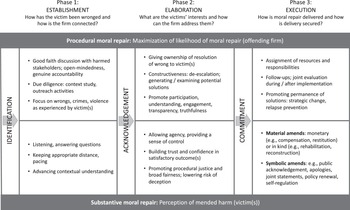
As a validity test of sorts, we tried to formulate what procedural and substantive moral repair would look like throughout the moral repair process (see Figure 1), also because extant process models of moral repair (e.g., Pfarrer et al. Reference Pfarrer, Decelles, Smith and Taylor2008; Dirks, Lewicki, and Zaheer Reference Dirks, Lewicki and Zaheer2009; Goodstein, Butterfield, and Neale Reference Goodstein, Butterfield and Neale2016) tend to treat it as a simple, noncomplex activity, thus entangling normative and socioconstructivist perspectives. We identified three broad and overlapping phases. The first is Establishment, where, collectively, the connection between the transgression, the offender, and the victim(s) is made; the second is Elaboration, where the offender and its victim(s) determine the latter’s needs and ways in which the former can fulfill them; finally, the third is Execution, where the two parties decide on specific amends and work to secure durable relationship restoration. In line with Walker’s (Reference Walker2006) definition of moral repair, at the heart of these three phases lies the offender’s engagement with victim(s). However, before such engagement can take place, the offender needs to realize that it has the moral duty to initiate or continue the process of moral repair. Each of the three phases of moral repair is therefore initiated by a moral-cognitive trigger: the Establishment phase is triggered by the Identification of moral damage; meaningful Elaboration commences with Acknowledgment of the connection between the transgression, the offender, and victim harm; and finally, Execution starts with the Commitment to offering effective amends. In the remainder of this section, we further develop this process model.
Moral Repair Process Model

Phase 1: From Identification to Establishment
Although some scholars have described acknowledgment as a requirement for moral repair (e.g., Walker Reference Walker2006; Margalit Reference Margalit2001), we believe that there is a cognitive-moral process that precedes admitting the connection between offender, transgression, and victim harm, namely, Identification. The cognitive aspect of Identification is the realization that a firm might have caused moral damage. This realization can be triggered from different directions. For example, victims or observers might signal a transgression to the supposed offender, such as in the case of Barrick Gold (Aftab Reference Aftab2016); alternatively, actors within the firm might come to conclude that their firm has harmed one or more of their stakeholders, which may prompt a search for victims. For example, in 2009, whistleblowing at Pfizer led to settlements with patients who had been using a dangerous painkiller (Rubin Reference Rubin2009). Consistent with our socioconstructivist definition of substantive moral repair, we think it unlikely that actions can constitute moral damage to relationships per se; in principle, at least one directly (through harm) or indirectly (through the observation of harm) affected stakeholder has to identify and report damage to a moral relationship. Assuming perfect information, if no one identifies moral harm, arguably, no moral relationship has been damaged, regardless of the actions that have taken place (cf. Pfarrer et al. Reference Pfarrer, Decelles, Smith and Taylor2008). The moral aspect of Identification fits with our normative conceptualization of procedural moral repair and represents the offender’s duty to engage affected parties once the possibility of a moral transgression has been identified.
The engagement triggered by Identification incites the first phase of our process model, Establishment. During this phase, the supposed offender and potential victims deliberate the nature and scope of the transgression, how it has caused harm, and who is responsible for it. Because amends making is still in its infancy here, this stage more likely features procedural rather than substantive moral repair, but both can be identified. In procedural terms, Establishment pertains to the supposed offender’s efforts to facilitate the discussion between affected parties. For example, keeping an open mind—treating favorable and unfavorable information equally—fosters good-faith discussion (Dawkins Reference Dawkins2014). Relatedly, maintaining genuine accountability, for example, by openly confronting difficult questions and inconvenient truths, could be helpful. To illustrate, the Hudson’s Bay Company opened its archives to support an open discussion about its historical treatment of Indigenous trappers (Van Lent and Smith Reference Van Lent and Smith2020). Furthermore, as suggested by the UN Guiding Principles for Business and Human Rights (United Nations 2011), due diligence could be essential. Due diligence can exist in collecting appropriate information to build a comprehensive understanding of the wrongdoing (Cropanzano, Bowen, and Gilliland Reference Cropanzano, Bowen and Gilliland2007). That effort could involve outreach activities aimed at identifying stakeholders and obtaining their view of past events. Finally, discussions are more likely to yield a contextualized understanding of the transgression if they focus on that transgression rather than on the supposed offender’s perspective on things, in which case, stakeholders might lose their motivation to engage them (Schormair and Gerlach Reference Schormair and Gerlach2020).
As noted, procedural practices may take on substantive meaning. In the Establishment phase, good-faith discussions may add moral value to (supposed) victims because being listened to and having one’s questions answered signal respect and thus recognition (cf. Hamber Reference Hamber2006). Relatedly, focusing on victim experiences may help the offender strike the right tone and maintain appropriate distance and pacing (Colquitt et al. Reference Colquitt, Conlon, Wesson, Porter and Ng2001). Some victims, for example, consider the mere thought of interacting with the offender to be painful or below their dignity, such as many Jewish Holocaust survivors (Slyomovics Reference Slyomovics2014). Accepting victims as they are and treating them accordingly can also be seen as a form of recognition. Moreover, providing a thorough contextual understanding to stakeholders who have signaled moral damage can sometimes help alleviate that damage, for example, by offering a more nuanced, contextualized perspective on the supposed offender’s behavior or by completing victims’ interpretations of that behavior. Upon learning more about the history of the alleged transgression and the role of various actors, some victims might reevaluate the extent to which they have been harmed and/or the connection between their suffering and the supposed offender’s actions, for example, by understanding the latter’s reasoning in a larger constellation of factors and the contribution of their own behaviors to their harm (Tomlinson and Mryer Reference Tomlinson and Mryer2009). Body cameras, for example, have not only exposed instances of police brutality but also helped exonerate police officers accused of misconduct (Evans Reference Evans2016).
Phase 2: From Acknowledgment to Elaboration
Establishment sets the stage for Acknowledgment, the cognitive-moral trigger of the second phase of moral repair: Elaboration. On the basis of research and interaction with involved parties, the supposed offender draws conclusions about the connection between its acts and experienced moral damage. Some companies have required proof in this regard, such as Barrick Gold and Primark after the collapse of the Rana Plaza garment factory (International Commission of Jurists 2019). Acknowledgment is in principle a cognitive process driven by sense making and interpretation, so the outcome may not satisfy all parties involved. Still, depending on how well the procedural aspect of Elaboration is carried out, a certain degree of intersubjectivity can be reached. For example, South Africa’s Truth and Reconciliation Commission offered a national dialogic space for shared understandings about the many public and private abuses under apartheid to emerge (Gobodo-Madikizela Reference Gobodo-Madikizela2015). Theoretically, it is possible that the accused firm convinces all parties involved that it bears no responsibility for a transgression (Benoît Reference Benoît1995; Elsbach Reference Elsbach2003), in which case moral repair is complete. However, once the (now) offender accepts (some) responsibility for moral damage, victim demands for validation and vindication become unquestionably legitimate (Walker Reference Walker2006, 209). Acknowledgment then also becomes morally significant, establishing the offender’s duty to determine with its victim(s) what amends should be made to repair that damage. That moral imperative triggers the Elaboration phase. In fact, moral repair requires Acknowledgment, for without it, any reparative act should be seen as charity rather than amends (Walker Reference Walker2006, 191).
The Elaboration phase features the main negotiation between offender and victim(s) and primarily involves mapping the latter’s needs and the former’s ability to address them. Because the making of amends is still in preparation at this stage, this phase also predominantly features procedural moral repair. At that level, Elaboration centers on maximizing the likelihood that offender–victim negotiations will reach a mutually satisfactory outcome. Several specific practices contribute toward this goal. For example, the offender can give the victims control over the alleviation of their harm by providing a secure space where viewpoints can be shared (Christie Reference Christie1977). Second, the offender can take a constructive stance toward the negotiation, working toward de-escalation and tension reduction and assisting in the search for the best possible solution. For instance, representatives of the Cerrejón coal mine in Colombia actively proposed solutions to local community members to alleviate the environmental damage caused by the mine’s operations (International Commission of Jurists 2019). Relatedly, the offender can promote participation by actively engaging victims and understanding (comprehension and mutual sympathy) by practicing transparency and truthfulness (Schnackenberg and Tomlinson Reference Schnackenberg and Tomlinson2014). Tesco, for example, overcame the distrust of exploited South African suppliers by communicating openly about its grievance mechanism (International Commission of Jurists 2019). Understanding is even more important in multilateral settings, because if victims have full information about the amends that other victims receive, they can better assess the amends they have received. As such, understanding lowers the risk that outcome differentials will cause further moral damage.
Still, like during Establishment, some procedural Elaboration practices may take on substantive meaning. Substantive moral repair exists where the offender’s observed negotiating practices contribute directly to the restoration of moral relationships. For example, empowering victims to identify the right amends may promote a sense of control and self-worth (cf. Clamp Reference Clamp2015). Moreover, an integrative negotiation style that focuses on “win-win” may foster victim trust and confidence in a good outcome (Gillespie and Dietz Reference Gillespie and Dietz2009). Exemplary is Adidas’s third-party complaint mechanism, established in the aftermath of alleged human rights abuses in its factories, which was designed to instill trust in the proceedings by allowing victims to seek assistance from a third party if needed (International Commission of Jurists 2019). Finally, involving a maximum number of stakeholders in the negotiation and promoting understanding give victims a broad perspective on the dynamics of the negotiation. This visibility may push the offender to maintain procedural justice (Cropanzano, Bowen, and Gilliland Reference Cropanzano, Bowen and Gilliland2007) and to work toward a somewhat consistent “relationship” between experienced harm and offered amends, so that no victim will feel left behind. As such, it will contribute to a broad sense of fairness and lower the risk of ex post dissatisfaction. BHP Billiton and Vale, the two iron producers responsible for the Bento Rodrigues dam failure in Brazil, faced exactly that when their grievance mechanism failed to deliver on its stated intention to organize for direct representation of the local communities who had suffered environmental damage (International Commission of Jurists 2019).
Phase 3: From Commitment to Execution
In the Elaboration phase, offender and victims work to find appropriate amends. Moral repair fails if no agreement is reached, but if it is, concrete amends are expected. Deliberating the practical implications of amends making induces the third cognitive-moral trigger: Commitment. From a moral perspective, Commitment seems straightforward: the offender has the moral duty to respect any commitment. From a cognitive standpoint, however, Commitment is less obvious, as it involves translating the deal’s terms into concrete action, which may require morally significant practical decisions (Roht-Arriaza Reference Roht-Arriaza2004). Questions related to the delivery of material amends include when to make the transfer (early vs. late payments, payments on a symbolic date), from and to which account (direct vs. indirect payments, taxability), in how many installments (smaller installments may dilute the transaction’s significance), and under what conditions. For example, the #MeToo movement, which sparked public debate about sexual harassment in the workplace, has raised questions about the use of nondisclosure agreements (Chilton Reference Chilton2020; Topping Reference Topping2021). Implementation issues may also exist for symbolic amends (Greeley et al. Reference Greeley, Orwicz, Falconi, Reyes, Rosenberg and Laplante2020), such as timing (e.g., a one-off vs. a recurring event, duration), aesthetics (e.g., decoration, use of audiovisual technology), delivery (e.g., who represents the offending firm, choice of media outlets), and tone (e.g., choice of wording, nonverbal communication). Facebook’s poorly received apology for manipulating newsfeeds in 2014 illustrates how easily mistakes can be made in this area (Schweitzer, Brooks, and Galinsky Reference Schweitzer, Brooks and Galinsky2015). The negotiating parties may cover infrastructural issues during Elaboration, but where they are not, implementing the agreement requires deliberation.
Once it has become clear how the offender will respect its agreement with victims, the Execution phase begins. This phase revolves around the delivery of amends and therefore mainly comprises substantive moral repair. At this final stage of the moral repair process, substantive actions are the culmination of a conscious collaborative effort aimed specifically at restoring moral relationships. Therefore, in line with definitions provided by scholars of moral repair (e.g., Hamber Reference Hamber2006; Sharpe Reference Sharpe, Johnstone and Van Ness2007; Walker Reference Walker2006), these actions can typically be categorized as either material or symbolic amends. Both types of amends can serve as “markers of redress” (Mégret Reference Mégret2009, 6), but they have slightly different purposes: whereas material amends usually aim to compensate for the specific tangible or intangible harm resulting from a wrong (Sharpe Reference Sharpe, Johnstone and Van Ness2007, 27), symbolic ones give meaning to the material conditions of human existence (Greeley et al. Reference Greeley, Orwicz, Falconi, Reyes, Rosenberg and Laplante2020, 187) and therefore cater to broader needs for recognition and respect (Mégret Reference Mégret2009, 6). Because victim needs can be complex (Walker Reference Walker, Davis and Womack2001), especially when several are involved, amends often combine material and symbolic aspects.
However, the implementation of an agreement requires active attention, without which it may lose momentum. Hence Execution also involves procedural moral repair, which helps offending firms fulfill their pledge. One procedural practice that victims may monitor, if desired, is the assignment of specific resources and responsibilities to those charged with delivering the amends, for example, in the form of a specific team or task force consisting of undisputed firm representatives or independents. Barrick Gold’s Olgeta Meri Remedy Framework is a case in point (e.g., Aftab Reference Aftab2016). Another way to facilitate Execution is to organize follow-ups and joint evaluation sessions with victim representatives to assess the progress of implementation. To illustrate, since attending the commemoration, Prodeco has strived to remain in dialogue with the local community (Pax 2018c). Finally, to foster trustworthiness (Gillespie and Dietz Reference Gillespie and Dietz2009), the offender can work to promote the permanence of amends. Internally, the offender may revise its strategy and supporting policies to erase structural inequalities and negative externalities. Without such a revision, firms might reoffend easily, like DuPont, which consciously continued environmentally damaging operations in the 1980s because in doing so, it maximized shareholder wealth even when adjusting for potential fines and damages (Shapira and Zingales Reference Shapira and Zingales2017). Furthermore, offenders can establish a formal grievance mechanism to improve their responsiveness to new experiences of moral harm (Kimotho and Ogol Reference Kimotho and Ogol2021). Externally, potentially in conjunction with local authorities or NGOs, offenders might invest in accountability (Wielga and Harrison Reference Wielga and Harrison2021): Prodeco, for example, now systematically reports on human rights–related actions.
Despite offenders’ options at the procedural level, our socioconstructivist conceptualization of substantive moral repair implies that the value of amends is subject to interpretation. Because victim needs may be complex (Walker Reference Walker, Davis and Womack2001), it seems difficult to identify consistent (linear) relationships between amends types and moral outcomes. Therefore we introduce configurational thinking as a way to approach the practice of moral repair. In organization theory, configurations denote any constellation of conceptually distinct elements of an organizational phenomenon that commonly occur together (Meyer, Tsui, and Hinings Reference Meyer, Tsui and Hinings1993)—much like material and symbolic amends in moral repair. In configurational thinking, the parts of the organizational phenomenon in question are only meaningful as a whole, because they are tightly coupled and entangled in reciprocal, nonlinear causality; that is, elements that are somehow causally related in one configuration may be inversely related in another. Consequently, different organizational configurations may be “equifinal,” leading to the same organizational outcome(s) (Hinings Reference Hinings2018; Meyer, Tsui, and Hinings Reference Meyer, Tsui and Hinings1993). Conversely, consistent sets of elements may produce dissimilar outcomes (Short, Payne, and Ketchen Reference Short, Payne and Ketchen2008). A configurational lens might do justice to moral repair’s relational nature, allowing for similar sets of amends to yield different moral outcomes and for different sets of amends to yield similar results depending on the victim(s) involved. As such, its adoption in the moral repair process may lower the risk that victims will perceive amends differentials as morally harmful, provided that the offender adequately practices procedural moral repair, most notably by maintaining full transparency regarding the available amends.
DISCUSSION
Several corporate wrongdoings have recently come into the limelight, such as those involving Prodeco (Molinares and Jaccard Reference Molinares and Jaccard2016) and Barrick Gold (Aftab Reference Aftab2016). Because public attention to it can hurt a firm’s legitimacy (Suchman Reference Suchman1995), a corpus of scholarship on moral repair has emerged (e.g., Walker Reference Walker2006; Radzik Reference Radzik2009; Gillespie, Dietz, and Lockey Reference Gillespie, Dietz and Lockey2015; Greeley et al. Reference Greeley, Orwicz, Falconi, Reyes, Rosenberg and Laplante2020). However, at the core of moral repair exists a tension between normative and socioconstructivist perspectives (e.g., Honneth and Margalit Reference Honneth and Margalit2001; Honneth Reference Honneth1995; Radzik Reference Radzik, Johnstone and Van Ness2007, Reference Radzik2009). This tension poses a conceptual problem—how moral repair should be understood—and at a practical level, it leaves firms struggling to adequately mend damaged stakeholder relations. The purpose of our article was to systematically delineate and connect moral repair’s normative and social constructivist components, which led us to distinguish between procedural and substantive moral repair. To further explore these levels of activity, we theorized a process model of moral repair. Whereas procedural moral repair is conducive to normative guidance and paves the way for making amends, substantive moral repair is premised on social construction and consists in the achievement of moral healing as experienced by victims, whether intended by the offender through specific amends or unintended as a “by-product” of procedural practices. Procedural and substantive moral repair appear to persist throughout the three main phases of moral repair: Establishment, Elaboration, and Execution. In turn, these phases are connected through cognitive-moral triggers—Identification, Acknowledgment, and Commitment—that also reflect the coexistence of normativity and socioconstructivism.
On the basis of our theorization, we identify three contributions to the literature on moral repair. First and foremost, our analysis marks an important step toward conceptual clarification. Whereas previous treatments of moral repair implicitly harbored normative and socioconstructivist elements, we separate them as predominantly operating at two different levels of thought and practice, demonstrating their working throughout the moral repair process. Most important, this exercise yields that the normativity of moral repair is most pertinent to the procedural level, that is, where offenders provide the conditions for the design and implementation of amends. In other words, beyond maximizing the victims’ opportunity space for the formulation of desired amends or maximizing the likelihood that the firm will reach a satisfying agreement with its victims, it seems difficult to expect the offender to deliver “absolute” moral value. Indeed, at the substantive level, the effectiveness of amends crucially depends on a victim’s interpretation, which is subject to a host of forces beyond the offender’s control. In effect, our two-level conceptualization of moral repair channels normative and socioconstructivist contributions to the understanding of the concept. As such, it may bring more order to the literature, reducing the risk of convoluted debates that mix arguments resting on fundamentally different onto-epistemological principles.
Second, our elaboration of procedural and substantive moral repair has culminated in a process model that systematically organizes a range of specific practices around amends making. Although the ethical literature has not yet examined moral repair as a sequence of actions, focusing instead on its philosophical foundations (e.g., Walker Reference Walker2006; Radzik Reference Radzik2009) and desired morphology (Gillespie, Dietz, and Lockey Reference Gillespie, Dietz and Lockey2015; Greeley et al. Reference Greeley, Orwicz, Falconi, Reyes, Rosenberg and Laplante2020), process models offered by the organizational literature (e.g., Pfarrer et al. Reference Pfarrer, Decelles, Smith and Taylor2008; Goodstein, Butterfield, and Neale Reference Goodstein, Butterfield and Neale2016) tend to downplay moral repair’s complexity, which limits their applicability. Our process model yields several important observations. First, whereas the ethical and organizational literatures commonly view moral repair as consisting of intentional amends making (Walker Reference Walker2006), our model suggests that there is a procedural lead-up that may add moral value in its own right. As such, it puts the categories of material and symbolic amends into a wider perspective and opens up conceptual space for less intentional forms of moral repair. Moreover, our model offers a narrower definition of acknowledgment, which is often seen as moral repair’s starting point (Walker Reference Walker2006; Margalit Reference Margalit2001), distinguishing it from Identification and Establishment in a more conceptually refined image of early-stage moral repair. Finally, our framework advances understanding of the dynamics that drive moral repair. In particular, the three cognitive-moral triggers indicate that cognition informs offenders’ moral reasoning, which extends normative perspectives that explain the fulfillment of moral repair through the moral agency of firms (Radzik Reference Radzik2004).
Third, our process model gives rise to a more flexible yet systematic characterization of the relationship between the making of amends and the delivery of moral value to victims. We categorize both material and symbolic amends as substantive moral repair, which we conceptualize from a socioconstructivist perspective. At the same time, our model highlights the sustained importance of procedural moral repair during the Execution phase. Even if no consistent relationships between specific amends and moral outcomes can be defined, if procedural principles, such as transparency during negotiation and implementation, are upheld, it is possible that specific configurations of amends can meaningfully coexist. Situated between the normative search for fixed relationships between amends and moral outcomes (e.g., Gillespie and Dietz Reference Gillespie and Dietz2009, 134; Walker Reference Walker2006), which does not necessarily accommodate the full spectrum of victim demands, and the socioconstructivist reluctance to generalizing the moral effects of amends beyond specific cases (e.g., Bertels, Cody, and Pek Reference Bertels, Cody and Pek2015; Gromet and Okimoto Reference Gromet and Okimoto2015; Gillespie, Dietz, and Lockey Reference Gillespie, Dietz and Lockey2015), a configurational approach reconciles the two traditions. That is, it allows the same set of amends to have different results across cases and alternative combinations of amends to have similar effects. As such, it constitutes a unified lens for studying cause-and-effect relations in the context of moral repair.
On a practical note, our analysis, first of all, helps firms engage (potential) victims more systematically, which will likely increase overall ex post satisfaction. Instead of following potentially contradictory (Dirks, Lewicki, and Zaheer Reference Dirks, Lewicki and Zaheer2009) recommendations about specific amends, our analysis suggests that firms can and should maximize the possibility space for victims to identify appropriate (sets of) amends. Figure 1 lists several procedural practices that firms could follow throughout the moral repair process, including a good-faith approach to (supposed) victims in the Establishment phase, a constructive focus on option generation in the Elaboration phase, and assigning resources to delivering amends in the Execution phase. Part of the “maximization effort” may also consist in augmenting the firm’s ability to implement procedural moral repair, for example, by creating a dedicated unit or team with adequate resources and responsibilities, putting (un)ethical conduct at the forefront of HR policies, and investing in archives so that past practices can more easily be reconstructed if necessary. The importance of adequate procedural moral repair goes beyond its potential benefits, because its absence could hamper the effectiveness of substantive moral repair. For example, if victims can observe each other’s outcomes, impeccable procedures, such as in the form of full transparency, can greatly reduce the risk of post hoc dissatisfaction (even if, in principle, the moral value of amends is subjective), because they can signal that every victim is treated with the same respect.
As a second and related recommendation, in line with our introduction of configurational thinking in regard to amends making, our study suggests that firms build a “repertoire” of amends that can be offered on request. Because the moral value of amends cannot be defined in absolute terms, adhering to fixed (sets of) amends when dealing with multiple victims will most likely yield dissatisfaction. In contrast, the flexibility to offer various combinations of amends may be the key to offering similar levels of satisfaction to victims with different desires. Inspiration for specific amends to be included can come, for example, from interaction with victims or from research on moral repair (e.g., Pfarrer et al. Reference Pfarrer, Decelles, Smith and Taylor2008; Goodstein, Butterfield, and Neale Reference Goodstein, Butterfield and Neale2016). Offering configurations of amends will likely yield higher overall satisfaction under the condition of transparency, which allows victims to better understand any differences between them and therefore appreciate that not everybody deserves the same amends. Needless to say, transparency in the context of moral repair is to be understood strictly within the bounds of the protection of victims’ privacy and potential sensitivities deriving from their experienced harm and trauma.
FURTHER RESEARCH AND CONCLUDING REMARKS
Our two-level conceptualization of moral repair and the associated process model offer conceptual clarification in that they reconcile the normative and socioconstructivist perspectives and order the various practices that compose moral repair in an action sequence. Furthermore, they have led to the introduction of configurational thinking with regard to the moral effects of (sets of) amends. An additional advantage is that they channel research and thereby facilitate more refined theorization. There are several specific opportunities for further inquiry. First, although we have endeavored to describe the two levels of moral repair through a host of specific practices at different stages of the process, the validity of our two-level conceptualization across time and space needs to be empirically tested, preferably by means of culturally diverse and/or historical settings. Such efforts could augment knowledge of the different practices that procedural and substantive moral repair may encompass and of the interconnectedness between activities at the two levels. Furthermore, they may advance understanding of the process along which moral repair unfolds, exploring its possible variations according to the firm; the moral transgression in question (Walker Reference Walker2006, 203; Gonzales, Manning, and Haugen Reference Gonzales, Manning and Haugen1992); and the wider political, economic, and societal contexts (Goodstein and Butterfield Reference Goodstein and Butterfield2010). For example, factors like corporate values, economic circumstances, and the general disposition toward taking social responsibility might affect the moral-cognitive triggers and thus facilitate or hamper advancement from one phase of moral repair to the next.
Relatedly, recent years have witnessed increased public attention to historical corporate transgressions, for example, in relation to the Holocaust (Federman Reference Federman2020), slavery (Wilder Reference Wilder2013), and apartheid (Ibhawoh Reference Ibhawoh, Gibney, Howard-Hassmann, Coicaud and Steiner2008), which has spawned a body of work on firms’ historic social responsibilities (e.g., Van Lent and Smith Reference Van Lent and Smith2020; Schrempf-Stirling, Palazzo, and Phillips Reference Schrempf-Stirling, Palazzo and Phillips2016; Phillips, Schrempf-Stirling, and Stutz Reference Phillips, Schrempf-Stirling and Stutz2020). Whereas our process model features the direct interaction between offenders and victims, in the case of historical transgressions, the moral repair process is likely conducted by the descendants and/or successors of the victims and offenders, respectively, who may face unique procedural and substantive challenges. For example, at the procedural level, reaching the point of acknowledgment may be more complicated if the circumstances of a particular transgression need to be historically reconstructed. Substantively, temporal distance between the wrongdoing and moral repair may affect what offenders define as the maximum opportunity space for offering amends and may amplify (e.g., through systemic inequality) or weaken (e.g., through education) the victim’s sense of harm. To illustrate, in the case of alleviating the damage inflicted by slave trade, implicated firms seem to prefer symbolic rather than material amends, precisely because the pressure to compensate for multiple generations of inequality would loom large if material amends were considered (Harris, Campbell, and Brophy Reference Harris, Campbell and Brophy2019). Examination of challenges like these can deepen understanding of the moral repair process.
Then, the suggestion that the effect of amends should be studied through a configurational lens provokes a host of follow-up questions, such as what varieties of configurations exist and how they relate to each other. Zooming in, scholars could study the effect of specific amends as part of a configuration in terms of necessary and sufficient conditions. In so doing, they might better distinguish between broadly and narrowly applicable amends. One increasingly popular empirical approach to studying configurational multiplicity is qualitative comparative analysis (QCA), which is a set-analytic method (Rihoux and Ragin Reference Rihoux and Ragin2008) for evaluating the causal contribution of specific conditions (e.g., aspects of a practice or a phenomenon) to an outcome of interest (Park, Fiss, and El Sawy Reference Park, Fiss and El Sawy2020). Owing to the technique’s ability to handle causal complexity, the use of QCA might enable researchers to inductively develop “causal recipes” for moral repair, deductively test theoretical multiplicity by means of alternative configurations of amends, and formulate more advanced guidelines for the practice of moral repair.
Despite the avenues for further research that our theorization of moral repair generates, it is also subject to limitations and boundary conditions. First, our conception of moral repair is rooted in recognition theory and thus in Western moral philosophy (cf. Pfarrer et al. Reference Pfarrer, Decelles, Smith and Taylor2008). As a result, concepts like moral harm and moral relationship restoration are implicitly understood from a somewhat individualistic point of view. Alternative ethical frameworks rooted in more communal cultures may favor a different approach to making amends (Ren and Gray Reference Ren and Gray2009). For example, the African notion of Ubuntu represents a communitarian conception of ethics (for a critical overview, see Krog Reference Krog2008; Matolino and Kwindingwi Reference Matolino and Kwindingwi2013). Often characterized by the Zulu aphorism “umuntu ngumuntu ngabantu,” or “I am because we are, and since we are, therefore I am” (Mbiti Reference Mbiti1989, 106), Ubuntu stresses values like reciprocity, harmony, and humanity as tools for community building (Nussbaum Reference Nussbaum2003) and emphasizes the healing of breaches, the redressing of imbalances, and the restoring of relationships (Tutu Reference Tutu1999, 51). As such, Ubuntu accommodates modes of moral repair that are less pronounced in Western theory, such as collective healing, involving, for example, extended family or community members, and spiritual recovery, which may entail prayer, worship, rites, pilgrimage, and sacrifice, among other things. If offender and victims cannot agree on broad ethical standards, for example, when they have different cultural backgrounds, efforts toward moral repair may be less effective (Menkel-Meadow Reference Menkel-Meadow2007).
Moreover, even though moral repair assigns a central role to the wrongdoer (Walker Reference Walker2006), our conceptualization of moral repair may, in certain respects, rely too strongly on firms driving the process forward. First, corporations can use some combination of coercive and persuasive power to shape their environments (Wilson Reference Wilson2008), and as practitioners of moral repair, they could choose to manipulate their victims or otherwise bend the process in their favor (Levrant et al. Reference Levrant, Cullen, Fulton and Wozniak1999; Menkel-Meadow Reference Menkel-Meadow2007). This possibility underscores the importance of properly executed procedural moral repair and of respecting victims’ assessment of substantive moral repair and should incite a healthy dose of criticism on the part of affected parties in their dealings with offending firms. Second, our process model does not fully account for the agency that victims and their allies may have in alleviating moral harm. Moral repair may be driven by input from different parties in various forms of coordination and is not predicated on the offender’s active involvement. For example, victims of the rapes, beatings, and killings by Barrick Gold’s security forces had to campaign hard to get corporate recognition of their claim; in fact, the firm took the allegations seriously only after Human Rights Watch, an international NGO, presented the findings of its own research into the matter (Aftab Reference Aftab2016, 11). That moral repair is not necessarily the offending firm’s prerogative suggests the value of examining posttransgression victim responses and interstakeholder dynamics.
Relatedly, as it revolves around firms seeking to mend damaged moral relationships, our conceptualization of moral repair may not sufficiently address the power of the societal context in which moral repair takes place. First, depending on factors like national and stakeholder culture, a general climate of forgiveness could reduce the importance of moral repair practices (Fehr and Gelfand Reference Fehr and Gelfand2012). Moreover, third parties can limit the offending firm’s ability to practice moral repair by offering alternative frameworks from which those harmed by a corporate transgression can derive moral value. Most notably, punishment represents a form of retribution that does not require the offending firm’s active participation. Punishment can be either official, administered by government institutions in such forms as fines, criminal persecution, and shutdown (Menkel-Meadow Reference Menkel-Meadow2007), or unofficial, delivered by affected stakeholders or civil society actors (e.g., NGOs) engaging in such initiatives as public shaming and boycotts (Pfarrer et al. Reference Pfarrer, Decelles, Smith and Taylor2008). Whether official or unofficial, punishment limits the offender’s ability to make amends and/or may reduce the need for them, as it may become a source of recognition, solace, or satisfaction in its own right (Leval Reference Leval2013; De Quervain et al. Reference Dominique, Fischbacher, Treyer and Schellhammer2004). Some critics of “soft processes” like moral repair underline the importance of this boundary condition, highlighting that, if not embedded in a formal adjudication system, they could undermine formal legal accountability, privileging the verbal, well resourced, represented, or manipulative (Menkel-Meadow Reference Menkel-Meadow2007).
Still, as philosophically and practically constrained as it may be, our core insight that moral repair consists of a procedural and a substantive level of activity seems valid throughout the moral repair process and resolves an underlying tension between normative and socioconstructivist lenses that has obfuscated theory and practice. As such, it contributes to a more systematic understanding of the concept, which may ultimately help improve firms’ ability to mend damaged stakeholder relations in the wake of a transgression.
Acknowledgments
The authors would like to thank the editor, Bruce Barry; three anonymous reviewers; and the audience at the “Vermut Session” of Esade’s Institute for Social Innovation for their incisive and constructive comments, which have significantly helped us improve the quality of our work. This research has been generously supported by the One Year Research Merger Grant from the Leading House for Latin American Region and by a project grant from the Swiss Network for International Studies.
Jordi Vives-Gabriel (jordi.vives@unisg.ch, corresponding author) is a senior research fellow at the Institute for Business Ethics at the University of St. Gallen in Switzerland, where he also received his PhD. Vives Gabriel is also a researcher at ESADE Business School and lecturer at EADA Business School. His research examines how organizations repair for their human rights wrongs in transitional justice settings and how they deal with legacies of irresponsibilities.
Wim Van Lent is an associate professor of strategy and entrepreneurship at IESEG School of Management (France) and an associate member of the ETI Chair at IAE Paris Sorbonne Business School (France). He received a PhD in management from ESSEC Business School, and before joining IESEG, he was a faculty member at Montpellier Business School. His research interest lies at the intersection of strategy, sociology, and history and focuses, among other things, on corporations’ engagement with (critiques of) their past. His work has been published in journals including Academy of Management Review, Organization Studies, and Human Relations.
Florian Wettstein is chair and professor of business ethics and director of the Institute for Business Ethics at the University of St. Gallen in Switzerland. Florian has published widely on topics at the intersection of corporate responsibility, business ethics, and business and human rights. He is the author of Multinational Corporations and Global Justice: Human Rights Obligations of a Quasi-governmental Institution (2009) and of Business and Human Rights: Ethical, Legal, and Managerial Perspectives (Cambridge University Press, 2022). He is editor in chief of the Business and Human Rights Journal (BHRJ), published by Cambridge University Press.