Implications
Lucerne is favoured for its high yield and nutritional quality, but is seldom grazed in pure stands as it causes bloating. Condensed tannins (CT)-containing legumes do not cause bloating and form CT–protein complexes that are stable and insoluble at rumen pH. Several papers have focused on the effect of CT on the nutritive value of CT-containing forages. The aim of this study was to investigate whether the use of sainfoin CT enhances feed value when given with tannin-free legumes (lucerne). We tested the effects of different sainfoin/lucerne proportions on voluntary intake, in vivo digestibility and in situ ruminal and intestinal digestibility in sheep.
Introduction
Lucerne is one of the most nutritious forages available, and is used widely in diets for ruminants. Lucerne proteins are often poorly utilised by ruminants as they are quickly and extensively degraded in the rumen, which leads to nitrogen (N) losses via urinary urea excretion (Min et al., Reference Min, Barry, Attwood and McNabb2003) because energy is not sufficient. Technological processes can be proposed to overcome the problem of excessive solubility such as the production of dehydrated lucerne as a source of high-dietary-value proteins but it is energy consuming. Haymaking and barn drying provide an intermediate degree of protein protection. Other solutions included the use of forages containing condensed tannins (CT). CT are a group of plant secondary compounds that bind protein and inhibit its ruminal degradation (Barry and McNabb, Reference Barry and McNabb1999). McMahon et al. (Reference McMahon, Mc Allister, Berg, Majak, Acharya, Popp, Coulman, Wang and Cheng2000) and Julier and Huygue (Reference Julier and Huygue2010) suggested that the utilisation of transgenic lucerne cultivars able to produce CT could be an alternative way to reduce protein losses. Another more realistic solution is the use of a mixture of forages with and without CT, which leads to protein degradability in the rumen of the mixture being lower than the average of the two initial fodders as has been demonstrated in in vitro conditions by Julier et al. (Reference Julier, Lila, Huygue, Morris, Allison and Robbins2002) for a mixture of lucerne and birdsfoot trefoil. Previous in vitro results (Waghorn and Shelton, Reference Waghorn and Shelton1997) have shown that CT from Lotus corniculatus are able to bind with and precipitate protein from a ryegrass/clover pasture, but when these forages were fed together to sheep, the CT had only low effects on digestion and animal performances. Aufrère et al. (Reference Aufrère, Dudilieu, Poncet and Baumont2005) showed that surplus CT in sainfoin can efficiently reduce the in vitro N solubility of lucerne when well mixed with it. The aim of the study reported here was to test this hypothesis in in vivo conditions.
This study was designed to measure the effects of CT in sainfoin co-fed with lucerne to sheep. The trial was conducted indoors, with sheep fed individually in order to fully control the proportions of sainfoin and lucerne provided. The effects of the proportion of sainfoin in the mixture and of the growth stages of the two plants on voluntary intake, digestibility and N balance were investigated in vivo. The digestive characteristics of the mixtures were assessed by in situ measurements in the rumen and the small intestine.
Material and methods
Forages
Sainfoin (Onobrychis viciifolia L., cv. Zeus) and lucerne (Medicago sativa L., cv Aubigny) swards were sown in spring 2005 on the INRA's Clermont-Ferrand/Theix (France) site at an altitude of 850 m on a deep silt loam soil. Mineral fertilisation was supplied in spring 2006 at 37 kg P and 56 kg K/ha.
The experiment was conducted in 2006 using fresh sainfoin and lucerne harvested at two dates (stages 1 and 2) in the first growth cycle. Both forages were harvested on the same date (3rd week of May and 2nd week of June). The sum of temperatures from 1st February was 586°C for stage 1 and 802°C for stage 2. For sainfoin, stage 1 was defined as the vegetative stage (30 to 40 cm height) and stage 2 was defined as the early flowering stage (5% to 10% of stems in a metre row observed with at least one open flower). Lucerne was cut at the vegetative stage and the budding stage for stages 1 and 2, respectively.
Animals and experimental design
The study was carried out indoors at the INRA-UE-RT experimental farm in France (45°42′N, 03°304′E). The sheep were handled by specialist personnel trained in animal care and welfare according to European Union Directive No. 609/186, under agreement No. A63 565.
Fresh sainfoin and lucerne forages were combined in ratios of 100 : 0, 75 : 25, 25 : 75 and 0 : 100 (as fed) denoted S100, S75, S25 and S0, respectively. A total of four groups of six Texel sheep (12 months old, 60 ± 3 kg live weight) were used simultaneously for measurements of voluntary intake, digestibility and N balance on each mixture.
Concurrently, four groups of three adult Texel sheep, fitted with a large rumen cannula, were used to measure the in-rumen degradability of the different mixtures using the nylon bag technique. Rumen fluid samples were collected in kinetics on these sheep.
Another group of four adult Texel sheep fitted with duodenal and ileal T-type cannulae were used to determine intestinal digestibility using the mobile nylon bag technique according to Aufrère et al. (Reference Aufrère, Dudilieu and Poncet2008).
All the sheep were housed indoors in individual pens for in situ measurements or in individual metabolic crates for in vivo measurements. They were allowed ad libitum access to water and salt (NaCl) block. Before starting the experiments, the sheep were drenched with an anthelmintic (Ivomec, Merial, Lyon, France) to eliminate internal and external parasites. The animals were fed ad libitum (10% refusal) at 0900 h and 1700 h every day. The actual refusal proportion was on average 9.9% dry matter (DM). Forages were cut daily using a sickle bar mower at about 5-cm cutting height, and then chopped into 5- to 10-cm pieces with a chaff cutter to prevent wastage by the animal. Forages formed of the two legumes were mixed well in the different proportional ratios and were immediately distributed in the morning. The mixtures were then conserved at 4°C for the evening meal. The chemical composition (N and NDF of refusals) did not reveal the dietary preference of the sheep (N: 28, 16 (S100), 27, 18 (S75), 28, 24 (S25), 31, 27, (S0) at stages 1 and 2, respectively; NDF: 470, 525 (S100), 471, 546 (S75), 474, 512 (S25), 446, 496, (S0) at stages 1 and 2, respectively). However, there may be a selection of different parts of the plant which was explained by differences in N, NDF contents between forages offered and refusals (N: 31, 22 (S100), 32, 24 (S75), 35, 29 (S25), 36, 32, (S0) at stages 1 and 2, respectively; NDF: 443, 432 (S100), 419, 414 (S75), 371, 380 (S25), 347, 363, (S0) at stages 1 and 2, respectively).
The sheep were allowed to adapt to the diet and to the crate during the first 2 weeks of each period. Measurements were performed in the 3rd week.
In vivo measurements and sampling
Voluntary intake, digestibility and N balance measurements were performed on 6 consecutive days (Demarquilly et al., Reference Demarquilly, Chenost and Giger1995). The sheep were housed in metabolic crates equipped for daily collection of total faeces and urine. Loss of ammonia from urine was prevented by the daily addition of 50 ml of 30% (w/v) sulphuric acid to the collection flask. Daily aliquots of faeces and urine were pooled per sheep for the week of measurements. During this week of measurement, the forages offered were sampled every day, and then pooled over the week. Samples of fresh forages, refusals and faeces were dried in a forced-air oven at 60°C for 72 h before being pooled. All samples were ground through a 1-mm sieve before analysis. Pooled samples of urine were conserved at −20°C for the analysis of total N (tN).
In situ degradation in the rumen
Nitrogen degradability was measured via the nylon bag procedure using Dacron bags (pore size 53 ± 15 μm; Ankom Co., Fairport, NY, USA) with an internal surface of 5 × 11 cm. Fresh forages sampled mid-week during the in vivo measurements were shredded before bagging. The degradability of the four mixtures (S0, S25, S75, S100) was measured on a group of three fistulated sheep fed with the same mixture.
Bags were filled with a quantity of fresh forage equivalent to 2.5 g DM, and then sealed with two stitches and quickly frozen in liquid nitrogen for storage at −20°C until analysis. Incubation periods were 2, 4, 8, 16, 24 and 48 h, with two bags for 2-, 4- and 8-h measurements, six bags for 16 h measurements and three bags for the 24- and 48-h measurements. Samples of a common hay were incubated (8 h) daily in duplicate in the rumen of each animal to detect any changes in degradation levels during the experiment. After removal from the rumen, the bags were washed and kept at −20°C until analysis. Before analysis, the bags were thawed and then washed in a washing machine (3 × 10 min) with cold water until the rinse water was clear. The bags were then beaten for 7 min in a ‘stomacher’, then re-washed (2 × 10 min), dried at 60°C for 48 h and ground through a 1-mm screen. In order to take into account adherent bacteria not detached by this treatment, a correction was performed according to Michalet-Doreau and Ould-Bah (Reference Michalet-Doreau and Ould-Bah1989). The soluble N fraction was determined by soaking the bags containing the samples in warm water (40°C) for 1.5 h, and was considered as the proportion of forage N that had disappeared from the bags at 0 h.
Ruminal fluid sampling
During the experimental weeks, rumen fluid was taken from the 12 sheep fitted with a rumen cannula that were fed the four mixtures. Samples were collected before the morning meal (time after the meal (T) 0 h), and at 1, 2, 3 and 7 h after feeding. For each sample, 150 ml of rumen fluid was collected, muslin-filtered and centrifuged for 5 min at 120 × g at 4°C to remove large dietary particles and protozoa. The supernatant was centrifuged at 27 000 × g for 20 min at +4°C to remove small dietary particles and bacteria. Proteins were then precipitated by adding trichloroacetic acid (125 g/l) and separated after centrifuging (at 20 000 × g for 10 min).
In situ intestinal digestibility
In situ intestinal N digestibility of sainfoin/lucerne mixtures was subsequently measured in a separate experiment using the mobile nylon bag technique on sheep fitted with duodenal and ileal cannulae. The residues recovered after 16 h of rumen incubation were considered representative of the forage residues escaping from the rumen, and were thus used to fill the intestinal nylon bags (18 mm × 18 mm, 48 μm pore size, 100 mg/bag). The bags were closed by heat sealing. The residues recovered after 16 h of rumen incubation were dried at 60°C and ground through a 1 mm sieve before filling the bags. The bags were then incubated for 1.5 h at 39°C in an HCl solution (0.01 N, pH 2.7) containing pepsin (2 g/l, Merck 2000 FIP-UIG, Darmstadt, Germany) to simulate abomasal digestion. After the morning meal, five bags per sheep were introduced into the duodenum at a rate of one bag every 30 min, that is, 5 × 4 bags for each growth stage of each fresh forage of each mixture; three hours after placing the Dacron bags in the duodenum, the ileal cannula was opened for bag recovery every 30 min. The recovered bags were roughly rinsed under cold tap water and stored at −20°C. After thawing, all the bags were washed (5 × 2 min) using a standardised procedure involving shaking in 1 l flasks containing 500 ml of warm water (39°C), and then dried in a forced-air oven at 60°C for 48 h. The results are presented as digestibility in the small intestine (SI), although they also included the disappearance of forage components from the HCL–pepsin treatment to simulate digestion in the abomasum.
Laboratory analyses
The total N content in forages, refusals, faeces and urines was determined using the Kjeldhal method. N in samples from in situ measurements was analysed using the Dumas method.
NDF, ADF and ADL were analysed according to Van Soest and Wine (Reference Van Soest and Wine1967) as modified Pagan et al. (Reference Pagan, Wolfe, Terrill and Muir2009).
Pepsin–cellulase digestibility (Dcellms) was determined according to Aufrère and Michalet-Doreau (Reference Aufrère and Michalet-Doreau1983). The CT content was determined on freeze-dried samples using the HCl–butanol technique (Terrill et al., Reference Terrill, Rowan, Douglas and Barry1992).
Ammonia N (NH3-N) in rumen fluid was determined using the Weatherburn method (Reference Weatherburn1967).
Calculations and statistical analysis
The in situ forage N disappearance curves in the rumen were fitted to the model of Ørskov and McDonald (Reference Ørskov and McDonald1979) using a non-linear regression procedure. The proportion of N degraded at time (t) was calculated according to the equation N degraded = a + b (1 − exp−ct), where ‘a’ is the rapidly degradable fraction, ‘b’ is the slowly degradable fraction and ‘c’ is the degradation rate of b. (100 − a − b) was considered as the undegradable fraction. The effective degradability of N (DegN) was calculated according to the equation: DegN = a +[(b × c)/(c + kp]), with the fractional passage rate kp assumed to be 0.06/h.
The same model was used to calculate the effective degradability of DM (DegDM).
In situ estimated forage N intestinal digestion was calculated as the fraction of initial forage N disappearing from mobile bags in the abomasum and the small intestine.
The different mixtures were called diet (D). Data from in vivo and in situ measurements were subjected to analysis of variance according to the repeated measurement model for testing diet (D) and growth stage (G) effects. Growth stage (G) was considered as the repeated variable, with animal as a random variable.
For the NH3-N and N contents in the rumen juice, D, T and G effects were subjected to analysis of variance according to a repeated measurement model. Time was considered as the repeated variable, with animal as a random variable.
Linear and quadratic contrasts were established to identify the effects related to the dietary proportions of the CT-containing legumes (sainfoin) in the mixtures. The mean differences between sainfoin–lucerne ratios were evaluated using the Tukey test and were considered significant when P < 0.05.
All analyses were performed using the Mixed procedure of the SAS software package (Statistical Analysis Systems Institute, 2000).
Results
Chemical composition
The N content was lower for sainfoin (S100) than for lucerne (S0). NDF, ADF and ADL (mean values) decreased when the percentage of lucerne increased in the mixture and had lower values for the mixtures (S0 and S25; Table 1). As expected, within each species, the N content decreased and ADL increased with plant maturity (Table 1). The N content and Dcellms of mixtures increased progressively with the increase in the percent lucerne content in the mixture (Table 1). The decrease in the N content between stage 1 and stage 2 was stronger for sainfoin than for lucerne (−8.6 g/kg DM as compared −4.8 g/kg DM). This decrease remained high for S75 (7.8 points), whereas it ranged from 5.8 to 4.8 points for the other mixtures.
Chemical composition, Dcellms and CT content (g/kg DM) of mixtures of sainfoin and lucerne (S100, S75, S25, S0) studied as fresh forages at the vegetative stage and at the early flowering stage (stage 1 and stage 2, respectively)

Dcellms = pepsin–cellulase digestibility; CT = condensed tannins; DM = dry matter; N = nitrogen.
Moreover, Dcellms was closely linked to organic matter digestibility (OMD; R 2 = 0.78) for the mixtures. The CT content of sainfoin decreased with the growth stage (64 to 52 g/kg DM) and when the percentage of lucerne increased (S25: 19.8 and 16 g/kg DM).
Voluntary intake, digestibility and N balance (Table 2)
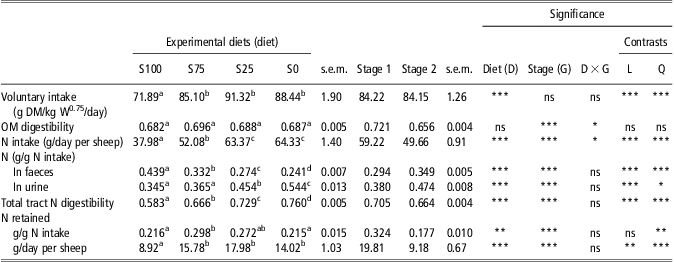
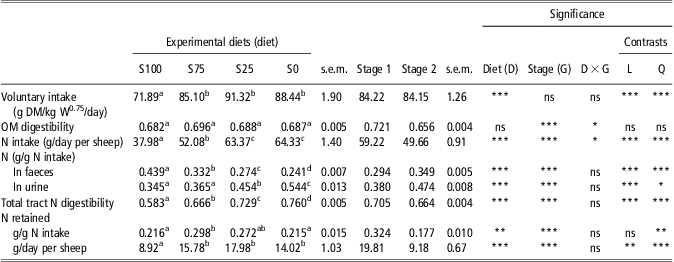
The voluntary DM and N intake increased significantly with the proportion of lucerne, showing a quadratic effect (P < 0.01 for quadratic contrast), and the highest DM and N intake values were obtained with diets containing 25%, 75% or 100% lucerne (i.e. S75, S25 and S0). Voluntary DM intake did not appear to decrease between the vegetative and the early flowering stage, whereas N intake decreased at the early flowering stage (P < 0.001).
Voluntary intake (g/kg W0.75), N intake (g/day per sheep), OM and N digestibility in the total tract and N retention variables measured on four groups of six sheep simultaneously fed ad libitum on different mixtures of sainfoin and lucerne (S100, S25, S75, S0) as fresh forage at the vegetative stage (stage 1) and at the early flowering stage (stage 2)
N = nitrogen; OM = organic matter; L = linear contrast; Q=quadratic contrast; DM = dry matter.
Probability of significant effects due to composition of the experimental diet (D), growth stage (G) and their interaction (D × G) for fresh forages (*P < 0.05, **P < 0.01, ***P < 0.001).
Different superscripts in a same line correspond to a significant difference (P < 0.05) between diets.
OMD of the forages remained similar for sainfoin and lucerne and was unaffected by plant mixture ratios (P > 0.05). However, OMD decreased significantly with the growth stage (P < 0.001). This decrease was stronger for lucerne (S0: 0.77) than for sainfoin (S100: 0.41), which consequently led to an interaction between diet and growth stage.
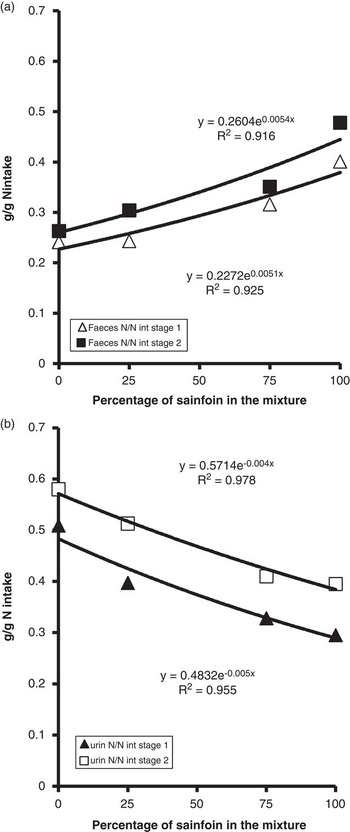
Faecal N output (g/g N intake) increased significantly via a quadratic effect as the proportion of sainfoin in the diet increased. Conversely, urinary N output was higher with lucerne (S0) and decreased via a quadratic effect with increasing proportions of sainfoin in the diet. No significant differences were found between S75 and S100. Total-tract N digestibility followed the same pattern as urinary N.
The N retained (g/g N intake) was significantly affected by the diet, although there were no differences between the two plants fed alone (S0 and S100). Interestingly, the amount of N retained increased significantly (P < 0.01 for the quadratic effect without a linear effect) for the two mixtures (S25 and S75). When N retained was expressed in g/day per sheep, the highest values were again obtained for the same mixtures and also for S0.
Nitrogen output in faeces and urine increased significantly with plant maturity, whereas the N content of the forages decreased and thus N digestibility and N retained by the animals decreased, without interaction with the diet effect. The observed decrease with plant maturity did not modify the classification.
In situ DM and N degradability in the rumen
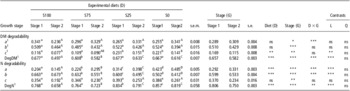
The DegDM of sainfoin (S100) was close to that of lucerne (S0) at stage 1 but decreased more markedly with forage maturity than for lucerne (0.18 units as compared with 0.05 units). Consequently, the interaction between diet and growth stage has a significant effect on DegDM (D × G, P < 0.001). The DegDM of the mixtures (S75 and S25) was linearly affected by the proportion of the two plants.
At stage 1, the DegN of sainfoin (S100) and the S75 mixture was lower than the DegN of S25 and S0 (mean of 0.765 as compared as 0.835; P < 0.001). The decrease in DegN with forage maturity was significantly stronger for sainfoin (0.10 units) than for lucerne (0.04 units; D × G, P < 0.001). As for DegDM, the DegN was linearly affected by the proportion of the two plants in the mixture. At both vegetation stages, the rapidly degradable N fraction ‘a’ was much smaller for sainfoin (S100) than for lucerne (S0). This fraction increased linearly with increasing proportions of lucerne in the legume mixture (P < 0.001). The opposite pattern was observed for the slowly degradable fraction ‘b’ (P < 0.001; Table 3).
In situ rumen DegDM and DegN in mixtures of sainfoin and lucerne studied as fresh forages at the vegetative stage (stage 1) and at the early flowering stage (stage 2)

N = nitrogen; DM = dry matter; DegDM = degradability of DM; DegN = degradability of N; L = linear contrast; Q=quadratic contrast.
1a: rapidly degradable fraction (n = 4), b: slowly degradable fraction (n = 4), c: degradation rate of b fraction; In situ ruminal degradability of DM or N calculated with a passage rate of 0.06/h.
Probability of significant effects due to composition of the experimental diet (D), growth stage (G) and their interaction (D × G) for fresh forages (*P < 0.05, **P < 0.01, ***P < 0.001).
Different superscripts in a same line correspond to a significant difference (P < 0.05) between diets (Stage 1: lower character, Stage 2: upper character).
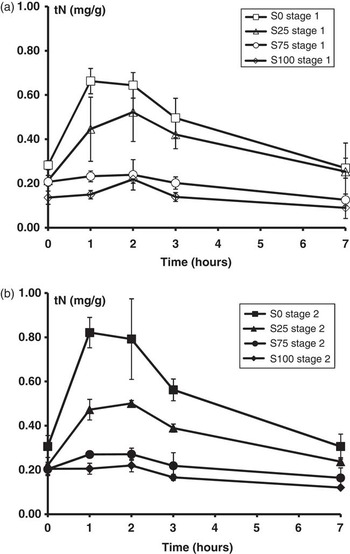
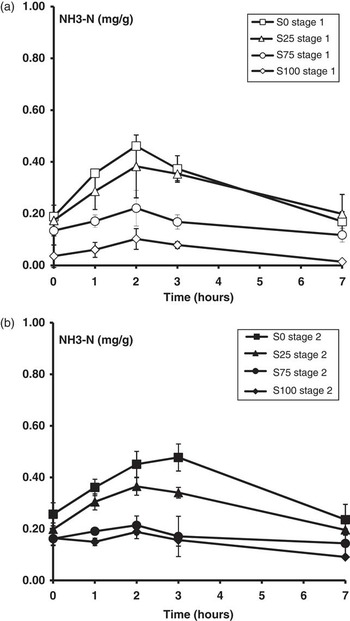
Rumen fluid composition (tN (Figure 1) and NH3-N (Figure 2.))
There were significant differences in the tN and NH3-N content in the rumen fluid with diet, with time following the meal, and with the D × T interaction. Both total tN and NH3-N decreased significantly with the growth stage (P < 0.01 and P < 0.001, respectively).
Evolution of the concentration (mg/g) of total nitrogen (tN) measured in rumen fluid in four groups of three sheep simultaneously fed different mixtures of sainfoin and lucerne (S100, S25, S75, S0) as fresh forage at the vegetative stage (stage 1, Figure 1a) and at the early flowering stage (stage 2, Figure 1b).

Evolution of the concentration (mg/g) of ammonia nitrogen (NH3-N) measured in rumen fluid in four groups of three sheep simultaneously fed different mixtures of sainfoin and lucerne (S100, S25, S75, S0) as fresh forage at the vegetative stage (stage 1, Figure 2a) and at the early flowering stage (stage 2, Figure 2b).

The total N and NH3-N content in the rumen fluid increased for all diets to peak at 1 or 2 h after feeding, but had decreased back to the pre-feeding values at 7 h after feeding. The peak values were higher for lucerne than sainfoin (0.821 as compared with 0.220 mg/g for tN and 0.456 as compared with 0.145 mg/g for NH3-N at 2 h post-feeding, respectively; P < 0.001). N in NH3-N concentrations decreased linearly from S0 to S100 as the proportion of sainfoin in the mixtures increased according to the following model:
Y = −0.0023x + 0.3335; R 2 = 0.99, r.s.d. = 0.004, where Y is the NH3-N concentration and x is the proportion of sainfoin in the mixture expressed as percentage.
In situ N digestion in the SI
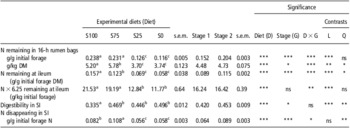
Consistent with the results measured for DegN, the fraction of forage N remaining in the nylon bags after a 16-h incubation in the rumen was much higher for sainfoin (S100, S75) than for lucerne (S25, S0), with the highest value being measured for stage-2 S100 (P < 0.001), in agreement with its lowest DegN (Table 4).
Effect of sainfoin-lucerne ratios on N remaining in bags after 16-h incubation in the rumen and after passage through the abomasum and SI, digestibility in the SI of 16-h rumen residual forage N, and forage N disappearing from mobile nylon bags in the SI, at two phenological stages (vegetative (Stage 1) and early flowering (Stage 2))

N = nitrogen; SI = small intestine; DM = dry matter; L = linear contrast; Q=quadratic contrast.
Probability of significant effects due to composition of the experimental diet (D), growth stage (G) and their interaction (D × G) for fresh forages (*P < 0.05, **P < 0.01, ***P < 0.001).
Different superscripts in a same line correspond to a significant difference (P < 0.05) between diets.
All results were expressed in gN or N × 6.25/g initial forage N, except digestibility in the SI.
The fraction of forage N remaining in the bags recovered at the ileum was almost 2 times higher for sainfoin (S100, S75) than for lucerne (S25, S0; D, G, D × G all P < 0.001; quadratic contrasts). Finally, although N digestibility in the SI was significantly lower for S100 than for S0, S75 and S25, the quantity of N that disappeared in the intestine expressed in g/g of initial forage N or DM was higher for the S75 mixture than for sainfoin (S100) and for lucerne (S0) and the S25 mixture, with a significant quadratic effect (P < 0.001; Table 4).
Discussion
The reported associative effects between forages vary broadly among studies (Niderkorn and Baumont, Reference Niderkorn and Baumont2009), but there are few publications on the effect of mixing a tannin-containing and a tannin-free forage. Many papers conclude that there is an improvement in the N value in mixtures compared with pure forage, but without specifying whether the improvement is due to an associative effect (non-linear contrast) or not (linear contrast).
Chemical composition
The differences in the N and cell wall contents between sainfoin and lucerne at the same growth stage were in agreement with the literature data. The N content decreased faster with the growth stage in sainfoin than in lucerne, probably due to a more rapid change in the leaf-to-stem ratio from the beginning of flowering (Borreani et al., Reference Borreani, Peiretti and Tabacco2003; Bal et al., Reference Bal, Ozturk, Aydin, Erol, Ozkan, Ata, Karakas and Karabay2006) in sainfoin than in lucerne (Theodoridou et al., Reference Theodoridou, Aufrère, Andueza, Lemorvan, Picard, Stringano, Pourrat, Mueller-Harvey and Baumont2011).
In vivo digestibility and voluntary intake
In agreement with our pepsin–cellulase digestibility results (Aufrère et al., Reference Aufrère, Theodoridou and Baumont2012), OMD was very similar between the two forages (S100 and S0). Kraiem et al. (Reference Kraiem, Garrett, Meiske, Goodrich and Marten G1990) reported no differences between lucerne, birdsfoot trefoil and sainfoin when compared with hays or silage harvested at early flowering stages. These results were consistent with our findings on DegDM and on the in vivo digestibility of sainfoin compared with lucerne harvested at two growth stages (Aufrère et al., Reference Aufrère, Dudilieu and Poncet2008).
In line with the literature data, advancing stages of maturity resulted in a decrease in OMD according to the increase in the cell wall contents (NDF, ADF and ADL) for lucerne (D × G < 0.05), whereas the cell wall content of sainfoin remained almost unchanged. Although the cell wall content was higher in sainfoin (S100) than in lucerne (S0), we found no significant effects on OMD among the sainfoin–lucerne mixtures. In contrast to the present findings, Turne and Neel (Reference Turne and Neel2003) observed an effect of level of quebracho condensed tannin supplementation on lucerne organic matter and fibre digestibility. Wang et al. (Reference Wang, Barbieri, Berg and Mc Allister2007) showed that the OMD of alfalfa–sainfoin mixtures preserved as hay or silage was improved compared with alfalfa preserved alone.
The lower voluntary intake of sainfoin (S100) than lucerne in our results has previously been related to NDF and ADF contents (Van Soest, Reference Van Soest1994). Moreover, it has been reported that high levels of CT inhibit feed intake due to their astringent effects on eating and their inhibition of ruminal digestion (Waghorn et al., Reference Waghorn, Shelton and McNabb1994a; Reed, Reference Reed1995). In our study, the CT contents measured using the HCl–butanol method may have negatively affected voluntary dry matter intake (DMI). Willman et al. (Reference Willman, Mtengi and Moseley1996) compared with the physical structure of sainfoin and lucerne forages and their voluntary intake by ruminants, and showed that sainfoin is not fragmented to the same extent as lucerne. Lees et al. (Reference Lees, Howarth, Goplen and Fessr1981) attributed the resistance of sainfoin to mechanical disruption to its greater cell wall and tissue strength relative to lucerne. These studies demonstrate the inherent structural differences between sainfoin and lucerne, in addition to the presence of CT.
We found a positive associative effect of sainfoin and lucerne on voluntary intake, as revealed by the significant quadratic contrast, with the highest voluntary intake being observed with the S25 mixture. Cortes et al. (Reference Cortes, Damasceno, Jamot and Prache2006) demonstrated that dry ewes offered a choice of herbage species at pasture (Lolium perenne and Festuca arundinacea) showed an increase in their overall intake, and that this pattern was mediated via an increase in the grazing time rather than an increase in the intake rate. Ginane et al. (Reference Ginane, Baumont, Lassalas and Petit2002) observed that DMI was higher by at least 10% when heifers were offered a choice between two hays than when the same forages were offered alone. It has been suggested that food diversity may provide animals a positive stimulus that increases their motivation to eat and therefore their intake levels.
N utilisation
In line with our findings here, other studies with legume forages have found lower N in vivo digestibility for sainfoin than lucerne, whether fresh or preserved as hay (Aufrère et al., Reference Aufrère, Dudilieu and Poncet2008) or silage (Fraser et al., Reference Fraser, Fychan and Jones2000). The differences between S100 and the mixtures in terms of the amounts of N intake and N digested arise from a combination of differences between sainfoin and lucerne in terms of voluntary intake and N content. This decrease in N digestibility was also attributed to the presence of CT in sainfoin. The decrease in ruminal protein degradation with CT results from the ability of the CT to either bind feed protein or suppress proteolytic protozoa. The higher faecal N excretion in S100 is largely counterbalanced by a lower urinary N excretion due to the lower ruminal degradability of nitrogenous compounds. Conversely, the high urinary N excretion for lucerne (S0) results from the higher digestible N content and the higher ruminal N degradability of lucerne compared with sainfoin (quadratic contrast, Figure 3). Getachew et al. (Reference Getachew, Pittroff, DePeters, Putnam, Dandekar and Goyal2008a) observed higher faecal N as the tannic acid level on lucerne hay was increased. Tiemann et al. (Reference Tiemann, Avila, Ramirez, Lascano, Kreuer and Hess2008) studied the effect of using two tannin-rich shrub legume species as replacements for a herbaceous high-quality legume (Vigna unguiculata) on the nutritive value of a diet composed of tropical grasses (Brachiaria brizantha and V. unguiculata). They found that faecal N losses increased linearly relative to N intake with increasing proportion of CT-rich legumes in the diet, while the proportionate urinary N losses decreased for both CT-rich legume shrubs. These results suggested that the tannin–protein complexes formed in the rumen may not be fully dissociated post-ruminally (Barry and McNabb, Reference Barry and McNabb1999).

Moreover, according to McMahon et al. (Reference McMahon, Majak, Mc Allister, Hall, Jones, Popp and Cheng1999), although sainfoin did not completely eliminate bloat in cattle grazing alfalfa-based pastures, there is evidence that sainfoin will reduce the incidence of bloat in grazing cattle if it accounts for at least 15% DM in the pasture.
The relationship between in vivo N digestibility and sainfoin content in the mixture is quadratic and was closed (R 2 = 0.93, P < 0.001), indicating an interaction (associative effect) between sainfoin CT and lucerne. These results are in contrast to those obtained by Waghorn and Shelton (Reference Waghorn and Shelton1997) on L. corniculatus in a grass-legume pasture. Their study suggests that the 1% CT from L. corniculatus may be insufficient to affect the nutritive value of fresh forages for sheep. A similar trial conducted previously with ryegrass and Lotus pedunculatus had shown a substantial reduction in N digestibility due to the CT in the Lotus (Waghorn et al., Reference Waghorn, Shelton, McNabb and McCutcheon1994b).
Finally, our results found that the ratio of N retained to N intake was on average the same for S100 and S0 and higher for S75 and S25 (quadratic contrast).
Sainfoin–lucerne mixtures can be fed to ruminants to alter the form of excreted N and to reduce environmental N pollution because faecal N output is considered to be an environmentally less harmful N form than urinary N.
Rumen degradability
DegN was lower in the high-sainfoin mixtures (S100 and S75) than the low-sainfoin mixtures (S25 and S0; mean = 0.728 as compared with 0.827, respectively). The relation between DegN and sainfoin content in the mixture did not show an associative effect.
This lower DegN for sainfoin was expected, as it is well documented that CT reduces ruminal protein degradation by complexing proteins and making them less degradable by ruminal microbes (Reed, Reference Reed1995). We found a less significant difference in DegN between sainfoin and lucerne (0.10 units) than that in other studies (Aufrère et al., Reference Aufrère, Dudilieu and Poncet2008; 0.20 units). The differences in DegN may be explained by differences in the N content between the two forages and differences in the sainfoin CT content or structure between the two experiments.
The results of Hervas et al. (Reference Hervas, Frutos, Giralgez, Mantecon and Avarez Del Pino2003) suggest that the effect of quebracho CT extract on ruminal fermentation measured by gas production and the bag technique was clearly dose-dependent. Getachew et al. (Reference Getachew, Pittroff, Putnam, Dandekar, Goyal and DePeters2008b) determined the effects of different types and levels of tannins, that is, gallic acid, tannic acid and quebracho, on the in vitro rumen gas production of lucerne, and concluded that the effect of tannins on rumen fermentation and protein degradation varied with the type and the level of tannins.
Intestinal digestibility
The SI digestibility of residual N from lucerne, estimated using the mobile bag technique, was lower than the published values for tannin-free forages (Hvelplund et al., Reference Hvelplund, Weisberg and Andersen1992), but residual N at the ileum was similar to published values (Nozières et al., Reference Nozières, Dulphy, Peyraud, Poncet and Baumont2007; Aufrère et al., Reference Aufrère, Dudilieu and Poncet2008). The present study was designed to eliminate any microbial N interference as much as possible, and digestion of residual feed N in the large intestine was ruled out by the ileal recovery of intestinal bags. These measurement conditions almost certainly contributed towards the low level of N digestibility obtained.
The crucial question was whether or not the plant protein protected from ruminal degradation was digested and absorbed in the SI. Although the residual N content at the end of the SI was higher for the high-sainfoin-content mixtures (S100 and S75), the amount of forage N digested in the SI was higher with the presence of lucerne. Thus, the higher N disappearance in the SI (in g/g initial forage N) under the S100 (mean = 0.0822) and mainly S75 (0.1085) diets compared with the S25 (0.056) and S0 (0.058) diets resulted from greater higher N escape from the rumen that was not counterbalanced by a lower forage N digestibility in the intestine. These results suggested a positive effect of CT on N utilisation at high-sainfoin-content mixtures. The impact of CT on intestinal function in ruminants is still not well understood. Studies suggest that CT inhibit the ability of endogenous enzymes to cleave proteins into peptides and amino acids and also inhibit their absorption, whereas other studies found that absorption was increased or remained unchanged (Waghorn, Reference Waghorn2008).
Evolution in the rumen fluid
It is important to underline the concordance between the tN content kinetics and the NH3-N content kinetics. The lower tN and NH3-N concentrations measured in the rumen for the mixtures (S25, S75, S100) may have been obtained because of several reasons. First, the initial N intake was lower for sainfoin (S100 and S25) than for lucerne (S25 and S0). Furthermore, decreased ruminal NH3-N concentration is a commonly reported effect of tannin-rich forages on protein metabolism in the rumen (Min et al., Reference Min, Barry, Attwood and McNabb2003; Barry and McNabb, Reference Barry and McNabb1999). The tN and NH3-N values in our results were higher for stage 2 than for stage 1, whereas N intake was lower in stage 2 than stage 1. This contrast may be explained by the lower CT content in stage 2 than in stage 1.
Wang et al. (Reference Wang, Berg B, Barbieri, Veira and Mc Allister2006) found that cattle grazing lucerne/sainfoin mixtures containing as little as 85 g sainfoin/kg DM had lower ruminal NH3-N concentrations than those grazing pure lucerne pasture. Kraiem et al. (Reference Kraiem, Garrett, Meiske, Goodrich and Marten G1990) reported lower ruminal NH3-N concentrations in cattle fed diets containing sainfoin as compared with lucerne, whether as hay or as silage.
The ruminal concentration of NH3-N represents an equilibrium in production between utilisation and absorption. It is well-known that CT reduces protein degradation and subsequent deamination in the rumen. Thus, the reduction in the NH3-N concentration likely resulted from decreased ammonia production, which is also consistent with the relatively lower intracellular and extracellular proteolytic activity in ruminal fluid (Jones et al., Reference Jones, Mc Allister, Muir and Cheng1994; Wang et al., Reference Wang, Berg B, Barbieri, Veira and Mc Allister2006). The main effect of tannin was to decrease the solubilisation of plant protein.
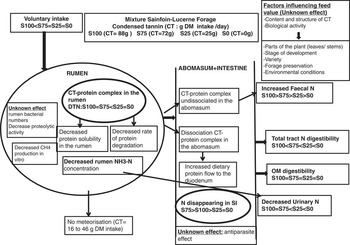
The effects of the diets composed by different ratios of sainfoin and lucerne on digestive parameters in ruminants are summarised in Figure 4. Our results showed that low levels of tannins (CT<72 g DM intake/day) did not impair the voluntary intake (S75 = S25 = S0) or OMD of the mixtures (S100 = S75 = S25 = S0). Ruminal DTN was lower when fresh sainfoin was fed (S100, S75) compared with fresh lucerne (S25, S0). In the rumen, CT (S100, S75) tended to increase the flow of non-ammonia N to the small intestine. The decrease in N digestibility in the total digestive tract can be attributed to the presence of CT in sainfoin (Total-tract N digestibility S100 < S75 < S25 < S0). The higher faecal N excretion for sainfoin (S100, S75) resulted from the lower ruminal N degradability, whereas the lower urinary N excretion resulted from the decrease of rumen NH3-N content. The disappearance of N from the intestine was higher with S75 (S75 > S100 > S25 = S0). Other beneficial effects of feeding sainfoin forage in association with lucerne, but not studied in this experiment, include a reduction in incidences of bloating (McMahon et al., Reference McMahon, Majak, Mc Allister, Hall, Jones, Popp and Cheng1999). More research should be carried out in order to identify other factors related to CT that could lead to variations in the effect of CT on the feed value of forage mixtures (content, structure and biological activity of CT, leaf/stem ratio, variety, preservation method and environmental conditions; Theodoridou et al., Reference Theodoridou, Aufrère, Andueza, Lemorvan, Picard, Stringano, Pourrat, Mueller-Harvey and Baumont2011 and Reference Theodoridou, Aufrère, Andueza, Lemorvan, Picard, Pourrat and Baumont2012).
Schematic diagram of the effects of condensed tannins on digestive parameters in ruminants for sainfoin–lucerne mixtures (S100, S25, S75, S0; from the present results and McMahon et al., Reference McMahon, Majak, Mc Allister, Hall, Jones, Popp and Cheng1999 results). CT = condensed tannins; DM = dry matter; N = nitrogen; NH3-N = ammonia N; CH4 = methane.

Conclusion
This study shows an associative effect of sainfoin and lucerne (quadratic contrast). The effects of CT of sainfoin on the feed value of sainfoin–lucerne mixtures were the highest for high-sainfoin-content mixtures (S75; CT mean value = 72 g DM intake/day). At this proportion, voluntary intake, N retention and disappearance of N in SI were maximum and N rumen degradability showed the lowest values. Further experiments are needed to determine whether other secondary compounds are involved in the associative effects of sainfoin–lucerne mixtures.
Acknowledgements
The authors thank the staff at the ‘Annexe Elevage’ experimental farm for their diligent care of the experimental animals, Bernard Debote for his advice on establishing sainfoin swards and Eric Villeneuve and his staff for growing and cropping the forages.