




No CrossRef data available.
Article contents
Comparative assessment of the access of albendazole, fenbendazole and triclabendazole to Fasciola hepatica: effect of bile in the incubation medium
Published online by Cambridge University Press: 19 January 2004
Abstract
The work reported here describes the comparative ability of albendazole (ABZ), fenbendazole (FBZ) and triclabendazole (TCBZ) to penetrate through the tegument of mature Fasciola hepatica, and the influence of the physicochemical composition of the incubation medium on the drug diffusion process. The data obtained from the trans-tegumental diffusion kinetic studies were complemented with the determination of lipid-to-water partition coefficients (octanol-water) for the benzimidazole (BZD) anthelmintic drugs assayed. Sixteen-week-old F. hepatica were obtained from untreated artificially infected sheep. The flukes were incubated (37 °C) over 60 and 90 min in incubation media (pH 7·4) prepared with different proportions of ovine bile and Krebs' Ringer Tris (KRT) buffer (100, 75, 50, 25 and 0% of bile) containing either ABZ, FBZ or TCBZ at a final concentration of 5 nmol/ml. After the incubation time expired, the liver fluke material was chemically processed and analysed by high performance liquid chromatography (HPLC) to measure drug concentrations within the parasite. Additionally, the octanol-water partition coefficients (PC) for each molecule were calculated (as an indicator of drug lipophilicity) using reversed phase HPLC. The 3 BZD molecules were recovered from F. hepatica at both incubation times in all incubation media assayed. The trans-tegumental diffusion of the most lipophilic molecules ABZ and FBZ (higher PC values) tended to be greater than that observed for TCBZ. Interestingly, the uptake of ABZ by the liver flukes was significantly greater than that measured for TCBZ, the most widely used flukicidal BZD compound. This differential uptake pattern may be a relevant issue to be considered to deal with TCBZ-resistant flukes. Drug concentrations measured within the parasite were lower in the incubations containing the highest bile proportions. The highest total availabilities of the 3 compounds were obtained in liver flukes incubated in the absence of bile. Altogether, these findings demonstrated that the entry of the drug into a target parasite may not only depend on a concentration gradient, the lipophilicity of the molecule and absorption surface, but also on the physicochemical composition of the parasite's surrounding environment.
Keywords
Information
- Type
- Research Article
- Information
- Copyright
- 2004 Cambridge University Press
INTRODUCTION
The economic importance of helminth infections in livestock has long been recognized and it is probably for this reason that the most relevant advances in the chemotherapy of helminthiasis have come from the animal health area (Horton, 1990). Chemotherapy still remains the most widely used method to control parasitism in livestock (Zajac, Sangster & Geary, 2000) and human health (Quellette, 2001). The activity of most anthelmintic molecules is based on their affinity for a specific receptor, and on the kinetic properties that allow the delivery of effective drug concentrations to the receptor inside the parasite, in sufficient time to cause the therapeutic effect (Thompson et al. 1993). Anthelmintic drugs can reach target helminth parasites by either oral ingestion or by diffusion through the external surface of the parasite, or some combination of both routes (Thompson & Geary, 1995). The accumulated data show that the main route of acquisition of broad-spectrum anthelmintics by target parasites appears to be by passive diffusion through their tegument (cestodes/trematodes) (Alvarez, Sánchez & Lanusse, 1999; Alvarez et al. 2000, 2001) or cuticle (nematodes) (Ho et al. 1990; Sims et al. 1996; Cross, Renz & Trees, 1998). Consequently, the rate of penetration of a drug will mainly depend on the intrinsic lipid-to-water partition coefficient of the molecule (Mottier et al. 2003), pH/pK relationship, molecular size, concentration gradient and the surface area of contact between drug and parasite.
Benzimidazoles (BZD) are broad-spectrum anthelmintic compounds widely used in human and veterinary medicine to control nematode, cestode and trematode infections (McKellar & Scott, 1990). The BZD compounds currently marketed as anthelmintics can be grouped as BZD thiazolyls, BZD methylcarbamates, pro-BZD and halogenated BZD thiols (Lanusse & Prichard, 1993). Only a few molecules within the BZD chemical family demonstrated activity against the trematode, Fasciola hepatica. Albendazole (ABZ) is the only BZD methylcarbamate recommended to control fascioliasis in domestic animals, despite its activity being restricted to flukes older than 12 weeks (McKellar & Scott, 1990). Fenbendazole (FBZ), a similar BZD methylcarbamate widely used in veterinary medicine as a nematodicidal drug, is not as effective as ABZ against F. hepatica, but a single treatment of 5 mg/kg reduced F. gigantica infection in sheep by up to 95% (Roberson & Courtney, 1995). Unlike other BZD compounds, the halogenated derivative triclabendazole (TCBZ) has been shown to have an excellent efficacy against the adult and juvenile stages of F. hepatica (Boray et al. 1983). However, TCBZ activity appears to be restricted to the liver fluke and the lung fluke, Paragonimus spp. (Weber, Buscher & Buttner, 1988; Calvopina et al. 1998), because the drug does not show clinical efficacy against nematodes, cestodes and other trematode (Dicrocoelium dendriticum, Paramphistomun spp. and Schistosoma mansoni) parasites. BZD nematodicidal activity is based on its binding to parasite β-tubulin (Borgers & De Nollin, 1975; Lacey, 1988; Lubega & Prichard, 1991), which inhibits polymerization into microtubules (Friedman & Platzer, 1980). Thus, all the functions ascribed to microtubules at the cellular level are altered (cell division, maintenance of cell shape, cell motility, cellular secretion, nutrient absorption and intracellular transport) (Lacey, 1988). BZD methylcarbamate molecules such as ABZ or FBZ act upon nematode microtubules at the tubulin colchicine binding site (Lacey, 1988). It is likely that a different site of action is involved on the flukicidal activity of TCBZ, which could also explain its lack of efficacy against other helminth parasites (Stitt & Fairweather, 1994). However, differences in the ability of ABZ, FBZ and TCBZ to penetrate through the F. hepatica external tegument may help to explain the observed differences in clinical efficacy among those chemically related drugs. Comprehension of the patterns of drug diffusion into target parasites, in conjunction with the available pharmacodynamic information on drug-receptor interactions, may substantially contribute to elucidation of the mechanisms of drug action and enhancement of their activity.
BZD anthelmintics are extensively metabolized in all mammalian species studied (Lanusse & Prichard, 1993). Albendazole sulphoxide (ABZSO), the main metabolite found in plasma after ABZ administration to sheep, has been recovered at higher concentrations compared with the parent drug in abomasal and intestinal fluids of treated sheep (Alvarez, Sánchez & Lanusse, 1999; Alvarez et al. 2000). However, in specimens of Moniezia spp. (Alvarez et al. 1999) and Haemonchus contortus (Alvarez et al. 2000) collected from the same ABZ-treated animals, the availability of ABZ parent drug was greater than that of its sulphoxide metabolite. The in vivo uptake studies carried out in Moniezia spp. and H. contortus demonstrated that ABZ has the capability to concentrate in the parasite. Such a pattern was not observed in liver flukes (Alvarez et al. 2000), where the ABZ ratio of area under the concentration versus time curve (AUC) between F. hepatica and bile was 0·33, which clearly demonstrated a lower drug accumulative process in the adult trematode parasite. These findings suggest that the drug-partitioning phenomenon between gastrointestinal fluid and parasite tissues might be different from that occurring between the surrounding bile and target liver flukes.
The current experiments were designed to investigate the comparative ability of ABZ, FBZ and TCBZ to diffuse into mature F. hepatica and to assess the influence of the physico-chemical composition of the incubation medium on the drug diffusion process. The results obtained from the trans-tegumental diffusion kinetic studies were complemented with the determination of lipid-to-water partition coefficients (octanol-water) of the anthelmintic drugs assayed, as an indicator of drug lipophilicity.
MATERIALS AND METHODS
Collection of parasite material
Eight (8) parasite-free Corriedale sheep were infected with 200 metacercariae of F. hepatica each, given in a gelatine capsule by the oral route. Sixteen weeks after infection the animals were killed by captive bolt plus exsanguination, following internationally accepted animal welfare guidelines. To recover adult specimens of F. hepatica from the liver, common bile ducts and the gall-bladder of each sheep were removed and opened. The specimens were rinsed extensively with saline solution (NaCl 0·9%) (37 °C) to remove bile and/or adhering materials.
Drug diffusion assays
The collected flukes were maintained for 2 h before starting the incubation in a Krebs' Ringer Tris (KRT) buffer (pH 7·4) at 37 °C (McCraken & Lipkowitz, 1990). Two flukes (approximately 0·2 g) were incubated at 37 °C for 60 and 90 min in 2 ml of an incubation medium (pH 7·4) prepared with bile and KRT buffer in different proportions (100/0, 75/25, 50/50, 25/75 and 0/100), containing either ABZ, FBZ or TCBZ at a final concentration of 5 nmol/ml. This is a pharmacologically relevant concentration obtained from previously reported work where the BZD concentrations in bile were measured after conventional treatments in ruminants (Hennessy et al. 1987; Alvarez et al. 2000). Ovine bile was collected from the gall-bladder of non-infected untreated sheep killed at the local abattoir at the same time as the infected animals. There were 6 replicate incubation assays for each drug at each incubation time. Blank samples containing parasite material and incubation medium without drug, and drug-spiked medium without parasite material were incubated during the same time-intervals. Once the incubation time had elapsed, the flukes were rinsed thoroughly with saline solution, blotted on coarsefilter paper and stored at −20 °C until their preparation for high performance liquid chromatography (HPLC) to measure drug concentrations. The parasite material was processed shortly after the incubation assays.
Measurement of drug concentrations
The parasite material (0·2 g) was homogenized using an Ultraturrax® homogeniser (T 25, Ika Works Inc., Labortechnik, USA) and spiked with oxibendazole (OBZ) used as internal standard. The parasite material homogenate was mixed with 1·5 ml of methanol and shaken for 5 min to extract the drug analyte/s present in the fluke sample. The collected methanol phase was evaporated to dryness. The residue obtained was dissolved in 1 ml of a methanol/water solution (20/80) and prepared for HPLC analysis using the extraction procedure described by Alvarez et al. (1999). All the solvents and reagents used during the extraction and drug analysis processes were HPLC grade.
Experimental and spiked liver fluke samples were analysed to measure the concentrations of each drug by HPLC using a model 10 A system (Shimadzu, Kyoto, Japan). The extraction efficiency of the different analytes from parasite material samples, expressed as absolute recovery, ranged between 85 and 97·5% with a coefficient of variation (CV) of [les ]15·5%. The quantification limits of the HPLC technique for all the molecules assayed was 0·27 nmol/100 mg protein. The molecules under study were identified by comparison with the retention times of pure drug standards, which were used to prepare standard solutions to construct the calibration lines for each analyte in the parasite material analysed. The linear regression lines for each analyte in the range between 0·27 and 27·2 nmol/100 mg protein (triplicate determinations) showed correlation coefficients greater than 0·995. The concentrations of each analyte were quantified by comparison of the chromatographic peak area of each analyte with that obtained for the internal standard, using the Class LC 10 Software (Shimadzu, Kyoto, Japan) on an IBM 486-AT computer. The final concentration values for the different drugs assayed are expressed as nmol/100 mg protein. The determination of parasite protein concentrations was carried out according to the methodology described by Smith et al. (1985).
Octanol-water partition coefficients (PC)
The octanol-water PC (Log P) was used as an indicator of lipid solubility of the BZD molecules used in the current experiment. The methodology used to calculate this parameter was adapted from that reported by Péhourcq, Thomas & Jarry (2000). The octanol-water PC was estimated by the combination of the traditional shake-flask technique and HPLC analysis, using n-octanol (Merck, Schuchardt, Germany) and desionized ultrapure water (pH 7·4) (Simplicity®, Water purification system, Millipore, Brazil) as a biphasic liquid system. Samples of 20 μl of either ABZ, FBZ or TCBZ (from 1 mM stock solutions) were added to 1980 μl of desionized ultrapure water previously saturated with n-octanol. Under the chromatographic conditions described above, 200 μl of the aqueous phase were collected, evaporated to dryness and re-suspended in 150 μl of the HPLC mobile phase (27% acetonitrile, 73% water) to calculate the peak area of the analyte before partitioning (W0). In screw-capped glass tubes, the remaining 1800 μl of the aqueous phase (Vaq) were supplemented with 200 μl of an octanol phase (Voc), previously saturated with desionized water (pH 7·4). The mixture was shaken for 90 min in a mechanical shaker (Cole Parmer®, Vernon Hills, Illinois, USA) at 15 °C. The mixture was then centrifuged (1500 g, 5 min) and 1 ml of the lower aqueous phase was recovered, evaporated to dryness, resuspended in 150 μl of mobile phase and injected into the HPLC system to determine drug concentration in the aqueous phase after partitioning (W1). The partitioning of the drug between both phases (P value) was calculated using the following equation (Péhourcq, Thomas & Jarry, 2000):

The partition coefficient (Log P) was calculated as the logarithm of the obtained experimental P value.
Analysis of the data
The individual concentration values are reported as mean±S.D. The statistical analysis of the data was performed as follows: (a) the comparison of the concentrations achieved in F. hepatica in the different assayed incubation media, for each drug (ABZ, FBZ or TCBZ) and at each incubation time (60 and 90 min), was performed by analysis of variance (ANOVA); (b) Student's t-test was used to compare drug concentrations obtained at 60 and 90 min of incubation in the different incubation media. The statistical analysis was performed using the Instat 3.0 Software (Graph Pad Software, San Diego, California). When ANOVA was employed and a significant F value was obtained, Tukey's range test was performed to indicate order of significance. Values were considered different at P<0·05.
RESULTS
The 3 molecules investigated were detected in F. hepatica after their ex vivo incubation. The amounts of ABZ, FBZ and TCBZ recovered from F. hepatica incubated in the absence of bile were significantly greater than those obtained with media containing bile (100, 75, or 50%). The comparison of the drug concentration profiles recovered in liver flukes incubated with ABZ and FBZ in media with different composition is shown in Fig. 1. The highest concentration values for ABZ (20·1±8·15 nmol/100 mg protein) and FBZ (13·5±4·06 nmol/100 mg protein) were measured in flukes incubated in the absence of bile. In the presence of bile in the incubation medium (100% bile), TCBZ concentrations recovered from the flukes ranged between 0·32±0·07 and 0·47±0·17 nmol/100 mg protein. Those TCBZ concentrations have a significant enhancement in the incubations without bile, reaching values up to 7·48±2·62 (60 min) and 8·76±3·16 (90 min) nmol/100 mg protein. There was a positive correlation between the percentage of KRT buffer in the incubation medium and the drug concentrations measured in F. hepatica, with high correlation coefficients obtained for ABZ (>0·81), for FBZ (>0·88) and TCBZ (>0·75).

Fig. 1. Comparison (mean±S.D.) between albendazole (ABZ) and fenbendazole (FBZ) concentrations (nmol/100 mg protein) measured in Fasciola hepatica incubated with different proportions of ovine bile. ABZ concentrations are significantly different from those obtained for FBZ at P<0·05.
Although all drugs penetrated the trematode's tegument, the rates of penetration were different. In all cases, the concentrations of the most lipophilic BZD methylcarbamates (FBZ, ABZ) recovered in F. hepatica were higher than those of TCBZ. The partition coefficients (Log P) obtained for FBZ, ABZ and TCBZ were 3·99, 3·82 and 3·48, respectively. The relative ability of ABZ and FBZ to penetrate into the liver flukes incubated in different media after 60 and 90 min is presented in Fig. 1. After 60 min of incubation, the amount of ABZ recovered from the parasite was significantly greater than that of FBZ, regardless of the composition of the incubation medium. However, the length of drug incubation for the flukes seems to play a role, as some differences in the uptake pattern between ABZ and FBZ were observed after 90 min of incubation. The slightly greater FBZ lipid solubility (compared to ABZ) may have to be taken into account to explain why the extension of the incubation time up to 90 min allowed its recovery at higher concentrations in flukes incubated in the presence of bile at 25, 50 and 75% of the total medium composition. Interestingly, the amount of ABZ recovered from F. hepatica incubated exclusively in ovine bile (100%) was between 32% (90 min) and 220% (60 min) higher than that measured for FBZ.
Despite the differences in the amount of FBZ recovered in F. hepatica between 60 and 90 min of incubation, the length of the incubation period did not significantly affect the drug concentration profiles of both ABZ and TCBZ recovered within the parasite.
The relative diffusion of ABZ and TCBZ into F. hepatica after 60 and 90 min of incubation with (100%) or without (0%) bile is shown in Fig. 2. The diffusion of ABZ was significantly greater than that observed for TCBZ in all the incubation conditions under investigation. The diffusion of ABZ into F. hepatica incubated in ovine bile was between 281% (60 min) and 434% (90 min) higher than that measured for TCBZ. In the absence of bile, ABZ diffusion was between 129% (90 min) and 151% (60 min) higher than that of TCBZ.

Fig. 2. Diffusion of albendazole (ABZ) and triclabendazole (TCBZ) into Fasciola hepatica. Results express drug concentrations (mean±S.D.) (nmol/100 mg protein) in flukes after 60 and 90 min of incubation with (A) and without (B) bile in the incubation media. TCBZ concentration values are significantly lower than those measured for ABZ at P<0·05.
The concentrations of FBZ and TCBZ (mean±S.D.) measured in F. hepatica incubated without bile during 60 and 90 min, and the octanol-water partition coefficients for both molecules are compared in Fig. 3. The diffusion of FBZ into the trematode parasite was between 50 and 80% higher than that of TCBZ.

Fig. 3. Comparison of fenbendazole (FBZ) and triclabendazole (TCBZ) (mean±S.D.) concentrations (nmol/100 mg protein) measured in Fasciola hepatica incubated without bile. The insert shows the octanol-water partition coefficients (PC) for both molecules. The diffusion of FBZ into F. hepatica was between 50 and 80% higher than that of TCBZ. The mean concentration values obtained at 60 min of incubation are statistically different at P<0·05.
DISCUSSION
The relationship between F. hepatica and its surrounding environment occurs both across its external (tegument) and internal (gastrodermal cavity) surfaces (Thompson & Geary, 1995). The relative importance of these 2 available routes for drug uptake in F. hepatica is still unclear. However, the higher absorption surface of the tegument probably determines its major relevance in drug diffusion from the surrounding medium. This statement is supported by the fact that F. hepatica can survive long periods under in vitro conditions, in the absence of detectable nutrient absorption across the intestine (Smith & Clegg, 1981). Additionally, the higher concentrations of the lipophilic ABZ parent drug recovered in F. hepatica, compared to the more polar sulphoxide metabolite under ex vivo conditions (Alvarez et al. 2000) may also contribute to demonstrate the relevance of the trans-tegumental drug passage. A large number of experiments have shown that different chemical substances, as well as anthelmintic drugs, are mainly taken up through the external surface, as opposed to oral ingestion, in H. contortus (Rothwell & Sangster, 1997; Alvarez et al. 2000), Ascaris suum (Ho et al. 1990; Alvarez et al. 2001), Moniezia spp. (Alvarez et al. 1999; Mottier et al. 2003), F. hepatica (Fetterer & Rew, 1984; Alvarez et al. 2000, 2001), Onchocerca ochengi (Cross, Renz & Trees, 1998) among other helminth parasites.
The accumulated data show that anthelmintic drugs move across the external surface of helminth parasites by passive diffusion. In this process, the membrane behaves as an inert lipid-pore boundary, and drug molecules traverse this barrier either by diffusion through the lipoprotein region or, alternatively, filtering through aqueous pores (channels) without the cellular expenditure of energy if they are of sufficiently small size (Baggot, 1982). The rate of diffusion is proportional to the area of diffusion surface, the concentration gradient across the membrane and to the lipid-to-water partitioning of the drug (Baggot, 1982), and it is inverse to the medium viscosity of the drug-containing medium (Hörter & Dressman, 2001). Lipid solubility is a major factor determining drug penetration across nematode cuticle (Alvarez et al. 2000, 2001) as well as through the tegument of cestodes (Alvarez et al. 1999; Mottier et al. 2003) and trematodes (Fetterer & Rew, 1984; Alvarez et al. 2000, 2001) Although, there are relevant structural differences between cuticle and tegument, the mechanism of drug entry to both type of structures seems to be equally dependent on lipophilicity as a major physicochemical determinant of drug capability to reach therapeutic concentrations within the target parasite. The logarithm of the octanol-water PC (Log P) was chosen as an indicator of drug lipophilicity since it is the most frequently used parameter for defining the lipophilic character of a given drug molecule (Péhourcq et al. 2000). This coefficient represents the fraction of molecules that distribute in an organic phase (octanol) versus an aqueous phase (water), and provides an estimate of how readily a molecule will penetrate a lipoidal membrane such as the trematode tegument. In all cases, the most lipophilic BZD methylcarbamates (FBZ, ABZ) were recovered at higher concentrations, as compared to TCBZ, in the incubated liver flukes.
Regardless of the time of incubation, the availability of ABZ in liver flukes incubated in the absence and presence of bile was significantly higher than those measured for FBZ. It has been suggested that the sulphoxide metabolites of both ABZ and FBZ may contribute substantially to the nematodicidal (Lanusse & Prichard, 1993) and flukicidal (Fetterer, Rew & Knight, 1982) activities of the parent compounds. A series of free and conjugated ABZ and FBZ metabolites have been recovered in the bile of treated sheep (Hennessy et al. 1989; Hennessy, Prichard & Steel, 1993). However, the concentration profiles of the anthelmintically active unconjugated ABZ sulphoxide metabolite measured in bile were higher than those of FBZ sulphoxide (oxfendazole). Altogether, the greater trans-tegumental rate of ABZ diffusion into F. hepatica reported in the current work, and the higher availability of its active metabolite in bile may account for the advantageous flukicidal activity of ABZ compared to FBZ. However, other factors such as a differential portal blood concentration profile and differences in affinity for fluke β-tubulin should be considered in order to understand the low flukicidal activity of FBZ, a compound that is chemically closely related to ABZ and shows an equivalent spectrum of activity against nematode parasites.
ABZ and TCBZ are the only BZD compounds used as flukicidal drugs in domestic animals. While ABZ is recommended for flukes older than 12 weeks, TCBZ is active against both mature and immature stages of F. hepatica (Boray et al. 1983), being the most extensively used flukicidal drug in veterinary medicine (Coles & Stafford, 2001). The intensive use of TCBZ in endemic areas of fascioliasis has resulted in the development of liver flukes resistant to this compound (Overend & Bowen, 1995; Mitchell, Maris & Bonniwell, 1998; Moll et al. 2000; Thomas, Coles & Duffus, 2000), which is considered a major problem for veterinary therapeutics. A recent study has shown that ABZ is active against TCBZ-resistant isolates of F. hepatica (Coles & Stafford, 2001). If it is assumed that TCBZ and ABZ may act on tubulin in F. hepatica, then differences in uptake or metabolism of these 2 drugs could explain their differential efficacy against TCBZ-resistant flukes (Robinson et al. 2002). The drug biotransformation capacity of the liver fluke, recently characterized by Solana, Rodríguez & Lanusse (2001), could have potential involvement in the development of resistance to BZD compounds. It is possible that TCBZ may target a molecule other than β-tubulin, which would explain why ABZ continues to act against TCBZ-resistant flukes. However, the comparative ability of ABZ and TCBZ to penetrate through the tegument of susceptible liver flukes shown here provides some useful information. The diffusion of ABZ was significantly greater than that observed for TCBZ in all the incubation conditions under investigation similar results were observed for FBZ regardless of its lower flukicidal activity. This would suggest that the lower PC value obtained for TCBZ could play against its trans-tegumental diffusion ability. Finally, the greater trans-tegumental diffusion capability of ABZ compared to TCBZ may account for its efficacy pattern against TCBZ-resistant flukes, which is a relevant finding to be considered in fascioliasis control.
Lipid solubility is a relevant factor to determine drug diffusion into a target parasite. However, although lipophilicity is an important condition to define drug diffusivity through lipoidal tissues, it does not account for all factors that control this process. The results presented here demonstrated that the presence of bile in the incubation medium modified the diffusion of ABZ, FBZ and TCBZ into F. hepatica. The higher the proportion of the KRT buffer in the incubation medium, the greater the concentrations of the 3 molecules recovered within the flukes. Why did bile modify drug diffusion into the parasite? Bile is an hepatic aqueous secretion composed of biliary acids and pigments, lipids, amino acids and glucose, amongst others. Biliary secretion has different functions, such as providing an excretory route for metabolic detoxification products, including metabolites and drugs; neutralize the H+ in the duodenum; and providing a source of bile acids that are necessary for fat digestion and absorption. Bile acids are surfactants and they reduce the surface tension of water. This enables water to wet surfaces that are normally water-repellent, dissolving substances that are normally insoluble in water and emulsifying substances that do not normally mix with water. Consequently, bile acids act as detergents and bring water-insoluble material into solution by forming a negatively charged aggregate called a micelle. This increases the surface area enormously and facilitates the diffusion across the lipid membrane into the cell. Solubilization into simple bile salt micelles has been reported for many poorly water-soluble drugs, which has been correlated with higher intestinal drug absorption (Del Estal et al. 1993; Virkel et al. 2003). Drug solutions in micellar media consist of 2 separate phases: an aqueous phase with a fraction of the drug free in solution, and a micellar phase with the remaining fraction of the drug solubilized in micelles (Poelma et al. 1991). The inclusion of lipophilic drugs into micelles increases their solubility in an aqueous environment (Hörter & Dressman, 2001). However, the concentration of the free drug in solution is considered as the only driving force for diffusion. Under our experimental conditions, the presence of amphiphilic bile components in the incubation medium may have induced the micellar solubilization of ABZ, FBZ and TCBZ reducing the proportion of free drug in solution and thus decreasing drug diffusibility through the parasite tegument, which would explain the reduced drug penetration observed in the medium containing the higher bile proportions.
The knowledge of anthelmintic drug concentrations achieved in tissues/fluids of parasite location contributes to an understanding of differences in clinical efficacy. Furthermore, the comparative ex vivo diffusion studies provide relevant information on drug capability to reach its specific receptors inside the target parasite. Understanding the mechanisms involved in drug access to the target parasite, together with drug pharmacodynamics, will enhance overall comprehension of anthelmintic drug activity. However, results reported here demonstrate that drug concentrations at the site of parasite location and the lipid solubility of the anthelmintic molecule are not the only parameters to consider when drug kinetics is evaluated. The physicochemical characteristics of the tissues and fluids surrounding the parasite may play a relevant role in drug diffusion into the parasite. The findings described here, together with those previously reported from in vivo drug uptake studies, indicate that availability is dependent upon features of the environment where the parasite is located. For instance, a given ABZ concentration (e.g. 5 nmol/ml or g) may not represent the same in the gastrointestinal fluid content, in a mucosal tissue or in the bile. The partitioning of the active drug/metabolites between an aqueous gastrointestinal fluid and the lipoidal tissue of the target parasite may facilitate the accumulation of the drug within the parasite, as has been shown for H. contortus (Alvarez et al. 2000). This drug partitioning phenomenon may be different for other sites of parasite location such as the biliary tract, where the bile-induced micelle formation may affect the diffusion of the active drug/metabolite into the target parasite (e.g. liver fluke). These findings seem to indicate that the physicochemical features of the environment where the target parasite is immersed play a pivotal role in the process of drug access, indicating that some helminths may be protected from the deleterious effect of an anthelmintic drug when living in their predilective location tissues. This phenomenon may also explain many therapeutic failures observed in parasite control in both human and veterinary medicine, which in some cases have contributed to exposure of target parasites to subtherapeutic drug concentrations.
The authors would like to acknowledge Dr Juan Salles from Instituto DILAVE ‘Miguel C. Rubino’, Montevideo, Uruguay, who provided the metacercariae of F. hepatica. Lourdes Mottier is a recipient of a fellowship from the Consejo Nacional de Investigaciones Científicas y Técnicas (CONICET), Argentina. This research was partially supported by the Agencia Nacional de Promoción Científica y Tecnológica (PICT 08-07277) (Argentina), Universidad Nacional del Centro de la Provincia de Buenos Aires (Argentina) and Consejo Nacional de Investigaciones Científicas y Técnicas (Argentina).
References
REFERENCES
ALVAREZ, L.,
SÁNCHEZ, S. &
LANUSSE, C.
(1999).
In vivo and ex vivo uptake of albendazole and its sulphoxide metabolite by cestode parasites: relationship with their kinetic behaviour in sheep.
Journal of Veterinary Pharmacology and Therapeutics 22, 77–86.CrossRefGoogle Scholar
ALVAREZ, L.,
IMPERIALE, F.,
SÁNCHEZ, S.,
MURNO, G. &
LANUSSE, C.
(2000).
Uptake of albendazole and albendazole sulphoxide by Haemonchus contortus and Fasciola hepatica in sheep.
Veterinary Parasitology 94, 75–89.CrossRefGoogle Scholar
ALVAREZ, L.,
MOTTIER, L.,
SÁNCHEZ, S. &
LANUSSE, C.
(2001).
Ex vivo diffusion of albendazole and its sulphoxide metabolite into Ascaris suum and Fasciola hepatica. Parasitology Research 87, 929–934.Google Scholar
BAGGOT, D.
(1982).
Disposition and fate of drugs in the body. In
Veterinary Pharmacology and Therapeutics
(ed. Booth, N. H. &
Mc Donald, L. E.), pp. 37.
Iowa State University Press,
Iowa.
BORAY, J.,
CROWFOOT, P.,
STRONG, M.,
ALLISON, J.,
SCHELLENBAUM, M.,
VON ORELLI, M. &
SARASIN, G.
(1983).
Treatment of immature and mature Fasciola hepatica infections in sheep with triclabendazole.
Veterinary Record 113, 315–317.CrossRefGoogle Scholar
BORGERS, M. &
DE NOLLIN, S.
(1975).
Ultrastructural changes in Ascaris suum intestine after mebendazole treatment in vivo.
Journal of Parasitology 60, 110–122.CrossRefGoogle Scholar
CALVOPINA, M.,
GUDERIAN, R.,
PAREDES, W.,
CHICO, M. &
COOPER, P.
(1998).
Treatment of human pulmonary paragonimiasis with triclabendazole: clinical tolerance and drug efficacy.
Transactions of the Royal Society of Tropical Medicine and Hygiene 92, 566–569.CrossRefGoogle Scholar
COLES, G. &
STAFFORD, K.
(2001).
Activity of oxyclozanide, nitroxynil, clorsulon and albendazole against adult triclabendazole-resistant Fasciola hepatica.
Veterinary Record 148, 723–724.CrossRefGoogle Scholar
CROSS, H.,
RENZ, A. &
TREES, A.
(1998).
In vitro uptake of ivermectin by adult male Onchocerca ochengi.
Annals of Tropical Medicine and Parasitology 92, 711–720.CrossRefGoogle Scholar
DEL ESTAL, J.,
ALVAREZ, A.,
VILLAVERDE, A. &
PRIETO, J.
(1993).
Comparative effects of anionic, natural bile acid surfactants and mixed micelles on the intestinal absorption of the anthelmintic albendazole.
International Journal of Pharmaceutics 91, 105–109.CrossRefGoogle Scholar
FETTERER, R.,
REW, R. &
KNIGHT, H.
(1982).
Comparative efficacy of albendazole against Fasciola hepatica in sheep and calves: relationship to serum drug metabolite levels.
Veterinary Parasitology 11, 309–316.CrossRefGoogle Scholar
FETTERER, R. &
REW, R.
(1984).
Interaction of Fasciola hepatica with albendazole and its metabolites.
Journal of Veterinary Pharmacology and Therapeutics 7, 113–118.CrossRefGoogle Scholar
FRIEDMAN, P. &
PLATZER, E.
(1980).
Interaction of anthelmintic benzimidazoles with Ascaris suum embryonic tubulin.
Biochimica et Biophysica Acta 630, 271–278.CrossRefGoogle Scholar
HENNESSY, D.,
LACEY, E.,
STEEL, J. &
PRICHARD, R.
(1987).
The kinetics of triclabendazole disposition in sheep.
Journal of Veterinary Pharmacology and Therapeutics 10, 64–72.CrossRefGoogle Scholar
HENNESSY, D.,
STEEL, J.,
LACEY, E.,
EAGLESON, G. &
PRICHARD, R.
(1989).
The disposition of albendazole in sheep.
Journal of Veterinary Pharmacology and Therapeutics 12, 421–429.CrossRefGoogle Scholar
HENNESSY, D.,
PRICHARD, R. &
STEEL, J.
(1993).
Biliary secretion and enterohepatic recycling of fenbendazole metabolites in sheep.
Journal of Veterinary Pharmacology and Therapeutics 16, 132–140.CrossRefGoogle Scholar
HO, N.,
GEARY, T.,
RAUB, T.,
BARSHUM, C. &
THOMPSON, D.
(1990).
Biophysical transport properties of the cuticle of Ascaris suum.
Molecular and Biochemical Parasitology 41, 153–166.CrossRefGoogle Scholar
HÖRTER, D. &
DRESSMAN, J.
(2001).
Influence of physicochemical properties on dissolution of drugs in the gastrointestinal tract.
Advanced Drug Delivery Reviews 46, 75–87.CrossRefGoogle Scholar
HORTON, R.
(1990).
Benzimidazoles in a wormy world.
Parasitology Today 6, 106.CrossRefGoogle Scholar
LACEY, E.
(1988).
The role of the cytoskeletal protein tubulin in the mode of action and mechanism of drug resistance to benzimidazoles.
International Journal for Parasitology 18, 885–936.CrossRefGoogle Scholar
LANUSSE, C. &
PRICHARD, R.
(1993).
Clinical pharmacokinetics and metabolism of benzimidazole anthelmintics in ruminants.
Drug Metabolism Reviews 25, 235–279.CrossRefGoogle Scholar
LUBEGA, G. &
PRICHARD, R.
(1991).
Interaction of benzimidazole anthelmintics with Haemonchus contortus tubulin: binding affinity and anthelmintic efficacy.
Experimental Parasitology 73, 203–213.CrossRefGoogle Scholar
McCRACKEN, R. &
LIPKOWITZ, K.
(1990).
Structure-activity relationship of benzimidazole anthelmintics: a molecular modelling approach to in vivo drug efficacy.
Journal of Parasitology 76, 853–864.CrossRefGoogle Scholar
McKELLAR, Q. &
SCOTT, E.
(1990).
The benzimidazole anthelmintic agents – a review.
Journal of Veterinary Pharmacology and Therapeutics 13, 223–247.CrossRefGoogle Scholar
MITCHELL, G.,
MARIS, L. &
BONNIWELL, M.
(1998).
Triclabendazole-resistant liver fluke in Scottish sheep.
Veterinary Record 143, 399.Google Scholar
MOLL, L.,
GAASENBEEK, C.,
VELLEMA, P. &
BORGSTEEDE, F.
(2000).
Resistance of Fasciola hepatica against triclabendazole in cattle and sheep in the Netherlands.
Veterinary Parasitology 91, 153–158.CrossRefGoogle Scholar
MOTTIER, L.,
ALVAREZ, L.,
PIS, A. &
LANUSSE, C.
(2003).
Transtegumental diffusion of benzimidazole anthelmintics into Moniezia benedeni: correlation with their octanol-water partition coefficients.
Experimental Parasitology 103, 1–7.CrossRefGoogle Scholar
OVEREND, D. &
BOWEN, F.
(1995).
Resistance of Fasciola hepatica to triclabendazole.
Australian Veterinary Journal 72, 275–276.CrossRefGoogle Scholar
PÉHOURCQ, F.,
THOMAS, J. &
JARRY, C.
(2000).
A microscale HPLC method for the evaluation of octanol-water partition coefficients in a series of new 2-amino-2-oxazolines.
Journal of Liquid Chromatography and Research Technology 23, 443–453.CrossRefGoogle Scholar
POELMA, F.,
BREAS, R.,
TUKKER, J. &
CROMMELIN, J.
(1991).
Intestinal absorption of drugs. The influence of mixed micelles on the disappearance kinetics of drugs from the small intestine of the rat.
Journal of Pharmacy and Pharmacology 43, 317–324.Google Scholar
QUELLETTE, M.
(2001).
Biochemical and molecular mechanisms of drug resistance in parasites.
Tropical Medicine and International Health 6, 874–882.CrossRefGoogle Scholar
ROBERSON, E. &
COURTNEY, C.
(1995).
Anticestodal and antitrematodal drugs. In
Veterinary Pharmacology and Therapeutics
(ed. Adams, R.), pp. 950–951.
Iowa State University Press,
Iowa.
ROBINSON, M.,
TRUDGETT, A.,
HOEY, E. &
FAIRWEATHER, I.
(2002).
Triclabendazole-resistant Fasciola hepatica: β-tubulin and response to in vitro treatment with triclabendazole.
Parasitology 124, 325–338.CrossRefGoogle Scholar
ROTHWELL, J. &
SANGSTER, N.
(1997).
Haemonchus contortus: the uptake and metabolism of closantel.
International Journal for Parasitology 27, 313–319.CrossRefGoogle Scholar
SIMS, S.,
HO, N.,
GEARY, T.,
THOMAS, E.,
DAY, J.,
BARSHUM, C. &
THOMPSON, D.
(1996).
Influence of organic acid excretion on cuticle pH and drug absorption by Haemonchus contortus.
International Journal for Parasitology 26, 25–35.CrossRefGoogle Scholar
SMITH, M. &
CLEGG, J.
(1981).
Improved culture of Fasciola hepatica in vitro.
Zeitschrift für Parasitenkunde 66, 9–15.CrossRefGoogle Scholar
SMITH, P.,
KROHN, R.,
HERMANSON, G.,
MALLIA, A.,
GARTNER, F.,
PROVENZANO, M.,
FUJIMOTO, E.,
GOEKE, N.,
OLSON, B. &
KLENK, D.
(1985).
Measurement of protein using bicinchoninic acid.
Analytical Biochemistry 150, 76–85.CrossRefGoogle Scholar
SOLANA, H.,
RODRIGUEZ, J. &
LANUSSE, C.
(2001).
Comparative metabolism of albendazole and albendazole sulphoxide by different helminth parasites.
Parasitology Research 87, 275–280.CrossRefGoogle Scholar
STITT, A. &
FAIRWEATHER, I.
(1994).
The effect of the sulphoxide metabolite of triclabendazole (‘Fasinex’) on the tegument of mature and immature stages of the liver fluke, Fasciola hepatica.
Parasitology 108, 555–567.CrossRefGoogle Scholar
THOMAS, I.,
COLES, G. &
DUFFUS, K.
(2000).
Triclabendazole-resistant Fasciola hepatica in south-west Wales.
Veterinary Record 146, 200.Google Scholar
THOMPSON, D.,
HO, N.,
SIMS, S. &
GEARY, T.
(1993).
Mechanistic approaches to quantitate anthelmintic absorption by gastrointestinal nematodes.
Parasitology Today 9, 31–35.CrossRefGoogle Scholar
THOMPSON, D. &
GEARY, T.
(1995).
The structure and function of helminth surfaces. In
Biochemistry and Molecular Biology of Parasites
(ed. Marr, J. &
Muller, M.), pp. 203–232.
Academic Press Ltd,
London.CrossRef
VIRKEL, G.,
IMPERIALE, F.,
LIFSCHITZ, A.,
PIS, A.,
ALVAREZ, A.,
MERINO, G.,
PRIETO, J. &
LANUSSE, C.
(2003).
Effect of amphiphilic surfactant agents on the gastrointestinal absorption of albendazole in cattle.
Biopharmaceutics and Drug Disposition 24, 95–103.CrossRefGoogle Scholar
WEBER, P.,
BUSCHER, G. &
BUTTNER, D.
(1988).
The effects of triclabendazole on the lung fluke, Paragonimus uterobilateralis in the experimental host Sigmodon hispidus.
Tropical Medicine and Parasitology 39, 322–324.Google Scholar
ZAJAC, A.,
SANGSTER, N. &
GEARY, T.
(2000).
Why veterinarians should care more about parasitology?
Parasitology Today 16, 504–506.Google Scholar
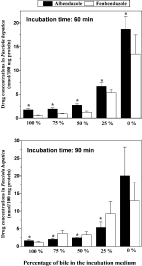
Fig. 1. Comparison (mean±S.D.) between albendazole (ABZ) and fenbendazole (FBZ) concentrations (nmol/100 mg protein) measured in Fasciola hepatica incubated with different proportions of ovine bile. ABZ concentrations are significantly different from those obtained for FBZ at P<0·05.
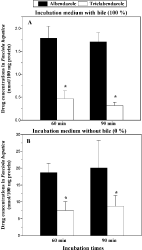
Fig. 2. Diffusion of albendazole (ABZ) and triclabendazole (TCBZ) into Fasciola hepatica. Results express drug concentrations (mean±S.D.) (nmol/100 mg protein) in flukes after 60 and 90 min of incubation with (A) and without (B) bile in the incubation media. TCBZ concentration values are significantly lower than those measured for ABZ at P<0·05.
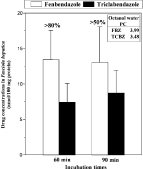
Fig. 3. Comparison of fenbendazole (FBZ) and triclabendazole (TCBZ) (mean±S.D.) concentrations (nmol/100 mg protein) measured in Fasciola hepatica incubated without bile. The insert shows the octanol-water partition coefficients (PC) for both molecules. The diffusion of FBZ into F. hepatica was between 50 and 80% higher than that of TCBZ. The mean concentration values obtained at 60 min of incubation are statistically different at P<0·05.
 You have
Access
- 22
- Cited by