In November 1997, the United Nations Special Commission (UNSCOM) met to discuss the progress of weapons inspections in Iraq and to deliberate on a forthcoming report to the UN Security Council. It had been a contentious year. Russia, China, and France were pushing for an end to weapons inspections and UN sanctions on Iraq, which had recently expelled all U.S. weapons inspectors. During the meeting, Gennady Gatilov, a Russian member, argued that the draft report was biased, Iraq had disarmed, and UNSCOM should cease its inspection activities. An argument ensued over how the findings of the weapons inspectors should be presented to the Security Council. Three years later, UNSCOM head Richard Butler wrote: “The result was a report as close to the facts as diplomacy would allow.”1
Butler 2000, 108.
The political pressure placed on reports by Butler and UNSCOM was not isolated to this one incident. When UNSCOM was created at the end of the Gulf War in 1991, it initially had broad support from the Security Council. However, as Russia, China, and France came to oppose economic sanctions in the late 1990s, they accused UNSCOM of being too biased in favor of U.S. policy. The agency was abolished in 1999 and replaced with the UN Monitoring, Verification, and Inspection Commission (UNMOVIC), which initially had U.S. support. However, after the terrorist attacks of 11 September 2001, the United States grew willing to use military force to disarm Iraq, and U.S. leaders believed that UNMOVIC was too biased against U.S. policy. Throughout the weapons inspection process, changes in the preferences of key UN Security Council members affected both the communication between the Security Council and chief weapons inspectors, and the selection of top-level inspectors.
The situation of Butler is not unique. Governmental and organizational bureaucrats often serve as informational agents: collecting information and reporting back to their superiors about what they have learned. An agent's incentive to report truthfully is affected by how the information that he provides will be used. If the principal will make a decision that the informational agent finds distasteful, then it is unlikely that the agent will tell the truth. In the realm of international politics, many types of individuals can be classified as informational agents, including the heads of many UN agencies, technical advisors at the World Bank, and the mediators and fact-finding commissions that are often used to resolve international conflicts.2
Kydd 2003.
I construct a cheap talk model in which an informational bureaucrat (the “sender” or “agent”) possesses private information about how international policies translate into outcomes.3
See Crawford and Sobel 1982; and Farrell and Rabin 1996 for an overview of the cheap talk framework; and Osborne 2004, 343–49 for textbook-level introductions to solving cheap talk games.
In the traditional cheap talk framework with a single receiver, it is generally the case that both the receiver and sender are better off the more closely their preferences are aligned: increasing the similarity of the players' preferences means that the sender has a greater incentive to send more precise signals, thereby communicating more information in equilibrium. This reinforces the findings of Calvert and Kydd, both of whom argue that it is often rational for a politician to choose advisors who are biased in his favor.4
However, it is not clear whether this finding holds with multiple receivers: do international policymakers prefer “biased” informational bureaucrats whose preferences are closely aligned to their own, or do receivers prefer “moderate” bureaucrats whose ideal policies lie midway between the ideal policies of the policymakers?I find that the answer to this question is highly dependent on certain aspects of the bargaining process. When all parties adhere to the result of the bargaining process (either because they lack the ability to act unilaterally or because it is undesirable for them to do so), then moderate bureaucrats are preferred. That is, each policymaker A would rather have an informational agent with moderate preferences than an agent who is biased in A's favor. However, when one player possesses an attractive outside option and is able to leave the bargaining table and unilaterally implement a desired outcome (such as abandoning a UN Security Council resolution and attacking another country in an international interaction), then all policymakers prefer a bureaucratic agent who is biased in favor of the policymaker with the outside option. That is, if country A has an attractive outside option, then countries A and B are best off choosing an international bureaucrat with preferences that are closely aligned with A. In both situations the international policymakers want to hire an agent who will provide as much information as possible. However, the identity of this optimal agent depends on features of the international bargaining environment.
Using a cheap talk framework, Milner and Rosendorff show that it is often optimal for a domestic legislature that must ratify an international agreement to value the information provided by domestic interest groups because such information indirectly constrains the set of agreements that an executive can successfully negotiate.5
Milner and Rosendorff 1996.
Keohane 1982.
Previous applications of the cheap talk modeling framework have been limited by their assumption that only one receiver is able to hear the message of the sender.8
A rare exception is Farrell and Gibbons 1989, in which a sender communicates with two receivers who then independently choose separate actions. They are not bound to jointly choose an action, as in my framework and most political applications. Similarly, Ainsworth and Sened 1993 construct a model in which a lobbyist signals information to both a unitary actor government and potential members of a interest group. However, final public policy is made by the government alone.
The bargaining framework below is similar to the bargaining game used by Voeten 2001 in his study of decision making within the UN Security Council. However, Voeten does not examine how the bargaining process affects communication by informational agents, which is the focus of my analysis.
The analysis below is very general in its description of institutional features, such as the bargaining process between policymakers and the availability of outside options. The model has been crafted in this manner to ensure that the results apply across many different institutional contexts and are as general as possible. After characterizing equilibrium behavior, I illustrate my findings by examining the role of UN weapons inspectors in Iraq from 1991 to 2003.
The Model
Suppose there are three players: a sender (S) and two receivers (A and B). The sender privately observes the true state of the world, ω, which is uniformly distributed over the unit interval, ω ∼ U [0,1].10
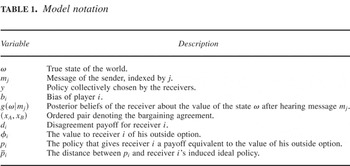
Model notation is also displayed in Table 1.
Model notation

After hearing the sender's message, the two receivers engage in a bargaining game to choose a collective policy

. After the policy is chosen, the true state of the world is observed and payoffs are obtained according to the standard quadratic-loss utility function, Ui(y|ω,b1) = −(y − (ω + bi))2 where (ω + bi) is player i's ideal point and bi denotes player i's bias for i ∈ {S,A,B}. I place no restrictions on the value of bS and assume without loss of generality that bA = 0 and bB > 0. Note that each player's most preferred policy is induced by his beliefs about the true state of the world. Since the sender actually observes ω, her most preferred policy is a function of what she observes about the true state. The receivers cannot observe ω directly but can make inferences about its value based on the sender's message. So each receiver's most preferred policy is induced by beliefs about the value of ω, and these beliefs can be affected by communication with the sender.
The equilibrium concept employed is a perfect Bayesian equilibrium. This requires that each player's actions are sequentially rational given her beliefs, and that these beliefs are consistent with Bayes's rule when possible.
11Fudenberg and Tirole 2000. The concept of a perfect Bayesian equilibrium places no restrictions on off-the-equilibrium path beliefs. It is trivial to construct these beliefs such that the equilibrium behavior below is supported.
Crawford and Sobel 1982.

and j ∈ {1,…, J − 1}, or

and j = J.
13The precise specification of behavior at the cutpoints (that is, whether the message spaces are open or closed intervals) is irrelevant for deriving equilibrium behavior because the state space is continuous.

Each receiver's expected utility from policy y after hearing message mj is

The sender knows the true state, ω, and in equilibrium she can infer the policy outcome that will be collectively chosen by the receivers based on her message,

. So the sender's utility for sending a message mj is

One can now derive the most preferred policy for receiver i after hearing the sender's message:
Claim 1. Receiver i's most preferred policy is equal to the midpoint of the message interval plus i's bias
Proofs for all claims and propositions are provided in the Appendix.

Recall the assumption that bA = 0 and bB > 0. So player A's most preferred policy is the midpoint of the interval for which message mj is sent. In contrast, player B's most preferred policy is bB units higher. Now it is possible to examine how different bargaining processes affect communication by the sender. I proceed by first considering the results of the model when neither receiver has an outside option in the bargaining game. Then I examine how the possibility of an outside option affects equilibrium behavior.
Cheap Talk and Bargaining Without Outside Options
Bargaining and communication
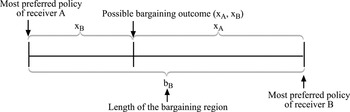
Figure 1 shows the set of policies that lies in the interval between the most preferred policies of the receivers after hearing a message mj,

Any policy that is chosen by the two receivers must lie in this interval, and once such a policy is chosen neither receiver can be made better off without making the other receiver worse off. One can mathematically describe any point in this interval by an ordered pair (xA,xB) where xi denotes the extent to which the final negotiated policy choice conforms to player i's most preferred policy. A higher value of xA pushes the chosen policy closer to receiver A's most preferred policy, and a higher value of xB means that the bargaining outcome is closer to B's most preferred policy. This allows one to mathematically define the set of possible bargaining agreements as: X = {(xA,xB)|0 ≤ xA ≤ bB and xB = bB − xA}.
15Muthoo 1999 provides an excellent introductory overview to bargaining games. Expositional elements of this analysis are similar to the framework that he uses.

, translates into a final policy choice,

, in the following way:

.

The bargaining region without outside options
Since each receiver's utility function is defined over policy outcomes, one must define a new function Vi(xi) to denote player i's expected utility from implementing the bargaining agreement characterized by xi:

If players A and B are unable to agree to a final chosen policy, then each receives a disagreement payoff di. Substantively, this payoff could represent player i's utility from a status quo policy that remains in place if no new policy is implemented.16
Under this interpretation, the players know the utility that they derive from an existing status quo policy, but are uncertain about their utility from implementing a new policy.
This technical assumption is needed so that each player has incentive to choose a policy rather than to delay the bargaining process forever. It is analytically equivalent to “forcing” the players to choose a policy. Allowing for dA ≠ dB affects the specific form of the bargaining outcome but does not affect the substance of my results. Note that the disagreement payoff is not state-contingent: the players know the utility that they derive from a failure to reach agreement.
I assume throughout my analysis that the bargaining game comes from the broad class of protocols that result in the Nash bargaining solution (NBS).18
Nash 1950.
See Rubinstein 1982; and Binmore 1987. One of the axioms on which the NBS is based is symmetry. Symmetry stipulates that if two players are in identical strategic situations, then the bargaining outcome should give them equivalent payoffs. However, this does not require that players must be in identical strategic situations. It simply means when two players are in identical circumstances, player A does not get a different payoff than player B simply because he is called “player A.” Note that use of the NBS ensures that my results are more robust than if I were to assume a specific extensive form bargaining game.
Such rules might include restrictions on debate, proposal power, or agenda-setting. This point is also emphasized in Milner and Rosendorff 1996. For scholars interested in institutional contexts for which a bargaining protocol may be well defined and binding, applying alternative bargaining frameworks is a simple modeling extension. The discussion section below examines the robustness of results to such changes.
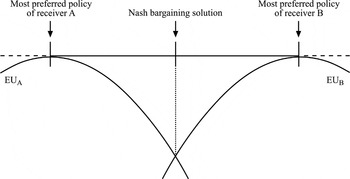
Claim 2. The chosen bargaining agreement after hearing message mj will be the midpoint of the bargaining interval, and the final chosen policy will be equal to player A's most preferred policy plus half of player B's bias:

So the receivers will “split the difference” by choosing a policy that is equidistant between the most preferred policies of the two receivers. Inspection of the partial derivatives of the final chosen policy,

, yields the following comparative statics. As the bias of player B grows, the bargaining region expands and a higher policy is chosen in negotiations. Additionally, when the sender uses higher messages (that is, messages with larger values of

and

, he signals higher possible values for the true state of the world, ω. These messages induce the choice of a higher policy.
21These are fairly intuitive findings, which suggests that I have selected a bargaining framework that is appropriate for modeling my broader concern: how the presence of a bargaining game affects both communication by an informational agent and the selection of optimal agents.

Bargaining outcomes without outside options
Now one can consider the sender's incentives for informative communication. An equilibrium becomes “more informative” as more distinct messages are sent by the receiver, which leads to a finer partition of the state space. As with all uses of the cheap talk framework, one can establish an upper bound on how much information can be communicated in equilibrium.22
I restrict attention to the most informative equilibrium (that is, the one in which the largest number of distinct and informative messages are sent in equilibrium) because, as shown in the proof of Proposition 2, this equilibrium maximizes the ex ante expected utility of all players.
Claim 3. Equilibrium communication becomes more informative as the sender's bias approaches half of receiver B's bias (that is, as bS → (bB /2)).
Choosing a sender
Since the willingness of the sender to communicate informatively depends on the bargaining outcome and the sender's bias, what type of sender will be most preferred by the receivers? Cheap talk models with a single receiver generally conclude that optimal informational agents are senders whose preferences are closely aligned with the preferences of the receiver.23
For example, Crawford and Sobel 1982.
Proposition 1. When receivers cannot exercise outside options, all individuals have identical ex ante preferences over the choice of a sender.
Each receiver's ex ante expected utility over possible types of sender (that is, the expected utility of values of the sender's bias, bS, before learning any information about the true state of the world) can be expressed as a linear transformation of the utility of the other receiver. This means that both utility functions represent the same preferences over the value of the sender's bias, bS. This result even holds for unmodeled strategic actors who have utility functions of the form Ui(y|ω,bi) = −(y − (ω + bi))2 over possible policy outcomes but have no meaningful role in the policymaking process. By considering how ex ante expected utility for an individual changes in response to changes in the value of the sender's bias, bS, I establish the following result:
Proposition 2. When receivers cannot exercise outside options, individuals maximize their ex ante expected utility by choosing a “moderate” sender, whose bias is midway between the bias of the two receivers.
Both receivers maximize their ex ante expected utility by choosing a sender who can provide as much information as is possible. This means that the receivers are best off choosing an agent who will send the largest number of messages possible in equilibrium. As a result of Proposition 1, this holds even for strategic actors who have no influence over the actual bargaining process and so are not explicitly included in the model. In an institution, such as the United Nations, one might believe that certain actors, such as the five permanent members of the Security Council, have great influence over the choice of policies while other actors possess little or no power over policy outcomes. Propositions 1 and 2 imply that these latter actors, who are insignificant in the bargaining process, will have preferences that are identical to those of the major powers in the selection of informational bureaucrats. This means that it does not matter who chooses the sender or how the selection process works because everyone prefers the same type of agent.
If the sender is an extremist, in the sense of having either high or low bias, the sender has an incentive to send vague messages that provide little information. In contrast, a moderate sender, whose most preferred policy is close to the final policy that will be chosen collectively by the receivers, has an incentive to provide very precise information to the committee. This means that each receiver would rather hire a moderate sender than another agent who is biased in the receiver's favor because all policymakers are best off in expectation by learning as much information as is possible.
Cheap Talk and Bargaining with Outside Options
Bargaining and communication
I now consider how the ability of one or more players to “leave the bargaining table” affects communication with an informational agent, as well as the choice of an optimal agent. In bargaining theory, an outside option is the utility that a player can achieve by exiting the bargaining game and engaging in another activity. In a political interaction, one might interpret an outside option as the utility that a player gets from unilaterally imposing a policy. For example, a country may unilaterally impose a tariff, thereby affecting the profits of its firms and of its international trading partners. However, use of an outside option does not necessarily imply that other players are bound to a particular outcome. For example, the U.S. decision to abandon UN weapons inspections in 2003 and proceed with military action did not mean that other UN members were forced to invade as well. In order to make my results as general as possible, I allow both receivers to exercise outside options. Allowing only one player to have an outside option does not affect my findings. Similarly, attaching a specific substantive interpretation to the outside option does not affect my results.
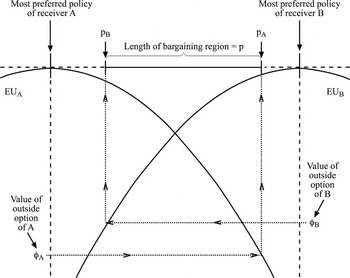
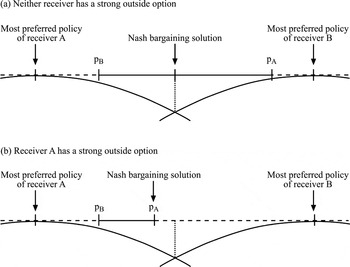
I continue to assume the basic setup from above and let φi denote the value to receiver i of an outside option that i can exercise. Suppose that φi < 0 for i = A,B; so each player can conceivably be made better off under a bargaining agreement than under the outside option. Since outside options are expressed in terms of their utility, one must identify the policy that gives each receiver a value equivalent to his outside option. As shown in Figure 3, I define pA as the maximum policy that gives player A the same utility as his outside option and pA as the distance between pA and the most preferred policy of player A that is induced by message mj. Mathematically, pA ≡ max{E [UA−1(φA|mj,bA)]} and pA ≡ pA − yA*(mj,bA). Similarly, pB is the minimum policy that gives B the same utility as his outside option, and pB is the distance between pB and the most preferred policy of player B. So pB ≡ min{E [UB−1(φB|mj,bB)]} and pB ≡ yB*(mj,bB) − pB. This means that player A will accept only policies that lie between his most preferred policy and policy pA, while player B will accept only policies that lie between pB and his most preferred policy.

Bargaining outcomes with outside options
I assume throughout that there exists at least one negotiated policy that makes each receiver better off than he would be by unilaterally exercising his outside option. This is equivalent to assuming that pB ≤ pA, which ensures that there exists a bargaining region between policies pB and pA. As such, the outside option constricts the bargaining space rather than directly affecting the utility functions of the players.24
This is the standard formalization of outside options. See Muthoo 1999, 99–105.

The collectively chosen bargaining agreement translates into a final policy

in the following way:

.
Since equilibrium bargaining behavior is contingent on the value of each receiver's outside option, I describe receiver A as having a “strong outside option” if receiver A would rather exercise his outside option than accept the “split the difference” policy that would result in a game without outside options.25
Note that the assumption that pB ≤ pA ensures that it is impossible in this model for both receivers A and B to have strong outside options. Since the labeling of receivers is arbitrary, I restrict attention without loss of generality to cases in which A has a strong outside option.
Claim 4. If neither receiver has a strong outside option, the final chosen policy will be equal to player A's most preferred policy plus half of player B's bias:

If receiver A has a strong outside option, the final chosen policy will be the policy that gives player A value equivalent to his outside option, pA.
If neither receiver has a strong outside option, the bargaining region induced by the outside option, [pB, pA], contains the policy that is chosen when there are no outside options. When this occurs, the receivers will “split the difference” by choosing a policy midway between their two most preferred policies. This is shown visually in panel (a) of Figure 4. Substantively, one would expect this to occur when one or both receivers can exercise an outside option, but doing so provides a low level of utility. In contrast, if receiver A's outside option becomes more desirable than the “split the difference” policy, then the bargaining region will lie completely below the midpoint between the two receivers' most preferred policies. This is displayed in panel (b) of Figure 4. When this occurs, the players no longer split the difference: the chosen policy is the right-most point of the bargaining interval, pA, which gives receiver A the same amount of utility as he gets from exercising his outside option.26
This is a manifestation of the outside option principle. See Muthoo 1999, 103.

Bargaining outcomes with outside options
Inspection of the partial derivatives of the final chosen policy,

, yields the following comparative statics. The collectively chosen policy,

, is: decreasing in player A's outside option, φA, when player A has a strong outside option; and increasing in player B's bias, bB, and the cutpoints associated with the message of the sender,

and

, when neither player has a strong outside option. This means that as the value of the outside option increases for receiver A, he is able to extract an outcome that is closer to his most preferred policy. However, this comparative static does not hold strictly. Increases in player A's outside option only affect the final policy when player A has a strong outside option.
One can now consider how this bargaining behavior affects communication by the sender.
Claim 5. If neither receiver has a strong outside option, equilibrium communication becomes more informative as the sender's bias approaches half of receiver B's bias (that is, as bS → (bB /2)). If receiver A has a strong outside option, equilibrium communication becomes more informative as the sender's bias approaches the distance between player A's ideal policy and the policy equivalent of A's outside option (that is, as bS → pA).
A key point to note is that the value of the outside options, φA and φB, is constant. This means that the sender's message affects the location of the most preferred policies of the receivers but does not affect the relative positions of the policy equivalents of the outside options (pA and pB). So exactly one of two cases must hold across all possible messages that the sender could make: either neither player has a strong outside option and the bargaining region, [pB, pA], contains the “split the difference” solution, or receiver A has a strong outside option and the region lies completely below this solution. In the first case, cheap talk behavior is equivalent to sender behavior in the model without outside options. In contrast, when player A has a strong outside option, the bargaining region lies below the midpoint of the receiver's most preferred policies, as in panel (b) of Figure 4. When this occurs, more messages are possible as the sender's bias, bS, moves toward the distance between player A's ideal policy and the policy equivalent of A's outside option, pA.
Choosing a sender
One can now consider the preferences that receivers have regarding the choice of an informational agent. I begin by establishing that the result in Proposition 1 continues to hold, even when one allows for a bargaining game with outside options:
Proposition 3. When receivers can exercise outside options, all individuals have identical ex ante preferences over the choice of a sender.
This means that it is not necessary to explicitly model the process by which the sender is chosen. Since all players have identical ex ante preferences over the value of bS, it does not matter who chooses the sender. One can now consider how different aspects of the bargaining process will affect the choice of an optimal sender:
Proposition 4. When neither receiver has an outside option that is preferred to a policy that “splits the difference” between the two players, then the receivers maximize their ex ante expected utility by choosing a “moderate” sender, whose bias is midway between the bias of the two receivers.
This result follows directly from the combination of Claim 4 and Proposition 2. The analysis above ensures that the presence of outside options does not automatically affect the bargaining process. If neither receiver's outside option is preferred to splitting the difference, then the bargaining and cheap talk behavior is equivalent to equilibrium behavior in a model without outside options. Since the final bargaining outcome will be the midpoint of the two receivers' most preferred policies, a sender who is moderate will be able to communicate more informatively than a sender with low or high bias. Since the political principals are best off when they receive as much information as is possible, each prefers to hire a moderate sender. However, when outside options become sufficiently attractive that they affect the final bargaining outcome, the optimal choice of a sender will change.
Proposition 5. If receiver A has a strong outside option, then both receivers maximize their ex ante expected utility by choosing a sender whose preferences are biased toward those of the receiver with the strong outside option.
If receiver A has an attractive outside option, then the induced bargaining region lies completely below the midpoint of the receivers' most preferred policies. This means that the receivers no longer split the difference: they choose a policy at the right endpoint of the bargaining region induced by the outside options. A sender has incentive to communicate more informatively as her most preferred policy approaches the policy chosen by the receivers. This means that both receivers would like to choose a sender biased in the direction of the player with a strong outside option to maximize the potential for informative communication in equilibrium. Note that this finding implies that there exist circumstances in which a principal finds it optimal to choose an informational agent who is biased against his preferred policy. If a receiver knows that he will be able to extract little at the bargaining table because his competitor has a strong outside option, he will be best off choosing a sender biased in favor of his opponent.
Discussion
Robustness
The substantive results of the model are robust to relaxing many of the assumptions made to simplify the exposition and analysis above. These include quadratic-loss utility functions, uniform prior beliefs about the true state of the world, and the invocation of the NBS. Suppose that any (or all) of the above assumptions are changed. If one can imagine a hypothetical unitary actor R who would find it optimal to unilaterally choose policy

after hearing message mj from the sender, then the collectively chosen policy can be rationalized as the result of optimization by an unmodeled strategic player. If the utility function of this hypothetical player satisfies the basic conditions of Crawford and Sobel, then all of the substantive results of this article regarding communication by the sender continue to hold.
27Crawford and Sobel 1982, 1437, 1444. These conditions include: UR(·) is twice continuously differentiable, (∂/∂y)UR(y*,ω,bi) = 0 for some

, (∂2/∂y2)UR(y,ω,bi) < 0, (∂2/∂y∂ω)UR(y*,ω,bi) > 0, and an arbitrage and monotonicity condition. See Theorem (1) for the general proof strategy.
Crawford and Sobel 1982, 1448–49. See Theorems (3) and (4) for the general proof strategy and note that the linear transformation implies identical preferences for all receivers.
It is worth noting that I assume throughout my analysis that the value of each receiver's outside option is fixed. I do not allow for state-contingent outside options, in which the utility that a receiver derives from an outside option depends on the true state of the world. If this were true, then the relative position of the induced bargaining region would change across different sender messages. Suppose that one interprets the outside option in the following manner: each of the receivers has some ability to unilaterally impose a policy, but this ability is constrained. So a receiver i cannot unilaterally impose his most preferred policy but can impose a policy that is

units away. Another possible interpretation is that each receiver can achieve his most preferred policy via an outside option but suffers some disutility from acting unilaterally.
29Voeten 2001 argues persuasively for the latter view in his analysis of decision making within the UN Security Council.
Results
The findings above counter assertions often made in the cheap talk and delegation literature that a principal is best off when he chooses an informational agent who has preferences similar to his own. As this analysis shows, principals maximize their ex ante utility when they hire a sender who communicates as much information as is possible in equilibrium. The extent to which a sender is willing to provide such information depends on how closely the most preferred policy of the sender coincides with the final chosen policy, not the similarity of preferences of the sender and the receiver. With a unitary actor receiver, this distinction is not important because the receiver can unilaterally implement his most preferred policy. This means that choosing a sender with similar preferences is equivalent to choosing a sender whose most preferred point is close to the chosen policy. However, when a sender's message induces a bargaining game among multiple players, the distinction made above becomes important. It generates situations in which a receiver is best off choosing a sender who is moderate or is even biased in the direction of another player.
When neither receiver has sufficiently attractive outside options, the midpoint of the bargaining interval is chosen as the final policy. This gives many results in this article the “flavor” of results in the previous literature that invoke the median voter theorem in order to justify the assumption of a unitary actor policymaker. However, in this model there does not exist a pivotal policymaker who is located at the median. In many international political situations: (1) the median policymaker is irrelevant because all bargaining power rests with veto players who need not be median voters; or (2) there does not exist a median policymaker because politicians are engaged in bilateral policy negotiations.30
As Milner and Rosendorff 1996, 152, emphasize, many negotiations that are ostensibly multilateral in nature are de facto led and controlled by two states.
Any resemblance to median voter results disappears once a policymaker in this game has a strong outside option. It is often noted in international relations that no country is bound by the international policymaking process: all countries possess outside options because they can always refuse to comply with any policy that results from multilateral bargaining. As the model above highlights, this does not necessarily affect the policymaking process. If refusing to comply with a multilateral agreement provides low utility, then one should still expect the choice of relatively moderate policies and informational bureaucrats. However, as the desirability of functioning outside of a multilateral agreement increases for a given country, this will result in both the selection of agreements that this country finds more favorable and the choice of international bureaucrats who are more closely aligned with this country's preferences. This accords with the empirical observation that many international organizations, including the World Bank and the IMF, are often perceived as being dominated by bureaucrats favorable to the views of the United States.
The outside options in this model represent the utility that a country obtains from operating outside of the bargaining process. One way to interpret the influence of the outside option is to say that it allows a country to credibly commit itself to a particular bargaining position. The ability to leave the bargaining process allows the leader of country A to credibly say, “If the negotiated agreement isn't at least pA, then there is no way that I will accept this agreement.” As such, outside options can be interpreted as reflecting an asymmetric ability to commit to a given policy position.31
Schelling 1960.
Milner and Rosendorff 1996.
Brooks and Wohlforth 2005, 519.
Most surprisingly, Propositions 1 and 3 establish that one should not expect conflict over the choice of such bureaucrats: when bureaucrats must collect and report private information, all countries are better off with the selection of agents who will provide the most information to their political principals.34
Note that this contradicts Milner and Rosendorff 1996, which finds that the presence of informed domestic interest groups can raise the utility of the unitary-actor legislature by constraining (and hence lowering the utility) of the executive and his international negotiating partner.
Evaluating the Model: “Cowboys” and “Bunny-Huggers” in Iraq
Criteria for Evaluating the Model
When evaluating the model, it is important to begin by examining whether the assumptions of the model are consistent with the strategic situations of interest. This includes asking whether an international bureaucrat has preferences over the policies that result from her report; whether the potential for a multilateral agreement exists; and whether the choice of the NBS is appropriate for the institution under consideration. If these key assumptions hold, one can then proceed to examining whether the model's observable implications accord with reality. The first implication of the model is that agents will not fully and truthfully reveal all of their private information to the principals. Second, the model findings imply that changes in the preferences of the political principals can generate dissatisfaction with an agent who was previously optimal. Such dissatisfaction can manifest itself in the replacement of an agent and/or the restructuring of an agency to change the incentives of bureaucrats. If the preferences of one receiver become more extreme, the bargaining region will expand and the midpoint of the interval will move toward the player whose preferences have changed. This means that an agent whose preferences coincide with the previous policy will now begin to seem too biased in favor of the principal whose preferences remained fixed. Alternatively, if the preferences of the policymakers remain fixed but the value of an outside option increases and becomes sufficiently attractive to a given player, then the bargaining outcome will move toward the ideal policy of that player. So a moderate agent who was previously optimal will be less preferred than an agent biased in favor of the player with a strong outside option. Finally, the model predicts that there should be no conflict between political principals over the choice of an optimal informational agent.
International organizations such as the United Nations, the World Trade Organization (WTO)/General Agreement on Tariffs and Trade (GATT), and the World Bank employ thousands of bureaucrats who provide policy-relevant information to member-states. These bureaucrats rarely elicit public attention, largely because there is little controversy in how they are selected and perform their jobs. This accords with the model's finding that one should not expect political principals to engage in conflict over the choice of informational bureaucrats: all policymakers will have identical preferences over such choices and want to hire the agent who will provide the most information in equilibrium. In the case study below, I examine the selection and communication of UN weapons inspectors in Iraq from 1991 to 2003. These individuals were often in the public spotlight both because of the tremendous importance of their work and because of the controversies and contentiousness often generated by their reports to the UN Security Council. As such, this sets a high threshold for evaluating the model because this is a situation in which initial intuition might suggest that the results of the model do not hold. However, to the extent that one can observe strategic behavior consistent with the model, one can be confident in its explanatory power.
Applying the Model to Weapons Inspections in Iraq
At the end of the Gulf War in 1991, the permanent members of the UN Security Council passed Resolution 687, which required Iraq to disarm in the areas of nuclear, chemical, and biological weapons, as well as to destroy all missiles with a range greater than 150 kilometers. As U.S. Secretary of State James A. Baker noted, there was agreement regarding the need for multilateral action: “We were … determined to maintain substantial economic and political sanctions against Iraq to restrict its aggressive tendencies …. [W]e needed all our coalition partners to be with us.”35
Baker 1995, 441.
One can loosely think of the application of the fundamentals of the model to this case in the following manner. The unknown state variable, ω, represents the extent to which Iraq was complying with Resolution 687 and the policy parameter, y, reflects the rewards and/or punishments imposed by the Security Council in response to Iraqi actions. Each permanent member of the Security Council had different preferences regarding how the level of compliance by Iraq should translate into UN policies. These preferences manifest themselves in the bias parameter, bi. The disagreement payoff, di, reflects the utility that the UN Security Council members derived from the absence of any response to the actions of Iraq, including the end of both weapons inspections and sanctions. While policymakers may have differed regarding the relative desirability of this outcome, all believed that some form of multilateral response was preferable to doing nothing. Finally, the value of the outside option, φi, represents the utility that each of the permanent Security Council members derived from abandoning the multilateral policymaking process. While the UN Charter is clear in establishing the veto power of the five permanent members of the Security Council, the institution lacks explicit and fixed rules regarding the policy formation process.36
Even the detailed study of Bailey and Daws on the customs and norms of procedure in the UN Security Council notes that “agreement on the substance of decisions that will be taken, along with the procedure to be followed, is almost always reached in the course of informal consultations prior to a public meeting of the Council.” See Bailey and Daws 1998, 390.
Voeten 2001.
The UN Security Council allowed the International Atomic Energy Agency (IAEA) to retain its responsibility for nuclear inspections. However, the Security Council created the UN Special Commission (UNSCOM) to collect information about compliance in the other weapons areas. The Security Council pursued a two-pronged strategy when trying to create an optimal informational agent. First, it hired top-level officials who were believed to be supportive of the views of the permanent members. However, unlike the model above in which the sender's bias is assumed to be common knowledge, there is a limit to how much anyone can infer about the preferences and biases of any given individual. So the Security Council also designed the institution in a manner that led to a tough attitude by UNSCOM agents toward Iraqi compliance. The General Assembly and the UN Secretariat, which operates on the principle of geographical representation, had much more lenient attitudes. So the tough-minded Security Council ensured that the head of UNSCOM reported directly to it, ensuring independence from the UN Secretariat. Additionally, all staff and equipment were directly provided and paid for by member states in order to remove UNSCOM from interference by the General Assembly, which controls the UN budget.38
When combined with the technical skills needed by weapons inspectors, this ensured that the United States was the dominant provider of personnel and that UNSCOM agents supported the tough attitudes of the Security Council toward compliance.These attitudes stood in marked contrast to other UN agencies and often generated interagency conflict. Hans Blix, head of the IAEA from 1981 to 1997, wrote: “To UNSCOM, the IAEA inspectors seemed too much like proper civil servants; to the IAEA, some of the UNSCOM inspectors seemed to act Rambo-style …. UN people who were in Baghdad for various humanitarian functions called UNSCOM staff ‘cowboys’ and the latter reciprocated by nicknaming the UN staff ‘bunny-huggers.’”39
Blix 2004, 22–23.
Butler 2000, 206.
Throughout the early 1990s the permanent members of the UN Security Council remained committed to tough sanctions against Iraq and the enforcement of Resolution 687. During this period, UNSCOM was a relatively uncontroversial agency. The potential for multilateral agreement in the UN Security Council clearly existed, and the preferences of UNSCOM weapons inspectors coincided with the tough policy being pushed by the permanent five members of the Security Council.
However, the late 1990s saw a gradual change in the preferences of many of these policymakers. In late 1996, Iraq was allowed to resume the sale of oil in exchange for humanitarian supplies under the Oil-for-Food program. As noted by a subsequent independent inquiry on corruption in this program, the vast bulk of Iraqi trade took place with companies based in Russia and France.41
Volcker 2005.
Albright 2003, 275.
The changing preferences of Russia and France regarding the severity of Iraqi sanctions did not affect the value of exercising an outside option because overriding existing UN sanctions cannot be done unilaterally.
Butler, head of UNSCOM at the time, was acutely aware of this trend. He later described Russia, France, and China as “the three Iraqi sympathizers among the permanent five” of the Security Council and as Iraq's “powerful allies.”44
Butler 2000, 91, 92.
Ibid., 132.
Note that the model also predicts that the United States should have been supportive of these staff changes. Unfortunately, there is not enough information in the historical record to evaluate whether this finding of the model is supported or contradicted.
In January 1999, it was revealed in the Western press that undercover U.S. intelligence officials had been working as UNSCOM weapons inspectors.47
See Boston Globe, 6 January 1999, A1; and New York Times, 7 January 1999, A1, A6.
However, the terrorist attacks of 11 September 2001 drastically changed the political landscape. While the United States had never explicitly ruled out unilateral preemptive action against countries perceived as threats, the terrorist attacks of 2001 increased the utility of exercising such an outside option.48
U.S. National Security Council 2002.
New York Times, 2 March, 2003, 13.
It is rare for high-level bureaucrats to admit to making imprecise statements or withholding information from their political principals. Nonetheless, Blix subsequently admitted to doing so: “I said [to the Security Council] that there were ‘strong indications’ that Iraq had produced more anthrax than it declared and that some of it might still exist. I did not go further than that. An expert briefing I had had on this matter had strongly suggested that a quantity of anthrax had been retained when anthrax was being destroyed in 1991, and could still be effective if Iraqis had succeeded in drying the agent. However, the evidence, although impressive, had not been compelling.”50
Blix 2004, 139–40.
Blix's reports during this period often induced intense conflict amongst his political principals. If the desirability of exercising an outside option by invading Iraq had increased for the United States and Great Britain following the 11 September 2001 terrorist attacks, why did the UN Security Council members not agree to replace Blix with a weapons inspector who was more closely aligned with the preferences of the United States and Great Britain? If the findings of the model hold, such a replacement would have communicated more information to the Security Council in equilibrium and all members of the Security Council should have identical preferences regarding the value of such a replacement. However, it is not likely that such a personnel change would have forestalled military action. Simply stated, the expected payoff from invading Iraq was most likely perceived by U.S. and British policymakers as far superior to any agreement that could be negotiated within the confines of the Security Council. It was no longer true that there existed a multilateral agreement that made all receivers better off than exercising their outside option. One can think about the delay between September 2001 and the abandonment of the weapons inspection process in early 2003 as reflecting factors not present in the model. For example, perhaps Bush and Blair were initially uncertain about the cost of military action for reasons unrelated to the weapons inspection process, thereby explaining their willingness to allow Blix to retain his position until they had considered the feasibility of unilateralism. Also, the need to persuade the British and U.S. public of the desirability of invasion and to build up military forces contributed to the delay. Additionally, perhaps the other UN Security Council members were uncertain regarding the value that the United States and Great Britain derived from abandoning the UN weapons inspection process and acting unilaterally. While none of these factors are explicitly modeled, all are consistent with the basic framework and findings above.
The conflict generated by Blix's reports is not consistent with the model's finding that political principals should have identical preferences over the choice of an informational agent. It is important to note that in the model above there exist two possible ways in which conflict between political principals can be induced: (1) conflict over the choice of a bureaucratic agent; and (2) conflict over the choice of a policy in response to the messages of an agent. While the model analytically demonstrates that the former will not take place in equilibrium, there is still potential for conflict in the unmodeled policymaking process. However, to the extent that conflict in the Security Council resulted from the choice of Butler as an agent, and not simply from attempts by Security Council members to shape policies in response to his reports, one aspect of the model is not supported.
Weapons inspectors, such as Butler and Blix, no doubt had good intentions during the years that they served as international civil servants. However, they were also individuals with preferences regarding the policies that would result from the information that they provided. As high-level bureaucrats they had a great deal of discretion in their communication with their principals. As the model above explains, these two factors affected the both the credibility and the informativeness of their communication. In accordance with the model's findings, changes in the political preferences of key members of the Security Council affected the choice of informational agents. When Russia and France shifted to a more lenient approach to Iraqi compliance with UN Resolution 687, UNSCOM could no longer serve effectively: a change of informational agent was needed. UNMOVIC, which was designed by all of the permanent members of the Security Council to be more moderate than its predecessor, was able to function effectively for a few years. However, the terrorist attacks of 2001 increased the willingness of the United States to exercise an outside option via unilateral military action. The analysis above explicitly modeled how the presence of such an outside option affects both bargaining between policymakers and communication by an informed agent. In accordance with the model's findings, UNMOVIC was now too moderate to be able to communicate effectively with its political principals.
While this case study provides strong overall support for the model, the conflict induced by Butler's reports in the post-2001 period does not accord with the model finding that all principals will have identical preferences over the choice of an informational agent. There are two ways in which the model might be profitably expanded to account for such conflict. First, the sender's bias, bS, was assumed to be common knowledge. To the extent that this parameter is private information, conflict over the choice of an optimal agent can be induced in the game. All receivers will agree on what the optimal level of bias is in an agent but may disagree on which potential agent has preferences that match this level of bias. Second, the value of the outside option was fixed and common knowledge in the model above. However, principals may have incentive to argue about the choice of the agent to build support from domestic political audiences. Such support could influence the bargaining process to the extent that it shapes the value of the outside option. For example, to the extent that the U.S. public believed Blix was an Iraqi appeaser, leaving the Security Council and taking unilateral action became more desirable because multilateral action appeared to be ineffective. By explicitly modeling domestic responses to international behavior, the model may be profitably expanded to allow for endogenous outside options.
Conclusions
The cheap talk literature has provided great insight into situations in which an informational agent can communicate with a single receiver. However, these results have limited applicability because informational agents, such as bureaucratic agencies, policy advisors, and international fact-finding commissions, must often serve multiple principals with heterogeneous preferences. As I demonstrate, the presence of multiple audiences affects the incentives for a sender to informatively communicate with his receivers.
I examine strategic communication when a report made by a single informational bureaucrat is heard by two policymakers who then bargain over a set of policy choices. I find that both the bureaucrat's willingness to communicate informatively and the choice of an optimal bureaucrat are contingent on the bargaining powers of the two policymakers. These international policymakers are best off choosing agents who will provide the most information in equilibrium. A bureaucrat's incentive to communicate informatively increases as her most preferred policy approaches the policy chosen by the policymakers. This differs from previous research, in which the similarity of the preferences of the sender and receiver is argued to be key to informative communication. When each policymaker is bound to adhere to the bargaining outcome, the receivers will choose policies located at the midpoint of their two most preferred policies. Since moderate policies will be chosen, moderate bureaucrats are most preferred ex ante by both policymakers. In contrast, when at least one principal can leave the bargaining table and exercise an outside option, incentives can change. If one policymaker has a sufficiently attractive outside option, he is able to extract more in the bargaining game. This means that both principals will prefer to choose a bureaucrat who is biased in the direction of the principal with the attractive outside option.
This theoretical framework is particularly important for the study of international institutions—a research area in which results based on a median voter framework can rarely be invoked. My analysis complements past research on policymaking within the UN Security Council.51
Voeten 2001.
Kydd 2003.
Appendix
Proof of Claim 1.

Proof of Claim 2.
By definition, the NBS is the agreement that solves the following optimization problem:

Note that since the induced utility functions are defined over the set X, Vi(xi) is strictly increasing in xi for i = A,B. This means that the inverse function Vi−1(vi) exists over X. So for a given utility level vi, there exists exactly one bargaining agreement xi such that Vi(xi) = vi. When combined with the differentiability and concavity of Vi for i = A,B, this ensures that the NBS is unique and solves the following equation:

Filling the relevant values into equation (1) yields the following NBS:

.
Proof of Claim 3.
For a J-message monotonic equilibrium to exist, it must be that case that

This implies that for j = 1,…, J − 1

Given the monotonicity of

, this can only hold if

Since

, the class of solutions satisfying the difference equation is

Let N(bS, bB) denote the largest number of messages that are possible in equilibrium. Then N(bS,bB) is the largest positive integer j such that j(j − 1)|2bS − bB| < 1 and N(.) increases as bS → (bB /2).
Proof of Proposition 1.
Let N = N(bS, bB). The ex ante expected utility of player i from a sender with bias bS is

Note that E [Uj(bS|·)] = α + E [Ui(bS|·)], where α = bB(bj − bi) + (bi2 − bj2). Since E [Uj(bS|·)] is a positive linear transformation of E [Ui(bS|·)], both expected utility functions represent the same preferences over bS.
Proof of Proposition 2.
Let x = 2bS − bB and N = N(bS,bB). From the proof of Proposition 1,

Note that N is the maximum integer j such that j(j − 1)|x| < 1. So N is a discontinuous step function. For most values of x, (∂N/∂x) = 0. For such values of x:

Note that when x < 0, (∂/∂x)E [Ui(bS|·)] > 0, and when x > 0, (∂/∂x)E [Ui(bS|·)] < 0. So as x → 0, the utility of player i increases. One must now consider what happens at the points of discontinuity of function N. Consider values x > 0 and

such that

and

. So an

-message equilibrium is possible for x − ε, but not for x. Compare the ex ante utility for player i of an

-message equilibrium to an

-message equilibrium, holding x constant:

So an infinitely small decrease in the value of x raises utility by increasing the number of messages that are possible in equilibrium. Analogous reasoning shows that for values x < 0 and

, such that

and

, an infinitely small increase in x raises utility by increasing the number of messages that are possible in equilibrium. Furthermore, this shows that all players' ex ante utility is maximized in the equilibrium with the finest partition of messages that is possible. This means that player i is best off choosing a sender such that x is as close to 0 as is possible. Also, player i is indifferent between x′ > 0 and x′′ < 0 if and only if −x′′ = x′.
Proof of Claim 4.
The derivation of equation (1) in the proof of Claim 2 continues to hold, which yields the following NBS:

Proof of Claim 5.
Case 1: Suppose

. For a J-message monotonic equilibrium to exist, the following must hold for j = 1,…, J − 1:

Given the monotonicity of

, this can only hold if

Since

, the class of solutions satisfying the difference equation is

Let N(bS,φA) denote the largest number of messages that are possible in equilibrium. Then N(bS,φA) is the largest positive integer j such that j(j − 1)|2bS − 2pA| < 1 and N(.) increases as bS → pA.
Case 2: Suppose

. Then the bargaining game induces sender behavior that is equivalent to cheap talk in the game without outside options.
Proof of Proposition 3.
Suppose

. Then

and the proof of Proposition 1 holds.
Suppose

. Then

. Let N denote the largest number of messages that are possible in the corresponding cheap talk equilibrium. The following holds:

Note that E [Uj(bS|·)] = α + E [Ui(bS|·)], where α = 2pA(bj − bi) + (bi2 − bj2). Since E [Uj(bS|·)] is a positive linear transformation of E [Ui(bS|·)], both expected utility functions represent the same preferences over bS.
Proof of Proposition 4.
If

, then

, as in the bargaining model without outside options. This ensures results equivalent to Proposition 2.
Proof of Proposition 5.
Let N denote the largest number of messages that are possible in the corresponding cheap talk equilibrium and x = 2bS − 2pA. Then the results derived in the proof of Proposition 2 regarding (∂/∂x)E [Ui(bS|·)] continue to hold. As x → 0, the ex ante expected utility of player i increases.