The fifteenth-century Florentine world that George Eliot studied and recreated in Romola (Cornhill Magazine, July 1862–August 1863) was characterized by the idea of love between males and the practice of sex between males. Same sex desire took various forms from the love of the older teacher for his pupil to the illegal but common practice of penetrating adolescent boys, for which many fifteenth-century Florentine men were prosecuted, particularly under the regime of the Dominican monk Girolamo Savonarola (1494–98).Footnote 1 The monasteries themselves constituted an intense, all-male community of voluntary celibacy. These various sexual behaviors co-existed with more visible heterosexual institutions and practices, from the often politicized arranged marriages of the wealthy elite to the casual coupling of the peasant classes.
In Romola, George Eliot does not use the language available to her for love and sex between males, such as pederasty and sodomy, and the late-nineteenth-century word homosexuality – which brought together disparate ideas and practices into a totalizing concept – was not available to her. Yet, without any of these terms, sex between males is everywhere in Romola – part of the determinedly realistic context Eliot created for her fictional characters and integral to both the theme of cultural transmission and to the mechanisms of that transmission to which she contributed by writing her historical novel.
As part of her research prior to writing Romola, Eliot read Savonarola's sermons and other writings. In a sermon on “Haggai” delivered on 12 December 1492, Savonarola exhorted the Florentine public to “pass laws against that accursed vice of sodomy, for which you know that Florence is infamous throughout the whole of Italy; this infamy arises perhaps from your talking and chattering about it so much, so that there is not so much in deeds, perhaps, as in words.” In addition to recommending that “these people be stoned and burned,” he also charged that “you remove from among yourselves these poems and games and taverns and the evil fashion of women's clothes” (Savonarola 157–58).Footnote 2
The burning of books, closing of taverns, and reform of women's clothing during Savonarola's rule are all depicted in Romola. In contrast, Eliot strategically left out the Frate's rhetoric about sodomy. Through indirection, innuendo, and allusion, however, she managed to convey the prevalence of sodomy in Florence. Her male characters are constantly talking and chattering about sex, charging the political atmosphere and accounting for the passionate feelings for and against Savonarola's reforms. What we would call homosexuality is not isolated as vicious or immoral in Romola and is never commented upon by the narrator; rather, it is integrated into the larger social, cultural and political account of this distinctive time and place.Footnote 3 In this article, I will show how Eliot portrayed the chattering and writing about homosexuality as part of her historical realism. The texts she drew upon to write her novel immortalized same sex desire, whether approvingly in the dialogues of Plato that were being rediscovered, with opprobrium in Dante's Inferno, or with humor in the popular poetry of the late fifteenth century. By including all of these traditions, Eliot ensured that love and sex between men was integral to the portrait of the age that she transmitted to her contemporaries. In this respect, she prepared the way for a Victorian revival of interest in the Italian Renaissance that acknowledged homosexuality.Footnote 4
Romola was a turning point in Eliot's career. Not only was it her first major departure from works that drew on her recollections of rural English life (Scenes of Clerical Life, Adam Bede, The Mill on the Floss, and Silas Marner), it was the first work in which she seemed less interested in appealing to a broad audience than in communicating to a smaller group of readers educated enough to appreciate her aesthetic and scholarly accomplishments. Her success was recognized by fellow writers such as Anthony Trollope, who nonetheless cautioned her not to “fire too much over the heads of your readers” (Carroll, 195), and by her most astute reviewers, who agreed that it was “not likely to be generally popular; it is too great both in mind and heart” (Century 29–30). These early readers were correct. Romola has never been as popular as Eliot's other novels, probably because she did in fact “fire too much over the heads” of her readers.
Although Eliot uses literary allusions to generate layers of meaning throughout her fiction, the density of allusion is particularly remarkable and difficult in Romola because she is able to utilize not only literary works but also historical figures to generate a subtext. In addition to the writings of many Renaissance authors, accounts of their lives, such as Giorgio Vasari's Le vite de’ più eccellenti architettori, pittori, e scultori italiani (1550–68), Paulus Jovius's Elogia Virorum Literis Illustrium (1546), and Pasquale Villari's La Storia di Girolamo Savonarola e de'suoi tempi (1859–61), become part of the novel's far-reaching intertext. Some of these historically-based characters, like Savonarola and Nicolo Machiavelli, would be known to Eliot's educated contemporaries, but others, including Domenico di Giovanni or Il Burchiello (1404–49), Angelo Ambrogini or Poliziano also known as Polititian (1454–94), Luigi Pulci (1432–84), Antonio Beccadelli (called Panormita or Panhormita) (1394–1471), Bartolommeo Scala (1428–97), Marsilio Ficino (1433–99), and Pietro Crinito (1465–1505), could only be recognized by those who were exceptionally knowledgeable about the literature and history of the Italian Renaissance.
Through her literary and historical allusions in Romola, Eliot encodes what she could not say directly: Renaissance Florence had a thriving homosexual sub-culture that Savonarola actively sought to repress. The fictional character, Tito Melema, – beautiful, androgynous, and strongly appealing to both men and women – exploits his physical attractions to advance himself socially and politically. Because of the reaction against homosexuality at the time in which the novel is set, Tito's explicit flirtations and implied self-prostitution are part of the dangerous, duplicitous game he plays in addition to his adultery and political spying. We know little about Tito's life prior to his appearance in Florence, except that he is Italian by blood and the only adopted child of an unmarried, Italian man and classical scholar (Baldassarre Calvo) who raised and educated him primarily in Greece. Initially, Tito seems merely to pursue pleasure, avoid pain, and seek his own self-interest. But these character traits eventually create inescapable circumstances that lead him into outright villainy, including the betrayal of his adoptive father, his wife, and more than one political party. His willingness to trade on his physical beauty is a facet of a moral corruption fostered by the chaos of the political moment. Allusions that connote homosexuality track his descent, moving from the light and Platonic (contemporary pastoral poetry inspired by young men) to the dark and menacing (gangs of young men who cruise the streets of Florence).Footnote 5
Eliot's knowledge of homosexuality – and boldness in representing it (however coded) – should not surprise us. References to love and sex between men abound in the literature she read while researching this period, and her allusions to homosexuality in Romola are continuous with her explorations of the complex and various forms of gender and sexuality throughout her work. Critics have overlooked this dimension of the novel's recreation of Florence.Footnote 6 To decode Romola, we need to look closely at pervasive literary and historical allusions, which once expanded and examined, point unmistakably to sex between men as an important dimension of the novel's plot, characterization, historical accuracy, as well as its preoccupation with various forms of cultural transmission.
Renaissance Florence
In the fifteenth century, all of the Italian states had become associated with the practice of sodomy, but, as Savonarola asserted in his sermons, Florence was particularly notorious. In Forbidden Friendships: Homosexuality and Male Culture in Renaissance Florence, historian Michael Rocke observes: “The sexual renown of Florentine males was remarked on by both local and foreign chroniclers, condemned by preachers, deplored by concerned citizens, derided – or occasionally admired – by writers and poets” (3). In 1432, the city created an “innovative judiciary magistracy solely to pursue and prosecute sodomy” (4). The “Office of the Night” (Ufficiali di notte) functioned in this capacity until its abolition in 1502. Furthermore, the “Eight of Watch” (Otto di guardia), the city's central criminal magistracy, established a special tribunal that complemented the activities of the Office of the Night. Rocke's book, which remains the standard source, estimates that between 1432 and 1501, “as many as 17,000 individuals or more were incriminated at least once for sodomy, with close to 3,000 convicted” (4) and between 1478 and 1501, the special tribunal tried several hundred cases of sodomy (10).
Any historian of fifteenth-century Florence – in the nineteenth century, as now – would encounter references to the Office of the Night and the Eight of Watch. Romola opens with a reference to “the ‘Eight’ who attended to home discipline” (6) and concludes with a glimpse of “the odious figure of Dolfo Spini,” who, “as one of the Eight,” condemns Savonarola to death (544).Footnote 7 The barber Nello facetiously observes that if you fear for your life, “the Magnificent Eight will put you in prison a little while just to ensure your safety, and after that their sbirri [police] will conduct you out of Florence by night” (166). When Tito is startled by the touch of Niccolo Macchiavelli's hand on his shoulder, Macchiavelli wonders why “you took my light grasp for that of a sbirro, or something worse?” (157). The presence of the Eight of Watch contributes to the ominous atmosphere of surveillance that characterizes Eliot's portrayal of the Florentine Republic during the ascendance, decline, and death of Savonarola. As Rocke has shown, sodomites were particularly targeted for surveillance and prosecution at this time.
Savonarola's movement to reform Florentine boys, who were previously renowned for their unruly, vicious behavior, figures as background to the plot of Romola. Groups of these reformed boys were sent out to roam the streets of Florence, indulging their same mischievous and malicious tendencies under a façade of Christian purity and with a mandate to reform others. During the last days of the Carnival of 1497, the year of the infamous Bonfire of the Vanities, these “beardless inquisitors” set out to “coerce people by shame, or other spiritual pelting . . . and if some obstinately wicked men got enraged and threatened the whip or the cudgel, this also was exciting” (397). There is humor but also cruelty and humiliation in their forcing the old woman Mona Brigida to relinquish her “vanities” and leaving her pitifully exposed in the streets without her berretta and false hair. Gangs of young men, whether Piagnoni (the popular name for Savonarola's followers) or Compagnacci (Dolfo Spini's young, angry branch of the anti-Savonarola Arrabbiati faction), generate the threatening and charged atmosphere in which Eliot's characters move and create a tension between the relative sexual permissiveness of the past and Savonarola's new sexually repressive regime.
The Piagnoni reforms were successful enough that fewer passive homosexual partners were available to Florentine men, who had been accustomed to forming relationships with adolescent boys on the ancient Greek model. Consequently, the average age of such partners rose. According to Rocke's account of court records of prosecutions:
The vast majority, moreover, of passive partners in homosexual sodomy from 1478 to 1502 ranged from the age of twelve to eighteen or twenty, with a mean age of fifteen or sixteen, precisely the age of the main corps of Savonarola's boys. The refusal of hundreds of adolescents to accept men's amorous advances sharply limited the potential pool of men's young sexual companions. . . . During the years of Savonarola's sway, the age of passive partners rose substantially above the normal mean of sixteen to eighteen years. (Rocke 210)
This information sheds light on the enthusiasm with which several male characters receive the youthful twenty-three year old refugee Tito.
Rocke points out that “the Piagnoni battle against sodomy was equally an attack on gender ambiguity” (210). As the pseudonymous fifteenth-century Fra Pacifico Burlamacchi or Pseudo-Burlamacchi put it in his Life of Savonarola (which Eliot read), the boys of Florence “looked like girls in all their ornaments and coiffures, or rather, like public prostitutes, shameless in word and deed,” adding, “especially in that unspeakable vice – a thing abominable to name” (excerpted in Savonarola 213). From the opening scene of the novel, in which the peddler Bratti Ferravecchi discovers Tito sleeping on the streets of Florence, Eliot emphasizes the youth and beauty of the young “Greek” (as he is called). Nello refers to him as a “pretty youngster” (36). The mercurial (unmarried) barber also notes that the outline of Tito's chin and lip is “as clear as a maiden's,” making Tito worry that he shall have “a perilous resemblance to a maiden of eighteen” (35). This comment should be considered in light of Savonarola's campaign against gender ambiguity, as well as Rocke's estimate that the average age of passive (and therefore feminized) partners was eighteen at this time, and suggests a reason for Tito's facetious and flirtatious concern that this resemblance to an eighteen year old maiden might be “perilous,” even though Nello assures him, “your proportions are not those of a maiden” (36). Rocke's account of Florence's notoriety for homosexuality raises questions about what Tito, as a stranger to Florence, may have heard about the city before deciding to seek his fortunes there. All we know comes from his own cryptic testimony that he initially intended to try Rome, but “a fallacious Minerva in the shape of an Augustinian monk” advised him that “Florence is the best market in Italy for such commodities as yours’” (30).
Romola's main plot involves Tito's marriage to the eponymous character, Romola de’ Bardi, and his adulterous affair with the peasant girl (contadina) Tessa. The marriage and adultery plot, comparable to what Eve Sedgwick, referring to Eliot's Adam Bede, calls the “magnetic and preemptive drama of heterosexual transgression” (137), has deflected critical attention from a less obvious aspect of Tito's duplicitous character, specifically his appeal to the men of Florence and his position within the strongly homosocial, frequently homoerotic and occasionally homosexual literary and political atmosphere of Florentine society. As Eliot makes clear, the literary, political, and sexual contexts were closely linked during this remarkable cultural moment in Italian history.
Nello the Barber
Tito's beauty is attractive to many of the male characters in the novel: the peddler Bratti, the eccentric painter Piero di Cosimo, the men of the Medici party, and Dolfo Spini. But the barber Nello's actions, comments and unscholarly literary allusions are worth examining in detail because it is through his flirtatious, campy presence (he “skips” around the patrons he shaves, 158), that Eliot seems to code Tito's implied homosexual involvements, as well as the overall literary and political sub-culture of homosexuality.
After their initial meeting, Nello takes Tito to his barbershop and confesses suggestively: “I am quivering with the inspiration of my art even to the very edge of my razor” (31). He defines his own role in Florentine society through a reference to “my great predecessor, Burchiello” (33). Andrew Brown writes that Nello is clearly modeled on Il Burchiello (Dominico di Giovanni, 1404–1449), the barber, poet, political propagandist and ultimately political exile (562). Eliot took extensive notes on Burchiello from Domenico Manni's Vita di Burchiello (1815), copying his sonnets as well as facts about his life (“Florentine Notes”). But Burchiello's presence as a figure known to Nello complicates the notion of his being a silent historical model behind the barber's characterization. Since Nello is neither a poet nor a political partisan, his recognition of Burchiello as a predecessor shows an intriguing self-consciousness of his own literary origins and leads us to wonder what characteristics – other than that of his profession – he may share with Burchiello.
According to Alan K. Smith in “Fraudomy: Reading Sexuality and Politics in Burchiello,” Burchiello's cryptic, “nonsense” poems are full of coded references to sodomy. Smith expands one dimension of French critic Jean Toscan's massive Le Carnaval du Langage: Le Lexique Érotique des Poètes de L'Équivoque de Burchiello à Marino (XV-XVII Siècles) (1981). Toscan argues that “an entire tradition of Italian poetry throughout the early modern period employed a verifiable ‘equivocal code’ that refers to transgressive sexual practices (especially sodomy) and homosexual culture” (Smith 88–89). Following Toscan, Smith plays out this theme in Burchiello's sonnet “Nominativi fritti e mappamondi.” He argues that the coded allusions to sodomy “may be relevant to our understanding of the city's political history” during a time when literary and political cultures were inseparable (93).
Eliot's decision to have Nello describe himself as an inheritor of Burchiello's mantle – as well as to have him refer specifically to the barber/poet's writings – provides a context for Nello's behavior and his references to other poets. The central code of homosexuality in Romola lies in allusions to contemporary writers familiar to a non-scholar such as Nello. He knows some of them personally, and their verse is part of the living cultural climate of Florence. He reads the poetry of Lorenzo, Pulci, and Poliziano – contemporaries who are explicitly contrasted to the Greek and Roman poets, as well as to Dante and Petrarch. Nello's reading reflects the groundswell of poetry written in the vernacular in the late fifteenth century in contrast to the simultaneous revival of classical literature in Greek and Latin. And yet, one of the things that connects the Greek tradition and these early Renaissance writers is their exploration of love between men – the Platonic love popularized by the scholar Marsilio Ficino, whom Eliot's narrator describes as “fed on Platonism in all its stages till his mind was perhaps a little pulpy from that too exclusive diet” (322).Footnote 8
Romola's father, the elderly, blind and bitter scholar Bardo de’ Bardi – representing a generation that rejects both the religiosity of Savonarola and the superficiality of literature contemporary to the novel's setting – scolds Nello for the corrupting influence of burlesques and farces. “You are not altogether illiterate,” he tells Nello, “and [you] might doubtless have made a more respectable progress in learning if you had . . . not clogged your memory with those frivolous productions of which Luigi Pulci has furnished the most peccant exemplar” (60). Bardo thinks Nello has been corrupted by the “frivolous productions” and “monstrosity of form” of these “babbling, lawless productions.” Nello, for his part, blames his indulgence on Pulci's popularity among the people: “Messer Luigi's rhymes are always slipping off the lips of my customers: – that is what corrupts me” (61).Footnote 9
This discussion, in which Bardo denounces the popular poetry of the moment, includes a warning to Tito that scholarly debates at this time often result in personal slanders. Florentine intellectual culture is full of examples of such rivalries, and Eliot illustrates them in the chapter entitled “A Learned Squabble” (ch. 7). Bardo explains that when personally involved in such a debate, he was “taxed with treachery, fraud, indecency, and even hideous crimes” (63). Although he would be thoroughly familiar with classical examples of homosexual love, Bardo's condemnation of contemporary corruption seems to encompass the sexual as well as the intellectual. He clearly views the literature and the sexual conduct of his contemporaries as degraded, and his euphemistic references to “indecency” and “hideous crimes” – even “monstrosity” of form – suggest his disgust at Florence's current cultural climate, which is inseparable from a sexual climate that gives impetus to Savonarola's reforms.
Andrew Thompson has explored the association between Tito and the poetry of Lorenzo de’ Medici and Luigi Pulci, especially Lorenzo's “Carnival Song” with its Bacchus and Ariadne imagery. Some critics have recognized the explicit symbolism of these images (Bonaparte, Gray, Muscau). Thompson observes that the classical associations function to provide a “critical commentary” on Tito's character. He argues that Eliot emphasizes Pulci's “scepticism, rather than the frivolity and licentiousness of which he was accused by Bardo” (77); however, it is precisely the frivolity and licentiousness of Pulci's burlesquing poetry that Eliot emphasizes in order to create the context of degeneracy in popular Florentine literary culture.
These particular allusions to Pulci and others appear through the prism of Bardo's outdated (literally blinded) perspective. They are made in the scholarly sanctuary of Bardo's home, which he shares with his devoted and sheltered daughter. Nello and Tito's intrusion upon this enclosed world occasions Bardo's outburst against his contemporaries. In contrast, Nello's barbershop is the locus of male camaraderie and political and social gossip. The newest currents of thought, embodied in men such as the young Machiavelli, filter through the shop – a space where Tito finds an all-male refuge and a flattering stream of comments about his beauty. It is a space for men devoted to the beautification and vanity of men. Political talk is interspersed with flirtation, and the male gaze falls repeatedly on Tito, as when Nello, finding Tito “a pretty image of self-forgetful sadness . . . just perceptibly pointed his razor at him, and gave a challenging look at Piero di Cosimo, whom he had never forgiven for his refusal to see any prognostics of character in his favourite's handsome face” (159). Piero, the eccentric, perceptive, unmarried artist, acknowledges Tito's beauty but throughout the novel remains skeptical of his moral character.
Nello has an undisguised interest in young male beauty, emphasized by his keeping a boy shop assistant – Sandro – a “solemn-looking dark eyed youth” (33) who lurks in the background of the bachelor's private rooms. Nello's sexual innuendo is ongoing. He is old, ugly, and has no object of his affection. In spite of this – or because of it – sex seems to be constantly on his mind. His flirtation with Tito includes the observation that they both play the lute, “though the serenata is useless when daylight discloses a visage like mine, looking no fresher than an apple that has stood the winter” (33). The serenata is “useless” because its primary purpose is seduction, and seduction is beyond him.
Frederic Leighton's illustration of this scene, appearing in the original Cornhill serialization and in subsequent illustrated editions of Romola, is worth considering for the ways in which it enhances the homoeroticism of the initial encounter between Tito and Nello (Figure 1). In correspondence with Leighton, Eliot suggested “Nello's sanctum” (Letters 4: 39) as a leading illustration. Leighton adopted her idea, portraying Tito after the first of his many shaves and haircuts in Nello's shop. When she saw the drawing on which this engraving would be based, she was delighted: “Nello is better than my Nello” (Letters 4: 41). She went on to write: “I never saw anything comparable to the scene in Nello's shop as an illustration. There could not be a better beginning” (Letters 4: 42). Interestingly, she implies in a letter to George Smith (proprietor of the Cornhill) that Leighton was not pleased with the engravings, referring to “poor Mr. Leighton's chagrin at the engraver's rendering of Nello” (Letters 4: 48).
After Frederic Leighton, “‘Suppose you let me look at myself.’” Engraved illustration for George Eliot, Romola. 1862–63. Ed. Andrew Brown (Oxford: Clarendon, 1993), 36. Courtesy of Oxford University Press.

Whatever Leighton's objection, it is the rendering of Nello in the engraving that appeared in the Cornhill and subsequent illustrated editions. Nello's face is even more ghastly than his own self-deprecating comments imply. Hugh Witemeyer writes of the illustration: “The unpleasantness of the smile on Nello's harlequin-like mask of a face is emphasized by its visual association with the grimace of the satyr's bust in the garden” (167).Footnote 10 What appears to be a bust in the upper left of the arched doorway is Leighton's variation, since the text tells us that the garden contains a stone Hermes. Adding a satyr to the garden statuary creates an unseen but implied juxtaposition of beautiful youth (Hermes) and lecherousness (satyr) outside to match the contrast between Nello and Tito inside the shop. The text also tells us that there is a sketch of a Satyr within Nello's shop, part of a baffling sketch of masks drawn by Piero di Cosimo.Footnote 11 Leering satyrs thus surround the beautiful Tito, admiring himself in the Venetian mirror. From his position, Nello would see both the back of the young man and his face reflected in the mirror, while Tito would see Nello in the mirror gazing at him from behind. In this way, the illustration captures Tito's narcissism but also his canny awareness of how his beauty attracts admiration and might be used to his advantage.Footnote 12
Eliot and Leighton shared concerns about representing period dress accurately, and the two exchanged letters on the subject. In this illustration, the legs and crotches of Tito and Nello are prominently displayed in their tight hosiery under short jerkins. Stepping down from the barber's chair, one leg lingering behind in an open-legged attitude, Tito gazes at himself, while Nello, just behind, stands in crossed-legged satisfaction at his barber's art, reaching his bony, elongated fingers toward the mirror. The effect is a foregrounded tangle of men's legs, Nello's thin and slightly sagging, Tito's shapely and attractive.Footnote 13 Tito's knife is tucked in place on his left side, while Nello dangles the tool of his trade, the shaving razor, from his left hand. Tito's hair is full and flowing, the clippings of his recent haircut littering the floor beneath his feet. In contrast, Nello's hair under his cap is wild and wispy, suggesting a faded, old man's version of Tito's lustrous locks. The exposure of their bodies to the waist and their respective phallic tools, together with the mirror in which they would both be reflected, link the barber and his young customer in an image as sexually suggestive as later images of Tito and Tessa. Nello's lute rests against the wall, foreshadowing later scenes in the barbershop, where Tito will be shaved, flattered, and serenaded.
Throughout the novel, Nello is comical, pandering, gossipy, and mildly lecherous, but his sexual inclinations and idle talk serve a larger purpose in Eliot's characterization of Florence generally and Tito in particular. As we have seen, Nello is also a representative reader of Italian poetry – secular, vernacular, popular. And like other average Florentines, his language and frame of reference involve an internalized – if not always accurate – knowledge of Dante. It is Nello who voices many of the coded allusions to homosexuality in the novel.Footnote 14
After giving Tito his first shave in Florence, Nello counsels him on the importance of remaining beardless: “if you repent, and let your beard grow after it has acquired stoutness by a struggle with the razor, your mouth will by and by show no longer what Messer Angelo calls the divine prerogative of the lips, but will appear like a dark cavern fringed with horrent brambles” (30). The Messer Angelo to whom Nello refers is Angelo Ambrogini or Poliziano (1454–94), known in English as Politian. Eliot read and admired his Stanze per la giostra (1478), as well as his Miscellanea, Lamia, Orfeo, and Epistolae. Nello's reference to “the divine prerogative of the lips” may derive from Poliziano's early Greek Epigrams, addressed to various young men: “Content yourself, O Jupiter, with Ganymede, and leave to me the splendid Chiomadoro [‘golden-curls’] who is sweeter than honey. O, I am thrice and four times happy! For truly I have kissed, and truly I kiss again your mouth, O delightful youth!” (quoted in Saslow 30). Referring to this aspect of the famous scholar's writing, James Saslow calls Poliziano “a clear example of a Florentine Neoplatonist who overtly translated homosexual feelings into erotic expression” (29).
More than just a barber's bid for customers, Nello's comment about the desirability of smoothness as opposed to hairiness is startlingly sexual, betraying a dread of female sexuality. Nello's advice to the young man hoping to make his way in Florentine society is to keep his mouth smooth and hairless. In this context, Nello cannot resist a reference to Dante: “I have seen men whose beards have so invaded their cheeks, that one might have pitied them as the victims of a sad, brutalizing chastisement befitting our Dante's Inferno” (35). One can only imagine what sin an overgrown beard might punish, but following the comparison of an unshaven mouth to a “dark cavern fringed with horrent brambles,” there is sexual insinuation in this preference for smoothness. In Nello's later reference to the Inferno, the homosexual implications become clear, and with them a tradition of representing sodomites in literature.Footnote 15
Poliziano: His Life and Poetry
The renowned scholar and poet Poliziano never appears as an actual character in Romola, but references to him, his scholarly accomplishments, and his poetry are insistent, making him a shadowy presence whose life and work are a subtext. He dies during the course of the novel, and without ever learning exactly what happens to him, we get indications of some unspecified form of decline from the height of his influence and popularity at the time of the novel's opening in 1492. Nello first mentions Poliziano as a famous scholar who delivers popular lectures and a customer who “relaxes himself a little in my shop” (32). Comparing Poliziano's scholarly prowess to that of Tito, Nello confesses, “between ourselves, his juvenile ugliness was not less signal than his precocious scholarship” (36). As Nello indicates, Poliziano was notorious for his ugliness. One source for Eliot's knowledge of Poliziano's life, Paulus Jovius (1483–1552), calls him “grotesque” with “an enormous nose and drooping eyelid” (Elogia). Referred to by Nello as “honey-lipped” (38) and decried by Bardo for his “superficial ingenuity” (49), Poliziano becomes a central intellectual presence with the chapter devoted to his “Learned Squabble.” But behind the content of his intellectual endeavors is Eliot's (and her characters’) inevitable knowledge of his notorious personal life and the homosexuality for which Jovius is a primary source.
“A Learned Squabble” describes an incident between Poliziano and Bartolommeo Scala, secretary of the Florentine Republic and man of scholarly pretensions to whom Tito sells some of the jewels with which he hopes to fund his career in Florence. Scala entertains Tito with details of his contentious correspondence with Poliziano. Andrew Brown notes that their exchange over Scala's error in gendering the Latin word culex (gnat) as feminine takes on a sexual tone when Poliziano corrects Scala by writing to him in the voice of the culex: “I am not a woman, Scala, neither in Latin nor Greek, and therefore I like girls” (Romola, Clarendon 621). Although the story is that Poliziano was rejected as a suitor to Scala's daughter (hence the initial animus between the two), Scala takes up the insinuating tone in attacking not only Poliziano's scholarship but his character when he offers to show Tito “a few little matters in the shape of sonnets, turning on well-known foibles of Politian's, which he would not like to go any farther, but which would, perhaps, amuse the company” (77). What are these well-known foibles that Scala, flirting with Tito, has made the subject of sonnets? They may perhaps be Poliziano's soon-to-be public predilection for young men.
Transmission
The coded presence of homosexuality in Romola is inevitably bound up with themes of intellectual and biological transmission and posterity, which are primarily expressed through Romola's father, Bardo. Literary allusions implicitly reinforce and layer these themes. Eliot's knowledge of Italian literature leads her to construct genealogies of poets and poetic traditions. From Dante, Cavalcanti and Boccaccio follow Pulci, Poliziano and Machiavelli. Such intellectual propagation through writing is a more urgent matter for some of her characters than biological propagation. As Gary P. Cestaro writes: “Implicit in the patriarchal humanist endeavor was a rejection of biological reproduction as common in favor of a loftier love of generation through letters, a love traditionally passed from male master to male pupil” (1031). Bardo has no grandchildren, nor does he care about them; he cares about his scholarly reputation and his library: “I have a right to be remembered” (54). Instead of descending to posterity as the high priest of Platonism as he had hoped, he has instead “not effected anything but scattered work, which will be appropriated by other men” (51). He blames his fate on his son Dino, who left his father and a legacy of humanistic, classical scholarship to become a monk. Bardo hopes that Tito will take Dino's place as inheritor and perpetuator of his work in a way that Romola, as a woman, could never do.
Bardo is pathetic in his vain aspirations, a precursor of Eliot's most famous failed scholar, Edward Casaubon. In contrast to the fictional rivals of Mr. Casaubon – named in Middlemarch as Carp, Pike, and Tench – the writers to whom Bardo compares himself were historical contributors to Renaissance culture that Eliot's readers might recognize. Lamenting his failures, Bardo compares himself to men with much greater reputations. He speaks with contempt of those who made their names through “superfluous and presumptuous attempts to imitate the inimitable, such as allure vain men like Panhormita” (50). He thinks that he is the equal of Poliziano, whom he expects, unlike himself, will live on in “glorious memory” (51).
The accomplishments of the scholars mentioned by Bardo are manifold. Their reputations cannot be reduced to aspects of sexuality in their lives or writings, yet they are all in some way associated with ideas about male love or with sex between men. Taken together, they constitute a set of coded allusions to homosexuality in relation to cultural transmission. Antonio Beccadelli (known as Panormita, 1394–1471) wrote the Latin verses, Hermaphroditus (1425), “modeled in part both on the ancient corpus of obscene and elegant poems known as the Priapea . . . and on the epigrams of the Roman poet Martial” (O'Connor 1; de Cossart 21). Hermaphroditus is dedicated to Cosimo de’ Medici, and the poet addresses him directly in explaining his title: “In effect, my book has both a penis and a vagina, so its title is intended to convey this fact as succinctly as possible. If you were to call it The Arse, since it also waxes lyrical about the arse, as a title this would still not be wholly appropriate” (de Cossart 26). Notorious in its time and afterwards, it describes a variety of heterosexual and homosexual acts, including sex between older men and young boys: “Thus, anyone who has ever got a boy to bend over for him will never be able to rid himself of the habit” (de Cossart 30). Some of the poems express malice: “Be off with you, Quinzio, you loathsome and shameful slut. . .Could anybody calculate how many pricks your gaping arse has swallowed up any more than the number of ships devoured by Scylla on the coast of Sicily?” (de Cossart 32). At the same time, they express longing: “What joy is left me since you went off to the country?. . .The only joy that remains for me is the boy's staying here in town, because his face reminds me of yours” (de Cossart 57). Christian commentators condemned Panormita's salacious and satirical poem, though scholars praised it for its accomplished Latin verse. Panormita belonged to the generation prior to that portrayed in Romola. He thus lived in the memory of her characters as representative of Cosimo's more humanistic and liberal era preceding Savonarola's Christian Republic. It is important to remember that Eliot read the Hermaphroditus in preparation for writing Romola and that she determined to make it part of the background context to show what Savonarola and other Christian reformers were reacting against, as well as what the classical scholar Bardo found disgusting and trivial.Footnote 16
Bardo also mentions Marsilio Ficino with jealousy at his fame. Ficino translated Plato's Symposium, attempted to reconcile his Christian perspective with Plato's descriptions of love between men, and popularized a theory of Platonic (or Socratic) love. In his exploration of Ficino's writings, Giovanni Dall'Orto speculates that Ficino “was probably a homosexual man” (41) and recounts his relationship with the young scholar, Giovanni Calvalcanti. Ficino was also the teacher of Poliziano and is thus part of this intellectual genealogical, generational lineage and rivalry that Eliot parallels to the political, familial rivalries of Florentine politics. Medici power depended on blood relations and strategic marriages, whereas intellectual genealogies depended on other models of influence, such as the teacher-student bond, which was inevitably a bond between men.
One of the reasons Romola is so challenging is that it demands awareness of multiple temporalities: the classical Greek period “reborn” in the Renaissance, the late fifteenth-century Italian context, and the 1860s when the novel was written and published. There is an irony in allusions to the Renaissance revival of interest in the literature of Greek and Roman homosexuality in relation to posterity. What the narrator knows (but her characters do not) is just how the English Victorians would remember (or not) these old Florentines. Eliot treats the double time frame of Romola (late fifteenth-century/mid-nineteenth-century) with the same self-consciousness that she would display in subsequent historical novels (Felix Holt in 1866 and Middlemarch in 1871–72), both set in England during the period of the First Reform Bill (1832). The difference is that in Felix Holt and Middlemarch, the characters are all fictional, while in Romola, the fictional Bardo is speculating on how actual historical authors like Ficino, Poliziano, and Panormita will be remembered. Consequently, the narrator's perspective in Romola is even more layered and complex than that of narrators in her later works.Footnote 17
Eliot's knowledge of how posterity would view Renaissance writers derived from her intensive study of their work and subsequent commentaries on it. In the act of writing an historical novel that recreates these characters for a Victorian audience, she participated in the transmission of their work to her own time. Complaining about the reception of Romola, she wrote: “The general ignorance of old Florentine literature, and the false conceptions of Italy bred by idle traveling . . . have caused many parts of ‘Romola’ to be entirely misunderstood” (Letters 5: 174). Readers were not comprehending the ways in which she was using “old Florentine literature.” Reader impatience, indifference or ignorance is apparent in the comments of a reviewer for the Saturday Review: “Most of the Italians introduced are mere names to us – some few of them, like Politian, old names, but most of them new names – the names of men about whom we know nothing or care nothing, even when the most indefatigable and ingenious antiquarian has tried to reach and to interest us” (Carroll, ed. 208–09). Eliot intended to animate these “men about whom we know nothing,” but she had counted on some of her readers sharing her knowledge, without which much of what she wanted to say must be, in her words, “entirely misunderstood.” That readers should fail to appreciate her novel because they were ignorant of “old Florentine literature” gives a further irony to the anxiety about posterity expressed by the old Florentine characters.
Critics have failed to note the way Romola's allusions to Florentine poets repeatedly hit the note of homosexuality, creating authentic contexts and reinforcing the historical association between intellectual and sexual relations among men. In one particularly homoerotic scene, Tito awakens Nello, who has fallen asleep while reading Lorenzo de’ Medici's poem Nencia da Barberino (1470). The boy Sandro is “playing a game at mora by himself” in the corner of the room (125). Since mora is a game that can only be played by two, the image suggests that – as a servant kept by Nello – Sandro is isolated from the activities of Savonarola's reformed boys, most of whom came from families of social standing. Tito takes up the lute and sings to Nello from Lorenzo's “Carnival Song,” specifically “The Triumph of Bacchus and Ariadne.” The song awakens Nello, who responds with ardor:
“What is it, my Orpheus?” here Nello stretched out his arms to their full length and then brought them round till his hands grasped Tito's curls and drew them out playfully. “What is it you want of your well-tamed Nello? For I perceive a coaxing sound in that soft strain of yours. Let me see the very needle's eye of your desire, as the sublime poet says, that I may thread it.” (126)
The choice of song obviously reinforces Tito's association with Bacchus. Nello may call Tito “Orpheus” merely because he is singing, but the line also foreshadows Tito's singing of Poliziano's Orfeo later in the novel. Nello has no need to disguise his delight in Tito or the fact that he has been well tamed by the Greek youth. As is typical of him, he alludes to Dante, selecting a metaphor (threading a needle) for his wish to fulfill Tito's desire, which, taken out of its textual context, is suggestively sexual (Purgatorio XXI: 37–38).Footnote 18
This scene takes place on September 7, 1492, two months after Tito and Romola are engaged. In the conversation that follows, Tito admires Poliziano's genius and erudition, but makes a comment that reflects a change in the status of the great scholar/poet, whose life and death are tracked over the course of the novel. Tito complains that people have only “cried me up” because “Poliziano is beaten down with grief, or illness, or something else” (127). This cryptic remark leaves the reader wondering: What else? The plot is structured so that Tito's star is rising as Poliziano's – for unexplained reasons – is setting.
Nello takes the opportunity of this discussion of Poliziano's decline to tease Tito about being “a new Poliziano,” asking: “And are you not a pattern of virtue in this wicked city? with your ears double-waxed against all siren invitations that would lure you from the Via de’ Bardi, and the great work which is to astonish posterity?” (127). Nello's words reflect his ironic perspective on Savonarola's vision of Florence as wicked (and specifically homosexual) and his distance from the reforms that the Frate was busily putting in place. The innuendo suggests not only sarcasm about Savonarola's characterization of the city in his sermons, but also an insider's knowledge of the “siren invitations” that might confront a “pretty youngster” like Tito, leading him astray from his socially respectable marriage to Romola, who lives in the Via de’ Bardi. If in fact Tito's ears are double-waxed against siren invitations – which Nello's irony renders doubtful – it would intensify the contrast between him and Poliziano.
Poliziano, as gossip had it – and as was passed down to posterity – did succumb to the siren songs of Florence. He died in late September 1494, as commentators today still remark, amid “scandal and obloquy” (Godman xi). We learn this as Nello is strumming the lute in his shop full of men: “the incomparable Poliziano, not two months since, gone – well, well, let us hope he is not gone to the eminent scholars in the Malebolge” (247). Critics have pondered why Nello makes this comment, but they have overlooked an implication that becomes clear once we understand the nature of the “scandal and obloquy” amid which Poliziano died.
Andrew Thompson, for example, thinks that in having Nello refer to Poliziano in the Malebolge, Eliot confused Poliziano with Luigi Pulci because Poliziano is “less easily associated with Hell than Luigi Pulci” (211). This explanation, however, is inadequate. Eliot clearly knew the difference between the Renaissance poets she put into her novel. It is more likely that the casual and imprecise Nello confused the Malebolge (the ninth circle described in Cantos XVI–XXX of the Inferno) with the seventh circle (described in Cantos XV-XVI) – that of the sodomites. Nello's insinuating comment makes sense given what has already been hinted concerning Poliziano's “well-known foibles,” and most importantly, the infamous death he is reputed to have suffered. Eliot's source for information about Poliziano's death is Jovius's Elogia:
They say [Poliziano] was made an easy prey to fatal disease by his mad love for a noble youth. For, having seized his lute in the heat and fever of his consuming desire, he burst into song with such overmastering passion that presently in his frenzy his voice and the muscles of his fingers and finally breath itself failed, as a shameful death bore down upon him. Years of life which a ripening judgment would have rendered sane and normal were thus swept away by hasty Fate, to the great injury of the Muses and the grief of his generation; for he had hardly reached his forty-fourth year.
Eliot treats Poliziano's death in what might seem to be an unnecessarily indirect and obscure manner. Nello's comments make no sense without knowledge of Jovius's account of Poliziano's death and of the Inferno. Knowing Jovius's account clarifies not only Nello's observations on Poliziano's death but also the nature of Nello's earlier innuendo about Poliziano's decline (127). Whether or not the story of Poliziano's death was true, it was known at the time and it has persisted.Footnote 19 So while this gossip may have no historical validity, and Jovius's work post-dates the novel's setting, the implication is clear: Eliot's characters had access to the same gossip that led to Jovius's future, damning version of Poliziano's death. Working the scandal of Poliziano's death into her novel in this covert way (which those who had read what she had about Poliziano would recognize), Eliot provided the homosexual context within which she wanted her readers to understand Tito's character. She was also commenting on the uncertainties of posterity generally and the ironic inaccuracy of Bardo's prognosis – driven by resentment – about the glory with which future generations would remember Poliziano.
To further comprehend Eliot's intended meaning, it is important to remember that the Malebolge is not populated by scholars (with the possible exception of Michele Scotto, a necromancer and astrologer appearing in Canto XX). There are, however, several scholars in the circle to which the sodomites are condemned (the seventh circle condemning violence), most centrally Dante's teacher, Brunetto Latini, and also Priscian, “the celebrated Latin grammarian” (Inferno commentary 269), as well as Francesco d'Accorso, a law professor. Brunetto tells Dante that his companions in hell were all “clerks, and great men of letters and of great fame, in the world defiled by one same sin” [“tutti fur cherci/e literati grandi e di gran fama/d'un peccato medesmo al mondo lerci”] (Inferno XV. 106–08). It seems that Nello is aware that the scholar, poet, and teacher Poliziano – who died for love of a male youth – might well find suitable company in the circle of the sodomites, but in his untutored knowledge of Dante, he used Malebolge carelessly as a synonym for hell.Footnote 20
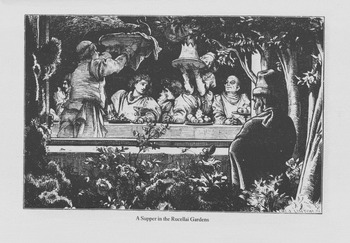
The culmination of Poliziano's function in the novel as a code for the homosexual context of the Florentine society in which Tito moves is the banquet scene set in the Rucellai Gardens. In a contemporary, Victorian aside, Eliot's narrator discourses on the intellectual context of the banquet, mentioning Lorenzo de’ Medici's Platonic Academy. Upon Lorenzo's death, the meetings were transferred to these gardens, along with his bust of Plato, which had looked down upon Pico della Mirandola, Ficino, Poliziano, and “many more valiant workers whose names are not registered where every day we turn the leaf to read them, but whose labours make a part, though an unrecognized part, of our inheritance, like the ploughing and sowing of past generations” (322). With this invocation of a scholarly lineage via a metaphor of fertility in reference to “our” (the Victorians’) inheritance, Eliot establishes the neo-Platonic context and the theme of cultural transmission. The question arises: who, in addition to George Eliot, turns the leaf to read the Renaissance masters “every day”? The answer is: those readers who will be able to see what to others will be invisible in the novel.
In the narrator's description of the supper, Tito sits between Lorenzo Tornabuoni and Giannozzo Pucci, “accomplished young members of the Medicean party” (322). As the dining and drinking progresses, the two Mediceans engage in political talk, trying to win over Tito to the Medici side. Tornabuoni, “laying one hose-clad leg across the knee of the other, and caressing his ancle” (328), flatters Tito with assurances of his indispensability to the Medici cause. Pucci, “laying his hand on Tito's shoulder, says ‘the fact is Tito mio, you can help us better than if you were Ulysses himself’” (329).
Leighton's illustration of “A Supper in the Rucellai Gardens” (ch. 39) gives life to this dramatic scene (Figure 2).Footnote 21 Framed as a fusion of The Symposium and “The Last Supper,” the picture shows Baldassarre (Tito's adoptive father) in what the novel calls “the chill obscurity that surrounded this centre of warmth, and light” (325). Lurking in the bushes and gazing on in the foreground at right, Baldassarre waits for the right moment to reveal himself. The image captures all the homoeroticism implied in the text. Servants bring opulent dishes. A full peacock (carefully described in the text), its tail feathers streaming out of frame, will be left uneaten by the revelers. A balding, older man at right, hands clasped on the table (possibly Niccolo Ridolfi), glances knowingly at the two men at center. In the text, Ridolfi has been discoursing on the fallacy of Savonarola's talking “as if vice could be swept out with a besom by the Magnificent Eight” (327).
After Frederic Leighton, “A Supper in the Rucellai Gardens.” Engraved illustration for George Eliot, Romola. 1862–63. Ed. Andrew Brown (Oxford: Clarendon, 1993), 347. Courtesy of Oxford University Press.

From Eliot's description, we have to conclude that the young man left of center is Tito, leaning suggestively toward Pucci, who gazes at him in rapt attention with his head leaning on his right hand. Tito's hair is abundant as he turns suggestively toward his admirer, left hand casually on his wine goblet with what the text describes as “careless grace” (325). The illustration captures the moment of political conversation before the entertainment begins. The overall impression is one of suspense (when will Baldassarre reveal himself?) and also one of decadence, accentuating the over-abundant dishes and the sensuality of this gathering of privileged men.Footnote 22
With this homoerotic stage set, Pucci asks Tito to “lead the last chorus from Poliziano's Orfeo that you have found such an excellent measure for” (331). Eliot then describes Tito “leaning towards Pucci, and singing low to him the phrases of the Maenad-chorus” (331). The choice of Poliziano's verse reinforces the homoerotic, seductive power of Tito's serenade. In addition to invoking Bacchus, it might also recall Jovius's account of Poliziano's death while playing the lute for a young man. Furthermore, this particular chorus would be known to those familiar with Poliziano's text as the one following Orpheus's homosexual, anti-female diatribe.
Eliot read it in the original, but perhaps the most relevant translation of the Fabula di Orfeo (1494), is that of J. A. Symonds in 1879. His rendering of the “Song of Orpheus,” which precedes the Maenad chorus sung by Tito, accentuates its homosexual content:
In discussions of the Orpheus and Bacchus myths in Romola, scholars have overlooked the misogynistic, homosexual thrust of Poliziano's play.Footnote 23 Recovering the content of these lines reveals that they further charge the homoerotic atmosphere of this Platonic symposium. Additionally, in keeping with the theme of cultural transmission and the recognition of neo-Platonism as both the Renaissance inheritance from the Greeks and the Italian's legacy to the Victorians, the scene reinforces the association of homosexuality with a particular type of unnatural, non-familial reproduction. It is dramatically and thematically significant that this is a moment when the son's betrayal of the father resonates clearly, as Baldassarre interrupts Tito's homoerotic performance of Poliziano's lines and accuses him of filial treachery.
Dolfo Spini
The homosexuality coded through references to Poliziano is Greek in nature (Platonic love of young males as expressed in poetry and song) – even if scandalous and humiliating when revealed to be overly passionate or lustful as it is in Jovius's account. But Romola represents another form of homoeroticism that Eliot clearly viewed as base and contemptible – something distinct from the neo-Platonic ideal and aesthetic that is “our inheritance.” Speaking of Savonarola's public sermons (which often railed against sodomy), her narrator comments: “The men of ideas, like young Niccolo Macchiavelli, went to observe and write reports to friends away in country villas; the men of appetites, like Dolfo Spini, bent on hunting down the Frate as a public nuisance who made game scarce, went to feed their hatred and lie in wait for grounds of accusation” (222). Spini is consistently associated with violent hunting metaphors. He wants to hunt down the Frate because the Frate “made game scarce.” Rocke's description of the Piaganoni reform movement as making young males unavailable as passive homosexual partners, leads us to ask what “game” Spini found scarce under Savonarola's rule.
In his biography of Savonarola, Villari (one of Eliot's sources), described the Compagnacci and noted that their leader, the “depraved Doffo Spini, was a youth of noted audacity” (532). Rocke explains that the Compagnacci were young men from wealthy families who, to oppose Savonarola, staged “lavish, ostentatious banquets.” He observes that the “sodomites and the Compagnacci had a solid generational affinity as well as a convergence of interests in relaxing moral restrictions” (222). He continues, “Indeed, some of the leading Compagnacci were implicated in sodomy. . . . Their ringleader, Doffo d'Agnolo Spini, was named in a boy's confession in 1494” (222). Eliot characterizes Spini as both a man of “appetites” and as a typical example of “slow-witted sensual people” (486).
In a highly charged scene, Spini puts his hand on Tito's shoulder to discuss his plot against Savonarola. The exchange simmers with disgust on Tito's part, lechery on Spini's, and mutual distrust, all couched in insincere, flirtatious banter. Spini refers to Tito as “my necromancer” (486) and Tito calls him “my cavalier” (486), “my Dolfo,” and then, cryptically, “my Alcibiades” (487). The political treachery of the historical Alcibiades is intended in this exchange, but surely in the neo-Platonic context, any mention of Alcibiades also connotes Plato's character, the strongly homoerotic Alcibiades of the Symposium and of the two dialogues named for him. The dialogue between Tito and Dolfo concludes in the following manner: “‘We shall have our supper at my palace to-night,’ interrupted Spini, with a significant nod and an affectionate pat on Tito's shoulder” (488). The Compagnacci are ruthless; they are also sensual and indulgent. Although mistrustful, they, like the Medici, want Tito on their side. Spini's insinuating invitation to dine at his palace represents a less intellectual and more uncouth form of homoerotic entertainment than the Medici banquet in the Rucellai Gardens, but the telling language and physical touches in both cases emphasize the homoerotic atmosphere of Florentine politics.
The shameful, off-stage death of Poliziano foreshadows Tito's descent from the social height he attains at the Medici banquet where he sings the chorus from Poliziano's Orfeo. As Tito becomes entangled in intrigue as a triple agent, the debauchery of his enemies seems to heighten the danger of his position. In addition to Spini, Tito comes to fear the notary and political operative Ser Ceccone, who harbors a paranoid belief that Tito has thwarted his own political career. Rocke mentions that the notorious “ser Ceccone” (Francesco di ser Barone Baroni), organizer of a celebrated Compagnacci banquet, “had been jailed in Siena for sodomy as an adolescent (1465), and in 1494 was named in a boy's confession to the Night Officers” (222). Like Spini, Ser Ceccone's disgrace for actual or merely alleged actions comes in 1494, squarely within the narrative time frame of Romola. His presence in a minor role seems yet another example of the coded references to homosexual desire that characterize the novel as a whole.
Conclusion
I am not claiming that Eliot necessarily wanted readers to think of Tito as sexually involved with Nello, Pucci, Spini, or any other specific character. Rather, his flirtatious, insinuating relations with these men are played out against a background in which men regularly had sex with younger men or boys. Eliot meant her characters to be aware (in varying degrees) of Plato's theories of love, Florence's long tradition of sex between men as celebrated, burlesqued, or morally condemned in literature, the Frate's sermons against sodomy, and the special disciplinary bodies established to enforce the laws against it.
The climate of homoeroticism, homosexuality, and sodomy in Romola is undeniable. It was part of the literary and political cultures of late fifteenth-century Florence and is present through indirect, coded allusions that run the gamut from Nello's flirtations, to Poliziano's homoerotic verse and allegedly shameful death, to the aggressive and insinuating behavior of Dolfo Spini. Eliot could expect her most educated readers to decipher this code and understand that about which they could not speak. That critics today continue to overlook this context may derive from our assumption that Eliot would not, or could not have, known about such things. But the evidence of her reading shows conclusively what she did know about the “men of appetites” as well as the “men of ideas,” and that she was able to place both within the lineage of ancient Greek teaching and within the context of fifteenth-century sodomy and the Christian backlash against it. In her cryptically but unmistakably encoded narrative, she used her knowledge to reconstruct this historical moment, to deepen and complicate her psychological portrait of Tito Melema, and to reflect on cultural transmission: from Ancient Greece to Renaissance Florence to Victorian England. When the code is deciphered, we see that a legacy of homosexuality in literature appears in George Eliot's works, “where every day we turn the leaf to read them,” making “a part, though an unrecognized part, of our inheritance.”
We know more today about sex between men in Renaissance Florence than George Eliot and her contemporaries could have known, and we have notions of modern sexualities that would have been unimaginable to the Victorians. In order to interpret Romola, I have tried to reconstruct what George Eliot knew, just as she had to reconstruct what Renaissance Florentines knew in order to write it. Histories of homosexuality and queer theories of reading literature have enabled me to illuminate what seems to have been obscure to generations of readers, but which was there all along, awaiting a new audience to decode and appreciate it.