Diabetic macular edema (DME) is a significant and burdensome consequence of the progression of diabetic retinopathy (Reference Romero-Aroca1;Reference Romero-Aroca2). Approximately 15 percent of the estimated 2 million Americans with diabetic retinopathy have DME, and half of these have clinically significant disease (Reference Lee, Yu and Cahill3;Reference Wong, Klein and Islam4). Untreated, DME causes moderate vision loss in 25–30 percent of patients, and severe vision loss and blindness in many of these individuals (Reference Romero-Aroca2;5–Reference Wong, Mwamburi and Klein7). Even moderate vision loss substantially reduces health-related quality of life (Reference Bibby, Maslin, McIlraith and Soong8–Reference Hazel, Petre and Armstrong10) and diabetes self-care (e.g., testing blood glucose, reading food labels) (Reference Peters, James and Tran11) in patients with DME.
Focal or diffuse laser photocoagulation has been the standard of care for DME since the 1980s, following the publication of the Early Treatment Diabetic Retinopathy Study (ETDRS) trial (5). While laser therapy is effective in slowing the progression of vision loss, complete cessation of vision loss and/or improvements in visual acuity are rarely observed (Reference Cheung, Mitchell and Wong12).
The introduction of agents that inhibit vascular endothelial growth factor (VEGF), which is known to contribute to neovascularization and inflammation, has sparked clinical interest in their use for DME. Several agents have undergone testing in DME, including pegaptanib (Macugen®, Eyetech/Pfizer, Inc.), bevacizumab (Avastin®, Genentech/Novartis, Inc.), ranibizumab (Lucentis®, Genentech/Novartis, Inc.), and aflibercept (Eylea®, Regeneron, Inc.). Ranibizumab has received regulatory approval for use in DME in both Europe and the United States (13;14). Pegaptanib and aflibercept are approved for other ocular conditions such as neovascular age-related macular degeneration and macular edema following central retinal vein occlusion. Bevacizumab is approved only for chemotherapeutic uses, but has been compounded for intravitreal use with increasing frequency (Reference Avery, Pieramici and Rabena15).
To date, no systematic reviews have compared clinical benefits and potential harms across all available anti-VEGF agents. In addition, there is evidence that anti-VEGF agents differ substantially in their cost. For example, compounded doses of bevacizumab typically cost less than $100 per injection (Reference Rosenfeld16), while the cost per injection of ranibizumab has been estimated to be approximately $2,000 (Reference Steinbrook17).
Given the uncertainty around potential clinical and economic differences between anti-VEGF agents for DME, the present review was conducted to examine the evidence on clinical benefits and potential harms for available anti-VEGF agents among patients with DME.
METHODS
Literature Search and Retrieval
We conducted electronic database searches for literature published from January 2000 to June 30, 2012 using MEDLINE, EMBASE and The Cochrane Central Register of Controlled Trials. Searches were supplemented by ancestry searching (i.e., manual review of retrieved citations from accepted articles) to identify potentially relevant articles. Included studies were English-language, involved comparisons of ranibizumab, bevacizumab, aflibercept, or pegaptanib, and involved patients with DME or an identifiable subgroup with this condition. The search strategy is presented in detail in Supplementary Table 1, which can be viewed online at http://dx.doi.org/10.1017/S0266462313000500.
Studies were rated as “good,” “fair,” or “poor” quality based on the methods of the U.S. Preventive Services Task Force (18). Supplementary Figure 1, which can be viewed online at http://dx.doi.org/10.1017/S0266462313000500, provides a flowchart of the search results, in PRISMA format.
Study Selection
Study designs
Data from randomized controlled trials (RCTs) and observational studies were considered. RCTs of any sample size represented the primary source of data on effectiveness and harms. Dosing protocols of anti-VEGF therapy reflected general clinical practice where patients receive multiple injections before efficacy is evaluated. RCTs evaluating short-term outcomes after a single injection of anti-VEGF therapy were excluded.
Observational studies were used to evaluate data on (a) long-term effectiveness and/or durability of clinical benefit, and (b) examination of potential harms. Included observational studies were limited to those with evaluation of efficacy outcomes for one year or longer; and/or examination of potential harms in studies with sample sizes exceeding 50 eyes and study duration of six months or longer. Observational studies were not included in meta-analyses given the likely presence of selection and other attendant biases in these studies.
Patient populations
We evaluated studies involving patients with any form of DME, including focal, diffuse, and clinically significant macular edema. We did not use formal thresholds for DME severity (such as visual acuity or retinal thickness) as entry criteria. Studies of patients with diabetic retinopathy were excluded unless there was further definition of concurrent macular edema either in all patients or in an identified subgroup with separate measurement of outcomes.
We included studies of patients who were treatment naive (no previous therapy for DME), those who had received laser, anti-VEGF, and/or corticosteroid therapy previously, and patients refractory to laser treatment or who were not candidates for additional laser sessions. No limits were placed on studies with respect to age, duration of diabetes or DME, previous DME treatment, or level of glycemic control.
Interventions
All intravitreal anti-VEGF agents with at least one published RCT in a DME population were included. These included ranibizumab, pegaptanib, and aflibercept, which are approved in multiple countries for use in DME or other ocular conditions, as well as bevacizumab, which is frequently compounded and used off-label for ocular use.
Comparators
The comparator of primary interest was focal or grid laser photocoagulation, the traditional gold standard therapy for patients with DME (Reference Cheung, Mitchell and Wong12). We accepted studies using any laser protocol, including randomization to laser as a baseline treatment or use of laser as a “rescue” modality for all treatment arms. We evaluated data from other comparators in clinical trials, most prominently intravitreal triamcinolone, either as an individual treatment modality or as concurrent therapy.
Outcomes
Visual Acuity: We included all measures of change in visual acuity, including a count of letters correctly identified on the eye chart (i.e., BCVA), the logarithm of the minimal angle of resolution (logMAR), or Snellen fractions. To reflect the increasing use of ETDRS letters as a standard outcome measure in RCTs, we abstracted visual acuity data (mean change in BCVA) in the form of letters. When studies reported data in logMAR form, we converted baseline and follow-up visual acuity using a standardized conversion equation (Reference Holladay19;Reference Thomson20) as follows below:
 \[
100 - (50\,{\rm X}\,logMAR)
\]
Health-Related Quality of Life (HRQoL): Generic and vision-specific assessments of HRQoL were abstracted. Available outcome scales included the EuroQoL EQ-5D and the National Eye Institute Visual Function Questionnaire (NEI VFQ-25). The NEI VFQ-25 provides vision-specific QoL data within domains such as near vision, driving, and ocular pain, in addition to general health domains such as social functioning and mental health (Reference Mangione, Lee and Gutierrez23). The EQ-5D provides a measure of general health status that can be directly mapped to an estimate of utility using a variety of population norms (Reference Shaw, Johnson and Coons24).
Treatment usage
Study protocols varied widely with respect to dosing interval, evaluation for retreatment, and the use of rescue laser therapy. Evaluation of individual treatment usage provided a benchmark to frame safety and efficacy outcomes. Where available, we abstracted information regarding numbers of injections, numbers of laser treatments and/or proportions of patients receiving rescue therapy and/or retreatment.
Potential harms
We collected data on adverse events occurring throughout the trials, using the longest recorded follow-up. All events were abstracted regardless of potential attribution to the study interventions. We evaluated serious events that were systemic in nature or specific ocular conditions, including: Endophthalmitis, Glaucoma, Stroke, Myocardial infarction, Other cardiovascular serious adverse events, and Death
The focus on stroke, myocardial infarction, and all serious cardiovascular events was based on previous documentation of such risks from prior systematic reviews of bevacizumab as a chemotherapeutic agent (Reference Cao, Tan and Gao25–Reference Geiger-Gritsch, Stollenwerk and Miksad28) as well as its withdrawal from the U.S. market for metastatic breast cancer based on a determination of an unfavorable risk-benefit profile (29).
Timeframes
Data from included RCTs were appraised at 3-, 6-, 9-, 12-, and 24-month timepoints as available. Safety data were assessed at the latest follow-up timepoint available.
Data Synthesis
Where feasible, estimates of treatment effect were synthesized using meta-analysis, focusing on (a) mean change in BCVA at a common follow-up timepoint; and (b) the percentage of patients gaining more than 10 letters. Random-effects models were specified for studies of each anti-VEGF agent versus laser or sham control, using RevMan v5.1 software (Cochrane Collaboration, Oxford, UK).
We determined that the advantages of using a sophisticated mixed treatment comparison approach to make comparisons between anti-VEGF agents, such as exploration of between-study heterogeneity and adjustment for differences in study characteristics using meta-regression, would be severely limited (Reference Cooper, Sutton and Morris30,Reference Salanti, Marinho and Higgins31), and model findings using this approach would be difficult to interpret.
To enhance transparency, we opted instead to conduct a series of pairwise indirect meta-analyses. Pooled estimates from direct meta-analyses as above were input into a software tool developed by the Canadian Agency for Drugs and Technologies in Health (CADTH) to calculate pairwise indirect comparisons.
Primary analyses were limited to those (a) involving control therapy with laser photocoagulation or sham injection with rescue laser available; (b) fair or good quality; and (c) reporting of visual acuity at 6–24 months of follow-up.
We also conducted sensitivity analyses to examine the robustness of our findings with respect to changes in the inclusion criteria for studies, including (a) comparison to all controls (i.e., laser, sham, and triamcinolone); (b) inclusion of poor-quality studies; and (c) both of these.
RESULTS
Evidence Quality
A total of fifteen RCTs and eight observational studies were eligible for review, with no direct comparisons of two or more anti-VEGF agents found. Details of included studies are provided in Supplementary Tables 2–5, which can be viewed online at http://dx.doi.org/10.1017/S0266462313000500. Six trials (n = 2,228) investigated ranibizumab, six trials (n = 625) evaluated bevacizumab, two trials (n = 432) assessed pegaptanib, and one trial (n = 219) investigated aflibercept. Characteristics of poor-quality studies included lack of intent-to-treat analysis or alternative analytic design to control for study withdrawal; inappropriate or poorly documented masking procedures for treatment and outcome assessment; and failure to account for potential confounders in data analyses.
While most studies were of fair quality, variability in study quality was observed by agent. The RCTs of ranibizumab, pegaptanib, and aflibercept, which tended to be large, multicenter studies sponsored by industry or government, were almost exclusively good- or fair-quality trials. Trials of bevacizumab were smaller, single-center trials with three studies rated as fair quality and three rated as poor quality.
A broad range of clinically relevant patient subtypes were evaluated, including patients without prior DME treatment within 3–6 months of study entry, treatment-naive patients, and patients documented as refractory to laser therapy. Most studies included a specific laser treatment protocol as the control arm, whereas other studies had a control arm using laser therapy at the discretion of the treating clinician as a “rescue” option. In most trials, the study drug was used in conjunction with a laser treatment protocol or rescue laser, but some studies used a study drug alone if the patients being studied were exclusively those who had already received maximal laser treatment.
Analyses of visual acuity included several methods for assessment of effectiveness. While either ETDRS letters or logMAR values were used to track changes, these data were evaluated as treatment group effects in some RCTs, as a treatment-by-time interaction in others, and as change from baseline within treatment groups in still others. In addition, some treatment effect estimates accounted for baseline differences in confounders (e.g., baseline visual acuity, HbA1c), while others did not.
Clinical Benefits
Visual acuity: Qualitative review
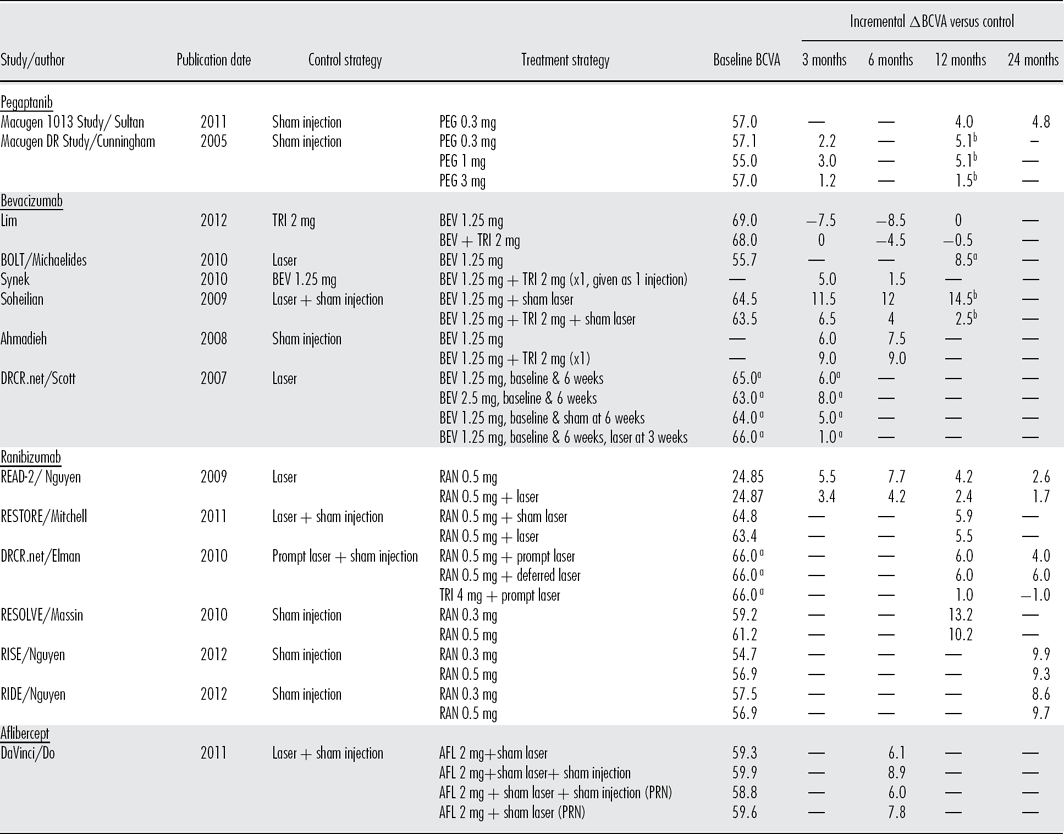
A summary of BCVA letter changes relative to control therapy is presented for each anti-VEGF study in Table 1. Two elements of these results merit consideration in light of the decision to pool data quantitatively. First, in studies reporting findings at multiple timepoints, differences in BCVA improvement seen at earlier timepoints remained relatively stable throughout follow-up, suggesting that results from shorter-term studies are relevant for comparison to longer-term trials. Second, while the average gain in vision relative to control ranged between 0 and 14.5 letters across all studies, the magnitude of improvement was similar across anti-VEGF agents. Most improvements were in the 6–9 letter range in studies of bevacizumab, ranibizumab, and aflibercept, regardless of study entry criteria, baseline visual acuity, treatment protocol, or duration of follow-up. Level of improvement was slightly lower for pegaptanib, ranging from 4–5 letters at 9–24 months of follow-up.
Summary of Change in Best-Corrected Visual Acuity, by Anti-VEGF Agent and Clinical Study

BCVA, Best-corrected visual acuity; AFL, Aflibercept; BEV, Bevacizumab; PEG, Pegaptanib; RAN, Ranibizumab; TRI, triamcinolone.
aMedian data reported.
b9-month data reported.
Findings for the percentage of patients gaining more than ten letters echoed those of mean BCVA changes; 21–73 percent of patients receiving bevacizumab, ranibizumab, or aflibercept gained more than ten letters at 6–24 months of follow-up versus 5–32 percent of those randomized to laser or sham injection (data not shown). Rates for drug-treated groups were higher than for control therapy in all studies. While the percentage of pegaptanib patients with a more than ten letter gain was significantly higher than that for sham (34–37 percent versus 10–20 percent, p ≤ .003 for both studies), the magnitude of this difference was not as great compared with the other anti-VEGF agents. Similar trends in the percentage of patients gaining more than fifteen letters were observed.
Visual acuity: Quantitative synthesis
As mentioned previously, effect sizes were similar across agents and studies, which allowed for the conduct of quantitative synthesis. The potential evidence network for these analyses is presented in Supplementary Figure 2, which can be viewed online at http://dx.doi.org/10.1017/S0266462313000500.
Findings for the weighted mean difference (treatment versus laser/sham control) in the change in BCVA are presented in Figure 1. Pooled mean differences (range: 5–12 letters) were statistically significant in favor of all anti-VEGF agents versus control; it should be noted, however, that only single RCTs of aflibercept and pegaptanib were available for this analysis. Results from indirect comparisons found no statistically significant differences between bevacizumab, ranibizumab, or aflibercept. While mean changes were significantly greater for each of these agents in comparison to pegaptanib, results should be interpreted with caution given the paucity of RCT data for the latter.
Meta-analysis and indirect comparisons of mean difference in change in best-corrected visual acuity between anti-VEGF therapy and laser/sham control.
Findings for primary analyses of the rate ratio (treatment versus laser/sham control) in the percentage of eyes with a gain of 10 or more letters can be found in Figure 2. Pooled results indicated a statistically significant likelihood of more than 10 letter gains for bevacizumab, ranibizumab, and aflibercept relative to laser/sham control, with rate ratios ranging from 1.7 to 3.0. Findings for pegaptanib were not significant. Indirect comparisons indicated no statistically significant differences between anti-VEGF agents in the likelihood of achieving a more than 10 letter gain.
Meta-analysis and indirect comparisons of likelihood of gain of more than ten letters between anti-VEGF therapy and laser/sham control.
Results of our analyses did not materially change with the addition of poor-quality studies and/or data from additional control arms (data not shown).
Treatment usage
Eleven trials reported data on treatment usage.
Six RCTs of ranibizumab and pegaptanib provided data on patients receiving rescue laser. In general, fewer patients receiving anti-VEGF agents were treated with rescue laser, and used less rescue laser than those receiving sham injections. For example, significantly fewer patients in the RISE and RIDE trials of ranibizumab used rescue laser therapy versus those in the sham injection group (19.7–39.2 percent versus 70–74 percent; p < .0001).
Quality of life
Two trial reports provided data on quality of life assessment: both trials evaluated general health states using the EQ-5D, and vision-specific and general health benefits with the NEI VFQ-25. Neither study found significant differences among active treatment and control arms with respect to the EQ-5D. Significant treatment effects were observed in both studies on the NEI VFQ-25, primarily limited to vision-related domains.
Potential harms
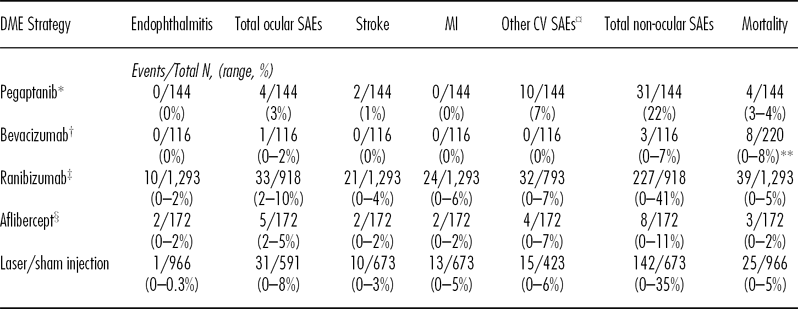
The incidence of mortality and of serious ocular and nonocular adverse events is described in further detail in the sections that follow and summarized in Table 2.
Data on Potential Harms of Strategies for the Management of Diabetic Macular Edema
CV, cardiovascular; DME, diabetic macular edema; MI, myocardial infarction; SAE, serious adverse event.
* 1/2 studies reporting outcomes.
¤ Includes serious adverse events other than stroke and MI.
† 3/6 studies reporting most outcomes.
‡ 6/6 studies reporting most outcomes.
§ 1/1 study reporting outcomes.
** Number of deaths and number randomized reported at level of individual eye.
Ocular Adverse Events
A total of 74 cases of serious ocular adverse events were reported among 1,941 patients in RCTs reporting such events; rates of these events ranged from 0 to 10 percent across trials. The most frequently cited individual serious ocular adverse event was endophthalmitis (13 cases), with incidence ranging from 0 to 2 percent across all trials. Other serious ocular events included cataract, glaucoma, retinal or vitreous hemorrhage, retinal tear, retinal detachment, and uveitis. In most studies, serious ocular events occurred at similar or lower rates for anti-VEGF agents versus control therapy.
An exception was the RIDE trial, in which serious ocular events occurred in 9.7 percent of patients randomized to ranibizumab 0.5 mg (versus 3.2 percent for ranibizumab 0.3 mg and 5.5 percent for sham); differences were manifested primarily in cases of cataract, endophthalmitis, and sudden losses of visual acuity >30 letters. Statistical significance was not reported; our own analysis of data using a chi-squared test indicated that differences were not statistically significant, either across the three groups or for each ranibizumab group in comparison to sham injection. Rates of serious ocular events were also slightly higher in the RESOLVE study for ranibizumab 0.5 mg (5.9 percent versus 2 percent each for ranibizumab 0.3 mg and sham), but the absolute number of events was small (i.e., three versus one versus one).
Rates of serious ocular events were rarely reported in bevacizumab trials. Endophthalmitis was not observed in three RCTs; cases of any serious ocular event were reported only in the BOLT trial (2.4 percent for bevacizumab versus 7.9 percent for laser). Rates of serious ocular events were not reported in the remaining three RCTs.
Among the 8 available observational studies of anti-VEGF agents, no cases of endophthalmitis were reported, and only two cases of any serious ocular adverse event were described (in a cohort of patients receiving triamcinolone plus laser).
Nonocular Adverse Events
The incidence of stroke and MI ranged from 0 to 4 percent (35 cases in 2,398 patients) and 0–6 percent (39 cases in 2,398 patients) across trials, respectively. As with serious ocular events, rates were generally comparable between anti-VEGF and laser/sham control. The incidence of stroke and MI was slightly higher for patients treated with ranibizumab in the RISE study, but this pattern was reversed in the RIDE study. Rates of all serious cardiovascular events ranged from 0 to 7 percent across RCTs, and were comparable between anti-VEGF therapy and control in most studies. Other cardiovascular events (i.e., other than stroke or MI) were reported in 61 patients among 1,648 patients studied; these were most commonly systemic hypertension.
Rates of serious nonocular adverse events in total ranged widely, from 0 to 41 percent, likely due to variability in the definition of serious nonocular events and/or lack of rigorous monitoring for such events. The highest rates of serious nonocular events were observed in the RISE/RIDE trials (28–41 percent versus 31–35 percent for sham). Events were dispersed across many categories; in addition, rates were higher versus sham in RISE, but lower than sham in RIDE. The authors further note that events potentially related to systemic VEGF inhibition were similar across the ranibizumab (6–12 percent) and sham (9–11 percent) arms; as with other RCTs, these rates were not tested statistically.
Rates of stroke, MI, other cardiovascular, and all nonocular events were rarely observed and/or reported in trials of bevacizumab for DME. Single cases of stroke and cardiovascular events were described in the three RCTs reporting such events, both of which occurred in the laser/sham arms. A total of two serious nonocular events were reported, three of which occurred in bevacizumab-treated patients. No data were reported in the remaining three RCTs.
Among available cohort and case series studies, single cases of stroke and MI were observed in a series of 139 patients receiving bevacizumab 1.25 mg or 2.5 mg who were followed for 24 months.
Mortality
Rates of death from all causes ranged from 0 to 8 percent at 6–24 months across available RCTs. A total of seventy-one deaths were reported among 2,575 patients receiving pegaptanib, ranibizumab, aflibercept, and laser/sham injection. Bevacizumab studies reported deaths in terms of eyes treated (8 of 220). In all studies except two of ranibizumab, rates did not materially differ between patients treated with anti-VEGF agents and those treated with control therapy. In the recent RISE and RIDE studies, mortality rates were higher in patients receiving ranibizumab (2.4–4.8 percent) versus sham (0.8–1.6 percent), but this difference was not statistically evaluated. We re-analyzed these data using Fisher's exact test; differences were nonsignificant for both RCTs. The authors also point out that in the DRCR.net study, mortality rates were numerically higher in the sham injection+laser group (5.1 percent versus 3.2–4.8 percent for ranibizumab).
Mortality with bevacizumab was measured in three of six available RCTs. Across the three studies, a total of three deaths were reported among patients receiving laser/sham treatment. In one of these studies, deaths were reported among patients receiving bevacizumab, but results were reported only at the level of the individual eye treated; a total of eight eyes treated with bevacizumab died during follow-up. No deaths were reported among bevacizumab-treated patients in the other two RCTs.
There were three deaths in the RCT of aflibercept, all in patients receiving anti-VEGF therapy. These were attributed to underlying comorbidity in all cases.
DISCUSSION
While available studies differed in terms of entry criteria, treatment protocol, comparators, measurement techniques, and duration of follow-up, the findings of our review suggest that anti-VEGF therapy is associated with sustained improvement in visual acuity and reduced requirements for “rescue” laser treatment over 6–24 months of follow-up. For many patients, improvements in visual acuity were marked and clinically significant (e.g., gains of 10 letters or more).
What is less clear is the ability to distinguish the performance of each individual anti-VEGF agent. There have been no published head-to-head comparative trials of anti-VEGF agents in patients with DME; in available RCTs of anti-VEGF agents versus control, there are marked differences in patient eligibility, control arm therapy protocols, measurement techniques, and study duration. While our meta-analyses on the mean difference (relative to laser, sham, or other control therapy) in improvement in BCVA and in the likelihood of achieving a ten-letter or better gain suggest no clinically or statistically significant differences in either outcome among ranibizumab, bevacizumab, and aflibercept, there is some indication that these agents were associated with greater improvements relative to pegaptanib. Future research will help confirm the findings of these indirect analyses.
Results suggesting equivalent effectiveness of these agents have important policy relevance for healthcare decision makers worldwide in light of the stark differences in agent cost. In the United States, for example, an analysis of recent Medicare payment rates indicated a per-injection payment of $61 for bevacizumab versus $1,000–$2,000 for the other anti-VEGF agents (32). In addition, a recent cost-effectiveness analysis found that combination treatment with focal laser photocoagulation and bevacizumab provided greater value than combination treatment with laser and either ranibizumab or triamcinolone, as well as in comparison to laser alone (Reference Stein, Newman-Casey and Kim33).
Our indirect comparison of data on safety merits additional comment. There was a marked contrast in the extent, detail, and rigor with which safety data were collected and reported in industry- and government-sponsored trials of ranibizumab, pegaptanib, and aflibercept, versus the primarily small, single-center trials of bevacizumab. In trials of anti-VEGF agents other than bevacizumab, rates of serious ocular and nonocular and/or systemic adverse events were generally comparable to rates for laser/sham control, although there were some discrepant findings in individual trials (e.g., higher rates of stroke/MI with ranibizumab versus sham in RISE, lower rates in RIDE).
In trials of bevacizumab, the level of detail on the specific adverse events and serious events as a whole was inferior to that in the trial reports for the other anti-VEGF agents. Examination of data from observational analyses failed to shed additional light on bevacizumab safety in DME, as reporting frequency and detail were also extremely limited.
We note some important limitations of our analysis. While efforts were undertaken to reduce publication bias and duplicative research, certain aspects of our search strategy (e.g., exclusion of non–English-language articles) may be subject to residual levels of such bias. Because only ranibizumab has marketing approval for DME in the United States and Europe, trials of the other anti-VEGF agents may have been conducted but not published. Also, as mentioned previously, we used a parsimonious approach to indirect meta-analyses rather than a more sophisticated approach that would have allowed for fuller examination of heterogeneity. Based on results of our primary and sensitivity analyses, however, it is unlikely that the conclusion of no material differences in effectiveness between agents would have changed with a more advanced technical approach. As more evidence accumulates over time, however, the field may in fact benefit from a network meta-analysis in the future.
In conclusion, evidence accumulated to date suggests that anti-VEGF therapy improves visual acuity in patients with diabetic macular edema and provides other clinical benefits relative to macular laser treatment or sham injection. While there are no head-to-head trials of anti-VEGF agents, there are sufficient fair- and good-quality RCTs of individual agents versus control therapies to allow for qualitative and quantitative indirect comparisons. The systemic side effect profile of bevacizumab relative to ranibizumab or other anti-VEGF agents remains the greatest element of uncertainty.
SUPPLEMENTARY MATERIALS
Supplementary Tables 1–5, and Figures 1 and 2 can be found at: http://dx.doi.org/10.1017/S0266462313000500
CONTACT INFORMATION
Daniel A. Ollendorf, MPH (dollendorf@icer-review.org), Chief Review Officer, Institute for Clinical and Economic Review, Boston, MA
Jennifer A. Colby, PharmD, Senior Research Associate, Institute for Clinical and Economic Review, Boston, MA
Steven D. Pearson, MD, MS, FRCP, President, Institute for Clinical and Economic Review, Boston, MA
CONFLICTS OF INTEREST
All authors report they have no potential conflicts of interest.