Introduction
Parthenogenesis, a form of asexual reproduction in which growth and development of embryos occur without male contribution, occurs naturally in many invertebrates as well as in some vertebrates. The parthenogenetic activation of mammalian oocytes is a vital tool for investigating the roles of paternal and maternal genomes in controlling early embryonic development. The parthenogenetic activation of oocyte protocol can be used as a reference model to improve the activation process of reconstructed oocytes during somatic cell nuclear transfer studies (Kim et al., Reference Kim, Simerly, Funahashi, Schatten and Day1996). Embryonic stem cells have been isolated successfully and cultured from parthenogenetically produced blastocysts in mice (Allen et al., Reference Allen, Barton, Hilton, Norris and Surani1994; Yu et al., Reference Yu, Yan, Chen, Cheng and Dou2011), monkeys (Cibelli et al., Reference Cibelli, Grant, Chapman, Cunniff, Worst, Green, Walker, Gutin, Vilner, Tabar, Dominko, Kane, Wettstein, Lanza, Studer, Vrana and West2002; Vrana et al., Reference Vrana, Hipp, Goss, McCool, Riddle, Walker, Wettstein, Studer, Tabar, Cunniff, Chapman, Vilner, West, Grant and Cibelli2003; Wei et al., Reference Wei, Sun, He, Tan, Lu, Guo, Su and Ji2011), humans (Revazova et al., Reference Revazova, Turovets, Kochetkova, Kindarova, Kuzmichev, Janus and Pryzhkova2007), pigs (Xu et al., Reference Xu, Hua, Jia, Huang, Yang and Dou2007), rabbits (Hsieh et al., Reference Hsieh, Intawicha, Lee, Chiu, Lo and Ju2011) and cattle (Pashaias et al., Reference Pashaias, Khodadadi, Holland and Verma2010).
During fertilization, the activation impulses generated by sperm penetration induce a series of calcium (Ca2+) transients in mature oocytes (Miyazaki et al., Reference Miyazaki, Shirakawa, Nakada and Honda1993; Carroll et al., Reference Carroll, Jones and Whittingham1996). According to Miyazaki (Reference Miyazaki1990), these Ca2+ spikes are propagated throughout the fertilized oocyte in the form of a wave, which initiates cortical granule exocytosis, resumption of second meiosis and affects later embryonic development. None of the reported experimental protocols of oocyte activation is capable of mimicking the natural sperm-induced response pattern in mammalian oocytes (Sun et al., Reference Sun, Hoyland, Huang, Mason and Moor1991). Both the amplitude and frequency of Ca2+ transients produced by in vitro stimulation affect the inactivation of maturation-promoting factor (MPF), duration of pronuclear formation, rate of blastomere compaction and blastocyst formation in parthenogenetically activated oocytes. The signalling for mammalian oocyte activation and the mechanisms that underlie these important biological events have not been fully established, although it has been confirmed that the development of a simple activation system can be capable of inducing the full series of developmental responses.
Several chemical and physical stimuli such as Ca2+ ionophore, ethanol, strontium, electro-stimulus and ultrasound have been used to activate metaphase II oocytes (Loi et al., Reference Loi, Ledda, Fulka, Cappai and Moor1998; Alberio et al., Reference Alberio, Brero, Motlik, Cremer, Wolf and Zakhartchenko2001; Das et al., Reference Das, Majumdar and Sharma2003; Sato et al., Reference Sato, Yoshida and Miyoshi2005; Varga et al., Reference Varga, Pataki, Lörincz, Koltai and Papp2008; De et al., Reference De, Malakar, Jena, Dutta, Garg and Akshey2012). Ionophores, i.e. calcium ionophore and ionomycin, increase the intracellular calcium concentration in metaphase II mammalian oocytes and have been reported to activate several calcium-dependent proteolytic pathways, leading to the destruction of cyclin B, inhibition of the MPF activity and resumption of meiosis (Rinaudo et al., Reference Rinaudo, Pepperell, Buradgunta, Massobrio and Keefe1997; Tomashov-Matar et al., Reference Tomashov-Matar, Tchetchik, Eldar, Kaplan-Kraicer, Oron and Shalgi2005; Jellerette et al., Reference Jellerette, Melican, Butler, Nims, Ziomek, Fissore and Gavin2006). Similarly, chemical activation by ethanol has been shown to increase the intracellular Ca2+ concentration that resulted from both extracellular entry and from mobilization of intracellular Ca2+ ion depots (Shiina et al., Reference Shiina, Kaneda, Matsuyama, Tanaka, Hiroi and Doi1993).
Culture medium is the most vital factor for improvements in the efficiency of in vitro embryo development. Commonly used media, such as TCM-199 and mSOF, have been shown to be less efficient for in vitro development of cloned buffalo embryos produced through hand-made cloning technology (Shah et al., Reference Shah, George, Singh, Kumar, Chauhan, Manik, Palta and Singla2008). Commercially available sequential medium (G1/G2, VitroLife, Sweden) has been reported to improve the efficiency to some extent (Simon et al., Reference Simon, Veerapandian, Balasubramanian and Subramanian2006). In the present study, three different types of media [embryo development medium (EDM), modified Charles Rosenkrans (mCR2a) medium and research vitro cleave (RVCL)] medium were evaluated for the efficiency of parthenogenetically activated goat embryo production.
The aim of the present study was to investigate the effects of different activation methods and culture media on yield of parthenogenetically activated goat blastocysts. In the first experiment, the effects of Ca2+ ionophore, ethanol or a combination of both ethanol and Ca2+ ionophore on production of blastocysts and hatched blastocysts were evaluated. In the second experiment, the effect of various culture media (EDM, mCR2a or RVCL) on goat embryo development was evaluated. In a third experiment, the quantitative expression of apoptosis, stress and developmental competence-related genes were analysed in different stages of embryos. The outcome of the experiments could help to improve the efficiency of somatic cell nuclear transfer and hand-made cloning in terms of yield and quality of blastocysts.
Materials and methods
All the present experiments comply with all relevant institutional and national animal welfare guidelines, policies and ethics committee approval. All chemicals and media were purchased from Sigma Chemical Co. (St. Louis, MO, USA) and disposable plasticwares were from Nunc (Roskilde, Denmark) unless specified otherwise.
In vitro maturation of cumulus–oocyte complexes
Goat ovaries were collected from a Delhi slaughter house and washed 2–3 times with normal saline (0.9%) at 35°C that contained the antibiotics penicillin (400 IU/ml) and streptomycin (50 μg/ml), trimmed with sterile scissors and washed 4–5 times with warm normal saline fortified with antibiotics. Immature goat cumulus–oocyte complexes (COCs) were punctured out from antral follicles. Grade A oocytes (those that had more than five layers of cumulus cells with evenly granulated cytoplasm) and grade B oocytes (having 3–5 layers of cumulus cells with evenly granulated cytoplasm) were collected in TCM-199. The COCs were washed twice with maturation medium [TCM-199 supplemented with 10 μg/ml luteinizing hormone (LH), 5 μg/ml follicle stimulating hormone (FSH), 1 μg/ml estradiol-17β, 50 μg/ml sodium pyruvate, 5.5 mg/ml glucose, 3.5 μg/ml l-glutamine, 50 μg/ml gentamicin, 3 mg/ml bovine serum albumin (BSA) and 10% fetal bovine serum (FBS)]. Washed COCs were incubated in in vitro maturation (IVM) medium and incubated at 38.5 °C in 5% CO2 in air in an incubator with maximum humidity for 24 h (Malakar et al., Reference Malakar, Das and Goswami2008).
Parthenogenetic activation of matured oocytes
Matured oocytes with expanded cumulus cells were transferred into the micro-centrifuge tube that contained 0.5 mg/ml hyaluronidase in T2 (TCM-199 supplemented with 2.0 mM l-glutamine, 0.2 mM sodium pyruvate, 50 μg/ml gentamicin and 2% FBS) and incubated for 1 min at 38.5 °C in 5% CO2 in air in an incubator. COCs in hyaluronidase was vortexed for 30 s and transferred to a 35-mm Petri dish that contained T2. Completely denuded oocytes were selected and washed twice in fresh T2 to remove cumulus cells.
Experiment 1: Effect of different chemical activation methods on blastocyst development
For chemical activation, the denuded oocytes were incubated in primary embryo development medium (EDM) [TCM-199 supplemented with 2.0 mM l-glutamine, 0.2 mM sodium pyruvate, 100 μl/ml non-essential amino acid (100×), 50 μl/ml essential amino acid (50×), 10 mg/ml BSA and 50 μg/ml gentamicin] in three groups. In group A, denuded oocytes were incubated in EDM that contained 5 μM Ca2+ ionophore A23187 for 5 min and in group B, oocytes were kept in EDM that contained 7% cell culture-tested ethanol for 8 min at 38.5 °C in 5% CO2 in air in an incubator. Similarly, in group C, oocytes were incubated in EDM that contained 2.5 M Ca2+ ionophore and 3.5% cell culture-tested ethanol for 7 min at 38.5 °C in 5% CO2 in air in an incubator. Activated oocytes were washed in EDM for complete removal of Ca2+ ionophore and ethanol followed by incubation in EDM that contained 2 mM 6-dimethylaminopurine (6-DMAP), at 38.5 °C in 5% CO2 in air in an incubator for 4 h.
Experiment 2: Effect of different culture media on development of parthenogenetic activated goat blastocyst
In order to evaluate the developmental competence of parthenogenetically produced goat embryos, the activated oocytes from Experiment 1 were washed with EDM to remove 6-DMAP and kept in three different culture media: (i) EDM; (ii) RVCL supplemented with 1% BSA; and (iii) modified mCR2a medium that contained 108.3 mM NaCl, 24.9 mM NaHCO3, 1 mM l-glutamine, 2.9 mM KCl, 2.5 mM hemicalcium lactate, 0.5 mM sodium pyruvate, 0.5 mM glycine, 0.5 mM alanine, 1 mM glucose, 100 μl/ml non-essential amino acid (100×), 50 μl/ml essential amino acid (50×), 10 mg/ml BSA and 50 μg/ml gentamycin). Uncleaved embryos were removed after 72 h of culture, and 50% of the medium was taken out from the droplet and replaced with replacement medium (EDM, mCR2a or RVCL medium supplemented with 10, 10 or 4% FBS respectively). Afterwards, the medium was replaced on alternate days for 6–8 days. Blastocysts and hatched blastocysts were observed after 7–8 days of culture.
Experiment 3: Gene expression analysis by real-time polymerase chain reaction (PCR)
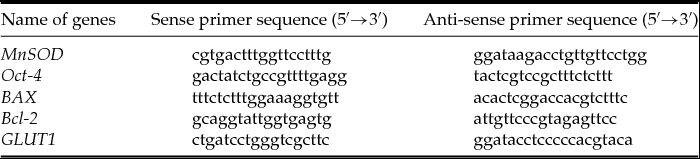
Expression of apoptosis, stress and developmental competence-related genes were analysed in different stages of embryonic development. Embryos at 2–4-cell, 8–16-cell, morulae and blastocysts stage, produced by different activation methods and culture media were separately selected for the gene expression study. Total RNA was isolated using the TRIzol method (Invitrogen Corporation, Carlsbad, CA, USA) and quantified by measurement of the absorbance ratio at 260:280 nm. First-strand complementary DNA (cDNA) was synthesized from 500 ng of total RNA by reverse transcriptase polymerase chain reaction (RT-PCR) using RevertAid™ First Strand cDNA synthesis kit (Fermentas). The transcript abundance of genes related to developmental competence of embryos was quantified by real-time PCR (qRT-PCR). Glyceraldehyde-3-phosphate dehydrogenase (GAPDH) was used as an internal control gene and the expression of each target gene was normalized to GAPDH. The sequences of the primer sets used for qRT-PCR analysis are shown in Table 1. The primers were amplified on a LightCycler® 480 instrument with software version 1.5 (Roche Diagnostics, Mannheim, Germany). The ‘crossing point’ or Cp values were determined by a ‘second-derivative max method’ in the software. All qRT-PCR runs were performed in triplicate and each reaction mixture was prepared in a total volume of 10 μl. The reaction mixture consisted of 2 μl of cDNA as template, 5 μl of 2× Maxima SYBR Green/ROX qPCR Master Mix (Thermo Scientific) that contained 0.5 μM of gene-specific primer. The following cycling conditions were employed for all the genes: preincubation at 95°C for 10 min, denaturation at 95°C for 15 s, annealing at 60°C for 30s and extension at 72°C for 30s. The relative abundance of transcripts was calculated using the equation, 2−(ΔCp sample – ΔCp control) developed by Livak & Schmittgen (Reference Livak and Schmittgen2001).
List of primers

Statistical analysis
Data pertaining to the developmental rates were analysed using SigmaPlot (Version 11) after the arcsine transformation of the percentage values. The differences between means were analysed by one-way analysis of variance (ANOVA). Significance was determined at P-values < 0.05.
Results
In vitro maturation of COCs
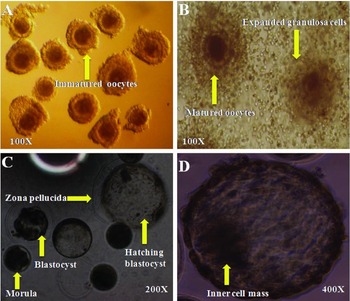
In the present study, only grades A and B immature oocytes were selected for in vitro maturation (Fig. 1 A). Generally, oocytes from different species reach metaphase II stage (maturation) at different times when cultured in vitro. Bovine and ovine oocytes mature in vitro in 18–24 h, but goat oocytes require 27 h for maturation. In vitro maturation of COCs was assessed by the expansion of their cumulus cells (Fig. 1 B).
Development of parthenogenetically activated goat embryos. (A) Immature goat oocytes. (B) Matured oocytes. (C) Morulae and blastocysts. (D) Hatched blastocyst. (A,B) ×100 magnification; (C) ×200 magnification; (D) ×400 magnification.

Experiment 1: Effect of different chemical activation methods on parthenogenetically activated embryo production
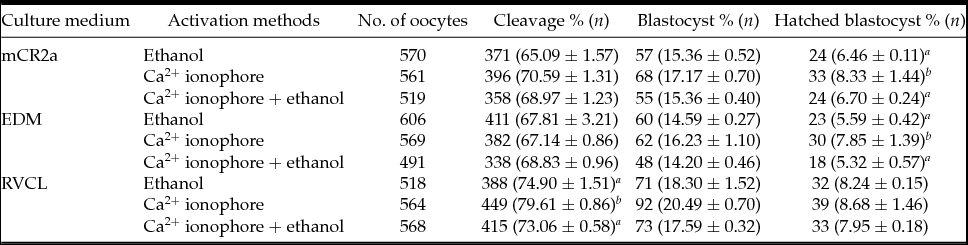
The results of Experiment 1 are shown in Table 2. When RVCL was used as a culture medium, cleavage rate in Ca2+ ionophore-mediated activation (79.61 ± 0.86) was significantly higher than for ethanol (74.90 ± 1.51) or the combination of Ca2+ ionophore and ethanol (73.06 ± 0.58) (Table 2). No significant difference was observed in terms of blastocysts or hatched blastocyst production rate in the above condition (Table 2; Fig. 1 C,D). In mCR2a and EDM culture media, hatched blastocyst production rate in Ca2+ ionophore-treated oocytes (8.33 ± 1.44) was significantly higher than for ethanol (6.46 ± 0.11) or the Ca2+ ionophore with ethanol combination (6.70 ± 0.24), and no significant difference was found in terms of cleavage and blastocyst production rate (Table 2).
Effect of different chemical activation methods on development of parthenogenetic activated embryos (data from four trials)

a ,b,c Values having different superscripts in the same column differ significantly (P < 0.05).
Results are expressed as mean ± standard error of the mean (SEM).
EDM, embryo development medium; mCR2a, modified Charles Rosenkrans; RVCL, research vitro cleave.
Experiment 2: Effect of different culture media on parthenogenetic activated embryo production
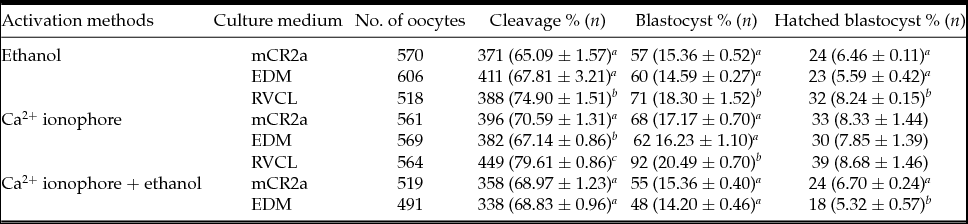
The outcome of Experiment 2 is shown in Table 3. In ethanol-activated parthenogenetic embryos, cleavage, blastocyst and hatched blastocyst production rates in RVCL medium (74.90 ± 1.51, 18.30 ± 1.52 and 8.24 ± 0.15, respectively) were significantly higher than in EDM (67.81 ± 3.21, 14.59 ± 0.27 and 5.59 ± 0.42) and mCR2a (65.09 ± 1.57, 15.36 ± 0.52 and 6.46 ± 0.11) (Table 3). No significant difference was found in terms of hatched blastocyst production rate among these three media with calcium ionophore-mediated activation. But cleavage and blastocyst development rates in RVCL medium (79.61 ± 0.86 and 20.49 ± 0.70) were significantly higher than in mCR2a medium (70.59 ± 1.31 and 17.17 ± 0.70) and EDM (67.14 ± 0.86 and 16.23 ± 1.10) (Table 3). Similarly, when both calcium ionophore and ethanol were used as an activating agent cleavage, blastocyst and hatched blastocyst production rates in RVCL medium (73.06 ± 0.58, 17.59 ± 0.32 and 7.95 ± 0.18) were significantly higher than for EDM (68.83 ± 0.96, 14.20 ± 0.46 and 5.32 ± 0.57) and mCR2a (68.97 ± 1.23, 15.36 ± 0.40 and 6.70 ± 0.24) (Table 3). The RVCL medium, in comparison with mCR2a and EDM, significantly affected the development of parthenogenetically activated goat embryos.
Effect of different culture media on development of parthenogenetic activated embryo (data from four trials)

a ,b,c Values having different superscripts in the same column differ significantly (P < 0.05).
Results are expressed as mean ± standard error of the mean (SEM).
EDM, embryo development medium; mCR2a, modified Charles Rosenkrans; RVCL, research vitro cleave.
Experiment 3: Gene expression analysis by qRT-PCR
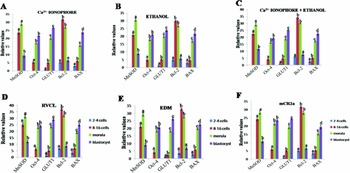
Expression of apoptosis, stress and developmental competence-related genes were analysed in different stages of embryonic development. The relative abundance of BAX, Bcl-2, MnSOD, Oct-4 and GLUT1 transcripts were evaluated in 2–4-cell, 8–16-cell, morula- and blastocyst-stage embryos (Fig. 2). The effects of different embryo culture media and activation methods were categorically examined for relative abundance of above transcripts. Irrespective of different media and activation methods used, most genes were not expressed or expressed at a greatly reduced rate in 2–4-cell stage embryos (Fig. 2). Variation in expression pattern was observed in subsequent developmental stages vis-à-vis 8–16-cell, morula and blastocyst-stage embryos. The BAX transcript level was significantly higher in 8–16-cell, morula- and blastocyst-stage, whereas Bcl-2 and MnSOD were found to be expressed at much higher levels in 8–16-cell and morula stages but decreased expression was noticed in blastocyst-stage embryos (Fig. 2). The expression of developmental competence-related genes (Oct-4 and GLUT1) increased gradually with the progression of embryonic development and attained maximum at the morula and blastocyst stages (Fig. 2). With relevance to different activation methods and embryo culture media used, a homogenous expression pattern of the above genes was observed in different developmental stages of parthenogenetically activated goat embryos (Fig. 2). Different activation methods and culture media imparted very small influence on variation pattern of transcripts abundance of same genes.
Quantitative reverse transcription polymerase chain reaction (qRT-PCR) of stress, apoptotic and developmental competence-related genes at different stages of parthenogenetically activated goat embryos developed in (A–C) respective activation methods; and (D–F) culture media. EDM, embryo development medium; mCR2a, modified Charles Rosenkrans; RVCL, research vitro cleave. a,b,c,dValues indicate.

Discussion
During fertilization, sperm entry provides a natural stimulus for oocyte activation, which influences early embryonic development (Collas et al., Reference Collas, Fissore, Robl, Sullivan and Barnes1993). According to Bootman & Berridge (Reference Bootman and Berridge1995), the sperm–oocyte interaction leads to release of intracellular Ca2+ from endoplasmic reticulum, which interacts to produce a series of repetitive waves that are responsible for meiotic progression and early embryo development. In a study by Kline & Kline (Reference Kline and Kline1992), the released Ca2+ ion binds to both inositol 1,4,5-triphosphate receptors (InsP3R) and ryanodine receptors (RyR). The InsP3R channel has been shown to be involved in propagation; maintenance of the Ca2+ waves and RyR channels has been linked to the conversion of the zona glycoprotein (ZP2) to its post-fertilization form ZP2f (Ayabe et al., Reference Ayabe, Kopf and Schultz1995). The continuous release of calcium in a pulsatile manner enables the oocyte to produce strong ionic signals, while, at the same time, the harmful toxic effects associated with prolonged exposure to high cytoplasmic Ca2+ concentrations should be avoided. It is, therefore, important to consider that artificial methods of activation provide a non-toxic calcium signal to the metaphase II-arrested oocyte. Each of the methods of activation tested in the present study utilized a different mechanism for the elevation of intracellular calcium ion. Ethanol induced a single Ca2+ rise that resulted from both extracellular entry and some mobilization of intracellular stores (Shiina et al., Reference Shiina, Kaneda, Matsuyama, Tanaka, Hiroi and Doi1993). However, according to Hoth & Penner (Reference Hoth and Penner1992), ionomycin exclusively mobilizes intracellular Ca2+ stores when used as an activating agent. A combination of both calcium and ionomycin has been observed to induce the release of calcium from extracellular entry and from some mobilization of intracellular stores. Each of the artificial activators induced the release of only a single wave rather than a series of repetitive calcium waves, generated during fertilization. A single rise in calcium levels from either source (extracellular calcium influx or by mobilization of intracellular stores) has been shown in most oocytes to enable progression from metaphase II arrest to pronuclear formation (Loi et al., Reference Loi, Ledda, Fulka, Cappai and Moor1998). These multiple and periodic oscillations in intracellular calcium concentrations were responsible for suppression of MPF and mitogen activation promoter factor (MAPK), and led to activation of the oocyte (White & Yue, Reference White and Yue1996).
Calcium ionophore A2187 increased intracellular Ca2+ concentration, which in turn destroyed the existing calcium-sensitive cytostatic factor (CSF) and resulted in the reduction of MPF activity (Swann & Ozil Reference Swann and Ozil1994). The combination of calcium ionophores with 6-dimethylaminopurine (6- DMAP) induces high rates of activation, pronucleus formation and development to the blastocyst-stage in sheep (Loi et al., Reference Loi, Ledda, Fulka, Cappai and Moor1998), cattle (Liu et al., Reference Liu, Ju and Yang1998) and goat (De et al., Reference De, Malakar, Jena, Dutta, Garg and Akshey2012). The outcome of the present study revealed that the Ca2+ ionophore significantly increased the production rate of hatched blastocysts, but had no effect on cleavage and blastocysts production rate, when activated oocytes were cultured in mCR2a and EDM. Calcium ionophore increased the cleavage rate in RVCL medium but exerted no difference on production of blastocyst and hatched blastocysts in same medium.
Similarly, when oocytes were activated by ethanol followed by kinase inhibitor treatment (6-DMAP), the formation of a second pronucleus was suppressed. It was postulated that 6-DMAP inhibits MAP kinase and leads to a disruption of spindle organization in metaphase II oocytes and irregularities in the gross morphology of the oocyte (Szollosi et al., Reference Szollosi, Kubiak, Debey, de Pennart, Szollosi and Maro1993; Moore et al., Reference Moore, Kopf and Schultz1995). Although 6-DMAP treatment enhanced the speed of pronuclear formation and suppressed polar body extrusion, this treatment has no measurable effect on the levels of MPF kinase in ovine oocytes after chemical activation (Bogliolo et al., Reference Bogliolo, Calvia, Leoni, Loi, Ledda and Moor1996). Ethanol was reported to induce oocyte activation in sheep (Loi et al., Reference Loi, Ledda, Fulka, Cappai and Moor1998), cattle (Simone et al., Reference Simone, Claudia and Joaquim2004), domestic cat (Grabiec et al., Reference Grabiec, Max and Tischner2007), pronucleus formation and development into blastocyst stage in cattle, either alone or in combination with strontium (Simone et al., Reference Simone, Claudia and Joaquim2004). The current study found that, compared with Ca2+ ionophore, either ethanol alone or in combination with Ca2+ ionophore did not significantly increase the development of caprine embryos. The combination of ethanol and Ca2+ ionophore may be relatively detrimental for oocyte architecture, and result in a lower cleavage rate and blastocyst production rate in goat.
Different culture media were employed for successful development of mammalian embryos. Modified synthetic oviduct fluid (mSOF) medium supplemented with essential and non-essential amino acids, sodium citrate, myoinositol and FBS has been used in cattle (Booth et al., Reference Booth, Tan, Reipurth, Holm and Callesen2001), horses (Lagutina et al., Reference Lagutina, Lazzari, Duchi, Turini, Tessaro, Brunetti, Colleoni, Crotti and Galli2007) and goats (Jena et al., Reference Jena, Malakar, De, Garg, Akshey, Dutta, Sahu, Mohanty and Kaushik2012) for culture of hand-made cloned embryos and parthenogenetic activated caprine embryos (De et al., Reference De, Malakar, Jena, Dutta, Garg and Akshey2012). Several media have been used for porcine embryos, i.e. Whitten's medium (Wright, Reference Wright1977); North Carolina State University (NCSU)-23 and NCSU-37 medium (Petters & Wells, Reference Petters and Wells1993); Beltsville Embryo Culture Medium (BECM)-3 (Dobrinsky et al., Reference Dobrinsky, Johnson and Rath1996); and porcine zygote medium (PZM)-3 and PZM-4 (Du et al., Reference Du, Kragh, Zhang, Li, Schmidt, Bogh, Zhang, Purup, Jorgensen, Pedersen, Villemoes, Yang, Bolund and Vajta2007; Yoshioka et al., Reference Yoshioka, Suzuki, Tanaka, Anas and Iwamura2002). Among these media, NCSU-23 has been used widely as the most successful medium for culture of porcine embryos after in vitro fertilization. mCR2a medium has been used in buffalo (Shah et al., Reference Shah, George, Singh, Kumar, Chauhan, Manik, Palta and Singla2008) and goats (Zhang et al., Reference Zhang, Hua and Zhang2007) for culture of hand-made cloned embryos. RVCL medium significantly increases cleavage, morulae and blastocyst production in cloned embryo of buffalo (Shah et al., Reference Shah, George, Singh, Kumar, Chauhan, Manik, Palta and Singla2008) and parthenogenetic activated embryos of goat (De et al., Reference De, Malakar, Jena, Dutta, Garg and Akshey2012). The present study showed that, compared with mCR2a medium or EDM, RVCL medium significantly affects the development of parthenogenetic activated goat blastocysts.
Apoptosis plays an important role in cellular differentiation and embryonic development. Environmental stressors, such as those created by in vitro culture, induce unplanned apoptosis in cultured embryos, which lead to abnormal development and lower embryo viability (Jurisicova et al., Reference Jurisicova, Latham, Casper and Varmuza1998; Byrne et al., Reference Byrne, Southgate, Brison and Leese1999). In the present study, expression analysis of pro-apoptotic (BAX) and anti-apoptotic genes (Bcl-2) indicated that the incidence of apoptosis reached its peak at the 8–16 cells stage of embryonic development. Hence, it can be speculated that apoptosis may play a rule in the developmental arrest of 8–16 cells stage goat embryos. MnSOD is an oxidative stress response gene and has been implicated in cellular differentiation process. The expression analysis of MnSOD shows that transcripts are not present at the 2–4-cell stage. The abundance of MnSOD was first observed at the 8–16-cell stage, attained maximum levels at the morula stage and decreased subsequently. This pattern may be due to the onset of differentiation procedure at the morula stage and to combat a gradual increase in oxidative stress with the advancement of culture process. The expression of glucose transporter (GLUT1) increased gradually starting from the 2–4-cell stage to the blastocyst-stage embryo. The metabolic activities of embryos increased with the advancement of its cell number and uptake of glucose also enhanced with it. Therefore the gradual rise in expression of the GLUT1 gene supported the notion that, to meet the increasing demand of glucose, the expanding cell number of embryonic cells required additional amounts of glucose transporter protein. Various activation methods and embryo culture media did not affect significantly on rate of compaction of blastomeres and cell number of morula or blastocyst-stage parthenogenetic activated goat embryos. So they imparted a small effect on relative expression of these stress, apoptosis and developmental related genes.
Conclusion
In conclusion, based on overall embryonic growth and development rates, activating agents Ca2+ ionophore was found to have the most beneficial impact on goat oocyte activation without compromising embryonic quality. For supporting growth and development of parthenogenetic goat blastocysts, RVCL medium was found to be better than EDM and mCR2a. The expression of BAX (pro-apoptotic), Oct-4 and GLUT1 (development related) transcripts increases gradually from the 2-cell stage to blastocyst-stage embryos, whereas the transcript level of Bcl-2 (anti-apoptotic), MnSOD (stress related) was significantly lower in parthenogenetic activated blastocyst-stage goat embryos. Importantly, different activation methods and embryo culture media imparted a small variation in transcript abundance pattern of these genes.