Introduction
The decrease in marital stability during the twentieth century has often been interpreted as a consequence of industrialization and the establishment of a market society. In these histories, a rising standard of living and more general market participation by both men and women have caused intertwined economic and cultural processes that have transformed marriage into a contingent and more individualized relationship.
Almost the entire transition from a low to a high divorce rate regime in Western countries occurred prior to the mid-1970s, with significant increases in the divorce rate during the 1940s and 1960s in both Europe and the United States (Chester Reference Chester1977; Goode Reference Goode1993: 84, 139; Phillips Reference Phillips1988: 585). This pattern of a surge in aggregate divorce during the 1960s is also characteristic of the development in Sweden. Beginning in the early 1960s the divorce rate increased from 4.6 divorces per 1,000 married females in 1963 to 14.3 in 1974, making the 1960s and early 1970s by far the most intense growth period of aggregate divorce in Sweden.
In the 1960s marital stability decreased in conjunction with extensive economic, institutional, and cultural change in terms of high levels of economic growth, marked expansion of social security, criticism of the traditional gender regime, and a rapid shift to a dual-provider model. Income differences decreased sharply beginning in the early 1960s, and continued to diminish until the mid-1980s. At the same time, welfare expenditure increased from 10 to 40 percent of the country's gross domestic product, resulting in a substantial reduction of socioeconomic differentials (Vogel Reference Vogel2003: 62–74). According to Gøsta Esping-Andersen, the specific type of Nordic welfare state that was institutionalized during the 1960s diverges from other Western welfare models as it worked to more extensively “defamilializate” individuals. By this, Esping-Andersen means that Nordic welfare states developed in a way that “maximized the individuals’ command of economic resources independently of familial or conjugal reciprocities” (Esping-Andersen Reference Esping-Andersen1999: 45).
Here, Esping-Andersen touches on the fact that the 1960s were characterized by a rapid move toward a more equal distribution of economic resources not only between social classes, but also between men and women. During the 1960s the transformation toward a dual-provider family model gained momentum in Sweden, and the idea that married women could and should work outside the home had a definitive breakthrough in social practice as well as political discourse (Åmark Reference Åmark2006: 323–34; Florin and Nilsson Reference Florin and Nilsson2000). The labor market participation of Swedish married women more than doubled between 1960 and 1970, reaching 56 percent in 1970 (Stanfors Reference Stanfors2003a: 81–86).
It is fair to say that divorce research in both demography and sociology has strongly emphasized the role of decreased socioeconomic differentials between classes and genders as a central form of restructuring that have resulted in increased divorce in Western societies and that these forms of equalization were markedly evident in Sweden during the 1960s.
Sociological theory has emphasized a macrostructural perspective, according to which economic restructuring and cultural changes have resulted in an “individualization process.” Men and women have increasingly prioritized market participation and expressive life goals in a way that has caused both an increased supply and demand for divorce (Bauman Reference Bauman2003; Beck and Beck-Gernsheim Reference Beck and Beck-Gernsheim1995; Giddens Reference Giddens1992; Lesthaeghe Reference Lesthaeghe, Mason and Jensen1995). In comparison, demographic research has been more focused on a microeconomic perspective that emphasizes utility maximization at the level of the couple. Theoretically, the specialization and trading model suggested by Gary Becker (Becker Reference Becker1991: 30–79; Becker et al. Reference Becker, Landes and Michael1977) has been at the center of much of the research (Lyngstad and Jalovaara Reference Lyngstad and Jalovaara2010: 258). This model views increasing female labor force participation as a primary cause for increased marital instability. Becker argues that symmetrical labor force participation has resulted in a decreased role specialization in marriage, which in turn has reduced the gains from marriage for both partners. Another theoretical model that has been extensively discussed in demography is William Goode's socioeconomic growth hypothesis, which links the general increase and more equal distribution of affluence in Western societies to increased divorce (Goode Reference Goode1962: 517; Reference Goode1993: 26–27). On the basis of the extensive changes in both female labor force participation and socioeconomic differentials during the 1960s, we argue that this period is especially well suited for tests of the relevance of both the Goode hypothesis and the specialization and trading model.
During the early 1960s, labor force participation among married women was still relatively low and the gender regime was still fairly traditional, making it of particular interest to study the effect of the wife's relative economic resources on the probability of divorce. If the sharp increase in the divorce rate during the 1960s is connected to the pronounced increase in the labor force participation of married women during the same time period, the risk of marriage breakdown should be considerably higher among the couples who were forerunners in the shift toward a dual-provider model.
A historical perspective is also necessary to ascertain the validity of the Goode hypothesis, which predicts a shift from a positive to a negative socioeconomic gradient of divorce during the course of the divorce transition. Essentially, Goode's argument is that divorce can be viewed as a consumer good that can be acquired to the extent that it is affordable, and that increased divorce is driven by a process whereby single life becomes feasible for low-income couples as well. Although few tests of the Goode hypothesis have been done on historical data, we know that the risk of divorce was substantially higher in the upper socioeconomic strata in Sweden during the 1920s and 1930s (Sandström Reference Sandström2011). However, it has not yet been established exactly when the “democratization” of the access to divorce began, and we do not know the extent to which the relationship had shifted by the early 1960s. If decreased socioeconomic differentials resulted in a more generalized access to divorce across socioeconomic strata, the relationship between divorce and socioeconomic status should have become negative in the 1960s. Such a shift would indicate that the rapid increase in aggregate divorce was associated with a decrease in absolute economic constraints to divorce that made single life feasible for low-income groups as well.
Despite the fact that the 1960s were a trenchantly dynamic period in the transition from a low to a high divorce rate regime in Sweden and other Western countries, most research on determinants of divorce has been done on divorces that have occurred since the 1970s due to the limited availability of data on historical populations. The few studies that to some extent cover the development in Sweden during the 1960s are based on data from the Swedish Fertility Register (Hoem and Hoem Reference Hoem, Hoem and Trussell1992) and the Swedish Survey of Family and Working Life (Oláh Reference Oláh2001). These studies have been constrained by the facts that the data source contains a small number of marriages that were at risk for divorce during the 1960s and that information is limited to just one of the spouses in the couple. Due to these constraints the studies have been forced to use crude measures of socioeconomic status, such as being employed or not, and can only estimate the probability of divorce for an individual man or a woman without being able to control for the characteristics of the other spouse.
Consequently, the knowledge of couple-level determinants of divorce in Sweden during the 1960s can benefit from further investigation. This study addresses the limitations in previous studies by using data from the Population and Housing Censuses from 1960 and 1965, which cover the entire married population in Sweden. This extensive data set makes it possible to carry out a comprehensive study of both individual and couple-level socioeconomic determinants of divorce, controlling for a large number of possible confounders.
The aim of this study is thus to examine a range of determinants of divorce during the first half of the 1960s that have been implicated in the theoretical discussion on rising divorce rates during the twentieth century. Special attention is given to the issue of how socioeconomic factors influenced divorce during a period of rapid restructuring in Sweden. Theoretically, we focus on the extent to which the specialization and trading model and the socioeconomic growth hypothesis fit the empirical patterns of divorce during the first years of the high economic growth period in the 1960s.
The paper is structured in six sections. Subsequent to this introduction we first describe the data set, after which we introduce our outcome variable and method of analysis. Following that, the independent variables as well as previous research relevant to our hypotheses are presented and discussed. In the next section, we present the results of the statistical analysis. Finally, in a concluding section the main findings are summarized and discussed in relation to previous research on socioeconomic determinants of divorce during later decades.
Data Set
The data set utilized in this study was drawn from the Population and Housing Censuses from 1960 and 1965. The data from the censuses are part of the ASTRID database, hosted by the Department of Geography and Economic History at Umeå University, and include all individuals living in Sweden in 1960 and 1965. Using the ASTRID database, a data set was constructed that included all married couples in Sweden who were cohabitating at the time of the census in 1960. The data set was then limited to only include couples in which both spouses were alive at the time of the next census in 1965 and under the age of 67 years at the time of the census in 1960. The reason for excluding old-age pensioners is that we do not know their prior occupation and thus cannot say anything about the man's and the woman's relative socioeconomic position (SEI). Approximately 3 percent of the cases had missing information on one of the independent variables and were thus excluded from the analysis.Footnote 1 After these restrictions were imposed, the data set included a total of 1,359,917 couples. The extensive nature of the data set offers several advantages over more finite samples. In particular, the large number of cases – approaching the total population – makes it possible to investigate many independent variables simultaneously and allows precise estimates of parameters.
Outcome Variable
The outcome variable is binary in terms of a marriage being disrupted as opposed to remaining intact. However, the outcome is rare and the probability of staying married is highly more probable than experiencing a marriage disruption. The divorce rate during the early 1960s was approximately five divorces per 1,000 married women per year, which gives a 1-in-200 mean probability of divorce for a single year. Modeling rare binary outcomes is associated with some statistical challenges. King and Zeng (Reference King and Zeng2001) have shown that a rare event bias will occur in logistic regression models if the distribution of events is highly skewed with many zeros, if the sample size is not sufficiently large. When the sample is relatively small (N < 1000) and the event is rare (p < .01), the estimated effects will be deflated to approximately half their correct size if appropriate corrections are not applied. However, as this bias is directly proportional to the sample size and the estimates converge as sample size increases, these effects lose practical importance when logistical regression is applied to data sets of the size used in this study (King and Zeng Reference King and Zeng2001: 150–53). Thus, for reasons of parsimony we elected to not apply any corrections and to use the canonical method for binary outcomes, that is, logistic regression.
The outcome variable is whether the marriage was intact or not at the time of the census in 1965, conditional on both spouses being alive in 1965. Both censuses reflect the composition of the Swedish population by November 1 of the census year and changes in marital status that we register are thus delimited by this date in 1960 and 1965. In order to test the robustness of the model, two alternative outcomes measuring marriage disruption were tested. The first approach was to model all divorces that had occurred between 1960 and 1962 whereby at least one of the spouses had not remarried by 1965. When at least one spouse had not remarried by 1965 the census gives information on when the divorce occurred, since the date of the last civil status change is recorded. This approach makes it possible to limit the cases to couples who divorced in the two years after the census of 1960. This was advantageous as it shortened the time period between the measurement of the independent variables and the outcome variable, and consequently reduced the amount of unobserved variability in the independent variables. The second approach was to try a wider definition and model if the couple had moved apart by 1965 and use this as a proxy for union disruption. However, the results were insensitive to these changes in the specification of the outcome variable; parameter estimates and overall fit of the model remained more or less the same regardless of the specification of marital disruption. Thus, we chose to keep the original specification and model the legal disruptions during the entire period from 1960 to 1965.
Independent variables
Control Variables
Previous research has conclusively shown that couples living in urban areas have higher dissolution risks than those living in rural areas in both Sweden and other Western countries (Chester Reference Chester1977; Gautier et al. Reference Gautier, Svarer and Teulings2009; Norval and Shelton Reference Norval and Shelton1985; Sandström Reference Sandström2011; White Reference White1990: 905). Theoretically, this relationship can be explained in a number of ways. If one's chances of supplementing a current partner with a new one are good, both incentives and constraints will be influenced in a manner that promotes divorce. Firstly, being exposed to a large number of potential partners increases the probability of finding a better match than the current partner, thus increasing incentives to change partners (South Reference South1995; Svarer Reference Svarer2007). Secondly, the better supply side in the marriage market provided by urban milieus increases the chances of finding a new partner after divorce, which will work to reduce the perceived cost of a divorce (South et al. Reference South, Trent and Shen2001; Udry Reference Udry1981). Other scholars argue that differences in normative structures and a lower degree of social control in urban areas explain the higher divorce rates in these settings (Goode Reference Goode1963: 83; Therborn Reference Therborn2004: 22). We control for the degree of urbanization where the couple resided using the system for classification of rural-urban localities developed by Statistics Sweden (Ylander Reference Ylander2004: 80–84). Based on the preceding assumptions, we expect to find a positive association between the probability of divorce and the degree of urbanization of the home district.
To control for period and duration effects, the year of marriage is included in the model. We expect to find a negative effect of marriage duration on divorce probabilities. The probabilities of divorce should be lowest for marriages that have survived the longest, and then increase to reach a maximum for the marriages that occurred close to the 1960s. Couples with long marriage duration in 1960 had lived their formative years and made their transition to marriage when the cultural climate was less secularized and the marital ideology was more traditional. In addition, previous research has found that the maximum risk of divorce occurred approximately five years after marriage during the period from 1911 to 1974 in Sweden, with the probability of union disruption decreasing monotonically after the fifth year. Moreover, the accumulation of marital capital and the weeding-out of couples that have nonobserved traits that increase the probability of divorce grows as a function of time, also contributing to making longer-duration marriages more stable. We also control for age at marriage of both the husband and the wife, and expect to find a negative association, as people who marry young have universally been found to have higher dissolution risks than those who marry at a later age (Lyngstad and Jalovaara Reference Lyngstad and Jalovaara2010: 259; White Reference White1990: 906).
The presence of minor children in the household, the age of the children and the children's kinship relationships with the parents have been found to influence the risk of divorce. Most studies find that unions that have dependent children exhibit lower dissolution probabilities as compared to childless couples (Hoem and Hoem Reference Hoem and Hoem1988: 6; Hong Reference Hong1996) and that this negative effect on divorce is greater the younger the child is (Andersson Reference Andersson1997: 130; Waite and Lillard Reference Waite and Lillard1991).
The stabilizing effect of dependent children likely works through several causal mechanisms. There should be a selection into parenthood of individuals who experience fairly high relationship quality, while those who anticipate divorce will be more inclined to limit their fertility (Lillard and Waite Reference Lillard and Waite1993). Economically, the added sustenance needs that minor children impose on the family will increase economic interdependence between spouses. The economic disincentives produced by children will be especially pronounced for women, who were normally awarded sole custody after a divorce during this period in Sweden (Special Advisers on Family Law [Familjelagssakunniga] 1972: 60). This form of economic deterrent is likely to be strongest for housewives, given their weaker labor market attachment. The effect of children as an economic deterrent to divorce will decrease as they get older and become less dependent on care. As the child reaches school age, the need for supervision during work hours decreases and finally stops sometime during adolescence. According to Gary Becker, children can be regarded as “marriage-specific capital” (Becker Reference Becker1991: 324–30). This status of the children will have been more accentuated for men than for women, as rights to shared custody against the wishes of the other parent were introduced in Sweden as late as 1998 (Schiratzki Reference Schiratzki1999). Consequently, the disincentives for male parents during the 1960s were likely more social and psychological than economic, as they experienced a higher risk of losing day-to-day contact and emotional ties with their children after a divorce.
However, the negative effect of dependent children on marriage dissolution has been found to be conditional on the birth order of the child. Higher parity births are usually not found to have the same preventive effects as the first child in the union (Andersson Reference Andersson1997; Koo and Janowitz Reference Koo and Janowitz1983). Some studies in fact find that all but the first parity increase the probability of divorce rather than decrease it; especially when applying statistical techniques to correct for the possibility that couples who choose to increase their family size are those experiencing higher marital quality in the first place (Lillard and Waite Reference Lillard and Waite1993; Svarer and Verner Reference Svarer and Verner2006). Given these results, we expect that biological children of low parities and low ages will decrease the risk of divorce while the effect at higher ages and parities will not have the same negative influence.
Besides parity and the age of the child, the biological relationship between parents and children is also important for the effect of children on divorce. Stepchildren have been found to increase rather than decrease the propensity for divorce, especially if it is the mother who is the biological parent (Bramlett and Mosher Reference Bramlett and Mosher2002: 25). In this study, the presence of stepchildren in the family will work as a proxy for several factors that can be assumed to promote divorce. We do not know the marital history of the individuals prior to the marriage in which they are observed. However, the presence of stepchildren indicates that the current marriage is a second or higher-order marriage for the parent in question. Previous divorce has been found to substantially increase the probability of disruption of a subsequent marriage (Amato Reference Amato2010; Hoem and Hoem Reference Hoem, Hoem and Trussell1992: 84–86; Lyngstad and Jalovaara Reference Lyngstad and Jalovaara2010: 262). Moreover, the more complex interpersonal relationships in stepfamilies introduce strains and possibilities for conflict related to parental roles and the upbringing of “your children and my children” that are not present in families in which the two parents are the biological mother and father of all children in the family (White and Booth Reference White and Booth1985). Consequently, we control for the kinship relationships between parents and children, and expect that the presence of stepchildren will increase the probability of marital disruption.
We also control for age differences between spouses, and assume that substantial asymmetries of age will increase the dissolution risk. In couples in which one spouse is significantly older than the other, there is a greater likelihood that conflicts will arise due to differences in preferences, role expectations, and life goals (Bumpass and Sweet Reference Bumpass and Sweet1972: 761–62). The fact that a couple is atypical with regard to age difference also increases the risk of experiencing negative attitudes from the social surroundings, which may negatively influence a couple's perceptions of their relationship and consequently increase the risk of dissolution. However, previous research has found that the effect is dependent on the gender of the younger spouse. As social norms tend to regard unions composed of younger women and older men as “normal” up to a certain point, the positive association between age differences and divorce should be more pronounced in cases in which the woman is older than the man (Kalmijn and Poortman Reference Kalmijn and Poortman2006; South Reference South1991).
Finally, we control for the ethnic backgrounds of the spouses in terms of the country of birth of the husband and wife, respectively. This categorization includes categories of homogenous but non-Swedish origin. Theoretically, ethnic diversity in marriage can be assumed to increase the likelihood of marital conflict due to differences in cultural attitudes and role expectations. Support for this hypothesis has been found with regard to spousal dissimilarity in language (Finnas Reference Finnas1997), religion (Becker et al. Reference Becker, Landes and Michael1977; Lehrer and Chiswick Reference Lehrer and Chiswick1993) and ethnicity (Bramlett and Mosher Reference Bramlett and Mosher2002: 20; Kalmijn et al. Reference Kalmijn, de Graaf and Janssen2005). For couples in which both have a non-Swedish background, we also expect a positive effect based on studies that find an increased risk of divorce among couples who undertake international migration (for a review see Lyngstad and Jalovaara Reference Lyngstad and Jalovaara2010: 269–70).
Socioeconomic Variables
The socioeconomic variables included in the study are the socioeconomic position of the wife and the husband and the housing tenure of the family. In a final model, we attempt to estimate not only the absolute effect of the socioeconomic position of the husband and the wife, respectively, but also the influence of the relative socioeconomic positions in the couple as a unit.
The 1960 and 1965 censuses do not include complete information on the socioeconomic position of the husband and wife. Variables such as income and educational levels for the man and the woman are only partially available, but complete information on the occupation of the spouses was recorded in the 1960 census. However, type of employment in terms of being self-employed or a hired employee is not available. To achieve a workable socioeconomic stratification that makes it possible to compare both the wife's and the husband's socioeconomic position, the occupational information was recoded using the stratification scheme for occupations developed by Statistics Sweden (Swedish socioeconomic classification MIS 1982: 4), which takes into account differences in educational requirements, income, and whether or not the occupation entails having subordinates (SCB 1983). Due to the composition of the data source, we were forced to classify all individuals as hired employees. For example, lawyers and carpenters were classified as higher white-collar and skilled blue-collar employees, respectively, regardless of whether they were self-employed or hired employees working for someone else. We are forced to code all nonemployed individuals in a combined group because we lack information on the exact cause for being nonemployed. Employed persons were coded into five different groups, the lowest level being unskilled blue-collar and the highest being higher white-collar professionals. A separate group was also added for farmers, resulting in a total of seven SEI groups.
Housing tenure is another aspect of the socioeconomic resources available to the couple. In previous research, home ownership has been found to negatively influence divorce probabilities (Greenstein Reference Greenstein1990; Jalovaara Reference Jalovaara2001; South and Spitze Reference South and Spitze1986). Owning rather than renting a home indicates relatively more affluent conditions, thus decreasing the risk of strains on marriage due to a scarceness of resources. Additionally, having large amounts of capital that are bound in assets and must be liquidated in cases of divorce will increase the economic risk and transaction cost of marriage dissolution. Consequently, the risk of divorce should be higher among couples who do not own their house.
Effect of Decreased Economic Interdependence in Marriage
The effects of the husband's and the wife's socioeconomic positions on divorce risk since the 1970s have been widely investigated and found to partly work in different ways. For men all indicators of the socioeconomic position during recent decades appear to be negatively associated with the dissolution risk (Lyngstad and Jalovaara Reference Lyngstad and Jalovaara2010; White Reference White1990), but for females research has found more complex causal patterns. Results regarding the effect of the wife's income have been inconclusive (for reviews see Lyngstad and Jalovaara Reference Lyngstad and Jalovaara2010; Sayer and Bianchi Reference Sayer and Bianchi2000; White Reference White1990). Although a majority of the studies investigating the effect of female economic independence using European data sets from the 1970s and 1980s have found evidence of a positive relationship (Chan and Halpin Reference Chan and Halpin2002; Hoem and Hoem Reference Hoem and Hoem1988: 38–40; Jalovaara Reference Jalovaara2001; Kalmijn and Poortman Reference Kalmijn and Poortman2006; Oláh Reference Oláh2001), several studies from both Europe and the United States have failed to reproduce a simple connection or find that the causality involved is complex with interactions between the socioeconomic position of the spouses (Jalovaara Reference Jalovaara2003; Tzeng Reference Tzeng1992), hours worked, and the perceived fairness of the division of unpaid work (Amato Reference Amato2010; Greenstein Reference Greenstein1990, Reference Greenstein1995; Nilsson and Strandh Reference Nilsson and Strandh2009). Studies from the United States, Sweden, and Denmark using data from the 1980s and 1990s have in fact found an opposite effect: that the independent economic resources of the woman are associated with increased marital stability, at least as long as woman's income is not substantially larger than the man's (Nilsson and Strandh Reference Nilsson and Strandh2009; Svarer and Verner Reference Svarer and Verner2006) or the perceived quality of the marriage is not poor (Cooke Reference Cooke2006; Kalmijn et al. Reference Kalmijn, De Graaf and Poortman2004; Sayer and Bianchi Reference Sayer and Bianchi2000; Schoen et al. Reference Schoen, Rogers and Amato2006).
The more complex relationship between the indicators of female socioeconomic status and divorce is normally explained with the theoretical argument that the independent economic resources of wives work in two counteracting ways (Ross and Sawhill Reference Ross and Sawhill1975). Firstly, access to personal economic resources has an independence effect that decreases the economic disincentives to leave an unsatisfactory marriage. Strube and Barbour (Reference Strube and Barbour1983) support this hypothesis, showing that battered women who are employed are markedly more likely to leave their partners than housewives are. Phillips (Reference Phillips1988: 620) has pointed out that in a legal regime that awards alimony to unemployed spouses—such as Sweden's during the 1960s—the independent resources of wives should also work to decrease disincentives for husbands, as this decreases the amount of alimony they have to pay. By contrast, there is an income effect of the wife's labor force participation, as the added income of the wife will increase the total amount of resources that are shared within the marriage. The income effect of the wife's salary will thus increase the incentives to remain married among dual-earner families. With the data set used in this study, it is not possible to disentangle the complex causal patterns of how education, income, and work time interact, as it only contains information on the occupations of the husband and wife. However, for the present purpose, to estimate the socioeconomic gradient of divorce and the effect of the independent economic resources of the wife, the utilized stratification scheme for occupations (SCB 1983) is satisfactory. Because it takes into account educational and income status, it allows for the investigation of the net effect of both the absolute and the relative socioeconomic positions of husband and wife.
It has also been argued that the diversity of results regarding the effect of different indictors of female economic independence is due to contextual and chronological variations in the gender regime. Oppenheimer (Reference Oppenheimer1997) argues that the predictions of the independence hypothesis become anachronistic in a setting where female employment has become generalized at the same time as modern, flexible labor markets have resulted in reduced employment security. In such a setting, the reduced sustenance risks experienced by dual-earner households result in a situation in which the utility of marriage (or cohabitation) is highest when both spouses make a significant contribution to household earnings. Thus, it might be that the effect of the independent economic resources of the woman is dependent on the prevailing gender regime, in that the effect of female labor force participation tends to change as this becomes a majority behavior. However, in Sweden during the early 1960s, when labor force participation was only practiced by a minority of married women, the underlying assumption of the specialization and trading model should be adequately met. Hence, we expect to find an evident positive association between the economic independence of the wife and divorce.
Concerning the relative socioeconomic position of the wife and the husband, a main question is the extent to which the probability of divorce differed between couples who remained in a traditional single-provider family model compared to the rapidly increasing proportion of marriages that adopted a dual-provider model during the 1960s. If the specialization and trading model is an adequate description of how female labor force participation influenced marital stability during this period in Sweden, we expect to find that dual-provider families had a higher probability of divorce than traditional single-provider couples. Additionally, we would expect that couples in which the wife had a higher relative SEI than her husband would exhibit an additional increase in divorce probability compared to other dual-earner couples—a pattern that has been found in previous studies on intracouple differentials and divorce risk (Jalovaara Reference Jalovaara2003; Tzeng Reference Tzeng1992).
Socioeconomic Growth
While the specialization and trading model concerns the effect of the relative distribution of intracouple resources, the socioeconomic growth hypothesis focuses on the effect of intercouple differences in economic resources. Basically, Goode (Reference Goode1993: 26–27) argues that when affluence increases and becomes more evenly distributed, relative deprivation starts to have a pronounced impact on marital stability, causing the effect of socioeconomic status to shift from a positive to a negative gradient. The net effect of such a shift is that levels of aggregate divorce will increase, as divorce becomes a feasible option even for couples in the lower socioeconomic strata. Commonly, studies testing the Goode hypothesis have focused on the effect of increasing and more equally distributed levels of education. However, it could be argued that a measure taking into account not only education but also income and labor market status is a better indicator of the effect of socioeconomic status. As already mentioned, all indicators of SEI position for men have been found to be negatively associated with divorce during recent decades in the Nordic countries (Hoem Reference Hoem1997; Jalovaara Reference Jalovaara2001, Reference Jalovaara2011; Nilsson and Strandh Reference Nilsson and Strandh2009), as well as in Europe and the United States (for reviews see Lyngstad and Jalovaara Reference Lyngstad and Jalovaara2010; White Reference White1990). Results regarding the SEI of the wife are more diverse. Scandinavian and US studies have tended to find a negative association (Hoem Reference Hoem1997; Hong Reference Hong1996; Jalovaara Reference Jalovaara2011; Lyngstad Reference Lyngstad2004; Ono Reference Ono2009) while positive associations have been found in several studies on central and southern European countries (Blossfeld Reference Blossfeld1993; Härkönen and Dronkers Reference Härkönen and Dronkers2006; Poortman and Kalmijn Reference Poortman and Kalmijn2002; Vignoli and Ferro Reference Vignoli and Ferro2009). That the educational gradient of divorce tends to be positive in southern and central Europe is usually explained with the argument that these countries are still characterized by a more traditional gender regime compared to northern European countries and the United States (Blossfeld Reference Blossfeld1993; Härkönen and Dronkers Reference Härkönen and Dronkers2006). These intercountry differences are interpreted as indirectly supporting the Goode hypothesis: countries in southern and central Europe have not moved as far toward a high divorce rate regime, presumably due to higher structural barriers making it necessary to have more resources in order to traverse the structural constraints in these settings.
Regarding the long-term development in Sweden, Sandström (Reference Sandström2011) has shown that the social gradient of divorce was markedly positive during the 1920s and 1930s. In fact, the probability of divorce in occupational groups with high education and high incomes, such as lawyers, engineers, and journalists, was on the same level as in the general population in Sweden today. However, it has not yet been established either exactly when the “democratization” of the access to divorce started to occur or the extent to which the relationship had shifted by the early 1960s. If the rapid increase in the divorce rate during the 1960s was a result of a socioeconomic equalization in the access to divorce, we should find a negative association between the probability of divorce and social class during this period. We do not primarily focus on education as such, which is the case in most studies of the Goode hypothesis; although they also usually control for income and labor market activity (for a discussion see Lyngstad and Jalovaara Reference Lyngstad and Jalovaara2010: 264–65). Rather, we use an aggregate measure of socioeconomic position that accounts for the joint effect of education, income, and labor market status. In our view this is an advantage, as Goode's theoretical argument refers to the simultaneous effect of all aspects of socioeconomic resources available to the individual rather than just education alone.
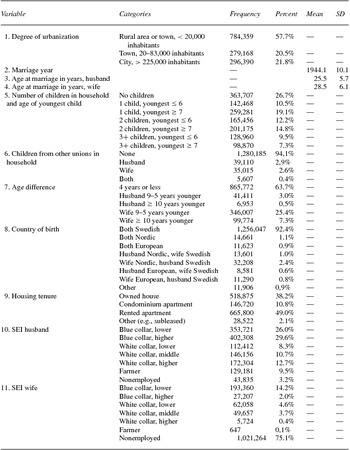
Table 1 provides descriptives for the independent variables that are included in the analysis. The table gives mean and standard deviations for the continuous variables, while factor variables are described with the absolute and relative frequencies for each category included in the final model.
Descriptive statistics

Source: Population and Housing Censuses 1960. Statistics Sweden (ASTRID-database, Department of Geography and Economic History at Umeå University).
Results
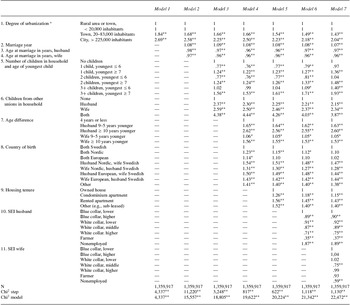
Results of the logistic regression analysis are reported in table 2. The variables are entered in consecutive steps. In the first four models the controls are introduced in blocks and then in models 5 through 7 the variables pertaining to the socioeconomic position of the couple are introduced one at a time. For each model, the effect of the variable on the outcome is reported as the antilog of the coefficient, exp(B), which—in the case of categorical predictors—is interpreted as the multiplicative difference in the odds of the event relative to the reference group. For continuous variables, the exp(B) value gives the multiplicative effect on the odds of a one-unit increase in the independent variable rather than relative differences in the odds between different categories of variable values. For events in which the probability of the outcome is small, such as divorce, the odds ratio can for all practical intents and purposes be interpreted as a relative risk (Agresti Reference Agresti2002: 47). Hence, the exp(B) values can be interpreted as the percentage difference in the risk of experiencing the event for a particular category as compared to the reference group, controlling for the other variables in the model. Significance of the complete model and added variables was tested by means of reduction in deviance. All models have a significant Chi-square for both the model and the added Chi-square of each step below the 1 percent level. Model fit was also tested using the Hosmer-Lemeshow goodness-of-fit test, which produced similar results as the Chi-square tests of reduction in deviance, indicating that the models fit the data at an adequate level.
Logistic regression estimates of the probability of divorce in 1960–65, married cohabitating couples in Sweden, aged 16–66 years

a There is a gap in size between the fourth-largest town in Sweden, Uppsala, which had 83,000 inhabitants in 1960, and the city of Malmoe with its population of 226,000.
** p. < .001 *p. < .05
Models 1 through 7 show that there is an evident effect of the degree of urbanization on the risk of divorce in all models, as we expected, based on presuppositions of reduced social control and better access to alternative partners in urban areas. The couples living in cities with more than 225,000 inhabitants (Stockholm, Gothenburg, and Malmoe) have approximately twice the probability of divorce as compared to couples living in rural areas and small towns with fewer than 20,000 inhabitants. The positive effect is consistent across models. The only variables that markedly decrease this effect of urbanization when controlled for are housing tenure and the SEI of the wife. Large and expansive urban areas in Sweden have been characterized by a shortage of housing; homeownership has been significantly more expensive and socially excusive than in other parts of the country. The proportion of married couples in the data set who lived in rented housing in Stockholm, Gothenburg, and Malmoe was 69 percent as compared to 38 percent in rural areas and small towns. The results indicate that part of the positive effect of urban living environments is a result of differences in the distribution of tenure between these environments. That urban couples largely lived in rented housing will have worked to decrease the transaction cost of divorce as compared to rural areas, where more couples had real estate that then had to be liquidated. Gainful employment among married women was also substantially more common in urban areas as opposed to small towns and rural areas. In the cities with more than 226,000 inhabitants, 36 percent of the wives were employed, compared to only 19 percent in rural areas and small towns.
The controls for marriage year and age at marriage exhibit the expected relationship; the effects are consistent across models. We also tested a five-year cohort specification of the marriage year to ensure that marked nonlinearity was not present. The effect proved to be monotonously increasing over marriage cohorts, and the continuous variable produced a slightly better fit than the cohort specification, thus indicating an essentially linear relationship.
An interesting result, at odds with both our hypothesis and most studies on divorce using post-1960s data in Sweden (Andersson Reference Andersson1997; Hoem and Hoem Reference Hoem and Hoem1988, Reference Hoem, Hoem and Trussell1992), is that having young children of low parities does not decrease the probability of divorce in any substantial way if the labor force participation of the wife is controlled for. In Models 3 through 6, there is a decrease in the probability of divorce for couples with a first- or second-parity child aged six years or younger as compared to those with no children. However, this risk reduction disappears when we control for the labor force participation of the wife in Model 7. When the wife's gainful employment is controlled for, there is actually an increase in divorce risk for parents in all age-parity combinations, with the exception of couples who have a first- or second-parity child of preschool age; such couples have essentially the same probabilities as those without children. Further analysis showed that traditional male single-provider families are associated with the expected pattern of having reduced risks for young children of lower parities, while dual-provider couples are not. Couples in which the wife was gainfully employed actually exhibit an increased probability of divorce at all ages and parities, as opposed to couples with no children. It thus seems that the protective effect of small children found in Models 3 through 6 primarily is explained by the fact that a majority of the women that had small children also were housewives. When we control for the labor force participation of the wife, having children does not decrease the probability of divorce. We also estimated a model that excluded all couples where the wife was more than 40 years of age to ensure that this effect was stable if we excluded couples that were not of childbearing age. The result for the constrained sample was consistent with the full sample and estimates were in practice the same.
The other variable pertaining to the effect of children is the kinship relationships of the children in the household to the parents. As evident in Models 3 through 7, the overall result is that the presence of stepchildren in the household promotes divorce, which is what we expect to find based on theory and previous research. The positive effect of stepchildren on marriage dissolution is greater in cases in which the wife rather than the husband is the biological parent. The strong positive effect of the combination where both the husband and the wife have children from a previous union is not surprising, as it functions as a proxy for other factors that have been found to be positively associated with divorce. Being in a higher order union is associated with an increased risk of dissolution of the current union. Further, the presence of nonbiological children in the family can be assumed to result in more complex intrapersonal relationships and parental roles that can result in marital strain.
Model 4 introduce controls for age and ethnic spousal dissimilarity. Age differences seem to have the influence we would expect based on the presupposition that a large age difference between husband and wife promotes divorce. The patter found here replicates the usual finding that age-difference results in a substantial effect only when the husband is younger than the wife. The hypothesis of increased probability of divorce among ethnically mixed couples is also confirmed. Couples of mixed ethnicity have approximately a 40 percent increase in the probability of divorce. The increase is more or less the same whether it is the husband or the wife who was not born in Sweden, and there are only slight differences between Nordic and other European immigrants. The estimate for couples in which both spouses were born outside Sweden is positive and of similar size as the combinations in which just one of the spouses was born outside Sweden.
Housing tenure, introduced in Model 5, is the first of three variables pertaining to the socioeconomic position of the family. The reference category is homeownership, and the empirical pattern is consistent with our expectation that the probability of divorce is inversely associated with the amount of capital bound in housing (Greenstein Reference Greenstein1990; Jalovaara Reference Jalovaara2001; South and Spitze Reference South and Spitze1986). Couples who rent or sublease their housing have approximately a 40 percent higher probability of divorce as compared to those who own their homes, when controlling for other variables. Condominium apartment owners exhibit slightly higher divorce probability than homeowners do, but a lower probability than couples living in rented housing. Apart from the constraining effect of having to liquidate property and the economic risk attached to this for both spouses, one could also argue that there is a selection effect at work. Couples who have a low anticipation of divorce and experience high marital quality will be more prone to invest a large sum of money together. Housing tenure also works as a proxy for socioeconomic resources in general, and couples who are economically well off and can afford a high material standard are less likely to be affected by strains on the marriage due to difficulties in making ends meet.
Models 6 and 7 show that there is a negative association between the SEI position of the husband and the probability that the couple will dissolve their marriage through divorce. For men outside the primary sector, there is a negative gradient of the SEI position, whereby men in higher white-collar occupations exhibit the lowest probability of divorce. Sandström (Reference Sandström2011) shows that this was not the case in Sweden during the 1920s and 1930s. During this earlier phase of the divorce transition, Sandström (Reference Sandströmibid.) finds a marked positive relationship between the socioeconomic position of the husband and the probability of divorce. The findings here show that by the early 1960s, this positive relationship had shifted in the manner suggested by the socioeconomic growth hypothesis—indicating that divorce had become more feasible for working-class couples. During the first half of the 1960s it was no longer white-collar professionals such as engineers, journalists, and lawyers who exhibited the highest probability of divorce but rather unskilled blue-collar workers.
However, farmers have by far the most stable marriages, which is a result also found in other studies (Goode Reference Goode1962: 517; Jalovaara Reference Jalovaara2001: 122). There are several factors that are likely to be responsible for this pattern. One aspect that is not controlled for in this study is the amount of capital bound in land and real estate, which tends to be greater for the average farmer than for other homeowners in the population. We only distinguish between different types of tenure; not between homeowners according to the size of their estate. Furthermore, farming usually implies the active contribution of both spouses to the work on the farm (although wives were normally recorded as nonemployed as their labor did not entail payment of salary). This made spouses mutually dependent on each other's work as well as the actual land they shared ownership of for their livelihood. The division of a large shared property and the breakup of the shared business in the case of divorce likely resulted in a strong economic interdependence in farming families, in turn producing strong disincentives for marriage dissolution. In contrast, the strongest positive relationship between the socioeconomic position of the husband and divorce concerns males that are nonemployed.
Model 7 shows a positive relationship between the labor force participation of wives and the probability of divorce. All SEI groups besides the middle white-collar employees and farmers have approximately a 70 percent higher probability of divorce as compared to wives who are not gainfully employed. The negative socioeconomic gradient of divorce found among men is not clearly evident for women, although there is a tendency for middle and higher white-collar occupations to have a lower risk than women in blue-collar occupations. Wives in the middle white-collar category, primarily composed of teachers and nurses, have a slightly higher probability of divorce than women outside the labor force. This probability is markedly lower than for other women who are gainfully employed. The lower propensity for divorce among these women is an interesting empirical pattern for which there is no clear-cut explanation. Some suggestions for how this pattern might be interpreted, however, are offered in the concluding discussion. The consistent higher probability of divorce among gainfully employed wives supports the hypothesis that economic self-sufficiency of the wife is associated with the general increase in the risk of divorce in Sweden during the 1960s. If there were a marked income effect the probability of divorce should be lower among females in the higher SEI groups, who generally made a greater contribution to the shared economy of the family. However, there is no clear evidence of such an effect in this study. Instead, the increased probability of divorce is relatively stable across the female SEI groups, except for the already mentioned middle white-collar group.
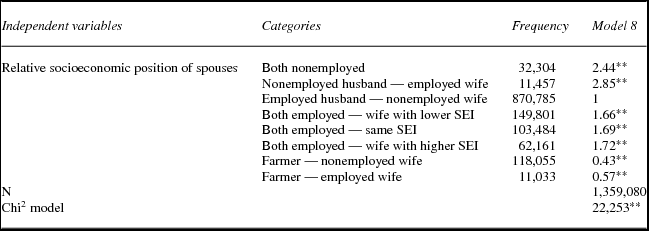
The influence of the relative socioeconomic positions of the spouses on the risk of divorce is tested in our last model, displayed in table 3. A main question in this paper is how the divorce risk varied between the couples who remained in a traditional single-provider family model compared to the rapidly increasing proportion of marriages that adopted a dual-provider model during the 1960s. To investigate this, we combined the SEI positions of the wife and husband to determine the extent to which relative difference and similarity in SEI position within the couple covaried with the probability of divorce. Previous research has usually concluded that couples in which the wife has a higher SEI position than the husband exhibit increased relative risks as compared to couples with similar SEI, as well as compared to couples in which the wife has a lower SEI relative to the husband (Jalovaara Reference Jalovaara2003; Tzeng Reference Tzeng1992). The model in table 3 controls for all the variables in Model 7 but replaces the separate SEI positions of wife and husband with a combined variable, in order to test the importance of relative SEI differences. The reference group is marriages with an employed husband and a wife outside the labor force. This is by far the largest combination of SEI positions, comprising 64 percent of the married couples in the data set.
Logistic regression estimates of the probability of divorce in 1960–65. Effect of relative socioeconomic positions on the probability of divorce 1960–65.a

a Model includes variables 1–9 in Table 2 as controls (not displayed).
** p. < .001 *p. < .05
The greatest increase in risk, with 2.8 times higher probability of divorce, is found in the group in which the husband is outside the labor force and the wife is employed. With this data set we cannot separate between different causes for nonemployment, such as long-term illness, being enrolled in education, or experiencing actual unemployment. However, theoretically we might expect that being nonemployed will tend to increase the probability of divorce, as all these categories will tend to experience lower incomes that in turn can be expected to increase strains in the relationship.
The high probabilities of marital breakdown among couples in which the husband is nonemployed have been firmly established in previous research on divorce in the Scandinavian countries during the 1980s and 1990s (Hansen Reference Hansen2005; Jalovaara Reference Jalovaara2003; Jensen and Smith Reference Jensen and Smith1990). Based on the theoretical argument of (Becker et al. Reference Becker, Landes and Michael1977), this effect is usually attributed to a husband's poor status as a dependable provider if he is not in employment, which in turn will decrease the wife's utility of the marriage. Scandinavian research has also paid attention to the fact that selection effects and unmeasured factors likely contribute to the positive effect of male unemployment on divorce (Hansen Reference Hansen2005: 139; Jalovaara Reference Jalovaara2003: 78). This is especially the case in a context like Sweden during the 1960s, when unemployment rates were very low; in 1960, only 1.4 percent of the workforce was affected (SCB 1961: 194). In a context of near full employment, in particular, being out of work becomes a proxy for various social problems such as long-term illness, drug abuse, and other risk factors that can be assumed to destabilize marriage. This selection effect will be even more accentuated due to the composition of the variable available in this data set that includes all types of nonemployed men.
Looking at the marriages in which both spouses are employed, there is little evidence of any marked effect of differences in the relative socioeconomic position among the dual-earner couples. Couples in which the wife has a higher SEI have a slightly higher probability of disruption than dual-earner couples in which the SEI of the husband is higher. The most evident relationship is that dual-earner marriages in general have approximately a 70 percent higher risk of divorce as compared to traditional single-provider families. Thus, the conclusion is that socioeconomic difference in terms of the husband making a greater contribution to the family economy decreases the probability of divorce. Adapting a dual-provider family model, then, clearly worked to increase the risk of divorce in Sweden during this period. Hence, it appears that the sharp increase in female labor force participation and the accompanying increased economic self-sufficiency of married women is one form of socioeconomic restructuring that contributed to the sharp decrease in marital stability in Sweden during the 1960s.
Discussion
The two central questions of this study are to what extent the decreased stability of marriage during the 1960s was associated with decreased economic interdependence in marriage, and a more symmetrically distributed access to divorce across socioeconomic groups. Although we cannot follow changes over time with a cross-sectional study like this, the findings do support the conclusion that economic self-sufficiency of wives was connected to increased probability of divorce in Sweden at a time when both female labor force participation and aggregated divorce entered its most intense growth period during the twentieth century. Also, comparing the results from this study with research on divorce determinants during the early twentieth century shows that a shift from a positive to a negative socioeconomic gradient of divorce had occurred by the early 1960s. The empirical findings thus support the theoretical points argued in both the specialization and trading model and the socioeconomic growth hypothesis and lends support to the notion that the increase in divorce during the 1960s was associated with a process of socioeconomic equalization between both the genders and the social classes.
During the first half of the 1960s in Sweden it seems as if dissimilarity, which placed the wife in a disadvantaged position with regard to cultural and economic capital, worked to promote marriage stability. The impact of relative differences between spouses is, of course, influenced by the attitudes promoted by the prevailing gender regime in society at any given time. In a context in which power and resources are asymmetrically distributed in favor of the male gender, an atypical distribution of social and cultural capital in favor of the woman can be assumed to destabilize marriage. This is apparent when it comes to the effects of age differences as well as employment status of the spouses in Sweden during the 1960s. Prevailing norms in Western culture have long regarded unions between younger women and older men as normal, while the opposite is less common and less accepted. In this study, this is reflected by the fact that the increase in divorce risk due to large age differences is much greater when the husband is the younger spouse in comparison to couples in which this asymmetry is in the opposite direction. Also, it is more culturally accepted for a woman to be economically dependent on a man than a man on a woman. Males who failed to live up to a male provider norm by not being gainfully employed had substantially higher probabilities of experiencing marriage disruption, especially if the wife in the couple was employed.
During the 1960s most married women were still housewives, although the norm that married women should stay at home had started to come under considerable pressure; married women opted to enter the labor market at a faster pace at this time than during any other period of the twentieth century. Structural changes in the labor market further contributed to female economic self-sufficiency as the wage gap between men and women decreased substantially during this period. In blue-collar occupations, the relative wage of female labor grew from approximately 70 percent of the male wage in 1960 to more than 80 percent in the late 1960s (Stanfors Reference Stanfors2003b, 43–56). The growing proportion of gainfully employed women who experienced improved relative wages had greater possibilities to act on a demand for divorce, because they did not experience the same economic constraints as women remaining in a traditional single-provider model. Women's increased economic self-sufficiency indirectly meant that the economic constraints to divorce were lowered for men as well. In practice, courts required men to pay maintenance after divorce only if the wife was incapable of supporting herself through employment (Special Advisers on Family Law [Familjelagssakunniga] 1972: 113). For the women who chose to embark on a life course that was more similar to that of their male companions, the result appears to have been that their marriages became less durable.
As observed by many scholars, it is likely that the destabilizing effect of decreased specialization in marriage is primarily relevant for the transition period from a single to a dual earner model when gender roles in the private sphere are still in a process of adapting to women's changed roles in the public sphere (Esping-Andersen Reference Esping-Andersen1999; Goldscheider Reference Goldscheider2000; Goldscheider et al. Reference Goldscheider, Oláh and Puur2010; Oppenheimer Reference Oppenheimer1997). There are several studies using more recent data from the 1990s and onward that do not find any simple positive association between the economic activity of the woman and marital instability, indicating that the determinants of divorce have not been stable over time and that the direction of effects might change due to changes in contextual factors. The Oppenheimer model, which assumes that the utility of marriage is highest when both spouses contribute to the income security of the household, might be a more adequate description of the relationship between economic independence in marriage and divorce in a setting where female employment has become the norm. However, our results show that the specialization and trading model does fit Swedish data well during the historical transition period from a low to high divorce rate regime, when it was still only a minority of married women who had shifted into gainful employment. It is plausible that the independence hypothesis and the specialization and trading model is better for describing these early adopters of an untraditional division of labor—who were at greater risk of experiencing marital conflict due to role strain—than contemporary dual-earner couples who negotiate in a setting where the gender regime has become more symmetrical. Hence, an explanation for the contextual and chronological differences in results regarding the effect of female economic independence might be the extent to which the gender regime has been transformed toward an institutionalized dual-provider model in a society at a particular point in time.
The results concerning the distribution of divorce risk across different socioeconomic groups also highlights the importance of a historical perspective on the long-term growth in divorce. We find that the association between socioeconomic position and divorce had become negative by the early 1960s, shifting in the manner suggested by the socioeconomic growth hypothesis. This supports the notion that a transition to a high divorce rate regime can only be established if the access to divorce is not socially exclusive. In this study, we find that by the early 1960s the relationship between social class and divorce indeed had changed so that males in the lower socioeconomic strata exhibited increased divorce risks relative to more affluent males. Thus, the democratization of the access to divorce seems to have been well underway by the early 1960s; in turn, it was a necessary precondition for the rapid increase in the divorce rate that occurred at the aggregate level during the 1960s and 1970s in Sweden.
With regard to the influence of the SEI position of the wife, the differences that stand out are the low probability of divorce for housewives and the relatively lower risk among middle white-collar women as opposed to other gainfully employed wives. The overall pattern is that all gainfully employed wives have a markedly higher risk of experiencing divorce as opposed to those outside the labor market. However, there is an interesting divergence exhibited by the females employed in the middle white-collar occupations, predominantly as teachers and nurses. The increase in the probability of divorce for these women is approximately half the increase found among other gainfully employed women when comparing with housewives. In previous research it has been argued that women in many middle white-collar occupations exhibit normative traits internalized as part of their professional roles that promote marriage stability. Such an interpretation is consistent with the findings of (Hoem et al. Reference Hoem, Neyer and Andersson2006) regarding Swedish women born in the 1950s that shows that women working in health care and teaching are both more prone to marry and have significantly higher marital fertility than do women in other sectors of the economy. They interpret these patterns as indicating a stronger family orientation among women in caring occupations, which might be the result of socialization during education and work life toward values that are conducive to family formation. Stanfors (Reference Stanfors2003b) comes to similar conclusions, arguing that women in these femininely coded occupations could more easily combine a traditional reproductive role with gainful employment: the particular organization of these occupations resulted in less role strain in their marriages as compared to other gainfully employed middle-class women. A possible historical explanation might also be that a more conservative normative culture persisted in these professions that worked to inhibit divorce. When these occupations were professionalized during the late nineteenth and early twentieth centuries, the professional roles incorporated ideals of strict morality and respectability. Employment as a nurse or an elementary school teacher usually required that a woman be unmarried, thus implying sexual chastity (Andersson Reference Andersson2002: 94–97; Florin Reference Florin1987: 194–98). Possibly, the historical development of these feminine caring professions and cultural preconceptions of respectability attached to the professional roles imposed greater normative constraints to divorce for women in these occupations during the early 1960s, which could help to explain the lower rates of divorce in this group.
An interesting result of this study is the increased probability of divorce among couples with children, and that this effect was more pronounced among dual-provider families. It is plausible that this link to same extent can be explained with mothers that anticipated divorce moved in to gainful employment “in advance” as the judicial process for most couples took at least one year to complete (Committee on Family Law 1964: 180–88). However, we argue that it is important to consider the role of differences in the institutional setting and the gender regime between the early 1960s and later decades when trying to understand the risk-promoting effect of children for employed women during this period. During the 1960s, children of preschool age were normally cared for in the home by their mothers; it was not until the 1970s that institutional arrangements for day care started to significantly expand in Sweden (SOU 1972). This made the gainful employment of both husband and wife more difficult to organize for families with preschool children than what would be the case during the 1970s and 1980s, when municipalities started guaranteeing low-cost day care (Hatje Reference Hatje2009: 178–95). The fact that married women entered the labor market at a rapid pace during the 1960s in Sweden, despite the lack of a developed institutional support system for dual-working families, is another possible explanation for the reversed relationship between children and the probability of divorce during this period. Furthermore, it is plausible that strains on marriage due to role conflicts were more accentuated in a normative climate in which the employment of married females—although rapidly increasing—was not yet a given choice and was still only practiced by a minority.
Decreasing family stability appears to be a fundamental demographic aspect of the development of modern society. Therefore, the question of family stability—and the factors influencing it—can be a powerful prism through which to view the structural changes Western societies underwent during the twentieth century. During the 1960s, Sweden entered a highly dynamic period of change in economic, social, and normative structures characterized by high economic growth, the establishment of the extensive Scandinavian welfare state, rapidly increasing female labor force participation, the sexual revolution, and the second wave of feminism. Another key aspect of the social development during the 1960s was a rapid increase in aggregate divorce rates—faster than during any other period of the twentieth century. The results of this study underline the importance of a historical perspective on family stability, as the determinants of divorce appear to have varied across different phases of the divorce transition during the twentieth century. Important determinants of divorce, such as socioeconomic position and the presence of minor children seem to have influenced family stability in Sweden in different ways depending on the structural setting in different time periods. This shows that it is not possible to extrapolate backward to gain a firm understanding of the changes in family stability, and that a historical perspective is necessary if we are to understand the long-term process that has produced current marital behavior.