Coralline red algae (Rhodophyta) are important reef builders (Bjork et al., Reference Bjoerk, Nohammed, Bjoerklund and Semesi1995) protecting these environments from wave erosion (Fabricius & De'ath, Reference Fabricius and De'ath2001). Due to their capacity to photosynthesize under low irradiance, they can be found from intertidal to subtidal zones up to 260 m depth (Littler et al., Reference Littler, Littler, Blair and Norris1985). Substrata-free living forms are known as rhodolith, maërl or calcareous nodules (Woelkerling, Reference Woelkerling1988; Foster, Reference Foster2001) and can accumulate on the sea bottom, buiding up large beds commonly known as maërl, rhodolith or coralline beds. Thallus architecture and bed structure create complex substrata providing niches of an extraordinary biodiversity, which is relatively poorly known (Barbera et al., Reference Barbera2003; Steller et al., Reference Steller, Riosmena-Rodriiguez, Foster and Roberts2003).
Rhodoliths have traditionally been exploited as a source of calcium carbonate and micronutrients being used especially as fertilizers and as organic soil conditioner, and in Europe these algae have been extracted by dredging since the 1970s (Grall & Hall-Spencer, Reference Grall and Hall-Spencer2003; Hall-Spencer, Reference Hall-Spencer2005). However, they are considered a non-renewable resource, since their growth rate is about 1 mm/y (Blake & Maggs, Reference Blake and Maggs2003). The harvest of thousands of tonnes per year in Brittany (Briand, Reference Briand, Guiry and Blunden1991) has led to proposals of legislation in an attempt to minimize the destruction of rhodolith beds. More recently, in England, the Board of Falmouth Harbour Commissioners, decided to cease the licensing of maërl extraction (Hall-Spencer, Reference Hall-Spencer2005).
In some regions of the Brazilian coast, rhodolith beds represent as much as 95% of the sea bottom, in which 22 species of Corallinales occur (Horta, Reference Horta2002). This reservoir of calcium carbonate is estimated at approximately 2 × 10¹¹ metric tonnes (Horta, Reference Horta2000) and according IBAMA—Brazilian Governmental Environmental Agency—between 96,000 and 120,000 metric tonnes are extracted per year in Brazil.
The accompaniment of some exploitation initiatives in south-eastern Brazil showed that the dredge process produced a plume of fine sediment, which may potentially amplify the impact on the remaining organisms and adjacent areas. In addition, the direct impact caused by the removal of the coralline bed (i.e. a decrease of the rhodolith population density) also threatens these environments. Wilson et al. (Reference Wilson, Blake, Berges and Maggs2004) suggest that burial by a fine sediment layer is lethal or causes significant stress on the species tested. Here we present an evaluation of the impact of a fine sediment cover on the oxygen production of a common species of rhodolith in north-eastern Brazil.
Fifty rhodoliths of Lithothamnion sp., of similar size and morphological type were collected randomly on a coastal reef at João Pessoa, Paraíba, Brazil (07° 04′ 24′′S 34° 49′ 33′′W) from around 1 m depth. Twenty litres of seawater and sediment from the adjacent area were also collected in plastic bags for the experiment.
The water samples were mixed and homogenized avoiding differences of temperature (26°C), salinity (34 psu) and pH (7.2) between the different treatments. The sediment samples were mixed, homogenized and dried for 12 h up to 100°C for the removal of organic matter. In the laboratory, each thallus was cleaned and transferred into 350 ml of seawater. After 24 h of acclimatization, four different treatments with three replicates were used to acquire the algae net rates of photosynthesis: (i) water and rhodolith; (ii) water, rhodolith and sediment; (iii) water; and (iv) water and sediment. For the treatments: (ii) water, rhodolith and sediment and (iv) water and sediment, 10 g of sediment were dissolved forming a thin layer with 0.13 (±0.04) mm.
The O2 production was measured using a microelectrode with low-stirring sensitivity (Revsbech, Reference Revsbech1989) and picoammeter (Unisense, Aarhus, Denmark). Prior to and following the experiment, the microsensor was calibrated in air-saturated and O2-free water (Visscher et al., Reference Visscher, Beukema and van Gemerden1991) at 26°C and 34 psu. The electrode was coupled to a micromanipulator, with a vertical resolution of <100 µm. The sensing tip was positioned within 200 µm above the surface of the seaweed, and the oxygen profile was measured upward from the thallus in treatments: (i) water and rhodolith and (ii) water, rhodolith and sediment. Three to five profiles were initially determined to account for variability. All the treatments were incubated under fluorescent light, 32 µmol photons m−2 s−1. The photon irradiance was measured with a quanta meter (LiCor LI 250A and spherical PAR quantum sensor LI190; LiCor, Lincoln, NE, USA). For acquiring the light attenuation the tip of the quanta meter was positioned under three recipients with water and the sediment layer and the respective control.
The net photosynthesis (gross O2 production corrected for water-only controls) of the rhodoliths was calculated by subtracting the average O2 production of the plankton from the total amount of oxygen produced in each treatment, adopting the method described by Roberts et al. (Reference Roberts, Külh, Glud and Rysgaard2002). The gross production was calculated by determining the photosynthetic oxygen flux of the coralline algae using the microprofiles. The net productivity—J(x)—of the rhodolith is equivalent to the flux of oxygen across the seaweed–water interface, and was calculated from the oxygen gradient in the diffusion boundary layer (DBL) at this interface. J(x) =−D0 δC/δx; where D0 represents the diffusion coefficient of oxygen in water and δC/δx represents the oxygen gradient in the DBL, ca. 200 µm above the thallus surface. As mentioned above, the thickness of the boundary layer was assessed prior to the incubations by measuring three to five O2 microprofiles under non-stirring conditions, starting at the surface of the thallus, moving the electrode away in ca. 100 µm increments, and this was repeated in ca. 200–250 µm increments during the experiment in order to maximize the number of observations within the incubation period. The thickness of the DBL under our experimental conditions was 0.2–0.25 mm, based on observations made by Roberts et al. (Reference Roberts, Külh, Glud and Rysgaard2002). A D0 value of 20.9 103 m−2d−1 was used, as calculated by Broecker & Peng (Reference Broecker and Peng1974). The Cochran's test was used to evaluate the homogeneity of variances and analysis of variance was used to check whether the O2 production was different between the treatments (Zar, Reference Zar1999).
The average gross production for Lithothamnion sp. production without a sediment layer was 13.27 (±0.88) µmol l−1 significantly greater (P < 0.05) than the production of the covered thallus 4.56 (±0.97) µmol l−1. There were no significant differences for the gross production of the plankton controls. The average net productivity of Lithothamnion sp. without the sediment cover was 104.45 (±21.70) mmol O2 m−2 thallus d−1, being significantly greater (P < 0.05) than the covered treatment (30.69 (±10.16) mmol O2 m−2 thallus d−1.
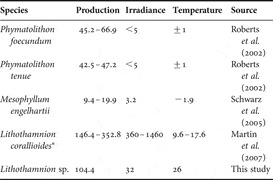
Under experimental conditions, the Lithothamnion sp. production was lower than the value reported for other common tropical fleshy seaweeds (Ursi et al., Reference Ursi, Pedersén, Plastino and Snoeijs2003; Necchi, Reference Necchi Junior2004), however, it was under the observed variation for coralline algae (Table 1).
Values of primary production (mmol O2 m−2 thallus d−1) from some species of coralline algae in different irradiances (μmol photons m−2 s−1) and temperatures (°C).

* In this study the authors used chambers to measure the community production, however this species was dominant at the study site.
The production of Lithothamnion sp. was lower than that measured for L. corallioides from France, however, the values reported in the French study, which exceeded 350 mmol O2 m−2 thallus d−1, were obtained with an irradiance higher than 350 µmol photons m−2 s−1, while in the present study, the irradiance was 32 µmol photons m−2 s−1. So, the production was similar to other values observed in production–irradiance curves for Lithothamnion (Martin et al., Reference Martin, Clavier, Chauvaud and Thouzeau2007). In addition, the values in this research were higher than the ones described for other coralline species analysed under different temperatures and irradiance such as those observed for Phymatolithon from the Arctic (Roberts et al., Reference Roberts, Külh, Glud and Rysgaard2002) and for Mesophyllum engelhartii from Antartica (Schwarz et al., Reference Schwarz, Hawes, Andrew, Mercer, Cummings and Thrush2005).
The use of oxygen microelectrodes to estimate the rate of photosynthesis has been previously acknowledged (Revsbech & Jørgensen, Reference Revsbech and Jørgensen1986; Pinckney et al., Reference Pickney and Zingmark1991; Epping et al., Reference Epping, Khalili and Thar1999; Roberts et al., Reference Roberts, Külh, Glud and Rysgaard2002). The relatively rapid response of the sensor enables comparison of multiple replicates and several different experimental treatments, as used in this investigation. Under laboratory conditions (with constant temperature and light), this enabled a direct comparison of seaweed that were exposed to light to those covered by a thin film of sediment. This increased our understanding of the impact of direct sediment cover of the thallus on photosynthetic rates, and, hence, growth rate and Lithothamnion sp. health. In situ measurements using a bell jar or other techniques would not have allowed for separation of multiple environmental conditions that impact upon the O2 production (Wolff et al., Reference Wolff, van der Land, Nienhuis and de Wilde1993).
The addition of sediment resulted in a reduction of 70% in the Lithothamnion sp. net production. This pattern was expected, since the deposition of the sediment resulted in a decrease of the irradiance which is available for photosynthesis. Although our experimental conditions resulted in a decrease of ca. 30% with the irradiance available, the reduction in productivity was twice as large. We hypothesize that the sediment deposition does not just reduce the available light, but that it can also hinder the supply of nutrients and the exchange of gases, indispensable for the maintenance of the primary metabolism of these seaweeds (Lobban & Harrison, Reference Lobban and Harrison1997). Wilson et al. (Reference Wilson, Blake, Berges and Maggs2004) described a significant reduction in the chlorophyll fluorescence in treatments that were covered by a thin layer of sediment. According to these authors, the light was filtered by the fine sediment particles in suspension which caused the death of the organisms after two weeks of incubation. These results reinforce our hypothesis about the reduction in fitness resulting from the sediment cover. The decrease in both net and gross production rates resulted in a significant decrease in the oxygen production rates of the tested species, clearly demonstrating that burial by a thin sediment layer has a negative impact on the rhodolith species. Such effects should be included in future studies that focus on environmental impacts of dredging activity, whether they are linked to the extraction of these coralline algae or not.
ACKNOWLEDGEMENTS
The authors thank UCONN, CAPES, and CNPq, for financial support and Eduardo Godoy (IBAMA—Brazilian Governmental Environmental Agency) for information on rhodolith exploitation status. The manuscript was enhanced by comments and suggestions of two anonymous referees and by George Bower.