From miniature poodles to Great Danes, from bulldogs to Afghans, pedigree dogs have been powerful instruments in the articulation of nation, gender, and class. Human relationships with the animal kingdom can illuminate the historical construction of culture through ritual, spectacle, husbandry, and conspicuous consumption, and the practice of dog breeding has been shown to be a rich arena for the expression of social identity through its competitions of hierarchy and heredity.Footnote 1 However, pedigree animals are not only corporeally shaped by their human breeders, but characteristic temperaments are also constructed and then naturalized in the most fundamental sense, in the form of a living, breathing, breeding creature. Breed histories can also function as a form of commemoration and celebration of very specific moments in colonial encounters, an aspect of mythmaking that is particularly pronounced in the story of the Pekingese in Britain. It is this naturalization of form and reputation under the sign of nation, together with the close and often emotional associations between owner and animal, that renders the pet dog an extremely potent object in the study of British femininities.
Lady Gooch with Pekin Yen (Ladies' Field, 31 August 1901, 489)

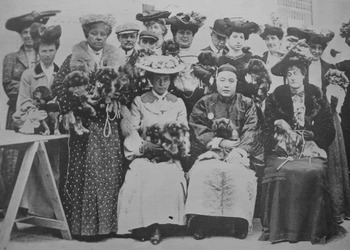
Early twentieth-century Pekingese (peke) dog breeding, showing, and mythologizing in Britain was a resolutely feminine, upper-class, and “Chinese” affair. In 1901, Mrs. Albert Gray held a “Pekingese Spaniel ‘At Home’” in her London residence, at which “nearly all the best” pekes in Britain were seen (fig. 1).Footnote 2 The dogs were tethered on the lawn, tea was served, and the Chinese ambassador himself was present, allegedly pronouncing one of the dogs so valuable that in China it would only have been allowed out with a guard of eunuchs. While other Chinese breeds were available, the Pekingese was a relative novelty compared to the pug or the chow and became an immensely fashionable lady's lapdog during the first three decades of the twentieth century. Between 1914 and 1962, the Pekingese was the most popular breed of pedigree toy dog in Britain.Footnote 3 However, as the peke was believed to have had an exclusively Imperial origin within the secret spaces of Chinese palaces, it also possessed a strong appeal as a souvenir of Old China—the mystical, impenetrable, and incomprehensible China of emperors and mandarins, which seemed to have fast receded before the tide of nineteenth-century foreign military incursions and was ultimately replaced by a Westernizing Chinese republic in 1911.
Since the China trade of the seventeenth and eighteenth centuries, direct contact via shipping between Europe and China had brought Chinese goods such as tea, silk, ceramics, and wallpapers to Britain. These were initially luxury rather than practical products, and even though tea and porcelain became fairly ubiquitous, China connoted the wonderful, the decorative, the extravagant, the exotically useless, and the morally suspect. This association of Chinese things with leisure and pleasure, often in excess, is underscored by the use of eighteenth-, nineteenth-, and twentieth-century European and American chinoiserie in spaces of popular and elite leisure, such as public gardens, cinemas, royal palaces, and stately homes, and also by the vilification of female consumers of porcelain as irrational and by the nineteenth-century Aesthetic movement's celebration of blue and white china as effete.Footnote 4 The Qing government had strictly regulated the China trade through the Canton System in the eighteenth century. This prevented Western incursion into Chinese territory and controlled not only customs duties but also Western contact with Chinese producers and consumers. Diplomatic attempts, such as the Macartney Mission of 1792, failed to open up reciprocal markets in China for Western industrially produced goods, but it was Chinese opposition to British opium, grown in Bengal and smuggled illegally into China by European and American companies, that ultimately became the issue for armed conflict under the rubric of free trade. In the Opium Wars of 1839–42 and 1856–60, China was defeated and forced to sign treaties with Britain, France, the United States, and Russia. These granted the Western powers ever-increasing trading rights and established the fifteen treaty ports where Europeans and Americans enjoyed immunity from Chinese jurisdiction, producing a semicolonialism concentrated along the coast at key mercantile and military sites. The suppression of the Boxer Uprising (1900), a popular rebellion against the foreign invaders that was supported by the Chinese court, further increased China's subjugation and even led to fears that China would be partitioned by Britain, Russia, Japan, and Germany. Destabilized by civil as well as colonial strife, Imperial China was becoming a thing of the past. The humiliation of China was underscored by Western use of the Forbidden City during the temporary flight of the empress dowager from Beijing in 1900, when curious Western travelers could tour the palaces, try out the Imperial throne, and even lie down on the emperor's bed.Footnote 5
These acts of Western imperialism maintained the significance of Chinese Imperial spaces and material culture through a constant evocation of the absent Chinese court, as James L. Hevia and Craig Clunas have so effectively explored.Footnote 6 Nostalgia for Old China also played an important role in the maintenance of China as a mysterious and alluring location at the turn of the twentieth century, when China was subjected to forms of Western colonialism that have been dubbed “a Chinese Raj.”Footnote 7 Chris Bongie has proposed that the rapid expansion of European colonialism aimed to achieve a global hegemony of Western civilization while simultaneously privileging exotic territories as a refuge of the exotic, so that colonialism, like modernity, produced exoticism by threatening to erase the exotic.Footnote 8 In this self-defeating and self-perpetuating quest, it would seem that early Pekingese dog ownership in Britain was a very feminine form of that colonial yearning, fixated on a China that predated Western invasion. At the same time, it was said that these dogs were obtained by Westerners through forced interactions with the Chinese court, using physical or diplomatic violence, so that the very presence of pekes in Britain profoundly contradicted such fantasies, producing an even greater investment in the preservation of memories of Old China.
The early years of the twentieth century marked a crucial period in the founding of the breed and its associations by a small, elite, and feminine circle. The foundations of Pekingese dog breeding in Britain constituted a form of colonial nostalgia that was mediated by women, in which the ownership and shaping of the Pekingese was an important expression of upper-class and imperialistic British femininities. Within this realm of nostalgia, the dogs functioned as potent souvenirs, linking metropolis and colony through close connections between colonial conquest, sentimental pet rearing, and domestic spaces.
Imperial Histories/Imperial Mythologies
It is important to appreciate that the peke's status as an animate (rather than inanimate) being was used to greatly enhance its capacity as a memory-bearing object in terms that were certainly anthropomorphic and highly sentimental but yet worthy of serious consideration.Footnote 9 Memory, as a process of “emotional and historical sedimentation,” is often accumulated in personal objects. However, because they are located in the private realms of the sensorial, they occupy a marginalized social position.Footnote 10 The Pekingese dog, as a small, cute, and furry pet, stands in danger of dismissal as a sentimental and therefore “inauthentic” object, a problem that is magnified by Modernism's antipathy to anthropomorphism in art and literature. With inanimate objects, their potency as souvenirs is directly related to the owner's ability to recall their participation at that particular time and place when the object was obtained. Thus, with the exception of the heirloom that retains its story and hence its relevance to the family, when souvenirs pass out of the hands of their original owners, their “set of referents” and hence their power is lost.Footnote 11 However, living dogs can be bred to produce more living dogs, and by imbuing each one with an anthropomorphic capacity to remember, memories of China and hence narratives of colonial acquisition could also be kept alive and passed on from owner to owner.
The Pekingese was constructed as capable of race memory, with some aficionados claiming that Pekingese dogs reared in Britain disliked thunderstorms because they actually remembered tropical typhoons or that tawny pekes would not mate with pekes of other colors because the dogs themselves were conscious that yellow was the sacred color of the Chinese emperor and empress.Footnote 12 This colonial nostalgia, projected onto the animals, enabled an array of incredible assertions to be indulged within an orientalist fantasy of exotic palaces and silk-clad mandarins. These may seem ridiculous, but given the importance of notions of human selective breeding and racial purity, and the essentialist class and race hierarchies that underscored eugenicist projects at home and colonial projects abroad, it was considered only natural for a Chinese palace dog to exhibit what was thought to be aristocratic Chinese behavior as an innate or instinctive aspect of its breeding.Footnote 13 Therefore, by virtue of their animation, Pekingese dogs came to constitute extremely powerful and unfading souvenirs of Old Imperial China. Anne Coath Dixey's 1931 history of the breed reminded readers time and again that these dogs could never be regarded as ordinary. “How many people realize, as they walk abroad with that most uncannily clever four-footed friend, that they are in the company of one of an imperial race of the loftiest lineage, a race that for hundreds of years was never set eyes on by any but the most privileged persons of the royal court, a race that less than a hundred years ago was shrouded in mystery, the subject of endless speculation by Chinese and foreigners alike? … We of a modern civilization may be unaware of this, but the proud little Pekingese never forgets.”Footnote 14 Such notions of a Western modernity animated by a living talisman of Chinese antiquity were actively set in place by the early British breeders.
The story of how pekes first came to Britain was absolutely inseparable from the story of the looting of the Summer Palace (Yuanmingyuan) by Franco-British troops in 1860, when Chinese Imperial material culture was seized and redistributed in Europe under the sign of righteous conquest during the closing stages of the Opium Wars.Footnote 15 The Summer Palace was a complex of eighteenth-century gardens and villas near Beijing, built in a European style for Emperor Qianlong, and during the looting it was ransacked and then burned to the ground. Much of its contents subsequently entered the art markets of Europe and America as items of curiosity, ownership of which could demonstrate, among other things, the superiority of modern France and Britain and the corresponding decline of the Chinese civilization. The possession of objects relating to the Chinese emperor, therefore, bore a special mark of colonial relation constructed through a myriad of transactions as soldiers purloined, dealers bought and sold, and officers presented to museums and royalty, creating a potentially alternative “oral history of plunder” centered around objects rather than official records.Footnote 16
Accounts vary in detail, but generally agree that during the looting, five Pekingese dogs were found abandoned in the royal apartments of a Chinese empress. Two were taken by a naval officer, Sir George Fitzroy, who eventually gave them to his cousin, the duchess of Richmond. Another pair were secured by Admiral Lord John Hay (brother-in-law to the duke of Wellington), and a fifth was carried off by General Dunne. This last, a fawn and white bitch, was presented to Queen Victoria and was the brazenly named Looty, whose portrait was painted by W. F. Keyl (1823–71), exhibited at the Royal Academy in 1862, and then hung in Windsor Castle.Footnote 17
Thus, Pekingese dogs were apparently first discovered by Westerners among an array of Chinese fans, furs, precious stones, textiles, ornaments, furniture, and weaponry that retained a Summer Palace connection as their main point of interest. However, the dogs could not be auctioned off, traded, collected, or exhibited in quite the same way as the rest of the loot and indeed could not be treated as fine art, applied art, or precious materials. Small lapdogs were a luxury item relating specifically to women and fashionable life. While Hevia has demonstrated that loot was used to cement class as well as colonial relations in the production of masculine colonial subjects, the Summer Palace story of the Pekingese dog reminds us that once these looted goods reached Britain, they were also consumed by women as collectors, as museum and exhibition visitors, and as the recipients of souvenirs of an empire that could be used to decorate the home.Footnote 18
The duchess of Richmond and the duchess of Wellington both tried to breed the Summer Palace dogs they had been presented; however, in order to produce a healthy British line, fresh blood was required. Two more dogs were sent to England in 1885 by the commander in chief of the China station, Admiral Sir William Dowell, and during the late 1880s or early 1890s, George Brown (vice consul in China) is also said to have brought in good dogs and bitches.Footnote 19 However, the most significant imports appear to have been Pekin Peter in 1893, and Pekin Prince, Pekin Princess, Ah Cum, and Mimosa in 1896. These dogs provided the actual foundation for the breed in England, appearing in nearly all the earlier pedigrees, so that the real contribution of the Summer-Palace five may well have been more mythical than material.Footnote 20
The later importations of the 1890s were accompanied by further colorful tales of Chinese intrigue, duplicity, and danger. If pekes were seen as the closely guarded dogs of the Chinese Imperial court, then the only ones that could be regarded as pure in pedigree would have to be stolen by unscrupulous Chinese working within the palaces. Stories of the penalties suffered for such an act evoked Chinese despotism and cruelty, becoming an immediate part of the breed's identity. One of the earliest published articles on the peke, which appeared in the women's magazine Ladies’ Field in 1901, stated: “You might as well ask a Chinaman to give you his pig-tail as his dog—either would be an impossibility. … The plain truth is they have to be stolen, and it often takes months before a favourable opportunity offers. The Chinaman, though wily and utterly regardless of life where money is concerned, prefers to bide his time and do the thing properly, thus saving his head, which, if detected, he would be sure to lose.”Footnote 21 Pekin Peter was imported by H. Loftus Allen, the captain of a merchant vessel, for his wife, Minna, who was already breeding and showing the Japanese spaniels he obtained for her directly from east Asia.Footnote 22 Loftus Allen bought Pekin Peter from a Shanghai taxidermist whose concern for secrecy was taken to mean that the dog had somehow been stolen from a palace. When Pekin Prince and Pekin Princess were obtained in 1896, they were also said to have been stolen from a palace, this time by a palace eunuch who was a friend's groom's brother.Footnote 23 Mrs. Douglas Murray's breeding pair, Ah Cum and Mimosa, were acquired by her husband, for which he was credited in Who's Who.Footnote 24 The dogs were advertised as smuggled out of the city while hidden in a crate intended for the wild-animal market. Ah Cum tends to be seen as the “patriarch of the breed in England,” and on his death in 1905 he was stuffed and presented to the Museum at South Kensington, finally to be archived as a piece of official British history.Footnote 25 The peke's status as a valuable Chinese rarity and important cultural artifact was thus confirmed, and along with other looted goods from China, the Pekingese was entered into the “Museum's larger mission of cultural self-definition.”Footnote 26
As with the looted dogs from the Summer Palace, dogs like Ah Cum represented a breeding standard not only because they were stolen goods but also because their need to be stolen guaranteed their status as desirable animals. It is certainly possible that early imports were crossed with Japanese spaniels, and records were not always kept. Breeders therefore liked to insist upon a stolen-from-the-palace pedigree to maintain a healthy yet restricted gene pool, and dogs such as Pekin Prince were celebrated as “well known in high Pekingese society.”Footnote 27 However, there is evidence that Pekingese dogs could also be bought at Lamaist temple markets, and Japanese arts, crafts, and antiques dealer Yamanaka Sadajiro was also importing pekes to Britain and America in 1903 in response to the demand and the profits to be made.Footnote 28 One could therefore speculate that other potentially suitable dogs were overlooked, so far as the writing of breed histories was concerned, because they had been obtained quite legally and were therefore not of interest.
Other famous pekes were obtained as diplomatic gifts in exchange for British services rendered to an increasingly beleaguered China—a China that could no longer afford to hang on to its dogs. In 1898, the famous statesman Li Hongzhang presented a pair of fawn and white pekes to Colonel Heuston, an Irish officer in the Royal Army Medical Corps who had founded a medical school in China.Footnote 29 That year also saw the issuing of a string of Westernizing reform decrees in China, the climax of the self-strengthening movement supported by Emperor Guangxu but opposed by Empress Dowager Cixi. However, following the Boxer Uprising of 1900, Cixi herself was forced to surrender to the demands of Westerners and Westernizers, and gifts of Pekingese dogs again formed part of this capitulation.Footnote 30 Other diplomatic exchanges were less delicately arranged. During the Boxer Uprising, when the palace was surrounded by Western allied forces, Major Gwynne offered safe conduct to Prince Qing if the prince would bring out two Pekingese dogs and give them directly to the major, giving the animals an incontrovertible royal palace provenance.Footnote 31 Thus it was that Mrs. Gwynne came to show a large red dog called Glanbrane Boxer and a bitch named Poongi at the Toy Dog Society Show at the Crystal Palace in May 1903. Surprisingly, no mention was made of their acquisition at gunpoint. It was reported that they were just out of quarantine, that Boxer was very large, and that Poongi's black coloring made her “most highly esteemed in China, where they are the very especial property of the ladies of the Palace.”Footnote 32 Thus, the dogs’ most salient detail in 1903 was that they had recently come from the Chinese court, and while the focus remained on obtaining the unobtainable, the omission of the Prince Qing story may point to the creation of another myth.
The very activity of drawing up points for a breed standard required the gathering of Chinese data with the sole aim of describing, deciding, and then inscribing the Pekingese dog's characteristics, so that it would not then deviate from a British standardized ideal of what was Chinese. Breeders were very dependent on visiting Chinese officials and residents of China to tell them what the correct standards for a Pekingese dog actually were. Prime Minister Li Hongzhang himself has been credited with imparting the first information on the Imperial history of the dogs to Colonel Heuston, and Li also presented some pekes to Sir Halliday Macartney, who was in service to the Chinese government in the 1870s. When new breed points were drawn up in 1900 by Lady Algernon Gordon-Lennox, Mrs. Douglas Murray, and Mrs. Albert Gray, they were sent to the Chinese minister in London (“Sir Chihchen Lufengluh”) for his seal of approval. Sir Halliday reported that in the minister's opinion, the average weight of a “well-bred Palace dog” should be five to six pounds, not eight to nine, and so two classes were established, dividing the larger dogs from the smaller, more “authentic,” dogs.Footnote 33
A close circle of army officers, merchants, travelers, diplomats—and, crucially, their wives—were responsible for the establishment of the Pekingese dog in Britain. Mrs. Albert Gray, the giver of the Pekingese dog garden party of 1901, had lived in China when her husband was in the diplomatic service, and her father was S. Wells Williams of the U.S. legation in Beijing, the author of numerous mid-nineteenth-century publications on China.Footnote 34 The Douglas Murrays's first introduction to the breed had been via the consul general at Guangdong, Sir Chaloner Alabaster, and Vice Consul George Brown was regarded as an authority on the breed, his advice being keenly sought while he was in Britain.Footnote 35 They were also typical contributors to the British imperial archive on China, whose nineteenth-century institutions have been defined as the British legation in Beijing, the Imperial Maritime Customs, and the Royal Asiatic Society, to which the Pekingese breeding clubs could be added as early twentieth-century sites for the collecting and decoding of knowledge about China.Footnote 36
Problems in Femininity, Authenticity, and China
During the 1890s, pekes were still unrecognized by the Kennel Club in Britain and had not even been officially named. They were referred to as “Chinese spaniels” or “pugs,” and it was in fact the Japanese Spaniel Club that, in 1898, drew up the breed's first set of points, reflecting a late nineteenth- and early twentieth-century tendency for Japanese and Chinese art, ceramics, commodities, textiles, and clothing to be considered within the same frame. However, 1900 marked a turning point, when the Japanese and Other Asiatic Spaniel Association was formed. In 1901 a Pekingese (Pekin Peter) won the Open Class at Crufts, the breed having finally been recognized by the Kennel Club, and there were also showings at the People's Palace Pet and Foreign Dog Show and at the Richmond Show.Footnote 37 In 1904 the Pekingese Club was formed.
The timing of this new awareness and official recognition of the breed thus coincided with the Boxer Uprising of 1900 and its suppression by Western forces, and in the context of the news stories of the relief of besieged legations at Peking and the victorious penetration of the palaces within the Forbidden City, the name of “Pekingese” dog takes on an added significance. A speculative analysis suggests that pekes became of interest from 1901 because colonial warfare created the sense of contemporaneity as well as the opportunity to make a pet fashionable, and there was now a viable breeding population in Britain. At the Toy Dog Society Show at Crystal Palace in 1903, it was reported that Asiatic dogs had “caught on,” and that the Pekingese, which had been practically unknown a few years earlier, had had their largest ever entry, giving four hours of judging.Footnote 38 By 1906 the Crystal Palace Toy Dog Show had thirteen classes for pekes, each of which was well filled, and in 1907 the Ladies Kennel Association Show had a Pekingese entry of 213, which was not regarded as out of the ordinary.Footnote 39 In 1908 there were 562 new Pekingese registrations with the Kennel Club, making the peke the second most popular toy dog, placed above the pug, the Yorkshire terrier, and the King Charles spaniel.Footnote 40
The vast majority of these Pekingese dog owners were women.Footnote 41 As a new point of reference within the imperial archive, Pekingese dogs offered British women a significant agency in the defining of China as a semicolonial possession, and myths and stories about the dogs' Imperial history played an important role in their development as fashionable. Fashionable breeders, such as Mrs. Andrews, whose kennels had originally bred pugs and then Japanese spaniels, turned to pekes, having “succumbed to the popular fascination.” In the space of a short decade, the Pekingese dog had gone from being a very rare and curious import to the breed of choice for smart British women.Footnote 42
This initial period of interest was charted in the pages of Ladies’ Field. A widely available weekly journal with a large circulation, Ladies’ Field offered aspirational middle-class readers the opportunity for vicarious enjoyment of upper-class lifestyles. Its pages reveal the complex nature of feminine social identities constructed through shopping, sporting, fashion, the arts, and paid employment, in relation to suffragism and imperialism.Footnote 43 As part of its society news, the journal provided pictures of Chinese statesmen and their families, especially when in London.Footnote 44 It also published topical images of Chinese scenes, such as photographs of military troops, hospitals, and memorials in China, and articles on the lives of Chinese and British residents.Footnote 45 The possible connection between interest in Pekingese dog stories and interest in events in China was also noted by one anonymous correspondent, undoubtedly a member of the Pekingese dog circle:
I have been told that Li Hung Chang [Li Hongzhang] always carries one of these midgets in his sleeve. Report tells us that when he visited this country some years ago the poor little thing fell out one day and sustained serious injury to one eye. As the great man would not own or carry about with him one that was not perfect he presented it to a gentleman of his acquaintance. This story has been told me by various people, but I have never been able to trace either the dog or its present owner, and, therefore, am inclined to think it is only a little piece of fiction, especially as it will be remembered that there were a great many dog stories circulated at the time of the great statesman's visit, many of which have been resuscitated from time to time as occasion offers since the Chinese crisis.Footnote 46
The positioning of a Pekingese dog up the sleeve of the Chinese minister, together with a clear awareness of the political circumstances that gave rise to both contact with and interest in China, assigns a surprising degree of colonial sensitivity to the Ladies’ Field's canine reporting.
The magazine also used the subject of dog breeding and showing to foreground gender politics. In 1905, it printed an angry response to an article in the Field, which had mourned for the “good old days” when there were, among other things, fewer female competitors at dog shows.Footnote 47 The Ladies’ Field accused the Field of being reactionary, while admitting that there had been a recent “craze” in which “lady exhibitors swarmed to the front … utterly swamping the male element.” The Ladies’ Field also made a number of separate attacks on the Kennel Club, which was charged with being disorganized, easily antagonized, and “so unflinching in its rather unnecessarily anti-suffragette sort of loftiness,” whereas the new Ladies’ Branch was said to be “conducted on thoroughly businesslike lines [and] certain to be a lasting success.”Footnote 48 An editorial in the weekly journal Our Dogs dubbed women dog-show judges “doggy suffragettes,” saying that because up to forty percent of Kennel Club exhibitors were female, the Kennel Club could not expect to resist the “tide of the great sexual emancipation and development of the times.”Footnote 49
While it cannot be suggested that the breeding of Pekingese dogs constituted an act of feminism, establishment attitudes as represented by the Field and the Kennel Club tended toward a masculinist dismissal of the breeds associated with women. This was in turn associated with issues of female emancipation by the Ladies’ Field and others, so that dog breeding and showing emerges as a contested area in which the presence and prominence of women produced a marked sense of change and modernity. Pekingese dog breeding itself was certainly a forceful feminine enclave in the previously masculine territory of the dog show arena. The Pekingese was classed as a toy breed, suitable for ladies, and women were still unable to join the Kennel Club as members and so were segregated within a newly formed Ladies’ Branch and a separate organization, the Ladies’ Kennel Association.Footnote 50 Therefore, men who did participate in Pekingese circles would have found access to many important shows problematic, so that nearly all of the handful of men involved with pekes were part of a husband and wife team. The first president of the Pekingese Club, formed at the Chelsea home of Mrs. Albert Gray, was Lady Algernon Gordon-Lennox, and the other twenty-nine founding members were predominantly female.Footnote 51 In addition, although dogs shows were generally under male management, the Pekingese ring was very often stewarded and judged by women.Footnote 52
It would seem, therefore, that in the Pekingese dog world, women predominated at an organizational and participatory level. Indeed, in the writing of British Pekingese dog histories, a key moment in the breed's foundation is a possibly apocryphal account of how Lady Algernon Gordon-Lennox caught sight of Mrs. Douglas Murray's pekes and dashed down a London street after them; the two women then combined the Goodwood strain with the fresh blood of Ah Cum and Mimosa.Footnote 53 Mr. Douglas Murray and Mr. Loftus Allen may have been credited for Chinese importations; however, their possible contributions to the breed once on British soil were obscured by the activities of their wives in a feminine breeding and judging circle. It was Mrs. Douglas Murray and Mrs. Loftus Allen who received status, exposure, and control in the upper-class Pekingese breeding set and beyond through the pages of Ladies’ Field that further marginalized male participation by the practice of reporting only female achievement.
As an object of feminine empowerment, the peke's Imperial history was an extremely important and defining element. The legendary Chinese palace genesis was at the forefront of their identity as “high-born” animals, and so, like living imperial heirlooms, they conferred “high-born” status upon their mistresses. The durable heirloom effect could also be doubled by referencing the past Pekingese dog ownerships of Chinese emperors and empresses, particularly Cixi (1835–1908) whose late nineteenth-century prominence as empress dowager invited interesting parallels with Queen Victoria. It was speculated that Pekingese dogs had been kept by the Chinese court since the eighth century, but using Cixi as an exemplar enabled the British dog set to indulge a model of antiquarian Chinese Imperial ownership that also had contemporary authentication. Cixi's importance to British breeders was further increased by the constant circulation of a piece of writing attributed to her on the subject of the care and ideal appearance of Pekingese dogs.Footnote 54 This work described the dogs as dining on shark's fins and curlews’ livers, biting “foreign devils,” and venerating their ancestors. Instructions that, for example, ears should be “sails set like a War Junk” were regarded as both “apropos and quaint.”Footnote 55 The flowery prose, its provenance entirely unproved, reproduced existing stereotypes of Chinese culture and character (e.g., peculiar culinary delicacies, xenophobia, and ancestor worship) to provide an entertaining read that doubled as serious information on peke breeding, on Cixi herself, and also on the dog's wider cultural significance for its Western owners.Footnote 56 Cixi was still living, and since visiting dignitaries’ wives could attest to the continued existence of both Cixi and her dogs, she functioned as an anachronism that secured the Chinese palace's identity as the site of the breed's genesis. This also maintained China as a static location of exotic antimodernity and Western imperial domination.
The narrative of the souvenir substitutes “a context of perpetual consumption for its context of origin. It represents not the lived experience of its maker [the Chinese emperor or empress] but the ‘secondhand’ experience of its possessor/owner [the British lady].”Footnote 57 Hence, by reference to Cixi, British women inserted themselves into the Pekingese dog's narrative or, rather, adopted that narrative as their own, displacing the original Chinese Imperial owners in a very colonial form of appropriation. Victoria, as empress of India, had made increasing use of “oriental” ritual, color, and splendor to effect a colonial rule in which national identities were translated into imperial identities.Footnote 58 In China, from 1900 onward, the Western powers were reshaping the Chinese Imperial court along the lines of Western models of national sovereignty that could be more readily dealt with, but which would not accord the Chinese emperor with too much symbolic status. This was also partly achieved by a Western appropriation and control of Chinese court etiquette where interactions with Western dignitaries were involved and by the refiguring of the Chinese emperor as “a mere symbol of an archaic form of power.”Footnote 59 The constant invocation of Cixi within canine literature as both “apropos and quaint,” the retrospective importance placed upon the Summer Palace dog Looty (who had not in fact been of any particular interest to Victoria), and also the celebration of Queen Alexandra's affection for her own Pekingese, Little Billee, does not reflect merely this requirement for colonial control over China through negotiated systems of governance.Footnote 60 The simultaneous deference to and supplanting of Cixi by British ladies through the discussion of dogs highlights the fuller breadth of colonial strategy, located just as strongly within the domestic, the sentimental, and the metropolitan, where women could be richly invested in colonial rule.Footnote 61
The class identity of the Pekingese dog set should not go unchallenged. Through the use of colonial nostalgia, it appears that women were able to constitute themselves and the Pekingese dogs both as the rightful inheritors of colonial wealth and as aristocrats. Owners who were many times removed from the original scene of importation could therefore still retain some connection to palace status through the lineage of the purebred Pekingese, substituting dog ancestry for human ancestry. This holds particularly true if we consider that the earliest owners in Britain tended to be wealthy members of high society, making Pekingese shows into society occasions.Footnote 62 However, this was also an era of decline for the British aristocracy, whose social and economic power was being undermined by the rise of a rich upper-middle class who were blurring the social boundaries, so that demonstrations of gentility took on an extra significance.Footnote 63
The activities of the Pekingese Club were reported in the Court Circular column in The Times, and descriptions of club president Lady Algernon Gordon-Lennox's dogs oscillated between confirmation of the animals’ high pedigree and confirmation of her own.Footnote 64 By contrast, another fashionable high society owner of Pekingese dogs, Mrs. Ronald Greville (1863–1942), was of more humble origins. The daughter of a wealthy Scottish brewer, she nevertheless became a powerful Mayfair hostess, an example of how the nouveau riche could acquire all the material trappings of a landed status and entry into the highest echelons of society.Footnote 65 Similarly, it was known that not all Pekingese in Britain were actually descended from Chinese palace stock—that some Pekingese dogs were not of the right stock, just as some upper-class ladies were not titled or landed. For the magic of heirloom and souvenir to work, the purity of the line needed to be preserved and traced back to the Imperial courts, in which other kinds of Chinese material culture could play a useful supporting role, in particular, Chinese robes.
Chinese embroidered garments, often referred to as dragon or mandarin robes, formed part of an export industry centered around Guangdong and also a thriving secondhand market in old textiles, as economic turmoil in China encouraged formerly wealthy families to sell off gowns, skirts, bed hanging, and altar hangings.Footnote 66 The dragon robe, so called because of its silk embroidered dragons, was a part of Chinese bureaucratic dress from the seventeenth to the nineteenth centuries. A highly decorated and luxurious garment, it evoked Old Chinese cultural hierarchy and ceremony. As Verity Wilson writes, “At the very time that Chinese society was going through a series of disastrous dislocations, dragon robes were held up as symbols of an ordered empire, static and wisely ruled. This picture, as we know and as many knew at the time, was far from the truth. … They took these robes as tangible evidence of a myth.”Footnote 67
Available in Britain from department stores, antique shops, and even missionary sales, Chinese robes, hangings, and sleeve bands were sold as items of fancy dress and as decorative pieces of embroidery that could be cut up and applied to furnishings or clothes.Footnote 68 A fascination with Imperial China framed their sale, and, like the dogs, the textiles were often presented in Britain in the context of past Chinese greatness and present Western access to imperial booty, in which any connection to the Chinese imperial court was particularly significant. Thus, in a sale of Chinese embroideries in 1894, Liberty and Co. invoked notions of Qing court etiquette at every opportunity, no matter how tenuous, describing a hanging as “produced, in all probability, as a present to a mandarin of high rank by his colleagues on his appointment to office,” and evening capes were described as being made out of “Mandarin's robes” when they had in fact been fashioned from Chinese women's skirts.Footnote 69 In such department store catalogs, any article showing a five-clawed dragon, “only found on pieces made for use in the Imperial household,” was of special interest.Footnote 70 As Wilson emphasizes in her exploration of the dragon robe as a souvenir of China, there was a need to construct stories of acquisition that elided any quotidian buying and selling and that foregrounded any connection with the court.Footnote 71
This mode of selling was only characteristic of the higher classes of retailers. Chinese embroideries were, after all, available from a very wide variety of sources, from missionary fund-raisers selling door to door to fancy goods stores, oriental emporia, and the high street draper.Footnote 72 Upper-class retailers, such as Debenham and Freebody's or Liberty’s, distinguished their stock from the mass-produced items of more middle-class establishments, such as Whiteley’s, by making specific mention of the exact provenance and age of their pieces and sometimes even supplying a narrative of acquisition. Whiteley's was content to describe embroidered pieces as “antique Chinese silk,” and its Chinese goods were sold within a more general oriental department that was a common feature of department stores at this time.Footnote 73 By contrast, Debenham and Freebody waxed lyrical on “Mandarin or Court Robes, Sleeves and other small pieces … such as were worn by the Manchu aristocracy during the period of Empire,” which had been “collected” in Chengdu.Footnote 74 There were obvious price differences too, which seem closely connected to expressions of British and Chinese social prestige. A humble nine-inch circular table mat of Chinese embroidery cost sixpence at Whiteley’s, whereas Liberty's fourteen-inch “Mandarin Blotting Pad,” featuring a Chinese embroidered square apparently cut from a dragon robe, cost twenty-one shillings.Footnote 75 Western colonial conquest of China was used in upper-class retailing to create social distinction, selling high social status by making embroidered robes into “authentic” colonial heirlooms that underlined the dismemberment of Old Chinese badges of office and the collection and preservation of Old China in Britain by the ruling classes.
The use of Chinese robes in conjunction with the Pekingese dog in Britain can be seen in a feature that the Ladies’ Field ran in 1903 on the Pekingese of Mrs. Lilburne MacEwen. This was illustrated with four photographs, of which the largest was entitled, “Miss MacEwen with Three of Her Favourites” (fig. 2).Footnote 76 In a greenhouse or conservatory, Mrs. MacEwen's only daughter was shown dressed in a Chinese embroidered robe, footwear, and headdress, next to three Pekingese dogs who, being also bred by Mrs. MacEwen, could almost be considered as Miss MacEwen's siblings. The dogs sat on a table, made altarlike by the use of a richly embroidered and probably highly colorful Chinese cloth, with a mass of chrysanthemums behind. The girl faces the dogs and looks down, one hand on her necklace and one hand on a dog, an integral part of the constructed Chinese moment that is being expressed. Chinese masquerade occurred at this time in a wide range of British contexts, from missionary fund-raising activities to drawing room decor, and such photographs were not particularly unusual. As such, the picture forms an interesting domestic variation on the masculine wearing of the Chinese robes that were sometimes bestowed upon foreign officials in China in the early 1900s. Wilson makes the important distinction that a Western official (unlike a Western missionary) was never actually expected to wear his Chinese robes in the course of his duties, so that to don the robes constituted an extraordinary piece of fancy dress that would not diminish his Western standing.Footnote 77 Similarly, Chinese robes were not appropriated wholesale into late Victorian and Edwardian women's wardrobes in Britain, being more fashionable as decorative household objects or a source of embroidery panels than as garments.Footnote 78 Therefore, the playacting of Miss MacEwen implies a staged moment of private, familial dreaming made public through a photograph that was undoubtedly intended for publication and that invited an audience to participate in its flight of fancy. Through their depiction alongside Chinese objects, pekes were constantly framed as a Chinese insignia of high status. Through fancy dress, women could engage in a fuller fantasy of
“Miss MacEwen with Three of Her Favourites” (Ladies' Field, 5 December 1903, 568)

Imperial China, in which British homes were imagined as Chinese palaces and British daughters, as Chinese princesses.
However, Mrs. MacEwen was to have a further Chinese adventure in which questions of Chinese authenticity and Chinese authority in Britain were forced by confrontations with Chinese people. In 1905 the Ladies’ Kennel Association had a special show and invited “Chinese connoisseur” Wang Yun from the embassy in London to judge the Pekingese.Footnote 79 A 1936 account states that he was dressed in crimson and green brocaded satins and silks, had a pigtail, and drew such a crowd that he could hardly move. Wang's appearance at the dog show as a decorative addition was a resounding success. However, when it came to the actual judging, an interesting problem arose. Wang was clearly unimpressed by the dogs, having a very different set of criteria than the British breeders, and he was not open to advice. Later, at the kennels of Mrs. MacEwen, he saw a dog that had not been highly valued by British breeders, and proclaimed him “the best Pekingese he had ever seen.” Reportedly, Wang exclaimed, “Never, never part with that dog!” and Mrs. MacEwen altered her intentions accordingly.Footnote 80
Thus, this Chinese judge had caused excitement and surprise. As the “authentic object” in Chinese dress, Wang's judgement could not be doubted. However, the women did doubt his judgement, and a pantomime of manners resulted in which the Ladies' Kennel Association attempted to teach a Chinese man what to look for in a Pekingese dog while appearing to defer to his superior wisdom. Wang could not be dismissed because of the heavy investment that the Pekingese Club had made in Chineseness. Hence, Mrs. MacEwen, whose Pekingese had already been selected for special Chinese attention at Mrs. Albert Gray's garden party, was persuaded to alter her intentions toward a hitherto overlooked dog. Coverage of the event in Ladies’ Field included a photograph of Wang, subtitled “Mr. Wang-Yun, the Pekingese Judge: And Some of the Exhibitors L.K.A. Show” (fig. 3).Footnote 81 On this occasion, the identities of the lady competitors and their dogs were subordinated to that of Wang, who was ambivalently treated as both a Pekingese judge and a judge of Pekingese, although he may actually have been neither.
At the Pekingese Club show of 1907, the appearance of people and objects from contemporary China also disrupted the envisioning of a “proper” Chinese breed in Britain. Without the other breeds to cater to, exhibitors were given the opportunity to express their fantasies of China to the full, making the show an unusually sumptuous affair. The pens were twice the normal size and “tastefully and effectively draped,” and eminent breeder Mrs. Ashton Cross housed her long row of twenty-three pens in yellow for its associations with the Chinese emperor, a display she repeated at Cruft's the following year.Footnote 82 The catalog was also bound in “Imperial yellow” and printed and presented with no advertisements, so that the accent was on expense, elitism, and Chinese cultural codes. In addition, the prize cards were stamped with a gold Pekingese dog's head, and two large gold medals were given out in the place of the usual prizes, combining Chineseness, indulgence, luxury, and prestige. This was the occasion on which Mrs. Lancelot Carnegie chose to present a new black and white bitch called Li Tzu, which she had just brought back from Beijing. Ladies’ Field reported that “in open bitches under 10 lb. the winner was the Hon. Mrs. Lancelot Carnegie's Litzu, a pretty little imported black with butterfly ear carriage. With the memory of the great and glorious Ah Cum in our minds as the type we were expected to breed to, this little dog is of quite a different type, though possibly correct of its variety.”Footnote 83
Wang Yun, the Pekingese judge (Ladies' Field, 15 April 1905, 255)

Li Tzu was correct in the sense that she had been obtained from Beijing, and yet she was also not correct because she was different from earlier importations that had served as models for British breeders. However, in spite of this uncertainty, she had won her class and eventually joined the illustrious Ah Cum at the Museum, a contradiction that highlights the awkward and sometimes treacherous nature of authenticity. Mrs. Carnegie (later Lady Carnegie) had lived in Beijing with her husband at the legation for three years and had been asked to buy some pekes to bring home. It was her belief that Li Tzu was a stolen palace dog because a Chinese servant had insisted on hiding it from a visiting Chinese princess, although Mrs. Carnegie is also said to have asked to see the palace dogs during an audience with Cixi, receiving the rather disingenuous reply, “the naughty Boxers have killed all my dogs.”Footnote 84 In her claim to have the real thing, Mrs. Carnegie had all the authority that Chinese palace stories could provide, and furthermore, she enlisted the support of a Chinese amah named Shen Ah Nee.Footnote 85 As with Wang Yun, attention was drawn to Shen's Chinese clothing, and her photograph was also published in the Ladies’ Field (fig. 4). However, as a servant, her advice was not sought, and thus silenced, her presence was not problematic. Being purely “a note of Eastern colouring,” Shen was pictured sitting on a stool with a Chinese pug on her lap and Li Tzu held up to her face, as if she were the dog's nursemaid.Footnote 86 Lower class and female, Shen Ah Nee was merely an authenticating object, where Wang Yun, seen flanked by the Ladies’ Kennel Association, was presented as part of the British women's authenticating committee, a distinction that points to the complex and continuous dialogue between race, class, and gender in the formation of imperial subjectivities.Footnote 87
The figure of the Chinese mandarin in twentieth-century Britain was that of a decadent anachronism. Within Western ideologies of gender, masculine dress codes since the early nineteenth century had required men to wear dark colors, plain fabrics, and trousers in the creation of a serious subject, in opposition to a feminine dress code of color, decoration, and unbifurcated lower garments associated with the self-indulgence and impracticality suitable for the object of a controlling gaze.Footnote 88 Therefore, on the basis of his clothing alone, Wang's image sat uneasily with notions of modern masculinity. This can readily be fitted into theories of Orientalism in which the feminization of oriental men in Western representation corresponds with the subjugation and debilitation of China by Western powers. However, such a binary analysis has a tendency to suppress the potential of material culture for an ambivalence and a multivalence that can disturb discursive frameworks, create alternative narratives, and hence reveal the agency of both women and the colonial “Other.”Footnote 89
Shen Ah Nee with Litzu and Ta Jen (Ladies' Field, 20 July 1907, 241)

The mandarin Wang, caught on the pages of a women's magazine, was treated as a spectacle that compromised masculine access to positions of power, even though his costume and occupation were expressions of high social status and he was treated as a Chinese expert—a native allowed to speak for the native—who outranked other and less-authentic claims to knowledge about China.Footnote 90 We should therefore be circumspect in any reading of resistance, especially in view of the ambivalence and fragmentation that is characteristic of colonial identities and that renders native voices unclear within the imperial archive.Footnote 91 The Chinese mandarin was involved in a grandiose display that was double edged, and as Stoler has pointed out, any attempt to access and interpret a hidden record of colonial resistance through memories of colonial relationships encoded in things should be wary of the assumption that there will be a story of resistance there to tell.Footnote 92 Within the Pekingese dog set, Wang was offered a location of authority, however temporary, incomplete, and insecure, over the British ruling classes, enabling a Chinese representation of China, at the same time as upper-class British women were able to enunciate their own position of power by being able to compel a suitably attired Chinese mandarin to discuss Pekingese dogs.Footnote 93 Thus, the picturing of Wang among the ladies, with a dog on his lap, not only demonstrates the way in which race, class, and gender are interarticulated terms, but also forces an engagement with social systems of power and representation in the panoptic and commoditizing gaze of the camera and the Ladies’ Field reader, the upper-class positioning of the Pekingese dog show, the high cultural status of an ambassador (Chinese or not), the low cultural status of women's magazines, the gendering of male Chinese costume as feminine in a patriarchal Western context, and the matriarchal nature of the Pekingese circle in Britain.Footnote 94
Pedigree, Blood, and Breeding
Wang's authority was partly based in a prioritizing of upper-class solidarity above divisions of race and gender, and indeed notions of class were absolutely crucial to the idea of the “well-bred” Pekingese. The “blood myth” has been shown to be vital to both aristocratic and colonial ideologies, functioning within highly interrelated concepts of class and race as a politics of exclusion, and as interest in the Pekingese dog increased, significant problems were posed for the controlling, authenticating body.Footnote 95 By 1908, a fashion for pekes had resulted in a great deal of breeding for profit above purity, quantity above quality, so that the maximum weight had increased from ten pounds to eighteen pounds, and other anomalies such as long legs, long bodies, narrow chests, and pink noses were becoming cause for concern.Footnote 96 A decision was made to try to protect the breed in its original stolen-from-the-palace form, and so Lady Algernon Gordon-Lennox resigned from the Pekingese Club and formed the Pekin Palace Dog Association (PPDA).Footnote 97 The PPDA was dedicated to keeping English champion pekes under ten pounds, which had the effect of creating yet more classes at dog shows. However, it could be proposed that the members of the PPDA, whose meetings often took place at the Ritz Hotel, were also producing divisions of human social class through their dogs, using the notion of a true palace type to affirm themselves as a select group of aristocrats, placed above the fashionable yet uninitiated or unconnected owner.Footnote 98
As the architects of a dog-breeding program that united metropole and colony in a powerful discourse of pedigree, members of the PPDA also used scholarly research to articulate a higher cultural position. In their quest for an appropriate model of an “original Chinese type,” the PPDA became increasingly interested in representations of Pekingese dogs in Chinese art, which were used as a way of locating and fixing an ancestry. Depictions of lions were argued to be of particular significance. Club Secretary Lillian C. Smythe wrote: “The finest substance and the finest workmanship were devoted to these dogs, for they represent the God Fo, and Fo is full of symbolism. He represents, in one, the sacred dog and an alliance with the Korean Lion (in Buddhism, the protector of faith), and the embodiment of the Empire of China itself.”Footnote 99
Thus, because of the perceived importance of their religious symbolism, Chinese paintings and sculptures of lions and dogs gained a special significance as guides to a Pekingese dog's proper appearance. However, this notion was not universally accepted. In 1911, in a publication intended to disrupt and challenge, Mrs. Neville Lytton wrote that there was a tendency for modern writers to “surround the Pekingese with an atmosphere of … romantic nonsense.”Footnote 100 In her opinion, it was a mistake to associate the Pekingese dog with “grotesque Chinese gargoyles,” which she rightly pointed out were only ever intended as symbolic representations, as distorted as European heraldic emblems. Lytton also questioned the relevance of the Summer Palace legends, and her examples of “truer” dogs—one presented to Clara Kilbourne by Cixi in 1902, and another sent to Lord Lytton from China—did not form part of the PPDA canon of worthies.
Mrs. Lytton was in a distinct minority. In the original points drawn up by the Japanese and Other Asiatic Spaniel Association, general appearance was specified as “that of a quaint and intelligent little dog,” where the word quaint combines the antique with the unusual.Footnote 101 In maintaining and controlling the breed standard of the Pekingese, British women were extending their fantasies of China to include the dogs themselves, which, when correctly bred, could be physically and conceptually shaped to reflect the breeders’ own ruling-class identities. The dogs also represented a set of highly imperialistic relationships with China, which would increase following the collapse of the Qing dynasty in 1911 and the establishment of a new republic. Thus, the anxieties of the breed clubs reflected both the way in which mutation and hybridity were a threat to colonial constructions of race and “Otherness” and the early twentieth-century concerns of breeding, national and class identity, and racial purity.Footnote 102
Peke Popularization: A New/Old Dynasty
By 1914 there existed the Pekingese Club, the Pekin Palace Dog Association, the Pekingese Association of Ireland, and the Northern Pekingese Association, all of which were still dominated by women.Footnote 103 Pekingese dogs were by then considered “the most fashionable and fascinating favourites of the twentieth century,” having outstripped Pomeranians as the most expensive and best supported at toy dog shows.Footnote 104 Smythe's The Pekingese was in its fourth edition and included a short contribution from Chinese ambassador Li Qingfong on the history of Chinese dogs. He wrote that he had been surprised but pleased to find that pekes were popular in Britain, “especially with ladies,” with clubs to improve breeding standards, and he concluded, “All this goes to show that the ladies of the Occident have very much the same tastes and proclivities as their Oriental sisters; and gives one cause to call into question the truth of the statement … that East and West would never meet in true harmony and unison.”Footnote 105 While this quotation might appear to present Pekingese breeders as engaged in a project with the power to undermine colonial power structures, such notions of sisterhood can never be separated from imperialistic mechanisms and models.Footnote 106 A key objective of the PPDA was to keep the Pekingese dog's form frozen at the moment of their original acquisition, arresting any physical development after the fall of the Old China. If the model of the Buddhist lion had led breeders to see the Pekingese as “the embodiment of the Empire of China,” it was the embodiment of Old China, and any Pekingese dogs seen in China after 1911 were regarded as too coarse and common—too altogether republican—to properly represent the breed. Therefore, while breeding in Britain was spreading beyond its original select circle, dogs in China were losing their breeding in both social and genetic senses, and opportunities to acquire “the authentic object” seemed greatly diminished.
Thus, after 1911, the palace dog took on an additional cachet. Perceptions that palace dogs were all either dispersed, debased, or dead corresponded with perceptions of the court itself. The fate of the Chinese Imperial court and the fate of the Pekingese palace dogs were one, so that the replacement of an ancient Chinese empire with a new Chinese republic correlated with the replacement of diminutive, effete palace dogs with large and sturdy dogs of the street. With the canine remnants of the old court jealously guarded by Europeans, Pekingese dogs began to stand for the breakdown of social order in China and the maintenance of social order in Britain. As the guardians of a Chinese culture that was mediated by colonial nostalgia, British Pekingese dog breeders confirmed their imperial power over China while limiting the Chinese civilization to a stagnant and ineffectual past, so that ownership of the Pekingese dog enabled British women to confirm a particular kind of femininity and a particular kind of China. In the Four Dogs Song Cycle (1913), a song about a Pekingese bitch combined a pseudo-Chinese melody with a description of an entirely decorative, rather than useful, dog that was “all the way from old Pekin,” the “land of Mandarin,” and that was cradled by idle, silk-clad, Chinese “queens of far away.”Footnote 107 This feminine and oriental palace scene was in stark contrast to the characterization of three other dogs as male and active, but they were also stereotypes of British national and regional identities—an Aberdeen terrier “sturdy and staunch and leal [loyal],” a sheepdog “all the way from Devon,” and a bulldog “with a grip like death.” Through the fashionable Pekingese, the song cycle presented China as an extra, entirely feminine region of Britain.
Disavowal of the existence of a New China could also be transferred onto the dogs themselves, revealing their value and allure as imperial fetishes.Footnote 108 In Our Sentimental Garden (1914), an autobiographical account of the Surrey home and gardens of Agnes and Egerton Castle, a pet Pekingese became the perfect vehicle with which to relieve the unresolvable contradictions of New/Old China in the British imagination. “Loki will not believe that the Manchu masters have fallen in China (of course it is not from us that he has heard these distressing rumours), so he still demands as his right the best silk eiderdowns to lie upon, satin for his cushions, grilled kidney for his breakfast, freshly poured water in his bowl every time he wants to drink. … He sits up and waves his paws with imperious gesture; or else rolls over on his back and puts them together in an attitude of prayer.”Footnote 109 Loki's imagined capacity for memory, a function of his status as living souvenir, also required the Castles to plant wisteria sinensis as a Chinese living companion and to find him an “Imperial bride” whose “far ancestress” had been “bred in the secret sinister splendours of a Manchu Palace.”Footnote 110 Loki was also featured on a playful coat of arms that showed a castle surmounted by a Pekingese dog. The Castles defined themselves against a modern society plagued by suffragism, socialism, and rationalism, and their identity as Pekingese dog owners was of supreme importance in their articulation of tradition, class, and heritage. Like most lapdogs, Loki traveled everywhere with his owners, and one particular anecdote shows the extent to which Pekingese dog ownership could be tantamount to Freemasonry. Egerton Castle was traveling to London when he met another family with a peke whom he thought looked sad. “This little dog wants a pow-wow!” he told its female owner, who apparently knew exactly what he meant. The Castles commented, “No introductions, no explanations needed: even our own special doggy dialect instantly apprehended! One touch of Peky makes the whole world kin!”Footnote 111
The involvement of Egerton Castle, as well as Agnes, with Loki again shows the Pekingese dog's unusual status as a colonial object desirable to men but mediated by women, and yet the illustrations to Our Sentimental Garden depict only Agnes with Loki. The seventh annual PPDA show, held in 1914, was reported in The Times as a “Chinese parade” of “lions in miniature”: “the little tyrants are waited on and brushed and combed and petted by charming women.”Footnote 112 In addition, while the PPDA and Pekingese Club do not appear to have been in conflict, in 1910 the PPDA had been in serious dispute with the Kennel Club concerning the temporary expulsion of Mrs. Ashton Cross, who was a respected Pekingese breeder.Footnote 113 In her support, Lord Algernon Gordon-Lennox resigned as vice president of the Kennel Club, and the PPDA did not organize shows during her eighteen-month suspension. Pekingese circles were thus uniquely positioned socially, combining power and privilege with femininity and a strong sense of identity.
During the 1920s, the popularity of the Pekingese continued to increase. The further China moved into nationalism and Communism, the more its Imperial history had to be treasured in Britain, while the more popular the Pekingese became, the more poignant its aristocratic reputation seemed. Prospective owners in the mid-1930s could still expect to pay £50–£100 for a champion dog, £300 for a champion stud, and £20–£30 for one that was good enough to show, prices that seem to be virtually unchanged from those of 1907. Lower prices could be found because of a larger number of kennels and also because the breed was “no longer associated quite so entirely with the most fashionable women.”Footnote 114 However, pekes were still regarded as dogs for “people who love beautiful things, or who have a soft spot in their hearts, something of an adventure” due to the contradictory elements of exotic ancestry and colonial modernity with which they were imbued.Footnote 115
Conclusion
With breeding well established in England, Ireland, Belgium, France, Germany, America, and Australia, Mrs. Ashton Cross claimed that superior Western rearing methods had led to an even higher standard than the Chinese could ever manage, and she wrote: “With 1921 there began the curious paradox of the taking back to China of breeding stock in an effort to re-establish the Pekingese in his native land—a movement since continued and extended. So—should this movement succeed—it will be to the original looting of the Palace and the carrying of its little dogs to the far ends of the earth that China will owe the preservation of her Imperial breed!”Footnote 116 Thus, the colonial narrative of the Pekingese dog reached a dénouement. The imperialistic consequences of British ownership of Pekingese dogs, relics of Old China that had been carefully shaped and preserved by women such as Mrs. Ashton Cross, were openly expressed. Through the use of authenticating stories, objects, and people, fantasies of China were produced through the agency of upper-class women who were able to shape “China” in Britain, even as their male relatives—army officers, diplomats, and traders—were attempting to shape China abroad. In this process, possession of the most favored dog of a fading Chinese Imperial household was used to signify the victory of Western imperialism in China and also the high social and imperial status of Pekingese dog owners.
From the drawing room to the exhibition hall to the pages of a women's magazine, Pekingese dogs thus proved the animate instruments of colonial nostalgia and imperial memory, providing forceful and naturalized assertions of a feminine culture of power in which one empire was used to articulate another. Back in 1907, it had even been intended that the exclusive Pekin Palace Dog Association be distinguished from the ordinary Pekingese Club by the name Imperial Pekingese Club, a reminder of how the constructed significance of blood and breeding involved concepts that continually circulated between metropole and colony, as well as race, class, and empire.Footnote 117 More than this, the narratives and fantasies that were woven around the dogs confounded distinctions between “microsites of familial and intimate space” and the “macropolitics of imperial rule” or, more broadly, the problematic and often naturalized binary constructions of home and empire.Footnote 118
As “la creme de la creme of dogdom” the Pekingese dog allowed women to be the authors of an upper-class ideology that invoked a peculiarly sentimental and nostalgic discourse of colonial subjectivity.Footnote 119 However, this was more than just a way of coping with loss—with the loss of upper-class financial and social power and the loss of Old Imperial China. The potential for material objects to be “analogues to living memory” as well as instruments in the formation of self implies a private and embodied experience, and one that involves multivalence and intimacy as well as official meanings and memories enshrined through social institutions.Footnote 120 Both Bongie's exploration of colonial modernity articulated through a discourse of nostalgia and Hevia's study of colonial subjectivity constituted through Chinese loot invoke a series of masculine Western subject positions. The rise of the Pekingese dog in Britain reveals an emphatically feminine story of colonial appropriation in which women took control of China and assumed a powerful position in the definition of China. The marginalization of male participation in this context makes masculine agency hard to discern, an apparently simple inversion of the patriarchal status quo, but if this is in part a corollary of the disassociation and dismissal of feminine cultures by men, then the interest that some men did show in the breed only underlines the importance of the peke as a desirable and powerful oriental object.
Pekingese dogs were regarded, in seriousness and in jest, as little mandarins, and it was this anthropomorphic sentimentality and the animate status of the dog that allowed a constant movement between archive and artifact, memory and modernity, giving the imperial archive great social poignancy. When Li Qingfong made his observations on a Sino-British sisterhood of dog owners, there was already a dog named after him on the Kennel Club register of pekes.Footnote 121 His right to pronouncement was thus always compromised in the colonial interactions with the native that took place across the dog-show bench. In the acquisition and manipulation of Chinese material culture by British women, perhaps there was no creation and definition of the “Chinese” so potent as in the breeding of Pekingese dogs.