INTRODUCTION
The sea catfish genus Notarius Gill, 1863 is a neotropical genus represented by seven species in the tropical eastern Pacific (TEP): the Chomba sea catfish N. biffi Betancur-R & Acero, 2004, the freckled sea catfish N. lentiginosus (Eigenmann & Eigenmann, 1888), the flathead sea catfish N. planiceps (Steindachner, 1877), the neglected sea catfish N. insculptus (Jordan & Gilbert, 1883), the sculptured sea catfish N. kessleri (Steindachner, 1877), the false sculptured sea catfish N. cookei (Acero & Betancur-R, 2002) and the Chili sea catfish N. troschelii (Gill, 1863) (Betancur-R, Reference Betancur-R2009).
They are an important component of riverine and brackish water fisheries in the TEP region; however, distributional, ecological and population data are lacking on most sea catfish species. Moreover, the taxonomy of the sea catfish family Ariidae is in a chaotic state, since many genera lack adequate definition and some valid species remain undescribed or are synonymized (Betancur-R & Acero, Reference Betancur-R and Acero2004); hence N. troschelii can be found cited as a member of the genera Arius, Galeichthys, Sciades and Sciadeops (e.g. Acero & Betancur-R, Reference Acero and Betancur-R2007; Marceniuk & Menezes, Reference Marceniuk and Menezes2007). Here we follow the taxonomic criteria of Marceniuk & Ferraris (Reference Marceniuk, Ferraris, Reis, Kullander and Ferraris2003) and Betancur-R & Acero (Reference Betancur-R and Acero2004) for the genus assignation.
Notarius troschelii is the most widely distributed species of genus in the TEP, found from the Gulf of California to Peru (Froese & Pauly, Reference Froese and Pauly2010). It usually inhabits coastal waters, mainly marine, not common in shallow turbid environments, preferring deeper portions of estuaries or open sea (Robertson & Allen, Reference Robertson and Allen2008). This species is part of the shrimp fishing by-catch of the Pacific coast of Mexico.
The Chili sea catfish can be recognized by its robust body, cephalic shield granulated covered by thin skin, its medial groove broad and shallow. Predorsal plate large, square or hexagonal and shaped like a forward pointing arrow (Betancur-R & Acero, Reference Betancur-R and Acero2004). Premaxillary teeth sharp villiform, arranged in a broad band; palate with conical teeth in four patches, the two inner ones may be fused and joined with larger outer patches; gill rakers on first arch 11–12. In life, dorsum dark brown or bluish, silvery white on flanks and venter. Dusky fins. The sea catfish feed on small fish and a variety of benthic invertebrates such as shrimps, crabs and molluscs.
Information on maximum growth, weight–length relationships and age, are required to estimate population parameters, as asymptotic length and growth coefficient of fish, which is essential for fisheries resource planning and management. Because the information published on length and weight for sea catfish is particularly scarce, the aim of the present paper is to report a new maximum length and weight of N. troschelii.
MATERIALS AND METHODS
A specimen of Chili sea catfish, Notarius troschelii (Gill, 1863), was caught on 30 September 2007 by a local shrimp trawler with commercial trawl nets (head rope length of 28.96 m and mesh size 5.08 cm in the body net and 3.17 cm at the cod-end). The capture site is located nine nautical miles off Los Corchos, Nayarit, Mexico, between 21°68.726′N–105°64.801′W and 21°66.797′N–105°63.508′W (Figure 1). The fishing depth was almost 17 fathoms. The specimen was then transferred to the Ichthyological Collection (CI) of the Centro Interdisciplinario de Ciencias Marinas (CICIMAR-IPN) at La Paz, Baja California Sur, Mexico, where it was curated and deposited (catalogue No. CICIMAR-CI 7101). Morphometric and meristic data are given in Table 1; all characters were measured with a measuring tape to the nearest 0.1 mm. The specimen was weighed with a balance to the nearest 0.1 kg.
Continental shelf of Nayarit, Mexico, where the specimen of Chili sea catfish Notarius troschelii (Gill, 1863), was captured on 30 September 2007 (total length = 706 mm; total weight = 3910 g). The site is marked by the black dot.

Meristics and morphometrics of the Chili sea catfish Notarius troschelii, caught off the Nayarit coast. Measurements are presented in millimetres. Specimen unsexed (CICIMAR-CI 7101).

RESULTS AND DISCUSSION
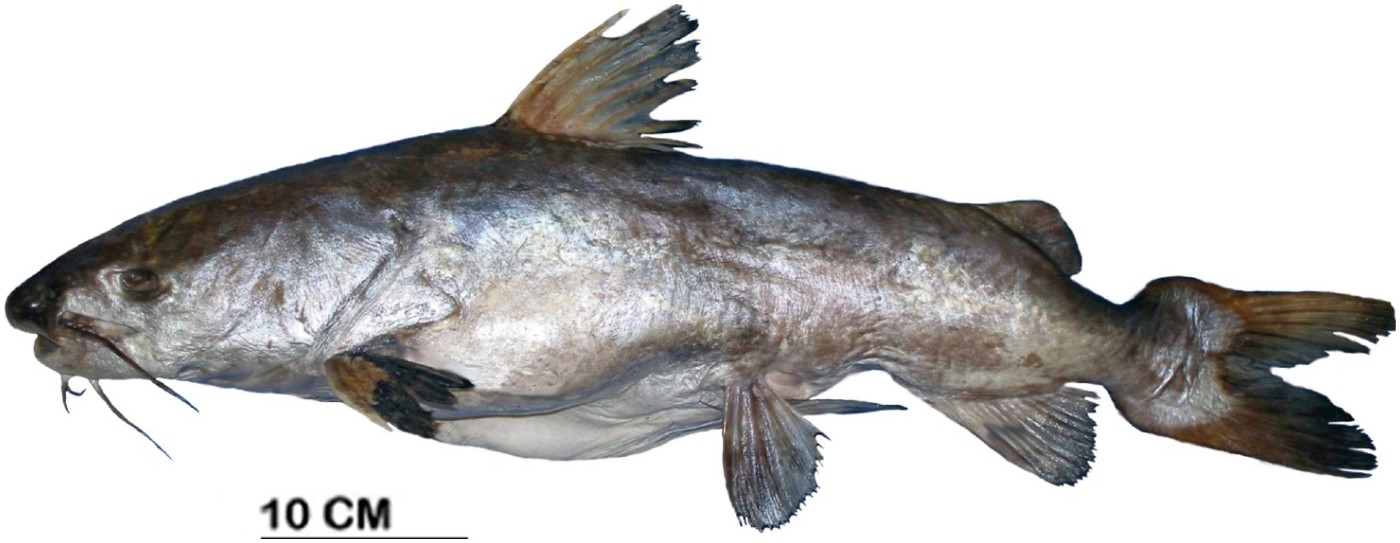
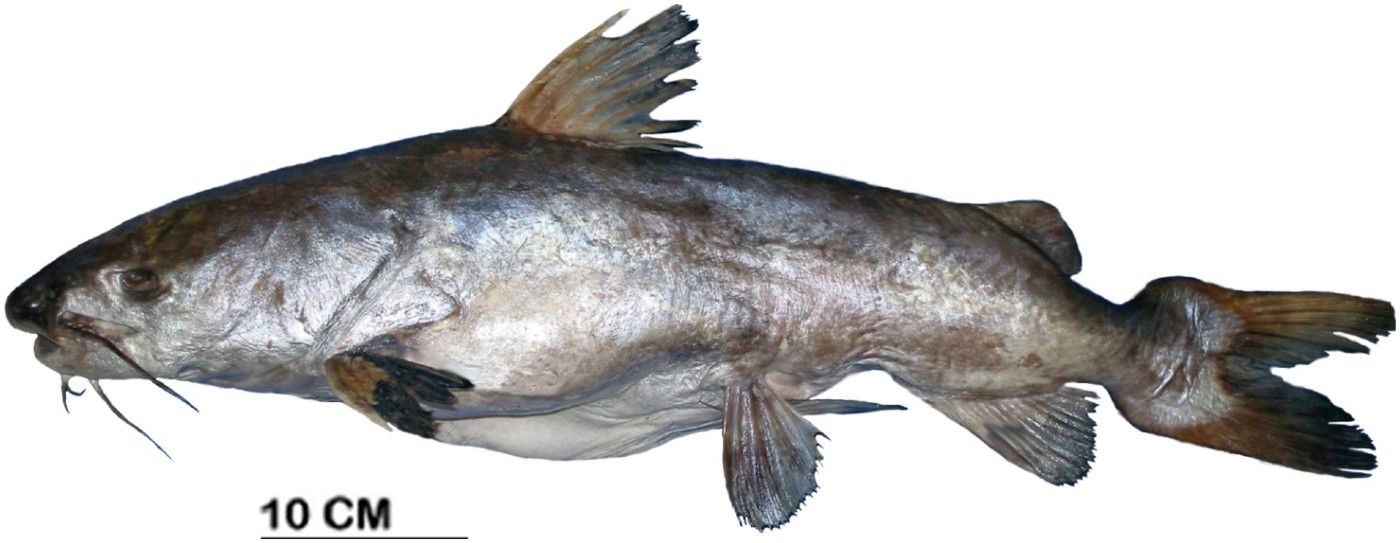
The captured Chili sea catfish is an unsexed specimen of 706 mm long (TL), weighing 3910 g (Figure 2). According to Acero & Betancur-R (Reference Acero and Betancur-R2007) the pelvic fin is a sexual dimorphic character (e.g. larger in females than in males), so it is likely that our specimen is female. The maximum size recorded for Notarius troschelii was 520 mm (Kailola & Bussing, Reference Kailola, Bussing, Fischer, Krupp, Schneider, Sommer, Carpenter and Niem1995), but no evidence exists on its weight. In the Gulf of Nicoya, Costa Rica, specimens reach 480 mm (Stephenson, Reference Stephenson, Pollnac and Sutinen1980) and for Colombian waters, Betancur-R & Acero (Reference Betancur-R and Acero2004) report the total length about 320 mm. All the other species of the genus in the TEP have a smaller size than N. troschelii, with sizes below 600 mm total length (TL) (Froese & Pauly, Reference Froese and Pauly2010). Considering the length–length parameters given in Froese & Pauly (Reference Froese and Pauly2010): TL = 1.22148 SL, the expected TL of 782 mm, a value 9% above our observed value, indicates that the model parameters (b) need to be recalculated because they overestimate the actual values. However, it should be mentioned that the regional differences in maximum length and weight depend on the ecological conditions that directly affect food availability and, therefore, fish growth.
Specimen of Chili sea catfish Notarius troschelii (Gill, 1863), captured by a shrimp trawler on the coast of Nayarit, Mexico on 30 September 2007. Total length 706 mm and weight 3910 g.
ACKNOWLEDGEMENTS
We wish to express our thanks to Armando Hernández López, S. Paúl Padilla Galindo and the crew of the vessel ‘Miguel López Rivera’ from San Blas, Nayarit, for collecting the specimen. To Jorge Guillermo Chollet Villalpando who took the photograph of the fish. J.D.A. would like to thank SNI-CONACyT, COFAA-IPN and EDI-IPN for their grants. J.T.N.N. would like to thank the Escuela Nacional de Ingeniería Pesquera/UAN, and the projects SAGARPA-CONACyT (grant Nos. 12004, 2003-057); SIP-IPN (grant Nos. 20090932, 20100900) and WWF-MEXICO (grant No. KH88) for their support. We would also like to thank the anonymous referees who reviewed the manuscript.