

Over the past few decades, mass violence such as genocidal killing and other atrocity crimes have become less frequent and individual episodes generally less lethal. At the same time, collective international responses have become more common and more comprehensive. What explains these two phenomena and are they connected? Steven Pinker claims that the recent downward trend is unexceptional and a product of broader social changes resulting from cultural and material transformations in the longue durée that promote cooperation over conflict.Footnote 1 Others posit more proximate causes for the decline in violence nevertheless unconnected to the rise in international activism such as the collapse of communism or decline of civil wars.
This article suggests that not only is the evidence of declining mass violence and growing international activism compelling, but that the two phenomena are connected by the emergence of a new international regime focused on human protection.Footnote 2 According to the UN secretary-general, Ban Ki-moon, human protection is a ‘subset of the encompassing concept of human security’, which relates to the ‘more immediate threats to the survival of individuals and groups’.Footnote 3 Since the end of the Cold War, an International Human Protection Regime (IHPR) has emerged comprising ‘principles, norms, rules, and decision-making procedures’ and focused on the protection of individuals and groups from the most immediate threats to survival: widespread and systematic arbitrary violence. This regime, best understood as an ‘overlapping’ regime, to borrow a phrase from Oran Young, developed in an ad hoc and uneven fashion but nevertheless has had the effect of both regulating the behaviour of armed combatants and establishing commitments, norms, and decision-making procedures related to how international society ought to respond to mass violence.Footnote 4 Thus, it may be understood as an ‘International Protection Regime’ of the sort described by Bruce Cronin in that it protects ‘clearly defined classes of people within sovereign states’ though it was not ‘designed’ per se, but rather evolved through diplomatic, juridical, and other practices.Footnote 5
This is significant for both practical and theoretical reasons. Practically-speaking, the emergence of an international human protection regime attests to important changes in the way that international society conceives and practices security that have bearing on behaviour. In relation to theory, this argument calls for a rethinking of the place of ‘human security’ within the broader field of security studies. Since the end of the Cold War, our understanding of security has been broadened and deepened by a variety of new theoretical approaches. One of the most prominent of these was ‘human security’, an approach prefaced on the normative claim that the ultimate referent for security ought to be the human individual, not the state or some other collective.Footnote 6 But while the policy utility of human security was forthrightly criticised for lacking precise definition and for being excessively expansive and vague, practices of human security have progressed apace, with the international human protection regime being only one manifestation.Footnote 7 As such, this experience lends support to calls for a more practice-based approach to international security that pays less attention to abstract concepts and more to what states and other security actors actually do. Footnote 8
The article proceeds in four parts. The first examines the evidence for thinking that the world is experiencing both a decline in mass violence and an increase in international activism in response to such violence. The second outlines the emergence, scope, and limits of the human protection regime. The third considers whether the regime itself is associated with the changing practices of third parties to mass violence. The fourth contrasts this explanation with potential alternatives.
Two global trends
Is there a global decline in mass violence and concomitant rise in international activism in response to such violence? Confronted with myriad contemporary crises, it would be tempting to argue that these basic indicators of international security are moving in the wrong direction. Indeed, some of the figures most associated with Responsibility to Protect (R2P) have reached precisely that conclusion: Michael Ignatieff warned of a ‘new world disorder’ characterised by a rise of ‘violence and hate’ whilst Louise Arbour argued that international society’s preferred approach ‘just doesn’t work’.Footnote 9 But despite recent setbacks, a number of studies confirm a downward trend in mass violence against civilians.
The case for decline is relatively straightforward to sustain, thanks to a proliferation of work on the subject.Footnote 10 Noted for his tendency for high-end casualty estimates, R. J. Rummel’s multiple surveys of ‘democide’ – the mass killing of people by their own government – in the twentieth century show a clear pattern of decline from a peak around the time of the Second World War.Footnote 11 This general trend is also found in the data presented by the Political Instability Task Force (PITF), which focuses on the incidence of government-sponsored mass killings and shows a sustained decline since 1993.Footnote 12 A similar view is presented by the Uppsala Conflict Data Programme (UCDP). UCDP provided data on one-sided violence for the 2013 Human Security Report that showed a steady decline in the number of cases from a peak in 2001 and a decline in the number of violent deaths globally.Footnote 13 Whilst both scales registered a recent upswing caused by the conflict in Syria, this was not sufficient to reverse the overall trend. Usefully, the report also disaggregated the data by region, revealing marked declines in the Americas, Central and South Asia, East Asia and Oceania, Europe, and sub-Saharan Africa, and an upturn in the Middle East and North Africa.Footnote 14 Pinker, meanwhile, aggregated the data from these sources and controlled for population growth to draw a clear picture of decline during the twentieth and early-twenty-first centuries.Footnote 15 Smaller datasets point in the same direction, towards a decline in both the overall frequency and lethality of mass violence against civilians.Footnote 16
Most recently, one of the leading forecasters of mass violence, Jay Ulfelder, observed that the data pointed towards a clear downwards trend and argued that ‘the spell of global political instability that began in the late 2000s has not yet produced a significant increase in the severity of one-sided violence around the world, at least as of the end of 2013’.Footnote 17 The PITF reached a similar conclusion, charting a general decline between 1950 and 2011 and more recently a slight upturn towards levels experienced in the 2000s but not (yet) sufficient to change the overall trend.Footnote 18 All of these datasets and observations relate specifically to the intentional use of lethal force against civilians, rather than to casualties of armed conflict generally. Indeed, a significant proportion of cases of one-sided violence against civilians occurs outside a context of armed conflict.
From this, it seems fair to suggest that the evidence points towards the decline of mass violence against civilians, a trend which may have begun before the end of the Cold War but which has become more apparent since. It is a trend that has been able to sustain individual shocks. Contemporary debates, therefore, tend to focus more on the causes of decline than on the fact of decline.Footnote 19 It is important, of course, to recognise the limits of the data we have to hand and to acknowledge that it represents only our best approximation. For example, detailed qualitative and quantitative studies suggest that within-case patterns of mass violence are complex and uneven.Footnote 20 Moreover, some feminist scholars complain, rightly, that datasets do not take sufficient account of gender-based violence.Footnote 21
The question of whether there has been a concomitant rise in global protection practice is somewhat more difficult to answer. Nonetheless, this question cannot be avoided since it lies at the heart of the issue of whether an IHPR has emerged in international society. To answer that question we need to look not just at the rhetoric of states but at their practice. Are they committing more physical resources to the protection of populations from atrocity crimes than before? A number of writers doubt whether there has been a change in this regard and thus question the practical salience of human protection norms.Footnote 22
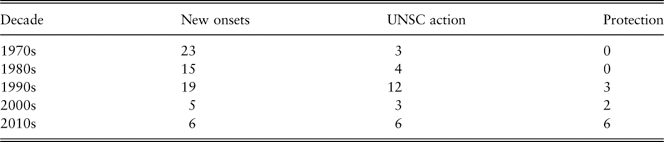
It is possible to devise systematic tests to measure international society’s response to atrocity crimes over times. We can measure both the frequency and scale of collective responses over time. That is, we can ascertain whether international society is becoming more or less likely to respond to mass atrocities and we can compare the scale of those responses in terms of the resources committed to them. There are a number of ways in which this might be done, but given that much of the debate about international society’s responsiveness to mass atrocities focuses on the practices of the UN Security Council, I will do the same. To measure international responsiveness over time, I asked whether the UN Security Council reacted to cases of mass violence by passing a resolution and whether that response included a specific focus on protection. In other words, I focused not on the rhetoric used by the Security Council and its members (thus I do not count presidential statements and press statements) but on its tangible practice – the issuing of legally binding resolutions containing specific demands or measures intended to protect populations from atrocity crimes. These resolutions give rise to actions such as the deployment of peacekeepers and humanitarian workers or the disarmament of armed groups or removal of specific weapons and facilitate the allocation of resources. Comparing Security Council practices to a dataset of major episodes of atrocity crimes, I then charted the Council’s performance since the 1970s.Footnote 23
Table 1, which includes the raw figures, and Figure 1, which illustrates change over time demonstrate that before the end of the Cold War, the UN Security Council’s response to atrocity crimes was very limited. More often than not, it chose to not respond at all to mass atrocities. Even if we include measures taken outside the Council, evidence suggests that during the Cold War, international society most often decided to not adopt measures to protect populations from atrocity crimes. This was principally because perpetrators were shielded by superpower politics, state sovereignty, and because of the weakness of relevant norms and institutions.Footnote 24 As a result, in a majority of cases where states perpetrated mass violence they were able to achieve their intended goals.Footnote 25
International responses to mass killing, 1970–2015.

International responses to mass killing, 1970–2015.
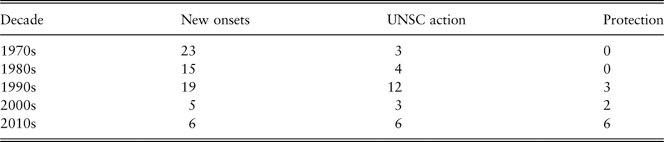
It is well known that with the end of the Cold War, the Security Council became more active, peacekeeping developed in form and size, and military interventions were often contemplated though still only rarely executed. Although some described this period as a ‘golden age’ of humanitarianism, international responses to mass violence remained fleeting.Footnote 26 In the 1990s, the Council issued resolutions in response to less than two-thirds of the major episodes of mass violence and where it did engage, the protection of populations from these crimes was seldom a priority, with the Security Council making specific provision for such protection only rarely. In the great majority of cases, therefore, to the extent that it was a consideration at all, the protection of people from mass violence was not a specified priority.Footnote 27 Although in the 1990s we can see the seeds of the emergence of an international human protection regime, protection practices themselves remained nascent until the very end of the decade.
Practices of human protection did not, therefore, emerge from nowhere at the end of the Cold War. They developed gradually through the 1990s, a decade that culminated in NATO’s controversial intervention in Kosovo (1999) and the much less controversial Australian-led intervention in East Timor (1999), collective recognition of the world’s failure in Rwanda and Kofi Annan’s challenge for international society to resolve the tensions between sovereignty and human rights that so often relegated human protection to the margins of international concern.Footnote 28 Matters improved significantly during the 2000s as both the likelihood of response and the focus on protection increased, an upward trend that has continued into the 2010s (see Figure 1).
Since early 2011 especially, and the adoption of a series of landmark Security Council resolutions on Libya (Resolutions 1970 and 1973) and Côte d’Ivoire (Resolution 1975), mass atrocities have generated almost habitual international responses with the Security Council issuing resolutions in response to all six of the qualifying crises since that time. This occurred despite deep controversies concerning the implementation of these resolutions and the Council’s perceived failures in Syria.Footnote 29 What is more, in each of these cases, the Security Council’s response has included a discrete focus on the protection of civilians from harm. Indeed, in South Sudan (UNMISS), the Democratic Republic of Congo (MONUSCO), Central African Republic (MINUSCA), and Mali (MINUSMA), the protection of civilians is identified as the UN’s primary objective. The same might also be said of the Security Council’s divided and lukewarm efforts concerning Syria. Where the Council has come together on Syria, it has been to focus on the question of protecting civilians – including the removal of specific threats to civilians (chemical weapons), the assurance of humanitarian relief even without the government’s consent, and the issuance of demands that the parties to the conflict comply with international humanitarian law.
We can therefore see an emerging pattern of practice towards heightened activism. Looking across the full range of the Security Council’s work, the NGO Security Council Report found that protection concerns were evident in ‘nearly all’ the Council’s resolutions and presidential statements.Footnote 30 There is therefore good reason to think that international protection practices have become more common over the past few decades. Not only is a Security Council response to mass violence much more likely than it was in the past, this response will almost certainly focus on protection, once considered a peripheral concern. These are tangible practices, not mere rhetoric. At the time of writing, in 2015, the UN has more than 100,000 military, police, and civilian personnel deployed around the world specifically mandated to protect civilians from harm. This compares to less than half that figure a decade ago and a total of zero personnel specifically mandated to protect civilians two decades ago. The daily lived reality of not only peacekeeping, but also peacebuilding and humanitarian work has changed over the past two decades as a result of the increasing focus on protection.Footnote 31
Focusing on the Security Council captures only one part of international society’s response to mass violence. Evidence from other sectors, however, further confirms the general trends found here. For instance, regional organisations are getting more, not less, engaged in their own peacekeeping operations and those operations are also becoming larger, more complex, and more focused on protection.Footnote 32 Given that both the AU missions in Somalia (AMISOM) and Central African Republic (MISCA) and NATO and EU missions in the former Yugoslavia included protection advisors, it seems fair to suggest that the prioritisation of protection practices applies to these organisations as well. Elsewhere, it is well recognised that an increasing proportion of violent conflicts and episodes of one-sided violence attract international mediation arising from both regional organisations and the UN, and sometimes (as in Kenya 2007–8 and Syria 2011–) both simultaneously, as well as from more informal sources.Footnote 33 Meanwhile, international peacebuilding has expanded in breadth and depth;Footnote 34 despite problems, international society’s human rights machinery has expanded, as have regional processes in the Global South, international criminal justice, transitional justice and truth commissions have proliferated;Footnote 35 and widespread or systematic sexual and gender based violence has come under the spotlight through regular UN reporting, targeted collective actions, a specifically targeted UK-led initiative to prevent sexual violence (PSVI), and a range of regional programmess.Footnote 36 Whilst practice has often lagged behind rhetorical commitment, and nowhere more so than with respect to gender equity, practices have typically moved in the direction of the commitments made.Footnote 37
Each of these has engaged in protection-related activities in the context of mass violence and all of these examples relate to practices not mere rhetoric – that is, the allocation of tangible resources for the specific purposes of protection populations from violence. Looking it in from the opposite perspective, it is difficult to think of a major international organisation that has become less engaged in the protection of populations from atrocity crimes in the past two decades.
Taken together, these practices lend credence to the claim that international society is becoming more proactive in its response to mass violence. Given that this increased activism coincides with a decline in the incidence of mass violence, there would also seem to be a prima facie case for thinking that the two are connected in that increased activism is contributing to declining mass violence. At the very least, this coincidence tells us that growing international engagement is not demand-driven, since global ‘demand’ for responses to mass violence was in decline. To understand the relationship between these two phenomena, we must therefore consider supply-side explanations that account for why states might be more willing than they once were to respond to mass violence by trying to protect the victims. The next section turns to one such possibility: the emergence of an IHPR.
An International Human Protection Regime
International regimes are sets of interconnected ‘principles, norms, rules, and decision-making procedures’ that govern state behaviour in specific issue areas.Footnote 38 In other words, they are prime examples of rules-based cooperation in world politics. International protection regimes are regimes focused on protecting ‘defined classes of people within sovereign states’.Footnote 39 Although most schools of thought in International Relations accept that regimes influence the behaviour of states, precisely how they do so remains the subject of debate. For neoliberals, the IHPR would be best understood as cooperation aimed at maintaining order in world politics by managing some of its deadly conflicts. For them, international regimes help states solve inefficiencies caused by uncertainty, imperfect information, and collective action problems and therefore persist by promoting and regulating cooperation. They are, Robert Keohane tells us, instruments established by states to help them achieve their interests and it is this commonality of underlying interest that explains their capacity to influence behaviour as states recognise that their interests are better served by common adherence to a set of rules than by short-term advantages that might be accrued by defection.Footnote 40 In practice, as Oran Young points out, once institutions are established they are not easily changed, creating additional incentives for compliance.Footnote 41 Although somewhat convincing, since it points to the collective action and coordination problems that helped give rise to new institutions and practices associated with protection, it is prefaced on an assumed prior recognition of shared interests in limiting mass violence that cannot be explained by rational self-interests alone.
Others might see the IHPR as simply an outgrowth of Western hegemony. A common realist/neorealist explanation is that regimes are established by hegemonic powers to advance their own interests or to protect the status quo.Footnote 42 From this perspective – one that is shared by some ‘critical’ scholarsFootnote 43 – the IHPR is simply an extension of Western influence into the non-Western world designed to impose order on the periphery and (by some accounts) export Western liberalism. The problem in this case is that the regime developed without significant great power support and even in the face of pronounced opposition to some aspects of it, such as US opposition to the International Criminal Court (ICC), and aspects of it were actively championed by states in the Global South (such as Guatemala).
Viewing the international as essentially social, constructivists maintain that social structures help constitute actors’ identities, that these identities tell actors who they are, what they want, and what they are prepared to do to get it, and that these actors form societies governed by norms, which establish appropriate behaviours and condition that types of actors and actions will be considered legitimate.Footnote 44 With legitimacy comes support; with illegitimacy comes opprobrium and opposition. As such, actions that correspond with a society’s shared norms will attract fewer costs than those that violate shared norms, and these calculations influence behaviour. Regimes arise out of shared ideas about the world (for example, the idea that civilians ought not be targeted by mass violence) and operate in this context by shaping beliefs about identities, appropriate behaviours, and legitimate responses to non-compliance through processes of learning and socialisation.Footnote 45 By focusing on ideas, this account has the virtue of tying the IHPR to ideas about the prohibition of civilian targeting in war and can explain how great powers were bound into a framework that, although not of their own creation, has exerted influence of their behaviour.
To some extent, however, the emergence of the IHPR confounds each of these expectations, since the regime emerged not from a particular state or group of states but rather from a set of interrelated practices pioneered by different sets of actors. Instead, the IHPR evolved from at least eight interconnected streams of norms, rules, practices, and institutional developments that emerged, in a variegated way, in response to different aspects of civilian suffering during war: (1) the extension of international humanitarian law; (2) the UN Security Council’s focus on civilian protection and incorporation of protection into the mandates of peace operations; (3) the development of international regimes focused on specific vulnerabilities, including those faced by refugees, displaced persons, women, and children; (4) the strengthening of global human rights promotion; (5) the development of international criminal justice; (6) an emerging focus on protection amongst humanitarians; (7) the embracing of protection by some regional organisations; and (8) the political commitment to R2P in 2005 and its implementation thereafter. These streams, which were in the main developed without specific regard for the broader human protection regime, reflect the varied concerns and interests of the various norm entrepreneurs and carriers and thus emphasise different components of protection. They were all, in some ways, connected to rise of theories and practices of human security.Footnote 46 Some of these streams, notably IHL, have roots stretching back beyond the Cold War. But it is their collective force, not each individual stream, that instantiates the IHPR and this began in earnest only after the Cold War and accelerated significantly in the early twenty-first century. This was facilitated by the strengthening norm of civilian immunity, itself assisted by the rise of global communications, which established a transmission belt of information about atrocity crimes that made it more difficult for the realities of mass violence to be obscured.Footnote 47 This uneven set of developments produced a comprehensive regime that deals with many specific types of vulnerability in the face of mass violence but (owing to the fact that there is no overall design) it has also left important gaps, which are discussed below.
The first stream, which arguably lays the foundation for all the rest, is IHL.Footnote 48 After the Second World War, IHL was developed and codified in a series of international treaties. In 1947, the newly established UN General Assembly approved the Genocide Convention, which prohibited the crime of genocide and assigned all states a legal duty to prevent it and punish the perpetrators. The laws of war were further codified in the four Geneva Conventions (1949), two additional protocols (1977), and in a range of protocols covering the use of Certain Conventional Weapons (1980, 1995, 1996, 2008). Of particular importance were Common Article 3 of the 1949 Geneva Conventions, which committed parties to respect the human rights of all those placed hors de combat, and the Convention on the Protection of Civilian Persons (Convention IV), which offered legal protection to non-combatants in occupied territories.Footnote 49 The Geneva Protocols (1977) extended the legal protection afforded to non-combatants to situations of non-international armed conflict. IHL thus established a normative standard of civilian protection that not only prohibited attacks on non-combatants and restricted the use of certain weapons but also called for the prevention of atrocity crimes (genocide) and punishment of perpetrators.
The second stream relates to the adoption by the UN Security Council of a thematic agenda on the protection of civilian in armed conflict and the translation of this agenda into protection mandates for UN peacekeeping operations. Since 1998, the UN Security Council has adopted a relatively broad civilian protection agenda that encompasses demands for compliance with IHL, operational issues connected to peace operations and humanitarian access, international responses to humanitarian emergencies, disarmament issues, and peacebuilding.Footnote 50 Since then, the Council has held a series of open meetings on the protection of civilians, establishing it as one of its major thematic interests. These meetings established a shared understanding that the protection of civilians from mass violence is a matter of international peace and security that legitimately falls under the purview of collective security. In 1999, the Council unanimously adopted Resolution 1265, expressing its’ ‘willingness’ to consider ‘appropriate measures’ in response ‘to situations of armed conflict where civilians are being targeted or where humanitarian assistance to civilians is being deliberately obstructed’ and expressed the Council’s willingness to explore how peacekeeping mandates might be reframed to afford better protection to endangered civilians. In 2006, it adopted another landmark resolution (Resolution 1674) on this theme which demanded that parties to armed conflict grant unfettered humanitarian access to civilians, restated the Council’s willingness to take action in cases where civilians were deliberately targeted and reaffirmed R2P.
Perhaps the principal way in which the Council has lent practical support to civilian protection agenda is through its peacekeeping operations. Starting in 1999 with the UN mission in Sierra Leone (UNAMSIL), the Security Council has invoked Chapter VII of the UN Charter with increasing regularity to authorise peacekeepers to use all means necessary to protect civilians.Footnote 51 Today, civilian protection and the authorisation of ‘all means necessary’ to that end are core aspects of UN peacekeeping and central to many of its new mandates, such as those for the Central African Republic (MISCA), Mali (MINUSMA), and South Sudan (UNMISS). In the Democratic Republic of Congo (DRC), the Security Council went even further by tasking a ‘Force Intervention Brigade’ to take the fight to those non-state armed groups that employ mass violence against civilians.
The third stream is the development of international regimes focused on specific vulnerabilities, including those faced by refugees, displaced persons, women, and children. Since the end of the Second World War, international society has periodically recognised groups that are exposed to particular vulnerabilities and has established mechanisms aimed at addressing or reducing those vulnerabilities. Of these, the best developed is the international refugee regime governed by the 1951 Refugee Convention and subsequent 1967 Protocol and overseen by the UN High Commissioner for Refugees (UNHCR). This system grants people facing persecution the right to claim asylum and receive resettlement in third-party countries and mandates the UNHCR to ensure that refugees have access to protection and durable solutions to their displacement.Footnote 52 During the 1990s, it became apparent that this system was unable to cope with a new displacement crisis – that of internal displacement: people forced from their homes by mass violence and other ills but remaining within their host country. As a largely ‘domestic’ issue there was little appetite for an international convention governing the displaced, so instead the UNHCR extended its mandate to cover the protection of all displaced persons and UN officials developed ‘guiding principles’ for their treatment based on the human rights they already enjoyed.Footnote 53
Other groups made especially vulnerable by mass violence have also been made subject to specific protection regimes. One longstanding facet of mass violence that gained political prominence only in the 1990s was sexual and gender based violence. The use of rape as a weapon of war in Bosnia and elsewhere helped shine a light on this practice and pushed the UN Security Council to establish the protection of women and girls as one of the principal elements of its ‘Women, Peace and Security’ agenda adopted in Resolution 1325 (2001).Footnote 54 Since then, the UN has established a number of mandates focused on the prevention of sexual and gender based violence, including the post of special representative of the secretary-general focused on the issue, and has instituted a series of annual reports that identify where these crimes are committed and advocate for steps to be taken in response. The global organisation has also begun to mainstream the protection of women and girls through, for example, the deployment of women’s protection advisers.Footnote 55 Beyond the UN, the British government launched a Prevention of Sexual Violence Initiative (PSVI). These developments have been paralleled by a range of initiatives focused on protecting children in armed conflict. Also led by the UN Security Council, the UN has appointed a Special Representative on the protection of children, which reports on the unique protection challenges facing children and related issues such as the recruitment of child soldiers.
The fourth stream relates to those elements of the global human rights system that relate to mass violence. Whilst human rights as a whole constitutes its own regime whose reach is wider and deeper than that of the IHPR, principles, norms, and decision-making structures connected with human rights do make an important contribution.Footnote 56 Two aspects in particular stand out but these are illustrative rather than definitive since the overlap is extensive and complex. First, emerging principles and practices of peer-to-peer review are helping to create expectations about the types of steps that states ought to take in order to protect their populations from various forms of abuse, including mass violence. Whilst the most intransigent states remain largely unmoved, there is increasing evidence that peer review activities are influencing many states towards greater compliance with their human rights obligations.Footnote 57 The second aspect relates to human rights investigations that inform decision-making within the IHPR. Over the past two decades, international society has made increasing use of permanent and ad hoc arrangements for human rights monitoring and reporting in its decision-making on mass violence. Through a variety of different mechanisms, such as independent commissions and inquiries, the appointment of special rapporteurs to report on thematic or country situations or fact-finding missions established by the UN secretary-general, international society is increasingly utilising human rights mechanisms to monitor and prevent mass violence. Most obviously, this reporting helps support decision-making on mass violence and promotes norm compliance.Footnote 58 The fifth stream is the development of international criminal justice, notably through the International Criminal Court (ICC) and a series of special and ad hoc tribunals. These institutions have proliferated since the mid-1990s and contribute to protection by holding individual perpetrators accountable for their actions. Proponents argue that by ending impunity such institutions help deter would-be perpetrators and give some legal protection to the victims.Footnote 59 The Rome Statute establishing the ICC in 1998 held that the court’s jurisdiction could be invoked when a state party proved unwilling or unable to investigate evidence pointing to the commission of widespread and systematic war crimes, crimes against humanity and genocide. The ICC prosecutor could initiate proceedings in cases where s/he was able to persuade a panel of judges, where a complaint was made by a signatory state, or when the Security Council referred a case to the prosecutor. The Security Council also reserved the right to postpone investigations by one year. To date, the Security Council has referred situations in Darfur and Libya to the ICC and the governments of the DRC, Uganda and the Central African Republic have requested that the ICC investigate and prosecute crimes committed in their countries. An investigation into Kenya was triggered by the fact that this country is a signatory to the Rome Statute. It remains too early to comment on the court’s effectiveness or its potential to deter mass violence, though evidence is emerging that the ICC can deter some would-be perpetrators.Footnote 60 More broadly, evidence suggests that transitional justice not only makes reoccurrence less likely whilst improving general human rights within the target country, but also has deterrent effects that spill over into other countries.Footnote 61
The sixth stream relates to principles of humanitarian action that state that civilians should be provided with life-sustaining relief on the basis of need. The notion that civilians ought to receive humanitarian assistance in wartime dates back to the nineteenth century and was integral to the development of humanitarianism. Those rights and expectations were incorporated into IHL but their applicability gradually expanded during the 1990s. The UN Security Council began authorising peacekeeping missions to support the delivery of humanitarian aid and, in the cases of Somalia and Bosnia, authorised the use of force to achieve this end. What is more, in a series of resolutions the Council demanded that parties to armed conflict grant unfettered access to humanitarian agencies. In Resolution 2165 (2014) the Council took this one step further, authorising the delivery of humanitarian aid into Syria without that government’s consent.
Human protection agenda has also been fostered at the regional level, and this is the seventh stream. The foundations for Europe’s engagement with civilian protection, for example, were laid in the 1970s with the Helsinki Accords. Over time, these provided the basis for a Conference on Security and Cooperation in Europe (CSCE) mechanism and when, in 1995, the CSCE was transformed into the OSCE it was given additional responsibility and capacities to protect human rights.Footnote 62 The EU also started to develop a civilian protection role, exemplified by the French-led multinational force in eastern DRC (Operation Artemis, 2003), EUFOR T/chad/RCA deployed into Chad and Central African Republic (CAR) in 2007 to protect civilians, and the 2014 EUFOR operation in the CAR (EUFOR RCA). For its part, the African Union (AU) has established a comprehensive regional system for crisis management and response that includes a specific focus on the protection of civilians from mass violence. Article 4(h) of the AU’s Constitutive Act enshrines the Union’s right to intervene in the affairs of its member states in issues relating to genocide and mass atrocities. The AU’s peacekeeping operation in Darfur (AMIS) included a civilian protection mandate and the Union’s missions in Mali, CAR, and Somalia have also supported civilian protection. In Latin America, states have established a comprehensive regional human rights mechanism and even the sovereignty-minded region of Southeast Asia has become to develop its own mechanisms for promoting human rights and protection through the ASEAN Intergovernmental Commission on Human Rights.Footnote 63
The eighth stream is the Responsibility to Protect (R2P) principle. In late 2005, world leaders unanimously adopted R2P in paragraphs 138–40 of the UN World Summit Outcome Document. This commitment was subsequently reaffirmed by both the UN Security Council and General Assembly, which also committed to ongoing consideration of its implementation. The secretary-general, Ban Ki-moon identified the implementation of R2P as one of his main priorities oversaw its institutional development within the UN.Footnote 64 Meanwhile, the principle has become part of the working language framing international engagement on atrocity crimes.Footnote 65 The Security Council has referred to R2P in more than thirty resolutions and has employed the principle in a variety of different ways.
These eight streams of practice, which were developed along parallel but distinct trajectories by different collections of actors, coalesce to form an IHPR that regulates the behaviour of combatants in armed conflict and international responses. In particular, the regime increases the likelihood of international responses to mass violence, ensures that protection concerns are central to those responses, and guides the form of response. By inhibiting actors through normative pressure and increasing the likelihood of response, the rise of the IHPR makes a substantial contribution to the decline in mass violence described earlier.
To understand how these streams hang together in the IHPR, it is useful to borrow Steven Krasner’s classic definition of an international regime and work through each of its elements. Krasner’s basic definition of a regime as comprising four elements (principles, norms, rules, and decision-making practices) has rightly been criticised for being conceptually thin because it offers little guidance on how to identify and distinguish between the different elements of a regime.Footnote 66 Our purpose here, though, is to use the framework only for illustrative purposes – to show how the elements hang together rather than to provide a comprehensive account of the regime with all its intricacies. A detailed accounting and assessment of the IHPR would require lengthier analysis than is possible here.
The first are principles, which Krasner defines as ‘beliefs of fact, causation, and rectitude’.Footnote 67 We might suggest that the IHPR rests on four such principles. First, a normative principle, shared by all the world’s major religions and ethical codes, that non-combatants ought not to be subjected to mass violence.Footnote 68 Second, a causal principle that connects mass violence against civilians with heightened levels of international disorder. Third, a principle that recognises that as well as relations between states, what occurs within states has normative and practical implications for international peace and security. Fourth, a principle of collective action (for example, the problem of mass violence can be mitigated only by cooperation between states).
The second characteristic of a regime are its norms – understood here as shared expectations about appropriate behaviour for an actor with a given identity.Footnote 69 The IHPR comprises a dense web of norms, proscribing and prescribing different courses of action for different actors. One set of norms, for example, restrain the behaviour of combatants. They include the principles of discrimination and non-combatant immunity (combatants must not target non-combatants); the principle of proportionality (combatants must not use disproportionate force); norms prohibiting or limiting the use of certain types of weapons that might cause undue harm to civilians; (chemical and biological, land mines, cluster munitions); norms prohibiting physical abuses other than intentional killing such as sexual violence, kidnapping, forced displacement, and torture; and norms prohibiting violence against certain groups (humanitarians, peacekeepers, children). Another set of norms require positive actions by combatants such as the granting of humanitarian access, respect for safe areas and ceasefires, and cooperation with international actors. A third set of norms set expectations about appropriate international responses by prescribing positive actions by different third parties. For example, the UN Security Council’s responsibility to take ‘timely and decisive action’ in the face of mass violence; the ICCs responsibility to investigate and punish perpetrators within its jurisdiction; the responsibility of humanitarian agencies to provide aid to civilians; the responsibility of peacekeepers to protect civilians from attack within their areas of operations; the responsibility of human rights organisations to uncover and investigate alleged abuses; and the responsibility of regional organisations to contain and manage conflicts within their regions. It bears mentioning that each of these norms operates beneath a broader set of norms governing international behaviour – those associated with the UN system and its collective security system. The IHPR was developed within the UN’s collective security system and remains squarely part of that order, self-consciously so in many respects.
The third property of a regime, rules, are specific prescriptions or proscriptions that dictate how states (and other actors) should act in order to comply with the regime’s norms. Different parts of the IHPR are governed by different sets of rules, but each of the streams includes specific rules that guide behaviour. Some are complex and detailed, for example the rules governing the ICC’s criminal prosecutions, the status of forces agreements and rules of engagement that dictate what peacekeepers are able to do, or the rules that govern human rights operations within a particular country. Other rules, however, remain quite vague. Immense discretion is granted to the UN Security Council, by both the UN Charter and relevant aspects of the IHPR, to determine for itself when and how it will act to satisfy the shared norms and judge its own performance.
Mapping the various decision-making structures related to the IHPR is beyond the scope of this article. Because the IHPR developed from within, and is part of, the UN’s collective security system, it shares, to some extent, decision-making procedures and ‘prevailing practices for making and implementing collective choice’ with that order.Footnote 70 As such, key decisions about whether to deploy international forces, impose sanctions for non-compliance, authorise the delivery of humanitarian aid, or establish ad hoc international tribunals are taken by the UN Security Council, utilising powers granted to it in order to maintain international peace and security by the UN Charter in 1945. Other components of the regime are governed by their own decision-making structures but sometimes overlap with the authority of the Security Council. For example the Rome Statute of the ICC carefully prescribes the Court’s decision-making but its jurisdiction can be imposed on non-parties to the Statute by the UN Security Council. Elements of IHL also have their own decision-making structures, such as conferences of the state parties and complaints procedures, as do regional organisations, the UN’s human rights machinery, and complementary regional systems.
Because the IHPR has developed in a fragmented and ad hoc manner, there are inevitably gaps in its coverage. These include, first, the gap between expectations and capabilities. Whilst expectations about human protection have progressed apace, international society’s capacity has not grown sufficiently to satisfy them. Some states simply lack the capacity to protect their populations, others lack the political will, and international actors can improve protection but not provide the degree of protection offered by stable states and societies owing to limited capacity and the complexities of comprehensive protection. Second, there are geographic coverage gaps. The global density of the IHPR is uneven owing, for example, to the nature and coverage of regional arrangements and the fact that not all states are signatories to all elements of IHL or the Rome Statute of the ICC. Third, there are agency gaps since the regime relates more to states than to non-state actors, resulting in a lack of clarity about the protection responsibilities of non-state armed groups but also with respect to the self-protection activities of local communities and the role of the private sector. Fourth, there remain substantive gaps. Whilst some indiscriminate weapons (such as land mines and cluster munitions) have been banned in some parts of the world, others (such as nuclear weapons) have not yet been banned anywhere. Likewise, whilst some protection practices have progressed apace, others – most notably the protection responsibilities of occupying powers – have not been developed beyond their starting positions (in this case, in the 1949 Geneva Conventions).Footnote 71 Another substantive gap lies in the protection of women and children from sexual and gender-based violence – forms of violence that remain quite common in non-war settings. Fifth, there are coherence gaps. Not only does the lack of coherence and coordination across various streams of human protection produce inefficiencies, action in one protection stream might negatively impact upon activities in another stream.Footnote 72 Understanding these gaps more precisely should be part of the IHPR’s future research agenda; closing them will undoubtedly be part of its future political agenda.
Human protection and the decline in mass violence
Evaluation of the association of the IHPR with the decline in mass violence can be parsed into two specific questions: whether the international practices associated with the regime have positive effects in terms of reducing the extent of mass violence and the extent to which participation in those actions is influenced by the regime. If it were possible to answer both these questions in the affirmative, then there would be strong grounds for drawing an association between the regime and the decline in mass violence.
The first question is the most straightforward to answer owing to the abundance of studies, some already cited, demonstrating the positive effects of individual components of the IHPR. Amongst other things, recent studies have demonstrated that: the deployment of peace operations to a country reduces the likelihood of conflict reigniting;Footnote 73 the deployment of peacekeepers with civilian protection mandates reduces the incidence of attacks on civilians within the areas of operations;Footnote 74 armed interventions targeting the perpetrators reduce the severity of genocide whilst impartial third-party interventions reduces the incidence of mass killing in the longer term;Footnote 75 effective humanitarian operations reduce casualties by providing life sustaining relief and sanctuary for displaced populations; naming and ‘shaming’ perpetrators of grave abuses of human rights tends to improve human rights practices especially when this is combined with pressure from third-parties and other factors;Footnote 76 and transitional justice mechanisms that hold perpetrators to account for their past crimes improve human protection within the country concerned and deter violations by others.Footnote 77 Although there are fewer studies on the effectiveness of the protection of women and girls from sexual and gender-based violence, the studies suggest that well-calibrated multi-actor initiatives can reduce the incidence of violence and that the absence of specific initiatives is associated with heightened risk.Footnote 78
Combined, these studies provide strong grounds for thinking that the regime as a whole exerts significant downward pressure on mass violence. It does this in three principal ways. First, by increasing the expected costs likely to be incurred directly by perpetrators, including the social costs associated with ‘naming and shaming’, the personal costs associated with criminal prosecution, and the heightened potential for third-party armed intervention. Second, by making it more difficult for perpetrators to achieve their goals through, for example, the interposition of peacekeepers and humanitarians, and the reporting of human rights monitors. Third, by increasing the direct protection afforded to vulnerable populations in the form of military peacekeepers, humanitarian action, or opportunities for flight.
But even if it is demonstrably the case that these, and other, practices exert downwards pressure on mass violence, it does not necessarily follow that the IHPR is having an effect. After all, these effects might be the unintentional by-products of actions taken for other reasons or simply a result of chance. How can we know why third-party states do what they? First of all, we can discount chance. We know that the effects described above are the result of deliberate choices by states and not simply the accumulation of random or ‘consistently inconsistent’ decisions. Lisa Hultman, for example, has demonstrated that the likelihood of the UN Security Council authorising a peacekeeping operation in the context of a civil war is greater in situations where the warring parties are targeting civilians.Footnote 79 Lending more support to the regime theory, she shows that although the pattern is evident across the whole period between 1989 and 2006, it is particularly strong after 1999. These findings are supported by earlier studies showing that the severity of a crisis and risk of escalation are the best predictors of Security Council involvement.Footnote 80 From this, it would seem fair to suggest that third-party activism in response to mass violence is increasing because states are choosing to become more actively involved.
The best way of ascertaining why states are making this choice with increasing frequency is by looking at how they explain their actions. Over the past few years states of all varieties, and not just Western liberal states, have repeatedly explained their actions in diverse and sometimes highly politicised settings as being influenced by human protection concerns. Most obviously, states have recognised their own support for these norms. Among the most controversial of the norms associated with the IHPR is R2P. Yet, an overwhelming majority of states have pledged their support for it. At the September 2014 General Assembly dialogue on R2P, China described R2P as a ‘prudential norm’, argued that ‘states should establish relevant policies and mechanisms’ for its implementation, and noted the appropriateness of international measures to support R2P, including the use of force ‘as a last resort’. At the same meeting, India noted that R2P ‘was agreed [upon] by all’ and Indonesia offered emphatic support, saying it ‘fully subscribes to the finest purposes and objectives of the concept of R2P’.Footnote 81 These statements – all from the global South and including governments often considered quite hostile to R2P – provide strong support for the idea that states accept and recognise norms associated with the IHPR.
But it is one thing to commit to a principle, another thing entirely to allow that principle to influence behaviour. But not only is there abundant evidence of compliant practices and matching rhetoric, demonstrated in part in the first section of this article and evident in the statements made by states to justify decisions to take collective action in crises such as South Sudan, Central African Republic, Mali, Democratic Republic of Congo, Somalia, and Darfur but there is also evidence to suggest that in the most difficult of cases, where geopolitical interests and countervailing norms are strongest, the IHPR may sometimes induce states to do things that they would not ordinarily do.
In February 2011, the UN Security Council reacted with unprecedented speed to the unfolding crisis in Libya. Within a few days of the upsurge of violence there, the Security Council unanimously imposed a range of coercive measures without the consent of the Libyan government, including financial and arms embargoes and a referral to the ICC. Why did states such as Russia and China, who would normally object to such measures at such an early stage in a crisis, support Resolution 1970? Russia’s formal answer was characteristically direct: ‘The Russian Federation supported Security Council resolution 1970 (2011) because of our serious concern over the events taking place in Libya. We sincerely regret the many lives lost among the civilian population. We condemn the use of military force against peaceful demonstrators and all other manifestations of violence and consider them absolutely unacceptable. We call for an immediateFootnote 82 end to such actions. We exhort the Libyan authorities to comply with the demands of the international community’. Likewise, China explained its affirmative vote by noting that ‘it is of the greatest urgency to secure the immediate cessation of violence, avoid further bloodshed and civilian casualties, restore stability and normal order as soon as possible’.Footnote 83 In other words, although other factors were obviously at play, both states saw the crisis in Libya squarely in terms of the IHPR. These concerns were evident a few weeks later when both states took the momentous step of abstaining on a draft resolution authorising the use of force in Libya. Again, whilst other considerations impacted on their decisions, one cannot explain their choice to permit armed intervention in Libya without understanding the normative pressure exerted by the IHPR. Russia’s explanation of its decision to acquiesce in the authorisation of force rather than block it was couched emphatically in human protection terms: ‘I underscore yet again that we are consistent and firm advocates of the protection of the civilian population. Guided by this basic principle as well as by the common humanitarian values that we share with both the sponsors and other Council members, Russia did not prevent the adoption of this resolution.’Footnote 84 China observed that it is ‘always against the use of force in international relations’ but decided to abstain because of the ‘special circumstances’ in Libya, namely: ‘China is gravely concerned by the continuing deterioration of the situation in Libya. We support the Security Council’s adoption of appropriate and necessary action to stabilise the situation in Libya as soon as possible and to halt acts of violence against civilians.’Footnote 85
To show that Libya was not an exceptional one-off, we can consider international society’s response to Syria. Even though the great powers are deeply divided on almost every aspect of this conflict, human protection imperatives have been at the fore of the Security Council’s deliberations. Often, these imperatives have proven insufficient to change state behaviour, yet sometimes they have trumped self-interest. For example, the Security Council agreed to disarm Syria’s chemical weapons and decided to authorise the delivery of humanitarian assistance without the government’s consent. Russia explained its position thus: ‘The Russian federation participated actively in the negotiation of this resolution, given the need to improve the humanitarian situation in Syria, alleviate the plight of the civilian population in the country and improve conditions for the work of humanitarian agencies. We were able to support the resolution after sponsors took into account our key priorities.’Footnote 86 Thus, Russia recognised the imperative of relieving civilian suffering in the face of mass violence, an imperative that is central to the IHPR. I am not suggesting that the IHPR ‘caused’ Russia’s decision to permit action without its ally’s consent, just that there is every reason to think that, without that imperative, Russia would not have supported Resolution 2165.
This section has advanced two claims. First, that practices of human protection exert significant downward pressure on mass violence. Second, that state justifications for these actions point clearly towards the principles and norms associated with IHPR. This both provides evidence of the regime itself and shows that the regime is associated with heightened international activism in response to mass violence and the corresponding decline in that violence. But what else might explain the decline of atrocities and increased response?
Alternative explanations
This section examines three alternative explanations and suggests that although each points to a significant part of the puzzle, none offers a sufficiently compelling alternative.
The general decline thesis contends that the decline of mass atrocities is a long-term historical phenomenon not related to the emergence of the IHPR. Pinker maintains that the decline of mass violence is simply part of an evolutionary downwards trend in all forms of human violence that stretches back to 10,000 BCE.Footnote 87 Outwardly, then, this would appear to challenge the role of the IHPR in supporting the decline of mass violence. On closer inspection, however, the general decline thesis is consistent with the narrower thesis offered in this article. Pinker maintains that the general decline in human violence can be traced through five distinct stages, the latest one of which he characterises as the ‘new peace’ emerging out of the Cold War characterised by both the decline of great power competition but also the rise of international cooperation to counter violent conflict. In other words, from this perspective the IHPR is a contemporary manifestation of broader evolutionary trends against violence. More than that, however, the IHPR is a manifestation that appears to have accelerated these longer-term trends through being, as the Human Security Report notes, ‘remarkably effective in driving down the number and deadliness of armed conflicts’.Footnote 88 The general decline in human violence is not a self-fulfilling fact, but a phenomenon produced and reproduced by historically contingent forces. In the post-Cold War era, Pinker identifies international activism associated with the ‘new peace’, a range of practices associated with the IHPR’s, as the principal driver of a decline that has accelerated over the past few decades.
The second alternative explanation is the end of communism thesis. Some analysts maintain that the global decline in mass violence resulted from the collapse of communism at the end of the Cold War.Footnote 89 There is little doubting either that communist regimes themselves perpetrated massive violence against their own populations or that the global competition between communism and capitalism encouraged atrocities. But the collapse of communism alone cannot account for the entirety of the global picture described earlier. That is partly because the patterns of decline have been strong in East Asia, where a majority of communist regimes survived the end of the Cold War. In addition, patterns of violence in other global hotspots, such as sub-Saharan Africa and the Middle East, were not primarily driven by ideological struggles. What is more, the end of communism thesis cannot explain how downwards pressure on mass violence increased well after the collapse of communism in Eastern Europe.
A third explanation, the consistent inconsistency thesis, takes us close to the null hypothesis argument. It suggests that the forces that propel states and societies towards, and away from, mass violence are deep, historical, and therefore not subjected to direct human intervention. According to this account ‘our disposition to violence may well be a genetic function of our ancestral evolution’.Footnote 90 From this perspective, any decline in mass violence is not caused by human design but rather by chance. Decline is necessarily temporary. We can leave to one side the question of whether the decline in mass violence is temporary, since there is no suggestion here that it might not be. Based on what we do know about the historical trajectories of violence, the consistent inconsistency theory rests on implausible empirical grounds, given the strong evidence of long-term decline charted by Pinker and others. If humans are genetically disposed to violence, even the more recent accelerated general pattern of decline over the past three decades would seem difficult to explain. Moreover, although there are certainly inconsistencies across individual cases, there are discernible patterns of increased international engagement with mass violence and a series of distinct studies showing the downward pressure these engagements exert.
Finally, it is also commonly argued that the decline in mass violence is associated with the general decline of civil wars. Whilst this is certainly the case, the decline in the frequency and lethality of civil wars itself cannot be wholly explained without factors associated with the IHPR and nor is the decline of civil wars sufficient as an explanation since mass violence occurs not only in civil war but also in contexts outside armed conflict as well as in interstate war.
Conclusion
The decline of mass violence and increased international activism over the past three decades can be largely explained by the emergence of a fragmented international human protection regime (IHPR). Through at least eight distinct but connected streams of practice, this regime has codified norms of acceptable behaviour, established responsibilities for third-party states and international institutions, and contributed to the emergence of a range of practices aimed towards the protection of vulnerable populations. As a result, mass violence today is typically met with complex – if not always well-cohered or entirely effective – responses from a range of different types of actors focused on restraining the behaviour of armed combatants, limiting their capacity to harm civilians, and providing direct assistance to affected civilian populations. Many of the specific practices associated with the IHPR have been shown to have positive effect; cumulatively, therefore, they can be said to exert significant downward pressure on mass violence. Evidence for thinking that it is principles, norms, rules, and decision-making structures associated with a regime that is encouraging third-party states to become more proactive in human protection was found in how some non-Western states explained their responses to protection crises.
As I noted in the introduction, there are strong grounds for thinking of this as a case where the practice of international security has outpaced the theory: international society has established a thick web of norms and institutions for human protection in advance of our ability to understand and conceptualise it. In particular, it would appear that in this narrow subset, at least, the practice of human security has developed apace without concomitant developments in the relevant theories and concepts. However, important gaps remain and the future trajectory of the regime will depend greatly on the extent to which international society works to close these gaps by ensuring that commitments to protection are met with adequate physical resources, the regime is dispersed into different parts of the world where coverage is currently limited, armed non-state actors are brought under its ambit, the regime’s substantive elements are expanded to include all sources of violent threats to civilians such as nuclear weapons and sexual and gender based violence, and great coherence is brought to bear.
Biographical information
Alex J. Bellamy is Professor of Peace and Conflict Studies and Director of the Asia Pacific Centre for the Responsibility to Protect at The University of Queensland, Australia. He is also Non-Resident Senior Advisor at the International Peace Institute, New York, and Fellow of the Academy of Social Sciences in Australia. Recent books include The Responsibility to Protect: A Defense (Oxford, 2015) and (edited with Tim Dunne), The Oxford Handbook on the Responsibility to Protect (Oxford, 2016). He is currently writing a book on the decline of mass atrocities in East Asia.
Acknowledgments
Thanks to Sara E. Davies, Paul D. Williams, and the editors and anonymous reviewers for their advice and constructive feedback. Thanks also to Kimberley Knackers for research assistance.