INTRODUCTION
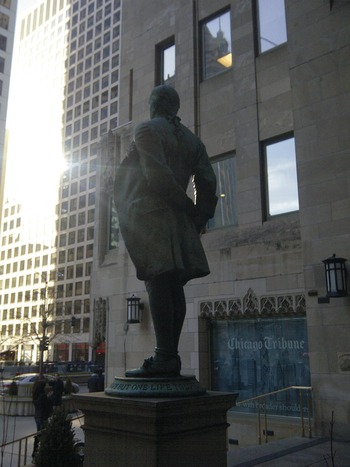
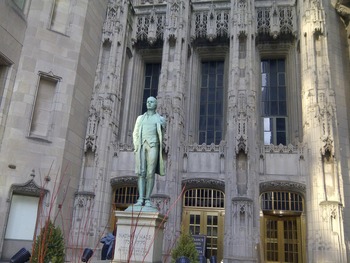
At 435 N. Michigan Avenue stands the Tribune Tower, built in the neo-Gothic style during the 1920s. Tucked within a somewhat enclosed area that leads visitors to the entrance of the building is an oxidized bronze statue of the American Revolutionary patriot spy, Nathan Hale. The idealized representation of this Connecticut Yankee is a replica of a statue that sits at Yale, where both the spy and the spy's sculptor, Bela Lyon Pratt, had studied. It is also where Robert McCormick, the powerful publisher of the Chicago Daily Tribune and the one who commissioned the statue, attended college. The simple but powerful rendering depicts a captured Nathan Hale with ankles and wrists bound, standing in youthful defiance yet dutifully resolved to his grim fate. Perched on a simple and austere pedestal designed by Leo Weissenborn, the Pratt replica has served as the centerpiece of the Tribune Tower plaza since the statue's dedication to the Reserve Officers of America in 1940.Footnote 1
The statue of Nathan Hale with wrists and ankles bound stands in the Tribune Plaza on Michigan Avenue in Chicago, Illinois. Photograph by the author.

Frontal view of the Nathan Hale statue in the Tribune Plaza. Photograph by the author.

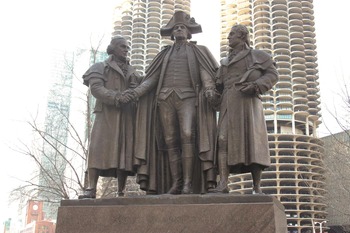
The Washington–Morris–Salomon Monument at Wabash Avenue and Wacker Drive in Chicago, Illinois. Photograph by Myriam Young.

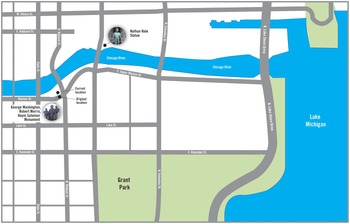
Leaving the Tribune Tower, it takes about seven minutes to walk to another American Revolutionary War-themed statue, which is more imposing than Pratt's Hale. This original sculpture sitting at Wacker and Wabash is made up of three figures – George Washington, Robert Morris, and Haym Salomon – and sits on a large foundation. On one side of this base is a quote from George Washington to the Hebrew Congregation in Newport, Rhode Island, in 1790. The other side features a bas-relief of Lady Liberty welcoming people to America. While not a complicated statue, it does have more detail than the representation of Nathan Hale at the Tribune Tower. This one depicts three patriots with hands joined, displaying strength and unity. This theme is centered on the idea of America's strength through military and civilian cooperation, illustrated by having General Washington flanked by two financiers, Morris and Salomon. American diversity united in one cause is conveyed through the representation of Virginia-born Washington, English-born Morris, and Polish-born Salomon, who was also a religious Jew. The driving force behind the statue and the concept that informed it was Barnet Hodes, corporate counsel for the city of Chicago, and like his hero, Salomon, a Polish Jew who emigrated to America. Designed by Chicago sculptor Lorado Taft, the Washington–Morris–Salomon sculpture sits conspicuously on Wacker Drive in publicly owned land in downtown Chicago.Footnote 2
What follows is the tale of two Americans and their statues. Robert McCormick and Barnet Hodes were important Chicagoans who contributed to the artistic landscape of the city. In the late 1930s and early 1940s, a dangerous era of encroaching German National Socialism and Japanese militarism, both men looked to individuals of the American Revolutionary era for meaning and inspiration. While differing in their politics, McCormick and Hodes felt that their early education slighted the history of the American Revolution, and they both saw the erection of statues depicting heroes of the War for Independence as a way to rectify the deficiency. A year and a half separated the dedications of each man's statue, but as both events unfolded the malefic forces overseas were not far from the minds of participants.
Robert McCormick, a Republican and the publisher of the “World's Greatest Newspaper,” the Chicago Daily Tribune, was a soldier's soldier. Commonly referred to as the “colonel,” reflecting the rank he achieved during the Great War, McCormick immortalized in Chicago the doomed American Revolutionary spy, Nathan Hale, by dedicating on 4 June 1940 a statue of him in a highly visible area on Michigan Avenue between his famed Tribune Tower and his WGN radio studio. The Jewish patriot of the American Revolution, Haym Salomon, was Barnet Hodes's hero. Beginning in 1936, Hodes, as cochairman of the Patriotic Foundation of Chicago, a group made up of prominent Chicagoans, spearheaded the first successful effort to erect a statue featuring the financier of the American Revolution. The Chicago Democrat's dream came to fruition on 15 December 1941, when the statue of Haym Salomon, which shared a pedestal with representations of George Washington and Robert Morris, was dedicated in downtown Chicago in Heald Square on Wacker Drive.
It is not surprising who each man chose to immortalize in bronze. For McCormick, Nathan Hale was a person whose notoriety stemmed from courage and love of country – traits McCormick admired. He believed that Hale was an excellent role model not for one specific ethnic demographic, but rather for a generation – America's youth. For Hodes, Haym Salomon's unsung contribution to the American Revolution symbolized the Jewish contribution to the founding of the United States. This held great appeal for Hodes who was, like his hero, Jewish and deeply patriotic.
McCormick and Hodes were striking opposites in many respects: McCormick was tall, Hodes was short; McCormick was a Republican, an isolationist, and a staunch opponent of President Franklin Delano Roosevelt, while Hodes was a member of the Chicago Democratic machine and supporter of the President and his Lend–Lease policy; McCormick was a businessman engaged in a private company, Hodes was a public figure; McCormick a Northwestern Law School dropout, Hodes a Northwestern Law School graduate. Yet regardless of these points of departure, some more important than others, they were both men of their time who were moved by a patriotism that harkened to the American Revolution for inspiration. In this respect, McCormick and Hodes were hardly unique. Both men conceived their ideas during the heyday of the “Colonial Revival” when all things early American were the rage. From furniture to architecture to the magnificent restoration of an entire colonial village (Williamsburg, Virginia), Americans embraced an imagined ideal. For McCormick and Hodes, it was the human courage and republican virtue displayed during the War for Independence that most resonated. While certainly nowhere near the scale of Colonial Williamsburg or the preservation efforts and sense of place that resulted in South Carolina in “Historic Charleston,” the interests and work of the two Chicagoans resulted in American Revolutionary War-themed fixtures on the city's sculptural landscape. McCormick and Hodes hoped that the existence of the statues would serve to remind those who are part of the day-to-day rhythms of the bustling metropolis of the heroic physical and financial sacrifice of the founding generation.Footnote 3
Each of the bronze sculptures stands as a “boundary stone of another age,” as Pierre Nora astutely observes of monuments. Even so, and as the reader will see below, changing contexts, such as German aggression in Europe or the Japanese attack on Pearl Harbor, can shift the meaning of the statue from what had initially prompted its creation. While the conceptions of the statues emerged during a period of colonial revivalism, World War II immediately colored the dedications with the concerns of “another age” than the one in which the project had been conceived. As Dydia DeLyser explains, historically themed statues become a “component of social memory,” and as such “they make a version of the past meaningful for the present, and, because of their permanence, cast it forward for those yet to come.” Ultimately, these monuments create a “symbolic landscape” that infuses geography with a political and cultural significance.Footnote 4
While monument building and commemoration undoubtedly reveal something about the time in which monuments are built and the events that are commemorated, and, to be sure, colonial revivalism was evident throughout America in the 1930s, it is nonetheless intriguing that two men who were so close geographically, if not politically, brought American Revolutionary War-themed statuary to Chicago for such different reasons just seventeen months apart. Yet as historians Michael Kammen and Karal Ann Marling remind us, the American Revolution was a historical moment in American public life where one could expect to find a broad consensus. Even so, remembering the American colonial and Revolutionary past has had it difficulties. Studies by Seth Bruggeman and Anders Greenspan, which focus on historical sites in Virginia, home of a number of famous American Revolutionaries, including George Washington, demonstrate the contentiousness of the variety of parties involved in the shaping and redefining of memory in historically and symbolically rich spaces associated with the origins of the United States of America.Footnote 5
This essay suggests that while it would not have been entirely exceptional for the two Chicagoans to look to the Revolutionary era for guidance and inspiration in the midst of colonial revivalism in the 1930s, their effort to forge a public memory of American Revolutionaries in downtown Chicago was remarkably free of conflict.Footnote 6 Unlike other subjects of early American-themed statuary in the city of Chicago, those who were remembered for their service to the Cause during the War for Independence never stepped foot in Chicago or the surrounding area. This reality contributed to a public memory marked by consensus rather than the conflict that characterized other spaces of historical remembrance during the same era.Footnote 7
The geographical as well as the more significant chronological distance of the defining events of the American Revolution from the western shore of Lake Michigan and the city that would later develop along it assured that the foundational event of the United States of America was not part of lived experience for a broad swath of Chicagoans. Consequently, there was no emotional or traumatic connection that required the monuments featuring American Revolutionaries to play a healing role as others have in American public life, from the Civil War to the Vietnam War. Author Judith Dupré reminds us that beyond the healing potential of public memorials, public memory in the form of building monuments is “political” because the artistic works reveal “what is valued by the majority of the population at a given moment in history.”Footnote 8 Moreover, as John Bodnar contends, public memory formation tends to stimulate a tension between those interested in advocating a narrative that upholds the status quo (“the official”) and those who seek to challenge this perspective with their own views or lived experience (“the vernacular”). Class can, did, and does play a role in the friction that not surprisingly emerges when official and vernacular forces are at play in the shaping of public memory. This was especially apparent when conflicts over the memory of the American Revolution emerged in the United States during the first half of the nineteenth century.Footnote 9 However, these characteristics are noticeably absent when efforts to remember the American Revolution in sculpture were conceived in Chicago during the 1930s. This is especially interesting when one considers that Hodes's monument included two businessmen who were known for their financial acumen.
Conflict or tension in public memory formation continues to play a central role in the literature on the subject. Scholars are correct in pointing out that a tension between a range of interests has been integral to the story of the ongoing development of the public monumental landscape in America. However, the cases of Robert R. McCormick and Barnet Hodes and their statues in downtown Chicago demonstrate the limitations of these otherwise useful interpretations. While the argument presented here does not attempt to diminish the role of conflict in public memory formation, it does nevertheless suggest that consensus, not the juxtaposing of opposing cultural or political forces, accounts for the motivations as well as the realities under which these American Revolutionary-themed statues emerged successfully in Chicago in the early 1940s.Footnote 10
AMERICAN REVOLUTIONARY-THEMED STATUARY IN CHICAGO
Even though Revolutionary War-themed statuary has not received the attention that has been given to Civil War-related sculpture, it accounts for a fair share of Chicago's early American-themed public art. In fact, of the forty-two early American-themed statues in the city, ten, or roughly 24 percent, focus on individuals who participated in the American War for Independence, in both military and civilian capacities. Unlike the Civil War, the War for Independence was strictly a historical event, not a lived experience, for nearly all inhabitants of a city founded in the 1830s, a time when the American public became increasingly aware of the passing of the Revolutionary generation.Footnote 11
In at least one notable case, however, elite Chicagoans attempted to stake a claim to the American Revolution by proudly acknowledging that David Kennison, the last surviving participant of the Boston Tea Party in 1773, lived among them. According to historians, Kennison beguiled “an audience [that was] eager to embrace a living link to the Revolution.” In the end, it was all a sham. As it turned out, the man buried in Lincoln Park in the belief that he was a Revolutionary War veteran was born in 1766 and later served the country in the War of 1812. So desperate were leading Chicagoans for a connection to the opening scenes of American nationhood that the city's elites went as far as to offer to buy, and relocate to Chicago, the Old State House in Boston, a tangible connection to the American Revolution.Footnote 12
Without a living or architectural link to the Revolutionary struggle with Great Britain, Chicagoans turned to sculpture. As one might expect, General George Washington is the subject of four of the ten statues in Chicago that look to the American Revolution for inspiration. Perhaps more surprising is that the runner-up is Alexander Hamilton, who is the subject of two. Other subjects include Benjamin Franklin, diplomat; Thaddeus Kosciuszko, Polish émigré and military engineer; and Thomas Jefferson, main author of the Declaration of Independence.Footnote 13
Most of the statues that feature participants of the American Revolution as their theme can be found downtown and along the lakefront. One exception is the George Washington Memorial (1904) by Daniel Chester French and Edward Clark Potter, located just outside the entrance to Washington Park on the South Side, near Hyde Park and the University of Chicago. The Thaddeus Kosciuszko Memorial (1904) was originally located on the Northwest Side, in what was once a Polish neighborhood, Humboldt Park. However, during the late 1970s the statue was relocated (and rededicated) in a downtown location near Lake Michigan and the Museum Campus that includes the Adler Planetarium, the Shedd Aquarium, and the Field Museum. Others outside the downtown area include the sculpted face of George Washington that once graced the old City Hall building but is currently located in Indian Boundary Park on the North Side, and most recently, on the Northwest Side, a 2005 facelift to the transportation hub in the Jefferson Park neighborhood included a statue depicting Thomas Jefferson in the act of writing the Declaration of Independence. In short, with the exception of French and Potter's equestrian George Washington, the old City Hall's George Washington, and the statue of Thomas Jefferson, all of the American Revolutionary-themed statuary is located downtown or in parks along Lake Michigan.Footnote 14
ROBERT R. MCCORMICK AND THE RESERVE OFFICERS' TRAINING CORPS
Just as they had when they were colonists, Americans continued to celebrate the birth of their leader. Trading one George for another, Americans have celebrated Washington's Birthday since the earliest days of the republic. Marking Washington's birth continued throughout the nineteenth century and into the twentieth. It was at such an occasion on 22 February 1940 that Robert McCormick first revealed the Nathan Hale statue.Footnote 15
Set in the WGN radio studio, this nationally broadcast gala event celebrating the birth of George Washington honored members of the Reserve Officers' Training Corps (ROTC) as the “hope and faith of our country for an adequate number of well trained leaders of this citizen army.” The commander of the 6th Corps area, which included Chicagoland and bordering states, Lieutenant General Stanley H. Ford, discussed George Washington and military preparedness in his address to the hundreds of khaki-attired young men who filled the WGN studio that February evening. The general told the cadets and WGN listeners that “Washington, too, received military training as a youth,” before going on to explain the benefits of military training in the eighteenth century as well as at the present. General Ford, a veteran of the Spanish–American War, the Philippines Insurrection, and World War I, as well as one of the highest-ranking United States military officers at the time, was an early participant in officer training while an undergraduate at Ohio State University. To the audience before him and to those tuning in on the radio, he suggested that the ROTC was “an institution such as Washington would have us perpetuate.” Soon afterwards, the statue of Nathan Hale was unveiled.Footnote 16
Cadets from Lane Technical High School posted the colors followed by a recitation of the Pledge of Allegiance by cadets from St. Mel's. The WGN concert orchestra then performed “Virginia Rhapsody,” which was dedicated to George Washington. This was followed by a rendition of “Carry Me Back to Old Virginny” performed by orchid-bedecked soprano Marion Claire. To close out the program, Robert McCormick gave a brief history of the “Star Spangled Banner” before six hundred cadets sang the national anthem.
Several days later, Colonel Robert Kirkwood of the University of Illinois ROTC told the Tribune publisher that he deserved “the highest commendation for the public spirited manner, energy, and enthusiasm with which you carried out this very interesting and worthwhile program” for the good of the ROTC and the nation's defense. Bruce Borland, president of the Glenwood Manual Training School in Glenwood, Illinois, a suburb south of the city near Indiana, expressed his appreciation for “a very interesting program” and congratulated McCormick for the “splendid work” that the Daily Tribune was doing for the ROTC.Footnote 17
The Washington Birthday celebration was an opportunity for McCormick's newspaper to showcase its contribution to the ROTC program. Not long after the ROTC began in the Chicago schools, the United States entered World War I. In 1918, the school board called for all male students to participate in military training, but by 1919, when the United States army was demobilized, the military faculty for the Chicago ROTC was reduced considerably. Nonetheless, the officer training program in the Chicago schools continued to grow. The Great Depression brought new challenges, ranging from the school board's unsuccessful attempt to eliminate the ROTC budget to equally unsuccessful attacks by opponents of the program. The program having grown to one of the largest in the nation, the Chicago Daily Tribune boasted that since 1916 it had supported the program through its editorials. By the mid-1930s, the newspaper began to go beyond editorial and radio programming support on WGN for the ROTC by sponsoring a program that rewarded excellence by giving deserving cadets gold, silver, and bronze medals as well as American flags. Parents, school principals, and cadets alike applauded McCormick and the Chicago Daily Tribune for the effort.Footnote 18
McCormick was devoted to the program of training military leaders because he believed that while students and civilians who had served in the Great War as officers had done a splendid job, had they received proper training they could have done even better. He believed it was senseless to give “every man a chance to display his incapacity at the expense of his troops.” Clearly this staunch isolationist was also a realist regarding the momentous events then taking place in the world. Due to ROTC training, McCormick confided to Colonel Kirkwood, who was stationed at the Armory at the University of Illinois, “the problem of company officers in the forthcoming war is no problem at all.”Footnote 19
A DANGEROUS WORLD
Quite rightly, McCormick saw the world of the 1930s as a dangerous place. With the military in power in Japan, he believed that war was all but certain regardless of United States policy toward the island country because making war is what military rulers do. However, from his office on the twenty-fourth floor of the Tribune Tower, McCormick's concerns were less with Asia than with Europe. When the conflict in Europe was in its infancy, he publicly opposed American intervention in a speech at the annual Fall festival in St. Charles, Illinois. He did so, the New York Times reported, because to intervene would merely bolster one side in the “age-old quarrels without remedying the complex troubles of Europe.”Footnote 20
A veteran of the battlefields of Europe during the Great War, he believed that it was imperative that the United States stay out of the European fight. While no sympathizer of Germany's aggressive advances, he was certain that the current troubles stemmed from the wrongful acquisition of territory due to defects in the Versailles Treaty following World War I. Even as the United States declared its neutrality during the 1930s, it became clear to McCormick that the administration was inching its way closer and closer to siding with the British. The Chicago publisher believed that there was a conspiracy afoot to “throw the United States into another European war.” He took the occasion of an Independence Day speech to express unequivocally his view that the “true interests of this Republic have been subordinated time and time again to those of the kingdom from which it separated itself by the Revolutionary War.” He feared that involvement in another European war would lead to the scrapping of the Constitution of the United States and its being supplanted by something akin to Russian communism. When Republican leader Aldred Landon charged that the President's plan for universal military service was clearly “an attempt to regiment the youth of this country into labor battalions,” McCormick concurred with such an assessment when he declared that Roosevelt's plan was “insanity, nothing less.” When the Roosevelt administration's policy of cash-and-carry transformed into Lend–Lease, McCormick and his Chicago Daily Tribune unmistakably emerged as a voice of isolationism and as a thorn in the President's side. McCormick not only stood as an opponent of FDR's domestic policy, dubbed the “New Deal,” but now strenuously opposed the President's foreign policy as well.Footnote 21
In the months leading up to the dedication of the Nathan Hale statue to the Reserve Officers of America, the Nazis invaded or bombed Denmark, Norway, France, Belgium, Luxemburg, the Netherlands, and the British naval base at Scapa Flow. On 3 June 1940, the day before the anticipated ROTC parade in Chicago, Nazi warplanes bombed Paris. As Chicagoans gathered on a beautiful late morning and early afternoon on 4 June to celebrate the officer training program in the area high schools, and to dedicate the Nathan Hale statue, it was jarring to consider that the world was indeed a dangerous place.
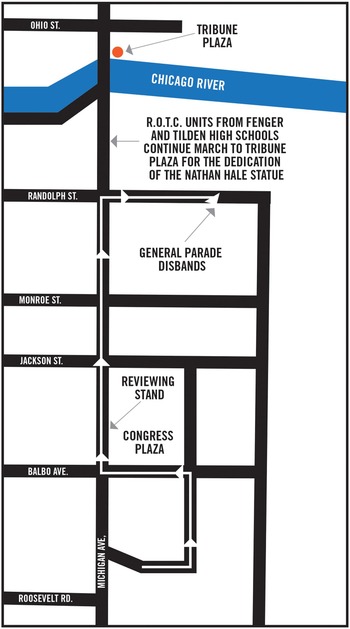
ROTC parade route on 4 June 1940 in Chicago. Map drawn by Ryan Shelton.

The cadets commenced the parade by disembarking, ironically, from Balbo Avenue (named in honor of a visit to the city during the 1933 World's Fair by the fascist Italian aviator, Italo Balbo) before passing the reviewing stand on Congress Plaza. They then marched in an impressive cadence north along Michigan Avenue to Randolph Street, at which point they disbanded, except for the two winning ROTC programs. These cadets continued to march northward, across the Chicago River. The menacing events in Europe, especially the latest news of Nazi aggression in Paris, added poignancy to the spectacle of seeing the young men who would fight the German war machine in the next armed conflict that was certain to come – no matter how hard the “Colonel of Chicago” tried to stop it.Footnote 22
“I WILL UNDERTAKE THE BUSINESS”
The memory of the “martyr of the American Revolution” was neglected for six decades following the War for Independence. In the immediate wake of his death, Nathan Hale was mourned privately due to the Hale family's disposition, but also because of his role as a spy – a position that brought on either aspersion or quiet honor. Moreover, Americans of the post-Revolutionary period were not overly eager to monumentalize their heroes or mark locations of heroic victories. Such activity was considered aristocratic and un-republican and therefore inappropriate. However, as veterans of the Revolutionary War began to pass away during the second and third decades of the nineteenth century, Americans sought ways to remember their heroes of '76. Rather than using statuary, columns and pillars held more appeal to republican Americans as appropriate marks of gratitude toward the patriots they chose to commemorate. For reasons ranging from political culture to economic crisis, it was not until the 1840s that Nathan Hale would receive a monument in his hometown of Coventry, Connecticut.Footnote 23
Born into a large religious family in 1755, Hale attended Yale College, graduating in 1773. For the first two years following graduation, he taught school in East Haddam and New London, Connecticut. The young man was known for his intellectual and physical qualities. Besides becoming a committed military officer, he was, as one person recalled, “the most manly man I have ever met” – two characteristics (a sense of military duty and manliness) that would have appealed to Robert McCormick as worthy of emulation.Footnote 24
Hale's outspokenness and bravery would have also attracted McCormick, who was, like his hero, a Yale graduate. Not long after the battles of Lexington and Concord on 19 April 1775, Hale urged his fellow townsmen to support the Revolutionary Cause. Shortly afterward he enlisted in a Connecticut regiment. By September, he and his comrades were participating in the siege of Boston. In that same month, Lieutenant Hale was promoted to captain. When soldiers' enlistments expired at the end of 1775, Hale, unlike many others, reenlisted. Six months later the captain joined Colonel Thomas Knowleton's intrepid Connecticut Rangers, a group known for its dangerous exploits.Footnote 25
When the British invaded Long Island on 22 August 1776, they set in motion a course of events that would lead to Hale's death one month later. General Washington, desperately needing intelligence, asked Colonel Knowleton to find a volunteer to cross enemy lines. Octogenarian Asher Wright, who had been a childhood friend of Hale and served with him during the war, remembered that when Knowleton first proposed the mission, one soldier flatly declined to volunteer and said, “I am willing to go & fight them, but as for going among them & being taken & hung up like a dog, I will not do it.” “Hale stood by,” the old friend recalled, “and said, I will undertake the business.” Dressed as a Dutch schoolmaster, Hale crossed British lines on 12 September 1776. He began to scout British positions not long afterwards, but was captured before completing his mission. A swift execution was generally the norm for spies, but it has been suggested that the treatment of Hale was exacerbated by the burning of New York City by an arsonist, or, as General Washington put it, by “Providence – or some good honest Fellow [who] has done more for us than we were disposed to do for ourselves.” Unfortunately, General Howe wrongly believed that Hale was somehow connected to the conflagration. On 22 September, the British hanged Hale from an apple tree as a fit punishment for a spy.Footnote 26
The provost marshal, who was infamous for his cruelty, denied Hale's request for a minister and a Bible. However, the young officer's courage could not be denied. British officer Frederick Mackenzie penned in his diary on the day of the American's execution that earlier that same day Hale had confessed to “being employed by Mr. Washington” as a spy. Mackenzie remarked that Hale “behaved with great composure and resolution.” The American told those present that he believed it to be “the duty of every good Officer, to obey any orders given him by his Commander in Chief,” and then gravely warned those who looked on “to be at all times prepared to meet death in whatever shape it might appear.” Hale is remembered largely for his legendary last words: “I only regret that I have but one life to lose for my country.” The Essex Journal reported that the Continental Army captain declared to those before him, “if he had ten thousand lives, he would lay them all down, if called to it, in defence of his injured, bleeding Country.” It was this devotion to country as exhibited by a volunteer military officer that appealed deeply to Robert McCormick, who believed the virtues and importance of the American Revolution were not appreciated enough in American society in general and, based on his own experience, in the educational system as well.Footnote 27
The publisher of the Chicago Daily Tribune was determined to change that. The moment to do so was drawing nearer as the winning high-school ROTC programs departed from their fellow cadets at Randolph Street, continued marching north along Michigan Avenue, crossed the Chicago River, and finally came to a stop at the doorstep of the gothic-like structure called the Tribune Tower.
The dedication ceremony lasted half an hour. In that short time, the quasi-religious ceremony – which featured music ranging from “Adoramus Te Christe” (performed by students from Hirsch and Lindblom High Schools), to “Recessional” (Rudyard Kipling poem set to Reginald De Koven's music), to “Deep River” (by Harry Thacker Burleigh) – suggests that participants wanted to provide a Christian burial service that was most likely denied to the executed American spy, whose sacrifice took on a Christ-like feel. Instead of sacrificing his life for the salvation of the world, Hale had sacrificed himself for the freedom of his country. In the weeks that followed, McCormick and the Daily Tribune sent over a thousand framed pictures of America's first spy to area schools – public, private, and parochial – so students could behold the image of youthful patriotism as personified by Nathan Hale.Footnote 28
BARNET HODES AND THE TRIO OF SCULPTED PATRIOTS
A short walk away, at Wabash Avenue and Wacker Drive, the city of Chicago's corporate counsel, Barnet Hodes, and the Patriotic Foundation of Chicago, had hoped to erect a statue depicting a trio of patriots during the same summer. Since its founding on 4 July 1936, the organization, under the leadership of Hodes, worked to erect such a monument. However, to have a completed monument by the summer of 1940 was not to be. Unlike McCormick, who received the right to reproduce the Nathan Hale statue designed by Bella Lyon Pratt in 1912 for Yale University, and who was able to pay a sculptor to re-create the image using the original mold, Hodes relied on the public for funds. While he had received offers from wealthy individuals to finance the commissioning of renowned sculptor and fellow Chicagoan Lorado Taft to create an original piece of art, Hodes firmly believed that funds ought to be raised via public subscription, which he considered a more democratic method of raising money.Footnote 29
BARNET HODES AND HAYM SALOMON
Born into a Jewish family in Poland at the turn of the century, Barnet Hodes emigrated with his parents to the United States when he was a child. He grew up in the small town of LaSalle, Illinois, located about a hundred miles southwest of Chicago. In a town with few Jews, Hodes was conscious of his ethnic and religious identity. The young Hodes was interested in American history, especially the Revolutionary era. As a high-school student, he became familiar with the works of a Protestant minister in New York City, Reverend Madison Peters, who wrote a number of books on the role of Jews in the founding of the United States. Aware of the Jewish contribution to the founding of the republic, Hodes was struck by how their story was not part of the narrative provided to students at LaSalle High School. He decided that one day he would rectify the situation by creating a greater awareness of the Jewish role in the American Revolution with particular attention given to Haym Salomon, a Polish Jew with whom Hodes could readily identify.Footnote 30
A lack of information on Haym Salomon has allowed the patriot to take on a near-mythic status. No one knows what the man who served the Revolutionary Cause as a financier and possibly as a spy looked like. The location of his remains within the Mikveh Israel cemetery in Philadelphia comes down to an educated guess. Nonetheless, Haym Salomon has been the subject of books, films, portraiture, a postage stamp, and sculpture. In terms of the latter, the monument featuring a representation of Haym Salomon in Chicago was the first.Footnote 31
Haym Salomon initially settled in New York City as a shopkeeper. Not long after the arrest and execution of Nathan Hale, the British suspected that Haym Salomon was a rebel spy and he was consequently arrested. Interestingly, in 1828, when the son of Haym Salomon tried to recover from Congress his father's financial contribution during the War for Independence, he hinted that his father torched New York on orders from General George Washington. While there is no evidence to support this claim, it is intriguing to consider that the two men who are immortalized in bronze not far from one another in Chicago nearly had, for a brief moment, their fates linked in New York City in 1776.Footnote 32
The British found Haym Salomon's fluency in English, French, and German to be a useful asset. Salomon was eventually assigned to the department of the Commissary, and while in the capacity of the commissionaire he persuaded some Hessian officers to leave their posts while assisting American and French prisoners to escape. Once the redcoats realized Salomon's role in the uptick of desertions and prisoner escapes, they decided to secure their talented detainee. Before they could do so, Salomon fled New York City for Philadelphia. It was in Philadelphia that Robert Morris, the finance minister for the budding republic, made use of Salomon's financial acumen by assigning to him the complicated task of dealing with the bills of exchange that were part of the financial alliance with the kingdom of France. After the war, Haym Salomon furthered his reputation for generosity when he lent members of Congress in Philadelphia, such as James Madison, money without charging interest.Footnote 33
AN AMERICAN MONUMENT
An attempt was made to erect a statue of Haym Salomon in New York City during the late 1920s and early 1930s, but it ultimately failed. It was unsuccessful because the statue proposed by the Federation of Polish Jews was meant to celebrate Haym Salomon as a Polish Jew – not as a Jew with whom others within that ethnic group but of different nationalities could identify, or even as a Jewish patriot of the American Revolution. Barnet Hodes avoided the same pitfall by having Haym Salmon symbolize minorities in general, rather than a specific group. In other words, the monument in Chicago was not a Polish Jewish monument, it was an American one.Footnote 34
In honoring a Jewish patriot who contributed to the American Revolution, Hodes was motivated not only by his pride in being Jewish, but, like McCormick, by his deeply held love of country. As Hodes tried to raise awareness and funds during the last half of the 1930s, his focus was on Haym Salomon's contribution to the American Cause. The rise of anti-Semitism, made especially real by Nazi laws affecting Jews in Germany, but also developments close to home, such as the presence of the German-American Bund in Chicago, lent urgency to the project. In fact, the climate of the period even led to design considerations. Hodes later remembered that he and sculptor Lorado Taft decided to have the trio of patriots join hands as a deterrent to a would-be anti-Semitic vandal. They figured that if a person destroyed the representation of Salomon, he would also ruin the Washington statue, which Hodes thought would be a national disgrace – an outcome that Hodes figured even an anti-Semitic vandal would want to avoid.Footnote 35
Not only was anti-Semitism and the rise of Nazism a theme at fundraising events, it also may have helped to recruit Lorado Taft for the job since the artist thought the rising tide of hatred toward Jews was simply un-American. Taft's son-in-law, University of Chicago professor and future United States Senator Paul H. Douglas, told Chicago architect Alfred S. Alschuler soon after the artist's death that the famed sculptor had become
increasingly concerned during the last two years of his life about the anti-semitic movement in the country … [and] became constantly more indignant as he saw some of the cunning attempts to stir up anti-semitism by reactionary groups, and he was very anxious to do what he could to help counteract these attempts.
Unfortunately, Taft died three months after receiving the commission and completing a maquette. Consequently, his family had to decide which of Taft's projects should move forward to completion. There were two main projects to choose from: the Washington–Morris–Salomon monument and the Fountain of Creation, which was designed to complement the Fountain of Time, which sits on the west side of the Midway Plaisance in Hyde Park on the South Side. The family decided to have Taft's associates, namely Leonard Crunelle, proceed on the Washington–Morris–Salomon project commissioned by the Patriotic Foundation of Chicago because Taft felt strongly about the emerging anti-Semitism. According to Douglas, Taft said, “If the memorial can be finished I can die happy,” before slipping into unconsciousness fifteen minutes later, never to be reawakened.Footnote 36
Consequently, remnants of the incomplete Fountain of Creation greet patrons to the main library at the University of Illinois at Urbana-Champaign while a monument commemorating what President Franklin Roosevelt called “this great triumvirate of patriots” sits downtown at Wacker Drive and Wabash Avenue.Footnote 37 Mayor Kelly proposed the prominent location on 19 June 1941, the same day that the City Council accepted it as a gift from the Patriotic Foundation of Chicago. Kelly believed that the monument ought to be situated in “the highest position our City is able to bestow on it,” a sentiment echoed by the Chicago Herald American, which editorialized, “A monument that so perfectly symbolizes the spirit of American unity and tolerance should be where ALL Chicagoans can see it as they come and go.”Footnote 38
At its dedication on 15 December 1941, the statue was ultimately presented as an American monument at the ceremony that was planned to coincide with the sesquicentennial of the Bill of Rights, a document that Salomon did not live to see. The emphasis on American freedom, rights, and toleration rather than on the statute's nod to American Jews no doubt had to do with the fact that Pearl Harbor had been attacked just over a week earlier and war with Germany formally declared four days before.Footnote 39 Barnet Hodes was joined on the dais by Mayor Edward Kelly, Governor Dwight Green, Senator Scott W. Lucas, and military officers Captain E. A. Lofquist and Major George Cummins, and by religious leaders, Catholic and Protestant bishops Bernad Shiel and Wallace Conkleag, respectively, and rabbis Morris Teller and Abraham Neuman, the latter hailing from Salomon's former synagogue in Philadelphia. This lineup of guests and speakers perfectly reflected the message desired by the Patriotic Foundation of Chicago – unity and toleration.Footnote 40
On this day that Hodes had worked so hard to make a reality, he told the crowd of over five thousand (and an estimated 40,000 who listened to the event, which was broadcast on an “amplification system” installed for the purpose of playing Christmas music for the shoppers expected on State Street in the weeks to come), that the monument, which was initially conceived as a “symbol of a patriotic ideal,” had now become, in the wake of recent events, “a symbol of the war time necessity of unity.” The main speaker, United States Senator from Illinois Scott Lucas, encouraged those present to use the anniversary to become reacquainted with the Bill of Rights. He told them, “These are sacred rights of constitutional liberty for which we battle the totalitarian powers of the earth.” “When Japan struck at peaceful Hawaii, one of the western outposts of liberty,” the Senator confidently explained, “the evening of life began for the Axis powers.”Footnote 41
However, while the emphasis was on how the monument reflected American values of unity, tolerance, and cooperation, the celebration of Haym Salomon was not completely sidelined. In fact, the symbolic value of Salomon became all the richer as it underscored the Americanism that had become the focus of the event especially as it contrasted with the tyrannical, destructive, and intolerant forces of the enemy. An editorial in the Daily Times, under the heading “The Rights of Man,” expressed how “almost awesomely splendid” it was that the United States was now honoring Haym Salomon at a moment when Americans are engaged in a struggle “against a tyranny more vicious than anything George III ever dreamed and – most splendid touch of all – against a tyranny so rotten that it has had to bolster its false courage by cruel persecution of the race which gave us Haym Salomon.”Footnote 42
CONCLUSION
Within a year and a half in the early 1940s, two statues were erected in downtown Chicago that depicted patriots of the American Revolution. The Nathan Hale statue and the Washington–Morris–Salomon monument were unveiled during an era of immense danger, not unlike the times experienced by the subjects of the statuary. While Robert McCormick and Barnet Hodes were remarkably different men, they both looked to the American Revolution to express what mattered most to them. For McCormick, an isolationist, the solitary figure of the Nathan Hale statue was a way to highlight the commitment, patriotism, and sacrifice of those who participated in the Reserve Officers' Training Corps. In the years following the dedication of the Nathan Hale statue, McCormick continued to look to the American Revolution as an instructive event for Americans.
The trio of patriots monument allowed Hodes to project what was important to him, just as McCormick's had for him. Instead of emphasizing the martial aspect of the American Revolution, Hodes used a group sculpture to stress the role of ethnic minorities and immigrants – a key constituency of the Democratic machine in Chicago – in the founding of the United States as well as the important part civilians played and the sacrifices that they made during wartime. The message of the Washington–Morris–Salomon monument was clear: unity and cooperation were key to America's success – as much during the Revolutionary War as during World War II.
This map illustrates the downtown locations of the Hale statue and the Washington–Morris–Salomon monument. Map drawn by Ryan Shelton.

Spirited contests over public memory took place on the East Coast at specific sites associated with the Revolutionary drama. In Chicago, however, public memory of the American Revolution and its cast of characters was neither contested nor controversial. Neither the commemoration of patriots of the American Revolutionary War in sculpture nor the dedication ceremonies that accompanied them caused friction between economic and social classes or partisans and ethnic groups. Although the Chicago River that separates the two statues could serve as a symbol for the sharp political division that separated McCormick and Hodes, the American Revolution provided a set of uncontested and uncontroversial ideas and images that could be used by different groups or individuals to discuss their visions, concerns, and values. Robert McCormick, a businessman engaged in private enterprise, offered the city a quasi-religious unveiling of the obedient and martyred patriot of the American Revolution. Barnet Hodes, a public figure bent on commemorating a devoted Jew, was instrumental in providing the city with a secular and thoroughly patriotic event.Footnote 43
The booming interest in early America during the 1920s and 1930s brought into relief the different publics that contended to shape the memory of the colonial and Revolutionary era. At the same time as associations and archaeologists elsewhere battled it out, or debates centered on historical interpretation versus memory and tradition became tangled, McCormick and Hodes demonstrated that in Chicago there was room for more than one take on the meaning of the American Revolution.