Introduction
Litidionite is a rare Cu–Na–K-bearing silicate, first discovered at the Somma–Vesuvius volcano, Italy (Scacchi, Reference Scacchi1880). At present, the litidionite group contains four minerals: litidionite, CuKNaSi4O10 (Pozas et al., Reference Pozas, Rossi and Tazzoli1975), manaksite, MnKNaSi4O10 (Khomyakov et al., Reference Khomyakov, Kurova and Nechelyustov1992), fenaksite, Fe2+KNaSi4O10 (Rozhdestvenskaya et al., Reference Rozhdestvenskaya, Bannova, Nikishova and Soboleva2004) and calcinaksite, CaKNaSi4O10⋅H2O (Chukanov et al., Reference Chukanov, Aksenov, Rastsvetaeva, Blass, Varlamov, Pekov, Belakovskiy and Gurzhiy2015). The litidionite-bearing assemblage is typical of high-temperature alteration processes at the rock-fumaroles interface (Pozas et al., Reference Pozas, Rossi and Tazzoli1975; Balassone et al., Reference Balassone, Petti, Mondillo, Panikorovskii, de Gennaro, Cappelletti, Altomare, Corriero, Cangiano and D'orazio2019). Synthetic analogues of litidionite, manaksite and fenaksite have been obtained under hydrothermal conditions and 230°C (Brandão et al., Reference Brandão, Rocha, Reis, dos Santos and Jin2009). Recently, Chukanov et al. (Reference Chukanov, Aksenov, Rastsvetaeva, Blass, Varlamov, Pekov, Belakovskiy and Gurzhiy2015) described an H2O-bearing litidionite member calcinaksite. Calcinaksite was first detected in a calcic xenolith hosted by an alkaline basalt at Bellerberg volcano, Eifel, Germany, as the product of contact metamorphism formed during the high-temperature hydrothermal stage (Aksenov et al., Reference Aksenov, Rastsvetaeva, Chukanov and Kolitsch2014; Chukanov et al., Reference Chukanov, Aksenov, Rastsvetaeva, Blass, Varlamov, Pekov, Belakovskiy and Gurzhiy2015). The second worldwide occurrence of this mineral was recorded at Somma–Vesuvius by Balassone et al. (Reference Balassone, Petti, Mondillo, Panikorovskii, de Gennaro, Cappelletti, Altomare, Corriero, Cangiano and D'orazio2019). Ti-bearing litidionite associations at Somma–Vesuvius are typically found in deep-blue glassy crusts and are characterised by very unusual thermally modified pyroclastic fragments related to the old fumarolic activity from the 1872 eruption (Scacchi, Reference Scacchi1880, Reference Scacchi1881; Zambonini, Reference Zambonini1910, Reference Zambonini1935; Pozas et al., Reference Pozas, Rossi and Tazzoli1975). A re-examination of this type of sample (currently under study) was carried out by Balassone et al. (Reference Balassone, Petti, Mondillo, Panikorovskii, de Gennaro, Cappelletti, Altomare, Corriero, Cangiano and D'orazio2019).
Litidionite-group minerals are of interest for their magnetic properties. Different electronic configurations and distortion of [M2+2O8] dimers produce antiferromagnetic interactions within the Mn (manaksite) and Cu (litidionite) dimers, whereas for Fe (fenaksite) dimers ferromagnetic interaction is observed (Brandão et al., Reference Brandão, Rocha, Reis, dos Santos and Jin2009).
In this contribution, the occurrence of a relatively low-temperature Ti-bearing litidionite from Somma–Vesuvius from a peculiar association at Somma–Vesuvius is reported. The complex method of incorporation of Ti into the litidionite structure and polyhedral and heteropolyhedral substitutions in the litidionite-group minerals are also discussed.
Volcanological and mineralogical overview
Located in southern Italy, near Naples, the Somma–Vesuvius edifice is a moderatly sized (1281 m a.s.l.) stratovolcano consisting of an older edifice dissected by a summit caldera (Somma) and a recent cone (Vesuvius), which grew within the caldera after the 79 AD Pompeii eruption. It belongs to the so-called Neapolitan district, the southernmost cluster of volcanoes of the Roman Magmatic Province (RMP, central-southern Italy), which is related genetically to the alkaline–potassic magmatism in the Central Mediterranean, developed from Oligocene to present as a result of the convergence of Africa and Eurasia.
The Somma caldera is a nested, poly-phased structure formed by several collapses related to the main explosive eruptions (Cioni et al., Reference Cioni, Santacroce and Sbrana1999, Reference Cioni, Bertagnini, Santacroce and Andronico2008). It consists of a pile of thin lava flows interbedded with spatter and cinder deposits post-dating the 39 ka old Campanian Ignimbrite of Campi Flegrei (Avanzinelli et al., Reference Avanzinelli, Cioni, Conticelli, Giordano, Isaia, Mattei, Melluso and Sulpizio2017, and references therein). The formation of the Somma caldera was completed with the famous AD 79 Pompeii Plinian eruption, afterwards the Vesuvius cone began to form discontinuously during periods of open conduit activity that occurred in the 1st–3rd centuries, 5th–8th, 9th centuries, 10th–11th centuries and in 1631–1944 AD.
The most recent period (1631–1944 AD) was characterised by summit or lateral lava effusions and semi-persistent, mild explosive activity (small lava fountains, gases and vapour emission from the crater) interrupted by pauses lasting from months to a maximum of seven years (Di Renzo et al., Reference Di Renzo, Di Vito, Arienzo, Carandente, Civetta, D'antonio and Tonarini2007; Avanzinelli et al., Reference Avanzinelli, Cioni, Conticelli, Giordano, Isaia, Mattei, Melluso and Sulpizio2017, and references therein). Since the last eruption of 1944, Vesuvius is quiescent (closed-conduit phase), as it has not shown signs of unrest and only moderate seismicity and fumaroles testify its activity (Avanzinelli et al., Reference Avanzinelli, Cioni, Conticelli, Giordano, Isaia, Mattei, Melluso and Sulpizio2017, and references therein).
At Somma–Vesuvius the magmatic products mainly display a potassic to ultrapotassic character and the copper-bearing mineralisation are related mainly to the most recent eruptive period of 1631–1944 AD, when strong fumarolic events occurred. Diffuse exhalative mineralisation took place, with a great variety of mineral species. With regard to the Cu-bearing phases, highly variable mixtures of sulfates, halides, oxides, vanadates and sulfides are observed (see Balassone et al., Reference Balassone, Petti, Mondillo, Panikorovskii, de Gennaro, Cappelletti, Altomare, Corriero, Cangiano and D'orazio2019 for further details).
At Vesuvius, a strong eruption occurred in April 1872, produced by strombolian activity with a lava fountain (3 days for the main phase) and ejection of scoria, lapilli, ash and mud flows (Arrighi et al., Reference Arrighi, Principe and Rosi2001). In June 1873, a mineral collector at the Vesuvius crater found small lapilli covered by deep-blue crusts typically with a peculiar glassy to enamelled-like appearance and brought them to the Neapolitan mineralogist Eugenio Scacchi. He characterised the blue material as a new mineral species – a copper, sodium and potassium silicate – and named it litidionite after ‘λιτιδιον’, the Greek word for lapilli (Scacchi, Reference Scacchi1880). Then, Arcangelo Scacchi, the father of Eugenio and director of the Mineralogical Museum of Naples, analysed some scoriae covered by blue–white sublimate products found in October 1880 at the Vesuvian crater, and established that the blue material was a new copper mineral, that he called ‘neocyanite’, whereas the white part was described as ‘opal’. Afterwards, Zambonini (Reference Zambonini1910, Reference Zambonini1935) determined the relationship between litidionite and ‘neocyanite’.
This rare silicate has been recorded in only two other occurrences: in fumarolic sublimates of the Tolbachik volcano, Kamchatka, Russia (Shchipalkina et al., Reference Shchipalkina, Pekov, Britvin, Koshlyakova, Vigasina and Sidorov2019, Reference Shchipalkina, Pekov, Koshlyakova, Britvin, Zubkova, Varlamov and Sidorov2020b) and at Pyro Pit Snowstorm mine (Mountain View mine), Nevada, USA (Castor and Ferdock, Reference Castor and Ferdock2003; https://www.mindat.org/min-2422.html).
According to Balić-Žunić et al. (Reference Balić-Žunić, Garavelli, Jakobsson, Jonasson, Katerinopoulos, Kyriakopoulos, Acquafredda and Nemeth2016), minerals found in European fumaroles are impressive due to the number of different species found, especially taking into account the fact that some prolific mineral groups, e.g. silicates and phosphates, do not contribute to the species list or contribute very little. Among the European fumarole localities, Vesuvius and Vulcano island in Italy show the richest mineralogy; as concerns Vesuvius, this status is due to the exceptional abundance of otherwise rare elements in its emanations, such as Cu, Cr, Mn, Ni, B, Tl, Pb, As and Se (Balić-Žunić et al., Reference Balić-Žunić, Garavelli, Jakobsson, Jonasson, Katerinopoulos, Kyriakopoulos, Acquafredda and Nemeth2016).
As regards the silicate occurrences in the fumarolic environments, Shchipalkina et al. (Reference Shchipalkina, Pekov, Koshlyakova, Britvin, Zubkova, Varlamov and Sidorov2020b) also observed that the silicate-bearing associations are rare, and the main minerals in most of fumaroles related to active volcanoes are sulfates, halides, oxides and sulfides. A thorough investigation on silicate-bearing mineralisation in sublimates in active volcanic fumaroles related to the Tolbachik volcano in Kamchatka, Russia was carried out by Shchipalkina et al. (Reference Shchipalkina, Pekov, Britvin, Koshlyakova, Vigasina and Sidorov2019, Reference Shchipalkina, Pekov, Britvin, Koshlyakova and Sidorov2020a, Reference Shchipalkina, Pekov, Koshlyakova, Britvin, Zubkova, Varlamov and Sidorov2020b, Reference Shchipalkina, Pekov, Koshlyakova, Britvin, Zubkova, Varlamov and Sidorov2020c). These authors reported that fumarolic silicates in the Tolbachik volcano are typically enriched with ‘ore’ elements, i.e. Cu, Zn, Sn, Mo, W and As (Shchipalkina et al., Reference Shchipalkina, Pekov, Koshlyakova, Britvin, Zubkova, Varlamov and Sidorov2020b), virtually hydrogen-free, and formed in the temperature range 500–800°C as a result of direct deposition from the gas phase (as volcanic sublimates) or gas–rock interactions.
Even though our survey on the Cu-bearing silicates and associated minerals from the 1872 eruption of Vesuvius is still in progress, similarities between the Tolbachik and Vesuvius occurrences in terms of silicate mineral assemblages can be pointed out. For example, Balassone et al. (Reference Balassone, Franco, Mattia and Puliti2004) found rare silicate (+oxides, sulfates, etc.)-bearing assemblages (with fluorophlogopite, indialite, magnetite, hematite and gypsum) in some 1872 AD ejected breccia that had been strongly hydrothermally modified at high temperatures, which is similar to some mineral assemblages (with fluorophlogopite, indialite, copper-rich oxide spinels, hematite, anglesite and baryte) recorded at the Tolbachik volcano by Pekov et al. (Reference Pekov, Sandalov, Koshlyakova, Vigasina, Polekhovsky, Britvin, Sidorov and Turchkova2018).
According to our data (see also Balassone et al., Reference Balassone, Petti, Mondillo, Panikorovskii, de Gennaro, Cappelletti, Altomare, Corriero, Cangiano and D'orazio2019), litidionite from Somma–Vesuvius has an extremely complex association of different silicates, basically consisting of litidionite, calcinaksite, tridymite, wollastonite, diopside and a glassy phase. Various traces of non-silicates are also recorded (see Results section), and it is very likely that further minor to trace phases will be identified in this Vesuvian mineral assemblage from our ongoing research on new sample sets.
Materials and methods
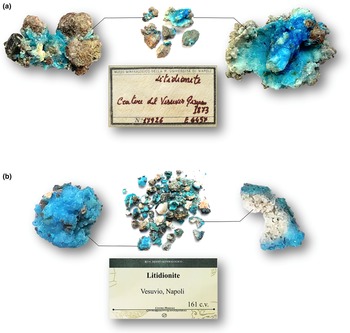
The litidionite-bearing samples, #17926 E6457 and 161 c.v. (Fig. 1), are from the Mineralogical Museum of the University of Naples Federico II (Italy) and belong to the vast collection devoted to the Somma–Vesuvius volcano. Preliminary investigations on sample #17926 E6457 were previously carried out by Balassone et al. (Reference Balassone, Petti, Mondillo, Panikorovskii, de Gennaro, Cappelletti, Altomare, Corriero, Cangiano and D'orazio2019), whereas sample #161 c.v. is part of a new set of litidionite-bearing samples currently under investigation. Samples with copper-bearing minerals represent a significant part of the Vesuvian collection and typically occur as encrustations and/or tiny patinas, coatings and/or void filling associated with the historical activity of Vesuvius (Balassone et al., Reference Balassone, Petti, Mondillo, Panikorovskii, de Gennaro, Cappelletti, Altomare, Corriero, Cangiano and D'orazio2019). Litidionite and the associated minerals are found in shiny deep-blue to white crusts, sometimes with a glassy aspect, on lava fragments or small lapilli affected severely by the fumarolic activity (Balassone et al., Reference Balassone, Petti, Mondillo, Panikorovskii, de Gennaro, Cappelletti, Altomare, Corriero, Cangiano and D'orazio2019, and references therein).
The Ti-litidionite-bearing samples studied. (a) Sample 17926 E6457: the fragment on the left side shows small lapilli with a tiny blue litidionite-rich crust between them, whereas the fragment on the right side represents typical encrustations of litidionite and associated neoformed minerals. (b) Sample 161 c.v.: the fragment on the left side is made mainly of mixed amorphous silicate material and litidionite, the fragment on the right side is composed of litidionite (blue part) and a mixture of tridymite, diopside, kamenevite and glass (white part). The length of the Museum labels is 7 cm.

Back-scattered electron (BSE) images of sample #17926 E6457 were carried out using a LEO-1450 scanning electron microscope (SEM) with a Quantax 200 energy-dispersive spectrometer (EDS). The chemical composition was determined with the Cameca MS–46 electron microprobe (Geological Institute of the Kola Science Center, Russian Academy of Sciences) operating in a wavelength-dispersive mode (WDS) at 20 kV and 20–30 nA. The electron beam diameter used was 1–10 μm. The following standards were used: lorenzenite (Na and Ti); pyrope (Mg and Al); diopside (Si and Ca); wadeite (K); hematite (Fe); metallic niobium (Nb); metallic copper (Cu); wulfenite (Pb) and atacamite (Cl).
Imaging and analysis of sample #161 c.v. were carried out using a Jeol JSM5310 scanning electron microscope with an Oxford EDS equipped with an INCA X-stream pulse processor and the 4.08 version Inca software (Department of Earth Science, Environment and Resources, DiSTAR, University of Naples Federico II Italy). The operating conditions were an acceleration voltage of 15 kV, 50–100 μA filament current, variable spot size and a working distance of 20 mm; the reference standards used for quantitative microanalysis were: anorthoclase (Si, Al and Na); diopside (Ca); microcline (K); rutile (Ti); fayalite (Fe); olivine (Mg); serandite (Mn); sphalerite (Zn); benitoite (Ba); celestite (Sr); fluorite (F); halite (Cl); pyrite (S); galena (Pb); and pure metal (Cu). Detection limits of the elements analysed are <0.1%. Composition of litidionites from sample #161 c.v. was also determined with a Cameca SX50 WDS (Institute of Environmental Geology and Geoengineering, National Research Council, IGAG CNR, Rome). Operating conditions were 15 kV acceleration voltage, 15 nA beam current and 10 mm spot size. Oxides, silicates and pure metals were used as standards. Raw elemental data were corrected using the PAP programs (Pouchou and Pichoir, Reference Pouchou, Pichoir, Heinrich and Newbury1991).
Cation contents were calculated with the MINAL program of D. Dolivo-Dobrovolsky (Dolivo-Dobrovolsky, Reference Dolivo-Dobrovolsky2016). Statistical analyses were carried out with STATISTICA 8.0 (StatSoft. Inc., 2008).
Raman spectra of Ti-bearing litidionite sample #17926 E6457, collected from uncoated polished sections, were recorded with a Horiba Jobin-Yvon LabRAM HR800 spectrometer equipped with an Olympus BX-41 microscope in back-scattered geometry. Raman spectra were excited by a He–Ne laser (632.8 nm) with actual power of 2 mW under the 50× objective with a numerical aperture equal to 0.75. The spectra were obtained in the range of 70–4000 cm–1 at a resolution of 2 cm–1 at room temperature with a 2 μm beam diameter and 150 s acquisition time. The spectra were processed using Labspec (Jobin Yvon) and Origin software (OriginLab Corporation, Northampton, MA, USA).
The crystal-structure studies on sample #17926 E6457 were carried out at the X-ray Diffraction Resource Centre of St. Petersburg State University by means of the Rigaku XtaLAB Supernova diffractometer equipped with CCD detectors using monochromatic CuKα radiation (λ = 1.54184 Å) at room temperature. More than a half sphere of the diffraction sphere was collected (scanning step 1° and exposure time 10–40 s). The data were integrated and corrected using the Rigaku CrysAlisPro program package, which was also used to apply an empirical absorption correction using spherical harmonics, as implemented in the SCALE3 ABSPACK scaling algorithm (Agilent Technologies, 2014). The crystal structure of Ti-bearing litidionite was refined to R 1 = 0.063 (R int = 0.041) for 1730 independent reflections with F o > 4σ(F o) in P $\bar{1}$ space group using the SHELXL software package (Sheldrick, Reference Sheldrick2015). The crystal structure was drawn using the VESTA 3 program (Momma and Izumi, Reference Momma and Izumi2011). The distortion indexes for polyhedra were calculated according to the formula proposed by Baur (Reference Baur1974).
Results
Chemical composition
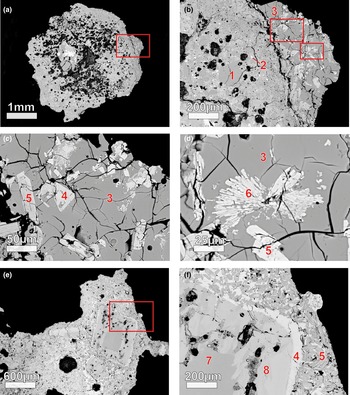
In the analysed sample #17926 E5457 (Figs 2 and 3), there are four different types of litidionite-group minerals which crystallise in the following order: euhedral and platy crystals of litidionite or Ca-bearing litidionite up to calcinaksite (Fig. 2c) → altered zones around diopside crystals consisting of litidionite (Fig. 2e,f) or fine-grained litidionite (Fig. 3a) → coarse-grained calcinaksite crystals in the litidionite matrix (Fig. 2f) → marginal zones of lapilli represented by Ti-bearing non-stoichiometric litidionite (Fig. 3a).
BSE image of litidionite-group minerals in the lapilli from Somma–Vesuvius, sample #17926 E6457: 1 – Al-bearing diopside, 2 – perovskite, 3 – Si-glass, 4 – litidionite, 5 – calcinaksite, 6 – kamenevite, 7 – diopside and 8 – Fe-bearing diopside.

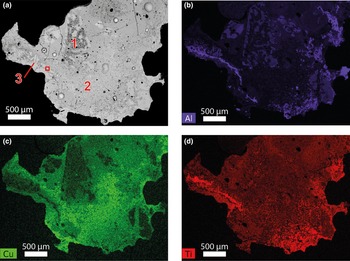
(a) BSE image of Ti-bearing litidionite areas, sample #17926 E6457: 1 – Fe-bearing diopside, 2 – litidionite and 3 – Ti-bearing litidionite; (b,c,d) X-ray distribution maps for Al K, Cu K and Ti Kα radiation. The area studied by Raman spectroscopy is indicated by a red square.

In this sample, litidionite occurs in two assemblages, i.e. with tridymite, diopside, calcinaksite, wollastonite, minor amorphous silica-rich glass, kamenevite (K2TiSi3O9⋅H2O, the second occurence after Pekov et al., Reference Pekov, Zubkova, Yapaskurt, Belakovskiy, Lykova, Britvin, Turchkova and Pushcharovsky2019), perovskite, spinel, atacamite, magnetite or with ilmenite, apatite, rutile, kamenevite, perovskite, Fe-Al spinel, atacamite and halite. Table 1 shows the chemical composition of Ti-bearing litidionite. The Ti content in the litidionite reached up to 12.06 wt.% or 0.56 atoms per formula unit (apfu). The Ti-rich zones are Si-, Cu-, K-, Na-deficient and Al-, Mg-, Pb-enriched (Fig. 3a–d). Note the presence of small amounts of Al, as well as traces of Pb and Cl in the chemical composition in Ti-bearing litidionite only.
Elemental composition (wt. %) and coefficients in the formula (atoms per formula unit, on the basis on Al + Si = 4 apfu) of litidionite-group minerals from the Somma–Vesuvius complex, sample #17926 E6457 (analyses 1–5) and sample #161 c.v. (analyses 6–10), obtained by WDS analyses.

‘–’ = not detected
In sample #161 c.v. (Table 1) we recorded both a litidionite almost similar to the stoichiometric composition, with very low Ti content, and a Ti-bearing phase (up to 3.95 wt.%), even though we have not observed high Ti amounts as in sample #17926 E5457, at least in the analysed areas.
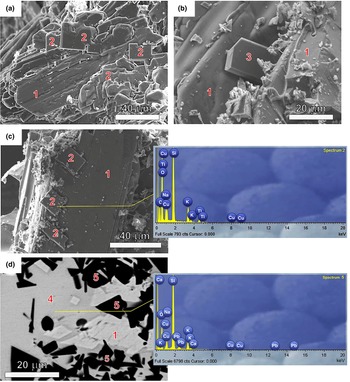
Figure 4 shows SEM-BSE micrographs of litidionite together with Ti-bearing litidionite detected in sample #161 c.v. (Fig. 4a,c). Note that Ti-litidionite is always later that litidionite, as already observed in the previous sample. In Fig. 4d, an unusual composition, which could correspond to a Pb-rich litidionite, was also found. It is worth noting that Zambonini (Reference Zambonini1935) reported significant amounts of Pb in litidionite. Selected compositional analyses of litidionite, Ti- and Pb-bearing litidionite are presented in Table 1. Mixed litidionite–calcinaksite compositions occur in association with kamenevite (Fig. 4b), REE-bearing perovskite, celestine, glass and an unknown Na–K sulfate.
SEM-BSE images of litidionite varieties in sample #161 c.v.: (a), (b), (c) SEM micrographs of sample fragments; (d) BSE image in polished section. 1 – litidionite, 2 – Ti-bearing litidionite, 3 – kamenevite, 4 – Pb-bearing litidionite and 5 – tridymite.

Chemical compositions of selected minerals associated with litidionite are presented in the Supplementary table S1.
Raman spectroscopy
The spectrum of Ti-bearing litidionite (#17926 E5457) is close to that of reference litidionite from Vesuvius taken from sample R130088 of the RRUFF project (Lafuente et al., Reference Lafuente, Downs, Yang, Stone, Armbruster and Danisi2015). The Raman spectrum (Fig. 5) contains an intense band at 1118 cm−1, which, together with weak bands at 1043 and 999 cm−1, can be assigned to the Si–O–Si and O–Si–O asymmetric stretching vibrations in the [Si8O20]8− groups. The band at 687 and weak band at 792 cm−1 are related to the symmetric stretching vibrations of the same bonds (Yakovenchuk et al., Reference Yakovenchuk, Pakhomovsky, Panikorovskii, Zolotarev, Mikhailova, Bocharo, Krivovichev and Ivanyuk2019). The most intense band at 597 cm−1 is related to the asymmetric bending vibrations of Si‒O bonds or overlapping stretching vibrations of Ti‒O bonds (Filippi et al., Reference Filippi, Doušová and Machovič2007; Celestian et al., Reference Celestian, Powers and Rader2013). The bands in the range 350‒500 cm−1 correspond to symmetric bending vibrations of O‒Si‒O bonds and overlapping stretching vibrations of Ti‒O bonds (Filippi et al., Reference Filippi, Doušová and Machovič2007; Pakhomovsky et al., Reference Pakhomovsky, Panikorovskii, Yakovenchuk, Ivanyuk, Mikhailova, Krivovichev, Bocharov and Kalashnikov2018; Yakovenchuk et al., Reference Yakovenchuk, Pakhomovsky, Panikorovskii, Zolotarev, Mikhailova, Bocharo, Krivovichev and Ivanyuk2019). The bands at 292 and 334 cm−1 are assigned to the symmetric bending vibrations of the Si−O bonds. The strong band at 249 together with 267 cm−1 correspond to the bending/stretching vibrations of the Na‒O bonds of the NaO6 coordination polyhedra (Yakovenchuk et al., Reference Yakovenchuk, Pakhomovsky, Panikorovskii, Zolotarev, Mikhailova, Bocharo, Krivovichev and Ivanyuk2019). The bands below 150 cm−1 can be assigned to the lattice vibrations. No boron-bearing groups and water molecules were detected, as the bands in the range of 1150 to 1650 cm−1 were absent.
Raman spectrum of Ti-bearing litidionite, sample #17926 E6457.

Single-crystal X-ray diffraction
Occupancies of the cation sites were calculated from the experimental site-scattering factors (ssfexp) in accordance with empirical chemical composition. The ssfexp for the Na, Si and K sites was obtained from unconstrained refinement of Si1–4, Na1 and K1 site occupancies. The Ti site was refined initially with occupancy (Ti0.73Cu0.27)1.00 and its resulting occupancy (Ti0.32Cu0.30Ca0.29Fe0.09)1.00 is calculated in accordance with the chemical composition and ssfexp and was fixed during refinement. Experimental details are shown in Table 2. The final atomic coordinates and displacement parameters are given in Table 3 and Table 4, selected interatomic distances are in Table 5. The crystallographic information file has been deposited with the Principal Editor of Mineralogical Magazine and is available as Supplementary material (see below).
Crystal data and structure refinement for Ti-bearing litidionite.

Atom coordinates, displacement parameters (Å2) and site occupancy for the structure of Ti-bearing litidionite.

*Occupancies calculated in accordance with the chemical composition and ssfexp, and fixed during refinement.
Anisotropic displacement parameters (Å2) for the structure of Ti-bearing litidionite.

Selected bond distances (Å) in the crystal structure of Ti-bearing litidionite.

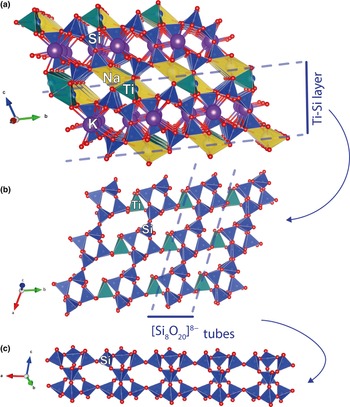
The crystal structure of Ti-bearing litidionite consists of a complex heteropolyhedral pseudolayered framework (Fig. 6a). The Cu–Si pseudolayers (Fig. 6b) are based on the infinite tubes [Si8O20]8−∞ running along [100] (Fig. 6c). The layers are connected by the [M2+2O8] dimers into a three-dimensional framework (Golovachev et al., Reference Golovachev, Drozdov, Kuz'min and Belov1970; Kornev et al., Reference Kornev, Maksimov, Lider, Ilyukhin and Belov1972; Pozas et al., Reference Pozas, Rossi and Tazzoli1975). The cavities in the structure are represented by three types of channels populated by Na+ and K+ cations.
Crystal structure of Ti-bearing litidionite: (a) general view; (b) titanosilicate heteropolyhedral layer; and (c) silicate tubes.

The crystal structure contains four symmetrically independent Si tetrahedra with Si−O bond distances in the range 1.564–1.633 Å. According to the refined site-scattering factors (ssf) for Si sites of 13.46, 13.74, 13.60 and 13.74 e− for Si1, Si2, Si3 and Si4 sites, there is a small admixture of Al in each site. The mean bond lengths for the <Si1−O>, <Si2−O>, <Si3−O> and <Si4−O> tetrahedra are 1.617, 1.602, 1.612, and 1.605, respectively.
The Na1 site in the litidionite structure is 7-coordinated with a mean <Na–O> distance of 2.597 Å. The refined occupancy of the Na1 site is 0.75, in accordance with ssf of 8.25 e−. The K is 8-coordinated with the mean <K−O> distance of 2.913 Å. The refined occupancy is 0.91. The chemical analysis demonstrates the deficit of K and Na and we propose that 0.25 of Na1 and 0.09 of K1 sites are vacant.
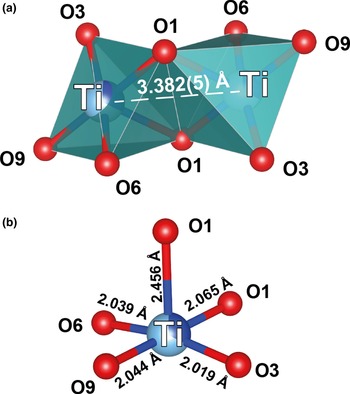
The square-pyramidal sites form [Ti2O8] dimers (Fig. 7a) with a Ti–Ti distance of 3.382 Å. In the sample investigated, the five-coordinated site is occupied predominantly by Ti atoms. The bond lengths are typically distorted for a square pyramid with one long Ti−O bond of 2.456 Å and four shorter bonds in the range 2.019–2.039 Å (Fig. 7b). The distortion index of the TiO5 square pyramid is 0.061, slightly less than the value of 0.089 observed for litidionite (Brandão et al., Reference Brandão, Rocha, Reis, dos Santos and Jin2009) with full occupancy by Cu2+ that is in agreement with the decreasing Jahn–Teller distortion associated with the decreasing Cu content. The mean bond distance of 2.125 Å is in good agreement with its refined occupancy (Ti0.32Cu0.30Ca0.29Fe0.09)Σ1.00, which in turn agrees with the observed and calculated ssf of 23.89 and 23.88 e−, respectively.
(a) The M2O8 (Ti) dimeric unit and (b) the distortion of bonds in the TiO5 square pyramid in the crystal structure of Ti-bearing litidionite.

The final crystal-chemical formula for Ti-bearing litidionite from Somma–Vesuvius can be written as follows: (K0.91□0.09)Σ1.00(Na0.75□0.25)Σ1.00(Ti0.32Cu0.30Ca0.29Fe0.09)Σ1.00(Si3.70Al0.30)Σ4.00O10, where □ = vacancy, which is in good agreement with the chemical analyses and Raman data.
Discussion
In the system investigated, litidionite sensu stricto is the primary litidionite-group species, followed by calcinaksite and Ti-bearing litidionite. The volcanic silicate glass from the lapilli with litidionite contains up to 3 wt.% of TiO2. Partial crystallisation of this glass probably leads to the formation of Ti-bearing minerals such as perovskite, rutile, kamenevite and Ti-bearing litidionite. The latest litidionite crystals to form can also accommodate Pb (up to 4.27 wt.%) and Cl (up to 0.21 wt.%).
The five-coordinated site in litidionite-group minerals can be occupied by Cu2+ in litidionite, Fe2+ in fenaksite, Mn2+ in manaksite and by Ca2+ in calcinaksite with 5 + 1 coordination (Golovachev et al., Reference Golovachev, Drozdov, Kuz'min and Belov1970; Pozas et al., Reference Pozas, Rossi and Tazzoli1975; Khomyakov et al., Reference Khomyakov, Kurova and Nechelyustov1992; Aksenov et al., Reference Aksenov, Rastsvetaeva, Chukanov and Kolitsch2014). All these cations are divalent. According to our chemical data, the maximal TiO2 content is 12.06 wt.% or 0.56 Ti apfu. Incorporation of Ti4+ cations is in negative correlation with the Na content (Fig. 8a) and correlates positively with the Al content (Fig. 8b). Incorporation of Ti4+ into the litidionite structure can be explained by the complex substitution VTi4+ + VII–VIII□ + IVAl3+ ↔ VCu2+ + VII–VIII(Na,K)+ + IVSi4+. The excessive charge in the M site is most likely compensated by the formation of vacancies at the Na or K sites.
Relations between the cation contents in litidionite of (a) Ti and Na (R 2 = 0.55) , and (b) Ti and Al (R 2 = 0.50). Sample #17926 E6457.

The Ti is a charge-dominant component at the M site (Table 1, analysis 5) with a Ti4+ charge of 2.24 and sum for Mg2+, Ca2+, Cu2+ and Fe2+ of 1.12; the observed composition of the M site (Ti0.56Mg0.29Cu0.11Ca0.10Fe0.06)Σ1.12 corresponds to the composition of a new litidionite-group mineral according to the application of the dominant-valency rule (Bosi et al., Reference Bosi, Hatert, Hålenius, Pasero, Miyawaki and Mills2019). However, zones of the Ti-bearing litidionite studied by single-crystal X-ray diffraction correspond to an M site occupancy of (Ti0.32Cu0.30Ca0.29Fe0.09)Σ1.00, which does not correspond to the new litidionite mineral composition.
In litidionite-group minerals, the M site is populated by different cations, whereas the rest of structure does not change; the same is observed for the vesuvianite-group minerals, which crystallise under similar temperature conditions (Panikorovskii et al., Reference Panikorovskii, Chukanov, Aksenov, Mazur, Avdontseva, Shilovskikh and Krivovichev2017a, Reference Panikorovskii, Chukanov, Rusakov, Shilovskikh, Mazur, Balassone, Ivanyuk and Krivovichev2017b, Reference Panikorovskii, Shilovskikh, Avdontseva, Zolotarev, Karpenko, Mazur, Yakovenchuk, Bazai, Krivovichev and Pekov2017c, Reference Panikorovskii, Shilovskikh, Avdontseva, Zolotarev, Pekov, Britvin, Hålenius and Krivovichev2017d). In vesuvianite, the 5-coordinated position demonstrates significant variability (by Fe3+, Fe2+, Mg, Mn2+, Mn3+ and Cu2+) accompanied by the change in the polyhedral volume of the Y1 site within 30%. The five-coordinated M site in the litidionite-group minerals can be occupied by Ca2+, Cu2+, Mn2+, Fe2+ and Ti4+. The diverse occupancy of the M site (square pyramid in litidionite) is related to the flexibility of the MO5-polyhedra, possible population of the additional intra-channel O11 site and the variability of distances between the neighbouring silicate tubes. The M site in the litidionite-group minerals can possess different coordination environments: square-pyramidal (litidionite, manaksite), trigonal prismatic (fenaksite) and octahedral (calcinaksite). The polyhedral volume of the M site may change from 7.06 in litidionite to 16.93 Å3 in calcinaksite. Such a flexibility of coordination and polyhedral volumes results in high chemical capacity and cationic diversity, which allows one to predict possible new litidionite-group species with different occupancies of the M site.
Examples of mineral-inspired materials in materials science are few and include zorite (ETS–4), ivanyukite (GTS, SIV), kamenevite (AM–2, STS) and sitinakite (IONSIV–911, TAM–5, STS, CST) (Oleksiienko et al., Reference Oleksiienko, Wolkersdorfer and Sillanpää2017). Incorporation of Ti into litidionite with creation of vacancies at the K site makes it possible to consider this phase as a prospective material for the selective removal of radionuclides from waste aqueous solutions. According to our recent studies, calcination of the ion-exchanged forms of titanosilicates up to 1000°C results in the formation of Synroc-type titanate ceramics.
Conclusions
Active volcanic fumaroles can be considered as natural laboratories with the possibility to study in situ the processes of mineral formation, geochemical behaviour and migration of chemical elements (Shchipalkina et al., Reference Shchipalkina, Pekov, Koshlyakova, Britvin, Zubkova, Varlamov and Sidorov2020b). Even though in Vesuvius ejecta, Ti is a trace element, it can form independent phases (e.g. perovskite, rutile and kamenevite) at the last stages of mineral evolution.
This study demonstrated that the flexibility of the litidionite structure is much stronger than previously thought and involves not only isovalent substitutions at the M site. The incorporation of Ti into the litidionite structure is accompanied by complex heterovalent substitution by the scheme VTi4+ + VII–VIII□ + IVAl3+ ↔ VCu2+ + VII–VIII(Na,K)+ + IVSi4+. Replacing one Cu2+ atom by Ti4+ at the M site is accompanied by the replacement of Si4+ by Al3+ at the T site and the formation of a vacancy (□) at the Na or K sites. We noted significant Ti (up to 0.56 apfu) and Mg (up to 0.34 apfu) amounts that incorporate into the M site, which leads us to assume the possible end-members of the litidionite group, CuTiK□Na2Si7AlO20 (Z = 1) or CuTiK2Na□Si7AlO20 (Z = 1) and MgKNaSi4O10 (Z = 2). The chemical diversity at the M site is possible owing to the flexibility of site coordination connected with the variability of distances between neighbouring [Si8O20]8−∞ tubes.
Acknowledgements
This work is dedicated to the memory of Prof. Enrico Franco, who introduced GB to the study of the Somma–Vesuvius minerals. Authors are grateful to the Principal Editor Dr. Stuart Mills and referees Prof. Peter Leverett and two anonymous reviewers for the constructive comments that significantly improved paper quality. R. de Gennaro (DiSTAR, Naples) is thanked for SEM-EDS analyses. The technical support of M. Serracino (IGAG CNR, Rome) with WDS analyses (IGAG-CNR, Rome) is greatly appreciated. The research is supported by the Russian Foundation for Basic Research, grant 18-29-12039 and by the Kola Science Center of Russian Academy of Sciences (АААА-А19-119111190038-5). X-ray diffraction studies were performed at the XRD Research Resource Centre and Geomodel of St. Petersburg State University. G. Balassone also benefited from the fund # “Ricerca Dipartimentale 2020” granted by the University of Napoli Federico II (Italy).
Supplementary material
To view supplementary material for this article, please visit https://doi.org/10.1180/mgm.2022.1