Introduction
Impairments in processing sensory stimuli in patients with schizophrenia are now well documented, and these may underlie the more complex symptomatology such as hallucinations and delusions. Javitt & Freedman (Reference Javitt and Freedman2015) suggest that the failure to accurately process basic sensory information leads to an inevitable impact on neuronal mechanisms further down the processing stream in regions involved in higher order functions (Javitt, Reference Javitt2009). Studies using electroencephalogram (EEG) (Butler et al. Reference Butler, Martinez, Foxe, Kim, Zemon, Silipo, Mahoney, Shpaner, Jalbrzikowski and Javitt2007; Boutros et al. Reference Boutros, Arfken, Galderisi, Warrick, Pratt and Iacono2008), functional MRI (fMRI) (Jones, Reference Jones1997; Woodward et al. Reference Woodward, Karbasforoushan and Heckers2012; Anticevic et al. Reference Anticevic, Cole, Repovs, Murray, Brumbaugh, Winkler, Savic, Krystal, Pearlson and Glahn2014) and positron emission (Andreasen et al. Reference Andreasen, O'Leary, Cizadlo, Arndt, Rezai, Ponto, Watkins and Hichwa1996) have demonstrated dysfunctional communication between subcortical and cortical centres involved in processing sensory stimuli. While there is currently no consensus around the exact nature of connectivity disturbance in schizophrenia, it is now clear that brain-wide dysconnectivity is a hallmark of schizophrenia. Of particular interest is the connectivity of the thalamus to the rest of the brain since this forms multiple parallel pathways to relay information to and from the cortex (Behrens et al. Reference Behrens, Johansen-Berg, Woolrich, Smith, Wheeler-Kingshott, Boulby, Barker, Sillery, Sheehan, Ciccarelli, Thompson, Brady and Matthews2003), and has recently been shown to be a key hub underlying the widespread network dysconnectivity in schizophrenia (Cheng et al. Reference Cheng, Palaniyappan, Li, Kendrick, Zhang, Luo, Liu, Yu, Deng, Wang, Ma, Guo, Francis, Liddle, Mayer, Schumann, Li and Feng2015).
Regional homogeneity (ReHo) and fractional amplitude of low-frequency fluctuations (fALFF) provide a measure of regional spontaneous brain activity, or ‘local connectivity’ and have also been shown to associate with connectivity of intrinsic networks with greatest amplitudes being observed in default mode regions (Zuo et al. Reference Zuo, Di Martino, Kelly, Shehzad, Gee, Klein, Castellanos, Biswal and Milham2010; Lin et al. Reference Lin, Chu, Hsu, Lin, Tsai, Tsai and Kuo2015). In schizophrenia, studies using ReHo and fALFF are limited, although there is growing evidence for significant alterations across the brain, including consistent reductions in posterior sensory regions (Liu et al. Reference Liu, Liu, Liang, Hao, Tan, Kuang, Yi, Xu and Jiang2006; Hoptman et al. Reference Hoptman, Zuo, Butler, Javitt, D'Angelo, Mauro and Milham2010; Turner et al. Reference Turner, Damaraju, van Erp, Mathalon, Ford, Voyvodic, Mueller, Belger, Bustillo, McEwen, Potkin and Calhoun2013; Yu et al. Reference Yu, Hsieh, Wang, Liu, Liu, Hwang, Chien, Hwu and Tseng2013, Reference Yu, Chien, Wang, Liu, Liu, Hwang, Hsieh, Hwu and Tseng2014; Cheng et al. Reference Cheng, Palaniyappan, Li, Kendrick, Zhang, Luo, Liu, Yu, Deng, Wang, Ma, Guo, Francis, Liddle, Mayer, Schumann, Li and Feng2015; Xu et al. Reference Xu, Zhuo, Qin, Zhu and Yu2015). Interestingly, during n-back task performance, the distal functional connectivity of visual regions appear to be abnormally increased in schizophrenia compared to healthy controls and patients with bipolar disorder (Palaniyappan & Liddle, Reference Palaniyappan and Liddle2014), suggesting that abnormalities in visual cortex connectivity is likely to have spatially distributed impact on information processing tasks that are relevant to schizophrenia. Furthermore, structural abnormalities have also been reported including reduction in white-matter integrity, and various changes in gray-matter structure (Ananth et al. Reference Ananth, Popescu, Critchley, Good, Frackowiak and Dolan2002; Narr et al. Reference Narr, Toga, Szeszko, Thompson, Woods, Robinson, Sevy, Wang, Schrock and Bilder2005; Onitsuka et al. Reference Onitsuka, McCarley, Kuroki, Dickey, Kubicki, Demeo, Frumin, Kikinis, Jolesz and Shenton2007; Palaniyappan et al. Reference Palaniyappan, Al-Radaideh, Mougin, Gowland and Liddle2013a ; Guo et al. Reference Guo, Palaniyappan, Liddle and Feng2016). Recent work now suggests that there is a dysconnectivity between these occipital regions and the thalamus (Woodward et al. Reference Woodward, Karbasforoushan and Heckers2012; Anticevic et al. Reference Anticevic, Cole, Repovs, Murray, Brumbaugh, Winkler, Savic, Krystal, Pearlson and Glahn2014; Klingner et al. Reference Klingner, Langbein, Dietzek, Smesny, Witte, Sauer and Nenadic2014). Collectively, the literature thus far suggests that there are alterations in local connectivity within sensory regions, with concurrent aberrant longer-range connectivity with the thalamus. Here, we used a publicly available dataset acquired by the Centre for Biomedical Research Excellence (COBRE) to identify in patients with schizophrenia: (1) if dysfunctional spontaneous activity and localized connectivity co-occur in the visual cortex, (2) if directional differences exist in resting-state connectivity of the visuothalamic network. Additionally, we hypothesize that the patterns of local and directed connectivity of the visuothalamic circuitry can accurately discriminate patients from controls.
Materials and method
Participants
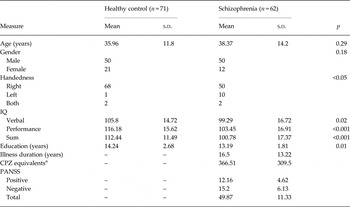
Data were acquired from a total of 147 subjects (75 healthy controls, 72 patients with schizophrenia). From these, two healthy controls withdrew from the study and a further two were not eligible. Ten patients were also excluded from the analyses due to excessive movement (>3 mm) during the scans. This resulted in a total of 133 subjects (71 healthy controls, 62 patients with schizophrenia). All subjects were screened and excluded if they had history of neurological disorder, history of mental retardation, history of severe head trauma with more than 5 min loss of consciousness, history of substance abuse or dependence within the last 12 months. Patients with co-morbid diagnoses of other Diagnostic Statistical Manual IV (DSM-IV) conditions were also excluded. The Structured Clinical Interview used for DSM Disorders (SCID) was used for diagnostic purposes. Demographic information is listed in Table 1. The authors assert that all procedures contributing to this work comply with the ethical standards of the relevant national and institutional committees on human experimentation and with the Helsinki Declaration of 1975, as revised in 2008.
Demographics of healthy control and patient subjects

CPZ, Chlorpromazine; IQ, intelligence quotient; PANSS, Positive and Negative Syndrome Scale; s.d., standard deviation.
a Chlorpromazine equivalents of current medications calculated according to dose equivalences provided by COBRE investigators based on Andreasen et al. (Reference Andreasen, Pressler, Nopoulos, Miller and Ho2010) and reported by Yang et al. (Reference Yang, Murray, Repovs, Cole, Savic, Glasser, Pittenger, Krystal, Wang, Pearlson, Glahn and Anticevic2014)
Image acquisition and preprocessing
The COBRE dataset (http://fcon_1000.projects.nitrc.org/indi/retro/cobre.html) consisted of resting-state fMRI scans acquired on a 3 T Siemens Magnetom Trio MRI scanner using a single-shot full k-space echo-planar imaging (EPI) with ramp sampling correction using the intercomissural line (AC-PC) as a reference (TR: 2 s, TE: 29 ms, matrix size: 64 × 64, 32 slices, voxel size: 3 × 3 × 4 mm3). A multi-echo MPRAGE (MEMPR) sequence was also acquired with the following parameters: TR/TE/TI = 2530/(1.64, 3.5, 5.36, 7.22, 9.08)/900 ms, flip angle = 7°, FOV = 256 × 256 mm2, Slab thickness = 176 mm, matrix size: 256 × 256, Voxel size: 1 × 1 × 1 mm3. With 5 echoes, the TR, TI and time to encode partitions for the MEMPR are similar to that of a conventional MPRAGE, resulting in similar GM/WM/CSF contrast.
The first five time-points of the resting-state data were discarded due to instability of the initial MRI signal, which left 145 volumes for processing. The data were preprocessed using the Data Processing Assistant for resting-state fMRI (DPARSF) package (Chao-Gan & Yu-Feng, Reference Chao-Gan and Yu-Feng2010). First, images were slice-timing corrected. To correct for movement artefacts, we undertook a rigorous three-step approach. Next, we excluded any subjects with more than one voxel length of movement (3 mm or 3 degrees). Images were spatially realigned to the first image of each dataset and movement parameters were assessed for each subject and corrected using the rigid-body 6 approach (Friston et al. Reference Friston, Ashburner, Frith, Poline, Heather and Frackowiak1995). The data was scrubbed to further correct for movement artefacts using Frame-wise Displacement (FD, 0.5 mm) using a nearest-neighbour interpolation approach (Power et al. Reference Power, Barnes, Snyder, Schlaggar and Petersen2012). We also compared FD values between groups and found that patients (mean = 0.37, s.d. = 0.19) were significantly higher than controls (mean = 0.27, s.d. = 0.15). We therefore entered these values as covariates in the subsequent ANOVA. No significant correlation was observed between FD and the extracted values for ReHo (controls: r = −0.18, p = 0.13; patients: r = −0.16, p = 0.21), fALFF (controls: r = 0.03, p = 0.8; patients: r = −0.12, p = 0.35) or GCA seeded from cuneus (controls: r = 0.04, p = 0.71; patients: r = 0.13, p = 0.32) and thalamus (controls: r = 0.16, p = 0.17; patients: r = −0.02, p = 0.87). White matter and CSF signal were both regressed out as nuisance covariates. DARTEL (Ashburner, Reference Ashburner2007) was used to normalize the data using each subject's structural image before removing linear drift. For fALFF calculation, the data were spatially smoothed using a 4 mm FWHM Gaussian kernel. The smoothing for ReHo was applied last in the pipeline prior to higher level analysis. We then applied a band-pass filter (0.01–0.08 Hz) to remove low-frequency fluctuations and high-frequency noise.
Reho and fALFF analyses
Both ReHo and fALFF maps were generated using the DPARSF package. ReHo was calculated for each subject by calculating Kendall's coefficient of concordance of each voxel's time-course with those of its nearest neighbours (26 voxels) (Zang et al. Reference Zang, Jiang, Lu, He and Tian2004). For fALFF, the time series of each voxel was transformed to the frequency domain to determine the power spectrum, and the sum of amplitude of the low-frequency range determines ALFF. fALFF maps were calculated for each subject as the proportion of power spectrum of low frequency (0.01–0.08 Hz) across the entire frequency range (Zou et al. Reference Zou, Zhu, Yang, Zuo, Long, Cao, Wang and Zang2008). The ReHo and fALFF maps were then z-transformed for the higher-level analyses.
Conjunction analysis
We first identified regions with significant difference between groups for both ReHo and fALFF [family-wise error (FWE)-corrected, p < 0.05] and found clusters located in the cuneus and postcentral gyrus for both ReHo and fALFF, and additionally the thalamus for the ReHo analysis, showing attenuation in patients compared to controls (Supplementary Fig. S1). To visualize the spatial overlap of group differences across ReHo and fALFF, the statistical parametric maps of both modalities were thresholded at p < 0.001 uncorrected and the intersection between the two were determined as voxels contained in both maps with a cluster extent threshold 150 voxels. Since the use of FWE-corrected maps for the conjunction makes it very unlikely that overlapping regions are found, and further lowers consistency of overlap (Duncan et al. Reference Duncan, Pattamadilok, Knierim and Devlin2009), a more liberal and uncorrected threshold was used. However, in order to minimize type I error, we also determined a cluster threshold by calculating cluster size threshold estimation for ReHo and fALFF maps which produced 18 and 84 voxels, respectively. Both methods resulted in the same cluster in the cuneus. The cuneus cluster was then used to create a spherical region of interest (ROI) as a seed region for Granger causality analysis (GCA).
Granger causality analysis
GCA provides a measure of effective connectivity whereby Granger causal connectivity between two regions indicates that neuronal activity of one region is predictive of activity that occurs in another region. We used a 6-mm radius sphere centred on the peak of the cuneus cluster (MNI: 0, −84, 24) identified from the conjunction analysis to determine effective connectivity of this region to the rest of the brain. The comparison between groups resulted in a significant cluster in the thalamus. We also then ran a reverse GCA seeding from this significant thalamic cluster to identify effective connectivity from the thalamic cluster back to the cuneus. Detailed procedures for the GCA analysis are reported in a previous study (Iwabuchi et al. Reference Iwabuchi, Peng, Fang, Jiang, Liddle, Liddle and Palaniyappan2014).
Statistical analysis
The z-transformed GCA maps seeded from the ROIs were subjected to whole-brain voxelwise analysis using SPM8 to identify differences in effective connectivity from the cuneus to the rest of the brain between schizophrenia patients and controls. Since we were specifically interested in visuothalamic connections, for the voxel-wise analysis, we used the corresponding small-volume correction mask of the visual thalamic mask taken from the Oxford thalamic probability atlas (Behrens et al. Reference Behrens, Johansen-Berg, Woolrich, Smith, Wheeler-Kingshott, Boulby, Barker, Sillery, Sheehan, Ciccarelli, Thompson, Brady and Matthews2003) which are structural connectivity-based subdivisions of the thalamus based on probabilistic tractography. We also extracted mean GCA coefficients from the cuneus and thalamus seed masks from the z-transformed x-to-y GCA maps to identify group differences in directional influence between the two regions maps (i.e. mean of thalamus ROI from GCA seeded from cuneus; mean of cuneus ROI from GCA seeded from thalamus). The GCA coefficients were entered into a repeated-measures ANOVA with direction (cuneus-to-thalamus and thalamus-to-cuneus) as within-subject factor and group (control and patient) as between subject factor. We also extracted mean ReHo and fALFF values from the cuneus seed used in the GCA to explore associations between these measures and the directional influence between the cuneus and thalamus using Spearman's correlation (as thalamus-to-cuneus GCA was not normally distributed). To rule out effects of medication, the GCA coefficients were correlated with current antipsychotic dose as measured by chlorpromazine (CPZ) equivalents. We also explored whether there are any relationships between visuothalamic connectivity (Granger coefficients in either direction, and ReHo and fALFF values extracted from the cuneus) and PANSS scores and illness duration. All statistical analyses were performed on IBM SPSS v. 21.0 (IBM Corp., USA) for Windows and used an α-level of 0.05 (correlation analyses were corrected for multiple comparisons using the Holm–Bonferroni correction).
Classification
The classification analysis was carried out using Pattern Recognition for Neuroimaging Toolbox (PRoNTo) (http://www.mlnl.cs.ucl.ac.uk/pronto). The ReHo, fALFF and GCA maps seeded from both the cuneus and thalamus were entered as separate modalities into a multiple kernel learning (MKL) classifier, which is based on a support vector machine algorithm. Separate linear kernels were built for each modality and features were mean-centred using training data and kernels were normalized. The outer loop for assessing the model's performance used a leave one subject out per group cross-validation approach. To validate and assess performance of the classifier, cross validation was performed in a double nested loop. The inner loop was used for the parameter optimization using a k-fold cross-validation approach on subjects per-group out with k = 5. This optimizes the soft-margin parameter C and provides good generalizability via a bias-variance trade-off (James et al. Reference James, Witten, Hastie and Tibshirani2013). Values of parameter C were 0.01, 0.1, 1, 10 and 100. The value of C that was selected most frequently for each model was as follows: ReHo: 100; fALFF: 1; GCA: 1; ReHo + fALFF: 100; ReHo + GCA: 1; ReHo + fALFF + GCA: 100 (although it should be noted that the value of C may not have been the same for all folds). The outer loop for assessing the model's performance used a leave one subject per group out cross validation approach. We obtained values for balanced accuracy, specificity, sensitivity, predictive values and area under the receiver operator curve (AUC) and statistical significance of these measures was determined by way of permutation testing (n = 1000 permutations with random assignment of patient/control labels to the training data) using p < 0.05).
Results
Effective connectivity
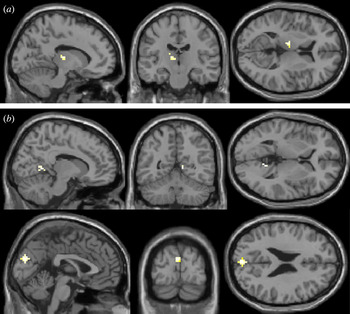
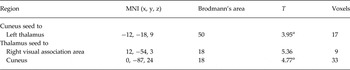
Analyses revealed significantly higher cuneus–thalamus (left) effective connectivity in controls compared to patients (p < 0.05, FWE corrected, k > 5) using a small-volume correction (SVC) of the visual-thalamic mask (Fig. 1a , Supplementary Fig. S2 and Table S2). The whole-brain analysis for GCA seeded from the thalamus showed a significant cluster of higher GCA coefficient in patients compared to controls in the right visual association area (p < 0.05, FWE corrected) (Fig. 1b and Table 2). SVC using the cuneus seed mask also revealed a significant cluster in the cuneus region (p < 0.05, FWE corrected).
(a) Thalamus cluster showing greater effective connectivity from the cuneus seed region of interest (ROI) in controls compared to patients [significant at p < 0.05, family-wise error (FWE) corrected, k > 5]. (b) Visual association cortex cluster (top) and cuneus cluster (bottom) showing greater effective connectivity from the thalamus seed ROI in patients compared to controls (significant at p < 0.05, FWE corrected, k > 5).

Regions showing significantly altered effective connectivity in patients compared to controls from the cuneus and thalamus seed regions (significant at p < 0.05, FWE corrected)

a Small volume corrected at p < 0.05, family-wise error (FWE) corrected.
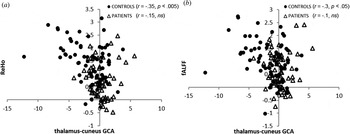
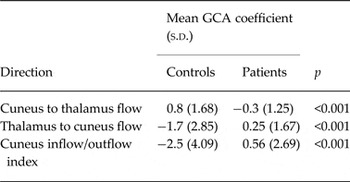
The repeated-measures ANOVA revealed significant interaction for group and direction (F 1130 = 22.28, p < 0.001). Specifically, for the cuneus thalamus connectivity, controls showed a positive influence (mean = 0.8, s.d. = 1.68) while patients showed a negative influence (mean = −0.3, s.d. = 1.25) (p < 0.001). Conversely, the thalamus-cuneus connectivity showed a negative influence in controls (mean = −1.7, s.d. = 2.85) and a positive influence in patients (mean = 0.25, s.d. = 1.66) (p < 0.001). Furthermore, while controls showed a significantly opposing directional influence between the cuneus and thalamus (p < 0.001), patients did not show such a pattern (p = 0.25). The correlation of influence between the two directions is highly correlated in both controls and patients (r = −0.61 and r = −0.69, respectively, both p < 0.001); however, on closer inspection, the inflow/outflow index (indexed by thalamus-cuneus influence subtracted by cuneus-thalamus influence) is significantly diminished in patients (p < 0.001). Furthermore, a one-sample t test also revealed that Granger coefficients in both directions of the patient group did not differ significantly from zero (p > 0.05), suggesting very weak connectivity between the thalamus and cuneus. Healthy controls on the other hand showed significant strength of connectivity in both directions (p < 0.001). Results are summarized in Table 3. Both mean ReHo and fALFF of the cuneus seed correlated significantly with the inflow/outflow index in controls (r = −0.32, p < 0.01 and r = −0.25, p < 0.05, respectively) while this was diminished in patients (r = −0.16, p > 0.05 and r = −0.09, p > 0.05, respectively). Correlation with each direction separately revealed that this association was driven solely by the thalamus-cuneus influence (controls: r = −0.35, p < 0.005 and r = −0.3, p < 0.05, patients: r = −0.15, p > 0.05 and r = −0.1, p > 0.05 for ReHo and fALFF, respectively) (cuneus-thalamus was not significantly correlated in either group). This is depicted in Fig. 2. There were no significant correlations between CPZ equivalents and Granger coefficients in either direction (p = 0.75 and 0.58 for cuneus-thalamus and thalamus-cuneus, respectively), suggesting that differences in connectivity are not due to antipsychotic medication. Neither the clinical scores nor illness duration correlated significantly with local connectivity or effective connectivity in either direction (all p > 0.1).
Spearman's correlation between mean (a) regional homogeneity (ReHo) and (b) fractional amplitude of low-frequency fluctuations (fALFF) of the cuneus seed and Granger causality analysis (GCA) coefficients of cuneus seeded from the thalamus.

Mean GCA coefficients in the cuneus and thalamus in controls and patients

GCA, Granger causality analysis.
Classification
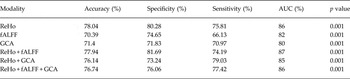
The MKL classifier using ReHo, fALFF and GCA maps in both directions performed with a balanced accuracy of 76.74% with specificity of 76.06% and sensitivity of 77.42% with an area under the curve of 86%. The contribution for each modality was as follows: ReHo = 32.57%, fALFF = 35.65%, cuneus to thalamus GCA = 17.98%, thalamus to cuneus GCA = 13.81%. Based on this, we also ran the classifier for ReHo and fALFF both separately and combined to see whether GCA maps improved classification accuracy. ReHo alone yielded an accuracy of 78.04% (80.28% specificity, 75.81% sensitivity) while fALFF resulted in an accuracy of 70.39% (74.65% specificity, 66.13% sensitivity). ReHo and fALFF combined in the model provided an accuracy of 77.94% (81.69% specificity, 74.19% sensitivity). Combining the two best modalities of GCA and ReHo resulted in an accuracy of 76.14% (73.24% specificity, 79.03% sensitivity) with an area under the curve of 85%. Results are summarized in Table 4.
Balanced accuracy, sensitivity, specificity and area under curve for multiple kernel learning classifier using ReHo, fALFF and GCA maps

ReHo, Regional homogeneity; fALFF, fractional amplitude of low-frequency fluctuations; GCA, Granger causality analysis.
Discussion
We note several findings relevant to the occipital cortex physiology in schizophrenia, that are, to our knowledge, hitherto unreported. In patients, there is significantly reduced low-frequency signal amplitude, co-occurring with reduced local connectivity within the occipital regions, which is also accompanied by an abnormal pattern of effective connectivity between this region and the thalamus at resting state. While controls exhibited a strong positive influence from cuneus to thalamus along with a strong negative influence from the thalamus back to the cuneus, patients showed substantially weakened connectivity of this thalamo-cortical feedback circuit. In addition, ReHo also provided high discriminatory accuracy between the two groups, with the highest sensitivity (correctly labelling a patient as a patient) achieved with the combination of ReHo and GCA maps, suggesting these modalities may be valuable in the search for biological markers for schizophrenia.
Local connectivity
Our ReHo and fALFF conjunction analysis showing reductions in the cuneus are consistent with previous literature employing similar methods, albeit in isolation, to study patients with schizophrenia (Hoptman et al. Reference Hoptman, Zuo, Butler, Javitt, D'Angelo, Mauro and Milham2010; Liu et al. Reference Liu, Xu, Xu, Wang, Zhao, Lv, Cao, Zhang and Du2010; Turner et al. Reference Turner, Damaraju, van Erp, Mathalon, Ford, Voyvodic, Mueller, Belger, Bustillo, McEwen, Potkin and Calhoun2013; Yu et al. Reference Yu, Hsieh, Wang, Liu, Liu, Hwang, Chien, Hwu and Tseng2013, Reference Yu, Chien, Wang, Liu, Liu, Hwang, Hsieh, Hwu and Tseng2014; Xu et al. Reference Xu, Zhuo, Qin, Zhu and Yu2015). In schizophrenia, decreases in fALFF seem to be more consistently reported than increases, and tend to occur in posterior regions including occipital and precuneus/cuneus regions (Hoptman et al. Reference Hoptman, Zuo, Butler, Javitt, D'Angelo, Mauro and Milham2010; Turner et al. Reference Turner, Damaraju, van Erp, Mathalon, Ford, Voyvodic, Mueller, Belger, Bustillo, McEwen, Potkin and Calhoun2013; Yu et al. Reference Yu, Chien, Wang, Liu, Liu, Hwang, Hsieh, Hwu and Tseng2014). Similarly, ReHo has also shown reductions in occipital regions (Liu et al. Reference Liu, Xu, Xu, Wang, Zhao, Lv, Cao, Zhang and Du2010; Yu et al. Reference Yu, Hsieh, Wang, Liu, Liu, Hwang, Chien, Hwu and Tseng2013). A recent meta-analysis of studies investigating ReHo and ALFF/fALFF alterations in schizophrenia also showed decreased levels in the occipital cortex (Xu et al. Reference Xu, Zhuo, Qin, Zhu and Yu2015). A similar measure of resting-state functional connectivity density, which measures the connectivity of a single voxel with all other brain voxels, has also shown to be reduced specifically in the occipital cortex in schizophrenia (Zhuo et al. Reference Zhuo, Zhu, Qin, Qu, Ma, Tian, Xu and Yu2014). Also of relevance is a report of increased centrality in schizophrenia (but not in bipolar disorder) notable in the occipital cortex, suggesting that the redistribution of the global connectivity of the visual cortex is a consistent feature of schizophrenia (Palaniyappan & Liddle, Reference Palaniyappan and Liddle2014). In line with this finding of aberrant visual cortex connections, input from the visual regions to the insula has also shown to be diminished in schizophrenia (Palaniyappan et al. Reference Palaniyappan, Simmonite, White, Liddle and Liddle2013b ), indicating cross-network sensory-processing disruptions. Further, steady-state visual evoked potential studies have demonstrated strong evidence for magnocellular dysfunction showing early-stage visual-processing deficits, which likely contribute to impairments further up the cognitive and social processing stream resulting in global dysfunction in schizophrenia (Butler & Javitt, Reference Butler and Javitt2005). To support, Wynn et al. (Reference Wynn, Green, Engel, Korb, Lee, Glahn, Nuechterlein and Cohen2008) reported abnormal functional topography of the lateral occipital cortex in patients which they suggest may relate to impaired ability in object recognition tasks.
Effective connectivity
Studies thus far have indicated a dissociation of undirected thalamo-cortical functional connectivity between prefrontal and sensory networks characterized by thalamic hyperconnectivity with motor and sensory regions (Woodward et al. Reference Woodward, Karbasforoushan and Heckers2012; Anticevic et al. Reference Anticevic, Cole, Repovs, Murray, Brumbaugh, Winkler, Savic, Krystal, Pearlson and Glahn2014). We note that this relative hyperconnectivity is actually directed from thalamus to visual areas, with net cuneus inflow/outflow being above zero in patients, while being below zero in healthy controls. In general, similar work has predominantly focused on prefrontal-thalamic coupling, with few studies specifically exploring visual-thalamic pathways despite aforementioned reports of visual processing impairment in schizophrenia. However, one recent study using whole brain approach to study the connectivity of the thalamus to cortical ROIs found greater coupling of fronto-thalamic circuits, as well as an absence of negative correlations between the thalamus and sensory and motor regions in schizophrenia (Klingner et al. Reference Klingner, Langbein, Dietzek, Smesny, Witte, Sauer and Nenadic2014). This lack of negative correlation holds true for our data where the strong negative influence from the thalamus to cuneus observed in controls is completely diminished in the patients. Anticevic et al. (Reference Anticevic, Gancsos, Murray, Repovs, Driesen, Ennis, Niciu, Morgan, Surti, Bloch, Ramani, Smith, Wang, Krystal and Corlett2012) have previously proposed a mechanism via cortical disinhibition to account for the disrupted long-range cortico-cortical connectivity, and further explain the possibility of aberrant brain-wide balance of excitation and inhibition which disrupts the relay of information between the thalamus and cortex (Anticevic et al. Reference Anticevic, Cole, Repovs, Murray, Brumbaugh, Winkler, Savic, Krystal, Pearlson and Glahn2014). This widespread alteration of inhibitory and excitatory balance has indeed been observed in both magnetic resonance spectroscopy studies in schizophrenia as well as animal models (Krystal et al. Reference Krystal, D'Souza, Mathalon, Perry, Belger and Hoffman2003; Kehrer et al. Reference Kehrer, Maziashvili, Dugladze and Gloveli2008; Jardri & Denève Reference Jardri and Denève2013; Schobel et al. Reference Schobel, Chaudhury, Khan, Paniagua, Styner, Asllani, Inbar, Corcoran, Lieberman, Moore and Small2013; Marsman et al. Reference Marsman, Mandl, Klomp, Bohlken, Boer, Andreychenko, Cahn, Kahn, Luijten and Hulshoff Pol2014; Taylor & Tso, Reference Taylor and Tso2015), consistent with the NMDA receptor hypofunction model. Functionally, negative correlations between brain regions have been thought to subserve inhibitory interactions where strength of anti-correlations are related to cognitive performance (Kelly et al. Reference Kelly, Uddin, Biswal, Castellanos and Milham2008; Hampson et al. Reference Hampson, Driesen, Roth, Gore and Constable2010). Given that glutamate is the primary neurotransmitter within the visual system, combined with glutamatergic theories of schizophrenia (Javitt, Reference Javitt2010), it would be of great interest to investigate whether disrupted ReHo and fALFF relate to levels of glutamate in the visual cortex. To date, studies of occipital neurochemistry in schizophrenia are limited and both methodology and findings are vastly inconsistent (Chang et al. Reference Chang, Friedman, Ernst, Zhong, Tsopelas and Davis2007; Marsman et al. Reference Marsman, Mandl, Klomp, Bohlken, Boer, Andreychenko, Cahn, Kahn, Luijten and Hulshoff Pol2014). Combining modalities in the same dataset is essential for the development of a more complete understanding for the mechanisms underlying sensory dysfunction in schizophrenia.
Association between local and distal connectivity
Interestingly, our analyses revealed a loss in association between the thalamus–cuneus influence and local connectivity measures in patients, suggesting a diminished interaction between spontaneous activity within the occipital region and the input from the thalamus. In controls, greater local connectivity and spontaneous activity is related to stronger negative influence of the thalamus on the cuneus, however this pattern is not reflected in patients. If local connectivity measured using BOLD is reflective of local excitation/inhibition balance as claimed recently using computational approaches (Deco et al. Reference Deco, Ponce-Alvarez, Hagmann, Romani, Mantini and Corbetta2014), then it is intriguing to note that such local balance in the visual cortex could be influenced by thalamic input in patients more than controls. Obviously, it is not entirely possible to deduce from the current data whether the breakdown occurs in the cuneus, the thalamus or elsewhere, though it is evident that the circuit failure exists at both a regional and distal level of connectivity. Taken together, these findings collectively suggest that there is a breakdown of the interaction between the thalamus and cortex, which might be attributed to a mechanism of disinhibition, resulting in a brain-wide excitation/inhibition imbalance, and ultimately resulting in the global and multi-faceted impairments and symptomatology of schizophrenia.
Classification using connectivity maps
Studies using machine learning to discriminate schizophrenia from controls using resting state fMRI are growing though to date have been relatively limited (Shen et al. Reference Shen, Wang, Liu and Hu2010; Venkataraman et al. Reference Venkataraman, Whitford, Westin, Golland and Kubicki2012; Arbabshirani et al. Reference Arbabshirani, Kiehl, Pearlson and Calhoun2013; Wang et al. Reference Wang, Zeng, Chen, Yin, Tan and Hu2015). In a recent meta-analysis of machine learning approaches discriminating patients with schizophrenia from controls, classification accuracies vary between 64–94% for sensitivity and 65–98% for specificity (Kambeitz et al. Reference Kambeitz, Kambeitz-Ilankovic, Leucht, Wood, Davatzikos, Malchow, Falkai and Koutsouleris2015), though this is likely attributed to the diversity in type of classifier used and parameters selected, as well as the heterogeneity of samples studied. Shen et al. (Reference Shen, Wang, Liu and Hu2010) used an ROI-based functional connectivity approach to discriminate patients from controls and achieved high total accuracy of 93.75% for discriminating patients (sensitivity), though specificity reached only 75%. Similarly, Arbabshirani et al. (Reference Arbabshirani, Kiehl, Pearlson and Calhoun2013) also attained high accuracy of up to 96% (92% specificity, 100% sensitivity) using functional connectivity of major resting state networks. However, more modest accuracies around 75% have also been reported using similar inputs of resting state functional connectivity for machine learning (Venkataraman et al. Reference Venkataraman, Whitford, Westin, Golland and Kubicki2012; Wang et al. Reference Wang, Zeng, Chen, Yin, Tan and Hu2015). Our study, using a multiple kernel learning SVM approach to determine contributions of the three resting-state fMRI measures achieved accuracies that lie between these previous reports, with ReHo achieving the best performance for overall accuracy. We aware of only one previous study using ReHo and fALFF to discriminate schizophrenia patients from control. Chyzhyk et al. (Reference Chyzhyk, Graña, Öngür and Shinn2015) were able to discriminate patients from controls with a very high accuracy reaching 97 and 100% for ReHo and fALFF respectively. Surprisingly, the most highly performing classifier (100%) used ReHo to discriminate schizophrenia patients with auditory hallucinations from those without. However, the sample size in this study was much smaller than the current study, which is known to produce higher accuracy rates due to sample homogeneity (Schnack & Kahn, Reference Schnack and Kahn2016). Larger samples often have lower accuracy, but are more generalizable to other samples, which is vital with regards to clinically translatable findings. Therefore, although functional connectivity is often utilized for pattern classification of mental disorders, local connectivity may be a potential biomarker to consider for clinically diagnosing schizophrenia. Furthermore, it is possible that the combination of both local and longer-range connectivity indices might differentiate the subtle brain-wide pathophysiology better than one modality alone. The challenge will be to determine the exact measures that will enable the best discriminatory ability.
One of the issues in the current study, as well as many others in the field, is the effect of medication. While we cannot completely eliminate the potential confounding effects of medication, we found that medication was not associated with effective connectivity, suggesting that these changes are unlikely to be driven by medication. Furthermore, illness duration also did not show an association with thalamo-cortical connectivity, which indicates that this change might precede illness onset. Findings of (Anticevic et al. Reference Anticevic, Haut, Murray, Repovs, Yang, Diehl, McEwen, Bearden, Addington, Goodyear, Cadenhead, Mirzakhanian, Cornblatt, Olvet, Mathalon, McGlashan, Perkins, Belger, Seidman, Tsuang, van Erp, Walker, Hamann, Woods, Qiu and Cannon2015) support such a notion where they reported dysconnectivity of the thalamo-cortical circuitry in those at risk for psychosis. Moreover, those who converted to full-blown psychosis had the most profound dysfunction, which has significant implications for considering thalamo-cortical connectivity in prognosis for schizophrenia. This idea might also explain the lack of association observed between symptom measures and IQ and effective connectivity, where aberrant communication between the cuneus and thalamus already exists prior to more externally visible characteristics of the disorder.
To summarize, we have observed a crucial physiological aberration in the visual cortex in schizophrenia, and highlighted the potential clinical utility of the observation in discriminating a patient with schizophrenia compared to a healthy control. We wish to highlight that occipital regions, as well as the prefrontal cortex, are amenable to noninvasive neuromodulation by virtue of their vicinity to the scalp surface. Experimental studies to investigate the ability of brain stimulation approaches to modify the physiological changes highlighted here would offer a potential means to move towards therapeutic translation.
Supplementary material
The supplementary material for this article can be found at https://doi.org/10.1017/S0033291716003469
Acknowledgements
Wellcome Trust (grant no. 076448/Z/05/Z). Department of Psychiatry & Schulich School of Medicine Dean's Support funds, Western University, Ontario. People Programme (Marie Curie Actions) of the European Union's Seventh Framework Programme (FP7/2007-2013) under REA grant agreement no. PCOFUND-GA-2012-600181.
L.P. was previously supported by a Grant from the Wellcome Trust (grant no. 076448/Z/05/Z) and currently by the Department of Psychiatry & Schulich School of Medicine Dean's Support funds, Western University, Ontario. S.I. has received funding from the People Programme (Marie Curie Actions) of the European Union's Seventh Framework Programme (FP7/2007-2013) under REA grant agreement no. PCOFUND-GA-2012-600181.
Declaration of Interest
S.I. declares no conflict of interest. L.P. received a Young Investigator travel fellowship sponsored by Eli Lilly (2010) and Travel Support from Magstim Limited (2014) and in the last year, has held shares of Shire Inc. and GlaxoSmithKline in his spousal pension funds. L.P. is also supported by the Bucke Family Fund and the Academic Medical Organization of Southwestern Ontario (AMOSO).