Introduction
In Vietnam, English has been held in high regard since the country embarked on its economic reform known as Doi Moi (Renewal) in 1986 (Ngo, Reference Ngo, Ruecker and Crusan2018a; Nguyen, Reference Nguyen2016). Yet, over the past decades, the country's English teaching sector has consistently been underperforming (Le, Reference Lein press; Ngo, Reference Ngo, Ruecker and Crusan2018a, Reference Ngo2018b; Nguyen, Reference Nguyen2016; Nguyen & Nguyen, Reference Nguyen, Nguyen, Kirkpatrick and Liddicoat2019). As an indicator, a recent survey has found that most Vietnamese secondary school graduates cannot communicate in English for survival needs even after seven years of compulsory education (Le, Reference Le, Spolsky and Sung2015). Such poor English proficiency has been perceived by the Vietnamese government as a threat to the country's successful integration into the regional and global market (Dudzik & Nguyen, Reference Dudzik, Nguyen, Stroupe and Kimura2015; Ngo, Reference Ngo, Ruecker and Crusan2018a), prompting it to issue Decision 1400 (Vietnamese Government, 2008), thereby launching the National Foreign Language Project (often known as Project 2020, as it was anticipated to conclude in 2020). With a substantial budget of 9,378 trillion Vietnamese Dong (approximately US$400 million) (Vietnamese Government, 2008) or 0.4% of its GDP in 2008 (World Bank, n.d.), the National Foreign Language Project was expected to:
… deliver comprehensive reforms in the teaching and learning of foreign languages in the public education system and implement new foreign language curricula at all levels of education in order that by 2015 there will have been a considerable advance in the workforce's foreign language competence, especially in areas of priority, and by 2020, the majority of Vietnamese graduates from post-secondary institutions will have become independent and confident users of foreign languages, being able to study and work in a multi-lingual and multi-cultural environment. (Vietnamese Government, 2008: 1)
It should be noted that in Vietnam, the term ‘foreign language’ is virtually synonymous with English, which is learnt by over 90% of students at all levels of education (Nguyen, Reference Nguyen2016; Tran et al., Reference Tran, Kettle, May and Klenowski2016). To achieve this overarching goal, Decision 1400 (Vietnamese Government, 2008) outlines numerous tasks and solutions. However, due to the space limitations, this paper will address three key issues that that have attracted arguably the most scholarly interest and debate: Project 2020's borrowing of the Common European Framework of Reference (CEFR) (Council of Europe, 2001) to set the learning outcomes at all levels of education, recent CEFR-aligned mandatory testing policy and test development, and large-scale assessment and (re)training of English teachers.
Project implementation
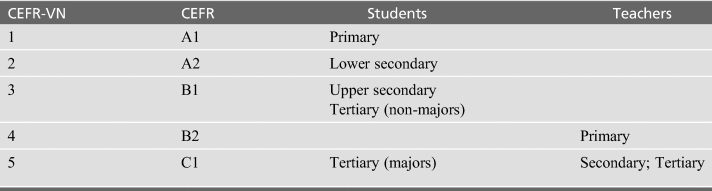
A top priority of Project 2020 as written in Decision 1400 is to develop a six-level foreign language competency framework compatible with the CEFR, which serves as the basis for ‘developing foreign language curricula, textbooks, teaching plans, and assessment criteria at all levels of education to ensure continuity’ (Vietnamese Government, 2008: 2). In line with this founding document, the Ministry of Education and Training (MOET) eventually issued the Foreign Language Competency Framework for Vietnam via Circular No. 01/2014 (MOET, 2014). Curiously, six years before this framework was introduced, Decision 1400 (Vietnamese Government, 2008) had already specified the required benchmark of English proficiency for students and teachers at all levels of education (see Table 1). Nevertheless, this pre-specification was understandable given that the framework itself is a ‘near translation of the CEFR's can-do statements’ (Ngo, Reference Ngo, Ruecker and Crusan2018a: 48; see also Nguyen & Hamid, Reference Nguyen and Hamid2015), which accounts for why this competency framework is more widely known as CEFR-VN among local English teachers (Ngo, Reference Ngo2017, Reference Ngo, Ruecker and Crusan2018a).
Required English proficiency benchmarks for students and teachers

With the CEFR-VN in place, the MOET's next move was to introduce two major reforms in English assessment closely linked with this borrowed framework. First, to ensure that all university graduates can ‘become independent and confident users’ of English (Vietnamese Government, 2008: 1), the MOET implemented the mandatory exit testing policy, under which students who failed the final English exam would be deemed ineligible for graduation (Ngo, Reference Ngo, Ruecker and Crusan2018a, Reference Ngo2018b). Second, to provide a cost-effective communicative testing solution (Nguyen et al., Reference Nguyen, Do, Do, Nguyen, Dang, Nguyen and Pham2014), the MOET commissioned the development of a standardized English test called the Vietnamese Standardized Test of English Proficiency (henceforth VSTEP) (ULIS, 2015). Heralded as ‘a breakthrough in foreign language assessment reforms’ (Vu, Reference Vu2015: 1), VSTEP is a test battery comprised of four papers (Listening, Reading, Writing, and Speaking) designed to measure English proficiency from Level 3 to Level 5 on the CEFR-VN (equivalent to Levels B1-C1 in the CEFR). To be specific, VSTEP's Listening and Reading papers test a range of reading and listening sub-skills (e.g. listening/ reading for details, main ideas, and inferences), but both make exclusive use of four-option multiple choice items. VSTEP's Writing paper consists of an email- or letter-writing task and a short essay, whereas the Speaking paper consists of a short interview, a problem-solving task, and a topic-development task based on suggested ideas presented in a mind map.
Last, but far from least, Project 2020 dedicated up to 85% of its budget to retraining English teachers in both language proficiency and pedagogy (Dudzik & Nguyen, Reference Dudzik, Nguyen, Stroupe and Kimura2015; Le, in press; Le & Nguyen, Reference Le and Nguyen2017). To fulfil this ambitious task, the MOET ordered five key regional foreign language institutions to conduct initial assessment of teachers’ proficiency, the scale of which was unprecedented in the country's English education history. As an example, in the period of 2011 to 2013 alone, up to 44,995 English teachers were tested, which revealed alarming results: over 83%, 87% and 91% of teachers at primary, lower secondary, and upper secondary schools respectively failed to meet their required benchmarks (see Table 1) (Nguyen, Reference Nguyen2013). Following the initial assessment, thousands of teachers were sent to take intensive courses in both English (400 hours for each CEFR-VN level) and teaching methods at the five key regional foreign language centers (Dudzik & Nguyen, Reference Dudzik, Nguyen, Stroupe and Kimura2015).
An expected failure?
There has been little dispute about the necessity and significance of Project 2020. In fact, it has been praised as ‘a timely reform’ (Nguyen & Nguyen, Reference Nguyen, Nguyen, Kirkpatrick and Liddicoat2019: 194), ‘reflect[ing] a strong commitment by the Vietnamese government’ (Le, Reference Le, Spolsky and Sung2015: 186), and a milestone in the history of foreign language education in Vietnam (Le & Nguyen, Reference Le and Nguyen2017). However, few would go as far as considering the project a success, and even the MOET's leader had to admit publicly about its failure (Le & Nguyen, Reference Le and Nguyen2017; Mai, Reference Mai, Hashimoto and Nguyen2018). For many scholars, this outcome is to be expected since both the project's goals and implementation were based on political will rather than theoretical underpinning and empirical evidence (Le Reference Le, Spolsky and Sung2015; Le & Nguyen Reference Le and Nguyen2017; Ngo Reference Ngo, Ruecker and Crusan2018a; Nguyen, Hamid & Renshaw, Reference Nguyen, Hamid and Renshaw2016; Nguyen et al., Reference Nguyen, Nguyen, Nguyen, Nguyen and Siew Kheng2018)
Regarding the adoption of CEFR to build the CEFR-VN, recent studies have revealed some major problems with this seemingly logical and straightforward decision, which aimed to bring English teaching and assessment in Vietnam in line with international standards (Dudzik & Nguyen, Reference Dudzik, Nguyen, Stroupe and Kimura2015). First, while the original CEFR consists of a descriptive scheme which details the ‘knowledge, skills, attitudes learners will need to develop’ (Council of Europe, 2001: 18) and a set of six common reference levels, the CEFR-VN is comprised of only the second part, which risks de-emphasizing the original framework's use for learning and teaching and places undue stress on assessment (Nguyen & Hamid, Reference Nguyen and Hamid2015). This concern is not unfounded and has been confirmed by such papers as Ngo (Reference Ngo2017), Nguyen et al. (Reference Nguyen, Hamid and Renshaw2016), and Nguyen et al. (Reference Nguyen, Nguyen, Nguyen, Nguyen and Siew Kheng2018). Second, the proficiency benchmarks set for teachers and students as in Table 1 have been repeatedly critiqued as unattainable by both institution leaders (Nguyen et al., Reference Nguyen, Hamid and Renshaw2016) and classroom teachers at tertiary (Ngo, Reference Ngo, Ruecker and Crusan2018a) and secondary levels (Le, Reference Le, Spolsky and Sung2015). As shall be shown below, the mere borrowing of an international framework does not guarantee international standard practices; on the contrary, it may push institutions and teachers to dubious acts in their attempt to achieve the unattainable goals prescribed by policymakers.
In the area of assessment, mandatory exit testing has led to several unintended consequences. As institutions were required to align their assessment to the CEFR, which they had limited knowledge about, they became heavily reliant on commercial exam materials with unsubstantiated claims of CEFR linkage (Nguyen & Hamid, Reference Nguyen and Hamid2015; Nguyen et al., Reference Nguyen, Nguyen, Nguyen, Nguyen and Siew Kheng2018; Nguyen et al., Reference Nguyen, Hamid and Renshaw2016). As shown in Nguyen and Hamid (Reference Nguyen and Hamid2015) and Ngo (Reference Ngo2017), high-stakes tests that determined students’ eligibility for graduation were compiled from IELTS, TOEFL, and Cambridge books and were regarded as ‘a mess’ by teachers (Ngo, Reference Ngo2017: 19). More seriously, in an attempt to assist their students, institutions have been found to employ unethical practices, such as decreasing item difficulty and providing exam questions in advance (Nguyen et al., Reference Nguyen, Hamid and Renshaw2016; Ngo, Reference Ngo, Ruecker and Crusan2018a). As Ngo (Reference Ngo, Ruecker and Crusan2018a) has argued, this use of standardized testing to engineer reforms is problematic and potentially counter-productive due to the unpredictability of test washback (Wall, Reference Wall, Fulcher and Davidson2012). With respect to the development of local tests (i.e. the VSTEP suite), this was certainly a welcome development. Nevertheless, the validity evidence for this test battery remains severely limited and based on internal research (Nguyen et al., Reference Nguyen, Do, Do, Nguyen, Dang, Nguyen and Pham2014; Tran et al., Reference Tran, Nguyen, Dang, Nguyen, Nguyen, Huynh and Davidson2015). Hence, it remains debatable whether this locally developed test can be used for making high-stakes decisions, such as students’ graduation eligibility or teachers’ contract renewal.
Finally, the MOET's swift move to assess tens of thousands of English teachers nationwide also sparked considerable controversy. On the one hand, it alerted the public about English teachers’ alarmingly poor proficiency (Nguyen et al., Reference Nguyen, Hamid and Renshaw2016; Le, in press); on the other hand, this large-scale assessment was based on unvalidated testing instruments and caused acute stress among teachers (Dudzik & Nguyen, Reference Dudzik, Nguyen, Stroupe and Kimura2015; Le, Reference Le, Spolsky and Sung2015). Moreover, the follow-up intensive English courses were also problematic because they were designed to prepare teachers for proficiency tests rather than enhance their ability to teach English (Le, Reference Le, Spolsky and Sung2015; Mai, Reference Mai, Hashimoto and Nguyen2018). Likewise, teaching method courses did not seem to generate change in the classroom practices of teachers, who, despite their appreciation of the knowledge gained during training, could not practise communicative language teaching or task-based and game-based teaching because of their students’ low motivation and English proficiency (Le, Reference Le, Spolsky and Sung2015). As Le (in press) explains, the limited applicability of such training courses was predictable given that they were designed and delivered by university lecturers with limited understanding of English teaching in secondary school.
Coda: 2020 and beyond
At the time of writing, Project 2020 has been extended to 2025 with the issuance of Decision 2080 (Vietnamese Government, 2017) after the MOET conceded to the improbability of accomplishing Decision 1400's ambitious goals by 2020 (Le & Nguyen, Reference Le and Nguyen2017; Mai, Reference Mai, Hashimoto and Nguyen2018). A close scrutiny of Decision 2080, nonetheless, reveals that it is basically a reincarnation of Decision 1400 with a five-year extension of all deadlines and slightly more tentative wording. The constructive criticisms from the academic community and classroom teachers (Le, Reference Le, Spolsky and Sung2015; Le & Nguyen, Reference Le and Nguyen2017; Ngo, Reference Ngo, Ruecker and Crusan2018a; Nguyen et al., Reference Nguyen, Hamid and Renshaw2016; Nguyen et al., Reference Nguyen, Nguyen, Nguyen, Nguyen and Siew Kheng2018) did not appear to be taken into consideration in the formulation of Decision 2080. This issue, however, is hardly surprising given the centralized top-down policy making tradition (Le & Nguyen, Reference Le and Nguyen2017; Le, in press) that can be traced back to Vietnam's command economy before 1986. Considering the problems elaborated in the previous section, this paper argues that a bottom-up approach to policy making should be adopted for Project 2020 and other future English language reforms. Specifically, this bottom-up approach should be based on evidence generated by the academic community and then subject to a consultation process with different stakeholders, including, but not limited to, institutional leaders, teachers, students, and parents. Such consultation is essential because, as argued in Nguyen et al. (Reference Nguyen, Nguyen, Nguyen, Nguyen and Siew Kheng2018) and Nguyen et al. (Reference Nguyen, Hamid and Renshaw2016), these actors determine a policy's eventual success or failure. Another benefit of extensive stakeholder consultation is that the voices of those on the frontline of policy implementation will enable English policies to better account for regional and contextual differences (Le, Reference Le, Spolsky and Sung2015; Le & Nguyen, Reference Le and Nguyen2017) so that the goals, once set, can motivate rather than debilitate and push institutions to unethical practices as reported in Ngo (Reference Ngo, Ruecker and Crusan2018a) and Nguyen et al. (Reference Nguyen, Hamid and Renshaw2016).
As mentioned above, a good starting point for policy making is empirical evidence from quality academic studies. Thus, this paper recommends that a considerable budget be allocated to research in not only Project 2020 but also future English reforms. Such initial investment in research promises high return because it may avert the waste of money on unfocused and ineffective implementation of project goals (Le & Nguyen, Reference Le and Nguyen2017). In relation to the CEFR, more research is needed to validate and enrich the level descriptors because previous studies (Ngo, Reference Ngo2017; Nguyen & Hamid, Reference Nguyen and Hamid2015) have shown that the CEFR and the CEFR-VN are under-developed and lacking in detail. Equally important, there is a need for studies into how to educate stakeholders about the framework given their current limited knowledge and application of the CEFR (Ngo, Reference Ngo2017; Nguyen et al., Reference Nguyen, Hamid and Renshaw2016). Regarding assessment, ongoing validation of locally-developed tests is urgently needed, especially when these tests have already been used for making high-stakes decisions. Likewise, the limited impact of both English proficiency and teaching method courses implies that research efforts should focus on developing and evaluating new models of professional development, such as enhancing teachers’ English classroom competence (Freeman & Drean, Reference Freeman and Drean2017), establishing local communities of practice (Le, Reference Le, Spolsky and Sung2015), and a more effective school/university partnership to bridge the gap between university-based training courses and school practices.
Finally, there has been a thorny, yet largely ignored issue in the literature on Project 2020, namely teachers’ financial compensation. It is a well known fact that, whereas the demand for English learning in the country is booming (Ngo, Reference Ngo, Ruecker and Crusan2018a, Reference Ngo2018b; Nguyen, Reference Nguyen2016), Vietnamese English teachers’ salaries cannot cover their basic living expenses (Nguyen, Reference Nguyen2017; Le, Reference Le, Spolsky and Sung2015). Hence, the majority of teachers actively participate in a ‘shadow education economy’ by teaching classes at English centers and/or at home in the evening, leaving little time for lesson planning, let alone professional development (PD) activities. This means that, without proper financial rewards, Project 2020's extensive PD programs may not only go to waste but also be perceived as an unwelcome burden by time-poor teachers (Le, Reference Le, Spolsky and Sung2015). Hence, this paper, in similar fashion to Nguyen (Reference Nguyen2017), argues that teachers’ compensation should be regarded as a crucial rather than peripheral issue in educational reforms since better financial rewards will incentivize teachers to enhance their proficiency and engage in other PD activities (Tran et al., Reference Tran, Kettle, May and Klenowski2016).
To conclude, Project 2020 or the Vietnamese Government's trillion-dong attempt to boost the nation's English proficiency can be seen as a proactive measure to sharpen the nation's competitive edge in a world where English is undeniably the lingua franca. Nevertheless, if there were no shift away from the current centralized and politically deterministic approach to goal setting and implementation, few would be willing to bet on the success of Project 2020 – or Project 2025 as it may be called due to the recent extension.
 XUAN MINH NGO is a PhD student at the University of Queensland, Australia, and a former TESOL lecturer at Vietnam National University, Hanoi. His research interests lie in the intersection of language assessment, language policy, and teacher education. His works have appeared in System, Asian EFL Journal, Journal of World Languages, and a recent Routledge edited collection. Email: x.ngo@uq.edu.au