Introduction
In July 2016, the British media covered the events in Whitehall from the viewpoint of cats. Larry, the Number 10 Downing Street cat, along with his feline colleagues Palmerston, Gladstone and Evie, made the news when the coverage of British politics was transferred to the street fights of competing tomcats Larry, Palmerston, and Gladstone. Headlines included: ‘The feline fight for Downing Street: Larry and Palmerston face-off to be the top cat of No 10’ (Burrows, Reference Burrows2016) in The Daily Mail; ‘Gladstone the cat lands Treasury job’ (‘Gladstone the Cat Lands Treasury Job’, 2016) on the BBC; ‘Gladstone the cat gives Treasury some paws for thought’ (Walker, Reference Walker2016) in The Guardian; and ‘Cat & Mouser. Foreign Office moggie in stand off with Larry at No10 as bid for power continues’ (Foxton & Pettitt, Reference Foxton and Pettitt2016) in The Sun.
This personification of cats – or perhaps this catification of British politics – in the media is part of a current trend in the online world: Cats are considered the axiomatic internet phenomenon. In 2016, the number of pet cats was estimated at 8 million in the UK (FEDIAF, 2017a) and at almost 103 million in Europe (FEDIAF, 2017b). As the internet can also be regarded as a ‘virtual cat park’ (Eppink, Reference Eppink2015) for people showing their cat to others, it does not come as a surprise that the online world seems to consist to a large extent of cat pictures, cat videos, cat memes, and cat stories. The media popularly perceives the internet as dominated by cats (see e.g. Shepherd, Reference Shepherd2014; Rhodes, Reference Rhodes2015), but in fact only about 0.3 per cent of all internet traffic is cat-related (Eppink, Reference Eppink2015).
Cats feature in countless stories in the media. They are very active in the political sphere on social media platforms, with e.g. #catsforBrexit, #catsagainstBrexit, #catsagainstterrorism, #pawsforpeace, #purrsforpeace, and more #catsfor and #catsagainst hashtags, and have also entered the academic world with #academicswithcats on Twitter (Podhovnik, Reference Podhovnik2016; Wright, Reference Wright2015a, Reference Wright2015b, Reference Wright2017: 194). Especially on social media platforms, this trend has left its mark on the English language with so-called meowlogisms. The term meowlogism refers to word formations which, in a cat inspired word play, have been given a purrified, or catified, twist, such as ‘paws’ (pause) and ‘top cat’ used in the headlines above.
As this paper shows, meowlogisms are a common feature in the discourse in the cat communities on social media platforms and have also found their place in the mass media. After providing some theoretical background on a sociolinguistic approach to computer-mediated discourse, language varieties on the internet, and methodological considerations, this paper offers a qualitative sociolinguistic analysis of #blackcat on Instagram, describes meowlogisms on #blackcat, and rounds off the results with examples of meowlogisms in four British online media.
Sociolinguistic Approach to #blackcat on Instagram
When following cats on the internet, it becomes obvious that meowlogisms are used on a regular basis in cat communities on social media platforms setting the cat community apart from other communities. To provide some framework for the description of #blackcat on Instagram, relevant studies discussing the concepts of community, identity, internet, variables, and data collection are briefly mentioned.
In their collection of essays, Blommaert and Varis (Reference Blommaert and Varis2015) discuss identity, identity discourses, and online communities. Blommaert and Varis (Reference Blommaert and Varis2015: 54–55) introduce the idea of so-called ‘light communities’, which are groups of people who temporarily identify with a group focusing on a particular topic. In order to belong to a specific community, people use discourse features typical for that community. There is a tendency towards the use of ‘sets of emblemic resources’, such as specific linguistic forms, emoticons, and ideas characterising identity, which are then judged by the other members of this community on a continuum ranging from authentic to fake. Likes and shares, which are very common on social media, are linked to the concept of phatic expressions used to keep the social communication channels open (Blommaert & Varis, Reference Blommaert and Varis2015: 68–70).
Herring (Reference Herring2007) introduces the term computer mediated discourse (CMD) to reflect the clusters of features in discourse and provides a classification scheme with medium factors and situation factors for an analysis of computer mediated discourse. Medium factors include the various possibilities of messaging, such as synchronicity/asynchronicity, transmission, availability of transcript, the number of allowed characters per message, channels, anonymity, private messages, filtering, quoting, and message format (Herring, Reference Herring2007: 6). Situation factors comprise the structure of participation, characteristics of participants, purpose, topic/theme, tone, activity, norms, and code (Herring, Reference Herring2007: 8). With this framework, computer mediated discourse of a specific community can be shown in its facets.
In his studies on bilingual interaction on the internet, Androutsopoulos (Reference Androutsopoulos2014, Reference Androutsopoulos, Danet and Herring2007) suggests ways to look at language choice and code-switching in internet forums and talks about qualitative and quantitative ways of researching language on the internet. Community variables can be taken as features to study, and linguistic variables to be researched can include emoticons, unconventional spellings, representation of spoken language features, regional dialect features, obscenity, and code-switching (Androutsopoulos, Reference Androutsopoulos2006: 425).
Androutsopoulos (Reference Androutsopoulos, Mallinson, Childs and Herk2013) describes online data collection and takes up methodological and ethical issues, such as data sampling, online observation, and privacy. The sampling techniques relevant for #blackcat data are ‘sampling by theme’ and ‘sampling by phenomenon’. Sampling by theme refers to data collection by looking at a theme, for example by using specific hashtags in the data search. Sampling by phenomenon takes a specific linguistic feature, e.g. specific emoticons or spellings, as the starting point (Androutsopoulos, Reference Androutsopoulos, Mallinson, Childs and Herk2013: 238). Additionally, data can be categorised in screen-based and in user-based data. Screen-based data refers to the data production without a researcher's prompt, while user-based data is created in direct interaction by the researcher (Androutsopoulos, Reference Androutsopoulos, Mallinson, Childs and Herk2013: 240). As far as online observation by the researcher is concerned, the virtual presence of the researcher in the community can be active or passive. In the data analysis itself, the privacy of the informants has to be protected (Androutsopoulos, Reference Androutsopoulos, Mallinson, Childs and Herk2013: 247).
At this point, I would like to add a cat-inspired sidenote. Cats also turn up in sociolinguistic research. Blommaert and Varis (Reference Blommaert and Varis2015: 65) as well as Androutsopoulos (Reference Androutsopoulos, Mallinson, Childs and Herk2013: 245) use the example of lolcats to refer to the concept of memes. Lolcats are assumed to be a well-known internet phenomenon, which could be seen as a case in point of the perceived internet dominance of cats.
LOLspeak – A Cat Related Internet Variety
Although this study does not discuss the theoretical issue of the connection of variationist studies and the Internet, it mentions the notion of internet language variety, which is important for a sociolinguistic approach to the selected #blackcat community. Crystal (Reference Crystal2006: 19) mentions various terms for the language used on the internet: netspeak, netlish, weblish, internet language, cyberspeak, computer mediated communication (CMC), and more. Herring et al. (Reference Herring, Kouper, Kutz, Vaisman and Zhang2012) talk about ‘special internet language varieties’ and refer to the example of Leetspeak, which is a language originally used by hackers.
Other varieties include Chanspeak (Fiorentini, Reference Fiorentini2013: 91; Lisecki, Reference Lisecki2013) and Lolspeak (Fiorentini Reference Fiorentini2013, Miltner Reference Miltner2012). The variety Chanspeak is used on the message board 4chan, which has played a role in the creation of the hashtag #caturday. #caturday was first used on 4chan to categorise cat images posted on Saturdays and is actually a very well-known example of a meowlogism.
The internet language variety commonly associated with cats is Lolspeak. Lolspeak is related to the images of lolcats, which are funny cat images with captions and which also originated on 4chan. Popularised with the caption ‘I can has cheezburger’, Lolspeak is now also used in the wiki-based project of the Lolcat Bible. Lolspeak is also known as Kitty Pidgin and has always been characterised by certain emblemic resources, like features of baby talk and Leetspeak. In Lolspeak, cats are given a baby voice, and specific orthographic, grammatical, and lexical features are used, such as mis-declined verbs, mis-declined gerunds, incorrect plural and verb foms, and article dropping (Fiorentini, Reference Fiorentini2013: 93–94). With the Lolcat Bible, a corpus of Lolspeak is already available. On its wiki, the Lolcat Bible project offers visitors a resource to learn lolspeak (LOLCat Bible Translation Project, n.d.).
In another cat-inspired sidenote, I would like to point to the real cat language of the Meowsic research project. The Meowsic project looks at melody in human-cat communication and wants to provide an understanding of prosodic features in human speech and cat vocalisations (Schötz, Eklund & van de Wejer, Reference Schötz, Eklund and van de Wejer2016).
Data Collection for Meowlogisms of #blackcat
This research is qualitative in nature and its aim is to show the variety of meowlogisms that are used. At this stage, the investigation does not look at quantitative factors, such as how often a particular form has been used.
In order to list meowlogisms in English, data has been collected on the social media platform Instagram and, to give a wider view of the range of meowlogisms, in the online editions of four British media. The data sampling was based on theme and, in the case of #blackcat on Instagram, also based on phenomenon. The data is on-screen data.
From 2014 onwards, I have been observing the cat community online on Facebook, Instagram, cat blogs, and in the media, looking for ‘cat content’ (which is the German expression for the phenomenon of cats on the internet and in the public sphere), for another study (Podhovnik, Reference Podhovnik2016), and taking informal research notes for my research blog The Meow Factor (Podhovnik, Reference Podhovnik2017). While the encountered meowlogisms feature in those research notes, I did not systematically search for meowlogisms prior to this study.
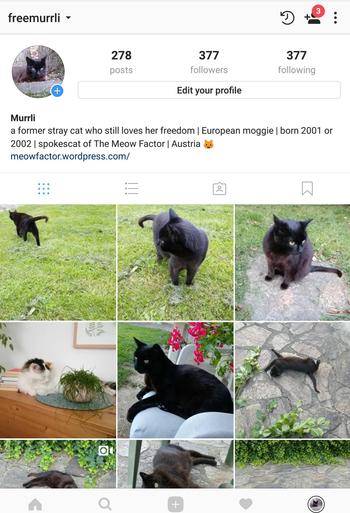
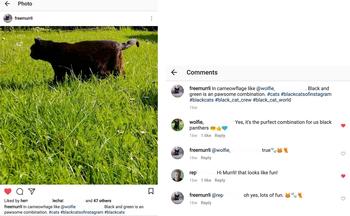
The reason for the choice of #blackcat as a community variable is the fact that I am active with #blackcat on Instagram as freemurrli Footnote 1, the account of my black cat Murrli (see Figure 1), posting photos of Murrli with captions on a regular basis, liking and sometimes commenting on other people's cat photos. Figure 2 shows an example post of freemurrli with a caption and comments.
Instagram account of freemurrli on www.instagram.com/freemurrli

Post of freemurrli

In order to conduct a systematic search for meowlogisms, I decided on a data collection period of one month, from 19 March 2017 to 20 April 2017. To keep the parameters of users as similar as possible and to limit the amount of data, I narrowed down the sample to three cat accounts I follow as freemurrli, namely the black cats Wolfie, Luna, and Raven. The usernames have been shortened to the cats’ names to protect the real accounts’ privacy. All three cats regularly use #blackcat and appear on Murrli's homefeed. The choice in the non-random sample was based on the regularity of posting, the amount of text in the captions, and the number of comments. Wolfie and Luna claim to be from the UK and Raven from the US.
Captions and comments have been collected by copying and pasting the text in preparation for use in the QDA software MinerLite (Provalis Research, n.d.). All in all, data from 97 posts has been compiled: 20 posts by Wolfie, 32 by Luna, and 45 by Raven. The posts have been analysed qualitatively with deductive and inductive categories. The results are presented in the sections #blackcat as a Light Community on Instagram and Meowlogisms in #blackcat.
For the analysis of the media, the sampling was done in a one-month period from 01 July 2016 to 31 July 2016. The search was conducted via Google News (Google, 2017) with the key-word ‘cat’. All cat news stories were collected from the online editions of the BBC, the Daily Mail, the Guardian, and the Sun. These news sites make their article available without a paywall. The original aim of that data collection was a different study on cat news stories, which is why the sampling dates of the media stories do not coincide with the dates of the Instagram samples. The media meowlogisms have been included as incidental material to complement and extend the results found on Instagram. All in all, there are 79 cat news stories, which have also been analysed with the software MinerLite.
#blackcat as a Light Community on Instagram
The social media platform Instagram was initially developed for mobile devices as an app to share photos and videos. Now so-called Instagram stories can be added, too, which disappear once a follower has seen them. The images can be edited before posting. Users can write captions, tag other users in the photos, add a location, and share the post to Facebook, Twitter, and Tumblr. On its website, Instagram claims to have 700 million-plus users, monthly active, and 400 million-plus daily actives (Instagram, 2017).
On Instagram, cats in general and black cats in particular are very popular. A search on 24 August 2017 with the hashtag #cat resulted in 121,759,457 posts, with the hashtag #blackcat in 6,537,267 postsFootnote 2. The numbers increase daily, and the majority of these posts feature cats, though it is impossible to say how many of the users have cat accounts. Cat accounts are those accounts which have been opened on behalf of the cats in the profile and whose posts are mainly cat images. User names often have the parts name + cat, cat + name, or have user names following the pattern name + the + adjective + cat, although there are other forms as well.
As of 25 August 2017, Murrli has 375 followers. Although this number varies slightly from day to day, there is a general tendency for more followers. About 20 followers are personally known to me from university, and some followers are businesses. The majority of followers are other cat accounts. The main language on freemurrli is English, but other languages, including German, French, Italian, and Russian, are used, depending on where Murrli's followers are from. Wolfie, Luna, and Raven are also among Murrli's followers, and in their comments, the language is English.
Geographic location does not play a role in #blackcat on Instagram as, unless the settings are on private, users from everywhere can see, like, and comment each others’ photos. A newly shared picture appears in the newsfeeds of the followers, and older pictures with likes and comments are available on the users’ profile pages (see Figure 1).
To belong to the #blackcat community, to be more precise, to show up in the #blackcat feed, the caption of the uploaded image has to include the hashtag #blackcat. The more hashtags a caption includes, the more feeds and users are reached as the algorithms of Instagram have more data to work with.
Instagram notifies the user which and how many other users have liked the image, which new followers follow the account, and suggests additional accounts to follow based on the existing followers and likes. Thus, light communities are formed focusing on the topic of black cats with users liking each others’ photos and videos. The mutual likes are a form of phatic expression in order to keep the social channels open. While no interest groups can be founded and there are no noticeboards, collective cat accounts exist, such as @black_cat_crew and @blackcatsclub. Collective cat accounts are accounts that post other users’ cat images which have been tagged with the collective's name as a hashtag for a chance to be featured in the collective cat account.
Wolfie, Raven, and Luna always provide captions with their uploaded photos and videos. The captions are usually short texts, emoticons, and hashtags, although Raven posts longer texts, especially on #wickedcatwednesday when Raven, as a member of #teamwicked, gives an account of the naughty things she has done to her human. In the captions, Wolfie, Luna, and Raven generally use the first person pronoun ‘I’, refer to their owners as their humans and/or their parents, and use meowlogisms, thus making clear to the followers that the post is the cat's and not the human's.
In general, the captions point to the somewhat hedonistic lifestyle of cats: loving their comfort, eating, playing, having fun, lazing around, sleeping, and being cute and beautiful as a cuddly predator. On Instagram, cats are given the same anthropomorphic roles that have been associated with them in arts and literature for a very long time. Cats have been and still are anthropomorphised as entertainers, guardians, heroes, healers, and tricksters (Nikolajeva, Reference Nikolajeva2009).
In addition to liking, some followers leave comments. These include emoticons, text, or both, and are short. Usually the followers compliment the cat on its beauty and cuteness and/or take up the caption. As can be seen in Figure 2, user rep comments on Murrli being in black and green cameowflage: ‘Hi Murrli! That looks like fun!’ Emoticons are usually of the type of smileys, hearts, and cat emoticons. Depending on the mobile device, there is a wide choice of emoticons, with five or six cat emoticons to choose from: smiling cat, grinning cat, loving cat, crying cat, sitting cats, and paw prints.
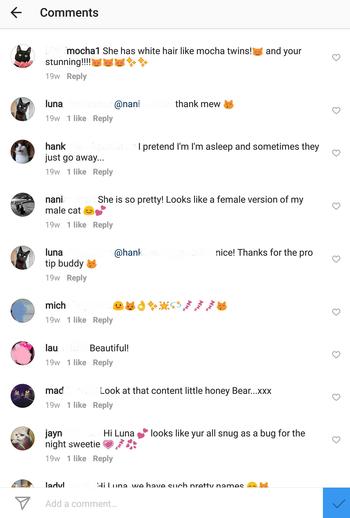
Interaction of the poster with the followers takes place on two communication levels, the feline and the human, with the role identification being fluid in the communication, e.g. the posters address their followers as a cat and later on answer as the human owners in a comment. The followers on their side comment as cats to the cat, as humans to the cat, or as humans to the human.
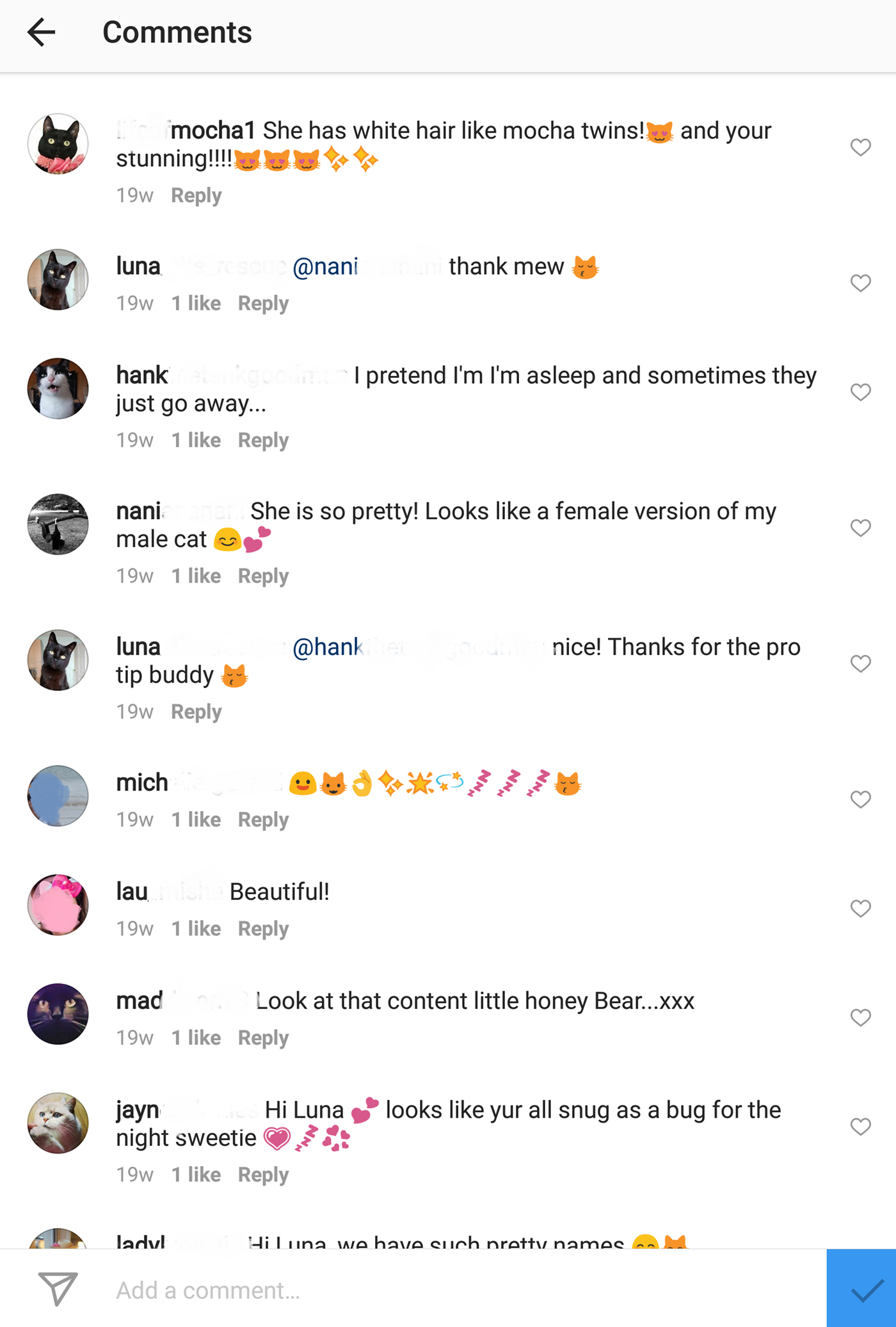
Figure 3 shows examples of those levels: User nan compliments the human user of Luna: ‘She is so pretty! Looks like a female version of my male cat [smiley emoticon heart emoticon]’. User hank shares a tip from cat to cat with Luna: ‘I pretend I'm I'm [sic] asleep and sometimes they just go away … ’, they being the humans, to which Luna replies: ‘nice! Thanks for the pro tip buddy [cat emoticon]’. The user mocha changes roles in one comment: ‘She has hair like mocha twins! [cat emoticon] and yur stunning!!!! [three cat emoticons two other emoticons]’.
Comments on Luna's post
The hashtags Wolfie, Luna, and Raven use fall into the following categories: cat-specific, cat-general, days, kittens, people, and sounds. These categories are explained below and some examples are given. The full list of hashtags is included in the Appendix. In the sample cat-specific, cat-general, and days occur in more varieties than the other categories.
Cat-specific hashtags are those that categorise a specific type of cat, based e.g. on colour or breed. The obvious hashtags that set the black cat community apart from other communities are #blackcat, #blackcats, #blackcatsofinstagram, #blackcatsrule, #iloveblackcats, #crazyforblackcats, and more. Black cats are also equalled with #panthers, #gardenpanthers, and #housepanthers. The image of a panther for black cat is quite common as some examples show. Wolfie sets black cats apart in a comment on freemurrli (see Figure 2): ‘Yes, it's the perfect combination for us black panthers’, and the collective cat account @black_cat_crew refers to a distinction between panthers and non-panthers.
Cat-general hashtags are hashtags used for cats without specifying a certain type of cat. #cat, #cats, #catsofinstagram, #instacat, and #catsrule are commonly used. This category also includes hashtags focusing on a cat's body parts, such as #whiskers, #paws and #fangs, calls for action, such as #pawsneedclaws, #adoptdontshop and #adoptblackcats, and rescue cats, such as #rescuepetofinstagram, #rspca, and #rspcacat. Cats as cute animals are tagged with the cat-general #fantasticfurballs; cats are also given godlike status with #bastet, who is the #egyptiangoddess of cats.
Kittens as a category are #crazykitty, #sillykitty, and #kitnipbox. As Wolfie, Luna, and Raven are adult cats, the variety of kitten hashtags is smaller than that of Instagram as a whole. Hashtags referring to people include #ilovecats, #crazycatlady, #lovcats, #catmums, and #realmenlovecats. The hashtags belonging to the category of sounds make use of the cat's meow. Examples include #meows, #meowbox, and #bestmeow. Day hashtags assign a specific type of image to each day of the week. This category is not used exclusively in the cat community but occurs across Instagram. For cats, the days get a feline angle.
Monday, as the first day of the working week, is not really liked as a day and is tagged with #ihatemondays, #boycottmonday, and #mondayface. Monday as #meownday is also the day for #meowga in #meowgamonday, when cats are shown in yoga poses.
On Tuesday images showing cats with their tongues out are tagged with the hashtags #tongueouttuesday and #tot. The hashtag #tissuepapertuesday features cats playing with tissue paper. Though not occurring in the sample, #tummyrubtuesday is used for cats showing their bellies.
Wednesday features cats’ whiskers or plays on cats’ wicked deeds. #whiskerswednesday and #wonderfulwhiskerswednesday focus on the whiskers, while #wickedwednesday and #wickedcatwednesday categorise stories of the cats being naughty. As mentioned above, Raven is a very active member of #teamwicked.
Thursday is categorised by hashtags, such as #furrsday and #fursdayfeature. The hashtag #throwbackthursday usually marks images of the cats as kittens. A recently seen hashtag not occurring in the sample is #pantherthursday, which refers to black cats on a Thursday.
The weekend is reserved for parties and relaxation. With #fridaynightboxpawty, Friday is a typical pawty (party) day on which cats hiding in or playing with cardboard boxes are featured. Friday is also #furiday and #flashbackfriday. Saturday is the day of #caturday. It is also on #caturday that the @black_cat_crew features cats that are not black, i.e. non-panthers, in #black_cat_crew_caturdayfeature. Other hashtags are #caturdaynightderpoff, #caturdaynitederpoff, and #caturdaynightderpoffpawty for funny cat faces on #caturday. Sunday is #sunday and #sundayfunday and shows relaxing cats or cats having fun.
In one more cat-inspired side note, I would like to point to the study looking at why cats like cardboard boxes. According to Vinke, Godijn and van der Leij (Reference Vinke, Godijn and van der Leij2014), cardboard hiding boxes reduce the cat's stress level.
Meowlogisms in #blackcat
A meowlogism is a word whose spelling has been altered or a part of which has been substituted to make it cat-specific by using cat-related words. An example of a meowlogism is the word meowlogism itself, which has been created by substituting ‘neo’ in ‘neologism’ with ‘meow’. Similarity in spelling or pronunciation makes the creation of a meowlogism easier as shown e.g. in the book title ‘Catify to Satisfy’ (Galaxy & Benjamin, Reference Galaxy and Benjamin2015) and in the term ‘catvertising’ for advertising with cats (Podhovnik, Reference Podhovnik2016). Meowlogisms are not limited to cats alone as wordplay with ‘paw’ as in ‘pawty’ also occurs in connection with dogs. Still, cats dominate public perception.
Meowlogisms are quite common in the cat community. Wolfie, Luna, and Raven make use of meowlogisms in their captions and comments. The word ‘cameowflage’ for ‘camouflage’ in Murrli's post in Figure 2, which has been mentioned above, was actually taken up from one of Wolfie's posts.
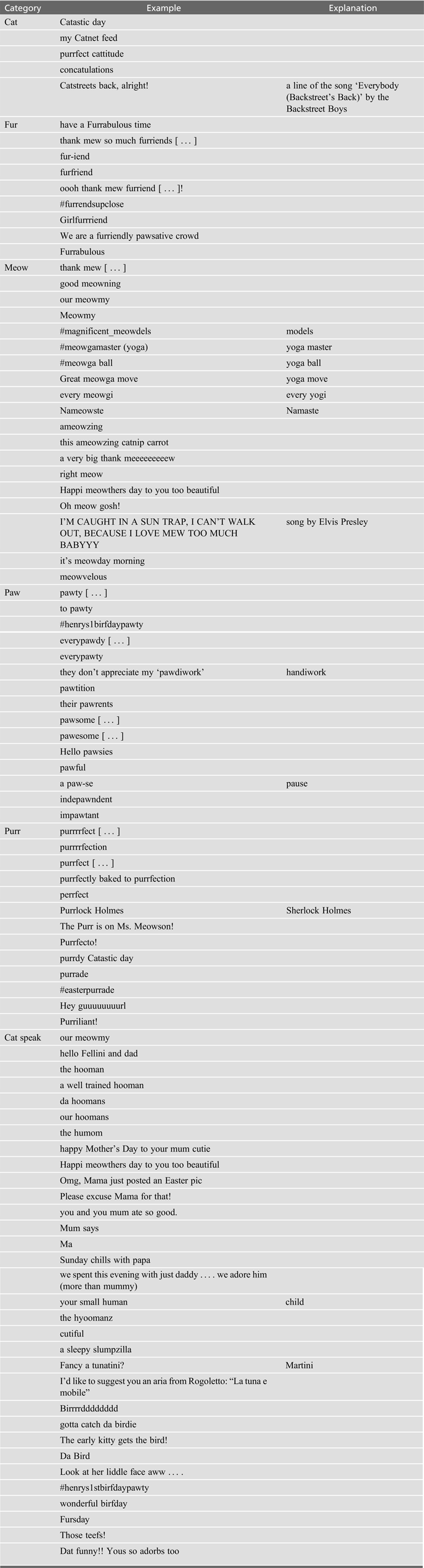
Like hashtags, meowlogisms fall into certain categories. The categorisation is based on the cat word used for the substitution. The words used for substitution are ‘cat, fur, meow, paw, purr, hiss’, and ‘claw’. Though ‘hiss’ as in ‘hissterical’ and ‘claw’ as in ‘clawsome’ do not show up in the sample, they occur elsewhere, e.g. in the Android game ‘Simon's Cat Crunch Time’, which in August 2017 had 100,000 players (Strawdog Studios, 2017). Additionally, the category ‘cat speak’ is used to show cats talking in cat-like ways to refer to humans and food, which includes tuna and birds, and to indicate cuteness, which is achieved by the substitution of sounds.
The examples of meowlogism phrases are presented in their respective categories in Table 1. If the meaning of a meowlogism is unclear without a context, an explanation has been given. When the same meowlogism occurs more often in the sample, this is indicated by [ … ] after the word. Spelling, including upper case and lower case, has been left unchanged.
Meowlogisms in Categories

Meowlogisms in the British Media – Incidental Material
In the sampling period in July 2016, all in all 79 online articles featured cats. The BBC published 15 articles, the Daily Mail 45, the Guardian 4, and the Sun 15. Cat news stories usually cover the topics of unbelievable cats, such as runaway cats returning home after a long time, cats as pets, homeless and feral cats, cat abuse, and famous cats (see Podhovnik, Reference Podhovnik2016, for more information on the cat story types). As already mentioned in the introduction, the online media focussed a lot on the cat fight of the famous cats Larry and Palmerston.
Wordplay is common in the headlines, article body, and photo captions, and, like the users of #blackcat on Instagram, the media take up the feline angle making use of ‘cat, paw, purr’, and ‘meow’ in their meowlogisms. Table 2 shows the individual media's use of meowlogisms. If applicable, an explanation and the number of occurrences are given.
Meowlogisms in the Media

Conclusion
As this paper has shown, Internet cats have been leaving their scratch marks on the English language. Cats, to be more precise their human owners, use their own Internet language variety which includes meowlogisms, specific hashtags, and cat emoticons. In other words, cats are present on the Internet not only with photos, videos, and memes, but also with their own variety of English, namely purrified English.
For the selected light community of #blackcat on Instagram, meowlogisms serve as identification markers, and a wide variety of meowlogisms is used. Meowlogisms are formed with cat-specific words ‘cat, purr, meow, fur’, and ‘paw’ and by using cat-speak to indicate the cat perspective of the posts. While captions and comments are not limited to speaking on the cat's behalf and may also include the human voice, the posts are generally generated by the cat and are, thus, produced in purrified English.
Cat-specific hashtags are another identification marker for the #blackcat community. As the community variable is related to specific cats, black cat specific hashtags define the #blackcat community the most. While the emoticons have not been analysed in detail for this study, a general observation can be made: Emblemic resources tend to be cat-inspired.
Meowlogisms in English are used by the wider public, too, to show the connection of cats with what is being said or written. Meowlogism formation is done with the words ‘cat, purr, meow, paw’, and ‘claw’. All four selected media have included meowlogisms, thus making meowlogisms more than a mere social media phenomenon and showing some forms of purrified English when it comes to cat-related content. Both tabloids and quality media have included meowlogisms, thus providing a somewhat official platform for purrified language.
The aim of this study has been to show the variety of meowlogisms used on Instagram. This study is based on qualitative research of a small non-random sample and is thus not representative of all cat accounts on Instagram or of the online cat community as a whole. Digital methods analysing a larger corpus than the one used for this study and providing a quantitative analysis would complement these initial results.
The trend of cats in the public sphere has not abated yet, and perhaps it is safe to say that the trend will go on for some time. For the English language, this might mean that meowlogisms will continue to leave paw prints on social media platforms and in the online media.
Appendix: List of Hashtags

 EDITH PODHOVNIK lectures at the Department of Media & Design at the University of Applied Sciences FH Joanneum Graz, Austria. She received her PhD in English from Swansea University specialising in dialectology and sociolinguistics. Her research interests include social and regional language variation, social media, cross-cultural communication, and cats in the public sphere. She is active on the social media and writes a research blog on cats in the public sphere. She currently has two cats. Email: Edith.Podhovnik@fh-joanneum.at