Modern conflicts kill thousands but uproot millions. Wartime displacement has become one of the most pressing issues facing humanity today as more people are fleeing violence worldwide than at any point since World War II.Footnote 1 Flows of refugees and internally displaced persons (IDPs) have dire humanitarian consequences and important implications for international security because of their potential to spread conflict, overwhelm neighboring states and host communities, and undermine post-conflict peace and development.Footnote 2 The political repercussions of displacement are also increasingly evident as refugees have become a salient election issue in the United States and Europe.
While population displacement is often considered an unintended consequence of conflict, recent scholarship demonstrates that it is also a deliberate strategy of it.Footnote 3 Yet there have been few efforts to gather cross-national data on these strategies, and as a result, we know relatively little about where and to what extent they are employed. Most studies focus on why people flee war instead of why combatants force them to flee,Footnote 4 and those that address the latter often confine their analysis to ethnic or political cleansing.Footnote 5 But strategic displacement in wartime can take multiple forms,Footnote 6 so there is a need to distinguish different types and compare where they occur to understand why they are used. This is crucial for evaluating the generalizability of different theories, which largely rely on studies of individual conflicts or a limited number of cases. Some explanations emphasize ideological factors such as ethnic nationalism,Footnote 7 while others attribute displacement to the inability of combatants to identify enemy fighters and supporters. Yet the mechanisms that link identification problems to strategic displacement remain unclear. Some scholars posit that combatants displace to “drain the sea” and deny opponents access to resources supplied by civilians,Footnote 8 while others suggest that displacement is a form of collective punishment against politically disloyal communities.Footnote 9
In this article I introduce new data on strategic displacement in civil wars and identify variation across conflicts in the use of three types: cleansing, depopulation, and forced relocation. I use the data to test different explanations for displacement by state actors—who I find are the predominant perpetrators—and propose a new theory to explain forced relocation, the most common type. I argue that combatants uproot civilians not only to expel undesirable or disloyal populations, but also to identify the undesirables or the disloyal in the first place. Triggering displacement forces people to send costly and visible signals of allegiance and affiliation based on whether, and to where, they flee. This process makes communities more “legible,” which allows combatants to use people's movements as a continuous indicator of loyalty while extracting rents and recruits from the local populace. Forced relocation is therefore attractive because it provides unique solutions to information and resource problems in wartime by acting as a sorting mechanism and a force multiplier.
The paper proceeds as follows. After presenting a typology of strategic wartime displacement, I discuss existing explanations for these methods, which I group into three categories: ethnic nationalism, denial, and punishment. I then develop my theory, which contends that forced displacement is not just an eliminative or punitive strategy but also an assortative one. I present two sets of evidence to evaluate these arguments. The first is an original data set of population-displacement strategies by state forces in 160 major civil wars from 1945 to 2008. I test empirical implications of each explanation at the conflict level and find that, consistent with my expectations, different displacement strategies occur in different contexts and appear to follow different logics. Cleansing is more likely in conventional wars, where territorial conquest takes primacy, while forced relocation is more likely in irregular or “guerrilla” wars, where identification problems are most acute. The evidence indicates that cleansing follows a logic of punishment. The results for relocation, however, are consistent with the implications of my assortative theory: it is more likely to be employed by resource-constrained incumbents fighting insurgencies in “illegible” areas—rural, peripheral territories. The findings also cast doubt on the generalizability of alternative explanations.
The second set of evidence is a case study from Uganda, which exploits variation in forced relocation across multiple conflicts in the same country. While the cross-national analysis lends indirect support for my argument, the case study demonstrates the assortative logic of displacing civilians and provides direct evidence for my theoretical mechanism. Drawing on data collected through extensive fieldwork—including hundreds of interviews with perpetrators and victims—I examine observable implications of my theory and show that alternative arguments are insufficient to explain variation in this case. I conclude by discussing the implications of my arguments and pathways for further research.
As the most comprehensive analysis of strategic wartime displacement to date, this paper provides new theory and evidence that can help explain variation in its use across conflicts. In doing so, it challenges some core assumptions regarding a massive form of contemporary political violence. First, it finds that strategic displacement has been more common in civil wars than previously thought, and diverges from existing researchFootnote 10 by demonstrating that different types of conflicts exhibit different forms of combatant-induced displacement. Second, it counters the notion that all displacement strategies follow the same logic.Footnote 11 While I concur with prior claims that identification problems drive strategic displacement, I show that different types reflect different responses to these problems. Cleansing aims to get rid of the undesirable or the disloyal, and is more likely where combatants have access to group-level identifiers linking civilians to an armed group. Forced relocation, however, is intended to figure out who the undesirables or the disloyal are, and is more likely when combatants lack group-level identifiers. I therefore demonstrate how identification problems can lead combatants to relocate—rather than expel—civilians. Finally, contrary to conventional wisdom, I show that relocation is used not just to demobilize noncombatants, but also to mobilize them, and rather than requiring extensive resources, it is utilized to help incumbents overcome resource limitations.
This article therefore demonstrates that uprooting civilians often serves broader functions than simply “draining the sea.” This has important implications for the study of displacement, civilian victimization, and civil war. The assortative logic helps account for the appeal of displacement over strategies such as mass killing, and illuminates the politics of civilian movements in wartime. It also illustrates how the nonselective targeting of civilians can facilitate the subsequent use of more selective targeting, suggesting a plausible mechanism for explaining indiscriminate violence in wartime, which remains poorly understood. Finally, by exemplifying how combatants rely on costly signals, not just ascriptive traits, to infer wartime sympathies, this research helps clarify the links between information and violence in civil wars, which remain underexamined.Footnote 12
Displacement as a Distinct Strategy of War
I define strategic wartime displacement as the deliberate, systematic, and coercive movement of noncombatants by armed groups. This is based on the criminal definition of displacement promulgated by the International Criminal Court.Footnote 13 While civilian displacement occurs in most civil wars, it is often the result of people spontaneously electing to flee military activity. Strategic displacement is intentional, systematic displacement of civilians that is directed or encouraged by government or rebel group leadership.Footnote 14
Conflict researchers have increasingly called for analyzing nonlethal violence separately from lethal violence, the dominant focus in the literature.Footnote 15 Given this—and the fact that wars uproot far more people than they kill—examining displacement in isolation is essential. Building on the existing literature, I identify three types of strategic displacement, which differ in the targeting of displacement, its intended duration, and orientation.
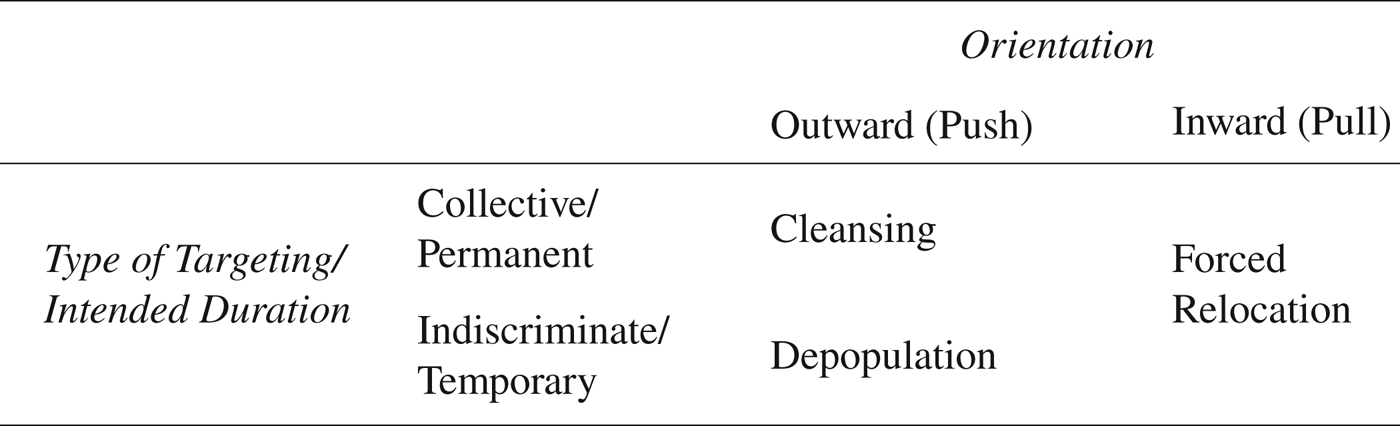
Cleansing is the deliberate expulsion of members of a political, ethnic, or social group.Footnote 16 It is defined by three criteria. First, displacement is carried out through collective targeting: victims are subjected to removal on the basis of a shared group-level characteristic, such as ethnicity, religion, or political affiliation. The second criteria is that displacement is intended to be permanent. This is often evidenced by perpetrators refusing to allow the displaced to return, or by repopulating evacuated areas with other groups.Footnote 17 The third characteristic of cleansing is that it has an outward or “push” orientation, meaning that it focuses on removing the population from the perpetrator's territory or deporting it from the country altogether.
Cleansing along ethnic lines occurred during wars in Bosnia (1992–95), Lebanon (1975–90), and the Democratic Republic of Congo (1996–97). Political cleansing—in which members of political parties, rather than ethnic groups, are targeted for expulsion—has been employed in Colombia (1978–) and Spain (1936–39).Footnote 18 Perpetrators typically make little effort to resettle the targeted population; if they do, victims are transferred far from the conflict zone—as when Soviet counterinsurgents expelled Ukrainians and Chechens to settlements in distant regions of the USSR (1945–50).
Depopulation is similar to cleansing in its outward orientation, but it differs in two ways. First, it is carried out through indiscriminate, rather than collective, targeting, so that everyone in an area is subject to removal, with little effort to determine guilt or affiliation. Second, depopulation is often temporary: once a conflict ends, the uprooted are permitted to return home. Russia, for example, pursued “pacification by depopulation” through its indiscriminate bombing of Grozny in Chechnya (1994–2009), which mimicked the “rubbleization” strategy utilized by the Soviet Union in Afghanistan (1979–92). While the discriminatory nature of cleansing means it is typically carried out through direct or “face-to-face” violence, depopulation is often triggered by indirect violence such as shelling and airstrikes.Footnote 19
Forced relocation describes displacement with an inward or “pull” orientation. The perpetrator, rather than pushing people out of its territory, seeks to bring the population into its domain. This means that while cleansing and depopulation tend to disperse the targeted population or dispatch it to distant areas, relocation concentrates people within the conflict zone, whether in a makeshift camp or urban area.Footnote 20 Therefore, compared to other displacement strategies, forced relocation involves a more concerted effort to move the uprooted to designated settlements. Relocation can be employed through collective or indiscriminate targeting, and like depopulation, it is often meant to be temporary. Examples include “model villages” in Bangladesh (1974–97), Burma (1960–95), and Guatemala (1978–94); “regroupment” in Burundi (1991–2005) and Rwanda (1996–2002); and “strategic hamlets” in Vietnam (1960–75) and Peru (1980–96).
Figure 1 summarizes my typology of strategic displacement. I focus exclusively on displacement by state actors for two reasons. First, as I show, civil war incumbents employ these methods much more frequently than insurgents. Second, most of the theories tested stem from studies of state-induced displacement and may apply mainly, if not exclusively, to government combatants.
A typology of strategic wartime displacement

Existing Explanations for Strategic Displacement
Some explanations for strategic wartime displacement emphasize ethnic nationalism. These arguments posit that exclusionary beliefs motivate wartime leaders to purge undesirable groups and create ethnically homogenous territories.Footnote 21 Straus, for example, argues that group-selective violence is a product of elite-propagated “founding narratives” that elevate one subnational group and exclude others from state power.Footnote 22 Politically inclusive governments are therefore less likely to employ mass violence against civilians, including population cleansing.Footnote 23
A second set of explanations claims that displacement is an instrumental response to a central problem that combatants, particularly counterinsurgents, face in civil wars: a lack of information about insurgents’ identities and civilians’ loyalties. This “identification problem” prevents incumbents from coercing and deterring support for their enemies.Footnote 24 However, the mechanisms explaining why combatants would uproot communities in response to identification problems remain underspecified as scholars have proposed multiple logics.
Some suggest a logic of denial. In this view, since counterinsurgents cannot distinguish friend from foe, they remove the entire population in order to “drain the sea” and deprive rebels of their civilian resource base.Footnote 25 Other scholars propose a logic of punishment. When armed groups lack information about individual loyalties, they turn to group-level indicators, such as ethnic or political affiliation, to identify and expel potential adversaries. This is particularly likely where combatants seek to conquer or annex territory,Footnote 26 and may be influenced by prewar processes such as the level of political competition.Footnote 27 In Lebanon, Hägerdal finds that non-coethnic enclaves were susceptible to ethnic cleansing because combatants had little choice but to use ethnicity as a proxy for political loyalty.Footnote 28 SteeleFootnote 29 and Balcells and SteeleFootnote 30 show that even non-ethnic conflicts can produce political cleansing when combatants use election results to infer support for rivals. These studies suggest similarities between ethnic and non-ethnic cleansing, though other research indicates that ethnic cleansing is unique due to ethnicity's distinct territoriality.Footnote 31
Despite the viability of these arguments, they largely derive from studies of specific conflicts and have yet to be tested more broadly, limiting their generalizability. Moreover, they suffer from several weaknesses. First, these explanations grant little agency to the civilian population. This conflicts with a growing consensus in the forced migration literature that while civilians in war zones face significant constraints, they still exercise choice in deciding whether to flee violence.Footnote 32 Second, existing arguments shed little light on why combatants opt for displacement over other methods. “Draining the sea” has also been used to explain mass killing in counterinsurgency wars, so why would incumbents go to the trouble of uprooting civilians instead of massacring them?Footnote 33 Strategic displacement is puzzling precisely because of its dubious track record as a means of denial: according to one study of civilian relocation in military operations, such schemes “frequently fail to sever ties between insurgents and the population.”Footnote 34
Finally, while the denial and punishment logics attribute displacement to identification problems, they fail to explain whether—and how—displacement helps resolve them. Either displacement is an alternative to solving these problems (denial), or it is an outcome of perpetrators making an ex ante presumption about who is guilty (punishment). If counterinsurgents’ aim in triggering displacement is to control a population, addressing this ambiguity is crucial because, as Magruder argues, resolving the identification problem “comes logically prior” to establishing control.Footnote 35
An Assortative Theory of Displacement
Like other scholars, I see displacement as a strategic response to identification problems in civil wars. But unlike them, I argue that uprooting civilians is not only a reaction to ex ante information about identities and loyalties. It is also a way to infer identities and loyalties ex post.
Displacement As a Signaling Process
I start from the observation that when combatants cannot observe the identities and loyalties of the population directly, they use heuristics to infer them.Footnote 36 While previous research has focused on the use of heuristics such as ethnicity and other ascriptive traits, I contend that one common, yet overlooked, profiling criterion for wartime sympathies is people's physical locations and movements. The well-established link between territorial control and civilian collaboration in civil war suggests a potential and oft-perceived overlap between physical space and political affiliation.Footnote 37 A description from the Angolan civil war conveys this dynamic:
People … began to associate zones of Angola with a particular movement. As a consequence of this territorialization, people found themselves labeled as “belonging” to one or another movement regardless of what views they might have held.
[The government], particularly the military, labeled people on the basis of their location … Political identity … was assigned on the basis of where one was.Footnote 38
An implication of the territorialization of political identity in wartime is that population movements can provide signals of association and allegiance. Civilians exercise agency in war, and even “forced” migration entails strategic choices, however constrained, about whether, when, and where to flee. Thus as Barter argues, the flight of civilians to an armed group can amount to an act of support for that group,Footnote 39 while fleeing from it, according to Kalyvas, is a form of defection.Footnote 40 Staying behind can therefore be a form of passive collaboration—or at least, it can be perceived as such. This explains why in many modern conflicts, “civilians who did not flee combat areas were considered suspect and often killed by warring parties.”Footnote 41 For example, when the Islamic State seized parts of Iraq in 2014, civilians who fled immediately were accepted by authorities in areas where they sought sanctuary. But those who fled later were denied access on suspicion of being collaborators because they “stayed, in the eyes of local authorities, too long in areas under Islamic State control.”Footnote 42 The political implications of flight are not lost on civilians. In Peru, displaced people avoided being identified “for fear that they would be suspected by both the army and the opposition as deserters who had joined the other side.”Footnote 43
These examples exemplify what I call guilt by location: the tendency for combatants to treat fleeing and staying in wartime as indicators of collaboration or defection. This can help explain the strategic logic of orchestrating displacement in order to help overcome identification problems. By creating overwhelming incentives to flee, and where to flee, armed groups can use displacement patterns to draw inferences about civilians’ loyalties and distinguish potential allies from adversaries. Individuals tend to be opportunistic in wartimeFootnote 44 and decisions to flee violence are typically driven by security and survival concerns.Footnote 45 Thus in the eyes of combatants, sympathetic or neutral civilians should, all else equal, respond to incentives and move as ordered. Yet civilians do have options, even if combatants’ use of coercion limits them. Rather than complying with orders to flee, civilians can engage in one of three acts of defection: noncompliance (refusing to move), switching sides (moving to rival territory) or exit (fleeing conflict areas). All these options are public and visible—and thus easy for combatants to observe.
Noncompliance is risky and therefore sends a costly signal of disloyalty. In Ethiopia, when the government directed residents of areas infiltrated by the Oromo Liberation Front (OLF) to relocate to new villages, the military “suspected that any who refused [to relocate] were OLF.”Footnote 46 Similarly, during the civil war in El Salvador, the army sought to evacuate contested villages under the logic that “civilians who don't want to cooperate [with insurgents] will leave the area and those who remain are collaborating.”Footnote 47 Noncompliance often becomes untenable as time goes on, since being subjected to persistent violence makes people more likely to choose a side.Footnote 48 For the uprooted, this means settling in one group's territory or physically defecting to its opponent. Switching sides sends the strongest signal of disloyalty because people are actively seeking sanctuary with the enemy. When the Peruvian military ordered peasants to concentrate in hamlets during the war against Sendero Luminoso, those caught fleeing to rebel-held areas were “regarded … as terrucos trying to escape to their comrades in the mountains” and subjected to execution.Footnote 49
The final form of defection, exit, may be less concerning for combatants if it implies that civilians have left the battlefield. But for the displaced, it still risks indicating disloyalty. When Salvadoran refugees fled to Honduras instead of to government areas, officials accused them of collaborating with guerrillas.Footnote 50 Evading combatants has a similar effect. After the Burmese military relocated villagers in Karen State, those who hid in the jungle were targeted and subjected to abuse “on suspicion of being rebel supporters.”Footnote 51
Since armed groups are principally concerned with identifying the disloyal, the more overwhelming the incentives to move, the more costly defection becomes—and thus the stronger the signal it sends. One may presume that such incentives deprive the targeted population of discretion in moving. But if displacement—like other forms of civil war violence—is jointly produced by combatants and civilians,Footnote 52 then theoretical models must account for the agency of both parties. As I noted, research on wartime flight has shown that it involves an interplay between compulsion and choice, and a broader set of studies demonstrates that civilians in conflict zones select from a wide repertoire of possible actions.Footnote 53
The empirical record reveals that strategic displacement campaigns leave room for targets to comply or defect. In El Salvador, despite facing evacuation orders from government forces and intense aerial bombardment, some peasants who supported the rebels remained in contested regions while the less sympathetic fled.Footnote 54 In Guatemala, civilians uprooted by the army were left “to choose between fleeing to remote mountainous regions of the country … or agreeing to relocate to government-controlled areas.”Footnote 55 When the Portuguese enacted a large-scale villagization program in colonial Mozambique, people “resisted being villagised from the outset … whole communities fled and allegedly joined the rebels.”Footnote 56 And during the Strategic Hamlets Program in Vietnam—which sought “to isolate those ‘of doubtful sympathy’” and “bring about a moment of decision for the peasant farmer”Footnote 57—observers noted that “many managed to escape movement” to hamlets.Footnote 58
These anecdotes illustrate that even when combatants employ displacement through brute force, civilians can and do engage in defection. These movement decisions may not always reflect people's true political or ideological preferences, just as ethnic affiliation may not be an accurate indicator of one's loyalties. While a variety of factors can motivate individuals and communities to defy displacement,Footnote 59 combatants often interpret civilians’ behavior in wartime as political even when it is not intended to be.Footnote 60 If political identities and preferences influence movement decisions and reflect people “voting with their feet”—as studies of wartime resettlement in Colombia, Spain, and El Salvador have foundFootnote 61—then orchestrating displacement helps publicly reveal these preferences. If not, then it still forces civilians to undertake an observable act of obedience or defection. Thus for armed actors looking for informational shortcuts, triggering displacement provides a rapid and visible, if crude, means of sorting the population.
Legibility and Extraction
Of course, there is little to prevent the disloyal from complying with relocation orders. But wartime displacement is a dynamic phenomenon, and using it to sort the population is an iterative process. While initial departures can reveal the most credibly disloyal, moving to destinations dictated by perpetrators is necessary, but not sufficient, to cast off suspicion. By triggering displacement at t1, combatants can then monitor the locations and movements of civilians for further signals of loyalty and affiliation at t2.
Displacement therefore enables the sorting of the population not just through the initial process of flight, but also by rendering those who relocate within the perpetrator's purview more “legible,”Footnote 62 facilitating the further detection of the disloyal. Forced migration scholars have shown that the external appearance of displacement camps as chaotic often belies a regimented order that improves the visibility and legibility of its occupants.Footnote 63 Concentrating communities makes it harder for people to hide their preferences and actions, and enables authorities to impose measures to better “see” the population. Through these techniques—registration lists, identification documents, roll calls, curfews, the demarcation of settlement boundaries—incumbents can continuously monitor people's whereabouts in order to distinguish combatants from civilians, and loyal from disloyal.
Relocating the population also serves combatants’ extractive needs. The idleness and uncertainty that displacement engenders, along with the dependency it cultivates on services provided at relocation sites, facilitates civilian recruitment into a group's informant networks, military ranks, and labor pool. This was a feature of the government's “regroupment” policy in Burundi, where civilians ordered to displacement camps were made to join local patrols to hunt rebels and perform hard labor.Footnote 64 Likewise, part of the rationale for “strategic grouping” in the Philippines was “to get the people to ‘protect themselves’ (i.e., to organize them into government-sponsored militias).”Footnote 65 And in Ethiopia, the state's “villagization” program in rebel-affected areas made it easier to conscript soldiers, organize militias, and collect taxes.Footnote 66
Theoretical Implications
The assortative logic outlined here suggests that different types of strategic displacement will occur in different kinds of civil wars. In irregular or “guerrilla” conflicts, rebels are militarily weaker than the state and tend to avoid direct engagement with government forces. They instead prefer to hide among the local population, which intensifies identification problems for counterinsurgents.Footnote 67 Moreover, in irregular wars civilians tend to reside in contested areas where control is fragmented between belligerents,Footnote 68 which under the territorial logic of political identity makes their loyalties ambiguous. It follows, then, that relocation will be more attractive in irregular conflicts.
By contrast, in conventional civil wars—where two sides with more symmetric military capabilities confront each other directly along clear frontlines—identification problems are less severe.Footnote 69 Since military success in irregular wars depends on civilians, detecting disloyalty in the local population is of paramount concern to combatants. But success in conventional conflicts hinges on firepower and traditional military capabilities, with civilians playing a less pivotal role. In these contexts, cleansing will be more attractive than relocation for two reasons.
First, conventional wars mimic interstate conflicts, where capturing or annexing territory is more important than identifying enemies or eliciting compliance from noncombatants. Conquest, in turn, is made easier by expelling or homogenizing the local population.Footnote 70 Second, in conventional wars civilians reside not in disputed areas but under the control of one side. Combatants are therefore more likely to perceive those living under the adversary as disloyal and seek their expulsion.
H1 Irregular wars are associated with a higher likelihood of forced relocation, while conventional wars are associated with a higher likelihood of cleansing.
My theory also suggests that relocation will be more likely in conflicts waged in “illegible” areas: rural, peripheral territories. While rebellions tend to emerge in distant frontiers,Footnote 71 fighting often spreads elsewhere, and higher proportions of wartime violence occur in urban areas.Footnote 72 When it comes to strategic displacement, major cities—including Baghdad, Beirut, Dushanbe, Kinshasa, Mogadishu, Nicosia, and Sarajevo—have frequently been the site of cleansing campaigns. Forced relocation, however, is more attractive when contested areas lie in the rural periphery for several reasons.
First, government forces lack mobilizational capacity far from political and military hubs, which complicates intelligence gathering and encourages incumbents to rely on simplifying heuristics to identify opponents.Footnote 73 Relatedly, rural localities, particularly in the hinterland, tend to be the most underutilized and illegible to incumbents. Populations are more homogeneous than in urban contexts, and they usually live in scattered settlements across inaccessible terrain, sometimes outside the reach of the state.Footnote 74 As a result, counterinsurgents are less likely to have access to reliable sources of information on the population. Finally, displacement will have less of an impact on a country's infrastructure in these areas, since they tend to be more isolated, underdeveloped, and less productive than other regions.
H2 Forced relocation is more likely against rural, peripheral insurgencies.
Even in peripheral territories, counterinsurgents may prefer alternative methods of identification—such as paying informants or engaging in selective interrogations.
Why would they instead opt to relocate the population? Because these other tactics require incumbents to occupy contested territories. Cordon-and-search operations, in which combatants conduct house-to-house searches to collect intelligence and weed out rivals, may be more effective at detecting enemies. Yet they are also resource-intensive.
When incumbents have limited capacity or are overstretched by multiple military commitments, clustering their resources and bringing people to them is more expedient than scattering units and risking overextension. While the transformation of contested areas into free-fire zones makes military operations logistically easier, perpetrators are often able to shift the burden of managing displacement camps onto humanitarian organizations and other external actors.
I therefore hypothesize that—while a certain level of capacity is needed to orchestrate civilian relocation—incumbents tend to engage in these methods not when they have a preponderance of resources but when they do not have enough of them. Scholars have argued previously that limited capacity can lead armed groups to victimize civilians.Footnote 75 But when it comes to strategies of population relocation, researchers tend to assume these measures require extensive assets to employ and are thus more likely under wealthier, stronger incumbents.Footnote 76
H3 Forced relocation is more likely to be employed by resource-constrained incumbents.
Cross-National Evidence from Civil Wars
Existing data on conflict migration record annual refugee and IDP flows but provide no information about whether they were deliberately induced by armed groups. Several scholars have therefore attempted to compile lists of cases of strategic displacement.Footnote 77 While these efforts have provided useful data, they are neither comprehensive nor do they systematically collect data on all types of displacement employed in war.
I therefore built an original Strategic Displacement in Civil Conflict (SDCC) data set that covers 160 major civil wars between 1945 and 2008. SDCC includes 147 conflicts identified by Kalyvas and BalcellsFootnote 78 plus an additional thirteen that meet their criteria of at least 1,000 fatalities in at least one year. With the assistance of a research team, I coded whether strategic displacement was employed in each conflict using previous case studies of wartime cleansing and forced relocation; conflict histories; and reports from UNHCR, the Internal Displacement Monitoring Centre, the US State Department, Amnesty International, and Human Rights Watch.
I used coding procedures similar to those in Greenhill's study of engineered international migrations.Footnote 79 For each case, I examined patterns and descriptions of displacement, violence, and human rights violations to identify evidence of orchestration and intent by combatants to systematically uproot civilians. Orchestration means that civilian flight was promoted or executed by armed actors, whether through explicit threats, evacuation orders, or the destruction of property. Displacement must have also been intentional, in that sources indicate that displacement due to government or rebel actions was deliberate. I therefore do not include instances of displacement as collateral damage, in which civilians spontaneously flee military battles.
Once a case of strategic displacement was identified, I coded the perpetrator and type employed. If there was evidence that victims were members of an identifiable group, that they were targeted because of this affiliation, and that displacement was intended to be permanent, a case was coded as cleansing.Footnote 80 If displacement was temporary and perpetrators made little effort to differentiate between groups—hence targeting was indiscriminate—or to resettle the displaced, it was coded as depopulation. If perpetrators did not just expel the population but sought to concentrate it into settlements within the conflict zone or a nearby location, it was coded as forced relocation. Appendix 1.2 provides more details on coding procedures.
During the coding process I discovered four borderline cases. Wars in Iran (1979–84) and Iraq (1991–93) could be classified as experiencing state-induced cleansing or depopulation because the method of targeting and intended permanence of displacement were ambiguous. Likewise, it is clear that temporary, indiscriminate displacement was employed by government forces in both Indonesia (1956–60) and Sri Lanka (1983–2002), yet these cases could be coded as relocation or depopulation. I classified these four cases based on the type for which there was the strongest evidence, but included the second type as an alternative coding for robustness checks.
Limitations
Several limitations to the data set are worth noting. First, the unit of analysis is the conflict. While I was able to identify the year of displacement onset in many cases, the empirical record was not always clear about the timing. The second limitation is the possibility of omitted cases. Lack of access to conflict zones by observers or variation in the volume and quality of sources could have led to cases of strategic displacement being overlooked, biasing the results. However, focusing on contemporary conflicts should mitigate these concerns. The development of the post-World War II refugee regime has made displacement a global issue and provided international organizations and advocacy groups with the motivation and tools to publicize forced population movements. This has made it difficult for combatants to hide these incidents or conceal their role in them.
Finally, there may be inconsistent interest in, or reports of, strategic displacement over time. For example, the issue of internal displacement did not receive widespread attention until the 1990s, which may have increased international focus on IDPs. These concerns are alloyed by the fact that, as I show, the proportion of civil wars experiencing strategic displacement is relatively consistent over time. Moreover, to ensure the reliability of the data, I checked my coding with existing lists of wartime cleansings and relocations and found there is close agreement, though I discovered a number of missing cases (see Appendix 1.3). I also included a precision ranking reflecting the degree of certainty that a case constitutes strategic displacement, based on the evidence, to check the robustness of the results.
Variation Across Conflicts
State actors employed strategic displacement in 58 percent of civil wars from 1945 to 2008, indicating these measures have been more frequent than previous research suggests.Footnote 81 Of the wars that did experience state-induced displacement, cleansing was used in 35 percent of cases (or 21 percent of all conflicts), depopulation 13 percent (8 percent of all conflicts), and relocation 56 percent (33 percent). All but two cases of cleansing (94 percent) were ethnic cleansings. Incumbents used multiple displacement strategies in only four conflicts: Burundi (1991–2005, cleansing and relocation); Sudan (1963–72; 1983–2002, depopulation and relocation); and Myanmar/Burma (1960–95, cleansing and relocation). By contrast, rebels orchestrated displacement in 15 percent of wars. While cleansing and depopulation have occurred almost exclusively in ethnic conflicts, forced relocation has been a common state strategy in ethnic and non-ethnic wars (see Appendix 2.1).
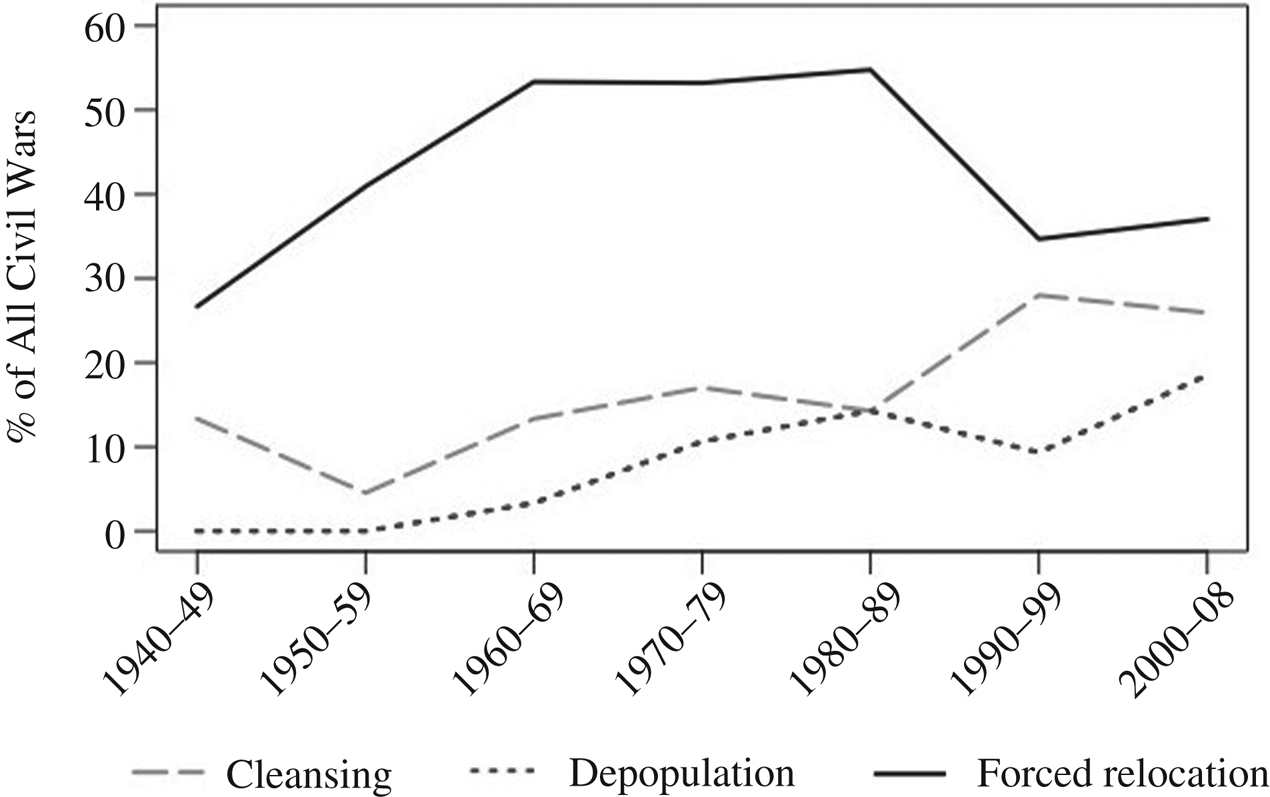
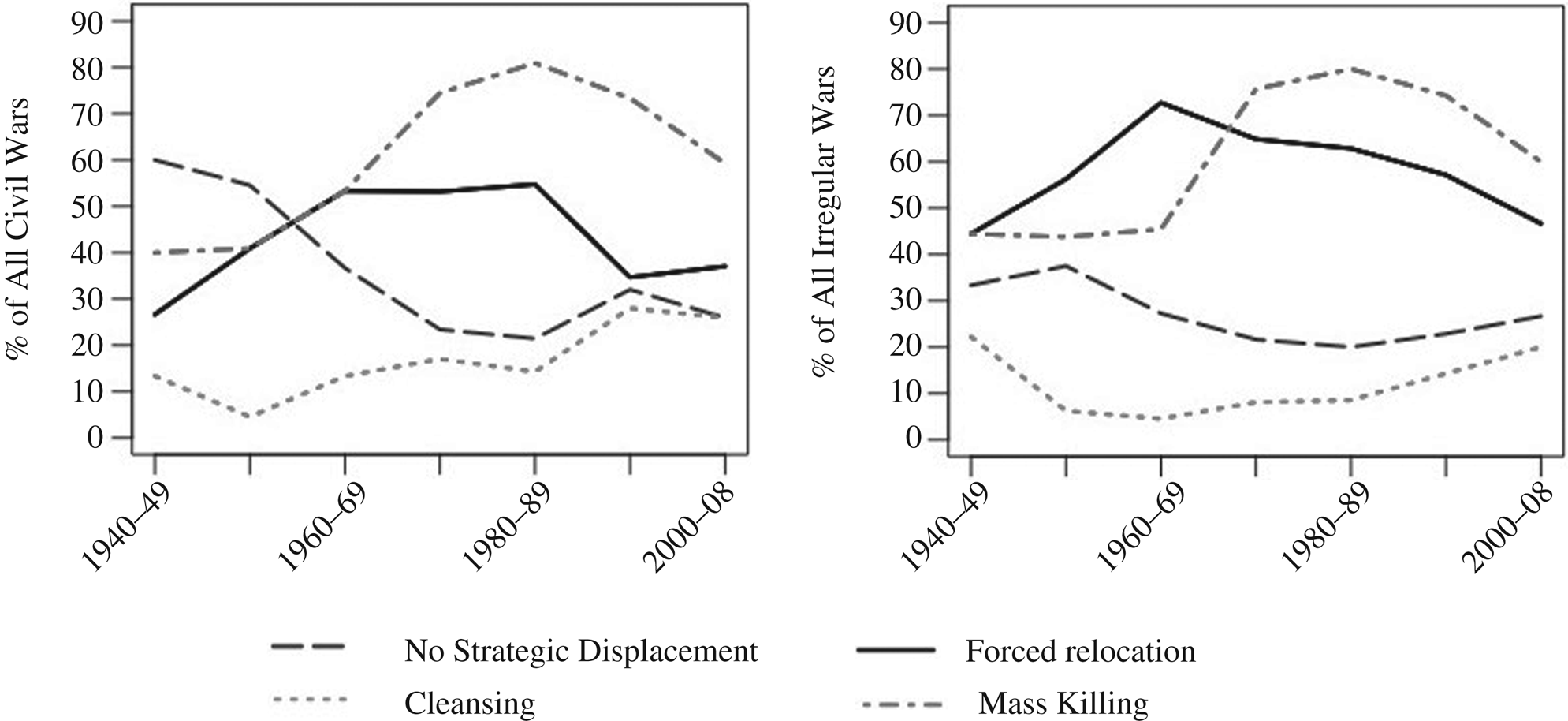
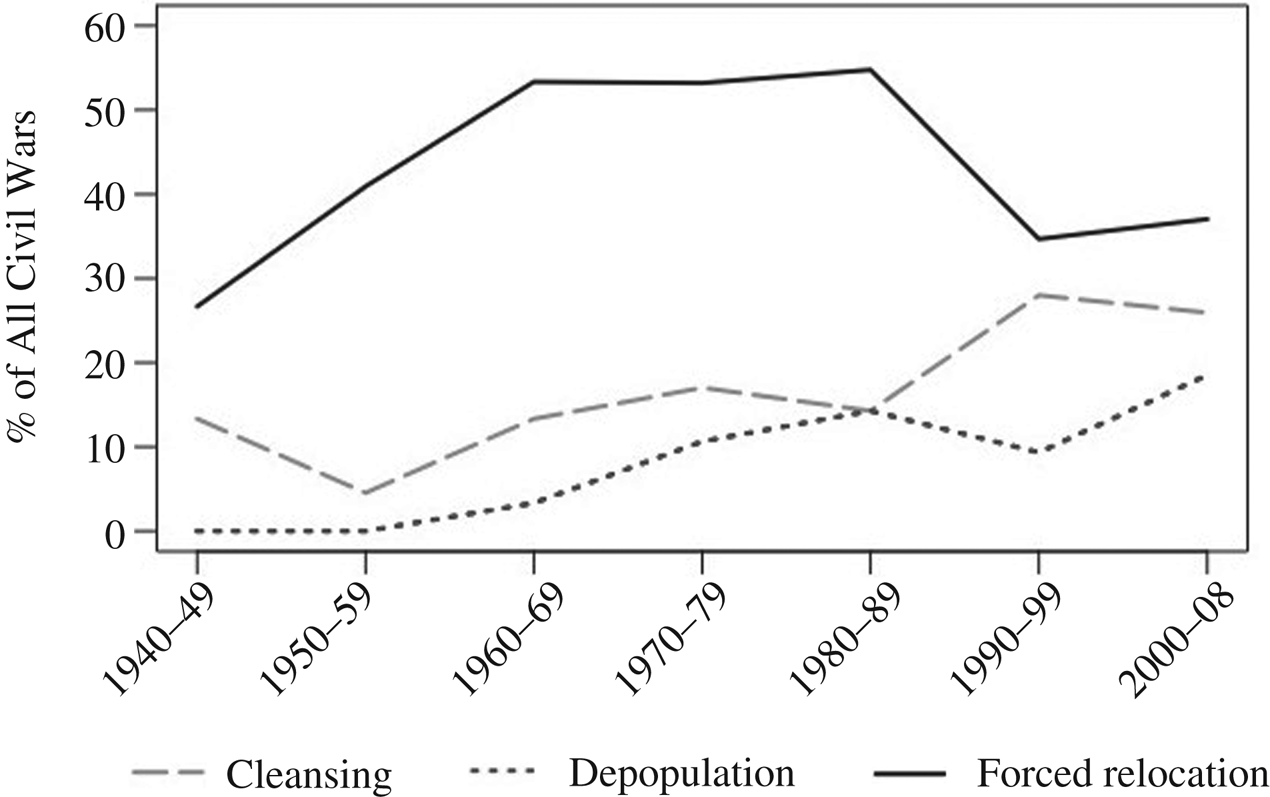
Figure 2 tracks time trends in each displacement strategy. The prevalence of forced relocation in civil wars peaked in the 1980s—after the 1977 amendment to the Geneva Conventions prohibited “the forced movement of civilians” under international law—before declining after the Cold War.Footnote 82 While cleansing and depopulation have occurred in a smaller proportion of wars, they increased in frequency in the 1990s and 2000s. This is likely attributable to shifts in the nature of intrastate conflict from irregular to conventional warfare.Footnote 83
Prevalence of state-induced displacement strategies
Variables and Measures
Dependent Variable
To construct my dependent variable I need to determine how to treat the four conflicts in the data set that experienced multiple types of state-induced displacement. For example, during the civil war in Burundi (1991 to 2005), counterinsurgents committed cleansing against Hutus in Bujumbura in 1993 and then forcibly relocated rural populations from 1996–2003. For these cases, I coded the dependent variable based on the primary type of displacement employed in the conflict, in terms of intensity, duration, and scope. As a robustness check I used the secondary type of displacement and the results were not substantively different.
Independent Variables
For H1, based on Kalyvas and Balcells's coding of military technologies of rebellion at the onset of a civil war, I set a dichotomous variable equal to 1 if a conflict was an irregular war and 0 if it was a symmetric war, which covers both conventional and symmetric nonconventional (SNC) conflicts.Footnote 84 I used two separate but related measures to proxy for rural, peripheral insurgencies (H2). The first is a dichotomous measure of border conflict set equal to 1 if the conflict zone (a) falls outside the capital, (b) abuts an international or coastal border, and (c) has a significant rural component. As a second measure I used distance, in kilometers (logged), between the capital and the conflict zone.Footnote 85 Since distance is influenced by country size, when analyzing this variable I controlled for the land area (logged) of the host state. Data for these measures were taken from Buhaug, Gates, and Lujala.Footnote 86 While previous research has attributed some of these factors at the country level to civil war onset,Footnote 87 subsequent studies found that the geographical characteristics of conflict zones tend to differ from those of the host countries.Footnote 88
For H3, I use three measures. One is an indicator for whether an incumbent was fighting a parallel conflict, according to UCDP/PRIO, which limits the coercive resources available to state forces.Footnote 89 This includes both conflicts with another state and other domestic insurgencies. The other two variables are commonly used measures of state overall capacity (gdp per capita)Footnote 90 and state military capacity (the number of military personnel).Footnote 91
Other Variables.Footnote 92
It is possible that alternative arguments—ethnic nationalism, denial, and punishment—could explain variation in wartime displacement strategies, acting as complementary or competing logics to my theory. I therefore included a series of measures to account for these explanations. For ethnic nationalism, I incorporated a measure of whether the incumbent regime possessed an exclusionary ideology (exclusionary) according to the Center for Systemic Peace.
Denial arguments suggest that displacement should be employed against rebel groups that are dependent on civilians for logistical support, such as food, shelter, and recruits. I used two measures to proxy for this. The first, rebextsupp, indicates whether rebels received troops, supplies, or sanctuary from a foreign sponsor,Footnote 93 which weakens the interdependence between insurgents and the local population.Footnote 94 The second, rebel forced recruitment (rebel fr), indicates a group's reliance on civilians for manpower and is based on data collected by Cohen and several other sources.Footnote 95
I also incorporated two measures to proxy for punishment arguments, which suggest that strategic displacement is more likely where group-level information about wartime loyalties is readily available. The first is rebel claim from the Ethnic Power Relations data set.Footnote 96 This variable indicates whether insurgents made an exclusive claim to fight on behalf of a particular ethnic or religious group, which creates an association between a rebellion and a specific group identity. The second measure follows from the finding that electoral results can reveal information about communities’ loyalties and provide a basis for cleansing.Footnote 97Elections is a dichotomous variable indicating whether competitive elections were held during the conflict or within five years prior, according to Steele and Schubiger.Footnote 98
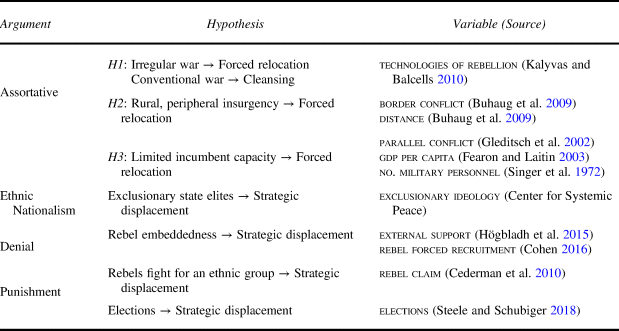
Finally, I added several control variables that have been identified as important factors influencing wartime violence. These include the size of the country's population (logged),Footnote 99democracy (Polity IV), and battle deaths per month, a control for conflict intensity.Footnote 100Table 1 summarizes the arguments, variables, and data sources. Summary statistics are provided in Appendix 3.
Hypotheses for strategic wartime displacement

Analysis
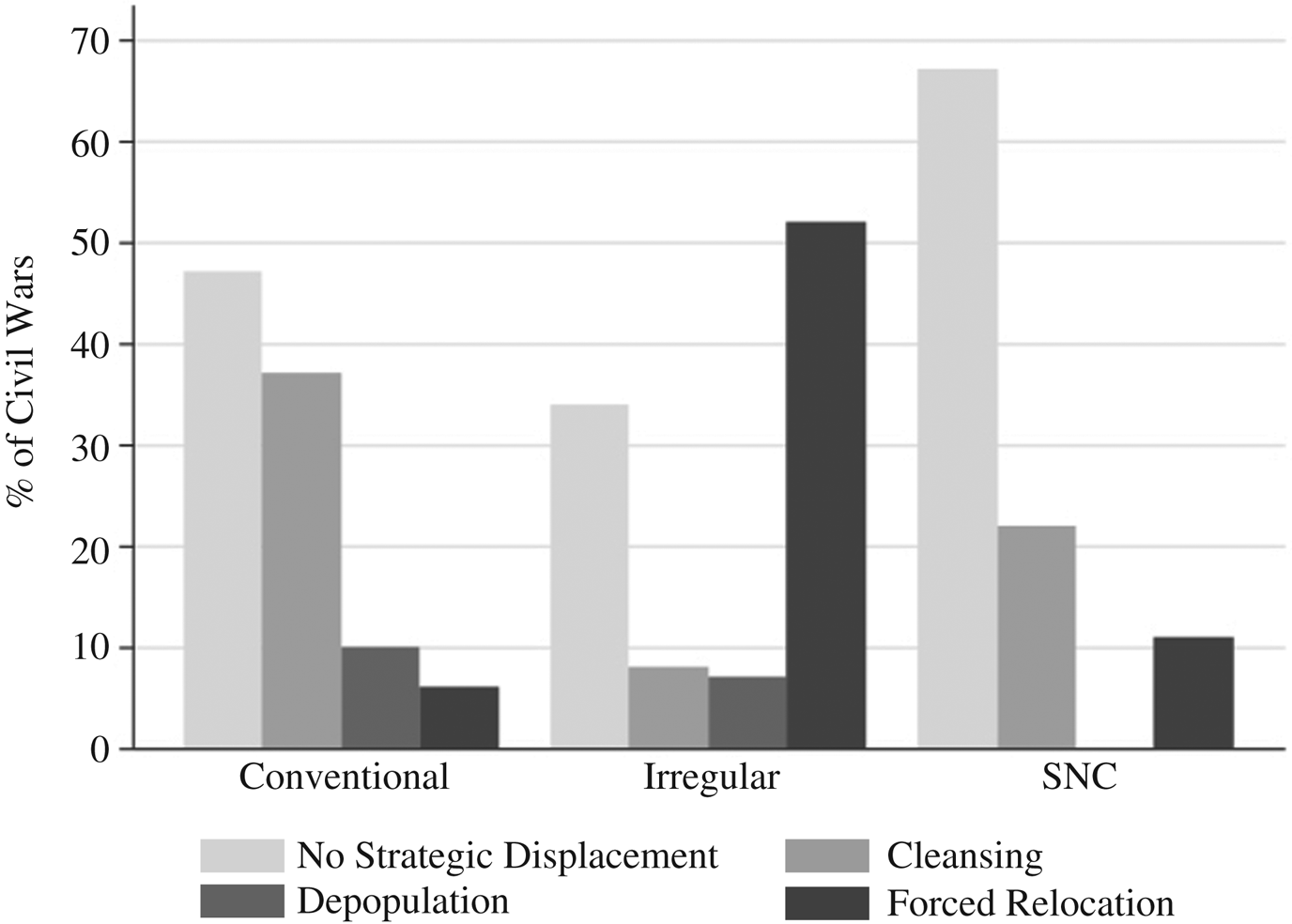
I begin by exploring the relationship between strategic displacement and military technologies of rebellion. Figure 3 displays the results of cross-tabulations based on the primary type of displacement employed in each conflict. It lends strong support to H1, as irregular wars are much more likely to experience relocation than conventional and SNC wars (52 percent versus 7 and 11 percent, respectively), while conventional wars are more likely to experience cleansing compared to irregular conflicts (37 versus 8 percent). The differences are statistically significant (χ 2 = 45.46, p < 0.001).
Strategic displacement and technologies of rebellion (1945–2008)

Moving beyond bivariate analysis, I ran a series of multinomial logistic regressions to estimate the effect of each variable on the likelihood that a specific type of strategic displacement is employed by state forces in a given conflict. I use an unordered multinomial logit with four outcomes: cleansing, depopulation, forced relocation, and no strategic displacement (the reference category). Estimates using binary logit models, in which the reference category is adjusted, yield the same results.
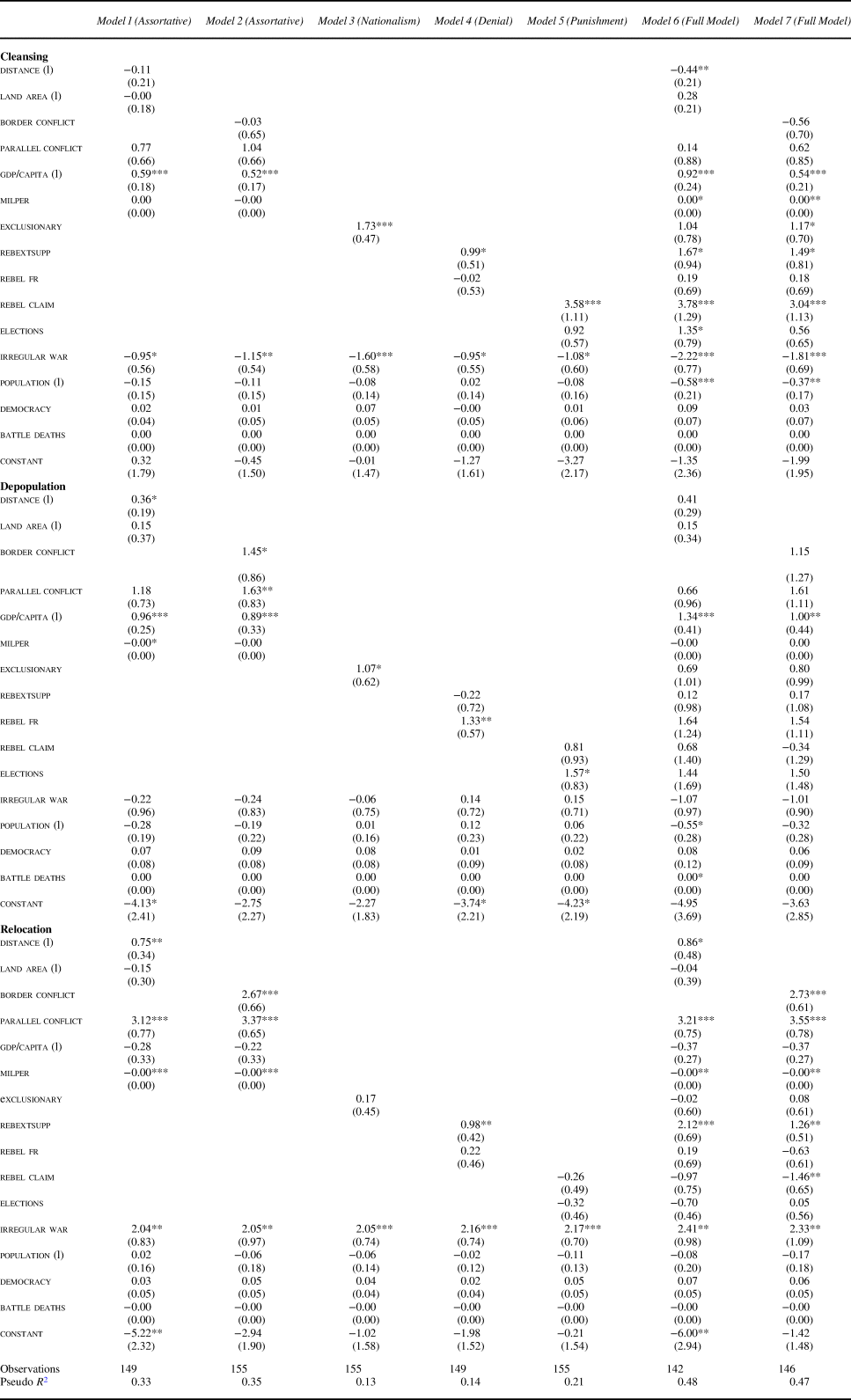
Using the measures specified, I tested each argument in separate models and together in two comprehensive models. I reported robust standard errors clustered by country to address the probability that conflicts in the same country are not statistically independent of each other. Results are provided in Table 2. My analysis focuses on the findings for cleansing and relocation because the number of cases of depopulation is too small (n = 12) to draw reliable conclusions. In each model, I included irregular war with the other controls to account for the relationship shown in Figure 3.
Strategic wartime displacement: Multinomial logit results

Notes: Standard errors in parentheses. * p < .10; ** p < .05; *** p < .010.
Assortative Logics
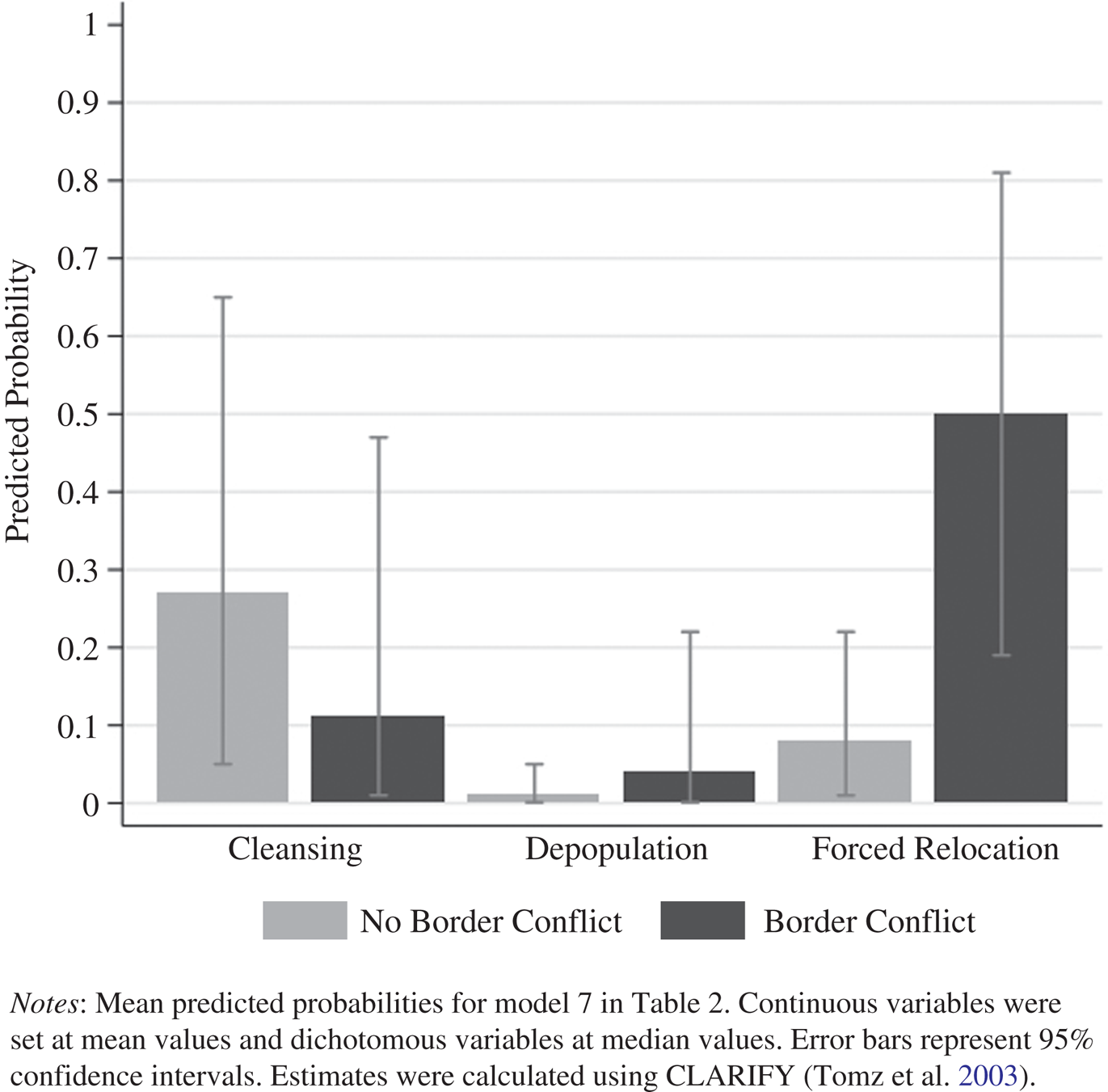
The results in Table 2 lend support to the proposition that forced relocation is associated with rural, peripheral conflicts (H2) according to multiple specifications—while cleansing is more common in wars fought at the center. The coefficient for border conflict is positive and statistically significant for relocation, and distance is also positive and significant, even when controlling for country size. Both of these variables are negative, however, for cleansing. In terms of substantive effects, Figure 4 shows that forced relocation is six times more likely in border conflicts as in nonborder conflicts, whereas cleansing is nearly three times less likely in border conflicts.
Predicted probability of strategic wartime displacement

The coefficient for parallel conflict is also positive and statistically significant across all models for relocation, but not for cleansing.Footnote 101 This lends support to H3. Moreover, while gdp is consistently positive and significant for cleansing, both gdp and milper are consistently negative for relocation—and the latter is statistically significant. The finding is similar if milper, which measures a state's absolute capacity, is replaced with a logged measure of its relative capacity compared to rebels, troop ratio (see Appendix 2.8). These results challenge the conventional wisdom by indicating that states with limited resources, rather than those with an abundance of them, tend to engage in population relocation.
These results support my expectations regarding the form that strategic displacement should take, and the conditions under which it is likely to be used, if uprooting civilians is driven by an assortative logic. But the findings are also potentially consistent with alternative arguments that, while emphasizing different logics, still anticipate displacement where combatants are starved for information. I therefore turn to the results for other explanations.
Denial
Models 4 to 7 in Table 2 show no support for the denial mechanism in explaining cleansing or relocation. Indicators of rebel embeddedness in the population do not align with expectations. Rebel fr is statistically insignificant across all specifications (and sometimes negative), while the sign for rebextsupp is positive and significant for both displacement strategies and therefore not in the hypothesized direction. This indicates that forced relocation is actually more likely where rebels are able to rely on support from sources other than the civilian population.
But an association between relocation and a particular type of external support—foreign sanctuaries—could still be consistent with a denial logic. If rebels have a base in a neighboring country, an incumbent might relocate civilians to prevent them from crossing the border and joining the insurgency. However, the results are not significant when rebextsupp is replaced with an indicator for external base (not shown).Footnote 102
Punishment
In Models 5 to 7, the coefficients for rebel claim and elections are positive for cleansing, and rebel claim is highly statistically significant. This supports the notion that when rebels fight on behalf of a particular subnational group, incumbents are more likely to use group affiliation as a proxy for political loyalty and target members for expulsion. In contrast, both rebel claim and elections are generally negative for relocation.Footnote 103 This finding is consistent with the idea that when information-starved combatants lack group-level identifiers that would allow them to engage in ethnic or political profiling, they are prone to resort to spatial profiling to help identify their opponents.
A logic of punishment also suggests a relationship between strategic displacement and lethal violence. To explore this, I incorporated a measure of whether the state engaged in the mass killing of at least 1,000 civilians from Ulfelder and Valentino.Footnote 104 The results reveal a positive association between strategies that kill and those that displace, but the relationship is not statistically significant (see Appendix 4.1). It is possible, however, that a substitution effect between strategic displacement and mass killing is revealed not in spatial patterns but temporal ones. Due to the rise of norms against killing, it is plausible that counterinsurgents have increasingly opted to displace people. Time trends in strategic displacement and mass killing (Figure 5) indicate that this might be true for cleansing and depopulation: the percentage of civil wars experiencing these strategies increased in the 1990s as mass killing began to wane. But the incidence of forced relocation in armed conflicts, like mass killing, peaked in the 1980s before dropping the following decade.
Strategic wartime displacement and mass killing, by decade

Ethnic Nationalism
The results show some support for ethnic nationalism arguments in explaining cleansing, but the results are not robust. The coefficient for exclusionary ideology is consistently positive for cleansing, but it only reaches statistical significance in some models. For relocation, exclusionary is statistically insignificant across all specifications.
Robustness Checks and Additional Tests
I conducted a series of additional tests to check the robustness of the results, which are shown in Appendix 4 due to space constraints. First, to address collinearity and other concerns, I repeated the analysis with each explanatory variable in separate models and dropped all controls except irregular war. Second, I removed conflicts with low precision rankings for strategic displacement to exclude ambiguous cases. Third, I dropped both cases of non-ethnic (political) cleansing from the analysis. Fourth, I restricted the analysis to the period 1975–2008, which dropped colonial wars. In all instances, the main findings held. They also held when I included controls for region, post-cold war (to account for temporal and geopolitical factors), and secessionist war.Footnote 105 Finally, to check the sensitivity of the results to the use of a multinomial model, I ran two sets of binary logit models for cleansing and relocation. One set used the same reference category of no strategic displacement, while the other controlled for whether a conflict experienced either of the other two displacement strategies. The substantive results were similar to those in the multinomial models.
Moreover, to mitigate concerns that my results are driven by the choice of particular measures or data sources, I tested alternative proxies for other explanations for strategic displacement. I examined two alternative measures of ethnic nationalism: ethnic polarizationFootnote 106 and whether a government was inclusive of different subnational groups.Footnote 107 Cleansing is associated with wars in more polarized societies, and relocation with wars in less polarized societies, but only the latter is statistically significant. Inclusive government is also not significant, and the main results remained robust.
I also tested two alternative measures of denial. The first, drugs, indicated whether rebels had access to extractive resources or contraband, which reduces their reliance on local populations.Footnote 108 The second, rebconcen, is taken from Stanton, who argues that the smaller and more geographically concentrated a rebel group's civilian base, the more feasible it is for governments to “drain the sea” through displacement.Footnote 109 Both variables are positively but weakly correlated with each displacement strategy—casting further doubt on the sufficiency of the denial logic. I also tested an alternative measure of punishment: whether the state committed genocide during the conflict.Footnote 110Genocide was positive and statistically significant for cleansing and insignificant for relocation, and the main findings remained robust.
For a final robustness check I considered alternative interpretations of my findings. The tendency for resource-constrained incumbents to engage in relocation could reflect desperation. Some scholars have argued that governments victimize civilians when the costs of conflict reach unacceptable levels, such as when facing the prospect of defeat.Footnote 111 We would then expect strategic displacement in more intense conflicts. Yet the results in Table 2 show that battle deaths—a common measure of conflict intensity—is positively but weakly associated with incumbent cleansing and negatively associated with relocation. Moreover, a comparison of conflict outcomes reveals that losing incumbents are only slightly more likely to employ relocation as victorious governments (see Appendix 4.8). I also tested measures of the strength of a rebel group and the extent to which it controlled territory.Footnote 112 Neither of these tests produced significant results.
Summary
The cross-national analysis yields two main findings. First, different displacement strategies occur in different contexts and follow different logics. Cleansing is typically employed in conventional wars and seems to be driven by a punishment logic, which is consistent with previous research. Forced relocation is most common in irregular wars waged in “illegible” areas and, counterintuitively, is used by incumbents with limited or constrained resources. Cleansing is more likely when group-level information about wartime loyalties—revealed through ethnic ties to insurgents—is available. But relocation is more likely in the absence of such information: environments that incentivize the use of displacement itself as an identification process. Second, when it comes to forced relocation, I find little support for alternative arguments, including ethnic nationalism, denial, and punishment, according to multiple measures.
Overall, these findings provide support for my assortative theory, though the evidence is indirect. I attempt to rule out other arguments by using several measures to proxy for each one, and my analysis controls for a variety of plausible omitted variables. But a direct statistical test of my theory is complicated by a lack of fine-grained data and potential identification issues. Some of the findings could therefore still be consistent with alternative explanations—at least those predicated on asymmetric information. To address these concerns and provide direct evidence for the argument, I turn to a case study from Uganda.
Evidence from Civil Wars in Uganda (1986–2006)
Uganda offers a unique opportunity to examine the strategic use of population displacement due to (1) an unusual openness about this subject among authorities and citizens, and (2) a high degree of within-case variation in the dependent variable. The Ugandan government, led by President Yoweri Museveni's National Resistance Movement (NRM), has faced a series of armed rebellions since it took power in 1986. Yet it engaged in forced relocation during wars against some rebel groups—including the Lord's Resistance Army (LRA, 1996–2006) and Allied Democratic Forces (ADF, 1996–2002)—but not others.
This case draws on original data collected during fieldwork in 2016 and 2017, including interviews with 230 government officials, military commanders, rank-and-file soldiers, civil society leaders, and humanitarian workers. For the interviews I relied on snowball sampling using multiple points of insertion. In addition to arranging formal interviews with high-ranking officials, I recruited veterans and other interviewees through informal networks of local researchers, journalists, and nongovernmental organizations (NGOs). I also draw on eighty-five focus group discussions that I conducted with village residents in twelve war-affected districts in northern and western Uganda. Villages were selected through multi-stage cluster sampling, and in each research site, multiple sources were used to recruit participants, including local council officials, youth mobilizers, tribal leaders, and civil society groups.
I make no claim that my respondents are representative of all perpetrators and victims of displacement in Uganda. Rather, my sample comprises a diverse range of perspectives and experiences, and I sought to ensure broad geographical coverage. Potential biases are mitigated in part by the diversity of respondents. In Appendix 5 I discuss my sampling approach in detail and the precautions I took to guard against bias.
The case study demonstrates the assortative logic of strategic displacement and examines a series of observable implications. The first two provide necessary but not sufficient evidence, since they are also consistent with other arguments that attribute displacement to identification problems. I therefore focus the analysis on the third and fourth implications, which are unique to my theory. In particular, the case study shows how Ugandan forces used displacement as a means of overcoming identification problems against both ethnic and non-ethnic rebellions while also compensating for the state's limited coercive capabilities. I also show that alternative arguments are insufficient to explain variation in this case.
The first observable implication is that relocation should target rural, peripheral insurgencies. The LRA primarily operated in the northern region of Acholiland, a vast hinterland inhabited by the ethnic Acholi in highly dispersed settlements. In 1996, the Ugandan People's Defense Forces (UPDF) began encouraging and then forcing civilians to move from their villages into IDP camps near trading centers, towns, and army barracks, which authorities called “protected villages.” The UPDF sustained, and in 2002 expanded, its policy of displacement, eventually relocating an estimated 1.8 million people.Footnote 113 Meanwhile, soon after the Islamist ADF crossed into western Uganda in early 1997 from the Democratic Republic of Congo (DRC), the UPDF issued similar relocation orders to hundreds of thousands of villagers residing in the forested mountains along the Uganda-DRC border. Displacement orders were broadly applied and eventually covered all conflict-affected districts of the north (Gulu, Kitgum, and Pader) and west (Bundibugyo, Kabarole, and Kasese). They targeted the most rural villages first and spared only those close to major towns or trading centers.
A second implication is that displacement should be used against rebels who employ guerrilla tactics and create identification problems for counterinsurgents. In northern Uganda, the NRM refrained from uprooting civilians during campaigns against the LRA's predecessors—the Uganda People's Defense Army (UPDA, 1986–89) and the Holy Spirit Movement (HSM, 1986–88)—even though these groups possessed more fighters and posed a greater threat than the LRA. Both the UPDA and HSM largely engaged in conventional warfare, confronting the Ugandan army in direct combat while donning uniforms or religious symbols that made combatants easily identifiable.Footnote 114 The UPDF initiated relocation only after the LRA adopted evasive methods, hiding deep in the bush or within villages to avoid detection by state forces. The ADF relied on similar tactics.
As a result, according to interviews and focus groups, identifying insurgents became the primary challenge for Ugandan forces. This explains why displacement was employed against the LRA and ADF, but not other insurgencies. Authorities considered forming IDP camps in response to the West Nile Bank Front (WNBF), which took up arms against the NRM in 1996, but opted not to because the WNBF relied on more conventional military methods.Footnote 115 Moreover, when the LRA expanded its activities to the eastern district of Teso in 2003, there were few reports of state-induced displacement. Teso, however, was the one area that precluded the effective use of guerrilla maneuvers. As described in one study of the LRA war, “unlike in Acholiland … [counterinsurgents] did not face an identification problem in Teso. The rebels had no command of Ateso, the local language, which implies that they could not intermingle with the population as they were used to in Acholiland.”Footnote 116
A third observable implication—which pertains to how displacement helps overcome the problem of rebel identification—is that people should be treated differently based on their movements and locations, not just their ethnic or religious identities. The LRA and ADF shared similar tactics, but the former was a “sons of the soil” insurgency that fought for one ethnic group, while the latter was a multi-ethnic religious rebellion. Yet in both conflicts, after government forces ordered people to IDP camps, human rights groups reported that “anyone who remained [in villages] was assumed to be a [rebel] sympathizer, and moving to the camps became proof of not being an informer or collaborator.”Footnote 117 Uprooted villagers reported to journalists “that the army had told them to choose between staying with the rebels in the villages or coming to town.”Footnote 118 A local official in Pader echoed this sentiment, explaining in an interview that people “had to make their own choice. But when everyone was in the camp and you are alone [the UPDF] would ask what you are still doing in the villages. Could you be planted [by rebels] as an informant?”Footnote 119
The IDP camps were located within contested territories, mere miles from evacuated villages. In interviews, both UPDF commanders and rank-and-file soldiers emphasized that population relocation made it easier to differentiate friend from enemy simply based on where one was:
“The good people were in the camps. Anyone found out of the camp was seen as a rebel or collaborator automatically.”Footnote 120
“When we found a person outside the camp, there was no need even asking if he was a civilian because civilians were warned to stay inside camps. The only thing to do was to put that person out of action.”Footnote 121
“Identifying who is a rebel and who is a civilian became very easy [in camps]. But before, when people were scattered and the rebels were mixed with civilians, it was difficult to know who to shoot.”Footnote 122
Indeed, as reported by an NGO consortium in northern Uganda, the “distinction between combatants and civilians no longer depends on whether or not you are actively engaged in armed conflict, but on your geographical location.”Footnote 123 Human rights monitors confirmed that people caught outside the IDP camps were often victimized by the army,Footnote 124 and one UPDF veteran acknowledged that “some people [outside camps] were mistaken to be rebels and killed.”Footnote 125
It is therefore clear that counterinsurgents drew inferences about people's identities and loyalties based on their (im)mobility. In interviews, perpetrators and victims alike indicated that identification problems motivated the government's relocation policies—and that relocation sought to weed out rebels and their sympathizers. As one veteran soldier from Kasese explained, “it was impossible to differentiate between rebels and civilians” and thus “the camps were very important [because] they helped us know who the enemy was.”Footnote 126 Similarly, a former IDP said that by ordering displacement, “the government wanted to know which side civilians were on.”Footnote 127 According to another respondent, instead of pursuing rebels deep into the bush, the army tried “to sort out who is a rebel among the civilian population.”Footnote 128 Some people did not comply with the military's directives, and in focus groups, members of targeted communities reported that the longer people took to move to the camps, the more they were treated with suspicion once they did relocate. As one government minister said, “people [who] did not come until later, we were suspicious of them. Why did you stay behind for so long, if you really were a [good] person?”Footnote 129
Most civilians eventually complied with orders to move, but even in the IDP camps, authorities regularly tracked people's movements. Those who disappeared without permission became suspects. Due to inadequate food in many camps, curfews were imposed allowing occupants to return and cultivate their fields during set days and times, sometimes with military escorts. According to one senior UPDF commander, once people went to cultivate, “if they wanted to join the rebels, it would have been impossible to stop.”Footnote 130 The curfews, then, amounted to more than just tools of control; they provided temporal markers of differentiation between rebel and civilian activity, just as the camps provided spatial ones. Thus leaving camps outside designated hours was considered risky and sent a costly signal of potential rebel affiliation: “People knew that moving outside the camp was a risk. Why should someone sneak and move out? This was the basis for following people's movements, so we could identify exactly who they are.”Footnote 131
Concentrating the population therefore enabled the government to impose “legibility” on insurgent-affected communities, as congestion and lack of privacy were critical features of the IDP camps. For example, in Pabbo Camp, “there were 42,000 people from over 120 villages, settled into eight zones of 2 square kilometers … Huts were tightly packed, often with little more than one meter between each.”Footnote 132 Occupants could monitor each other and rapidly report suspicious activities to the government, which found plenty of idle civilians to serve as operatives for its Popular Intelligence Network. Civilian leaders were “incorporated as surveillance tools”Footnote 133 and tasked with registering camp inhabitants, many of whom had previously resided in areas largely outside the reach of the state. Interviews confirmed that registration lists were used to plan aid distributions but also to identify suspected rebels and collaborators. IDPs were often given letters that identified them as residents of the camps—documents of belonging many lacked when they lived in their villages. Camp leaders would also conduct regular roll calls to identify the missing, another tool for detecting guilt on the basis of location. As a former military intelligence chief explained in an interview, “IDP camps had one advantage: people were concentrated together, they talked, they had no privacy. So you could easily know who moves out of the camp at night. Who comes back late?”Footnote 134
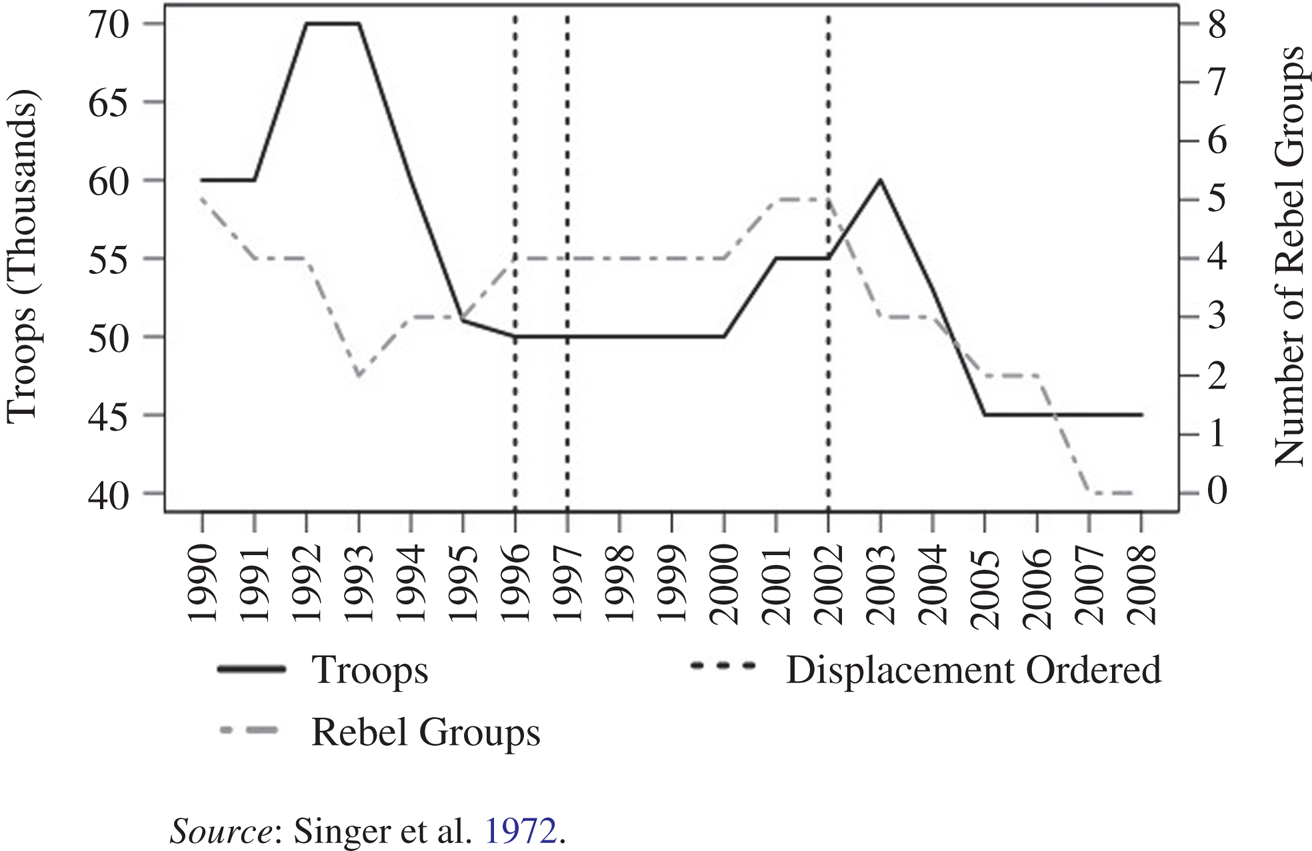
A fourth and final implication of the assortative logic is that relocation should occur when resource constraints limit an incumbent's ability to occupy contested areas—and should serve an extractive function to compensate for these constraints. This may help explain the timing of displacement orders in Uganda. As Figure 6 illustrates, the UPDF tended to relocate villagers when it was overstretched because of donor-mandated budget cuts and force commitments to multiple battlefronts, including domestic insurgencies and cross-border operations in Congo, Sudan, and Rwanda.
UPDF personnel and rebel groups (1990–2008)

The displacement orders of 1996 and 1997 were issued as several new rebellions (the ADF and WNBF) joined the LRA in challenging Museveni's regime, just as the government finished demobilizing 36,000 troops according to the austerity requirements of development loans provided by international donors. Around the same time, Uganda became involved in the civil war in the DRC, resulting in a “massive diversion of military resources and troops.”Footnote 135 When the NRM announced a second displacement order in the north in 2002, it faced further demands from donors to downsize the UPDF, which had launched a campaign to disarm 20,000 Karamojong cattle raiders in eastern Uganda. These imposed force reductions—and the need to combat several insurgencies simultaneously—created significant manpower problems for the army and strained its resources.
Relocating the population not only provided clues about civilian loyalties. It also served as a force multiplier. As early as 1988, the government began training and equipping Local Defense Units (LDUs) to secure rural areas and fend off rebel threats throughout the country. But mobilizing LDUs could prove difficult since tribal and religious leaders sometimes resisted the militarization of their communities, and because village life, where the agricultural economy tethered people to their fields, complicated recruitment and oversight. After the LRA escalated attacks in northern Uganda in 1995, the army attempted to dispatch LDUs only to discover that many had deserted and returned to their villages.
Thus forming the IDP camps made it easier for the UPDF to replenish and augment its forces without having to occupy the country's hinterlands. While official figures are not available, human rights reports indicate that recruitment of LDUs and other auxiliary forces in the camps was pervasive,Footnote 136 and my interviewees reported that most people were enlisted after relocation. According to one estimate, these auxiliaries increased UPDF force strength in northern Uganda alone by nearly two-thirds.Footnote 137 Recruits helped protect displaced communities, deployed with the UPDF on patrol, and even supplemented its forces in DRC and other places where Uganda was engaged in military operations. IDPs unable or unwilling to fight were often made to serve as scouts, porters, or to cut brush around camps to help the UPDF spot rebel incursions. In interviews, military officials consistently emphasized how displacement helped them “mobilize” the population:
“Before IDP camps people had a lot of work [in the fields] that fully engaged them and met their needs. But in the camp such work was not there, so joining the LDUs or home guards was the only alternative.”Footnote 138
“Congregating people into camps meant [they] had nothing to do. You have nothing to sell; you are living a redundant life. So if we [UPDF] are looking for homeguards, you should volunteer.”Footnote 139
Former LDU members acknowledged that the conditions that characterized the IDP camps—“dependency, idleness, and debilitating uncertainty”Footnote 140—encouraged people to enlist. Virtually everyone I interviewed emphasized the crucial role this mobilization played in helping the UPDF defeat the LRA and ADF, particularly since the LDUs spoke the local languages and were intimately familiar with the local terrain. But according to one government official, this mobilization may not have occurred to the extent it did without displacement: “It was only really after we removed people from the mountains that they decided to fight for us. I don't know if they would have volunteered if they hadn't been forced to leave their homes. [emphasis added].”Footnote 141
Alternative Explanations
Both the LRA and ADF scoured rural villages for foodstuffs and abducted civilians to fill their ranks. A desire to deny rebels access to these resources undoubtedly contributed to the government's decision to employ forced relocation. But the denial logic is insufficient to fully explain these measures for at least three reasons. First, the LRA and ADF operated from bases in Sudan and DRC, and both groups received most of their support from external as opposed to local sources. This was well known by the Ugandan government. Even before the UPDF ordered displacement, a senior commander acknowledged that “we have clear evidence that [the LRA] is kept, fed, and armed by Sudan.”Footnote 142 In fact, the UPDF did not implement displacement until after the LRA began receiving assistance from Khartoum.
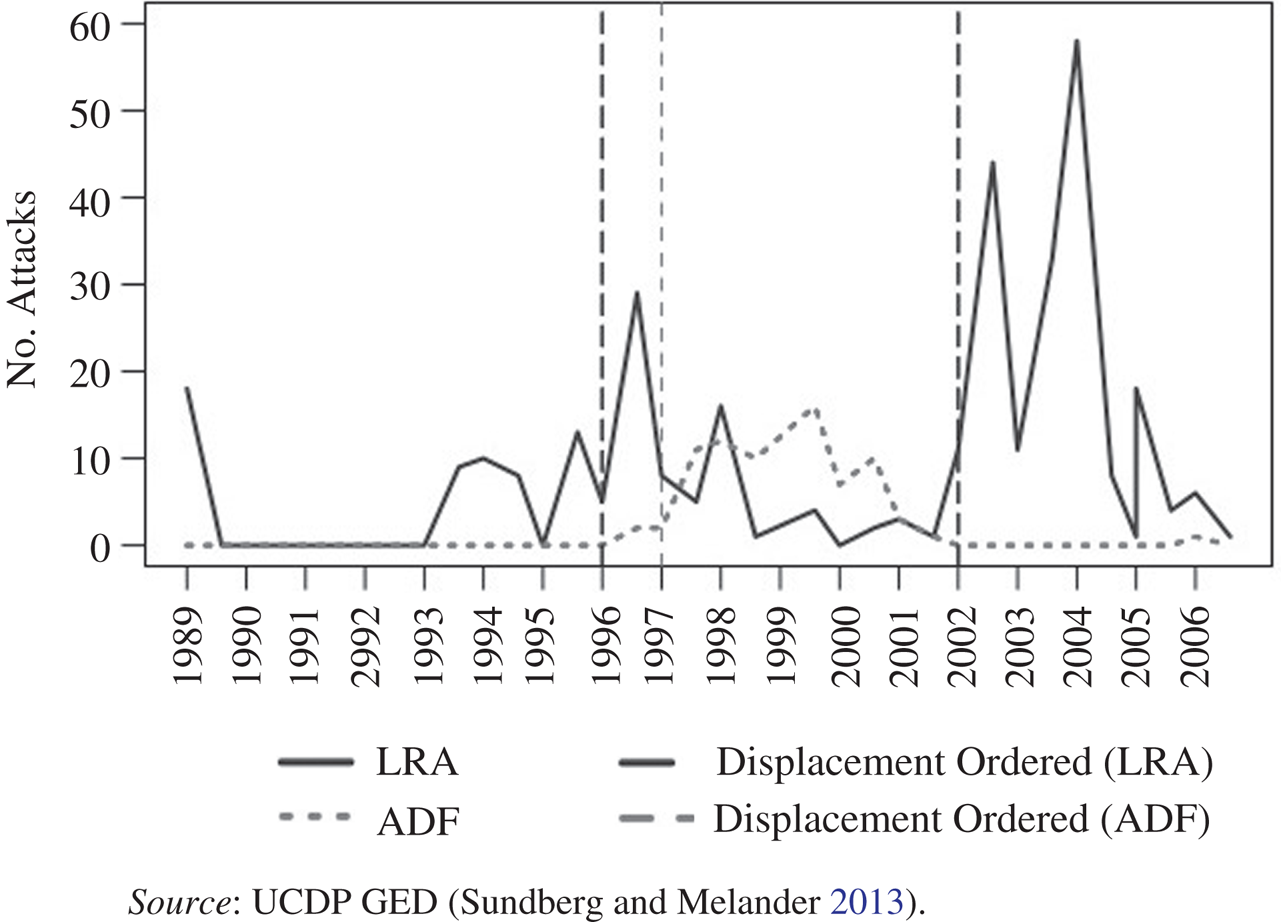
Second, the UPDF did not employ displacement against the LRA's predecessors, the UPDA and HSM—groups that lacked external support and were arguably more reliant on civilians for resources.Footnote 143 Third, forced relocation did not prevent abductions or reduce rebel violence against civilians. It had the opposite effect: concentrating people into large, crowded sites made them easy targets. The displaced were poorly protected, as the UPDF often withdrew soldiers from IDP camps and entrusted them to auxiliaries.Footnote 144 As a consequence, rebels frequently raided the settlements to loot food and supplies, and to kill and kidnap en mass. An analysis of violent events data (Figure 7) reveals that LRA and ADF attacks on civilians escalated following the government's displacement orders.Footnote 145 The number of battles between UPDF and rebel forces, and the number of reported rebel fatalities, also increased (see appendix). This indicates that forced relocation did help counterinsurgents better identify and engage rebels in combat, even as it failed to reduce rebel attacks on civilians. The escalation in rebel violence was often described by the LRA and ADF as collective punishment for civilians moving to camps, which these groups interpreted as tacit support for the government—further evidence of the signaling effects of displacement.Footnote 146
Rebel attacks on civilians in Uganda (1989–2008)

Rebel abductions also increased after displacement. In Acholiland, the number of civilians taken by the LRA peaked in 2003–04, when roughly 85 percent of the population resided in IDP camps.Footnote 147 Branch therefore concludes that “the formation of the camps made resource acquisition, if anything, easier for the rebels.”Footnote 148 It is possible, of course, that these outcomes reflect poor implementation. What is perplexing, however, is that despite the failure of civilian relocation to deny rebels resources, Ugandan authorities sustained these measures for years, and even expanded them. This suggests that displacement provided other strategic benefits.
Another possible explanation for forced relocation in Uganda is that it served as a form of collective punishment. Given that displacement orders were first issued shortly following the country's 1996 elections, the NRM may have uprooted communities it perceived as politically disloyal. Consistent with this logic, President Museveni received just 15 percent of the vote share in Acholiland in 1996.Footnote 149 Yet the fact that the ADF-affected districts of western Uganda collectively cast 97 percent of their votes for the NRM did not spare them from displacement. In a January 1997 letter to local officials—around the time the UPDF began ordering civilians to relocate—the commissioner for the western district of Bundibugyo commended his constituents’ “support to NRM government” since they gave Museveni “one of the highest percentage of votes” of any district.Footnote 150 It is unlikely the government would inflict punishment on such a bastion of support. That civilians were deliberately uprooted in these districts in addition to the north also questions accusations that displacement was motivated by ethnic enmity against the Acholi by Museveni, an ethnic Banyankole from southwestern Uganda. Finally, if the government's motive for displacing civilians was largely punitive, it seems improbable that the UPDF would train, arm, and fight alongside their intended victims—which they did by recruiting IDPs to serve in LDUs and other auxiliaries.
In summary, the strategic use of displacement in Uganda is better explained by my assortative theory than by denial, punishment, or ethnic nationalism.
Conclusion
Given the tremendous human and financial costs of population displacement, it is vital to understand not only why people flee conflict, but also why conflict parties force them to flee. Drawing reliable conclusions, however, requires developing a clear comparative understanding of the different forms that combatant-induced displacement takes and where they occur. This article attempts to systematically identify and explain variation in the use of different displacement strategies by state combatants. I argue that displacement is not just intended to eliminate or punish civilians: it is also used to sort the population by loyalty and affiliation. Both quantitative and qualitative evidence supports these claims. Statistical analysis of civil wars between 1945 and 2008 shows that different types of strategic displacement follow different logics. Cleansing follows a logic of punishment: it is more likely in conventional wars, and where state forces have access to group-level identifiers that link civilians to an armed group.
Yet the findings for forced relocation—the most common displacement strategy—suggest an assortative logic: it is more likely in irregular wars waged in “illegible” territories, and it tends to be employed by underresourced incumbents engaged in multiple conflicts. While these findings provide indirect support for my argument, the Uganda case study offers direct evidence for the assortative theory. I show that the Ugandan government used forced relocation to make inferences about people's identities and loyalties, impose legibility on frontier communities, and extract local recruits when and where information and manpower deficiencies demanded it.
The assortative logic I proposed offers an explanation for the puzzling persistence of forced displacement as a method of counterinsurgency despite its frequent failure to cut ties between rebels and civilians. Combatants often displace not to “drain” the sea, but to map it. This can help explain why uprooting civilians is more attractive than alternative conflict strategies. It also demonstrates that moving and staying in war can be considered a political act—which should prompt researchers to give greater attention to the politics of civilian displacement when examining the dynamics and consequences of conflict.
Additional research is required, however, to verify or invalidate the implications of my analysis. More fine-grained data on displacement strategies is needed to further explore their relative frequency and magnitude within and across conflicts, which would allow for more precise tests of different explanations. Case studies of depopulation and rebel-induced displacement are also needed to see how broadly my arguments apply. Additionally, future studies should compare the outcomes of different strategies and when they are effective. This research is essential both for enhancing scholarly understanding of wartime population movements and for improving policy efforts to prevent, mitigate, and better respond to them.
Data Availability Statement
Replication files for this article may be found at <https://doi.org/10.7910/DVN/J4WZGT>.
Supplementary Material
Supplementary material for this article is available at <https://doi.org/10.1017/S0020818320000089>.
Acknowledgments
I am grateful to Leo Arriola, Alex Braithwaite, Allison Carnegie, Tiffany Chu, Kelly Greenhill, Ron Hassner, Kim Howe, Stathis Kalyvas, Rana Khoury, Aila Matanock, Justin Schon, Abbey Steele, Scott Straus, Paul Thissen, and numerous conference participants for helpful comments and suggestions on various stages of this project. Thanks also to two anonymous reviewers and to the IO editors for their comments, which greatly improved the article. Gohar Abrahamyan, Harshil Bansal, Linda Fawaz, Morgan Ivanoff, Courtland Vogeding, and Angelica Zocchi provided excellent research assistance on the cross-national data. My field research in Uganda was facilitated by Stephen Oola, James Latigo, and Phil Wilmot, and Francis Abonga and Oyet Kenneth Odong were indispensable research assistants. This research was conducted under UC Berkeley IRB Protocol 2015-06-7645 and with the approval of Uganda's National Council for Science and Technology.
Funding
I acknowledge funding support from the National Science Foundation (No. 1746447), the United States Institute of Peace, the Harry Frank Guggenheim Foundation, the University of California Institute on Global Conflict and Cooperation, and the UC Berkeley Center for African Studies.