Introduction
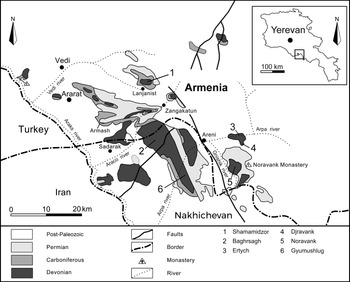
Cyrtospiriferidae are spire-bearer brachiopods that originated in the Middle Devonian (Givetian) (Paeckelmann, Reference Paeckelmann1942; Grechishnikova, Reference Grechishnikova1996; Schemm-Gregory, Reference Schemm-Gregory2011; Gourvennec, Reference Gourvennec2019). They diversified rapidly during the Frasnian and proliferated on tropical/subtropical platforms during the Late Devonian (Ma and Day, Reference Ma and Day1999) until their extinction at the end of the Famennian, during the Hangenberg event (Carter and Gourvennec, Reference Carter, Gourvennec and Kaesler2006; Mottequin et al., Reference Mottequin, Brice and Legrand-Blain2014). Thanks to their richness in brachiopods, the Upper Devonian sedimentary sequences of Armenia can provide interesting insights to improve our understanding of brachiopod changes in diversity in relation to well-known extinction events (Abrahamyan, Reference Abrahamyan1957, Reference Abrahamyan1964, Reference Abrahamyan and Akopian1974; Arakelyan, Reference Arakelyan, Mkrtchian, Vardaniants, Gabrielian, Maghakian and Paffenholz1964; Alekseeva et al., Reference Alekseeva, Afanasjeva, Grechishnikova, Oleneva and Pakhnevich2018a, Reference Alekseeva, Afanasjeva, Grechishnikova, Oleneva and Pakhnevichb; Serobyan et al., Reference Serobyan, Danelian, Crônier, Grigoryan and Mottequin2021). However, although Upper Devonian–lower Carboniferous brachiopods of the Lesser Caucasus (Armenia and Nakhichevan; Fig. 1) were studied systematically by Abrahamyan (Reference Abrahamyan1957, Reference Abrahamyan1964, Reference Abrahamyan and Akopian1974), Grechishnikova (Reference Grechishnikova1986, Reference Grechishnikova1996), and more recently by Alekseeva et al. (Reference Alekseeva, Afanasjeva, Grechishnikova, Oleneva and Pakhnevich2018a, Reference Alekseeva, Afanasjeva, Grechishnikova, Oleneva and Pakhnevichb) and Serobyan et al. (Reference Serobyan, Grigoryan, Mottequin, Mayilyan, Crônier and Danelian2019, Reference Serobyan, Danelian, Crônier, Grigoryan and Mottequin2021, Reference Serobyan, Danelian, Crônier, Grigoryan and Mottequin2022), they still remain largely undocumented from taxonomic and biostratigraphic points of view. This is particularly true for the cyrtospiriferids, among which most species were described previously without examination of the most fundamental features in brachiopod taxonomy, such as their internal structure and type of micro-ornament, which are significant for their supraspecific classification. Consequently, many of them were mistakenly referred to genera such as Cyrtospirifer Nalivkin in Fredericks, Reference Frederiks1924, and Cyrtiopsis Grabau, Reference Grabau1923.
Schematic geological map and distribution of upper Paleozoic sequences in the Lesser Caucasus (Central Armenia and Nakhichevan), including the locations of sections mentioned in the present study (modified after Serobyan et al., Reference Serobyan, Grigoryan, Mottequin, Mayilyan, Crônier and Danelian2019).

Based on recently collected material from a single brachiopod biozone (the Aramazdospirifer orbelianus Zone; see Serobyan et al., Reference Serobyan, Danelian, Crônier, Grigoryan and Mottequin2022) from four different localities in Armenia (Fig. 1), the prime objective of this contribution is to reassess the taxonomy of two lower Famennian cyrtospiriferid species, one of which was documented in the second half of the twentieth century and used in the biostratigraphy of the lower Famennian sequences of the Lesser Caucasus. Taking this opportunity, taxonomic aspects of the family Cyrtospiriferidae are discussed, as well as evolutionary and paleobiogeographic implications of the newly erected genera. Finally, two types of encrusters are documented for the first time from the Armenian material and the epibiont-host relationship is discussed.
Geological and stratigraphic setting
The Upper Devonian sedimentary sequences of Armenia have a restricted geographic distribution and occur mainly in the southern part of Central Armenia, but they continue westwards in Nakhichevan (Fig. 1). They consist essentially of marly and sandy biogenic limestones, rich in brachiopods, and intercalations of quartzose sandstones (arenites), fine-grained sandstones and shales. The carbonate-siliciclastic sequences of both areas belong to the South Armenian Block (SAB; Sosson et al., Reference Sosson, Rolland, Müller, Danelian, Melkonyan, Kekelia, Adamia, Babazadeh, Kangarli, Avagyan, Galoyan, Mosar, Sosson, Kaymakci, Stephenson, Bergerat and Starostenko2010), which at the time was part of the northern margin of the Gondwana megacontinent. These sedimentary sequences are considered to have been accumulated in rather shallow water platform environments (Arakelyan, Reference Arakelyan, Mkrtchian, Vardaniants, Gabrielian, Maghakian and Paffenholz1964; Ginter et al., Reference Ginter, Hairapetian and Grigorian2011). The Frasnian and Famennian deposits were subdivided into a number of ‘formations’ (e.g., Baghrsagh, Noravank, Ertych) by Arakelyan (Reference Arakelyan, Mkrtchian, Vardaniants, Gabrielian, Maghakian and Paffenholz1964) (Fig. 2). However, the latter were defined mainly based on their brachiopod assemblages; thus, they bear a biostratigraphic rather than lithostratigraphic significance (see discussion in Grigoryan et al., Reference Grigoryan, Serobyan, Randon, Mayilyan, Avagyan and Danelian2019, and Serobyan et al., Reference Serobyan, Grigoryan, Mottequin, Mayilyan, Crônier and Danelian2019). Consequently, they are here regarded as horizons and not as lithostratigraphic formations.
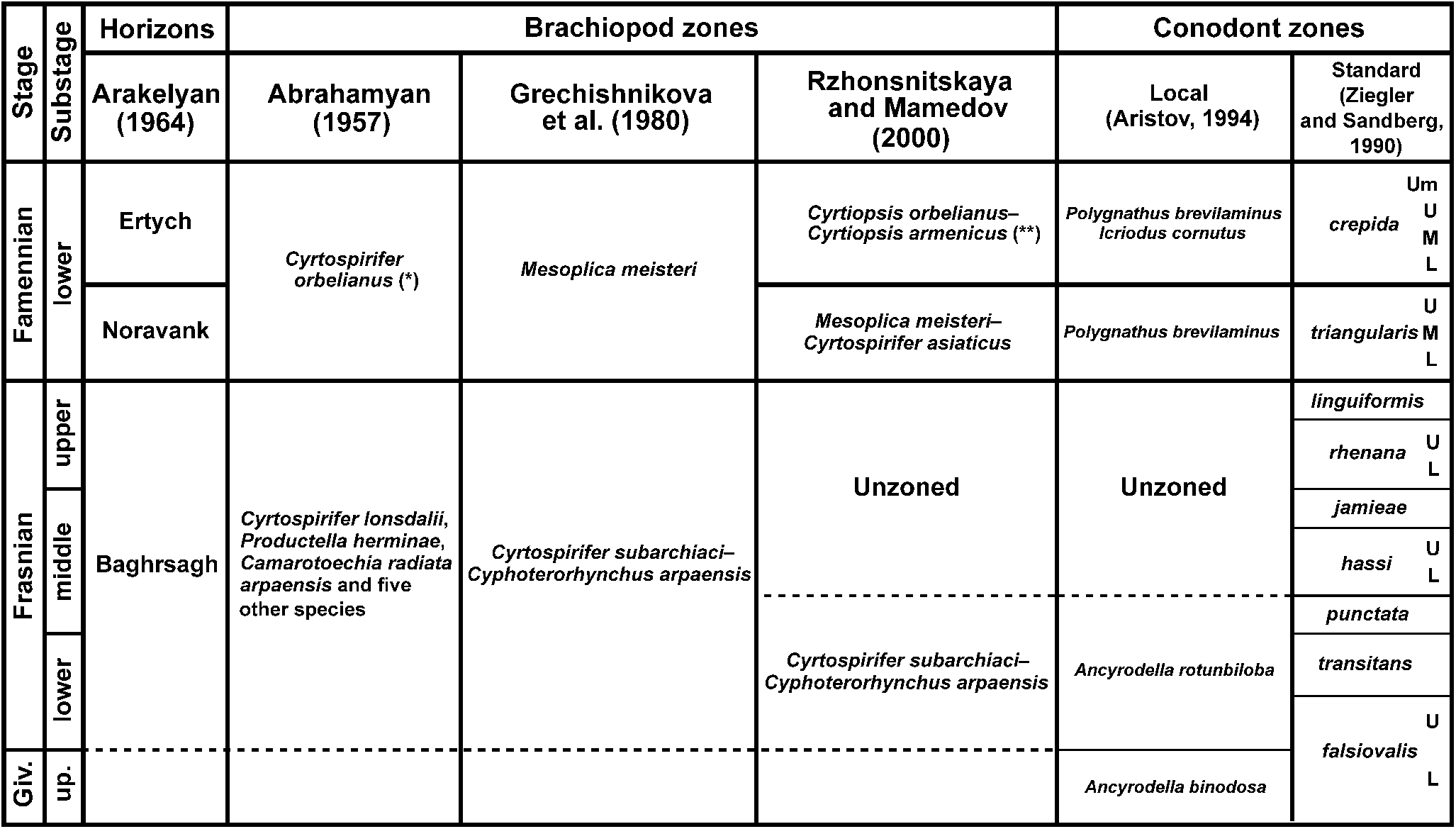
Biochronostratigraphic framework of the Frasnian–lower Famennian sedimentary sequences in the Lesser Caucasus, including the biostratigraphic horizons established by Arakelyan (Reference Arakelyan, Mkrtchian, Vardaniants, Gabrielian, Maghakian and Paffenholz1964) and brachiopod biozones of Abrahamyan (Reference Abrahamyan1957) in Central Armenia and of Grechishnikova et al. (Reference Grechishnikova, Levitskiy and Feliks1980) and Rzhonsnitskaya and Mamedov (Reference Rzhonsnitskaya and Mamedov2000) in Nakhichevan. (*) currently Aramazdospirifer orbelianus; (**) currently Aramazdospirifer orbelianus-Tornatospirifer armenicus. It also includes the regional conodont zonation established by Aristov (Reference Aristov1994) in Nakhichevan and the standard conodont zones of Ziegler and Sandberg (Reference Ziegler and Sandberg1990). Abbreviations: L = Lower; M = Middle; U = Upper; Um = Uppermost.

The biostratigraphical zonal scheme of the Upper Devonian rocks of the Lesser Caucasus was first established by Rzhonsnitskaya (Reference Rzhonsnitskaya1948), who simply subdivided the Devonian into two parts: Lower and Upper. Later, Abrahamyan (Reference Abrahamyan1957) introduced a new continuous biostratigraphic scheme, mainly for the Famennian, composed of taxon-range and assemblage biozones (Fig. 2). Abrahamyan's biozones were further revised by Mamedov and Rzhonsnitskaya (Reference Mamedov and Rzhonsnitskaya1985) and updated by Rzhonsnitskaya and Mamedov (Reference Rzhonsnitskaya and Mamedov2000), who also correlated them with the conodont biozonation of Aristov (Reference Aristov1994), which was carried out in Nakhichevan. In addition, Grechishnikova et al. (Reference Grechishnikova, Levitskiy and Feliks1980, Reference Grechishnikova, Aristov, Reitlinger and Chizhova1982) and Grechishnikova and Levitskiy (Reference Grechishnikova and Levitskiy2011), and more recently updated by Grechishnikova in Alekseeva et al. (Reference Alekseeva, Afanasjeva, Grechishnikova, Oleneva and Pakhnevich2018a, Reference Alekseeva, Afanasjeva, Grechishnikova, Oleneva and Pakhnevichb), contributed to the biostratigraphy of the Middle Devonian–lower Carboniferous sequences of the Lesser Caucasus. However, in spite of these studies, the brachiopod biostratigraphy of the Middle–Upper Devonian sequences of the Lesser Caucasus still remains poorly understood. Moreover, these studies sometimes caused confusion, as can be illustrated with the following example: Aristov (Reference Aristov1994) recognized two conodont zones across the Givetian-Frasnian boundary (Ancyrodella binodosa and A. rotunbiloba); he further specified that the binodosa Zone may be correlated with the lower part of Cyrtospirifer subarchiaci-Cyphoterorhynchus arpaensis brachiopod Zone, whereas its upper part should be coeval with the rotunbiloba conodont Zone. However, Rzhonsnitskaya and Mamedov (Reference Rzhonsnitskaya and Mamedov2000) raised the lower boundary of the Cyrtospirifer subarchiaci-Cyphoterorhynchus arpaensis brachiopod zone to the early Frasnian. Afterwards, Alekseeva et al. (Reference Alekseeva, Afanasjeva, Grechishnikova, Oleneva and Pakhnevich2018a) considered this brachiopod zone to be late Frasnian in age, without giving any further evidence.
Another example that requires future clarification concerns the lower Famennian brachiopod biozonation. Abrahamyan (Reference Abrahamyan1957) and Grechishnikova et al. (Reference Grechishnikova, Levitskiy and Feliks1980, Reference Grechishnikova, Aristov, Reitlinger and Chizhova1982) recognized only one brachiopod zone within this substage, namely the Cyrtospirifer orbelianus and the Mesoplica meisteri zones, respectively. However, Rzhonsnitskaya and Mamedov (2000) established two biozones for the same interval: the lowermost Famennian Mesoplica meisteri-Cyrtospirifer asiaticus and the lower Famennian Cyrtiopsis orbelianus-C. armenicus zones. Finally, Alekseeva et al. (Reference Alekseeva, Afanasjeva, Grechishnikova, Oleneva and Pakhnevich2018a) followed the biostratigraphic scheme of Grechishnikova et al. (Reference Grechishnikova, Levitskiy and Feliks1980) and considered that the lower Famennian of the Lesser Caucasus is represented by only one brachiopod zone; however, they re-named it the Mesoplica meisteri-Cyrtospirifer asiaticus Zone. The biostratigraphic scheme of Rzhonsnitskaya and Mamedov (Reference Rzhonsnitskaya and Mamedov2000) was followed by Ginter et al. (Reference Ginter, Hairapetian and Grigorian2011), who described chondrichthyan remains from the Upper Devonian–lower Carboniferous succession of Armenia, some of which were recovered from the Frasnian–Famennian interval of the Ertych and Noravank sections. Besides chondrichthyans, these authors also reported conodonts from the Aramazdospirifer orbelianus-Tornatospirifer armenicus Zone of the Noravank section, among which some elements indicate the lower Famennian Palmatolepis crepida Zone (see Ginter et al., Reference Ginter, Hairapetian and Grigorian2011, text-fig. 4).
Material and methods
The examined material was collected from the Cyrtospirifer orbelianus brachiopod Zone of Abrahamyan (Reference Abrahamyan1957) cropping out in four different localities (Fig. 1). This brachiopod zone was correlated with the Palmatolepis crepida conodont Zone by Rzhonsnitskaya and Mamedov (Reference Rzhonsnitskaya and Mamedov2000) (Fig. 2).
The internal morphology of specimens was investigated by using the standard technique of serial sections and acetate peels, in addition to numerous photographs of ground specimens taken with a Canon EOS 700D camera, in order to catch the very minute details related to the development of internal features. Shells selected for scanning electron microscopy were coated with gold and their micro-ornament was observed with the help of a ZEISS EVO 10 Scanning Electron Microscope hosted with the Paleontology team of Lille University. The larger specimens were coated with magnesium oxide before being photographed.
Repositories and institutional abbreviations
Most of the specimens illustrated and investigated herein are deposited at the Geological Museum of the Institute of Geological Sciences of the National Academy of Sciences of Armenia, Yerevan (IGSNASRAGM/PS). The prefix PS indicates the laboratory of Paleontology and Stratigraphy. A few specimens are housed at the public paleontological collection of Lille University (France).
Systematic paleontology
The supraspecific classification of this study follows the one suggested by Carter et al. (Reference Carter, Johnson, Gourvennec and Hou1994) and Johnson (Reference Johnson and Kaesler2006).
Order Spiriferida Waagen, Reference Waagen1883
Suborder Spiriferidina Waagen, Reference Waagen1883
Superfamily Cyrtospiriferoidea Termier and Termier, Reference Termier and Termier1949
Family Cyrtospiriferidae Termier and Termier, Reference Termier and Termier1949
Subfamily Cyrtospiriferinae Termier and Termier, Reference Termier and Termier1949
Genus Pentagonospirifer new genus
Type species
Pentagonospirifer abrahamyanae n. gen. n. sp., by monotypy.
Diagnosis
Shell medium-sized, aequibiconvex to ventribiconvex, with acute to slightly mucronate cardinal extremities; widest at hinge line; ventral interarea triangular, high, variably concave, apsacline; pseudodeltidium with distinct, stacked sets of growth lamellae, with apical foramen; wide, well-defined dorsal fold and ventral sulcus; ribs numerous, usually simple on flanks, increasing by bifurcation in sulcus and on fold; micro-ornament of capillae with pustules on them and closely spaced growth lines; dental plates long, always intrasinal; delthyrial thickening is formed by a development of strong apical callus on delthyrial plate, around dental plates and floor of ventral valve; ctenophoridium unsupported.
Occurrence
Lower Famennian of Armenia.
Etymology
Pentagonus, a, um (Latin): five-angled; spirifer is a common suffix used in the spiriferide group. The name draws attention to the pentagonal ventral valve of the genus.
Remarks
Pentagonospirifer n. gen. is assigned to the subfamily Cyrtospiriferinae (Cyrtospiriferidae) on the basis of its wide hinge line, high interarea, and acute cardinal extremities.
Pentagonospirifer n. gen. differs from Aramazdospirifer Serobyan et al., Reference Serobyan, Danelian, Crônier, Grigoryan and Mottequin2022, mainly by its shell shape and by the lack of longitudinal and median elevation in sulcus and similar elevation often developed on fold. Furthermore, the micro-ornament of Pentagonospirifer n. gen. includes fine capillae with pustules on them that are present only on ribs, whereas Aramazdospirifer has capillae both on ribs and in interspaces that are devoid of pustules on them. Internally, Pentagonospirifer n. gen. differs by the presence of a strong apical callus developed on a thin delthyrial plate and formed by the accretion of shelly material from the internal faces of the dental plates and the floor of the ventral valve, which is a feature not observed in Aramazdospirifer.
The new genus resembles to some extent some representatives of the lower Famennian genus Sinospirifer Grabau, Reference Grabau1931, as revised by Ma and Day (Reference Ma and Day2003, Reference Ma and Day2007) and Ma et al. (Reference Ma, Chen, Day and Jin.2003), by its wide hinge line, acute cardinal extremities, a massive apical callus developed in the ventral interior, and its unsupported ctenophoridium. However, Pentagonospirifer n. gen. has a higher ventral interarea, a minute foramen near the apex, more ribs in the sulcus and on the fold, and pustules developed only on capillae. Internally, the most significant difference concerns the dental plates, which are intrasinal and devoid of thickening in Pentagonospirifer n. gen., whereas Sinospirifer possesses greatly thickened extrasinal dental plates.
Externally, Pentagonospirifer n. gen. appears to be closely related to Wenjukovispirifer Oleneva, Reference Oleneva2016, known from the Famennian of the European Platform, and more particularly by its rounded subpentagonal outline, inflated shell, high ventral interarea, well-developed sulcus and fold, and ornamentation composed of simple and low ribs separated by narrower interspaces. However, Pentagonospirifer n. gen. is distinguished by its relatively aequibiconvex lateral profile, its pseudodeltidium with distinct, stacked sets of growth lamellae, and its minute foramen developed apically. It is worth noting that the internal structure of Wenjukovispirifer is not known as yet; therefore, further comparison is hampered. Nevertheless, Oleneva (Reference Oleneva2016) did mention the presence of a ventral septum (=myophragm?) in the ventral interior of Wenjukovispirifer, which was not observed in Pentagonospirifer n. gen. Moreover, no strong apical callus on the delthyrial plate, which is a feature observed in Pentagonospirifer n. gen., is mentioned for Wenjukovispirifer.
Pentagonospirifer n. gen. may be distinguished from the late Givetian to early Famennian? genus Cyrtospirifer Nalivkin in Frederiks, Reference Frederiks1924, as revised by Ma and Day (Reference Ma and Day2003), by its more longitudinally elongated shell, the presence of a robust pseudodeltidium and its micro-ornament. Internally, Pentagonospirifer n. gen. mainly differs by the presence of strong apical callosity developed on the delthyrial plate.
Pentagonospirifer n. gen. displays many external similarities (e.g., rounded subpentagonal outline, acute cardinal extremities, widest at hinge line, well-developed sulcus and fold with ribs fainter than those on flanks) with Pripyatispirifer Pushkin, Reference Pushkin1996, from the lower Famennian of Belarus and possibly from the lower Frasnian of Nakhichevan (Afanasjeva in Alekseeva et al., Reference Alekseeva, Afanasjeva, Grechishnikova, Oleneva and Pakhnevich2018b), but differs by its larger shell size, high ventral interarea and by its minute apical foramen. In addition, Pentagonospirifer n. gen. differs by its micro-ornament composed of capillae with pustules on them, whereas Pripyatispirifer representatives lack plicae and pustules on ribs. It is difficult to compare precisely the internal morphology of these genera because Pushkin (Reference Pushkin1996) did not illustrate transverse sections, but based on Pushkin's illustration (Reference Pushkin1996, p. 47, fig. 2), the cardinal process of Pripyatispirifer appears to be trilobed, which is quite an unusual case, thus different from that of Pentagonospirifer n. gen.
Pentagonospirifer n. gen. differs from Eodmitria Brice, Reference Brice1982, known from the lower–middle Frasnian of Western Europe (Belgium, France and Germany) and Turkey (Brice, Reference Brice1982; Sartenaer, Reference Sartenaer and Sartenaer1982; Gourvennec, Reference Gourvennec2006), mainly by its more inflated shell, high ventral interarea, and well-defined fold and sulcus. Furthermore, the micro-ornament of Pentagonospirifer n. gen. consists of capillae with pustules on them (only on ribs), whereas the micro-ornament of Eodmitria is papillose. It is worth noting that both genera have quite similar internal morphologies, with the exception of the disposition of dental plates, which are intrasinal in Pentagonospirifer n. gen., versus extrasinal in Eodmitria.
Pentagonospirifer n. gen. is distinguished externally from Pseudocyrtiopsis Ma and Day, Reference Ma and Day1999, from the lower Famennian of South China, by its larger and more inflated shell (due to the greater thickness of the dorsal valve), its bifurcating ribs in the sulcus and on the fold, its finer and more numerous ribs on flanks, as well as the lack of capillae that are developed in the interspaces of Pseudocyrtiopsis representatives. Internally, Pentagonospirifer n. gen. mainly differs by the presence of a strong apical callosity developed on the delthyrial plate and by its unsupported ctenophoridium.
Pentagonospirifer n. gen. differs from Plicapustula Ma and Day, Reference Ma and Day2007, from the lower Famennian of South China and North America, by its more inflated and transversely elongated shell, well-developed pseudodeltidium with a minute foramen near the apex, bifurcating ribs across the whole width of sulcus, and by the presence of capillae on ribs. Moreover, no strong apical callus on the delthyrial plate is mentioned for Plicapustula, which is a feature observed in Pentagonospirifer n. gen.
Pentagonospirifer n. gen. is distinguished externally from Lamarckispirifer Gatinaud, Reference Gatinaud1949, from the lower Famennian of South China, as revised by Ma and Day (Reference Ma and Day2007), by its inflated shell, its high and subogival tongue, the larger number of ribs on the flanks and fold and in the sulcus, and by the absence of a median furrow on the fold, which is generally present in Lamarckispirifer. Moreover, Pentagonospirifer n. gen. differs by the presence of a strong apical callus developed on the delthyrial plate and by its unsupported ctenophoridium.
Pentagonospirifer abrahamyanae new species
Figures 3–5; Table 1
Holotype
An almost complete articulated specimen that is partly covered by encrusters in its sulcus (IGSNASRAGM 3967/PS 3073; Fig. 3.11–3.18), lower Famennian Aramazdospirifer orbelianus Zone of the Djravank section (7 km southeast from Areni, Vayots Dzor Province, Central Armenia; Fig. 1).
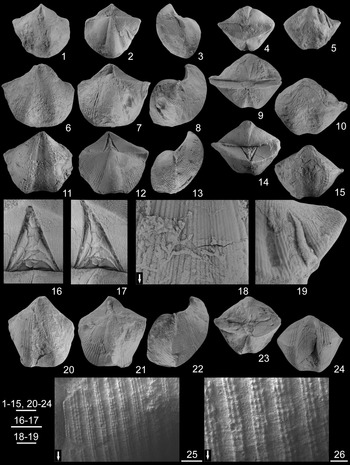
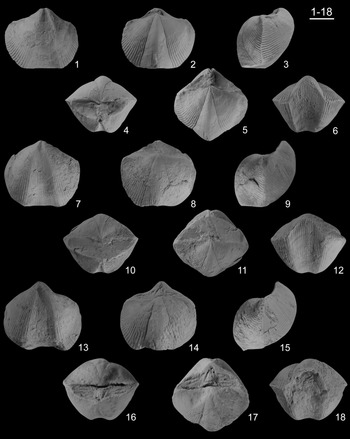
Pentagonospirifer abrahamyanae n. gen. n. sp. from the lower Famennian of Armenia. The arrows (18, 25, 26) indicate the anterior margin. (1–5, 19) IGSNASRAGM 3965/PS 3071 (Djravank section), almost complete juvenile specimen in ventral, dorsal, lateral, posterior, and anterior views (1–5), and close-up of cornulitid tubeworm (19). (6–10) IGSNASRAGM 3966/PS 3072 (Djravank section), almost complete specimen in ventral, dorsal, lateral, posterior, and anterior views. (11–18) IGSNASRAGM 3967/PS 3073 (holotype, Djravank section), almost compete specimen in ventral, dorsal, lateral, posterior, posterodorsal, and anterior views (11–15), close-up of the ventral interarea (delthyrium) showing the pseudodeltidium composed of several distinct, stacked sets of growth lamellae with an ovate foramen near the apex (16, 17), and close-up of Hederella encrustation patterns near the front (18). (20–26) IGSNASRAGM 3968/PS 3074 (Ertych section), partly exfoliated specimen in ventral, dorsal, lateral, posterior, posterodorsal, and anterior views (21–26), and close-up of the micro-ornament (capillae with pustules) on ventral valve (25, 26). Scale bars = 10 mm (1–15, 20–24), 5 mm (16, 17), 2 mm (18, 19), 400 μm (25), 200 μm (26).

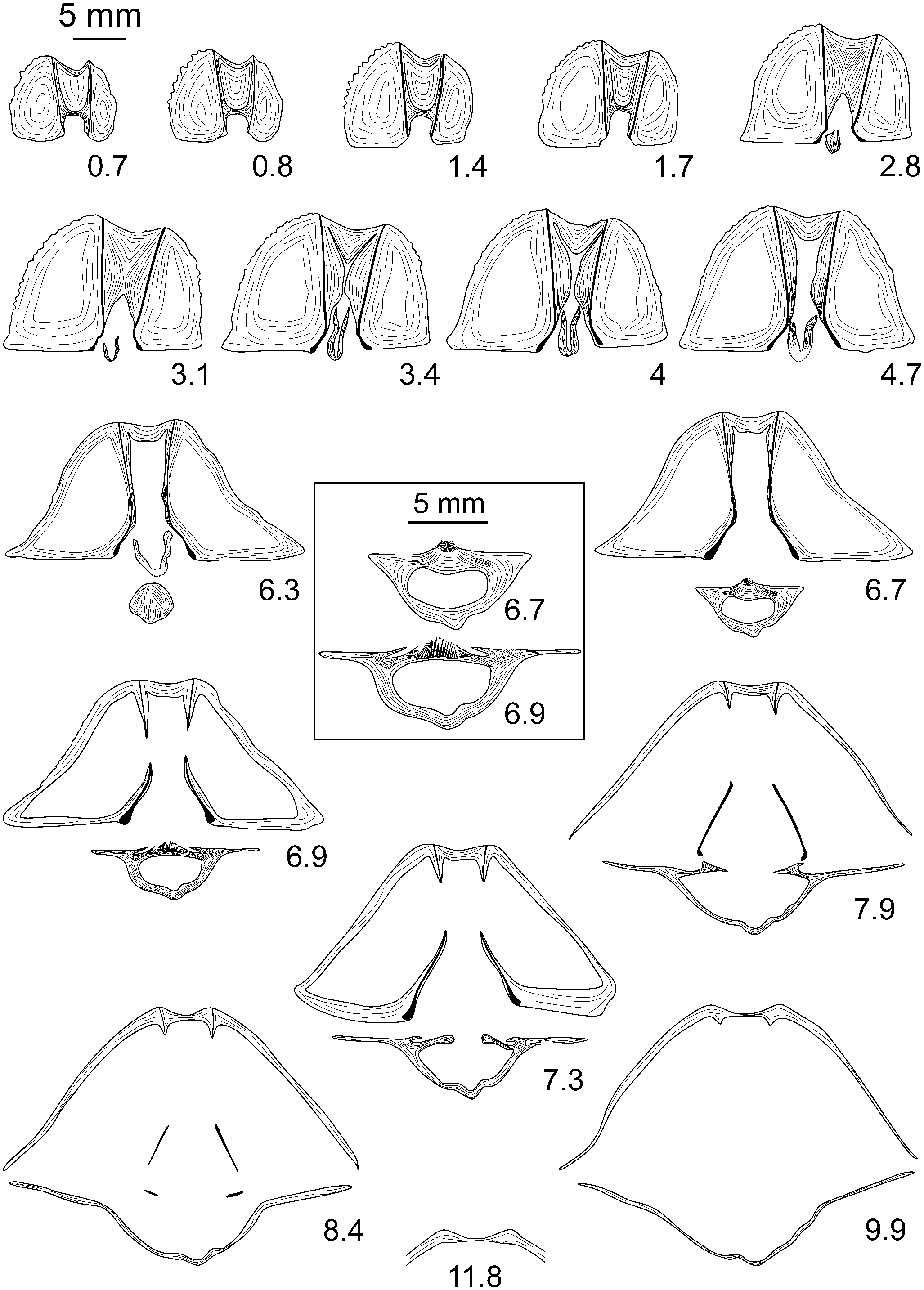
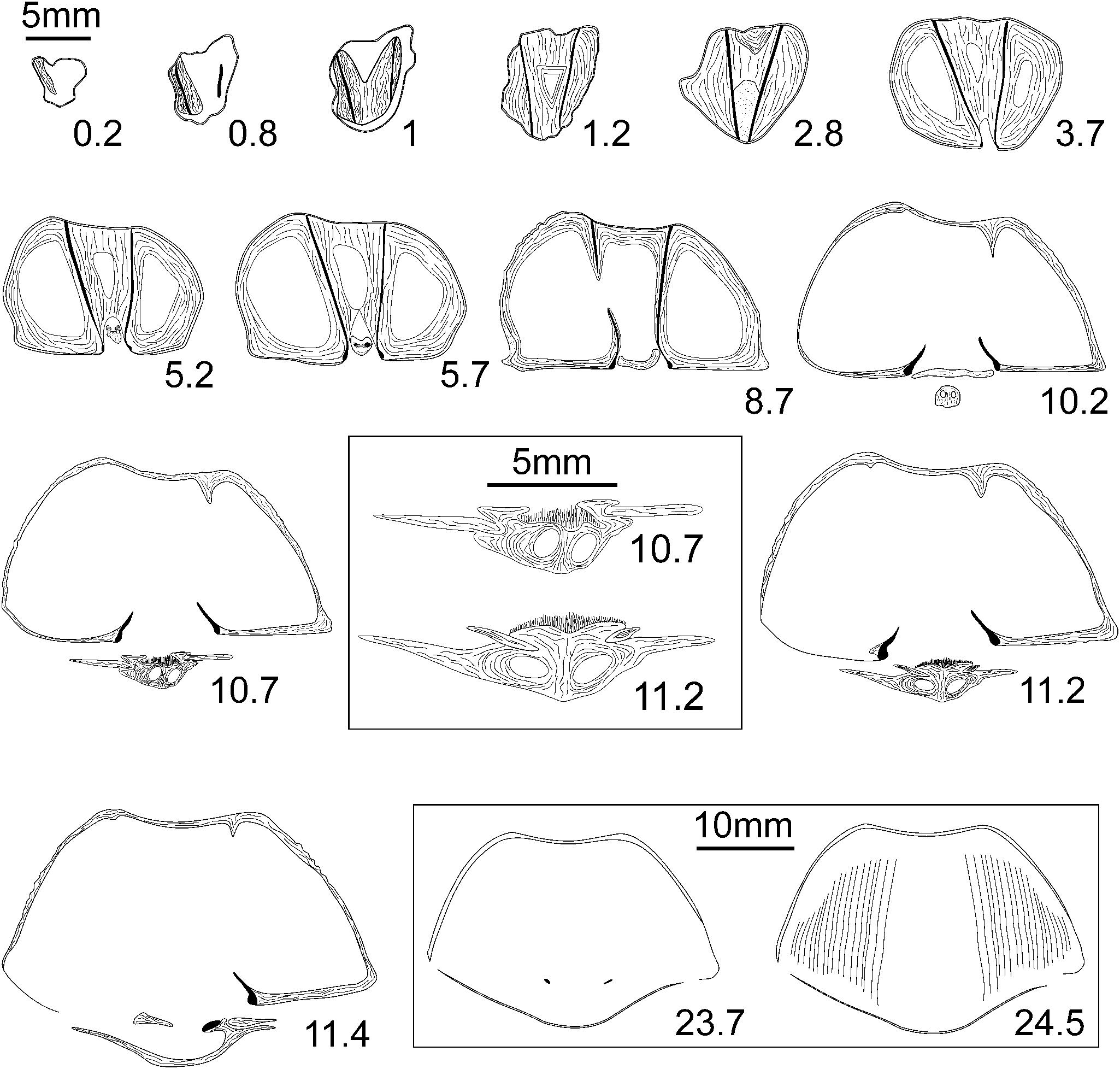
Transverse serial sections of Pentagonospirifer abrahamyanae n. gen. n. sp., (IGSNASRAGM 3964/PS 3070), Djravank section. Numbers refer to distance in mm measured from the top of the ventral umbo. Scale bars = 5 mm.

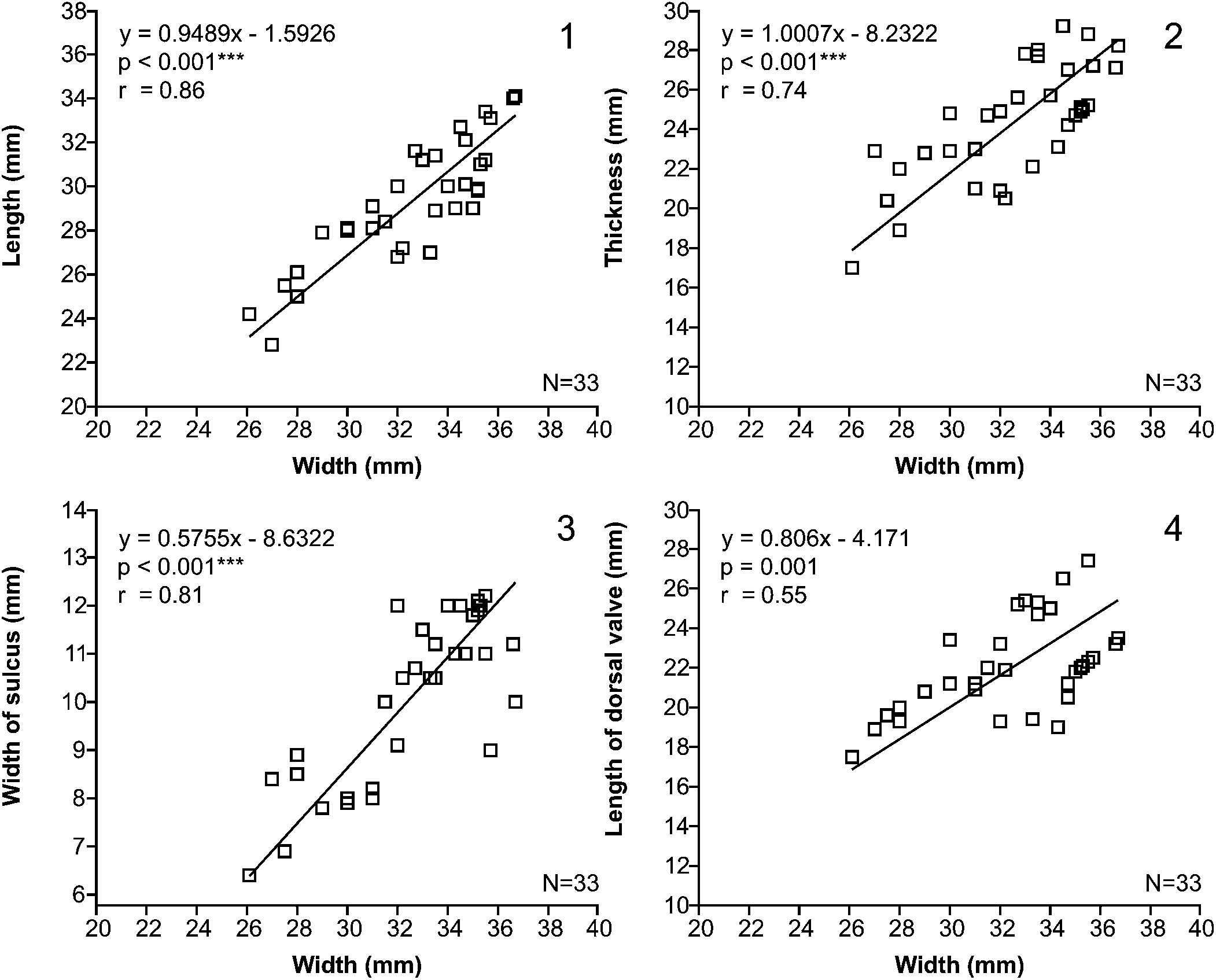
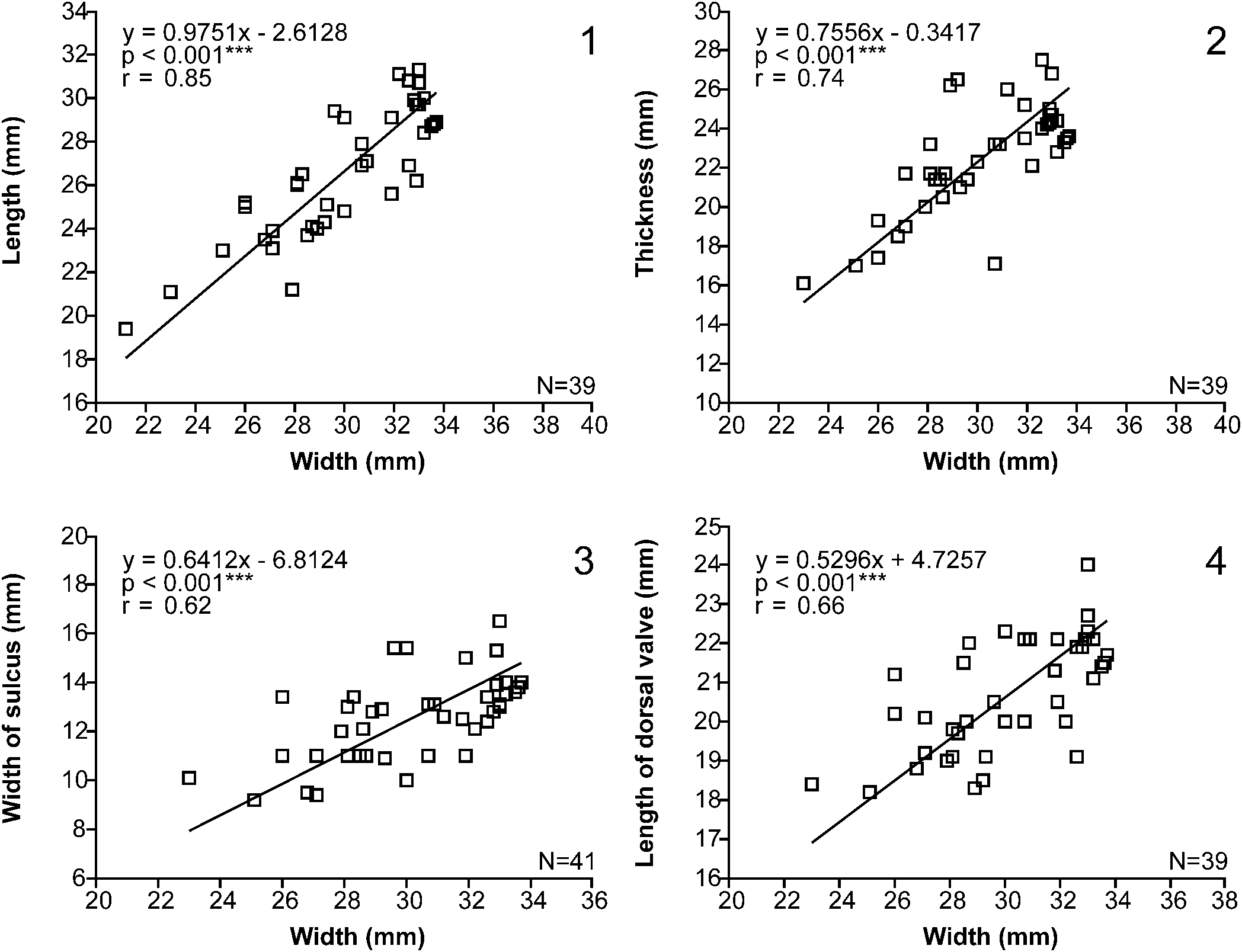
Scatter diagrams of Pentagonospirifer abrahamyanae n. gen. n. sp. (1) Relation between shell width and length. (2) Relation between shell width and thickness. (3) Relation between shell width and width of sulcus. (4) Relation between shell width and length of dorsal valve. Abbreviations: N = number of specimens measured; y = ax + b, linear model; r = coefficient of correlation; p*** = significant probability value.

Measurements in mm and ratios of Pentagonospirifer abrahamyanae n. gen. n. sp. Abbreviations: W = width of the shell; L = length of the shell; T = thickness of the shell; Ws = width of the sulcus; dL = length of the dorsal valve.

Diagnosis
Shell medium-sized (up to 36.7 mm in width, 34.1 mm in length, 29.2 mm in thickness) (Table 1), wider than long, aequibiconvex to ventribiconvex, widest at hinge line, highest at about midlength, with acute cardinal extremities; anterior margin emarginate; anterior commissure uniplicate; ventral interarea triangular, high, apsacline; pseudodeltidium with distinct, stacked sets of growth lamellae and with a minute, ovate foramen positioned apically; dorsal fold and ventral sulcus wide, and well defined; tongue high, subtriangular to subcircular in outline; ribs numerous, usually simple on flanks, increasing by bifurcation in sulcus and on fold; micro-ornament of capillae with pustules on them and closely spaced growth lines; dental plates long, extending to ~30% of the shell length, slightly convergent, diverging dorsally in the umbonal region, always intrasinal; delthyrial thickening formed by a development of strong apical callus on delthyrial plate, around dental plates and floor of ventral valve; ctenophoridium unsupported, slightly convex, with numerous vertical lamellae.
Occurrence
Pentagonospirifer abrahamyanae n. gen. n. sp. occurs in the lower Famennian Ertych horizon of Arakelian (Reference Arakelyan, Mkrtchian, Vardaniants, Gabrielian, Maghakian and Paffenholz1964), the Cyrtospirifer orbelianus brachiopod Zone of Abrahamyan (Reference Abrahamyan1957) and the Cyrtiopsis orbelianus-Cyrtiopsis armenicus brachiopod zone of Rzhonsnitskaya and Mamedov (Reference Rzhonsnitskaya and Mamedov2000) (see Fig. 2). The Ertych horizon is also correlated with the Palmatolepis crepida conodont Zone.
Description
Shell medium-sized, wider than long, generally aequibiconvex to slightly ventribiconvex, rounded subpentagonal in outline, widest at hinge line, highest at about midlength; cardinal extremities acute; anterior margin emarginate; anterior commissure uniplicate. Ventral valve strongly inflated, with convex flanks sloping steeply towards lateral commissures; highest in the posterior third of the valve, then decreasing progressively towards anterior margin; umbo strongly inflated, large and prominent; beak straight to suberect; interarea apsacline, triangular, high, generally slightly concave (occasionally perpendicular to commissural plane) well defined; delthyrium wide, covered by a pseudodeltidium for most of its height, the latter being formed by distinct, stacked sets of growth lamellae; foramen minute, ovate near the apex; sulcus relatively wide, shallow to moderately deep, originating from beak, with rounded lateral boundaries, round- to flat-bottomed at front; tongue high, perpendicular to commissural plane or slightly bent dorsally, subtriangular to subcircular in outline.
Dorsal valve wider than long, strongly inflated, with flanks sloping moderately towards lateral commissures, subtrapezoidal in outline; highest in the anterior third of the valve (occasionally near midlength at the juvenile growth stages), but progressively decreasing towards anterior margin; interarea linear, flat to slightly concave, orthocline; fold moderately high to high, wide, originating from beak, round-topped at front.
Ornamentation of up to 29 rounded, simple, flattened, low ribs on each flank (5 ribs per 5 mm at anterior margin near sulcus and fold), becoming fainter towards posterolateral margins; in sulcus and on fold, up to 25 ribs, increasing by bifurcation, much narrower than those present on flanks; ribs twice as wide as interspaces on the entire shell; micro-ornament of fine capillae only on ribs, with pustules on them and with closely spaced growth lines sometimes thickened as growth varices.
Ventral valve interior (Fig. 4) with relatively thin, long, intrasinal and slightly divergent dental plates, becoming subparallel more anteriorly, converging dorsally in umbonal region (as seen in transverse section); delthyrial thickening formed by accretion of strong apical callus from the internal faces of the dental plates and floor of ventral valve; delthyrial plate thin; lateral apical cavities posteriorly infilled; teeth relatively small, subcircular.
Dorsal valve interior (Fig. 4) with flat to slightly concave, unsupported ctenophoridium composed of up to 27 well-developed, relatively long lamellae; dental sockets shallow; hinge plate divided; crural bases mediodorsally oriented; spiral cones not preserved in the sectioned specimens.
Etymology
The species name refers to Marina Semenovna Abrahamyan (1922–1999), who contributed greatly to the taxonomy and biostratigraphy of the Upper Devonian–lower Carboniferous brachiopods of the Lesser Caucasus.
Material examined
Forty-eight articulated specimens and nine dissociated valves from the Ertych horizon of the sections Ertych (nine articulated specimens and two ventral valves), Djravank (28 articulated specimens and five ventral valves), and Noravank (11 articulated specimens and two ventral valves). One of the examined specimens (IGSNASRAGM 3965/PS 3071) is encrusted by two cornulitid tubeworms that display the external features of the genus Cornulites von Schlotheim, Reference Vinn, Musabelliu and Zaton1820 (Fig. 3.2, 3.19), whereas the encrusters observed on IGSNASRAGM 3967/PS 3073 (Fig. 3.11, 3.15, 3.18) appear to be colonial organisms belonging to the genus Hederella Hall, Reference Hall1883.
Shell ontogeny
Examination of a few juvenile specimens shows that almost all superficial features (e.g., aequibiconvex shell covered by numerous rib, well-developed sulcus and fold, relatively high ventral interarea, high tongue) may be observed in the early growth stages—the only difference to separate juveniles from adults is their shell size. Size distributions during the growth, as represented by the width/length, the width/thickness, the width/width of sulcus and the width/length of dorsal valve plots, show a continuous and progressive growth with no distinct grouping (Fig. 5). The relative proportions of the latter are represented by sufficient material remaining constant (linear regression: y = ax + b; significant probability value: p < 0.01***) whatever the degree of development of individuals (Fig. 5). Moreover, the correlation is positive with width varying proportionally with length, thickness, width of sulcus, and length of dorsal valve. However, the width/length of the dorsal valve ratio shows less dispersed values (Fig. 5.4). To complete the scatter plots, measurements (in mm) of numerous individuals of P. abrahamyanae n. gen. n. sp. are also represented in Table 1.
Remarks
Despite the great faunal similarities between the Upper Devonian sequences of Armenia and Nakhichevan, literature review of papers devoted to the brachiopods described in Nakhichevan (e.g., Grechishnikova, Reference Grechishnikova1986, Reference Grechishnikova1996; Grechishnikova in Alekseeva et al., Reference Alekseeva, Afanasjeva, Grechishnikova, Oleneva and Pakhnevich2018b) did not reveal specimens that could be assigned to Pentagonospirifer abrahamyanae n. gen. n. sp. The main difference of the latter species from other early Famennian cyrtospiriferids of Armenia is the presence of delthyrial thickening, which is formed by a development of strong apical callus on delthyrial plate, around dental plates and floor of ventral valve. It is worth noting that until now, among the spiriferides described in Armenia, encrusters have been observed only on specimens of this species.
Subfamily Cyrtiopsinae Ivanova, Reference Ivanova1972
Genus Tornatospirifer new genus
Type species
Cyrtiopsis senceliae armenica Abrahamyan, Reference Abrahamyan and Akopian1974.
Other species
Cyrtiopsis caucasia Grechishnikova, Reference Grechishnikova1986, is considered here as a junior synonym of the type species of Tornatospirifer n. gen. because we observed all superficial features that were supposed to separate the latter from Abrahamyan's species. Cyrtiopsis senceliae Sartenaer sensu Sidjachenko, Reference Sidjachenko1962, and Cyrtospirifer (Cyrtospirifer) helenae Sidjachenko, Reference Sidjachenko1962, from the Famennian of Central and southeastern Kara-Tau (Kazakhstan) are allocated to this genus, although the pseudodeltidium and micro-ornament of the latter are unknown due to poor preservation. Spirifer (Cyrtospirifer) archiaci Murchison sensu Nalivkin (Reference Nalivkin1937), also from Central Kara-Tau, is tentatively assigned to this genus; however, its internal morphology and micro-ornament are unknown. Spirifer murchisonianus de Koninck [sic] sensu Reed (Reference Reed1922, pl. 10, figs. 3–12, pl. 11, figs. 1–7) from the Famennian (excluding the lowermost and uppermost Famennian, according to Sartenaer, Reference Sartenaer1970) of Pamir (Tajikistan) also probably belongs to this new genus. Sartenaer (Reference Sartenaer1956a, Reference Sartenaer1965) clearly demonstrated that Spirifer murchisonianus de Koninck is a nomen nudum. Although Reed (Reference Reed1922) did not illustrate serial sections, he mentioned the presence of dental plates and dorsal median septum (he apparently observed the development of a callus supporting the ctenophoridium) that fit well with the diagnosis of Tornatospirifer n. gen.
Diagnosis
Shell medium-sized, ventribiconvex, rounded subpentagonal, brachythyrid with obtuse or rounded cardinal extremities (although the latter are worn in most of the studied specimens); ventral interarea triangular, high, apsacline; delthyrium relatively wide, covered by a pseudodeltidium formed by several distinct plates; fold and sulcus wide, well-defined; ribs numerous, simple on flanks, increasing by bifurcation in sulcus and on fold; micro-ornament of closely spaced growth lines, capillae occurring only on ribs and numerous pustules developed only on capillae; dental plates long, strong, intrasinal; delthyrial plate well-developed; ctenophoridium supported by an apical callosity; hinge plates divided.
Occurrence
Lower Famennian of Armenia and Nakhichevan, Famennian of Central Kara-Tau (Kazakhstan) and probably Famennian of Pamir (Tajikistan).
Etymology
Tornatus, a, um (Latin): rounded; spirifer is a common suffix used in the spiriferide genera. The name refers to the rounded subpentagonal shell shape.
Remarks
Tornatospirifer n. gen. is placed within the subfamily Cyrtiopsinae due to its brachythyrid shell and obtuse or rounded cardinal extremities.
Tornatospirifer n. gen. differs from Aramazdospirifer Serobyan et al., Reference Serobyan, Danelian, Crônier, Grigoryan and Mottequin2022, mainly by its general shape and outline, by the lack of a longitudinal and median elevation in the sulcus, and an analogous elevation that is often developed on fold. It should be emphasized that the micro-ornament of both genera is quite similar (they both possess capillae that occur only on ribs, as well as numerous pustules developed only on the capillae). Internally, Tornatospirifer n. gen. is distinguished by the clearly less-intrasinal position of its dental plates and its supported ctenophoridium, whereas the latter is unsupported in Aramazdospirifer.
Tornatospirifer n. gen. is closely related to the genus Tiocyrspis Sartenaer, Reference Sartenaer, Königshof and Werner1994, which is known from the upper Frasnian of Belgium and Germany; however, the former displays more inflated ventral valve and higher ventral interarea. Moreover, Tornatospirifer n. gen. possesses delthyrial plate, a character that is not observed in Tiocyrspis.
Tornatospirifer n. gen. mainly differs externally from Cyrtiopsis Grabau, Reference Grabau1923, sensu Ma and Day (Reference Ma and Day1999), from the lower Famennian of China, by its high ventral interarea, its pseudodeltidium composed of several distinct plates, and by its clearly defined sulcus, which is contrary to those with rounded lateral boundaries occurring in Cyrtiopsis representatives. The essential internal difference between the two genera is the presence of a well-developed delthyrial plate in Tornatospirifer n. gen., which is absent in Cyrtiopsis.
Tornatospirifer n. gen. shares several external and internal characters with the genus Uchtospirifer Ljashenko, Reference Ljashenko1957, sensu Sokiran (Reference Sokiran2006). More particularly, both genera display a brachythyrid shell that is subpentagonal in outline and ornamented with closely spaced and flattened ribs, an apsacline and triangular ventral interarea, as well as intrasinal and divergent dental plates. However, Tornatospirifer n. gen. differs by its more globular shell, the type of its pseudodeltidium (formed by several distinct plates), the development of ribs in the sulcus and on the fold that are not transforming into capillae, flattening or disappearing as observed in Uchtospirifer representatives. Internally Tornatospirifer n. gen. is distinguished by its supported ctenophoridium, whereas the latter is unsupported in Uchtospirifer.
Tornatospirifer n. gen. differs from the lower Famennian genus Pseudocyrtiopsis Ma and Day, Reference Ma and Day1999, from South China, by its general shape and outline, bifurcating ribs in the sulcus and on the fold, as well as lack of capillae that are developed in the interspaces of Pseudocyrtiopsis representatives. Although, it is also worthwhile to stress that these genera have quite similar internal morphologies (e.g., strong, divergent dental plates; a well-developed delthyrial plate; and a supported ctenophoridium).
Tornatospirifer n. gen. is distinguished externally from Ghorispirifer Mottequin and Brice, Reference Mottequin and Brice2019, known from the upper–uppermost Famennian of Afghanistan and Iran by its high ventral interarea and by its micro-ornament, which is composed of capillae and numerous pustules only on ribs, whereas Ghorispirifer has capillae with pustules both on ribs and in interspaces. The most substantial difference lies in the ventral internal morphology. In Tornatospirifer n. gen., the dental plates are connected by a well-developed delthyrial plate which is absent in Ghorispirifer.
Tornatospirifer n. gen. is distinguished externally from the widespread genus Dichospirifer Brice, Reference Brice1971, as revised by Mottequin and Brice (Reference Mottequin and Brice2019), by its high ventral interarea, well-defined fold and sulcus, its simple ribs on flanks. Furthermore, the micro-ornament of Tornatospirifer n. gen. consists of capillae with dense pustules only on ribs, whereas capillae with rare pustules are observed both on ribs and in interspaces in Dichospirifer. The internal morphology of both genera is quite similar, with the exception of the delthyrial plate, which is massive and well developed in Tornatospirifer n. gen., whereas Dichospirifer possesses a rudimentary one, and secondly the ctenophoridium of the latter genus is bilobed posteriorly, which is not the case of the new genus.
Tornatospirifer n. gen. is distinguished from the Famennian genus Dmitria Sidjachenko, Reference Sidjachenko1961, by its well-developed sulcus and fold, its high and subogival tongue, its high ventral interarea, and by the presence of numerous pustules developed on capillae. Internally, Tornatospirifer n. gen. mainly differs by its delthyrial plate, which is absent in Dmitria representatives.
Tornatospirifer armenicus (Abrahamyan, Reference Abrahamyan and Akopian1974) new combination
Figures 6–9; Table 2
- Reference Arakelyan1952
Cyrtospirifer murchisonianus; Arakelyan, p. 40.
- Reference Abrahamyan1957
Cyrtospirifer murchisonianus (de Koninck); Abrahamyan, p. 73, pl. 9, fig. 1, text-fig. 14.1.
- Reference Abrahamyan1964
Cyrtospirifer murchisonianus (de Koninck); Arakelyan, p. 75.
- Reference Abrahamyan, Arakelyan, Azizbekov, Rzhonsnitskaya, Nalivkin, Rzhonsnitskaya and Markovski1973
Cyrtospirifer murchisonianus (de Koninck); Abrahamyan et al., p. 218.
- Reference Abrahamyan and Akopian1974
Cyrtiopsis senceliae armenica ssp. n.; Abrahamyan, p. 61, pl. 21, fig. 1, pl. 22, fig. 4.
- Reference Abrahamyan, Arakelyan and Papoyan1975
Cyrtiopsis senceliae armenica; Abrahamyan et al., p. 54.
- Reference Brice, Jenny, Stampfli and Bigey1978
Cyrtiopsis senceliae armenica Abrahamyan; Brice in Brice et al., p. 24.
- Reference Aristov, Grechishnikova, Tschigova and Felix1979
Cyrtiopsis armenica (Abrahamyan); Aristov et al., p. 88.
- Reference Grechishnikova1986
Cyrtiopsis caucasia; Grechishnikova, p. 55, pl. 1, figs. 3, 4, text-fig. 2.
- Reference Alekseeva, Afanasjeva, Grechishnikova, Oleneva and Pakhnevich2018a
Cyrtiopsis caucasia Grechishnikova; Grechishnikova in Alekseeva et al., p. 855.
- Reference Alekseeva, Afanasjeva, Grechishnikova, Oleneva and Pakhnevich2018b
Cyrtiopsis caucasia Grechishnikova; Afanasjeva in Alekseeva et al., p. 1005, pl. 29, figs. 5, 6, text-fig. 101.
- Reference Mottequin and Brice2019
Cyrtiopsis senceliae armenica Abrahamyan; Mottequin and Brice, p. 56.
Tornatospirifer armenicus (Abrahamyan, Reference Abrahamyan and Akopian1974) n. comb. from the lower Famennian of Armenia. (1–6). IGSNASRAGM 3978/PS 3084 (Djravank section), almost complete specimen in ventral, dorsal, lateral, posterior, posterodorsal, and anterior views. (7–12) IGSNASRAGM 3979/PS 3085 (Noravank section), almost complete specimen in ventral, dorsal, lateral, posterior, posterodorsal, and anterior views. (13–18) IGSNASRAGM 3980/PS 3086 (Djravank), partly exfoliated specimen in ventral, dorsal, lateral, posterior, posterodorsal, and anterior views. Scale bar = 10 mm.

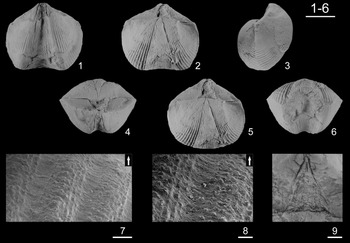
Tornatospirifer armenicus (Abrahamyan, Reference Abrahamyan and Akopian1974) n. comb. from the lower Famennian of Armenia. (1–8) IGSNASRAGM 3981/PS 3087 (neotype, Shamamidzor section), partly exfoliated specimen in ventral, dorsal, lateral, posterior, posterodorsal, and anterior views (1–6), and close-up of the micro-ornament (capillae with pustules) on dorsal valve (7, 8). (9) IGSNASRAGM 3982/PS 3088 (Djravank section), incomplete specimen, close-up of the ventral interarea (delthyrium) showing partly preserved pseudodeltidium with an ovate foramen near the apex. Scale bars = 10 mm (1–6), 2.5 mm (9), 400 μm (7), 200 μm (8).

Transverse serial sections of Tornatospirifer armenicus (Abrahamyan, Reference Abrahamyan and Akopian1974) n. comb. (IGSNASRAGM 3977/PS 3083), Djravank section. Numbers refer to distances in mm measured from the top of the ventral umbo.

Scatter diagrams of Tornatospirifer armenicus (Abrahamyan, Reference Abrahamyan and Akopian1974) n. comb. (1) Relation between shell width and length. (2) Relation between shell width and thickness. (3) Relation between shell width and width of sulcus. (4) Relation between shell width and length of dorsal valve. Abbreviations: N = number of specimens measured; y = ax + b, linear model; r = coefficient of correlation; p*** = significant probability value.

Measurements in mm and ratios of Tornatospirifer armenicus (Abrahamyan, Reference Abrahamyan and Akopian1974) n. comb. Abbreviations: W = width of the shell, L = length of the shell, T = thickness of the shell, Ws = width of the sulcus, dL = length of the dorsal valve.

Neotype
After extensive search at the Geological Museum of Yerevan, none of the syntypes illustrated by Abrahamyan (Reference Abrahamyan and Akopian1974, pl. 21, fig. 1, pl. 22, fig. 4) was found in Abrahamyan's collection; they are therefore considered as lost. Consequently, one of the recently collected specimens from the Ertych horizon (lower Famennian) of the Shamamidzor section (type locality) (Lanjanist village, Ararat province, West Central Armenia; Fig. 1) is hereby designated as the neotype (IGSNASRAGM 3981/PS 3087) and illustrated in Figure 7.1–7.8.
Occurrence
Tornatospirifer armenicus n. comb. characterizes the lower Famennian Cyrtospirifer orbelianus Zone of Abrahamyan (Reference Abrahamyan1957), as well as the Cyrtiopsis orbelianus-Cyrtiopsis armenicus Zone of Rzhonsnitskaya and Mamedov (Reference Rzhonsnitskaya and Mamedov2000) (Fig. 2), both in Armenia and Nakhichevan. Tornatospirifer armenicus n. comb. is known only in the Ertych horizon; in addition to our results from the Shamamidzor, Ertych, Djravank, and Noravank sections, it was also found in the Zangakatun section (Armenia), studied by Abrahamyan (Reference Abrahamyan1957) and Arakelyan (Reference Arakelyan, Mkrtchian, Vardaniants, Gabrielian, Maghakian and Paffenholz1964), and in the Gyumushlug section in Nakhichevan, studied by Abrahamyan (Reference Abrahamyan1957) and Grechishnikova (Reference Grechishnikova1986) (Fig. 1).
Description
Shell medium-sized (reaching 33.7 mm in width, 31.3 mm in length, and 27.5 mm in thickness) (Table 2), slightly wider than long, ventribiconvex, rounded subpentagonal in outline, widest at about midlength; cardinal extremities obtuse or rounded (although the latter are poorly preserved in our examined material); anterior margin gently emarginate to straight; anterior commissure uniplicate.
Ventral valve strongly inflated, rounded subpentagonal in outline, with convex flanks sloping moderately towards lateral commissures; highest in the posterior third of the valve, then decreasing progressively towards anterior margin; umbo markedly inflated, large; beak acute, straight to suberect; interarea apsacline, triangular, high, well defined, slightly concave; delthyrium relatively wide, covered by pseudodeltidium formed by several distinct plates with an ovate foramen at its top (Abrahamyan, Reference Abrahamyan and Akopian1974, pl. 22, fig. 4) (Fig. 7.9); sulcus well defined, wide, moderately deep, originating from beak, widening and becoming deeper anteriorly, flat- to round-bottomed at front; tongue wider than high, perpendicular to commissural plane or slightly bent dorsally, high, subcircular to subogival in outline.
Dorsal valve wider than long, moderately inflated with convex flanks sloping gently to moderately towards lateral commissures, rounded rectangular in outline; highest at about midlength or more anteriorly to it, then decreasing gradually towards anterior margin; interarea linear, nearly flat, orthocline; fold well delimited, wide, moderately high, originating from beak, widening and becoming relatively higher anteriorly, round-topped at front.
Flanks covered by 26–32 rounded (5–6 ribs per 5 mm at anterior margin near sulcus and fold), simple, flattened, low ribs, becoming weaker towards posterolateral margins; in sulcus and on fold, up to 25 ribs, mainly increasing by bifurcations, generally in their middle part; interspaces narrower than ribs; micro-ornament (Fig. 7.7, 7.8) of closely spaced growth lines (irregularly thickened as growth varices), capillae occurring only on ribs and numerous pustules developed on capillae.
Ventral valve interior (Fig. 8) with long, intrasinal posteriorly thickened and divergent (19–25°) dental plates; delthyrial plate thick; central and lateral apical cavities large and poorly filled in by callus; teeth small, subrectangular.
Dorsal valve interior (Fig. 8) with ctenophoridium consisting of up to 36 well-developed, relatively long lamellae, and supported by a short pseudoseptum; hinge plates divided; outer hinge plate slightly concave; crural bases dorsally convergent; spiralia oriented posterolaterally with at least 18 whorls per spiral cone.
Material examined
Forty-one articulated specimens, ten ventral valves, and six dorsal valves from the sections Ertych (five articulated specimens and two dorsal valves), Djravank (eighteen articulated specimens and three ventral valves), Noravank (twelve articulated specimens, two ventral valves, and two dorsal valves), and Shamamidzor (six articulated specimens, five ventral valves, and two dorsal valves).
Shell ontogeny
Examination of juvenile forms suggests that the latter differ from adults in having inconspicuous umbones, small acute beaks, fainter ribs, and flat ventral interarea. The tongue of specimens at young stages is subogival in outline, then progressively becoming subcircular with age. Well-developed sulcus and fold occur in early growth stage. The size distribution during growth, as represented by the width/length, width/thickness, width/width of sulcus and width/length of dorsal valve plots, shows a continuous and progressive growth with no distinct groupings (Fig. 9). The relative proportions of Tornatospirifer armenicus (Abrahamyan, Reference Abrahamyan and Akopian1974) n.comb. represented by sufficient material remain constant (linear regression: y = ax + b; significant probability value: p < 0.01***) whatever the degree of development of individuals (Fig. 9). Moreover, there is a positive correlation in the variation of the shell's width proportionally with length, thickness, and width of sulcus, and the length of dorsal valve. The width/length of the dorsal valve shows less-dispersed values (Fig. 9.4). To complete the scatter plots, the measurements (in mm) of numerous individuals of Tornatospirifer armenicus (Abrahamyan, Reference Abrahamyan and Akopian1974) n. comb. are also presented in Table 2.
Remarks
Arakelyan (Reference Arakelyan1952) initially identified this species as Cyrtospirifer murchisonianus (de Verneuil, Reference de Verneuil1845), a lower Frasnian representative of the genus Uchtospirifer from Russia (Ljashenko, Reference Ljashenko1959; Sartenaer, Reference Sartenaer1965). It was first illustrated by Abrahamyan (Reference Abrahamyan1957), who also examined its internal morphology, without resolving the taxonomic confusion. Many years later, the relatively detailed study of Abrahamyan (Reference Abrahamyan and Akopian1974) established that it should be assigned to the genus Cyrtiopsis as a subspecies of Cyrtiopsis senceliae Sartenaer, Reference Sartenaer1956 (see Sartenaer, 1956b) (= ‘Pseudocyrtiopsis’ senceliae, see discussions in Ma and Day, Reference Ma and Day1999, and Mottequin and Brice, Reference Mottequin and Brice2019), a species known from the lower Famennian of southern Belgium, one of the paratypes of which (Sartenaer, Reference Sartenaer1956b, pl. 1, fig. 4) was re-illustrated recently by Mottequin and Brice (Reference Mottequin and Brice2019, fig. 5.16–5.20). In fact, ‘P.’ senceliae is clearly distinct from the Armenian material because its mucronate shell is longer than wide (different outline) and displays notably a fold divided longitudinally into three subequal parts. Brice in Brice et al. (Reference Brice, Jenny, Stampfli and Bigey1978) considered Cyrtiopsis senceliae armenica Abrahamyan, Reference Abrahamyan and Akopian1974, as a synonym of Ghorispirifer chakhaensis (Brice, Reference Brice1971), known from the upper and uppermost Famennian of Afghanistan and Iran. However, as explained by Mottequin and Brice (Reference Mottequin and Brice2019), this opinion cannot be accepted because the material from Armenia may be easily distinguished from G. chakhaensis by its different outline (G. chakhaensis displays a rounded or ovate outline with rounded posterolateral commissures, whereas the specimens from Armenia display a rounded subpentagonal outline and almost straight posterolateral commissures), its pseudodeltidium formed by several distinct plates, its high ventral interarea, having more ribs in sulcus and on fold, and lacking numerous pustules developed on capillae. Moreover, T. armenicus n. comb. has a delthyrial plate, which is absent in G. chakhaensis.
Later, Aristov et al. (Reference Aristov, Grechishnikova, Tschigova and Felix1979) raised Abrahamyan's (Reference Abrahamyan and Akopian1974) subspecies to the species level. Grechishnikova (Reference Grechishnikova1986) erected Cyrtiopsis caucasia from the lower Famennian of Nakhichevan and indicated the similarity to C. senceliae armenicus, coming from the same locality (Gyumushlug section; Fig. 1). The author compared her material with Abrahamyan's (Reference Abrahamyan and Akopian1974) subspecies and mentioned that C. caucasia differs from the former by its triangular shell outline, smaller size, ventral triangular interarea, and prominent ventral beak. Grechishnikova (Reference Grechishnikova1986, pl. 1, fig. 3) illustrated only the holotype, which was re-illustrated by Afanasjeva in Alekseeva et al. (Reference Alekseeva, Afanasjeva, Grechishnikova, Oleneva and Pakhnevich2018b, pl. 29, fig. 5). The latter compared Grechishnikova's species and C. senceliae from Western Europe, China [sic], as well as Armenia, and indicated that the former differs by its subtriangular shell outline. Thus, she implicitly considered either that Abrahamyan's (Reference Abrahamyan and Akopian1974) subspecies is still a subspecies of Sartenaer's (Reference Sartenaer1956b) species, or simply that she does not recognize armenicus as a valid subspecies. However, all of the external features mentioned by both Grechishnikova (Reference Grechishnikova1986) and Afanasjeva in Alekseeva et al. (Reference Alekseeva, Afanasjeva, Grechishnikova, Oleneva and Pakhnevich2018a, Reference Alekseeva, Afanasjeva, Grechishnikova, Oleneva and Pakhnevichb), which were supposed to point the differences, are also observed in Abrahamyan's (Reference Abrahamyan and Akopian1974) species, with the exception of the subtriangular shell outline, which is not even observed in their material because the holotype of C. caucasia is rounded subpentagonal in outline. Consequently, they certainly should be considered as intraspecific variations. Thus, we consider Cyrtiopsis caucasia as a junior synonym of Abrahamyan's (Reference Abrahamyan and Akopian1974) species. As seen above, this species has been the subject of much attention because of its peculiar external morphology and potential utility for recognizing lower Famennian strata in the Lesser Caucasus; however, its affinities at the genus level were unknown until now.
Discussion
Definition of the family Cyrtospiriferidae and the likely origin of the two new genera
In the classification put forward by Carter et al. (Reference Carter, Johnson, Gourvennec and Hou1994), one of the main distinguishing features of the superfamily Cyrtospiriferoidea is the presence of a delthyrial plate. In the same classification, taking into account the width of the hinge line and type of cardinal extremities, the family Cyrtospiriferidae is divided into two subfamilies: the Cyrtospiriferinae Termier and Termier, Reference Termier and Termier1949, and the Cyrtiopsinae Ivanova, Reference Ivanova1972, with Cyrtospirifer Nalivkin in Fredericks, Reference Frederiks1924, and Cyrtiopsis Grabau, Reference Grabau1923, as their type genera, respectively. However, following the taxonomic revision conducted by Ma and Day (Reference Ma and Day1999), it was realized that the genus Cyrtiopsis is devoid of any delthyrial plate, which contradicts one of the main criteria in the definition of the superfamily Cyrtospiriferoidea proposed by Carter et al. (Reference Carter, Johnson, Gourvennec and Hou1994). Therefore, Ma and Day (Reference Ma and Day2000, p. 450) revised the family Cyrtospiriferidae to include genera that are devoid of a delthyrial plate. Later, Ma and Day (Reference Ma and Day2003) noted that some genera possess a posterior ventral shell thickening that could be considered as equivalent to a delthyrial plate, and therefore they could also be included in the family Cyrtospiriferidae. Although Johnson (Reference Johnson and Kaesler2006), while defining the superfamily Cyrtospiriferoidea, argued that its representatives generally possess a delthyrial plate, it is obvious that the concept of this superfamily also requires revision to include those members that are devoid of any delthyrial plate. Moreover, among all genera assigned to the subfamily Cyrtiopsinae, a delthyrial plate is observed only in the genus Pseudocyrtiopsis Ma and Day (Reference Ma and Day1999), a genus erected to include those cyrtospiriferid species that resemble Cyrtiopsis Grabau, Reference Grabau1923, but also differ from it by their wide hinge line and the presence of a delthyrial plate. Although both Ma and Day (Reference Ma and Day1999; and later Gourvennec and Carter, Reference Gourvennec, Carter and Seldon2007) assigned Pseudocyrtiopsis to the subfamily Cyrtiopsinae, this genus displays a high ventral interarea, a wide hinge line, and mucronate cardinal extremities. These morphological characters suggest an assignment to the Cyrtospiriferinae, according to Johnson's (Reference Johnson and Kaesler2006) classification. Thus, it appears that Tornatospirifer n. gen., and not Pseudocyrtiopsis Ma and Day (Reference Ma and Day1999), is the only genus of the subfamily Cyrtiopsinae that possesses a delthyrial plate. In conclusion, in spite of the extensive taxonomic studies led by Carter et al. (Reference Carter, Johnson, Gourvennec and Hou1994), Ma and Day (Reference Ma and Day1999, Reference Ma and Day2000, Reference Ma and Day2003, Reference Ma and Day2007), Ma et al. (Reference Ma, Chen, Day and Jin.2003), and Johnson (Reference Johnson and Kaesler2006), the superfamily Cyrtospiriferoidea, as well as the family Cyrtospiriferidae and its subfamilies, still require a thorough revision in order to further understand the phylogenetic relationships among the different species and genera assigned to this interesting and diverse group of spire-bearing brachiopods.
It is likely that Pentagonospirifer abrahamyanae n. gen. n. sp. evolved from a Cyrtospirifer stock. Adult shells of both genera resemble each other in terms of their size, rounded subpentagonal outline, acute cardinal extremities, and apsacline ventral interareas. It is possible that P. abrahamyanae n. gen. n. sp. evolved from Cyrtospirifer verneuili (Murchison, Reference Murchison1840) sensu Abrahamyan (Reference Abrahamyan1957), which has been reported by the latter author from both the Frasnian and lower Famennian deposits of Armenia. Morphologic trends leading to Pentagonospirifer n. gen. would have involved longitudinal elongation and inflation of the shell, development of a more complex pseudodeltidium (composed of several plates) and micro-ornament (fine capillae only on ribs with pustules on them), and a strong medial callosity on the delthyrial plate. We tentatively regard Tornatospirifer armenicus (Abrahamyan, Reference Abrahamyan and Akopian1974) n. comb. and the newly defined genus Tornatospirifer as having evolved from Tiocyrspis Sartenaer, Reference Sartenaer, Königshof and Werner1994. The latter genus is the oldest cyrtiopsine representative known only from the upper Frasnian of Germany and Belgium (Sartenaer, Reference Sartenaer, Königshof and Werner1994). Tornatospirifer n. gen. differs from Tiocyrspis mainly by its more complex pseudodeltidium and by possessing a delthyrial plate.
Paleobiogeographic considerations
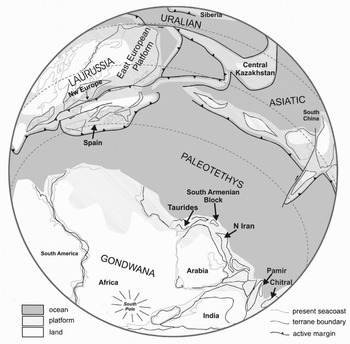
The Late Devonian was characterized by a high eustatic sea level and prolonged cosmopolitanism (Johnson et al., Reference Johnson, Klapper and Sandberg1985). Brachiopod provincialism was low overall at the time, presumably due to favorable patterns in oceanic current circulation that led to substantial interchange between previously isolated faunas (Brock and Yazdi, Reference Brock and Yazdi2000). However, as shown through the studies of Gaetani (Reference Gaetani1965, Reference Gaetani1968), Brice (Reference Brice1971), and Brice et al. (Reference Brice, Lafuste, de Lapparent, Pillet and Yassini1973, Reference Brice, Mistiaen and Rohart1999), a single bioprovince may be individualized for the Upper Devonian brachiopod assemblages found along the northern margin of Gondwana. Based on their study of lower Famennian rhynchonellides and athyrides from Armenia, Serobyan et al. (Reference Serobyan, Danelian, Crônier, Grigoryan and Mottequin2021) concurred recently with this viewpoint and argued for a rather uniform early Famennian brachiopod bioprovince that was developed between Pamir (to the east) and the Anatolide-Tauride microplate (to the west) (Fig. 10).
Late Devonian paleogeographic reconstruction of the Paleotethys Ocean and its surrounding continents, including the position of the South Armenian Block along the northern margin of the Gondwana megacontinent (redrawn and modified after Denayer and Hoçgör Reference Denayer and Hoşgör2014, based on the maps of Stampfli et al., Reference Stampfli, Von Raumer, Borel, Martinez Catalan, Hatcher, Arenas and Diaz Garcia2002).

The brachiopods studied herein belong to the rhynchonelliforms that used to have a benthic mode of life and produced lecithotrophic larvae, with a free-swimming larval stage (Williams et al., Reference Williams, Carlson, Brunton, Holmer and Popov1996; Carlson, Reference Carlson2016). Both the monospecific genus Pentagonospirifer n. gen. and the type species of Tornatospirifer n. gen. (T. armenicus n. comb.) appear to be restricted to the lower Famennian of the South Armenian Block. However, at least two (and possibly three) previously described species from the Kara-Tau region of Central Kazakhstan have been assigned by us to the newly defined genus Tornatospirifer n. gen. Another questionably assigned species, P. (?) murchisonianus de Koninck [sic] sensu Reed, Reference Reed1922, known from Pamir (Tajikistan) (Fig. 10), morphologically strongly resembles Tornatospirifer armenicus n. comb. and therefore phylogenetically the two species may be closely related. Thus, species of Tornatospirifer n. gen. had a quite wide latitudinal distribution during the Famennian, across the Paleo-Tethys ocean. Moreover, if our hypothesis is correct for the evolutionary origin of Tornatospirifer n. gen. from a Tiocyrspis ancestral stock situated in Western Europe, we may tentatively consider that its origination and migration took place during the earliest Famennian to both the Central Kazakhstan block and the northern Gondwanan margin (SAB). Nevertheless, in order to achieve robust conclusions in terms of the biogeographic distribution of Upper Devonian brachiopods, modern taxonomic revisions are necessary on the brachiopod fauna described during the second half of 20th century from areas of the former Soviet Union (Nalivkin, Reference Nalivkin1937, Reference Nalivkin1941; Martynova, Reference Martynova1961; Sidjachenko, Reference Sidjachenko1962).
Brachiopod encrusters: patterns and likely interaction with their host
Paleozoic encrusters were common elements of shelly substrates during Devonian time. More particularly, as noted by Musabelliu and Zatoń (Reference Musabelliu and Zatoń2018), the lower Famennian marked an increase in cornulitid abundance and morphological disparity. These epifaunal suspension feeders may be helpful for paleoecological interpretations; they inhabited only in waters of normal salinity (Vinn et al., Reference Vinn, Musabelliu and Zaton2019) as it is also the case of most brachiopod species. However, their biological affinities, morphological peculiarities, and paleobiodiversity remain largely undocumented. This is the first report documenting the presence of encrusters and their encrustation patterns on Upper Devonian brachiopods from the Lesser Caucasus (Armenia and Nakhichevan). Indeed, no observation or mention of any kind has been made before on this aspect (e.g., Abrahamyan, Reference Abrahamyan1957, Reference Abrahamyan1964, Reference Abrahamyan and Akopian1974; Arakelyan, Reference Arakelyan, Mkrtchian, Vardaniants, Gabrielian, Maghakian and Paffenholz1964; Grechishnikova, Reference Grechishnikova1986, Reference Grechishnikova1996; Alekseeva et al., Reference Alekseeva, Afanasjeva, Grechishnikova, Oleneva and Pakhnevich2018a, Reference Alekseeva, Afanasjeva, Grechishnikova, Oleneva and Pakhnevichb).
In our material, one specimen (IGSNASRAGM 3965/PS 3071) of Pentagonospirifer abrahamyanae n. gen. n. sp. was found to be encrusted by two cornulitid tubeworms on its dorsal valve, near the anterior margin, although one of them is only partly preserved (Fig. 3.2, 3.19). The latter displays external features of the genus Cornulites von Schlotheim, Reference von Schlotheim1820, the representatives of which are considered as hard-substrate encrusters, known from the Middle Ordovician to the late Carboniferous (Vinn, Reference Vinn2010), and are reported for the first time from the Upper Devonian of Armenia. The tube of Cornulites sp. is oriented with its aperture directed towards the brachiopod anterior commissure. This polarity suggests the way in which the tubeworm was attached on the brachiopod shell and its subsequent growth direction in order to “steal” some food transported by the weak currents produced by the feeding activity of the brachiopod host (Richards, Reference Richards1974). Moreover, the brachiopod shell displays distinct shell malformations that were obviously caused by the growth of the cornulitid tubeworm, thus affecting the shell-secreting epithelium of the host. Obviously, by feeding on the food brought by the weak currents produced by the brachiopod lophophore, the cornulitid had a clearly negative effect on the host, as indicated by a deviation in the growth pattern observed on the shell of the latter. It is likely that the small size of the host is not due to its young age, but due to the negative effect of the encrusters. In this regard, it is reasonable to consider this cornulitid tubeworm as an ectoparasite (Richards, Reference Richards1974) and not as a commensal in relation to its brachiopod host.
Encrusters observed on a second brachiopod specimen of Pentagonospirifer abrahamyanae n. gen. n. sp. (IGSNASRAGM 3967/PS 3073; Fig. 3.11, 3.15, 3.18) were likely colonial organisms. They may be assigned to Hederella Hall, Reference Hall1883, an enigmatic encrusting metazoan that is known from the Silurian to the Permian, although it is more common in the Devonian record (Tapanila, Reference Tapanila2005). Although it resembles cyclostome bryozoans, it is not considered as a bryozoan because of its branching patterns, lack of an astogenetic gradient, skeletal microstructure, and wide range in tube diameters (Wilson and Taylor, Reference Wilson and Taylor2001). It is likely that it was some kind of a lophophorate-grade animal of uncertain affinity (Taylor and Wilson, Reference Taylor and Wilson2008).
Conclusions
The taxonomic examination of two cyrtospiriferid species, based on newly collected material from the lower Famennian of Armenia, led us to define two new genera: Pentagonospirifer (Cyrtospiriferinae) and Tornatospirifer n. gen. (Cyrtiopsinae). Tornatospirifer n. gen. appears to be the only genus within the subfamily Cyrtiopsinae, which possesses a delthyrial plate. This indicates that although most of cyrtiopsine genera lack a delthyrial plate, the presence or absence of this internal structure should not be used in the definition of the Cyrtiopsinae in classifications that possibly will be established after a thorough revision of the whole superfamily Cyrtospiriferoidea, as recommended by Ma and Day (Reference Ma and Day2000). Cyrtiopsis caucasia Grechishnikova, Reference Grechishnikova1986, is hereby considered as a junior synonym of Tornatospirifer armenicus (Abrahamyan, Reference Abrahamyan and Akopian1974) n. comb., which is one of the most biostratigraphically valuable species for the recognition of lower Famennian strata in the Lesser Caucasus. Both illustrated species in this study appear to be restricted to the lower Famennian of the SAB, arguing possibly for its relative isolation within the northern margin of Gondwana.
Acknowledgments
V. Serobyan is grateful to the French Embassy in Yerevan, the MOBLILEX International Mobility Grant Programme of the University of Lille and the Erasmus + ICM programme for funding his studies in France. T. Danelian and A. Grigoryan would also like to thank the Erasmus + ICM Programme for funding their staff mobility in 2018 and 2019, respectively. C. Crônier acknowledges the financial support of the Lille Institute on Environmental Sciences (IRePSE). Fieldwork was also facilitated by the logistic support of the Institute of Geological Sciences (Armenian Academy of Sciences). The authors thank the Région Hauts-de-France, the Ministère de l'Enseignement Supérieur et de la Recherche (CPER Climibio), and the European Fund for Regional Economic Development for their financial support. S. Régnier (UMR Evo-Eco-Paleo, ULille) is gratefully acknowledged for the high-quality SEM pictures obtained on specimens deposited at IGSNASRAGM. The authors are also grateful to A. Baliński for his advice on spiriferides from the Eastern European Platform. This work is a contribution to the IGCP project n° 652 “Reading Geologic Time in Paleozoic Sedimentary Rocks.” The manuscript benefited from the reviews of A. Baliński and an anonymous reviewer, and from the editorial help of J. Jin, to all of whom we are much indebted.