

INTRODUCTION
One of the important topics raised during the well-known scholarly dispute over Chinese family law between Niida Noboru and Shiga Shūzō in the 1950s was the property rights of daughters in the Southern Song: specifically, the question of whether or not they had the right to inherit family property. Taking the concept of the zong 宗 (“lineage” or “descent group”) as his analytical axis, Shiga offered a coordinated and unified explanation of issues ranging from sacrificial veneration of ancestors to the division of family property, contending that no right to inherit family property existed for daughters inasmuch as they were excluded from the main lineage (benzong 本宗). Niida, on the other hand, held that the relationship between the concept of the descent group and the inheritance of family property should be understood in a more restricted manner. He introduced historical instances from the Southern Song period wherein daughters were in fact allotted property, positing the existence of a contemporary custom in areas south of the Huai River or south of the Yangzi river basin by which daughters could receive family property.Footnote 1
The argument reached an impasse before any clear and decisive resolution emerged, and eventually broke off because of Niida's death. A new development took place in the 1980s, however, when a Ming edition of Minggong shupan qingmingji 名公所判清明記 (Collection of Lucid Decisions by Celebrated Judges; hereafter, Qingmingji) came to light. Finding new material in the texts of legal decisions contained in this Ming edition of Qingmingji, Yanagida Setsuko took up the question of property rights not only for daughters but more broadly for women in general. She presented historical sources recording that when a widow remarried, she was able to take with her the lands that had accompanied her into her previous marriage (zisuitian 自随田), and also her dowry fields (zhuangliantian 妝奩田), in her own name. The dispute between Niida and Shiga had also raised the so-called “daughter's half-share law” (nüzi fenfa 女子分法), which held that: “When the father and mother have already died and the sons and daughters divide the property, a daughter shall receive half a son's portion.” From this law, Yanagida conjectured that the right, albeit a partial one, of women to hold property was in the process of being established during the Southern Song, and further that this right to property declined with the onset of the Ming.Footnote 2 In response to this, Nagata Mie carried out a survey of the circumstances under which property was apportioned to daughters, demonstrating that it was practiced under extremely limited conditions: namely, situations where a household became extinct (戶絶 hujue), situations where both daughters and a posthumously appointed heir (mingjizi 命繼子) were present, and situations where the father and mother (principal wife) had died leaving unmarried daughters and immature sons as orphans. Nagata argued that it was thus impossible to generalize that female children were acquiring the right to inherit the family property. Nagata also found fault with the claim that the practice of widows taking their own property when they remarried had begun in the Southern Song period.Footnote 3 Itabashi Shin'ichi then published an article defending the logic that Yanagida had proposed, urging a partial reconsideration of Nagata's interpretation of historical sources. Yet rather than actively seeking to engage with the most contentious points in the controversy as it had developed thus far, Itabashi confined his discussion principally to peripheral matters, such as the disposition of property for extinct households and the connections between women and lawsuits.Footnote 4
Building upon the previous research on this question outlined above, I will attempt in what follows to offer a fresh re-examination of the issue of daughters' property rights, but I would like to state at the outset that I will not consider the property rights of wives, widows, and mothers. Not only do unmarried women and married women have totally distinct relationships with the zong “descent group,” but the property at stake in each case—that which becomes the object of any “rights”—is quite different in these two situations. In other words, marriage is a point of transition where a woman shifts from her father's descent group to her husband's descent group. The property at issue thus also depends on the situation; in the case of an unmarried woman, it is the property of her father's household, but in the case of a married woman, it is typically the property of her husband's household or the property that she brought with her. In the case of widows and mothers, we must think not only of rights of ownership over property but also rights to manage family property. In sum, we can conclude that there was a very large disconnect for women in their circumstances pre- and post- marriage, even just in property-related aspects. Therefore, it does not seem appropriate for us to lump unmarried and married women together and frame the matter as a singular issue of the “property rights of women (and female children).” The problem of the property rights of married women is one that should be explored separately from the matter at hand here, which is the property rights of daughters. In this article, unless otherwise specified, when I speak of daughters or female children, I refer to unmarried women (zaishinü 在室女, daughters living in their natal homes), and sometimes also to married women (chujianü 出嫁女, married daughters living outside the natal home), or to divorced or widowed women (guizongnü 歸宗女, daughters who have returned to the natal homes of their parents). In all cases, the women I consider occupy the position of daughter with regard to the family property of their father.Footnote 5
QUESTIONS OF INTEREST AND MY BASIC CONCEPTUALIZATION
When one looks back on the previous research briefly introduced above, one senses a certain shared framework that those involved have treated as a tacit premise. It is an undeniable fact that there was a law stating that “When the father and mother have already died and the sons and daughters divide the property, a daughter shall receive half a son's portion” and moreover that there were actual cases where, on the basis of this law, a daughter was awarded a portion of the family property.Footnote 6 That being the case, on the one hand, there are those who attempt to positively evaluate these facts as reflecting a phenomenon that has newly appeared on the surface of history: a right for daughters. However, they cannot demonstratively explain the historical background against which this right came into being. On the other hand, there are those scholars who try to treat this phenomenon that appeared in isolation only during the Southern Song period as an exception that departs from the fundamental principle that only male children have the right to inherit family property. And yet they can offer no persuasive explanation as to why such an exception came to exist. Why should these two perspectives that stand in sharp opposition to one another both display this similar weakness? I think it is because both of them attempt to treat the circumstances under which family property is awarded to daughters as a question of “rights.” Because they see the matter in terms of rights, they must explain where these rights came from. Niida Noboru had to resort to the groundless conjecture that it was a reflection of customs that existed “in areas south of the Huai River or south of the Yangzi river basin.” For Shiga Shūzō as well, by treating the question in terms of rights, he could only deal with these instances as “heterogeneous” cases and “exceptions” that ran counter to the principle that only male children possessed the right to inherit family property.Footnote 7
Yet is the law that “a daughter shall receive half a son's portion” something that reflects in some way a “right” of a daughter to household property? If it is a right, then under what conditions is that right exercised? If we consider it instead as a reflection of customs, then what actual customs is it based on? In other words, the point is not to emphasize that the law is itself evidence confirming the rights of daughters, nor is it to assess where this law can be placed in relation to the principles of the inheritance of family property. Rather, what is important is to ask why such a law should have existed at all in the Southern Song, to ask what the significance of this law was at the time.
To state my conclusion straight away, I think that if we intend to understand the relevant historical materials in a rational and coordinated way, then we must see this so-called “daughter's half-share law” as a legal and social policy response in the Song Dynasty undertaken to safeguard the dowry (jiazi 嫁資) of unmarried daughters. It was Nagata's scholarship that first started me thinking along these lines. Nagata examined the sorts of situations in which daughters were awarded family property. In looking, for example, at cases when the household became extinct she found that the amount of family property awarded to daughters in the Song dynasty had not necessarily increased in comparison to Tang levels. With regard to the so-called “daughter's half-share law” she also pointed out how it was applied under special conditions. Even if we treat this situation within the framework of rights, surely it cannot be called a level-headed judgment for us to compare a right that is recognized under limited conditions for daughters alongside something like the right for sons to inherit family property, which is unconditionally recognized simply by virtue of the fact that they are sons. To assess these two situations in a single category as though they vary only in terms of their extent is not a reasonable methodology. For example, in the case where the household becomes extinct, it was common for daughters to be allotted family property. But at the present moment, in the wake of the dispute between Niida and Shiga,Footnote 8 there is probably no one who would assert that daughters had a right to inherit family property, even a limited one.Footnote 9 The reason is that the allotment of property to the daughter took place in those cases only because the unusual condition of the household's demise had arisen; it was something that emerged from circumstances of a different order from the typical inheritance of family property. That daughters were given property when the household became extinct was not because of a recognition of the rights of daughters but was rather a policy response by the dynastic authorities. And because it was a policy response, the treatment of the property of extinct households underwent a dizzying set of changes, as we will see shortly in the case of the Song dynasty. In the same way, when we view the so-called “daughter's half-share law” not in terms of rights but from a different vantage point—namely, as a social policy response by the Song dynasty—the hindrances to explaining the matter disappear. In what follows, I will employ this conceptual approach to further explore these issues.
DAUGHTERS AND THE EXTINCTION OF HOUSEHOLDS
From the beginning, in the Han Dynasty at the latest, and all the way down to the modern period it has been the principle of family property division in China that sons receive even portions. Daughters had neither a legal right to inherit family property nor did they have an actual or conventional right to do so. In some cases, when a daughter left home to get married, she might be presented with money or land to take with her as a result of her parents' and siblings' affection for her. In the sense that there was no fixed standard, it was an incidental occurrence; in the sense that it differed in each and every distinct case, it was idiosyncratic. However, under a set of specific conditions, there were cases when family property was given to daughters because of the law as well. In the Southern Song that is the focus of this article, these conditions were as follows:
1. Situations that were due to stipulations in the father's will.
2. Situations in which the household became extinct: that is, cases in which neither sons nor their wives were present in a house.
3. While not situations of an extinct household, cases in which both parents were dead and:
a. A daughter and a posthumously appointed heir (mingji 命繼) were present;
b. Daughters and very young sons were left.
Cases of the first type (where stipulated in the will) and the second type (where the household was extinct) are widely recognized diachronically, not just in the Southern Song. However, the essential pattern in cases that fall into the first type is that the father has used his last will to give his daughter the dowry that he would have presented to her had he lived longer; as such, they do not merit our particular attention. On the other hand, with regard to the cases that fall into the second category, regarding the disposition of property from extinct households, we see changes unique to the Song dynasty, not seen in other periods. It is cases that fall into the third category that have occupied a central position in debates concerning the so-called property rights of daughters. In what follows, I would like to discuss cases from the second and third categories.
In cases from the second category, where the household has become extinct, Tang-dynasty funerary statutes stipulated that the property of the extinct household was to be given in full, minus the portion necessary to cover the funeral expenses, to the daughters, assuming there were daughters. This still held during the Ming and Qing periods. Moreover, in the Ming and Qing, the rule applied to all biological daughters, whether they were unmarried daughters living at home, daughters who had returned to their natal home after marriage, or daughters who had left the home in marriage.Footnote 10 However, as Shiga and Nagata have already pointed out, during the Song dynasty, between the Northern Song and Southern Song, legal restrictions were applied to the distribution of property from extinct households.Footnote 11 This was, first, to create distinctions between the amounts that were given to unmarried daughters at home, daughters who had married out, and daughters who had returned to the home; second, to create an upper limit on the amount that was given to daughters; and third, in situations where there were no daughters, the field land and other property was not given to close relatives, but was confiscated by the government and then either put up for sale or directly managed. However, on the whole, the changes that took place in the handling of property from extinct households were technical matters of policy. It is safe to say that they do not reflect any qualitative changes in the disposition of property from extinct households, such as changes that either recognized or restricted the property rights of daughters. Let us look at the main changes in more concrete terms, in the following examples:
I. Jianlong 4 (963) of the early Northern Song. All of the property from an extinct household was given to unmarried daughters who remained at home and to daughters who had returned to the natal home. But when only daughters who had left the home to marry survived, they were given one-third and the remaining two-thirds was confiscated by the government. However, if cropland remained, then it was given to close relatives to farm.Footnote 12
II. Dazhong Xiangfu 8 (1015). When no daughters survived, fields that belonged to an extinct household were not given to relatives; rather, the government sold them and placed them in the national treasury. Fertile land was lent out and the two-installment tax (liangshui 兩稅) was collected along with rent.Footnote 13
III. Tiansheng 4 (1026). Fundamentally the same case as in example I, above, but in a situation in which there was not even a surviving married daughter, one-third was given to married aunts, sisters, and nieces of the deceased. The two-thirds portion that had traditionally been confiscated by the government was given to the relatives, uxorilocal sons-in-law, foster sons, children the wife had brought from an earlier marriage, and others, provided they had resided in the household for three years or longer. If there were no such individuals, then it would be presented to close relatives. If there were no close relatives, then it was given to those who had traditionally cultivated it.Footnote 14
IV. Yuanfu 1 (1098). This is what fundamentally determined the ways in which married daughters might receive a portion. When unmarried daughters, returned daughters, and married daughters survived, the total amount was given to the unmarried and returned daughters. However, if the property exceeded one thousand guan (貫 “strings” of cash), then one portion was allotted to married daughters. If returned daughters and married daughters survived, then two-thirds was given to returned daughters and one half of the remainder was given to married daughters. If the amount to be awarded to married daughters was less than 200 guan, then one hundred guan was awarded; if less than one hundred guan, the full amount was awarded. If only married daughters survived, then if the total amount of property was less than 300 guan, 100 guan would be awarded; if less than 100 guan, the full amount. If 300 guan or more, then one-third of the amount would be awarded. Still, the upper limit of the amount to be awarded to married daughters was set at 2,000 guan. If the amount of property of the extinct household was 20,000 guan, then the matter would be adjudicated.Footnote 15
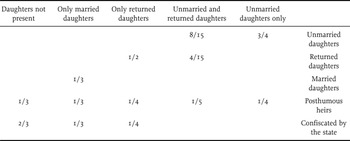
V. Southern Song period. All of the property would be given to the unmarried daughters. If there were unmarried daughters and returned daughters, then the returned daughters would receive half the portion of the unmarried daughters.Footnote 16 And as is indicated in the penal code of the Song History that I discuss below, a law was planned in Chunxi 4 (1177) that would set an upper limit of 3,000 guan on the amount of property from an extinct household that would be awarded even to unmarried daughters, and this eventually became law as we see in Table 1 below.

Note: In all of these cases, a maximum of 3,000 guan was set on the amount that daughters and posthumous heirs could receive (if the household property exceeded 20,000 guan then the maximum was 5,000 guan). The remainder was confiscated by the state.
The primary characteristic of the changes in policy and procedure that I have outlined above is that, as Shiga and Nagata have argued, the Song Dynasty was eager to have the property of extinct households returned to the national treasury.Footnote 17 Preventing arguments among the survivors over property distribution is not sufficient to explain these measures' stipulation that when only married daughters survived, they would be given one-third and the rest would be confiscated by the state; nor is it sufficient to account for their establishment of upper limits on the amount of the awards. Something else lay behind this. In the Song History (juan 200, Xingfazhi 刑法志 [Treatise on criminal codes] 2), the emperor himself expressed his reservations about this line of policy:
Prime Minister Zhao Xiong presented the Chunxi tiaofa shilei [Topically arranged legal code of the Chunxi period, 1174–1189] … In the legal code for households, it says that, “Extinct households shall be awarded family property not exceeding 3,000 guan. If it exceeds 20,000 guan, then the emperor's opinion shall be consulted.” [Emperor] Xiaozong said, “It is unfortunate that the house became extinct, but to confiscate the household property if it exceeds 20,000 guan would make it seem as though I covet their property.”Footnote 18
丞相趙雄上淳熙條法事類。・・・戶令:「戶絕之家,許給其家三千貫,及二萬貫者取旨。」帝曰:「其家不幸而絕,及二萬貫迺取之,是有心利其財也。」
The second characteristic is that even though distinctions were imposed between unmarried daughters, returned daughters, and married daughters, the economic protections accorded to unmarried daughters were consistently more generous. After unmarried daughters, it was returned daughters who were accorded the most family property. Those who were allotted the least, and sometimes not allotted anything at all, were the married daughters. This discrepancy is not one that arises because of different rights among the daughters with respect to the property of the extinct household. Needless to say, what this ordering indicates is nothing other than the consideration on the part of government officials for the necessity of securing dowry and living expenses. Its significance was to provide compensation for the support and dowry that would have been expected to be provided to unmarried daughters by their parents and brothers but that had been cut off by the extinction of the household. We might say that the government officials, acting in place of the daughters' parents and brothers, used legislative means to fulfill the protective role of safeguarding the daughters' dowry and living expenses.
ORPHANED CHILDREN
In what follows, I will take up the third category, cases in which the household did not become extinct, but where both parents were deceased. Before doing so, however, I would like to call attention to the following points.
When the parents in a household died, if males in a cohabiting relationship in that house (brothers or uncles) survived, the situation was not one of household extinction. If those males had reached the age of maturityFootnote 19 and were able to take charge of the family property, then the death of the household's parents meant, for the household, no more than a reduction in the number of its members. In that case, the death of the parents had no direct connection to the division of household property. It was simply a matter of waiting for the eventual division of household property according to the principle of equitable division among sons. Even if unmarried daughters or returned daughters survived, as long as adult brothers were present, it was typical for them to make the preparatory arrangements for the expenses of supporting and marriage. A decision by Ye Yanfeng 葉岩峰 titled “Though there is no reason to audit, an audit is sought” 不當檢校、而求檢校in Qingmingji (juan 7, “Huhunmen” 戶婚門 [Households and Marriage], “Jianjiao” 檢校 [Property audit]) concerns a case in which the paternal uncle of a thirty-year-old man named Zhang Wengeng 張文更, who along with his younger brothers and sisters (under ten years old) were the surviving members of a house, requested an audit of his late brother's household property. In the decision is the following passage:
Now Zhang Wengeng is thirty years old and can manage all of the affairs of his house. Even though his younger brother and sister are still not yet ten years old, since their biological brother can support them, this is a situation where the rule forbidding us to carry out an audit of household property applies … Now we will urge Zhang Wengeng to take care of his father's property and to look after and support his younger brother and sister. If they desire in the future to divide the family property, then there are laws for that purpose. No other people may meddle in these affairs.
今張文更年已三十、儘堪家事。縱弟妹未及十歲、自有親兄可以撫養、正合不應檢校之條。・・・今仰張文更主掌乃父之財產、撫養弟妹、如將來或願分析、自有條法在、餘人並不得干預。
For unmarried daughters who had been orphaned, even supposing they did not have brothers who had reached the age of maturity, if the father's brother (that is, their uncle) lived with them in the household, we would expect that, generally speaking, there would be no major problems.Footnote 20 However, it would not be surprising if an uncle tended to have less love and affection for his nieces than her parents or her biological brothers did. During the Southern Song period, there are signs that there was legislation enacted in consideration of this. In Qingmingji (juan 8, “Huhunmen” 戶婚門 [Households and Marriage], “Jianjiao” 檢校 [Property audit]) is an opinion written by Hu Ying 胡穎 titled “When audited property is infringed upon, the court shall apply the law forbidding the illegal disbursal of court-sealed property” 侵用已檢校財產、論如擅支朝廷封樁物法. In this case, Zeng Shishu 曾士殊 died, and his daughter Zeng Ergu 曾二姑 was left with her uncles (her father's younger brothers): Shizhen 仕珍, Shiliang 仕亮, and others:
As for the division of the property of Zeng Shishu, in accordance with the law, the portion that should be distributed to Zeng Ergu is one-half. In the current draft proposal by the notary assistant and the prefectural judge, it says that she will only receive one-third, but this does not match with the law at all. In the document from the judicial commissioner, it clearly states that the lawsuit took place after Zeng Ergu was married, but the extinction of her household came before the marriage. If that is true, then she ought to be considered an unmarried daughter, and in accord with the laws on children inheriting their father's property, she ought to receive one-half of the property. What kind of objection can there be to this? The remaining one-half would normally be confiscated by the government. However, I do not favor property confiscation because it makes the government look like it is seeking its own profit. For the time being, let Shizhen and Shiliang evenly divide the portion that would have been confiscated by the government. As for the property that has been purchased for Shishu's private quarters, according to the law on extinct households, this should be given entirely to Zeng Ergu. Within three days, the distribution of family property in accord with this decision shall be verified. As stated in the previous decision, those officials specially dispatched to handle this matter shall accompany the clerk and the parties to the case to the judicial commissioner, taking all the documents with them.
其曾士殊一分家業、照條合以一半給曾二姑。今僉廳及推官所擬、乃止給三分之一、殊未合法。大使司劄内明言、興詞雖在已嫁之後、而戶絶則在未嫁之先。如此則合用在室女依子承父分法給半、夫復何說。餘一半本合没官、當職素不喜行此等事、似若有所利而為之者。姑聽仕珍仕亮兩位均分外、仕殊私房置到物業、合照戶絶法盡給曾二姑。限三日對定、照已判、專人解推吏併詞人、抱案赴提刑司。
In actuality, the property of this household had been divided, and precisely because of this division, the prefectural judge and others thought that Shishu's household had become extinct and tried to give his married daughter one-third; as indicated in the title, it seems that the procedure of auditing was already under way, and in the text of the decision we find reference to “Shishu's private quarters.” Nevertheless, in form at least, the members of the house were cohabitants. If we consider this case along with the first half of the decision (which I did not quote above), it seems that Shizhen and his son used the fact that officially at least, the household was still undivided as an excuse to take Shishu's portion and share it with his younger brother Shiliang. We can conclude that Zeng Ergu, who was married, realized this and took legal action. Had Shishu died after completing the division of family property, it would have been a case of an extinct household, and since at that point Zeng Ergu was an unmarried daughter, she would have been able to inherit all of her father's property. Since that was not the decision that was made, it seems that Hu Ying rendered his judgment on the premise that they were co-habiting. In the text of the verdict, it is argued that since the extinction of the household (which here means simply the death of the father) took place before the daughter's marriage, an unmarried daughter was entitled to receive half of the portion that a son (if one had been alive) would have inherited of his father's property (in this case, equivalent to one-sixth of the total property of the Zeng house), and the rest would be confiscated by the authorities. This was said to be in keeping with the law. From this it is evident that at this time there must have been a law stipulating that when an unmarried daughter had been orphaned and cohabited with her deceased father's siblings, the daughter would receive half of what a son would receive (if one had been alive) when the family property was divided, and that the remaining half would be confiscated by the authorities.Footnote 21 This should also be seen as a means of affording economic protection to unmarried daughters.
In the Tang and Song periods, as is well known, if there were any unmarried sons or daughters at the time of dividing house property, there was a regulation stipulating that an amount corresponding to the betrothal funds (pingcai 娉財) and dowry would be deducted from the family property before that property was divided. The Tang household regulations (“Huling” 戶令, “Yingfentiao” 應分條 [Article on proper division]) reads:
When fields, buildings, and other property are to be divided, the brothers shall divide them equitably … for those who have not taken a wife, they shall separately be awarded betrothal funds; when aunts and sisters are in the house, the amount shall be reduced by one-half of the male betrothal fund.Footnote 22
諸應分田宅及財物者、兄弟均分・・・其未娶妻者、别與聘財、姑姊妹在室者、減男聘財之半。
Virtually the same text can be found in the Northern Song period Song xingtong (juan 12, “Hulü” 戶律 [Household law], “Beiyou siyong cai” 卑幼私用財 [Private use of property by the young]), but in the Southern Song period, a draft decision titled “When an adopted heir has been solidly established, the household does not become extinct” 立繼有據不爲戶絶 appears in Qingmingji (juan 7, “Huhunmen” 戶婚門 [Households and Marriage], “Liji” 立繼 [Establishing an adopted heir]) and records the following:
When the family property is to be divided, betrothal funds shall be given to unmarried sons and dowries to the father's unmarried sisters and the sons' sisters as well as to returned daughters. For daughters who have not reached the age when they are permitted to marry, separate property shall be given to them, but it must not exceed the amount of their dowry.… According to the law, marriage is permitted for males when they reach the age of fifteen and females when they reach the age of thirteen.
諸分財產、未娶者與聘財、姑姊妹有室及歸宗者給嫁資、未及嫁者則别給財產、不得過嫁資之數。・・・在法、男年十五、女年十三以上、並聽婚嫁。
We cannot say with certainty whether this law might not be an excerpt [from a longer text], but compared to the regulations of the Tang Dynasty, what is particularly noteworthy is that the ratio of the betrothal fund to the dowry is not clearly indicated, and moreover that there is an explicit statement that property should be given respectively to aunts, unmarried daughters who have reached maturity, returned daughters, and underage daughters. Perhaps this regulation was implemented after the irrationality of setting the dowry value at half the betrothal fund was pointed out and as the question of what to do about the dowry of returned daughters and underage daughters became an issue. Such a regulation concerning betrothal funds and dowries at the time of family property division reflected steps taken by government officials on behalf of the male and female children (or their aunts) who had lost their parents (or brother), the idea being that the state would assume the role of safeguarding (through legal means) the betrothal fund and dowry that would have been procured and prepared by the parent (or in the case of an aunt, by her brother) if only that person had survived. Even if the parent was currently alive and well, this law could also be expected to play a role in making preparations against unforeseen future circumstances, such as that the parent of an unmarried son or daughter might die before the marriage, triggering a dispute over property. We cannot know clearly whether the enactment of this law is a simple reflection of contemporary customs, or instead an indication that such disputes over betrothal funds and dowries were not at all uncommon. At the very least, the existence of this legal regulation is eloquent testimony to the fact that for sons and daughters alike, marriage required special expenses that could not be treated lightly in economic terms.Footnote 23
DAUGHTERS AND POSTHUMOUSLY APPOINTED HEIRS (MINGJIZI 命繼子)
Let us continue our examination of orphaned children. In situations where the parents had died and only daughters remained, it meant the extinction of the household. But among those households that suffered the misfortune of becoming extinct, there were many cases where a man's successor could be designated after his death provided that the deceased man had attained the age of maturity or had been married.Footnote 24 As is already well known, the procedure by which relatives of an extinct house would designate a successor was called mingji (命繼, “appointing an heir” or “posthumously appointing an heir”) in the Song Dynasty, and was distinguished from cases called liji (立繼 “adopting an heir” or “premortem adoption”), in which a successor had either been adopted while the father was still living or designated by the wife after her husband's death. In the categories I outlined above, these cases correspond to situations (see case 3a, above) in which only daughters remained in a household with a posthumously appointed successor. In these situations, there was a legal regulation stipulating that a portion of the family property would be given to the daughters. The reason that a distinction was made during the Song Dynasty between premortem adoption and postmortem adoption of heirs is that there was a discrepancy in the amount of family property that they were entitled to inherit, and it also seems to have been important to clearly delineate the procedure for distributing family property to successors and daughters.
Premortem adopted successors were able to inherit all of the family property in just the same way as biological sons. But the rights of posthumously appointed heirs to the family property, even in cases where there were no daughters, were limited to one-third of the total family property.Footnote 25 If daughters were present, the law for distribution was established as is indicated in Table 1 above.Footnote 26 Here as well, we can observe the same distinctive feature regarding the distribution of family property that we saw above in cases of household extinction: it was most generous to unmarried daughters, less so to returned daughters, and least of all to married daughters. Needless to say, this method of distributing reflects attentive consideration to the issue of dowry.
Let us look at legal decisions in cases where posthumously appointed successors were designated after the extinction of a household. A judgment written by Ye Yanfeng 葉岩峰 entitled “The state procures funds from fields allotted to two daughters, giving them to a premortem heir to carry out rites” 官司幹(斡)二女已撥之田與立繼子奉祀 in Qingmingji (juan 7, “Huhunmen” 戶婚門 [Households and Marriage], “Liji” 立繼 [Establishing an heir]) states:
Looking at the relevant documents, Huang Xingzhi has no male successors, but has two daughters. The elder is nine years and the second is still very young. Now those who will correspond to the succeeding generations shall be established and an heir appointed. If from the family property that is in the name of the two daughters, one-third of the portion of their dowry that has not been agreed upon shall be transferred and presented to the successor to cover the expenses of worship, then the house's extinction will be eliminated, the law requiring that family property be awarded to daughters will be satisfied, and the Huang family line will also live on. Inform the heads of the household quarters of my decision, instruct them to divide the family property fairly and report back on the result.
拖詳案牘、黄行之無嗣、有女二人。其長九歲、次幼。今爲立昭穆相當人爲其後。今就二女名下、斡未議得奩具三分之一、與立繼子爲蒸嘗之奉、其於繼絶之義、均給諸女之法、兩得之、而黄氏一脈可續。示房長從公分析、申。
The phrase here about “the portion of their dowry that has not been agreed upon” suggests that there had already been a partial designation of dowry expenses and trousseau goods for the two daughters. From the remaining household property, two-thirds were to be given to the two daughters and one-third to the posthumously appointed heir. We cannot say for certain whether or not this accords with the previous division method. A decision by Han Sizhai 韓似齋 entitled “The state takes measures” 官爲區處 in Qingmingji (juan 7, “Huhunmen” 戶婚門 [Households and Marriage], “Guyou” 孤幼 [Orphans and Minors]) reads:
Li Jieweng died without any sons. He had only one daughter, a girl named Liangzi, who was born to his maid, Zheng Sanniang. The state has already established for Jieweng a successor and carried out an audit of the household property, providing Liangzi with an appropriate portion of articles and land and having A-Zheng assume her care until marriage. The copper coins, paper money, and articles of silver that were given to Liangzi will be temporarily entrusted to the state, and therefore the measures taken to care for the orphan are complete.
李介翁死而無子、僅有一女、曰良子、乃其婢鄭三娘之所生也。官司昨與之立嗣、又與之檢校、指撥良子應分之物產、令阿鄭撫養之、以待其嫁。其錢會銀器等、則官爲寄留之、所以爲撫孤幼計者悉矣。
As this shows, there are examples in which the state officials placed dowry items for young, unmarried daughters in their safekeeping. We can see the same measures adopted also in “Disposition of land and property inheritance of orphans” (Chufen guyi tianchan 處分孤遺田產), a case in Qingmingji (juan 8, “Huhunmen” 戶婚門 [Households and Marriage], “Nüchengfen” 女承分 [Daughter's inheritance shares]) that was decided by Fan Yingling 范應鈴. This case concerns the house of Xie Rulin 解汝霖. With the attack of the Jin army, Xie Rulin and his wife died and all members of the house were taken prisoners of war. Several years later, their foster daughter Qigu 七姑 returned, and after that their granddaughter Xiuniang 秀娘 also returned and was cared for in the home of Xie Qin 解懃, the nephew of Rulin. In an attempt to obtain the property of Rulin, Xie Qin established a posthumous heir named Ban-ge 伴哥. Qigu was twenty-five years old and unmarried. Xiuniang seems to have been just over ten years old. In the verdict, in accord with legal regulation, the posthumous heir was given one-fourth and three-fourths was given to Qigu and Xiuniang; moreover, the following step was taken:
Rulin's share of the farm rent shall be held in trust and kept for the wedding expenses of the two daughters.
汝霖一分田租、併行樁管、存為二女出適之用。
There is also the case decided by Wu Ge 呉革 titled “A-Shen and Gao Wu'er dispute over rice rent” 阿沈高五二爭租米 in Qingmingji (juan 7, “Huhunmen” 戶婚門 [Households and Marriage], “Nüchengfen” 女承分 [Daughter's inheritance shares]) in which Gao Wuyi 髙五— died leaving his maid A-Shen 阿沈 and the one-year-old daughter, Gongsun 公孫, that she had borne. A-Shen applied for an audit in Shaoding 5 (1232), and at the same time, Gao Wuyi's younger brother Wu'er 五二 requested to designate his second son Liusi 六四 as posthumous heir. Both were granted, but while Gao Wu'er was raising Gongsun, A-Shen took Gongsun and married Wang San 王三. In Jiaxi 2 (1238), Gao Liusi, having come of age, asked that the audited property be restored to him and he obtained three-fourths of it; Gongsun received one-fourth in the form of rice rent.Footnote 27 However, Gao Wu'er along with Liusi and a tenant farmer Kangyi tried to obtain Gongsun's share and so over the course of nine years they did not hand over the rice rent; then when Gongsun turned twelve, they brought her back and triggered A-Shen's lawsuit. According to the verdict, they were compelled to return Gongsun as well as the nine years of rice rent, and were also subject to the following order:
The fields and property that belong to Gongsun shall be managed and the rent collected by A-Shen alone. Gao Wu'er shall not be involved. When Gongsun reaches the age of maturity, she may go to the government office and receive title to the property, which can be used for Gongsun's marriage expenses.
其一分產業、仰阿沈自行管給收租、髙五二不得干預。候公孫出幼、赴官請給契照、以爲招嫁之資。
It is clear that the interest of the government officials in all of these verdicts lay in safeguarding and managing the dowry of unmarried daughters.
As we have seen above, for unmarried daughters whose parents and biological brothers had died, even if a posthumously appointed heir was established, there were legal and administrative steps taken to divide the household property and safeguard the living expenses of unmarried daughters as well as their dowry. A premortem heir was a successor established at the direction of the parents. It follows therefore that behind the premortem heir's inheritance of all the house property was the parents' trust in him (equivalent to the trust they would have of a biological son), that is to say their expectation that the premortem heir would attend not only to the sacrifices to the ancestors and the parents themselves but that he would also duly carry out the support and assistance with marital expenses for any daughters who remained.Footnote 28 But a posthumously appointed heir, on the other hand, was one named by relatives. As can be seen from the verdicts introduced above, when successors were put in place and given backing as part of a scheme to acquire property, the situation of the daughters left behind would become extremely precarious. What doubtlessly lay behind the Song dynasty distinction between premortem adopted heirs and posthumously appointed heirs, as well as the delineation of detailed methods for dividing house property between posthumously appointed heirs and daughters, was the judgment that it was necessary for government to adopt legal and administrative safeguards toward these daughters.
DAUGHTERS AND IMMATURE SONS
Next, let us examine case 3b (above), situations in which daughters and young sons were orphaned. Of course, these are not cases of household extinction. Nevertheless, daughters did not have the right to manage household property and infant sons did not have the ability to manage household property. A decision by Hu Ying entitled “Uncle plots to seize infant nephew's property” 叔父謀吞併幼姪財産 in Qingmingji (juan 8, “Huhunmen” 戶婚門 [Households and Marriage], “Guyou” 孤幼 [Orphaned Minors]) reads:
In an imperial edict, it says that when someone dies leaving property behind, in the case where the deceased's orphaned sons and daughters are immature, if the elders and neighbors prepare a register [recording the property in a ledger in preparation for its disposition] without reporting to the authorities, they shall be given a punishment of eighty blows with the club. If when they make a register there is plundering or concealment, then they shall be punished two additional degrees.
準勑、諸身死有財產者、男女孤幼、廂耆隣人不申官抄籍者、杖八十。因致侵欺規隱者、加二等。
As this passage indicates, when all surviving sons and daughters were immature, the matter would be reported to the authorities along with a register of property. This property was then to be placed under the management of the state until the sons and daughters reached the age of maturity. In situations where only infant sons survived, government officials would survey and take custody of the property that the father had left behind, entrusting a portion of the property to someone among the surviving relatives to cover the expenses of supporting the son until his maturity, at which point he would take control of the house property himself. This is what was known as an “audit” (jianjiao 檢校) at the time. For example, in Ye Yanfeng's “Though there is no reason to audit, an audit is sought” 不當檢校、而求檢校 in Qingmingji (juan 7, “Huhunmen” 戶婚門 [Households and Marriage], “Jianjiao” 檢校 [Property audit]), there is a passage reading:
What is called “auditing” takes place when a father dies and his orphaned son is still very young. The state surveys the property and takes custody of it, calculating the amount that is necessary for daily life and awarding this to the infant orphan, placing him in the custody of a suitable relative with whom his care can be entrusted. When he reaches the age of maturity, the state returns entirely the property that it has held in trust. This is the law.Footnote 29
所謂檢校者、蓋身亡男孤幼、官爲檢校財物、度所須、給之孤幼、責付親戚可託者撫養、候年及格、官盡給還。此法也。
Similar to this case in which only young sons survived, in situations where the surviving sons and daughters were all very young, the household property would be subjected to the audit procedure and then typically the sons and daughters would depend upon their relatives to take care of them. However, it might happen that the relatives would focus their support on the young son who is the proper inheritor of the family property and neglect the daughter; they might also fail to provide her with a sufficient dowry at the time of marriage. Or we might also imagine a situation in which even though a daughter reached the age of maturity and took control of the family budget, perhaps the son would still be a child when the time came for his sister's marriage. In such a situation, who would take responsibility for preparing the dowry, and in what form? If the immature son was the sole inheritor of all the family property, then who would support the girl in her marriage and how?
On the basis of these concerns, in these situations where the parents' death left unmarried daughters along with immature sons, what was implemented in order to safeguard the daughter's dowry was the so-called “daughter's half-share law,” which stipulated, “When the father and mother have already died and the sons and daughters divide the property, a daughter shall receive half a son's portion.” It can be concluded that this law was decided upon as a means of providing an economic safeguard for unmarried daughters who did not have the right to inherit family property. We can regard the “Law on equitable distribution for children” that we will examine shortly as being precisely the same in terms of content as this so-called “daughter's half-share law.”
Let us look at a concrete example. “An uxorilocal son-in-law must not claim half the property of his wife's family” 女婿不應中分妻家財産, a decision by Liu Kezhuang (in Qingmingji, juan 8, “Huhunmen” 戶婚門 [Households and Marriage section], “Fenxi” 分析 [Division of Property]; see also Liu Kezhuang, “Jianchang xian Liu Shi suli sishi” 建昌縣劉氏訴立嗣事 [A lawsuit by Liu Shi of Jianchang county about the appointment of a successor], contained in Houcun xiansheng da quanji 後村先生大全集 [Great collection of Mr. Houcun], juan 193, shupan 書判 [Written decision]), concerns a case in which the parents died, leaving a daughter and a young son, but the daughter had already invited an uxorilocal husband. Above, I stated that daughters did not have the right to manage household property, but as this case shows, it seems that there were more than a few situations in which daughters, if they were older, did in effect take control of household property by inviting uxorilocal husbands until their younger brothers reached the age of maturity.Footnote 30
According to the law, when the father and mother have already died and the sons and daughters divide the property, a daughter shall receive half a son's portion. The child-in-womb [the child being carried by the mother at time of the father's death] is also a son. The property of the deceased man, Zhou Bing, shall be divided into three parts, with two going to the child-in-womb and one part to Xiyiniang. Only a division in this manner will be in accord with the law. Li Yinglong is an uxorilocal husband, but although there are orphaned children in the home of his wife, he flouts the law and shows no concern for the orphaned children. He has given the fertile cropland and property to his kinsmen, making up excuses about this being the portion allotted by his wife's parents. How on earth does it make sense for an uxorilocal husband to take half the property of his wife's house? The county sheriff has cited the precedent of Zhang Guaiya to give the uxorilocal son-in-law three shares, which is in keeping with the purport of the regulation presently in effect that a daughter receives half a son's share. Send a letter to the county officials in charge and request a certificate of rights to the cropland in Zhou Bing's name and also a list of chattel. Divide it into three parts so that the value is equal; then summon those who will receive an allotment and have them draw lots before an official. Prior to this, the notary assistant will requisition Li Yinglong's illegal certificate of rights, which shall be stamped invalid and attached to these materials.
在法、父母已亡、兒女分產、女合得男之半。遺腹之男亦男也。周丙身後財產合作三分、遺腹子得二分、細乙娘得一分。如此分析、方合法意。李應龍為人子婿、妻家見有孤子、更不顧條法、不恤幼孤、輙將妻父膏腴田產、與其族人、妄作妻父妻母摽撥。天下豈有女婿中分妻家財產之理哉。縣尉所引張乖崖三分與婿故事、卽見行條令女得男之半之意也。帖委東尉、索上周丙戶下一宗田園干照並浮財帳目、將磽腴好惡匹配作三分、唤上合分人、當廳拈鬮。僉廳先索李應龍一宗違法干照、毁抹附案。
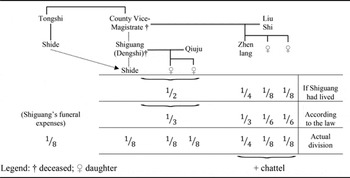
Now then, in this case, the care of a son is at issue, and so it might seem that the one-third of the household property that has been given to the daughter corresponds to the expenses for his care, but in fact that is not the case. The reason the judge Liu Kezhuang cited this particular law was in order to protect the portion of the property that the son would normally inherit—his full share, just so long as he attained the age of maturity and no legal conflicts had arisen—from the uxorilocal husband. Clearly, he did not intend to protect the rights of the daughter. Thus, it turns out that in this case, a law that was initially implemented to provide economic protection to unmarried daughters was brought to bear for a different purpose than its original intent.Footnote 31 And while the daughter was married, she remained behind in her father's house and was in effect in the same position as an unmarried daughter, meaning that there was no impediment in formal terms to the application of the so-called “daughter's half-share law.”Footnote 32 (See Table 2)

Next let us examine Liu Kezhuang's decision “A lawsuit by Liu Shi of Jianchang county about the appointment of a successor” 建昌縣劉氏訴立嗣事 (also in “Posthumous heirs can only obtain one-fourth of property” 繼絕子孫止得財產四分之一 in Qingmingji, juan 8, “Huhunmen” 戶婚門 [Households and Marriage], “Lijilei” 立繼類 [Matters concerning establishing an heir]), a case in which the county's Vice-Magistrate (xiancheng 縣丞) Tian 田 died, leaving his concubine Liu Shi 劉氏, her infant son, Zhenzhen 珍珍 [Zhenlang 珍郎], and two daughters; Vice-Magistrate Tian also had an adopted son, Shiguang 世光 [Dengshi 登仕], who had fathered two daughters with the maid Qiuju 秋菊 before dying himself (see Table 2 above). Since they were not wives, but rather a concubine and a maid, Liu Shi and Qiuju did not have the power over family property that wives and mothers would; their existence was immaterial to the matters at hand. The verdict was rendered in stages, and the case is a rather complicated one, but let me quote the portion of the conclusion that is necessary for my argument:
I again render a verdict below regarding the matter of Liu Shi's petition about the establishment of a successor. When I rendered my earlier judgment, I was unaware that Liu Shi also had two daughters. These two daughters are the biological daughters of the County Vice-Magistrate and thus if Dengshi [i.e., Shiguang] had lived, then Dengshi and Zhenlang [i.e., Zhenzhen] would have received an even share and each of the two daughters would have received one-half of a son's portion. But since Dengshi has already died, we can only rely upon the law to divide evenly among children. The two daughters of the County Vice-Magistrate shall inherit their father's property along with Zhenlang. Dividing the amount to be inherited into ten parts, five parts of this shall be inherited by Zhenlang, and the remaining five parts shall be distributed evenly between the two daughters. The two daughters of Dengshi shall, along with the successor that was established, receive Dengshi's portion. Since the successor was established after the death of Dengshi, three-fourths shall be awarded to the two daughters and one-fourth to the successor. Only such a division will be in accord with the law. However, Liu Shi will certainly object that Qiuju's two daughters' portion is greater than that of her own two daughters. Moreover, Dengshi's funeral has not been concluded. For these reasons, the two daughters of Qiuju shall receive the same amount as their two aunts: each a single share, and from this they shall spare one share to defray the costs of Dengshi's funeral expenses. Doing this will make the division equal …
I shall render my judgment again. According to the suit brought by Liu Shi, the County Vice-Magistrate had two sons and two daughters. The eldest son Dengshi is already deceased, but the one son who survives, Zhenlang, along with the two daughters, were all born of Liu Shi's womb. According to the law, all of the chattel of the County Vice-Magistrate, along with the field property shall be gathered together and divided into three equal portions. Dengshi and Zhenlang shall each get one portion, and the two daughters between them shall get one portion. However, all of the County Vice-Magistrate's chattel is already in the hands of Liu Shi. Even if now the government officials attempted to have each and every item of it be submitted and surveyed, in all likelihood, Liu Shi and her children would not submit it. Liu Shi and Qiuju would engage in a fierce dispute with one another until they went bankrupt. For this reason, this time I will render my decision on the sole basis of even division among children, and as for the chattel, I will not make them the object of any survey or division …
Below I render my judgment. If completely in accord with the law, Liu Shi's one son and two daughters would receive two-thirds of the field property, but now I will make the division equal and offset the deficiency with chattel. I think there is no fairer solution than this under Heaven.
再據劉氏訴立嗣事、奉判。前此所判、未知劉氏亦有二女。此二女既是縣丞親女、使登仕尚存、合與珍郎均分、二女各合得男之半。今登仕既死、止得依諸子均分之法。縣丞二女合與珍郎共承父分、十分之中、珍郎得五分、以五分均給二女。登仕二女、合與所立之子共承登仕之分。男子係死後所立、合以四分之三給二女、以一分與所立之子。如此區處、方合法意。但劉氏必謂登仕二女所分及多於二姑、兼登仕見未安葬、所有秋菊二女、照二姑例、各得一分、於内以一分充登仕安葬之費、庶幾事體均一。
・・・再奉判。據劉氏詞、縣丞有二子二女、除長子登仕係長子、已身故外、見存一子珍郎及二女、皆劉氏所出外。以法言之、合將縣丞浮財田產、並作三大分均分、登仕・珍郎各得一分、二女共得一分。但縣丞一生浮財籠篋、既是劉氏收掌。若官司逐一根索撿校、恐劉氏母子不肯齎出、兩訟紛拏、必至破家而後已。所以今來所斷、止用諸子均分之法、而浮財一項、並不在檢校分張之數。
・・・奉判。以法論之、則劉氏一子二女、合得田産三分之二、今止對分、餘以浮財準折。可謂極天下之公平矣。
What is most significant in the analysis quoted above is the following point. Even while it says in the first half that “we can only rely upon the law to divide evenly among children,” the distribution method that is actually indicated is to divide the family property between Dengshi and Zhenlang and having done so to then merely apply the division law stipulating “a daughter shall receive half a son's portion” between Zhenlang and the two daughters of Liu Shi. If we take the “law to divide evenly among children” and the law stating “a daughter shall receive half a son's portion” to be one and the same, then we can only conclude that here that law has been applied on a limited basis to the situation between Zhenlang and Liu Shi's two daughters. Dengshi's share was divided between Shide and the two daughters of Qiuju at a ratio of one to three, but this is the typical method of dividing between posthumously appointed heirs and unmarried daughters. For this reason, the phrase reading “According to the law” that appears in the paragraph following the ellipsis that begins “I shall render my judgment again” refers to the “law to divide evenly among children.” Inasmuch as it states “divide evenly among children,” we would expect that the division must be carried out among members of a single generation. This is because the two daughters of Qiuju are from a different generation than Zhenlang and others. Precisely because of this, it was inevitable that the decision should be: “All of the chattel of the County Vice-Magistrate, along with the field property shall be gathered together and divided into three equal portions. Dengshi and Zhenlang shall each get one portion, and the two daughters between them shall get one portion.” With this, the portions for sons and daughters determined by law would be two parts to one, which would be in accord with the law that “a daughter shall receive half a son's portion.”Footnote 33 However, in actuality, other circumstances were brought into consideration and thus a somewhat different form of distribution from “equal division among children” was employed.
Another instance that makes reference to the so-called “daughter's half-share law” and “law on equal division among children” can be found in Fan Yingling's “Daughters ought to receive a share” 女合承分 in Qingmingji (juan 8, “Huhunmen” 戶婚門 [Households and Marriage], “Yizhu” 遺嘱 [Wills]). This is a case involving an adopted son and a young daughter:
Zheng Yingchen had no biological sons. He had two daughters, named Xiaochun and Xiaode, and a foster son named Xiaoxian. The house was quite wealthy, with three thousand mu of fields and ten grain storehouses. While Yingchen was still alive, he expressed his last will and presented his two daughters 130 mu of fields and one grain storehouse each, which cannot be said to be particularly excessive. After Yingchen's death, his foster son Xiaoxian attempted to take possession of all the household property. Considering his testimony statement, his claims were extraordinarily heartless. Even supposing there had been no last will from his parents, it was only natural for the two daughters to receive that amount of property. Had the rule of equal division that is practiced in other prefectures been used to dispose of the property here, the two daughters and the foster son would each have received half. Now when his father has given his daughter a mere 130 mu, it is most unrighteous for a foster son to cling to it. If the deceased Yingchen were to learn of this he would find it regrettable ... Zheng Xiaoxian shall be struck one hundred times with a cane and put in the stockade; just as stated in the will, the two daughters shall each receive 130 mu of fields. [The decision] will be implemented immediately.
鄭應辰無嗣、親生二女、曰孝純・孝德、過房一子曰孝先。家有田三千畝・庫一十座、非不厚也。應辰存日、二女各遺囑田一百三十畝・庫一座與之、殊不為過。應辰死後、養子乃欲掩有。觀其所供、無非刻薄之論。假使父母無遺囑、亦自當得、若以他郡均分之例處之、二女與養子各合受其半。今只人與田百三十畝、猶且固執、可謂不義之甚、九原有知、寧無憾乎。・・・鄭孝先勘杖一百、釘錮、照元遺囑、各撥田一百三十畝、日下管業。
The judge Fan Yingling's statement “Had the rule of equal division that is practiced in other prefectures been used to dispose of the property here, the two daughters and the foster son would each have received half” was no more than a threat to the foster son who was attempting to take exclusive possession of household property; it does not seem to have been a case precedent that could be applied here, nor was it in fact.Footnote 34 The reason is that the foster son Xiaoxian is thought to have already reached the age of maturity. Even as he came out with such a threat, what was Fan Yingling trying to protect? It was none other than the economic assistance that the daughters would doubtlessly have received if their father had still been alive: the property corresponding to this amount that they had been assured in the father's will.
If one considers coolly and logically the cases I have discussed above, in which daughters in the Southern Song period received half a son's share of property, one can understand that it was a social policy measure that emerged as a means of ensuring the dowry (and sometimes the living expenses) of unmarried daughters who were living in circumstances in which they had neither parents nor mature brothers. I do not know of any cases of family property division in which a daughter was given a fixed percentage or a fixed amount of family property (other than as dowry) when the parents were alive and/or reliable brothers were present. We would need, I think, to find evidence that such forms of distribution existed and that they were solidly recognized socially and legally before we could legitimately claim that daughters had an actual right to property or a right to inherit. Sons, simply by virtue of the fact that they were sons, naturally had an unconditional right to inherit family property. In an extremely limited range of cases, through a special legislative measure taken by the state, daughters were given the portion corresponding to the economic support that they would have received if their parents had survived or if they had mature brothers. This is not a daughter's right to property but rather what might be called instead a policy response or an economic protection strategy undertaken by the Song Dynasty for these unmarried daughters on behalf of their parents. We should give due attention to how in Chinese society particularly during the Qing Dynasty and earlier, marriage was conceptualized as an indispensable point of passage in one's life:Footnote 35 something which in its momentousness required special expenses for both sons and daughters.Footnote 36
IN CONCLUSION
A law stating that when children divide family property after the death of their parents, a daughter should receive half a son's portion suddenly appeared during the Southern Song period. Even though each daughter received only half a son's portion, the appearance of this law stipulating that daughters could be given a portion alongside sons was the first and last of its kind in the context of Chinese society up to the Qing. Yet the real significance of this peculiar law lay in the meticulous consideration of government officials to ensure that something quite commonsensical and mundane was accomplished by commonsensical and mundane means. That is, it was a legal and social policy response undertaken by government officials to allow unmarried daughters who had no one to depend upon the ability to marry like everyone else. Therefore, judging from what is evident in the legal cases, where the law speaks of “sons” it does not mean sons in general, but rather the more limited sense of young sons who had yet to reach the age of maturity.Footnote 37
As we have already seen in this article, the legal and social policy response that the Song Dynasty made to protect unmarried orphan daughters was not simply limited to the so-called “daughter's half-share law.” There was a detailed method for apportioning household property in cases of household extinction, needless to say, but also in cases where daughters and posthumously appointed heirs were present. Even in cases where unmarried daughters and uncles survived, it seems that there was legislation implemented for a time that ensured half of the property that would be received by the father was given to the daughter. When we place the so-called “daughter's half-share law” in the context of this series of policy responses on the part of the Song Dynasty, it is easy to appreciate that it was anything but peculiar or incomprehensible. Rather, what still remains incomprehensible and unresolved for me is the following point.
In examining the ways in which laws were established and reformed in the Song, I suspect many people sense a certain quality of Song law that we might positively describe as its flexible versatility, its ability to make suitable adaptations to meet the circumstances: a quality that might more negatively be characterized as ad hoc haphazardness or a lack of solid principles.Footnote 38 When we trace the laws concerning civil matters in particular, what impresses us is that the orientation of Song law is fundamentally different from one that prescribes only the principles and leaves everything else up to the administrative level, to practical on-site application, such as we see in Tang law, for example. It seems that there was a shift in direction during the Song wherein there was an attempt to create new laws in order to handle by legal means matters that would surely have been left up to the individual discretion of local officials on site under the Tang. The issue that I have taken up in this article, the so-called “daughter's half-share law,” addresses the problem of unmarried daughters who lack the protection of their parents and brothers: a problem that surely existed in the Tang Dynasty and in other periods as well. We may suppose that during the Tang dynasty and in other eras as well, protection and support were provided for these unmarried daughters, sometimes through administrative steps and sometimes through protection and support provided by members of the daughters' families. For example, during the Qing, there was no law like the Song's so-called “daughter's half-share law,” but through the judgment of local officials, an allowance for the dowry of an unmarried daughter was provided. Song Daye 宋大業's “Betrayed obligations, usurpation of property, and other topics” 逆恩簒占等事 in his Rongwoxuan zagao 容我軒雜稿 [Miscellaneous drafts from Rongwoxuan] (manuscript held by Fudan University, not divided into juan, preface dated Kangxi 42 [1703]) is a case in which, after their father's death, his biological sons attempt to drive off the foster child:
As a result of the inquiry, the following facts were established. Zhao Fengfeng as well as Zhao Shaosan, Zhao Shaowu, and others are biological brothers born of the same father. Their father, Zhao Sunchen, married a woman with the surname Yang, but who did not bear any children. He therefore took the child of a relative, Fengfeng, and made him successor. Later, he took Wen Shi as concubine and had six sons and two daughters; he was truly very fortunate. The property he left behind had field rent of 35 shi [piculs] 5 dou [pecks], which was divided evenly among the seven sons, with each son receiving 4 shi. It will be suitable if the remainder goes toward the marriage expenses of the daughters of Wen Shi.
審得、趙逢鳳與趙少三・少五等實為同父之兄弟也。其父孫臣娶楊氏無子。因撫族人之子逢鳳為嗣。繼而娶妾文氏、得生六子二女。誠為厚幸。・・・所遺田租、五石五斗、應以七子平分、每給四石、餘則存為文氏之女嫁聚、可也。
In this case, whereas each son received 4 shi, each of the unmarried daughters was given 3.75 shi. In “Re-evaluation of the plan to establish Chen A-Xie as heir” 覆審陳阿謝立繼案 drafted by Xu Shilin 徐士林 and included in his Xu Yufeng zhongcheng kanyu 徐雨峰中丞勘語 [The notes of vice censor-in-chief Xu Yufeng] (Yongzheng [1722–35] era, Anqing Superior Prefecture), juan 2:
Give A-Xie 10 shi of rice and send him back to his parents for we cannot cause a succession dispute. However, A-Xie has a daughter not yet married. In the previous prefectural verdict it was decided to deduct one-third from the family property and set it aside for expenses toward the daughter's future marriage, thereby comforting the girl's father Yuanji in his grave and the living A-Xie as well. These words are very much in accord with rationality and were something I didn't think about when I wrote my earlier instructions.
阿謝給稻十石、仍令歸伊父母、不得爭繼。惟阿謝現有生女未嫁、前參令斷令提家產三分之一、以爲日後妝奩之資、慰元吉於地下、並慰阿謝於生前。此言殊爲得理、實補本府前檄之所不及。
As this passage shows, the premortem adopted heir received two-thirds of the family property and the unmarried daughter received one-third as capital for her later marriage expenses. In the first of these two examples, there are several biologically related brothers and in the second example, the mother is still alive. In either situation, it would seem that conditions are better than those that would have faced an unmarried orphaned daughter with underage brothers in the Song, and yet this sort of division is made. A sense that the dowry of unmarried daughters ought to be safeguarded, irrespective of the existence or non-existence of the “daughter's half-share law,” was shared by people as a social custom or conventional wisdom.Footnote 39 In the Song, legislation was used in an attempt to realize this aim, whereas in other periods when problems arose, they were settled according to the free discretion of local officials.
Moreover, while I cannot prove this point with statistics, it can be conjectured that during the Song, there were in fact many cases in which daughters' marriages were carried off smoothly through the assistance of their relatives and without the need for any compulsion from the law or administrative authorities. Nevertheless, during the Song, this was made law, and it was expected that government officials in charge of administration would handle cases by means of this law. With regard to the disposition of property from extinct households, as we saw earlier, there was a truly dizzying sequence of revisions to the law during the Song. Tang law, by contrast, was plain and simple, and during the Ming–Qing period too, only the following regulation was put in place:Footnote 40
As for the property of an extinct household, when there is no one among the same descent group who can become heir, a biological daughter may inherit it. If there are no daughters, then the local official shall report in detail to the senior authorities and make suitable disbursals to public funds.
戶絶財産、果無同宗應繼之人、所有親女承受、無女者、聽地方官詳明上司、酌撥充公。
In all likelihood, judgments as to what should be done for the provision of property to daughters in situations where a posthumous heir had been established, or as to whether property should be conferred equally on “biological daughters,” whether they were unmarried daughters, returned daughters, or even married daughters, were left to the discretion of local officials during the Ming and Qing periods. In the Song, it seems that such free discretion by local officials, judgments that might well occasionally be arbitrary or lacking in principle, were prescribed by law, and that there was an effort to impose coherent and unified administration rooted in law.Footnote 41 This is something that ought to be called a remarkable special feature of the Song government and of Song society in comparison to the Tang as well as the Ming and Qing. At the same time, however, there are limitations in covering the various dimensions of complex and diverse reality through law, so depending on time period and locality, the same problem might present different aspects. I suspect that this is why it is not at all rare for us to see what we might call a certain oscillation in principles or a trial-and-error approach manifest itself in Song law. This sort of tendency in the Song period, this orientation on the part of the Song government, however, would not, it seems, reappear in the Ming and beyond. Why was that? At present, I have no definite answer. But even before posing that question, we might ask why there was such an effort in the Song to carry out administration under the principle of conformity with legislation. And even for this question, I do not yet have an opinion to propose.
ADDENDUM
I published an earlier version of this chapter as a journal article.Footnote 42 After its appearance, Yanagida Setsuko published an evaluation of it;Footnote 43 Kathryn Bernhardt published an article which was translated into Japanese;Footnote 44 Ōsawa Masaaki published an article on Southern Song trials and women's property rights;Footnote 45 and Sadate Haruhito published an article on women's right of inheritance in the Tang Dynasty law code.Footnote 46
In her review of my article, Yanagida proposed several points to ponder in the interpretation of historical materials and wrote, “We can assume that there was consideration for unmarried daughters in the distribution of an extinct household's family property, but to assert, conversely, that [the policy] was enacted from the first with this purpose in mind is something that, to be honest, I cannot help feeling hesitant about.” Yanagida's critique firmly held to her own position, and about this I can only say that we have a difference of opinion. She also raised the question of the relationship between the household law, cited in Song xingtong (juan 12, “Hu Hun Lü” 戶婚律 [Household and marriage law], “Beiyou siyong cai” 卑幼私用財 [Private property of minors]), and the “daughter's half-share law.” The household law was something that codified the provision of dowry for unmarried daughters on the occasion of the division of household property in typical situations: thus, those in which there would be several adult sons surviving. The “daughter's half-share law” was something that codified the allowance for dowry in situations where such adult sons did not survive. In other words, the “daughter's half-share law” was legislation that was enacted to provide for circumstances when the stipulations in the household law could not be applied.
Next, Bernhardt's article argues that it is very likely that when Liu Kezhuang made reference to the “daughter's half-share law” he misunderstood the “Law on Extinct Households” that appears in Hu Ying's decision that I cited in the section on orphaned children, above: specifically the part of Hu Ying's decision that reads 在室女依子承父分法給半, translated above as: “[She ought to be considered] an unmarried daughter, and in accord with the laws on children inheriting their father's property, she ought to receive one half of the property.” Bernhardt argues that “A half-share law did not exist or, at the very least, was a highly anomalous law.”Footnote 47 This argument is one that I am utterly unable to endorse. The regulation that Hu Ying cites refers to a case in which a father's death had left an unmarried daughter and her uncles. Bernhardt calls the father's portion his “potential juehu [household extinction] property.” While the daughter's half-share law might be a paraphrase, it does say there “sons and daughters divide property” (ernü fenchan 兒女分產); no matter how one looks at it, this is not a case of household extinction or potential household extinction. I suppose the contention that Liu Kezhuang misunderstood the cited law can be entertained as a logical possibility, but in order to confuse a case of household extinction (or potential household extinction) with a case that is not one of household extinction, one would have to be exceptionally careless. Even supposing that Liu Kezhuang did misunderstand, the basis of his misunderstanding was surely not the regulation that Hu Ying cited.
Ōsawa's article does not show any inclination to participate directly in the debate under consideration here, so I avoid any comment on it.
Lastly, Sadate hypothesizes that the word pincai 聘財 (betrothal funds) in the “Yingfentiao” 應分條 [Article on proper division]) of the “Huling” 戶令 [Household Regulations] (姑姊妹在室者、減男聘財之半) is a textual corruption and conjectures that Liu Kezhuang's citation of the so-called “daughter's half-share law” is either the citation of this regulation in the Song xingtong cites or another law that descended from it. Yet as even Sadate himself recognizes, this remains no more than a hypothesis and a conjecture.