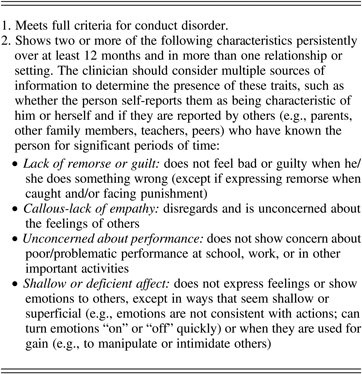
Adult psychopathy is considered a construct overarching at least three personality dimensions: (a) an arrogant and deceitful interpersonal style, (b) an impulsive and irresponsible behavioral style, and (c) deficiencies in affective experience (Cooke, Michie, & Hart, Reference Cooke, Michie, Hart and Patrick2007). The third dimension also has become known as callous–unemotional (CU) traits. These traits are supposed to represent the core symptoms of psychopathy: lacking guilt and empathy, showing callous use of others for one's own gain, and lacking normal emotionality, particularly showing a lack of anxiety (Frick & Ellis, Reference Frick and Ellis1999). In youths with conduct problems, CU traits predict more severe antisocial behavior and a worse overall prognosis (for a review, see Frick, Reference Frick2009). A proposal has been made to add a specifier for CU traits in the upcoming DSM-5 to identify the specific severe subgroup of conduct disorder (CD) as a possible precursor of psychopathy (see Table 1; Frick & Moffitt, Reference Frick and Moffitt2010). A better understanding of the etiology and neurobiology of CU traits will be crucial for developing better treatment modalities in the future.
Proposed specifier for callous–unemotional traits in DSM-5

Regarding the etiology and development of CU traits as a predisposition toward psychopathy, numerous models and theories have been developed, such as the low-fear model (Lykken, Reference Lykken1957), and the somatic marker model (Damasio, Reference Damasio1994; for a review, see Salekin, Reference Salekin2002). These theories all focus on specific elements in the etiology of psychopathy. Yet, it seems important to develop an overarching theory that does justice to the complexity of juvenile CU traits by integrating different aspects into one model that is applicable in different stages during life. As such, two theories aim to merge existing knowledge about neuropsychological and neurobiological functioning in psychopathy into an overarching theory: (a) the dual-hormone serotonergic hypothesis (DHS) and (b) integrated emotions systems (IES) theory. We will briefly describe these theories below.
DHS is an extension of the triple balance hypothesis of emotion (TBHE) as developed by van Honk and Schutter (Reference van Honk and Schutter2006). The neurocognitive starting point of this hypothesis is that psychopaths show decreased moral functioning (e.g., moral response to emotional stimuli or empathic responding) because they experience low basic fearfulness (Lykken, Reference Lykken1957). Due to low basic fearfulness, psychopaths show deficits in anticipatory emotional responses to warning signals (such as decreased emotional reactivity). This in turn leads to decreased passive avoidance (i.e., avoidance of behavior that could be punished). Finally, low basic fearfulness and decreased passive avoidance are thought to lead to decreased behavioral inhibition. Closely related is the finding of increased reward dependence in psychopathy. Increased reward dependence and decreased passive avoidance is thought to represent a motivational imbalance leading to psychopathy (Arnett, Reference Arnett1997).
The neurobiological framework of this motivational imbalance model could be that during social development, somatic markers are connected to specific stimuli to enhance future decision making (Damasio, Reference Damasio1994). For example, a sensory perception of stress becomes related to anxiety, which induces avoidance. In other words, decision making is dependent on bioregulatory markers in the brain that are linked to behavior that ensures survival. Deficits in these somatic markers could lead to psychopathy. Such deficits are thought to exist in dysfunction of the amygdala and the orbitofrontal, medial, and ventromedial regions of the PFC (omPFC). It is suggested that, because of these impairments, impairments in social information processing occur, such as decreased recognition of emotion, especially fear (Blair, Reference Blair2008). This in turn leads to decreased withdrawal responses that normally occur when confronted with distress, now leading to continuation of aggressive behavior. As such, these impairments were seen as a result of deficits in the brain stem threat response system (Blair, Reference Blair1995; Blair, Jones, Clark, & Smith, Reference Blair, Jones, Clark and Smith1997).
To explain the deficient threat response system, TBHE puts emphasis on the role of two steroid hormones: cortisol and testosterone. Cortisol suppresses the activity of the hypothalamic–pituitary–gonadal axis at all its levels, diminishes the production of testosterone, and inhibits the action of testosterone at the target tissues. Increased cortisol levels act on the amygdala and potentiate a state of fear (van Honk & Schutter, Reference van Honk and Schutter2006). Furthermore, cortisol is associated with withdrawal-related behavior and with the instigation and maintenance of the fight-or-flight response (Terburg, Morgan, & van Honk., Reference Terburg, Morgan and van Honk2009). Testosterone in turn inhibits the stress-induced activation of the hypothalamic–pituitary–adrenal axis at the level of the hypothalamus. In contrast to cortisol, testosterone not only has rewarding properties but also leads to reductions in fear. Testosterone is thought to induce a shift in motivational balance toward decreased punishment sensitivity and enhanced reward sensitivity.
According to TBHE, a balance between testosterone and cortisol is important, but their effect on the subcortico–cortical communication is important as well. With regard to the amygdala–omPFC communication, the amygdala attributes affective value to a stimulus, while the omPFC provides for the more complex affective evaluation that plays a role in the decision for proper action. Decreased cortisol levels are associated with decreased fear and increased subcortico–cortical communication (leading to increased decision making), while increased testosterone levels are associated with rewarding properties and reductions of fear, as well as decreased subcortico–cortical communication. In addition, more right-sided activity in the PFC is associated with more fearful behavior and higher levels of cortisol. More left-sided activity is associated with approach motivation and anger (Terburg et al., Reference Terburg, Morgan and van Honk2009). It is reasoned that relative low levels of cortisol in combination with relative high levels of testosterone result in (a) low fear and high reward sensitivity, (b) inadequate attribution of affective values to stimuli by the amygdala and subsequently to inadequate evaluation of information by the omPFC, and (c) enhanced approach-related emotions together with diminished withdrawal-related emotions. Thus, these hormones seem to play a crucial role in homeostatic emotion regulation through their antagonistic actions on physiological and psychological level, influencing the way in which organisms act in the presence of threat (van Honk & Schutter, Reference van Honk and Schutter2006).
The research group of van Honk recently extended TBHE to DHS (Montoya, Terburg, Bos, & van Honk, Reference Montoya, Terburg, Bos and van Honk2012), suggesting that the level of the neurotransmitter serotonin might play a role in the expression of aggression as well. Low levels of serotonin are thought to be related to impulsive aggression (Terburg et al., Reference Terburg, Morgan and van Honk2009). Thus, in individuals with a high testosterone–cortisol ratio and, therefore, with disposition toward aggression, low serotonin transmission induces impulsive aggression.
Taken together, DHS suggests that low cortisol and high testosterone levels account for (right-sided) inadequate functioning of the amygdala and inadequate communication between amygdala and PFC, leading to decreased fearfulness and increased reward sensitivity. In daily life this leads to decreased emotional reactivity, decreased passive avoidance, and thus to decreased moral reasoning as seen in psychopathy. Low serotonin transmission might account for impulsive aggression.
IES theory attributes a central role to the amygdala, adds genetic influences and gene–environment interactions, and assumes a role of the noradrenergic neurotransmitter system with less emphasis on the role of cortisol. IES (Blair, Reference Blair2008; Blair, Peschardt, Budhani, Mitchell, & Pine et al., Reference Blair, Peschardt, Budhani, Mitchell and Pine2006) can be considered an extension of the violence inhibition mechanism (Blair, Reference Blair1995). This model stated that in psychopathy there are impairments in withdrawal responses that normally occur when confronted with distress, leading to continuation of aggressive behavior. As already mentioned in the description of DHS, these impairments were seen as a result of deficits in the brain stem threat response system (Blair, Reference Blair1995; Blair et al., Reference Blair, Jones, Clark and Smith1997).
Furthermore, it was reasoned that the basic response to threat involves the noradrenergic system. When specific neurons in the central nucleus of the amygdala are activated by threat, they then activate the locus coeruleus, leading to an increase in noradrenaline release (Charney, Reference Charney2003). These higher noradrenaline levels ensure faster learning when confronted with information containing aversive cues. However, genetic variation in individuals with psychopathy may lead to early amygdala dysfunction and, thus, to decreased response to aversive cues, which in turn leads to impaired learning of stimulus–punishment associations. As such, according to IES, deficient amygdala functioning is seen as the core deficit that might lead to many of the behavioral phenomena associated with psychopathy, such as difficulties in empathic responding (Blair, Reference Blair2006), whereas hormonal disbalance is seen as the core deficit in psychopathy according to DHS.
Although IES incorporates some studies in youths, both theories (DHS and IES) were primarily based on research in adults with psychopathy, adults with specific brain damage, normal adult controls, or animal research. This makes it unclear whether these theories apply to youths as well. In many psychiatric disorders, such as depression and attention-deficit/hyperactivity disorder (ADHD), etiology and symptom presentation in youths compared to adults is different and need specific attention (Rutter, Kim-Cohen, & Maughan, Reference Rutter, Kim-Cohen and Maughan2006). This may also be the case in CU traits. For example, children and adolescents differ substantially from adults with respect to hormonal characteristics, especially androgens, as well as structural and functional brain characteristics (Sowell et al., Reference Sowell, Thompson, Leonard, Welcome, Kan and Toga2004). Children have less well developed cognitive control mechanisms and show continuing development of control and flexibility in executive functions up till the age of 13 to 15 years. Where children under 12 tend to choose for immediate rewards, this strategy is changed in adolescence toward choosing long-term rewards (for a review, see Crone et al., Reference Crone, Wendelken, Van Leijenhorst, Honomichl, Christoff and Bunge2009). Connections between the PFC and subcortical structures, such as the amygdala and ventral striatum, tend to become stronger through adolescence and at adult age (Somerville & Casey, Reference Somerville and Casey2010).
Therefore, in order to develop valid etiological models of psychopathy in youths, a specific focus on the neurobiological and psychological aspects of CU traits in this age category is required. Fortunately, the neuropsychological and neurobiological underpinnings of CU traits in youths got an increasing amount of attention over the last decade. As DHS is based on the role of hormones in adult psychopathy, it is particularly important to sort out whether the hypothesized imbalance between cortisol and testosterone can be found in youths with CU traits as well. If so, this would add important input to the discussion about the “downward extension” of the adult psychopathy construct (Edens, Skeem, Cruise, & Cauffman, Reference Edens, Skeem, Cruise and Cauffman2001; Hart, Watt, & Vincent, Reference Hart, Watt and Vincent2002; Salekin & Frick, Reference Salekin and Frick2005; Seagrave & Grisso, Reference Seagrave and Grisso2002). Furthermore, as both models reason about the involvement of specific neural structures and neurotransmitters, finding evidence for this involvement in youths with psychopathy would contribute immensely as well.
Moreover, in contrast with previous review studies (Blair, Reference Blair2006; Blair et al., Reference Blair, Peschardt, Budhani, Mitchell and Pine2006; Montoya et al., Reference Montoya, Terburg, Bos and van Honk2012; van Honk & Schutter, Reference van Honk and Schutter2006), we explicitly link findings on CU traits in youths to existing models on CU traits that have to date been predominantly based on findings in adult psychopathy literature, thereby exploring the validity of these models regarding the etiology of CU traits. As mentioned above, IES incorporated several studies in youths with psychopathy or CU traits as well and concluded that differences between adults and youths with psychopathy or CU traits were minimal or even absent. TBHE has been evaluated in a review that focused only on research in adult psychopathy (Glenn & Raine, Reference Glenn and Raine2008), not in youths. To our knowledge, our review is the first investigating the existing literature on the applicability of TBHE, and its recent successor DHS, in youths with CU traits.
Methods
Using the PubMed computerized literature database, all relevant empirical studies published between May 2007 and October 2012 were scrutinized for relevance and applicability. Key words included juvenile psychopathy and callous–unemotional traits, conduct disorder, amygdala, cortisol, MRI, autonomic reactivity, emotion recognition, empathy, orbitofrontal cortex, inhibition, emotional processing, moral reasoning, and social cognition. Terms were combined to narrow the findings, focusing on research articles addressing juvenile psychopathy and CU traits. References in papers that were identified in the initial search, in narrative reviews, and in book chapters were further screened for relevance and included if appropriate.
Next, a selection of studies was applied based on age, and studies only of children and adolescents (<19 years) were included in the follow-up analysis. The final analysis was to relate CU traits/psychopathy to neuropsychological or neurobiological measures.
Constraints were used on the years of publication because of the methodological weaknesses in studies that were published before 1980 (five case reports). In addition, study reports had to describe (a) group comparisons with at least one group of participants scoring high on either CU traits or psychopathy or (b) correlational analyses in which a measure of either CU traits or psychopathy was used in relation to other indices of CU traits or psychopathy. CU traits were operationalized as those subdimensions of psychopathy that include symptoms such as callousness, shallowness, and lack of empathy, which is in line with the newly proposed specifier of CD in DSM-5 (with and without CU traits).
Studies had to apply study tasks that lead to objective results (e.g., emotional reactivity as measured through heart rate and not by subjective rating of anxiety). Identified articles had to be published in English.
A total of 75 peer-reviewed papers were used for the final analysis. Studies were sorted according to two main research themes: (a) neurocognitive measures (prosocial reasoning, emotional reactivity, reward sensitivity, and emotion recognition) and (b) neurobiological measures (autonomic responsivity, endocrinological functioning, neural correlates). Studies that applied multiple tasks were “dissected.” Thus, in our review, a study report can be referred to in distinct paragraphs. We chose to sort the studies in this way because they seemed to cluster on specific themes within the etiological theories.
Because CU traits seem to be among the key features and precursors of psychopathy (Skeem & Cooke, Reference Skeem and Cooke2010) and because of its proposed place in the upcoming DSM, we focused primarily on research findings regarding CU traits. However, it is important to notice that the concept of psychopathy basically consists of three dimensions: (a) disinhibition, poor impulse regulation, and the inclination to immediate gratification; (b) boldness, bravery, and thrill and adventure seeking; and (c) meanness, callousness, and coldheartedness (Patrick, Reference Patrick, Salekin and Lynam2010; Patrick, Fowles, & Krueger, Reference Patrick, Fowles and Krueger2009). Meanness, in particular, is viewed by many experts as the core component of psychopathy. This dimension has become known as CU traits (Frick & Ellis, Reference Frick and Ellis1999). There is still discussion about whether a fourth dimension, labeled antisocial–aggressive behavior, should be added (Jones, Cauffman, Miller, & Mulvey, Reference Jones, Cauffman, Miller and Mulvey2006; Pardini, Obradovic, & Loeber, Reference Pardini, Obradovic and Loeber2006; Salekin, Brannen, Zalot, Leistico, & Neumann, Reference Salekin, Brannen, Zalot, Leistico and Neumann2006). Although the other dimensions play an important role as well (Feilhauer & Cima, Reference Feilhauer and Cima2012), CU traits have been studied most extensively in youths with and without conduct problems. Nevertheless, because CU traits are not always mentioned separately in the literature, we also included studies that reported on the broader concept of juvenile psychopathy. When reviewing the existent literature on neurocognitive and brain correlates of CU traits and psychopathy in youths, we will determine to which extent these neurocognitive data can be embedded into DHS as well as IES. In addition, the differences or similarities of data in youths and adults will be noted. The clinical implications and research implications of the findings will then be discussed.
Neurocognitive Measures
Prosocial reasoning
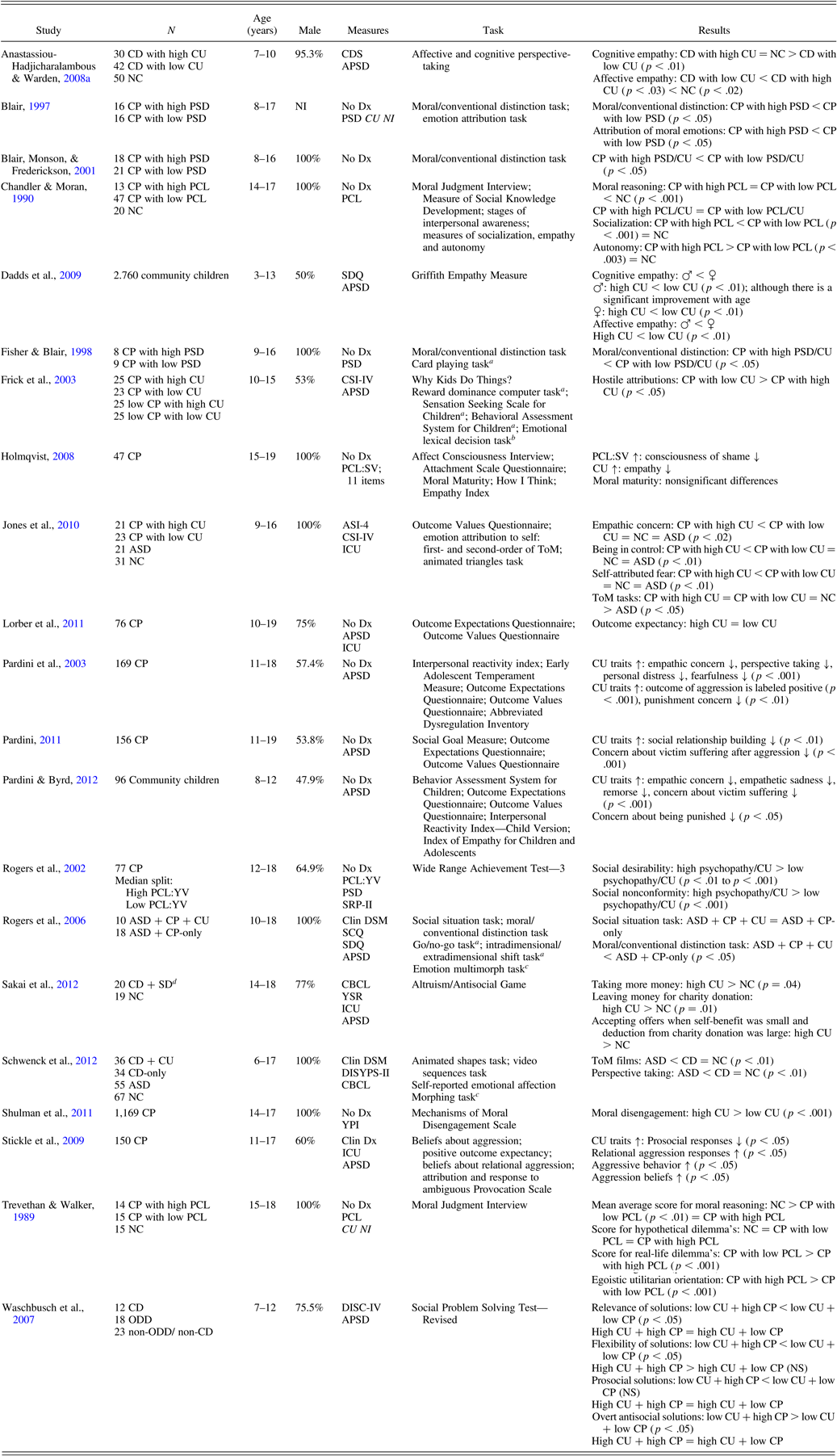
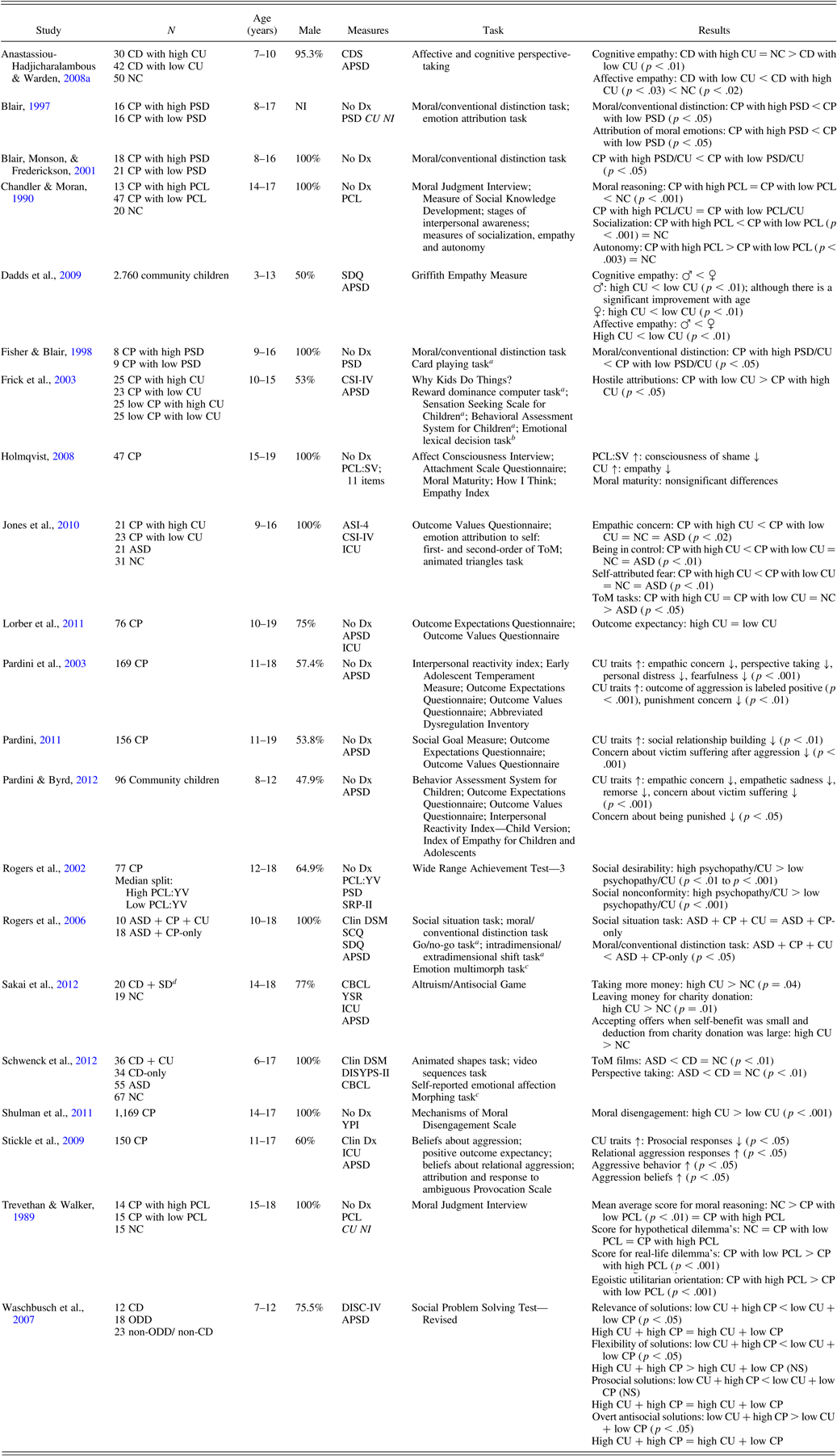
Prosocial behavior is seen as voluntary behavior intended to benefit another (Eisenberg, Fabes, & Spinrad, Reference Eisenberg, Fabes, Spinrad, Damon, Lerner and Eisenberg2006). Because of its multidimensional nature, it is difficult to define a standard or definition for prosocial behavior. Nevertheless, prosocial behavior has been studied through studying prosocial reasoning. Etiological theories regarding psychopathy suggest that inadequate attribution of affective values to stimuli by the amygdala, and subsequently to inadequate evaluation of information by the omPFC, lead to decreased prosocial reasoning (Blair, Reference Blair2006; van Honk & Schutter, Reference van Honk and Schutter2006). The question remains to what extent this impairment is present in youths with CU traits. Studies investigating prosocial reasoning in youths often use brief vignettes containing either moral stories or statements to which participants have to respond in (semi)structured interviews (see Table 2).
Studies on prosocial reasoning
Note: CD, conduct disorder; CU, callous–unemotional traits; NC, normal control; CDS, conduct difficulties subscale of the Revised Rutter Teacher Scales for School-Age Children (Hogg et al., Reference Hogg, Rutter and Richman1997); APSD, Antisocial Process Screening Device (Frick & Hare, Reference Frick and Hare2001); CP, conduct problems; PSD, Psychopathy Screening Device (Frick & Hare, Reference Frick and Hare2000); NI, no information given; No Dx, no DSM or International Classifications of Diseases diagnosis; CU NI, no information available on either the presence or influence of CU (related) traits; PCL, Psychopathy Checklist (Hare, Reference Hare1985); SDQ, Strengths and Difficulties Questionnaire (Goodman, Reference Goodman1997); ♂, male; ♀, female; CSI-IV, Child Symptom Inventory (Gadow & Sprafkin, Reference Gadow and Sprafkin2002); ODD, oppositional defiant disorder; PCL:SV, Psychopathy Checklist: Screening Version (Hart et al., Reference Hart, Cox and Hare1995); ↑, increased; ↓, decreased; ASD, autism spectrum disorder; ASI-4, Adolescent Symptom Inventory (Gadow & Sprafkin, Reference Gadow and Sprafkin1998); ToM, theory of mind; ICU, Inventory of Callous Unemotional traits (Frick, Reference Frick2004); PCL:YV, Psychopathy Checklist: Youth Version (Forth et al., Reference Forth, Kosson and Hare2003); SRP-II, Self-Report Psychopathy Scale—II (Hare, Reference Hare1991b); Clin DSM, clinical DSM diagnosis; SCQ, Social Communication Questionnaire (Rutter et al., Reference Rutter, Bailey and Lord2003); SD, substance dependence; CBCL, Child Behavior Checklist (Achenbach, Reference Achenbach1991); YSR, Youth Self-Report (Achenbach, Reference Achenbach1991); DISYPS-II, Diagnostik-System für psychische Störungen nach ICD-10 und DSM-IV für Kinder und Jugendliche-II (Döpfner et al., Reference Döpfner, Görtz-Dorten, Lehmkuhl, Breuer and Goletz2008); YPI, Youth Psychopathic Traits Inventory (Andershed et al., Reference Andershed, Kerr, Stattin, Kevander, Blaauw and Sheridan2002); Clin Dx, clinical diagnosis; DISC-IV, Diagnostic Interview Schedule for Children IV (Shaffer et al., Reference Shaffer, Fisher, Lucas, Dulcan and Schwab-Stone2000); NS, nonsignificant.
aSee Table 4.
bSee Table 3.
cSee Table 5.
d“Most of the patients admitted to this program have both CD and substance dependence by DSM-IV criteria.”
One example of investigating prosocial reasoning is to assess the acceptance of transgressive behavior. Transgressive behavior can be defined as behavior in which moral boundaries (e.g., a child hitting another child) or social boundaries (e.g., a boy wearing a skirt) are trespassed. The presence of conduct problems and high CU traits is associated with increased acceptance of moral and social transgressions, that is, misbehavior and aggression (Blair, Monson, & Frederickson, Reference Blair, Monson and Frederickson2001; Fisher & Blair, Reference Fisher and Blair1998; Shulman, Cauffman, Piquero, & Fagan, Reference Shulman, Cauffman, Piquero and Fagan2011), which also has been found in boys with autism spectrum disorder and conduct problems (Rogers, Viding, Blair, Frith, & Happe., Reference Rogers, Viding, Blair, Frith and Happe2006). The findings in juvenile psychopathy are similar (Blair, Reference Blair1997). Increased beliefs and expectations about the positive aspects of aggressive behavior in the presence of CU traits have been found as well (Pardini, Reference Pardini2011; Pardini & Byrd, Reference Pardini and Byrd2012; Pardini, Lochman, & Frick, Reference Pardini, Lochman and Frick2003; Stickle, Kirkpatrick, & Brush, Reference Stickle, Kirkpatrick and Brush2009).
Other studies tried to use the concept of moral maturity by assessing verbal reactions to moral and empathic statements. When applying hypothetical situations in youths with CU traits, moral maturity seemed not to be impaired (Chandler & Moran, Reference Chandler and Moran1990; Holmqvist, Reference Holmqvist2008). However, we found one study regarding moral maturity in juvenile psychopathy (Trevethan & Walker, Reference Trevethan and Walker1989) in which moral maturity seemed impaired in real-life situations but not in hypothetical situations. This raises the question whether this specific impairment is due to a difference in cognitive and affective perspective taking, because the latter particularly plays a role in real-life situations. Differences between cognitive perspective taking (“understanding what the other thinks”) and affective perspective taking (“understanding what the other feels”) were found in children with CD and high CU traits. These children performed equally to NC children on tasks of cognitive perspective taking, whereas they performed significantly worse than NCs on affective perspective taking. Thus, it seems that cognitive perspective taking in stories (situations in which emotion recognition is not needed) can be intact in youths with CU traits even though emotional-perspective taking seems to be impaired (Anastassiou-Hadjicharalambous & Warden, Reference Anastassiou-Hadjicharalambous and Warden2008a), which was supported by other studies (Dadds et al., Reference Dadds, Hawes, Frost, Vassallo, Bunn and Hunter2009; Jones, Happe, Gilbert, Burnett, & Viding, Reference Jones, Happe, Gilbert, Burnett and Viding2010; Schwenck et al., Reference Schwenck, Mergenthaler, Keller, Zech, Salehi and Taurines2012). However, Dadds et al. (Reference Dadds, Hawes, Frost, Vassallo, Bunn and Hunter2009) did find deficits in cognitive empathy in CD with CU traits as well, although these deficits attenuated with age.
Another important aspect of prosocial reasoning is the willingness to manipulate, which refers to the ability to present social desirable behavior while simultaneously deceiving the other in order to reach one's goals. This willingness was found to be larger in youths with conduct problems and high CU traits compared to those with low CU traits (Rogers et al., Reference Rogers, Vitacco, Jackson, Martin, Collins and Sewell2002). This is further supported by studies that imply enlarged willingness to manipulate (Frick et al., Reference Frick, Cornell, Bodin, Dane, Barry and Loney2003; Lorber, Hughes, Miller, Crothers, & Martin, Reference Lorber, Hughes, Miller, Crothers and Martin2011; Waschbusch, Walsh, Andrade, King, & Carrey, Reference Waschbusch, Walsh, Andrade, King and Carrey2007), and increased self-benefiting decision making (Sakai, Dalwani, Gelhorn, Mikulich-Gilbertson, & Crowley, Reference Sakai, Dalwani, Gelhorn, Mikulich-Gilbertson and Crowley2012).
Out of the 21 studies we found on this topic, all but 2 (Dadds et al., Reference Dadds, Hawes, Frost, Vassallo, Bunn and Hunter2009; Sakai et al., Reference Sakai, Dalwani, Gelhorn, Mikulich-Gilbertson and Crowley2012) controlled for conduct problems, thus showing an effect of CU traits over and beyond conduct problems. Taken together, these studies on prosocial reasoning show that the presence of conduct problems and high CU traits is associated with increased acceptance of misbehavior and aggression. Youths with CU traits experience deficiencies in moral maturity in real life, possibly due to deficiencies in affective perspective taking, and youths with CU traits seem to be more willing to manipulate. These findings are in line with the assumptions being made under DHS and IES: being less empathic and more egocentric, while having good abilities to assess and influence social situations (i.e., decreased prosocial reasoning). However, these findings cannot yet be related to the underlying causes. Finally, these findings seem to be similar to findings in adult psychopathy (Blair, Reference Blair1995, Reference Blair2006), which implies an association between youths with CD and CU traits and adult psychopathy with respect to prosocial behavior.
Emotional reactivity
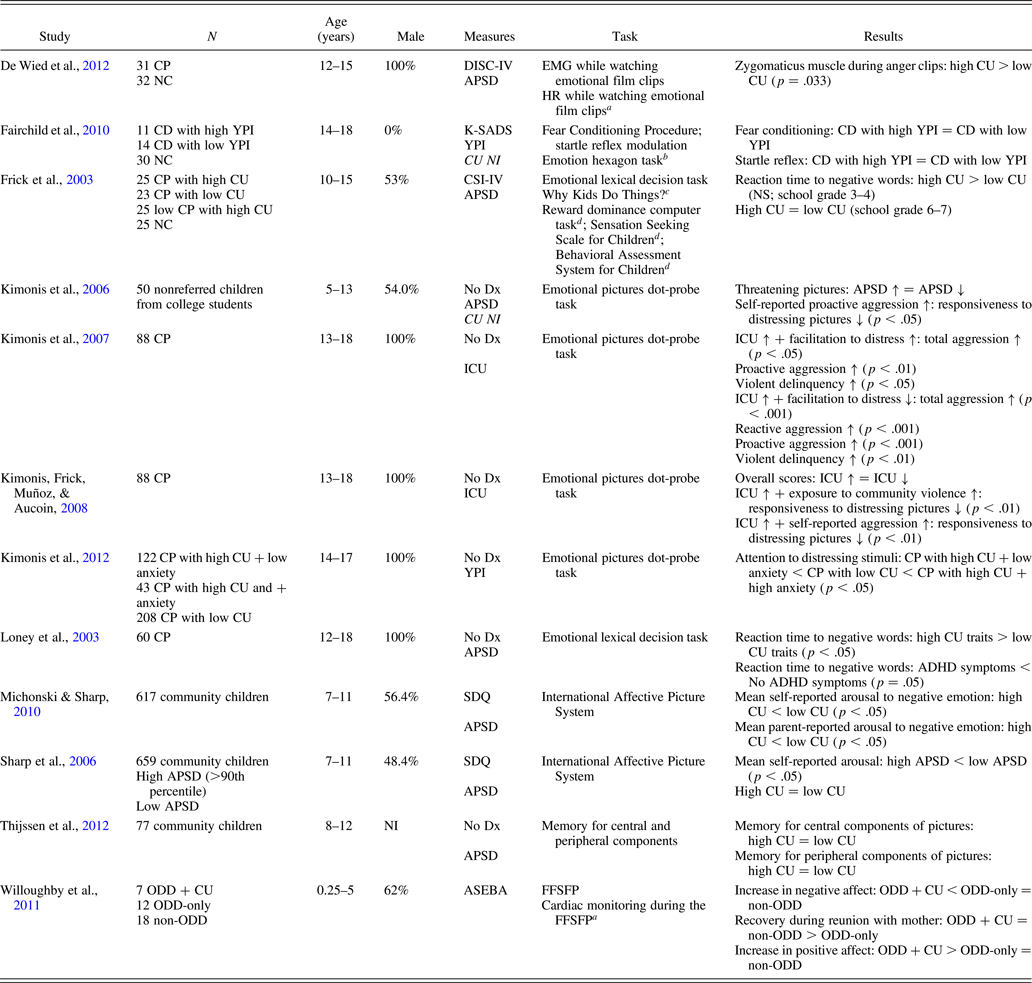
Both DHS and IES theories hypothesized that adult psychopathy is associated with a lack of responsiveness to threatening stimuli, originating from amygdala dysfunction. Hence, the reaction to emotional stimuli has been studied to investigate whether the same associations are found in youths with CU traits (Table 3).
Studies on emotional reactivity
Note: CP, conduct problems; NC, normal control; DISC-IV, Diagnostic Interview Schedule for Children IV (Shaffer et al., Reference Shaffer, Fisher, Lucas, Dulcan and Schwab-Stone2000); APSD, Antisocial Process Screening Device (Frick & Hare, Reference Frick and Hare2001); EMG, electromyography; HR, heart rate; CU, callous–unemotional traits; CD, conduct disorder; YPI, Youth Psychopathic Traits Inventory (Andershed et al., Reference Andershed, Kerr, Stattin, Kevander, Blaauw and Sheridan2002); K-SADS, Schedule for Affective Disorders and Schizophrenia for School-Age Children (Kaufman et al., Reference Kaufman, Birmaher, Brent, Rao, Flynn and Moreci1997); CU NI, no information available on either the presence or influence of CU (related) traits; CSI-IV, Child Symptom Inventory (Gadow & Sprafkin, Reference Gadow and Sprafkin2002); NS, nonsignificant; No Dx, no DSM or International Classifications of Diseases diagnosis; ↑, increased; ↓, decreased; ICU, Inventory of Callous Unemotional traits (Frick, Reference Frick2004); ADHD, attention-deficit/hyperactivity disorder; SDQ, Strengths and Difficulties Questionnaire (Goodman, Reference Goodman1997); NI, no information given; ODD, oppositional defiant disorder; ASEBA, Achenbach System of Empirically Based Assessment (Achenbach & Rescorla, 2000); FFSFP, face-to-face still face paradigm.
aSee Table 6.
bSee Table 5.
cSee Table 2.
dSee Table 4.
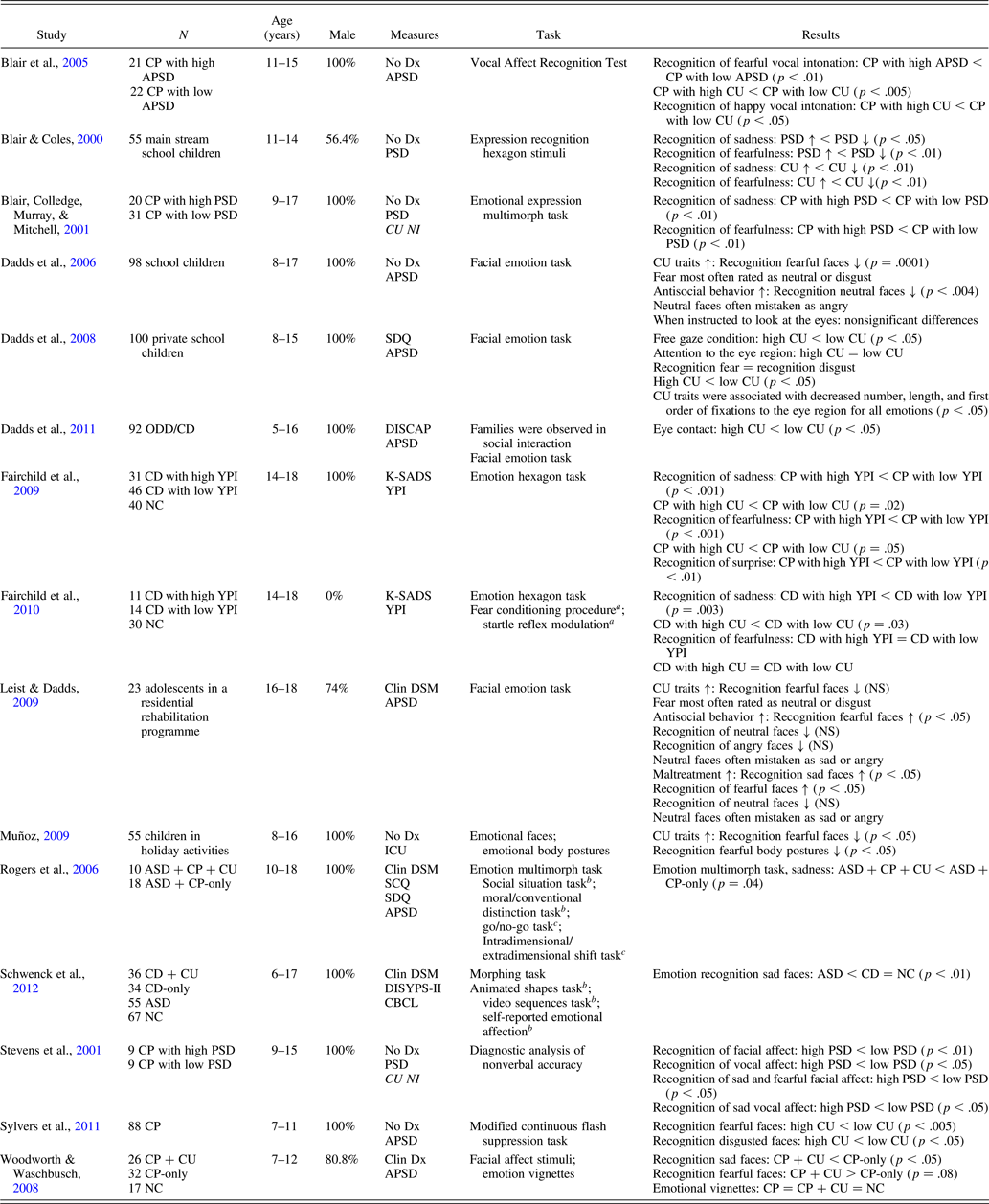
Several studies described the speed and accuracy of the response after the presentation of emotion-evoking visual stimuli, thereby systematically manipulating the valence of the stimuli using pictures from the International Affective Picture System (Lang, Bradley, & Cuthbert, Reference Lang, Bradley and Cuthbert1997). Differences in speed and accuracy of response toward emotion-evoking stimuli in comparison to neutral stimuli is regarded as reflecting emotion processing, with slower reaction times reflecting difficulty in emotion processing. Compared to neutral or positive emotional stimuli (pictures or words), a slower reaction time to negative emotional stimuli (distressing pictures or words) was found in adolescents with conduct problems when CU traits were high (Kimonis, Frick, Cauffman, Goldweber, & Skeem, Reference Kimonis, Frick, Muñoz and Aucoin2007; Kimonis, Frick, Muñoz, & Aucoin, Reference Kimonis, Frick, Muñoz and Aucoin2008; Loney, Frick, Clements, Ellis, & Kerlin, Reference Loney, Frick, Clements, Ellis and Kerlin2003), especially when self-rated anxiety is low (Kimonis et al., Reference Kimonis, Frick, Cauffman, Goldweber and Skeem2012). A slower reaction time to distressing stimuli was also found in those scoring high on juvenile psychopathy (Kimonis, Frick, Fazekas, & Loney, Reference Kimonis, Frick, Fazekas and Loney2006). This suggests a deficit in emotional response in adolescents with CU traits specifically for negative, aversive stimuli. This deficit was found in young children with high CU traits as well when presenting words with negative valence (Frick et al., Reference Frick, Cornell, Bodin, Dane, Barry and Loney2003). It is important that parent-reports of CU traits and self-reported arousal ratings to negative emotional pictures were significantly negatively correlated (Michonski & Sharp, Reference Michonski and Sharp2010), although a previous study did find this relationship only for psychopathy scores but not for CU traits (Sharp, van Goozen, & Goodyer, Reference Sharp, van Goozen and Goodyer2006). Furthermore, 6-month-old infants with high CU traits (assessed at age 3) were found to show less negative reactivity when their mothers react with a still face and greater recovery in positive affect during the reunion period (Willoughby, Waschbusch, Moore, & Propper, Reference Willoughby, Waschbusch, Moore and Propper2011). Memory for emotionally distressing pictures seems not be affected in community youths with high CU traits (Thijssen, Otgaar, Meijer, Smeets, & de Ruiter, Reference Thijssen, Otgaar, Meijer, Smeets and de Ruiter2012). However, this study was the only one out of 12 regarding emotional reactivity that did not control for conduct problems.
Emotional reactivity, as measured by electromyography of facial muscles, showed a significant increase in zygomaticus muscle activity in youths with conduct problems and high CU traits while watching film clips containing social interaction expressing anger. This finding is interpreted as that these youths felt amused rather than angered (De Wied, van Boxtel, Matthys, & Meeus, Reference De Wied, van Boxtel, Matthys and Meeus2012). In contrast, no differences were found regarding startle response (i.e., eyeblink response) and fear conditioning in conduct-disordered youths with psychopathy compared to those without psychopathy (Fairchild, Stobbe, van Goozen, Calder, & Goodyer, Reference Fairchild, Stobbe, van Goozen, Calder and Goodyer2010).
In summary, regarding youths with CU traits, a distorted lower responsiveness to distressing stimuli was found in the majority of studies, suggesting impaired emotional reactivity in the presence of CU traits over and beyond conduct problems. This is in line with DHS and IES that explain this impairment through a deficient brain stem threat response that leads to diminished withdrawal-related emotions. Furthermore, this is in line with findings in adult psychopathy (Fowles & Dindo, Reference Fowles, Dindo and Patrick2006; Loney et al., Reference Loney, Frick, Clements, Ellis and Kerlin2003).
Passive avoidance
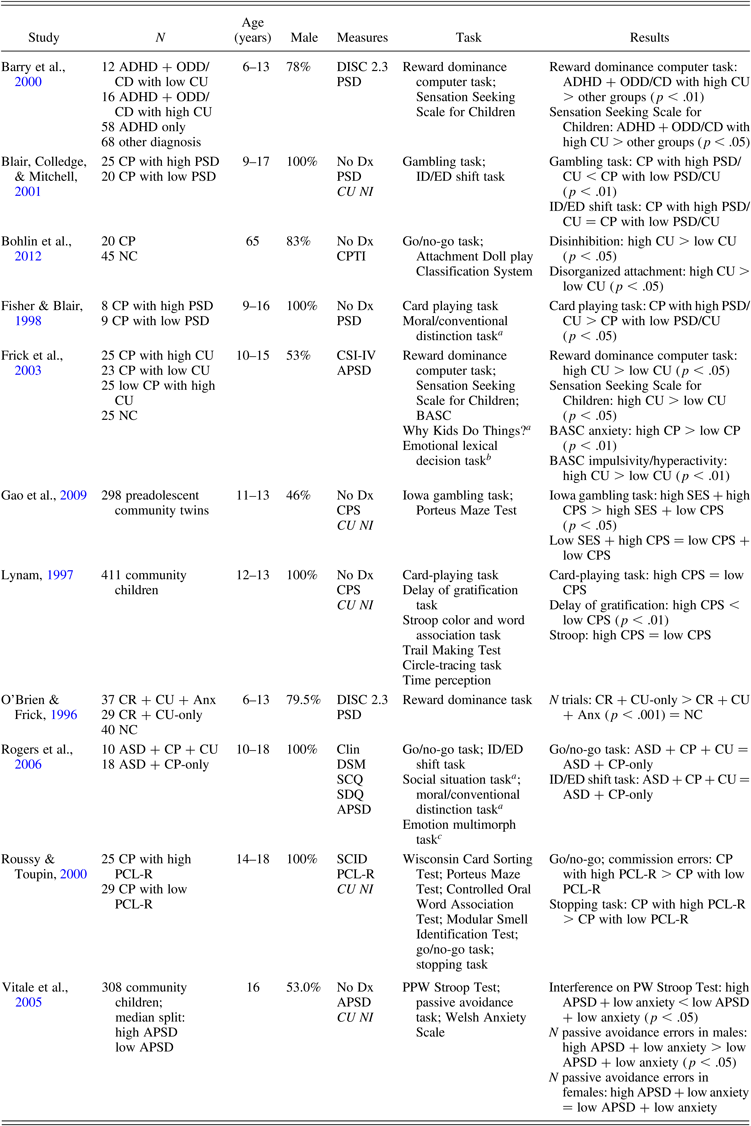
An increased sensitivity for reward is implied by research suggesting that adult psychopaths have problems in inhibiting responses that are known to lead to punishment (i.e., passive avoidance) when they are actively involved in reward-seeking behavior (Hiatt & Newman, Reference Hiatt, Newman and Patrick2006). This reversal learning seems to be impaired in adult psychopaths (Blair, Reference Blair, Salekin and Lynam2010a; Lykken, Reference Lykken1957) and is incorporated by DHS as well as IES. Moreover, IES predicts this impairment for youths with CU traits as well. Whereas DHS reasons that low cortisol and high testosterone are thought to induce a shift in motivational balance toward decreased punishment sensitivity and enhanced reward sensitivity, IES reasons impaired amygdala functioning to be the core deficiency in psychopathy, leading to decreased response to aversive cues, which in turn leads to impaired stimulus–punishment associations. These impairments in reward and punishment learning have become a major point of interest in the research in youths with CU traits (see Table 4).
Studies on passive avoidance
Note: ADHD, attention-deficit/hyperactivity disorder; ODD, oppositional defiant disorder; CD, conduct disorder; CU, callous–unemotional traits; ID/ED, intradimensional/extradimensional; DISC 2.3, Diagnostic Interview Schedule for Children 2.3 (Shaffer et al., Reference Shaffer, Fisher, Piacentini, Schwab-Stone and Wicks1992); PSD, Psychopathy Screening Device (Frick & Hare, Reference Frick and Hare2000); CP, conduct problems; No Dx, no DSM or International Classifications of Diseases diagnosis; CU NI, no information available on either the presence or influence of CU (related) traits; NC, normal control; CPTI, Child Problematic Traits Inventory (Andershed, Reference Andershed2009); CSI-IV, Child Symptom Inventory (Gadow & Sprafkin, Reference Gadow and Sprafkin2002); APSD, Antisocial Process Screening Device (Frick & Hare, Reference Frick and Hare2001); BASC, Behavioral Assessment System for Children; CPS, Child Psychopathy Scale (Lynam, Reference Lynam1997); CR, clinic referred; Anx, anxiety disorder; ASD, autism spectrum disorder; Clin DSM, clinical DSM diagnosis; SCQ, Social Communication Questionnaire (Rutter et al., Reference Rutter, Bailey and Lord2003); SDQ, Strengths and Difficulties Questionnaire (Goodman, Reference Goodman1997); PCL-R, Psychopathy Checklist—Revised (Hare, Reference Hare1991a); SCID, Structured Clinical Interview for DSM-III-R (Spitzer et al., Reference Spitzer, Williams, Gibbon and First1992); PW, Picture Word.
aSee Table 3.
cSee Table 5.
aSee Table 2.
The passive avoidance paradigm comprises games in which participants should learn to avoid risky decisions because of the negative consequences. Instead they should learn to make safe decisions because they finally result in an overall gain. In other words, the capability of avoiding negative consequences by refraining from action is measured. Most studies (Barry et al., Reference Barry, Frick, DeShazo, McCoy, Ellis and Loney2000; Fisher & Blair, Reference Fisher and Blair1998; Frick et al., Reference Frick, Cornell, Bodin, Dane, Barry and Loney2003; O'Brien & Frick, Reference O'Brien and Frick1996) regarding CU traits that aimed to measure avoidance of immediate punishment applied a task that was designed to measure reversal learning as well. Thus, participants also had to learn that formerly safe decisions have become risky and therefore should now be avoided. These studies all show that passive avoidance behavior, as well as response reversal in youths with conduct problems (Barry et al., Reference Barry, Frick, DeShazo, McCoy, Ellis and Loney2000; Fisher & Blair, Reference Fisher and Blair1998; Frick et al., Reference Frick, Cornell, Bodin, Dane, Barry and Loney2003) and youths without conduct problems (Frick et al., Reference Frick, Cornell, Bodin, Dane, Barry and Loney2003; O'Brien & Frick, Reference O'Brien and Frick1996), is decreased in the presence of CU traits. In psychopathic youths, passive avoidance, measured without response reversal, was found to be decreased in high psychopathic male but not in female participants who were low anxious (Vitale et al., Reference Vitale, Newman, Bates, Goodnight, Dodge and Pettit2005); a previous study in psychopathic youths did not find this decreased passive avoidance (Lynam, Reference Lynam1997).
Studies regarding juvenile psychopathy that aimed to measure passive avoidance of longer term punishment showed decreased passive avoidance as well when psychopathy scores were high (Blair, Colledge, & Mitchell, Reference Blair, Colledge and Mitchell2001), but only in high socioeconomic status subjects (Gao, Baker, Raine, Wu, & Bezdjian, Reference Gao, Baker, Raine, Wu and Bezdjian2009). This suggests that biological factors play a more important role when social risk factors seem to be absent. In a somewhat similar way, delay of gratification was found to be decreased in psychopathic youths (Lynam, Reference Lynam1997), implying an increased reward sensitivity.
Impairment in passive avoidance tasks was not due to deficits in attention shifting capacities in youths with either psychopathic traits (Blair, Colledge, & Mitchell, Reference Blair, Colledge and Mitchell2001), or with autism spectrum disorder and high CU traits (Rogers et al., Reference Rogers, Viding, Blair, Frith and Happe2006). Neither was the impairment in these tasks found to be due to deficits in response inhibition in relation to either CU traits (Bohlin, Eninger, Brocki, & Thorell, Reference Bohlin, Eninger, Brocki and Thorell2012; Rogers et al., Reference Rogers, Vitacco, Jackson, Martin, Collins and Sewell2002) or psychopathic traits (Roussy & Toupin, Reference Roussy and Toupin2000).
Three studies in community children (Gao et al., Reference Gao, Baker, Raine, Wu and Bezdjian2009; Lynam, Reference Lynam1997; Vitale et al., Reference Vitale, Newman, Bates, Goodnight, Dodge and Pettit2005) did not control for conduct problems. Nevertheless, the reviewed studies regarding passive avoidance imply decreased passive avoidance behavior in youths with conduct problems and CU traits, whereas response reversal seems to be impaired as well. According to Blair (Reference Blair2006) response reversal seems to be less marked in youths than in adults. Although these findings do not lead us directly to the supposed underlying causes, such as an imbalance in the testosterone/cortisol ratio or amygdala dysfunctioning, findings from the reviewed studies are in line with THBE and IES models.
Emotion recognition
Deficits in emotion recognition are thought to play an important role in impaired empathic functioning in psychopathy (Blair, Reference Blair1995, Reference Blair2007, Reference Blair2008). It has been suggested that impaired functioning of the amygdala leads to impaired recognition of facial expressions of distress, specifically fear. Although there seems to be a large overlap between psychopathic and other antisocial samples (Marsh & Blair, Reference Marsh and Blair2008), impairment in emotion recognition, particularly recognition of fear, has been found in adult psychopaths (Blair & Cipolotti, Reference Blair and Cipolotti2000; Blair et al., Reference Blair, Mitchell, Peschardt, Colledge, Leonard and Shine2004; Dolan & Fullam, Reference Dolan and Fullam2006; Kosson, Suchy, Mayer, & Libby, Reference Kosson, Suchy, Mayer and Libby2002; Montagne et al., Reference Montagne, van Honk, Kessels, Frigerio, Burt and van Zandvoort2005).
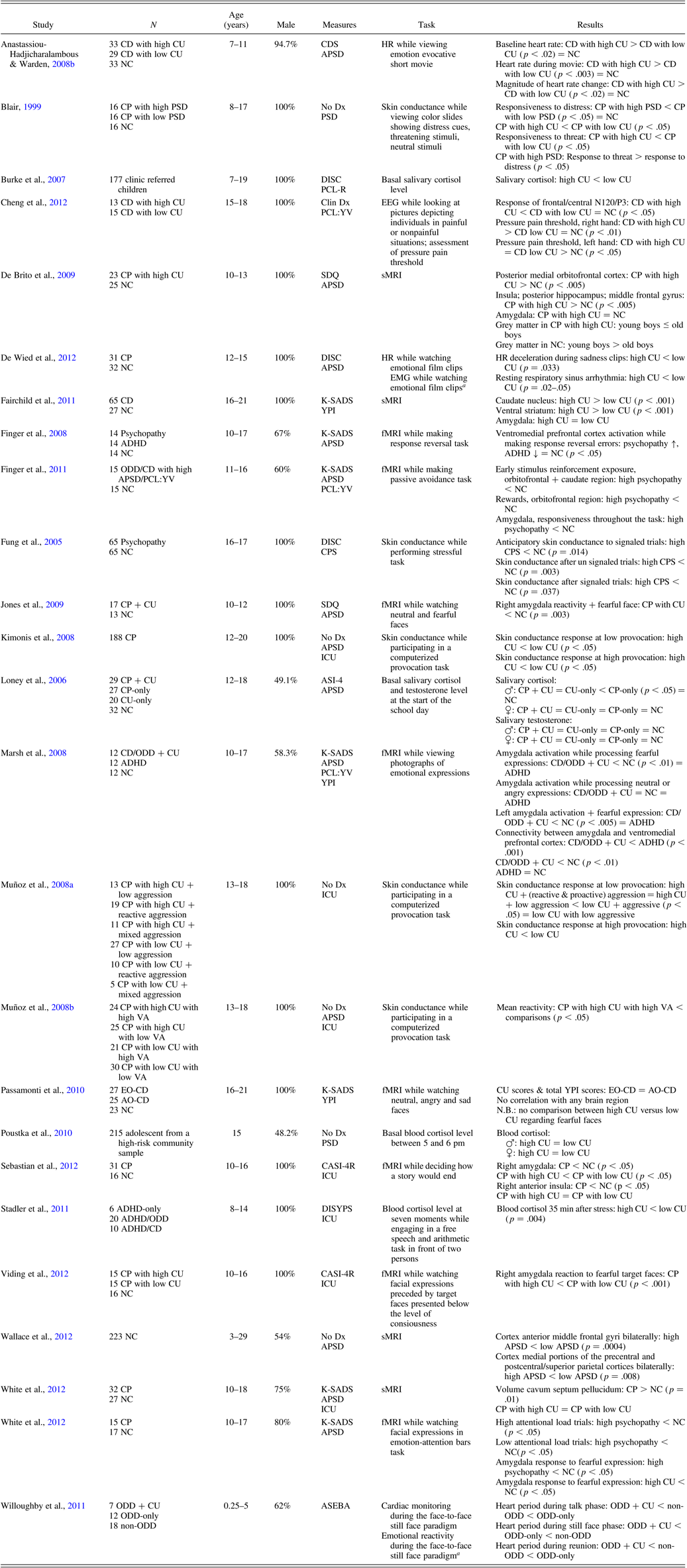
Emotion recognition studies regarding either CU traits in youths or juvenile psychopathy most often aim to measure visual recognition of facial expression of emotions (see Table 5). These studies used standardized sets of pictures of facial expression (most often sadness, happiness, anger, disgust, fear, and surprise). Research quite consistently shows impaired facial fear recognition in community youths (Blair & Coles, Reference Blair and Coles2000; Dadds et al., Reference Dadds, Perry, Hawes, Merz, Riddell and Haines2006; Dadds, El Masry, Wimalaweera, & Guastella, Reference Dadds, El Masry, Wimalaweera and Guastella2008; Muñoz, Reference Muñoz2009), and youths with conduct problems (Blair, Budhani, Colledge, & Scott, Reference Blair, Budhani, Colledge and Scott2005; Fairchild, van Goozen, Calder, Stollery, & Goodyer, Reference Fairchild, van Goozen, Calder, Stollery and Goodyer2009; Leist & Dadds, Reference Leist and Dadds2009; Sylvers, Brennan, & Lilienfeld, Reference Sylvers, Brennan and Lilienfeld2011) when CU traits are high. As only one study (Blair & Coles, Reference Blair and Coles2000) did not control for conduct problems, these findings seem to exist over and beyond conduct problems. However, preliminary evidence suggests that facial fear recognition may not be impaired when participants are instructed to look at the eyes (Dadds et al., Reference Dadds, El Masry, Wimalaweera and Guastella2008; Dadds et al., Reference Dadds, Perry, Hawes, Merz, Riddell and Haines2006). The findings on impaired recognition of sadness are found less often (Blair & Coles, Reference Blair and Coles2000; Blair et al., Reference Blair, Budhani, Colledge and Scott2005; Fairchild et al., Reference Fairchild, van Goozen, Calder, Stollery and Goodyer2009, Reference Fairchild, Stobbe, van Goozen, Calder and Goodyer2010; Woodworth & Waschbusch, Reference Woodworth and Waschbusch2008). Impaired recognition of sadness, but not of fear, was also found in a group of youths with autism spectrum disorder with high CU traits compared to low CU traits (Rogers et al., Reference Rogers, Viding, Blair, Frith and Happe2006). The time needed to recognize faces seems to be the same in boys with CD and high CU traits in comparison to those with low CU traits, whereas boys with autism spectrum disorder were found to react more slowly to faces that were developing a sad expression (Schwenck et al., Reference Schwenck, Mergenthaler, Keller, Zech, Salehi and Taurines2012). Studies reporting on juvenile psychopathy showed that higher levels of psychopathy were associated with poorer ability to recognise sad and fearful expressions (Blair, Colledge, Murray, & Mitchell, Reference Blair, Colledge, Murray and Mitchell2001; Stevens, Charman, & Blair, Reference Stevens, Charman and Blair2001).
Studies on emotion recognition
Note: CP, conduct problems; APSD, Antisocial Process Screening Device (Frick & Hare, Reference Frick and Hare2001); CU, callous–unemotional traits; No Dx, no DSM or International Classifications of Diseases diagnosis; PSD, Psychopathy Screening Device (Frick & Hare, Reference Frick and Hare2000); ↑, increased; ↓, decreased; CU NI, no information available on either the presence or influence of CU (related) traits; SDQ, Strengths and Difficulties Questionnaire (Goodman, Reference Goodman1997); ODD, oppositional defiant disorder; CD, conduct disorder; DISCAP, Diagnostic Interview Schedule for Children, Adolescents and Parents (Holland & Dadds, Reference Holland and Dadds1997); YPI, Youth Psychopathic Traits Inventory (Andershed et al., Reference Andershed, Kerr, Stattin, Kevander, Blaauw and Sheridan2002); NC, normal control; K-SADS, Schedule for Affective Disorders and Schizophrenia for School-Age Children (Kaufman et al., Reference Kaufman, Birmaher, Brent, Rao, Flynn and Moreci1997); Clin DSM, clinical DSM diagnosis; NS, nonsignificant; ICU, Inventory of Callous Unemotional traits (Frick, Reference Frick2004); ASD, autism spectrum disorder; SCQ, Social Communication Questionnaire (Rutter et al., Reference Rutter, Bailey and Lord2003); DISYPS-II, Diagnostik-System für psychische Störungen nach ICD-10 und DSM-IV für Kinder und Jugendliche-II (Döpfner et al., Reference Döpfner, Görtz-Dorten, Lehmkuhl, Breuer and Goletz2008); CBCL, Child Behavior Checklist (Achenbach, Reference Achenbach1991); Clin Dx, clinical diagnosis; ID/ED, intradimensional/extradimensional.
aSee Table 3.
bSee Table 2.
cSee Table 4.
Several studies have been conducted to test whether emotion recognition capabilities are decreased regarding only facial expressions or other types of emotion expression as well. Applying a vocal tone recognition task, CU traits were found to correlate negatively with fearful and happy vocal affect recognition (Blair et al., Reference Blair, Budhani, Colledge and Scott2005). Higher levels of juvenile psychopathy were significantly related to a decreased ability to name the sad and fearful facial and sad vocal affects correctly (Stevens et al., Reference Stevens, Charman and Blair2001). Furthermore, the accuracy in labeling body poses and facial expressions conveying fear was found to be decreased in the presence of high CU traits as well (Muñoz, Reference Muñoz2009). The results for emotion recognition in hypothetical situations showed no significant differences between these groups and NCs (Woodworth & Waschbusch, Reference Woodworth and Waschbusch2008).
DHS and IES both predict decreased emotion recognition, specifically regarding fearful emotion. This deficit is explained from decreased amygdala response to fearful expression. Regarding youths with high CU traits, specific deficits have been found in the recognition of fear and, to a lesser extent, sad emotion when expressed facially, vocally, and through bodily postures. A recent meta-analysis regarding psychopathy (Dawel, O'Kearney, McKone, & Palermo, Reference Dawel, O'Kearney, McKone and Palermo2012) suggested a possible broader emotion recognition deficit than only for fear and sad emotions. However, when investigating CU traits specifically, a specific deficit for fear seems to emerge in both youths and adults. As such, these findings are in concordance with DHS and IES.
Neurobiology
In the above-mentioned studies, the existence of specific neuropsychological information processing patterns in the presence of CU traits or psychopathy is demonstrated by measuring behavior. Research is ongoing to unravel the associated physiological systems, which have been described for adult psychopathy (Blair, Reference Blair2008, Reference Blair, Salekin and Lynam2010a; Fowles & Dindo, Reference Fowles, Dindo and Patrick2006; Glenn & Raine, Reference Glenn and Raine2008), and which play a crucial role in DHS as well as IES. Hence, it is important to find out whether findings for juvenile CU traits are consistent with these hypotheses. Studies have investigated autonomic responsivity, endocrinological functioning, and neural correlates in youths with CU traits (see Table 6).
Studies on neural correlates
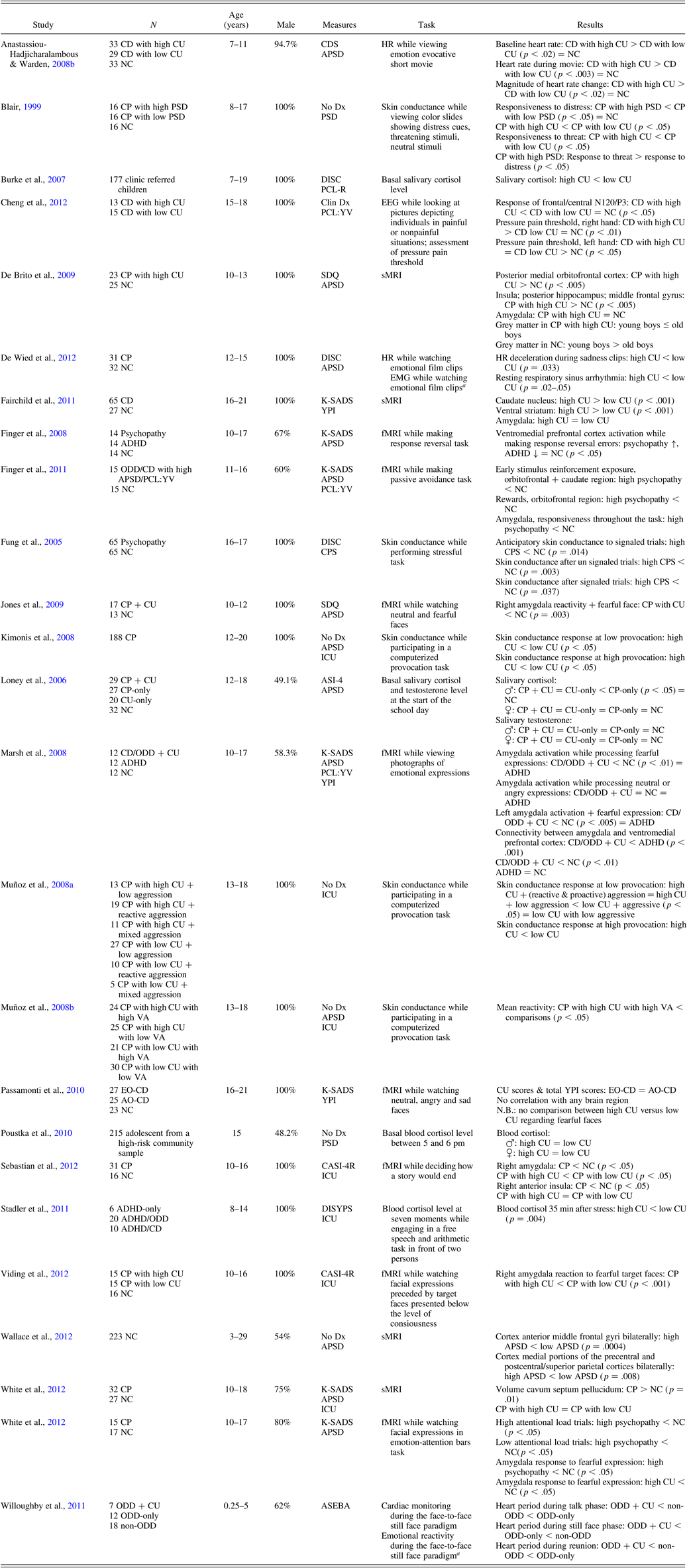
Note: CD, conduct disorder; CU, callous–unemotional traits; NC, normal control; CDS, conduct difficulties subscale of the Revised Rutter Teacher Scales for School-Age Children (Hogg et al., Reference Hogg, Rutter and Richman1997); APSD, Antisocial Process Screening Device (Frick & Hare, Reference Frick and Hare2001); HR, heart rate; CP, conduct problems; PSD, Psychopathy Screening Device (Frick & Hare, Reference Frick and Hare2000); No Dx, no DSM or International Classifications of Diseases diagnosis; DISC, Diagnostic Interview for Children (Costello et al., Reference Costello, Edelbrock, Dulcan, Kalas and Klaric1987); PCL-R, Psychopathy Checklist—Revised (Hare, Reference Hare1991a); Clin Dx, clinical diagnosis; PCL:YV, Psychopathy Checklist: Youth Version (Forth et al., Reference Forth, Kosson and Hare2003); EEG, electroencephalography; SDQ, Strengths and Difficulties Questionnaire (Goodman, Reference Goodman1997); sMRI, structural magnetic resonance imaging; EMG, electromyography; ADHD, attention-deficit/hyperactivity disorder; K-SADS, Schedule for Affective Disorders and Schizophrenia for School-Age Children (Kaufman et al., Reference Kaufman, Birmaher, Brent, Rao, Flynn and Moreci1997); YPI, Youth Psychopathic Traits Inventory (Andershed et al., Reference Andershed, Kerr, Stattin, Kevander, Blaauw and Sheridan2002); fMRI, functional magnetic resonance imaging; ↑, increased; ↓, decreased; ODD, oppositional defiant disorder; CPS, Childhood Psychopathy Scale (Lynam, Reference Lynam1997); ICU, Inventory of Callous Unemotional traits (Frick, Reference Frick2004); ASI-4, Adolescent Symptom Inventory (Gadow & Sprafkin, Reference Gadow and Sprafkin1998); ♂, male; ♀, female; VA, verbal abilities; EO-CD, early onset CD; AO-CD, adolescent onset CD; CASI-4R, Child and Adolescent Symptom Inventory-4R; DISYPS, Diagnostik-System für psychische Störungen im Kinders-und Jugendalter nach ICD-10 und DSM-IV (Döpfner & Lehmkuhl, Reference Döpfner and Lehmkuhl2000); ASEBA, Achenbach System of Empirically Based Assessment (Achenbach & Rescorla, 2000).
aSee Table 3.
Autonomic responsivity
Low fearfulness is associated with decreased autonomic arousal, which has been reported in psychopathic adults (Aniskiewicz, Reference Aniskiewicz1979; Blair et al., Reference Blair, Jones, Clark and Smith1997; Levenston, Patrick, Bradley, & Lang, Reference Levenston, Patrick, Bradley and Lang2000). Studies have examined whether emotional response to stimuli as reflected by the skin conductance response was diminished in youths with CU traits. This was found to be the case when using color slides with neutral, distressing, and threatening images (Blair, Reference Blair1999) and when using a computer game that included three levels of provocation of a fictitious peer (Kimonis, Frick, Skeem, et al., Reference Kimonis, Frick, Skeem, Marsee, Cruise and Munoz2008; Muñoz, Frick, Kimonis, & Aucoin, Reference Muñoz, Frick, Kimonis and Aucoin2008a, Reference Muñoz, Frick, Kimonis and Aucoin2008b). Similar results were found regarding juvenile psychopathy (Fung et al., Reference Fung, Raine, Loeber, Lynam, Steinhauer and Venables2005). Emotional response has also been investigated by monitoring the heart rate of participants (aged 7–11 years) while watching an emotion-evocative short movie in three groups. High CU traits were found to correlate with reduced baseline heart rate and reduced magnitude of heart rate changes (Anastassiou-Hadjicharalambous & Warden, Reference Anastassiou-Hadjicharalambous and Warden2008b). Although De Wied et al. (Reference De Wied, van Boxtel, Matthys and Meeus2012) could not replicate this finding, they found a significantly lower respiratory sinus arrhythmia, indicating lower cardiac vagal tone. Nevertheless, in 3- and 6-month-old infants heart rate was found to be increased in the presence of CU traits. It is suggested that early hyperarousal might lead to developmental downregulation toward an eventual hypoaroused state (Willoughby et al., Reference Willoughby, Waschbusch, Moore and Propper2011).
As predicted by DHS and IES, these studies, all of which controlled for conduct problems, show that in the presence of either CU or psychopathic traits, emotional reactivity and probably cardiac vagal tone (as measured through skin conductance and heart rate) seems to be decreased.
Endocrinological functioning
DHS posits that high testosterone levels accompanied by low cortisol levels lead to the impairments seen in psychopathy. In adults with psychopathy low basal levels of cortisol were found (Cima, Smeets, & Jelicic, Reference Cima, Smeets and Jelicic2008; Holi, Auvinen-Lintunen, Lindberg, Tani, & Virkkunen, Reference Holi, Auvinen-Lintunen, Lindberg, Tani and Virkkunen2006; O'Leary, Loney, & Eckel, Reference O'Leary, Loney and Eckel2007), whereas high testosterone levels were found to be related to socially deviant behavior but not to CU traits (Stålenheim, Eriksson, von Knorring & Wide, Reference Stålenheim, Eriksson, von Knorring and Wide1998). As cortisol levels are associated with emotional response to stress, these are thought to be diminished in the presence of juvenile CU traits as well. A recent study collected plasma cortisol levels in 15-year-olds from an epidemiological cohort study of children at risk for psychopathology. In both gender groups, CU traits were unrelated to cortisol levels, although lower cortisol levels in males were significantly related to higher scores on the subscale of poor impulse control (Poustka et al., Reference Poustka, Maras, Hohm, Fellinger, Holtmann and Banaschewski2010). However, this study did not control for conduct problems. Furthermore, in clinic-referred boys (Burke, Loeber, & Lahey, Reference Burke, Loeber and Lahey2007), as well as in a male community sample (Loney, Butler, Lima, Counts, & Eckel, Reference Loney, Butler, Lima, Counts and Eckel2006), high CU groups exhibited significantly lower resting salivary cortisol levels than did low CU groups. In females, differences were nonsignificant (Loney et al., Reference Loney, Butler, Lima, Counts and Eckel2006). Finally, cortisol reactivity was found to be blunted in boys with ADHD and high CU traits when performing a social stress test (Stadler et al., Reference Stadler, Kroeger, Weyers, Grasmann, Horschinek and Freitag2011), whereas no differences for testosterone were found (Loney et al., Reference Loney, Butler, Lima, Counts and Eckel2006).
In line with DHS and IES (although not explicitly discussed in the latter theory), research suggests a decreased salivary cortisol level in the presence of psychopathy. However, DHS predicted increased testosterone levels in relation to psychopathy. This prediction could not be confirmed in the one study in youths on this topic up till now. Thus, the question remains whether high testosterone levels are involved in the etiology of CU traits.
Neural correlates
Our knowledge regarding neural correlates of antisocial behavior is based primarily on studies in adults (Yang & Raine, Reference Yang and Raine2009). Structural magnetic resonance imaging (sMRI) studies in adults with psychopathy described inconsistent findings regarding anatomical abnormalities, although structural abnormalities within the superior temporal cortex, the orbitofrontal cortex (OFC) and the insula seem to be the most consistent findings. Most functional MRI (fMRI) studies regarding adult psychopathy showed reduced amygdala and OFC activity in response to tasks that are thought to correspond with amygdala-related emotional learning (for reviews, see Blair, Reference Blair2010b; Glenn & Raine, Reference Glenn and Raine2008). Recent studies further report decreased cortical thickness, especially prefrontal (Boccardi et al., Reference Boccardi, Frisoni, Hare, Cavedo, Najt and Pievani2011; Gregory et al., Reference Gregory, Ffytche, Simmons, Kumari, Howard and Hodgins2012; Ly et al., Reference Ly, Motzkin, Philippi, Kirk, Newman and Kiehl2012; Yang, Raine, Colletti, Toga, & Narr, Reference Yang, Raine, Colletti, Toga and Narr2010). Thus, the amygdala, the OFC and other parts of the PFC are important brain areas in the conceptualization of psychopathy, because these areas are thought to be involved in emotion processing and social judgment. Exposure to emotional faces potently activates the human amygdala, which has been implicated in different aspects of reward learning and motivation (LeDoux, Reference LeDoux2007). Furthermore, impaired amygdala activity was found to be related to impaired recognition of fearful faces (Adolphs et al., Reference Adolphs, Gosselin, Buchanan, Tranel, Schyns and Damasio2005). Moreover, the amygdala is thought to send valenced information to the OFC, where this information is used for social judgment and decision making (Blair, Reference Blair2007, Reference Blair, Salekin and Lynam2010a). Finally, a meta-analysis of brain event-related potential studies has shown that adult offenders with psychopathy, compared with nonpsychopathic offenders, have reduced P3 amplitudes when performing standard oddball tasks but not other tasks. This indicates that adult psychopaths have an inefficient deployment of neural resources in processing cognitive task-relevant information that is modulated by task characteristics (Gao & Raine, Reference Gao and Raine2009).
There are few MRI studies in youths with CU traits. An sMRI study compared boys (aged 10–13 years) with conduct problems and high CU traits (CP + CU) to typically developing boys (normal controls [NC]; De Brito et al., Reference De Brito, Mechelli, Wilke, Laurens, Jones and Barker2009). Grey matter volume was found to be increased in the posterior medial OFC and dorsal and rostral anterior cingulate cortices in the CP + CU group compared to the NC group. Whole brain analyses also confirmed grey matter volume increases in several other brain areas, whereas no structural differences were found in the amygdala and the anterior insula (De Brito et al., Reference De Brito, Mechelli, Wilke, Laurens, Jones and Barker2009). However, the interpretation of this study is limited by the omission of a group of subjects with CP and low on CU traits. In older boys (16–21 years) with CD and NC, no differences between the high CU and low CU groups could be found regarding the amygdala and the insula, the planned regions of interest in the study. However, a positive correlation was found between self-reported CU traits and the volume of the caudate nucleus and ventral striatum (Fairchild et al., Reference Fairchild, Passamonti, Hurford, Hagan, von dem Hagen and van Goozen2011). No enlargement of cavum septum pellucidum could be detected in youths with conduct problems and high CU traits (White, Brislin et al., Reference White, Brislin, Sinclair, Fowler, Pope and Blair2012), even though this relationship was found previously in adult psychopaths (Raine, Yang, & Colletti, Reference Raine, Lee, Yang and Colletti2010). Regarding juvenile psychopathy, thinning in different cortical regions was found (Wallace et al., Reference Wallace, Shaw, Lee, Clasen, Raznahan and Lenroot2012). However, interpretation of these findings remains difficult because only one study (Fairchild et al., Reference Fairchild, Passamonti, Hurford, Hagan, von dem Hagen and van Goozen2011) controlled for conduct problems.
An fMRI study in youths with CU traits found processing emotional expressions to be associated with weaker functional connectivity between the amygdala and the ventromedial prefrontal cortex (vmPFC) compared to youths without such traits (Marsh et al., Reference Marsh, Finger, Mitchell, Reid, Sims and Kosson2008). Moreover, reduced amygdala activity in response to viewing fearful faces has been found (Marsh et al., Reference Marsh, Finger, Mitchell, Reid, Sims and Kosson2008; White, Marsh, et al., Reference White, Marsh, Fowler, Schechter, Adalio and Pope2012), as well as a relative decreased activation of only the right amygdala (Jones, Laurens, Herba, Barker, & Viding, Reference Jones, Laurens, Herba, Barker and Viding2009; Sebastian et al., Reference Sebastian, McCrory, Cecil, Lockwood, De Brito and Fontaine2012; Viding et al., Reference Viding, Sebastian, Dadds, Lockwood, Cecil and De Brito2012). Furthermore, CU traits were found to predict variance in vmPFC responses during punished reversal errors (Finger et al., Reference Finger, Marsh, Mitchell, Reid, Sims and Budhani2008). With the use of pictures of only angry, sad, and neutral faces, no correlations with CU traits could be detected (Passamonti et al., Reference Passamonti, Fairchild, Goodyer, Hurford, Hagan and Rowe2010). Applying a passive avoidance and response reversal task in youths with high psychopathy scores, less activation was found in the amygdala, caudate, and dorsolateral PFC, compared to NCs (Finger et al., Reference Finger, Marsh, Blair, Reid, Sims and Ng2011). White, Marsh, et al. (Reference White, Marsh, Fowler, Schechter, Adalio and Pope2012) recently showed evidence that the emotional deficit observed in youths with conduct problems and psychopathic traits is primary located in the amygdala and not secondary to increased top-down attention to nonemotional stimuli. Regarding the fMRI studies, three (Passamonti et al., Reference Passamonti, Fairchild, Goodyer, Hurford, Hagan and Rowe2010; Sebastian et al., Reference Sebastian, McCrory, Cecil, Lockwood, De Brito and Fontaine2012; Viding et al., Reference Viding, Sebastian, Dadds, Lockwood, Cecil and De Brito2012) controlled for the level of conduct problems. However, Passamonti et al.'s study did not use fearful faces as stimuli, which makes the significance of the findings of the fMRI studies regarding CU traits of limited value.
A recent event-related potential study in youths with CD and high CU traits showed increased pain thresholds when compared to NCs. Moreover, the CD high CU group showed decreased electroencephalographic responses to distressing stimuli, that is, decreased N120 and P3 reactions (Cheng, Hung, & Decety, Reference Cheng, Hung and Decety2012). However, the clinical importance of this finding still has to be studied.
DHS and IES suggest impaired functioning of the amygdala, PFC, and decreased connectivity between these structures. On an anatomical level, findings from sMRI studies up until now are inconsistent, although no differences regarding the amygdala in relation to CU traits could be detected. The findings from fMRI studies indicate decreased responses in the amygdala and the PFC as well as a decreased connectivity between these two structures. This seems to be in line with adult psychopathy (Blair, Reference Blair2010b; Glenn & Raine, Reference Glenn and Raine2008). However, we found only two studies regarding youths showing an effect over and beyond conduct problems. Furthermore, a meta-analytic study (Yang & Raine, Reference Yang and Raine2009) regarding brain imaging studies in antisocial, violent and/or psychopathic behaviors did find reduced structure/function in the PFC, but a moderating effect of psychopathy could not be detected. Therefore, the presence of specific abnormalities in MRI studies is still not convincing.
Summary
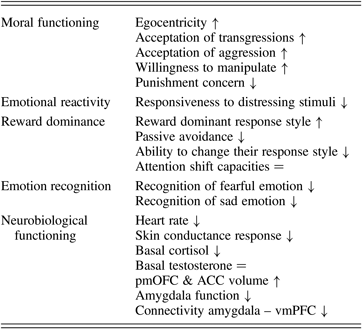
This work was undertaken to summarize the existent literature on neuropsychological and neurobiological functioning in juveniles with CU traits or juvenile psychopathy. It clearly shows that these juveniles show lower levels of prosocial reasoning, less psychological and physiological emotional responsivity, and decreased harm avoidance. Furthermore, there seem to be specific neural correlates, such as a reduced response of the amygdala and a weaker functional connectivity between the amygdala and the vmPFC in response to emotional stimuli (see Table 7).
Summary of findings on neurobiological markers
Note: ↑, increased in the presence of CU traits; ↓, decreased in the presence of CU traits; =, no difference; pmOFC, posterior medial orbitofrontal cortex; ACC, anterior cingulate cortex; vmPFC, ventromedial prefrontal cortex.
The data show the complexity of early psychopathy at different levels, ranging from clinical assessment to neuropsychology and neuroanatomy. Integration of these different levels into a single model is challenging to say the least. However, the need for an integrative model with reasonable predictive validity for outcome of clinical interventions would be of value to the field. To date DHS and IES are comprehensive models for psychopathy in adults that, in spite of showing overlap, also address distinct aspects. As such, they do not seem to be contradicting but, rather, complementary. Both theories address the role of specific brain structures, such as the amygdala and PFC, psychological aspects, such as low fearfulness, and neurocognitive impairments (decreased emotional reactivity, decreased recognition of fearful faces, decreased harm avoidance, decreased prosocial reasoning). DHS extends the etiological model in emphasizing the testosterone/cortisol ratio and the serotonergic system, while IES adds the gene/environmental interplay and the noradrenergic system. As such, the findings from our review regarding CU traits in youths are grossly in line with these theories. However, up till now an increase of testosterone, as well as decreased functioning of the right PFC, in relation to CU traits has not yet been shown. Thus, as discussed below, many questions remain regarding the role of neurotransmitters and hormones and neural correlates, as these have received only very limited study up until now, and findings are inconsistent. Therefore, the relationship with the etiological models still has to be explored. Furthermore, there seem to be areas of interest that may need to be incorporated in overarching etiological models, such as the role of oxytocin, neural mechanisms, and the precursors, risk factors, and correlates of CU traits in early infancy. These will be discussed in the Future Research Section.
Discussion
Morality and aggression are thought to be based on complex anatomical and functional brain networks in which many brain structures, hormones, neurotransmitters and enzymes interact (Fumagalli & Priori, Reference Fumagalli and Priori2012; Yanowitch & Coccaro, Reference Yanowitch and Coccaro2011). Thus, a hormonal balances account of CU traits would be a gross simplification of the complex neurobiologic structure of CU traits. It would be very unlikely that there will be a one-to-one mapping of biological variables to phenotypic constructs. However, the most prominent difference between DHS and IES relate to the moderating role of hormones and neurotransmitters in relation to psychopathy. This is an important difference, because clarifying this difference might help in a better understanding of the etiology of psychopathy in general and CU traits specifically. Therefore, we will briefly focus on a few topics regarding hormones.
Compared to other models, DHS specifically adds the importance of a decreased ratio between cortisol and testosterone levels. In particular, decreased cortisol has been thought to play an important role in empathy and callousness (Shirtcliff et al., Reference Shirtcliff, Vitacco, Graf, Gostisha, Merz and Zahn-Waxler2009), which is also recognized (though marginally) in IES. Decreased levels of cortisol have been found in youths with high CU traits. This is not surprising, because many studies regarding youths and CU traits included youths with conduct problems, and low cortisol levels are associated with aggression, particularly with early onset of aggression or proactive aggression (Barzman, Patel, Sonnier, & Strawn et al., Reference Barzman, Patel, Sonnier and Strawn2010; Cappadocia, Desrocher, Pepler, & Schroeder, Reference Cappadocia, Desrocher, Pepler and Schroeder2009).
However, no increase in testosterone was found in the only study in youths up till now (Loney et al., Reference Loney, Butler, Lima, Counts and Eckel2006). Although the DHS model hypothesizes an increased testosterone/cortisol ratio in youths with CU traits, there is no direct evidence to support this hypothesis. Nevertheless, increased levels of the precursor of testosterone, dehydroepiandrosterone, have been found to be increased in youths with antisocial behavior (for a review, see Barzman et al., Reference Barzman, Patel, Sonnier and Strawn2010). However, there is also discussion whether the relationship between testosterone and aggression should be seen as reciprocal instead of linear. Testosterone concentrations have been found to fluctuate rapidly in response to competitive and aggressive interactions, suggesting that not baseline differences but changes in testosterone shape ongoing and future competitive and aggressive behaviors (for a review, see Carré, McCormick, & Hariri, Reference Carré, McCormick and Hariri2011).
It was recently hypothesized that the level of the neurotransmitter serotonin might play a role in this equilibrium as well, leading to DHS and thus putting more emphasis on the testosterone–cortisol ratio in relation to prefrontal serotonin transmission (Montoya et al., Reference Montoya, Terburg, Bos and van Honk2012). DHS implies normal levels of serotonin in case of psychopathy. This is in line with the finding that the reactivity of the amygdala was found to decrease after administration of a single dose of citalopram. Citalopram is a selective serotonin reuptake inhibitor that increases the availability of serotonin in the brain. It is argued that this may account for a decrease in anxiety (Murphy, Norbury, O'Sullivan, Cowen, & Harmer, Reference Murphy, Norbury, O'Sullivan, Cowen and Harmer2009). Thus, normal cerebral serotonin levels relate to low anxiety, while low anxiety is thought to be a core symptom of psychopathy (Lykken, Reference Lykken1957). However, this has not been studied in youths with CU traits specifically.
IES states that the noradrenergic system is being disrupted in such a way that negative valence representations are less activated by aversive stimuli. There is some evidence that noradrenergic activity is decreased in disruptive behavior disorders (for a review, see Matthys, Vanderschuren, & Schutter, Reference Matthys, Vanderschuren and Schutter2011). Signals associated with punishment do not lead to noradrenergically driven increase of attention and change in emotional state, and therefore these signals become less meaningful. However, regarding noradrenaline and its precursor dopamine, complex mechanisms seem to be involved. These catecholamines act at different sites (Robbins & Arnsten, Reference Robbins and Arnsten2009), and mesolimbic dopamine responses seem to be context dependent, such that dopamine turnover can either increase or decrease depending on the social context (Trainor, Reference Trainor2011). A further complicating factor is that positron emission tomography and MRI data indicate that in an adult community sample the psychopathy dimension of impulsive antisocial behavior rather than fearless dominance (comparable to CU traits) might be associated with reward-related dopamine release in the nucleus accumbens. It is suggested that increased activity of dopamine neurotransmission plays an important role in psychopathy (Buckholtz et al., Reference Buckholtz, Treadway, Cowan, Woodward, Benning and Li2010). However, given the discussion whether aggressive/antisocial behavior should be seen as an essential part of psychopathy, and given that dopamine hyperactivity did not correlate with fearless dominance, the question remains whether high or low dopamine fits in an etiological model regarding psychopathy.
According to DHS, social-approach-related emotion is thought to be mediated by the left PFC, while withdrawal-related emotion is associated with the right PFC (van Honk & Schutter, Reference van Honk and Schutter2006). Therefore, the finding in three studies that boys with conduct problems and CU traits (Jones et al., Reference Jones, Laurens, Herba, Barker and Viding2009; Sebastian et al., Reference Sebastian, McCrory, Cecil, Lockwood, De Brito and Fontaine2012; Viding et al., Reference Viding, Sebastian, Dadds, Lockwood, Cecil and De Brito2012) showed decreased right amygdala reactivity to fearful faces is of special interest. This finding implies the possibility of less stimulation of the right PFC, which then leads to less social withdrawal and more approach-related behavior. In adults, however, findings regarding psychopathy are inconsistent (Yang & Raine, Reference Yang and Raine2009). Therefore, whether asymmetrical functioning of either the amygdala or the PFC is of vital importance for the existence of psychopathy has to be shown.
Taken together, the research findings in youths with CU traits, and especially with conduct problems, seem comparable to findings in adult psychopathy. This implies a convergence of neurobiological and neurocognitive underpinnings between youths with conduct problems and CU traits, and adult psychopathy. At this moment, the available research in youths, as reviewed, does find support for DHS and IES. However, specifically in relation to DHS, several assumptions have to be confirmed, such as an increase of testosterone in relation to CU traits, and a decreased functioning of the right PFC. In addition, more topics remain for further research, as will be discussed in the Future Research Section.
Limitations
It is important to bear in mind that this article is limited by the information available in the underlying primary papers. In the reviewed studies, distinct definitions were used regarding either CU traits or juvenile psychopathy. As there still is discussion about how to define both CU traits and psychopathy (Herpers, Rommelse, Bons, Buitelaar, & Scheepers, Reference Herpers, Rommelse, Bons, Buitelaar and Scheepers2012), it is difficult to fully compare the results from studies focusing on one of both definitions. In addition, many of the reviewed studies included youths with not only CD but also oppositional–defiant disorder (ODD) or comorbidity. Moreover, only 27 studies used structured interviews to assess these diagnoses. Only two of these diagnostic tools (i.e., the Diagnostic Interview Schedule for Children and the Kiddie Schedule for Affective Disorders and Schizophrenia) have been used more than twice (in 6 and 10 studies, respectively). Most often however, no specific diagnosis is described, and possible confounding factors, therefore, have not been clearly specified. Thus, a key limitation in the available research literature is the lack of evidence that the neurocognitive correlates or neurobiological correlates are specific to CU traits. Even though about 75% of the reviewed studies aim to control for either conduct problems and CD specifically, often it is not clear whether the neurocognitive of neurobiological correlates might be primarily related to conduct problems and/or aggression more globally. Therefore, future research thus needs to be more specific on the difference between CD and ODD when studying youths with conduct problems. Moreover, as CU traits can be present not only in the context of CD but also together with other forms of psychopathology, such as ODD or ADHD (without CD), or even without clear Axis I disorders, it is important in future research to apply (semi)structured diagnostic tools with clear separation of diagnostic groups.
Future Research
Several gaps in our knowledge about CU traits in youths can be identified. Here, we focus on those aspects of DHS and IES that we believe have gained insufficient attention in both models up till now.
Neither DHS nor IES refer to oxytocin as a moderating factor in the etiology of CU traits. However, oxytocin is thought to be a key moderator in complex social behaviors, such as attachment, social recognition, and aggression (Feldman, Reference Feldman2012; Heinrichs & Domes, Reference Heinrichs and Domes2008; Meyer-Lindenberg, Domes, Kirsch, & Heinrichs, Reference Meyer-Lindenberg, Domes, Kirsch and Heinrichs2011). Furthermore, it is suggested that the oxytocin/testosterone ratio seems to predict the kind of action one shows in social interaction, such that low oxytocin with high testosterone leads to antagonistic aggression (van Anders, Goldey, & Kuo, Reference van Anders, Goldey and Kuo2011). This is in line with findings that oxytocin, as well as social support and, especially, the combination, is found to have a positive effect on stress responsiveness, thus leading to decreased levels of cortisol (Heinrichs, Baumgartner, Kirschbaum, & Ehlert, Reference Heinrichs, Baumgartner, Kirschbaum and Ehlert2003). In addition, decreased responsiveness of the dopaminergic and oxytocinergic systems was found in mothers showing emotional neglect (Strathearn, Reference Strathearn2011). Finally, it seems the amygdala is the main target region of oxytocin (Meyer-Lindenberg et al., Reference Meyer-Lindenberg, Domes, Kirsch and Heinrichs2011). Therefore, it is important to conduct neurocognitive and neurobiological studies in which oxytocin is administered in subjects with high CU traits. In case of positive effects of oxytocin administration, the usefulness of therapeutic administration should be considered and investigated (cf. Dadds & Rhodes, Reference Dadds and Rhodes2008).
Conform IES twin studies showed that CU traits appear to be under moderate to strong genetic influence (~43%–81%; Blonigen, Hicks, Krueger, Patrick, & Iacono, Reference Blonigen, Hicks, Krueger, Patrick and Iacono2005, Reference Blonigen, Hicks, Krueger, Patrick and Iacono2006; Forsman, Lichtenstein, Andershed, & Larsson, Reference Forsman, Lichtenstein, Andershed and Larsson2008; Larsson, Andershed, H., Lichtenstein, Reference Larsson, Andershed and Lichtenstein2006; Taylor, Loney, Bobadilla, Iacono, & McGue, Reference Taylor, Loney, Bobadilla, Iacono and McGue2003; Viding, Blair, Moffitt, & Plomin, Reference Viding, Blair, Moffitt and Plomin2005; Viding, Frick, & Plomin, Reference Viding, Frick and Plomin2007; Viding, Jones, Frick, Moffitt, & Plomin, Reference Viding, Jones, Frick, Moffitt and Plomin2008). In the past few years, candidate genes have been detected. Significant associations between CU traits and gene variants that affect monoamine oxidase A (MAOA), catechol-O-methyltransferase (Fowler et al., Reference Fowler, Langley, Rice, van den Bree, Ross and Wilkinson2009), serotonin transporter (Fowler et al., Reference Fowler, Langley, Rice, van den Bree, Ross and Wilkinson2009; Sadeh et al., Reference Sadeh, Javdani, Jackson, Reynolds, Potenza and Gelernter2010), and oxytocin and oxytocin receptor gene polymorphisms (Beitchman, 2012) were found. A next step would be to link these genetic findings to cognitive and structural and functional MRI findings and adopt a so-called imaging genetics approach. This would reveal the cognitive and neural mechanisms that translate genetic vulnerability into clinical symptoms. Up till now, genes that encode for MAOA and serotonin transporter have been linked specifically to antisocial behavior (Gunter, Vaughn, & Philibert, Reference Gunter, Vaughn and Philibert2010). Low genetic expression of the gene that encodes for MAOA was found to be related to hyperreactivity of the left amygdala when viewing angry and fearful faces and increased connectivity with vmPFC, leading to increased harm avoidance and decreased reward dependence scores (Buckholtz et al., Reference Buckholtz, Callicott, Kolachana, Hariri, Goldberg and Genderson2008; Meyer-Lindenberg et al., Reference Meyer-Lindenberg, Buckholtz, Kolachana, Hariri, Pezawas and Blasi2006). Thus, high expression of the MAOA genotype might be related to either psychopathy or CU traits. Furthermore, the oxytocin receptor gene was associated with sociability, amygdala volume, and differential risk for psychiatric conditions, including autism, depression, and anxiety disorder (Brune, Reference Brune2012). However, whether this also can be found in youths with CU traits has to be shown. The same applies for the 32-kDa dopamine- and cAMP-regulated phosphoprotein DARPP-32 gene that encodes for a key regulatory molecule in dopaminergic signaling and was found to be related with higher aggression and smaller amygdala volume (Reuter, Weber, Fiebach, Elger, & Montag, Reference Reuter, Weber, Fiebach, Elger and Montag2009).
Thus far, DHS and IES do not include developmental considerations. Little is known about developmental changes regarding CU traits. Increasing, stable, and decreasing levels of CU traits over time were shown in a community sample (Fontaine, McCrory, Boivin, Moffitt, & Viding, Reference Fontaine, McCrory, Boivin, Moffitt and Viding2011; Fontaine, Rijsdijk, McCrory, & Viding, Reference Fontaine, Rijsdijk, McCrory and Viding2010). Furthermore, it remains unclear in which phase of development the deficits in neurocognitive and neurobiological functioning regarding CU traits arise. The reviewed studies roughly covered the age range between 6 and 18 years, with only three explicitly including younger children below age 6 (Dadds et al., Reference Dadds, Hawes, Frost, Vassallo, Bunn and Hunter2009; Kimonis et al., Reference Kimonis, Frick, Fazekas and Loney2006; Willoughby et al., Reference Willoughby, Waschbusch, Moore and Propper2011). Thus, virtually nothing is known about CU traits in infants and preschoolers. As early development of empathy predicts later prosocial behavior (Roth-Hanania, Davidov, & Zahn-Waxler Reference Roth-Hanania, Davidov and Zahn-Waxler2011), deficits in empathy may develop in early infanthood as well. It is implied that early PFC lesions occurring before 16 months might lead to treatment refractory and defective social and moral reasoning that bears similarities with psychopathy (Anderson, Bechara, Damasio, Tranel, & Damasio, Reference Anderson, Bechara, Damasio, Tranel and Damasio1999). The developmental “roots” for CU traits may stem from infancy in which attachment might play a moderating role in “‘reconnecting’ children born with a tendency toward interpersonal detachment” (Saltaris, Reference Saltaris2002, p. 744). Furthermore, attachment processes are reasoned to influence the development of the right brain as the dominant hemisphere for the unconscious processing of socioemotional information, in which also the amygdala and the PFC play an important role (Schore, Reference Schore, Solomon and Siegel2010). It is interesting that not only harsh parenting (Waller et al., Reference Waller, Gardner, Hyde, Shaw, Dishion and Wilson2012) but also disorganized attachment seems to be predictive for CU traits (Bohlin et al., Reference Bohlin, Eninger, Brocki and Thorell2012), which is in line with recent studies showing a correlation between CU traits and disorganized attachment (Pasalich, Dadds, Hawes, & Brennan, Reference Pasalich, Dadds, Hawes and Brennan2012) and early deprivation and CU traits (Kumsta, Sonuga-Barke, & Rutter, Reference Kumsta, Sonuga-Barke and Rutter2011). Furthermore, the importance of adequate attachment processes is illustrated by the finding that increasing eye contact with parents at an early age might increase empathic functioning, even when the deficit lies within the child (Dadds et al., Reference Dadds, Allen, Oliver, Faulkner, Legge and Moul2012; Dadds, Jambrak, Pasalich, Hawes, & Brennan, Reference Dadds, Jambrak, Pasalich, Hawes and Brennan2011). These studies suggest possible routes for interventions in which focus lies on social bonding in the very early phases of life (cf. Blair, Reference Blair2011). Further research regarding CU traits in infancy is needed, especially regarding brain development and attachment issues, as are follow-up studies after infancy.
Finally, the structural and functional neural underpinnings of psychopathy need further elucidation. As suggested in DHS and IES, the amygdala and PFC are involved in psychopathy (White, Marsh, et al., Reference White, Marsh, Fowler, Schechter, Adalio and Pope2012). However, we found only one sMRI study (Fairchild et al., Reference Fairchild, Passamonti, Hurford, Hagan, von dem Hagen and van Goozen2011) and two fMRI studies (Sebastian et al., Reference Sebastian, McCrory, Cecil, Lockwood, De Brito and Fontaine2012; Viding et al., Reference Viding, Sebastian, Dadds, Lockwood, Cecil and De Brito2012) that investigated the moderating role of CU traits while explicitly controlling for conduct problems and showing an effect over and beyond these problems. Thus, only tentative conclusions can be drawn regarding structural and functional neural correlates of CU traits in youths. Meanwhile, there still is discussion ongoing regarding the moderating role of the surrounding neuronal networks connecting several regions of interest around the amygdala (see, e.g., Glenn & Raine, Reference Glenn and Raine2008). Next, the mirror neuron system (MNS) may be an area of interest (Dinstein, Thomas, Behrmann, & Heeger, Reference Dinstein, Thomas, Behrmann and Heeger2008; Iacoboni & Mazziotta, Reference Iacoboni and Mazziotta2007). We were unable to find any studies that paid attention to the MNS in youths with either psychopathic or CU traits. However, we found one study in normal young adult students in which the MNS was activated by short videos (Fecteau, Pascual-Leone, & Theoret, Reference Fecteau, Pascual-Leone and Theoret2008). Students with the highest psychopathy ratings had the lowest activation of the MNS. Therefore, investigating the MNS in relation to CU traits might have an incremental value and lead to new insights regarding the neural organization in psychopathy.
The most important element supporting the incremental validity of a theoretical model is its predictive validity for choosing a treatment. Although findings regarding training in emotion recognition skills in school children are promising (Dadds, Cauchi, Wimalaweera, Hawes, & Brennan, Reference Dadds, Cauchi, Wimalaweera, Hawes and Brennan2012), medication might provide a path to improvement as well. However, it is still difficult to localize the specific neurotransmitter, neuroendocrinologic, or signaling pathway that is involved in psychopathy in youths as well as in adults (see also Glenn & Raine, Reference Glenn and Raine2008). Would a decrease of testosterone suffice for decreasing CU traits? Should cortisol levels be increased as well, or should we focus on oxytocin, instead, to improve trust and social bonding? Furthermore, as dopaminergic, noradrenergic, and serotonergic pathways seem also to be involved, maybe these need to be targeted as well. Moreover, when we use a pharmacologic agent for treatment, at which age or developmental period is it best to initiate treatment?
Conclusion
In conclusion, research data give an emerging view on the functioning of the brain in youths with CU traits and indicate that there are neurocognitive and neurobiological differences between juveniles with and without CU traits. Moreover, these differences seem to be in concordance with the findings in adult psychopathy and in line with existing theories on the development of and neurobiological functioning in psychopathy. IES and DHS both show important overlapping as well as distinct aspects. Nevertheless, they do not seem to be contradictory but complementary. The role of testosterone, and of the PFC, as suggested by DHS, has yet to be shown in juvenile CU traits. Furthermore, the role of other hormones and neurotransmitters needs further investigation as well. Finally, addition of oxytocin, the function of the MNS, and development in infants and preschoolers to these models needs further consideration.