Eleven years since the Good Friday Agreement and two years since the restoration of power-sharing in Northern Ireland, the British-Irish relationship remains a model of institutionalised cooperation and the case of Northern Ireland is held as a model of conflict resolution across the world. The aim of this article is to examine why cooperation evolved, by applying International Relations theory, specifically rational institutionalism, to the British-Irish relationship. In part one, an overview of rational institutionalism is provided and hypotheses are drawn. In section two, an overview is provided of the British-Irish relationship, highlighting the evolution of cooperation. In section three, rational institutionalism is applied to the findings and in conclusion the enduring relevance of rational institutionalism is stressed.
The centrality of British-Irish policy to resolving conflict in Northern Ireland necessitates an identification of the causes of British-Irish cooperation. Apart from its influence on the peace process in Northern Ireland, the British-Irish relationship necessitates investigation because historically, and until relatively recently, it was not a cooperative relationship. Even in 2004, it was described as ‘the most tense of all diplomatic relationships’ by one ex-Ambassador to the UK.Footnote 1 The impact of British-Irish policy on conflict in Northern Ireland has been examined rigorously,Footnote 2 but the causes of British-Irish cooperation have rarely been examined from an International Relations perspective. O'Leary set out various models to explain the Anglo-Irish Agreement (AIA) of 1985: the rational actor model, the organisational process model and governmental politics explanations.Footnote 3 The rational actor model assumes that the AIA was a rational decision reached by states in pursuit of their objectives.Footnote 4 The organisational process model states that governments are not unitary actors, but that their policies reflect bureaucratic standard operating procedures and approaches. The governmental politics explanation emphasises the role of political parties and leaders in explaining outcomes.Footnote 5
However, while there are overlaps between assumptions in some of these models and in some International Relations theories, (for example, assumptions of rationality, and assumptions of the role of institutions), an International Relations model is not included in O'Leary's typology. The value-added of International Relations is that it has developed with the key aim of explaining why cooperation and conflict occur.Footnote 6 The British-Irish relationship is a prime case to advance understanding of how cooperation can emerge in conflictual situations. Yet, it has been neglected by International Relations theorists and political scientists have failed to include International Relations approaches in their accounts.Footnote 7 Moreover, even in political science, explaining British-Irish cooperation is under-emphasised. The above explanations focus on the AIA in 1985, but theoretical explanations for later agreements and initiatives are not examined, as the emphasis is placed on the effect of cooperation on Northern Ireland. The aim of this article is not to dispute the relevance of other models to understanding the British-Irish relationship, but to supplement them by defining the indicators of British-Irish cooperation and by explaining how and why bilateral cooperation occurred in the British-Irish case.
1. Rational institutionalism: hypotheses and overview
The central tenet of this article is that a bilateral British-Irish institutional regime has advanced British-Irish cooperation. Regimes are defined as ‘institutions with explicit rules, agreed upon by governments that pertain to particular sets of issues in International Relations’.Footnote 8 For Keohane, ‘regimes are conceptualised primarily (although not exclusively) as explicit rules that are agreed upon by actors and embodied in treaties, or other documents’.Footnote 9 There are key themes in understanding bilateral or International Relations from a regime perspective. Of particular relevance to the British-Irish relationship is the work of Keohane and Nye.Footnote 10 While Keohane and Nye's study of bilateral relations ends in 1971, its findings and underlying assumptions are highly relevant to understanding bilateral British-Irish relations. In this section, four key issues – institutionalisation, cooperation, rationalism and interdependence – are examined and hypotheses for the British-Irish case are presented.
Institutionalism emphasises the role of institutions, specifically in this case, regimes, in enhancing the possibility of cooperation between states, based on their perceptions of self-interest. Regimes tap ‘realized or potential cooperation’.Footnote 11Cooperation is defined as ‘actions of separate individuals or organizations – which are not in pre-existent harmony […] brought into conformity with one another through a process of negotiation’.Footnote 12 For the purpose of this article, indicators of cooperation include:
• Number of meetings between government ministers and their officials.
• Mutual adjustment of policies
• A consensual style of policymaking
Order is defined by the absence of force, the lack of hierarchy among issues and the presence of multiple channels of contact between societies. There are two main ways in which a regime facilitates cooperation:
• It provides a long-term framework for bargaining, or a ‘reiterated game’
• It provides information to members, so that actors know that if one actor fails to cooperate, then other actors may reciprocate in the future.
Rationalism is at the heart of understanding the role of institutions in achieving cooperation between states. Under rationalist assumptions, actors, including governments, are rational egoists. Rational egoists are defined as actors who ‘seek to maximize value across a set of consistently ordered objectives’.Footnote 13 Where there are expectations of future interaction, actors may share ethical standards, even ‘though they may have different histories and experiences and perceptions’.Footnote 14 Axelrod demonstrated how in iterated games the likelihood of cooperation increased where future rewards of mutual cooperation are sufficiently valued. If one actor cooperates, the other reciprocates.
For institutionalists, the absence of full information among policymakers implies that conditions of bounded rationality exist in International Relations, analogous to market imperfections in microeconomics. One of the key benefits of the institution is that it provides more accurate information to its members about each other's intentions, preferences and the benefits of cooperation. Institutions allow members to share information and communicate more openly. Such bargaining will achieve policymakers’ aims more fully. A second key aspect of rational institutionalism is the role of interdependence.
Interdependence is crucial in understanding and explaining bargaining outcomes, defined as ‘mutual dependence’.Footnote 15 Interdependence can create conflict because if governments do not mutually adjust their policies, they can aggravate each other's situations.Footnote 16 For interdependence to exist there must be costs to actors if certain actions occur. In other words, interdependence demands some degree of coordination among actors, otherwise the behaviour of one actor will undermine the interests of other actors. Keohane and Nye specify different types of interdependence, providing a detailed breakdown of two main types: sensitivity interdependence and vulnerability interdependence:
Sensitivity interdependence involves degrees of responsiveness within a policy framework – how quickly do changes in one country bring costly changes in another, and how great are the costly effects?Footnote 17
Vulnerability interdependence refers to ‘the relative availability and costliness of the alternatives that various actors face’.Footnote 18 In others words, if two states are sensitive to each other's actions in oil policy, but one country has alternative sources of energy and the other does not, then the latter is more vulnerable, although both are sensitive to each other's actions. In Keohane and Nye's example, the ability of a country to change its policy in response to sensitivity interdependence may determine its vulnerability. Some countries may be constrained by physical factors, or by domestic constraints. Thus ‘the extent of domestic costs and the political willingness to bear them would be the measure of vulnerability’.Footnote 19 The various dimensions of interdependence – sensitivity and vulnerability – create asymmetriesFootnote 20 and these are sources of power for actors. However, different types of interdependence lead to potential political influence, but under different constraints. Sensitivity interdependence can provide the basis for significant political influence only when the rules and norms in effect can be taken for granted, or when it would be prohibitively costly for states to change their policies quickly.Footnote 21 These asymmetrical interdependencies determine bargaining outcomes, but only to an extent. For Keohane and Nye, the manipulation of these asymmetries in the bargaining process is crucial, because power measured in terms of resources may be different from power measured in terms of influence over outcomes.Footnote 22 The key determinant of whether the two dimensions differ is the stronger commitment of a less powerful state compared to that of a more powerful state.
A case study of the Canadian-American relationship shows stronger Canadian influence over bargaining outcomes in specific areas. The Canadian-American relationship is characterised as being a security community – the likelihood of military attack between both states is low. It operates within a complex interdependent environment. In addition, there are multiple channels of contact,Footnote 23 for example, trade, population flows, business ownership, social contacts. Each country was the other's most important trading partner.Footnote 24 Although formal institutions were weak, a strong regime existed: ‘diplomats and close observers were quite able to describe the expected procedures and rules of the game’.Footnote 25 These rules comprised: alliance, consultation and prohibition of overt issue linkage.Footnote 26
Within this regime, despite, the USA's hegemonic status, Canada has influenced more bargaining outcomes over time and has also altered the rules of the bargaining game over time.Footnote 27 In contrast, the Australian-American relationship afforded more influence to the USA over outcomes in the post-war period. Key reasons for this difference are identified. For example, asymmetry of vulnerability was less in Canadian-American case: in many cases, the USA was more vulnerable to Canadian decisions than it was in the Australian case, for example in business and trade. In the Australian-American relationship, military security topped the agenda and Australia depended heavily on USA protection during World War II and in the post-war period. While trade dependence on the USA was high for Canada, it also was significant for the USA, so Canada could threaten to retaliate using trade as a threat to impose its will.Footnote 28 In contrast, only ‘12 per cent of Australian exports went to the USA, compared to 66 per cent of Canadian exports’.Footnote 29 Migration between the USA and Australia was also considerably lower than that between the USA and Canada. Physical proximity also accounted for this situation.
In the Canadian-American case, a clear hierarchy of issues did not exist, but in the Australian case, hierarchy did exist with military security topping the agenda and economic interdependence being less significant. Therefore, ‘Canadians could play on American sensitivity dependence in certain issues’.Footnote 30 Intensity of preferences was stronger for Canada, particularly if Canadian multinationals aroused Canadian nationalist sentiment. For Canada, the intensity and coherence of the smaller state's ‘bargaining position’Footnote 31 contributed to its influence vis-à-vis the US. Institutionalisation is central to understanding the Canadian-American relationship, whereby it refers not only to formal international organisations, but to regime-building also.
The case of the Canadian-American relationship is potentially relevant to the British-Irish case. Its characteristics bear at least a superficial resemblance to those of the British-Irish relationship: the Canadian-American case and the British-Irish case were identified as ‘security communities’ by Deutsch in 1966, whereby ‘neither the publics, nor the political elites, nor even the military establishments expect war with each other’.Footnote 32 Both cases are governed by sets of regimes for specific policy areas. The Canadian-American case is a prime example of a relationship between a relative hegemon and a lesser power sharing a land border. It is an example of a relationship deeply set within an intricate web of social and economic ties, as is the British-Irish relationship While there are clear differences between cases, in particular, contemporary Canadian-American case has not been marked by a dispute over territory,Footnote 33 or rival nationalisms, these issue areas are not obstacles to comparing both cases, because in both cases cooperation appears to have evolved when it was not necessarily inevitable. Conflictual issues in the British-Irish case are potentially far greater, but the fact that it is viewed as a successful relationship begs the question of whether it has operated like any other bilateral relationship, in this case the Canadian-American relationship, or whether there are other reason for its success. Indeed, the British-Irish case because of its conflictual history can be viewed as an acid test of Keohane and Nye's framework.
The following propositions and hypothesis can be derived from the above institutionalist account. Under conditions of complex interdependence in bargaining relationships:
• Institutionalisation occurs where policy space is dense
• Institutionalisation causes increased cooperation
• The less powerful state concentrates resources on achieving its preferences
• The more powerful state has higher vulnerability and sensitivity interdependence
• The less powerful state achieves its preferences
In the next section an overview of the British-Irish relationship is provided before explaining why cooperation occurred.
2. The British-Irish relations: conflict, interdependence and cooperation
British-Irish Conflict: The British-Irish relationship is a case where ‘harmony […] a situation in which actors’ policies […] automatically facilitate the attainment of others’ goals’Footnote 34 has not always existed, yet relations were interdependent. Relations between both states occurred in the context of multiple ties and connections – a state of complex interdependence. Mass emigration to the UK throughout Irish history meant that most Irish citizens had relatives and/or friends in the UK. Trade links were high and communication and travel connections were well established. From the late 1960s, the desire to end conflict in Northern Ireland was an overriding common interest shared by both governments. Yet, historical differences created tension in the relationship.
In past centuries, Ireland's status a colony of the UK and British policy to Ireland were sources of prejudice, hatred and conflict. With independence in 1921, such conflict continued. In the 1920s, the Irish government refused to pay land purchase annuities to the British Exchequer and in retaliation the British government imposed tariffs on Irish agricultural imports to recoup its losses (the ‘economic war’).Footnote 35 When the conflict in Northern Ireland erupted, clear lines of division existed between British and Irish governments. In 1969, the then Irish Taoiseach Jack Lynch made an historic address stating that his government could not ‘stand idly by’, calling for UN intervention, an ending of partition and announcing the movement of troops and field hospitals to the border.Footnote 36 The suggestion of UN intervention was rejected by the British government, because it was alleged to erode British sovereignty. When Westminster Direct Rule over Northern Ireland began in 1972, and even in more recent times, differences between both governments emerged. Many political conflicts stemmed from the position of both governments as guardians of nationalist and unionist constituencies in Northern Ireland: ‘The British government is committed to defending the will of the majority in Northern Ireland’.Footnote 37
Traditionally, British and Irish preferences with respect to Northern Ireland reflected unionist and nationalist constituencies respectively. In particular, Irish preferences reflected SDLP (Social and Democratic Labour Party) preferences from the 1970s. Differences between both governments about the appropriate means of solving conflict in Northern Ireland led to strains in the British-Irish relationship. For Irish governments, until the 1980s, particularly for Fianna Fail governments, traditional nationalists constrained policy, whereby Irish unification was both the purpose of policy and the means of ending violence. As the next section shows, throughout the period of Direct Rule, conflicts between British and Irish governments about desired policy goals and the means of achieving them periodically loomed. Therefore there were potential trade-offs for both governments between maintaining a cooperative British-Irish relationship and protecting nationalist/unionist communities.
Un-equal: Historically, the British-Irish relationship was not only a conflictual relationship but an unequal one, feeding into Irish sensitivity about its ex-colonial status. The UK as a larger and more prosperous state enjoyed relative hegemony compared to the ROI on the world stage. Table 1 provides details of British-Irish trade.
British-Irish Trade, 1926–1984, as per cent of Irish total trade in £m

Source: McAleese (1984), cited in Tannam (1999), p. 45
In 1960, 46 per cent of Irish imports were from the UK and 61 per cent of Irish exports were to the UK.Footnote 38 While interdependence typified the policymaking environment, it was asymmetrical.
Even in contemporary times, Ireland's economic growth was not matched by international influence on the world stage. Studies of EU policymaking, for example, have emphasised the UK, France and Germany as dominant powers.Footnote 39 Studies of regional alliances within the EU demonstrate Irish allegiance and proximity to the UK, but for the UK, there are far more sets of bargaining relationships.Footnote 40 Again its diplomatic and bargaining connections are more diversified. Moreover, as Northern Ireland is legally part of the UK, the UK possessed ultimate policymaking power with respect to Northern Ireland, not Ireland. These historic sensitivities, divisions and asymmetries imply that the high level of British-Irish cooperation that preceded the resolution of conflict in Northern Ireland was not inevitable. It begs the question as to how cooperation occurred, despite historical tension and in a period of conflict in Northern Ireland. In the next section, an overview of the British-Irish relationship is provided.
1972 –2008: Evolution of cooperation
When the conflict erupted in Northern Ireland, policymaking differences were most stark and both governments were exposed as being ill-informed and poorly resourced to deal with the crisis:
One of the most striking features of the eruption of the Northern Ireland conflict in 1969 was the nakedness, both political and administrative, of the governments in both Dublin and London; both were badly informed and policies were formulated on an ad hoc basis.Footnote 41
After the eruption of conflict, institutional changes were made gradually. In the UK a Northern Ireland Office was created which worked with the Foreign and Commonwealth Office. These departments and members of other departments in civil and military agencies were coordinated by the Cabinet Office. In Ireland a separate Anglo-Irish unit was created in the Department of Foreign Affairs and the Department of the Taoiseach became increasingly involved in Anglo-Irish policymaking. The period between 1972 and 1985 was marked by both cooperation and tension in the British-Irish relationship. The outbreak of violence in Northern Ireland precipitated the imposition of Direct Rule in 1972 and also British-Irish discussions about new constitutional arrangements. Coinciding with domestic institutional change and the imposition of Direct Rule, British-Irish cooperation evolved tentatively from the 1970s and particularly from the 1980s onwards.
The Sunningdale Agreement (1973) provided for a two-tier Council of Ireland – a Council of Ministers with seven Irish and seven Northern Irish Ministers with executive powers in designated areas. Sunningdale was significant in that the UK government recognised an Irish dimension to solving the conflict, for the first time.Footnote 42 Ireland also recognised Northern Ireland's constitutional status in the UK. However, this recognition was not a commitment to provide for Irish constitutional recognition of Northern Ireland.Footnote 43 When Sunningdale failed in the face of unionist opposition, division in British-Irish preferences and policies was revealed once more. The UK government continued to emphasise internal solutions to the conflict, such as increased security and emergency powers. Moreover, British-Irish cooperation floundered until the 1980s.
In the early 1980s, British-Irish differences of opinion were very publicly apparent.Footnote 44 The Irish government became irate about the British government's handling of the 1981 nationalist hunger strikes in Northern Ireland, where ten nationalist prisoners died on hunger strike. There was also anger about British failure to reform the Northern Irish judicial system. Similarly, the British government was angered by Irish failure to agree to extradition arrangements, to increase security cooperation with the UK and by Irish refusal to support the UK in the Falklands/Malvinas War. A key unionist preference that the Irish constitutional claim to Northern Ireland be amended was not on the Irish bargaining agenda and nor was any form of joint authority – an Irish and nationalist preference – on the British bargaining agenda. This period became known as one of ‘megaphone diplomacy’, where both governments appeared strained and the then British Prime Minister, Margaret Thatcher, periodically became enraged by various Irish stances.Footnote 45
Overall, the early 1980s were marked by clear divisions of opinion. While joint initiatives were made, for example, the historic meeting between the Irish Prime Minister, Charles Haughey, and the British Prime Minister, Margaret Thatcher in May 1980 and the establishment of an Anglo-Irish Intergovernmental Council in 1981, both governments used the media to publicise their differences of opinion. For example, a month after the Haughey-Thatcher meeting, Haughey appealed to the UK to accept that British withdrawal from Northern Ireland was in the best interests of the UK and Ireland.Footnote 46 Irish traditional nationalist aims were stated explicitly. Similarly, then Irish Minister for Foreign Affairs, Brian Lenihan, stated that British-Irish talks ‘could lead to Irish unity in ten years’.Footnote 47 Prime ministerial meetings were also spasmodic.
When both prime ministers met in March 1983, it was the first prime ministerial meeting in nearly sixteen months.Footnote 48 Megaphone diplomacy reached its loudest point in 1984, when Thatcher vociferously rejected proposals from the nationalist parties’ New Ireland Forum Report. Again, annoyance by both governments was publicised. The Irish Prime Minister, Garrett FitzGerald, was alleged to have said that Thatcher's behaviour was viewed as being ‘gratuitously offensive’.Footnote 49 Gradually, these public displays of anger became less common. The cessation of megaphone diplomacy coincided with the creation of new institutional arrangements for Northern Ireland in 1985 – the Anglo-Irish Agreement (AIA).
The AIA signified a new departure in the British-Irish relationship by institutionalising the relationship by international treaty, implying that both states were bound to the terms of the Treaty unless both agreed to change it – it created a regime. The obligation to meet at least biannually meant that negotiations were not just once-off events, but part of a longer process to which both governments had committed. In this way, the AIA created a longer-term bargaining framework – a reiterated game – and provided greater certainty and information exchange in the bargaining relationship.
The AIA also marked a key change in that British-Irish governments began to play a joint leadership role. During this period, the relationship between nationalist and unionist preferences and British-Irish ones began to weaken. In particular, while Irish governmental preferences continued to be influenced by the SDLP, from 1985 both governments began to take the lead in constraining and/or creating extreme nationalist and unionist choices politically. A carrot-and-stick approach underlies successive British-Irish initiatives from this time. If nationalists and unionists agreed to support British-Irish initiatives, they would be rewarded: they would gain power, or some bargaining leverage. If they refused, they would be excluded – a policy of coercive consociationalism.Footnote 50 Thus, rather than British-Irish preferences simply reflecting unionist/nationalist preferences, British-Irish governments began to adopt a strategic leadership role from 1985, attempting to shape nationalist and unionist behaviour.
The AIA provided for a civil service secretariat in Belfast to provide a consultative role on specific cross-border issues and for an Anglo-Irish Intergovernmental Council to meet regularly, comprising heads of government and relevant ministers, where appropriate. The secretariat and the Intergovernmental Council were intended to reflect an ‘Irish dimension’ to resolving the conflict in Northern Ireland and reflected a compromise between Irish preferences for joint authority over Northern Ireland and British reluctance to cede sovereignty.
While, the AIA signified an historic step in the Anglo-Irish relationship, it did not meet Irish preferences for a fuller Irish dimension and nor did it meet British demands that the Irish constitutional claim to the territory to Northern Ireland be amended. However, the AIA coincided with a new period in the British-Irish relationship, where disagreements were generally less publicised and conducted through institutional and diplomatic channels. The post-1985 period witnessed concerted attempts to develop new institutional arrangements and build upon the provisions of the AIA. By 1993, it was evident that the Irish government was more willing to accept a referendum on constitutional change. Similarly, in the Downing Street Declaration, the British government stated that it had no selfish or strategic interest in Northern Ireland.
In 1995, The New Framework for Agreement, or Joint Framework Document (JFD), 22 February 1995, included a commitment to establish joint cross-border institutions possibly with executive powers over specific functional areas of activity. The issues of whether sovereignty would be eroded by the JFD and its cross-border provisions and whether Irish constitutional change would be provided for received particular attention. Immediately after the JFD, John Major, the British Prime Minister, emphasised that cross-border proposals did not imply joint sovereignty. Unlike previous negotiations, Irish constitutional amendment was obviously on the bargaining table in the 1990s and was referred to quite openly by Irish political leaders. The linkage of Articles Two and Three of the Irish Constitution to the establishment of cross-border institutions was implicitly accepted by Anglo-Irish policy makers, as shown by the Good Friday Agreement (GFA) in 1998.
The GFA drew from the 1995 Joint Framework Document providing for a power-sharing executive with devolved powers over specified areas was to be formed, following Assembly elections by PR-STV. A North-South Ministerial Council would be established to develop ‘consultation, cooperation and action within the island of Ireland, including through implementation on an all-island and cross-border basis – on matters of mutual interest within the competence of Administrations, North and South’. A British-Irish Council was provided for, comprising representatives the British and Irish Governments, devolved administrations/governments in Northern Ireland, Scotland and Wales and the crown territories of the Channel Islands and Isle of Man and if established, elsewhere in the UK. There was also a new British-Irish Intergovernmental Conference which subsumed both the Anglo-Irish Intergovernmental Council and the Intergovernmental Conference established under the AIA.
Finally, both governments agreed to introduce legislative changes to support the Agreement. As regards British legislation, Northern Ireland was deemed to be part of the UK and would not cease to be so without the consent of a majority of the people of Northern Ireland. If majority opinion changed, then legislation would be introduced to amend Northern Ireland's constitutional status. The 1920 Government of Ireland Act would be amended to underpin the establishment of new North/South institutions and East/West institutions. Most significantly, provision was made to amend the Irish constitution so as to remove the Irish territorial claim to Northern Ireland.
The following years were not without crises, but bilateral cooperation typified responses to these crises. In the aftermath of the GFA, uncertainty about the IRA's commitment to decommission its arms and criticisms of Sinn Féin for IRA failure to do so required the Irish government to reach agreement about decommissioning with its British counterpart and parties in Northern Ireland. However, the decommissioning issue also required the Irish government to keep Sinn Féin on board, rather than alienate extremist elements in Northern Ireland. British suspension of the Northern Ireland Assembly in 2000 in response to unionist dissatisfaction with IRA decommissioning constituted a potentially serious division between both governments, as the suspension was against Irish preferences. However, both governments returned to ‘cooperative bi-national intergovernmentalism’Footnote 51 and in 2001 ‘the Irish government secured a commitment from the British not to suspend unilaterally the power-sharing institutions without the consent of the Irish government’.Footnote 52 Moreover, both governments met and prepared a ten-page document of proposals linking IRA decommissioning to RUC reform. The effort to resolve the decommissioning crisis was made within the British-Irish intergovernmental framework.Footnote 53 Similarly, in 2003 a ‘raid’ of Stormont to expose alleged spies in Sinn Féin did not result in either government blaming the other, but instead precipitated a series of intensive crisis meetings between both governments to manage the crisis. In 2004, the Leeds Castle talks highlighted the united front presented by British and Irish governments with the aim of reaching agreement on reviving the Assembly with DUP and Sinn Féin participation.
In 2006,the St. Andrews Agreement laid the immediate path for the multi-party agreement to restore the Northern Ireland Assembly (May 2007) and enshrined most aspects of the GFA, but altered some aspects mainly at the behest of the DUP. For example, the First Minister of the Northern Ireland Executive must nominate a minister to attend the North-South Ministerial Council (under the GFA there was a requirement that representatives of both nationalist and unionist communities must attend).Footnote 54 There was a clearer statement that North-South Ministerial Council meetings must be attended by representatives of the Northern Ireland executive, that papers must be circulated in advance and that the executive should have improved oversight over the North-South Ministerial Council's work. The above overview testifies to the unprecedented scale of British-Irish institutional change.
Close British-Irish cooperation continued in the years following the St. Andrews Agreement. In 2008, the failure of the Northern Ireland executive to meet because of disagreements about devolving policing arrangements, precipitated close British-Irish contacts. While, there was greater onus on the Northern Irish parties to resolve the crisis themselves, given the establishment of a devolved assembly, the British-Irish response was one of ensuring that there was no option of muddling through in the absence of agreement on policing.Footnote 55 If no agreement was reached, there was a growing prospect of elections in Northern Ireland.Footnote 56 Moreover, while not stated, if parties were made aware that continuing in the absence of agreement on policing was not possible, then suspension of the executive and assembly could occur again. Thus, a modified type of coercive consociationalism continued to typify British-Irish policy to Northern Ireland. The above historical overview has highlighted the evolution of British-Irish cooperation. The number of agreements since 1973 reflected bilateral cooperation, but it also appears to have increased levels of cooperation, as the next section shows.
3. The British-Irish regime's effect on cooperation: the applicability of rational institutionalism
A fundamental problem in the rational insitutionalist argument that regimes may increase levels of international cooperation is the ‘cause and effect’/endogeneity problem,Footnote 57 namely that if governments decide to set up a regime or institution in the first place, they have already decided to cooperate to achieve their own interests. In the next section, evidence that the British-Irish regime caused increased levels of cooperation is provided. In other words, while the AIA and subsequent initiatives reflected a strong degree of cooperation, these initiatives also had an ‘independent impact’Footnote 58 on levels of cooperation.
Incidence of prime ministerial meetings
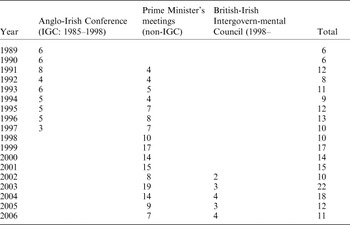
The Canadian-American relationship was typified by cooperation, a clear regime and Canadian bargaining influence. In this section, these characteristics are found to be present in the British-Irish relationship also. The clearest method of measuring cooperation is to examine the number of meetings between government leaders over time. Table 2 lists the number of meetings between British and Irish prime ministers since 1989.
Meetings between British and Irish prime ministers 1989–2006

Source: Keatinge (1990/1998), Rees, (1998/2007)Footnote 59
Source adapted
It is noteworthy that from the 1991 numbers of meetings increased. While figures for the 1970s and 1980s are harder to obtain, numbers of meetings began to increase after the AIA in 1985. Moreover, an increasing number of meetings occurred between prime ministers outside the formal IGC framework. This trend continued in 1998 when the GFA replaced the AIA. From the late 1990s, prime ministerial meetings increasingly spanned two or three days. Therefore, the AIA appears to have kick-started prime ministerial meetings within an institutional framework. However, from the 1990s, these meetings began to occur informally and more frequently, indicating a significant level of cooperation. One participant has observed that the biggest change in the conduct of British-Irish relations is their informality.Footnote 60 For example, the Irish Taoiseach now meets with his British counterpart at short notice and with very little preparation, compared to prime ministerial interaction in the 1980s.Footnote 61
Another striking feature of the above figures is the periodic increase in the number of meetings (for example, 1999 and 2003). In 2003, the high number of meetings was caused by the attempt to implement the GFA following the suspension of devolved government in 2002.Footnote 62 The crisis precipitated by the spy allegations of 2003 (see above) and the failure of the IRA to decommission led to close intensive prime ministerial cooperation and intervention typified British-Irish responses to crises in Northern Ireland, rather than overt disagreements about the appropriate means of dealing with each crisis. In contrast to the early 1980s, where prime ministers failed to meet for 16 months in reaction to the hunger strike crisis, the reaction to crises is now more communication, not less. This change in itself does not deal with the above endogeneity issue. The AIA in itself marked a decision to cooperate more closely and obliged prime ministers to meet regularly. However, the AIA appears to have had a multiplier effect on the number of meetings and also there is evidence that the regime gradually changed how British-Irish relations were conducted and how decisions were made. As the next section shows, mutual adjustment and consensual policymaking and strong civil service involvement typified the bargaining relationship from the late 1980s.
Mutual adjustment and consensus
Civil servants’ accounts of the British-Irish policymaking process highlight its increased informality and continuity since the AIA. For example, one senior official observed how in the early stages of negotiating the AIA there were clearly opposing sides.Footnote 63However, as negotiations continued, trust increased between both sides and gradually the Irish delegation ceased to advocate a purely Irish set of preferences on the bargaining table, but would take on board British approaches and vice versa. Thus, misperceptions diminished throughout the whole bargaining period. Similarly, another official has observed that by the 1990s the bargaining process was very much an intellectual exercise, whereby officials on both sides meet to resolve a current issue and approach the problem with a common view in an effort to conceptualise jointly the core of the problem.Footnote 64 Policies were more likely to emerge jointly from British-Irish discussions. Again, while the very signing of the AIA reflected cooperation, the bargaining processes precipitated by the AIA's institutional framework had a multiplier effect on levels of cooperation.
The policy agenda was also tightly controlled by officials in the Anglo-Irish Division of the Department of Foreign Affairs in Dublin and in Westminster. Conflicts of interest about issues not related to the conflict in Northern Ireland did not spill over to the British-Irish regime. Even before the GFA, all issues related to EU economic aid and cross-border cooperation were tightly controlled by and channelled through the Anglo-Irish Division.Footnote 65 More contentiously, the Sellafield issue, whereby successive Irish governments opposed the British nuclear reprocessing plant in Sellafield, was kept separate from other issues on the British-Irish agenda.Footnote 66 In this way potentially destructive issue linkage was rejected and ‘megaphone diplomacy’ was avoided. In other words, institutional design preserved bilateral cooperation.
Therefore, key indicators of cooperation exist in the British-Irish case: increased communication between policy makers and advisers, consensual politics and mutual adjustment of policies. Adversarial behaviour was avoided and disagreements were channelled diplomatically, rather than confrontationally, as in the 1970s and early 1980s. By the 1990s, issues which would have led to very public displays of disagreement and the need for ‘cooling off’ periods between both governments, had become rare, if not obsolete, highlighting the success of the British-Irish diplomatic relationship. The consensus was not perfect, however. Apart from the examples of tension listed above, one account of the GFA negotiations by a former adviser to Tony Blair mentions episodes of annoyance between politicians and bureaucrats about their dealings with groups in Northern Ireland.Footnote 67 However, the response by policymakers to such strains was typified by close interaction and coordination, despite potential intergovernmental conflicts. These changes in the bargaining style, the strong commitment to cooperation, despite differences of opinion and the higher incidence of prime ministerial meetings, as well as their informality, all indicate that institutionalisation caused increased levels of cooperation, rather than simply reflecting cooperation.
The British-Irish case resembles the Canadian-American one at a basic level, because an international regime, or regimes were created for managing specific policy areas and contributed to increased bilateral cooperation. In both cases, states were geographically proximate to each other. In both cases migration flows were high and in both cases there were shared common interests that were more effectively solved jointly. In particular, a key similarity is that in both cases the less powerful state wielded disproportionate influence over bargaining outcomes: Ireland and Canada respectively. The existence of this disproportionate influence constitutes another key similarity between both cases.
Irish influence on bargaining outcomes
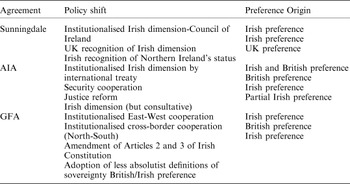
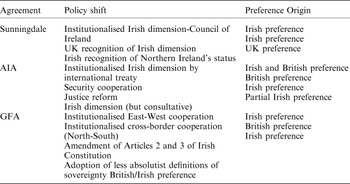
The GFA and its aftermath reflected fundamental change in the British-Irish relationship and fundamental compromise by Irish and particularly British governments. It reflected a degree of cooperation not present in the early years of conflict in Northern Ireland. By 1998 there was a tighter British-Irish consensus on resolving the conflict through the creation of new institutions and through constitutional reform. In other words, British preferences began to converge with Irish preferences over time. As argued above, this consensual process indicates the existence of increased levels of cooperation, but it also indicates Irish influence over bargaining outcomes, not coercively, but through consensual means. Table 3 demonstrates the key policy shifts and bargaining outcomes since 1973.
British-Irish policy shifts and preferences, 1973–1998
Source: Tannam (2001), p. 509, source amended
The above table highlights the degree to which bargaining outcomes reflected compromise, but also Irish preferences. Of the eleven key bargaining outcomes, seven can be traced to Irish preferences from the 1970s. Similarly, O'Leary has observed in his capacity as adviser to the Shadow Northern Ireland Secretary (Kevin McNamara) and then Northern Ireland secretary (Mo Mowlam) that from 1989–1998 many policy ideas setting the British-Irish bargaining agenda emanated from the Anglo-Irish Division.Footnote 68 Again, many of these ideas-sharing sovereignty, joint authority, recognition of multiple identities can be traced to John Hume's approach from the early 1980s. However, in terms of British-Irish bargaining, once Irish governments incorporated these ideas, they gradually began to influence both British preferences and the final policy outcomes.
However, both the Sunningdale Agreement and the AIA fell short of Irish demands, while satisfying some preferences. On one level, the Sunningdale Agreement appears to have differed little from the 1998 GFA, implying limited preference change and/or outcome change. However, unlike subsequent agreements, Sunningdale was ‘British-led’ and was ‘geared initially towards devolved power-sharing in Northern Ireland, followed by a belated side-payment to nationalists in the form of a Council of Ireland linking Northern Ireland and the Irish Republic’.Footnote 69 The underlying assumption for British policymakers was that the conflict in Northern Ireland was an internal one: the Irish government and the British-Irish relationship were not core components of conflict resolution. Security measures continued to be heavily stressed by the British government and commitment to end internment was overturned.Footnote 70 Twin declarations were made by both governments about the status of Northern Ireland, but these were made separately by both governments, unlike the JFD.
The AIA did not satisfy Irish governmental demands for a stronger Irish dimension, giving the Irish government only consultative power in designated areas. It also reflected differences between British and Irish governmental approaches to the conflict. The Irish government ‘primarily sought to reform Northern Ireland by advancing minority interests and aspirations in the administration of justice’, but the British government continued to emphasise security arrangements and minimising loss of sovereignty.Footnote 71 However, the Irish constitutional claim to Northern Ireland was a frequent topic of negotiation in the formulation of British-Irish policy and Irish governmental unwillingness to provide for its amendment or inability to do so because of public opinion, prevented its inclusion until 1998.
From 1985, a gradual alteration in British and Irish approaches to constitutional questions, implicitly, if not explicitly, is evident. A key Irish policy shift was the decision to provide for amendment of the Irish constitutional claim to Northern Ireland in the GFA. In contrast, in the GFA the British government made two policy shifts related to sovereignty – acceptance of a joint ministerial council and of the British-Irish Council. Moreover, the British policy shift in the mid-1980s from emphasising security and militarisation as a solution to the conflict in Northern Ireland to accepting a linkage between security reform, RUC reform and the inclusion of an Irish dimension was a fundamental policy shift. Many British policy changes satisfied Irish preferences. Clearly, even in the 1970s, British governmental preferences were not unequivocally tied to Union with Northern Ireland: for example, in 1972, the British government allowed a referendum in Northern Ireland on Northern Ireland joining the Republic of Ireland. However, this willingness to let Northern Ireland cede from the UK does not imply that the above British-Irish agreements simply reflected British revealed preferences – to be rid of Northern Ireland. The bargaining outcomes in Table 3, reflect a change in British policy to Northern Ireland, because implicitly the British government accepted notions of divisible sovereignty – Northern Ireland did not have to choose to be in the UK, or out of it, but could be both British and Irish. Similarly it was argued that ‘either, or sovereignty choices are now remote from reality’.Footnote 72
British governments also began to accept a strong Irish dimension to British policymaking for Northern Ireland. These concepts of sharing authority and of pooling sovereignty reflect fundamental changes in British approaches to the state and role of government. They also reflected SDLP and Irish governmental preferences from the mid to late 1980s. The reasons for Irish influence over final bargaining outcomes are very similar to the reasons for Canadian influence in the British-Irish relationship.
Sensitivity interdependence existed for both governments, but was higher for successive British governments. British governments were particularly sensitive to Irish governmental decisions towards Northern Ireland in security, giving Irish governments leverage in the relationship. Irish security cooperation along the border and more generally, was essential to combat nationalist paramilitary threats to Britain. The IRA attack on the Conservative Annual Conference in 1984, (the ‘Brighton Bomb’) brought the threat of IRA violence much closer to British citizens. While IRA bombing campaigns occurred throughout the 1970s, the 1984 bomb was significant politically in that is directly threatened British political elites, including the then Prime Minister Margaret Thatcher. It occurred after a period of intense security policy in Northern Ireland, yet the 1984 Brighton Bomb indicated that British policy was failing to resolve conflict. The 1981 hunger strike and subsequent death of hunger strikers led to a groundswell of support for Sinn Féin and the IRA and an increased support in the Republic of Ireland, indicating that British policy was failing. While bombing campaigns also occurred in the Republic of Ireland (for example, in 1974), the incidence of campaigns in Britain was higher, increasing sensitivity interdependence in security. Gaining Irish acceptance of closer security cooperation became a powerful bargaining incentive and created incentives for British governmental compromise in other areas.
Irish security cooperation was hindered by Irish criticism of miscarriages of justice in Northern Ireland – for example, the Diplock court system, and the shoot-to-kill policy. British policy reform became linked to security cooperation, thus giving Irish governments an important bargaining chip. More broadly, Irish security cooperation became linked to British agreement institutionalised cooperation with an Irish dimension. Again, largely because of asymmetrical sensitivity interdependence, Irish governments gradually influenced final bargaining outcomes – the AIA and later the GFA. While sensitivity interdependence was higher for the UK than for Irish governments, vulnerability was relatively equal.
Vulnerability interdependence: Vulnerability interdependence was relatively equal for both governments and awareness of this aspect coincided with deepening British-Irish cooperation. The failure of past policies to resolve conflict highlighted that there were very few alternatives, if British-Irish cooperation did not occur. However, British governmental perception of the absence of realistic alternatives occurred at a later date. As stated until the mid 1980s, a belief that British policy alone could solve the problem through normalisation and criminalisation dominated policy to Northern Ireland. By the 1990s, this emphasis on British sovereign policymaking power had been replaced by an Irish dimension. Again, in the absence of vulnerability, acceptance of an Irish dimension and the degree of Irish influence shown in subsequent years would not have occurred. Thus, higher British sensitivity interdependence and relatively equal British-Irish vulnerability interdependence explain the evolution of the British-Irish relationship since the 1980s and of Irish influence in that relationship. Other factors drawn from Keohane and Nye also explain Irish influence:
Irish Bargaining's Coherence and Intensity: Irish governments’ policy was marked (generally) by intensity and coherence. The Anglo-Irish Division was dedicated to British-Irish policy and, apart from membership of the EU in 1973, foreign affairs for the Irish government was mainly focused on the British-Irish relationship. As an ex-colony, Irish governmental attention was keenly focused on the UK. Moreover, as a lesser power, the Irish agenda was less crowded than that of the UK.
While there is evidence that increased institutionalisation, not only reflected, but also caused increased levels of British-Irish cooperation, the argument that institutionalisation caused increased Irish influence must be qualified. Irish assertiveness was observed in various historical accounts of the British-Irish relationship. For example, in the early stages of Irish independence, efforts were made to assert Irish identity on world stage, whereas for the UK:
Given the extensive preoccupations of a great power at bay, for the British government, the Anglo-Irish relationship was but one problem in a crowded agenda.Footnote 73
Anglo-Irish policy on the constitutional issue was often the result of unilateral decisions taken by the Irish governments which British governments chose to ignore rather than resist.Footnote 74
Historically, Irish pro-active policy and British reactive policy implied that British policy to Northern Ireland was a choice between ‘alternatives set by others’.Footnote 75
For example, the Irish government unilaterally declared an Irish Republic in 1949.Footnote 76 In 1973, the then Irish Prime Minister Jack Lynch played a key role in persuading then British Prime Minister, Edward Heath, to negotiate the Sunningdale Agreement.Footnote 77 However, the actual negotiations and outcomes of the Sunningdale agreement did not reflect Irish preferences as fully as later agreements (see above). It appears that Irish governments moulded British preferences through their successive negotiations in the British-Irish regime. In other words, Irish assertiveness and concentration of resources were not caused by institutionalisation, but the British-Irish regime seems to have afforded Irish governments more success in influencing British policy consensually, rather than Irish governments taking assertive, but unilateral initiatives, as in past decades. Apart from the above qualification, four aspects of Keohane and Nye's study of the Canadian-American relationship differ from, or confuse comparison with the British-Irish case: the role of violence, homogeneity, trade dependence and the role of the EU.
The limits of the institutionalist argument?
The role of violence and rise of Sinn Féin: The ‘elephant in the room’ with respect to any comparison of the British-Irish and Canadian-American relationship is that while the British-Irish relationship was described as a security community the outbreak of violence in Northern Ireland posed a very real threat to security in both states. Thus, as explained above, a counter to the institutionalist argument is that in the British-Irish case violence led to a regime – the regime is the result of cooperation, not the cause. Related to this argument, the groundswell of support for Sinn Féin after the hunger strikes in 1981 and its decision to enter electoral politics – the policy of the ‘ballot and the armalite’ – are recognised as key reasons for the AIA.
It is clear that in the absence of violence neither government would have had such large incentives to cooperate. At a basic level the conflict in Northern Ireland was a cause of the British-Irish regime and indeed cooperation itself is a meaningless term unless conflict exists in the first place.Footnote 78 However, empirical studies of the incidence of paramilitary violence and British-Irish initiatives cast doubt on the argument that increases in violence led to British-Irish initiatives:
There was no overwhelming case for a security offensive by the British and Irish states before the signing of the AIA. The most intense phase of political violence was in the early 1970s, during the collapse of Stormont and the failure of the Sunningdale settlement.Footnote 79
Similarly, levels of violence in the 1990s were not as high as in the 1970s, yet the GFA was signed in 1998. While Sinn Féin's decision to enter democratic politics in the 1980s was perceived as a threat by both British and Irish governments, the British-Irish common interest of stemming support for Sinn Féin in the early 1980s was similar to their common interest in stemming violence itself. In other words, the threat of Sinn Féin in the early 1980s and the need to undermine violence constitute common interests that led to the AIA. However, the above overview has highlighted how previous threats and crises did not always lead to bilateral cooperation. The Sunningdale Agreement was an act of cooperation in response to violence. However, when it failed, levels of cooperation fell – the will to cooperate was not sufficient to maintain dynamism in the British-Irish relationship in the 1970s. Indeed increased violence and instability dissipated British-Irish cooperation, rather than increasing it during this period. In contrast, the AIA while reflecting cooperation, also caused a consistency in British-Irish policymaking and a momentum that did not collapse. The AIA's long-term framework provided an avenue for the evolution of far greater compromise and consensual politics over the subsequent decade. In other words, violence and the threat of Sinn Féin in the British-Irish case constituted common interests – they caused regime-building. However, the regime itself had an independent and dynamic effect on cooperation. In this way, violence, while far more tragic, constituted a common interest in the British-Irish regime, just as economic factors constituted common interests in the Canadian-American regime. The underlying operation of the British-Irish and Canadian-American regimes is very similar, even though their specific interests and conflicts differ quite markedly.
Homogeneity: Keohane and Nye's precondition of domestic homogeneity in allowing states to pursue effective bargaining policy is difficult to apply to the British-Irish case. In fact traditionally, in the Republic of Ireland, the Northern Ireland issue and partition was the cause of a bitter divide upon which the party system was based. Fianna Fail particularly was divided in its policy to Northern Ireland until the 1980s, its more traditional nationalist wing being more extreme. Charles Haughey, then leader of Fianna Fail, opposed the AIA on the basis that it fell short of Irish demands and copper–fastened partition (as did Sinn Féin). The foundation of the (now-defunct) Progressive Democrats by a group of Fianna Fail politicians was partially an expression of opposition to more traditional nationalist policies within Fianna Fail. Northern Ireland became a political football, particularly for Fianna Fail, because it sought to maintain traditional nationalist support within the Republic of Ireland. In the UK, Northern Ireland was not as salient issue at election time. However, in the British case, ethnic divisions did limit homogeneity. Demands for devolution to Scotland and Wales became more vocal in the late 1980s and devolution was granted under the Blair-led Labour government in 1998.
However, by the 1990s, there was more political homogeneity, especially in the Irish case. Once in power Haughey supported the AIA and a cross-party consensus on the main lines of British-Irish cooperation developed. Homogeneity gradually typified policymaking. Northern Ireland's salience as an electoral issue was also in steady decline: economics dominated voters’ list of priorities, just as in the UK, enabling constitutional amendment of Articles 2 and 3. A key problem in relating homogeneity to Irish bargaining strength, however, is again a causality issue: it is possible that homogeneity resulted from British-Irish policy over time. In other words British-Irish policy altered citizens’ attitudes to sovereignty issues, rather than public opinion causing British-Irish policy change.
The EU: Another difference between the British-Irish case and the Canadian-American case is that since 1973, the UK and the Republic of Ireland have been EU members subject to common policies and an innovative political framework. The EU has created a multilateral consensual framework for British-Irish policymaking, involving a wider spectrum of actors. British and Irish membership of the EU exposed policymakers to a consensual mode of bargaining. The Franco-German model of post-war cooperation offered an example to other states of cooperation in the midst of historical division:
The language and conventions of EU policy-making have helped to open up a space for contending parties to talk about solutions to old problems in a new way – and to act upon them.Footnote 80
The EU has provided another platform for British-Irish negotiations, geographically separated from the domestic political realm, in providing ample opportunity for informal ‘corridor politics’. Both internal (Northern Irish groups and parties) and external influences, (for example the EU and USA) have an input into British-Irish policymaking.
The EU also provided a source of international pressure on British governments in the early 1980s. The European Commission on Human Rights criticised British policy in the early 1980sFootnote 81 and the European Parliament issued the Haagerup Report recommending the establishment of ‘Anglo-Irish’ machinery to deal with Northern Ireland.Footnote 82
As with the above qualifications, the role of the EU in the British-Irish relationship does not necessarily undermine the applicability of the Canadian-American model to the British-Irish case, but it does imply an amendment of the Canadian-American model in the latter case. The EU's reaction to the peace process and its various policy stances on Northern Ireland reflected the success of Irish and SDLP lobbying at EU level. Thus, the EU, while a factor not present in the Canadian-American case, may provide another example of Irish influence over bargaining outcomes – in this case in a multilateral regime. Moreover, as a multilateral regime, any positive impact on bilateral cooperation can be explained by the Keohane and Nye framework. Finally, much emphasis in highlighting the effect of the EU on British-Irish cooperation rests on its role in giving the Republic of Ireland more equal status with respect to the UK. However, the historical overview illustrated that the Republic of Ireland succeeded in being relatively assertive towards the UK since the foundation of the Irish state. Moreover, lessening trade dependence on the UK began to occur in the late 1950s and a very obvious decline is apparent from 1960 to 1973, implying that general conditions of global interdependence were also influencing the relationship. There is no counterfactual by which to measure the EU's impact on British-Irish cooperation and there are indicators that relative equality was emerging in pre-membership years. The consensual model provided by the EU may have influenced SDLP and Irish approaches to the Northern Ireland conflict, but it is difficult to determine the extent to which the EU explains Irish bargaining influence, or British-Irish cooperation.
Trade Dependence: the above overview highlighted how Irish trade dependence has gradually weakened, whereas in the Republic of Ireland case, trade interdependence was high with Canadian dependence on the US for exports being higher than USA dependence on Canada for its exports. However, again, this difference does not alter the applicability of the Republic of Ireland model. While trade links have altered, economic and cultural connections are still strong. Moreover, the overriding political interest of ending violence provided the most powerful incentive for regime-creation. In other words, the principles of the Republic of Ireland model still apply to the British-Irish case.
The role of leaders and political parties
The rational institutionalist framework may be criticised for neglecting the role of political turnover of political parties and of leaders. However, on closer inspection, a remarkable feature of British-Irish policy since 1985 is its continuity, despite different leaders and governing parties. This continuity was heralded as a sign of the influence of domestic bureaucratic influence, or proof of an organisational model at work, even before 1985:
Ensconced in the vacillations of personalities and crises-episodes, behind the zigzags in British policy-postures […] buried under the rapid turnover of Irish governments during 1980–82 […] compatible strategies for managing the Northern Ireland conflict have developed within the agencies of both states.Footnote 83
If personalities and parties were a causal factor in the British-Irish relationship, this degree of continuity would not have existed. The arrival of Tony Blair's Labour government after 16 years would have signified a deeper change in policy. However, in fact, the Labour government's path was eased by the Joint Declaration and the Framework Documents that were announced under John Major's Conservative government (see above). Therefore, there is no evidence that political parties, or leadership changes had a significant influence on British-Irish policy, or on levels of cooperation. However, another related argument is that John Hume and the SDLP played a key role in influencing the British-Irish relationship:
[T]he decisive actors in the politics of the signing of the Anglo-Irish Agreement has been the SDLP and its leader John Hume […] as the instigator of Anglo-Irish discussions […] as an actively consulted adviser to the Irish government during the negotiations, Hume has contributed more than any other leader towards the Agreement.Footnote 84
Again, this article does not dispute that Hume had a key influence over policy. However, the argument is that, once established, the British-Irish regime had an independent effect on cooperation – a multiplier effect. Empirical events, crises, violence, the rise of Sinn Féin, the influence of civil servants and Hume's tenacious lobbying and vision were all factors in explaining the AIA. However, this article has attempted to show that the specific international institutional framework established by the AIA had an independent effect on levels of British-Irish cooperation, by altering the mode of decision-making, the character of negotiations and by increasing the incidence of contacts. The rational institutionalist argument does not negate other arguments, but it does add to them, as the concluding section shows.
4. The ‘value-added’ of liberal International Relations theory
The overview of the British-Irish relationship and of its policymaking process highlights key characteristics that ‘fit’ rational institutionalist International Relations theory:
• The British-Irish relationship has become highly institutionalised, and highly cooperative
• Institutionalisation occurred in response to the need to manage a common interest: conflict in Northern Ireland and its resultant dense and complex policy space
• Irish preferences have dominated bargaining outcomes, despite Irish lesser status on world stage
The topic of British-Irish cooperation has been relatively neglected by academics. There are no International Relations accounts of it and there are very few political science accounts. This article has not disputed political science explanations that do exist. In particular, O'Leary's argument that the AIA was signed ‘because of a confluence of well-established bureaucratic strategies, incremental and exploratory manoeuvres by politicians and administrators interested in symbolic initiatives and jockeying for position on the part of the SDLP’Footnote 85 is not disputed. However, the focus of this article is on the impact of the AIA's institutional framework after 1985. The causes of the AIA may be explained by political science accounts, but the impact of the AIA's institutional framework cannot be explained by these accounts, because these accounts do not deal with the impact of international institutions and organisations, as opposed to domestic bureaucracies. The key argument is that international institutions, in this case bilateral institutions, provide powerful dynamics for cooperation – the bilateral outcome is larger than the sum of its parts. The logic of institutionalism at the domestic level is valid, but International Relations provide insight into the specific effects of international institutions.
The above section highlighted the gradual evolution of British-Irish cooperation from 1972 and also increasing institutionalisation of the British-Irish policymaking process. The reasons for institutionalisation multi-faceted: at heart the need to end violence and security threats motivated both governments to establish a firmer bargaining relationship, the need to stem the rise of Sinn Féin in the early 1980s, and the lobbying role of John Hume and the SDLP all explain the AIA. However, functionally, greater institutionalisation was needed to manage the variety of complex policy issues in Northern Ireland, issues that had definite implications for conflict resolution. Security cooperation was linked to British justice reform and Irish constitutional amendment was linked to a stronger Irish dimension in Northern Ireland for example. All these issues and many more were linked to conflict resolution overall. By dealing with all issues as a package through a British-Irish institutional regime, more effective policy and cooperation emerged. Undoubtedly, the creation of a British-Irish institutional regime reflected a degree of cooperation and shared interests. However, the creation of this institution had a fundamental effect on the conduct of relations. The above overview has highlighted the dynamic effects of British-Irish institutionalisation. Overall, the above case study of the British-Irish relationship has shown the enduring usefulness of Keohane and Nye's work and its striking applicability to the British-Irish case. These findings are significant not simply because they explain the evolution of cooperation in the British-Irish case, but because the institutional model identified by Keohane and Nye is likely to provide a template for other cases of conflict and tension in the twenty-first century, testifying to its ‘enduring relevance’ to international politics.