INTRODUCTION
Birds and bats disperse seeds of many tree and shrub species in Neotropical forests. This is particularly important in and near wet and wet-seasonal forests where the greater majority of trees and shrubs are dispersed by animals (Howe & Smallwood Reference HOWE and SMALLWOOD1982, Regal Reference REGAL1977). In southern Veracruz, Mexico, fruit and seed attributes of woody-plant species recruiting in experimental plots indicate that birds play a dominant dispersal role for trees of both early and later succession (de la Peña-Domene et al. Reference DE LA PEÑA-DOMENE, MARTÍNEZ-GARZA, PALMAS-PÉREZ, RIVAS-ALONSO and HOWE2014). To gain insight into which dispersal agents potentially facilitate seedling recruitment, it is useful to know which bird species use experimental plots of different initial planting treatments in agricultural mosaics of pasture, crops, forest remnants and isolated trees.
Whole-plot counts that recorded bird activity patterns in 24 fenced experimental plots over 10 y address four hypotheses: (1) Frugivore and non-frugivore activity increases more in planted than unplanted stands. (2) Fruit-eating birds are more likely to frequent stands of planted animal-dispersed trees. (3) Larger fruit-eating birds (≥70 g) capable of bringing seeds of moderate size (0.5–1.0 g) of shade-tolerant forest trees are more likely to frequent planted stands of animal-dispersed trees than stands of wind-dispersed trees or unplanted controls.
METHODS
Experimental plots were established in 2006. Twenty-four 30 × 30-m plots were fenced in a 3 × 8 grid over 12 ha of active pasture in August and September (182–260 m asl, central GPS point 18o35′43.64″N, 95o06′06.29″W). Plots were 90–460 m from late-secondary forest continuous with primary forest of the Los Tuxtlas Biological Station of Universidad Nacional Autonoma de Mexico. In September and October 2006, twelve 10–20-cm-high seedlings of each of 12 native animal-dispersed trees were planted in eight plots, 12 seedlings of each of 12 native wind-dispersed trees were planted in eight plots, and eight plots with no plantings served as controls. Precipitation varied from 2.7 m in a drought year (2007) to a mean of 4.8 m in normal years. Details of planting, maps, stand maturation and tree recruitment are reported elsewhere (de la Peña-Domene et al. Reference DE LA PEÑA-DOMENE, MARTÍNEZ-GARZA and HOWE2013, Reference DE LA PEÑA-DOMENE, MINOR and HOWE2016; Martínez-Garza et al. Reference MARTÍNEZ-GARZA, BONGERS and POORTER2013a, Reference MARTÍNEZ-GARZA, TOBON, CAMPO and HOWEb).
Initial vegetation was grass (primarily Cynodon plectostachyus; plant nomenclature follows www.tropicos.org), with negligible woody cover 2006–2009 to a median of 85% woody cover in 2016. Remaining herbaceous cover not under trees was grass or an invasive fern (Nephrolepis hirsutula), mostly in control plots, by 2016. Beginning in 2009, a few of 53 planted or passively recruited females of the dioecious pioneer tree Cecropia obtusifolia (Urticaceae) produced fruit; by 2010 nearly half of females of this species did. By 2013, all did. To estimate production of this fruit in one season of early succession, diameter at breast height (1.3 m) was measured in 2015 to estimate overall fruit production using an allometric relationship determined at Los Tuxtlas by Alvarez-Buylla & Martínez-Ramos (Reference ALVAREZ-BUYLLA and MARTÍNEZ-RAMOS1992). Estimates of annual fruit production were assumed to be in rank order of crop size of female trees in fruit during the sampling period in June 2015. From 2010–2016, some planted Ficus yoponensis (Moraceae), Inga sinacae (Fabaceae) and Tabernaemontana donnell-smithii (Apocynaceae) produced fruit sporadically in stands of animal-dispersed trees.
Birds were counted in late dry season (late May–mid June) 2007–2016. Whole-plot counts of 20 min were conducted one plot at a time on a stratified randomly timed schedule 06h30–18h30 (Bibby et al. Reference BIBBY, BURGESS, HILL and MUSTOE2000). Each block (stratum) of three counts included one plot in each treatment. Bird nomenclature follows the American Ornithologist Union database (http://checklist.aou.org/). Body masses were from Dunning (Reference DUNNING2013).
Brief, randomly timed bird counts that record activity throughout the day document use of vegetation and generally low-priority foods without biasing samples by time of day. The method permits evaluation of pooled data, for instance of frugivores and non-frugivores, or frugivores that disperse seeds and those that do not. Randomly timed counts at the end of the dry season do not address seasonal variation in use and may miss episodic events.
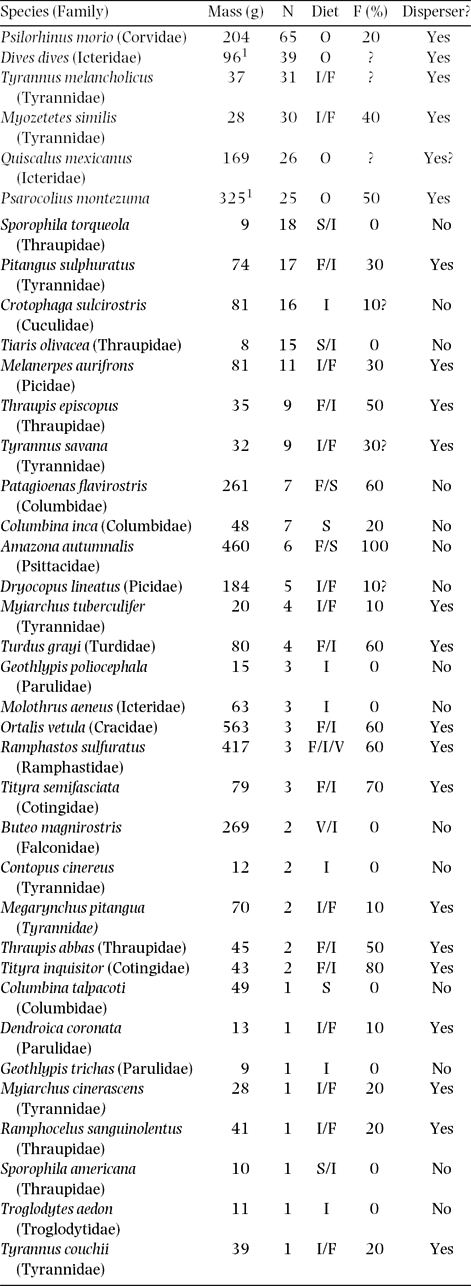
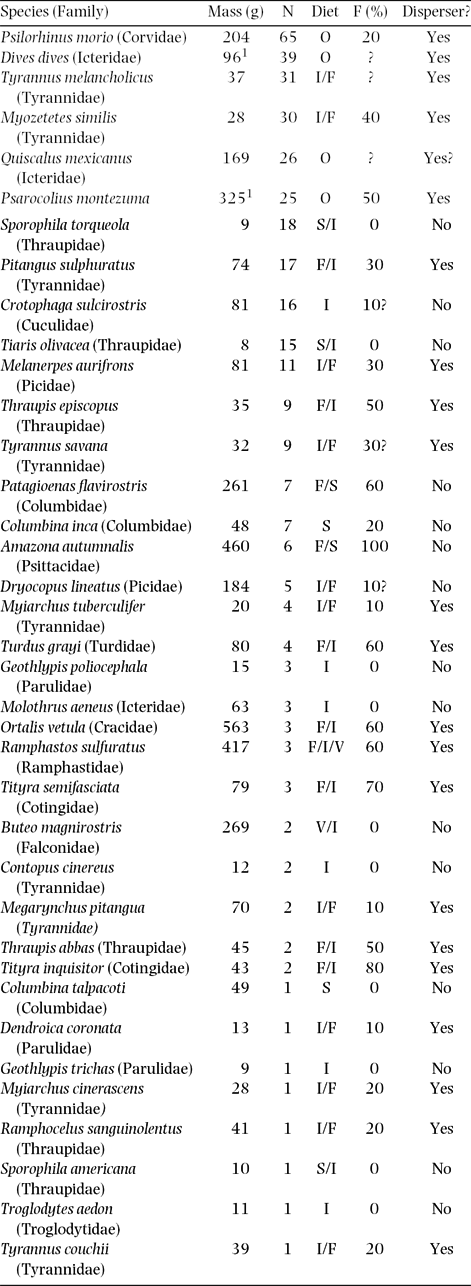
Designation of bird species as frugivores or seed consumers relied on literature and observations by the author (Appendix 1). Differences in designations of the same bird species as frugivores or not are common in the literature. Percentages of fruit in the diet of observed species are listed from a compendium of such literature (Wilman et al. Reference WILMAN, BELMAKER, SIMPSON, DE LA ROSA, RIVADENEIRA and JETZ2014). Where discrepancies occur, other literature or observations by the author are noted.
Over-dispersion of count data required use of non-parametric statistics (e.g. Spearman correlations of rank-order data, Friedman non-parametric ANOVA). Data were counts of birds per plot within treatments, or counts of birds in plots as a function of C. obtusifolia fruit resources. Analyses employed Systat 13.
RESULTS
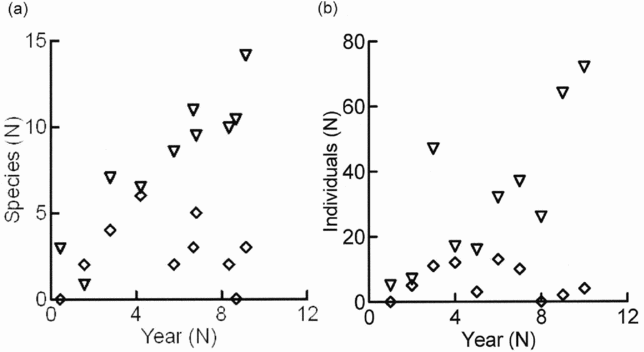
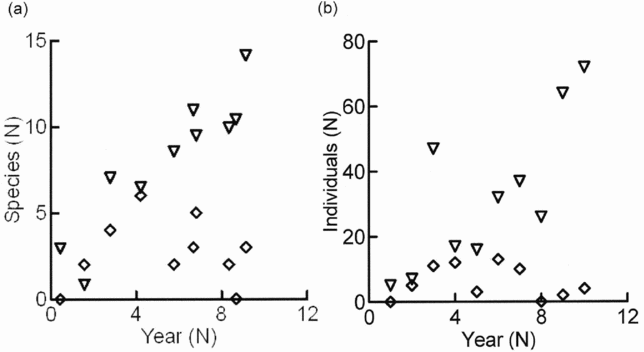
Counts of species and individuals of fruit-eating birds in plots increased monotonically over the 10-y study interval, but counts of non-frugivorous birds did not (Figure 1; Appendix 1). Similar results occurred in counts of frugivores that disperse seeds (e.g. Corvidae, most Icteridae, Ramphastidae, Tyrannidae) as compared with frugivores that were primarily seed consumers likely to kill seeds (e.g. red-billed pigeon Patagioenas flavirostris, red-lored parrot Amazona autumnalis, yellow-faced grassquit Tiaris olivacea).
Bird species and numbers in 24 whole-plot counts each year at Los Tuxtlas, southern Mexico. Species of birds that eat fruit (triangles) increase with time (rs = 0.97, P < 0.001), while those that eat little or no fruit (diamonds) show no consistent pattern (rs = −0.15, ns) (a). Number of individual fruit-eating birds (triangles) increases with time (rs = 0.77, P = 0.02), while number of birds that eat few or no fruits does not (rs = −0.13, ns) (b). Year 1 is 2007, Year 10 is 2016.
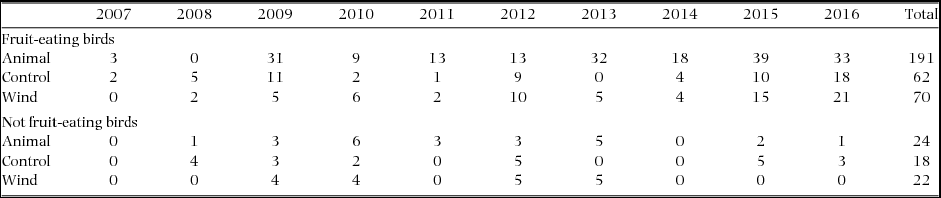
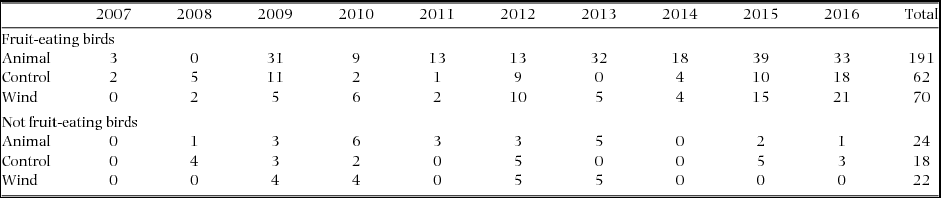
Counts of frugivorous versus non-frugivorous birds differed by planting treatment (Table 1). Fruit-eating birds were observed more in the eight stands of animal-dispersed trees over 10 y (191 records) than stands of wind-dispersed trees (70) or controls (62), while non-frugivorous birds showed no differences (24, 22, 18 respectively). Distributions of fruit-eating as contrasted with non-fruit-eating birds differed by treatment (χ2 = 11.1, df = 2, P < 0.005). Counted fruit-eating birds that dispersed seeds (170, 66, 59 as above) and fruit-eating birds unlikely to disperse seeds (42, 22, 22) did not differ by treatment (χ2 = 2.20, ns). Similarly, a non-parametric analogue to repeated measures analysis of variance, the Friedman test, determined whether changes in rank order, in this case of frugivore and non-frugivore counts in different treatments 2007–2016, were likely to be due to chance alone (Table 1). They were not (Friedman statistic = 21.2, 9 df, P ≤ 0.02).
Counts of birds observed y−1 in eight plots of planted animal-dispersed trees, eight plots of planted wind-dispersed trees, and eight unplanted controls at Los Tuxtlas, southern Mexico. Each of 24 fenced plots in active cattle pasture was watched for one whole-plot count between 06300 and 1830 h. See Appendix 1.
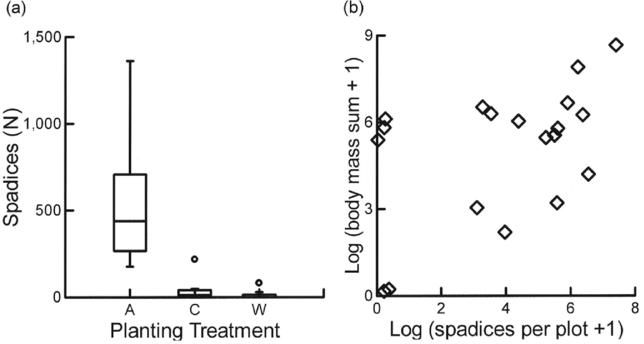
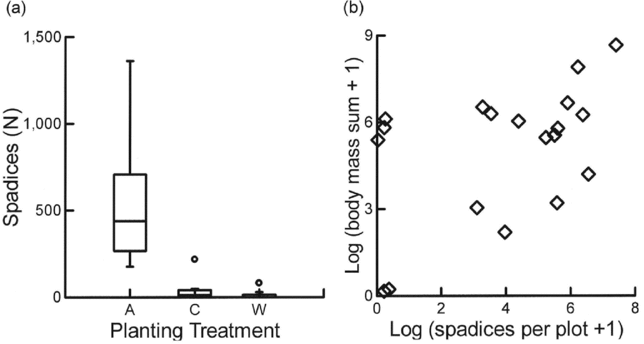
A more direct test with bird variables and C. obtusifolia fruit availability was possible in 2015. Planted C. obtusifolia resulted in higher fruit production of mature female trees in stands of animal-dispersed trees, but passively recruited reproductive females also occurred in four control and two plots of wind-dispersed trees (Figure 2a). Spearman correlations showed significant associations of frugivore species and individuals with rank order of estimated spadix number per plot (rs = 0.64 and 0.65, respectively, with correction for multiple tests P < 0.005), but not of non-frugivorous birds and spadix numbers per plot. Estimated biomass of fruit-eating birds (Appendix 1) in each plot in 2015 was positively correlated with rank order of estimated spadix numbers per plot (Figure 2b, rs = 0.52, P = 0.01).
Cecropia obtusifolia as a resource for fruit-eating birds in 2015 in experimental pasture plots at Los Tuxtlas, southern Mexico. Estimated production of edible spadices consisting of pulp and seeds by planting treatment. Horizontal lines indicate medians, boxes 25% quartiles, vertical lines minimum and maximum excluding outliers, and circles outliers > 3/2 of the upper quartile. Median spadix availability differs by planting treatment, where A represents plantings of animal-dispersed trees, W plantings of wind-dispersed trees, and C represents controls (Kruskal–Wallis statistic = 20.94, 2 df, P < 0.001) (a). Summed body masses of fruit-eating birds observed per plot as a function of Cecropia obtusifolia spadices per plot in 2015 (rs = 0.52, 24 samples, P = 0.01) (b). Zeros represent plots without fruiting female C. obtusifolia. Natural log transformations (value + 1) are used for illustration (transformation does not change rank order).
DISCUSSION
The results have implications for bird use of different habitats in agricultural landscapes. From the perspective of bird conservation, the number of species and individuals of fruit-eating birds, whether dispersal agents or not, increased dramatically over 10 y, favouring plots with planted animal-dispersed trees. A surprise was that birds not known to eat fruits or that eat fruits only occasionally did not increase over 10 y. Avian species richness is low in pastures (Estrada et al. Reference ESTRADA, COATES-ESTRADA and MERRIT1997), but increases in habitat complexity with succession would have predicted increases of both frugivores and non-frugivores with time.
Foraging is a contingent process, with choices of a given bird species changing with season, location and what is available (Howe Reference HOWE2016). This is important for inference of the roles that birds play in choice of habitat types. For instance, in the present experiment the tropical kingbird (Tyrannus melancholicus) frequently snatched parts of Cecropia spadices while foraging for insects. In the compendium of foraging data of Wilman et al. (Reference WILMAN, BELMAKER, SIMPSON, DE LA ROSA, RIVADENEIRA and JETZ2014), the proportion of insects in the diet of this species was 100%, with fruit 0%. Nonetheless, other authors report that T. melancholichus eats a variety of fruits in Mesoamerica, although at the indicated places and times, Cecropia was not among them (Kantak Reference KANTAK1979, McDiarmid et al. Reference MCDIARMID, RICKLEFS and FOSTER1977, Skutch Reference SKUTCH1980). Similarly, the melodious blackbird (Dives dives) did not show as a frugivore in the most comprehensive compendium available (Wilman et al. Reference WILMAN, BELMAKER, SIMPSON, DE LA ROSA, RIVADENEIRA and JETZ2014). This species eats fruits at some times and places occasionally or regularly, including in the present experiment (Kantak Reference KANTAK1979, Ortiz-Pulido Reference ORTIZ-PULIDO2000, Scott & Martin Reference SCOTT and MARTIN1984). Refinement of the database will be possible as diets of many species are studied more comprehensively than has been the case to date.
Frugivores differ greatly in preferred fruits (Kantak Reference KANTAK1979, Ortiz-Pulido Reference ORTIZ-PULIDO2000, Scott & Martin Reference SCOTT and MARTIN1984, Skutch Reference SKUTCH1980, Wilman et al. Reference WILMAN, BELMAKER, SIMPSON, DE LA ROSA, RIVADENEIRA and JETZ2014). Few depend entirely on fruits for food, but some eat fruit more than others. At Los Tuxtlas, the toucan (Ramphastos sulfuratus) flies from forest to the plots to forage for fruits and then forage for insects, bird eggs or whatever else is available. The oropendola (Psarocolius montezuma) arrives singly, in pairs, or in groups, foraging for insects and fruit. The brown jay (Psilorhinus morio) is a constant presence, flying to and from forest while foraging for insects and fruit. These larger (200–400 g) species defecate or regurgitate viable seeds from minute to larger (e.g. > 1 g) sizes. They are probably responsible for importing most medium-sized to large seeds of later-successional trees from forest that are now represented by recruited seedlings or saplings of tree species other than those planted (de la Peña-Domene et al. Reference DE LA PEÑA-DOMENE, MARTÍNEZ-GARZA, PALMAS-PÉREZ, RIVAS-ALONSO and HOWE2014, 2016). Most recruiting trees recorded in the experiment are of species with small seeds (< 0.1 g). For those, abundant small (< 100 g) frugivores doubtless play major roles (Carlo & Morales Reference CARLO and MORALES2016). Some may bring seeds from nearby forest; others move seeds around among experimental plots.
Some fruit-eaters are primarily seed-eaters. These include the parrot (Amazon autumnalis), red-billed pigeon (Patagioenas flavirostris), small seed-eaters (Sporophila americana and S. torqueola) and grassquit (Tiaris olivacea). Among these, larger species (≥ 250 g) probably pass some very small seeds through the gut unharmed (Coates-Estrada & Estrada Reference COATES-ESTRADA and ESTRADA1988, Fleming et al. Reference FLEMING, WILLIAMS, BONACCORSO and HERBST1985, Janzen Reference JANZEN1981). For planted or recruited trees with seeds ≥ 0.1 g, the parrot and pigeon are likely seed predators. Most other birds censused or seen at other times at the site that eat fruit and disperse seeds forage for insects much of the time, eat fruit opportunistically, live within the study grid rather than commute from forest, are smaller and less likely to carry large seeds, or all four (Appendix 1).
For birds to increase plant diversity and plant mobility across agricultural landscapes, presence of effective dispersers that range widely is critical (Schupp et al. Reference SCHUPP, JORDANO and GOMEZ2010). More important from the plant perspective than proportion of fruit in a frugivore diet is that behaviour of foragers that eat fruits results in deposition of seeds in sites where germination and establishment are possible (Russo et al. Reference RUSSO, PORTNOY and AUGSPURGER2006). For instance, in a study of dispersal of seeds of a rain-forest tree (Cymbopetalum baillonii) in continuous forest, the brown jay (Psilorhinus morio) accounted for < 0.5% of bird foraging visits to the trees, but 46% of the seeds carried > 30 m from fruiting trees (Coates-Estrada & Estrada Reference COATES-ESTRADA and ESTRADA1988). At Los Tuxtlas, large birds (> 200 g) traverse substantial distances while foraging for fruit. These likely play an outsized role in importing seeds > 0.1 g of many species from nearby forest.
Unlike fruits that are so preferred that daily fruit crops are depleted within hours of daylight (reviewed by Howe Reference HOWE2016), fruits of C. obtusifolia are eaten by many birds and mammals but are preferred by few (Estrada et al. Reference ESTRADA, COATES-ESTRADA and VAZQUEZ-YANES1984). With no indication of daily depletion, C. obtusifolia fruits are unlikely to be limiting as either a food resource or as a source of seeds in forest regeneration. Of 181,656 seeds collected in seed traps in plots over 6 mo in 2014, 84% are of this species (Popoca-Ortega Reference POPOCA-ORTEGA2016). Very few individuals of this or other animal-dispersed pioneer trees establish in shaded understorey or in dense herbaceous cover (de la Peña-Domene et al. Reference DE LA PEÑA-DOMENE, MARTÍNEZ-GARZA, PALMAS-PÉREZ, RIVAS-ALONSO and HOWE2014). Rapidly maturing C. obtusifolia facilitate succession by drawing fruit-eating animals that bring seeds of shade-tolerant trees from forest.
Strong positive correlations of frugivore species and numbers with quantities of apparently superabundant low-priority fruits are somewhat paradoxical. Why should birds not go directly to the nearest fruiting C. obtusifolia? The answer plausibly lies in differences in time management where bird species use landscapes on different scales for different purposes (García & Ortiz-Pulido Reference GARCÍA and ORTIZ-PULIDO2004). For large commuters that visit the plots daily from forest, minimizing lost-opportunity costs may include seeking fruits where they are abundant first, and then foraging for insects, small vertebrates or bird eggs that are more difficult to find. Distributions of seedlings and saplings of large-seeded endemic Ocotea uxpanapana (Lauraceae) show non-random patterns among plots that are consistent with multiple uses by large frugivores (de la Peña-Domene et al. Reference DE LA PEÑA-DOMENE, MINOR and HOWE2016). Lehouck et al. (Reference LEHOUCK, SPANHOVE, VANGESTEL, CORDEIRO and LENS2009) hypothesize that rich-fruit resources in farmlands support forest frugivores. Results from the present study are consistent with this hypothesis. Opportunistic frugivory probably explains why some birds not listed as frugivores in Wilman et al. (Reference WILMAN, BELMAKER, SIMPSON, DE LA ROSA, RIVADENEIRA and JETZ2014) did eat C. obtusifolia fruit in this study, and why some known to eat fruits elsewhere did not in this study (Appendix 1).
Birds used habitat patches in agricultural landscapes in multiple ways (Guevara & Laborde Reference GUEVARA and LABORDE1993, Reid et al. Reference REID, MENDENHALL, ROSALES, ZAHAWI and HOLL2014). At Los Tuxtlas, some fruit-eating birds occurred in plots with little or no fruit (Table 1, Figure 2b). Nests or family groups with fledglings indicated that several species used the plots for nesting or cover as woody vegetation matured. Such species in this experiment included the brown jay (Psilorhinus morio), golden-fronted woodpecker (Melanerpes aurifrons), social flycatcher (Myiozetetes similis), black-capped and masked tityras (Tityra inquisitor and T. semifasciata) and grassquit (Tiaris olivacea). Three or more nests of the insectivorous paraque (Nyctidromus albicollis) occurred in shaded understorey each year after 2010. In 2016, a dead planted Heliocarpus appendiculatus (Malvaceae) (c. 25 cm diameter 3 m above ground) hosted a family of the lineated woodpecker (Dryocopus lineatus, c. 200 g). Planted habitat patches clearly favoured fruit-eating birds, but they and some other species used plots for forage, refuge and nest sites.
The absence of a monotonic increase in non-frugivore richness with time was unexpected. Presumably, birds foraging on grass seeds (e.g. Sporophila and Tiaris) lost habitat. It is possible that in small plots insectivores that did not eat fruits declined because insectivores that did eat fruits became common enough to competitively suppress bird species restricted to insect diets.
While this experiment documents disproportionate use of experimental plantings of animal-dispersed native trees by frugivores, it underscores a challenge in retaining biodiversity in tropical landscapes. If large-seeded trees of old-growth forest require large fruit-eating birds for seed dispersal, sufficient landscape heterogeneity must be retained or created to attract and maintain such birds (Elliott et al. Reference ELLIOTT, BLAKESLEY and HARDWICK2013, McConkey et al. Reference MCCONKEY, PRASAD, CORLETT, CAMPOS-ARCEIZ, BRODIE, ROGERS and SANTAMARIA2012). A sobering issue in the present experiment is that so few species of wide-ranging frugivores are likely to carry large seeds of old-growth-forest trees to habitat patches embedded in pasture (Catterall et al. Reference CATTERALL, FREEMAN, KANOWSKI and FREEBODY2012, de Bonilla et al. Reference DE BONILLA, LEÓN-CORTÉS and RANGEL-SALAZAR2012). Without toucans and oropendolas at Los Tuxtlas, frequent daily commutes to and from forest would be by smaller jays. The study has not been done, but seed imports by smaller birds and one species of moderate size are likely to be less diverse than those including a more diverse community of large dispersal agents.
ACKNOWLEDGEMENTS
I am grateful for advice from and discussions with J. Arnow, R. Coates, J. Davlantes, M. de la Peña-Domene and C. Martínez-Garza, comments on the manuscript by L. Beltran, T. A. Carlo, J. Davlantes, A. Hazra and A. Holloway, and logistical support from the Los Tuxtlas Biological Station. Sr. Benito Palacios remains a gracious host for extended use of his land. The project was partially supported by the United States National Science Foundation (DEB 0516259), the University of Illinois, and the National Geographic Society (9302-13).
Birds in whole-plot censuses at Los Tuxtlas, southern Mexico 2007–2016 by descending order of frequency. Nomenclature follows the American Ornithologists’ Union (http://checklist.aou.org/). Body masses are from Dunning (Reference DUNNING2013). Midpoint of female and male masses are used for sexually dimorphic species. A superscript (1) indicates a body-mass sample ≤ 10. For diet, O = eats fruits, seeds, insects, small vertebrates, I = eats insects, F = eats fruits, S = eats and digests seeds, V = eats small vertebrates. A number in column F is % fruit in diet from Wilman et al. (Reference WILMAN, BELMAKER, SIMPSON, DE LA ROSA, RIVADENEIRA and JETZ2014). A number and question mark indicates the species is listed as a fruit-eater in the above but was not observed eating fruit in this study. A solitary question mark indicates that the species is not listed as a fruit-eater in the above, but fed on Cecropia obtusifolia in this study.