Introduction
According to the World Health Organization, suicide accounts for more than 1 million yearly deaths worldwide (http://www.who.int/topics/suicide/en/) and is one of the leading causes of preventable premature deaths. In addition, 10 to 20 times more individuals engage in non-fatal suicidal acts, currently the most predictive risk factor for future suicide (Oquendo et al. Reference Oquendo, Galfalvy, Russo, Ellis, Grunebaum, Burke and Mann2004). To date, the prevention of suicidal behaviors remains difficult partly due to the fact that the complex processes underlying the triggering and development of a suicidal crisis in a given individual are not fully understood. As a consequence, tools to detect high-risk subjects are insufficient and interventions specifically targeting suicidal risk are lacking.
It is generally agreed that suicidal behaviors may be best modeled as the interplay between vulnerability and contextual factors, including proximal stressful events, acute mental disorder like major depression, alcohol intake or physical pain (Mann, Reference Mann2003). This model has been strongly supported by clinical, cellular, molecular and genetic studies (Mann, Reference Mann2003) and, more recently, by neuropsychological and neuroimaging studies (Jollant et al. Reference Jollant, Lawrence, Olié, Guillaume and Courtet2011).
Neurocognitive alterations represent relevant vulnerability factors and potential endophenotypes of suicidal behavior. Indeed, several recent publications have reported cognitive deficits in patients with a history of suicidal acts compared with non-suicidal patients and healthy controls (Jollant et al. Reference Jollant, Lawrence, Olié, Guillaume and Courtet2011). Moreover, some deficits, like disadvantageous decision-making, have been found in remitted patients (Jollant et al. Reference Jollant, Bellivier, Leboyer, Astruc, Torres, Verdier, Castelnau, Malafosse and Courtet2005) and to be influenced by an interaction between early adverse events and genetic variants (Guillaume et al. Reference Guillaume, Perroud, Jollant, Jaussent, Olié, Malafosse and Courtet2012) while others [as measured by the Wisconsin card sorting test (WCST)] have been shown in relatives of suicide completers (McGirr et al. Reference McGirr, Jollant and Turecki2013). Apart from improving our understanding of the suicidal vulnerability, these cognitive deficits could be both measurable markers of vulnerability and the target of future therapeutic interventions aimed at reducing the long-term risk of suicidal acts.
There is a need to synthesize evidence from cumulating literature on cognitive deficits in suicide attempters in order to determine which neuropsychological tests reveal impairments more strongly associated with a history of suicidal act, i.e. a higher risk of recurrence of suicidal acts and completed suicide. It is notably important to disentangle the cognitive deficits associated with suicidal behavior from those more closely related to co-morbid disorders such as major depression. In the current paper, we systematically reviewed the literature on the neuropsychology of suicidal behavior, and conducted a meta-analysis to explore putative cognitive markers of suicidal vulnerability.
Method
Data sources
An English and French systematic literature search of Medline, EMBASE and PsycINFO databases was performed for human studies published from 1 January 1960 to 31 March 2013. The medical subject heading (MeSH) term ‘suicide’ was combined with the MeSH terms ‘cognition’, ‘neuropsychology’, ‘neuropsychological tests’, ‘executive function’, ‘decision making’, ‘problem solving’, ‘prefrontal cortex’, and with the title/abstract (TIAB) terms ‘neuropsychological functions’, ‘executive functioning’ and ‘executive performance’. An iterative process was used to ensure that all relevant articles were obtained. A further hand search of the bibliographical references of the selected papers and existing reviews was conducted to identify additional potential studies. References were also selected from our research group's online database (www.bdsuicide.disten.com).
Study selection
Abstract selection was based on the STrengthening the Reporting of OBservational studies in Epidemiology (STROBE) checklist (Von Elm et al. Reference Von Elm, Altman, Egger, Pocock, Gøtzsche and Vandenbroucke JP2008) which describes items that should be included in reports of cohort studies. Abstracts identified through the literature search were independently evaluated by two reviewers (S.R.-D. and F.J.) and selected by a consensus from all authors.
Studies that met the following inclusion criteria were included in this meta-analysis: (1) published in an English or French language peer-reviewed journal; (2) included at least one neuropsychological task; (3) compared at least two groups of which one comprised patients with a history of suicide attempt (defined as any act carried out with a certain intent to die and different from non-suicidal self-injury; Mann, Reference Mann2003); and (4) included patients who suffered from mood disorders (both unipolar or bipolar) but not schizophrenia or other major psychiatric disorder diagnosed according to the Diagnostic and Statistical Manual of Mental Disorders, fourth edition, text revision (DSM-IV-TR) criteria. We focused on mood disorders as more studies have been published in this domain and to limit heterogeneity in studied populations. Full articles were then obtained for final analyses.
Of the 1830 originally identified abstracts, 25 studies met the inclusion criteria (Bartfai et al. Reference Bartfai, Winborg, Nordström and Asberg1990; Ellis et al. Reference Ellis, Berg and Franzen1992; Becker et al. Reference Becker, Strohbach and Rinck1999; King et al. Reference King, Conwell, Cox, Henderson, Denning and Caine2000; Keilp et al. Reference Keilp, Sackeim, Brodsky, Oquendo, Malone and Mann2001, Reference Keilp, Gorlyn, Russell, Oquendo, Burke, Harkavy-Friedman and Mann2013; Audenaert et al. Reference Audenaert, Goethals, Van Laere, Lahorte, Brans, Versijpt, Vervaet, Beelaert, Van Heeringen and Dierckx2002; Jollant et al. Reference Jollant, Bellivier, Leboyer, Astruc, Torres, Verdier, Castelnau, Malafosse and Courtet2005, Reference Jollant, Lawrence, Olié, O'Daly, Malafosse, Courtet and Phillips2010; LeGris et al., Reference LeGris and van Reekum2012; Raust et al. Reference Raust, Slama, Mathieu, Roy, Chenu, Koncke, Fouques, Jollant, Jouvent, Courtet, Leboyer and Bellivier2007; Westheide et al. Reference Westheide, Quednow, Kuhn, Hoppe, Cooper-Mahkorn, Hawellek, Eichler, Maier and Wagner2008; Yen et al. Reference Yen, Cheng, Ko, Yen, Huang and Chen2008; Malloy-Diniz et al. Reference Malloy-Diniz, Neves, Abrantes, Fuentes and Correa2009; Oldershaw et al. Reference Oldershaw, Grima, Jollant, Richards, Simic, Taylor and Schmidt2009; Cha et al. Reference Cha, Najmi, Park, Finn and Nock2010; Martino et al. Reference Martino, Strejilevich, Torralva and Manes2010; Gilbert et al. Reference Gilbert, Garno, Braga, Shaya, Goldberg, Malhotra and Burdick2011; Richard-Devantoy et al. Reference Richard-Devantoy, Annweiler, Le Gall, Garre, Olié and Beauchet2011, Reference Richard-Devantoy, Jollant, Kefi, Turecki, Olié, Annweiler, Beauchet and Le Gall2012, Reference Richard-Devantoy, Guillaume, Olié, Courtet and Jollant2013a ; Bridge et al. Reference Bridge, Mcbee-Strayer, Cannon, Sheftall, Reynolds, Campo, Pajer, Barbe and Brent2012; McGirr et al. Reference McGirr, Dombrovski, Butters, Clark and Szanto2012; Miranda et al. Reference Miranda, Gallagher, Bauchner, Vaysman and Marroquin2012; Gorlyn et al. Reference Gorlyn, Keilp, Oquendo, Burke and Mann2013). Although eligible, three studies were not included, or only partially (for instance, some tests but not others), because precise means and standard deviations were not available in papers and could not be obtained after contacting the authors (Williams & Broadbent, Reference Williams and Broadbent1986; Dombrovski et al. Reference Dombrovski, Butters, Reynolds, Houck, Clark, Mazumdar and Szanto2008; Gilbert et al. Reference Gilbert, Garno, Braga, Shaya, Goldberg, Malhotra and Burdick2011). Finally, one study which assessed patients with borderline personality disorder was also included as levels of depression and rates of co-morbid mood disorders were high (LeGris et al. Reference LeGris, Links, Van Reekum, Tannock and Toplak2012).
The quality of each study was assessed independently by two reviewers (S.R.-D. and F.J.) using the Crombie criteria adapted by Petticrew & Roberts (Reference Petticrew and Roberts2006).
Data extraction and analyses
A standardized form was used to extract data, which included authors, date of publication, study design, settings, study population, cognitive tests used, definition of suicidal behavior, and neuropsychological scores (means and standard deviations).
Only tasks that were used in at least three separate studies were included in the analyses. Overall, seven neuropsychological tests were analysed as they met this criterion: (1) Iowa gambling task (IGT; net score = number of advantageous minus disadvantageous choices); (2) Stroop test (Stroop; interference score, i.e. time to read the color–word interference sheet minus time to name the color of each block sheet); (3) trail-making test part B (TMTB; time completion); (4) WCST (perseverative errors); (5) FAS semantic verbal fluency test (number of words); (6) categorical verbal fluency test (Animals; number of words); and (7) continuous performance test (CPT; commission errors).
Analyses were performed using Comprehensive Meta-Analyses version 2.0 (Biostat, USA), and IBM SPSS version 20 (IBM Corporation, USA) software.
Three groups were compared: suicide attempters (patients with a history of suicide attempt), patient controls (i.e. patients with no personal history of suicidal act) and healthy controls. When two groups of suicide attempters were reported in one study [e.g. low versus high lethality (McGirr et al. Reference McGirr, Dombrovski, Butters, Clark and Szanto2012, Keilp et al. Reference Keilp, Gorlyn, Russell, Oquendo, Burke, Harkavy-Friedman and Mann2013) or violent versus non-violent (Jollant et al. Reference Jollant, Bellivier, Leboyer, Astruc, Torres, Verdier, Castelnau, Malafosse and Courtet2005)], the combined means and standard deviations were calculated to obtain a global group, using the following formula:
 $$\mu _{X \cup Y} = \displaystyle{{N_{X}\mu_ {X} + N_{Y}\mu _{Y}} \over {N_X + N_Y}}\comma $$
 $$\sigma _{X \cup Y} = \sqrt {\displaystyle{{N_X \sigma _X^2 + N_Y \sigma _Y^2} \over {N_X + N_Y}}+\displaystyle{{N_X N_Y} \over {(N_X + N_Y )^2}} + (\mu _X - \mu _Y )^2} .$$
We performed a meta-analysis of aggregate data and used a random-effects model as we assumed that the true effect sizes had probably varied between the included studies (Riley et al. Reference Riley, Higgins and Deeks2011). Pooled Hedges’ g effect sizes for subjects’ neuropsychological scores and depression ratings were computed (Hedges & Olkin, Reference Hedges and Olkin1985). Qualitative descriptors of the obtained effect sizes are usually considered small if <0.3, moderate if between 0.4–0.8, and large if >0.8 (Egger et al. Reference Egger, Davey Smith and Altman2001).
Heterogeneity was assessed using the Q statistics and the I 2 index (Cooper et al. Reference Cooper, Hedges and Valentine2009). Values of p < 0.10 for the former and >35% for the latter were deemed as indicative of study heterogeneity. Finally, we used funnel plots, Rosenthal's fail-safe N (Rosenthal, Reference Rosenthal1979) and Egger's regression intercept (Egger et al. Reference Egger, Davey Smith, Schneider and Minder1997) to test for the presence of publication bias (Cooper et al. Reference Cooper, Hedges and Valentine2009).
Results
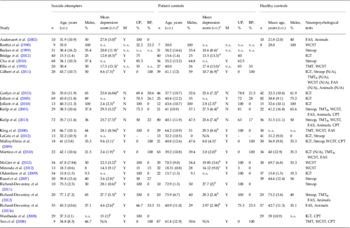
A total of 25 studies were included (Table 1) comprising 2323 participants, of whom 831 were suicide attempters [mean age = 40.5 years, s.d. = 9.4 years; 43.6% males; 75.4%, 95% confidence interval (CI) 15–100% unipolar disorder; 52.4%, 95% CI 15–100% bipolar disorder], 824 patient controls (mean age = 41.6 years, s.d. = 9.4 years; 41.0% males; 77.2%, 95% CI 3–100% unipolar disorder; 54.9%, 95% CI 17–100% bipolar disorder], and 668 healthy controls (mean age 39.2 years, s.d. = 9.5 years; 50.8% males). In 18 studies, patients were under a psychotropic medication; in four studies, patients did not have any medication (Keilp et al. Reference Keilp, Sackeim, Brodsky, Oquendo, Malone and Mann2001, Reference Keilp, Gorlyn, Russell, Oquendo, Burke, Harkavy-Friedman and Mann2013; Jollant et al. Reference Jollant, Bellivier, Leboyer, Astruc, Torres, Verdier, Castelnau, Malafosse and Courtet2005; Gorlyn et al. Reference Gorlyn, Keilp, Oquendo, Burke and Mann2013), and data were not available for three studies even after contacting the authors (Bartfai et al. Reference Bartfai, Winborg, Nordström and Asberg1990; Ellis et al. Reference Ellis, Berg and Franzen1992; Becker et al. Reference Becker, Strohbach and Rinck1999).
Studies included in the meta-analysis

s.d., Standard deviation; M, medication; UP, unipolar disorder; BP, bipolar disorder; Y, yes; FAS, FAS verbal fluency test; Animals, animal verbal fluency test; n.a., data not available; WCST, Wisconsin card sorting test; IGT, Iowa gambling task; TMT, trail-making test; TMTB, trail-making test part B; CPT, continuous performance test.
a Depression scores come from different scales and, therefore, cannot be directly compared across studies:
b Hamilton Depression Scale.
c Beck Depression Inventory.
d Beck Depression Inventory.
e MADRS: Montgomery–Asberg Depression Rating Scale.
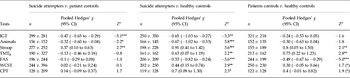
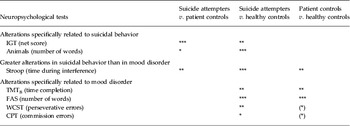
Table 2 presents the results of the contrasts between the three groups for the seven neuropsychological tests, and Table 3 provides a summary of the main findings. Detailed information on heterogeneity and publication bias can be found in the online Supplementary material.
Effect sizes for the contrasts between suicide attempters, patient controls and healthy controls for the seven neuropsychological tests

CI, Confidence interval; IGT, Iowa gambling task; Animals, animal verbal fluency test; TMTB, trail-making test part B; FAS, FAS verbal fluency test; WCST, Wisconsin card sorting test; CPT, continuous performance test.
a Test for the significance of the effect size.
* p < 0.05, ** p < 0.01, *** p < 0.001, (*) contrast became significant after excluding studies responsible for heterogeneity.
Summary of findings

IGT, Iowa gambling task; Animals, animal verbal fluency test; TMTB, trail-making test part B; FAS, FAS verbal fluency test; WCST, Wisconsin card sorting test; CPT, continuous performance test.
* p < 0.05, ** p < 0.01, *** p < 0.001, (*) contrast became significant after excluding studies responsible for heterogeneity.
Suicide attempters versus patient controls
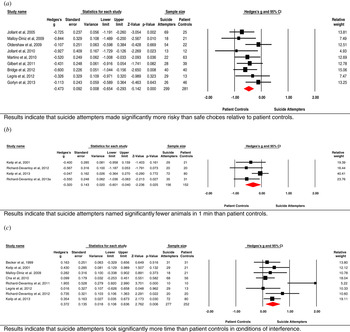
Suicide attempters had significantly lower IGT net scores and Animals scores, and lower Stroop performance than patient controls (Fig. 1), all representing moderate effect sizes. The fail-safe N, i.e. the number of unpublished or missing null findings that would be needed to render the results non-significant, was 60 for the IGT, five for the Animals and 29 for the Stroop. Mean age, gender, depression level, and the proportion of unipolar/bipolar disorders did not differ between the two groups for any test, thus ruling out these variables as confounding factors. Regarding Stroop, results were significant whether assessing the traditional version only or including the emotional version.
Comparison of the Iowa gambling task net scores (a), animal verbal fluency scores (b) and Stroop interference scores (c) between suicide attempters and patient controls. CI, Confidence interval.

Heterogeneity exceeded that expected by chance at p < 0.05 only for the Stroop and TMTB, implying that the variance among the effect sizes was greater than expected by sampling error (online Supplementary Table S1). The study by Richard-Devantoy et al. (Reference Richard-Devantoy, Annweiler, Le Gall, Garre, Olié and Beauchet2011) was probably responsible for the heterogeneity related to the Stroop, and the studies by Ellis et al. (Reference Ellis, Berg and Franzen1992) and Yen et al. (Reference Yen, Cheng, Ko, Yen, Huang and Chen2008) for the TMTB. After excluding these studies, the heterogeneity disappeared and the main results remained significant.
The funnel plots were reasonably symmetrical for all neuropsychological tests except for the CPT, suggesting a low risk of publication bias. Nevertheless, the more conservative Egger's regression intercept suggested no publication bias.
Suicide attempters versus healthy controls
Suicide attempters had significantly lower performance than healthy controls on all seven neuropsychological tasks, all with moderate to high effect sizes. The fail-safe N was 100 for the IGT, 96 for the Stroop, 26 for the TMTB, 27 for the WCST, 44 for the FAS, 36 for Animals, and seven for the CPT. Mean age and gender did not differ between the two groups, except for the TMTB with more men among the healthy controls compared with the suicide attempters.
Heterogeneity exceeded that expected by chance for all tests except for the FAS and Animals. No specific study or set of studies was identified as being probably responsible for the heterogeneity associated with data on the IGT. The studies by Richard-Devantoy et al. (Reference Richard-Devantoy, Jollant, Kefi, Turecki, Olié, Annweiler, Beauchet and Le Gall2012) and Malloy-Diniz et al. (Reference Malloy-Diniz, Neves, Abrantes, Fuentes and Correa2009) were probably responsible for the heterogeneity related to the Stroop, the studies by Richard-Devantoy et al. (Reference Richard-Devantoy, Jollant, Kefi, Turecki, Olié, Annweiler, Beauchet and Le Gall2012) and Martino et al. (Reference Martino, Strejilevich, Torralva and Manes2010) for the TMTB, the study by Malloy-Diniz et al. (Reference Malloy-Diniz, Neves, Abrantes, Fuentes and Correa2009) for the WCST, and the study by Keilp et al. (Reference Keilp, Sackeim, Brodsky, Oquendo, Malone and Mann2001) for the CPT (2013). After excluding those studies, the heterogeneity of each neuropsychological test disappeared but the main results remained significant.
The associated funnel plots were reasonably symmetrical for all neuropsychological tests. Egger's regression intercept test suggested no publication bias.
Patient controls versus healthy controls
Patient controls had significantly lower performance on the Stroop, TMTB and FAS than healthy controls, all with moderate effect sizes. Fail-safe N's were 40, 40 and 33, respectively. Mean age and gender did not differ between the two groups except for the Stroop. Compared with healthy controls, patient controls were older. In addition, the heterogeneity exceeded that expected by chance for this task. The study by Keilp et al. (Reference Keilp, Gorlyn, Russell, Oquendo, Burke, Harkavy-Friedman and Mann2013) was probably responsible for the heterogeneity related to the Stroop task. After excluding this study, the heterogeneity disappeared and the difference in age and gender was not significant anymore.
Heterogeneity exceeded that expected by chance for the IGT, Stroop, TMTB, WCST and CPT. The studies by Martino et al. (Reference Martino, Strejilevich, Torralva and Manes2010) and Oldershaw et al. (Reference Oldershaw, Grima, Jollant, Richards, Simic, Taylor and Schmidt2009) were probably responsible for the heterogeneity related to the IGT, whereas the studies by Richard-Devantoy et al. (Reference Richard-Devantoy, Jollant, Kefi, Turecki, Olié, Annweiler, Beauchet and Le Gall2012) and Keilp et al. (Reference Keilp, Gorlyn, Russell, Oquendo, Burke, Harkavy-Friedman and Mann2013), and the studies by Keilp et al. (Reference Keilp, Gorlyn, Russell, Oquendo, Burke, Harkavy-Friedman and Mann2013) and Malloy-Diniz et al. (Reference Malloy-Diniz, Neves, Abrantes, Fuentes and Correa2009), were probably responsible for the heterogeneity related to the TMTB and the Stroop, respectively. After excluding those studies, the heterogeneity disappeared but the main results remained significant. The studies by King et al. (Reference King, Conwell, Cox, Henderson, Denning and Caine2000) and Malloy-Diniz et al. (Reference Malloy-Diniz, Neves, Abrantes, Fuentes and Correa2009) were probably responsible for the heterogeneity related to the WCST, and the study by Keilp et al. (Reference Keilp, Sackeim, Brodsky, Oquendo, Malone and Mann2001, Reference Keilp, Gorlyn, Russell, Oquendo, Burke, Harkavy-Friedman and Mann2013) for the heterogeneity related to the CPT. After their exclusion, the heterogeneity disappeared and the contrasts became significant.
The associated funnel plots were reasonably symmetrical for all variables, although Egger's regression intercept test suggested a possible publication bias for the TMTB.
Discussion
To our knowledge, this is the first meta-analysis on neuropsychological tests associated with vulnerability to suicidal behavior. We report here that performance on the IGT, Animals and Stroop was significantly altered in patients with a history of suicide attempts relative to those without such history. Hedges’ g effect sizes were moderate (0.47, 0.37 and 0.32, respectively), which is particularly relevant considering the fact that we are comparing two patient groups. IGT and Animals scores were found to be significantly different between suicide attempters and both control groups, but not between patient controls and healthy controls, suggesting that the measured deficits are associated with the vulnerability to suicidal behavior but not with co-morbid mood disorders. In the case of the Stroop, however, a reduced performance was also found in patient controls versus healthy controls, suggesting a shared vulnerability to suicidal behavior and mood disorders, with greater alterations observed in suicide attempters. Finally, other tests including the TMTB, WCST, FAS and CPT seemed to be more closely associated with mood disorders than suicidal behavior. It is important to point out that these latter alterations were also found in suicide attempters versus healthy controls. Therefore, although they did not seem to be specifically related to suicidal behavior, they should be considered as part of the general set of cognitive deficits experienced by these patients.
Findings from this meta-analysis have three main implications. First, they indicate directions for the understanding of suicidal behaviors. Although no neuropsychological test is specific to a cognitive function or brain region, our results suggest that suicide attempters display alterations affecting their ability to make decisions in conditions of uncertainty (Bechara et al. Reference Bechara, Damasio, Damasio and Lee1999), to generate words restricted to a given category (Harrison et al. Reference Harrison, Buxton, Husain and Wise2000) and to override automatic responses (MacLeod, Reference MacLeod1991). It cannot be completely ruled out here that these deficits are not related to more basic deficits including working memory or attention impairments although a recent study suggests that deficits in the IGT in suicide attempters are largely independent from them (Richard-Devantoy et al. Reference Richard-Devantoy, Olié, Guillaume, Bechara, Courtet and Jollant2013b ). In addition, we cannot assume that these deficits affect all suicide attempters. For instance, one study reported disadvantageous decision-making to be mainly found in attempters who used violent means (Jollant et al. Reference Jollant, Bellivier, Leboyer, Astruc, Torres, Verdier, Castelnau, Malafosse and Courtet2005). This will have to be clarified. However, we believe that these findings support at the cognitive level the general model of vulnerability to suicidal behavior (Mann, Reference Mann2003), with patients at higher risk of suicide showing alterations not found in patients at lower risk.
At the neurocognitive level, we could hypothesize that vulnerability to suicidal acts results from a combination of alterations in value-based/motivational/reward-learning processes (supporting decision making as measured by the IGT) on one side, and in cognitive control processes (as measured by Animals and Stroop) on the other side (Jollant et al. Reference Jollant, Lawrence, Olié, Guillaume and Courtet2011). Cognitive control refers to mechanisms that ‘orchestrate thought and action in accordance with internal goals’ (Miller & Cohen, Reference Miller and Cohen2001) and, therefore, encompass multiple functions from task switching, response inhibition, error detection, response conflict and working memory (Glascher et al. Reference Glascher, Adolphs, Damasio, Bechara, Rudrauf, Calamia, Paul and Tranel2012). This schematic distinction is generally supported by neuroimaging and lesion studies (Kouneiher et al. Reference Kouneiher, Charron and Koechlin2009; Stuss, Reference Stuss2011; Glascher et al. Reference Glascher, Adolphs, Damasio, Bechara, Rudrauf, Calamia, Paul and Tranel2012). In the case of suicide attempters, disadvantageous IGT performance has been related to deficient encoding of abstract risk in the ventrolateral orbitofrontal cortex (Jollant et al. Reference Jollant, Lawrence, Olié, O'Daly, Malafosse, Courtet and Phillips2010), a region that was also more responsive to social signals of rejection in this population compared with patient controls (Jollant et al. Reference Jollant, Lawrence, Giampietro, Brammer, Fullana, Drapier, Courtet and Phillips2008). However, decreased verbal fluency has been linked to more dorsal prefrontal regions, including the anterior cingulate and the dorsolateral prefrontal cortices (Audenaert et al. Reference Audenaert, Goethals, Van Laere, Lahorte, Brans, Versijpt, Vervaet, Beelaert, Van Heeringen and Dierckx2002; Oquendo et al. Reference Oquendo, Placidi, Malone, Campbell, Keilp, Brodsky, Kegeles, Cooper, Parsey, Van Heertum and Mann2003). These latter brain regions also underlie brain processing during Stroop (Alvarez & Emory, Reference Alvarez and Emory2006), although specific investigations of suicide attempters are lacking.
A clinical translation of this neurocognitive model could be that vulnerable individuals are more likely to strongly value particular life events, notably social signals of rejection, which, when they happen, lead to an intense negative state. Their difficulty to control this response (possibly associated with a ruminative mode of thinking; O‘Connor & Noyce, Reference O'Connor and Noyce2008) and with a pre-existing difficulty to envision the long-term consequences of some options, may limit the extent of their choices and lead them to consider suicide as the only possible way to escape this painful state. An additional hypothesis could be that limited verbal abilities (as revealed by the animal verbal fluency test) may reduce the possibilities to solve problems at an explicit level and, consequently, increase the risk of ‘acting out’ negative emotions and suicidal ideas.
In addition, disadvantageous decision-making may also increase the risk of interpersonal difficulties, a classical trigger of suicidal crisis (Jollant et al. Reference Jollant, Guillaume, Jaussent, Castelnau, Malafosse and Courtet2007). This proposed model has yet to be properly tested in empirical studies. Of note, this model (and the results of this meta-analysis) partly overlaps with Mark Williams's ‘cry of pain’ cognitive model (Williams & Pollock, Reference Williams, Pollock and van Heeringen2001). This model proposed that vulnerable people show: (1) a higher sensitivity to signals of defeat as revealed by the emotional version of the Stroop; (2) the feeling to be trapped associated with lower problem-solving abilities and too general autobiographic memory; and (3) the feeling of hopelessness correlated with reduced verbal fluency (using a modified version). The link with the ‘escape from self’ theory of suicide is less obvious (Baumeister, Reference Baumeister1990).
The two other implications of our findings are more speculative at this stage. The IGT, Animals and Stroop could be helpful tests in the future for assessing the long-term suicidal risk of patients with mood disorders. These neuropsychological tests could be part of a future comprehensive assessment of patients with mood disorders. However, longitudinal studies will be first necessary to measure the predictive value of these cognitive deficits versus the simple collection of clinical signs and symptoms and past history. Finally, interventions aiming at remediating cognitive deficits revealed by these tests should be developed and their overall clinical utility assessed.
Limitations
First, studies included in this review examined various populations. For example, some enrolled only adolescents (Bridge et al. Reference Bridge, Mcbee-Strayer, Cannon, Sheftall, Reynolds, Campo, Pajer, Barbe and Brent2012), middle-aged (Keilp et al. Reference Keilp, Gorlyn, Russell, Oquendo, Burke, Harkavy-Friedman and Mann2013) or elderly (Richard-Devantoy et al. Reference Richard-Devantoy, Jollant, Kefi, Turecki, Olié, Annweiler, Beauchet and Le Gall2012) participants. In addition, some studies included only patients with bipolar depression (Malloy-Diniz et al. Reference Malloy-Diniz, Neves, Abrantes, Fuentes and Correa2009), or with a unipolar depressive disorder (Westheide et al. Reference Westheide, Quednow, Kuhn, Hoppe, Cooper-Mahkorn, Hawellek, Eichler, Maier and Wagner2008), or a combination of patients with both subtypes of mood disorder (Jollant et al. Reference Jollant, Bellivier, Leboyer, Astruc, Torres, Verdier, Castelnau, Malafosse and Courtet2005). Also, some studies were conducted in patients who were acutely depressed (Abrahams et al. Reference Abrahams, Jewkes, Martin, Mathews, Vetten and Lombard2009; Richard-Devantoy et al. Reference Richard-Devantoy, Jollant, Kefi, Turecki, Olié, Annweiler, Beauchet and Le Gall2012), while others focused on those in remission (Jollant et al. Reference Jollant, Bellivier, Leboyer, Astruc, Torres, Verdier, Castelnau, Malafosse and Courtet2005). Also, participants in some studies were on medication while in other studies they were not. Moreover, it was not possible to separate neuropsychological targets of low from high lethality suicide attempters, and violent and non-violent suicide attempters, because too few studies distinguished both groups. Personality disorders were not formally assessed or reported in too many studies to be taken in to account in analyses. Finally, some studies were only conducted in males (Jollant et al. Reference Jollant, Lawrence, Olié, O'Daly, Malafosse, Courtet and Phillips2010) while most included both genders. Of note, the effect of several variables (including the intensity of depressive symptoms, age, gender, and the proportion of unipolar and bipolar disorders) could be ruled out here. Meta-analyses have often been criticized for combining heterogeneous studies, for their potential of publication bias, and for the inclusion of poor-quality trials. In the present study, however, these concerns were addressed by the use of stringent inclusion criteria and by the objective examination of both publication bias and heterogeneity (see online Supplementary material). Second, as our main focus was on suicide attempters, contrast between non-suicidal patients and healthy controls was only based on studies that included a suicidal group. Consequently, many studies have not been taken into account in this contrast. Third, only patients with mood disorders have been included in the analyses. Similar analyses should be conducted in other clinical populations. Finally, many tests and related functions could not be assessed, as they had not been used in a sufficient number of studies.
Conclusion
Performance at the IGT, animal category verbal fluency test and Stroop test were found to be deficient in patients with histories of suicidal acts in comparison with patients with mood disorders but no suicidal act history. These results shed light on possible mechanisms underlying the suicidal process. In addition, these tests may become part of future systematic assessment of the vulnerability to suicidal behavior and guide therapeutic and preventative interventions.
Supplementary material
For supplementary material accompanying this paper visit http://dx.doi.org/10.1017/S0033291713002304.
Acknowledgements
We thank Dr G. Turecki for his support and Mrs Alexandra Hoehne for manuscript editing. S.R.-D. received a post-doctoral grant from the Canadian Institutes for Health Research (CIHR). F.J. and M.B. received a ‘chercheur-boursier clinicien’ salary grant from the Fond de Recherche du Québec – Santé (FRQS).
Declaration of Interest
None.