Tetralogy of Fallot is a type of congenital heart defect, which is classically characterised by four anatomical abnormalities: ventricular septal defect, biventricular connection of the aorta, subpulmonary stenosis, and right ventricle hypertrophy.Reference Ho, McCarthy, Josen and Rigby 1 , Reference Becker, Connor and Anderson 2 In congenital heart disease, tetralogy of Fallot, the fifth of congenital heart disease, comprises 6.0% of the cases, and is the most common cause of blue baby syndrome.
Tetralogy of Fallot occurs in approximately 400 per million live births, making it the most common cyanotic heart defect.Reference Child 3 , Reference Hoffman and Kaplan 4 Although great progress has been made, the molecular mechanisms of tetralogy of Fallot are far from being fully understood and the treatment for this disease remains palliative. The aetiology is multifactorial, but recent experience has pointed to the much more frequent association of micro-deletion of chromosome 22.Reference Khositseth, Tocharoentanaphol, Khowsathit and Ruangdaraganon 5 , Reference Maeda, Yamagishi and Matsuoka 6
In this study, we aim to explore the molecular mechanism of tetralogy of Fallot using the bioinformatics. We downloaded the miRNA and mRNA from the gene expression database (GEO) and performed the differentially expressed gene analysis. Then we used the miRNA and their corresponding forecast target genes to construct the co-expressed network. The candidate agents identified by our approach may provide the groundwork for a new therapy approach to treating tetralogy of Fallot.
Materials and methods
Affymetrix miRNA chip data
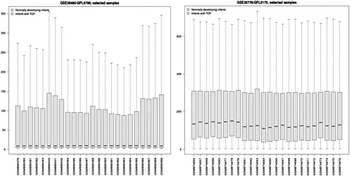
GSE35490 (miRNA) and GSE35776 (mRNA) were downloaded from the gene expression database (GEO),Reference O'Brien, Kibiryeva and Zhou 7 including eight normal samples and 16 tetralogy of Fallot samples. Both data were related to tetralogy of Fallot and were from the same experiment. GPL8786 [miRNA-1_0] Affymetrix miRNA Array and GPL5175 [HuEx-1_0st] Affymetrix Human Exon 1.0 ST Array (Fig 1).
The cartridge diagram after normalisation.

Data pre-processing and differentially expressed gene analysis
First, we transformed the downloaded original CEL files to recognisable files with Affy package in R language, including filling the missing dataReference Troyanskaya, Cantor and Sherlock 8 and normalisation.Reference Fujita, Sato, Rodrigues, Ferreira and Sogayar 9 Then we performed the differentially expressed gene analysis for the normal and lesion tissue with limma,Reference Toedling, Sklyar and Huber 10 and used the Benjamini-Hochberg method for multiple test correction.Reference Benjamini and Hochberg 11 The miRNA and mRNA whose p-value was <0.05, FDR < 0.05, and |log FC| > 1 were selected as the candidate data.
miRNAs and target genes
From the TargetScan miRNA database,Reference Lewis, Shih, Jones-Rhoades, Bartel and Burge 12 we downloaded all the human miRNA and their corresponding forecast target genes, based on the target genes across species conservative and miRNA-target genes dimerisation body heat mechanics characteristicsReference Lewis, Burge and Bartel 13 method. We screened the score higher than 0.9 as a candidate for the regulation.
Construct the co-expressed network
We uploaded the selected miRNA and target genes to String 10,Reference Szklarczyk, Franceschini and Kuhn 14 which could forecast the co-expressed possibility of genes according to the characteristic of sequence that is calculating the expressed factor between genes. The regulatory pair more than 0.5 was used to construct the co-expressed network.
Functional analysis of the co-expressed network
Using DAVIDReference Da Wei Huang and Lempicki 15 online software, based on super geometric distribution algorithm enrichment analysis, we screened the p-value < 0.05 and count > 2 to get the gene function cluster.
Results
Screen the miRNA and genes
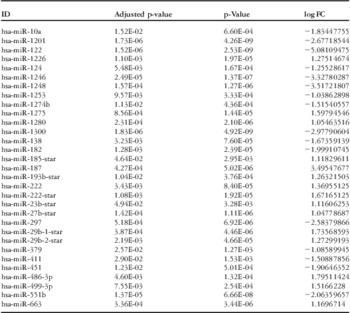
After normalisation, a total of 32 differentially expressed miRNA and 875 genes were screened (p < 0.05, FDR < 0.05, and |log FC| > 1) (Table 1).
The selected miRNAs.

Screen the differentially co-expressed miRNAs
In all, 24 miRNAs and 203 target genes were screened as the candidate regulation pairs from the 2393544 genes. Combining the TargetScan, we analysed and obtained differentially expressed miRNA. The hsa-miR-124 regulates 34 differentially expressed genes and has-miR-138 regulates LMAN1 and LYPLA1.
Construct the co-expressed network
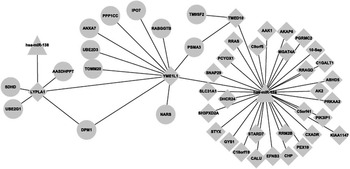
In all selected differentially expressed genes, except the target genes of has-miR-124 and has-miR-138, there may be indirect regulatory differentially expressed genes. Therefore, we used the co-expressed factor between 875 differentially expressed genes to select 231 co-expressed pairs. Combining the regulatory relationship, the co-expressed network was constructed. As we can see from Figure 2, there were another 13 genes that were regulated indirectly.
The co-expressed network. The triangles represent two specific expressed miRNAs, diamonds represent the target genes, and the circulars represent the co-expressed genes.

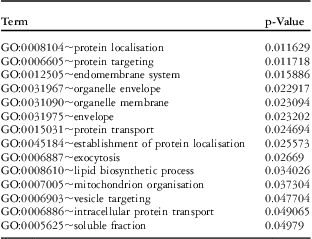
To demonstrate the function of the genes in the network, functional enrichment analysis was performed by DAVID for GO annotation terms. P value < 0.05 and count > 2 were considered statistically significant. A total of 14 functional clusters were shown in Table 2.
The functional clusters of the network.

Discussions
Congenital heart defects are the most common type of major birth defect. Although several recent studies have used microarray technology to examine the global gene expressions in tetralogy of Fallot, the molecular mechanisms of this disease are far from completely understood.Reference Kaynak, von Heydebreck and Mebus 16 , Reference Konstantinov, Coles and Boscarino 17 In this study, a total of 32 differentially expressed miRNA and 875 genes were screened (p < 0.05, FDR < 0.05, and |log FC| > 1). Combining the TargetScan, we analysed and obtained 24 differentially expressed miRNA and 203 target genes. It is mentioned that the hsa-miR-124 regulates 34 differentially expressed genes and has-miR-138 regulates LMAN1 and LYPLA1. Combining the regulatory relationship, the co-expressed network was constructed, and we found that there were another 13 genes that were regulated indirectly. There was a total of 14 functional clusters. In addition, we identified a large amount of small molecules, which can provide new ideas for therapeutic studies in tetralogy of Fallot.
In recent years, as the understanding of pathological changes in tetralogy of Fallot has become more profound, the development of tetralogy of Fallot operation in infants and the success rate of tetralogy of Fallot radical mastectomy have also improved greatly. However, it is influenced by many factors, and the operation still has certain risk. In addition to pulmonary artery stenosis, artery anomaly and existing multiple ventricular septal defect are two other vital factors.Reference Pozzi, Trivedi, Kitchiner and Arnold 18 Therefore, tetralogy of Fallot for the harm of children is very big, even if the operation can be treated, but surgery is also relatively risky due to the increased risk of sudden death. In addition, during surgery, there may also be a lot of complications, such as perfusion lung and respiratory failure.Reference Paron, D'elia and D'ambrosio 19
Along with the advance in science and technology, the accuracy and efficiency of the tumor diagnosis and treatment have gradually improved. In this study, basing on the analysis for expression files of miRNA and mRNA of patient, we screened two significantly down-regulated miRNA (has-miR-124 and has-miR-138) and their target genes are LMAN1 and LYPLA1, respectively. These known target genes are also differentially expressed genes in organisation. If these genes get through experimental verification, it would help in early diagnosis, and the design drug for target genes will become a reality. If this disease can be diagnosed and treated in a timely manner, it will reduce the risk of surgery and the pain after surgery.
In acute myeloid leukaemia, the hsa-miR-124 is a target of EVI1, interestingly, MEG-01 cells, with EVI1 overexpression and no protein, expressed low levels of hsa-miR-124. Transiently, transfection of pre-hsa-miR-124 in HEL and KU-812 cell lines, both with EVI1 protein and no hsa-miR-124 expression, showed a dramatic increase of hsa-miR-124; however, no changes in EVI1 expression either at the mRNA or protein level were detected.Reference Vázquez, Maicas and Marcotegui 20 These results indicate that hsa-miR-124 does not regulate EVI1 expression.
Combined with the fact that miR-138 is endogenously expressed in fibroblasts, induced pluripotent stem cells, and embryonic stem cells, our study demonstrated that regulation of the p53-signalling pathway and promotion of induced pluripotent stem cell generation represent an unrevealed important function of miR-138.Reference Ye, Wang and Liu 21 Candidate agents identified by our approach may provide the groundwork for a new therapy approach to treating tetralogy of Fallot.
Acknowledgements
None.
Financial Support
This research received no specific grant from any funding agency, commercial or not-for-profit sectors.
Conflicts of Interest
None.
Ethical Standards
None.