Political scientists have long been interested in how formal and informal political institutions such as electoral systems and candidate recruitment and selection procedures shape the legislative agendas and the representative roles of individual members of parliament (MPs). One of the widest-reaching electoral reforms in recent decades, deeply affecting the core of representative democracy, has been the introduction of electoral gender quotas. Over the past two decades, more than 100 countries, democracies as well as nondemocracies, have adopted either voluntary or compulsory electoral gender quotas in order to rapidly address women's historical underrepresentation in both national and subnational legislatures (Krook Reference Krook2009).
Studies examining the origins and impacts of gender quotas now constitute one of the fastest-growing subfields within gender and politics research. Whereas a first wave of quota research examined the spread and reasons for adoption of quotas as well as the numerical impacts of these reforms (Bush Reference Bush2011; Dahlerup Reference Dahlerup2006; Krook Reference Krook2009; Tripp and Kang Reference Tripp and Kang2008), an emerging scholarship also investigates the effect of quotas on the representation of women's interests in politics and policy making (Childs and Krook Reference Childs, Krook, Franceschet, Krook and Piscopo2012; Devlin and Elgie Reference Devlin and Elgie2008; Franceschet and Piscopo Reference Franceschet and Piscopo2008).
In this article, we integrate research on women's substantive representation with the rapidly growing body of research on gender quota effects to examine the ways in which quotas may mediate the relationship between the numbers of female officeholders—women's descriptive representation—and the articulation of women's interests—women's substantive representation—in the legislative process. Specifically, we investigate whether MP gender—what we label descriptive effects—and quota status—what we label quota effects—impact the articulation of women's interests in plenary speeches. We do this through a dataset consisting of the near complete record of all plenary speeches in the Ugandan Parliament from 1998 to 2011.
Uganda provides an ideal case to empirically test our expectations relating gender and gender quotas to the articulation of women's political interests during policy making. Since 1989, Uganda has reserved seats for female legislators, but women are also allowed to compete against men for unreserved seats. This feature creates three main types of MPs—quota-elected women, non-quota-elected women, and men—and thus allows us to observationally separate the effects of gender from that of the quota in predicting MP behavior in the plenary.
To our knowledge, this article is the first to examine the content of legislators' speech (male and female, quota and non-quota) across all legislative debates over a significant period of time to examine how gender and gender quotas affect the articulation of women's interests in the legislative process. Given that quota adoption has expanded—and is continuing to expand—most rapidly in non-Western contexts, our work also provides empirical evidence on the dynamics of quota adoption in a case that has parallels to many recent quota adopters. This contribution is particularly important given the current dearth of quantitative work on the effects of quotas in the global south—a research effort often stymied by a lack of reliable data. Here, we use data compiled from the Ugandan Hansard, which records verbatim plenary speech transcripts (a practice common in the British Commonwealth and former British colonies). The unique dataset that we develop, consisting of 14 years of speech transcripts from 500 unique MPs and more than 40,000 pages of Hansard text, provides a rare opportunity to test previous expectations concerning the substantive effects of electoral gender quotas in a systematic way. We also have the advantage of examining how speech patterns have changed over time—allowing us to observe the short- versus long-term behavior of quota-elected MPs, as well as how MPs elected through different mechanisms respond to external stimuli, such as the introduction of relatively infrequent gender-related legislation.
GENDER, QUOTAS, AND WOMEN'S SUBSTANTIVE REPRESENTATION
Linking Women's Descriptive and Substantive Representation
To date, most studies on the substantive representation of women have focused on the relationship between the number of women in office and the representative functions they may hold to act for the interests of women. These studies build on theoretical arguments that claim that women bring different backgrounds and experiences and therefore are better situated and have greater incentives to represent women as a group (Mansbridge Reference Mansbridge1999; Phillips Reference Phillips1995; Pitkin Reference Pitkin1967). A large body of empirical research supports these arguments, finding that female legislators report a greater desire to act for women's interests (Dodson Reference Dodson2006; Esaiasson Reference Esaiasson, Esaiasson and Heidar2000; Reingold Reference Reingold2000) and, indeed, introduce, sponsor, and cosponsor bills concerned with gender quality to a greater extent than their male counterparts (see, e.g., Bratton and Ray Reference Bratton and Ray2002; Childs Reference Childs2004; Taylor-Robinson and Heath Reference Taylor-Robinson and Heath2003; Thomas Reference Thomas1994; Wolbrecht Reference Wolbrecht and Rosenthal2002). Many of these studies, however, emphasize that numbers typically constitute a necessary but not sufficient condition to ensure greater attention to women's interests in the legislative process. Recently, the idea of a critical mass and the focus on female legislators as the sole vehicles for change have given way to an increased emphasis on other factors that might determine the representation of women's interests, such as legislators' personal characteristics and party identification as well as broader institutional contexts (Bratton Reference Bratton2005; Celis et al. Reference Celis, Childs, Kantola and Krook2008, Reference Celis, Childs, Kantola and Krook2014; Childs and Krook Reference Childs and Krook2009; Mackay Reference Mackay2008). This approach emphasizes that the link between women's descriptive and substantive representation is “weak, complicated and contingent” (Mackay Reference Mackay2008, 127). Our work is an extension of this approach. We highlight how quotas may provide an institutional context that mediates the extent to which female MPs have the incentives and capabilities to vocally represent women's interests in the policy-making process, an emphasis that allows us to focus on a potential difference between female MPs.
Quotas as Institutional Context
Research investigating how quotas mediate the relationship between women's descriptive and substantive representation has provided mixed, and at times contradictory, insights. Advocates of gender quotas point to evidence that quota reforms change the legislative arena by normalizing women's political presence, thereby generating new political cultures, broadening the mainstream political agenda, and causing both women and men to pay more attention to women's interests (Franceschet Reference Franceschet, Krook and Mackay2011; Mackay Reference Mackay2008; Xydias Reference Xydias2014). Further, a growing body of work suggests that quotas may change the personal legislative agendas of individual female legislators, encouraging female MPs to give greater attention to issues that directly affect women's welfare (Childs and Krook Reference Childs, Krook, Franceschet, Krook and Piscopo2012; Franceschet and Piscopo Reference Franceschet and Piscopo2008; Skjeie Reference Skjeie1991; Wang Reference Wang2013b) and to enact policies that reflect female citizens' political and economic preferences (Chattopadhyay and Duflo Reference Chattopadhyay and Duflo2004; Devlin and Elgie Reference Devlin and Elgie2008).
Conversely, other work has demonstrated the ways in which quota reforms may actually cement—or even exacerbate—existing gendered power structures. For instance, quota reforms may create a backlash among male legislators who, in reaction to quotas and the influx of women, try to preserve power, close down spaces for women's substantive representation, and marginalize female newcomers (Beckwith 2007; Towns Reference Towns2003). Male legislators may also respond to the sudden influx of women by handing over “women's issues” to women, thus devoting less legislative attention to these issues over time. Further, the potential stigma associated with needing the “special help” of a quota policy may delegitimize the female beneficiaries of these policies and lessen their legislative capabilities (see Clayton Reference Clayton2015). Relatedly, other research has documented instances in which quota-elected MPs have come to be considered secondary or redundant legislators in such a way that women's issues become a less salient or less prestigious legislative agenda (Childs Reference Childs2004; Childs and Krook Reference Childs, Krook, Franceschet, Krook and Piscopo2012; Franceschet and Piscopo Reference Franceschet and Piscopo2008). Finally, several researchers have documented cases in which quota-elected women have become overly loyal to incumbent regimes, often in authoritarian or semi-authoritarian settings, in ways that affect their autonomy to advocate for issues outside the male-dominated party chapter and verse (Bauer Reference Bauer and Tremblay2008; Longman Reference Longman, Bauer and Britton2006; Tripp Reference Tripp, Britton and Bauer2006, Reference Tripp2010; Walsh Reference Walsh, Krook, Franceschet and Piscopo2012).
Representing Women through Legislative Speech
Using text as “big data” is a growing trend in political science (Lucas et al. Reference Lucas, Nielsen, Roberts, Stewart, Storer and Tingley2015), and researchers are increasingly using Hansard texts in particular to develop robust measures of legislators' debate activity (e.g., Eggers and Spirling Reference Eggers and Spirling2014). Our work is in line with this growing methodological approach, as we choose to use the contents of MP speech during plenary debates as an indicator of women's substantive representation.
Several studies related to experiences in Western democracies have similarly analyzed the role of gender in predicting the frequency and content of MPs' participation in parliamentary debates (Bäck, Debus, and Müller Reference Bäck, Debus and Müller2014; Osborn and Mendez Reference Osborn and Mendez2010; Pearson and Dancey Reference Pearson and Dancey2011; Tamerius Reference Tamerius, Duerst-Lahti and Mae Kelly1995). This body of work has largely found that female legislators are more likely than their male counterparts to raise issues related to gender equality in their legislative speech, although attention to women's interests may be quantitatively marginal (Tremblay Reference Tremblay1998) or spearheaded by only a small group of female MPs (Celis Reference Celis2006). With a few notable exceptions, analyses of legislative speeches as a way to measure women's substantive representation in quota settings have been scarce. Using data from Argentina, Piscopo (Reference Piscopo2011) finds that female quota beneficiaries portray female constituents' needs through various ideological prisms in debates on sexual health reforms in the Argentine National Congress. Examining MPs' speeches in the German Bundestag, Xydias (Reference Xydias2014) finds that entering the legislature as a member of a party with a gender quota socializes male members—but not female members—to engage in the substantive representation of women's interests. Finally, examining the Ugandan case in particular, Clayton, Josefsson, and Wang (Reference Clayton, Josefsson and Wang2014) find that, over time, all women, regardless of seat type, are recognized in plenary debates less frequently than their male counterparts. Using similar data, Wang (Reference Wang2014) finds no significant gender differences in overall speech activity but does find evidence that female MPs in parliamentary leadership speak significantly more than any other group.
THEORETICAL EXPECTATIONS
The literatures presented here suggest several, often competing, expectations and claims relating an MP's gender and electoral pathway to his or her articulation of women's interests in the plenary. Turning first to legislators' gender, we may expect that female MPs as a group, regardless of how they achieve office, share similar biological experiences, face the same socially constructed expectations about appropriate gender roles, and continue to experience many forms of active discrimination. Given these experiences, female MPs may have a stronger desire than men to actively represent women's interests in the legislative process. In this scenario, gender trumps seat type; potential differences between the two types of female legislators in their articulation of women's interests are not observable. Instead, we should observe positive effects related to gender—what we call descriptive effects—associated with greater numbers of women in legislative positions in both reserved and unreserved seats.
H1:
Women speak more about women's interests than men; there are no differences in speech patterns between women in reserved and unreserved seats.
There are several scenarios, however, in which we might expect men to raise topics related to women's interests to the same extent as, or perhaps even more than, their female colleagues. First, women may be wary of becoming stereotyped or pigeonholed and therefore avoid raising issues that disproportionally affect women for fear that doing so will stymie their career advancement. Indeed, women in Uganda and other semi-authoritarian regimes have been criticized for their loyalty to the ruling party at the expense of advancing countercultural legislative issues, such as progressive stances on women's rights (Goetz Reference Goetz, Goetz and Hassim2003; Tripp Reference Tripp, Britton and Bauer2006). Second, it is also important to recognize that men have incentives to act for women—they, too, have constituencies that are half female and therefore the electoral incentives to appeal to female voters by supporting gender-related legislation. Moreover, given their greater numbers, men are often more involved in policy debates that shape female constituents' well-being and hold powerful legislative positions, making them potentially powerful advocates for women's interests if they so choose (see Celis et al. Reference Celis, Childs, Kantola and Krook2014). Given this, female MPs may realize the strategic advantage of making male allies in order to achieve more broad-based support in male-dominated legislatures. Indeed, in Uganda, female MPs have actively mobilized their male colleagues to speak on their behalf to muster support for women's rights legislation (Wang Reference Wang2013a, Reference Wang2013b). In addition, given that “women's interests” often also have direct implications for men (e.g., inheritance laws or bride price), men certainly have incentives to actively participate in these policy debates.
H2:
Men speak as much or more about women's interests than women.
Aside from legislators' gender, we examine how quotas, as formal electoral rules, shape MPs' capabilities and incentive structures to actively represent women's interests in the legislative process. Again, the theoretical discussion outlined earlier suggests that this effect may go in either direction. If quota policies advance female legislators who are perceived by their constituents and colleagues as inferior or redundant, women elected through this electoral rule may shy away from legislative agendas that are countercultural, such as taking a strong stance on women's rights. In such scenarios, women elected under quotas should vocalize women's interests less often than women elected in open competition with men. Under these circumstances, negative quota effects, which highlight differences between women who enter into legislative office with and without quotas, damper the potential for the positive descriptive effects of women's increased presence in legislative bodies as a result of quotas.
H3:
Women in reserved seats speak less about women's interests than women in open seats.
Previous work also points to the possibility that quota-elected women see themselves as having a mandate to actively represent interests specific to their female constituents. In Uganda, for instance, these women are, in fact, called “Women's Representatives.” If mandate effects are at play, we expect women elected through the quota to be the most outspoken advocates of women's interests in the policy-making process compared with their female colleagues in unreserved seats. In this scenario, quota effects are positive and would strengthen the potential descriptive effects of more women in public office.
H4:
Women in reserved seats speak more about women's interests than women in open seats.
We also expect legislators' advocacy around women's interests to reflect the circumstances under which the quota was implemented, particularly in semi-authoritarian contexts. In Uganda, the ruling National Resistance Movement (NRM) party implemented quotas in 1989 as part of a wider strategy to ensure regime stability and strengthen support among various social groups. As such, the Ugandan quota system has been criticized for creating a group of women more beholden to the political regime than accountable to female citizens (see e.g., Goetz and Hassim Reference Goetz and Hassim2003; Tamale Reference Tamale1999; Tripp Reference Tripp2000, Reference Tripp, Britton and Bauer2006). We expect, then, that quota-elected women belonging to the ruling party will be less vocal on issues related to women's substantive representation than opposition members. This expectation is likely generalizable beyond the Ugandan case, as several accounts document other instances in which authoritarian or semi-authoritarian regimes have adopted gender quotas to bolster support in legislative bodies (see, e.g., Panday Reference Panday2008 on Bangladesh; Meena Reference Meena2004 on Tanzania; and Longman Reference Longman, Bauer and Britton2006 on Rwanda).
H5:
Women in reserved seats associated with the ruling party speak less on women's interests than women in reserved seats in opposition parties.
CASE SELECTION: RESERVED SEATS IN UGANDA
Uganda was one of the first countries in the world to introduce reserved parliamentary seats for women in 1989, which enables us to assess the quota's more long-term effects on legislative speech compared with more recent adopters.Footnote 1 In this study, we are able to measure MP speech over three legislative terms and consider whether these patterns are affected by broader institutional reforms, such as Uganda's transition from de facto one-party rule to a formal reintroduction of multiparty elections in the 2006 elections. Being an early quota adopter, the Ugandan quota design has inspired later quota adopters in the region, which expands our possibilities to generalize results beyond the Ugandan case. Following Uganda's quota adoption in 1989, in the central and eastern Africa region alone, Burundi, Sudan, South Sudan, Eritrea, Djibouti, Kenya, Somalia, and Zimbabwe have all adopted reserved seat quotas in their majoritarian parliaments.
Uganda, as most countries with a reserved seats quota, operates under a first-past-the-post electoral system, in which one candidate wins each single-member constituency. Both men and women are allowed to compete in the unreserved constituencies, which currently number 290. The number of women entering parliament through direct competition with men is still relatively small and seems to have reached a plateau. In the current parliament, women only hold 19 of the 290 open seats. The reserved seats for women are single-member “women's districts,” cobbled together to overlap with several unreserved single-member constituencies. Since the quota policy was adopted in 1989, the number of reserved seats for women, and thus the number of districts, has almost tripled, reaching 112 seats in the most recent 2016 elections. In total, women hold 33.5% of the total number of seats in the current parliament. Despite the interim character of the quota policy as stipulated in the 1995 Constitution, the incumbent NRM has only further expanded and institutionalized the quota system to maintain its dominant position. A policy of forming new districts has been instrumental in this regard, as the number of districts should correspond to the number of reserved seats for women at the district level. The process of district creation and decentralization is highly politicized, and several careful observers have noted the NRM's tendency to use district creation to gain electoral strength and create deeper patronage networks (Green Reference Green2010; Muriaas and Wang Reference Muriaas and Wang2012).
Previous studies examining quotas and women's substantive representation in Uganda paint a mixed picture. An early lack of success in securing women's rights legislation after the 1995 Constitution, despite the relatively high number of female MPs, has been explained by an excessively strong executive and patronage-based politics as well as the quota system's propensity to create a group of women more beholden to the NRM regime than Ugandan women (Goetz and Hassim Reference Goetz and Hassim2003; Hanssen Reference Hanssen2005; Tripp Reference Tripp, Britton and Bauer2006). Despite early disappointments, in recent years, female MPs in both open and reserved seats and in close collaboration with the women's movement and some male counterparts have successfully lobbied for gender equality legislation (Johnson and Josefsson Reference Johnson and Josefsson2016; Muriaas and Wang Reference Muriaas and Wang2012; Wang Reference Wang2013a, Reference Wang2013b), such as the Domestic Violence Act (2010), the Prohibition of Female Genital Mutilation Act (2010), the Prevention of Trafficking in Persons Act (2009), the Penal Code (Amendment) Act (2007), the Equal Opportunities Commission Act (2007), and the National Equal Opportunities Policy (2006).
Turning to legislative speeches in the Ugandan context, MPs are formally free to speak on the floor of parliament, but they must first signal that they want to take the floor by “catching the Speaker's eye.” MPs' contributions to plenary debates primarily serve two purposes, which, we argue, relate to their representative function. First, they allow MPs to vocalize their opinions as a way to signal their legislative positions to their constituents, party, and other interest groups. Given that the Ugandan plenary floor is often a raucous environment, standing and speaking on issues related to gender requires a nontrivial amount of commitment to these issues. Second, speeches in the plenary have the ability to sway general opinion and, subsequently, to affect what is ultimately included in new legislation. Because of these functions, the extent to which MPs speak for the interests of women relates to substantive representation as a process rather than to the potential outcomes of substantive representation, such as gender-related policy change. We consider legislative speech as complementary to other indicators of substantive representation as a process, such as bill sponsorship or cosponsorship (on this, see Franceschet and Piscopo Reference Franceschet and Piscopo2008).
DATA AND METHODOLOGICAL APPROACH
We use individual-level MP speech data as our indicator for women's substantive representation. Our data come from the near-complete Hansard transcripts of the plenary debates in the Ugandan Parliament from 1998 to 2011. In total, these transcripts consist of approximately 1,000 parliamentary sessions and 153,000 unique MP contributions recorded in more than 40,000 pages of Hansard text. We use the programming language Python to create a unique content analysis database that links each MP to the number of identified keywords that he or she contributed to plenary debates for each year under review. The algorithm we develop in Python is quite simple and allows us to automate the search process for our identified keywords. After the automated process, we thoroughly reviewed the dataset to correct for any coding errors—for instance, repeat observations when an MP's name was misspelled or attributed to his or her ministerial title. Relatedly, we exclude all prepared ministerial statements because these speeches often reflect the position of a particular ministry and are less of an indicator of MPs' spontaneous and personal contributions to plenary debate. We also exclude contributions by the Speaker, as well as any reference to the term “Women's Representative,” as this title was often listed after an MP with this seat type.
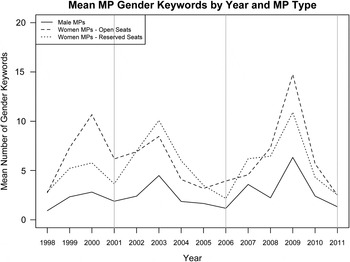
Throughout this process, we consistently spot-checked our Python-generated results to confirm that the keyword count was recording instances in which MPs spoke in ways related to women's interests. The temporal trends we observe in Figure 1 provide face validity for our measure, as we observe that the keyword count peaks during the years in which several gender-related bills were under debate. Finally, we merged the keyword data with data from the Ugandan Scorecard Project (see Humphreys and Weinstein Reference Humphreys and Weinstein2012) as well as other metrics of MP performance that we previously created from the Hansard text in related projects (see Clayton, Josefsson, and Wang Reference Clayton, Josefsson and Wang2014).
Mean MP gender keywords by year and MP seat type.

Our data are largely complete across the 14 years of Hansard transcripts—but we have incomplete data for two indicators for the last two years under review, the total number of lines each MP contributed to plenary debates for each year and how many times each MP is referred to by name per year. To not discount the rich information that we do have for these two years, we chose to use Amelia II for R to impute these values rather than list-wise delete observations with missing values.Footnote 2 The analyses that follow, however, are robust to list-wise deletion.
With imputation, our cumulative data contain approximately 4,000 observations in the unit of MP-years. We group our variables in the unit of MP-years rather than a measure based on unique MP observations across years in order to include time-variant components in the analysis, such as year-level fixed effects, backbencher status, and the rare instances in which MPs switched political parties or moved from unreserved to reserved seats. Our results, however, are robust to keyword counts measured for each unique MP in the dataset, which decreases our number of observations from 4,017 to 499. In the online appendix, we include the model results associated with a dependent variable defined by each MPs' average contribution per parliamentary session, which allows us to define keywords uniquely for each MP while capturing different lengths of parliamentary tenure within the outcome variable.
Returning to our primary analysis, most of our MP-year observations consist of male MPs elected to open seats (n = 2477), followed by female MPs in reserved seats (n = 837), and only a small proportion consists of female MPs elected to open seats (n = 116). In addition, Uganda sets aside five sets of reserved seats for other categories of MPs: youth, workers, and people with disabilities, as well as 10 army representatives and 13 ex officio members. We include these MPs in the analyses that follow by grouping their observations together in the category of “other reserved seats” (n = 537) and explicitly investigate gendered differences in this group's speech contributions in the analyses that follow.
Our primary dependent variable is a count of how many times any particular MP says any keyword related to legislative issues that disproportionately affect women for each included year in our dataset. As a secondary analysis, we also model the likelihood that an MP brings up any gender keyword in a given year conditional on our included covariates. We define our keywords related to women's issues inductively. Cumulatively, we conducted more than 100 semistructured interviews between 2009 and 2013 with female and male MPs in Uganda, members and staff of the Ugandan women's parliamentary association (UWOPA), and prominent figures in the women's movement in Ugandan civil society. In the interviews, we asked the respondents, among other things, about what they perceived to be women's issues or women's interests in the Ugandan context. Based on these interview data as well as other sources, including newspapers, parliamentary and civil society documents, pamphlets, bills, acts, and reports, we created the following list of keywords: “women,” “gender,” “female,” “girl,” “domestic,” “mother,” “daughter,” “rape,” “wife,” “child,” “genital,” “pregnant,” “breast,” “birth,” “reproductive,” “maternal,” “FGM” (female genital mutilation), “marriage,” “divorce,” “defilement,” “trafficking,” “sexual,” “MDB” (Marriage and Divorce Bill), “infant,” and “baby.” The complete list of keywords also includes all the variations of these words, such as plurals and possessives, as well as instances in which the words are included in larger words, such as “breastfeeding.”
Our analysis reveals whether and how often MPs reference these words in plenary debates. This implies that we capture when legislators speak about issues that are of concern to women rather than when they speak for women. We do not capture legislators' stance on these issues—that is, what the MP believes is the best course of action for women as a group. The advantage of focusing on issues rather than predetermined preferences (such as feminist or antifeminist preferences) is that we capture a wider range of claims about women and issues that disproportionally concern women, including both claims that reinforce traditional gender roles and claims that seek to promote gender equality. Moreover, we do not confine our analysis to predetermined policy areas, such as health care or education, but capture debates about issues concerning women in all policy areas under debate. Whereas this analysis focuses on a more cumulative measure of women's substantive representation, an important extension of our work involves investigating how and when legislators speak for women.
Another feature of our dependent variable is that it captures both the desire and the ability of MPs to bring up keywords related to women's interests. As noted, the ability to speak during a plenary debate first requires that the Speaker call on an MP who is raising his or her hand. During uncontroversial debates, the Speaker may be able to exhaust all the desired contributors; however, more controversial debates are often raucous, and not all desired contributors are given the opportunity to speak. We do not have data on the frequency with which certain MPs raise their hands and are ignored, but if the Speaker's choices are random across seat type, this should not bias our results. If, however, the Speaker is more likely to call on female MPs during debates related to issues that predominantly affect women, our results may be capturing an MP's ability to speak on theses issues rather than his or her desire to do so. Indeed, in this analysis, we are not able to differentiate between a scenario in which female MPs (in both open and reserved seats) have both a greater ability and a greater desire than their male counterparts to vocally represent women and a scenario in which men and women have an equal desire but women are given more opportunities because of the Speaker's preferences. However, in both of these scenarios, the presence of female MPs directly leads to the greater substantive representation of women. We argue that although we do not have the necessary data to break down this component of the representative process into its constituent parts, studying “when substantive representation happens” is an important contribution to this research area.
RESULTS: GENDER, GENDER QUOTAS, AND LEGISLATIVE SPEECH
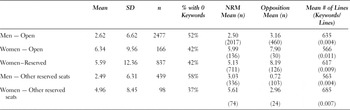
Table 1 shows the descriptive statistics for the dependent variable aggregated across the 14 years by MP seat type, split into five categories: men elected to open seats, women elected to open seats, women elected to reserved seats, and male and female MPs elected or appointed to other special reserved seats (army, ex officio, youth, workers, and people with disabilities). Table 1 also displays the differences in keyword count for each category of MP in both ruling and opposition parties, the average number of lines contributed to the Hansard for each group, and the associated percentage of keywords to lines.
Dependent variable descriptive statistics

Notes: Unit of analysis: MP/year. Total n = 4,017.
A chi-squared test reveals that the distribution of gender keywords is systematic by seat type (p ≤ .000). Relevant to the purposes of this study, we use a series of t-tests to uncover whether there are systematic differences between men and women in open seats and women in reserved seats. Comparing men and women in reserved seats and men and women in open seats reveals statistically significant differences (p ≤ .000 for each test). A t-test comparing women in open seats and women in reserved seats does not uncover a statistically significant difference (p = .383).
Two other trends become apparent from Table 1. First, we see that across our three main seat types of interest, members of the opposition bring up more gender keywords than ruling party members. These differences are statistically significant between opposition and ruling party women in reserved seats (p = .046), and they are just barely under the traditional significance threshold for male MPs' party differences (p = .065) but do not reach statistical significance among women in open seats (p = .406), presumably in part because of this group's limited number of observations. Second, the last column in Table 1 reveals that MPs across our three main seat types have similar total speech contributions measured by the average number lines they contribute to the Hansard per year (p = .266), a trend that is also confirmed by Wang's (Reference Wang2014) analysis of cumulative patterns in MP plenary speech. We also see that keywords spoken as a percentage of total speech follow similar patterns as our keyword count variable.
The descriptive statistics around total contributions to the Hansard raise an important point about MP effectiveness by seat type. Although there has been research that indicates that Ugandan MPs have similar backgrounds and qualifications across seat type (Josefsson Reference Josefsson2014; O'Brien Reference O'Brien, Franceschet, Krook and Piscopo2012), one might expect that women who attain their seats in open competition with men are more skilled politicians, as they must compete with a larger candidate pool. If these women's skills as candidates are associated with increased legislative skills, we might observe a scenario in which openly elected women speak more frequently but devote less of this speech to gendered issues, while quota-elected women speak less in general but experience a higher mandate to represent women's issues in their speech. From Table 1, however, we observe that women in reserved seats actually contribute more lines on average to plenary debates than women in open seats, a trend that seems counter to the claim that female MPs in open seats are more able legislators than their colleagues in reserved seats.
Perhaps more revealing than grouped indicators, Figure 1 plots the descriptive trends of the mean number of keywords spoken by the three main seat types for the 14 years under study. The gray vertical lines indicate a change in the parliamentary term.
Similar to the indications from the descriptive statistics presented earlier, the temporal trends reveal that women in both seat types consistently bring up keywords related to women's issues more often than male MPs. We further see that women in open seats mention keywords pertaining to women's issues more often than women in reserved seats for most years under study, but the two seat types largely follow a tightly connected pattern. The mention of keywords spikes in 2009, when several key pieces of legislation related to women's rights were under debate, leading us to believe that our measure accurately captures legislators' speech patterns on issues that disproportionately affect women.
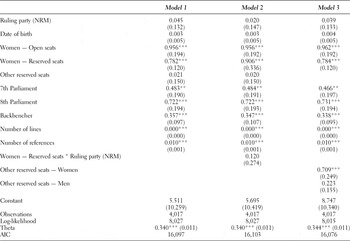
To further understand the relationship between seat type and women's substantive representation, we model the count of gendered keywords spoken by each MP as a function of seat type as well as other potential explanatory variables. Our dependent variable is count data that is overdispersed with a variance that is greater than its mean (see Table 1), following a negative binomial distribution. We model gendered keywords in MP speech over time as a function of various MP-level attributes and external-level variables. Our key covariate, gender/seat type, is a multinomial variable, and in the models that follow, we use male MPs in open seats as the reference category. Our model specifications include additional covariates to account for other possible explanations of keyword count. For each MP-year unit, we control for ruling (NRM) party membership, date of birth, backbencher status (an MP without an active ministerial or shadow cabinet appointment), total number of Hansard lines contributed, and total number of references by name as a measure of MP prestige (see Clayton, Josefsson, and Wang Reference Clayton, Josefsson and Wang2014). We also include individual years (not shown) and parliamentary terms as fixed effects. Our second model specification adds interaction terms to the baseline model to interact women in reserved seats with NRM party membership to test whether ruling party affiliation is associated with different gendered speech patterns. All model specifications reported below include standard errors clustered at the MP level.
We see from Models 1 and 2 in Table 2 that while controlling for other possible explanatory variables, women elected to both open and reserved seats are significantly more likely to bring up keywords related to women's interests than men elected to open seats. Additionally, the models indicate that MPs with significant standing in parliament are more likely to bring up issues related to women, as the total number of lines contributed to the Hansard and the total number of references by name are positively associated with keyword count and backbencher status is negatively associated with keyword count. The interaction term in Model 2 is negative but not statistically significant. Although there is a statistically significant three word per year difference (p = .046) between the number of keywords raised by opposition and ruling party women in reserved seats (see Table 1), the limited number of observations in the former category (n = 126) may partly explain why this coefficient does not reach statistical significance when controlling for other covariates.Footnote 3
Negative binomial regression results dependent variable: Number of gender keywords

*p < .1; **p < .05; ***p < .01.
Because negative binomial regression coefficients are not intuitive to interpret (the log of expected count of the response variable), we simulate the average expected values associated with each of our three seat type categories of interest. Holding all other covariates to their central tendencies (median for numerical values and mode for qualitative values), men are expected to bring up 3.31 fewer average keywords per year than women in unreserved seats (men's 2.03 average compared with unreserved women's 5.34) and 2.56 fewer average keywords than women in reserved seats (who have a 4.55 average). The 0.81 average difference between the two categories of female MPs is not statistically significant (95% confidence range from –0.56 to 2.66). The coefficients associated with Table A1 in the online appendix also confirm these estimated substantive effects.
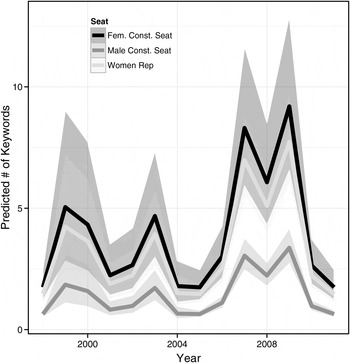
To visualize these results over time, Figure 2 plots the predicted values of the dependent variable for each year for the three seat types of interest. We hold all other values at their appropriate central tendencies to reveal patterns in keyword count while controlling for the other potential explanatory variables used in our parametric estimates. We also plot the uncertainty around these estimates through 95% confidence intervals, which is particularly important given the varying number of observations within each group. Figure 2 confirms the descriptive patterns revealed in Figure 1 and indicates that the differences between men and women in both types of seats have grown more substantial and statistically significant over time. We also note that these discrepancies peaked during the time in which the greatest numbers of gender-related bills were under debate. Finally, again we observe that the patterns of legislative speech from women elected to reserved seats and those elected to open seats are not statistically differentiable from each other.
Predicted values and 95% confidence intervals of gender keywords by MP seat type and year. All other variables held at their appropriate central tendencies.

As an additional test relating MP gender and seat type to legislative speech on gendered issues, we divide the other reserved seat categories (ex officio members, youth, workers, people with disabilities, and army representatives) into male and female members. The descriptive statistics for these two groups are displayed in Table 1 and reveal that this category also divides along gendered lines, with female MPs in other reserved seats raising the gender keywords significantly more frequently in plenary debates than male members in other reserved seats (p = .01). Column 3 of Table 2 shows the associated parametric estimates. The model results confirm the descriptive statistics of Table 1 and provide additional evidence that gender is indeed a salient determinant of legislative speech related to women's interests in another instance in which electoral pathway is held constant. Indeed, all of our results indicate that gender is stronger than seat type in predicting whether MPs articulate women's interests during legislative debates.
As a final robustness check, we examine whether seat type is a significant predictor of whether an MP says any keyword related to gender in a given year, which is particularly important given that in any given year, about 50% of MPs report zero gender keywords. Table A2 in the online appendix displays these logistic regression results under the same covariate specifications listed earlier. The results are quite similar to our models of keyword count, and both categories of female MPs are significantly more likely to bring up at least one keyword in any given year than male MPs. Holding all other values constant, women in reserved seats are 23% more likely than their male colleagues to bring up any gender keyword in a given year, and women in open seats are 21% more likely than men to do so. Under this specification, there are again no significant differences between quota-elected and non-quota-elected women.
DISCUSSION: WHAT THE UGANDAN CASE TELLS US
Our findings demonstrate that female MPs in the Ugandan Parliament, regardless of how they achieve office, devote more legislative speech to women's issues than their fellow male legislators. Indeed, we consistently find that being a woman, across seat types (open seats, seats reserved for women, and seats reserved for other groups), is the strongest predictor of both whether and the extent to which an MP speak about issues that are of concern to women. Returning to the expectations, our findings strongly support H 1 , which postulated that the positive descriptive effects of quotas would be associated with increased levels of advocacy around women's issues. Consequently, we reject H 2 , which posited that men would speak as much or even more than women about women's interests. Moreover, we do not find any evidence of either negative or positive quota effects, as postulated in H 3 and H 4 —there is no significant difference in gendered speech patterns between women elected in open seats and women elected in reserved seats. Finally, we find limited support for H 5 , which related to the potential negative effect of ruling party membership on gender-related speech. Differences between ruling party and opposition members emerge in our descriptive statistics, but are not robust to parametric estimates of the likelihood or frequency of gendered speech.
The overarching trend for female MPs in Uganda to more actively and frequently raise women's issues on the plenary floor relative to male MPs is likely related to the larger institutional context in which the gender quota is situated, namely, the design of the reserved seat system and the length of time the quota has been in place. Uganda, like most countries with reserved seat quotas, operates under a first-past-the-post electoral system, in which one candidate wins each single member constituency. Unlike the quota systems in, for instance, neighboring Rwandan and Tanzania, in which parties have a more direct role in appointing female MPs through the quota, Ugandan quota recipients are elected in more than 100 separate “women's districts” that overlap with the more than 200 general constituencies. Thus, although the ruling NRM party coffers are large and its reach extensive, it still cannot determine who takes each parliamentary seat to the same degree that is possible when parties submit closed candidate lists under proportional representation systems or when reserved seats are filled after general elections directly by political party appointment. This changes the accountability structures of parliamentary candidates who, in addition to their political parties, must answer to their constituents who voted for them and other organizations who assisted in their campaigns, including the Ugandan women's movement that actively supports female candidates. Being held to account by multiple actors likely gives Ugandan female MPs more legislative space to lobby for issues outside of traditional party doctrine.
The “success” of the Ugandan quota is also likely related to the duration of the policy. With the policy's adoption in 1989, Uganda was one of the first countries in the world to implement a reserved seat quota policy. It is not until recently, however, that a significant number of women's rights bills have been successfully passed, many of which took decades to pass. In the 14 years under review in our work, we observe that cumulative patterns of MP speech on women's issues have increased over time, and, importantly, that differences between male and female MPs have also become more pronounced over time. This evidence suggests, although certainly far from proves, that the behavioral effects of quotas may become more observable in the long term.
Our findings speak to another institutional dynamic of quota effectiveness, although, admittedly, only speculatively. We observe that male and female patterns of gendered speech in the plenary move together, suggesting that rather than women replacing men's voice on these issues, women's increased presence acts as a catalyst for more general debate on women's interests in the legislative arena. While male MPs lag behind female MPs in speaking on gendered issues, they have not reacted to the influx of attention to women's welfare by engaging less on these topics. We cannot test whether the increasing amount of attention devoted to women's issues over time is a result of the quota's ability to shift the plenary contributions of all MPs toward more attention to women's interests; but there is significant qualitative evidence that male MPs are becoming more perceptive to legislative issues that disproportionately affect women. An increasing number of male MPs are associated members of the Ugandan cross-party women's parliamentary caucus and female MPs report enhanced collaboration with their male colleagues in recent years, in part explaining the recent success in enacting important pieces of women's rights legislation, including in areas of domestic violence, rape, and female genital mutilation (Wang Reference Wang2013a, Reference Wang2013b).
CONCLUSION
Expanding the scholarship on women's substantive representation beyond an analysis of pro-women policy outcomes to content analysis of legislative speech represents a relatively new and unexplored field of research. The empirical analysis presented here shows that gender, but not gender quotas, affect the extent to which legislators talk about issues that disproportionally affect women in plenary debates. Thus, in Uganda, the descriptive benefits of greater numbers of women in legislative office trump potentially negative quota effects that might differentiate patterns of advocacy on women's issues among female legislators.
Indeed, taken together, our findings suggest that what is commonly regarded as the most controversial type of quota policy in the literature—reserved seats—may actually strengthen women's substantive representation, even in a semi-authoritarian setting. We attribute this finding in the Ugandan context to at least two factors, which also speak to their generalizability to other settings. First, reserved seats in Uganda are designed in such a way that beneficiaries of the policy feel pressure to represent their constituency, a strong and autonomous women's movement, as well as the agenda of the ruling party. Although more work certainly needs to be done on the cross-national determinants of the effectiveness of different types of quota policies, our argument implies that quota effects will be the weakest when quota-elected women are solely accountable to their party's agenda (in patriarchal party settings) and strongest when beneficiaries are held to account by multiple actors.
Second, the evidence we present here suggests that the substantive effects of quotas may take several election cycles before becoming fully observable. Although it is beyond the scope of this article to determine the microfoundations of time-related effects, the general patters we observe fit well with other research on the presence of long- versus short-term effects (see Clayton Reference Clayton2015, 360). Future work might seek to determine causal explanations for various time effects. For instance, it may be that quotas become more effective when the stigma of benefiting from an affirmative action policy dissipates as quotas become normalized as a legitimate electoral rule over time. Alternatively, quotas may become more effective over time as women who attain their positions through quotas become more skilled legislators with increased political experience. Further still, the effects of quotas over time may be related to women's presence reorienting parliamentary cultures more generally. These hypotheses all have implications that could certainly be tested with the right data. On a broader point about the generalizability of our findings, we encourage quota scholars interested in substantive representation (including ourselves) to build on the rich case-based literature and begin to establish a more cross-national framework on quota effectiveness. Quota scholars as well as quota advocates would certainly benefit from a growing comparative approach to the institutional and contextual determinants of various dimensions of quota effectiveness across cases and over time.
Another extension of our work would involve a deeper analysis of women's substantive representation (quantitative or qualitative) in plenary debates or in committee work. Whereas our analysis provides a neutral measure of women's substantive representation, it falls short of capturing differences between MPs policy preferences (i.e., feminist versus conservative) and the extent to which these orientations advance different policy outcomes. Moreover, our analyses do not capture whether female MPs in Uganda contribute to engender debate across a range of policy issues or whether they concentrate their efforts and have more substantial contributions in particular policy fields. Our work here has established a baseline pattern of gendered speech, and future work may seek to further differentiate how and when the substantive representation of women occurs.
In conclusion, we see our research as part of an expanding agenda that views multiple actors and institutional contexts as shaping the dynamic process of interest representation. In this article, we have examined the correlation between women's increased presence in legislative bodies and advances in pro-equality legislation by putting greater primacy on the agency of individual legislators. By investigating how MPs act for women in terms of the agenda-setting power of individual legislators in plenary debates, we have observed that women can act as powerful representatives of women's interests even in less than democratic quota regimes.
SUPPLEMENTARY MATERIAL
To view supplementary material for this article, please visit http://dx.doi.org/10.1017/S1743923X16000453