Introduction
Neo-liberal thinking emphasizes individual choice in the marketplace combined with limited government involvement in the economy. As an economic theory, neo-liberalism was developed in the 1960s by proponents such as Friedman (Reference Friedman1962), becoming a dominant model in policy discussions during the 1970s and continuing to play an important role in informing political and economic discussion worldwide to this day. Essentially, neo-liberalism is a restoration of the laissez-faire and free trade theories of economics popularized in the 18th and 19th centuries by economists such as Smith (Reference Smith1991) and Ricardo (Reference Ricardo1996) adjusted to today’s global economy. The core component of neo-liberal economic philosophy is that economic decisions are best left to individuals, who will allocate their resources in the most utilitarian manner for their own needs. Markets, as groupings of individuals, require only minimal interference from government, whose role should be limited to promoting an environment in which property rights are protected, contracts are respected and the money supply is stable (Morgens, Reference Morgens1976; Gwartney et al., Reference Gwartney, Lawson and Holcombe1999). Privatization is a core component of neo-liberal thought, as governments are viewed as inefficient economic players incapable of running large business enterprises (Shleifer, Reference Shleifer1998). At the national level, neo-liberalism endorses the removal or reduction of market impediments such as tariffs, high marginal tax rates, ownership restrictions, and government transfers and subsidies. At the international level, it promotes trade as the best method to bring about economic development for less developed countries, and therefore opposes trade restrictions (Kreuger, Reference Kreuger1998). As a school of thought, then, neo-liberalism encompasses three basic tenets: (1) non-intervention by government in the marketplace, (2) equal protection of property rights and contract enforcement under the law and (3) free trade.
Advocates of neo-liberalism argue that increased economic freedom is the most efficient and democratic manner through which to promote economic growth (Ayal and Karras, Reference Ayal and Karras1998; Cole, Reference Cole2003). Neo-liberal thinking contends that economic freedom may improve political freedom and that, in conjunction with the benefits of increased trade, it lessens social ills in the long run (Friedman, Reference Friedman1962; Price et al., Reference Price, Pollock and Shaoul1999). For example, one argument put forth by proponents of neo-liberalism is that increased levels of democracy coupled with freer trade may have equalizing effects on income distribution (Reuveny and Li, Reference Reuveny and Li2003). Democratic societies have more political participation by groups that may be underserved in less open societies, and these groups demand smaller income disparities. Also, trade should lessen income inequality through increased competition that lowers the cost of basic consumer goods (Birdsall, Reference Birdsall1998).
Conversely, neo-liberalism’s critics maintain that such policies primarily benefit the wealthy and deprive vulnerable population groups of social safety nets (Clark et al., Reference Clark, McDowell, Caerlewy-Smith and Strauss2005; Labra, Reference Labra2002; Lynch, Reference Lynch2000). It has been argued that neo-liberalism widens the income divide and weakens social cohesion, causing social safety nets to shrink to the detriment of at-risk populations (Wennemo, Reference Wennemo1993; Cornia, Reference Cornia2003; Coburn, Reference Coburn2004; Wu and Perloff, Reference Wu and Perloff2006). Some research has demonstrated a link between increased government transfers (i.e. social welfare programs) and improved absolute and relative poverty measures; these programs would be reduced or eliminated in the neo-liberal ideal (Kenworthy, Reference Kenworthy1999; Labao and Hooks, Reference Labao and Hooks2003; Kunitz and Pesis-Katz, Reference Kunitz and Pesis-Katz2005).
Neo-liberalism and population health
While the debate about the economic impact of neo-liberal practices has been accompanied by substantial empiric research on the topic, less research has been carried out documenting the effect, if one exists, of neo-liberalism on population health. However, several theoretical models have been proposed to explain how neo-liberalism may affect health outcomes. David Coburn proposed a framework in which more neo-liberal practices increase income inequality and reduce social cohesion to the overall detriment of population health (Muntaner and Lynch, Reference Muntaner and Lynch1999; Coburn, Reference Coburn2000). Coburn argues that neo-liberalism is at least not averse to, and may encourage, socio-economic disparities because individuals are rewarded and punished by an indifferent market in relation to their inputs. Coburn cites a body of empirical work that has demonstrated the negative relation between particular components of neo-liberalism, especially as regards government transfers, and national income inequality. For example, relative poverty increases as the proportion of gross domestic product (GDP) spent by the government as social transfer payments decreases (Kenworthy, Reference Kenworthy1999). Another study, classifying countries by government methods for redistribution of resources, found a negative association between the degree to which a country follows the traditional welfare state pattern and its level of income inequality (Korpi and Palme, Reference Korpi and Palme1998). In addition, Coburn argues that neo-liberalism’s emphasis on the individual and his or her complete freedom to act within the market necessarily de-emphasizes the public or communal sphere, reducing social cohesion (Muntaner and Lynch, Reference Muntaner and Lynch1999; Coburn, Reference Coburn2000). Privatization of most public goods is a central component of neo-liberal thought; this process commodifies all aspects of human existence and creates a strict delineation between ‘mine’ and ‘yours’, eliminating anything which could be considered ‘ours’ (Nettleson and Burrows, Reference Nettleson and Burrows1998). Day-to-day life becomes a Hobbesian struggle for survival in an asocial environment. Therefore, Coburn and others have argued that in countries where neo-liberal political philosophies are dominant, greater income inequality and reduced social cohesion mediate a relation between neo-liberalism and adverse health outcomes (Coburn, Reference Coburn2000; Lynch, Reference Lynch2000; Tarlov, Reference Tarlov2000).
Some researchers have disputed this emphasis on neo-liberalism as a determinant of health. Wilkinson (Reference Wilkinson2000) for example, argues that the traditional welfare states were only marginally successful at income re-distribution in the first place and that such “anti”-neo-liberal devices as universal health care systems ultimately have little impact on health because socio-economic factors are more important determinants of individual and population health. Others, while in general agreement with Coburn, have questioned the relative contribution of neo-liberal practices to overall population health and have suggested that neo-liberalism is only one piece in the puzzle of social change which occurred in the 20th century, a time of dramatically improved population health (Hertzman, Reference Hertzman2000; Lynch, Reference Lynch2000; Tarlov, Reference Tarlov2000). Several authors have emphasized the need for empirical studies to test the theorized relationship between neo-liberalism and population health (Lynch, Reference Lynch2000; Tarlov, Reference Tarlov2000).
Some authors have written regarding the implementation of neo-liberal reforms within a country and the effects of these policies on health measures. These analyses have typically reported anecdotal evidence of a negative association between neo-liberalism and health (Labra, Reference Labra2002; Cupples, Reference Cupples2005). However, few empirical studies analyze the effect of neo-liberalism on health directly. Mehrtens (Reference Mehrtens2004), examining recent data, found an association between certain components of neo-liberalism and higher infant mortality in 18 high-income countries. Navarro et al. (Reference Navarro, Muntaner, Borrell, Benach, Quiroga, Rodriguez-Sanz, Verges and Pasarin2006) observed a strong correlation between longer years of government by pro-redistributive parties, which would be antithetical to neo-liberal policies, and lower infant mortality. In contrast to these findings of potentially detrimental effects of neo-liberalism on population health, Grubel (Reference Grubel1998) and Esposto and Zaleski (Reference Esposto and Zaleski1999) found some evidence for a relation between higher levels of neo-liberalism and improved life expectancy. However, all of these analyses have focused on small or unspecified samples of countries, have looked at only cross-sectional associations, or have failed to include controls for other country-level characteristics that may be important confounders or in the pathway between neo-liberal practices and population health.
In this paper, informed by the theoretical rationales discussed above for neo-liberalism’s potential role in shaping population health, we present a cross-national evaluation of the relation between components of neo-liberalism and population health over time. We examined the relation between different aspects of neo-liberalism and under-five mortality across 119 countries between 1980 and 2004. We also examined the roles of income inequality, social capital and democratic institutions, which have been hypothesized to be potential mediators of the relation between neo-liberalism and population health (Muntaner and Lynch, Reference Muntaner and Lynch1999; Coburn, Reference Coburn2000; Shandra et al., Reference Shandra, Nobles, London and Williamson2004).
Methods
Key dependent and independent variables
Population health
We used a measure commonly employed in cross-national analyses to evaluate population health as our health indicator of interest (Rodgers, Reference Rodgers1979; Wennemo, Reference Wennemo1993; Shen and Williamson, Reference Shen and Williamson2001; Moore et al., Reference Moore, Teixeira and Shiell2006). Under-five (or child) mortality rate is “the probability that a newborn will die before reaching age five, if subject to current age-specific mortality rates”, expressed as rate per 1000 live births (World Bank, 2005). This measure more accurately reflects current population health than other indicators, such as life expectancy, which may in fact measure the health of a population as it was years earlier (Coburn, Reference Coburn2004). Mortality data were obtained from the World Bank’s World Development Indicators (WDI) database, which uses data from the United Nations and UNICEF (World Bank, 2005).
Neo-liberalism
We assessed each country’s degree of neo-liberal economic policies and practices using scores from the Economic Freedom of the World: 2005 Annual Report published in association with the Fraser Institute (Gwartney and Lawson, Reference Gwartney and Lawson2005). The Economic Freedom of the World (EFW) index has been created for 123 countries, many with data from 1970 to the present. The overall index is the average of its five component parts, each measured on a scale of 0 to 10 with a higher number signifying more neo-liberal tendencies. These components comprise five areas central to neo-liberal precepts: (1) size of government, (2) legal structure and security of property rights, (3) access to sound money, (4) freedom to exchange with foreigners and (5) regulation of credit, labor and business. Each component is discussed in detail further. Hong Kong and Singapore had the highest scores on the EFW index in 2003 (8.7 and 8.5, respectively), whereas Zimbabwe (3.3) and Myanmar (3.1) scored the lowest. Country rankings differ across each of the five components; examples of countries with high and low scores, in 2003, on each component are provided below (Gwartney and Lawson, Reference Gwartney and Lawson2005).
(1) The size of government component of the EFW index measures total government spending and the value of government transfers and subsidies as a proportion of total national spending, the value of government businesses compared to total investment, and maximum tax rates, both individual and corporate. Countries with less government involvement in economic life will score higher on this component than countries with extensive social welfare programs, since such programs are antithetical to neo-liberalism. Ecuador (9.0) had the highest score for the size of government component in 2003, while Sweden (3.0) had the lowest.
(2) The legal structure and security of property rights component examines whether an independent judiciary exists and if it is impartial, whether intellectual property rights are recognized, and whether the country has a civilian-controlled military. Denmark (9.5) had the highest score on this component, while Rwanda (1.0) had the lowest in 2003.
(3) The access to sound money component score is determined by measuring the change in the annual growth of the money supply vs the GDP, the inflation rate and its variability, and the freedom of the country’s citizens to own foreign currency. Panama and the United States scored the highest on the access to sound money component in 2003 (9.8), while Zimbabwe (1.3) was ranked as the lowest scoring country.
(4) The freedom to trade with foreigners component score measures taxes on international trade, institutionalized trade barriers, total amount of trade compared to the expected amount [based on the country’s population size, geographical area, miles of coastline and location (Akhter, Reference Akhter2004)], whether there is a significant gap between any official exchange rate and the black market rate, and controls on citizens’ ability to trade in international capital markets. Hong Kong (9.7) and Singapore (9.5) had the highest scores on this component, with Burundi (3.2) and Myanmar (1.9) earning the lowest scores.
(5) The regulation component includes indicators from the credit, labor and financial markets. Credit market indicators include degree of private bank ownership, the ability of banks to compete freely on the foreign market, the depth and extent of private credit and whether a country has fixed interest rates. Labor market indicators include the effect of minimum wage laws, the extent to which employees can be freely hired and fired, union activity, unemployment benefits and mandatory military service. Business market indicators include price controls, difficulty of starting a new business, and time spent by executives dealing with government officials and corruption. Higher scores imply less regulation. Hong Kong (8.2) and Iceland (7.9) had the highest scores on this component in 2003, while Mozambique and Syria had the lowest (3.7).
Other covariates
We used the polity score to measure the extent of each country’s political openness. The polity score was calculated by subtracting the country’s level of autocracy (lack of competition in politics, few restraints on the executive branch, barriers to political participation and executive recruitment) from its level of democracy (competitive political participation, executive restraints, civil liberties for all). These data were obtained from the Center for International Development and Conflict Management’s (2005) Polity IV Project. Previous research assessing the impact of democratic institutions has also preferred the polity measure to the democracy measure (Reuveny and Li, Reference Reuveny and Li2003). The polity score ranges from −10 to 10 with a higher score signifying more open political institutions. Because of a non-normal distribution, the polity score was divided into three categories of high (9 to 10), middle (7 to 8) and low (−10 to 6). For the purposes of our analysis, low polity was the reference group.
In addition to the polity score, we controlled for several other potential confounding variables. Data on total population, rural population as a proportion of the total population and average fertility rate were obtained through the World Bank’s WDI database (World Bank, 2005). National GDP in purchasing power parities (PPPs) expressed in constant 2000 international dollars was also obtained from the WDI database (World Bank, 2005). We also included dummy variables for each five-year time interval (using 1980–1984 as the reference group), consistent with previous longitudinal studies in this field that have included dummy time variables to account for changes in child mortality over time (Wennemo, Reference Wennemo1993; Judge, Reference Judge1995; Mellor and Milyo, Reference Mellor and Milyo2001; Gravelle et al., Reference Gravelle, Wildman and Sutton2002).
Covariates used in secondary analysis
Income distribution. We used the Gini coefficient to measure within-country income distribution. The Gini is measured on a scale of 0 to 1, where 0 represents perfect equality and 1 represents perfect inequality. It is the ratio of the area between the actual income distribution line (called the Lorenz curve) and the line of perfect equality (a line drawn at 45° angle to the horizontal axis) to the entire area under the 45° line. Data were obtained from the United Nations University, World Institute for Development Economics Research (2005) (UNU-WIDER) World Income Inequality Database version 2a (WIID2a). Only observations from samples with full area, population and age coverage for the country were included in our analysis. In the case of two or more entries in the same year for the same country, the higher quality observation was preferred, followed by observations gathered using similar definitions for income and measurement unit.
Social capital. Social capital was measured as the per cent of people who answered the question “Generally speaking, would you say that most people can be trusted or that you can’t be too careful in dealing with people?” by responding “Most people can be trusted”, following previous research in this field (Kawachi et al., Reference Kawachi, Kennedy, Lochner and Prothrow-Stith1997; Kennelly et al., Reference Kennelly, O’Shea and Garvey2003). A higher number therefore indicates more social capital. These data come from the World Values Surveys and European Values Surveys (Inglehart, Reference Inglehart2004), which were conducted in four waves beginning in the early 1980s.
Female literacy. Female literacy was defined as the per cent of females aged 15 or older who “can, with understanding, both read and write a short, simple statement related to their everyday life” [United Nations Development Programme (UNDP), 1995, 1999, 2000, 2001, 2006]. Female literacy may be a confounder of the relation between neo-liberalism and infant or child mortality, as countries with more neo-liberal practices may have higher levels of literacy (Grubel, Reference Grubel1998; Esposto and Zaleski, Reference Esposto and Zaleski1999) and higher levels of female literacy and education are associated with decreased child mortality (Grosse and Auffrey, Reference Grosse and Auffrey1989; Martyn, Reference Martyn2004; Mogford, Reference Mogford2004; Schell et al., Reference Schell, Reilly, Rosling, Peterson and Ekstrom2007). These analyses were restricted to the 1990–2004 time period because of limited availability of adult female literacy data before 1990.
Data analysis
Analyses were conducted on 119 World Bank member countries (World Bank, 2007) for which data were available for all measures of interest in at least one time interval (countries included in the analysis are listed in the Appendix). Since data were available in different years for different countries, we calculated interval averages for five-year periods between 1980 and 2004, with a total of 464 observations contributed by the 119 countries. The five time intervals were 1980–1984, 1985–1989, 1990–1994, 1995–1999 and 2000–2004. We examined all variable distributions for outliers and normality. In the case of non-normal distributions (for under-five mortality, total population and GDP) we used natural log transformations. We calculated summary statistics for each variable of interest, including mean, standard deviation, minimum and maximum values. We ran bivariate and multivariable regression analyses with child mortality as the outcome, using generalized estimating equations to adjust for repeated measures on each country over time. We performed separate multivariable analyses for each domain of neo-liberal policy (size of government, legal structure, sound money, trade and regulation) as well as the aggregate EFW index. Results were considered significant at the p < 0.05 level.
In order to assess whether neo-liberal practices had differential effects in rich vs poor countries, as has been suggested in some studies looking at the relations between neo-liberalism and outcomes other than health (e.g. Graeff and Mehlkop, Reference Graeff and Mehlkop2003), we stratified the overall country set into two subsets based on gross national income (GNI) per capita and repeated all analyses. Sixty-three countries classified by the World Bank as low (⩽US $765) or lower-middle income (US $766–$3034), based on 2003 GNI per capita, were classified in our analysis as low-income countries, whereas, fifty-six countries classified as upper-middle (US $3035–$9385) or high-income countries (⩾US $9386) by the World Bank were classified as high-income countries in our analysis (World Bank, 2005). Although in earlier intervals GNI per capita in an individual country may have fallen above or below the level of US $3035 used to distinguish low and high-income countries in this analysis, each country’s status remained fixed for the purpose of the analysis across all time intervals based on the 2003 classifications.
The primary analysis included controls for neo-liberal practices, as well as polity, total population, rural population, fertility, GDP per capita and time interval. We also performed secondary analyses that included additional controls for income inequality, social capital and female literacy in multivariable models. The inclusion of these three variables further restricted the sample to 60 countries, with a total of 107 observations, because of limited availability of these data. Because of the smaller sample size, the secondary analyses were conducted among all countries, without disaggregation by income group. The country intervals included in this secondary analysis are indicated in the Appendix.
We carried out four additional sensitivity analyses to assess the robustness of our results. In the first and second sensitivity analyses, we used male and female working-age mortality rates, respectively, as the outcome of interest. Working-age mortality data were collected from the World Bank’s WDI database, with working-age mortality defined as “the probability of dying between the ages of 15 and 60…if subject to current age-specific mortality rates between those ages” (World Bank, 2005). Effects of country-wide practices on working-age mortality may differ from effects on childhood mortality because different processes are involved (e.g. non-communicable diseases in working-age mortality vs communicable diseases in child mortality) (Murray and Lopez, Reference Murray and Lopez1997); additionally, greater variability in working-age than child mortality exists, especially across high-income countries, where levels of child mortality are low, enhancing the ability to detect effects. Third, we restricted the analyses to the highest income countries, those with 2003 GNI per capita greater than US $9385, which are classified as high-income by the World Bank, to assess whether relations between neo-liberal practices and population health may be different in these countries, as prior studies have suggested determinants of mortality in high-income countries differ from those in low- and middle-income countries (e.g. Lindstrom and Lindstrom, Reference Lindstrom and Lindstrom2006; Schell et al., Reference Schell, Reilly, Rosling, Peterson and Ekstrom2007). Fourth, we excluded the United States from all analyses, as it has been shown to be an outlier in other studies including national income as a predictor of population health (e.g. Reinhardt et al., Reference Reinhardt, Hussey and Anderson2002).
Results
Descriptive statistics
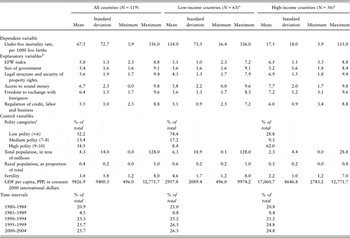
Descriptive statistics for all variables included in the primary analysis are shown in Table 1. The average under-five mortality rate across all countries during 1980–2004 was 67.5 deaths per 1000 live births; low-income countries had higher average child mortality rates than high-income countries. The EFW index averaged 5.8 across all countries, with lower scores in low-income than high-income countries, particularly for the component scores of legal structure and property rights, access to sound money, freedom to trade and regulation of credit, labor and business. Over sixty per cent (62.0%) of high-income countries had high polity scores, compared to less than one-tenth (8.4%) of low-income countries. Compared to high-income countries, low-income countries included in the analysis had larger populations, greater proportions of the population living in rural areas, and higher fertility from 1980 to 2004.
Descriptive statistics of dependent variable, explanatory variables and control variables for primary analyses, 1980–2004

EFW = Economic Freedom of the World index; GDP = gross domestic product; PPP = purchasing power parities.
a“High-income countries” are those classified by the World Bank as “upper-middle” or “high” income countries according to 2003 GNI (gross national income) per capita; “low-income countries” are those classified as “lower-middle” or “low” income.
bAll components of the EFW index are measured on a scale of 0 to 10; a higher score indicates a more neo-liberal outlook.
cMeasured on a scale of −10 to 10; a higher score indicates more open political institutions.
Primary analysis
In bivariate analyses, all explanatory and control variables were significantly associated with under-five mortality (p < 0.01) across the 119 countries studied. Specifically, higher levels of neo-liberalism, polity, population size and GDP per capita were associated with lower child mortality rates, whereas higher rural population and fertility were associated with higher mortality rates. Mortality rates decreased over time, as indicated by negative coefficients for each time interval in comparison to the 1980–1984 time interval.
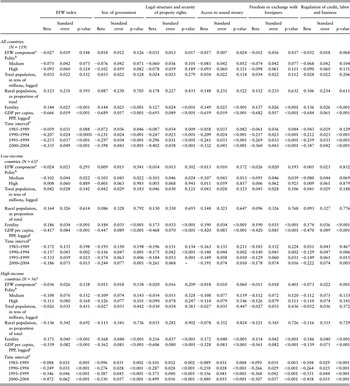
In adjusted multivariable models (Table 2), the EFW index score was not significantly associated with under-five mortality in any of the country groups (all countries, high-income, low-income). As for the components of the EFW index, higher scores on property rights and the access to sound money components were significantly associated with lower under-five mortality among all countries (p = 0.017 and p = 0.024, respectively), and less market regulation, indicated by higher scores on the regulation of credit, labor and business component, was significantly associated with lower mortality in high-income countries (p = 0.001). None of the EFW component scores were significantly associated with under-five mortality among low-income countries.
Multivariable models predicting log of under-five mortality rate, 1980–2004

EFW = Economic Freedom of the World index; GDP = gross domestic product; PPP = purchasing power parities.
aAll components of the EFW index are measured on a scale of 0 to 10; a higher score indicates a more neo-liberal outlook.
bMeasured on a scale of −10 to 10; a higher score indicates more open political institutions. Low polity is the reference group.
cGDP per capita, PPP, was expressed in constant 2000 international dollars before natural log transformation.
dThe 1980–1984 interval is the reference group.
e“High-income countries” are those classified by the World Bank as “upper-middle” or “high” income countries according to 2003 GNI (gross national income) per capita; “low-income countries” are those classified as “lower-middle” or “low” income.
Among all countries from 1980 to 2004, lower fertility rates and higher GDP per capita were associated with lower child mortality (p < 0.001 for both). These associations remained in the analyses for high-income and low-income countries. Medium levels of polity as compared to low polity were associated with lower mortality among low-income countries. The decline in child mortality over time among all countries was confirmed with significant negative associations between the dummy variables representing five-year periods and child mortality starting with the 1990–1994 period (compared to the 1980–1984 reference period).
Secondary analysis with additional covariates
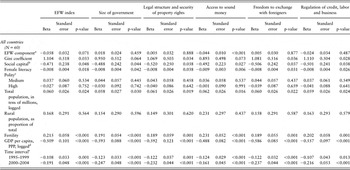
In adjusted multivariable models controlling for Gini coefficient, social capital and female literacy (Table 3), the EFW index score was not significantly associated with child mortality but the sound money component of the score was negatively associated with child mortality (as in the more parsimonious analysis). Lower income inequality and smaller population were associated with lower child mortality among all countries as were higher levels of social capital and female literacy. Dummy variables representing time since the 1990–1994 reference period were also negative and significant predictors of child mortality.
Multivariable models predicting log of under-five mortality rate, including adjustment for Gini coefficient, social capital and female literacy, 1990–2004

EFW = Economic Freedom of the World index; GDP = gross domestic product; PPP = purchasing power parities.
aAll components of the EFW index are measured on a scale of 0 to 10; a higher score indicates a more neo-liberal outlook.
bProportion of participants in the World and European Values Surveys who responded to the question: ‘Generally speaking, would you say that most people can be trusted or that you can't be too careful in dealing with people?’ with ‘Most people can be trusted’.
cMeasured on a scale of −10 to 10; a higher score indicates more open political institutions. Low polity is the reference group.
dGDP per capita, PPP, was expressed in constant 2000 international dollars before natural log transformation.
eThe 1990–1994 interval is the reference group.
Sensitivity analyses
We conducted several sensitivity analyses to assess the robustness of the results of the primary analysis described above to different outcomes, model specifications and samples. We summarize the results of these sensitivity analyses here; detailed results and tables are available from the authors upon request. All sensitivity analyses were done using the primary independent variable set (components of neo-liberal practices, as well as polity, total population, rural population, fertility, GDP per capita and time interval) from 1980 to 2004.
Alternative health outcomes
The average male and female working-age mortality rates across all countries during 1980–2004 were 255.9 and 187.3 deaths per 1000 population, respectively; low-income countries had higher average working-age mortality rates (339.1 for males and 276.6 for females, per 1000 population) than high-income countries (172.0 for males and 97.2 for females, per 1000 population). Relations between neo-liberal economic practices and male and female working-age mortality were similar to those in models with under-five mortality. Specifically, the EFW index was not associated with male or female working-age mortality. Improved access to sound money was associated with lower male mortality in all (p = 0.005) and low-income countries (p = 0.004). Security of property rights and less market regulation were associated with lower male mortality in high-income but not low-income countries (p-values of 0.003 and 0.004, respectively). None of the EFW components were significantly associated with female working-age mortality. Higher GDP per capita was associated with lower male (p < 0.001) and female (p < 0.001) mortality and lower fertility rate was further associated with lower female mortality (p < 0.001).
Different country sets
Restricting analyses to only countries defined by the World Bank as high-income [GNI per capita >US $9385 in 2003 (World Bank, 2005)] resulted in 33 countries (indicated in the Appendix), and 147 country intervals. In these models, there were significant negative associations between the EFW index score (p = 0.001), sound money (p = 0.016) and market regulation (p = 0.023) and child mortality. Again, this indicates that these more neo-liberal policies were associated with lower rates of child mortality. Excluding the United States from analyses resulted in a total of 118 countries (459 country intervals). There were no substantial differences in results after excluding the United States.
Discussion
The extant literature that has considered the relation between neo-liberal economic practices and population health is conflicting. Some studies have found a relation between higher scores on the EFW index and improved health, indicated by increased life expectancy (Grubel, Reference Grubel1998; Esposto and Zaleski, Reference Esposto and Zaleski1999). In contrast, Mehrtens (Reference Mehrtens2004) observed an association between higher scores on the EFW index and poorer health, indicated by higher infant mortality rates, in adjusted models among 18 high-income countries. Others have reported similar negative effects of neo-liberalism on population health (Pampel and Pillai, Reference Pampel and Pillai1986; Labra, Reference Labra2002; Mehrtens, Reference Mehrtens2004; Cupples, Reference Cupples2005; Navarro et al., Reference Navarro, Muntaner, Borrell, Benach, Quiroga, Rodriguez-Sanz, Verges and Pasarin2006). These different results might be explained by different study designs (cross-sectional vs our time-series analysis), the larger number of high-income countries included in our analysis and the different control variables used in our multivariable models.
Aiming to build on this work, we considered the relation between specific disaggregated features of neo-liberal economic practices and their relation to population health. Using a longitudinal cross-national analysis we found that certain domains of neo-liberal economic policy, specifically protection of property rights and access to sound money were associated with lower levels of child mortality among all countries over time. No neo-liberal economic policies were associated with child mortality in low-income countries. High-income countries characterized by less regulation of credit, labor and business had lower child mortality rates, as well as lower working-age male mortality, even after controlling for other covariates. Access to sound money was also associated with lower working-age male mortality.
The association between sound money supply and lower child mortality documented in our study may be explained by the deleterious effect of inflation on poor families. When the inflation rate is high, it can wipe out the savings of all but the richest members of society. The small buffer that separates the more vulnerable members of society from poverty or indigence is then removed, leaving them exposed and with no recourse should they fall ill, thus leading to higher child mortality rates. Similarly, better protection of property rights allows families greater security of tenure and permits them greater access to credit for economic and health investments, using property as collateral. In this respect, then, the observed associations between the property rights and sound money components of the EFW index and lower under-five mortality may reflect the centrality of family savings (not captured in typical measures of aggregate income) and property as protection against adverse circumstances and as positive influences on population health.
In high-income countries, the association between less regulation of credit, labor and business, as indicated by higher scores on the regulation component of the EFW index, and under-five mortality may be due to the impact of a favorable climate for private enterprise on employment opportunities. These opportunities may serve to provide ongoing employment and a steady income, which are associated with better population health (Ross and Mirowsky, Reference Ross and Mirowsky1995; Benzeval and Judge, Reference Benzeval and Judge2001). The lack of this association in low-income countries may be testament to the many other barriers (including lack of education and financial capital) to such employment opportunities.
We did not find an association between government size and child mortality among countries included in the analysis, when controlling for other factors. Other studies that have examined the size of the welfare state or public health expenditures (important determinants of government size) and the association between government size and population health have found that higher levels of social welfare spending as a proportion of total government spending, and longer government by parties in favor of redistributive efforts, are associated with lower infant and post-neonatal mortality rates (Pampel and Pillai, Reference Pampel and Pillai1986; Navarro et al., Reference Navarro, Muntaner, Borrell, Benach, Quiroga, Rodriguez-Sanz, Verges and Pasarin2006).
We found no significant association between trade and population health. This concurs with previous research (Mehrtens, Reference Mehrtens2004; Moore et al., Reference Moore, Teixeira and Shiell2006) in high-income countries. However, the lack of association between higher levels of free trade and improved population health among low-income countries contrasts with previous cross-sectional findings suggesting that trade and foreign direct investment may bring improvements in infrastructure, such as better roads and telecommunication networks, and other technology spillovers essential to the promotion of population health in poorer countries (Blomstrom and Kokko, Reference Blomstrom and Kokko1997). It is possible, however, that freer trade alone (rather than in combination with foreign direct investment), which in many poor countries means exports of raw or minimum value-added goods, will have limited effect on economic growth and national infrastructure.
We found a significant positive association between income inequality and child mortality in all countries. This is consistent with previous work on the subject, which has shown that increases in income inequality are associated with poorer population health (Rodgers, Reference Rodgers1979; Kawachi et al., Reference Kawachi, Kennedy, Lochner and Prothrow-Stith1997; Flegg, Reference Flegg1982; Wilkinson, Reference Wilkinson1992). Higher levels of social capital were significantly associated with lower child mortality in our secondary analysis. Here, our research agrees with some earlier authors and contradicts others. For example, some studies focusing on associations within single countries have found the same protective relationship between social capital and population health (Kawachi et al., Reference Kawachi, Kennedy, Lochner and Prothrow-Stith1997). Other studies using a cross-national design have found no such association (Kennelly et al., Reference Kennelly, O’Shea and Garvey2003). The differences may be accounted for by differences in study design and samples of countries under study.
We did not find a robust association between openness of political institutions and health at any income level in adjusted models. When low-income countries were considered together, medium but not high levels of openness of political institutions were associated with lower child mortality. This may be because there were very few (eleven) low-income countries with high polity ratings. Other researchers have found that higher levels of democracy were associated with lower child mortality rates across countries (Franco et al., Reference Franco, Alvarez-Dardet and Ruiz2004).
Previous findings of a positive association between fertility and child mortality are confirmed in our study regardless of income level (Rutstein, Reference Rutstein2000; El-Ghannam, Reference El-Ghannam2003; Macinko et al., Reference Macinko, Guanais, de Fatima and de Souza2006). We also found a strong negative relationship between absolute wealth, as indicated by GDP per capita, and child mortality in both high- and low-income countries, consistent with previous research (Hales et al., Reference Hales, Howden-Chapman, Salmond, Woodward and Mackenbach1999; Beckfield, Reference Beckfield2004; Chung and Muntaner, Reference Chung and Muntaner2007).
Study limitations
Several limitations of this study should be considered when interpreting the results. The first limitation involves comparability of the data. When collecting cross-national data, comparability of sources is always a concern. Different countries may collect data differently and in such a way that they are reporting on very different phenomena, although the indicators share a common name. For example, the WIID2a income distribution database, from which we obtained the Gini coefficient estimates, includes observations from several types of surveys, many of which measure income according to different definitions. Some surveys measured net income, while others included gross measures or relied on consumption patterns rather than monetary income. While every effort was made to include data with consistent definitions, the scarcity of data made it impossible to include only observations collected using entirely consistent methodologies.
Another limitation was data availability. Many of the variables were missing entirely for some countries or were available only intermittently from 1980 to 2004. Income distribution data had been poorly documented, especially for low-income countries, and especially prior to the 1990s. Social capital is a relatively new theoretical concept, and no cross-national data exists prior to the early 1980s. Similarly, female literacy data was only available after 1990. These three variables limited the sample size of our secondary analysis; results of that analysis may reflect the selected nature of the countries with available data as well as reduced power to identify significant effects. In addition, many low-income countries report health statistics only every five or ten years, which decreased the number of observations in our study. Therefore, inference about non-significant associations should be drawn with caution from these data.
Finally, the EFW index is one particular operationalization of neo-liberal economic policies and practices. Previous studies have quantified neoliberal practices and economic globalization using measures of inflation, market regulation, government transfers and trade openness (e.g. Labao and Hooks, Reference Labao and Hooks2003; Gerring and Thacker, Reference Gerring and Thacker2005; Gerring and Thacker, Reference Gerring and Thacker2008). These components of neoliberalism and globalization, considered essential to evaluations of the effects of these practices on economic growth and human development (Gerring and Thacker, Reference Gerring and Thacker2005; Gerring and Thacker, Reference Gerring and Thacker2008), are included in the EFW index, as described above, and were evaluated separately using the five components of the EFW index. Other measures of economic freedom include Freedom House’s Economic Freedom Indicators (Messick, Reference Messick1996) and the Heritage Foundation’s Indices of Economic Freedom (O’Driscoll et al., Reference O’Driscoll, Holmes and Kirkpatrick2001). Although these measures include components similar to those included in the EFW index, the Freedom House indicators emphasize civil liberties whereas the Heritage Foundation indices emphasize development assistance; however, these alternate measures of economic freedom are highly correlated with the EFW index and produce similar rankings of countries (Hanke and Walters, Reference Hanke and Walters1997). Both the EFW index and the Heritage Foundation indices incorporate information on the stability of each country’s monetary supply and the size of government, characteristics that are central to discussions of the relation between neo-liberal practices and population health (Coburn, Reference Coburn2000). The EFW index, with data available from the 1970s, is available for a longer time span than the Heritage Foundation indices, which began in 1994, making it a superior choice for longitudinal analysis. Furthermore, our desire to conduct a cross-national analysis quantifying the relation between neo-liberal economic policies and practices argued against grouping countries according to type of government policies (e.g. Navarro et al., Reference Navarro, Muntaner, Borrell, Benach, Quiroga, Rodriguez-Sanz, Verges and Pasarin2006) or using other measures of neo-liberal reform that have only been developed for limited country sets [e.g. Latin American countries in Huber and Solt (Reference Huber and Solt2004)], reinforcing our decision to use the EFW index and its components as the explanatory variables of interest in this analysis. Although the EFW index was better suited to the objectives of this analysis than other measures of economic freedom or indicators of neo-liberalism and globalization, some aspects of neo-liberal policies that have been linked to health outcomes, including structural adjustment programs (Breman and Shelton, Reference Breman and Shelton2007), were not included in this measure. Thus, the conclusions drawn here may only apply to the aspects of neo-liberalism incorporated in the EFW index. Importantly, the neo-liberalism variables included here are themselves composite measures of many separate policy and economic factors, some of which may act in opposite directions on child mortality. While our interest here was in capturing the influence of several components of neo-liberal policy, further disaggregation into specific sub-components of business and government behavior would be instructive.
Conclusion
Three central findings emerge from our results. Access to sound money had the single-most robust association with lower under-five mortality across countries in all analyses. Protection of property rights was also associated with lower under-five mortality in all countries in the more parsimonious analyses (not adjusting for income inequality, social capital or female literacy). Both these policy areas can theoretically be linked with better economic prospects for households that may, in turn, lead to improved health outcomes.
Among more developed countries (i.e. those with average incomes above approximately US $3000), less market regulation was also associated with lower child and adult male mortality. It is plausible that in these countries, the majority of which already have basic infrastructure and other determinants of health (e.g. closed sewers, treated water systems, quality health care) in place and thus relatively good population health, a more robust private enterprise may further improve health.
Among low-income countries, none of the neo-liberal policies examined were associated with child mortality. In these countries, where large portions of the population may lack even the most basic health infrastructure, the greater individual economic freedom allowed by neo-liberal economic practices may do little to offset the lack of fundamental determinants of health from proper nutrition to clean water to functioning health systems. However, we failed to find any evidence that neo-liberal practices and policies were independently associated with poorer population health using the EFW measures of neo-liberalism. Importantly, we did not assess the impact of neo-liberal policy on equality in health outcomes among socioeconomic groups within rich and poor countries. Other observers have suggested that neo-liberal economic practices may lead to more unequal health outcomes between socioeconomic groups within countries (Hertzman, Reference Hertzman2000; Wilkinson, Reference Wilkinson2000; Kim, Reference Kim2005).
In sum, our analyses suggest that a more nuanced view of neo-liberalism is required when assessing its relation with population health. Neo-liberalism is not a single entity – different policies traditionally included under that umbrella may have different effects on a country’s economic growth (Ayal and Karras, Reference Ayal and Karras1998; Carlsson and Lundstrom, Reference Carlsson and Lundstrom2002) and thus health. Indeed two domains, access to sound money and protection of property rights, appear to promote better health outcomes. Our work also confirms the importance of conducting stratified analyses to understand the differential effects of neo-liberalism on countries at different levels of development. Further work that evaluates the differential contribution of specific economic policies to health is required to better understand these complex associations. Future research should also evaluate the impact of these policies on equity in health outcomes within countries.
Acknowledgements
The authors would like to thank Dr George Kaplan for helpful comments on an earlier version of this manuscript.
Appendix
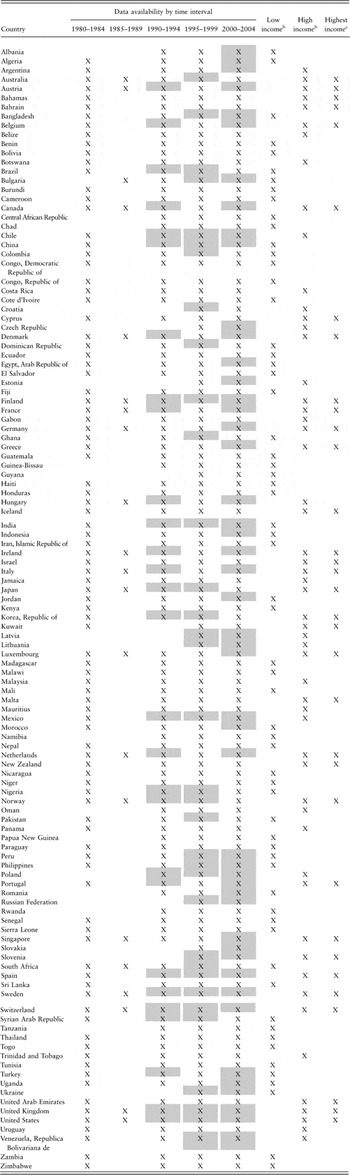
Countries included in analyses (N = 119; 464 country intervals)Footnote a

a Country intervals shaded in gray were also included in models predicting outcomes with adjustment for Gini coefficient, social capital and female literacy (N = 60 countries, 107 country intervals).
b “High-income countries” are those classified by the World Bank as “upper middle” or “high” income countries according to 2003 GNI (gross national income) per capita; “low-income countries” are those classified as “lower-middle” or “low” income.
c “Highest income” countries are those classified by the World Bank as “high” income countries according to 2003 GNI per capita.
‘X’ indicates the inclusion of an observation in the analysis for a given country in a given time interval.