On 16 August 1971, the leaders of white South Africa's parliament, executive, foreign service, and military congregated on the tarmac of Waterkloof Air Force base in Pretoria. In the wake of the Afro-Asian assault on apartheid in the early 1960s, visits by foreign statesmen were rare. But the guest arriving that day, the regime's leaders believed, could change all that. Malawian President-for-Life Hastings Banda's five-day state visit was the first to South Africa by the head of an independent African country. He was welcomed with a 21-gun salute at the airport and whisked down the new N1 highway to Johannesburg's President Hotel, where up to 3,000 South Africans – white and black – awaited the spectacle.Footnote 1 Pretoria spared no expense, as Prime Minister John Vorster fêted the Malawian leader at a series of banquets.Footnote 2 Banda did not leave his hosts disappointed. ‘South Africa doesn't need a certificate of respectability’, he told the press: ‘It already has one.’Footnote 3
Banda was not alone. In the years between Foreign Minister Hilgard Muller's first visit to Malawi in 1968 and South Africa's disastrous intervention in the Angolan Civil War in the second half of 1975, Vorster's ‘outward policy’ prompted a flurry of bilateral meetings between South African representatives and their African counterparts.Footnote 4 By the time of Banda's visit, South Africa already had regular dialogue with just under half of all the countries in independent Africa.Footnote 5 Then, in response to the Carnation Revolution in Portugal and the pending decolonisation of the Angolan and Mozambican bookends of South Africa's cordon sanitaire of white-ruled states, Vorster launched a parallel campaign aimed specifically at Southern Africa, which quickly came to be known as ‘détente’ (1974–5).Footnote 6 Why did Pretoria reach out to independent Africa through its ‘outward policy’ and ‘détente’ campaigns? How did the apartheid regime reconcile such a course with its racial hierarchies at home?Footnote 7
Although these counterintuitive events have attracted no shortage of attention, scholars have been signally divided in their analyses. One school has seen Pretoria's African outreach as driven primarily by economic considerations.Footnote 8 ‘The requirements of economic expansion were vitally important in the shaping of South Africa's policies towards Africa’, Sam Nolutshungu declared.Footnote 9 Others take the economic argument further, spelling out its strategic corollaries. The outward policy was designed to establish a sphere of hegemony throughout Southern Africa, asserted Sean Gervasi.Footnote 10 Eschewing economic rationales, a second school has seen the outward policy as an essentially geopolitical programme designed to corrode the Republic's international isolation by working through Africa.Footnote 11 In a resilient variation, numerous studies interpret Pretoria's African outreach as a detour – an end run, in American parlance – to improving relations with the West.Footnote 12
Much of this literature was written contemporaneously. Often working with limited or no access to South African archives, scholars inevitably made extensive assumptions about how Pretoria engaged with independent Africa based on their understanding of its relationship with black Africans at home, neglecting the white polity's own perceptions of that relationship. Among the economic school, Marxian classifications of South Africa's racial hierarchies as a sophisticated vertical class structure were often highly influential, informing a common identification of Pretoria's outreach into Africa as an extension of exploitative capitalist interests.Footnote 13Although this theoretical approach has largely long since fallen into disfavour, the economic thesis continues to cast a long shadow. In the most detailed recent study, Roger Pfister puzzlingly depicts South Africa's outreach into Southern Africa, at least, as being broadly ‘economic’ in motivation.Footnote 14 Afrikaner capital was certainly in favour of the opening of new markets. As early as 1967, the Afrikaanse Handelsinstituut (Afrikaner Commerce Institute) had offered full-throated support for ‘cooperation with African countries in the economic realm’.Footnote 15 But the documents show that private sector ambition was hardly the driving force behind the outward policy. As for public economic gain, the archival evidence actually confirms Adrian Guelke’s earlier speculation that Pretoria was prepared to take an economic hit in exchange for political benefits in Africa.Footnote 16
The geopolitical thesis casts Pretoria's outreach as an exercise in realpolitik, with limited exploration of the intellectual currents and political dynamics beneath the two-dimensional diplomatic surface.Footnote 17 Yet to understand what African outreach meant, we need to grasp how apartheid and African nationalism were variously understood in the corridors of power in Pretoria, through reference to the ideas and historical experiences that shaped the Afrikaner National Party's (NP) ruling ideologies.Footnote 18 Much like the prospect of increased trade with independent Africa, potential improvements in Pretoria's standing in Washington – an important consideration in the regime's overall foreign policy profile – were hardly unapparent to South African policymakers.Footnote 19 But the thesis that African outreach specifically was ‘directed as much at Washington as at Africa’,Footnote 20 as expressed in perhaps the most sophisticated of these analyses, reflects a decidedly outdated ‘centre-periphery’ model of Cold War relations. Newer approaches to international history,Footnote 21 recent calls to include settler societies in understandings of decolonisation,Footnote 22 and moves to foreground the domestic political scene in African history,Footnote 23 as well as the fruits of a broader archival base, all direct the historian's lens towards the ideological factors informing South African state agency, specifically evolving conceptions of Afrikaner nationalism in a localised African context.
On a purely diplomatic level, Pretoria indeed strove to exploit cleavages on the African scene that cut across anti-apartheid sentiments and thereby gain limited forms of international acceptance. Yet this article argues that African outreach was intended to do much more. Vorster's aim was to create a forum in which Pretoria could advance a new state identity underpinning longer-term security: the acceptance of the Afrikaner community as part of independent Africa via an ‘Africanisation’ of apartheid. As James Brennan and Jonathan Glassman have demonstrated, the racial divisions stratifying postcolonial social orders were not innate, but constructed and contested structures, shaped alternately by specific processes of pre- and post-independence governance, tensions between communities for resources and status, and self-identification through metaphor and discourse.Footnote 24 Amid substantial opposition, Vorster sought to navigate much the same process and manipulate it to the Afrikaners' advantage. Nationalist leaders were no more immune to the ‘contradictions of accumulation and control’, in John Lonsdale and Bruce Berman's term, than their imperial predecessors or white counterparts elsewhere on the continent: they had to keep Africans in a position of subjugation and exploitation, while simultaneously being seen to govern for the benefit of the social order as a whole.Footnote 25 Vorster's strategy for dealing with this challenge in a changing world was to fundamentally reshape the ideological basis for the regime's existing racial hierarchies through embedding South Africa's existing apartheid order, with some minimal alterations, in a different network of values and norms. Apartheid would be rearticulated both to black Africa and to the white electorate as representing a network of interdependent nations – each with an equal claim to African nationalism – rather than a hierarchical system entrenching white racial dominance. Pretoria's relationship with independent Africa became the central engine for this landmark shift. If Africa's opposition to South Africa was largely a function of the perception that apartheid was among the last and most oppressive vestiges of colonialism, then Vorster's African outreach was an attempt to shatter this association between Pretoria and the practices of European empires by redefining apartheid into the norms of the post-independence era. Statecraft was conscripted in the service of state-building; diplomacy in the service of ideological renewal. This was not an effort merely to divide and rule African leaders, or to get back in Washington's good graces. It was a campaign to contest and shape the definition of a legitimate African state.
The first part of this article charts the emergence of Vorster's reconceptualisation of the Afrikaner national project. The second explores his initial efforts to establish a foundation in foreign policy for reimagining the regime's relationship with African nationalism. Finally, this article explains how Vorster bolstered this vision through détente policies that distanced his regime from both erstwhile allies across Southern Africa, as well as exploring the increased domestic opposition to his new agenda that this shift provoked.
‘WE ARE NOT EUROPEANS’
The ideological edifice of the apartheid state as envisaged by John Vorster's predecessor, Hendrik Verwoerd (1958–66), was unapologetically exclusive, driven explicitly by the unilateral preservation of Afrikaner independence.Footnote 26 That edifice stood on twin foundations: the nationalist precepts espoused by mid-century Afrikaner intellectuals, often expressed through religious tropes; and norms and discourses that drew directly on conceptions of racial supremacy.Footnote 27 The Afrikaner had been ‘planted here at the southern point’ of Africa, he proclaimed in a landmark 1958 speech commemorating the 1838 Boer victory over the Zulus at Blood River, ‘so that from this resistance group … all that has been built up since the days of Christ may be maintained for the good of all mankind’. Just as the original voortrekkers (Afrikaner pioneers) had been decried by hostile missionaries for insisting that ‘the supremacy of the white man’ was ‘necessary’ for civilised development, as Western powers forsook traditional bonds of race in the era of decolonisation, it once more fell to whites in Africa to ‘be an anchor and a stay for Western civilisation and for the Christian religion’.Footnote 28 Such ideologies were equally expressed in Cold War terms, with communism positioned as the atheistic, barbaric antithesis of ‘civilisation’.Footnote 29
As newly-independent African and Asian states pushed South Africa to the brink of expulsion from the international community in 1960–1, Verwoerd vaunted a practical solution to the emergence of African nationalism: the creation of homelands or bantustans.Footnote 30 Blacks would be expelled from the white state and granted the opportunity to progress separately towards ‘survival and full development, politically and economically’.Footnote 31 However, the ideological basis of Afrikaner legitimacy and control remained unchanged. ‘[T]his Republic is part of the White man's domain in the world … He, and the spirit with which he is endowed … will always be needed where order and peace and progress are desired’, Verwoerd reiterated in 1966.Footnote 32 While the regime continues to occupy an ambiguous position in historical narratives of colonialism, the ideological discourse of the Verwoerd era was decidedly ‘colonialist’ or ‘neocolonial’ in that it unashamedly sought to maintain and reproduce much of the discredited conceptual foundation that had sustained European colonial projects in Africa.
Upon Verwoerd's assassination, Vorster's central political priority comprised the fulfilment of his predecessor's separate development vision. However, Vorster realised that the old framework of norms, values, and institutions that sustained the South African regime both domestically and abroad was losing currency, such that pursuing the separate development goal within the existing conceptual framework would lead only to unsustainable isolation. He therefore sought new scaffoldings of legitimacy for the state by embarking on a most unexpected political campaign: to corrode the identification of his regime as a brutal remnant of European colonialism and redefine the white polity as part of independent Africa.
After only six months in office, he launched this campaign in a speech in the Afrikaner heartland in Bloemfontein. In the nineteenth century and culminating in the Boer Wars, he stressed, Afrikaners had formed ‘the first African state to have revolted against [British] imperialism. It [was] the first state in whose midst there were cries for emancipation and independence.’ From this invented tradition of anti-colonialism emerged a claim to the nativist territorial nationalism of the post-independence era: ‘[W]e are in every respect a part of Africa.’Footnote 33 On the face of it, this was simply an extension of a pre-existing strand in the Nationalist canon.Footnote 34 However, Vorster's purpose was quite different, as he then used this reformulation of the historical foundations of Afrikaner nationalism as a platform from which to conceptually reshape apartheid around norms of interdependence and coexistence rather than dominance and hierarchy. ‘[I]f Nationalism was right for my people then it is right for anyone, irrespective of his colour or identity’, he continued.Footnote 35 The erstwhile language of unbridled white dominance was slowly eschewed. Instead, the watchword became coexistence of white and black on an equal footing, both inside the republic's borders between the regime and the homelands, as well as on the continent as a whole. Vorster was determined to appropriate the very same principles which South Africa's enemies used to attack the regime – anti-colonialism, the elimination of racial hierarchies, and self-determination – adapt them to the Verwoerdian programme of separate development, and use the new constructs to justify Afrikaner independence and viability at the core of a broader white power structure.
This was no mere shift in emphasis or style from his predecessor. Despite his creation of the homeland vision, Verwoerd's conceptualisation of Afrikanerdom retained a fundamentally inimical relationship with African nationalism. Just before his death, Verwoerd met with Leabua Jonathan, soon to be leader of independent Lesotho, but pointedly refrained from lunching with him.Footnote 36 In contrast, Vorster believed that the emergence in the post-independence era of the nation-state as the sole repository of legitimate sovereignty opened a path to justify Afrikaner legitimacy on the very same basis as the nationalist claims of new African states. African nationalism, previously viewed as an existential threat, could actually be used to strengthen the Afrikaner claim to legitimacy. The articulation of separate development as facilitating a horizontally structured multinational polity in contrast to a vertically stratified multiracial one only reinforced ‘the inalienable right of each national group’ – Afrikaner and African alike – ‘to its own particular territory’.Footnote 37 The argument that the morality of separation derived from its facilitation of parallel nationalisms had been stressed in what appears to be the first written mention of the term ‘apartheid’ in its modern usage, by Dutch Reformed Church pastor J. C. du Plessis in 1929. Rejecting an existing policy that offered blacks no ‘independent national future’, du Plessis had advocated that the Gospel be brought to bear in a way that fitted the African ‘character, nature and nationality’.Footnote 38 Now, Vorster revived and foregrounded this subordinated element of apartheid discourse:
[W]hat is the basis of separate development? It is, in the first instance, the right of the Whites to preserve their white identity … But what he wants for himself he does not begrudge those of other colours in South Africa … [I]f [the black man] comes to you and says, I want political rights, then I say to him you may have your political rights, but not in my territory … I say to him he can develop into a free independent nation in his own territory … Our whole policy is aimed at leading [South Africa's blacks] to independence, to self-determination.Footnote 39
The audience for such messages was as much domestic – as with this speech, delivered in the small rural town of Naboomspruit – as foreign. Continuing, Vorster told his fellow Afrikaners outright: ‘[W]e have too long described ourselves as Europeans to the outside world. We are not Europeans, we are of Africa as any other person is of Africa.’Footnote 40
But how to give this ideological shift from vertical racial hierarchies to parallel national communities some policy reinforcement? The Verwoerdian model presented apartheid as a monolithic programme. Total separation of the races was both the ends and the means; apartheid was, in Verwoerd's phrasing, ‘a rock of granite’.Footnote 41 Conservatives duly rationalised that a crack anywhere in the rock, of any type, only weakened the whole. Vorster saw things more pragmatically. Unlike Verwoerd, he had never been part of the nationalist intellectual circles of the 1940s and had little time for ideological rigidities.Footnote 42 Shortly after becoming prime minister, he reportedly told a group of Nationalist Party members of parliament:
The cardinal principle of the NP is the retention, maintenance and immortalisation of Afrikaner identity within a white sovereign state. Apartheid and separate development is merely a method of bringing this about and making it permanent. If there are other better methods of achieving this end, then we must find those methods and get on with it.Footnote 43
For Vorster, the overarching imperative of horizontalising the ideological foundation of the social order meant the gradual detachment of petty apartheid, which discriminated among South Africans based on race alone, from separate development, which drew distinctions based on (attributed) ethnic or national identities.
Vorster's new state-building agenda proved destabilising to an Afrikaner community accustomed to Verwoerd's uncompromising assertions of unilateralism, hierarchy, and supremacy. Early in Vorster's tenure, even very minor reforms designed to represent a more parallel rather than hierarchical conception of the relationship between South Africa's ethnic communities – such as allowing non-white athletes to represent the republic in sporting competitions (although without competing alongside or against white South Africans) – provoked a vicious conservative backlash. The resulting internecine verlig-verkrampstryd (1968–70), fought between those prepared to countenance some minor reforms in order to keep the separate development programme compatible with the changing realities of South African society and an evolving world (more pragmatic verligte Afrikaners), and those who saw any mitigation of total racial separation as opening the door to the eradication of Afrikaner self-determination, culture, and viability (dogmatic verkramptes), severely damaged party unity, consumed Vorster's first term as prime minister, and buried his reform agenda.Footnote 44 Some verkramptes saw his reframing of the Verwoerdian gospel as little short of apostasy. A former Calvinist minister and editor of the Pretoria daily Hoofstad, Andries Treurnicht, provided the intellectual ballast to a political cause more often articulated in cruder terms:
If petty apartheid lapses completely, then grand apartheid is senseless, superfluous, and unnecessary, because if white and non-white are acceptable to one another at all levels of everyday life and they mix everywhere without reservation, then it is senseless to force them to live in separate states or residential areas.Footnote 45
Quite so. Vorster ultimately triumphed over his conservative foes, but he did not extinguish their cause or ideas. Only four out of 126 Nationalist MPs left the party in 1969, though at one stage it appeared that perhaps as many as forty would do so.Footnote 46 The prime minister crushed the breakaway Herstigte Nasionale Party (HNP) at the 1970 national elections and then used his new political mandate to shame leaders of the Broederbond, the secretive ethno-nationalist organisation to which many Afrikaner elites belonged, into purging renegades from the organisation in the name of preserving volk unity.Footnote 47 However, it was evident to all that the HNP constituted only ‘the merest tip of a large verkrampte iceberg’, in David Welsh's phrase.Footnote 48 In 1969, then chairman Piet Meyer had told the Broederbond outright that the notion that good relations between South Africa's different groups could develop through ‘the removal of so-called “petty apartheid”’ was ‘very unrealistic’ and the mark of ‘a spineless Afrikanerdom’.Footnote 49
Into the 1970s (and beyond), the persistent claims of verkramptes to be the true representatives of Afrikaner values and history directly challenged the NP's identity as the political incarnation of the volk.Footnote 50 This domestic opposition was a critical factor in the acceleration of Pretoria's African outreach from 1970 onward. After the verlig-verkrampstryd, Vorster had limited incentive to pursue his vision through sustained domestic reform, thereby risking entanglement once more in destructive internal battles over Afrikaner national purity. Instead, he turned to foreign affairs, where he was slowly gaining traction with African leaders, where he as prime minister had the most freedom of manoeuvre, and where he was least constrained by the entrenched racial and nationalist norms of his party.
THE OUTWARD POLICY
Verwoerd had seen little need to reach out to independent Africa.Footnote 51 ‘It is not that we are not willing to enter into friendly relations with any well-disposed African state’, he explained in 1962, ‘[b]ut they must first abandon their hostility towards South Africa.’Footnote 52 Where Verwoerd saw an impasse, Vorster instead saw an opportunity. He placed the execution of his outward policy in the hands of a small team of trusted advisors, comprising Muller as foreign minister, Brand Fourie as secretary for Foreign Affairs, and Hendrik van den Bergh as the Bureau for State Security (BOSS) chief.Footnote 53 Reporting directly to the prime minister, they worked discreetly to open doors to Africa, reasoning that if South Africa offered to help African states achieve their goals, then those states would embrace mutually advantageous cooperation rather than assuming the posture of confrontation that emanated from their anti-colonialism and pan-Africanism.Footnote 54
To find common ground, Vorster articulated a new vision for Africa's future grounded in economic development and continental cooperation: interdependence between independent states, regardless of colour. ‘The problem of the Third World is not political rights, but the very basic necessities for existence like bread and butter and employment’, Nationalist MP L. A. Pienaar summarised.Footnote 55 In seeking a discourse through which to argue this new model of post-independence African politics and a network through which to connect South Africa with potential fellow-minded states, the language and structures of the Cold War provided ready tools. Vorster and his team appreciated not only that anti-communist (or ‘moderate’) African states were distinctly more receptive to their overtures than radical ones whose ideologies dictated a more militant brand of anti-colonialism, but that by constructing relationships with the former it could help deepen the cleavage between the two blocs.Footnote 56 Given the ‘Russian penetration and violence that Africa is facing’ and ‘the Red-Chinese belt in Africa’, Vorster suggested in 1971, ‘the leaders in Africa who are concerned about the peace and the security and the prosperity of Africa should find and understand each other’.Footnote 57 Three years later, he extended this vision, predicting that South Africa's engagement with its black neighbours would form the basis of ‘a power bloc … against communism’.Footnote 58 Pretoria therefore strove not merely to take advantage of African regimes' Cold War loyalties, but to strengthen those identifications and commensurately weaken the importance of anti-apartheid militancy as a central ideological pillar of African state identity.
This pitch to reshape the contours of African geopolitics was well timed. By the late 1960s, militancy against white rule had run aground. In 1968–9, only four African states bothered to pay their Organisation for African Unity (OAU) Liberation Committee dues.Footnote 59 This situation both reflected and spurred a much broader failing to articulate state identities that were substantively broader than mere opposition to ongoing white rule as a symbol of the colonial past. In francophone Africa, institutions like the African and Malagasy Common Organisation (OCAM), created in 1965 to sustain a moderate françafrique vision of close links to Paris and broadly status quo social structures, were collapsing into irrelevance; only three heads of state attended its 1973 summit in Mauritius.Footnote 60 This crisis of state identity spurred two trends. First, African leaders increasingly articulated their ruling ideologies in Cold War terms. As Frederick Cooper contends, rulers found themselves in charge of ‘gatekeeper’ states, with legitimacy coming from foreign recognition of their ownership of the gate. As leaders searched for ideologies to help them govern what were often fractious and unstable societies, they became increasingly receptive to those with external legitimacy, whether radical-communist or conservative-‘free world’.Footnote 61 Second, African leaders' heightened sensitivity to the precariousness of power amid extensive political instability provided an incentive to entrench the boundaries of political contest in the nation-state while shunning transnational claims on their citizens' identities (and, potentially, loyalties).Footnote 62 Both developments favoured Pretoria's promotion of the inviolable state as the essential principle of Africa's future, while also providing favourable intellectual terrain for Pretoria's efforts to exile anti-apartheid militancy, with its explicit challenge to that principle, to the radical agenda. At the June 1971 Addis Ababa summit of the OAU, a body largely defined by the twin causes of opposition to white rule and pan-African unity, no fewer than six anti-communist states – Gabon, Côte d'Ivoire, Lesotho, Malawi, the Malagasy Republic, and Mauritius – risked being seen as sell-outs on both fronts by voting against a resolution that rejected engagement with Pretoria, in effect repudiating the existing approach of confrontation and isolation. A further five out the 39 states present abstained.Footnote 63 ‘We have cut the black countries to our north completely in half – they are at one another's throats', Vorster later exaggerated to Rhodesian Prime Minister Ian Smith.Footnote 64
Yet Vorster sought not only to build new relationships with African states in an effort to alleviate international isolation, but also to parlay Africa's engagement with the regime into a more enduring ideological foundation for the state's legitimacy. He duly mobilised the new and tentative coexistence with African nationalism on the continent behind the old Verwoerdian argument that separate development was the only means of enabling each of South Africa's ethnic groups to exercise their right to self-determination. On one front, Pretoria's new willingness to engage with independent African states was advertised as proving its good faith regarding coexistence within South Africa. In the wake of the June 1971 OAU summit, Vorster used the diplomatic gains abroad to energise his domestic agenda, embarking on a week-long ‘listening tour’ of the homelands. Simultaneously, the white polity's ability to interact productively with the new homeland entities was presented as a symbol of its readiness to coexist with African nationalism across the continent. In a 1969 speech at the Akademie vir Wetenskap en Kuns (Academy for Science and Art), Vorster spelled this out: ‘[W]hat I consider most important of all, what will eventually turn the scale in our policy of co-operation with Africa, is that, slowly but surely, it is becoming clear to the African states that we are absolutely honest towards our own black peoples within our borders.’Footnote 65 Better ties with Africa and Vorster's state-building agenda at home thus became mutually reinforcing programmes. This was not a charade intended for foreign consumption, but a top-down campaign to promote a new ideological foundation for South Africa's social, political, and economic structures – and one that captivated its advocates. Foreign Minister Muller scrawled excitedly on one letter from Secretary of Foreign Affairs Fourie:
Most [foreign observers] fail to see that the position in SA is changing – not as a result of pressure from without, not in the form of concessions for favours (eg. Respectability) – not as a quid pro quo – not as a result of fear or eagerness to win friends – but as a result of the implementation of the policies of the Govt, re the various non white peoples. Policies consistently declared & maintained and implemented with increasing speed … to achieve self-determination.Footnote 66
To Vorster's team there was no contradiction between hosting Banda and imposing apartheid. Rather, the two phenomena were perfectly compatible under the cardinal principle of respecting each national community's right to fulfilment and independence.
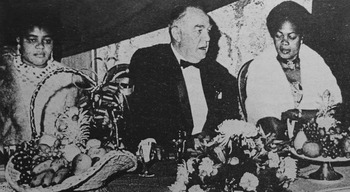
Accordingly, as African leaders began engaging with Pretoria on a regular basis, Vorster exploited the atmosphere of flux created on the domestic political scene to signal a move away from the hierarchical racism of the past. ‘Under no circumstances should you slight a person who speaks a different language, whose skin is a different colour, who has a different standard of civilisation’, he declared in 1970, ‘You must never adopt the attitude that you are better than another person.’Footnote 67 The next year, he went further: ‘If your policy is founded on your being better than someone else because you have a white skin, it is wrong, foolish and vain. What are you but a creature of God, as he is, to raise yourself and think you are better than he?’Footnote 68 These were truly radical statements in the context of the policies of his party and the racial mores of his electorate. More was to come. During Banda's state visit in 1971, Vorster allowed himself to be photographed sitting between two black women (see Fig. 1). This was nothing short of scandalous to verkramptes: the photo appeared in every copy of the HNP's publication Die Afrikaner for months afterwards.
South African Prime Minister John Vorster allows himself to be photographed dining between two Malawian women at Johannesburg's President Hotel during Malawian President Hastings Banda's state visit in August 1971. The image was still appearing in the right wing Herstigte Nasionale Party's mouthpiece Die Afrikaner two years later. Source: Die Afrikaner, 25 May 1973.

Vorster's outward policy experienced only mixed success on the international stage. In 1969, 14 Eastern and Southern African leaders signed the ‘Lusaka Manifesto’, which stood firm on militancy towards Portugal and Rhodesia while qualifying the existing support for armed struggle against South Africa.Footnote 69 African leaders were prepared to flirt with abandoning their commitment to bringing down the apartheid regime on the grounds that the existing OAU policies of blanket hostility, economic boycott, and support for liberation movements were proving ineffective. However, Vorster's broadening of the conversation with independent Africa did not eliminate the fundamental abhorrence many African leaders felt towards a system deeply redolent of the racism and exploitation they associated with their own experiences of colonialism.
South African Minister for Sports Piet Koornhof congratulates the captain of the Bantu soccer team after unexpectedly losing the final to the white team at the South Africa Open International Games in April 1973. Under the principle of ‘multinationalism’, teams representing each racial grouping within the republic competed against each other in a controversial reversal of policy. Source: Die Afrikaner, 8 June 1973.

Even Banda, the leader with whom Pretoria found the warmest reception, reflected the tension between these two impulses. His diplomats saw the OAU as ‘vocal’ and ‘emotional’, and its anti-apartheid militancy as yielding only ‘popular but unrealistic pronouncements or policies'.Footnote 70 He also defined his governing ideology against the ‘other’ of communist power, rather than white rule. In a personal letter he told Kenneth Kaunda that he ‘bitterly resented’ the Zambian president's criticism of Malawi's cooperation with Pretoria:
More than once, you have sent your Ministers to Russia, China and other countries for discussion or negotiations on trade and other matters. Neither I nor any of my Ministers or anyone else in this country, has ever said a single word against you personally … [b]ecause, we feel it is none of our business whatsoever.Footnote 71
This encapsulated at one stroke the fusion of anti-communism and state-based geopolitics grounded in non-interference that Pretoria was promoting on the continent. However, having worked as a young man in the mines near Johannesburg, where racial oppression and economic exploitation went hand in hand, Banda was under no illusions about the power structures of apartheid. His unpublished autobiography, which he wrote while imprisoned by the British at Gwelo in 1959–60, relates: ‘The idea behind the policy of apartheid, is not justice and equity to the Africans, but rigid control over them, in order, the better and more effectively, to keep them in perpetual subjection and serfdom.’Footnote 72 Even as he accepted a soft loan from Pretoria to build a new capital city and fulfil his modernisation agenda, he told South African officials, ‘I am as strongly opposed to apartheid, colonialism and discrimination as is any other African leader.’Footnote 73 There was extensive talk in verligte circles about granting meaningful rights to Africans living in urban areas, repealing large swathes of the most offensive petty apartheid legislation, and deracialising public spaces en masse. ‘In South Africa we have a government and a people that is moving away from racism, that is moving away from discrimination, that wants to rectify it and get it out of its system’, announced up-and-coming MP Louis Nel.Footnote 74 However, the relative lack of concrete legislation to give effect to the vaunted flattening of South Africa's racial hierarchies was a major obstacle to recalibrating African understandings of what separate development entailed.
From its height in 1971, the outward policy stalled as radicals effectively reinvigorated the cause of anti-apartheid militancy. In 1972, the ‘Mogadishu Declaration’ largely repudiated the ‘Lusaka Manifesto’ in favour of a return to blanket confrontation. By early 1973, one BOSS analysis of the African scene observed starkly: ‘In the face of the stronger military disposition and the formal rejection by the OAU of dialogue with South Africa as a path to reaching a modus vivendi, the enthusiasm of supporters of dialogue has faded and with it our hope for the expansion of our outward policy.’Footnote 75
However, instead of reassessing the feasibility of their new models of African identity, South African policymakers perceived in the recent setbacks only a case for renewed efforts to stop Pretoria's relationship with Africa being hijacked by communist-backed radicals. ‘If it were not for the interference on the part of Russian militarism and Chinese insurgence, we would reach an agreement with Africa’, concluded Defence Minister P. W. Botha.Footnote 76 Indeed, Vorster's new thinking soon became entrenched in policymaking circles as establishing a strategic template for long-term viability. Far from apartheid constituting a barrier to the regime's acceptance on the continent, the government rationalised that it was especially among African leaders, as Muller put it, that South Africa's ‘bona fides [would] not be generally accepted until we have taken our policy to its full consequences, in other words, until the homelands have become independent states'.Footnote 77 By the time regime change in Portugal shifted South Africa's strategic calculus in April 1974, South Africa's foreign policy rested on three principles: first, that a distinction existed between African states' declared opposition to apartheid and their willingness to act to overturn it; second, that this distinction was congruent with the fissure between moderate and radical regimes on the continent, not with the division between white and black ones; and finally, that through judicious diplomacy that distinction could be maintained and exploited, buying South Africa time to grant its black peoples self-determination through the homelands, convince the world of the legitimacy of these polities, and eventually overturn Africa's opposition to Pretoria. ‘The policy of separate development can be sold in Africa’, the prime minister assured his caucus behind closed doors as late as 1975.Footnote 78
DÉTENTE
The decision by the new Portuguese regime to withdraw from Angola and Mozambique alarmed many within the South African power structure. The halcyon days of the cordon sanitaire were over. ‘There was an immediate sense that … there was a change and it was a change not for the better’, recalled Jeremy Shearar, Chargé d'Affaires at the South African embassy in London.Footnote 79 ‘It is clear that our adversaries smell blood’, reported the South African mission to the UN.Footnote 80
Vorster saw things differently. The prime minister understood that his inability to match his Africanisation programme with much more than token reductions in military and diplomatic support for Salisbury and Lisbon, as well as South Africa's continued dominion over South-West Africa (SWA), substantially undermined the government's efforts to dispel widespread perceptions of the regime as a form of colonial rule. In 1968, Kaunda had written to Vorster: ‘It is only South Africa's apparent decision to throw her lot in with the rebel regime in Rhodesia which has brought her into the full focus of criticism by the rest of the international community.’ That apart, the Zambian president continued, he ‘certainly would be interested’ to learn more about Pretoria's envisaged programme of leading its African communities towards self-determination.Footnote 81 Now, Vorster saw that circumstances had presented a prime opportunity to reinforce the regime's move away from racial hierarchies and bolster South Africa's case for a moderate and interdependent Africa as an alternative to the ascendant radicalism that demanded the destruction of the white regime. The appropriation of the ‘détente’ label for the new venture was itself a clear nod to Pretoria's desire to embed African geopolitics in an explicitly Cold War context – as defined by the apartheid regime.
The first test came in Mozambique. With independence pending, Ian Smith asked Vorster to help Mozambican separatists establish a rump state south of the Zambezi River friendly to both Rhodesia and South Africa.Footnote 82 Pretoria was also approached by white settler or multiracial but right wing groups seeking support, funds, and arms for coups in both Angola (by at least five separate groups between April and September 1974) and Mozambique (at least three groups).Footnote 83 All received short shrift: they missed that Vorster was less interested in maintaining a white-ruled neocolonial status quo than in creating a brand new architecture for international coexistence on the continent. To the prime minister, the incoming wave of decolonisation posed no threat to South Africa:
We must view the developments in Moçambique in the light of our own policy, which is based on self-determination. Several neighbouring countries are under Black governments and we ourselves are in the process of creating some more by leading our own Black homelands to independence. The emergence of a Black government in Moçambique therefore does not upset us in the least.
OR
is but another proof that our policy based on self-determination [in contrast to Portugal's policy of assimilation] is a sound one.Footnote 84
Mozambique was just the beginning. Vorster simultaneously sought to shift perceptions of his regime's role in SWA. Already in August 1973, he had announced his intention to usher SWA towards a controlled form of majority rule.Footnote 85 Now , a top secret committee known as Bronze – featuring among others Fourie, van den Bergh, and local white representatives – met to explore ways in which SWA could become fully independent through separate and ethnically defined political entities, much as in South Africa.Footnote 86
Finally, Vorster turned his attention to the long-running political impasse in Rhodesia. Over the previous year, he had repeatedly overruled Botha's and the defence force's recommendations of new military assistance to the beleaguered Smith regime.Footnote 87 Now, the prime minister's second thoughts gave way to strident action. From his backchannel conversations with the Zambians, Fourie reported that black Rhodesian expectations had escalated.Footnote 88 Vorster concluded that the Smith regime had become more of a liability than an ally. If South Africa were to coexist peacefully with black Africa in the new environment, the cautious and piecemeal approach of the outward policy would not be enough. Seizing the initiative, Vorster resolved to ride the wave of re-energised African nationalism and work with regional leaders to broker the removal of white minority rule in Rhodesia.
With this in mind, Vorster sat down secretly with Kaunda's right-hand man, Mark Chona, in Cape Town. Chona told the leader of the apartheid regime that he spoke not only for Kaunda, but had also met with Julius Nyerere of Tanzania, Seretse Khama of Botswana, Frelimo President Samora Machel, and interim Mozambican Prime Minister Joaquim Chissano. All had reiterated the ‘Lusaka Manifesto's acknowledgement of Pretoria's noncolonial status ‘in the strongest possible terms'. They saw South Africa as an ‘independent and sovereign state’ and agreed that the Afrikaners were ‘not merely people in Africa, but people of Africa’. As Chona stressed on no fewer than five occasions during the conversation, Africa would not ‘take the fight’ to South Africa and there was ‘no question of interfering in [its] internal affairs'. Instead, Africa sought Pretoria's cooperation on the Rhodesian issue, which was ‘a stumbling block in trying to get Africa to understand the South African problem’ which was ‘totally different’.Footnote 89 It seems Chona was not just telling the South Africans what they wanted to hear. Kaunda told the British, Zambia’s partner in hostility to Smith, the same thing: ‘Zambia and other members of the OAU considered South Africa to be in a different position from Rhodesia. They abhorred apartheid but did not consider but did not consider South Africa to be a colonial power except in Namibia.’Footnote 90 The Africans seemed to accept that avoiding a brutal racial war across the region required Pretoria’s cooperation regardless of the signal it sent to black South Africans. For his part, Vorster was more than receptive. He and Chona spent the afternoon constructing a detailed framework to remove the Rhodesian ‘stumbling block’ to Pretoria's acceptance as a full part of Africa.
As détente dramatically materialised in the southern autumn of 1974, with Kaunda and Vorster publicly acting out a carefully choreographed scene of reconciliation and cooperation, and Ian Smith reluctantly agreeing to resurrect negotiations, two powerful critiques emerged on Vorster's domestic front. First, Botha and the military were ardently opposed to the new direction on security grounds. Instead of seeing the decolonisation of the Portuguese colonies as an opportunity to prove the regime's ability to coexist peacefully with black African governments, they saw events through the prism of a communist-backed OAU assault against white rule in Southern Africa. ‘[T]he change of government in Mozambique is certainly the greatest potential threat which [South Africa] has ever had’, the defence minister wrote in a strident letter to his prime minister. The OAU's ‘ideology has already for a long time declared war on the white ruled states–because they are white, and because the power is in white hands', he asserted; accordingly, ‘the longer Rhodesia can remain standing the more advantageous it will be for [South Africa]’.Footnote 91 In party forums, such as the annual congress of the Cape NP in September 1975, Botha proclaimed that he ‘identified wholeheartedly with the détente policy’.Footnote 92 In reality, Botha and the military continued to believe that the OAU's drive ‘to force the existing order in white-ruled Southern Africa to change’ would be relentless due to the inherently expansionist doctrines of its communist backers.Footnote 93 In handwritten notes for his contribution to the annual no confidence debate in February 1975, Botha revealed his true feelings: ‘Nie détente nie – maar appeasement – paaiery! (Not détente – but appeasement – appeasement!).’Footnote 94
On a separate front, many in the electorate were instinctively resistant to the notion that Pretoria might ‘sell out’ the white Rhodesians and failed to see how abandoning one of South Africa's few allies constituted wise foreign policy. In June 1975, Vorster and Smith attended a rugby match between South Africa and France at Loftus Versfeld, Pretoria. When Vorster's presence was announced by loudspeaker, he received warm applause; but when the embattled Smith was introduced, the crowd went into raptures.Footnote 95 Vorster had to avoid getting too far out in front of these popular attitudes and allowing détente to become a focal point for the ‘fifth column’ of far right wingers who remained in his party even after the traumatic HNP breakaway.Footnote 96 From the NP's own backbenches, Treurnicht criticised those ‘urging that South Africa should dissociate itself from Rhodesia … and that Rhodesia should stew in its own juice’.Footnote 97 It was not only on the far right that such ideas reverberated. In October 1974, Ben Schoeman, Vorster's recently retired deputy prime minister and former leader of the Transvaal NP, launched a blistering attack on détente in a speech in Kimberley:
I think that we as White people must be under no illusions. The Black military states with their Communist allies have only one aim and object in view and that is the surrender of the White man in South Africa. Nothing less than Black majority rule will ever satisfy them. Those misguided people who believe that appeasement will satisfy them are living in a fool's paradise.Footnote 98
The reality was that outside Vorster's foreign policy circle, white South Africans were fundamentally conflicted over détente. They were excited by the prospect of an end to confrontation, violence, and isolation. ‘There is a curious mood in the Republic today which is almost euphoric’, observed London's Financial Times in a feature article. ‘For the first time for well over a decade White South Africans, pilloried and isolated in the international community, now believe they are well on the way to acceptability. They find it a heady experience.’Footnote 99 However, white South Africans were reluctant to stomach the steps Vorster was outlining as necessary to achieve these ends: a move away from the old affinities of the white redoubt, with all that entailed for shifts in racially hierarchical thinking more broadly.
Vorster worked hard to neutralise these fears and condition public opinion to support his diplomacy. Through confidential briefings of newspaper editors – some of which he conducted personally in the cabinet room – the prime minister ensured that both the Afrikaans- and English-language dailies showed striking support for his counterintuitive initiatives.Footnote 100 The press largely avoided any implication that South Africa was interfering in Rhodesia's affairs and explicitly assured readers that a settlement in Salisbury would not create momentum towards a transfer of power in South Africa because the racial orders in the two were different. ‘For now, the details of the settlement agreement are Rhodesia's responsibility’, Die Transvaler editorialised:
In South Africa many people argue emotionally about Rhodesia because whites are involved. They consider South Africa's position as analogous to Rhodesia's. Our policy however guarantees separate development and the authority [seggenskap] of each group over its own affairs. This eliminates the whole question of majority rule in South Africa.Footnote 101
This delicate recalibration of the argument over détente and the accompanying subtle neutralisation of the population's pan-white sympathies was precisely what Vorster sought. The prime minister likewise ensured that Muller told the Perskor newspapers not to publish a word of Schoeman's Kimberley speech. (The task of speaking to the Cape-based Nasionale Pers papers was delegated to P. W. Botha, a member of its board, who neglected to convey the message.Footnote 102) Ultimately, opponents of détente could not match Vorster's offers of access or patronage and found their perspectives marginalised. Schoeman later raged in his memoirs against a rare ‘unholy alliance between the liberal English press and certain of our Afrikaans newspapers … on Rhodesia they spoke with one voice’.Footnote 103
Vorster also sought to use the Broederbond to market détente within elite Afrikaner circles. In both November 1974 and February 1975, Vorster appeared before the Broederbond's Executive Council (Uitvoerende Raad, UR). On both occasions, he stressed that events compelled the government to act decisively. ‘Urgent action is necessary’, he said in November; ‘We must consider what is necessary to maintain control over our political destiny and ensure our White identity’, he echoed in February.Footnote 104 Although such views were doubtless distributed to each of the Broederbond chapters, Vorster's message was not alone. In May 1975, the UR tabled its own extended study of détente. The study was careful to display support for the merits of Vorster's overall vision:
Détente must serve as a prerequisite for the development of a situation of real peace, where sovereign states exist alongside each other and where simultaneously there reigns cooperation on all levels of common interest, without ceding one's own identity and without the interference of one in the internal affairs of the other.
However, it continued, while the OAU had at times embraced negotiation (the ‘Lusaka Manifesto’) and other times confrontation (the ‘Mogadishu Declaration’), its commitment to the removal of white rule as a whole remained unchanged. ‘One thing remains however consistently clear, and this is that African countries will never change course on their ultimate aims in Southern Africa,’ the report stated. Africa and Pretoria had ‘irreconcilable aims'. The unmistakeable implication – that Vorster's dream of peaceful coexistence with African nationalism was not realisable – was clear enough.Footnote 105 For all Vorster's efforts, opposition to détente persisted. When he addressed the NP caucus in late February 1975, with détente foundering on Smith's intransigence, Vorster's words pointed to the unspoken divisions within his own party: ‘We have to stand together. We can never always stand together, but standing together [now] is essential. Our calling is to live in Africa.’Footnote 106
Despite these misgivings, Vorster's improbable ideas gained substantial traction. By the end of 1974, his idea of horizontal coexistence had become the core of a new, though fragile, Africanised identity for the regime, providing Afrikanerdom with much needed ethno-nationalist direction in the wake of the verlig-verkrampstryd. Emerging MP Dawie de Villiers, a future minister in the Botha and F. W. de Klerk governments, as well as the post-apartheid Government of National Unity, encapsulated the new thinking: ‘We shall have to give more content to our African identity … In order to be able to do this, we shall have to give up many of our prejudices concerning Africa and the people of Africa.’Footnote 107 Pienaar even used Vorster's new ideology to hammer the opposition United Party (UP) for maintaining an antiquated policy of ‘one united colonially inspired South Africa’. The UP ‘had only one idea: of the White man governing the Black man in South Africa’. This stood in stark contrast, he insisted, to Nationalist policy: ‘[W]e have changed to a South Africa which is being shared … The decolonisation process has been tackled successfully … When the winds of change blew through Africa it was the National Party which conceived the idea of the liberation and decolonisation of the Bantu peoples of South Africa.’Footnote 108 The government even portrayed African outreach as a long-standing Nationalist tradition. ‘Even the Voortrekkers established relations with Bantu chiefs for diplomatic affairs', the 1974 election manifesto informed voters.Footnote 109 ‘The White Nationalist has never at any time seen himself as a colonialist in Africa. He has never at any time been afraid of the upsurging nationalism among the Blacks and he does not disregard the right of the Blacks to self-determination’, proclaimed MP J. J. Engelbrecht.Footnote 110 The shift in the historicisation of Afrikanerdom's relationship with African nationalism since Verwoerd's Blood River speech was unmistakeable.
CONCLUSION
In his analysis of South Africa's relations with black Africa, Roger Pfister suggests that South Africa's diplomacy during this period constituted an effort to convince Africans that ‘not all whites supported apartheid’.Footnote 111 Not so. Instead, John Vorster attempted to use diplomatic successes in black Africa to drive an unlikely relegitimisation of apartheid as a system compatible with post-independence norms of self-determination, development, and state autonomy. Unwilling to change what apartheid was, he resolved to change what it meant. This unlikely initiative was launched on two fronts: persuading black Africa that apartheid meant something new by rearticulating existing racial hierarchies in the language of parallel national development, thereby Africanising the identity of Afrikaner nationalism; and convincing white South Africa that the discrete racist measures of petty apartheid could be jettisoned from the programme of separate development without injury to the original Verwoerdian master plan.
This story eclipses understandings of the position of the apartheid regime in narratives and processes of decolonisation. Vorster's outward and détente policies constituted attempts to create an alternative model of African identity governed by discourses of non-interference, mutual economic development, and anti-communism, thereby enabling the polity to reach across the colour line and lay an equal claim to the power and protection of African nationalism. This was far from a refusal to acknowledge that the age of white supremacy was over; it was, in fact, a recognition that changed times required the adoption of new paradigms of security and legitimacy. Indeed, Vorster was willing to go further still and abandon the racial bonds of the white redoubt: he reconceptualised the category of ‘whiteness' in national rather than racially supremacist terms, trading in the anchor of ‘European’ that had featured so prominently in Verwoerd's ideological legacy for the unlikely identity of ‘African’.Footnote 112
These counterintuitive efforts demonstrate the potency of postwar norms of non-racial governance. Even Pretoria, supposedly the ultimate hold out, took them firmly into account. They also support historians' growing appreciation of decolonisation as a multifaceted contest replete with conflict, failure, and contradiction, rather than as a set of north-south transfers of political power.Footnote 113 Further, this analysis contributes to emerging understandings within African historiography of the racial categories underpinning national identities as politically malleable, rather than rigid in meaning or content.Footnote 114 From here, we can begin to connect the history of state-building in early independent black Africa with that of ideological renewal and nationalist introspection in apartheid South Africa.