Introduction
Horticultural crops grown in the open air are important economical crops in Spain, accounting for 274,358 ha in 2010. Weed incidence is one of the main aspects to be considered in these crops, because it causes important yield decreasesReference Oerke1, Reference Cirujeda, Aibar, Anzalone, Martin-Closas, Meco, Moreno, Pardo, Pelacho, Rojo, Royo-Esnal, Suso and Zaragoza2.Weed control methods differ for each crop and within regions. Mulching with polyethylene (PE) or biodegradable plastics was used on 7% of the total open-air horticulture area in the Aragón region (northeastern Spain) and up to 30% in the nearby Navarra region3 where installation of biodegradable mulch is enhanced by subsidies. Plastic mulching is very popular in processing tomato production but has decreased steadily due to difficulty in removing all of the plastic mulch from the soil after harvest. Biodegradable plastic and paper mulches have not replaced PE in organic tomato production due to the higher costReference Cirujeda, Aibar, Anzalone, Martin-Closas, Meco, Moreno, Pardo, Pelacho, Rojo, Royo-Esnal, Suso and Zaragoza2. Therefore, herbicides, physical weed control or hand-weeding are the primary weed control techniques. An important drawback of herbicides is the limited number of active ingredients registered in horticultural crops, and the potential impact on the environment. In tomato, at present, only nine active ingredients are authorized for this crop, three of them being post-emergence graminicides4. The most used herbicide combination is metribuzin+rimsulfuron but this does not control Cyperus rotundus which is one of the problem weeds in tomato. In addition, the use of herbicides is not allowed in organic production, a sector which has increased considerably in Spain over recent years. For this reason, physical weed control and hand-weeding are the remaining weed control methods.
Research has been conducted in northern Europe to develop and evaluate mechanical implements to control weeds primarily in the intra-row space where weeds are more difficult to removeReference Melander, Rasmussen and Barberi5. To spread the knowledge to the end-users, a manual on non-chemical weed control was edited in 2006Reference Van der Schans, Bleeker, Molendijk, Plentinger and van der Weide6. However, there has been limited research in southern Europe except in Italy, where new machinery has been developedReference Raffaelli, Fontanelli, Frasconi, Ginanni and Peruzzi7, Reference Raffaelli, Fontanelli, Frasconi, Ginanni and Peruzzi8, and by the research group in Zaragoza (Spain) where commercial mechanical weed control implements have been tested in horticultural crops since 2005Reference Cirujeda, Anzalone, Pardo, León, Zaragoza and Cloutier9, Reference Cirujeda, Aibar, Fernández-Cavada, Zuriaga, Anzalone, Zaragoza and Cloutier10. Research should be conducted because differences in climatic conditions, soil types, irrigation methods and weed species, including perennial nutsedge (Cyperus spp.), may limit the usability of some of these tools.
The chosen implements considered innovative due to their limited use in horticultural crops have been the horizontal brush weeder, the torsion weeder, the finger weeder, the flex-tine harrow and flaming. No references have been found for the use of these implements in tomato crops except the description of new tools developed by the Italian research groupReference Raffaelli, Fontanelli, Frasconi, Ginanni and Peruzzi8.
The first description of the horizontal brush weeder was published in 1986 shortly after its commercial launchReference Geier, Vogtmann, Cavaroll and El Titi11, and one of its highlighted advantages is that the brush works efficiently even on heavy soils without creating a cultivation pan. When compared to conventional herbicides in broccoli and strawberries, the brush provided similar or higher control of summer species, such as Amaranthus retroflexus and Chenopodium album, and high yields were obtained in broccoliReference Colquhoun and Bellinder12 and in strawberriesReference Kelly, Pritts and Bellinder13. However, other research has shown that greater weed control and higher yield were observed when the brush hoe was used in combination with a flex-tine in snap beansReference Colquhoun and Bellinder12. Comparable yield to that achieved in plots treated with conventional herbicide was generally achievedReference Colquhoun and Bellinder12, Reference Kelly, Pritts and Bellinder13 but lower yield can also be obtained in the brushed plots (as, e.g., 1 year in carrotsReference Ascard and Mattsson14).
Results of experiments with torsion and finger weeders have been published since 1996 in Weed Control Congresses and since 2002 by the EWRS working group ‘Physical and Cultural Weed Control’. High efficacy was found in some crops, such as onion with the finger weederReference Ascard, Bellinder, Brown, Cussans, Devine, Duke, Fernandez-Quintanilla, Helweg, Labrada, Landes, Kudsk and Streibig15, lettuce and leek with both toolsReference Bleeker, van der Weide, Kurstjens and Cloutier16, cabbage and lettuce with the finger weederReference Leinonen, Saastamoinen, Vilmunen and Cloutier17 and lettuce with both toolsReference Smith, Silva Ruiz and Cloutier18; however, efficacy was too low in other cases, such as onion with the torsion weederReference Ascard, Bellinder, Brown, Cussans, Devine, Duke, Fernandez-Quintanilla, Helweg, Labrada, Landes, Kudsk and Streibig15, sugar beet and onions with both toolsReference Bleeker, van der Weide, Kurstjens and Cloutier16 and leek with the torsion weederReference Smith, Silva Ruiz and Cloutier18. In addition, yield decreases were found with the finger weeder in onionReference Ascard, Bellinder, Brown, Cussans, Devine, Duke, Fernandez-Quintanilla, Helweg, Labrada, Landes, Kudsk and Streibig15 and with the torsion weeder in lettuceReference Smith, Silva Ruiz and Cloutier18. The main drawbacks of both the torsion and finger weeder are the low efficiency when used on firm soilReference Bleeker, van der Weide, Kurstjens and Cloutier16, the requirement of additional inter-row cultivation with another implement because the finger weeder acts only in the intra-row spaceReference Ascard and Mattsson14 and the need for accurate steering to obtain successful intra-row efficacyReference Ascard, Bellinder, Brown, Cussans, Devine, Duke, Fernandez-Quintanilla, Helweg, Labrada, Landes, Kudsk and Streibig15. No references have been found for irrigated Mediterranean crops.
Despite the fact that the flex-tine harrow is commonly used in extensive crops such as cereals, only a few publications show results in horticultural crops. Thus, good weed control in onionReference Ascard, Bellinder, Brown, Cussans, Devine, Duke, Fernandez-Quintanilla, Helweg, Labrada, Landes, Kudsk and Streibig15 and broccoliReference Colquhoun and Bellinder12 was found, but the results were poor in snap beansReference Colquhoun and Bellinder12 and strawberriesReference Kelly, Pritts and Bellinder13, and lower yield in onionReference Ascard, Bellinder, Brown, Cussans, Devine, Duke, Fernandez-Quintanilla, Helweg, Labrada, Landes, Kudsk and Streibig15 and strawberry cropsReference Kelly, Pritts and Bellinder13. Probably the main problem of using this tool in horticultural crops is maintaining crop selectivity and achieving high weed control efficacy.
Concerning flaming, no references have been found for the control of frequent weeds in tomato crops, such as Portulaca oleracea and C. rotundus. The needed propane consumption was 7–65 kg propane ha−1 depending on both the weed species and on the size of the weedsReference Peruzzi, Di Ciolo and Raffaelli19 and between 20 and 100 kg propane ha−1 in a laboratory trialReference Ascard20. In field trials, consumption is usually higher, as weeds are in different development stages: 107.5 kg propane ha−1Reference Raffaelli, Filippi, Peruzzi, Graifenberg and Cloutier21 and two split applications of 50 kg propane ha−1 eachReference Netland, Balvoll and Holmoy22.
It is necessary to combine different physical weed control methods because the dependence of environmental factors and weed size may limit the efficacyReference Liebman, Gallandt and Jackson23, Reference Tei, Montemurro, Baumann, Dobrzanski, Giovinazzo, Kleifeld, Rocha, Rzozi, Sonseovic, Simoncic and Zaragoza24, Reference Mohler, Liebman, Mohler and Staver25. Indeed, an 80% efficacy combining flamer with the torsion weeder has been found in onionReference Ascard, Fogelberg and Cloutier26. Also, other authors found advantages when combining different implements, e.g., the combination of the finger weeder with the torsion weeder was more selective in broadleaved crops than a weed harrow used aloneReference Bleeker, van der Weide, Kurstjens and Cloutier16. The combination of flaming and cultivation has also been found effectiveReference Knezevic, Datta, Stepanovic, Bruening, Neilson, Gogos and Rubin27.
Summarizing, all these results show that some tools can be useful on some crops but are non-selective in others, and also that positive or negative results can be obtained with the same tool used on the same crop in different years. Following the literature, quite constant and positive results can be expected with the brush hoe, while finger and torsion weeders may need to be combined with other tools to be used efficiently on heavy soils. Also, some adjustments may be needed with the flex-tine harrow to improve selectivity, and the use of the flamer will probably need successive split applications. Focusing on the tomato crop, a good ability to compete against weeds can be expected since the plant covers the soilReference Ronchi, Serrano, Silva and Guimaraes28, so that weed control at the beginning of the cropping cycle might be enough to obtain high yield.
The objective was to determine weed control with commercially available physical weed control tools alone and in combination with each other for both conventional and organic production in irrigated processing tomatoes.
Materials and Methods
Experimental field design
Field trials were established at the experimental fields of the Centro de Investigación y Tecnología Agroalimentaria (CITA) in Zaragoza (Spain) (41°43′40.36″N, 0°49′2.1″W) from 2005 to 2007 on a loam soil (sand 36%, silt 40% and clay 24%) at the Aula Dei farm and during 2008–2011 on a clay loam soil at the San Bruno farm (sand 33%, silt 42% and clay 25%). Each year, the trial was placed on a different part of the field to prevent excessive weed density and phytosanitary problems due to lack of rotation. The experimental design was completely randomized with three replicates in 2005–2008 and a randomized complete block design with four replicates in 2009–2011. Each replicate consisted of a single crop row, 15 m long in 2005–2008 and 20 m long in 2009–2011.
All years, soil preparation included soil tillage, the use of rotary cultivation and the formation of 0.8 m-wide raised beds with a distance of 1.5 m between each bed. ‘Perfect Peel’ tomato, a commonly planted hybrid for the processing tomato industry, was transplanted at 0.2 m plant spacing in a single row (33,333 plants ha−1).
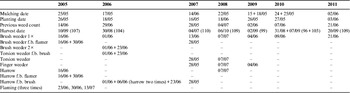
Tomato plants were transplanted by hand between 16 May and 3 June, except for 2008 when intense rainfall after mulching delayed planting for 28 days (88 mm recorded between May 23, 2008 and June 17, 2008) (Table 1). Mulching materials were placed manually in 2005–2007 and mechanically in 2008–2010, 1–11 days prior to transplanting tomato, except in 2008 (28 days) due to the high rainfall (Table 1). The crop was drip irrigated with one 16 mm diameter tube per bed with 0.33 m spacing between emitters. The irrigation system was configured so that the plots could be irrigated separately. The moisture values obtained by dielectric probes ECH2O model EC-20 (Decagon Devices, Inc.) were used to determine the appropriate amount of irrigation required to avoid excessive moisture stress in the mulched plots or lack of water in the un-mulched plots. Therefore, bare soil was irrigated more than the mulched plots during the first months to maintain the same moisture level at each treatment. As soon as the tomato plants covered the soil in all treatments, irrigation was the same for all the treatments. Mineral fertilization was applied through the irrigation system at weekly intervals, applying 210, 105 and 315 kg ha−1 each cropping season of nitrogen, phosphorus and potassium, respectively. In March 2010, soil was fertilized with 30 t ha−1 of calf manure. The rest of the needs were applied in the usual way, considering that the manure contained 77, 108 and 48 nitrogen, phosphorus and potassium.
Dates of the different treatments made in the trials.

f.b., followed by.
Values in parentheses: days after transplanting.
Weeding tools and their adjustments
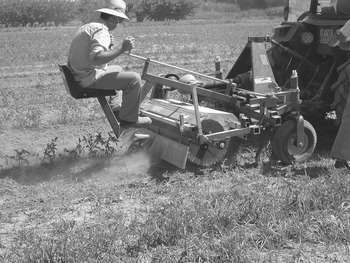
Each tool was tested for at least 3 years, with the exception of the manual flamer (Agrieco, Tecnasa, Madrid, Spain). This flamer was used only in 2005 because split applications were needed to control the emerging weeds, making this implement non-commercial for processing tomato production. The manual flamer had a 15×30 cm burner (Fig. 1) and the total gas consumption was 90 kg propane ha−1 in three applications at a working speed of 0.7 km h−1.
Manual flamer used in the space next to the crop.

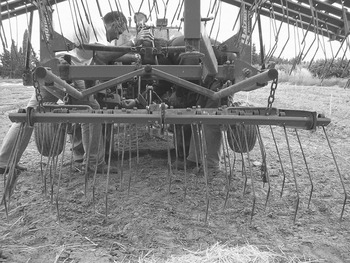
The flex-tine harrow (Hatzenbichler, St. Andrea, Austria) (Fig. 2) was used from 2005 to 2007 because of the unsatisfactory weed control results. One single 1.5-m bed with six rows of ten tines each was used, and one central tine of each row was removed to protect the tomato plants. The most vertical (i.e., most aggressive) position was used in 2005 and 2006 (β=5°) and the second most-aggressive position in 2007 (β=23°)Reference Bàrberi, Silvestri, Peruzzi and Raffaelli29 at a working speed of 6 km h−1.
Flex-tine harrow. The central tines were removed to improve crop selectivity.

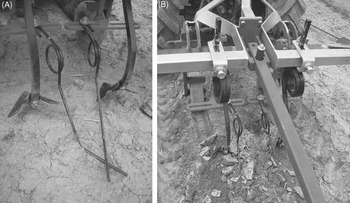
The torsion weeder (Frato Machine Import, Nijmegen, The Netherlands, 9-mm diameter tines) (Figs. 3A and 3B) was introduced in 2006 and used until 2008 due to the poor weed control on the crusty soil despite using it in combination with cultivator blades since 2007. The tines measured 16 cm and the tips crossed at 11 cm; the tool was used at 1.5 km h−1. Cultivator blades of 22 cm width were mounted on both sides of the torsion weeder at a separation of 17 cm from center to center of each implement. In 2008, the torsion weeder worked at a depth of 3.1±0.48 cm.
Torsion weeder (center) and cultivation blades at the sides. The tips of the torsion weeder work in the soil at an approximate depth of 3 cm.

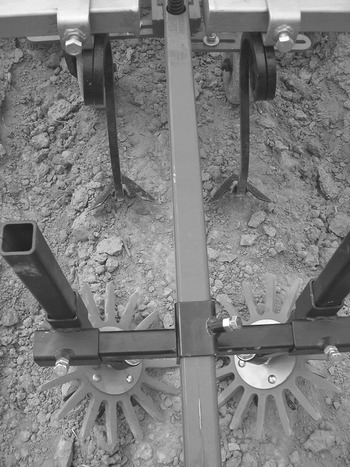
The finger weeder (Kress, GmbH, Vaihingen an der Enz, Germany, hardest fingers) (Fig. 4) was used from 2007 to 2009 in combination with cultivator blades mounted on both sides of the finger weeder, at a separation of 14 cm from the center of the cultivator blade to the end of the rubber fingers, at a speed of 1.5 km h−1. In 2008, the finger weeder worked at a depth of 3.4±0.63 cm.
Brush weeder (front) and cultivation blades (back). The movement is achieved by the metallic fingers (beneath) turning the rubber fingers, which pull out the weeds.

The horizontal PTO-driven brush hoe with plastic bristles (Bärtschi-Fobro, type 500, Hüswill, Switzerland) (Fig. 5) was used all years due to easy handling, good weed control and positive yield results at 1.5 km h−1. The rubber discs were separated 4 cm from each other allowing the crop to pass through without damage. The brush hoe worked at a depth of 5.0±0.71 and 5.8±0.21 cm in 2008 and 2011, respectively. Since 2008 a ridging blade was mounted on the frame to rebuild the raised bed in the same weeding operation. When necessary, tools were used two times, although rainfall did not always allow the second pass (2005, 2008) even if high efficacy with a single tool was targeted.
Horizontal brush weeder at work. Back steering allows high crop selectivity.

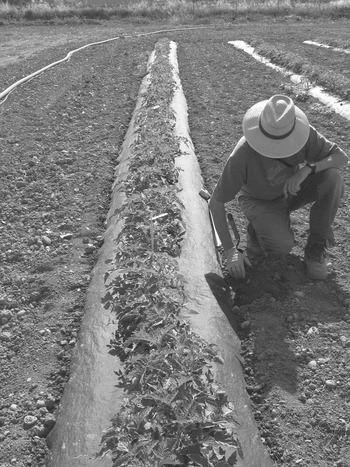
PE mulching (PE, black, 15 μm) and untreated plots were included all years as control treatments. During years 2009 to 2011 biodegradable plastic mulch (Mater-Bi®, Novamont, black, 15 μm) and paper mulch (Mimgreen®, Mimcord, black, 85 g m−2) (Fig. 6) were included for comparison (Table 1).
Black paper mulch controlling weeds.

Experimental assessments
Weed assessment
Owing to very high weed plant density, weed infestation was assessed as weed soil cover visually in four fixed 0.2 cm×1 m frames placed 0.1 m away from the tomato plants on the raised bed in each row. These operations were performed 0, 8, 21, 36 and 50 days after treatment (DAT) following the guidelines for physical weed control researchReference Vanhala, Kurstjens, Ascard, Bertram, Cloutier, Mead, Raffaelli and Rasmussen30. In addition, weed density of each species was assessed on the day of treatment and total dry weed biomass was recorded 63 DAT by removing the above-ground portion of the weeds and drying at 60°C until constant weight. Because tomato plants had already covered the row at this moment, it was assumed that weed biomass would not increase due to the high crop competition.
Crop assessments
Tomato plants were selected randomly, excluding plants growing next to the weed assessment frames to avoid a possible disturbance effect of weed sampling. Tomato plant height was measured 20 and 42 (2010 only) days after transplanting (DATP) on four plants in each row.
Beginning at 80 DATP the number of green and ripe (breaking to red) tomato fruit were recorded at weekly intervals and the fruit was harvested when ripe fruits accounted for more than 80% of the fruit. At harvest, red, green and cull tomatoes were weighed separately from eight plants per plot. Also the weight of 100 ripe fruit was recorded to describe fruit size.
Data analysis
When necessary, data were transformed to satisfy normality and variance homogeneity following the indications of the Box–Cox transformationReference Bowley31 using (x)0.25, (x)0.5, (x)2 or (x)4. Standard ANOVAs were performed using the procedure PROC GLM with SAS version 9.1. Student–Newman–Keuls mean separation test was used to describe differences between means with α=0.05. The interaction treatment×year was tested for the treatments, which were repeated several years. When the interaction was not significant, the mean separation test was performed on the pooled data.
Results and Discussion
Weeds
Weed species and initial density
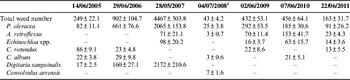
Although weed composition differed from year to year, common purslane (P. oleracea) was the main weed species present all years, while redroot pigweed (A. retroflexus) was present most years (Table 2). Common lambsquarters (C. album), purple nutsedge (C. rotundus) and barnyard grass (Echinochloa spp.) were among the most important species 4 out of 7 years. Extremely high weed density at treatment was found in decreasing order for 2007 (reaching 4467 plants m−2), 2006, 2010 and 2009, whereas especially low initial weed density was found in 2008 (43 plants m−2). That year, persistent rainfall after seedbed preparation caused a huge weed emergence and destroyed the raised bed. This first emergence flush was thus eliminated mechanically before the delayed planting, explaining the much lower weed density during the cropping cycle (Table 2).
Weed density of the four most abundant species and of the total weed density (plants m−2) immediately before mechanical weed control.

1 Stale seedbed performed before planting.
Mean±standard error.
Weed biomass
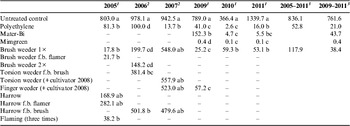
Weed biomass was the highest in the non-treated plots in all years (Table 3) and was in the range of the values found in the mechanically treated tomato plots in the Italian trialsReference Raffaelli, Fontanelli, Frasconi, Ginanni and Peruzzi8. However, this parameter was higher in year 2011 and in some treatments in 2005–2007. These differences within years caused the interaction treatment×year to be significant and that data could not be pooled together. All treatments reduced weed biomass compared to the untreated control, and greatest weed biomass reduction was achieved with the mulches, followed by the brush hoe in all years except 2007. In previous studies, good weed control was achieved with the brush hoe in broccoli, strawberries and carrotsReference Colquhoun and Bellinder12, Reference Kelly, Pritts and Bellinder13, Reference Ascard and Mattsson14. Other effective treatments were manual flamer in 2005 and finger weeder in 2009 (Table 3). Weed biomass in the flamed plots was the lowest but the main drawback of the flamer was the need to control the perennial C. rotundus in three split applications to burn down the newly emerging sprouts. Split applications have been found to reduce weed biomass greater than a single treatmentReference Ascard32 which, however, makes the system unpractical in field conditions. Weed biomass recorded in the plastic mulches was also due to the ability of C. rotundus to pierce the plastic mulches but not the paperReference Cirujeda, Anzalone, Aibar, Moreno and Zaragoza33. Torsion and finger weeders reduced weed biomass compared to the untreated control but did not perform as well as the brush weeder, probably due to the heavy soilReference Bleeker, van der Weide, Kurstjens and Cloutier16 and additionally due to the soil crust, which appeared in the irrigated conditions due to daily wetting and drying processes.
Weed biomass (g ha−1) in the different treatments and years 63 days after transplanting.

Different letters within each year refer to statistically significant differences according to Student–Newman–Keuls mean separation test at P<0.05.
f.b., followed by.
1 Data are back-transformed least squares means from (x)0.25 after analysis.
2 Data are back-transformed least squares means from (x)0.5 after analysis.
3 No mean separation test could be performed due to the significant interaction treatment×year.
The brush weeder was more aggressive and reduced weed biomass despite the crusty soil conditions, confirming the descriptions of the implementReference Geier, Vogtmann, Cavaroll and El Titi11. Weed biomasss reduction was 80% or higher on six occasions (including year 2008, when weed biomass was not collected due to insignificant weed number); only in year 2007 was biomass reduction low (42%) (from Table 3). The brush weeder could be used earlier (9, 11, 14 or 18 DATP in years 2009, 2010, 2006, 2011 and 2008, respectively) or later (21 and 28 DATP in years 2005 and 2007, respectively) with similar weed control results in that quite wide time span. Moreover, a single pass was sufficient and the weeded area was bigger than the area weeded with the finger or torsion weeders, so that no additional tool had to be mounted or used afterwards.
Weed soil cover
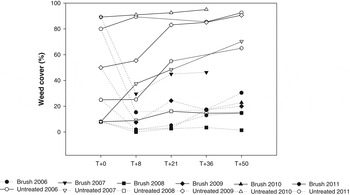
Weed soil cover decreased drastically after using the brush hoe in all years, regardless of the initial weed cover (Fig. 7). Thus, the immediate effect (0 versus 8 DAT) was high in all cases. However, the surviving weeds continued growing and weed soil cover at 50 DAT exceeded 20% soil cover in three occasions (Fig. 7), indicating that a single brush treatment might not be effective in situations with severe weed infestations. However, the shield protecting the crop in the brush hoe does not allow a later treatment with plants exceeding 30 cm height, so that previous preventive weed control methods, such as stale seedbed, could be appropriate.
Mean weed soil cover (%) at five different moments for the untreated control plots and for the brush-weeded plots in years 2006–2011.

Tomato plant height
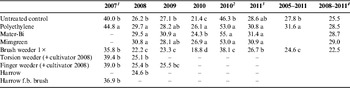
Tomato plant height 21 DATP was greater in PE-mulched plots compared to plants grown on bare ground and greater than for plants on the mechanically treated plots in all 7 years (Table 4). The significant interaction treatment×year for data obtained from 2008 to 2011 did not allow pooling of the data. However, a very similar pattern was found for these years, too, with only slight differences in some cases (Table 4). Probably there is a combined explanation for these observations. First, temperature increases in the soil due to black mulching could cause higher initial plant growthReference Berihun34, explaining high values for the other black mulching materials. Second, mechanical control probably caused some damage to the crop plants, which would explain the fact that tomato plants were higher in the untreated control compared to the mechanically treated plots. Results at 42 DATP in 2010 suggest that the differences lasted for at least 20 days more (Table 4).
Tomato plant height (cm) 21 DATP in the different treatments and years.

Different letters within each year refer to statistically significant differences according to Student–Newman–Keuls mean separation test at P<0.05.
1 Data are back-transformed least squares means from (x)0.5 after analysis.
2 At 42 days after transplanting
3 Data are back-transformed least squares means from (x)2 after analysis.
4 No mean separation test could be performed due to the significant interaction treatment×year.
Tomato yield
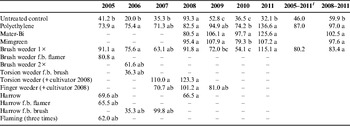
Weeds reduced tomato yield all years except 2008. That year, the uncommon climatic conditions delayed planting and the first weed germination flush was controlled prior to planting so that weed competition did not cause yield decrease that year (Table 5). Plants grown on PE gave among the highest yield all years. Quite high yield was also obtained for the different mechanical treatments used in 2005–2009, especially for the finger and the torsion weeder (Table 5). The significant interaction treatment×year did not allow pooling of data from 2005 to 2011 but, with the exception of years 2009 and 2010, yield obtained in the brushed plots was among the highest. In 2010, higher soil moisture content the day of treatment compared to the other years probably damaged the crop and delayed plant recovery. From 2008 to 2011 higher yield was obtained for plants grown on the brushed plots and on all mulching treatments compared to the untreated plots (Table 5).
Commercial yield (t ha−1) in the different treatments and years.

Different letters within each year refer to statistically significant differences according to Student–Newman–Keuls mean separation test at P<0.05.
f.b.: followed by.
1 No mean separation test could be performed due to the significant interaction treatment×year.
Mean fruit weight
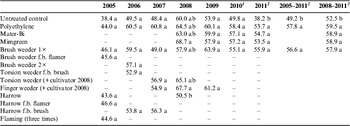
Fruit size was constant regardless of the weed control method. Only slight differences were found in year 2008 (Table 6). Pooled data showed that fruit size was lower for the fruits grown on untreated plots and similar within the rest of treatments, showing that the different control methods did not affect fruit size.
Mean weight per fruit (g) in the different treatments and years.

Different letters within each year refer to statistically significant differences according to Student-Newman-Keuls mean separation test at P<0.05.
1 Back-transformed from (x)4.
2 Back-transformed from (x)2.
Conclusions
Despite being used in an aggressive position, the flex-tine harrow was not capable of reducing weed biomass sufficiently and performed weakly due to the heavy and crusty soil. Similar results were observed from the torsion weeder and flaming did not control the perennial weed species, C. rotundus. The finger weeder combined with two cultivation blades gave promising results but needed accurate adjustments. The brush hoe gave the best results and plots weeded with that implement yielded similar to plots mulched with PE, biodegradable plastic mulch and paper mulch but should not be used with moist soil due to yield decrease. The main advantage was simple steering and high crop selectivity thanks to the protective shields, and that a single pass was sufficient to maintain weed population at low density and no additional tool needed to be mounted.
Acknowledgements
The authors kindly thank M.L. Suso and A. Pardo from the CIDA of La Rioja for sharing with us their brush weeder. We also thank Theo Remij from Frato Machine Import, for providing the torsion weeder. We also appreciate the valuable technical assistance of F. Arrieta, M. León, J.M. Royo, J.A. Alins and A.I. Marí.