

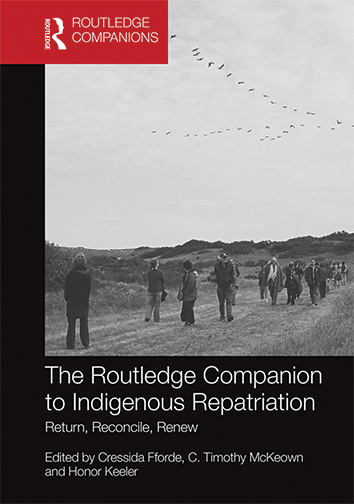
The Routledge companion and handbook volumes are curious beasts: encyclopaedic yet filtered, current yet immediately out-of-date on publication, and often inaccessibly priced for most individuals. Companions and handbooks most relevant to archaeology include fairly recent titles focused on intangible cultural heritage, cultural property, spatial history [GIS], global historical archaeology (landscape studies) and one forthcoming on global Indigenous history. The Routledge companion to Indigenous repatriation: return, reconcile, renew is, like most of the other texts in these two series, a behemoth of a book, with 982 pages. While it is unclear, at least to this reviewer, what exactly such large packaging does for a discipline, sub-discipline, or research area, the magic of this tome is in how the editors thoughtfully constructed it, achieved diverse representation and ultimately produced an indispensable volume for anyone interested in the repatriation of Indigenous ancestors.
The 56 individual chapters of this book are organised into four parts: (1) A global movement: repatriation reflections from around the world; (2) Networks of removal: understanding the acquisition of ancestral remains in the long nineteenth century; (3) Repatriation methods in research and practice; and (4) Restoring dignity. Reading the book from cover to cover, then, grants the reader a visceral experience of the history and practices of Indigenous repatriation.
In Part 1 the reader is treated to the thoughtful reflections of both Indigenous and non-Indigenous people(s) on the repatriation processes in which they were involved. The ethical imperative of repatriation and the frustrating socio-political obstacles to repatriation that remain are on full display. Part 2 is an historical gut-punch; chapter after chapter details the complicated ways in which Indigenous ancestors and sacred items were transported from their homes all around the world. From this part of the volume, one gets the sense of exactly how arduous it has been and will be to reunite Indigenous ancestors with their descendants. Parts 3 and 4, however, are the heart and soul of this volume. Part 3 represents an imminently useful collection of practical ‘how-to’ chapters on repatriation, covering everything from archive and digital research, to community relations and cultural protocols, and ceremony to ancient DNA. Part 4 offers a series of pieces, including especially impactful contributions from artists, which underscore the restorative work that repatriation does for Indigenous peoples.
Throughout, more theoretical and/or historically analytical chapters on Indigenous repatriation punctuate the narratives about specific experiences, histories and recommendations. In particular, standouts here are the Introduction (pp. 1–19), Paul Turnbull's “Collecting and colonial violence” (pp. 452–68), Russell Thornton's “Repatriation and the negotiation of identity: on the 20th anniversary of the Pawnee Tribe-Smithsonian Institution Steed-Kisker dispute” (pp. 890–901) and Tristram P. Besterman's “Contested human remains in museums: can ‘hope and history rhyme’?” (pp. 940–60). Many of the chapters provide effective background information on repatriation in a certain region, but these offerings represent the most useful ruminations on repatriation in general.
The reader will notice that a good portion of this volume—a little under half—is focused on Indigenous repatriation in Australia and the Torres Strait Islands. This is not an accident, as the two original projects from which this book emerged were administered and funded by Australian institutions. This is also reflected in Fforde's, and to a lesser extent, Aranui's, Pickering's and Turnbull's multiple author chapters. In putting together the current book, however, the editors did a laudable job diversifying the rest of the contributions, addressing, in no particular order, Europe (the UK, France and Germany), the United States, Canada, New Zealand, Russia, Japan, Namibia, Tanzania, Rapa Nui (Chile) and Argentina. The geographic coverage, therefore, is generally satisfying.
The one quibble I have in terms of the volume's content and organisation concerns neither Australian over-representation nor its coverage. The editors clearly worked very hard to bring in and harmonise numerous voices. But when they wanted reflective pieces, such as those listed above, they generally turned to heavy-hitting veterans of repatriation, such as Turnbull, Thornton, McKeown and Pickering; there is nothing inherently wrong with this approach, since many archaeologists and their students can still learn much from all of these authors. Making such a choice, however, does give the book a retrospective flavour, rather than engendering a forward-looking vision of where repatriation might go from here. Here, a synthetic conclusion by a younger Indigenous scholar may have been helpful.
Nevertheless, The Routledge companion to Indigenous repatriation is the volume we need right now. In the wake of the continuing racial reckoning sparked by the 2020 murder of George Floyd in Minneapolis, archaeologists and anthropologists need more reminders of the difficult history that we have inherited. Further, in the last few years, more and more museums are repatriating ancestors, art and sacred objects to descendant communities around the world. Meanwhile in the United States, although not a new idea, a repatriation movement is coalescing among African American scholars and activists. We need, therefore, to be reminded of the colonial and imperial obsession with collecting and the savagely unethical ways in which many colonised peoples were torn from their homelands. We need to be reminded of the heart-wrenching results of repatriation denials. We need to be reminded of the careful and nuanced cultural work that goes into successful repatriations. Perhaps one of the great gifts of this volume, then, is the cultural and ceremonial information that some of the Indigenous contributors were willing to write down and share; these are powerful reminders of how repatriation sits at the nexus of the past, present and future. Having these narratives and all of this experience in Indigenous repatriation in one place—a Herculean task of organisation and communication—should spur us to look up from our excavations, laboratory tables and lecture and report writing and consider that repatriation is the future of archaeology. There is no ethical, meaningful or useful archaeology without it. This book can serve as an essential reference for our path forward.


