Introduction
Cognitive impairment (i.e., loss of ability to learn, process, and remember information) in old age is common and poses a major public health problem because it is related to disability and mortality (Gale, Martyn, & Cooper, Reference Gale, Martyn and Cooper1996; Park, O'Connell, & Thomson, Reference Park, O'Connell and Thomson2003). Projections indicate that with the progressive aging of the population, the prevalence of cognitive impairment, Alzheimer's disease and other dementias is expected to increase in the coming years (Hebert, Scherr, Bienias, Bennett, & Evans, Reference Hebert, Scherr, Bienias, Bennett and Evans2003). The identification of risk factors that may be related to cognitive impairment is important for disease prevention and will likely be critical in reducing the deleterious effects of loss of cognition.
Psychosocial stress is a potentially modifiable environmental risk factor that has been linked to a variety of negative health outcomes, including cognitive impairment. It is well established from both animal and human studies that chronic stress leads to functional and structural changes in the nervous system (Margarinos, Verdugo, & McEwen, Reference Margarinos, Verdugo and McEwen1997). Animal studies that invoke psychological or experiential stressors (e.g., withholding reward, novelty), have shown that animals subjected to chronic stressors show degenerative changes in the hippocampus, a brain region that supports learning and memory, and impairment on memory tasks mediated by the hippocampus (e.g., Stewart et al., Reference Stewart, Davies, Sandi, Kraev, Rogachevsky, Peddie and Popov2005). One proposed mechanism is the activation of the hypothalamic-pituitary-adrenal (HPA) axis, which leads to increased release of glucocorticoids from the adrenal gland. In humans, subjective reports of stressful life events have been shown to be associated with poorer episodic memory and information processing speed (Caswell et al., Reference Caswell, Vitaliano, Croyle, Scanlan, Zhang and Daruwala2003; Lee, Kawachi, & Grodstein, Reference Lee, Kawachi and Grodstein2004), and persons who score high on measures of distress have been shown to have an increased risk of cognitive impairment in several studies (Boyle et al., Reference Boyle, Lyness, Duberstein, Karuza, King, Messing and Tu2010; Kuzma, Sattler, Toro, Schonknecht, & Schroder, Reference Kuzma, Sattler, Toro, Schonknecht and Schroder2011; Potvin, Forget, Grenier, Preville, & Hudon, Reference Potvin, Forget, Grenier, Preville and Hudon2011; Wilson, Evans, et al., Reference Wilson, Evans, Bienias, Mendes de Leon, Schneider and Bennett2003; Wilson, Begeny, Boyle, Schneider, & Bennett, Reference Wilson, Begeny, Boyle, Schneider and Bennett2011).
Most studies of psychosocial stress and cognitive impairment have been conducted with older Whites. Relatively little is known about the impact of psychosocial stress on cognitive function in older African Americans. However, a growing body of research suggests that stressful life experiences linked to race can have adverse affects on the health of minority populations. Because stress is linked to social status (Orpana, Lemyre, & Kelly, Reference Orpana, Lemyre and Kelly2007; Pearlin, Reference Pearlin1989), African Americans tend to experience a disproportionate burden of chronic stress compared to Whites due, at least in part, to their relative disadvantaged position in US society (Paradies, Reference Paradies2006; Williams, Reference Williams1997). For example, numerous studies have documented that African Americans are more likely to experience stressful life conditions linked to race as a result of limited job opportunities, highly segregated housing or neighborhoods and institutionalized racism (Boardman, Reference Boardman2004; Ewart & Suchday, Reference Ewart and Suchday2002).
One type of chronic psychosocial stress that is particularly relevant to African Americans is perceived discrimination, which has gained considerable attention in the literature over the past decade. Perceived discrimination has been linked to several important risk factors for cognitive impairment in older African Americans, including C-Reactive Protein (Lewis, Aiello, Leurgans, Kelly, & Barnes, Reference Lewis, Aiello, Leurgans, Kelly and Barnes2010), blood pressure/hypertension (Brondolo et al., Reference Brondolo, Libby, Denton, Thompson, Beatty, Schwartz, Sweeney and Gerin2008; Lewis et al., Reference Lewis, Barnes, Bienias, Lackland, Evans and Mendes de Leon2009), atherosclerotic disease (Borrell et al., Reference Borrell, Roux, Jacobs, Shea, Jackson, Shrager and Blumenthal2010; Lewis et al., Reference Lewis, Everson-Rose, Powell, Matthews, Brown, Karavolos and Wesley2006; Troxel, Matthews, Bromberger, & Sutton-Tyrrell, Reference Troxel, Matthews, Bromberger and Sutton-Tyrrell2003), depressive symptoms (Barnes et al., Reference Barnes, Mendes de Leon, Wilson, Bienias, Bennett and Evans2004; Schulz et al., Reference Schulz, Gravlee, Williams, Israel, Mentz and Rowe2006), and psychological distress (Barnes et al., Reference Barnes, Mendes de Leon, Wilson, Bienias, Bennett and Evans2004; Kessler, Mickelson, & Williams, Reference Kessler, Mickelson and Williams1999). However, to our knowledge there have been no studies linking perceived discrimination to cognitive function in any population, especially not older African Americans. Indeed, perceived discrimination may be a particularly important psychosocial stressor to examine in this population because African Americans in this age cohort would have come of age at a time when discriminatory treatment was legal in the United States (e.g., Jim Crow Laws). Given the history of the United States and its entrenched racial tensions during the early part of the 20th century, most African Americans were likely exposed to discriminatory treatment on a fairly regular basis (e.g., Essed, Reference Essed1991). Thus, they may be particularly sensitive to maltreatment and consequently more vulnerable to its negative health effects (Barnes et al., Reference Barnes, Mendes de Leon, Wilson, Bienias, Bennett and Evans2004; Mays, Cochran, & Barnes, Reference Mays, Cochran and Barnes2007; Williams & Williams-Morris, Reference Williams and Williams-Morris2000). Whether the commonly reported negative health effects of discrimination extend to cognitive function in a group that has arguably had the most consistent exposure to discriminatory behaviors (Klarman, Reference Klarman2004), is as of yet, an unanswered question.
There is evidence that experiences of discrimination can negatively affect cognitive performance in a laboratory setting. Salvatore and Shelton (Reference Salvatore and Shelton2007) found that ambiguous and blatant cues of racial prejudice—presented in fictional vignettes immediately before completing the Stroop color naming task—was related to poorer test performance among African American and White undergraduate students, respectively. While this study suggests an acute effect of perceived discrimination on cognitive function in a controlled setting, it remains unclear what effect perceptions of “real-world” experiences of discrimination have on cognitive function in an older African American population.
The primary purpose of the current study was to examine the relation of perceived discrimination to cognitive function in a community-based cohort of older African Americans. We hypothesized that higher levels of perceived discrimination would be related to poorer performance on cognitive function tests, particularly episodic memory tests, and that these associations would be independent of risk factors known to affect cognitive test performance, including age, education, and vascular conditions. Because depressive symptoms have been strongly associated with both perceived discrimination and cognitive function in prior studies, we were particularly interested in determining whether any observed associations were independent of depressive symptoms.
Another potentially important consideration in the association of discrimination with cognitive function is the role of personality (Williams, Neighbors, & Jackson, Reference Williams, Neighbors and Jackson2003). Because of the inherently subjective nature of perceived discrimination, it is plausible that individual personality characteristics may influence the tendency to perceive that one is receiving discriminatory treatment, as well as influence how one responds to the perceived discrimination. In fact, there is limited support for this in the literature (Operario & Fiske, Reference Operario and Fiske2001; Pinel, Reference Pinel2002). In the general literature on stress and health, neuroticism, a stable personality trait that reflects the tendency to experience emotional distress, has been shown to be associated with the frequency and severity of daily stressors (e.g., De Jong, van Sonderen, & Emmelkamp, Reference De Jong, van Sonderen and Emmelkamp1999), and can modify the stress-health relationship (e.g., Knepp & Friedman, Reference Knepp and Friedman2008). Similar findings have been reported with cognition as the health outcome. For example, Neupert, Mroczek, and Spiro (Reference Neupert, Mroczek and Spiro2008) found that neuroticism moderated the relationship between daily stressors and self-reported memory failures from a validated questionnaire in older adults. On days when people high in neuroticism experienced interpersonal stressors, they were more likely to report memory failures than persons who were lower in neuroticism. While neuroticism has been linked to daily interpersonal stressors and cognitive impairment, little is known about whether it might impact the association between perceived discrimination and cognitive health (e.g., Ong, Fuller-Rowell, & Burrow, Reference Ong, Fuller-Rowell and Burrow2009). One might postulate that persons who score high on neuroticism, may be more likely to perceive an ambiguous behavior as discriminatory treatment. Given evidence that neuroticism can inflate associations between self-reported stressful events and health outcomes (e.g., Watson & Pennebaker, Reference Watson and Pennebaker1989), we asked the question—would neuroticism be associated with an exaggerated effect of discrimination on poor cognition in our study. Thus, in exploratory analyses, we hypothesized that the association between discrimination and cognitive function would be stronger in persons who scored higher on neuroticism.
Finally, this is a study of cognitive test performance in older African Americans. It is fairly well established that there are a variety of adverse social and environmental experiences over the life course that can influence assessment of cognitive function in African Americans (e.g., Brickman, Cabo, & Manly, Reference Brickman, Cabo and Manly2006; Glymour & Manly, Reference Glymour and Manly2008). Older African Americans often have fewer years of formal education, fewer socioeconomic resources, and poorer health, factors that have been shown in numerous studies to be associated with lower cognition (Karp et al., Reference Karp, Kareholt, Qiu, Bellander, Winblad and Fratiglioni2004; Luo & Waite, Reference Luo and Waite2005). Literacy or reading ability, often considered an estimate of quality of education (Manly, Jacobs, Touradji, Small, & Stern, Reference Manly, Jacobs, Touradji, Small and Stern2002), has also been shown to be an important correlate of cognitive test performance in African Americans in several studies (Dotson, Kitner-Triolo, Evans, & Zonderman, Reference Dotson, Kitner-Triolo, Evans and Zonderman2009; Johnson, Flicker, & Lichtenberg, Reference Johnson, Flicker and Lichtenberg2006; Manly, Touradji, Tang, & Stern, Reference Manly, Touradji, Tang and Stern2003; Manly, Byrd, Touradji, & Stern, Reference Manly, Byrd, Touradji and Stern2004; Manly et al., Reference Manly, Smith, Crystal, Richardson, Golub, Greenblatt and Young2011), and accounts for some of the lower performance in this population. Understanding the impact of other culturally relevant variables, such as perceived discrimination, in the neuropsychological assessment of African Americans may bolster research efforts aimed at identifying individual sources of variability in test performance in a group that is at high risk for cognitive impairment.
Methods
Participants
Participants included self-identified African Americans from an epidemiologic cohort study of risk factors for cognitive impairment called the Minority Aging Research Study (MARS) (Lewis et al., Reference Lewis, Aiello, Leurgans, Kelly and Barnes2010). The cohort consists of non-institutionalized seniors over the age of 65 without known dementia who agreed to annual clinical evaluations and cognitive testing. The cohort was recruited from various community-based organizations, churches, and senior subsidized housing facilities in and around the Chicago metropolitan area and was approved by the Institutional Review Board of Rush University Medical Center. The study has a rolling admission, and more than 350 persons have completed a uniform structured baseline clinical evaluation between August 2004 and November 2011. To increase sample size, African Americans from another Rush cohort study of aging and Alzheimer's disease, the Rush Memory and Aging Project (MAP) (Bennett et al., Reference Bennett, Schneider, Buchman, Mendes de Leon, Bienias and Wilson2005), were included in the analytic sample. The Memory and Aging Project is a longitudinal clinical-pathological study of common chronic conditions of aging. Participants are recruited from approximately 40 continuous care retirement communities in and around the Chicago metropolitan area. Because residents of continuous care retirement communities are predominantly White and tend to be more affluent, the study also recruits from Section 8 and Section 202 housing subsidized by the Department of Housing and Urban Development, retirement homes, and through local churches and other social service agencies serving minorities and low-income elderly. Between 1997 and 2011, more than 1400 persons have enrolled in the study. Both the Minority Aging Research Study and the Rush Memory and Aging Project use identical recruitment techniques, recruit from the same catchment areas for minorities, and have a large common core of data collection and operational methods, which facilitates analyses of data from the combined cohorts (Arvanitakis, Bennett, Wilson, & Barnes, Reference Arvanitakis, Bennett, Wilson and Barnes2010; James, Boyle, Buchman, Barnes, & Bennett, Reference James, Boyle, Buchman, Barnes and Bennett2011).
Eligibility for these analyses was restricted to persons who were free of dementia at baseline and had non-missing scores for discrimination and cognitive function. Each participant underwent an annual uniform clinical evaluation that included a medical history, complete neurological examination, and cognitive function testing, as previously described (Arvanitakis et al., Reference Arvanitakis, Bennett, Wilson and Barnes2010). A physician then clinically classified persons with respect to dementia using established criteria (McKhann et al., Reference McKhann, Drachman, Folstein, Katzman, Price and Stadlan1984), which required a history of cognitive decline and evidence of impairment in at least two cognitive domains. At the time of these analyses, 434 African Americans had completed a baseline clinical evaluation. Of those, we excluded 15 with dementia and an additional 12 because they had missing discrimination scores. This left 407 eligible persons (327 MARS participants, 80 MAP participants); analyses are based on this group.
Assessment of Perceived Discrimination
Perceived discrimination was assessed with a previously established 9-item measure (Williams, Yu, Jackson, & Anderson, Reference Williams, Yu, Jackson and Anderson1997). The scale assesses the subjective experience of being treated unfairly in common everyday situations and has been validated in several previous studies including older samples (Barnes et al., Reference Barnes, Mendes de Leon, Wilson, Bienias, Bennett and Evans2004, Reference Barnes, Mendes de Leon, Lewis, Bienias, Wilson and Evans2008; Lewis et al., Reference Lewis, Barnes, Bienias, Lackland, Evans and Mendes de Leon2009; Taylor, Kamarck, & Shiffman, Reference Taylor, Kamarck and Shiffman2004). Respondents indicated how often they experienced nine instances of discrimination, and the frequency was rated on a 4-point scale (3 = often, 2 = sometimes, 1 = rarely, 0 = never). Sample items include “You are treated with less respect than other people,” and “You receive poorer service than other people at restaurants or stores.” Following previous work with this measure, we recoded the responses to a binary format (often or sometimes = 1, rarely or never = 0) and then summed across the individual item scores to get the total score (range = 0–9), with higher scores indicating more discrimination (Barnes et al., Reference Barnes, Mendes de Leon, Lewis, Bienias, Wilson and Evans2008; Brown, Matthews, Bromberger, & Chang, Reference Brown, Matthews, Bromberger and Chang2006; Lewis et al., Reference Lewis, Aiello, Leurgans, Kelly and Barnes2010). The Cronbach coefficient α, an indicator of internal consistency reliability, was 0.80.
Assessment of Neuroticism
Chronic level of psychological distress, or neuroticism, was assessed with the neuroticism sub scale of the NEO Five-Factor Inventory (Costa & McCrae, Reference Costa and McCrae1992). Participants rated agreement with each of 12 statements on a 5-point scale (0 to 4) with individual item scores added to compute the total score (possible range = 0–48). Sample items include “When I'm under a great deal of stress, sometimes I feel like I am going to pieces” and “Sometimes I feel completely worthless.” Cronbach α was 0.84.
Assessment of Cognitive Function
A battery of 19 cognitive function tests was administered in a 1-h session. Detailed information on the individual tests is published elsewhere (Bennett et al., Reference Bennett, Schneider, Buchman, Mendes de Leon, Bienias and Wilson2005; Wilson et al., Reference Wilson, Barnes, Kreuger, Hoganson, Bienias and Bennett2005). One test, the Mini-Mental State Examination (Folstein, Folstein, & McHugh, Reference Folstein, Folstein and McHugh1975), was used to describe the overall cognitive functioning of participants in the cohort, but not in analyses. The remaining 18 performance-based tests assessed five specific domains of cognitive function. There were seven tests of episodic memory: immediate and delayed story recall of story A from the Logical Memory subtest of the WMS-R (Wechsler, Reference Wechsler1987) and of the East Boston Story (Albert et al., Reference Albert, Smith, Scherr, Taylor, Evans and Funkenstein1991; Wilson et al., Reference Wilson, Barnes, Kreuger, Hoganson, Bienias and Bennett2005) and Word List Memory, Word List Recall, and Word List Recognition from the procedures established by CERAD (Morris et al., Reference Morris, Heyman, Mohs, Hughes, van Belle, Fillenbaum and Clark1989); two tests of semantic memory: a 15-item version (Morris et al., Reference Morris, Heyman, Mohs, Hughes, van Belle, Fillenbaum and Clark1989) of the Boston Naming Test (Kaplan, Goodglass, & Weintraub, Reference Kaplan, Goodglass and Weintraub1983; Morris et al., Reference Morris, Heyman, Mohs, Hughes, van Belle, Fillenbaum and Clark1989) and semantic Verbal Fluency from Cerad (Morris et al., Reference Morris, Heyman, Mohs, Hughes, van Belle, Fillenbaum and Clark1989; Wilson et al., Reference Wilson, Barnes, Kreuger, Hoganson, Bienias and Bennett2005); three tests of working memory: Digit Span Forward and Digit Span Backward from the Weschler Memory Test-R (Wechsler, Reference Wechsler1987) and Digit Ordering (Cooper & Sagar, Reference Cooper and Sagar1993; Wilson et al., Reference Wilson, Barnes, Kreuger, Hoganson, Bienias and Bennett2005); four measures of perceptual speed: Symbol Digit Modalities Test (Smith, Reference Smith1982), Number Comparison (Ekstrom, French, Harman, & Kermen, Reference Ekstrom, French, Harman and Kermen1976), and two indices from a modified version of the Stroop Neuropsychological Screening Test: the number of color names correctly read aloud in 30 s minus the number of errors, and the number of colors correctly named in 30 s minus the number of errors (Trenerry, Crosson, DeBoe, & Leber, Reference Trenerry, Crosson, DeBoe and Leber1989); and two tests of visuospatial ability: a 15-item version of Judgment of Line Orientation (Benton, Sivan, Hamsher, Varney, & Spreen, Reference Benton, Sivan, Hamsher, Varney and Spreen1994) and a 16-item version of Standard Progressive Matrices (Raven, Court, & Raven, Reference Raven, Court and Raven1992). To make use of all available data, we formed a composite measure of global cognition by converting raw scores on each test to Z-scores, using the baseline mean and SD, and averaging the Z-scores to compute the composite. The Cronbach α for global cognition was 0.88. Detailed information about the method for computing the summary score is published elsewhere (Wilson, Barnes, & Bennett, Reference Wilson, Barnes and Bennett2003; Wilson et al., Reference Wilson, Barnes, Kreuger, Hoganson, Bienias and Bennett2005).
The results of a previous factor analysis of these tests supported the existence of five pre-specified domains. Accordingly, we created composite measures of episodic memory (Cronbach α = 0.82), semantic memory (Cronbach α = 0.55), working memory (Cronbach α = 0.64), perceptual speed (Cronbach α = 0.80), and visuospatial ability (Cronbach α = 0.50), by converting raw scores on each component test to Z-scores and averaging the Z-scores to obtain the domain score, as previously described (Wilson et al., Reference Wilson, Beckett, Barnes, Schneider, Bach, Evans and Bennett2002, Reference Wilson, Barnes, Kreuger, Hoganson, Bienias and Bennett2005).
Assessment of Other Risk Factors
Covariates were selected based on prior association with cognitive function in this cohort. Educational attainment was self-reported as years of schooling completed. Three vascular risk factors were assessed. They included: (1) a history of current or former smoking (“Do you smoke cigarettes now?”, and if no, then “Did you ever smoke cigarettes regularly?”), (2) diagnosis of hypertension based on visual inspection of medications or reported history, and diagnosis of diabetes based on medication inspection or reported history. We computed a summary score indicating each individual's vascular risk factor sum (resulting in a score from 0 to 3 for each individual) and used the summary score in the analysis. Depressive symptoms over the past week were assessed with the 10-item version of the Center for Epidemiological Studies Depression scale (CES-D) (Radloff, Reference Radloff1977). The shorter 10-item form was developed to reduce participant burden in older adults, and its correspondence to the original version has been previously established (Kohout, Berkman, Evans, & Cornoni-Huntley, Reference Kohout, Berkman, Evans and Cornoni-Huntley1993). Possible scores ranged from 0 to 10, with higher scores indicating more depressive symptoms.
Data Analysis
We examined the association of perceived discrimination to cognitive function in a series of linear regression models. All models included terms to control for age, sex, and education, with vascular conditions and depressive symptoms adjusted in subsequent models. Initial models used the global composite of cognitive function and secondary models replaced global cognition as the outcome variable with each of the five cognitive abilities. In secondary analyses, we tested whether level of neuroticism modified the association of discrimination and cognitive function by including in two separate models a term for the main effect of neuroticism and then terms for the main effect of neuroticism and the interaction of discrimination and neuroticism to the core model for global cognition and each of the cognitive domains. Models were validated graphically and analytically and all programming was done in SAS version 9.2 (SAS Institute, Inc., Cary, NC).
Results
Sample Characteristics and Perceived Discrimination
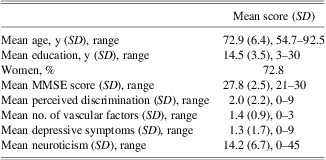
Demographic characteristics of the study sample are summarized in Table 1. Participants were a mean age of 72.9 (MARS: 72.8; MAP: 72.2) years (SD = 6.4), had a mean of 14.5 (MARS: 14.6; MAP: 13.9) years of education (SD = 3.5), and a mean score of 27.8 (MARS: 28.0; MAP: 27.6) (SD = 2.5) on the Mini-Mental Examination; 72.8% (MARS: 70.4; MAP: 80.9) of the sample was women.
Clinical characteristics of study sample (N = 407)
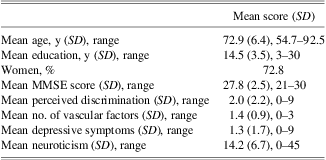
Note. MMSE: Mini-Mental State Examination (Folstein et al., Reference Folstein, Folstein and McHugh1975). Values in the table represent mean, SD, and range for the sample.
The perceived discrimination scale was positively skewed in our sample, with 36.3% reporting no experiences of discrimination, 17.4% reporting only one experience, 11.5% reporting two, 11.3% reporting three experiences, and 21% reporting four or more experiences of discrimination. Perceived discrimination was correlated with education (r = −0.14; p = .004), but was not significantly related to age or sex. The mean discrimination score was 2.0 (SD = 2.2).
In a crude analysis comparing those who reported no perceived discrimination to those who reported at least one experience, those who reported discrimination tended to have fewer years of education (p = .05) and lower MMSE scores (p < .01). There was no difference between the two groups in age or number of vascular risk factors.
Perceived Discrimination and Cognitive Function
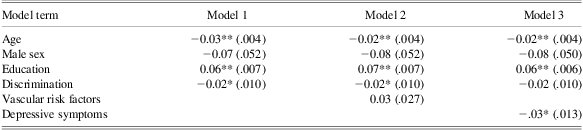
We examined the association of perceived discrimination with cognitive function in a series of linear regression models. Initial analyses began with the global measure of cognitive function, which ranged from −1.87 to 1.43 (mean = −0.005; SD = .53), with higher scores indicating better cognitive function. The first model examined the association of perceived discrimination to global cognition controlling for the potentially confounding effects of age, education, and sex. In this model, perceived discrimination was negatively related to global cognition (estimate for perceived discrimination = −.02 (SE = .01), p-value <.05 Table 2, model 1), such that each point on the discrimination scale was associated with a .02 unit lower score on the global cognition summary measure. The main effect of discrimination on global cognition was unchanged after controlling for vascular health conditions (Table 2, Model 2). In the third model, we adjusted for depressive symptoms. Depressive symptoms were significantly correlated with global cognition and each of the cognitive domains (r = −.17 global cognition; r = −.13 episodic memory; r = −.12 perceptual speed; r = −.18 semantic memory; r = −13 visuospatial ability; and r = −14 working memory; all p's > .05), as well as with perceived discrimination (r = .23; p < .0001). After adjusting for depressive symptoms, the estimate for discrimination was only slightly attenuated but no longer significant (Table 2, Model 3: discrimination estimate = −0.02; SE = 0.01; p = 0.11).
Association of perceived discrimination to global cognitive function (N = 407)
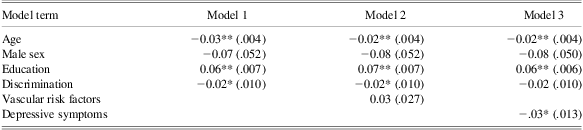
Note. Estimates (standard error in parentheses) from linear regression models that controlled for age, sex, and education. Model 1 is the core model with the demographics plus discrimination. Model 2 adds the summary measure for vascular risk factors. Model 3 includes the demographics, discrimination, and depressive symptoms.
*p < .05.
**p < .001.
Additional models examined five separate cognitive abilities including episodic memory, semantic memory, working memory, perceptual speed, and visuospatial ability. Perceived discrimination was associated with lower performance only in episodic memory and perceptual speed (Table 3). Both associations remained in models that adjusted for vascular risk factors, but not in models that adjusted for depressive symptoms (after adjustment for vascular risk factors: Episodic memory estimate = −0.03; SE = 0.01; p < .05; Perceptual Speed estimate = −0.04; SE = 0.02; p < .05; After adjustment for depressive symptoms: Episodic memory estimate = −0.02, SE = 0.01, p = .06; Perceptual Speed estimate = −0.03; SE = 0.02; p = .06).
Association of perceived discrimination and five cognitive abililites from linear regression models (N = 407)

Note. Estimates (standard error in parentheses) from linear regression models that controlled for age, sex, and education.
*p < .05.
**p < .001.
Because negative personality traits such as neuroticism have been found to modify the association of chronic stress and health, we repeated the core model for global cognition (including the demographic variables, vascular risk factors, and depressive symptoms) with a term added for neuroticism and then in a subsequent model, we added terms for neuroticism and the interaction of neuroticism with perceived discrimination. Neuroticism and discrimination were significantly correlated (r = .28; p < .0001). The effect size of discrimination on global cognition was reduced only slightly and reached marginal significance (estimate for discrimination = −.02; SE = .01; p = .06), but there was a significant effect modification by neuroticism (Discrimination × neuroticism: estimate = .005; SE = .00; p = .0004). We repeated each model for the individual cognitive abilities, adding in sequential models a term for neuroticism and terms for neuroticism and the interaction of neuroticism and perceived discrimination, respectively. Neuroticism modified the association of perceived discrimination for perceptual speed, episodic memory, and semantic memory (Table 4), such that the negative association between discrimination and each cognitive domain was only present in those who scored low on the neuroticism scale.
Interaction models of perceived discrimination and neuroticism regressed on cognition (N = 407)

Note. Estimates (standard error in parentheses) from linear regression models.
*p < .05.
**p < .01.
***p < .001.
Discussion
Numerous studies have demonstrated that experiences of discrimination are a source of stress that adversely affect health (e.g., Barnes et al., Reference Barnes, Mendes de Leon, Lewis, Bienias, Wilson and Evans2008; Borrell et al., Reference Borrell, Roux, Jacobs, Shea, Jackson, Shrager and Blumenthal2010; Brondolo et al., Reference Brondolo, Libby, Denton, Thompson, Beatty, Schwartz, Sweeney and Gerin2008; Lewis, Kravitz, Janssen, & Powell, Reference Lewis, Kravitz, Janssen and Powell2011; Williams et al., Reference Williams, Neighbors and Jackson2003). Perceptions of discrimination or unfair treatment are common among minority groups and recent evidence suggests that experiences of discrimination may occur on a weekly basis for some groups (Brondolo, Gallo, & Myers, Reference Brondolo, Gallo and Myers2009). Older African Americans represent a particularly vulnerable population given the pervasive and persistent level of institutional racism and prejudice they would have faced throughout their early life, yet relatively few studies have focused on the adverse health effects of discrimination in this group. In this study of 407 older African Americans, we examined the relation of perceived discrimination to global cognition and five cognitive abilities. Although the overall mean level of perceived discrimination was low, consistent with previous reports in older African Americans (Barnes et al., Reference Barnes, Mendes de Leon, Wilson, Bienias, Bennett and Evans2004, Reference Barnes, Mendes de Leon, Lewis, Bienias, Wilson and Evans2008; Lewis et al., Reference Lewis, Barnes, Bienias, Lackland, Evans and Mendes de Leon2009), the majority of the cohort reported at least one instance of perceived discrimination. We found that a higher level of discrimination was associated with worse cognitive performance. In particular, participants who reported more instances of discrimination had lower scores on the global measure of cognition and specific cognitive abilities including episodic memory and perceptual speed. The fact that the findings were selective for episodic memory—the hallmark of Alzheimer's disease—and perceptual speed, is consistent with perceived discrimination being a social stressor in African Americans. Although null studies have been reported (e.g., Beckner, Tucker, Delville, & Mohr, Reference Beckner, Tucker, Delville and Mohr2006), there are well known effects of stress on memory retrieval and hippocampal volume (Lupien, Maheu, Tu, Fiocco, & Schramek, Reference Lupien, Maheu, Tu, Fiocco and Schramek2007; Merz, Wolf, & Hennig, Reference Merz, Wolf and Hennig2010), and impaired performance on processing speed (e.g., Liston, McEwen, & Casey, Reference Liston, McEwen and Casey2009). Although the overall magnitude of effect of discrimination on cognition was small, with a one-point increase on the discrimination scale reflecting on average a 0.02 lower global cognition score, the effect on cognition was qualitatively similar to being a year older at baseline. For persons reporting high levels of discrimination, this could have important clinical implications.
The magnitude of the association between perceived discrimination and cognitive function was unchanged after adjusting for demographic factors and vascular health conditions, but was attenuated after adjusting for depressive symptoms, suggesting that the association of discrimination with poorer cognitive test performance is not independent of depressive symptoms. Discrimination has been consistently linked to depressive symptoms across cohorts (e.g., Barnes et al., Reference Barnes, Mendes de Leon, Wilson, Bienias, Bennett and Evans2004; Kessler et al., Reference Kessler, Mickelson and Williams1999; Schulz et al., Reference Schulz, Gravlee, Williams, Israel, Mentz and Rowe2006). Although the mechanisms are not clear, it is possible that experiences related to being treated poorly may engender negative feelings that lead to depression. In fact, early qualitative studies of perceived discrimination and perceived racism describe several psychological consequences of feeling discriminated against including powerlessness, feeling unworthy and looked down upon, as well as feeling sad and fearful (e.g., Essed, Reference Essed1991). These same types of feelings have been shown in numerous studies to be related to greater cognitive impairment (e.g., Barnes, Alexopoulos, Lopez, Williamson, & Yaffe, Reference Barnes, Alexopoulos, Lopez, Williamson and Yaffe2006). For example, several studies have found that depression is associated with impairments in learning, memory, attention, and executive function. Although it has been difficult to determine whether it is a cause or symptom of cognitive impairment, depressive symptoms have been associated with reduced density of dendrites and spines in the CA3 region of the hippocampus (Soetanto et al., Reference Soetanto, Wilson, Talbot, Un, Schneider, Sobiesk and Arnold2010), suggesting that depressive symptoms may be a risk factor for cognitive impairment.
Because our findings are cross-sectional, it is difficult to disentangle the temporal associations among perceived discrimination, depressive symptoms and cognition. We cannot rule out the possibility that individuals with increased depressive symptoms are more likely to report experiences of discrimination and perform more poorly on cognitive tests. However, because longitudinal research suggests that reports of discrimination actually precede increases in depressive symptoms (Schulz et al., Reference Schulz, Gravlee, Williams, Israel, Mentz and Rowe2006), our results are at least consistent with a scenario whereby perceived discrimination might lead to increased depressive symptoms, which in turn might lead to poorer cognitive test performance. Additional prospective studies are needed to explore this possibility. If replicated, our findings suggest that depressive symptoms due to discriminatory treatment could be an important target for interventions to reduce poor cognitive performance in older African Americans.
In secondary analyses, we also examined the role of neuroticism. Some have suggested that personality characteristics could influence the association of perceived discrimination and health (Williams et al., Reference Williams, Neighbors and Jackson2003). We, therefore, hypothesized that neuroticism, the tendency to experience psychological distress, would modify the association of perceived discrimination with cognition. We did find an effect modification for global cognition, episodic memory, semantic memory, and perceptual speed, but not in the direction that we hypothesized. We found that the inverse association of perceived discrimination and these cognitive abilities was strongest in those who scored lower on the neuroticism scale. These results suggest that it is the people who are not prone to negative emotions who are having the worse impact of discrimination on cognition. When neuroticism was low and reports of discrimination were high, performance on the cognitive tests was low. In contrast, when neuroticism was high and discrimination was high, performance on the cognitive tests was also high.
Taken together, these results could have important implications for understanding the role of race-relevant variables such as perceived discrimination in the study of neuropsychological performance among African American elders. Perceived discrimination is a potentially unique variable that reflects particularly well the historical and current social experience of African Americans in the United States. It is extremely common among minority populations, particularly African Americans, and has been linked to several poor health outcomes. To our knowledge, no studies have reported an association with cognitive function, although it is related to several important correlates of cognitive function. The overall magnitude of the effect was small, but focused on domains of function that are the hallmark of Alzheimer's disease. Whether perceived discrimination in and of itself has a direct effect on cognitive function or whether it is merely a proxy for an important marker of “racial experience,” findings from this study suggest that perceived discrimination may need to be considered as a potential correlate of cognition in African Americans and could be added to the list of other race-relevant variables that impact cognition, such as acculturation and quality of education (Manly, Reference Manly2006). Future studies are needed to determine whether perceived discrimination may be a meaningful variable to explain racial differences in cognition and other health outcomes. Furthermore, it may prove to be a useful construct in neuropsychological examinations of other marginalized groups who experience discrimination (e.g., other ethnic minorities, language minorities, the homeless, GLBT individuals, and persons with disabilities).
The current study has limitations. First, participants are from two select volunteer-cohorts of well-educated African Americans from the Midwest. Second, we used only a single assessment of perceived discrimination that focused on minor but recurrent instances of unfair treatment. Major discriminatory events such as being denied a loan or being fired from a job represent more traumatic instances of discrimination as opposed to the more subtle but common experiences measured in this study. It is possible that the association between discrimination and cognition might have been stronger had we used a lifetime measure of major discriminatory events, which could more accurately reflect the experiences of discrimination for an older African American cohort, rather than the everyday discrimination measure used in the present study. Third, we used years of education rather than a marker of educational quality to control for educational experience. Incorporating data on educational quality (e.g., length of school year or spending per pupil) in future studies might provide additional insight on the association of discrimination and cognition in African Americans. Fourth, overall levels of discrimination were relatively low in this population, a finding that is consistent with previous reports of declining discrimination with age (e.g., Kessler et al., Reference Kessler, Mickelson and Williams1999). It is possible that the low scores on discrimination reflect the fact that older adults tend to be less mobile and restrict their daily activities to smaller neighborhood areas (Satariano, Reference Satariano1997). Given the high level of residential segregation in Chicago neighborhoods, future studies are needed with older African Americans living in more racially integrated areas. Finally, the discrimination scale we used makes no attribution of the cause or source of discrimination. However, others have found that the attribution does not appear to matter as much as the actual experience of feeling discriminated against (Lewis et al., Reference Lewis, Everson-Rose, Powell, Matthews, Brown, Karavolos and Wesley2006).
The study also had several strengths that increased confidence in the findings. To our knowledge, this study is among the first to examine the association between discrimination—a culturally relevant stressor—and cognitive function in older African Americans. Participants received a comprehensive battery of performance-based cognitive function tests that assessed five different cognitive abilities. We also used a well-validated measure of perceived discrimination that has been used previously with older samples (Barnes et al., Reference Barnes, Mendes de Leon, Lewis, Bienias, Wilson and Evans2008; Kessler et al., Reference Kessler, Mickelson and Williams1999). Finally, we were able to adjust models for several important covariates that may influence associations between discrimination and cognition.
The finding that perceived discrimination is associated with poorer cognitive test performance in older African Americans has important public health implications. It is well documented that older African Americans typically perform poorly on neuropsychological tests designed to measure cognition, and some studies suggest an increased risk of dementia and Alzheimer's disease (Sheffield & Peek, Reference Sheffield and Peek2011). Although the reasons for their poor performance and possible increased risk of impairment are not clear, the current results suggest that experiences and perceptions of discrimination, which represent a persistent stressor for African Americans, may negatively influence cognitive test performance, but not independently of depressive symptoms. Longitudinal research is needed to further disentangle the associations among discrimination, depressive symptoms and cognitive function.
Acknowledgments
We thank Charlene Gamboa, MPH; Tracy Colvin, MPH; Tracey Nowakowski, Barbara Eubeler, Karen Lowe-Graham, MS, and Mary Futrell for study recruitment and coordination, John Gibbons, MS and Greg Klein for data management, Wenqing Fan for statistical programming, and the staff of the Rush Alzheimer's Disease Center. The authors thank the participants of the Minority Aging Research Study and the Rush Memory and Aging Project for their invaluable contributions. This study was supported by the National Institute on Aging grants R01 AG22018, R01 AG17917, and the Heart, Lung, and Blood Institute grant K01HL092591. The authors report no conflicts of interest.