Infants with congenital heart disease have a higher incidence of low birth weight.Reference Rosenthal, Wilson, Permutt, Boughman and Ferencz1–Reference Kramer, Trampisch, Rammos and Giese3 Advances in perinatal medicine have led to dramatic improvements in survival among low-birth-weight infants.Reference MacDorman and Mathews4 This has resulted in increasing numbers of low-birth-weight infants with congenital heart defects requiring therapy. However, mortality among premature and low-birth-weight infants undergoing surgery for congenital heart defects remains high.Reference Cheng, Almodovar and Laussen 5 Therefore, catheter-based interventions as a palliative and therapeutic option have been increasingly used to improve the mortality of high-risk low-birth-weight infants. Few large studies reporting their catheterisation experience have shown increased risk of mortality and complications in low-birth-weight infants.Reference McMahon, Price and Salerno 6 – Reference Zepeda-Arambula, Gutierrez-Cobian, Villatoro-Fernandez, Pacheco-Lopez and Tlacuilo-Parra 18 Nevertheless, technical feasibility, outcome, and complications of cardiac catheterisation in this specific population need clarifications. That is why this procedure for low-birth-weight infants is still very debated by neonatologists and paediatricians. Patent ductus arteriosus is very frequent in the population of premature babies. Its transcatheter closure has been reported and is expanding. In this context and before expansion, we think that morbidity and mortality of cardiac catheterisation, in general, in this peculiar population of low-birth-weight infants should be provided. The objective of our study was to share our experience with low-birth-weight infants describing the results of cardiac catheterisation in small infants weighing <2500 g.
Methods
The population
We performed a retrospective review of patients weighing <2500 g who underwent cardiac catheterisation in our centre from January 2000 to July 2016. Informed consent was obtained from parents. The study was performed with approval from our institutional review board.
Data collection
Demographic data were recorded, including gender, gestational age, birth weight, comorbidity, and type of ventilation used, if any. All procedures were divided according to their interventional or diagnostic nature. To better categorise the risk of procedures, procedures were classified according to the haemodynamic vulnerability index and the procedure type risk as described by Bergersen et al.Reference Bergersen, Gauvreau and Marshall 10 , Reference Bergersen, Gauvreau and Foerster 11 Finally, data on tolerance of the procedure were recorded by taking into account any adverse reaction classified according to the time of occurrence: per procedure and short term (<30 days post-catheterisation). The complications were classified according to the adverse event severity score, which categorises complications ranging from 1 to 5 (negligible, minor, moderate, severe, catastrophic). This score, defined by Bergersen et al, is used in the international nomenclature of congenital cardiac catheterisation.Reference Bergersen, Gauvreau and Marshall 10 , Reference Learn, Holzer and Daniels 12 , Reference Kobayashi, Sallaam and Aggarwal 13 The events reported were death, cardiorespiratory arrest, respiratory failure requiring invasive mechanical ventilation, haemodynamic instability, vascular wounds, acute anaemia requiring transfusion of red blood cells, arrhythmia, and any complication requiring any active medical or surgical procedure responsible for an extension of the length of stay or an increase in morbidity.
Data and statistical analysis
The descriptive analysis of efficacy and tolerability covered the entire cohort. We first analysed the occurrence of death on the whole population and then according to weight categories (<1500, 1500–2000, and 2000–2500 g), in order to study a possible correlation between the rate of complication and lower weight. Then, we compiled the complications according to their time of occurrence. Analysis was performed using MedCalc software (Mariakerke, Belgium). The qualitative variables are expressed by their associated distribution frequency and 95% confidence interval. The comparison was made by chi-squared or by exact Fisher tests. Quantitative variables are expressed as mean, standard deviation, associated 95% bilateral confidence intervals when the distribution of the variable is Gaussian; or minimum, maximum, median, and quartiles if the distribution is non-Gaussian. Depending on the distribution of each variable, comparisons were made either by Student t-test or by Wilcoxon test. All tests were carried out bilaterally with a risk of first alpha species set at 5%.
Results
Patients’ characteristics
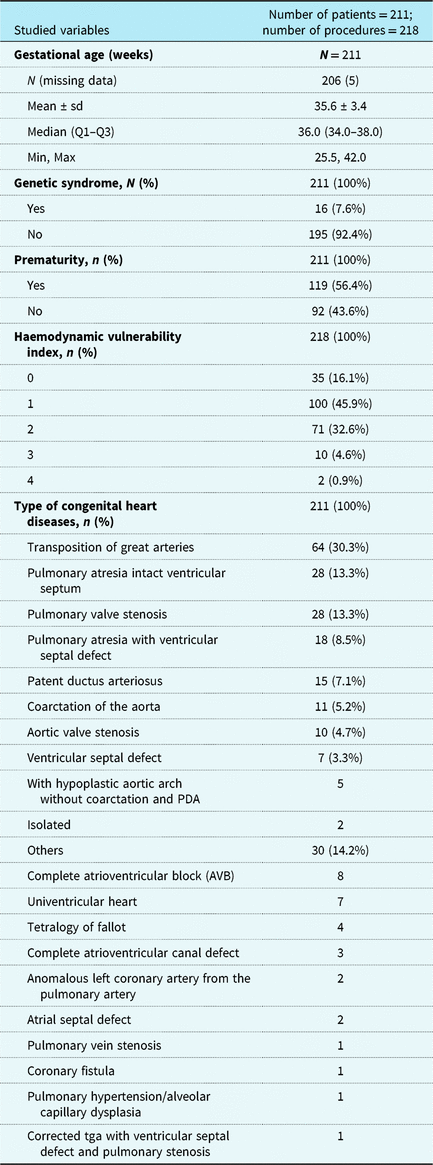
In 211 patients weighing <2500 g at the time of catheterisation, 218 procedures were performed. Seven patients had two procedures. The mean age at catheterisation was 15 ± 26 days. The mean weight on the day of catheterisation was 2111.1 ± 338 g. The patients’ characteristics are summarised in Table 1.
Characteristics of included patients.

TGA, transposition of great arteries; PDA, patent ductus arteriosus.
Characteristics of procedures
Forty-four procedures (20%) were diagnostic; 174 procedures (80%) were interventional, 80 and 94 of which being, respectively, palliative and curative. Interventional catheterisation consisted of: (1) Rashkind intervention (n = 59: 55 transposition of great arteries [TGA], 1 hypoplastic left heart syndrome, 1 double outlet right ventricle with pulmonary stenosis, 1 pulmonary atresia with intact ventricular septum [PAIVS] with hypoplastic RV); (2) perforation/dilatation of the pulmonary valve (n = 54: 20 perforations including 17 PAIVS and 3 pulmonary atresia with ventricular septal defect [PA-VSD]); (3) stenting of patent ductus arteriosus (n = 10: 2 complex TGA, 1 PA-VSD, 5 PAIVS, 2 univentricular heart with pulmonary atresia); (4) closing patent ductus arteriosus (n = 10); (5) aortic valvuloplasty (n = 10); (6) dilation of aortic coarctation (n = 9); (7) pulmonary artery dilation (n = 4, including right ventricular outflow tract stenting in 2); (8) temporary endovascular pacing wire for complete atrioventricular block (n = 10); (9) coronary angioplasty (n = 3); (10) vascular embolisation (n = 4, 1 coronary fistula, 3 MAPCA); and (11) 1 pericardiocentesis (post arterial switch operation). Among interventional catheterisations, success rate was 92.5%; 7.5% (n = 13/174) were considered unsuccessful.
Complications
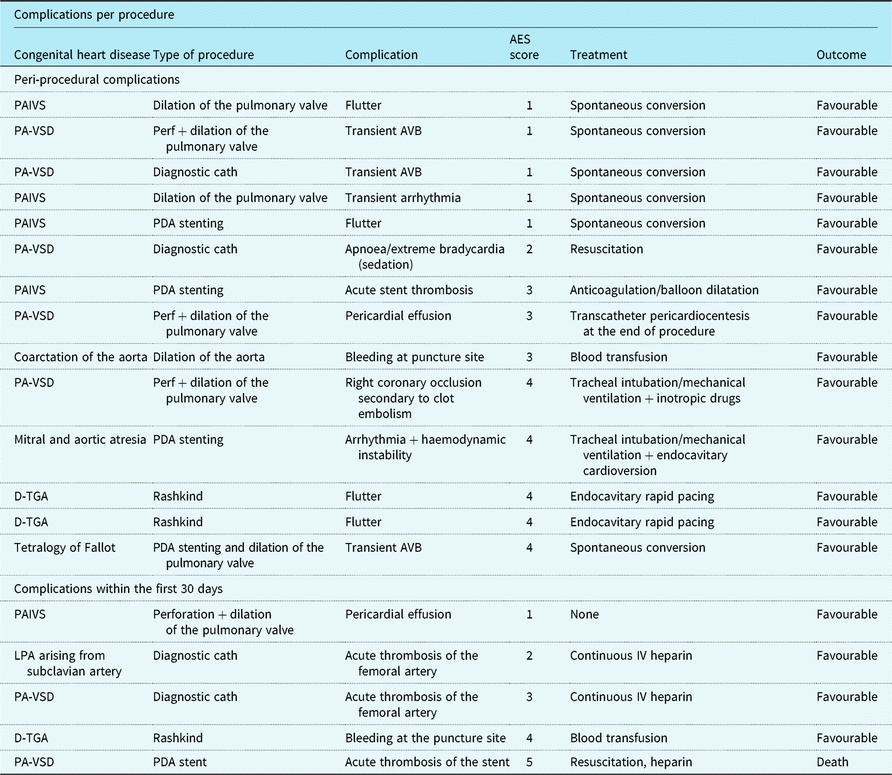
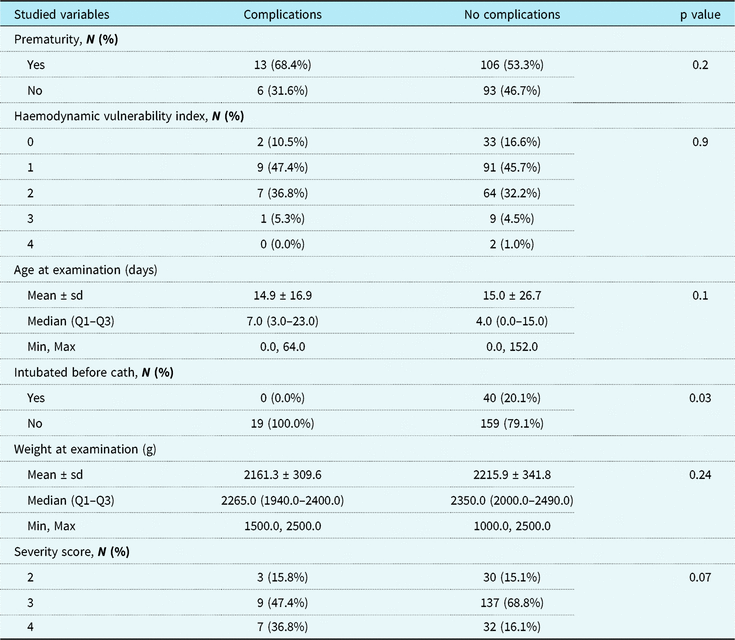
In our series, we identified 19 complications (8.7% of all performed procedures): 14 occurred during the procedure and 5 within the first 30 days of catheterisation (see Table 2). No complications were observed after 30 days of catheterisation. All but one had favourable outcome without sequelae. One patient died (due to catheterisation itself or to the post-care management) despite resuscitation from acute arterial duct stent thrombosis that occurred within 30 days post-procedure, giving a mortality rate of 0.4% for cardiac catheterisation. The comparison of populations with complications with those who did not experience any complications in post-procedure is presented in Table 3. All-cause mortality study according to weight classes found no correlation between weight reduction and mortality. The comparison of patients according to the procedure type risk score showed no statistically significant difference in all-cause mortality in our population.
Complications according to the time of occurrence.

AES; adverse event severity; PA-VSD, pulmonary atresia with ventricular septal defect; PAIVS, pulmonary atresia with intact ventricular septum; D-TGA, D-transposition of great arteries; LPA, left pulmonary artery; PDA, patent ductus arteriosus.
Characteristics of the sub-groups according to complications.

Discussion
This study assessed the feasibility and safety of cardiac catheterisation in children weighing <2500 g. It showed that cardiac catheterisation is feasible and efficient, with a risk of morbidity and mortality acceptable for the patient. In our population, only one death was directly attributable to catheterisation, which represents a mortality rate of 0.46% of the procedures. This is in agreement with the literature data in which the mortality rate secondary to a complication of catheterisation fluctuates between 0.3 and 3%.Reference Simpson, Moore and Teitel 7 , Reference Rhodes, Asnes, Blaufox and Sommer 8 , Reference Cassidy, Schmidt, Van Hare, Stanger and Teitel 15 – Reference Zeevi, Berant, Fogelman, Galit and Blieden 17 The overall rate of major complications (adverse event severity score > 2) in our study was around 5% (95% CI 2–8.5%). This rate is also lower than the rates reported in previous studies. Thus, Learn et al, who had studied the prevalence of complications on the C3PO series, found a rate of 13%.Reference Learn, Holzer and Daniels 12 Zepeda et al also had a 13% complication rate for 143 procedures performed in children of all ages, regardless of weight.Reference Zepeda-Arambula, Gutierrez-Cobian, Villatoro-Fernandez, Pacheco-Lopez and Tlacuilo-Parra 18 Our complication rate was even lower than the rate of Backes et al, who reported the occurrence of post-procedure complications in 13.7% of patients weighing <3000 g and in 6.8% of patients weighing >5000 g. The rate of complication in our study is finally very encouraging since it was lower than the rate reported for patients recognised as less risky (i.e. patients weighing >5000 g).Reference Backes, Cua and Kreutzer 14
Several previous studies have shown that a weight <2500 g was associated with an increase in the complication rate ranging from 26 to 56% with a higher rate in case of interventional catheterisation.Reference Simpson, Moore and Teitel 7 , Reference Rhodes, Asnes, Blaufox and Sommer 8 , Reference Vitiello, McCrindle, Nykanen, Freedom and Benson 16 , Reference Zeevi, Berant, Fogelman, Galit and Blieden 17 This was not found in our study: the comparative study according to weight classes did not find any correlation between the occurrence of complications or death and lower weight. This suggests, contrary to previous studies,Reference McMahon, Price and Salerno 6 , Reference Kobayashi, Sallaam and Aggarwal 13 , Reference Backes, Cua and Kreutzer 14 that lower weight (<2500 g) is not a risk factor for morbidity and mortality in our study. This consideration is really important in the management of low-weight children with congenital heart disease, which represents a large proportion of patients (36,000 births per year; EUROCAT study).Reference Rosenthal, Wilson, Permutt, Boughman and Ferencz 1 , Reference Khoshnood, Greenlees, Loane and Dolk 19
The reasons for discrepancies between our study and previously reported studies are unclear. Multiple explanations can be given. On the one hand, our population did not include children <1000 g. Several studies have shown a mortality rate that varied between 70 and 80% in these patients.Reference Lynema, Fifer and Laventhal 20, Reference Pappas, Shankaran and Hansen 21 This difference in prognosis is most certainly inherent to the proportion of extreme prematurity of these infants. Indeed, the correlation between prematurity and mortality in patients with congenital heart disease is clearly established.Reference Rosenthal, Wilson, Permutt, Boughman and Ferencz 1 , Reference Costello, Polito and Brown 22 On the other hand, the proportion of chromosomal abnormalities in those patients weighing <1000 g certainly affects the vital prognosis.Reference Pappas, Shankaran and Hansen 21 As a result, this study does not apply to infants weighing <1000 g. Thirdly, the methodological limitations are those inherent to a retrospective study. The risk of such studies is to underestimate the number of events. However, because this population is peculiar, all patients are cared and monitored in intensive care units for a long period, allowing us to record all adverse events and to prevent any underestimation of events and mortality. Fourthly, the indication of catheterisation was made in the absence of clear recommendation and was, therefore, not standardised. Thus, it was impossible to estimate the number of infants weighing <2500 g who could have been candidates for catheterisation but considered “too ill” to benefit from this examination. The last explanation that can be given is the fact that the study was conducted within a single tertiary care centre with a single operator performing more than 800 cases per year in children. This is consistent with data from Jayaram et alReference Jayaram, Spertus and O’Byrne 23 who found that the rate of severe complications after cardiac catheterisation was inversely proportional to the number of cases performed by the centre. Many studies have also shown that the quality of care and outcome are partially related to the volume of activity of specialised teams.Reference Jayaram, Spertus and O’Byrne 23 – Reference Hickey, McCrindle, Caldarone, Williams and Blackstone 25
The evaluation of scores used by the international nomenclature of congenital catheterisation, C3P0, revealed that the haemodynamic vulnerability index is predictive of the occurrence of complications or catheterisation-related deaths. It was not the case in our study. It is, however, interesting for the operator to have this score in mind to guide his intervention and take necessary precautions pre-, peri-, and post-procedure. It also appears that the procedure type risk score is not a good indicator of mortality risk. This score was also not discriminating on the occurrence of complications in our study. This could be explained by the fact that this score, which takes into account items such as age in an inaccurate way (<1 month), may not be appropriate for a population of small weights. Indeed, in low-birth-weight population, it is more appropriate to express age in days and in corrected age.Reference van der Linde, Konings and Slager 26 It would be interesting to carry out a multicentric study on the same model as C3PO for small weights in order to establish a more suitable score for children <2500 g.
Conclusion
Cardiac catheterisation performed in a tertiary care centre, whether interventional or diagnosis, is a feasible technique with low morbidity and mortality in infants previously identified to be at a high risk. The weight on day of catheterisation for these small-weight patients no longer seems to constitute a major risk factor of complication or mortality at least for those weighing between 1000 and 2500 g. In addition, the procedure type risk score used by many interventional cardiologists to evaluate the indications of catheterisation is inappropriate for these patients and should be excluded from the decision making. Cardiac catheterisation, being a risky technique, should be avoided as much as is possible. Non-invasive imaging should always be performed when possible. The indication of this procedure must be evaluated collegially after evaluating the benefits and risks of all alternatives solutions. Such catheterisations should be performed in tertiary centres with experience in cardiac catheterisation for low-birth-weight infants.
Financial Support
This research received no specific grant from any funding agency, commercial or not-for-profit sectors.
Conflict of Interest
None.
Ethical Standards
The authors have no conflicts of interest relevant to this article to disclose. Funding: The project was done without specific support. Informed consent was obtained from every patients (parents or legal tutors) included in the study.