A number of indicators signal a growing interest in the study of political phenomena from a network perspective in the United States, such as the growing number of published articles with a network focus in the discipline's top-tier journals and the creation of a new Political Networks section of the APSA in 2008. Yet another notable indicator is the organization of a new annual conference financially supported by the National Science Foundation—the Political Networks conference. The meeting not only brings together scholars who study networks in political science, but also fosters collaboration across disciplines by encouraging participation of non–political scientists with the goal of achieving more comprehensive answers to questions that cannot be properly answered within the confines of individual disciplines.
So far, the Political Networks conference has taken place three times: in June 2008 and June 2009 at Harvard University, and in May 2010 at Duke University.Footnote 1 These annual meetings give scholars the opportunity to present research and gain methodological training through workshops geared toward graduate students and faculty. But perhaps more importantly, they provide a setting in which professional collaboration may unfold among the members of this new scholarly community. In this article, I examine how the conference is helping shape this new community by showing: (1) who attended the first two conferences, (2) how these individuals engaged in collaboration with other attendees, and (3) whether new collaborative links bridge the limits of particular disciplines and subfields in political science. This last issue is particularly important to explore, because political science has been characterized repeatedly as a discipline in which scholars tend to work in compartmentalized ways (Almond Reference Almond1988) and frequently ignore the professional benefits that can be derived from collaborative exchanges across subfields (see, e.g., Garand and Giles Reference Garand and Giles2003) or disciplines. The emergence at the networks conferences of collaborative links connecting subfields of political science or bridging the void between our discipline and others suggests the development of a rich scholarly network that should facilitate a more comprehensive study of politics; the end result should be an enhanced ability to understand how political processes work.Footnote 2 The following section provides a short description of the process of data collection. A later section presents results in a twofold manner: first, I address the patterns of collaboration and their changes, and second, I use a homophily analysis to show the tendency of attending scholars to diversify their contacts in ways that allow for professional collaboration across disciplines and subfields in political science.
DATA COLLECTION
In December of 2008 and October of 2009, I released two online surveys directed, respectively, to the participants of the 2008 and 2009 Political Networks conferences, both organized at Harvard University. In 2008, 96 of the 147 individuals who attended the conference (65.3%) responded to the survey. For the second survey, released in 2009, 108 individuals of the 139 who attended the conference (77.7%) responded. Survey respondents provided information about the main discipline in which they were active and, if they identified themselves as political scientists, supplied the main subfield in which they worked. Of the 147 individuals who attended the 2008 conference, 101 (69%) were political scientists. The subfield with the largest representation was American politics, with 30 attendees (20%), followed by public policy/public administration, with 24 (16%), and international relations and comparative politics, with 18 scholars each (about 12%). Nine other individuals (6%) did not fit in the categories provided and were grouped as being active in “other subfield,” with the majority (six) identifying themselves as “political methodologists.”Footnote 3 Also in attendance were 42 scholars (29%) who were active in a discipline other than political science.Footnote 4 Sociologists formed the most important part of this group, with 17 individuals (12%). The remaining 25 non–political scientists in attendance (17%) came from disciplines such as philosophy, statistics, and economics.
In 2009, the number of political scientists in attendance as a percentage of the total remained stable at about 67% (93 of 139 attendees), as did the distribution by subfield; American politics had the largest representation of all subfields, with 28 scholars (20%), followed by public policy/public administration, with 21 scholars (15%), and international relations and comparative politics, with 15 attendees each (11%). However, the respondents picking the “other subfield” category grew in 2009 when compared to 2008. A total of 15 (11%) individuals picked this category, with the majority choosing “political methodology” as their main area of interest. Among non–political scientists, the distribution did see some more significant changes. The percentage of sociologists dropped to approximately 7% of the total (10 of 139 attendees), whereas other non–political scientists showed higher numbers in 2009. Thirty-five individuals, or over 25% of attendees, came from a variety of disciplines, including law, computational linguistics, computer science, economics, philosophy, psychology, and statistics. Clearly, the second conference was more diverse than the first one in terms of represented disciplines.
The main goal of each of the two surveys was to map collaboration networks among conference participants. To accomplish this goal, each respondent was presented with a list of all other conference attendees, preceded by the following statement:
Below is a list of individuals who attended the (2008 or 2009) Harvard Political Networks Conference. Please indicate:
1. With whom you have collaborated in writing before attending the conference (articles, grant proposals, papers, etc.—include those in progress)
2. With whom you have collaborated in writing since attending the conference and as a result of such attendance (articles, grant proposals, papers, etc.)
3. With whom you have informally exchanged professional advice before the conference
4. With whom you have informally exchanged professional advice since attending the conference and as a result of such attendance”
With the responses to these questions, I created squared directed matrices for 2008 and 2009 that included only respondents to the survey. Because these links are obviously of an undirected nature (that is, a link going from actor A to actor B indicating that A mentions B as a collaborator should also be a link going from actor B to actor A), I symmetrized the matrices to turn every directed edge into an undirected one. The reciprocity level was high enough in the directed matrices (always greater than 70%) to justify this procedure.Footnote 5 This approach also allowed me to include nonrespondents in the matrices, assuming that the links they received from respondents were reciprocated. Hence, the matrices for 2008 include 147 rows and columns, whereas the matrices for 2009 include 139 rows and columns.
COLLABORATION IN WRITING
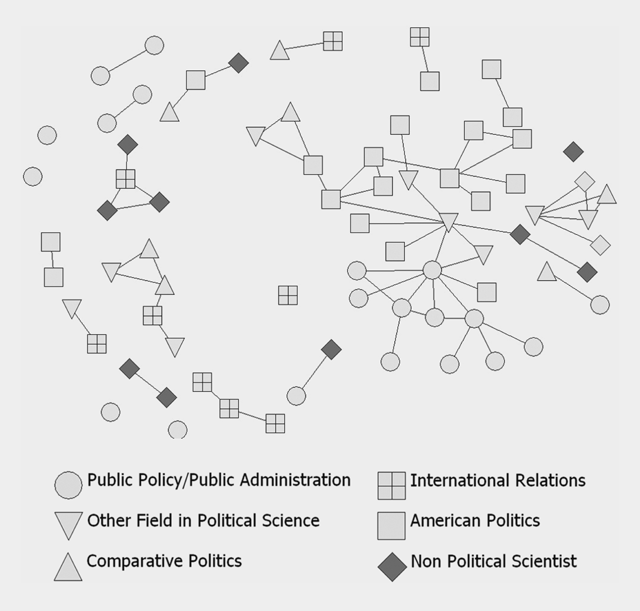
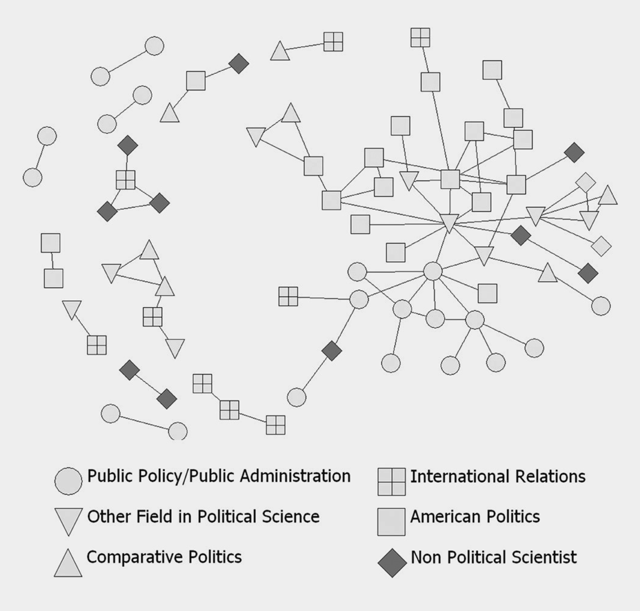
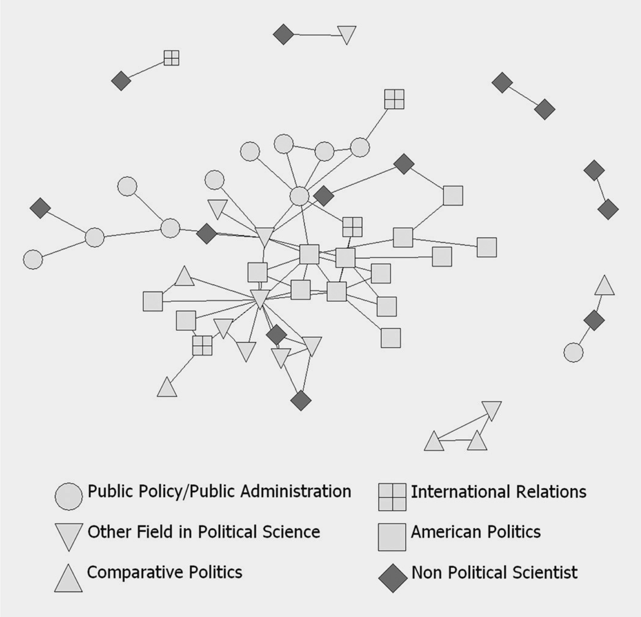
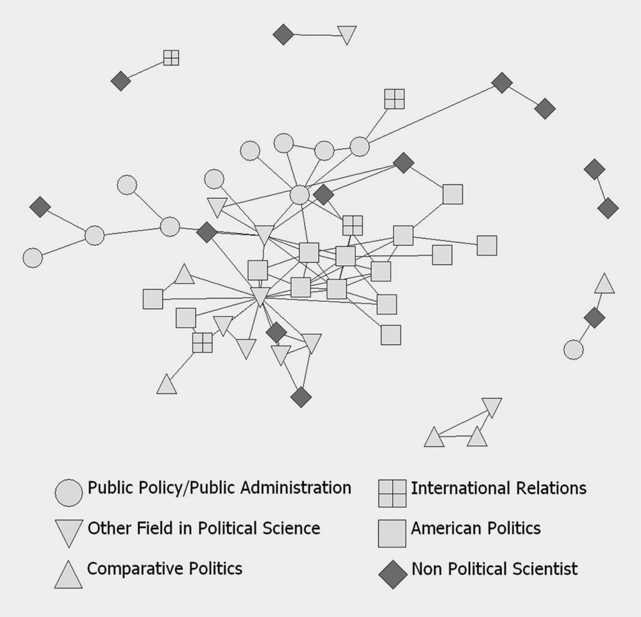
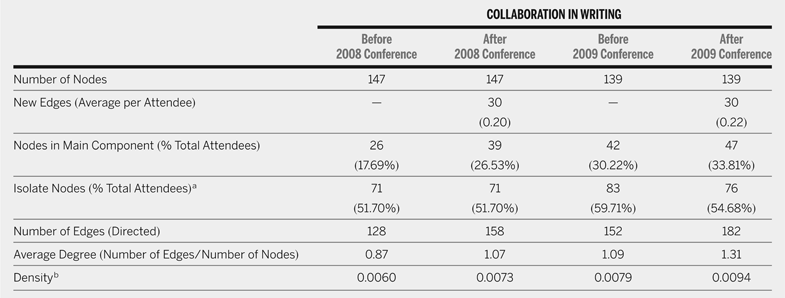
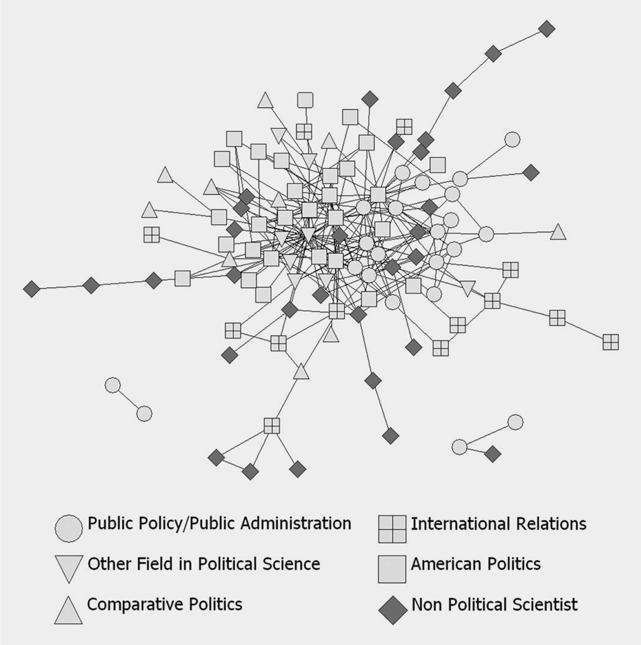
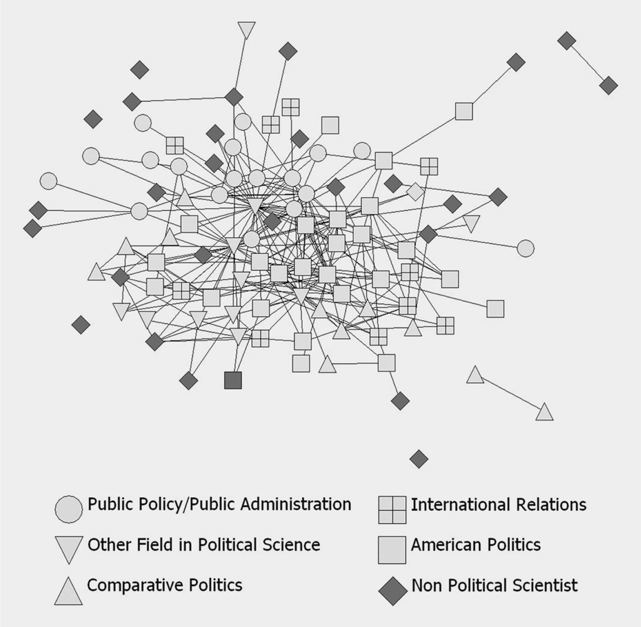
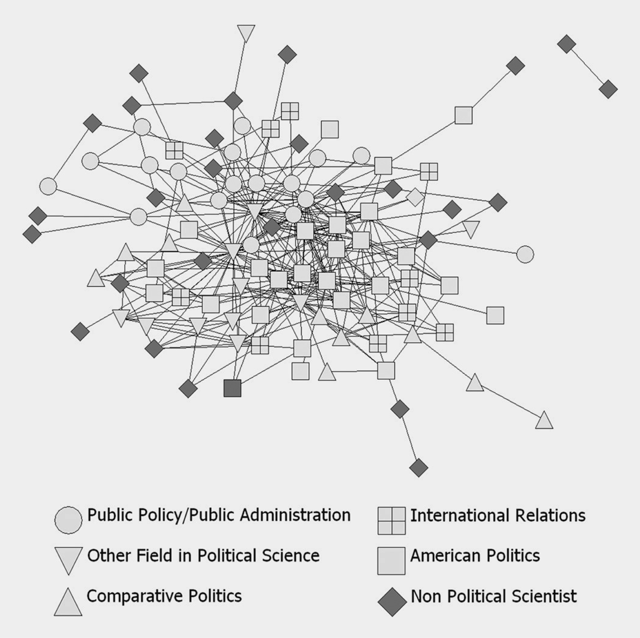
Figures 1a through 1d contain graphic depictions of the collaboration networks in writing for individuals who participated in the 2008 and 2009 conferences, both before and after each conference took place.Footnote 6 The two drawings for each network are the result of adding the collaborations that existed before the conferences and the collaborations created as a consequence of conference attendance. As a result, the changes in the networks that resulted from conference attendance are clear.
Network of Written Collaboration before 2008 Conference

Network of Written Collaboration after 2008 Conference

Network of Written Collaboration before 2009 Conference

Network of Written Collaboration after 2009 Conference

A first impression from looking at figure 1 is that the network of written collaboration among conference attendees is relatively sparse, but this finding should not be unexpected, since network scholarship in political science has only recently begun to develop strongly, and so one would expect collaboration in writing to reflect this relative novelty. The indicators presented in table 1 provide a more comprehensive idea of how the networks are structured.
Networks of Collaboration in Writing

Notes.
a Isolates are not shown in the pictures to preserve readability.
b Density is measured simply as (# edges)/(# nodes * [# nodes − 1])
The first two network conferences facilitated the creation of collaborative linkages, as indicated by the new edges that formed after the conferences took place. Additionally, table 1 shows that the collaboration networks in writing became more “integrated” in the sense that the main component in each year grew larger after the conference. This growth occurred despite the fact that the number of isolated nodes (individuals with no ties to any other conference attendees) remained relatively constant. Such a finding indicates that the formation of new links tends to involve nodes with at least some previous history of collaboration, although this is not always the case. I should stress that this measure of the number of nodes in the main component indicates that the 2009 conference was more successful than the 2008 conference in terms of integrating scholars to the main component. The main component in the 2009 network of collaboration in writing prior to the conference already contained a higher percentage of the total number of attendees than the main component in the 2008 network after that year's conference. Not only is the conference integrating participants into the main component of collaboration, but it is also attracting more scholars who already collaborate with some of the most integrated individuals in the network.
COLLABORATION AS INFORMAL EXCHANGE OF PROFESSIONAL ADVICE
The second type of collaborative link involves the informal exchange of professional advice. Figures 2a, 2b, and 2c present the networks as measured after the 2008 conference and before and after the 2009 conference.Footnote 7
Network of Exchange of Professional Advice after 2008 Conference

Network of Exchange of Professional Advice before 2009 Conference

Network of Exchange of Professional Advice after 2009 Conference

It is immediately clear that the networks shown in figure 2 are denser than those shown in figure 1 (i.e., more links among participants exist). This difference should not come as a surprise, since, in general, the informal exchange of professional advice with colleagues demands less time as a collaborative activity than the process of joint written efforts.
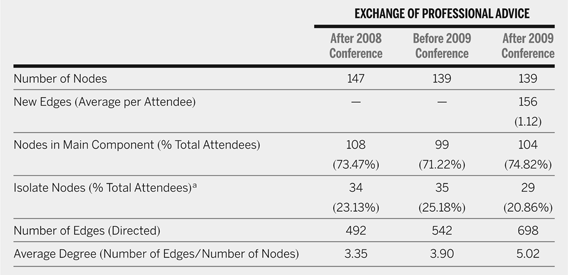
The descriptive elements outlined in table 2 show that the advice networks are approximately three times as dense as the networks of written collaboration in table 1. These networks have fewer isolated nodes, a much higher average per attendee of new edges (based only on the 2009 data), and bigger main components, which contain in all cases over 70% of conference participants. As in the written collaboration networks, the number of edges grew noticeably. The average degree of attendees was 3.35 after the 2008 conference, but this number grew to more than 5 for those who participated in the 2009 conference. Overall, these results reinforce the tendency indicated in the previous section: the conferences are good vehicles for the establishment of collaborative ties, and they promote the integration of participants into the community of scholars who form the network's core (represented in the main component).
Networks of Exchange of Professional Advice

Note.
a Isolates are not shown in the pictures to preserve readability.
While it is important to know that the conference has promoted the establishment of collaborative links, it is far more interesting to investigate whether those links bridge disciplinary and subfield boundaries or whether they are created between scholars working in the same scholarly niche. The establishment of collaborative links between individuals who do not share a subfield in political science or are not both political scientists will more likely lead to richer and more diverse approaches to the study of politics. An increase in this type of collaboration would indicate the potential of this new community of network scholars to make innovative contributions to our collective understanding of how political processes work.
ASSESSING THE EFFECT OF THE CONFERENCES ON THE COLLABORATION BETWEEN SCHOLARS FROM DIFFERENT DISCIPLINES OR SUBFIELDS IN POLITICAL SCIENCE
A quick look at figures 1 and 2 shows that collaboration exists beyond subfield or disciplinary boundaries (represented by the different nodal shapes included in the figures). However, without a more systematic analysis of the patterns of collaboration, it is difficult to assess the extent of conference participants' efforts to engage scholars from other fields or disciplines.
A simple way to explore this issue is through the calculation of the E-I index created by Krackhardt and Stern (Reference Krackhardt and Stern1988) and available in UCINET. The index captures a network's tendency to homophilyFootnote 8 based on a given attribute and is calculated with the following formula:

where EL represents the number of links between nodes who do not share a given attribute or characteristic, and IL represents the number of links between nodes who share that attribute or characteristic. The index ranges from −1 (complete homophily, in which all links are between nodes who share a given characteristic) to 1 (complete heterophily, in which all links are between nodes who do not share a given characteristic).
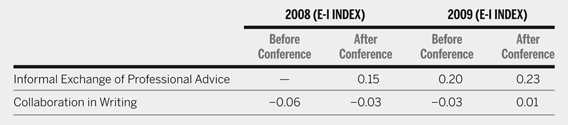
One survey question asked respondents to identify themselves as either political scientists or not. Respondents who self-identified as political scientists were asked to choose the main subfield in which they were active (American politics, public policy/public administration, comparative politics, IR, or “other field”). The information collected with these two questions was combined to create a categorical variable with six possible values (0 = the respondent is not a political scientist, 1 = the respondent is a public policy/public administration scholar, 2 = the respondent is an American politics scholar, etc.). The E-I index was then calculated in UCINET using this variable. Results are presented in table 3.
Homophily in Networks of Professional Collaboration

Calculations of the E-I index for the seven networks show a tendency toward heterophily. In the case of the networks of collaboration in writing, the original pattern of linkages (before the 2008 conference) shows a negative value, although the number is close to zero. After the 2008 conference, however, the negative value is cut almost in half, showing that the conference contributed to the creation of ties between individuals who do not share disciplines or are not professionally active in the same political science subfield. In 2009, the pattern is repeated. Before the conference, the value of the index is still negative (although again, close to zero), but the network of collaboration in writing that results after the conference is more “heterophilic,” as signaled by the positive value of the index.
In the networks of informal exchange of professional advice, the same progression can be observed, although the analysis must be confined to the 2009 networks, since information about the network before the 2008 conference is not available. Before the 2009 conference, the value of the index was well above zero, demonstrating that the exchange of professional advice among attendees prior to the conference was already diverse, but the value continued to grow after the conference. Overall, these results show that new collaborative links created at the conferences have tended to diversify professional collaboration by extending beyond the confines of different political science disciplines or subfields. The ability to promote multidisciplinary and cross-field work seems to be one of the trademarks of the conferences, at least in their initial editions.
Several years ago, Grant (Reference Grant2005) questioned the idea of political scientists sitting at “different tables” that was previously proposed by Almond (Reference Almond1988), who claimed the existence of a double division (ideological and methodological) that structures relationships inside the discipline. Grant conducted an analysis of the pattern of membership for APSA sections and concluded that political scientists group around common subjects of inquiry rather than ideological or methodological views. The new connections that have emerged among conference attendees and have increased the heterogeneity of collaborative patterns provide support for this optimistic view of scholars interacting with each other in potentially productive ways.
Of course, one should not miss the important point that there are niches among network scholars; after all, the majority of collaborative links still occur inside subfields—that much can be concluded from a quick look at the network of collaboration diagrams offered here. However, the boundaries of these niches are likely to be progressively blurred as more and more scholars step beyond the familiar boundaries of their own fields to engage in collaboration with others, as indicated by the changes in the E-I indexes.
Additionally, one should keep in mind that many potential benefits can accrue from the establishment of scholarly collaborative links among members of different disciplines. Interdisciplinary collaboration can lead to better-informed theories and improved methodological approaches to study phenomena that exceed disciplinary limits, which in turn should benefit scholars in a number of ways, from gaining access to wider audiences to increasing the likelihood of publication in the main journals of their disciplines (see Sigelman Reference Sigelman2009).
CONCLUSION
This article describes how scholars in political science and other disciplines who attended the first two Political Networks conferences in 2008 and 2009 collaborate with each other both in writing and by informally exchanging professional advice. Some of my findings indicate the formation of a new community of scholars that is diverse and potentially innovative in its approach to the study of political phenomena. These findings include the growing number of collaborative links among conference attendees, the decaying number of isolated individuals, and the tendency of the networks of collaboration to reach higher levels of integration by including more nodes in their larger components.
However, perhaps the most important finding is that networks of collaboration seem to become more “heterophilic” over time, indicating that collaboration is developing across both subfields of political science and whole disciplinary boundaries. Political scientists attending the conference seem to benefit not only from their interactions with other political scientists, but also from their collaboration with sociologists, computer scientists, philosophers, law scholars, social psychologists, and statisticians. In this sense, the conferences may be a good vehicle to achieve the main goal of the new Political Networks section of the APSA, which is to promote “a better understanding of network theorizing and analysis across political science and to connect the study of networks in political science to other disciplines as well.”Footnote 9
There are now many more political scientists interested in the study of political phenomena from a network perspective than there were a few years ago, but it is still too early to know whether network studies in our discipline are here to stay or will be a passing phenomenon. However, one thing is clear: the Political Networks conferences are contributing to the creation of a strong scholarly community from which innovative research agendas are likely to sprout in the future. This vitality can only strengthen network studies in contemporary American political science.