Every night people in Santa Clara County, USA board 24-hour public transportation routes for shelter. While this social phenomenon exists in urban centres around the world, research or data about those who use buses or trains as shelter are limited. This is not surprising given that most research about people who are homeless takes place in shelters (Cunningham and Henry, Reference Cunningham, Henry and McNamara2008). Not only do we not know much about those who use this type of shelter strategy, the practice raises questions similar to those being asked about the rights of people without homes to access and use public space (such as libraries, public parks or plazas) as an alternative or in addition to separate services designed specifically to serve the unhoused.Footnote 1 While laws are not being broken, policies and services are often being utilised by those who are unhoused in unintended ways, conflicting with how service providers, businesses and the housed envision or desire the space to be used.
In this paper, we discuss the results of our study to bring to light this presumably widespread but under-researched phenomenon of riding public transportation for shelter. We talk about our methodology, which utilises the university, as an example of how such issues can be inexpensively explored. And we discuss the dilemmas that exist when housed and unhoused persons use similar policies and services for different purposes. We do this by attempting to understand the problem of homelessness from the perspective of those who ride the bus for shelter. We explore the frequency with which unhoused persons use the bus for shelter, their demographics, the reasons why they choose the bus over other potential options, and the services that those who ride the bus for shelter say they want and need. While this case is focused in the US, the research provides an opportunity to think about the issue as it presents itself around the world. It also provides a cautionary tale about what can happen when a weak welfare state is combined with low levels of affordable housing (Fitzpatrick and Stephens, Reference Fitzpatrick and Stephens2007). We hope that this initial snapshot will help us to better understand those who find alternatives to targeted programmes for homelessness, as well as raise important questions about how current policies and strategies guiding responses to homelessness affect multiple public realms.
Background
In most communities in the US, there exists a complicated maze of separate public and non-profit services and benefits available for people without permanent housing. While the UK, for example, has a framework of statutory responsibilities towards those who are homeless, the US response is typically piecemeal and differs significantly by locality (Minnery and Greenhalgh, Reference Minnery and Greenhalgh2007). Some cities and counties devote significant resources to build local shelters and affordable housing, as well as augment the work of independent non-profit shelters and private developers, but there is no federal or state mandate for such an approach (Shin, Reference Shin2007). Therefore, as long as the US (and countries like it) approach homelessness as an individual problem of welfare, rather than a structural lack of affordable housing, the issue and problem are never adequately addressed (Daly, Reference Daly1996). Relatedly, in most, if not all, communities in the United States there is not enough shelter space to meet the need.
While providing shelter has been the most common response to homelessness, this approach has been temporary and an inadequate stopgap. Emergency shelters typically follow similar rules about maximum nights of stay allowed. For example, single men are usually given shelter on a day-to-day basis, and families are allowed a longer time frame (30–90 days) (Feltey and Nichols, Reference Feltey, Nichols and McNamara2008). Many communities have also begun to open large shelter spaces during the winters only. In addition, because of the need to house large numbers of people, with a variety of needs and situations, rules tend to dominate lives in the shelters (Loseke, Reference Loseke1992; Spencer and McKinney, Reference Spencer and McKinney1997). People must be in and out of the shelters at specific times. Shelter residents also worry about exposure to sickness and criminal activity (Donley and Wright, Reference Donley, Wright and McNamara2008).
This combination of uncoordinated structural and individual responses to homelessness in the US has meant that there are vastly larger proportions of people sleeping rough in the US compared to Europe. As a result, people often cannot access emergency shelters and try to find alternatives. Popular substitutes include sleeping in vehicles, on the streets, and in encampments. Riding public transportation for shelter has also been identified by the press as a creative way to stay warm throughout the night (Brown, Reference Brown2005; Peterson, Reference Peterson2007; Royale, Reference Royale2007; Samuels, Reference Samuels2006).
While riders legitimately pay to ride the bus, transportation authorities and housed riders make complaints similar to those often raised about the use of libraries by the unhoused, specifically pointing out odour and unruly behaviour as problems. In addition, public agencies and employees in non-homeless service fields are confronted with a range of mental health, family and public health needs for which they are not prepared. Various cities have attempted to ask people who are homeless to leave libraries under a public nuisance clause. The removals have been challenged in the courts with mixed outcomes, and raise larger questions about who really has access to and control over public space and the functions of such spaces (Hodgetts et al., Reference Hodgetts, Stolte, Chamberlain, Radley, Nikora, Nabalarua and Groot2008; Wright, Reference Wright1997). Homelessness becomes more visible as a public issue, and communities often struggle to figure out how to respond.
Context
These dilemmas were being actively discussed in the community where this study took place. Transportation officials said that the buses should not be used as shelters, and other entities should be responsible for unhoused riders. At the same time, shelter and other service providers said they were fulfilling their mandates and had no responsibility (or resources) for addressing the issue. Cities could not act because the bus route crossed through many different jurisdictions. And no entity was quite sure exactly what, if anything, should be done. We decided to conduct a study with unhoused riders in the hope this would move the conversation forward and better inform any policy decisions that might be considered.
Santa Clara County is in Silicon Valley in Northern California, and has an estimated 1.8 million residents (US Census, Reference Census2008) with one of the costliest housing markets in the United States (Center for Housing Policy, 2009). A recent street count puts the number of homeless individuals in the county at 7,086 unduplicated persons, 2,270 of whom are defined as chronically homeless (Fernandez, Reference Fernandez2009). The county has approximately 26 emergency shelters that provide space for up to 1,000 persons each night. In the winter months (November through March), additional shelter is provided for 300 more persons (Santa Clara County, 2009).
At the systems level, shelter is not provided based on the numbers of unhoused persons or even known needs, but rather based on limited resources for existing services, funded usually on a year-to-year basis. As a result, non-profit shelters and social service organisations often compete with one another for funding, and while government entities support such organisations in their work, no entity is charged with monitoring needs and resources (Fogel et al., Reference Fogel, Smith and Williamson2008). The lack of funding stability is even more pronounced when localities are struggling economically. In 2009, a large shelter provider in the county had plans to cut the number of emergency shelter beds available until two wealthy couples donated funds to keep the shelter open at full capacity.
This uncertainty and gap between needs and resources results in many persons living on the streets, in encampments, in abandoned buildings, and any other configuration that can be utilised for shelter. The bus is one such repurposing of space. While there are a number of questions and issues that could be understood and explored from the perspectives of people who ride public transportation for shelter, this study provides a preliminary look at how often people say they ride the bus for shelter, who they are, why they say they ride the bus for shelter, and the services they say they would like to utilise.
The 24-hour bus route
The route in question is 42 kilometers long and passes through six cities. At the southern most end, the route travels through some of the most impoverished areas of San José and ends in one of the most affluent cities in the county, Palo Alto, home to Stanford University. It is the only all-night full-service route and, according to the transportation authority, carries 20,000 riders a day, 20 per cent of the total ridership in the county (VTA, 2009).
Because of its centrality and popularity, the bus runs frequently, every ten minutes or so during the day, reducing to every hour after 12:30 a.m. In the evening, the route takes approximately one hour and thirty minutes from end to end. At night, the layover times at the end of each line are at least an hour, and operators are required to empty the bus of passengers and lock up the bus until the bus leaves at the next scheduled time.
The bus on this route is often referred to by people who are homeless as ‘hotel 22’, in reference to the large numbers of people who ride this numbered route for shelter. Although there has never been an official count, an unofficial survey of bus operators puts the number at 50–60 persons a night who ride the route for shelter.
Methods
Surveys, conversational interviews and observations were the primary methods used in this study. Because there are few models of how to collect data on public transportation beyond ridership surveys, we spend some time discussing preparation for actual data collection as well as the implementation of the data collection strategy, the sample and limitations.
Preparation for data collection
Data were collected by 11 senior undergraduate students taking an applied sociology class.Footnote 2 Students were able to rank which of five research projects they wanted to participate in as part of the class. Many students wanted to work on this project. However, of those, only students with previous experience working in the community and who had taken at least one methods class (most had two: quantitative and qualitative) were chosen to participate. Three surveyors spoke Spanish fluently and three others had basic Spanish conversation skills. Some of the students grew up in the area and had prior experience riding this particular bus line. Regardless of their familiarity with the line, surveyors rode the bus at least once prior to data collection. In addition, data collectors were trained by outreach workers from a local mental health agency as well as transportation authority staff. Three current or formerly unhoused persons who had ridden the bus for shelter also talked to students about their experiences on the bus and gave them advice about how to approach and speak with riders.
The transportation authority alerted security and the bus operators that data collection would be taking place, and a field supervisor was assigned to work with the two people (the instructor and a peer educator for the class) ‘on the ground’, overseeing the data collection process. Human subject approval was obtained before data were collected.
Implementation
A survey was drafted and input was received from the city, the transportation authority and a subcommittee of community members (mainly service providers, transportation officials and representatives of local government), who had been meeting about the bus route and its unhoused riders. Questions covered a number of areas, including demographics, frequency of riding the bus for shelter, use of services and desire for particular services. Surveyors also kept field notes; preliminary notes were taken on the bus and subsequent, more thorough, notes were completed post data collection. Because some of the riders preferred talking to students rather than or in addition to taking the survey, many of the fieldnotes included the personal stories that riders shared with data collectors.
The data were collected over three nights (starting on a Thursday, then the next Saturday, and the final collection on the following Tuesday) in early November 2007. Surveyors boarded the buses in teams of two (on the first night there was one team of three). Four of the five teams started at the most southern end of the route and one team began at the northern-most end. Surveyors were driven to the beginning of the line, were met during the layover and picked up on the way back to the starting point.
On the first night, teams started boarding approximately every hour beginning at 9:40 p.m., with the latest team starting data collection at 12:21 a.m. The last team finished the route at 4:30 a.m. On the second night, it was decided that later routes were better in reaching riders who were unhoused, so the first team left at 10:56 p.m. Each team boarded the bus equipped with surveys in English and Spanish, pens and pencils, resource cards about services in four languages, fast food gift cards valued at $5 each and blank paper to record field notes. Surveyors were identified with a name badge that listed their first name, ‘student surveyor’, and the name of their university. The operators on each route were informed prior to boarding that the students would be on their route. Data collectors introduced themselves to the operators at the time of boarding.
When passengers boarded the bus, operators either pointed out people they believed to be unhoused, or students asked riders three screening questions to determine if they were using the bus for shelter.Footnote 3 While many of those surveyed filled out the survey themselves, a number asked the surveyors to read them the questions and record their answers. Each respondent was given a $5 gift card redeemable at a fast food restaurant along the route to thank them for participating. Surveys and conversations took place both on the bus and during the layovers at either end of the bus line.Footnote 4 Although we were somewhat worried about doing the survey out loud on and off the bus, one surveyor noted that, once others heard the questions, they were less intimidated about taking the survey and volunteered to participate.
Sample and analysis
On the first night of data collection, 24 surveys were collected, 12 were collected on the second night and 16 on the third. Of those, four surveys were collected in Spanish and the rest were collected in English (some of these were Spanish to English translations by the surveyors). During data entry, it was discovered that three people who completed surveys had permanent places to stay. These three surveys were not included in the final analysis reported here. Thus the final sample included in this analysis is 49. In addition, about 15 riders had conversations with surveyors who told them their stories of being homeless and why they rode the bus.
Although this is a small sample size, bus operators noted that they thought we had reached most of the riders they believed to be unhoused. Any reference to riders in the findings and conclusion sections is in reference to riders who were surveyed and/or interviewed and were unhoused.
Survey data were entered into SPSS and analysed. Fieldnotes were written up by the surveyors for each night of data collection and compiled. Data collectors who had conversations with riders wrote up individual summaries about each person they spoke with in depth. Many of these riders are not included as part of the survey data as they opted not to fill out a survey but preferred instead to talk about their experiences. Many of those who chose not to be surveyed did not define themselves as homeless, although their stories clearly indicated that they did not have a permanent place to stay. In terms of analysis, because of the small sample size and the preliminary nature of this study, we present our quantitative data descriptively, typically reporting raw numbers rather than percentages.Footnote 5
Findings
The bus as shelter
Like many experiences of being homeless, riding the bus for shelter requires timing and waiting. One rider said that she started her ride early, at 7:30 p.m., because that allowed her the longest stint to sleep: two hours before she had to deboard. After that the most she could sleep at a time was an hour and a half. Once boarded, most riders went to the front or back of the bus and quickly fell asleep. Although surveyors saw some people laying across the bench in the back of the bus or taking up two seats, most sat up and slept. Manuel noted how difficult it is to ride the bus:
It's been tough sleeping on the bus. Actually it's really hard to sleep on the bus because it moves a lot and makes a lot of noise. I have bruises on my body and wake up with pain. A human isn't meant to sleep on the bus, or to sleep sitting down. I know that this is only a phase in my life. I'm conscious of whom I am and I don't drink or do drugs like some of the other people on here. I know I'm going to be better and that things will work out.
Most unhoused riders did not leave the bus before the end of the line. At the end of the route, one operator would walk up and down the aisle of the bus hitting the metal rails with a cane to wake people up. During the layovers the data collection teams noted how deserted the bus terminals were, especially during the long layovers when the operators would drive the buses to a garage. Riders waited quietly, some sleeping on benches, a few huddled with other riders, but most stayed awake and alone with their belongings.
Both terminals at each end of the line are in isolated locations. One is essentially in the parking lot of a large shopping mall that is closed all night, and the other is near a train terminal and tucked behind a closed catering business. During short layovers, the operators empty the buses and drive them away from the loading area, but still in view of riders. Sometimes the operators stay on the buses with the lights on, other times they stand outside, smoking, reading and/or talking on their cell phones. The buses generally leave on time, with buses pulling up to the terminal and passengers responding by quietly lining up for the ride back to the end of the line.
Frequency of riding for shelter
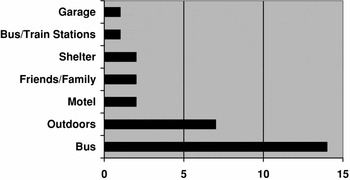
To get a sense of how often riders use the bus for shelter and other shelter options that riders used, we asked respondents to name all the places they usually stayed for shelter. Almost two-thirds of those surveyed said that the bus was their only or one of their usual sources of shelter. Of the 29 persons who said they usually stayed in only one place, 14 named the bus as that one place. The next most usual place to stay was outdoors (see Figure 1). Eleven respondents combined both the bus and one to three other places. Hotels/motels, shelters and bus/train stations were the most popular combinations with the bus.
If usually stay in one place, number stay in each place (n = 29)

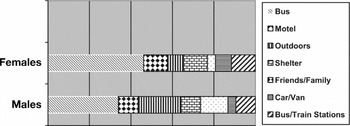
In Figure 2 we can see the types of places those surveyed said they usually stayed by sex. The bus was a usual place to stay for 12 of the 13 female riders surveyed and 18 of 35 male riders. Besides the bus, women were more likely than men to stay in shelters and car/vans, while men were more likely than women to stay outdoors and with friends and/or family.
Usual places of stay by sex (n = 48)

Over half (29 unhoused persons) rode the bus for shelter seven days a week. Only one person surveyed said that he rode the bus for shelter less than one day a week. More than half rode the bus for shelter throughout the entire year. Fourteen unhoused riders used the bus for shelter during the winter (generally November–March) only. Seventeen of the 49 said that they rode the bus seven days a week, all year long.
Twenty of those surveyedFootnote 6 said they had been riding the bus route for shelter for two years or less and the same number had been riding four or more years. Only seven riders had used the bus for shelter for two to four years. ‘Mary’ said that she had been riding the bus for 20 years: ‘I am in my 50s, and I'm an unhoused rider of “Hotel 22”. I've been riding for twenty years now . . . I'm permanently disabled and so I get an SSI cheque and live off of that.’ At the other end of the spectrum, Manuel said that he had just started riding the bus that week: ‘This is the first week that I use this bus for shelter. I have a job in maintenance so I use this bus to go to work too.’
When asked how respondents usually paid for their bus fare, for 19 respondents the most common response was a monthly pass. Just over a third paid for a day pass and nine paid cash for a single ride. No one used an annual pass. However, even though a large proportion of unhoused riders said that they usually paid with a monthly pass, half of those riders said they had paid cash for the particular trip they were on when surveyed (either for a single ride or a day pass).Footnote 7 Overall, when asked how they had paid for their current trip, a third of riders said they paid cash for a single ride ($1.75), just under a quarter said they used a day pass ($5.25), and eight persons said they used a monthly flash pass. It should be noted that the day pass expires at midnight so riders who stay on the bus overnight must buy two day passes. One rider said that he paid $10 a night to ride the bus, far cheaper than any motel he could find.
Who rides the bus for shelter?
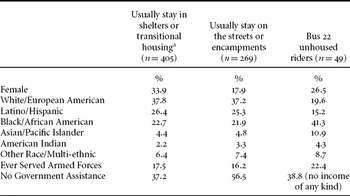
Those surveyed ranged in age from 20 to 71 years, with a mean age of 47 years. More men (n = 35) than women (n = 13) rode the bus for shelter. Almost half were African American, ten were white, and similar proportions identified as Latino, Asian or of more than one race/ethnicity.
In Table 1 we compare the demographics of bus riders surveyed for our project with data from a survey conducted in March of 2007 as part of the homeless street count and census that takes place in the county every two years.Footnote 8 The most interesting difference between those who usually stay in shelters or outdoors compared to bus riders is the large proportion of bus riders who self-identify as African American. This is even more striking given that less than 3 per cent of the population of the county is African American (American Community Survey, 2005) and 20 per cent of the homeless population in the county has been identified as African American (Fernandez, Reference Fernandez2009). While the route connects in Palo Alto to the San Francisco bus system, and some riders could be seen waiting for this line to extend their ride, only one rider said that he considered San Francisco, which has a much larger African American population, home.
Unhoused riders compared to other unhoused populations

Notes: aData in columns one and two are from the survey portion of the 2007 Santa Clara. County Homeless street count and survey.
A little over half of those riding the bus for shelter had some sort of income. Almost a third received Supplemental Security Income (SSI), nine were employed, seven received general assistance, and three people received unemployment benefits (some received income from multiple sources). Said an employed rider:
Sometimes I stand on the sidewalks with other jornaleros, or day labourers, but with my age it's hard to find work. When I did get a day job, it was usually related to gardening or landscaping. I used to rent an apartment with other workers in [a nearby town], but little by little they stopped helping me pay for rent and utilities, so it got expensive and I knew I couldn't pay the rent on my own. So I put my belongings in a storage place, and that's where my stuff is sitting right now. Unfortunately, I don't have money to go back to Mexico. I'm stuck here.
When questioned about why they were unhoused, almost all respondents said they were not able to afford rent or did not have enough money in general. One student surveyor wrote the following in his field notes:
At the beginning of the night I spoke to a young man who moved from southern California to the south bay, and he talked about the differences between homeless people who rode the bus system down south versus those who rode the bus in San José. The main difference he noticed was that the people [in L.A.] who were homeless were mainly there because of drug abuse, whereas the majority of the homeless people he has met here were homeless because they could not afford housing costs.
Why ride the bus?
There were different reasons given by gender for riding the bus overnight. Thirty-two of the 35 men surveyed said that they rode the bus to sleep or because they did not have a permanent home. Over half of the women surveyed said that they rode the bus overnight for safety, while only a quarter of the men surveyed said that they rode the bus for that reason. Only five people in the full sample said that they rode the bus because they had been turned away from a shelter.
In informal conversations with riders, there was one person who said that he was unaware of local shelters, but most had stayed at shelters at some point and chose the bus over the shelters. The main reasons mentioned were concerns for safety and dissatisfaction with shelter rules.
Tony, who had ridden the bus for over six years, said:
I've been to the shelters, but they're terrible. I've had things stolen from me while I sleep; I've seen people attacking each other, and it is just not a safe place for people to be. It's not that I don't know where they are, but I just don't want to go. That's why I ride the bus; I think its overall a safer place, especially for children or families.
A few riders mentioned having previously been in prison and likened shelters to the jails. Edward said:
I don't like [names shelter] because it is like a prison. You can't smoke when you want to, they turn the lights on too early in the morning, and sometimes you wait all day and don't get a bed. They are closing down a shelter in March [end of winter seasonal shelter] and there will be more people riding the bus for shelter.
Patrick said that he used to sleep in a park but that has been outlawed, and this pushed him onto the bus:
I've been sleeping here [on the bus] for a few months. Before I started sleeping here, I would sleep in a park somewhere. They started closing that park down at night, so homeless people cannot sleep there anymore; I had to find a new spot to sleep. I just try to find a place that is safe enough that I won't be accosted. The bus is warm and a safe place to sleep. I don't like going to shelters because of all the rules. You also have to leave at like five in the morning.
He then mentions where he goes during the day:
During the day I usually go the library. I love reading, I just eat it up. I get hooked on a topic and I just spend the entire day researching that topic. It is a good way to fill time. That's what a lot of my life is, just filling time. It's a sort of ‘sublime monotony’.
When asked what they would do if this particular bus route did not exist, over a third of riders said they would find another bus route, 11 of the 49 said they would find a shelter and eight unhoused riders said they would ride light rail (however, there are no overnight light rail lines). Nine unhoused riders said they had no options other than the bus.
Resources
There were many strategies that unhoused riders employed when riding the bus, including travelling lightly by storing their belongings in hiding places outside. Mary said that she advised riders to: ‘wear warm clothes, dress in layers, and carry enough food’.
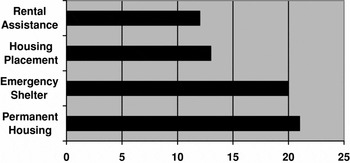
Figures 3 and 4 display the types of resources unhoused riders were most interested in receiving. Twenty-one of the 49 surveyed express a desire for assistance finding permanent housing. Also, 20 people wanted assistance in finding emergency shelters. Charlie, a frequent bus rider, said
I have been riding the bus on and off for several years. I have travelled throughout the United States searching for work as a musician since I was 17 years old. I am now in my mid-60s. It used to be easier finding a job as a drummer, but today it's not the same. In the past, I used to be able to show up and get a job fairly easily, but now I'll get one or two jobs a month. That's not enough to pay for housing anywhere. I don't know where the good shelters are around here, and I don't know much about services that are available either.
Housing assistance (individuals asking for assistance)

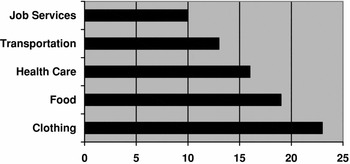
Most frequently requested assistance beyond housing (individuals asking for such assistance)

Beyond housing needs, the most desired supportive services were for clothing, food, health care and transportation. Ten unhoused riders said that they were working with a mental health provider.
Almost half of those surveyed expressed a need for clothing. Over two-thirds of participants said they did not have regular access to bathing or shower facilities. When a student asked one informant where he showered, he replied:
Oh, I stop at [a local restaurant] and get food. They don't make people like me pay for it. You know, they're decent people. So yeah, I stop by [the restaurant]; grab a ‘bird-bath’ and some food.
Other respondents noted how a lack of such facilities hindered their ability to find employment.
In addition, 20 of the 49 surveyed unhoused riders said they would like help with food and meals. Obtaining food did not seem to be a major problem for others. One rider relayed day-by-day where he obtained at least one meal a day. Carlitos said: ‘Oh, you know, food's not really a problem. I get food.’
In terms of health care, one surveyor wrote the following in her field notes:
One thing that I noticed first that kind of pulled on my heart strings was the fact that the first three or four people we ended up interviewing were elderly and had severe vision problems. When I mentioned filling out a survey, most would dig through their mix of coats, plastic bags and suitcases to pull out a pair of glasses and those who didn't have glasses said to me that they could not fill out the survey because the letters were too small.
Over a third of those surveyed said that they needed health care. One rider said that not having a place to lie down and sleep aggravated his health, and that his feet had become very swollen from never lying down.
William, who rode with his father and sister when they could not afford a hotel room, said that both his father and sister were disabled and that, ‘some days my sister struggles through the day with her kidney problems just so we can spend the night in the emergency room as she waits to be helped’.
The mixed attitudes of bus operators
Although interviewing bus operators was not part of the study, a number of the operators talked to the surveyors, as well as the instructor and peer educator on the ground. There were a variety of opinions among the operators about the presence of unhoused riders on their routes during the night. For example, although all operators were instructed to empty the bus at the end of the line, even when they were continuing back on the route, one did not, saying that he saw no need to empty the bus as long as he did not need to leave the bus himself and could stay awake.
One student team witnessed an operator calling the police to have a presumably mentally ill rider taken off the bus for yelling. When the police boarded at one of the stops and took the woman off the bus, another unhoused rider commented that ‘calling the cops is overreacting, she wasn't hurting anyone’. This same operator told the first author that he often calls the police during the night, including if he sees someone sleeping on the benches at one of the bus stops, because he or she could be hurt or injured.
During a layover, one of the riders told a surveyor that the operators were ‘being nice tonight because you guys [the surveyors] are on’. She commented that often the operators would not turn on the heat, but did this night she presumed because of the presence of the surveyors. Turning on the heat and dimming the lights in the bus during the ride were indicators to unhoused riders of a compassionate bus operator. Unhoused riders who had been riding for a number of years made sure to ride on the buses driven by those operators. As a result, some of the buses were quite crowded throughout the night, while others were virtually empty.
Discussion and conclusion
This is a small descriptive study in one geographical location in the United States, thus conclusions must be made tentatively. However, we believe that these preliminary findings raise important issues and questions about the practice around the world of using public transportation as shelter.
In this case, riding the bus was a frequent practice: a large proportion of the unhoused riders we spoke with and surveyed utilised the bus as a consistent form of shelter, on most days of the week and throughout the year. While some riders also used the shelter system, many did not, and instead used the bus, motels and sleeping outside as alternatives. Most riders indicated that they had only one or two usual places where they stayed. Further, riders who were unhoused shared many of the same demographics as those who slept outside. One area of difference was the large proportion of riders who were African American, especially compared to the proportion of African Americans who typically stayed in shelters.
Although we do not know from the riders’ perspective why a disproportionate number of African Americans rode the bus for shelter rather than used emergency shelters, there are many potential explanations. First, from a structural perspective, some economists controversially argue that the less extensive welfare state in the United States compared to European countries is the result of racial heterogeneity and fragmentation in the US, which limits public support for resource redistribution across racial lines (Alesina and Glaeser, Reference Alesina and Glaeser2005).
From the micro perspective, many African American males have negative experiences with the criminal justice system, resulting in distrust of other types of agencies (White and Crawford, Reference White, Crawford and McNamara2008). White and Crawford also found that all of the homeless African American men they interviewed perceived that racial discrimination was a barrier to getting out of homelessness. Similarly those of African American descent may perceive that race limits their ability to access and receive services, and instead opt to rely on the bus system for shelter.
Taken together, the perspectives of unhoused riders profiled in this study provide insight into the larger function of the bus and public space as shelter. Riding the bus, and using public space, is one way to attempt to escape the stigma and label that goes with homelessness. While libraries often function as day centres for those without housing, in the absence of other options public transportation serves as an overnight alternative to the shelter system. These options also allow people who are unhoused to potentially escape the label of being homeless and use spaces that are presumed to be accessible to all (Hodgetts et al., Reference Hodgetts, Stolte, Chamberlain, Radley, Nikora, Nabalarua and Groot2008; Johnsen et al., Reference Johnsen, Cloke and May2005). We saw riders distancing themselves from the label of homeless as well as acknowledging how bad it was to be homeless.
Parallel to the negative sentiments that those without housing expressed about service options in Hoffman and Coffey (Reference Hoffman and Coffey2008), some riders said that they used the bus to bypass the typical services provided by shelters and other social services agencies. Even when used, these temporary solutions to housing exacerbated feelings of lack of community or belonging. In answer to the question ‘What city do you consider home?’, one respondent said ‘hard to say’. Almost a third of the survey respondents left this question blank. This lack of rootedness was symbolically represented in the riding of a constantly moving bus throughout the night.
At the same time, the bus also provides a form of freedom that shelters do not. While most riders did not deboard the bus before the end of the line, theoretically they could at any time. This is different from most shelters that require checking in by a certain time and an inability to leave until the shelter opens its doors early the next morning. At the same time that the bus allows for a measure of freedom, it also provides a feeling of safety.
While the direct line that bus operators have to the police can cause problems for riders lest they be thrown off the bus, the bus provides an increased level of safety that sleeping outside (or perhaps even a shelter) cannot. In this way, this study reaches a different conclusion than Evans and Forsyth (Reference Evans and Forsyth2004), who found that men and women use similar survival strategies while on the streets. We find that over half of the female unhoused riders seek out the bus mainly as a way to get through the night safely, as opposed to males who mainly see the bus as a place to sleep. The individual shelter options that people utilise correlate with perceptions of and concerns for personal safety (Donley and Wright, Reference Donley, Wright and McNamara2008).
Similarly, people who stay in recreational vehicles say the vehicles provide them with safety and freedom as well as privacy (Wakin, Reference Wakin2005). In contrast, the use of the public bus space provides a degree of autonomy from some rules, but exposure to others (like having to get off at the end of the line) that allow for less than two hours of sleep at a time. And while security and safety may exist on the bus, the protection is minimal during layovers, especially in the early mornings.
We also heard how actions in other realms affect the likelihood of using the bus for shelter. Riders described limitations on their ability to use other public areas such as hospitals, libraries, parks and other types of public transportation. During the time of the study, the transportation authority was actively looking for ways to discourage people from riding the bus throughout the night (Peterson, Reference Peterson2007). Similar to parks that have closed down or laws that have been enacted to restrict the access of those without homes to public spaces (Johnsen et al., Reference Johnsen, Cloke and May2005; Pascale, Reference Pascale2005), pushing people off the bus forces people into the uncertainty of being able to get space at a shelter, and the rules and lack of mobility that go with shelter use, or the lack of safety and exposure to the elements that come with being on the streets.
The practice of actively choosing forms of shelter outside the social service system also points to inadequacies in how homelessness is addressed in communities in the US. In the past, shelter has been the primary focus and assumed need. More recently, service providers have been required to work together, but service provision continues to occur in specialised silos that compete with one another for funding while also limiting assistance by geography and/or demography.
Finally, we hope that this study provides an example of the role that universities can play in studying under-researched phenomena (also see Nichols et al., in press). Universities have the need to educate students well, and communities have many needs for research. Such partnerships are even more important during growing fiscal challenges in the public sector.
While the use of public transportation as a form of shelter is viewed by some as a public nuisance, it can also be seen as an innovative way that individuals who are unhoused respond to the inadequate and often piecemeal way that homelessness has been addressed. At the same time, the practice also raises policy questions about how public services for all can be provided within the context of a large homeless population. As long as there is homelessness, people who are unhoused will use public space, sometimes in unintended ways. The magnitude of the use will likely depend on the availability, knowledge and perception of the utility of other possible options.
Acknowledgements
The authors thank the eleven data collectors and a peer educator for their work on the project, as well as those who shared their experiences and filled out surveys. Additional thanks to Laurie Laird, VTA, the bus operators and supervisors for their help with the project, as well as the anonymous reviewers and editors of this journal for advice on the article. This project was part of the California Campus Compact-Carnegie Foundation Faculty Fellows: Service-Learning for Political Engagement Program, funded by The Corporation for National and Community Service, Learn and Serve America and the Ignatian Center at Santa Clara University. Opinions, points of view, and any mistakes are the authors’ alone.