It is well established that children who have problems with their early peer relations are more likely to experience maladjustment in later life (Hymel, Rubin, Rowden, & LeMare, Reference Hymel, Rubin, Rowden and LeMare1990; Kaplow, Fontaine, Burks, & Dodge, Reference Kaplow, Fontaine, Burks and Dodge2000; Parker & Asher, Reference Parker and Asher1987). This effect appears to be particularly true for children who are chronically rejected by their peers (e.g., Boivin, Poulin, & Vitaro, Reference Boivin, Poulin and Vitaro1994; Burks, Dodge, & Price, Reference Burks, Dodge and Price1995; Coie, Lochman, Terry, & Hyman, Reference Coie, Lochman, Terry and Hyman1992; Dodge et al., Reference Dodge, Lansford, Burks, Bates, Pettit, Fontaine and Price2003; Kupersmidt, Burchinal, & Patterson, Reference Kupersmidt, Burchinal and Patterson1995; see Parker & Asher, Reference Parker and Asher1987, for a review). Recently, there has been growing scientific interest in the psychological functioning through which peer-relation problems and early social experiences may affect the development of later internalizing difficulties, including symptoms of depression and anxiety (e.g., Boivin, Hymel, & Bukowski, Reference Boivin, Hymel and Bukowski1995; Burks et al., Reference Burks, Dodge and Price1995; also see Cicchetti, Rogosch, & Toth, Reference Cicchetti, Rogosch, Toth, Reynolds and Johnston1994, Reference Cicchetti, Rogosch, Toth, Luthar, Burack, Cicchetti and Weisz1997; Cicchetti & Toth, Reference Cicchetti and Toth1998).
One possible psychological mechanism is loneliness. The relation between early peer rejection and loneliness has been well established. As Asher, Parkhurst, Hymel, and Williams (Reference Asher, Parkhurst, Hymel, Williams, Asher and Coie1990, pp. 253–254) have asserted, “ … there is good reason to expect that rejected children are dissatisfied with their peer relationships” and “[t]here is evidence that peer relationships matter to rejected children; indeed, they claim to place as much importance on peer relationships as do other children.” It is no wonder, then, why children who are socially rejected or less preferred experience greater loneliness than do their nonrejected and socially preferred peers (Asher et al., Reference Asher, Parkhurst, Hymel, Williams, Asher and Coie1990); they lack (and may even be unable to attain) peer relationships to which they can attribute significant value.
This problem may be exacerbated as children enter adolescence and the importance of relationships with one's peers becomes even more important (Engels, Dekovic, & Meeus, Reference Engels, Dekovic and Meeus2002; also, see Claes, Reference Claes1992). During the transition from childhood to adolescence, youths focus more on peer relationships and less on relationships with adults, caregivers, and authority figures. Friendships in adolescence become more personal and intimate in that adolescents develop the ability and willingness to share their thoughts and feelings with each other and provide emotional support (Buhrmester & Furman, Reference Buhrmester, Furman, Derlege and Winstead1987; Engels et al., Reference Engels, Dekovic and Meeus2002). It is plausible that the effects of loneliness during childhood might be buffered by positive parent–child relationships (Hansell & Mechanic, Reference Hansell, Mechanic, Hurrelmann and Lösel1990), but relationships with parents may be of less interest or importance to youths during adolescence because of a greater need for autonomy (Laible, Reference Laible2007), or may not be sufficiently meaningful that they adequately compensate for the need to have positive relationships with peers (Engels et al., Reference Engels, Dekovic and Meeus2002). Although parents continue to influence their adolescent sons' and daughters' lives, (e.g., see Galambos, Barker, & Almeida, Reference Galambos, Barker and Almeida2003), it is generally undisputed that the impact of peer relationships becomes increasingly more critical as children transition into and through adolescence (e.g., see Allen & Land, Reference Allen, Land, Cassidy and Shaver1999).
As such, the absence of meaningful peer relationships can have a detrimental effect on adolescents' psychological well-being (Schneider, Weiner, & Murphy, Reference Schneider, Wiener and Murphy1994). There remains an important question, though, as to what, if any, role loneliness plays in this sequence. Researchers have found that loneliness in adolescence is associated with an array of psychological and emotional problems, including greater state and trait anxiety, depression, and social anxiety, and decreased attractiveness, likability, happiness, and life satisfaction (Moore & Schultz, Reference Moore and Schultz1983; also, see Rokach & Neto, Reference Rokach and Neto2000). Other research has suggested that loneliness may contribute to the onset and maintenance of developmentally persistent emotional problems such as depression (Fontaine, Burks, Dodge, & Price, Reference Fontaine, Burks, Dodge and Price2006; also, see Bukowski, Newcomb, & Hartup, Reference Bukowski, Newcomb and Hartup1996; who discussed the importance of positive peer relationships as a protective factor against adolescent depression). This set of findings suggests the feasibility of a mediating model by which early peer-relation difficulties lead to subsequent problems with anxious and depressive symptomatology in adolescence via loneliness.
Some studies have specifically explored relations among peer status problems (e.g., social rejection), cognitive–emotional factors (e.g., loneliness), and internalizing problems in childhood (e.g., Boivin et al., Reference Boivin, Hymel and Bukowski1995; Burks et al., Reference Burks, Dodge and Price1995; Crick & Ladd, Reference Crick and Ladd1993; Panak & Garber, Reference Panak and Garber1992; see McDougall, Hymel, Vaillancourt, & Mercer, Reference McDougall, Hymel, Vaillancourt, Mercer and Leary2001, for a review). Stable findings across these studies have demonstrated that rejected children tend to report greater loneliness than do their nonrejected peers (Asher et al., Reference Asher, Parkhurst, Hymel, Williams, Asher and Coie1990; Cassidy & Asher, Reference Cassidy and Asher1992; Ladd, Reference Ladd1990), and that loneliness is positively correlated with more significant internalizing-problem states such as depression (Boivin et al., Reference Boivin, Hymel and Bukowski1995; Burks et al., Reference Burks, Dodge and Price1995; Rubin, Hymel, & Mills, Reference Rubin, Hymel and Mills1989). However, relatively little is known about the role of loneliness in the relation between early peer-relation problems and later difficulties with anxious and depressed symptoms.
It is not difficult to imagine how being disfavored by one's peers may lead one to feeling lonely. The absence of interpersonal acceptance and meaningful peer relationships may detract from one's sense of social value, and lead to feelings of loneliness and longing for social satisfaction (Asher et al., Reference Asher, Parkhurst, Hymel, Williams, Asher and Coie1990; Asher, Hymel, & Renshaw, Reference Asher, Hymel and Renshaw1984). In turn, loneliness may lead to a variety of internalizing difficulties associated with anxiety and depression. For example, loneliness may contribute to a sense of low self-worth and the belief of being unloved and perhaps even unlovable. In addition, loneliness may play a role in developing social anxiety and reduced confidence in navigating interactions with peers and authority figures.
Dill and Anderson (Reference Dill, Anderson, Joiner and Coyne1999) posited that loneliness may be an important mediator of “causal factors,” such as peer-relation problems (e.g., involuntary subordination), in the development of depressive outcomes. Although longitudinal research that has directly addressed these interrelations in childhood and adolescence has been particularly sparse, two investigations deserve mention and discussion. First, Boivin et al. (Reference Boivin, Hymel and Bukowski1995) found that loneliness had a mediating effect on the relation between children's social conditions and depressive outcomes. Their findings provide some support for the mediating model by which loneliness accounts for the predictive increments of social withdrawal, social preference, and victimization on subsequent depressed mood. One limitation of this study, however, was that all factors were measured at only two time points so that the mediating effect of loneliness was discerned via concurrent measurements of changes in self-reported loneliness and self-reported depression at Time 2.
Sletta and Valås (Sletta, Valås, & Skaalvik, Reference Sletta, Valås and Skaalvik1996; Valås & Sletta, Reference Valås and Sletta1996) investigated the interrelations among a similar set of variables. They found that loneliness mediated the relation between peer acceptance and self-perceptions (e.g., self-esteem) in a Norwegian sample of 95 students in Grade 8 (ages 14–18). Limitations of this work include a small sample size, concurrent measurement of all examined variables, and the potential confound of self-report as an explication of the relation between the mediator variable (loneliness) and outcome variables (self-esteem and defensive ego involvement). In addition, the phenomenological distinction between these mediator and outcome variables is unclear, and is in need of greater empirical attention and support. Still, findings by Boivin et al. (Reference Boivin, Hymel and Bukowski1995) and Sletta and Valås are important because they are among the first to suggest that loneliness may play a mediating role in the path from early peer-relation problems to subsequent internalized emotional problems.
In the current study, we set out to test this hypothesized mediational sequence over a 10-year span from kindergarten through ninth grade. The bivariate interrelations of low social preference (at Time 1), loneliness (at Time 2), and anxious/depressed symptoms (at Time 3) were all hypothesized to be statistically significant. It was further hypothesized that, controlling for anxious/depressed symptoms at Time 1, loneliness mediates the relation between social preference in childhood and symptoms of anxiety and depression in adolescence. According to this mediating hypothesis, low social preference in early school years leads to loneliness, which in turn, leads to subsequent anxious/depressed problems in adolescence. In other words, we hypothesized that loneliness mediates the relation between low social preference (at Time 1) and change in youth difficulties with anxious and depressive feelings (from Time 1 to Time 3).
Method
This study was conducted as part of the Child Development Project (CDP), an ongoing longitudinal study of psychological and behavioral problems of children who have been followed from kindergarten through early adulthood. Details about participants and procedures have been reported previously (e.g., Dodge, Bates, & Pettit, Reference Dodge, Bates and Pettit1990; Dodge et al., Reference Dodge, Lansford, Burks, Bates, Pettit, Fontaine and Price2003; Dodge, Pettit, & Bates, Reference Dodge, Pettit and Bates1994; Pettit, Bates, & Dodge, Reference Pettit, Bates and Dodge1997).
Participants
Two cohorts of prekindergarten children were recruited to participate in the CDP in April of 1987 and 1988. Participants were recruited from three geographic sites: Bloomington, IN, Knoxville, TN, and Nashville, TN. During preregistration for kindergarten, parents were randomly approached to request their participation in the study. As approximately 15% of the children at targeted schools did not attend preregistration, a corresponding percentage of participants were recruited by letter, by telephone, or on site on the first day of school. Approximately 75% of those recruited agreed to participate.
At the first assessment of the CDP, a representative sample of 585 children (48% female; 82% European American, 16% African American, and 2% from other ethnic backgrounds) participated. Data analyzed in the current study were collected during Years 1 through 10 (i.e., kindergarten through Grade 9). By the completion of Grade 9, participation remained at 412 (70%; mother reports), 403 (69%; teacher reports), and 426 (73%; self-reports).
Procedure and measures
Social preference
Following the sociometric interview protocol described by Coie, Dodge, and Coppotelli (Reference Coie, Dodge and Coppotelli1982), sociometric nomination data were collected during each of the first 4 years (kindergarten through Grade 3) of the CDP (also, see Dodge et al., Reference Dodge, Lansford, Burks, Bates, Pettit, Fontaine and Price2003). Children were shown a class roster and interviewed individually and orally. Children named up to three peers they “liked most” (LM) and three peers they “liked least” (LL). Sums of LM nominations (peer acceptance) and LL nominations (peer rejection) were calculated and each sum was standardized within each class. Social preference scores were calculated by computing the standardized difference between the standardized LM and LL scores for each child. The resulting social preference variable represents participants along a continuum of low to high social preference. When calculated in this manner, social preference scores reflect both positive and negative peer evaluations and have been demonstrated to be highly reliable (Coie & Dodge, Reference Coie and Dodge1983). This continuous index of peer status has been used to reflect relative degree of peer standing in related developmental studies (e.g., Boivin et al., Reference Boivin, Hymel and Bukowski1995).
Loneliness
Loneliness was assessed during Grade 6 by administering the Loneliness and Social Dissatisfaction Questionnaire (Asher et al., Reference Asher, Hymel and Renshaw1984; Asher & Wheeler, Reference Asher and Wheeler1985). This self-report instrument involves participants responding to 24 items, 16 of which are primary items used in the assessment of loneliness, 8 of which are filler items (e.g., I have nobody to talk to, I can find a friend when I need one, and I don't have anyone to play with) on a scale from 1 (not true at all) to 5 (always true for me). To eliminate potential content overlap between social preference and loneliness constructs, four items were removed from the loneliness assessment: items 8 (Do you have lots of friends at school?), 12 (Is it hard to get kids in school to like you?), 22 (Do the kids at school like you?), and 24 (Do you have friends at school?). Item 10, I can find a friend when I need one, was retained because this item reflects one's perceived ability to find a friend when one is needed, and not an indication of the degree to which he or she is generally peer accepted or rejected.
Anxious/depressed symptoms
Anxious/depressed symptoms were assessed during Times 1 (kindergarten–Grade 3) and 3 (Grades 7–9). Specifically, data on anxious/depressed problems were obtained via mother reports on the Child Behavior Checklist (CBCL; Achenbach, Reference Achenbach1991a, Reference Achenbach1991b) during kindergarten–Grade 3, and Grades 7–9; teacher reports on the Teacher Report Form (TRF; Achenbach, Reference Achenbach1991a, Reference Achenbach1991c) during kindergarten–Grade 3, and Grades 7–8; and youths' self-reports on the Youth Self-Report (YSR; Achenbach, Reference Achenbach1991a, Reference Achenbach1991d) during Grades 7 and 9. The Achenbach scales have been used frequently in empirical investigations of child development, and have been shown to be highly reliable and valid in numerous scientific studies. For this study, raw scores on the anxious/depressed narrow-band scale (cries a lot, feels worthless or inferior, worrying, etc.) were of interest. However, items 12 (feelings of loneliness) and 33 (feelings of being unloved) were excluded from analyses because of potential content overlap with the loneliness assessment.
It should be noted that the source of report varied by measurement period and construct of interest to reduce potential measurement confounds. At Time 1 (kindergarten–Grade 3), social preference was reported by peers and early anxious/depressed symptoms were based on a combination of mother and teacher reports; loneliness at Time 2 (Grade 6) was self-reported; and adolescent anxious/depressed symptoms at Time 1 (kindergarten–Grade 3) were based on the reports of mothers and teachers, and at Time 3 (Grades 7–9) were based on mother and teacher reports, as well as participants' self-reports. Percentages of participants who scored higher than 1 SD above the standard mean were calculated, representing the average across CBCL, TRF, and YSR scores for each year assessed: 5.7 (kindergarten), 11.4 (Grade 1), 13.0 (Grade 2), 12.8 (Grade 3), 9.0 (Grade 7), 11.6 (Grade 8), and 8.2 (Grade 9).
Data analysis
The analyses of this study were conducted with the advanced latent variable modeling program Mplus (Version 4.2) via two major steps: (a) preliminary confirmatory factor analyses (CFAs) to obtain the latent scores of the scales, and (b) structural equation modeling to estimate the direct effect of low social preference (LSP) on adolescent anxious/depressed symptoms, as well as the mediating effect of loneliness. The CFAs were carried out respectively on Time 1 (CBCL anxious/depressed symptoms and TRF anxious/depressed symptoms from kindergarten through Grade 3), Time 2 (loneliness at Grade 6), and Time 3 (CBCL anxious/depressed symptoms from Grades 7 to 9, TRF anxious/depressed symptoms from Grades 7 to 8, and YSR anxious/depressed symptoms from Grades 7 to 9) constructs. Confirmatory factor analysis with categorical indicators that is conducted via Mplus is equivalent to item-response theory modeling to obtain latent scores for ranking respondents on a certain dimension (Takane & De Leeuw, Reference Takane and De Leeuw1987). This approach produces latent scores that are truly interval and unbiased against extreme individuals, as opposed to composite raw scores (Wright, Reference Wright, Embretson and Hershberger1999, p. 71). Thus, these simplified measures were used as indicators of the constructs for the final structural equation model. The anxious/depressed symptoms construct was specified as a higher order construct of two subconstructs further measured with latent scores of the CBCL and TRF from kindergarten through Grade 3 (Time 1), and as a higher order construct of three subconstructs further measured with latent scores of the CBCL, TRF, and YSR from Grades 7 to 9 (Time 3; see Figure 1).
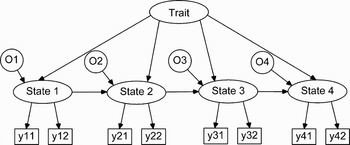
A conceptual illustration of a latent state–trait autoregressive model (see Steyer & Schmitt, Reference Steyer, Schmitt, von Eye and Clogg1994).

Steyer and Schmitt (Reference Steyer, Schmitt, von Eye and Clogg1994) proposed a trait–state–occasion autoregressive model by which a general trait factor is measured by a state factor that is further reflected by observed variables over time. The occasion factor serves as a disturbance term that affects each state factor. The state factor is autoregressed on the prior state factor, as seen in Figure 2. In the present study, the indicators of anxious/depressed symptoms by each informant were autoregressed because the latent scores derived from the preliminary confirmatory factor analysis were equivalent to the state factor. This modeling approach was adopted to obtain the constructs of social preference and anxious/depressed by each respondent across time in all cases in which there were no identification problems. First-order factor loadings were constrained to be equivalent across time so that mother reports, teacher reports, and youth self-reports reflected trait factors.
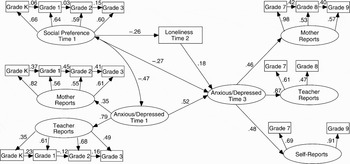
The structural model of the partial mediating effect of loneliness on the relation between low social preference in early school years and anxious/depressed symptoms in adolescence. All paths are statistically significant at p < .01. Grade K denotes kindergarten.

In addition, missing data were handled using the expectation–maximization (EM) algorithm for maximum likelihood estimation in Mplus under the missing at random assumption. This procedure provided the most likely means and variances for all variables estimated from available data. Model parameters were directly estimated from the estimated means and variances without imputing values for any case or deleting any case. This procedure was based on the assumption that data were missing at random, as supported by a set of tests. A dummy-coded variable that indicated nonmissing and missing values for each informant was created for each wave of data collection to examine whether it caused any difference in subsequent measurement. A series of general linear models showed that missing data in prior measurement did not have any effect on subsequent measurement for each respondent. Finally, because original variables were categorical, reliability of each scale was calculated using the formula

in which (∑λj)2 stands for the square of the sum of the factor loadings and ∑ψ2 stands for the sum of unique variances, as described by McDonald (Reference McDonald1999, p. 88).
Results
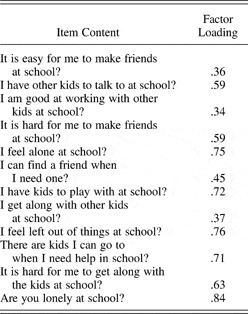
The measurement model of the adjusted loneliness scale fit the data satisfactorily, with χ2 (28) = 74.53, p < .01, comparative fit index (CFI) = .98, Tucker–Lewis index (TLI) = .98, and root mean square error of approximately (RMSEA) = .06. The standardized factor loadings ranged from .34 to .84 (see Table 1), with a reliability coefficient of ω = .87. Other measurement models of CBCL, TRF, and YSR scores all fit the data satisfactorily, with CFI and TLI outputs ranging from .91 to .98, and RMSEA outputs ranging from .03 to .06. Reliabilities of these scales ranged from .88 to .92.
Item content and standardized factor loadings of loneliness

Note: Some items were reverse coded so that higher raw ratings consistently reflected higher loneliness.
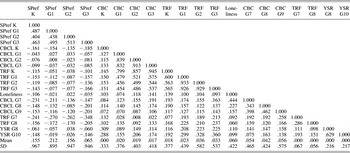
The structural equation model for testing the direct effect of social preference (at Time 1) and mediating effect of loneliness (at Time 2) on anxious/depressed symptoms (at Time 3) also fit the data well, with χ2 (153) = 268.89, p < .01, CFI = .98, TLI = .98, and RMSEA = .04. The structural parameter estimates, embedded in the graphic model (see Figure 1), show that social preference was negatively correlated with concurrent anxious/depressed symptoms measured by mothers and teachers at Time 1 (φ = −.47, z = 3.72, p < .01), had a significant effect on loneliness at Time 2 (γ1 = −.26, z = 4.32, p < .01), and had a significant direct effect on anxious/depressed symptoms at Time 3 (γ2 = −.27, z = 2.58, p < .01), measured with different raters across Grades 7–9 and controlling for Time 1 anxious/depressed symptoms (γ2 = −.52, z = 3.90, p < .01). Loneliness had a significant effect on anxious/depressed symptoms at Time 3 (γ2 = .18, z = 2.60, p < .01) as well as a significant partial mediating effect (−.26 × .18 = −.05, z = 2.34, p < .05). The mediating effect of loneliness accounted for 5% of the variance, whereas the inclusive model explained 56% of the total variance of anxious/depressed symptoms at Time 3. The sample covariance matrix to which this model was fit is displayed in Table 2, along with latent score means and standard deviations.
Final model covariances, means, and standard deviations
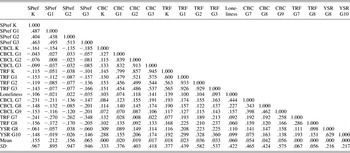
Note: SPref, social preference; G, grade; K, kindergarten.
Finally, we explored the possible moderating effect of gender on this mediating path. A moderating effect was not supported by a two-group structural equation modeling analysis, namely, the structural coefficients did not significantly differ by gender, as indicated by a chi-square difference test (χ2dif = 2.16, df dif = 4, p > .05).
Discussion
In line with past studies, peer rejection, loneliness, and anxious/depressed symptoms were all found to be interrelated. The goal of this research, though, was to shed light on the role of loneliness in the relation between early social preference and adolescent anxious/depressed outcomes. Findings provide evidence that loneliness plays a uniquely incremental and partial mediating role in this developmental sequence. This study is the first known empirical investigation to examine the hypothesis that loneliness has a mediating effect on the association between low social preference in early school years and anxious/depressed symptoms in adolescence by measuring and relating these constructs across three separate developmental time points.
Findings provide a significant empirical step forward in the scientific exploration of the roles of peer relations and loneliness in childhood in the development of adolescents' anxious and depressive symptoms. Although the partial mediating effect of loneliness was modest in size (16% of the total effect of social preference on anxious/depressed symptoms), it should be recognized that this effect was observed across a developmental span of 10 years (kindergarten–Grade 9). Because the complexities of the developmental transition from childhood to adolescence are considerable, though, we believe that the observed mediating effect of loneliness is notable.
Early peer-relation problems were demonstrated to predict loneliness in late childhood and anxious/depressed symptoms in adolescence. This suggests that low social preference during early school years may have predictive utility across child development, with respect to social, cognitive–emotional, and affective problems. This is important for several reasons. First, the current findings are based on longitudinal data that stem from childhood through adolescence and show that low social preference predicts different forms of social problems (i.e., loneliness and anxious/depressed symptoms) across development. Second, because the types of social and affective difficulties predicted by low social preference are related to numerous other maladaptive outcomes, it is critical that researchers and clinicians better understand them, and that science continues to identify their early markers (and possible causes) and developmental trajectories. Third, these results reinforce the importance of interventions that target peer-relation problems and social competence in children at an early age.
A developmental psychopathology model of peer relations and anxious/depressed difficulties posits that whereas problems with peers may lead to alternative outcomes (multifinality), affective problems in later childhood and early adolescence may be the result of varied developmental trajectories, some including a peer rejection component while others not (equifinality; see Cicchetti & Rogosch, Reference Cicchetti and Rogosch1996; Cicchetti, Rogosch, & Toth, Reference Cicchetti, Rogosch, Toth, Luthar, Burack, Cicchetti and Weisz1997). Although this study did not directly test multifinal models of early peer rejection or equifinal models of adolescent affective problems, results are consistent with an alternative-pathways perspective on the developmental relation between peer-relation problems in childhood and anxious/depressed outcomes in adolescence. That is, present findings suggest that whereas loneliness may serve as a mechanism by which early difficulties with peers lead to anxious and depressive outcomes, there are likely other paths, too, including a possible direct path between poor peer relations and anxious/depressed problems as well as other partial mediators of this developmental sequence. This indicates a need for anxiety and depression researchers to examine multiple early paths of socially disfavored children (Asher & Coie, Reference Asher and Coie1990; Asher et al., Reference Asher, Parkhurst, Hymel, Williams, Asher and Coie1990; Boivin, Thomassin, & Alain, Reference Boivin, Thomassin, Alain, Schneider, Attili, Nadel and Weissberg1989), as well as a variety of other anxiogenic and depressogenic factors in early and middle childhood (Cicchetti et al., Reference Cicchetti, Rogosch, Toth, Reynolds and Johnston1994, Reference Cicchetti, Rogosch, Toth, Luthar, Burack, Cicchetti and Weisz1997; Cicchetti & Toth, Reference Cicchetti and Toth1998), an emphasis that is entirely consistent with tenets of developmental psychopathology (see Cicchetti, Reference Cicchetti, Rolf, Masten, Cicchetti, Nuechterlein and Weintraub1990; Cicchetti & Cohen, Reference Cicchetti and Cohen1995a, Reference Cicchetti and Cohen1995b; Cicchetti & Rogosch, Reference Cicchetti, Rogosch, Kendall, Butcher and Holmback1999; Sameroff, Reference Sameroff, Cicchetti and Cohen1995, Reference Sameroff2000; Sroufe & Rutter, Reference Sroufe and Rutter1984).
Low social preference accounted for a portion of anxious/depressed symptomatology variance that was unique from that which was accounted for by loneliness, suggesting either a direct link between these factors or that there are mechanisms other than loneliness that may connect early peer-relation problems with anxious/depressed problems in adolescence. It is well established that there is variability in loneliness among rejected children and factors such as degree and chronicity of rejection and friendship have been offered as possible explicators (Asher et al., Reference Asher, Parkhurst, Hymel, Williams, Asher and Coie1990; Parkhurst & Asher, Reference Parkhurst and Asher1992). Although not all peer-rejected children feel lonely, there may be other effects of peer rejection that later contribute to anxious/depressed outcomes. That is, it is possible that the path marked by early peer rejection and later difficulties with anxious/depressed problems is mediated by factors such as low self-esteem and other negative self-evaluative cognitions (see Boivin & Hymel, Reference Boivin and Hymel1997; Panak & Garber, Reference Panak and Garber1992; Prinstein, Cheah, & Guyer, Reference Prinstein, Cheah and Guyer2005).
As discussed, only a few studies have considered the role of loneliness in the association between child peer-relation problems and various internalizing outcomes in adolescence (Boivin et al., Reference Boivin, Hymel and Bukowski1995; Sletta et al., Reference Sletta, Valås and Skaalvik1996; Valås & Sletta, Reference Valås and Sletta1996). The present investigation substantially adds to these past studies. For example, whereas Boivin at al. (Reference Boivin, Hymel and Bukowski1995) found a mediating effect, this finding was observed based on indices of loneliness and depression (but not anxiety) that were both self-reported and measured concurrently after only a single year's time had passed since assessing peer rejection at Time 1. The current study examined indices of peer-relation problems, loneliness, and anxious/depressed symptoms during three sequential time periods across 10 years of longitudinal data spanning childhood and adolescence. The partial mediating and uniquely predictive effects of loneliness on the path from early peer-relation problems to adolescent anxious/depressed symptoms suggest that early peer problems and loneliness play more varied, multifaceted roles in the development of adolescents' emotional difficulties than related studies have, to date, indicated.
Although the present study offers important evidence of both partial-mediator and unique-predictor roles of loneliness in the prediction of adolescent anxious/depressed symptoms, there is certainly need for further research and replication. First, this model should be tested across different stages of development and should be extended to predict alternative internalizing problems in later adolescence and adulthood. It is worthwhile to investigate the degree to which the hypothesized mediating course may be supported by studies that assess outcomes in later high school and years that immediately follow.
Second, additional factors need to be examined in the context of testing the current model. For example, how may factors such as self-esteem and self-perceived peer-relation problems contribute to our understanding of the links between peer-reported social preference, loneliness, and anxious/depressed symptoms? In addition, research on the development of loneliness and cognitive–emotional problems needs to consider a broader array of antecedents. Historically, research on the development of loneliness has focused on cognitive, personality, and interpersonal factors as antecedents (see Rokach & Neto, Reference Rokach and Neto2005; Rotenberg & Hymel, Reference Rotenberg and Hymel1999). Although social factors have been emphasized, relationships with peers have received disproportionately greater attention than have those with family. The roles of relationships with siblings, parents, and other family members should be included in future empirical investigations.
Third, whereas the current study utilized a community sample, additional research should examine the current mediating model as a possible framework for understanding the development of clinical anxiety and depression. Studies that identify extreme groups of rejected children and lonely and anxious/depressed adolescents should identify parameters of attributable risk and preventive fraction (i.e., the proportion of maladjustment that may be prevented) associated with experiencing repeated peer problems upon school entry. These indices may be of significant value to prevention researchers and interventionists in that the importance of protecting young children from being subjected to chronically negative interactions with peers to adaptive youth development may be better discerned.
Fourth, extended longitudinal research may be better able to examine how peer-relation problems and loneliness are involved in developmental courses that lead to noninternalizing maladaptive outcomes. Whereas the current study points to the need for further examination of peer-relation problems and loneliness as predictors of anxious/depressed symptoms, it is equally important to examine the relation of these early developments as possible markers of other social and externalizing problem patterns. For example, past studies have linked peer rejection with a multitude of externalizing conduct problems, including chronic aggressive behavior, juvenile delinquency, and adult criminality.
Fifth, the results of this study reinforce the need for interventions to be developed with respect to the individual needs of children. Subgroups of socially disfavored and lonely children (e.g., disfavored–lonely, disfavored–nonlonely, nondisfavored–lonely, etc.) may be at varied levels of risk for different maladaptive outcomes because their developmental courses vary in environmentally significant ways. For instance, whereas interventions that are tailored to socially disfavored–lonely children may focus on the development of adaptive social skills, lonely children who are not characterized by low social preference may need interventions that are more focused on nonsocial, internal problems (e.g., biased cognitive-operating styles) as it may be that their social skills are at least sufficient to buffer against being disfavored by peers. Alternatively, disfavored–nonlonely children may be best served by interventions that focus on a combination of adaptive social skills acquisition (or even morality training) and social problem-solving and decision-making techniques that may help them to be curb behaviors that lead to being disfavored by their peers. Discerning these subgroups at an early age may be accomplished by administering a combination of sociometric nomination and loneliness assessments soon after children enter school settings.
The limitations of the present study must be recognized. First, the research is correlational and precludes causal interpretations from being drawn. Although this is an inherent problem in much research on developmental psychopathology because of ethical considerations, studies that better lend themselves to causal designs may prove highly informative. Second, loneliness was measured at only one time point. Thus, loneliness may not be interpreted as a stable index of lonely thoughts and feelings in later childhood. In addition, because loneliness was not measured earlier in the investigation, prospective increases in loneliness could not be examined. Certainly, it would be useful to gain a better understanding of the potential utility of social preference in the prediction of change in loneliness across time. For these reasons, this study may be improved by assessing loneliness across multiple years. Third, multiple other cognitive–emotional factors (e.g., self-esteem, schema development) were not assessed that are also likely to play roles in the developmental sequence from early peer-relation problems to adolescent anxious/depressed outcomes. This point is intended not only to acknowledge the limitation of the present work, but also to encourage future studies. More inclusive research that addresses roles of multiple cognitive–emotional factors is of critical necessity.
Conclusion
In conclusion, the present study produced several findings that are of crucial importance to understanding the relations among low social preference, loneliness, and anxious/depressed symptoms across youth development. Particularly notable are our findings that (a) early peer-relation problems were shown to be a significant predictor of both feelings of loneliness and anxious/depressed problems, (b) low social preference and loneliness each uniquely accounted for variance in subsequent anxious/depressed symptoms in adolescence, and (c) loneliness partially mediated the path from early peer-relation difficulties to anxious/depressed problems in adolescence. The implications of these findings may be useful to both basic research in developmental psychopathology (e.g., alternative developmental pathways) as well as development and implementation of individually tailored interventions with at-risk children.