INTRODUCTION
The American civil rights movement continues to drive research questions across the social sciences. For those who study American political development (APD), the rise and fall of the civil rights movement embodies one of the most basic questions in the field: What are the conditions that create or block, begin or end, political orders? How and when does significant and durable political change occur in these “regular, predictable, and interconnected patterns of institutional and ideological arrangements that structure political life in a given place at a given time”?Footnote 1 How do political and/or socially marginalized groups with weak access to formal political structures and arrangements engage in political activism and effect policy change?Footnote 2
The emergence of African American voting in Virginia and the rest of the South during the decade and a half that preceded the decision in Brown v. Board of Education (1954) presents an interesting puzzle, as well as a test case to answer these questions about the role of political orderings in shaping both the role of marginalized groups in engaging in political activism and the emergence and durability of political change. The number of black voters in the South grew from less than 50,000 in 1940 to more than 1.2 million in 1953.Footnote 3 Black voter registration plateaued at this level until the enactment of the Voting Rights Act of 1965 (and its subsequent enforcement). The era of early black voting occurred despite the existence of two significant barriers.Footnote 4 The first of these barriers was the ongoing but still tentative transformation of the national political order into one that embraced and effectuated racial equality.Footnote 5 The second barrier was the seemingly stalwart (and even increased) resistance on the part of many political actors and Southern institutional arrangements toward racial equality.Footnote 6 In terms of its timing, the rise of early black voting given these barriers presents an interesting puzzle. Early black voting occurred before the decision in Brown v. Board of Education, and it occurred before the protest-oriented phase of the civil rights movement began. Why did black activists engage in electoral politics and not protest during this period? This question suggests that a far more nuanced explanation of the civil rights movement (and more broadly of the role of political orders) needs to take place. Rather than relying on overly broad interpretations that emphasize the role of national political actors and institutions like the courts or the NAACP, the question of early black electoral mobilization can be answered by turning our attention to the role of the multiple and often contradictory political, social, and ideational conditions of the Jim Crow South.
The primary argument made in this article is that the rise of Southern black voters during the 1940s was not simply because of shifts in political, institutional, and ideational arrangements that occurred at the national level. Nor was it the result of the rapid growth in civil rights rhetoric and organizations such as the NAACP. These shifts were certainly necessary, but they were not sufficient. Southern black political citizenship (at least that measured by voter registration) appeared in the 1940s because of the increasing ordered-disorder of the Jim Crow system itself. By “ordered-disorder,” I draw from Orren and Skowronek and others who argue that politics not only occurs within the context of “relatively independent” political and institutional arrangements (or orders) that move in and out of alignment with one another, but politics also occurs in “patterns of deep structural continuities and ceaseless change.”Footnote 7 Rather than seeing the Jim Crow South as a unitary and unchanging actor, an ordered-disorder approach acknowledges and puts to analytical use the heterogeneity of the South and its multiple sites of political, institutional, and ideational contestation.
I argue that early black voting (ca. 1940 to 1954) was the result of changes in Southern politics—particularly, growing intraparty competition among white political actors and the rise of a Southern black “organizational repertoire” of elite leadership and political-civic voluntarism. The combination of the these particular circumstances led to an embrace of politics via the ballot box as opposed to the protest activity that takes place outside of or directed at the state. This embrace of the ballot box at this stage differentiates the political-civic voluntarism model from the political process models employed by sociologists like Douglas McAdam. In the end, this set of circumstances was unstable and indeed collapsed in the face of the Brown decision (and the growing frictions between the national order and the Jim Crow order). The context of intraparty completion among whites changed, while the political-civic model of pre–Brown v. Board of Education (hereinafter, pre-Brown) black mobilization proved to be too fragile to survive amid broader political and ideational challenges from both whites and blacks; the incorporation of Southern blacks in the political system could not solely come from the ballot box.
In this article, I focus on the state of Virginia to explain the puzzle of early black voting. Although the state's white-controlled political and institutional arrangements appeared outwardly cohesive, fissures and frictions within those arrangements, starting in the 1930s, created an opening for sustained black political activism. I argue that the political openings in Virginia's state and local politics created space and incentive for black political organizing. To make this case, I focus on the rise and fall of the Virginia Voters League (VVL) during the 1930s and especially 1940s. The ordered-disorder of Virginia's Jim Crow political system coincided with, and in some ways encouraged, the establishment of the VVL and its coordinated campaign to boost poll-tax payments and thus registration rates by African Americans. The VVL's campaign was developed by a broad coalition of African American social, civic, and professional groups who collectively developed and deployed an organizational repertoire of political, ideational, and organizational tactics, strategies, and methods that fit with the multiple political orders in which Southern blacks were embedded.Footnote 8 Part of the fit that this repertoire reflected was the domination of a small group of black elites in shaping African American political life in the state. This elite domination was backed by a belief in working within the existing political system. At the same time, black elites’ belief in achieving the goals of “first-class citizenship,” which included formal participation in electoral politics, had been decades long in the making and shaped by earlier encounters with the state's political system.Footnote 9 The second part of that fit was the development of a political-civic voluntarism model that fit the context of 1940s Virginia. By political-civic voluntarism, I draw from Verba, Schlozman, and Brady, who define civic voluntarism as the “resources, engagement and recruitment” that occur within voluntary organizations and networks that transform individuals and communities into political citizenship.Footnote 10 Political-civic voluntarism also draws from the work of Charles Payne as well as social movement theorists such as Douglas McAdam, which focuses on the linkage between political opportunities, on the one hand, and structure and resources, on the other. These authors argue that not only must individuals come to imagine an alternative to the status quo, but they must also alter their behavior in light of changed conditions.Footnote 11 Therefore, political-civic voluntarism goes beyond simply creating a sense of “attentiveness to politics.” It also creates an engagement with, or a “doing [of] politics.”Footnote 12
During the 1940s, because of elite domination, a belief in working within the system, and the use of formal political participation as the criteria of citizenship, the organizational repertoire of African Americans in Virginia focused on political engagement via electoral politics rather than direct protest and confrontation. Using unique data derived from archival sources, I trace here the development and spread of voter mobilization through Virginia's African American communities, especially in relation to the activities of two organizations that influenced it: the VVL and the Virginia State Teachers Association (VSTA).Footnote 13 I trace how these organizations’ civic education and poll-tax payment campaigns were a form of political-civic voluntarism that created a way for formerly disenfranchised and politically disengaged black Virginians to connect to the state's political system. The emergence of the VVL challenges the ways in which political scientists have placed the NAACP as the primary driver of local political mobilization.
The civic campaigns and poll-tax payment campaigns were the most visible aspects of the political-civic voluntarism model developed by the VVL and its coalition partners. These campaigns gave black Virginians the experience to engage in multiple modes of political participation, from campaign activities to contacting local government officials to signing petitions, as well as participating in political meetings or donating money.Footnote 14 The VVL's civic campaigns enabled African Americans to learn political skills and acquire resources that other, less-marginalized groups may have gained through higher levels of education or income or from skills learned in the workplace. By working with the VVL and other organizations, black Virginians developed and honed their organizational and mobilization skills. For African American women, in particular, who had limited workplace opportunities, the experience garnered through participating in VVL campaigns was another route to political engagement.Footnote 15 There were other tangible benefits from this nascent black political activism, ranging from some local white elected officials delivering better roads and more school funding to the elections in 1947 and 1948 of African Americans to local and county offices for the first time since the adoption of the state's Jim Crow system in 1902.
Despite these successes, the long-term fit was not perfect between the VVL's political-civic voluntarism model, the repertoire of tools upon which it was developed, and the state's social-political order against which it deployed its tools. While the VVL was initially able to mobilize many black Virginians to take their first steps toward greater political participation, the VVL itself, and the political movement it gave birth to, were not durable. The health of the organization faltered when one of its leaders died in 1951. By 1954, with the Brown v. Board of Education decision, political conditions in Virginia decisively shifted as Virginia's political elites, especially the embattled state political machine, embraced “massive resistance.”Footnote 16 The political opening that the VVL had attempted to exploit had proven to be fragile. Despite the failure of this political approach, the circumstances that brought about Virginia's pre-Brown electoral mobilization were unique to the Jim Crow political order out of which it arose. No other state had this level of black political participation and electoral success during the pre-Brown era. Thus while this case of black political mobilization should be understood in its own right, the legacy of its success and failures transforms it into an important bridge to the emergence of the modern civil rights movement (the latter defined as the period from 1954–55 to 1965).
The VVL is an example of how black activist communities/movements developed strategies and tools that fit with Virginia's political and institutional configurations, while simultaneously drawing from outside the state's political order for additional leverage (e.g., judicial decisions such as Smith v. Allwright) to the NAACP. The VVL developed an “organizational repertoire” that was linked to the state's “managed race relations” model, the long-standing commitment of some black political elites to coalitional politics (e.g., black and tan Republicanism), and a willingness to engage in assertions of political self-determination as seen through past political campaigns and legal cases. The VVL's success was most apparent in the state's urban areas, where previous political experience, emergent political competition, and campaigns to increase political participation, coupled with the appearance of viable black candidates, resulted in political success, as measured by the election of African Americans to local offices.
VIRGINIA AS CASE STUDY
Beyond being a site of early black voting, Virginia is a useful case study for several reasons. By specifying by place and by time, this analysis takes up the challenge of placing the civil rights movement backward (and forward) into a much longer black liberation struggle and within the context of debates with the field of APD. In turn, spatial and temporal specificity allows for past actors, events, and developments to be reintegrated into historical and analytical consideration, allowing assessment of their significance. Five reasons are described next.
First, the spatial specificity of Virginia and the temporal extension of the civil rights movement can take into account how the New Deal order and World War II affected existing and future political orders at the subnational level.Footnote 17 It can also reincorporate into analytical consideration what historians have called the “forgotten years” of the civil rights movement, the decade or so of the pre-Brown era.Footnote 18 This was an era in which important events occurred, such as the successful deployment of NAACP-backed educational equalization suits, the rise of anti-poll-tax campaigns at the national and state levels, and the Supreme Court ruling in Smith v. Allwright, which ended the white primary system.Footnote 19 While many of these events are often swept up in a broader developmental arc that focuses on national-level institutions and processes, relatively less attention has focused on the effect of these developments at the subnational and local level. Indeed, in these broader, nationally oriented analyses, the causal mechanism that linked national elites, institutions, and processes to a potential African American voter in the rural (or even urban) South is not clear. For example, despite the Smith decision, the white-dominated Southern political order remained largely hostile to black voting.Footnote 20 Yet black voter registration took place despite this resistance, and despite the lack of federal oversight and enforcement that was later supplied by the Voting Rights Act of 1965 (and seen as key to the success of black political empowerment).Footnote 21
Second, Virginia is an exceptionally useful case study as it offers statewide county-level electoral data on black political participation during this period. With the exception of Louisiana and Florida, detailed data on black electoral participation during this period exist for no other state.Footnote 22 Even more fortuitously, this county-level data on African American political and organizational activity can be linked to a range of archival material, as well as institutional and contextual factors, such as political competition and macro-social structural measures, which permits development of a picture of black electoral mobilization in the pre–civil rights movement era. Although a regional analysis would be optimal, given the lack of sub-state-level data, any analysis that relied purely on aggregate state-level data would not be able to explore—in the way that I am able to here—the impact of state and locally specific political organizations and socioeconomic factors on black political organizing.Footnote 23
Third, Virginia offers an interesting case study because it shows that restrictive electoral laws, such as the state's poll tax, did not completely forestall electoral access for blacks. In Virginia, the growth of black political engagement occurred even though the poll tax, a key electoral barrier, was still in existence. The payment of poll taxes is important, because it was the first and fundamental step toward registering to vote, and Virginia's poll-tax laws were considered among the most onerous in the South. Voter registration in Virginia required a citizen to pay cumulative back taxes of $4.50 (about $70 in 2010 dollars).Footnote 24 State law also allowed counties, towns, and cities to add an additional $1 tax.Footnote 25 Prospective voters not only had to bring these taxes up to date, but they also had to pay these taxes for three years in a row before they could register to vote. This lag was intentional: It was meant to weaken the long-term commitment to voting (among blacks and whites) by detaching the act of payment from the act of voting. The law, however, did give rural Virginia residents a way to easily identify and fulfill their poll-tax payments via the local property-tax system. Thus, using Virginia as a case study shows the importance of recognizing that each state's suite of disenfranchising laws and practices can have a meaningful impact on shaping local organizational repertoires. To paraphrase the work of Rosenstone and Wolfinger, for African American voting, “first comes registration,” and in Virginia and other poll-tax states, the addendum, “and before that, the poll tax.”Footnote 26
Fourth, by focusing on a specific state like Virginia, the ways in which the activism of civil rights organizations varied across national, state, and local levels can be better understood. Critical to any analysis of black political mobilization is the role of the NAACP. Especially in the earliest phases of the “long civil rights movement,” the NAACP was one of the few organizations that initiated litigation against de jure discrimination at both national and the state/local level. By the early 1940s, the NAACP was the only organization of national stature that had a significant presence (with some exceptions) in almost every Southern state through the “long civil rights movement” era.Footnote 27 By the early 1950s, the organization not only continued to focus on litigation but also began to pay greater attention to electoral politics. The NAACP began sponsoring voter-registration drives and litigating against electoral laws that disenfranchised African Americans. These political aspirations led Richard Valelly to call the NAACP a “political party in waiting.”Footnote 28 Indeed, studies such as Matthews and Prothro's work from the early 1960s found the effect of NAACP activity on black electoral participation to be a positive one, albeit small.Footnote 29 Yet, by examining African American political organizations on a more fine-grained level, through the prism of African American political mobilization in Virginia, this article reveals a different and nuanced understanding of the NAACP at the state and local level. Meanwhile, the complicated role of local organizations such as the VVL and their role in political order and disorder of Jim Crow South can be better understood.
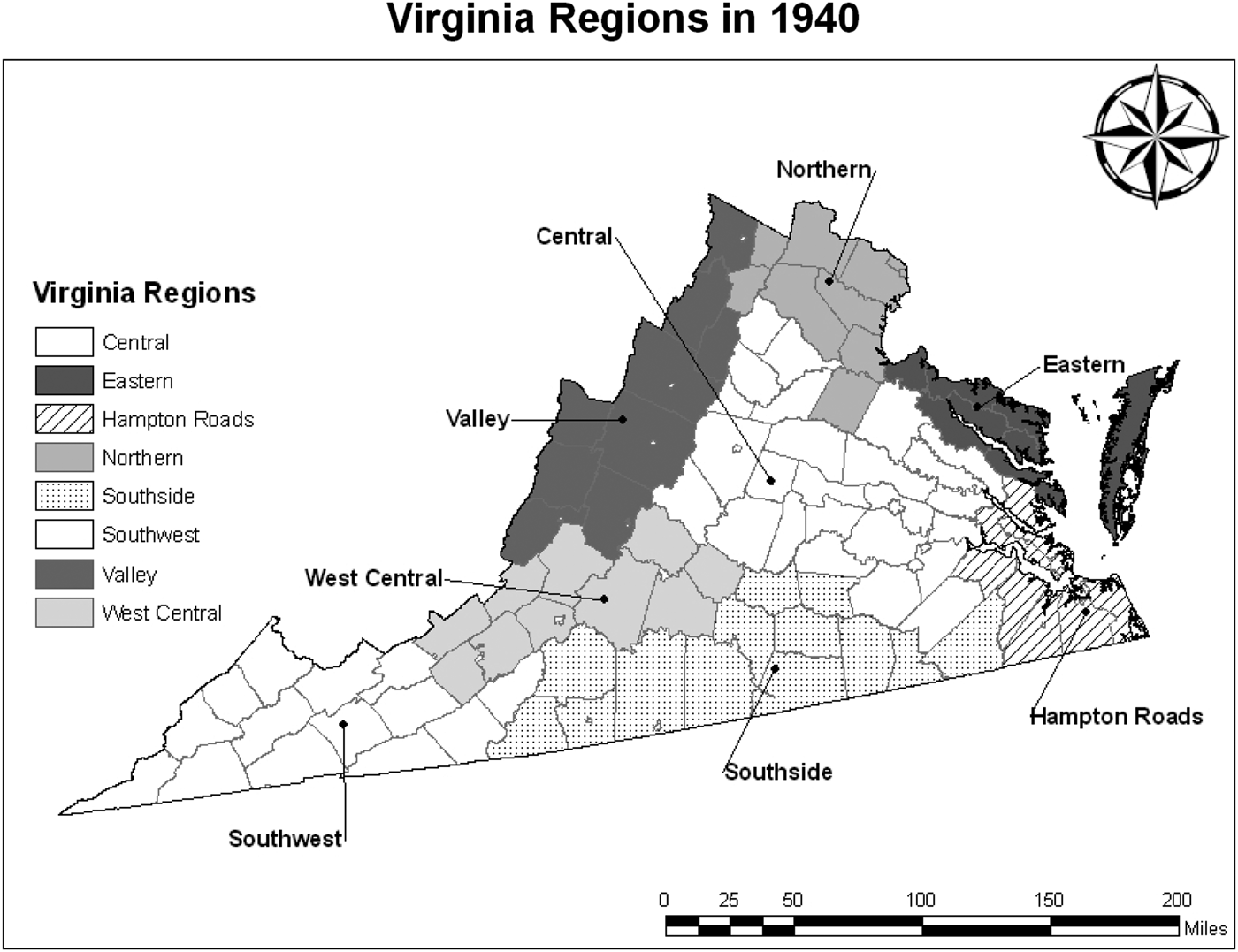
Fifth, Virginia is a useful case study because it exhibits interesting demographic and intrastate regional differences that mimic, in some ways, the diversity of the South. For example, Virginia's eight subregions—made up of 100 counties and twenty-four independent cities—reflected the multiple “local racial states” of the Jim Crow South (see Figure 1).Footnote 30
Virginia Regions in 1940.
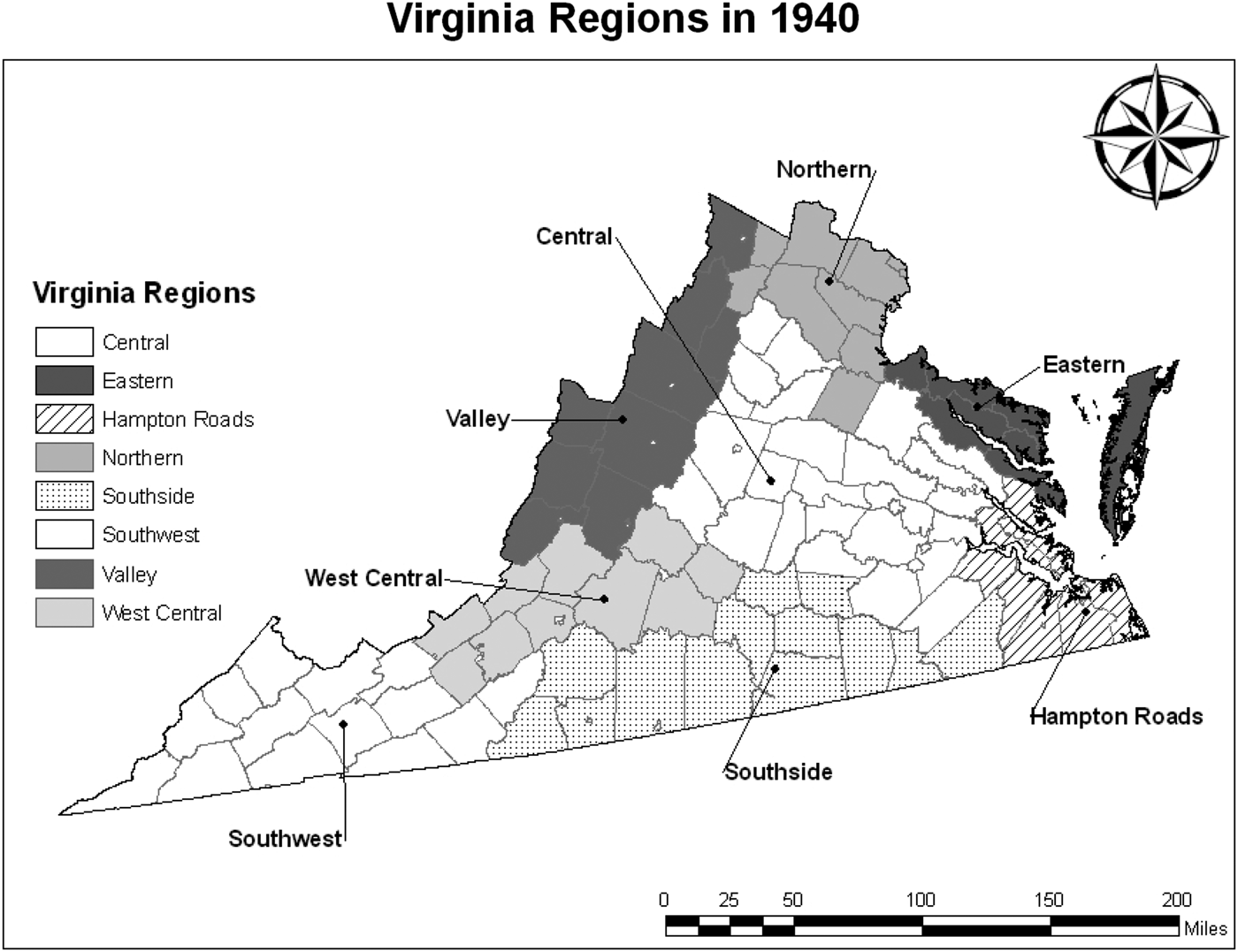
With its proximity to Washington, DC, Northern Virginia was, by the late 1940s, becoming more suburbanized and slightly more prosperous than the rest of the state. Meanwhile, two of its regions, the Eastern Shore and Southside (collectively, the Southeast regions), were similar to other Southern “black belt” counties. V. O. Key called these areas—where labor-intensive agricultural production (usually via tenant or share-cropping arrangements) was coupled with a majority black population—”the hard core of the political South.” Key argued that the highest levels of resistance to black political participation were found in areas where a threatened white minority faced a black majority.Footnote 31 The state's Southside region, located in the state's southeastern corner, was considered heart of the state's black belt and the base of the Harry Byrd organization. Virginia also had centers of manufacturing such as the Central and Hampton Roads areas, which encompassed the tobacco industry in Richmond and the shipyards of Norfolk. Finally, Virginia's Southwest regions (West Central, Valley, and Southwest) were similar to the predominantly white “hill counties” of other Southern states, where extensive local politics reflected hostility toward Southern political elites, whether black belt planters, “big mule” industrialists, or, in the case of Virginia, the Byrd machine.Footnote 32
POLITICAL ORDERS AND DISORDER IN JIM CROW VIRGINIA
One source of political order was Virginia's political system. Like other Southern states, Virginia had a small white elite committed to white supremacy and political inequality based on class. Like the other Southern states, Virginia marked the consolidation of the Jim Crow order with the adoption of a new Constitution in 1902 (and other laws) that disenfranchised nearly all of its African American citizens and a large portion of its white citizens. These provisions included restrictive voter-registration rules that incorporated residency requirements, understanding and literacy clauses, the imposition of a statewide “white primary” for nominees to Democratic office, and the adoption of a poll tax. Mass disenfranchisement in Virginia facilitated the rise of one-party rule in the state. For much of the first half of the twentieth century, Virginia's political system was dominated by the Harry Byrd “machine,” or the “Organization.”Footnote 33 The Organization's tight control of state and local politics and the resistance of its leadership to challenge or change led V. O. Key to call it a “political museum piece” and to liken Mississippi to a “hotbed of democracy” in comparison.Footnote 34 By 1940, overall voter turnout in Virginia for the U.S. presidential election was about 22 percent of the state's voting-age population, well below the 59 percent that was the U.S. average.Footnote 35
Although the influence of the Byrd machine was statewide, it was strong in the rural central and Southern areas of the state. The machine's influence was weaker in the state's independent cities and in the state's Southwest region, which encompassed what V. O. Key called the “Fighting Ninth,” a historically Republican-leaning congressional district.Footnote 36 Until the mid-1930s, Virginia's state and local politics reflected what Key called the issue-less politics of one-party rule.Footnote 37 Constant battles among ambitious candidates for local office among a relatively small pool of voters led to a complex calculus of local politics. In the mid-1930s, challenges to the Byrd machine, especially in the state's larger cities, began to emerge. Encouraged by President Franklin Delano Roosevelt's support and infighting within the Organization, James Price led a pro–New Deal faction to win the governor's office in 1937.Footnote 38 At the local level, one example of this pro–New Deal challenge to the machine was the 1936 congressional campaign in which Norman Hamilton (the pro–New Deal editor of the Portsmouth Star) defeated Rep. Colgate Darden (a scion of Virginia society and a rising star of the Organization). Hamilton narrowly won the election but lost the 1938 rematch between himself and Darden. Despite these promising inroads, some scholars have argued that an earlier New Deal faction led by Governor James Price was ultimately abandoned by FDR, leading to the collapse of a nascent anti-Byrd coalition until the 1940s.Footnote 39
Secular change also helped to fuel these challenges to the Organization. Like many parts of the South in the 1940s, Virginia was undergoing its own variation of transformation from “cotton belt to sunbelt,” which began to destabilize the certainty of machine rule.Footnote 40 Challenges to the Byrd machine appeared as former New Dealers, revitalized good government groups such as the League of Women Voters, the growing suburban communities of Northern Virginia, and the state's growing white middle class periodically coalesced against the Byrd machine.Footnote 41 The 1940s was a period of increased union activity among black Virginians, as the CIO and other unions led organizing efforts among tobacco and textile workers, as well as industrial occupations.Footnote 42 By the mid-1940s, returning World War II veterans and the state's small labor unions joined this loose coalition.Footnote 43 Although they did not win the governor's office, reform candidates made steady inroads against the dominance of the Organization. In the 1941 governor's race, anti-Byrd candidates won 21 percent of the vote against Colgate Darden. In 1945, the anti-organization candidate, Moss A. Plunkett, won 27 percent of the vote against Lt. Governor William Tuck. In 1949, anti-Byrd candidate, Frances Pickens Miller, won 31 percent of the vote against John Battle, the Organization's candidate.Footnote 44 Despite these small gains, anti-Byrd forces persisted throughout the 1940s, with scattered successes at the local level that maintained an ongoing opposition to the Organization.Footnote 45
Far from being a political museum piece, Virginia's state and local politics were undergoing multiple challenges. Political competition, especially in Virginia's cities, provided an opening and a justification for increased political activism for both white anti-Byrd forces and the state's African American population. Indeed, as the number of black voters increased, white politicians, especially those allied with the anti-Byrd forces, began to reach out to black leaders and groups like the VVL. The Hamilton-Darden congressional races discussed above are an early example of the growing attractiveness as well as availability of black votes. Hamilton narrowly defeated Darden by 1,800 votes, which both white politicians and black leaders attributed to black Portsmouth voters. In their 1938 rematch, Darden beat Hamilton, partly by publicizing among rural whites the heavy support Hamilton received from blacks. At the same time, Darden successfully made efforts to reach out to the black community for votes, insinuating that Hamilton was insufficiently supportive of black interests.Footnote 46 Black votes could matter, although white candidates were torn between the attractiveness of the black vote and the fear of being seen as sympathetic to black interests. As black votes increased throughout the South, the calculus of vote seeking and vote aversion plagued white politicians.Footnote 47
Black Political Life in Jim Crow Virginia
The second set of arrangements that shaped the VVL's repertoire and political activism comprised Virginia's “black counterpublic,” a social-political order defined by a set of institutions, organizations, and ideas demarcated by black racial identity. Virginia's black counterpublic was composed of formal organizations such as the Tuskegee-influenced Negro Opportunity Society, the Virginia State Teachers Association (VSTA), and a variety of local and state civic and fraternal groups. African American–owned newspapers, such as the Richmond Planet and the Norfolk Journal and Guide, were two of the publications that played a significant in both shaping and reflecting the state's black counterpublic. Attached to these organizational structures was the belief system of managed race relations held primarily by African American elites. These elites largely sought to work within the existing system with the goal of reform rather an immediate frontal assault on the system.Footnote 48
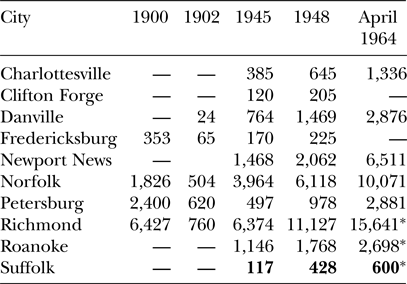
Virginia's 1902 Constitution dramatically decreased the number of African American voters, which was at a high of 96,000 male voters (statewide) in the 1880s and then fell to 21,000 black males (of the 147,000 that were of voting age) after 1902.Footnote 49 This drop in black voters was particularly dramatic in many of the state's cities (see Table 1).
African American Voter Registration in Virginia's Largest Cities, 1945–1948
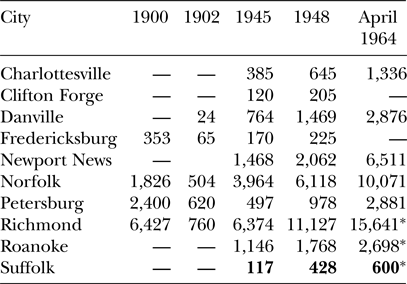
Source: Andrew Buni, The Negro in Virginia Politics, 1902–1965 (Charlottesville: University of Virginia Press, 1967). Figures for 1945 and 1948, p. 157; “Appendix A: November 1902 Voter Registration”; “Appendix C: Gains in Negro Voter Registration in Areas with Large Negro Populations, 1964.”
Note. *No data; figure based on 1960 registration, Buni, 206.
In cities like Norfolk and Petersburg, approximately three-quarters of black voters disappeared from the voting rolls. While in Richmond, new voting laws excised nearly 90 percent of the city's black voters from the electoral rolls.
Despite this mass disenfranchisement, black elites attempted to continue to participate in electoral politics via Republican Party politics. However, from the post-Convention era onward, Virginia's white-controlled Republican Party steadily retreated from interracial political activism. This retreat was formalized by 1910 with the rise of “lily-whitism,” in which Southern Republicans publically pushed blacks out of the party in the vain hope of attracting the votes of Southern whites. Footnote 50 Repeated attempts to come to some accommodation with the Republicans were rejected. In turn, a group of black political activists formed a “lily-black” Republican ticket in 1921. At the top of the ticket, running for governor, was John Mitchell, Jr., the editor of the Richmond Planet, one of the state's two major black newspapers. Although Mitchell received less than 3 percent of the overall state vote, he did well in counties with high black populations (greater than 30 percent), where he received 4–7 percent of the vote. Despite their failures at the polls, both lily-white and lily-black Republicanism stimulated a sharp debate within black political circles about black political strategy in this politically circumscribed era. Should blacks continue to try to participate in Republican Party politics, or should they push to participate in state Democratic Party politics? This debate took place in black communities throughout the South during the pre–New Deal era, highlighting the increasing divergence between Republican-tinged local black politics and increasing loyalty to the Democratic Party by national black political elites and the growing number of Northern urban black voters.
The efforts of elite African Americans to remain involved in state Republican Party politics were rebuffed, as were their later efforts to reach out to the Byrd machine.Footnote 51 Nonetheless, Mitchell's run for office offered a way for some black Virginians to participate in statewide politics for the last time (albeit more or less symbolically), until the rise of electoral activism in the 1940s. Mitchell's failed campaign and the fissures produced by this kind of electoral strategy pushed black Virginians to pursue the courts as a means of regaining the ballot box and political power. More broadly, the legacy of this failure, in the context of managed race relations, meant that in pre–civil rights era Virginia, black protest was not seen as a viable option. Within this counterpublic, past experiences, current organizational configurations, and ongoing debates shaped the rhetoric and tactics that the VVL drew upon to motivate potential voters and to shape community memories about past and future political possibilities.
Openings in a Closed System
In Virginia, as elsewhere in the South, one of the paths toward electoral mobilization of blacks was through the judicial system. Two judicial decisions pried open the ballot box in Virginia for its African American citizens: West v. Bliley, 33 F.2d. 177 (E.D. Va. 1929) and Davis v. Allen, 160 S.E. 85 (157 Va. 84). Joseph Newsome, a lawyer who also ran as attorney general on the Mitchell ticket, led both cases. In addition to being a lawyer, Newsome was editor of the Newport News Star (an influential African American newspaper); founder of the Warwick County Colored Voters League; and president of the Old Dominion Bar Association, the segregated counterpart to the Virginia Bar Association.Footnote 52
The first case, West v. Bliley, 33 F.2d. 177 (E.D. Va. 1929), challenged the state's white primary system. In line with Nixon v. Herndon, 273 U.S. 536 (1927), the federal court found, in West, that Virginia's white primary, which was financially supported by and controlled by the state government, violated the Fourteenth and Fifteenth Amendments.Footnote 53 With this ruling, the leaders of the Byrd organization faced a choice: To keep a restricted primary, the state would have to delink the primary from the state political apparatus. This, however, would lead to a decrease in the Byrd machine's control over local and state party organizations. Unwilling to give up the centralized control that evading the Constitution required, the Byrd organization reluctantly acceded to the West decision and opened the primary to all voters. Part of this acceptance on their part rested on the belief that the poll tax, as well as the hostility of local registrars, constituted a significant and formidable barrier to increased African American political participation.Footnote 54
The second prong of black Virginians’ judicial attack on the state's restricted ballot box occurred in 1930, with the second case led by Newsome. This case, Davis v. Allen, 160 S.E. 85 (157 Va. 84), challenged the discretionary power of local registrars. Virginia's State Supreme Court of Appeals agreed and ruled that a local registrar had overstepped the boundaries of the registrar's role as an evaluator of a potential registrant's “qualifications as an elector.”Footnote 55 From that point onward, local registrars could, at least theoretically, face the threat of a lawsuit. Although many registrars were not cowed by the ruling, its potential was an encouraging signal to the state's African American political activists.
Nonetheless, although these judicial decisions—along with other federal rulings, such as Smith v. Allwright (1944), which overturned the white primary throughout the South—were important in unlocking the Southern political system for African Americans, they were not sufficient. In Virginia, two developments occurred that translated the potential of West, Davis, and Smith into actual politics. First, changes in state politics, particularly the rise in intraparty competition between the Byrd and anti-Byrd factions, created a small window of opportunity for political challenges to take place. Second, establishment of the VVL in 1941 readied African American voters to participate in politics when the window of political opportunity opened up.
THE VVL: A VOTELESS PEOPLE IS A HOPELESS PEOPLE
The VVL was established in 1941 at a meeting of the Virginia State Teachers Association (VSTA), whose members included 92 percent of the state's 4,000 black teachers.Footnote 56 Since the VSTA represented teachers across the state, its status and reach allowed the VVL to touch almost all of the black communities in Virginia. The VVL's alliance with the VSTA was important. Starting in the 1930s, the VSTA rejected its long-standing program of individual training and uplifting favor of stronger “political unionism.”Footnote 57 This political unionism was the result of the organization coming to the aid of its members, who were among the first in the South to bring and win salary equalization suits against school districts. Moreover, the VSTA embraced a more politicized approach in order to assist its members in acquiring better educational credentials, often through lobbying for more funds for black higher education in the South. This assistance was necessary, because in the face of future potential salary equalization suits, school districts in the Virginia (like other districts in the South) shifted toward the use credentials rather than race as the basis for maintaining the salary distinctions between the races.Footnote 58
The VVL and the VSTA were part of a broader federation that included dozens of local voter and civic leagues that had sprung up across Virginia during the 1930s and 1940s. These groups included groups such as the Negro Opportunity Society, the United Civic League, and the Virginia Civic League; fraternal lodges such as the Elks; fraternities and sororities; and other organizations.Footnote 59 These groups had members in most of the state's major cities, such as Richmond, Norfolk, Danville, and Hampton, as well in each of the counties where significant black populations lived.
Although the goal of was to increase political mobilization, the elites who led these campaigns were animated by a combination of racial uplift and citizenship politics. Luther Porter Jackson, a history professor at Virginia State College in Petersburg, Virginia, was the founder and driving force of the VVL.Footnote 60 Like many others in his position who believed in racial uplift led by the elite, Jackson found this lack of political engagement among the privileged alarming, since he thought that “college men and women have a standing obligation to attack some of the fundamental problems of the race and to lift the masses.”Footnote 61 African Americans needed to develop a “keen appreciation of their obligation, under a democratic form of government, for participation in the civic and political life.”Footnote 62 Empirical evidence also backed this belief. Jackson had conducted a study of political attitudes among lower income African Americans found a high level of apathy and lack of political engagement. One respondent declared that “votin’ is fo’ the white folks. … We ain't got nothing to do with that.” Footnote 63
Indeed, according to Jackson, “victories won in the courts are sometimes empty victories if the people involved are not qualified to vote—a large voting strength sometimes even makes court battles unnecessary.”Footnote 64 Voting underscored Jackson's understanding of, and belief in, American democracy. To Jackson and others like him, “the ballot [was] the recognized instrument by which minority groups, under a democratic government, may defend their civil liberties.”Footnote 65 Whether or not barriers to the ballot were as minimal as Jackson believed, he and others proceeded according to the belief that only a process of education, linked to political activity, could mobilize Virginia's blacks to exercise their citizenship. To Jackson, the VVL, not the NAACP, was the natural vehicle for this empowerment.
Why the VVL and Not the NAACP? The Role of Local Conditions
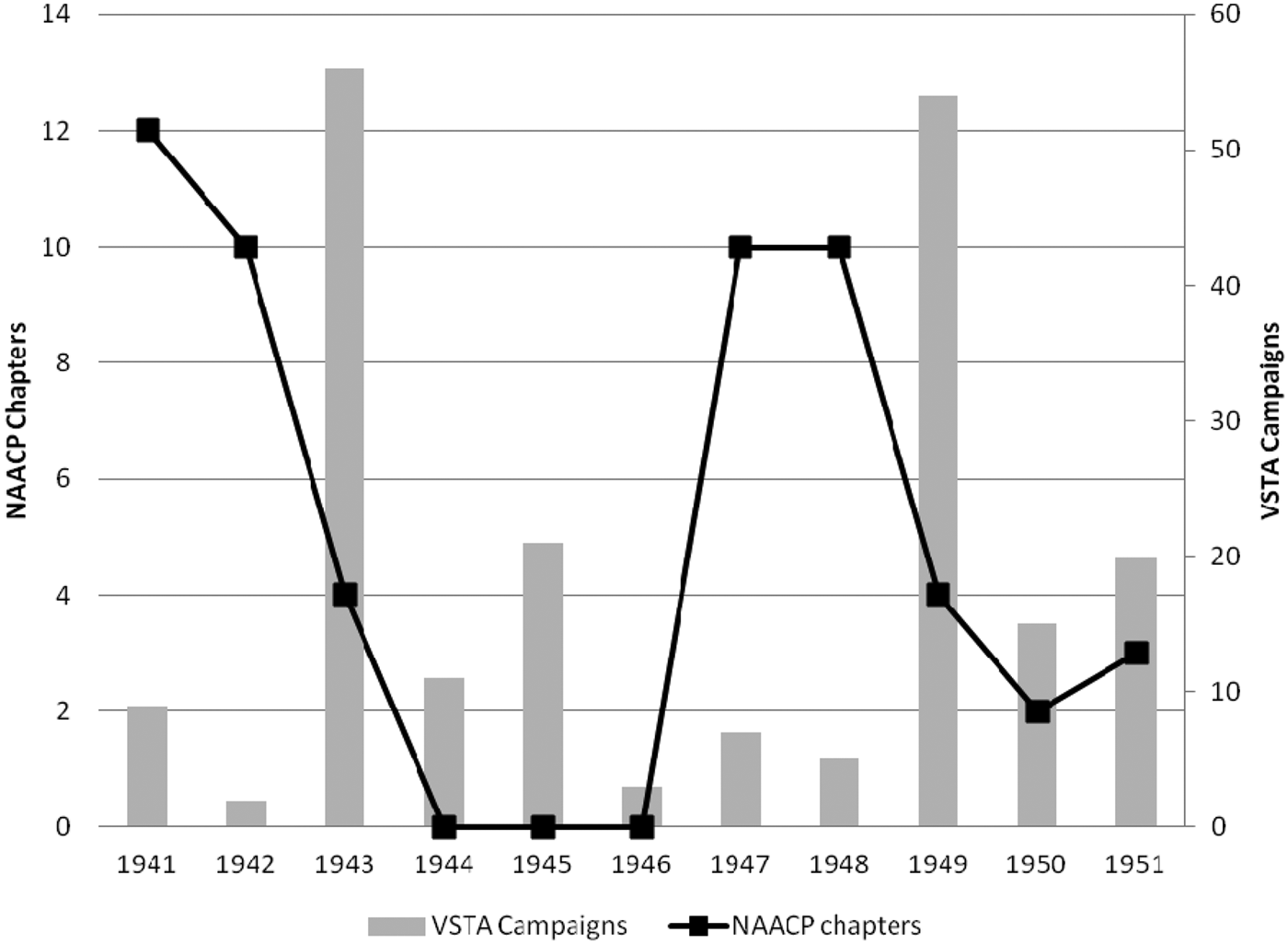
During the 1940s, despite its growing national stature, the role of the NAACP in local and state-level politics was constrained. In some state states like Mississippi and Alabama, the organization had a limited presence; membership was politically and personally perilous. In states like Virginia, the status of the NAACP was more visible and membership came with less political risk. While the organization worked with the state's teachers on some equalization cases, some teachers also decided to file suits without the NAACP participation.Footnote 66 In terms of membership, the fortunes of NAACP membership and chapters waxed and waned in the state. Between 1939 and 1941, the NAACP had 362 members and forty chapters in Virginia (see Figure 2).
VSTA Activity and NAACP Chapter Formation in Virginia, 1941–1951.
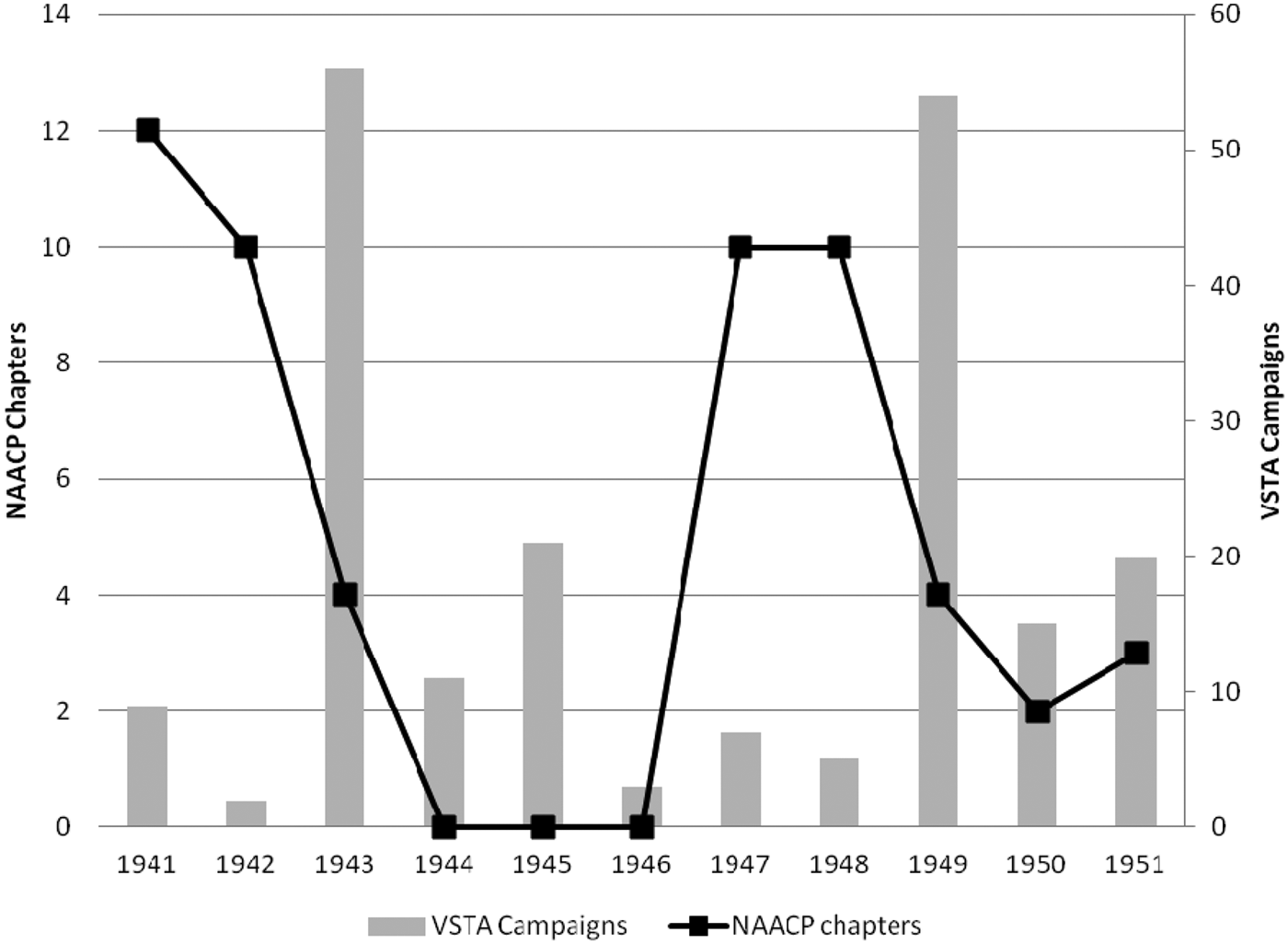
Despite this impressive start, between 1943 and 1947, no new NAACP chapters were created in the state. This drop in chapter formation reflected national trends. The demobilization of wartime industry starting in 1945 (which heightened black economic uncertainty) and an increase in the organization's membership dues in 1948 created a national drop in NAACP membership and chapter formation. At the national and the state level, the NAACP seemed to lack the ability to sustain itself as a mass-based organization.Footnote 67 Although growth slowed, it picked after 1947 so that by 1951 NAACP membership in Virginia had reached 10,000 people, spread out over seventy-eight chapters.Footnote 68
This membership growth did not necessarily translate into activism. For example, while many VVL leaders were also members of the NAACP, they saw their work with the VVL as far more substantive, intimately linked to local conditions, and especially as taking an active partisan role in local politics. For example, in a fundraising letter to Virginia's NAACP members, the VVL stated that it was “an organization specializing on merely one phase of the program of the NAACP. But it is a most important phase.” Footnote 69 By contrast, VVL leaders saw the NAACP as a useful means of broadening their fundraising efforts as well as a way to link VVL's political activism to NAACP members.Footnote 70 This brief overview of NAACP activity in Virginia supports the claim made in this article that a more nuanced comparative tracing of NAACP and local political activism is needed to understand the different ways that African American political organizations operated at the national, state, and local levels.
THE VVL: ACTIVISM AND THE POLITICAL-CIVIC VOLUNTARISM MODEL
By the end of the 1940s, the VVL had chapters in almost all of Virginia's 100 counties and its twenty-four independent cities.Footnote 71 The VVL/VSTA conducted over 209 civic education campaigns almost every year between 1940 and 1952 (see Figure 2).Footnote 72 The political-civic voluntarism model developed by the VVL was most visible at the civic education campaign meetings. The VVL held these meetings at churches and independent spaces that were not under the control of whites. These meetings gave ordinary citizens a way to engage with politics and were designed to publicly recognize individuals who had embraced “100 percent citizenship”—that is, by paying their poll tax and by registering to vote. Thus, one meeting program directed registered voters to sit at the front of the tax meeting space, while those who had paid their poll taxes were to sit immediately behind, and then all others.Footnote 73
As a result of the meetings, more people were inspired to take at least the minimal step of paying a poll tax. Without an immediate payoff—that is, one could not vote with satisfying the three-year and six-month time requirements—paying the poll tax symbolically established one's identity as a political citizen. Through ceremonial meetings of the VVL, poll-tax payment conferred community recognition and prestige. Moreover, the meetings inspired individuals to take the final step of actually registering to vote. Indeed, one VVL correspondent reported that after one particular meeting,
The next morning, three women brought their husbands to me and told me that they told their husbands that they were not real husbands unless they qualified. We went immediately to our Registrar and each registered without any trouble.Footnote 74
The meetings were also designed to create and foster networks of persuasion and support. Attendees were required to fill out forms listing six individuals in their communities whom they felt were ready and able to take on the responsibilities of citizenship.Footnote 75 VVL members were then directed to contact these individuals, and through a combination of persuasion, social pressure, and emotional support, they would help the identified individuals pay their poll taxes—or if they had already paid, go with them to the registrar offices.Footnote 76
The political-civic voluntarism model coordinated by the VVL and the VSTA provided the knowledge and education that enabled ordinary people to transform themselves into political citizens and helped them, in turn, to help others. This mutual assistance provided the solidarity needed to confront recalcitrant registrars.
Confronting white authority was not a small matter especially when this action transgressed one or more rules of Jim Crow. As Jackson noted in numerous reports, going to the registrar's office in rural areas might, for example, have involved going to a private home, and going into a white home, not as a servant or tradesperson, violated one of Jim Crow's unwritten rules.Footnote 77 Having the support of someone with knowledge of Virginia's voting laws and the backing of the VVL were therefore important factors in overcoming the reluctance of many black Virginians to challenge this aspect of Virginia's closed political system. In 1944, one VVL member wrote to Jackson:
You will be pleased to know that more Negroes registered last Saturday than any time in the history of this section. So many applied to register until the Registrar became frightened. Only one case where any trouble took place and that was out near Chula, not at the court-house. The Registrar refused to register a young man simply because he would not be examined in the Constitution. He had written out the proper questions and handed them in. The Registrar began to ask him about the Constitution. The young man drove into town and I went out to see the Registrar. I asked him to return the paper but he claimed to have destroyed it. I told him he should have given it back. I told him I was going to have the case tested before the court. He said that he was not afraid of the courts but rather than lose time he decided to register the man and did so on the spot.Footnote 78
In another sign of emerging civic voluntarism, VVL meetings provided a physical space that allowed a new generation of local and state political leadership to emerge, as local leaders and attendees discussed tactics to encourage not only the payment of poll taxes, but also the conversion of paid-up tax payers into registered voters and ultimately into votes. Advertisements and flyers distributed by the VVL were designed to make the connection between taxes, votes, and benefits. For example, one flyer stated,
The kind of officials we elect will depend on how we vote—and HOW MANY of us vote. A BIG vote is always a GOOD vote. Thus, when every citizen votes we get good government. Only then do we have a government that represents the majority of the people.Footnote 79
Still another flyer exhorted Black Virginians,
If YOU have no VOTE you have NO voice in the affairs of government, local, States or National. The kind of government we have depends on how we vote—and HOW MANY of us vote.Footnote 80
The Poll-Tax Payment Campaign
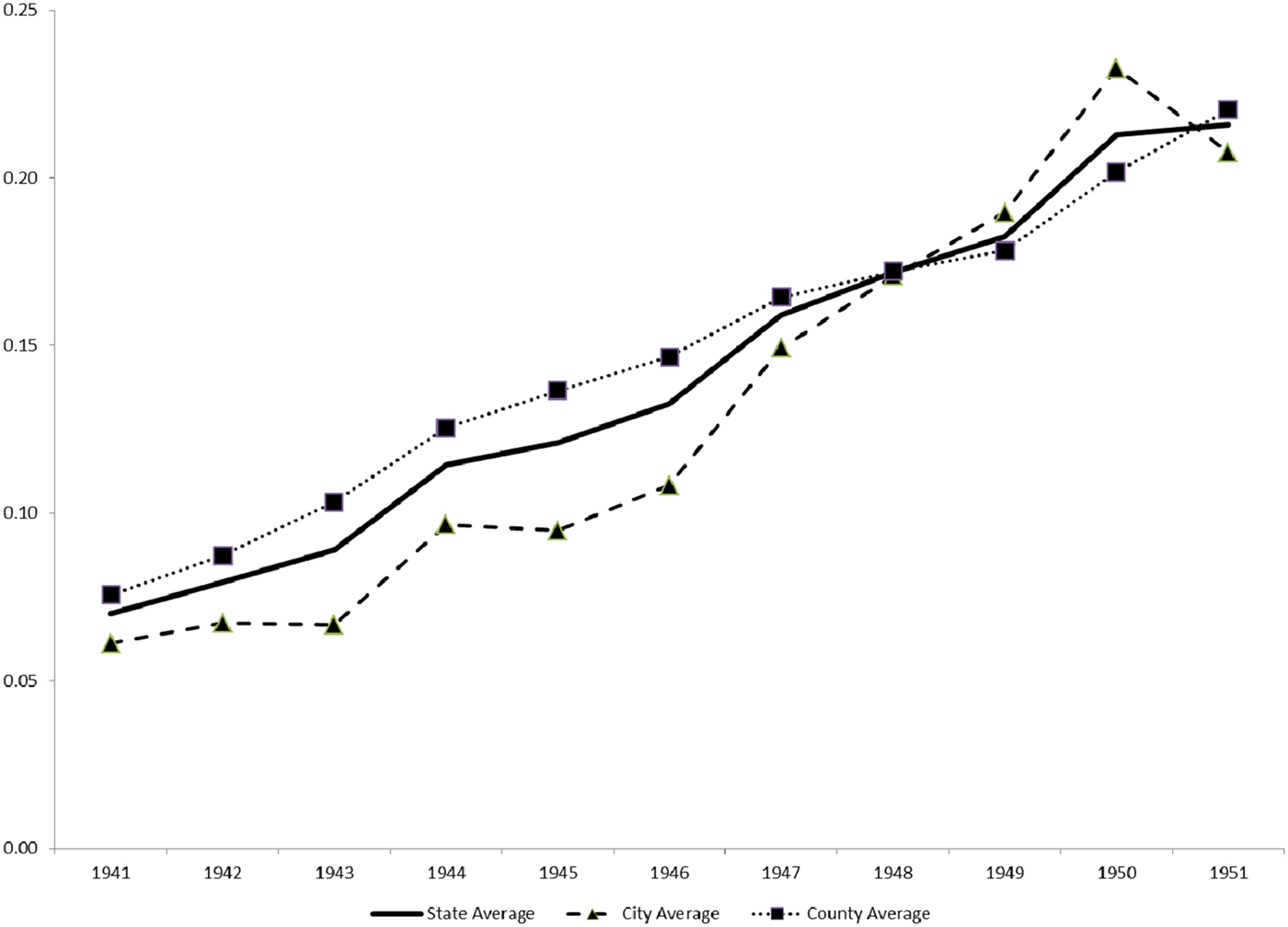
While the goal of the civic education campaigns was to create opportunities for political learning and mobilization, they also had a second purpose, which was to encourage African Americans to pay the poll tax and eventually register to vote. As part of their campaign, the VVL collected poll-tax payment data on African Americans for every county and independent city in the state.Footnote 81 From 1941 to 1951, there was a steady increase in the average rate of poll-tax payments made by blacks in Virginia (see Figure 3).
African American Poll-Tax Payment Rates in Virginia, 1941–1951.
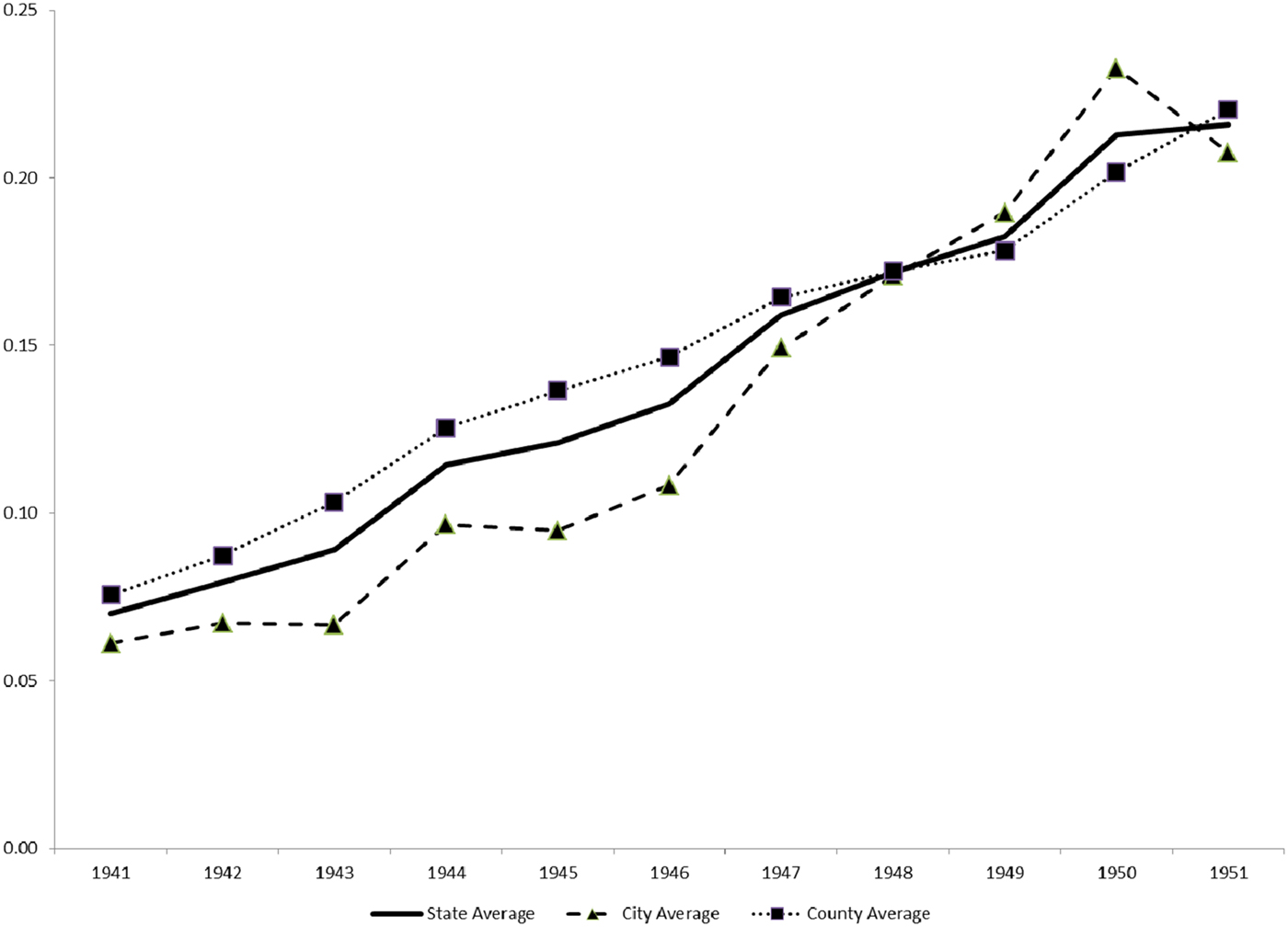
The rate of poll-tax payments among African Americans in Virginia increased from 9 percent in 1941 to 21 percent by 1951, although blacks’ incomes and occupational profile had not significantly changed in that decade.
Despite the three-year gap between first payment of the poll tax and an individual's eligibility to vote, which rendered payments made during the first two years purely symbolic, the VVL, as I will show, was able to persuade black Virginians to make a commitment to political engagement through these payments. So, while there was no immediate one-to-one translation of payment of poll taxes to votes, the poll-tax payment campaigns are important because they helped disenfranchised African Americans connect to the electoral process.
ANALYSIS AND FINDINGS
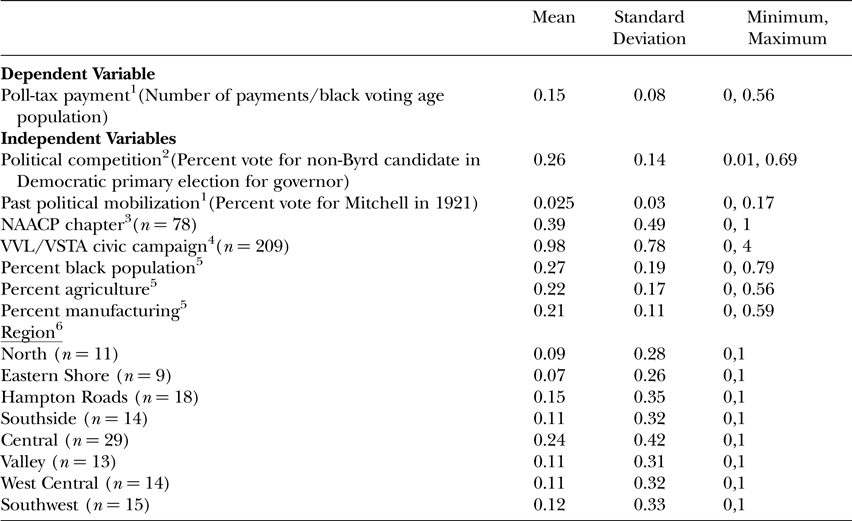
In this section, I examine the different elements of Virginia's ordered-disorder that may have influenced the poll-tax payment rate among the state's African Americans between 1941 and 1951. I analyze the poll-tax payment rate of African Americans in Virginia's 100 counties and twenty-four independent cities from 1941 to 1951. These years were chosen for two reasons. First, 1941 was the first year that reliable statewide numbers were collected and publicized by the VVL. Second, I chose 1951 because it was the year that Luther Porter Jackson, one of the main leaders of the VVL, died. Ending the analysis before 1954 also permits a look at electoral politics before the political pivot of Brown, which radicalized a significant part of the state's white political establishment. The dependent variable in the analysis is the percentage of a county's (or an independent city's) black voting-age population that made a poll-tax payment for the year. In 1941, the average rate poll tax payment rate was 9 percent, and by 1951 the state average was 21 percent (see Table 2 for summary statistics).
Descriptive Statistics: Selected Characteristics of Virginia Counties and Independent Cities, 1941–1951
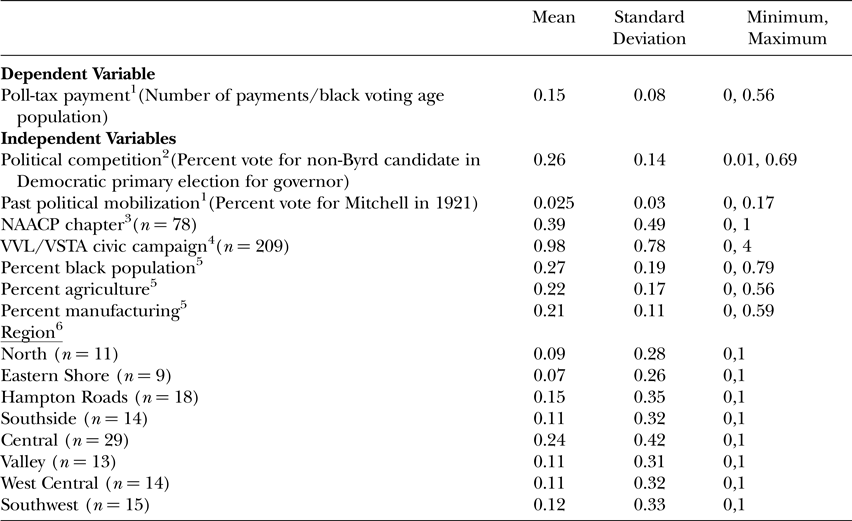
N = 1035
Notes. 1Virginia Voters League, “The Voting Status of Negroes in Virginia, 1941–1951,” LPJ papers. 2Political Competition Numbers derived from Alexander Heard and Donald S. Strong, Southern Primary and General Election Data, 1920–1949, ICPSR ed. (Ann Arbor, MI: Interuniversity Consortium for Political and Social Research [producer and distributor], 1992). doi:10.3886/ICPSR00071.v1. 3NAACP Annual Reports, 1940–1952. 4The Virginia Teachers Association Office of the “Civic Education Secretaries Office 1941–1950,” LPJ papers. 5Data from years 1941 through 1949 from 1940 U.S. Census; years 1950 through 1951 from 1950 U.S. Census. 6Regional definitions from Rebecca Tippett, “Virginia's Regions,” Weldon Cooper Center for Public Service, University of Virginia, April 11, 2011, http://www.coopercenter.org/demographics/publications/virginias-regions (accessed June 20, 2012).
Political Competition
The first element of the argument about Virginia's ordered-disorder was the role of intraparty white political competition, particularly the emergence of the anti-Byrd coalition during the 1930s and 1940s. Did the increase in party competition encourage black political engagement? Or, conversely, did black political engagement stimulate political competition? Based on the previous discussion, I suggest that party competition encouraged black political engagement. With the exception of closely fought elections such as the Hamilton-Darden campaign, most white politicians did not openly seek the black vote under ordinary conditions of political competition, nor did they see black voters as a key part of their reform coalition. While this lack of consideration might have been rooted in racial animus, it was more likely based on calculation. In 1940, the black vote was miniscule, especially outside of the cities. Therefore, when white politicians did seek out black voters, as the Hamilton campaign demonstrated, it was usually as a last resort. The VVL might have seen the growth of electoral competition in some counties as areas where demonstrating the potential of black voter engagement would be useful in stimulating more attentiveness to black issues among white politicians, as well as creating feelings of connectedness on the part of black Virginians. Certainly the correspondence with Jackson from VVL activists throughout the state revealed instances in which the growing visibility of black voters, coupled with the emergence of credible political competition, made some local politicians take notice. The first independent variable in this analysis, political competition, is the percent of county vote for the non–Byrd machine candidate.
Past Political Mobilization
The legacy of the organizational repertoire developed by the state's black political class may have also played a role in stimulating the VVL poll-tax campaign. As discussed earlier, figures such as Joseph Newsome bridged the early disenfranchisement era to the 1940s mobilization era. While not immediately successful in getting blacks back into the ballot box, these leaders may have sustained islands of black political engagement in which a black counterpublic of activists, organizations, and communication networks could exist until more favorable conditions presented themselves. Did these islands of past Mitchell supporters prove to be fruitful areas for the VVL poll-tax campaign? Were areas that had previously supported the Mitchell campaign predisposed to respond to the VVL campaign because of a legacy of earlier black activism? The second independent variable, past political mobilization, is measured by the (logged) percent of vote received by Mitchell in the 1921 election.Footnote 82
VVL Activity
The third element of Virginia's ordered-disorder was the emergence and activism of the VVL and its development of political-civic voluntarism. While the VVL and other organizations strengthened long-standing and broad networks of communication and leadership, the VVL also tried to establish new networks. Its education campaigns, coordinated by state-level activists but carried out by local actors, were aimed at not only at stimulating interest in politics, but also helping black Virginians learn important skills useful for political engagement such as organizing and running meetings and developing and presenting community needs to politicians. Did VVL campaigns influence black poll-tax payment rates in the state? If so, under what conditions? The third independent variable measures the cumulative number of civic education campaigns a county or city experienced by a particular year.
Role of the NAACP
Similarly, did the NAACP, whose fortunes in the state waxed and waned during this period, play a separate and influential role in influencing poll-tax payments? Understanding the role of the NAACP in local Southern politics is important, given that both political scientists and historians have identified the NAACP as one of the key actors in disrupting the Jim Crow order. The fourth independent variable is also a dummy variable, indicating whether a NAACP chapter was organized in a county or city.
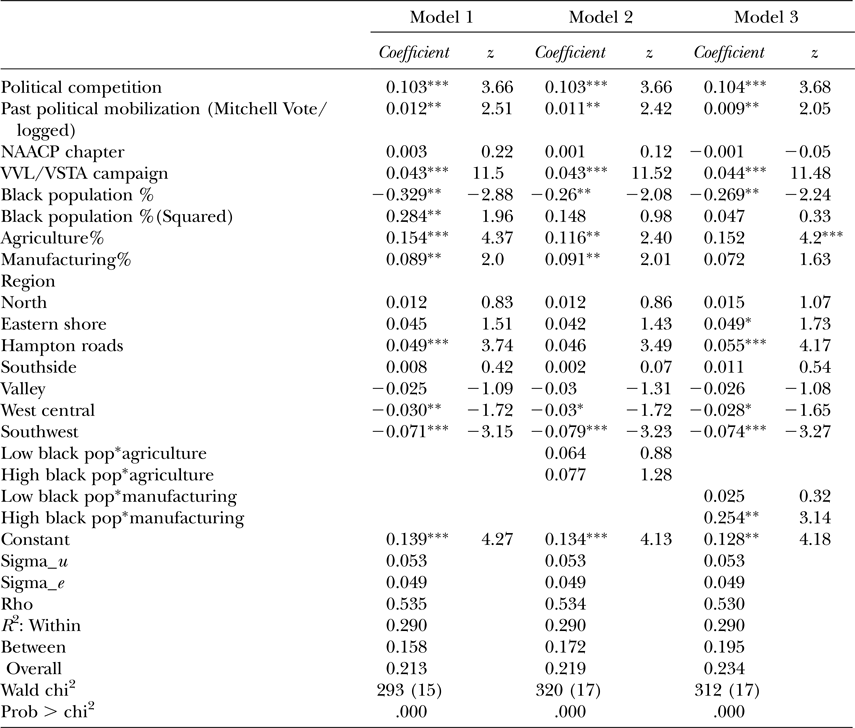
The elements of potential disorder and disruption—political competition, past political mobilization by blacks, VVL/VSTA educational campaigns, and NAACP presence—are evaluated in the quantitative analysis that follows. This analysis controls for the presence of intrastate regional differences that may have also played a role in shaping black electoral mobilization during this period. Variables controlling for the effect of (very) local racial states include the percentage of county or city population engaged in agriculture in 1940, the percentage of city or county population engaged in manufacturing in 1940, and the percentage of blacks in the total county or city population.Footnote 83 Each county or city was assigned to one of these regions, and for each region, a dummy variable was constructed, for a total of eight regions. To control for variation in population size across cities and counties, the total county population (logged) was included in the analysis. Finally, because the dependent variable changes across time and entities, and the independent variables include time-invariant variables, a random-effect generalized least squares (GLS) regression model was used to test the hypotheses.Footnote 84
Findings
Higher black poll-tax payment rates occurred in counties and cities with higher levels of political competition between the Byrd and anti-Byrd factions, holding all other variables constant. As seen in Model 1, counties that had a higher vote for the anti-organization candidate were also counties that had higher rates of black poll-tax payment (see Table 3).
Estimated Coefficients from Random-Effects GLS Models of Poll-Tax Payment Rates: Virginia Counties and Independent Cities, 1941–1951
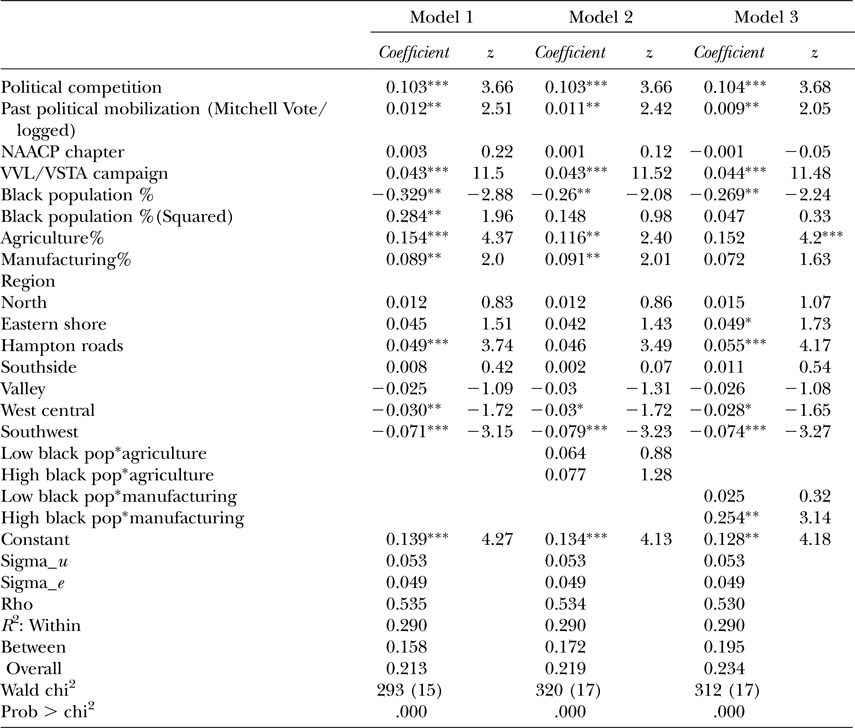
***p < .01; **p < .05; *p < .10. The region constant is central.
Notes. Low black population ≤ 15%; high black population ≥ 40%.
A 1 percent increase in the vote for the Organization opponent, holding all other variables constant at their means, corresponded to a 10 percent increase in the poll-tax payment rates of blacks. The presence of political competition, and perhaps a quiet search for votes, stimulated the VVL and its coalition partners to develop a potential pool of voters who could respond to current and future political opportunities. The disorder presented by political competition provided a window of opportunity for black Virginians. This window of opportunity did not, of course, occur everywhere in the state; not surprisingly, anti-Byrd political competitiveness and higher rates of black poll-tax payment occurred in the state's northern and southeastern corners, rather than the central and southern areas of the state, which were the heart of the Byrd machine's power. Cities and counties where there was a robust black counterpublic, such as Jackson's hometown of Petersburg and larger cities such as Norfolk and Richmond, were also places that displayed higher rates of political competitiveness.
The relationship between the political and organizational legacy of past political engagement and current black mobilization was mixed. The analysis shows that the relationship between a county's or city's vote for Mitchell and that county's or city's black poll-tax payment rate was positive and statistically significant (although small). A 1 percent increase in a county's vote for Mitchell translated into a 0.5 percent increase in a county's black poll-tax payment rate; and a county vote for Mitchell at the mean level of 3 percent translated into a 1.4 percent increase in black poll-tax payments, holding all other variables at their means. This finding suggests that, while there was not a one-to-one correlation between past political activity and mobilization in the 1940s, past political activity did have an effect, albeit attenuated, on black political mobilization twenty years or more after the mobilization took place. Thus, while some African Americans had come to believe that politics was for “white folks,” perhaps the state's cities remained repositories of past political struggles and the networks that endured after the nadir of Mitchell's loss. With the encouragement of the VVL, and possibly due to the strengthening and reinvigorating of local networks, African Americans in these areas made their poll-tax payments as the first step toward political participation.
The activism of the VVL and the VSTA had a large and significant effect on poll-tax payment rates. Indeed, the effect of VVL/VSTA activity on black poll-tax payment rates was the largest effect of the four independent variables examined. The number of times a county or city experienced a civic education campaign was found to have a positive effect on poll-tax payments. A county where one civic campaign was conducted saw an increase in the poll-tax payment rate of 4 percentage points; two civic campaigns increased the poll-tax payment rate by 8 points, while four campaigns (as occurred in some counties/cities) increased the poll-tax payment rate by 17 percentage points.
This finding is somewhat qualified, because some areas were less likely to experience multiple VVL campaigns, and some areas of the state in which fewer blacks lived (such as the state's southwestern areas) were more likely to have lower black poll-tax payment rate. To capture these intrastate differences, a dummy variable was created for each region (Table 3, Model 2). All of the variables were entered into the equation, except for one: the Central region, which is the reference category against which the effects of the other categories are assessed. The regional effects were in keeping with the earlier speculation about the effects of sociocultural-economic differences and the clustering of these differences within the state. Poll-tax payment rates were lower in the three western (and whiter) regions of the state compared to the Central region. In the Southwest region of the state, the poll-tax payment rates for blacks were nearly 7 percentage points less than in the Central region. Poll-tax payment rates were also less likely to increase in the two areas with the highest white population in the state: the Valley and West Central regions (relative to the Central region).
By contrast, the heavily black southeastern areas of the state—the Eastern Shore, Hampton Roads, and Southside regions—were each positively associated with increases in black poll-tax payment rates. The small increase in poll-tax payment rates in the Southside region, considered the heart of Virginia's black belt, are interesting despite the fact that they are not statistically significant, because this region was also the seat of the Byrd machine. The effect of region on poll-tax payment rates was especially significant in the case of the Hamptons Road region. Poll-tax payment rates in this region were 4.5 percentage points higher than in the Central region (the base variable). In some ways, this is not surprising, as the Hamilton-Darden election in 1936 presaged the rise of black political mobilization in this part of the state. In 1946, William Lawrence, an African American, was elected to the Board of Supervisors of Nansemond County, which was later absorbed into the City of Suffolk, part of the Hampton Roads region.Footnote 85
While the effect of the presence of an NAACP chapter on poll-tax payment rates was positive, it was not statistically significant. The NAACP's lack of effect was surprising, given that later studies, such as Matthews and Prothro's work from the early 1960s, had found the effect of NAACP activity on black electoral participation to be a positive one, albeit small. The effect of time on the model was also taken into account. In the case of persuading black Virginians to make a poll-tax payment, length of time was an important factor. The VVL's campaign that began in 1940 persuaded blacks not only to make a onetime payment, but also to continue to pay every year for three years until an individual qualified to register to vote. To further test the effect of time, I split NAACP chapters into two groups: those formed from 1939 to 1944 and those formed from 1945 to 1950. If the NAACP was successful in mobilizing black Virginians to pay their poll tax, then the effect should have been significant for NAACP chapters that formed in the early part of the decade. However, while there was a positive sign, the variable was not statistically significant. One reason for this lack of effect could be that the VVL and VSTA's activities, as seen in the qualitative analysis, were more explicitly directed toward electoral politics—unlike the NAACP in Virginia, which remained an organization that was not seen as directly involved in local politics. The type of resource mobilization offered by the NAACP was not a significant factor in Virginia politics during the 1940s. In stimulating the poll-tax payments, VVL activism took the lead. While local NAACP chapters may have been part of the broader coalition, VVL leadership determined where, when, and how often the campaigns took place.
DISCUSSION
Over the course of a decade, African Americans in Virginia made significant strides toward political mobilization. The rate of poll-tax payment, a necessary part of becoming a registered voter, increased every year between 1941 (when the VVL's poll-tax campaign began) and 1951.
In terms of political empowerment, the VVL poll-tax payment campaign bore significant fruit, especially in the state's independent cities. In ten of the state's cities with the largest African American population, black voter registration doubled from 1945 to 1948 (see Table 1).
African American candidates had run intermittently for office during the early twentieth century, most notably John Mitchell, Jr. By 1945, due to the increase in registered black voters, credible candidacies of African Americans began to emerge. In 1946, African Americans ran for City Council in Norfolk, Charlottesville, Danville, and Lynchburg.Footnote 86 For Jackson and other political activists, the emergence of African American political candidates created a virtuous circle. On the one hand, these candidacies played a large part in stimulating interest among potential voters; likewise, the growing numbers of black voters stimulated interest among African Americans in running for office. In 1947, the hope that Jackson and others had for a rebirth of black political mobilization received two boosts. The first was the election of William Lawrence (discussed above), and the second was the 1948 election of Oliver Hill, an attorney and a World War II veteran, to the Richmond City Council after he narrowly lost (by 191 votes) the Democratic primary for the General Assembly.Footnote 87 Hill's election is notable because it reflects the impact of the VVL's voter-registration efforts. In 1945, the number of African American registered voters in Richmond stood at 6,374. By 1948, 11,127 black voters were registered. Hill ran in a crowded race with twenty-nine other candidates for nine council seats. He finished ninth with 9,097 votes out of a total of 28,143 ballots cast.Footnote 88
The rising numbers of potential African American voters did not go unnoticed by some of the state's white politicians, especially at the local level. Correspondence to Jackson during the latter part of the 1940s contains numerous references to local white politicians paying more attention to these newly organized voters. For example, the political situation in Amelia County is particularly interesting in that it sheds some light on the changing dynamics of local politics. In 1941, the poll-tax payment rate in this county (located in the Central region of the state) was 9 percent. But by 1951, the poll-tax payment rate had increased to 29 percent. As a result of this sign of political mobilization, according to the local VVL chapter president, African Americans were
being heavily canvassed by men in the interest of their particular candidates. … So many Negroes have registered in Amelia that they are getting notice never before gotten. … P.S. This year as never before as go the Negro votes so goes the county.
One reason for this unusual attention was that the Byrd organization faced continuing challenges, especially as recent World War II veterans emerged as serious challengers to the political status quo.Footnote 89 In the case of Amelia County,
Mr. Hardy, our tax assessor is having trouble in his campaign for reelection as there is a strong young soldier running against him. He has already visited several Negroes and told them how he has stood by them and how he has assisted them in having their taxes reduced. He was over to see me Sunday and advised me to advise the Negroes [that] he was the cause of having their taxes reduced.Footnote 90
During the early 1940s, VVL members in Accomac County (Eastern Shore region) repeatedly wrote Jackson to report the uphill battle they faced in getting blacks to pay the poll tax and register to vote. By 1947, conditions had changed: Poll-tax payment rates had increased from less than 1 percent of the black voting-age population to 13 percent of that population. As a VVL member in Accomac reported:
We have decided to vote as a Bloc on August 5. Listen to this, do you remember the dirt road that runs in front of our Colored Church called Church Road? It is our colored section here in the little town of Accomac, also another dirt road through one of our largest Colored Sections have been hard surfaced due to the fact that the Supervisor in Lee District wanted to be reelected and came to me and asked for all of the Colored Votes. I told him that our people wanted these roads hard surfaced and these two roads have been done. It is a real pleasure to ride through these two Colored Sections. My people are sticking together and we are going to do things now.Footnote 91
This action was corroborated by the local paper, which reported that “nearly 5,000 votes were cast throughout Accomac. … At the polls everything was orderly and throughout the day reports came in that the county would pile up a record vote. The primary brought out the largest Negro vote in the last forty-four years.”Footnote 92 Another report—from Amherst County, located in the Southwest region of the state—stated that candidates were “now appealing to us for support this year as our voting strength is being felt.”Footnote 93 The poll-tax payment rate in Amherst increased from 6 percent to 23 percent. Still another letter writer reported in 1948 that “we are reaping a number of benefits since our election of a new mayor. We are preparing now for the election on the City manager form of government. Negroes are really playing an important part in our local elections now and it is working wonders for us. Really there is power in voting once you take notice of it.”Footnote 94 For some of Virginia's African Americans, politics rather than protest seemed to be a possible path to political mobilization.
CONCLUSION
In this article, I have addressed one part of a larger puzzle: How can political and/or socially marginalized groups engage in political activism and effect policy change within a context of few (if any) access points to political power or leverage on political power structures? The VVL is an example of how black activist communities/movements developed strategies and tools that fit with Virginia's political and institutional configurations, while simultaneously drawing from outside the state's political order for additional leverage (e.g., judicial decisions such as Smith v. Allwright to the NAACP). The VVL developed an “organizational repertoire” that was linked to the state's managed race relations model, the long-standing commitment of some black political elites to coalitional politics (e.g., black and tan Republicanism), and a willingness to engage in assertions of political self-determination (e.g., Mitchell's campaign and Newsome's court cases). The VVL's success was most apparent in the state's urban areas, where political competition and campaigns to increase political participation, coupled with the appearance of viable black candidates, resulted in political success, as measured by the election of African Americans.
The organizational repertoire employed by Jackson, the VVL, and the other moderate black leadership led to some successes, but it was also revealed as a strategy unsuitable for Virginia's post-1954 political environment. The VVL's federated structure allowed it to organize across the state under a variety of local political conditions. However, the potential strength of this federated structure was weakened as the organizational driving force was largely focused around Jackson with the assistance of VSTA members. This meant that the burden of leadership and coordination rested on a small group and was not widely enough dispersed to maintain that group, especially after Jackson's death. In addition to this weak mobilization structure, tensions grew between older, moderate black leadership and younger African Americans, as the VVL's strategy of politics did not resonate with younger Virginians. In both the fragility of its civil rights organizing and the growing generation gap, Virginia began to look much like the rest of the South. Indeed, the quick and fierce embrace of massive resistance by the state's white political and civic elites matched the equally fierce embrace of young African American activists in directly confronting the state's managed race relations model through protests and sit-ins.
The VVL strategy of politics rather protests was doomed because, as Elisabeth Clemens has argued, the more marginalized a group, the less likely an embrace of conventional strategies is able to succeed in the long run.Footnote 95 While the VVL, through its poll-tax payment campaigns, was initially able to “smuggle familiar forms into unfamiliar settings,” the VVL's coalition with anti-Byrd forces and the still-weak levels of black political engagement were not enough to help Virginia's blacks overcome the deeper political and institutional barriers that confronted them.
These findings should prod historians and political scientists, especially those engaged in APD, to probe the importance of local and state politics in shaping the early civil rights movement era and beyond. The particularities of the Virginia case offer the basis for rethinking the scope, pace, and timing of the rise and fall of the civil rights movement. With some key exceptions, while most APD accounts of the civil rights movement have focused on the conflict between the national political order and a unitary Jim Crow Southern order, this article emphasizes the importance of spatial and temporal specificity. I suggest that more attention be paid to how whites and blacks attempted to grapple with the newly emerging black vote from the 1940s onward. There should also be a greater consideration of how intergenerational and intraclass tensions within local and state African American and white communities played a role in shaping local responses to these political changes. Although the possible social and civil integration of society greenlighted by Brown may have been the last straw for Virginia's conservatives, it was preceded by a growing uneasiness about the growing and visible African American vote, and the political and social ramifications of that power. Rather than simply accepting backlash, we need to fully understand the context in which this backlash emerged and how backlash was both regionally and locally specific.
Understanding American state development as shaped by (and shaping) multiple political orders casts a new light on the significance of the modern civil rights movement on state development, both in terms of its successes and its limits. Although large-scale political and economic shifts at the national level during the 1940s were important in creating a new political arena for black political mobilization to occur, this analysis of black political mobilization in Virginia demonstrates that more analytical attention should be paid to understanding how these transformations translated into political action on the ground. A longer periodization of the civil rights era allows for a better understanding of the distinctive political, social, and institutional configurations that shaped the dynamics of civil rights activism in the South.
At the end of World War II, African Americans confronted a political and social landscape on the verge of tremendous transformation. The quest for “first-class citizenship,” in which voting played a key role, was one of the first strategies that black Southerners embraced. Yet this strategy was thwarted in two ways: first, by the continued structural barriers that blocked significant increases in the number of blacks voting, and second (and more specifically), by the nascent early black voting that was thwarted by the active hostility of white Southerners threatened by the possible consequences of black political mobilization. By the time of the Brown decision, politics as a means of securing citizenship seemed at a dead end. On the eve of Brown, Southern blacks shifted from politics to protest as the only means left to dismantle the Jim Crow order. In the complicated relationship between race and American state development, the switch from the ballot box to the street approach casts doubt on the assumption that state development and racial equality is linear or sequential; researchers should be attuned to the ways in which progression toward greater racial equality often coexists with a regression toward racial inequality.