INTRODUCTION
Non-motor symptoms of idiopathic Parkinson’s disease (PD) consist of cognitive, autonomic, sensory, and affective impairment. The mentioned problems can occur early in the course of this neurodegenerative disease, even before the characteristic motor symptoms become obvious (Wattendorf et al., Reference Wattendorf, Welge-Lüssen, Fiedler, Bilecen, Wolfensberger, Fuhr and Westermann2009). A well-known non-motor sign of PD is hyposmia, the reduced ability to smell and to detect odors (Doty, Reference Doty2014). The olfactory system is closely linked to the limbic system, which supports emotional and motivational functions. Therefore, it is not surprising that PD is accompanied by affective impairment (Borg et al., Reference Borg, Bedoin, Bogey, Michael, Poujois, Laurent and Thomas-Antérion2012). Considering the brain areas targeted by neurodegeneration in PD, it has been suggested that the afflicted patients are characterized by a specific deficit in disgust processing (e.g., Borg et al., Reference Borg, Bedoin, Bogey, Michael, Poujois, Laurent and Thomas-Antérion2012; Suzuki, Hoshino, Shigemasu, & Kawamura, Reference Suzuki, Hoshino, Shigemasu and Kawamura2006). However, a review by Assogna, Pontieri, Caltagirone, and Spalletta (Reference Assogna, Pontieri, Caltagirone and Spalletta2008) indicated that the findings on the degree and the selectivity of emotion recognition impairment in PD are rather unclear. This inconsistency may be due to different factors, such as individual characteristics of the patients which influence affective processing in general, and disgust processing in particular. A relevant factor in this context is disgust proneness. This personality trait can be defined as the temporally stable tendency of a person to experience disgust across different situations (e.g., when confronted with poor hygiene, spoiled food and other sources of potential contagion). Disgust propensity is the ease of becoming disgusted (Schienle, Walter, Stark, & Vaitl, Reference Schienle, Walter, Stark and Vaitl2002).
Of interest, the investigation of personality traits in PD has been rather limited. In their review, Poletti and Bonuccelli (Reference Poletti and Bonuccelli2012) concluded that the afflicted patients present a personality profile of low novelty seeking and high harm avoidance. To the best of our knowledge disgust proneness has not been investigated in PD as well as its underlying neuronal correlates. Relevant brain areas for disgust processing are regions involved in primary and secondary olfactory as well as gustatory processing, such as the insula, the orbitofrontal cortex (OFC), the pirifrom cortex (PC), and the amygdala (Schienle, Stark, et al., Reference Schienle, Stark, Walter, Blecker, Ott and Sammer2002). Several morphometric studies demonstrated that PD is associated with GMV reduction in these regions (Lee, Eslinger, Du, Lewis, & Huang, Reference Lee, Eslinger, Du, Lewis and Huang2014; Pan, Song, & Shang, Reference Pan, Song and Shang2012).
The goal of the present voxel-based morphometry study was to compare affective traits (trait anger, trait anxiety, and especially disgust proneness) and GMV between PD patients and healthy controls. Moreover, we expected positive correlations between GMV in the above mentioned regions involved in disgust processing and the degree of disgust proneness.
METHODS
Sixteen male PD patients and 24 healthy controls participated in the study. The groups did not differ in mean age (M PD =53.8 years (8.9), M CO =52.0 (7.9), t(38)=0.64 (p=.527), years of education (M PD =13.4 years (3.4), M CO =13.9 (3.9), t(38)=0.42 (p=.679), and did not show signs of cognitive impairment as assessed by the Test for Early Detection of Dementia (M PD =44.7 (2.8); M CO =44.6 (2.8), t(38)=0.21, p=.834) (Ihl et al., Reference Ihl, Grass-Kapanke, Lahrem, Brinkmeyer, Fischer and Gaab2000). The scores of this scale range between 0 and 50; a score below 35 indicates a tentative dementia diagnosis. Additionally, the groups did not differ in their Beck Depression Inventory scores (M PD =6.9 (5.5); M CO =6.7 (6.9), t(38)=0.10 (p=.920) (Hautzinger, Bailer, Worall, & Keller, Reference Hautzinger, Bailer, Worall and Keller1994). All patients were recruited and diagnosed with idiopathic PD by neurologists of the University Hospital in Graz (Austria). The patients had a mean UPDRS motor score (M, SD) of 38.4 (10.8) (Fahn and Elton, Reference Fahn and Elton1987). The Hoehn & Yahr rating score (Hoehn and Yahr, Reference Hoehn and Yahr1967) was 2.0 for 13 patients, 2.5 for one patient, and 3.0 for 2 patients. This indicates mild to moderate symptom intensity. Ten PD participants had right body side onset of motor symptoms and 6 had left-side onset. The symptom duration was on average M=75.4 months (SD=43.7). With one exception all patients were treated with L-Dopa and/ or a dopamine agonist (pramipexole, ropinirole).
The healthy controls were recruited by the department of Psychology of the University of Graz. We only selected male participants because PD has a higher prevalence in men, and there are significant gender-associated differences in disgust proneness (Schienle, Walter, et al., Reference Schienle, Walter, Stark and Vaitl2002) as well as in disease onset and progression (Haaxma et al., Reference Haaxma, Bloem, Borm, Oyen, Leenders, Eshuis and Horstink2007).
Written informed consent was obtained from each individual. The study was carried out in accordance with the Declaration of Helsinki and had been approved by the ethics committee of the Medical University of Graz.
All participants answered the following trait scales: The Questionnaire for the Assessment of Disgust Proneness (QADP) measures disgust propensity and describes 37 situations, which have to be judged on 5-point scales with regard to the experienced disgust (0, “not disgusting”; 4, “very disgusting”). The five subscales are a) death/deformation, b) body secretions, c) spoilage/decay, d) poor hygiene, and e) oral rejection (Schienle, Walter, et al., Reference Schienle, Walter, Stark and Vaitl2002). The Cronbach’s alpha of the total scale is.90. The trait scale of the State-Trait Anger Expression Inventory (STAXI; German version by Schwenkmezger, Hodapp, & Spielberger, Reference Schwenkmezger, Hodapp and Spielberger1992) assesses the tendency of a person to experience, express and control anger. The questionnaire consists of 4 subscales labeled “trait anger”, “anger suppression” (anger in), “anger expression” (anger out), and “anger control”. The 24 items are answered on 4-point scales (1=almost never, 4=almost ever). The Cronbach’s alpha ranges between .76 und. 87. The trait scale of the State-Trait Anxiety Inventory (STAI; Laux, Glanzmann, & Spielberger, Reference Laux, Glanzmann and Spielberger1981) measures the frequency of anxious feelings. The questionnaire consists of 20 items which are answered on a 4-point scale (1=almost never, 4=almost ever). The Cronbach’s alpha of the scale is.88. Group comparisons for questionnaire data were carried out by means of two-sample t tests using SPSS 22.0 for Windows. Effect sizes were calculated by using Cohen’s d.
For image acquisition, T1-weighted anatomical scans were acquired using a 3T Siemens Tim Trio system (Siemens, Erlangen, Germany) by means of a 3D-MPRAGE sequence (0.8×0.8×2 mm; 104 transverse slices, TR=1300 ms, TE=2.69 ms, TI=900 ms, flip-angle=9°, overall duration 4:48 min) using a 12-channel head coil.
Brain structural data were analyzed with the VBM8 toolbox (revision 343, http://dbm.neuro.uni-jena.de/vbm) for voxel-based morphometry. Individual anatomical scans were segmented into grey matter, white matter and cerebrospinal fluid partitions. An optimized blockwise nonlocal means de-noising filter, a Hidden Markov Random Field approach, partial volume estimates and normalization to MNI space by high-dimensional warping with a standard template included in the VBM8-toolbox were used for preprocessing (final resolution: 1.5×1.5×1.5 mm). To preserve brain volume and to correct for individual head sizes already in the pre-processing steps of the data, Jacobian modulation was applied to tissue class segments for non-linear normalization only. Finally, segments were smoothed by a Gaussian kernel (8 mm FWHM).
Statistical analyses (voxel intensity tests) were carried out using random effect models. Significant effects were followed up by means of simple t-contrasts. For all random effect analyses, modulated grey matter images were thresholded with an explicit mask created from the grey matter a priori template included in the SPM8 distribution (threshold >.2). We conducted simple t-contrasts to compare PD patients and controls for the following disgust-relevant regions of interest (ROIs): piriform cortex (PC), orbitofrontal cortex (OFC), insula, and amygdala. We tested the specific hypothesis that PD patients would be characterized by reduced ROI volumes. Multiple regression analyses were conducted separately for each questionnaire and each subscale to correlate the scores with GMV of the selected ROIs separately for patients and controls.
Additionally, we studied the substantia nigra, the ventral tegmental area (VTA) and the basal ganglia (putamen, pallidum, caudate nucleus) to identify disorder-specific neurodegeneration. VTA and OFC masks for the analysis were created using the WFU Pickatlas (v2.4; Wake Forest University School of Medicine) based on the automated anatomical labeling (AAL) template, while masks for the insula, amygdala, and basal ganglia regions were derived from the Harvard-Oxford Cortical and Subcortical Structural Atlas (Center for Morphometric Analysis, MGH-East, Boston, MA). ROIs for the piriform cortex and the substantia nigra were built with 5mm spheres around the following coordinates (PC: x=−22, y=0, z=−14, resp. x=22, y=2, z=−12; SN: x=±12, y=−12, z=−12). Each mask was created separately for each hemisphere. We chose a height threshold of .005 (uncorrected) and an extent threshold of 10 voxels. Results reported are based on voxel-peak-level inference with family-wise error (FEW) correction of p<.05.
RESULTS
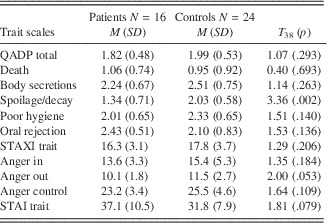
Relative to the control group, the PD patients reported significantly lowered disgust proneness toward spoilage and decay (Cohen’s d=1.06). Both groups did not significantly differ with regard to trait anger and trait anxiety. However, the control participants reported marginally higher scores on the subscale “anger out” (d=0.61) and marginally lower trait anxiety (d=0.57) than PD patients (Table 1).
Comparison of affective personality traits between PD patients and healthy controls

QADP=Questionnaire for the Assessment of Disgust Proneness; STAXI=trait scale of the State Trait Anger Expression Inventory; STAI=trait scale of the State Trait Anxiety Inventory.
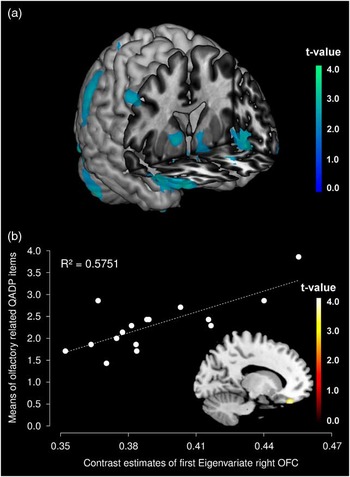
The PD patients were characterized by significantly smaller GMV in the substantia nigra (MNI coordinates x,y,z: 8,−12,−14; t=3.01, p(FWE) =.0177), the VTA (6,−12,−14; t=3.03, p(FWE)=.0257), the caudate nucleus (9,6,5; t=3.17, p(FWE)=.046), the pallidum (14,3,3; t=3.16, p(FWE)=.0284), and the OFC (−47,15,−11; t=3.76, p(FWE)=.0297) relative to the control participants (Figure 1, upper panel). Effects for the amygdala and the insula did not reach statistical significance; both ps>.30). Smaller PC volume of PD patients (−18,−2,−12; t=2.46, p(FWE)=.0479) was only detectable with a less conservative height threshold of.01 (uncorrected). The reversed contrast (PD>CO) produced no significant results.
Lower gray matter volume in Parkinson’s disease patients relative to controls (upper panel); correlation between volume of the right orbitofrontal cortex and olfactory related items of the Questionnaire for the Assessment of Disgust Proneness (lower panel). OFC=orbitofrontal cortex.

The multiple regression analysis revealed that scores of the QADP subscale spoilage/decay were positively correlated with OFC volume in PD patients (−15,36,−23; t=4.35, p(FWE)=.0370, see Figure 1 lower panel). For the control group, we observed no significant correlations.
DISCUSSION
This VBM study focused on affective personality traits which describe the tendency of a person to experience certain basic emotions (anxiety, disgust, and anger) in everyday life. PD patients differed from the control group in one particular aspect of disgust proneness: they reported lowered scores on the QADP subscale “spoilage and decay.” The associated items describe the smelling of spoiled food (e.g., smelling sour milk, rotten meat), whereas other subscales focus on the visual modality. It seems only logical that impairment of olfaction leads to reduced disgust feelings toward aversive smells, which longterm leads to a reduction of disgust-proneness for this specific domain. This observation corresponds with the fact that more than 95% of patients with PD present with olfactory dysfunction, which is typically an early sign of this disease.
In line with the self-report data the patients showed marginally reduced GMV of the PC and significantly reduced GMV of the OFC. The PC is comprised of areas in the rostro-ventral portion of the forebrain and receives direct projections from the olfactory bulb. The PC projects to orbitofrontal regions, which are involved in valence decoding, the assigning of social meaning as well as the initiation of appropriate behavioral responses (decision making). Several morphometric studies were able to demonstrate that reduced olfactory performance in PD was significantly associated with lower GMV in the PC as well as in the OFC (Lee et al., Reference Lee, Eslinger, Du, Lewis and Huang2014; Wattendorf et al., Reference Wattendorf, Welge-Lüssen, Fiedler, Bilecen, Wolfensberger, Fuhr and Westermann2009). These observations correspond with our finding of a positive correlation between olfactory associated disgust proneness and OFC volume of PD patients.
Further GMV abnormalities concerned the mesostriatal pathway with reduced volumes of the substantia nigra, the VTA, the caudate nucleus and the pallidum. Consequently, the moderate (motor) symptom severity as assessed by the UPDRS corresponded with the morphometric changes. We found no GMV reduction concerning the insular cortex and the amygdala in the clinical group, which may appear only in more advanced disease stages (e.g., Brenneis et al., Reference Brenneis, Seppi, Schocke, Muller, Luginger, Bosch and Wenning2003; Menke et al., Reference Menke, Szewczyk-Krolikowski, Jbabdi, Jenkinson, Talbot, Mackay and Hu2014).
In summary, our data demonstrate an association between PD-associated neurodegeneration and olfactory related facets of the personality trait disgust proneness. Future studies with bigger samples including females are needed. These investigations should include specific odor tests, which analyze the ability of PD patients to identify and differentiate odors that indicate spoilage.
Acknowledgments
This study was supported by the Austrian Science Fund (FWF), project number P 23258-B18. The authors declare no conflicts of interest.