Introduction
The East Asian-Australasian Flyway stretches from the Russian tundra to New Zealand, and hosts > 40% of global migratory bird species (Kirby et al. Reference Kirby, Stattersfield, Butchart, Evans, Grimmett and Jones2008, Yong et al. Reference Yong, Liu, Low, Española, Choi and Kawakami2015). Although many migratory species in this flyway are deemed to be declining due to various threats such as deforestation, agricultural expansion, and high levels of illegal trapping (Yang et al. Reference Yang, Chen, Barter, Piersma, Zhou and Li2011, Yong et al. Reference Yong, Liu, Low, Española, Choi and Kawakami2015, Jiao et al. Reference Jiao, Huettmann, Guo, Li and Ouyang2016), the status and declining rates of the most species throughout the range remain poorly understood (Newton Reference Newton2007, Yong et al. Reference Yong, Liu, Low, Española, Choi and Kawakami2015, Heim et al. Reference Heim, Trense, Heim, Kamp, Smirenski and Wink2019, but see Kamp et al. Reference Kamp, Oppel, Ananin, Durnev, Gashev and Hölzel2015, Edenius et al. Reference Edenius, Choi, Heim, Jaakkonen, Jong and Ozaki2016, Han et al. Reference Han, Zhang, Qin, Wang, Liu and Fu2018). Therefore, filling this gap is a key conservation priority in this flyway (Tarburton Reference Tarburton2014, Yong et al. Reference Yong, Liu, Low, Española, Choi and Kawakami2015).
The Brown Shrike Lanius cristatus is a long-distance migrant passerine in the East Asian-Australasian Flyway (Lefranc and Worfolk Reference Lefranc and Worfolk1997, Yosef and ISWG Reference Yosef2019). This species comprises four subspecies over a large breeding range in eastern Eurasia and typically overwinters in South-east Asia (Lefranc and Worfolk Reference Lefranc and Worfolk1997, Yosef and ISWG Reference Yosef2019). Although the global population trend is almost certainly declining, the species is not considered to meet the range size and population size criteria for the IUCN ‘Vulnerable’ category (BirdLife International 2016). Hence, this species is currently evaluated as ‘Least Concern’ on the IUCN Red List.
A subspecies of the Brown Shrike L. c. superciliosus, which typically breeds in Japan, was once a common bird in central and northern Japan (e.g. Kanna Reference Kanna1923, Yamashina Reference Yamashina1930, Tsushima Reference Tsushima1987). However, in contrast to its sister subspecies, a sharp decline in this taxon has been reported over the past several decades throughout its breeding range. For instance, Amano and Yamaura (Reference Amano and Yamaura2007) revealed that its breeding range in Japan contracted by approximately 80% between the 1970s and 1990s. Local-scale studies also reported that several breeding populations in central and eastern Hokkaido decreased or were extirpated from the 1970s to the late 1990s (Haas and Ogawa Reference Haas and Ogawa1995, Tamada et al. Reference Tamada, Hayama, Umeki, Takada and Tomizawa2017) and another population in Nagano Prefecture declined to approximately 10% from the early 1990s to the early 2000s (Imanishi Reference Imanishi2002).
However, the current population size of this subspecies remains unassessed throughout its breeding range. Because similar declines are reported in other openland migratory species in Japan such as Japanese Quail Coturnix japonica, White-throated Needletail Hirundapus caudacutus, Grey Nightjar Caprimulgus jotaka, Tiger Shrike Lanius tigrinus, and Yellow-breasted Bunting Emberiza aureola (Amano and Yamaura Reference Amano and Yamaura2007), understanding the status of L. c. supercilious may represent an essential first step to inform conservation actions for these migratory species in Japan.
Here, we estimated the current population size of L. c. superciliosus at all known breeding sites in Japan. We also conducted a comprehensive literature review and updated the extent of range contraction reported by Amano and Yamaura (Reference Amano and Yamaura2007). We documented the total population size of this subspecies at 149 breeding pairs and described a 90.9% contraction in breeding range over the past century. These results highlight the urgent need for national and international conservation action to preserve this endemic, migratory passerine.
Materials & Methods
Site selection and population surveys
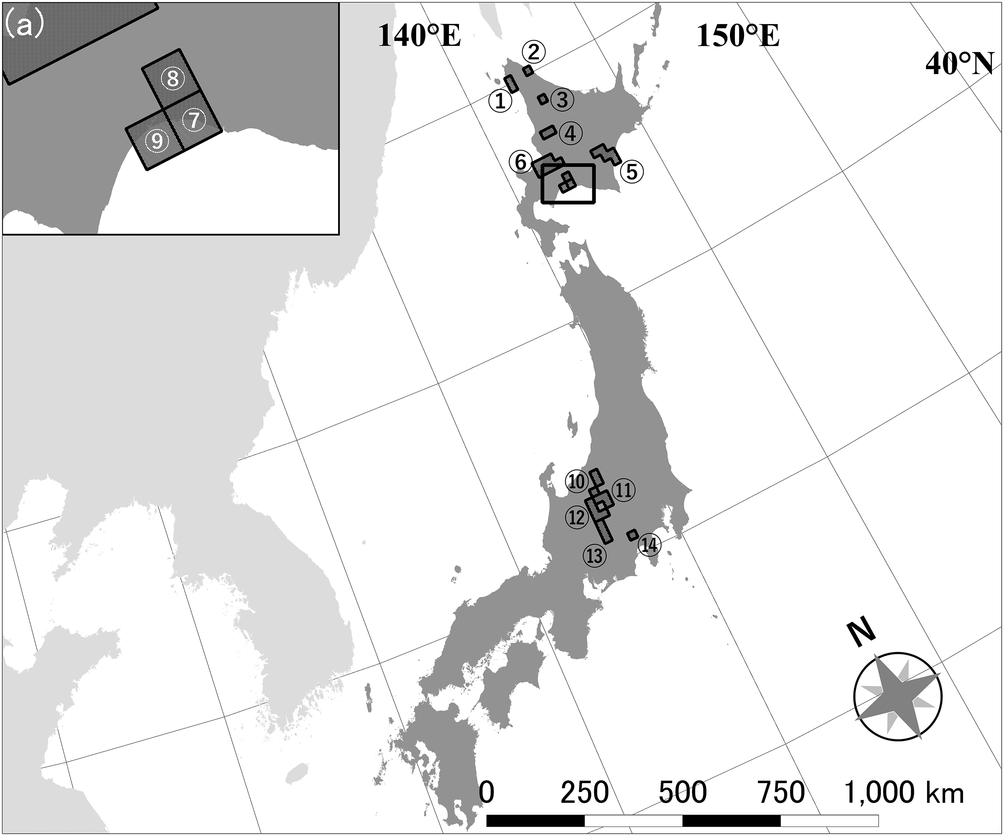
Population surveys were conducted in the following three regions where L. c. superciliosus is now confirmed to breed by literature review (see below): Hokkaido, Nagano Prefecture, and Mt. Fuji. We did not conduct surveys in other regions, as there were no reliable data to support breeding evidence of this subspecies at the initiation of this study. For each region, we first conducted interviews with local birdwatchers and asked them about recent records (2000s–2010s) of Brown Shrike (Appendix S1 in the online supplementary material). We then selected survey sites that had reliable observation records of L. c. superciliosus covering the 2000s and 2010s. We also determined high-potential breeding sites where no surveys had been conducted, although the habitat appeared suitable, using aerial imagery from Google maps (https://maps.google.com) and a vegetation map provided by the Natural Conservation Bureau of the Ministry of Environment (http://www.biodic.go.jp/trialSystem/top.html) (Appendix S2, Figure S1-2, Table S1). In total, we selected 11 survey sites (Atsuma, Abira, Fukagawa, Tomakomai, Western Ishikari, Central Ishikari, Eastern Ishikari, Tokachi, Sarobetsu, Teshio, and Hamatonbetsu) in Hokkaido, four in Nagano Prefecture (Northern Nagano, Eastern Nagano, Central Nagano, and Southern Nagano), and one on Mt. Fuji (Figure 1, Table 1).
Map showing survey site locations. 1. Sarobetsu; 2. Hamatonbetsu; 3. Teshio; 4. Fukagawa; 5. Tokachi; 6. Ishikari; 7. Atsuma; 8. Abira; 9. Tomakomai; 10. Northern Nagano; 11. Eastern Nagano; 12. Central Nagano; 13. Southern Nagano; and 14. Mt. Fuji. (a) Enlarged map of the area shown in the black square (7–9) in the upper left of the figure.

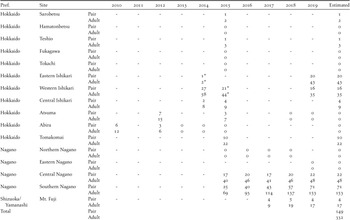
Survey years and current population status of L. c. superciliosus at each survey site. The number of breeding pairs and all mature adults (calculated by summing up non-breeders and doubled number of pairs) are shown. ‘-’ indicates no surveys were conducted at that site in that year. ‘*’ indicates surveys were conducted in part of the survey site. We estimated the current population size in Japan by summing the most recent counts for each site.

Surveys were conducted using the “look-see” method (Bibby et al. Reference Bibby, Burgess, Hill and Mustoe2000) during the breeding season (May to August) between 2010 and 2019 (Table 1). This method was suitable for our target because it has been reported that openland birds have a relatively high detectability (~0.6: Yamaura et al. Reference Yamaura, Connor, Royle, Itoh, Sato, Taki and Mishima2016). The noticeable behaviour of L. c. superciliosus (i.e. frequent fly-catching or a tendency to perch in the tops of trees) also increase detectability. At each site, we established a census route covering the entire site area; census routes were 50–29,000 m in length. Single or multiple observers slowly walked the census routes during the day (including both sunny and cloudy days) when wind speed was < 4 m/s. Observers occasionally employed audio playback of territorial calls of L. c. superciliosus using a portable speaker (BK-701D, Toshiba, Tokyo, Japan) when visibility was poor due to dense vegetation. We recorded the number of individuals detected, detection locations, and the presence of breeding evidence (e.g. territorial calls, feeding, nest construction, biparental vigilance, begging calls, or direct observations of fledglings). Each site was surveyed one to three times on different days in one or more years. We calculated the number of breeding pairs and the number of mature adults (estimated by summing up the number of non-breeders and doubled number of breeding pairs) for each site within each survey year. The former can represent an actual contribution to reproduction in a population, and the latter a more conservative status of the population. Both metrics are frequently used in population status assessment (e.g. IUCN 2001, BirdLife International 2019). We then summarized the most recent counts to provide a nationwide population size estimate.
Literature review and estimated rate of decline
To estimate the extent to which the breeding range of L. c. superciliosus has contracted, we calculated the breeding range area within current (2010s) and historical (up to the 2000s) periods. For the current period, we used results from the aforementioned population surveys. For the historical period, we summarized all historical records of L. c. superciliosus in Japan using two methods. First, we searched for published literature using a standardized search of two databases: Google Scholar for publications in English and J-STAGE for publications in Japanese. We used the search string ‘Brown Shrike’ AND ‘Japan’ for Google Scholar and translated the same search string into Japanese for J-STAGE searches. We also referred to other available sources: literature that had been cited in the resulting extracted publications, local Red Data Books, and bird checklists for each prefecture. Our second method was to individually search for records of this taxon in the following databases: the second and sixth National Survey of the Natural Environment of Japan (Biodiversity Center of Japan 2004); Breeding Bird Surveys for Tokyo Prefecture (Environmental Conservation Bureau of Tokyo Pref. 1998); The National Census of River Environment (http://www.nilim.go.jp/lab/fbg/ksnkankyo/); and the Yamashina Institute for Ornithology Specimen Database (https://decochan.net/) (Table S2). Of these, the first two sources investigated breeding bird distributions throughout Japan and in Tokyo Prefecture, respectively, between the 1970s and 1990s. The third source provided avifauna data collected along 123 major rivers throughout Japan. These surveys were conducted once every five years, and we searched records covering 1991–2018.
Once data from these sources had been obtained, we extracted observations that included exact localities, dates or seasons, and years. These observations were further categorized as those with and without evidence of breeding. Finally, we divided mainland Japan (Hokkaido, Honshu, Kyushu, Shikoku) into a grid of approximately 20 × 20-km cells. We then filled cells where L. c. superciliosus was recorded during the breeding season, summed the number of filled cells, and thereby estimated a total breeding range for both the current and historical periods. Records from Kyushu and Ryukyu were omitted because a sister subspecies, L. c. lucionensis, breeds in these regions (Yosef and ISWG Reference Yosef2019), and the majority of records did not identify which subspecies was observed.
Results
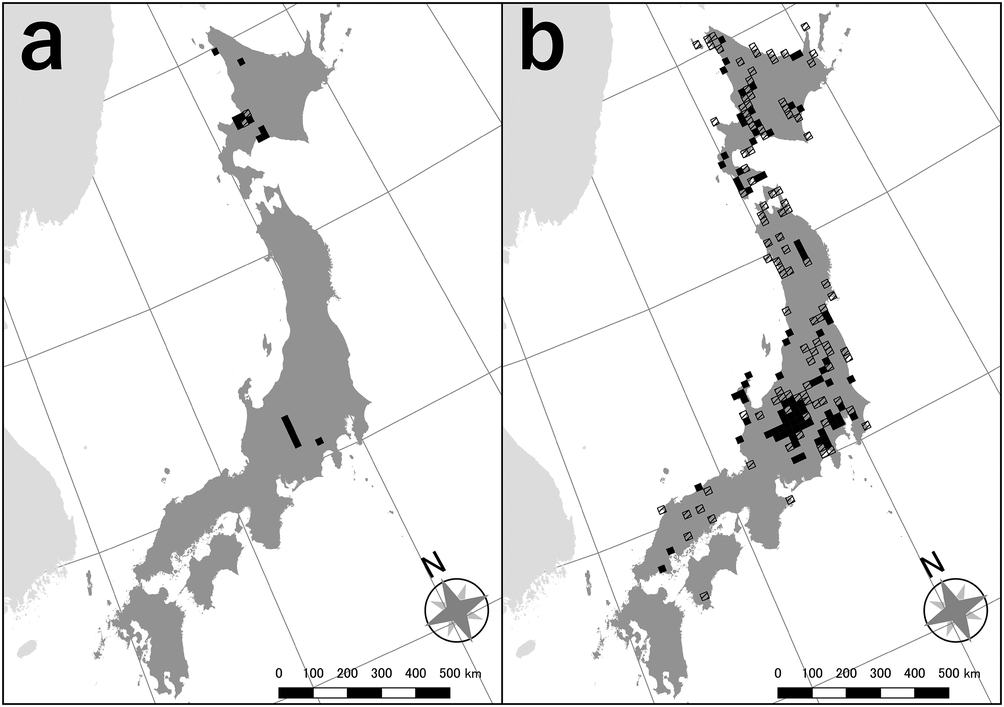
During all the field surveys, we counted 201 mature adults and 93 breeding pairs in Nagano Prefecture, 114 mature adults and 52 breeding pairs in Hokkaido, and 17 mature adults and 4 breeding pairs on Mt. Fuji (Table 1). In total, we estimated the current size of the Japanese population of L. c. superciliosus at 332 adults and 149 pairs (Table 1). Time series population data with equal survey effort after 2010 were available for seven sites (Western Ishikari, Central Ishikari, Atsuma, Abira, Central Nagano, Southern Nagano, and Mt. Fuji). Within these seven, breeding populations have been extirpated at two sites, decreased at one site, remained stable at two sites, and increased at two sites (Table 1). When field survey data were superimposed on the country-wide grid (20 × 20-km cells), we estimated that L. c. superciliosus occurs in 17 cells throughout Japan, suggesting a maximum current breeding range of 6,800 km2 (Figure 2a). Of these 17 cells, breeding evidence was confirmed in 15 cells and unconfirmed but probable in two (Figure 2a).
(a) The present (2010s) and (b) historical (1910s–2000s) breeding ranges of L. c. superciliosus. Observation records with (filled cells) and without (meshed cells) breeding evidence during the breeding season are shown.

Our literature review identified 86 published articles. Combined with additional data obtained from the four Japanese databases, we extracted a total of 532 observations that had associated spatial information. Records spanned the time period from the 1910s to the 2000s (Table S2). These data suggested that L. c. superciliosus was historically present in 186 grid cells across Japan, ranging from Hokkaido to the south of Honshu and Shikoku (Figure 2b). Of these cells, breeding evidence was available for 85 cells (Figure 2b). The historical breeding range was therefore estimated at approximately 74,400 km2, suggesting range contraction of 90.9% over the last century for this subspecies.
Discussion
We estimated the current population size of L. c. superciliosus in Japan at 332 mature adults and 149 breeding pairs. Its current breeding range was estimated at 6,800 km2, indicating that the range has contracted by 90.9% between the 1910s and 2010s, although we note that the size of the breeding range varied over time (Figure S3). Our results are critical for several reasons. First, the estimated population size and the extent of range contraction are both comparable to those of critically endangered species endemic to or occurring in Japan, such as the Bryan’s Shearwater Puffinus bryani, Okinawa Woodpecker Dendrocopos noguchii, Spoon-billed Sandpiper Calidris pygmaea, and Yellow-breasted Bunting (BirdLife International 2019). Second, the current population size of L. c. superciliosus is small enough to meet the criteria of an ‘Endangered’ species and fairly close to ‘Critically Endangered’ on the IUCN Red List (IUCN 2001), although this taxon is not given species status. Finally, of the 11 sites where L. c. superciliosus was found to breed at the beginning of the study, the populations were extirpated at two sites and declined at another after 2010. Breeding evidence was also not found at four confirmed breeding sites after 2015. Therefore, our results suggest that L. c. superciliosus is currently at high risk of extinction and highlight an urgent need for effective, immediate conservation action.
Although our surveys likely covered the majority of the breeding range of L. c. superciliosus, some literature sources suggested that this subspecies also breeds in southern Sakhalin Island, the southern Kuril Islands, and the coastal Russian Far East (Yosef and ISWG Reference Yosef2019). Moreover, we cannot exclude the possibility that there are undiscovered breeding sites in Japan (especially in Akita Prefecture: Table S2). Additional research may be desirable to elucidate the true breeding range and population size. However, we note that the three suspected additional breeding areas noted above are at the edge of this subspecies’ breeding range and that the population sizes in those locations appear to have been small. Furthermore, a recent survey failed to confirm breeding evidence of this subspecies on southern Sakhalin Island (Y. Redkin and M. Hasebe pers. comm.). Recent breeding evidence is also unavailable for Shikotan, Habomai, and Kunashiri Islands in the Kuril Islands (Panov Reference Panov2011). In coastal Russian Far East, there are some historical breeding records for this subspecies (Panov Reference Panov2011), but several other sources show that this region is outside the subspecies’ breeding range (Nechaev and Gamova Reference Nechaev and Gamova2009). Thus, the presence of a regular, breeding population in these regions may be unlikely. We believe that our estimates therefore represent a conservative, best estimate of the current status of this subspecies.
The causes of population decline within this subspecies remain unclear, but habitat loss and modification within breeding areas are likely contributing factors. Due to abandonment of natural coppice forests, the area of early successional forests in Japan has decreased by approximately 90% since the 1970s, which could result in habitat loss (Yamaura et al. Reference Yamaura, Amano, Koizumi, Mitsuda, Taki and Okabe2009). The conversion of grasslands to agricultural land is also suggested to cause the population collapse at several historical breeding sites (Takagi Reference Takagi2003). However, similar declines have been observed in intact grasslands (Tamada Reference Tamada2007, Tamada et al. Reference Tamada, Hayama, Umeki, Takada and Tomizawa2017). Thus, other factors such as habitat loss and illegal trapping along this subspecies’ migration route and/or in the overwintering area (Higuchi et al. Reference Higuchi, Morioka and Yamagishi1997) might also be contributing to the population decline. In fact, a recent tracking study revealed that the migration route of this taxon largely overlaps with coastal areas in southern China (Aoki et al. in prep.), where massive illegal trapping of the Yellow-breasted Bunting has been reported (Kamp et al. Reference Kamp, Oppel, Ananin, Durnev, Gashev and Hölzel2015). Another study also reported that the number of breeding pairs of L. c. superciliosus in Nagano Prefecture had declined drastically after long-term, extensive fires in one of the overwintering areas in Indonesia (Imanishi Reference Imanishi2002). These studies highlight the importance of habitat loss outside of breeding areas in overall population dynamics.
Despite the critically small population size of this subspecies, our limited understanding of the relationships between population dynamics and potential threats raises a question of which conservation actions may be effective or should be prioritized. We suggest protecting known breeding sites as an initial priority. Currently, most breeding sites are not legally protected and are thus exposed to development threats. Critically, we recently observed habitat loss by conversion to anthropogenic land uses at remnant breeding sites in Hokkaido, Nagano Prefecture, and Mt. Fuji (M. Kitazawa, H. Matsumiya, and H. Mizumura pers. obs.), which stresses the urgent need for the protection of remaining breeding sites. Although ex situ conservation is an option, there are many highly relevant concerns in terms of the procedures used for such action and an effective reintroduction plan if this option were to be undertaken. In Japan, ex situ conservation was unfeasible in the case of the Yellow-breasted Bunting because the Japanese population had nearly collapsed by the time the Japanese government activated the Endangered Species Act for this species. In light of this example, we still have hope for reversing the ongoing decline of this endemic shrike, depending on our future conservation actions.
In conclusion, this study revealed the drastic decline of a migratory passerine in the poorly studied East Asian-Australasian Flyway. Because there are many other long-distant migratory species with similar migratory traits and/or habitat preference to L. c. superciliosus, future studies should assess the status and trends of those species (Yong et al. Reference Yong, Liu, Low, Española, Choi and Kawakami2015). Candidate species around Japan include Tiger Shrike, Common Cuckoo Cuculus canorus, Stejneger’s Stonechat Saxicola stejnegeri, and Chestnut-cheeked Starling Agropsar philippensis (Yamaura et al. Reference Yamaura, Amano, Koizumi, Mitsuda, Taki and Okabe2009). It is also important to establish an international monitoring scheme involving many countries along this flyway (Wee Reference Wee2015, Yong et al. Reference Yong, Jain, Liu, Iqbal, Choi and Crockford2018). Finally, because land-use changes and illegal trapping in non-breeding areas would have threatened migratory species (Yamaura et al. Reference Yamaura, Amano, Koizumi, Mitsuda, Taki and Okabe2009, Kamp et al. Reference Kamp, Oppel, Ananin, Durnev, Gashev and Hölzel2015), clarifying the migration routes and wintering areas of individual species would become increasingly important for identifying conservation priority areas along the flyway (e.g. Yamaura et al. Reference Yamaura, Schmaljohann, Lisovski, Senzaki, Kawamura and Fujimaki2017 Heim et al. Reference Heim, Pedersen, Heim, Kamp, Smirenski and Thomas2018).
Supplementary Materials
To view supplementary material for this article, please visit http://doi.org/10.1017/S0959270920000556.
Acknowledgements
We thank Daisuke Aoki, Katsumi Tamada, Kazuhiro Kawamura, Masashi Hanioka, and Yuichi Yamaura for their helpful discussion, and Kanata Takaoka, Makoto Hasebe, Mutsuyuki Ueta, Shin Ichikawa, Y. Redkin, and Ministry of Land, Infrastructure, Transport and Tourism for providing the records for us. We also thank the farmers of survey sites, Tomatoh, Inc., and many birdwatchers for their cooperation with our field survey. This study was partly supported by an Avian Research Grant from the Japan Bird Research Association (2017-009).