Summations
The search identified 14 quantitative studies comparing the intended and unintended effects of seclusion and mechanical restraint.
The results of the 11 studies using a subjective outcome measure (patient preference/emotions) were in favour of seclusion, while the 3 studies using an objective outcome measure (duration of coercion/need for transition to other coercive measure) favoured mechanical restraint.
A cautious conclusion based on this review is that the availability of both methods may be necessary – as both have their pros and cons.
Considerations
The study methodology including outcome measures varied significantly across studies.
There was a high risk of residual confounding by indication and/or bias affecting the reported results.
Based on the available literature, it cannot be determined whether seclusion is superior to mechanical restraint or vice versa. Further studies using stringent methodology are required to answer this question.
Introduction
Aggressive, self-harming and violent behaviour is commonly observed at psychiatric wards (James et al., Reference James, Stewart and Bowers2012; Iozzino et al., Reference Iozzino, Ferrari, Large, Nielssen and de Girolamo2015) and threatens the safety of the patients exhibiting this behaviour as well as that of their fellow patients and the staff. When de-escalating techniques are not sufficient to handle such situations, coercive measures may be necessary to ensure the safety and survival of patients and staff (Hallett & Dickens, Reference Tingleff, Bradley, Gildberg, Munksgaard and Hounsgaard2017; Tingleff et al., Reference Hallett and Dickens2017).
The use of coercive measures is however an ethical problem, as it represents a potential violation of human rights (Kallert, Reference Fisher2008), and is associated with both physical and psychological adverse effects (Fisher, Reference Kallert1994; Steinert et al., Reference Steinert, Birk, Flammer and Bergk2013). Therefore, ever since Philippe Pinel released the insane from the iron shackles at Salpêtrière in Paris in the beginning of the 19th century (Weiner, Reference Weiner1992), it has been a priority to reduce the use of coercive measures to a minimum (Knox & Holloman, Reference Knox and Holloman2012; Molodynski et al., Reference Molodynski, Khazaal and Callard2016). Nonetheless, it has not been possible to completely avoid the use of coercion in psychiatry, and it therefore remains important to evaluate the methods being used with regard to both their intended and unintended (adverse) effects (Kallert, Reference Kallert2008).
Seclusion, that is, bringing a patient into a room (that is often padded) and locking the door, and mechanical restraint, that is, restraining a patient to a bed using belts or straps to limit movement, represent two of the most invasive coercive measures used in current clinical psychiatry (Fisher, Reference Fisher1994; Knox & Holloman, Reference Knox and Holloman2012). The use of these measures in comparable clinical situations vary greatly from country to country – and in some countries, only one of the two is used or even legal (Steinert & Lepping, Reference Steinert, Lepping, Bernhardsgrutter, Conca, Hatling, Janssen, Keski-Valkama, Mayoral and Whittington2009; Steinert et al., Reference Steinert and Lepping2010). It is thus clear that there is considerable controversy with regard to which of these measures is the most effective and conjure the least harm.
In order to inform the discussion of pros and cons of seclusion and mechanical restraint, a complete overview of the literature comparing these two methods is needed. We therefore conducted a systematic review of clinical trials and observational studies that compare seclusion and mechanical restraint by means of a quantitative measure of effectiveness and/or harm.
Methods
This systematic review was conducted in adherence to the Preferred Reporting Items for Systematic Reviews and Meta-Analyses guideline (Moher et al., Reference Moher, Liberati, Tetzlaff and Altman2009). To be eligible, a study had to meet all of the following inclusion criteria:
Mechanical restraint had to be defined as the restraining of a patient to a bed using belts or straps. Seclusion had to be defined as bringing a patient into a room and locking the door, such that the patient was alone and able to move freely within the room, but unable to leave.
The study participants had to be psychiatric patients of any age, who had been subjected to or questioned about seclusion and mechanical restraint.
The study had to compare seclusion with mechanical restraint via a quantitative measure (e.g., a questionnaire, a rating scale, or an assessment of the duration/adverse events of coercion).
The eligible designs were randomized or non-randomized clinical trials and observational studies. To ensure study quality, only articles published in journals with peer review were considered.
Information sources and study selection
A search in PubMed and Embase was conducted on November 2, 2018. As no Medical Subject Heading (MeSH) terms exists for mechanical restraint or seclusion, the search of PubMed was carried out using the following search terms: (seclusion* OR Patient Isolation[MeSH]) AND (Restraint, Physical[MeSH] OR restrain*). The Embase search was analogous and used comparable terms. The searches had no limits in terms of language or publication date. The reference manager system ‘RefWorks’ was used to remove duplicates and the remaining unique records were subsequently screened based on title and abstract. Full-text versions of the studies passing the initial screening were evaluated for eligibility based on the inclusion criteria. The references of included articles were searched for further relevant records. Both the screening and the evaluation of full-text versions were conducted independently by CSG and RSH. In cases of doubt regarding eligibility, a consensus decision was reached by CSG, SDØ, and RSH. After the selection process, the following data was extracted from the included studies: author, title, publication year, country, design, setting, number of participants, sex of participants, age of participants, psychosis status of participants, study outcome measure, and main results.
Results
A flowchart illustrating the screening of the literature is shown in Fig. 1. A total of 1439 articles were identified in the combined search of PubMed and Embase. After removal of 571 duplicates, the remaining 868 unique articles were screened. Of these, 827 were excluded as they did not meet the inclusion criteria of this review. The remaining 41 articles were eligible for full-text screening. Of these, 18 did not meet the inclusion criteria while further 10 articles reported their findings in a manner that made it impossible to differentiate between the effects of seclusion and mechanical restraint, leaving 13 articles to be included in the review. Another five potentially eligible articles were identified via a screening of the references of the 13 included articles. One of these five met the inclusion criteria, resulting in a total of 14 articles for the qualitative synthesis.
Flowchart illustrating the screening of the literature.

Study characteristics
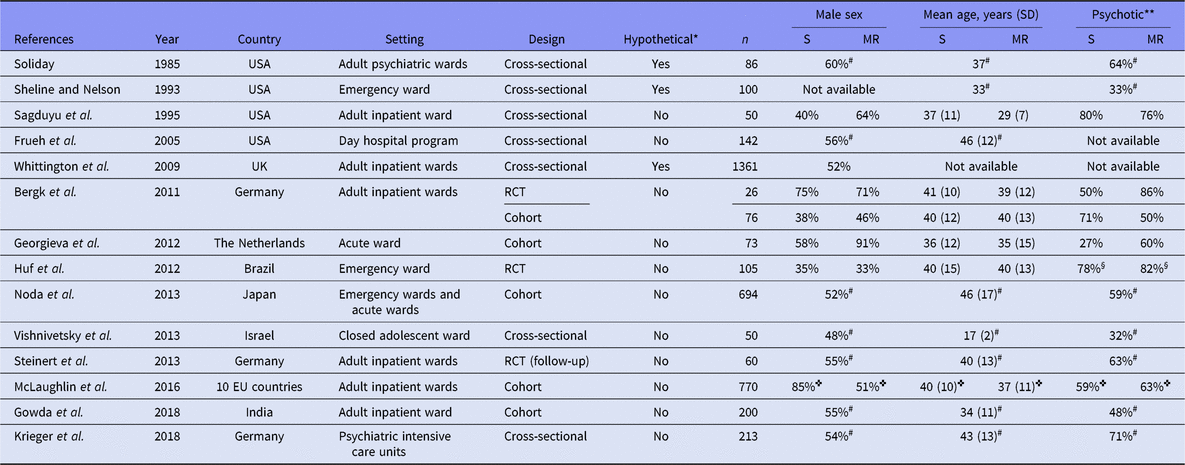
The characteristics of the studies included in the review are listed in Table 1. The included studies involved 4006 participants. Of the 14 studies, four were conducted in the USA (Soliday, Reference Sheline and Nelson1985; Sheline & Nelson, Reference Soliday1993; Sagduyu et al., Reference Sagduyu, Hornstra, Munro and Bruce-Wolfe1995; Frueh et al., Reference Frueh, Knapp, Cusack, Grubaugh, Sauvageot, Cousins, Yim, Robins, Monnier and Hiers2005), three in Germany (Bergk et al., Reference Steinert, Birk, Flammer and Bergk2011; Steinert et al., Reference Bergk, Einsiedler, Flammer and Steinert2013; Krieger et al., Reference Krieger, Moritz, Weil and Nagel2017), and one in Israel (Vishnivetsky et al., Reference Vishnivetsky, Shoval, Leibovich, Giner, Mitrany, Cohen, Barzilay, Volovick, Weizman and Zalsman2013), The Netherlands (Georgieva et al., Reference Georgieva, Mulder and Whittington2012), Brazil (Huf et al., Reference Huf, Coutinho and Adams2012), India (Gowda et al., Reference Gowda, Lepping, Noorthoorn, Ali, Kumar, Raveesh and Math2018), Japan (Noda et al., Reference Noda, Sugiyama, Sato, Ito, Sailas, Putkonen, Kontio and Joffe2013), and the United Kingdom (Whittington et al., Reference Whittington, Bowers, Nolan, Simpson and Neil2009), respectively, while one study examined patients from 10 different European countries (McLaughlin et al., Reference McLaughlin, Giacco and Priebe2016). The majority of the studies only examined adults with the exception of the study by Vishnivetsky et al. (Reference Vishnivetsky, Shoval, Leibovich, Giner, Mitrany, Cohen, Barzilay, Volovick, Weizman and Zalsman2013), which focused on adolescents. In terms of research design, two of the 14 studies were randomized controlled trials (RCTs). The RCT by Huf et al. (Reference Huf, Coutinho and Adams2012) included 105 randomized patients and the RCT by Bergk et al. (Reference Bergk, Einsiedler, Flammer and Steinert2011) included 26 randomized patients. In the study by Bergk et al., 76 patients who were considered for the RCT, but were not eligible according to the study protocol because either the responsible psychiatrist or the patient definitely preferred either seclusion or mechanical restraint, were followed as a cohort. Steinert et al. (Reference Steinert, Birk, Flammer and Bergk2013) conducted a follow-up study among the participants in the RCT/cohort study by Bergk et al. (Reference Bergk, Einsiedler, Flammer and Steinert2011). The remaining 11 studies all used an observational cohort or cross-sectional design.
Study characteristics

RCT, randomized controlled trial.
* The participants rated coercive measures they had not been exposed to or that were not available/legal in their country of residence.
** The proportion of patients with a diagnosis of schizophrenia or another psychotic disorder.
# Only reported for the entire sample and not for those subjected to seclusion or mechanical restraint specifically.
§ Including psychotic mania.
✜ Data published in Raboch et al. (Reference Raboch, Kalisova, Nawka, Kitzlerova, Onchev, Karastergiou, Magliano, Dembinskas, Kiejna, Torres-Gonzales, Kjellin, Priebe and Kallert2010).
Outcome measures
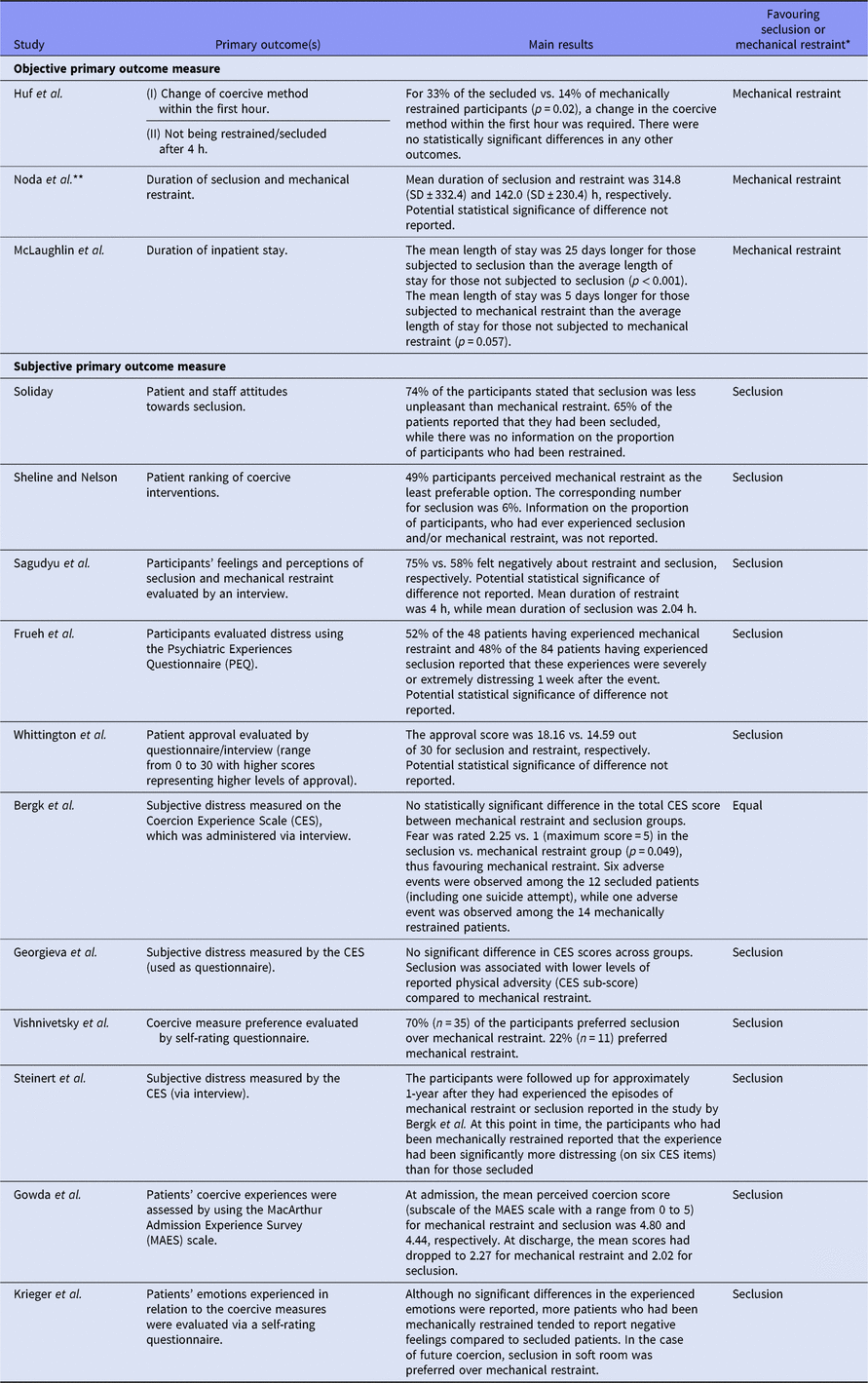
The outcome measures employed in the included studies to evaluate the intended and unintended effects of seclusion and mechanical restraint are listed in Table 2 along with the primary results. The studies by Huf et al. (Reference Huf, Coutinho and Adams2012), Noda et al. (Reference Noda, Sugiyama, Sato, Ito, Sailas, Putkonen, Kontio and Joffe2013), and McLaughlin et al. (Reference McLaughlin, Giacco and Priebe2016) used objective measures as their primary outcome. Specifically, Huf et al. (Reference Huf, Coutinho and Adams2012) chose ‘no need to change intervention early – within 1 h’ and ‘not restrained or secluded by 4 h’ as their primary outcomes. Noda et al. (Reference Noda, Sugiyama, Sato, Ito, Sailas, Putkonen, Kontio and Joffe2013) chose the duration of seclusion/restraint as their primary outcome, while McLaughlin et al. (Reference McLaughlin, Giacco and Priebe2016) chose the duration of the inpatient stay as their primary outcome.
Outcome measures and main results – stratified on the type of outcome measure

* When results of statistical comparisons were not available, this assessment was based on the numerical results reported in the studies.
** In the study by Noda et al. (Reference Noda, Sugiyama, Sato, Ito, Sailas, Putkonen, Kontio and Joffe2013), it is reported that the mean duration of seclusion and restraint was 314.8 (SD ± 332.4) and 142.0 (SD ± 230.4) h, respectively. These numbers are unusually high – as also pointed out by Noda et al., who provide the following explanation for their findings: ‘This study has found that the duration of seclusion (median, 204 h) and restraint (median, 82 h) on Japanese hospital wards responsible for acute psychiatric care are essentially 10-fold higher than those reported by previous overseas studies. It is crucial to clarify the reasons behind these long S/R durations. Structure issues, such as patient-to-staff ratios and the number of patients in wards, are factors thought to influence the duration of S/R. In Japan, the average number of beds on each emergency ward is 43.9 and the standard nurse-to-patient ratio is 0.50. In the UK, the average number of beds per ward is 21, with a nurse-to-bed ratio of 0.99, while in Norway, the average number of beds per ward is 11 with a staff-to-bed ratio of 3.5’.
In the remaining studies, patient self-ratings (questionnaires) or health personnel-administered rating scales (based on interviews with patients) were used as primary outcome measures. Generally, these assessment tools focused on the patients’ subjective experience/emotions in relation to the coercive episodes. Notably, the exact focus of these tools (i.e., the construct being measured) was rarely the same across studies and the units of measurement (Likert-type scale vs. yes/no answers) also differed substantially. Only three studies used the same outcome measure, namely Bergk et al. (Reference Bergk, Einsiedler, Flammer and Steinert2011), Steinert et al. (Reference Steinert, Birk, Flammer and Bergk2013), and Georgieva et al. (Reference Georgieva, Mulder and Whittington2012), which all used the Coercion Experience Scale (CES) as their primary outcome measure. The validity of the CES in the comparison of seclusion and mechanical restraint is debated in the Discussion section.
Comparison of seclusion versus mechanical restraint
As outlined in the paragraph above, the primary outcome measures can be grouped into two overall categories, namely I) objective (duration of coercion/inpatient stay or switch to other coercive measure needed) and II) subjective (patient preference/negative emotions). Below, we provide a synthesis of the primary results stratified into these two categories.
Objective outcome measures (duration of coercion/inpatient stay or switch to other coercive measure needed)
In two studies, the duration of coercive episodes or coercion’s effect on length of hospitalization was the primary outcome. In the study by McLaughlin et al. (Reference McLaughlin, Giacco and Priebe2016), which was based on the data from 10 European countries, it was reported that the mean length of stay was 25 days longer for those subjected to seclusion than the average length of stay for those not subjected to seclusion (p < 0.001). Similarly, the mean length of stay was 5 days longer for those subjected to mechanical restraint than the average length of stay for those not subjected to mechanical restraint (p = 0.057). The relatively longer hospital stays for the secluded and mechanically restrained patients are a likely consequence of these patients being among the most severely ill. In a multivariate analysis of this data, seclusion was associated with statistically significant increased length of hospitalization, while mechanical restraint was not (McLaughlin et al., Reference McLaughlin, Giacco and Priebe2016). Noda et al. (Reference Noda, Sugiyama, Sato, Ito, Sailas, Putkonen, Kontio and Joffe2013) examined patients from three acute and three emergency psychiatric wards in Japan and found that the mean duration of seclusion was more than twice as long as that of restraint (314.8 h, standard deviation =332.4 vs. 142.0 h, standard deviation = 230.4, difference not subjected to statistical testing). In the RCT by Huf et al. (Reference Huf, Coutinho and Adams2012), 33% of the participants allocated to seclusion versus 14% of those allocated to mechanical restraint (p = 0.02) required a change in the coercive method within the first hour.
Subjective outcome measures (patient experience/negative emotions)
As evident in the rightmost column of Table 2, the results of the studies having a subjective primary outcome measure are generally in favour of seclusion over mechanical restraint. Notably, three of these studies, namely those by Sheline and Nelson (Reference Sheline and Nelson1993), Whittington et al. (Reference Whittington, Bowers, Nolan, Simpson and Neil2009), and Soliday (Reference Soliday1985) were based on ‘hypothetical’ exposure to coercion, that is, the participants rated coercive measures they had not necessarily been exposed to – based only on descriptions of the measures. The validity of the results from these three studies is questioned in the Discussion section.
Discussion
Based on a systematic review of the literature, we identified 14 studies that compared the intended and unintended effects of seclusion and mechanical restraint in psychiatry. Most studies (n = 11) focused on the patients’ subjective experience of the coercion, while less (n = 3) used objective outcome measures such as duration of coercion/need of transfer to other coercive measure. The general pattern of the results was quite clear when stratified on whether the primary outcome measure was subjective or objective (see Table 2). Clearly, patients tended to consider seclusion to be less intrusive and more acceptable than mechanical restraint, while the objective results showed that mechanical restraint was associated with a more favourable outcome than seclusion with regard to the duration of coercion and the need for change of coercive intervention – the latter also representing a proxy for the safety of the interventions. This discrepancy between the subjectively and objectively measured results seems to capture the essence of the ethical dilemma of coercion quite well: How do we provide safe/effective treatment of patients at imminent risk of harming themselves or others – without causing them (predominantly psychological) harm? As outlined by the results of the studies identified by this systematic review, there is no easy answer to this question.
The studies covered by this review have some important methodological shortcomings, which are discussed below.
Confounding by indication
The vast majority of the studies (11 of 14) included in this review are of observational nature, that is, the study participants are patients being subjected to either seclusion or mechanical restraint as part of standard clinical practice. Consequently, as the participants in these studies are not randomly allocated to the two interventions, the results of these studies are very likely affected by confounding by indication (i.e., the selection of either seclusion or mechanical restraint is associated with a particular outcome). Specifically, we speculate that the patients exposed to mechanical restraint generally exhibit more aggressive, self-harming and violent behaviour than those exposed to seclusion. Consequently, when initiating mechanical restraint, the force needed to restrain a patient is likely more intense than that used to seclude a patient. This, in turn, may affect the outcome of the studies included here, such that mechanical restraint will be perceived to be more restrictive and more intrusive than seclusion – due to the mere allocation to/indication for the two methods. While it may be possible to adjust for part of the effect of this confounding in statistical analyses, there appears to be a substantial risk for residual confounding. Hence, the results of the observational studies included in this review should be interpreted with great caution – as they may favour seclusion over mechanical restraint due to residual confounding by indication.
Bias in randomized controlled trials
The ideal research design to avoid confounding (by indication) and establish causality is the RCT. We identified two RCTs in our systematic review of the literature. The primary threat to the internal validity (causal inference) of RCTs is bias. The main source of bias in RCTs of seclusion versus mechanical restraint is most likely that blinding of the participants is impossible (a so-called performance bias), as they will inevitably know whether they have been secluded or mechanically restrained. Based on the available data, it cannot be determined how such a bias would affect the results. If the outcome measure is self-rated, it seems likely that there will be a bias against the mechanical restraint, which appears to be disfavoured a priori by individuals that have not actually been exposed to it – as demonstrated in the studies by Soliday (Reference Soliday1985), Sheline and Nelson (Reference Sheline and Nelson1993), and Whittington et al. (Reference Whittington, Bowers, Nolan, Simpson and Neil2009). Based on the results of these studies, it appears that there is an inherent fear of mechanical restraint, which could affect self-ratings in RCTs of seclusion and mechanical restraint as well.
Another bias, which may be in play in relation to both RCTs is associated with the outcome measures being used. The RCT by Bergk et al. (Reference Bergk, Einsiedler, Flammer and Steinert2011) used the CES as the primary outcome measure. In fact, the CES was developed/validated as an intrinsic part of the RCT, which is an unusual approach from a psychometric perspective. Ideally, the scale would have been developed and validated prior to designing and conducting the actual trial. Furthermore, and perhaps most importantly in relation to the comparison of seclusion and mechanical restraint performed by Bergk et al. (and in the follow-up study of the same population performed by Steinert et al., Reference Steinert, Birk, Flammer and Bergk2013), the CES contains several items pertaining to restrictions in mobility: ‘HR2 – Restrictions to ability to move (extent)’, ‘HR3 – Restrictions to ability to move (experience)’, ‘S1 – Not able to move’, and ‘S16 – Washing body hygiene in presence/by aid of staff’ (Bergk et al., Reference Bergk, Einsiedler, Flammer and Steinert2011). These items appear to introduce a significant measurement bias in the comparison of seclusion and mechanical restraint (favouring the former), as mechanical restraint – per definition – restricts the ability to move and increases the necessity of personal care (hygiene) aided by staff.
In the randomized study by Huf et al. (Reference Huf, Coutinho and Adams2012), a measurement bias is probably introduced via the definition of the primary outcome: ‘no need to change intervention early – within 1 h’. For this outcome to be unbiased, a strong underlying assumption must be met, namely that the a priori likelihood of needing to change intervention inherent to mechanical restraint and seclusion is equal. This assumption is however unlikely to hold true, because there can be a highly acute need for transferring patients from seclusion to mechanical restraint (due to self-harm), whereas the need for the opposite transition (from mechanical restraint to seclusion) is likely to be less acute. This is underlined by the ‘adverse events’ findings from the RCT by Bergk et al. (Reference Bergk, Einsiedler, Flammer and Steinert2011): ‘During seclusion episodes, six adverse events were observed: severe agitation with damage to the seclusion room (N = 1), attempted suicide (N = 1), fracture (N = 1), and self-harm (N = 3). During mechanical restraint episodes, one adverse event was observed: retraumatisation of a former torture victim’. Therefore, using ‘no need to change intervention early – within 1 h’ as outcome measure will introduce a bias against seclusion. The quoted paragraph from Bergk et al. also highlights a very important aspect to consider when comparing seclusion and restraint, namely that patients can cause considerable physical harm to themselves – including suicide or accidental death (Nelson et al., Reference Nelson, McKinney, Ludwig and Davis1983) – while being secluded, something that seems less likely to happen during properly supervised mechanical restraint. On the other hand, (prolonged) mechanical restraint may increase the risk of venous thromboembolism and death for other reasons (Rakhmatullina et al., Reference Rakhmatullina, Taub and Jacob2013).
Outcome measures
As outlined in the Result section, one of the prime challenges in comparing the studies identified by this review of the literature is the heterogeneity of the outcome measures being used. Furthermore, only a few of the outcome measures have been subjected to psychometric validation; thus, it is unclear whether they measure the construct they are intended to tap into. The CES is the only tool, which is used as primary outcome measure in more than one study included in this review. Specifically, the CES was used in the studies by Bergk et al. (Reference Bergk, Einsiedler, Flammer and Steinert2011), Steinert et al. (Reference Steinert, Birk, Flammer and Bergk2013), and Georgieva et al. (Reference Georgieva, Mulder and Whittington2012). We have already mentioned the measurement bias introduced by the CES in the comparison of seclusion and mechanical restraint, but there is another potential problem with regard to this scale. The CES consists of 29 items, covering six ‘factors’: Humiliation, Physical adverse effects, Separation, Negative environment, Fear, and Coercion. The CES has been tested against a number of external validators, most importantly, the total score of the CES correlated highly significantly (r = 0.79, p < 0.001) with self-ratings on a visual analogue scale (VAS) assessing global strain experienced in relation to coercion. This indicates that the CES has ‘clinical validity’, that is, it taps into the global subjective experience of coercion-associated strain. However, the CES has not been tested for a very important aspect of psychometric validity, namely ‘scalability’ (also referred to as unidimensionality in the psychometric literature) (Bech, Reference Bech2012). Scalability describes the extent to which the symptoms represented by the items on a rating scale appear in an orderly manner, as the severity of the underlying latent dimension increases, such that scoring on higher prevalence items (representing less severe symptoms) tends to precede scoring on lower prevalence items (representing more severe symptoms). Only when scalability is present can the individual item scores of the rating scale be added to a total score, which reflects the overall severity of the latent dimension (Bech, Reference Bech2012). Rating scales consisting of more than 10–12 items (the CES has 29) are rarely scalable for two overall reasons: (i) the items are overlapping such that each of them do not contribute with unique information regarding severity (redundancy), and (ii) the scale covers multiple latent dimensions, which should actually be considered as individual scales (Bech, Reference Bech2012). When looking at the items included in the CES, both redundancy and multidimensionality are likely to be in play – questioning the validity of this scale. If the CES is not scalable, the total score is not a mathematically meaningful measure for the subjective burden experienced by patients as a consequence of coercion. Prior to being employed in future studies, the scalability of the CES should therefore be evaluated by means of item response theory analysis (Bech, Reference Bech2012). Alternatively, it would seem that a simple VAS of the global burden of coercion is very likely to be a superior outcome measure when comparing different coercive measures. Using a global scale would also seem to circumvent the measurement bias introduced by the CES in the comparison of seclusion and mechanical restraint.
Studies on ‘hypothetical’ exposure to coercion
Three of the studies included in this review focused on ‘hypothetical’ exposure to coercion (see Table 1), that is, the participants rated coercive measures they had not necessarily been exposed to – based only on descriptions of the measures. Obviously, the results of such studies should be interpreted with great caution. It would however be interesting to have the assessment of hypothetical coercion from patients who are subsequently exposed to these types of coercion to determine whether they change the perception of the coercive measure after the actual exposure to it. This would reveal any potential misconceptions of coercion.
Limitations of the systematic review
There are limitations to this systematic review that should be considered by the reader. First and foremost, we restricted our focus to seclusion and mechanical restraint and did not include, for example, coercive medication. We chose this focus because seclusion and mechanical restraint are generally considered to be the most invasive coercive procedures used in psychiatry, and there has therefore been a particular focus on these two interventions in the field in general, as well as in the literature (emphasized by the two RCTs included in this review). In clinical practice, less intrusive alternatives to seclusion and mechanical restraint, such as pro re nata (as needed) medication, intermittent/constant observation, verbal de-escalation, and ‘time out’, should of course also be considered (D’Orio et al., Reference D’Orio, Purselle, Stevens and Garlow2004; Whittington et al., Reference Whittington, Bowers, Nolan, Simpson and Neil2009; Bowers et al., Reference Bowers, Ross, Nijman, Muir-Cochrane, Noorthoorn and Stewart2012).
Another limitation of this review is that the vast majority of the included studies did not report on important characteristics of the wards – such as their bed capacity, single or shared rooms, noise level, staff to patient ratio, and the training level of the staff. While this is not a limitation of the comparison of seclusion and mechanical restraint per se – as these characteristics will tend to be comparable within the individual studies comparing these two interventions – it is a limitation for the generalizability of the results to specific clinical settings.
Reviews of the literature are sensitive to publication bias. Such a bias is introduced if results of a certain nature are more likely to be published – or not to be published – for instance, if studies favouring mechanical restraint would remain unpublished because researchers/reviewers/editors had a conscious or subconscious preference for seclusion. Based on this review, it is not possible to determine whether such a bias exists or its direction (favouring seclusion or mechanical restraint).
As outlined in the paragraph entitled ‘Bias in randomized controlled trials’, measurement biases (in both directions) are likely to affect the results covered by this review. In future comparative studies of seclusion and mechanical restraint (and other coercive measures), researchers should therefore carefully consider which outcome measure to use. As pointed out previously, a simple VAS of global burden of coercion may be the ideal (least biased) comparative measure.
Selection bias may also have affected the results of this review because not all eligible participants for the studies have consented to participate. If participants with a particular opinion on/response to seclusion or mechanical restraint have opted out (or in), it will have caused bias. Whether such a bias has affected the results of this review cannot be determined with the data at hand – as information on those not participating in the studies is not available.
Finally, although the search was relatively broad and the screening conducted by two independent researchers, we cannot exclude that relevant literature has been missed. However, if this has indeed happened, it is likely to have occurred at random and should therefore not bias the review.
Conclusion
Based on the currently available literature – and the limitations of the conducted studies in particular – it cannot be determined whether seclusion is superior to mechanical restraint or vice versa. Further studies using stringent designs (preferably RCTs) and sound outcome measures are required to answer this question. A cautious conclusion based on this review is that the availability of both seclusion and mechanical restraint may be necessary – as both have their pros and cons. Specifically, patients generally seem to prefer seclusion over mechanical restraint, but mechanical restraint appears to be a safer option for patients exhibiting severe self-harm. Thus, the availability of both options will likely result in the best-tailored treatment for the individual patient – and allow for the patient’s preference to be considered.
Acknowledgements
The authors thank research librarian Helene Sognstrup, The Royal Library, Aarhus.
Author contributions
The study was designed by RSH and SDØ. The screening of the literature was performed by CSG and RSH. Data extraction was performed by all authors. All authors drafted and approved the final version of the manuscript prior to submission.
Financial support
This research received no specific grant from any funding agency, commercial or not-for-profit sectors. SDØ is supported by Independent Research Fund Denmark (7016-00048).
Conflict of interest
None.