Introduction
The extinct genus Pseudoperissolax Clark, Reference Clark1918 constitutes a very small group of poorly known gastropods found predominantly in Paleocene and Eocene rocks along the eastern and western coasts of the Northern Pacific Ocean. The best record of Pseudoperissolax is in a region of the northeast Pacific extending from Washington to northern Baja California, Mexico (Fig. 1), hereafter simply referred to as the “northeast Pacific.” The full potential of using this genus for biostratigraphic purposes in this region, however, has been hindered because of the uncertainty as to how many species are actually represented. Analysis of the paleobiogeography of this genus has been stymied because for many years Pseudoperissolax was equated with the very poorly known, but widely used, genus Perissolax Gabb, Reference Gabb1864. The familial placement of Pseudoperissolax also has been equivocal because of incomplete knowledge about its morphology.
Localities and latitudinal distribution of northeast Pacific species of Pseudoperissolax.

Primary goals of the present study are to clarify the taxonomic relationship between Pseudoperissolax and Perissolax, to establish the number of northeast Pacific species of Pseudoperissolax, and in so doing, document their morphology, as well as update their biostratigraphy and geographic distribution. Ancillary goals are to establish the familial position of this genus and to make the first attempt to understand the global paleobiogeographic distribution of Pseudoperissolax.
Material and methods
This study is based on museum-collection specimens. The examined specimens are from argillaceous siltstone and sandstone. Specimens are generally scarce, but, locally they are abundant. Preservation is overall poor. Most specimens are incomplete, with their upper spire and most of their siphonal canal missing. A high-speed drill and diamond-coated drilling wheels of very small size were used for careful cleaning of the aperture of some of these specimens, and the findings are the main basis for new morphologic information concerning the genus. Morphologic terms used herein are from Cox (Reference Cox1960).
Most of the provincial molluscan “stages” used in Figure 2 are informal (in quotation marks). As discussed by Squires (Reference Squires2003), they stem predominantly from Clark and Vokes (Reference Clark and Vokes1936) and Weaver et al. (1944) and apply mostly to California and Baja California. Givens (Reference Givens1974) reported that although these stages and their boundaries are poorly defined, they are commonly recognizable. The Galvinian and Matlockian stages used in Figure 2 are formal (not in quotation marks) and apply mostly to Washington and Oregon. Squires (Reference Squires2003) discussed the history of the derivation of these two stages.
Chronostratigraphic ranges of northeast Pacific species of Pseudoperissolax. Ages of epochs, European-stage boundaries, paleomagnetic chrons/polarities, calcareous nannofossil zones, and timing of global-climatic events from Gradstein et al. (Reference Gradstein, Ogg, Schmitz and Ogg2012, figs. 2.2, 28.9). Northeast Pacific provinicial-molluscan “stage” boundaries based on Squires (Reference Squires2003, fig. 2.1). Dashed line=inferred lineage.
Much of the material used in this study is housed in the Natural History Museum of Los Angeles County Invertebrate Paleontology collection (LACMIP). Information about its localities can be accessed through the LACMIP website link: http://ip.nhm.org/ipdatabase/locality_show. Some of the examined material, collected by the author, was originally part of the California State University Northridge (CSUN) fossil collection. This collection was transferred to the LACMIP collection (Groves et al., Reference Groves, Filkorn, Squires and Johnson2003), and all former CSUN localities have been converted to LACMIP localities by adding 40,000 to the CSUN number. Information about type localities of some of the species mentioned in this present investigation can be accessed through the University of California (Berkeley) website and link: http://ucmpdb.berkeley.edu.
In compiling the synonymies presented here, citations accompanied by illustrations are generally the rule. A few that did not have accompanying illustrations were cited because useful taxonomic, morphologic, and/or geologic comments were provided. New stratigraphic occurrences of Pseudoperissolax detected during the course of this present investigation are indicated as “new information” in the “Occurrence” sections.
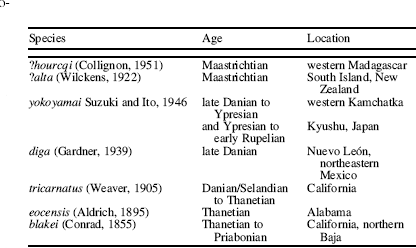
Table 1, which lists species from throughout the world that are placed by the present author in Pseudoperissolax, was based on a comprehensive literature search. The author’s placement of these species in Pseudoperissolax relied heavily on the illustrations found in the literature.
Age and geographic distribution of Pseudoperissolax species
Institutional abbreviations
CAS=California Academy of Sciences (San Francisco); CSUN=California State University, Northridge; LACMIP=Natural History Museum of Los Angeles County, Invertebrate Paleontology; PU=Purdue University, Lafayette, Indiana; UCMP=University of California Museum of Paleontology (Berkeley); USNM=United States National Museum (Washington, D. C.).
Systematic paleontology
Class Gastropoda Cuvier, Reference Cuvier1797
Clade Neogastropoda Wenz, Reference Wenz1938
Family Muricidae Rafinesque, Reference Rafinesque1815
Remarks
Modern-day muricids live mainly at shallow depths in tropical and subtropical waters. They are epifaunal carnivores that prey (or scavenge) upon other invertebrates, such as bivalves, gastropods, and barnacles. Muricids commonly bore the shells of their prey, but, they are also known to use their powerful foot to pry apart or to hammer the shells of bivalves. In most cases, development is direct because they are gonochoristic, but, rarely, they can have a pelagic larva (Boss, Reference Boss1982). The earliest known muricid is Poirieria (?Paziella) cenomae Garvie, Reference Garvie1991 from Upper Cretaceous (Cenomanian) strata in Germany.
Subfamily Muricinae Rafinesque, Reference Rafinesque1815
Remarks
Barco et al. (Reference Barco, Claremont, Reid, Houart, Williams, Cruaud, Couloux and Oliverio2010) reported that based on molecular phylogenetics, the Muricinae is not monophyletic and is in need of a modern phylogenetic study.
Genus Pseudoperissolax Clark, Reference Clark1918
Type species
Busycon? blakei Conrad, Reference Conrad1855, by original designation; late Paleocene to late Eocene, southwestern Washington, southwestern Oregon, California, and northern Baja California, Mexico.
Diagnosis
Shell size medium, up to height 62 mm height (spire incomplete). Fusiform with angulate whorls, spire moderately high, last whorl subquadrate, neck constricted, siphonal canal approximately half of shell height. Apical angle 72° to 84°. Protoconch 1.5 to 1.75 whorls, lowly domal, smooth. Teleoconch up to approximately 7.5 whorls. Suture impressed and can show variation in dip on spire whorls. Early on spire, spiral riblets develop, and convex whorls transition into shouldered whorls consisting of ramp, weak carina with nodes on shoulder, and several unnoded spiral riblets (with spiral lirae in interspaces) anterior to carina but slightly weaker than carina. Spiral riblets also present, at this stage, on dorsal side of long, anterior siphonal canal. All subsequent whorls covered by spiral riblets becoming increasingly stronger with growth. Ante-penultimate and penultimate whorls with single, prominently angulate carina bearing many lenticular nodes. Shell anterior to carina becoming less convex and more straight sided with growth. Last whorl with two or three (rarely four) prominently angulate carinae bearing numerous spinose, pustulose, or lenticular nodes. Aperture subquadrate. Outer lip simple but varix can be present, as well as several closely spaced varices near outer lip. Penultimate whorl can have single varix on left side of whorl. Varices can be somewhat aligned but not continuous. Outer lip without lirae on interior. Columella smooth, except for single rare pseudofold near base of columella on at least one species. Inner lip can have inductra. Siphonal canal long, straight, and smooth. Growth line opisthocline near carinae, opisthocyrt on ramp.
Remarks
The familial classification of Pseudoperissolax has been inconsistent. Clark (Reference Clark1918) assigned it to fusids, and Stewart (Reference Stewart1927) assigned it to a group entitled “Genera of Doubtful Systematic Position.” Vokes (Reference Vokes1939) questionably assigned it to muricids but provided no discussion as to basis of his assignment. Wenz (Reference Wenz1943) assigned it to vasids, whereas Davies (Reference Davies1935), Saul (Reference Saul1988), and Stilwell (Reference Stilwell1993) assigned it to tudiclids. Both vasids and tudiclids were placed in the neogastropod turbinellid family by Bouchet and Rocroi (Reference Bouchet and Rocroi2005). Although Pseudoperissolax has a long, straight siphonal canal like that found on tudiclids, as well as on neogastropod columbariids, Pseudoperissolax differs from both groups by having a narrower apical angle, higher spire, varices, inductra, a non-globose protoconch, no parietal fold, and no lirae on the outer lip interior.
Pseudoperissolax is placed here in subfamily Muricinae of family Muricidae based on the presence of inductra on the columella; a long, straight and smooth siphonal canal; and presence of varices. Pseudoperissolax is similar to the muricine genera Murex Linnaeus, Reference Linnaeus1758 sensu stricto; Haustellum Schumacher, Reference Schumacher1817; and Bolinus Pusch, Reference Pusch1837. Ponder and Vokes (Reference Ponder and Vokes1988) reported that convergence has presumably resulted in Murex, Haustellum, and Bolinus all having a similar long anterior canal, and the present author believes that Pseudoperissolax should also be included in this list. Pseudoperissolax differs from these other three genera by having much less well developed and fewer varices. In addition, Pseudoperissolax differs from Murex by not having numerous, long spines emanating from the varices. Although Haustellum also lacks these spines, Pseudoperissolax differs also from Haustellum by not having a nearly circular aperture.
Pseudoperissolax is most like Bolinus, but the former differs by having a higher spire, very poorly developed and fewer varices, less developed spines on the varices, much more extensive inducta, no row of spines on the siphonal canal, and no crenulations nor denticles on the interior of the outer lip. Merle et al. (Reference Merle, Garrigues and Pointier2011, pls. 28–30) reported the geologic range of Bolinus to be early Oligocene to Holocene, and they illustrated nearly all the known species. They also reported a questionable late Eocene species from the southeastern United States, whereas the other species are from northern Europe. Bolinus is also found today, however, at Isla Blanquilla, off the coast of Venzuela, southern Caribbean Sea, South America (Myers and Hertz, Reference Myers and Hertz1994). Extant species of Bolinus, including its type species Bolinus brandaris (Linneaus, Reference Linnaeus1758), live predominantly in the Mediterranean Sea and in the Atlantic Ocean in the vicinity of the Strait of Gilbraltar, as far north as Lisbon in southern Portugal and as far south as Tangier in northern Morocco (Leitão, et al., Reference Leitão, Vasconcelos, Ben-Hamadou, Gaspar, Barroso and Ruano2009; Merle et al., Reference Merle, Garrigues and Pointier2011).
The nomenclatural history of Pseudoperissolax is confusing because, unfortunately, early workers erroneously equated Perissolax Gabb, Reference Gabb1861 with Pseudoperissolax. Gabb reluctantly named Perissolax, even though he believed it to belong to a “family” with ambiguous morphologic characters. Stewart (Reference Stewart1927, Reference Stewart1930) and Wenz (Reference Wenz1943), furthermore, were undecided if Perissolax is a synonym of various other genera. Squires (Reference Squires2011, p. 1202) opined that Perrisolax is probably a nomen dubium. Gabb (Reference Gabb1861) used steinkerns (internal molds) as the basis for his genus, and he did not clearly designate a type species; thus, it is concluded herein, without equivocation, that Perissolax is a nomen dubium.
When Gabb (Reference Gabb1864) began describing California fossils that resembled Perissolax, he continued the use of this nomen dubium by placing Conrad’s (Reference Conrad1855) blakei in genus Perissolax. Clark (Reference Clark1918, p. 179) stated that “undoubtedly several different genera have been included under the name Perissolax,” and, therefore, he created Pseudoperissolax, using Buscyon? blakei Conrad, Reference Conrad1855 as its type species. Stewart (Reference Stewart1930, p. 41) overlooked the fact that Perissolax is based on steinkerns and unfortunately also equated Perissolax with Pseudoperissolax. Adding to the history of taxonomic confusion between these two names was Gardner’s (Reference Gardner1945, p. 183) agreement with Stewart’s (Reference Stewart1930) synonymy.
Clark (Reference Clark1918) did not provide an explanation of the name Pseudoperissolax. “Pseudo” is a Greek prefix meaning “false,” in an obvious reference to Clark (Reference Clark1918) affirming that Pseudoperissolax was not the same as Perissolax. “Perisso” is a Greek prefix meaning “odd” or “extraordinary.” Brown (Reference Brown1956) indicated that “laxus” is Latin for “loose, slack, or unstrung.” Its exact meaning in the context of the name Perrisolax is unknown because Gabb (Reference Gabb1861) did not provide an explanation. The root “lax” is an adjective modifying “perisso,” hence “lax” does not inherently have a gender. According to ICZN (1999), Article 30.1.4.2 and 30.2.3, when the word itself does not indicate a gender, the combination that the original author used can be taken into account. Pseudoperissolax would be masculine because Clark (Reference Clark1918) treated it as such.
Clark (Reference Clark1918) reported that Pseudoperissolax merriami Clark (Reference Clark1918, p. 181, pl. 21, fig. 4; pl. 22, figs. 10, 15) is “closely related to P. blakei Gabb.” Javidpour (Reference Javidpour1973, p. 201, figs. 2, 4, 7, 13) reported, however, that Pseudoperissolax merriami is a junior synonym of the turrid Aforia clallamensis (Weaver, Reference Weaver1916:52, pl. 4, fig. 59) of late Oligocene or early Miocene age.
Tegland (Reference Tegland1933) reported, with considerable reservations, that Pseudoperissolax? trophonoides Tegland (Reference Tegland1933, p. 133–134, pl. 13, figs. 10, 11), questionably belongs to Pseudoperissolax. Tegland’s species is based on two incomplete specimens, both missing their protoconch and siphonal canal. Both specimens differ significantly from Pseudoperissolax by having a more loosely coiled teleoconch, narrower apical angle (60° rather than 72° to 84°), prosocline rather than an opishtocyrt growth line on the ramp, and an inwardly directed whorl face anterior to carina rather than straight sided. Better specimens are needed to determine the generic and familial assignments for Tegland’s species, which is known only from the lower Oligocene Blakeley Formation, Kitsap County, Washington (Weaver, Reference Weaver1942; Durham, Reference Durham1944).
Two species of Late Cretaceous (Maastrichtian) age might be the earliest records of Pseudoperissolax. The so-called “Tudicula” alta Wilckens (Reference Wilckens1922, p. 20, pl. 4, figs. 7–11), preserved mostly as incomplete steinkerns from the Upper Cretaceous Amuri Group in South Island, New Zealand, is one of these species. Warren and Speden (Reference Warren and Speden1978, p. 39, fig. 25.16) reported it as belonging to Tudiclana? and of Maastrichtian age. Wilckens’ species, with its high spire and wide last whorl bearing two strong carinae that can have nodes, is overall very similar to Pseudoperissolax blakei. The siphonal canal of Wilckens’ species is, unfortunately, not preserved. The other possible earliest record of Pseudoperissolax is the so-called “Tudicula” hourcqi Collignon (Reference Collignon1951, p. 119, pl. 19, figs. 2, 2) of Maastrichtian age from the west-central coast of Madagascar. The species is based on an incomplete steinkern with its upper spire and siphonal canal missing.
Tricarinate specimens of Pseudoperissolax can resemble incomplete specimens of Taioma tricarinata Finlay and Marwick (Reference Finlay and Marwick1937, p. 72, pl. 10, figs. 5–7) that are missing their siphonal canal. Pseuodperissolax differs by having varices. Complete specimens of Pseudoperissolax differ by having a much longer siphonal canal, and the canal of Pseudoperissolax is not twisted. Taioma is a monotypic genus of uncertain familial affinity and is known from Danian strata in New Zealand (Beu and Maxwell, Reference Beu and Maxwell1990, p. 86).
Pseudoperissolax tricarnatus (Weaver, Reference Weaver1905)
Pseudoperissolax from the northeast Pacific. (1–11) Pseudoperissolax tricarnatus (Weaver, Reference Weaver1905): (1, 2) hypotype 14492, LACMIP loc. 16888 (Santa Susana Fm.), abapertural view, (1) entire shell, with arrow denoting base of the image shown below; (2) closeup of shell apex (height 4 mm); (3) hypotype LACMIP 14493, LACMIP loc. 16869 (Santa Susana Fm.), apertural view; (4, 5) hypotype LACMIP 14494, LACMIP loc. 16869 (Santa Susana Fm.), apertural and abapertural views; (6) holotype UCMP 11882, UCMP loc. 353 (Martinez Fm.), left-lateral view; (7) hypotype LACMIP 14495, LACMIP loc. 10460 (Silverado Fm.), apertural view; (8) hypotype LACMIP 14496, loc. 16869, right-lateral view; (9–11) hypotype LACMIP 14497, LACMIP loc. 16869 (Santa Susana Fm.), apertural, left-lateral, and abapertural views; (12–16) Pseudoperissolax blakei (Conrad, Reference Conrad1855). (12) Hypotype UCMP 15840, UCMP loc. 7200 (Tejon Fm.), apertural view of juvenile; (13) hypotype LACMIP 14498, LACMIP loc. 22340 (Tejon Fm.), left-lateral view of juvenile; (14, 15) hypotype LACMIP 14499, LACMIP loc. 16850 (McIntosh Fm.), apertural and abapertural views of juvenile. 6 hypotype LACMIP 14500, LACMIP loc. 22340 (Tejon Fm.), right-lateral view. All scale bars=5 mm.
1896 Perissolax blakei (Conrad). Stanton, p. 1045, pl. 67, fig. 1.
1905 Perissolax tricarnatus Weaver, p. 121, pl. 13, fig. 9.
1914 Perissolax tricarnatus: Dickerson, p. 151, pl. 16, fig. 8a (not fig. 8b).
1917 Perissolax blakei: Waring, Reference Waring1917, p. 85, pl. 13, fig. 9.
1927 “Perissolax tricarnatus” Weaver. Stewart, p. 429.
1929 Pseudoperissolax blakei: Clark, pl. 2, fig. 11 [reprinted from Dickerson, Reference Dickerson1914, pl. 16, fig. 8a].
1939 Pseudoperissolax tricarnata (Weaver). Vokes, p. 145–146.
1940 Perrisolax tricarnatus: Schenck and Keen, pl. 20, fig. 7 [reprinted from Stanton, Reference Stanton1896, pl. 67, fig. 1].
1983 Pseudoperissolax tricarnatus: Zinsmeister, pl. 4, fig. 5.
1989 Pseudoperissolax tricarnatus: Paredes-Mejia, p. 13, figs. 8–11.
Type
Holotype UCMP 11882, upper Martinez Formation, Contra Costa County, northern California.
Diagnosis
Shell size moderately small; last whorl with three, rarely four, carinae, equally spaced and nearly of equal strength; carinae with weak numerous nodes; varices rare and mostly on last whorl dorsum.
Occurrence
Upper lower Paleocene (near boundary of Danian and Selandian stages) to upper Paleocene Thanetian Stage; range equivalent to near boundary of provincial “Unnamed”and “Martinez” “stages to “Martinez Stage.” Northern California to northern Baja California, Mexico. NEAR BOUNDARY OF DANIAN AND SELANDIAN STAGES: Weavers’s (Reference Weaver1953) Vine Hill Sandstone (lower part), Benicia-Martinez area, Contra Costa County, northern California (Stanton, Reference Stanton1896). SELANDIAN STAGE: Santa Susana Formation (lower part), Meier Canyon, south side of Simi Valley, Ventura County, California (Zinsmeister, Reference Zinsmeister1983). Sepultura Formation, Mesa San Carlos, northern Baja California, Mexico (Paredes-Mejia, Reference Paredes-Mejia1989). THANETIAN STAGE: Lodo Formation (basal part), near junction of Silver and Panoche creeks, Fresno County, California (new information); Santa Susana Formation (upper part), Garapito Creek, Santa Monica Mountains, Los Angeles County, California (new information); Santa Susana Formation (upper part), “The Enclave,” Palisades Highlands, Santa Monica Mountains, Los Angeles County, California (new information); Silverado Formation (basal part), Coalmine Canyon, Santa Ana Mountains, Orange County, California (new information).
Description
Shell small-medium size (up to 29.4 mm height, 18.6 mm diameter, same specimen, nearly complete). Fusiform with angulated whorls, neck constricted. Spire high (approximately 40% of shell height on adult specimens). Apical angle approximately 72°. Protoconch approximately 1.5 mm height, 1.5 to 1.75 whorls, lowly domal, apparently smooth. Teleoconch up to approximately five whorls. Suture impressed and can show variation in dip on spire whorls. Ramp concave. Shell covered with weak to very weak spiral riblets. Ante-penultimate and penultimate whorls unicarinate with prominently angulate carina bearing many small nodes. Last whorl tricarinate; carina on shoulder most prominent and bearing approximately 15 weak to moderately prominent nodes (lenticular to pustulate); other two carinae subequal. Last whorl rarely with weak fourth carina located anteriorly of other carinae. Whorl face concave between carinae. Aperture subquadrate. Outer lip can be varicose. Two closely spaced varices can be present on left-lateral side of last whorl. Single varix can be present on penultimate whorl. Varices somewhat aligned, but not continuous. Columella smooth. Siphonal canal long, straight to slightly curved (near anterior end).
Remarks
Twenty five specimens were examined. Nearly all are in silty fine-grained sandstone. Preservation is poor, and many specimens are steinkerns. Only a single specimen showed the tip of the shell, but the shell is so weathered that only the outline of a very small, lowly domal tip can be discerned (Figs. 3.1, 3.2). This present study is the first to document that varices can be present on Pseudoperissolax tricarnatus.
Pseudoperissolax tricarnatus can be readily distinguished from P. blakei by having a smaller shell, three (rarely four) carinae instead of only two, slightly stronger spines, and slightly stronger secondary spiral ribs. Dickerson (Reference Dickerson1914, p. 176) commented that tricarnatus and blakei co-occur in the Tejon Formation, but Anderson and Hanna (Reference Anderson and Hanna1925, p. 70–71), in their work on the mollusks of the Tejon Formation, disputed Dickerson’s comment. Dickerson (Reference Dickerson1914, p. 176) also noted that, based on their supposed co-occurrence, tricarnatus might only be a variety of blakei, with the tricarinate form more common in Paleocene rocks.
At two localities in the northeast Pacific, however, specimens of both P. tricarnatus and P. blakei do co-occur: 1) at LACMIP locality 7044, in the upper basal Lodo Formation near the junction of Silver and Panoche creeks, Fresno County, central California; and 2) at PU loc. 1305 in the Sepultura Formation on the northwest flank of Mesa San Carlos, northern Baja California, Mexico.
Pseudoperissolax tricarnatus is similar to Pseudoperissolax eocensis (Aldrich, Reference Aldrich1895, p. 10, pl. 3, figs. 7, 7a) from southern Alabama in the Matthews Landing Marl of the Porters Creek Formation (Toulmin, Reference Toulmin1977, p. 167) and in the Greggs Landing Marl of the Tuscahoma Formation (Palmer and Brann, Reference Palmer and Brann1966, p. 821). Using the correlation chart that shows the calcareous nannoplankton (NP) zones for the Paleogene formations in the Gulf coast states (Dockery, Reference Dockery1986, fig. 1), in conjunction with the updated ages of these zones (Gradstein et al., Reference Gradstein, Ogg, Schmitz and Ogg2012), P. eocensis ranges from the late Danian (i.e., NP4 Matthews Landing Marl) to the late Thanetian (NP9 Greggs Landing Marl). Stewart (Reference Stewart1927, p. 429) placed Aldrich’s species in Pseudoperissolax, but Stewart (Reference Stewart1930, p. 41) returned the species back to Perissolax because he believed that Perissolax was the senior subjective synonym of Pseudoperissolax. Harris (Reference Harris1896, p. 215–216, pl. 10, fig. 3; 1897, p. 479, pl. 23, fig. 1; 1899, p. 65, pl. 8, fig. 13 [repeat of his 1896 figure]) figured Aldrich’s species but referred to it as the ranellid Triton (Ranularia) eocensis (Aldrich, Reference Aldrich1895). Gardner (Reference Gardner1939), however, reported that this species more likely belongs to the cassids. Toulmin (Reference Toulmin1977, p. 167–168, pl. 7, fig. 2) figured Aldrich’s species and referred to it as Pseudoperissolax sp., from the Matthews Landing Member of the Porters Creek Formation in Alabama. Aldrich’s species has a few varices. There is one on the first teleoconch whorl, one on the venter of the last whorl, and one on the outer lip. Aldrich’s species also has numerous and well developed denticulations on the interior edge of the outer lip. Aldrich (Reference Aldrich1895) reported that his species has a columellar fold, but this could not be confirmed because the anterior end of the aperture is poorly preserved. Harris’ (Reference Harris1896, Reference Harris1897) figures show wrinkles on the central part of the columella. Toulmin’s (Reference Toulmin1977) specimen appears to have two folds. Pseudoperissolax tricarnatus differs from P. eocensis by having stronger nodes, nodes on carinae in addition to the posteriormost one, and a rare fourth carina. The aperture of P. tricarnatus is poorly preserved and does not allow comparison to the aperture of well preserved P. eocensis, which has several small wrinkles and also a varicose outer lip with denticles on the interior edge of the outer lip.
Pseudoperissolax tricarnatus is somewhat similar to Perissolax diga Gardner (Reference Gardner1939, p. 34, pl. 7, figs. 7, 8). Gardner (Reference Gardner1939) did not give any formational nor any precise geologic age information for the occurrence of her new species, but she did state that its type locality is in the eastern part of Nuevo León, northeastern Mexico. Gardner (Reference Gardner1945, p. 183, fig. 5) indicated that the type locality is probably in the upper part of the “Midway formation” and of late Paleocene age. All the known specimens of P.diga are juveniles. The juvenile portion of Pseudoperissolax tricarnatus shells differ from P. diga by having more angulate whorls with the posteriormost carina bearing much stronger nodes.
Pseudoperissolax tricarnatus differs from a specimen reported by Gladenkov and Sinel’nikova (Reference Gladenkov and Sinel’nikova2014, pl. 1, fig. 4; figure 4 repeated on pl. 2, fig. 3) to be this species from the lower Eocene Ommai Formation in Kamchatka. Only the abapertural view is shown, and the presumed siphonal canal is missing. Their specimen differs from P. tricarnatus by having a bicarinate last whorl and having axial ribs on the penultimate whorl that extend from suture to suture.
Pseudoperissolax blakei (Conrad, Reference Conrad1855)
Pseudoperissolax blakei (Conrad, Reference Conrad1855) from the northeast Pacific. Except where otherwise noted, all are from LACMIP loc. 22340 (Tejon Fm.). (1, 2) hypotype CAS 848, CAS loc. 711 (Tejon Fm.), apertural and abapertural views; (3, 4) hypotype LACMIP 7647, apertural and abapertural views; (5, 6) hypotype CAS 847, CAS loc. 711 (Tejon Fm.), apertural and abapertural views; (7) hypotype LACMIP 14501, abapertural view; (8, 9) hypotype LACMIP 7648, apertural and apertural turned slightly to the left; (10) hypotype LACMIP 14502, axial cross-sectional view of interior; (11) hypotype LACMIP 14503, apertural view; (12) hypotype 14504, right-lateral view; (13) hypotype LACMIP 14505, right-lateral view; (14, 15) hypotype LACMIP 14506, right-lateral views and apical views; (16) hypotype LACMIP 14507, right-lateral view; (17) hypotype LACMIP 14508, right-lateral view (spire missing). All scale bars=5 mm.
1855 Busycon? blakei Conrad, p. 10–11 (unfigured).
1857 Buscyon? blakei: Conrad, p. 322, pl. 2, fig. 13 (erroneously reported by Conrad, Reference Conrad1855 as pl.1).
1864 Perissolax blakei (Conrad). Gabb, p. 92, pl. 21, fig. 110.
1914 Perissolax tricarnatus Weaver. Dickerson, pl. 16, fig. 8b.
1915 Perissolax blakei: Dickerson, p. 98, pl. 11, fig. 4.
1917 Perissolax blakei: Waring, p. 85, pl. 13, fig. 9.
1925 Pseudoperissolax blakei: Anderson And Hanna, p. 69–71, pl. 10, fig. 10; pl. 12, fig. 6.
1927 Pseudoperissolax blakei subsp.? (Conrad). Stewart, p. 429, pl. 28, fig. 1.
1929 Pseudoperissolax tricarnatus (Weaver). Clark, pl. 2, fig. 9 [reprinted from Anderson and Hanna, Reference Anderson and Hanna1925, pl. 10, fig. 10].
1929 Pseudoperissolax blakei: Clark, pl. 13, fig. 7 [reprinted from Anderson and Hanna, Reference Anderson and Hanna1925, pl. 12, fig. 6] and fig. 12 [reprinted from Dickerson, Reference Dickerson1915, pl. 11, fig. 4].
1935 Tudicla (Pseudoperissolax) blakei (Conrad): Davies, fig. 811e.
1938 Pseudoperissolax blakei: Clark, p. 718, pl. 3, figs. 5, 6, 12.
1938 Pseudoperissolax blakei: Turner, p. 91, pl. 17, fig. 11.
1939 Pseudoperissolax blakei: Vokes, p. 145, pl. 19, fig. 9.
1939 Pseudoperissolax blakei praeblakei: Vokes, p. 145, pl. 19, figs, 14, 22.
1940 Perissolax blakei: Schenck and Keen, pl. 26, fig. 5 [reprinted from Dickerson, Reference Dickerson1915, pl. 11, fig. 4].
1941 Pseudoperissolax blakei Gabb [sic]: Hanna And Hertlein, p. 170, fig. 62–11.
1942 Pseudoperissolax blakei: Weaver, p. 415, pl. 82, figs. 13, 17.
1943 Tudicla (Pseudoperissolax) blakei (Conrad): Wenz, p. 1305, fig. 3720.
1944 Perissolax blaklei: Shimer and Shrock, p. 501, pl. 206, fig. 5.
1968 Pseudoperissolax blakei praeblakei: Moore, p. 28, pl. 12b.
1974 Pseudoperissolax blakei praeblakei (Conrad): Givens, p. 88, pl. 10, figs. 15–16.
1974 Pseudoperissolax blakei: Givens, p. 88, pl. 10, fig. 17.
1975 Pseudoperissolax blakei praeblakei: Smith, pl. 2, fig. 16.
1979 Pseudoperissolax blakei: Givens and Kennedy, p. 88.
1984 Pseudoperissolax blakei praeblakei: Squires, p. 34, fig. 9a.
1987 Pseudoperissolax blakei praeblakei: Squires, p. 45, fig. 63.
1988 Pseudoperissolax blakei: Saul, p. 884, fig. 3.31–3.32.
1988 Pseudoperissolax blakei: Zinsmeister and Paredes-Mejia, pl. 2, figs. 11-12.
1989 Pseudoperissolax blakei preblakei: Paredes-Mejia, p. 318, pl. 13, figs. 1, 2 [reprinted from Zinsmeister and Paredes-Mejia, Reference Zinsmeister and Paredes-Mejia1988, pl. 2, figs. 12, 11, respectively].
1989 Pseudoperissolax blakei: Paredes-Mejia, p. 320, pl. 13, figs. 3–7.
1995 Pseudoperissolax blakei: Squires And Goedert, p. 259.
Types
Of blakei Conrad, Reference Conrad1855, holotype USNM MO 1863, Tejon Formation, Grapevine Canyon, Kern County, southern California. Of blakei preblakei Vokes, 1938, holotype UCMP 15799, paratype UCMP 15800; both from UCMP loc. 1817, which, according to Squires (Reference Squires1988) is in the Lodo Formation, lower Eocene Cerros Shale Member, Salt Creek-Urruttia Canyon area, Fresno County, California.
Diagnosis
Shell size medium; last whorl with two carinae bearing numerous swollen or lenticular nodes that can be spinose to slightly projected; varix can be present on outer lip, and cluster of varices can be present near outer lip; varix rarely on penultimate whorl; varices somewhat aligned but not continuous; columella rarely with rare pseudofold extending only short distance into aperture.
Occurrence
Upper Paleocene (Thanetian Stage) to upper Eocene (Priabonian Stage); range equivalent to provincial “Martinez Stage” to Galvinian Stage. Central California to northern Baja California, Mexico. THANETIAN STAGE: Lodo Formation (basal part), near junction of Silver and Panoche creeks, Fresno County, central California (Smith, Reference Smith1975). YPRESIAN STAGE: Lodo Formation, Cerros Shale Member, Salt Creek-Urruttia Canyon area, Fresno County, central California (Vokes, Reference Vokes1939). YPRESIAN TO LUTETIAN STAGES: Domengine Formation, central Fresno County, California (Vokes, Reference Vokes1939); Llajas Formation, Simi Valley, Ventura and Los Angeles counties, southern California (Squires, Reference Squires1984); Scripps Formation (upper part), Rose Canyon area, San Diego County, southern California (Givens and Kennedy, Reference Givens and Kennedy1979; Moore, Reference Moore1968). MIDDLE LUTETIAN STAGE: Transition zone of strata between Crescent Formation and overlying lower McIntosh Formation, northern Doty Hills, Lewis County, southwestern Washington (Squires and Goedert, Reference Squires and Goedert1995); Coaledo Formation (lower part), Cape Arago near Coos Bay, Coos County, southwestern Oregon (Turner, Reference Turner1938); Tejon Formation, Liveoak Shale Member?, Grapevine Canyon, Tehachapi Mountains, Kern County, southern California (new information, see “Remarks” below); Matilija Sandstone?, Whitaker Peak, Topatopa Mountains, Los Angeles County, southern California (Squires, Reference Squires1987). UPPER LUTETIAN STAGE: Markley Formation, Vacaville area, Solano County, northern California (Clark, Reference Clark1938); PRIABONIAN STAGE: Gaviota-Sacate Formation, Nojoqui Creek, Santa Ynez Mountains Santa Barbara County, southern California (new information).
Description
Shell size medium, maximum diameter 41 mm (incomplete); largest nearly complete specimen height 62 mm, diameter 34 mm, with uppermost spire missing. Spire high (approximately 45% of shell height on mature specimens). Apical angle approximately 84°. Protoconch unknown. Teleoconch up to approximately 7.5 whorls. Suture impressed and can show variation in dip on spire whorls. Uppermost spire whorls convex (shell-surface features unknown). On third or fourth whorl, at approximately 3 mm from shell apex, spiral riblets develop, convex whorl transitions into shouldered whorl consisting of ramp, weak carina with many minute nodes on shoulder, several unnoded spiral riblets anterior to carina but slightly weaker than carina, and with spiral lirae in interspaces between spiral riblets. Spiral lirae also present, at this stage, on dorsal side of long, anterior siphonal canal. All subsequent whorls covered by spiral riblets that become slightly stronger on successive whorls. Ante-penultimate and penultimate whorls unicarinate with prominently angulate carina bearing many lenticular nodes (approximately 20 nodes on penultimate whorl). Shell anterior to carina becoming less convex and more straight sided with growth. Last whorl of mature shell strongly bicarinate; carina on shoulder most prominent and bearing approximately 16 nodes (lenticular to pustulate to spinose). Whorl face concave between carinae, but overall whorl face having straight-sided appearance. Spiral ribs anterior of anteriormost carina tend to occur in sets of several weaker ones alternating with intermittent stronger ones that can (on few specimens) be moderately prominent; interspaces in these sets with variable number of spiral lirae; spiral ribs become less numerous anteriorly. Aperture subquadrate, relatively narrow. Outer lip strongly effected by carinae. Outer lip varix on 20% of specimens; clusters of closely spaced varices commonly adjacent to outer lip; varix can be present halfway between dorsum of last whorl and outer lip. Penultimate whorl can have varix on right side of whorl near beginning of penultimate whorl. Varices somewhat aligned but not continuous. Columella smooth (rarely with oblique pseudofold near base of columella and extending short distance into aperture), straight, long. Siphonal canal straight, long, rarely curved. Growth line opisthocline near carinae, opisthocyrt on ramp.
Remarks
Pseudoperissolax blakei is one of the species originally described from a fossiliferous boulder found in float in “Cañada de las Uvas,” now Grapevine Canyon, western Tehachapi Mountains, Kern County, southern California (Conrad, Reference Conrad1855). This boulder was collected by early surveyors, who were the first to collect fossils from California and who sent the boulder to T. A. Conrad in Philadelphia for his inspection. Anderson and Hanna (Reference Anderson and Hanna1925, p. 69), in their work on fossils from Grapevine Canyon, also used float material for their illustrations of P. blakei.
For this present study, 311 specimens were examined, and most were collected from LACMIP loc. 22340 in angular, poorly sorted, very fine-grained to coarse-grained sandstone. This locality, which was found in 1946 by W. P. Popenoe, is in the lower part of the Tejon Formation at elevation of 640 m (2100 ft.) and, reportedly, about 90 m (295 ft.) above the contact of the formation with the underlying crystalline-basement rock, along the east side of Grapevine Canyon, Tehachapi Mountains, Kern County, southern California. In 1988, the present author thoroughly searched this structurally complex area but only found some float material containing P. blakei. The outcrop at this locality was either destroyed during grading done in association with post-1946 construction of major highways through the canyon or was covered by a landslide, which is a common feature in this area, as shown on Nilsen’s (Reference Nilsen1987) geologic map. In the vicinity of locality 22340, the contact with the basement is now covered, and scarce outcrops consist of very fine-grained sandstone to silty sandstone lithologies that probably represent the Liveoak Shale Member of the Tejon Formation. Nilsen (Reference Nilsen1973, fig. 4) reported that the Liveoak Shale Member and the underlying Uvas Conglomerate are the only members of the Tejon Formation that are present in Grapevine Canyon.
Locality 22340 has a rich, shallow-marine faunal assemblage, but the geologic ranges of the faunal elements are too long ranging to pinpoint the exact age of the fauna. Preservation of shell material at locality 22340 is generally good, including the abundant shells of P. blakei. Every studied specimen, however, is missing its protoconch. Their loss was during post-mortem transport, based on specimens that were not entirely cleaned of rock matrix by early preparators. On these specimens, the broken-off apex area has been filled in by well-cemented matrix; thus the apex was not broken off mechanically during the collecting procedure in the field. Additional evidence of post-mortem transport includes the concentration of fossils, including P. blakei. Distance of post-mortem transport was short because fragments of some siphonal canals of P. blakei were found in close proximity to specimens of P. blakei. Also no shells are rounded.
Addicott in Nilsen, (1983) and Addicott in Nilsen (Reference Nilsen1987) reported unfigured specimens of P. blakei from the basal Metralla Sandstone Member of the Tejon Formation in Liveoak Canyon, which is approximately 4 km east of Grapevine Canyon. This member is temporally equivalent to the mostly middle Eocene “Tejon Stage” (Squires, Reference Squires2003, table 2.1).
In other formations, preservation of P. blakei is generally poor and specimens are incomplete. Steinkerns are common and resemble the poorly preserved type material used as a basis for naming Pseudoperissolax blakei preblakei Vokes, Reference Vokes1939.
Vokes (Reference Vokes1939, p. 220) reported, in the caption for a specimen of P. blakei praeblakei that he illustrated (pl. 19, fig. 22), that the specimen was collected from UCMP loc. 1817. Squires (Reference Squires1988) reported that this locality plots in the lower Eocene “Capay Stage” Lodo Formation, Cerros Shale Member, Salt Creek-Urruttia Canyon area, Fresno County, central California. Vokes (Reference Vokes1939, p. 145) listed three morphologic characters (i.e., flatness of the shoulder, relative strength of anterior angulation relative to the posterior one, and steepness of area between the angulations) to distinguish P. blakei praeblakei Vokes, Reference Vokes1939 from P. blakei. Because of morphologic variation, these characters are not reliable to be useful, and P. blakei praeblakei is not distinguishable from P. blakei.
Vokes (Reference Vokes1939, p. 145, fig. 9) illustrated what he called the “nucleus” of P. blakei and described it “as a rather large, elevated, of at least 5 smooth, shouldered, convex whorls.” This specimen is shown in Figure 3.12. The shell on the entire upper spire is missing. It is not possible to determine where the protoconch (nuclear whorls) ends and where the teleoconch begins. The earliest whorl to show ornamentation on this specimen is just like other immature specimens of P. blakei shown in Figure 3.13, 3.14. The latter specimen is rare because it has its siphonal canal intact. The specimen is from LACMIP loc. 16850 [=LACMIP loc. 41570; formerly CSUN loc. 1570, as listed in Squires and Goedert, Reference Squires and Goedert1995, p. 259] in middle Eocene pebbly mudstones in the transition zone of interbedded volcanic and sedimentary rocks between the upper part of the Crescent Formation and the overlying lower part of the McIntosh Formation in the northern Doty Hills of southwestern Washington.
Only a few of the examined specimens of P. blakei show a pseudofold on the columella. The term “pseudofold” was used by Saul (Reference Saul1988, fig. 3.32) for the same specimen shown here (Fig. 4.8, 4.9). The term is appropriate because the “pseudofold” does not extend very far into the aperture (Fig. 4.9). Axial cross-sectional cuts through the columella of a few randomly selected specimens revealed no fold on the columella in the interior of the shells (e.g., Fig. 4.10).
In spite of numerous papers that discussed and illustrated P. blakei, only Clark (Reference Clark1938) noted the presence of a varix on this species. He mentioned that it occurs on the outer lip. This present study is the first to document that varices can occur elsewhere on P. blakei.
The geologically youngest occurrence of P. blakei is known from the Priabonian Stage in the Gaviota-Sacate (undifferentiated) Formation, where only a single specimen has been found.
Pseudoperissolax blakei is very similar to Pseudoperissolax yokoyamai Suzuki and Ito, (Reference Suzuki and Ito1946, p. 610–612, unfig.) based on Eocene specimens from northern Kyushu, Japan. Pseudoperissolax yokoyamai was originally named Fusus sp. by Yokoyama (Reference Yokoyama1911, p. 10, fig. 7) and subsequently identified as Pseudoperissolax cf. blakei (Conrad) by Nagao (Reference Nagao1928, p. 114, pl. 17, figs. 32, 33) and by Makiyama (Reference Makiyama1957, pl. 2, fig. 7). Oyama et al. (Reference Oyama, Mizuno and Sakamoto1960, p. 76, pl. 15, figs. 2a, 2b) discussed and reprinted Nagao’s figures of this species. Devyatilova and Volobueva (Reference Devyatilova and Volobueva1981, p. 130, pl. 19, figs. 3, 4a, 4b, 5) reported this species, as Tudicula yokoyamai (Suzuki and Ito, Reference Suzuki and Ito1946), from the Ommai Formation of Kamchatka and assigned the formation to the upper Eocene. The formation was been reported as being of early Eocene age by Gladenkov and Sinel’nikova (Reference Gladenkov and Sinel’nikova2014: pl. 2, fig. 1), who reported Pseudoperissolax blakei preblake [sic] Vokes from this formation, and their illustrated Kamchatka specimen closely resembles Pseudoperissolax yokoyamai. Oleinik (Reference Oleinik1998, pl. 21, figs. 23–25) reported Suzuki and Ito’s species, as Tudicla (Pseudoperissolax) yokoyamai, from the upper Danian Getkilninskaya Formation in western Kamchatka, and Honda (Reference Honda1990, p. 501) reported it from lower Eocene to lowermost Oligocene rocks in Japan. Although the present author could not detect any significant morphologic differences between P. blakei and P. yokoyamai, the latter taxon is based on rather poorly preserved specimens. With better material of P. yokoyamai, it might eventually be conclusively proven that it is conspecific with P. blakei.
The Oligocene Japanese gastropod identified as Pseudoperissolax iesakai Oyama and Mizuno (Reference Oyama and Mizuno1958, p. 594), pl. 1, figs. 4a, 5a–5b) is based on small steinkerns. Oyama et al. (Reference Oyama, Mizuno and Sakamoto1960, p. 76–77, pl. 15, figs. 4a–c) reprinted Oyama and Mizuno’s figures of this species.
Global paleobiobiogeography
Pseudoperissolax questionably originated as early as the Maastrichtian (undifferentiated) in western Madagascar (in the Tethys Sea Ocean) and in South Island, New Zealand. Subsequent occurrences are also plotted on Figure 5, with the earliest confirmed occurrences of late Danian age from western Kamchatka, Alabama, and Nuevo León (northeast Mexico). The time of maximum dispersal of the warm-water gastropod Pseudoperissolax was initiated during the late early (Danian) to Selandian and was just prior to the Paleocene-Eocene Thermal Maximum event (PETM) (Fig. 5).
Global paleobiogeographic distribution and associated temporal ranges of Pseudoperisslax (plotted in order of first–appearance datum); data derived from Table 1. Geologic time scale, stage ages, and timing of global-climatic events from Gradstein et al. (Reference Gradstein, Ogg, Schmitz and Ogg2012, fig. 28.11). Land-mass positions from Smith et al. (Reference Smith, Smith and Funnel1994). Ocean-surface currents from Gordon (1953, fig. 6) and Oleinik (Reference Oleinik2001, fig. 6). Numbers at top of columns refer to geographic regions and primary sources of data: (1) Collignon (Reference Collignon1951). (2) Wilckens (Reference Wilckens1922). (3) Gardner (Reference Gardner1945) and Toulmin (Reference Toulmin1977). (4) Oleinik (Reference Oleinik1998). (5) Yokoyama (Reference Yokoyama1911), Oyama and Mizuno (Reference Oyama and Mizuno1958), Oyama et al. (Reference Oyama, Mizuno and Sakamoto1960), and Honda (Reference Honda1990). (6) Herein.
The earliest known occurrence of Pseudoperissolax from the northeast Pacific is in rocks that correlate temporally near the Danian/Selandian boundary in northern California. The migration of Pseudoperissolax into California could have been from two possible routes. One route might have been from Kamchatka, when there was an eastward-flowing current in the northern Pacific with no connection between it and the Arctic Ocean (Oleinik, Reference Oleinik2001, fig. 6). Gladenkov (Reference Gladenkov2012) and Gladenkov and Sinel’nikova (Reference Gladenkov and Sinel’nikova2014) reported that paratropical conditions existed in the Kamchatka region during the Paleocene and Eocene. Gladenkov and Sinel’nikova (Reference Gladenkov and Sinel’nikova2014) further stated that the shelf areas of the North Pacific had close links because more than half of the molluscan species found in these molluscan assemblages in Kamchatka are also found in west-coast North American formations. The other route of migration of Pseudoperissolax into California could have been from the Alabama and Nuevo León (northeast Mexico) region, when there was a westward-flowing equatorial current between North and South America (Fig. 5).
The youngest occurrence of Pseudoperissolax is P. yokoyamai of early Eocene to earliest Oligocene age in southern Japan. Honda (Reference Honda1990, p. 501) reported that this species is also known from the Ommai Formation (upper Eocene) of Kamchatka, based on work in the latter area by Devyatilova and Volobueva (Reference Devyatilova and Volobueva1981).
The wide distribution of Pseudoperissolax could be easily explained if this gastropod had a pelagic larval stage, but, as mentioned earlier, muricids normally have direct development, a mode of reproduction normally not conducive to wide distribution. Radwin and D’Atillio (Reference Radwin and D’Attilio1976:table 1, 35) reported, however, that the modern muricine Chiroreus brunneus (Link, Reference Link1807) has a non-pelagic larval development but is widespread throughout the entire Indo-West Pacific. The larval development of the muricine Marchia elongata (Lightfoot, Reference Lightfoot1786) is unknown, but this species is also widespread throughout the entire Indo-West Pacific (Radwin and D’Atillio, Reference Radwin and D’Attilio1976:57–58).
A widely accepted scenario of global cooling during the Eocene to Oligocene transition caused a significant biotic turnover (Oleinik and Marincovich, Reference Oleinik and Marincovich2003), and there is a strong correlation between the timing of this cooling event and the gradual extinction of Pseudoperissolax (Fig. 5). Squires (Reference Squires2003) reported that with the arrival of cooler waters in the northeast Pacific during the late Eocene, there was a disappearance of nearly half of the gastropod genera. He also reported that nearly all of these genera (including Pseudoperissolax) were thermophilic and that most had been present in the northeast Pacific since the late Paleocene or early Eocene. Pseudoperissolax blakei, the last species of this genus in the northeast Pacific, retreated southward during the late Eocene. Its earliest occurrences (middle Eocene) have been found as far north as southwestern Washington, whereas its youngest occurrence (late Eocene) is in Santa Barbara County, southern California.
Acknowledgments
M. Stecheson (LACMIP, now retired) allowed access to the collections and arranged for loans. Loans were also arranged by M. Goodwin (UCMP), J. DeMouthe (CAS), and P. Callomon (Academy of Natural Sciences at Drexel University, Philadelphia). L. T. Groves (Natural History Museum of Los Angeles County, Malacology) and H. Chaney (Santa Barbara Museum of Natural History, Invertebrate Zoology) facilitated in the acquisition of a part of a key reference. The manuscript benefited from constructive comments by L. T. Groves and an anonymous reviewer.