Introduction
The Triassic was a time of major evolutionary transitions in bivalves, which occurred at least partly in response to increased ecological opportunities after the end-Permian mass extinction (Gould and Calloway, Reference Gould and Calloway1980; Hautmann, Reference Hautmann2007; Ros et al., Reference Ros, De Renzi, Damborenea and Márquez-Aliaga2011; Friesenbichler et al., Reference Friesenbichler, Hautmann, Grădinaru and Bucher2019). Some of the most species-rich extant bivalve taxa have their roots in that time, such as the oysters (Hautmann, Reference Hautmann2001; Hautmann et al., Reference Hautmann, Ware and Bucher2017) and the scallops (Hautmann, Reference Hautmann2010). Scallops in the strict sense (Pectinoidea) are characterized by an alivincular-alate ligament system and a ctenolium (Waller, Reference Waller1978, Reference Waller1984; Hautmann, Reference Hautmann2004, Reference Hautmann2010; Serb, Reference Serb2016), and first appeared in the fossil record in the Anisian (early Middle Triassic; Hautmann, Reference Hautmann2010). In their gross morphology, scallops are similar to the geologically older Aviculopectinoidea, from which they likely evolved (Newell and Boyd, Reference Newell and Boyd1995; Hautmann, Reference Hautmann2010). Ancestral Aviculopectinoidea co-existed with descent Pectinoidea at least until the end of the Triassic (Newell and Boyd, Reference Newell and Boyd1995). This situation provides opportunities for the study of the ecological and evolutionary processes that operate when one clade is displaced by an ecologically similar sister taxon over geologic time, but it is also a challenge for taxonomists. The starting point and main purpose of this study is the description of some new Triassic taxa of Aviculopectinoidea. Thereby, we faced the problem that the current taxonomic concept of this superfamily is rather different from that of its sister taxon Pectinoidea, which is scientifically obviously unsatisfying. We therefore embed the description of the new taxa in a discussion of the different taxonomic approaches in these two superfamilies and possible routes towards a more coherent classification.
Outline and problems in the taxonomy of scallops and their ancestors
We herein refer to scallops in the strict sense all taxa that were included in the superfamily Pectinoidea by Carter et al. (Reference Carter, Altaba, Anderson, Araujo and Biakov2011). The synapomorphies of this superfamily are the presence of an alivincular-alate ligament system and a ctenolium (Waller, Reference Waller1978, Reference Waller1984; Hautmann, Reference Hautmann2004, Reference Hautmann2010). The Carter et al. (Reference Carter, Altaba, Anderson, Araujo and Biakov2011) classification accepts Waller's (Reference Waller2006) hypothesis that the absence of a ctenolium in Spondylidae is due to secondary reduction; the family Spondylidae is therefore included in the Pectinoidea.
Aviculopectinoidea are characterized by pectiniform shells with a deep byssal notch in the right valve and an alivincular-areate ligament. Our concept of the superfamily Aviculopectinoidea is equivalent to the hyporder Aviculopectinoidei Starobogatov, Reference Starobogatov1992, as used in Carter et al. (Reference Carter, Altaba, Anderson, Araujo and Biakov2011), excluding Pterinopectinoidea Newell, Reference Newell1938, which have a duplivincular ligament, and Deltopectininae Dickins, Reference Dickins1957 and Chaenocardiidae Miller, Reference Miller1889, which have a transitional ligament and articulating teeth. Aviculopectinoidea probably gave rise to Pectinoidea through genera such as Guizhoupecten Chen, Reference Chen1962 (Newell and Boyd, Reference Newell and Boyd1985) or Leptochondria Bittner, Reference Bittner1891 (Hautmann, Reference Hautmann2010). The alternative hypothesis that scallops derived from the entoliid Pernopecten Winchell, Reference Winchell1865 (Waller, Reference Waller2006) is less likely, given that the geologically oldest scallops lack all derived character states of entoliids (Hautmann, Reference Hautmann2010; Carter et al., Reference Carter, Altaba, Anderson, Araujo and Biakov2011).
Whereas there is a clear morphological concept of Pectinoidea and Aviculopectinoidea, the hierarchical arrangement of taxa within these superfamilies is complicated by random iteration of forms and structures (Hertlein, Reference Hertlein and Moore1969, p. N348; Newell and Boyd, Reference Newell and Boyd1995, p. 22). For that reason, Hertlein (Reference Hertlein and Moore1969) arranged scallop genera in informal groups rather than in subfamilies, and this practice was maintained for some time (e.g., Waller, Reference Waller and Shumway1991, fig. 8). More recently, however, Pectinidae have been subdivided into several subfamilies, but the composition of these subfamilies differs between authors, and each subfamily still comprises a considerable number of lower-rank taxa (Serb, Reference Serb2016, tab. 1.1).
In contrast to the integrative concepts of pectinoid families/subfamilies, Aviculopectinoidea have been split into a huge number of families/subfamilies, most of which contain only few genera and species. This approach started with Newell and Boyd (Reference Newell and Boyd1995), who divided the Aviculopectinoidea into nine families, each containing only few genera. Once established, it proved difficult to include new genera within these narrowly defined families, which resulted in the erection of even more families (e.g., Waterhouse, Reference Waterhouse2008). The current state of classification is summarized in Carter et al. (Reference Carter, Altaba, Anderson, Araujo and Biakov2011), who listed 23 families/subfamilies for the Aviculopectinoidea, as understood in this paper (see above).
The effect of these two different approaches is a strong bias of apparent richness at different taxonomic levels. Waller (Reference Waller and Shumway1991, p. 2) reported ~7000 described fossil and recent species for the Pectinoidea, 80% of which were placed in one of only five genera. Pectinoidea currently contains eleven families and subfamilies (Carter et al., Reference Carter, Altaba, Anderson, Araujo and Biakov2011), thus the ratio of the number of (sub)families to the number of described species is roughly 1:640 in this superfamily.
Because a complete survey of all described aviculopectinoid species is not available, we estimated the family to species ratio for Aviculopectinoidea from the number of described species listed in the Paleobiology Database for the families and genera treated in Newell and Boyd (Reference Newell and Boyd1995). Accordingly, the nine families recognized in that paper contain 18 genera with 322 described species (121 of which have been assigned to Aviculopecten), resulting in a family to species ratio of 1:35.
We note that the number of described species is likely much larger than the number of “true” species, but this bias applies to both superfamilies and therefore cancels out if the two ratios are compared. We also note that including the 16 mostly species-poor (sub)families that were added since the Newell and Boyd (Reference Newell and Boyd1995) study would make the difference in the family to species ratios even more pronounced.
Taking the estimations from above, it becomes clear that there is a pronounced discrepancy between the species richness of Aviculopectinoidea and Pectinoidea at different taxonomic levels. Pectinoidea have ~20 times more (described) species than Aviculopectinoidea, and a (sub)family of Pectinoidea contains on average 18 times as many species as a (sub)family of Aviculopectinoidea. However, Aviculopectinoidea have more than twice as many families/subfamilies as Pectinoidea (23 versus 11). An analysis of subfamily-level diversity would therefore indicate a significant decrease in richness between ancestral Aviculopectinoidea and descendent Pectinoidea, even though there is actually a huge increase at the species level.
It is a commonplace that all taxa above the species level are arbitrarily defined units and that no strict criteria exist how groups of phylogenetically related species are to be classified at different taxonomic levels (genus, family, order etc.). Usually, however, there is at least some intuitive agreement among specialists about the appropriate taxonomic rank of such groups, usually based on the number of morphological differences between and the taxonomic richness within them. Without such an agreement, it would not make sense to label supraspecific taxa at all. At least in bivalves, the case of Pectinoidea versus Aviculopectinoidea is an extreme exception, especially because these superfamilies are genealogically related and share comparable morphological traits. A revision of these two superfamilies with a coherent taxonomic concept is therefore overdue, but unfortunately not on the horizon.
As a first step to the solution of this dilemma, we suggest lowering the rank of taxon-poor families and subfamilies of Aviculopectinoidea to the level of tribes, and avoiding nested hierarchies where the phylogenetic relationships are not well established. Tribes are increasingly used for taxon-poor groups in the Pectinoidea (e.g., Serb, Reference Serb2016, tab. 1). Transferring this concept to the Aviculopectinoidea would clearly help to make the taxonomy of these two superfamilies better comparable. We apply this idea in the context of the new taxa introduced below, but we do not propose further revisions of the Aviculopectinoidea because we have not studied a sufficient amount of material from other families within this superfamily, particularly not from the Paleozoic. However, we hope that this discussion will serve as a starting point for a comprehensive revision in the future.
Materials and methods
Geologic setting
Specimens from the Anisian of North Dobrogea (Romania) were collected by E.G. in a limestone quarry south of the village of Mahmudia (45°03012.41″N, 29°03034.52″E). The fossils were associated with a Tubiphytes-microbial buildup within the Caerace Formation, located in the northeastern part of the quarry. Further details on the fossil locality, stratigraphy, and environmental context are given in Friesenbichler et al. (Reference Friesenbichler, Hautmann, Grădinaru and Bucher2019).
Material from the Early Triassic of West Timor stems from highly fossiliferous blocks up to a few meters thick that have been interpreted as olistoliths embedded in the Cenozoic Bobonaro Formation (Charlton et al., Reference Charlton, Barber, Mcgowan, Nicoll, Roniewicz, Cook, Barkham and Bird2009). However, a more recent interpretation suggests that these blocks have been brought up to the surface by mud volcanoes linked with oil seepage (Tim Charlton, personal communication, 2019; see also Rothpletz, Reference Rothpletz1891 for a similar, yet forgotten interpretation). Regardless of the question of their origin, the geologic age of the fossil material is precisely known thanks to co-occurring ammonoids, which indicate a Spathian (late Early Triassic) age for the bivalves studied herein.
Repositories and institutional abbreviations
The specimens from the Anisian of Romania that were examined in this study are deposited in the collections of the Museum of the Laboratory of Palaeontology in the University of Bucharest (LPB), Romania. The material from the Early Triassic of West Timor is part of the “John Snyder collection” (SNY) housed in the collection of the Paläontologisches Institut und Museum of the University of Zurich (PIMUZ), Switzerland.
Systematic paleontology
Family Aviculopectinidae Meek and Hayden, Reference Meek and Hayden1864
- Reference Boyd and Newell2000
Hayasakapectinidae Boyd and Newell, p. 534.
Revised diagnosis
Shell equiconvex or inequiconvex, auriculate, with deep byssal notch in right valve and byssal sinus in left valve; discs plicate; ligament alivincular-areate; hinge teeth absent.
Remarks
Valve convexities were regarded as a diagnostic character of this family, but it was debated whether the shell was equi- or inequiconvex. Newell and Boyd (Reference Newell and Boyd1995) considered Aviculopectinidae as equiconvex, but Fang and Morris (Reference Fang and Morris1999) have shown that the type species of Aviculopecten M'Coy, Reference M'Coy1851 is inequiconvex, having a nearly flat right valve. Boyd and Newell (Reference Boyd and Newell2000) accepted this finding and revised Aviculopectinidae accordingly. For equiconvex taxa that are otherwise morphologically comparable with Aviculopectinidae, they introduced the new family Hayasakapectinidae Boyd and Newell, Reference Boyd and Newell2000. The confusion about valve convexity arose from the coexistence of equiconvex and inequiconvex species in M'Coy's (Reference M'Coy1844, Reference M'Coy1851) collection and their close morphological resemblance with regard to their left valves (inequiconvex A. planoradiatus M'Coy, Reference M'Coy1851 versus equiconvex A. flexuosus M'Coy, Reference M'Coy1844 and A. americanus Newell and Boyd, Reference Newell and Boyd1995). We assume that the differential valve convexity among otherwise similar species is an indication of morphological plasticity with regard to this character, which therefore does not indicate phylogenetic relationships among genera. We therefore treat Hayasakapectinidae as a synonym of Aviculopectinidae.
Tribe Antijanirini Hautmann in Carter et al., Reference Carter, Altaba, Anderson, Araujo and Biakov2011
Remarks
We lower in rank here the family Antijaniridae Hautmann in Carter et al., Reference Carter, Altaba, Anderson, Araujo and Biakov2011 to a tribe. A full diagnosis of this taxon is given in Hautmann in Carter et al. (Reference Carter, Altaba, Anderson, Araujo and Biakov2011, p. 19). Antijanirini differ from other aviculopectinids among other things in having (sub)orbicular discs with short hinge margins; moreover, the posterior auricle is not alate. Antijanirini is a Triassic taxon that is similar in many morphological aspects to contemporaneously evolving Pectinidae (e.g., orbicular discs, tendency towards a more convex right valve, relatively short hinge margin, well-differentiated anterior auricles); however, it maintains primitive traits, such as an alivincular-areate ligament and the lack of a ctenolium.
Genus Cristaflabellum new genus
Type species
Pecten volaris Bittner, Reference Bittner1902.
Other species
Pecten interstriatus Münster, Reference Münster1841.
Diagnosis
Shell small to medium sized, equi- or slightly inequiconvex; discs acline, nearly orbicular, strongly plicate; hinge margin shorter than overall length; right valve with short anterior auricle with deep byssal notch lacking a ctenolium; posterior auricle of right valve blunt, rectangular or with very shallow sinus, similar in size to anterior one; auricles of left valve subequal.
Occurrence
Anisian to Carnian, western Tethys.
Etymology
Combination of crista (Lat.) = comb, and flabellum (Lat.) = fan, referring to the fan-like appearance of the ornamentation.
Remarks
The shell interior and the ligament area of Cristaflabellum are not known. However, placement of the new genus in Aviculopectinidae implies that its ligament system was alivincular-areate. This assumption seems justified because the alternative ligament condition (the pectinoid alivincular-alate condition; Hautmann, Reference Hautmann2004) evolved in conjunction with a ctenolium (Hautmann, Reference Hautmann2010), which is lacking in Cristaflabellum.
Bittner (Reference Bittner1902, p. 635) suggested that the high convexity of the right valve of his new species, Pecten volaris, was a diagnostic difference to the otherwise similar Pecten interstriatus, and that this difference was possibly of phylogenetic significance because a more convex right valve might indicate ancestry to Jurassic “Vola” (= Pecten). We agree that the morphology of Pecten volaris is reminiscent of some geologically younger pectinids, and that differences in the convexity of the right valve may serve as a criterion for the separation of the two species volaris and interstriatus. However, we do not assume that different convexity of the right valves is of generic importance; rather, we interpret the difference in valve convexity between these two otherwise similar species as an indication of morphological plasticity of Cristaflabellum with respect to this character.
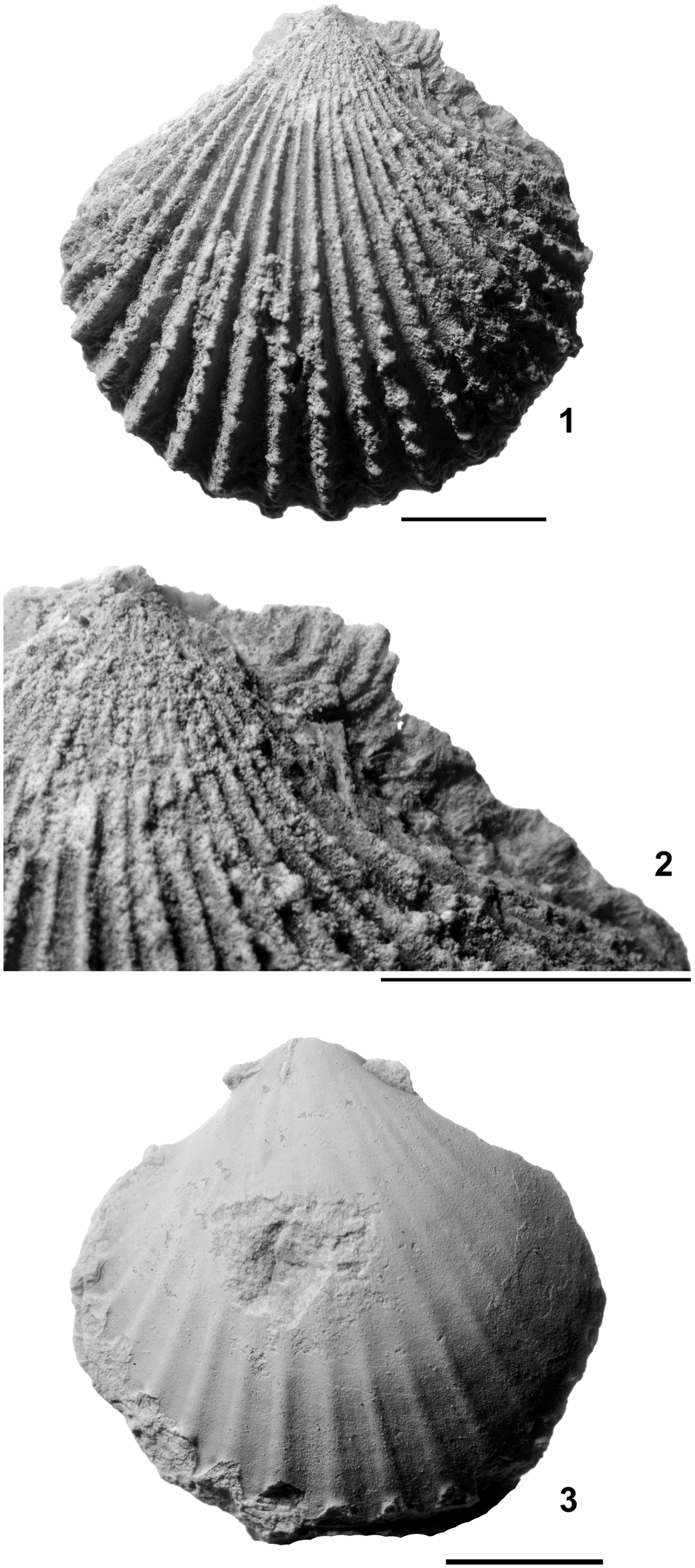
Allasinaz (Reference Allasinaz1972) assigned Pecten volaris and P. interstriatus to Chlamys Röding in Bolten, Reference Bolten1798, but our material of Pecten volaris demonstrates clearly the absence of a ctenolium (Fig. 1.2), which excludes an assignment to Chlamys. The plicate shells and the morphology of the auricles are in accordance with the diagnosis of the Aviculopectinidae, as revised herein. Within the Aviculopectinidae, Cristaflabellum shows typical traits of other genera of the tribe Antijanirini (Antijanira Bittner, Reference Bittner1901; Amphijanira Bittner, Reference Bittner1901; Oxypteria Waagen, Reference Waagen1907). Cristaflabellum differs from these genera by a high number of plicae that are equal in strength; additionally it differs from Antijanira in being equiconvex.
(1–3) Cristaflabellum volare (Bittner, Reference Bittner1902). (1, 2) LPB IIIL 2019, exterior of right valve; (2) detail of (1), showing right anterior auricle and anterior disc margin; note the absence of a ctenolium; (3) LPB IIIL 2020, internal mold, valve orientation uncertain. Scale bars represent 5 mm.

Cristaflabellum volare (Bittner, Reference Bittner1902)
Figure 1
- *Reference Bittner1902
Pecten volaris Bittner, p. 634, pl. 27(10), fig. 32.
- Reference Allasinaz1972
Chlamys (Chlamys) volaris; Allasinaz, p. 339, pl. 44, fig. 9; pl. 45, figs 1, 2.
- Reference Zardini1981
cf. Chlamys volaris; Zardini, pl. 18, figs 8a, b.
- Reference Friesenbichler, Hautmann, Grădinaru and Bucher2019
‘Pecten’ volaris; Friesenbichler et al., p. 12, fig. 4H.
Lectotype
Right valve illustrated in Bittner (Reference Bittner1902, pl. 27, fig. 32), designated by Allasinaz (Reference Allasinaz1972, p. 339).
Description
See Friesenbichler et al. (Reference Friesenbichler, Hautmann, Grădinaru and Bucher2019). We add here that this species is probably equiconvex, based on our material and the figures in Allasinaz (Reference Allasinaz1972, pl. 44, figs. 1, 2). We refigure (Fig. 1) the superbly preserved right valve (erroneously indicated as a left valve in Friesenbichler et al., Reference Friesenbichler, Hautmann, Grădinaru and Bucher2019) and an internal mold from the Anisian of Dobrogea (Romania).
Remarks
Cristaflabellum volaris differs from the otherwise similar C. interstriatus by having a more convex right valve (Bittner, Reference Bittner1902, p. 635).
Tribe Globodiscini new tribe
Type genus
Globodiscus n. gen.
Diagnosis
Shell equiconvex or nearly so; discs orbicular to slightly procrescent; ligament alivincular-areate; crura absent.
Right valve.—Umbo centrally placed, orthogyrate; anterior auricle well differentiated, large, anteriorly elongated, dorsally not projecting above hinge line; byssal notch deep; posterior auricle blunt and small or ill defined; ornamentation lacking or with fine, regularly spaced commarginal riblets.
Left valve.—Umbo centrally placed, orthogyrate; anterior auricle with shallow sinus; posterior auricle blunt and ill defined; shell exterior smooth or with weak, regularly spaced commarginal riblets.
Remarks
This new taxon exemplifies the problems of classification within a clade that is characterized by the prevalence of plesiomorphic traits and iterative evolution. Globodiscini n. tribe has an equiconvex shell with weak commarginal ornamentation and an alivincular-areate ligament, lacks hinge teeth or crura, and has an obtuse posterior extremity in both valves. It thus differs from Aviculopectinidae, which are plicate and have rectangular to acuminate posterior auricles, from Heteropectinidae, which are costate, have a flat right valve and an acuminate posterior auricle, and from Hunanopectinidae, which are inequiconvex and have crura. Therefore, the Globodiscini n. tribe cannot be accommodated within either of these families. However, none of its traits is unique within Aviculopectinoidea.
Genus Globodiscus new genus
Type species
Globodiscus kiliani n. sp.
Other species
Globodiscus vinzenti n. sp.
Diagnosis
As for the tribe.
Occurrence
Early to Middle Triassic, Tethys.
Etymology
Combination of globus (Lat.) = sphere and discus (Lat.) = disc, referring to the spherical shell with two virtually circular discs.
Remarks
See remarks on the tribe Globodiscini n. tribe.
Globodiscus kiliani Hautmann, new species
Figure 2.8–2.10
- Reference Friesenbichler, Hautmann, Grădinaru and Bucher2019
Aviculopectinoidea, gen. et sp. nov.; Friesenbichler et al., p. 13, figs. 4E–G.
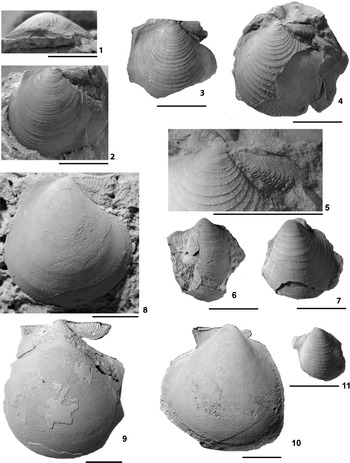
(1–7, 11) Globodiscus vinzenti n. gen. n. sp. (1, 2) PIMUZ 37585, holotype, right valve from SNY 14A: (1) ligament area, (2) shell exterior; (3) PIMUZ 37586, right valve from SNY11A; (4, 5) PIMUZ 37587, right valve from SNY 9A: (4) shell exterior, (5) details of anterior auricle; (6) PIMUZ 37588, left valve from SNY 13B; (7) PIMUZ 37589, left valve from SNY11A; (11) PIMUZ 37590, left valve (locality unknown). (8–10) Globodiscus kiliani n. gen. n. sp. (8) LPB IIIL2023, right valve; (9) LPBIIIL 2021, holotype, right valve; (10) LPB IIIL 2022, left valve. Scale bars represent 5 mm.

Holotype
LPBIIIL 2021, original of Friesenbichler et al., Reference Friesenbichler, Hautmann, Grădinaru and Bucher2019, fig. 4E; right valve from the Anisian of Dobrogea, Romania, refigured in Figure 2.9.
Diagnosis
Right anterior auricle without carina; greatest length of anterior auricle coincides with dorsal margin; discs externally smooth.
Occurrence
Middle Triassic, Romania.
Description
Shell medium-sized, biconvex; discs higher than long, slightly procrescent, externally smooth; umbones orthogyrate; posterior auricles small and blunt; anterior auricle of right valve elongated, dorsally straight, ventrally curved to form a deep byssal notch towards the disc, externally covered with weak commarginal ribs (Fig. 2.8, 2.9); anterior auricle of left valve with faint byssal sinus (Fig. 2.10); internal structures not observed.
Etymology
Named for my oldest son, Kilian.
Materials
Two right valves and one left valve.
Remarks
The only comparable species is the new species described in the following.
Globodiscus vinzenti Hautmann, new species
Figure 2.1–2.7, 2.11
Diagnosis
Right anterior auricle flexed in dorso-ventral cross section producing an external carina that marks the line of maximum length; incremental lines becoming stronger below carina; anterior margin of auricle angulated, distal end below dorsal margin; ornamentation with faint commarginal riblets.
Occurrence
Spathian (Early Triassic), Timor.
Description
Shell small (length of largest specimens ~15 mm); equiconvex; hinge without teeth or crura; ligament alivincular-areate (Fig. 2.1).
Right valve.—Disc orbicular; umbo orthogyrate, scarcely projecting above hinge margin; anterior auricle elongated, distally extending up to anterior limit of disc, with medial carina that defines the maximum length that is reached below the dorsal margin, incremental lines increasing in strength below carina (Fig. 2.5); posterior hinge margin not well differentiated from disc; ornamentation consisting of regularly spaced commarginal riblets (~20 for an individual of 10 mm length).
Left valve.—Anterior auricle separated from disc by shallow depression (Fig. 2.11); other characters as in the opposite valve.
Etymology
Named for my second son, Vinzent.
Materials
Three right and five left valves from the Spathian (Early Triassic) of Timor.
Remarks
Globodiscus vinzenti n. gen. n. sp. differs from G. kiliani n. gen. n. sp. by the morphology of its anterior auricle, the presence of commarinal riblets on the discs, and in being nearly circular in outline (rather than being slightly higher than long as in G. kiliani n. gen. n. sp.).
Acknowledgments
We thank editor S. Schneider and two anonymous reviewers for their helpful comments on this paper. Funding from the Swiss National Science Foundation (grant 200021-162402/1 to MH) is gratefully acknowledged.