Dao 道, the central concept in Chinese intellectual
history, is frequently translated as ‘way’ and explained in
terms of both a road to physically travel on and an abstract or
mystical pathway. Some scholars have however, questioned this
conventional translation and interpretation from an etymological
perspective, and others have indicated dao's
relationship with the Taiyi 太
 (‘Great One’) cult in early Chinese
sources. Recent archaeological discoveries, especially the
Taiyi sheng shui 太
生 水 (The ‘Great One’ Gives Birth to
Water) text from Guodian 郭 店, have further
inspired scholars to reconsider the complicated implications of
dao. This article applies a
multi-disciplinary approach to explore the religious origin of
dao and its signification in the
Laozi, for the first time providing
etymological, archaeological, and iconographic evidence to
support the identification of dao with the
Great One/deity of the Pole Star/High God/Heaven in Warring
States to Han texts. The religious origin of de
德, another primary concept, is also re-examined.
1. Dao and the Origin of the Great One Cult
As some scholars have demonstrated, in both received and
archaeological sources of the Warring-States Period to Han
dynasty, Dao is often identified with the
‘Great One'or its synonyms Da 大 (Great),
Yi
(One), and Taiji
太 極 (Great Pole/Ultimate), and the ‘Great One’ is further
defined as the deity of the Pole Star or High God
(Shangdi 上 帝 or Tiandi 天 帝).Footnote 1
In the Lüshi chunqiu 呂 氏 春 秋 (ca. 239 B.C.),
Dao is directly identified with the
‘Great One’: “As for Dao, it is the
quintessence. It cannot be given a shape, nor can it be
given a name. Forced to give it a name, I call it ‘Great
One’”; “The myriad things were produced from the Great
One”. Gao You 高 誘 glossed, “The Great One is
Dao” 太
, 道 也.Footnote 2 The authors of the
Taiyi sheng shui also give the
‘Great One’ the style-name Dao.Footnote 3
Both the Great and the One, abbreviated or even earlier forms of the ‘Great One’, are also used interchangeably with Dao in pre-Qin to Western Han writings. In the Laozi, Dao and Da are used as ‘style-name’ and name of the mother of the myriad things.Footnote 4 In the same text and the Lüshi chunqiu, Zhuangzi 莊 子, Guanzi 管 子, Heguanzi 鶡 冠 子,Footnote 5 and Huainanzi 淮 南 子, the close relationship between Dao and the One is also remarkable.Footnote 6 The silk-manuscript Jing 經 unearthed from Mawangdui again testifies this identification.Footnote 7
Dao is then again identified with
Taiji, the Great Pole/Ultimate. Xu
Shen 許 慎 glossed the One as “the beginning, the Great
Pole/Ultimate, Dao established from the
One” 惟 初 太 極, 道 立 於 .Footnote 8 As the ‘Great One’
represented the deity of the Pole Star (see below), the
Great Pole/Ultimate was originally a synonym for it. For
example, the “Xici” 繫 辭 commentary to the
Zhouyi reads, “The Great
Pole/Ultimate gives birth to the Two Principles” 太 極 生 兩
儀;Footnote 9
while the Lüshi chunqiu reads, “The Great
One gives birth to the Two Principles” 太
生 兩 儀.Footnote 10 The “Xici” again
reads, “The Yi (Change) possesses the Great Pole/Ultimate”
易 有 太 極. Ma Rong 馬 融 glossed the Great Pole/Ultimate as
the Pole Star, while Kong Yingda glossed it as the ‘Great
One’.Footnote 11
In numerous Han-dynasty texts, the ‘Great One’ is further defined as the deity of the Pole Star or High God. For example, the Shiji reads, “One of the bright stars in the heavenly pole constellation of the central palace is the regular dwelling of the ‘Great One’. . . . This is called the Purple Palace”.Footnote 12 The Huainanzi reads, “The Purple Palace is the dwelling of the ‘Great One’”.Footnote 13 Zheng Xuan 鄭 玄 said, “The ‘Great One’ is the name of the deity of the North Star”.Footnote 14 Miu Ji 謬 忌, a Han Taoist specialist, told Emperor Wudi, “The most honored celestial deity is the ‘Great One’, and the Five Gods are the Great One's assistants”.Footnote 15 The Han apocrypha Chunqiu yuanming bao 春 秋 元 命 苞 states, “The star of the Great One dwells high and hides deep, so it is called the North Pole”.Footnote 16 Another Han apocrypha Chunqiu hecheng tu 春 秋 合 誠 圖 reads, “The Pole Star is the Great God of Celestial August”.Footnote 17
The Great One's identity as the deity of the Pole Star or High God has long been noted by Qing-dynasty to modern scholars. The Qing scholar Jiang Xiangnan's 蔣 湘 南 defines the ‘Great One’ as High God and the deity of the Big Dipper, which he believed to have been the Pole Star. He also indicated that the ‘Great One’ possessed the power of manipulating yin-yang, the four seasons, and the production and destruction of the myriad beings.Footnote 18 Qian Baocong's “Taiyi kao” published in the 1930s is a comprehensive study of the ‘Great One’ cult.Footnote 19 Qian cites plentiful sources to verify the Great One's identity as the deity of the Pole Star and the most honoured High God. He further describes the ‘Great One’ worship in the Han dynasty and its relationship with the divination device shi 式, a cosmic-board with a round sky mounted on a square earth rotating around a central pivot which represents the Pole or Pole Star. Although some Warring-States texts mention the ‘Great One’, most of the texts describing the cult are Han works. This reason, plus his affiliation with the academic circle of “Questioning Antiquity”, makes Qian believe that the Great One cult was the invention of the Han people, and that the ‘Great One’ was originally an abstract concept which was not identified with the cult associated with the Pole Star and its deity before the Han.
More than half a century has passed since Qian's study, and many new archaeological discoveries have greatly enhanced our understanding of the ‘Great One’ cult. Li Ling cites the “Bing bi Taisui” 兵 避 太 歲 (Weapon to repel Grand Year) dagger-axe from Jingmen 荊 門 and the bamboo-slip divination texts from Baoshan 包 山 to clarify convincingly that during the Warring States period the ‘Great One’ was already a term that implies the sense of astral body, deity, ultimate thing, and its cult in the state of Chu.Footnote 20 Donald Harper further cites evidence beyond the confines of Chu to argue that the ‘Great One’ cult was not limited to Chu but a popular cult from the Warring States to Han period.Footnote 21
The excavation of the Taiyi sheng shui text from the Warring-States Chu tomb in Guodian in 1993 further testifies to the early appearance of the ‘Great One’ cult. The text illustrates a cosmology with the ‘Great One’ as the progenitor of the universe: the Great One gives birth to water, and water goes back to assist the ‘Great One’ to give birth to sky; then sky goes back to assist the ‘Great One’ to give birth to earth.Footnote 22 This cosmology has since become a focus of academic interest. Scholars have dug out scattered cosmological accounts which are conceptually similar to the ‘Great One’ cosmology from both received literature and other unearthed texts,Footnote 23 and indicated its close relationship with the ‘Great One’ cult, the supreme cosmic deities, early astrology, and astrological divination devices.Footnote 24 Some scholars even suggest that the rise of the use of the shi-board as a divination device during the Warring States period influenced the manner in which the cosmos was visualised, and the ‘Great One’ cosmology and cult arose in association with it.Footnote 25 However, if the Great One represented the deity of the Pole Star, the origin of the ‘Great One’ cosmology and cult must have been closely related to ancient Chinese people's observation and understanding of the Pole Star. The shi-board, the astrological device with the Pole Star as its pivot, should also have been based on the same observation and knowledge, and was unlikely to be the origin of the ‘Great One’ cosmology.
It has been established that ancient Chinese astronomy was of polar and equatorial orientation. Because of their particular geographical location, the ancient Chinese concentrated their attention on the Pole Star and the circumpolar stars:
By day they observed the length of the sun's shadow at noon, and by night they investigated the North Star, so that they might set in order mornings and evenings. 晝 參 諸 日 中 之 景, 夜 考 之 極 星, 以 正 朝 夕.Footnote 26
Due to the effect of the precession of the equinoxes,
various stars have been identified as Pole Stars in the
course of time. Some stars which have preserved their
Chinese names indicate that they were at various times
Pole Stars, but later ceased to be so. In about 4000–3000
bce the Big Dipper was very close to the
North Pole. The first star of the Dipper is called Tianshu
天 樞 (Heavenly Pivot; α Dubhe), the same name as the Pole
Star (4339 Camelopardi) during the Han dynasty. Therefore,
it might have been considered as the Pole Star. Ancient
Chinese people observed the directions of the Dipper
handle to determine the months and seasons, as recorded in
the Xia xiaozheng 夏 小 正,Footnote 27
Heguanzi, and
Shiji.Footnote 28 Based on these, Feng
Shi identifies the Pole Star cult as the Big Dipper
cult.Footnote 29 In earlier and later parts of
the 2nd millenium bce two circumpolar
stars named Tianyi 天 (Celestial One; i Draconis) and
Taiyi (Great One; 4 Draconis or 3539 Boss) might have been
considered Pole Stars respectively, and in about 1000
bce another circumpolar star named Di 帝
(High God; β Ursa Minor) also seems to
have been used as the Pole Star.Footnote 30 According to oracle
bone inscriptions, the Shang rulers frequently made
sacrifices to the deity of the Big Dipper.Footnote 31 Even
though the Dipper might no longer serve as the Pole Star
in the Shang age, its traditional function as the
indicator of time and seasons still made it a very
significant circumpolar star.Footnote 32 Therefore, the
Chinese observation and worship of the Pole Star surely
appeared much earlier than the Warring States period.
The Pole or Pole Star was supposed to be located on the highest and central region of sky with all other celestial bodies moving around it, and the celestial pole corresponded to the position of the king on earth, around whom the bureaucratic system revolved.Footnote 33 It is generally agreed that ancient Chinese state religion was of astronomical orientation.Footnote 34 As Sima Qian said, “Ever since the people have existed, when have successive rulers not followed the movements of sun, moon, stars, and asterisms?”Footnote 35 The practice of observing the sky centring on the Pole Star for guidance may even have emerged as early as the fifth millennium bce. In a recently discovered burial (ca. 4600–3900 bce) of Yangshao 仰 韶 culture in Henan Puyang 河 南 濮 陽, a corpse was oriented along the north-south axis, the figures of a tiger and a dragon were laid out using mollusc shells and placed to the west and east of the corpse, and a triangular figure was laid to the north, which has been interpreted as a symbol of the Big Dipper or Dixing, the Star of God.Footnote 36 Other archaeological evidence also shows that burials and dwellings from the beginning of the Bronze Age were uniformly built in a cardinal orientation, with the longitudinal axis aligned in a north-south direction.Footnote 37 The principle of symbolic centrality was also clearly manifested. A jade plaque discovered from Hanshan Lingjiatan 含 山 淩 家 灘 (ca. 2500 bce) is inscribed with ‘compass rose’ design with ‘arrows’ pointing from the centre to the four cardinal and four intermediate directions, which suggests the concept of a centre from which influence radiates outward to the eight directions.Footnote 38 The Shang people called their state ‘Zhong Shang’ 中 商 (Central Shang), and the kings conceived themselves as “standing at the core of a series of grids – familial, spiritual, geographical”.Footnote 39 The central position of royal palaces corresponded to the Pole Star, the residence whence the ‘Great One’ watched over the southerly world of men.Footnote 40 In about 4000–3000 bce the Big Dipper might have been regarded as the Pole Star, and the Shiji actually records a legend: “The Big Dipper is the chariot of the High God”. This legend is even visualised in a Han picture as seen in the Wuliang shrine 武 梁 祠.Footnote 41 The other stars that might have been considered as Pole Stars from 2000 bce to 1000 bce were named Celestial One, ‘Great One’, and High God. These names hint at the intimate relationship between High God, the ‘Great One’, and the deity of the Pole Star. As cited above, Han texts generally identify the ‘Great One’ with High God. Although these sources are of a somewhat later date, their records are in accord with early Chinese astrological knowledge and may have had an earlier origin. For example in these texts, the Pole Star/Great One is described as the determiner of the four seasons and the controller of wind, rain and other celestial phenomena. In the oracle bone inscriptions, High God is also a cosmic god who commands the deities of Rain, Thunder, and Wind.Footnote 42 If Heaven was supposed to be organised around the Pole or Pole Star, and ancient Chinese state religion was of astronomical orientation, then it is reasonable that the deity of the Pole Star/the ‘Great One’ was worshipped as the supreme deity – the Di or High God during the Shang dynasty and the Tian or Heaven through the Zhou dynasty.Footnote 43
2. The Origin of Dao: Face Motifs in Jade and Bronze Artifacts of Late-Neolithic Age to Yin-Zhou Period
Why is Dao identified with the ‘Great One’ or deity of the Pole Star and therefore with High God or Heaven in texts of Warring-States to Han? Sarah Allan believes that the focal meaning of dao is not a roadway, but a waterway, which is the root metaphor of the Chinese philosophical concept. Moreover, she states that dao was not simply modelled on a river that flows continuously from a natural spring, but was taken as the Celestial River that flows unceasingly from the womb of the ‘Great One’.Footnote 44 Allan's assumption of the celestial river as the imagery of the water produced by the ‘Great One’ is brilliant, but her gloss of dao as waterway does not seem to accord with the etymological structure of the character. Through an analysis of the character dao, this study traces the original implication of the term and provides etymological and archaeological evidence for the identification of dao with ‘Great One’ /High God/Heaven.
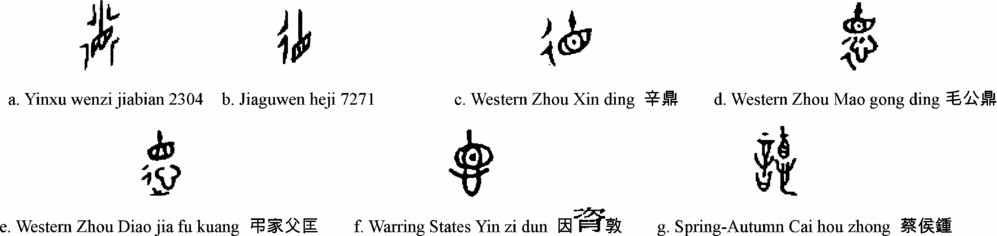
The character dao is not seen in the
oracle-bone inscriptions (though it actually appears in
another form, which will be discussed below). In Western
Zhou bronze inscriptions and other pre-Qin scripts, it is
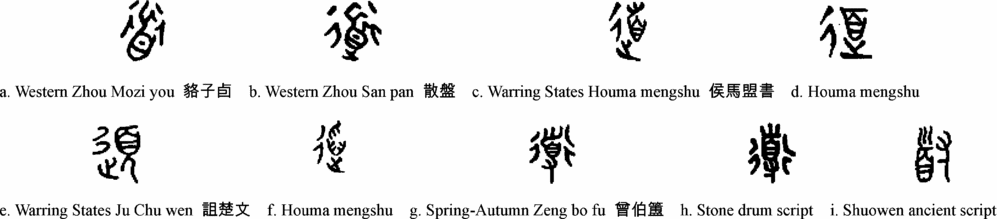
presented in several forms. The earliest form is a
compound of two graphic constituents,
shou 首 (head) and
hang 行 (a picture of a crossroads,
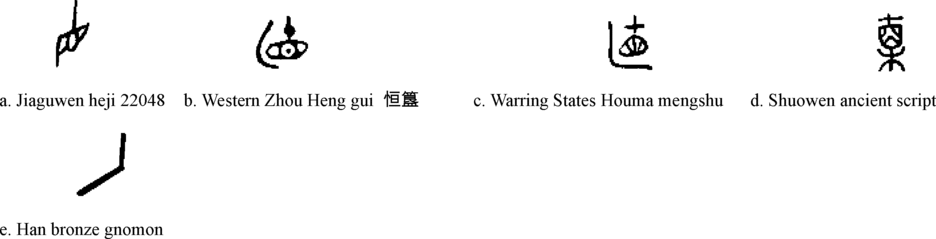
meaning to walk and move, or a road; Fig. 1a). In later forms of this
graph the constituent zhi 止 foot is added
(Fig. 1b),
which sometimes combines with the left half of
hang to form the constituent
chuo 辵 to walk (Fig. 1c). This
graph later became the standard character for
dao. In some cases,
shou 首 is written as
shou
 , ye 頁, or
yao 舀 (Figs. 1d–f); shou
and ye also mean head, while
yao is an erroneous form for
shou. Sometimes, the constituent
zhi 止 becomes the erroneous form
you 又 (Fig. 1g), or adds a decorative dot
to become cun 寸 (Fig. 1h). The Shuowen
jiezi provides an ancient script composed
of cun 寸 and shou 首
(Fig. 1i),
which Gui Fu 桂 馥 defines as dao 導.Footnote 45
However, as Peter Boodberg assumes, these are but variants
of the earliest form, and the word itself combined both
nominal and verbal aspects of the etymon; this is
supported by textual examples of the use of the primary
dao in the verbal sense “to
lead”.Footnote 46 Liu Xiang also defines
dao as a verb meaning to lead and
walk.Footnote 47
Dao 道.

Duan Yucai 段 玉 裁 (1735–1815) indicates that shou is the phonetic determinative in dao.Footnote 48 According to the phonetic reconstruction of archaic Chinese by Li Fanggui 李 方 桂, both dao (*dgəwx) and shou (*skhjəwx) belong to the you 幽 rhyme group and share the same final.Footnote 49 Peter Boodberg argues that shou is not merely the phonetic but also the semantic and expounds it from the meanings of ‘to head’, ‘to lead’, and ‘headway’.Footnote 50 Scholars have generally acknowledged the significant role of phonetic determinatives in the semantic structure of archaic Chinese characters. In most of the cases, the phonetic is also the semantic and serves as the etymon. Through a thorough examination of the graphs identified as shou in the oracle-bone inscriptions, I have made a significant discovery on the etymon and original meaning of dao, and therefore find archaeological, iconographic evidence for the textual identification of dao with the ‘Great One’ /High God.
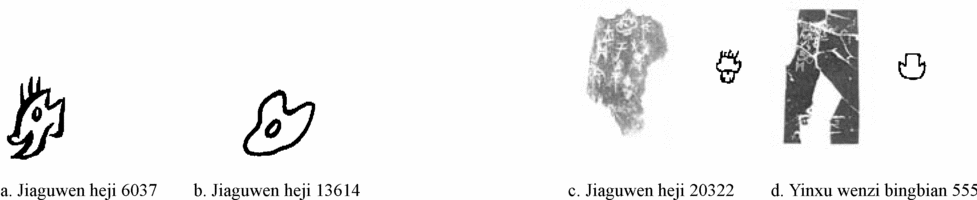
In the OBI, two kinds of graphs have been identified as shou. The first kind presents pictographs of a head with an eye, mouth, and/or hair (Fig. 2a–b).Footnote 51 The second kind presents two very different graphs, one being a mask-like pictograph of a frontal face wearing a protruding-topped plumed crown (Fig. 2c), and the other a pictograph of a protruding-topped crown (Fig. 2d).Footnote 52 In the OBI, these two kinds of graphs are used interchangeably. For example:
Cracking made on
jichou, Gu, divining: “The king
will set out and make the Shou sacrifice, and
there will be no harm.” 己 丑 卜,
 , 貞: 王
 ,
 , 無 它.
Cracking made on
jiaxu, Que, divining: “On the
next yihai, the king will set out
and make the Shou sacrifice, and there will be no
disasters.” “甲 戌 卜,  , 貞: 翌 乙 亥, 王
 ,
 , 無 禍”.Footnote 53
Here  and
 are used in the same way with the
same connotation. This verifies that the identification of
the second kind of graphs of crowned mask as
shou by the OBI experts is
credible.
Shou 首.

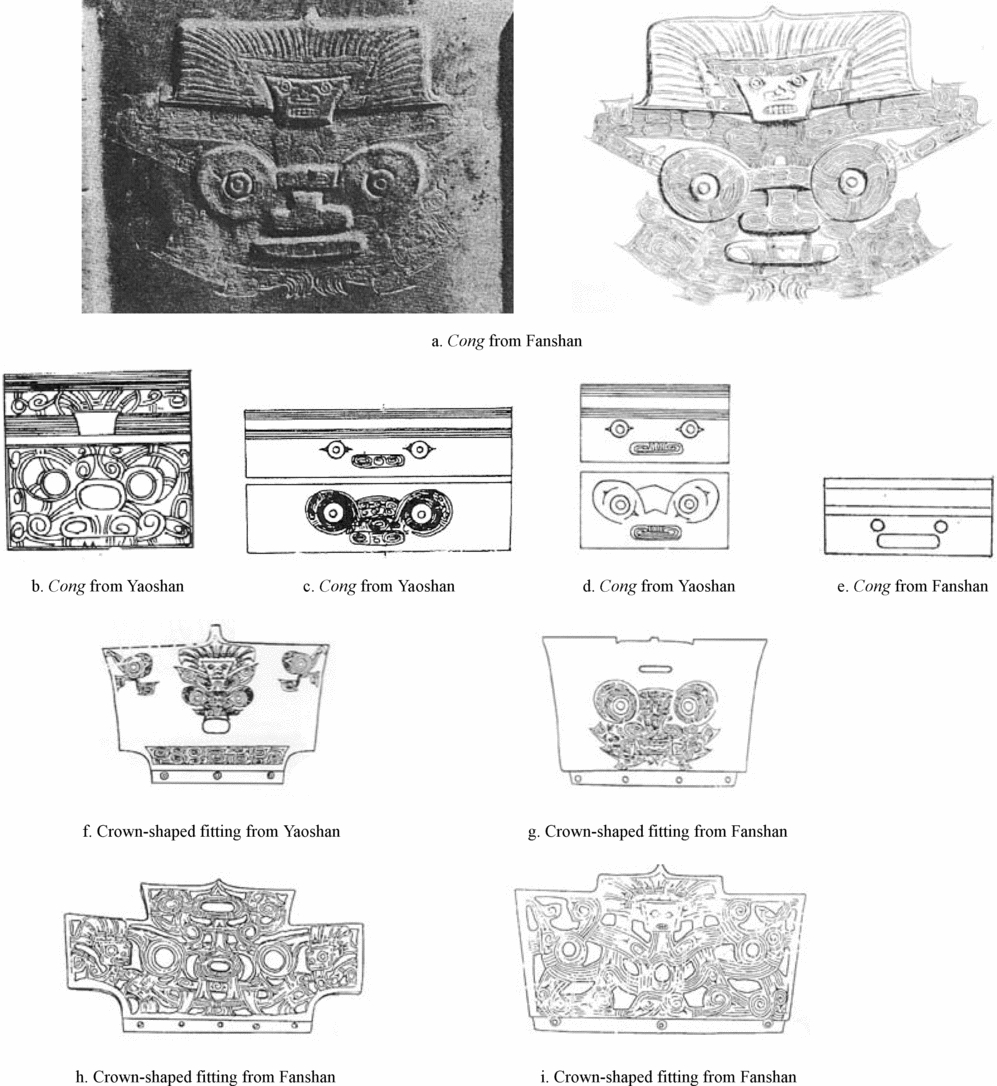
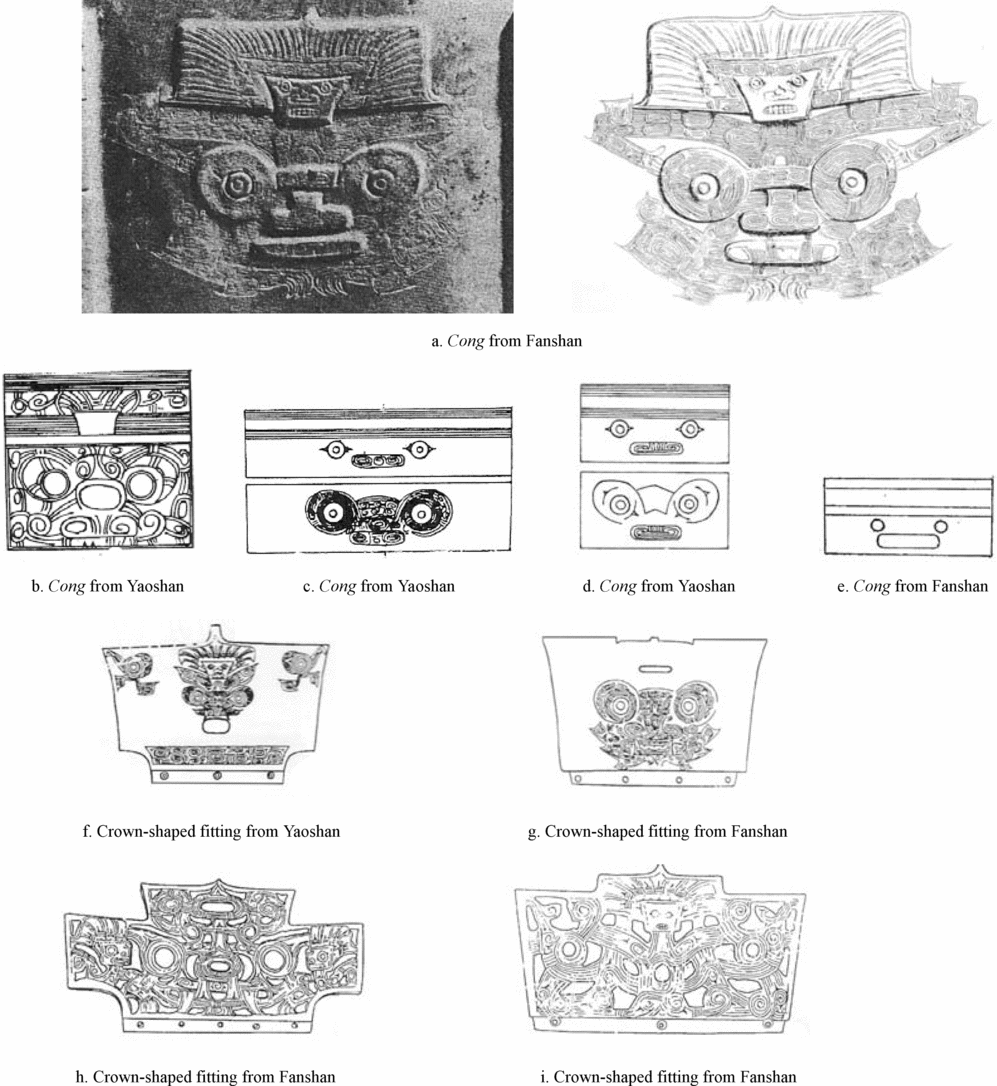
As is well known, the face motif (mianwen 面 紋, also called shoumianwen 獸 面 紋, animal-face motif, or shenren shoumianwen 神 人 獸 面 紋, divine-man and animal face motif) is the most important motif in jade and bronze artifacts of late-Neolithic to Shang-Zhou period. Various kinds of jade artifacts from Liangzhu culture 良 渚 文 化 (ca. 3500–2000 BC), including cong 琮, crown-shaped fittings (guanzhuang shi 冠 狀 飾), three-pronged plaques (sanchaxing qi 三 叉 形 器), awl-shaped ornaments (zhuixing qi 錐 形 器), d-shaped ornaments (huang 璜), column-shaped bead (zhuxing qi 柱 形 器), and axes, are dominated by face motifs.Footnote 54 The fullest form of face motif is seen in the “king of cong” discovered from Fanshan, which presents a human-like figure grasping a demon-like face in its hands (Fig. 3a):Footnote 55 the man-like face is inversely trapezoid-shaped, with staring round eyes and grinning mouth, wearing a dual headdress – inside a cap and outside a huge peak-centred, plumed crown, the demon-like face has large oval eyes and paired tusks (inners up and outers down), and the surface of the motif is filled with thunder patterns (leiwen 雷 紋). Scholars usually name the man-like face as divine-man face and the demon-like face as animal face, and together call it animal-face motif or divine-man and animal-face motif. However, as indicated by Robert W. Bagley, although the face motifs of Liangzhu jade artifacts, as well as of Shang-Zhou bronze artifacts, present some features of animals, it cannot be substantiated as any certain animal.Footnote 56 Therefore, in reference to the works of Deng Shuping 鄧 淑 蘋, Doris J. Dohrenwend, and Jessica Rawson,Footnote 57 this study uses the term face motif.
Face motif on Liangzhu culture jades.
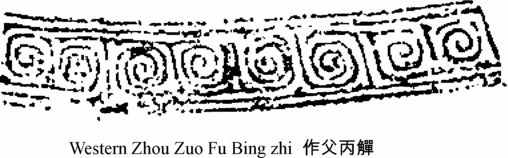
The thunder pattern fill-in on the mask is usually defined as
coiled-cloud pattern (juanyunwen 卷 雲 紋)
or cloud-thunder pattern (yunleiwen 雲 雷
紋).Footnote 58 However, according to Rong
Geng's 容 庚 study on a similar pattern on bronze artifacts,
this kind of pattern should be called thunder pattern. Xu
Shen describes the graph lei 靁 (雷) as
“deriving from yu, lei
resembling spiral-shapes” 從 雨, 畾 象 回 轉 形, and lists two
ancient scripts and one zhou script
(zhouwen 籀 文; (Figs. 4a–c)), of which two are
added to the graph  .Footnote 59 The Song scholar Shen Kuo 沈
括 (1031–1095) once got an ancient bronze
lei 罍 and observed its interweaving
patterns of cloud and thunder: the thunder pattern was
like the ancient script for thunder,
 , which symbolised the ‘spiral’
sounds of thunder, so he named the pattern as
cloud-thunder.Footnote 60 Rong Geng indicates that
this kind of pattern is actually thunder pattern: “What
the Song people called cloud-thunder pattern should
together be called thunder pattern now. The pattern that
curves to left and right like
 is the graph for
shen 申, which is also the graph for
dian 電” (Fig. 5).Footnote 61 Rong is right. In
the OBI, the graph lei comprises
shen (original graph for
dian, lightning, and
shen 神, deity) and dots that
symbolise thunder sounds (Figs. 4d–f).Footnote 62 This structure manifests
ancient Chinese people's understanding of the
thunder-lightning unity – lightning as the shape and
thunder as the sound.
Lei 雷 (靁).

Thunder motif.

Apart from some full images, most of the Liangzhu face motifs are simplified, incomplete patterns, dual or single, iconic or abstract and geometric (Figs. 3b–e).Footnote 63 Scholars in general believe that those jades engraved with face motifs were ritual artifacts and the face motifs represented deities worshipped by the Liangzhu people.Footnote 64 The shape of crown-like fittings is similar to the peak-centred, trapezoid-shaped crown worn on the divine heads (Fig. 3f–i),Footnote 65 so these fittings should also be symbols of the divine.Footnote 66 Since the face motifs of all the Liangzhu jade artifacts are amazingly similar, some scholars further suggest that this kind of face motif represented the deity generally worshipped by all Liangzhu people, which was possibly connected to the later concept of High God in the Shang dynasty.Footnote 67
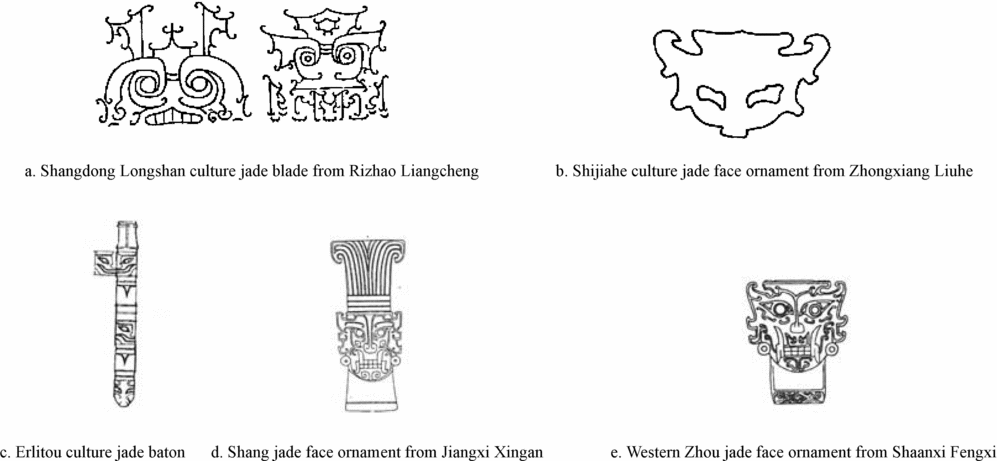
The plumed-crown motif painted on a pottery zun discovered from Dawenkou 大 汶 口 culture (ca. 5000–3000 bce; (Fig. 6a)) seems likely to be the prototype for the Liangzhu face motif.Footnote 68 This pottery zun is also supposed to have been used as a ritual artifact. Its peak-centred, plumed crown is similar to the Liangzhu crowns worn on the divine heads and crown-shaped fittings, and its inverted trapezoid shape of lower part looks just like the shape of the Liangzhu divine faces. Several scholars have suggested that the demon-like face is a version of the pig-dragon motif of slit rings (jue 玦) discovered from Hongshan 紅 山 culture (ca. 4000–3000 bce (Fig. 6b)).Footnote 69 The Liangzhu face motif then continues to appear on jade artifacts of the late-Neolithic to the Shang-Zhou period, including Shangdong Longshan 山 東 龍 山 culture (ca. 3000–2000 bce), Shijiahe 石 家 河 culture (ca. 2400 bce), Erlitou 二 里 頭 culture (ca. 2000–1600 bce), and Shang and Western Zhou period (Figs. 7a–e).Footnote 70 Although the various kinds of face motif from different cultures had more or less altered, some basic features continued, such as staring paired eyes, peak-centred crowns, and paired tusks with inners up and outers down.Footnote 71 These motifs reveal not only material exchanges between those cultures, but also a shared and continuous religious faith from the late-Neolithic period to the Shang and Western Zhou.
Crown and pig-dragon motifs.

Face motif.

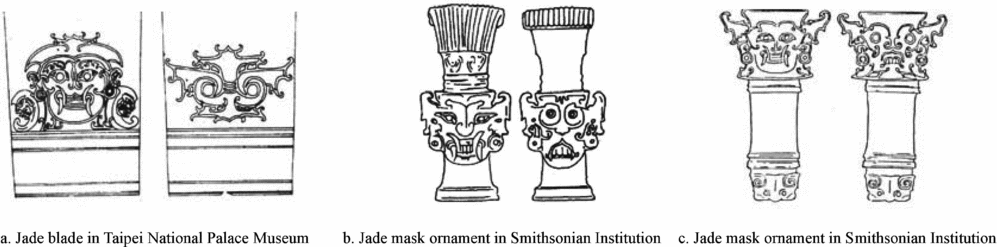
It is notable that the unified double face of divinity and demon in Liangzhu jades later became two somewhat different faces engraved on both sides of one jade artifact. The paired face motifs of the jade blade discovered from Rizhao Liangcheng, Shangdong cited above represent this kind of development (Fig. 6a). The paired face motifs from both sides of a jade blade preserved in the National Palace Museum, Taipei are quite similar to the Liangcheng motifs (Fig. 8a),Footnote 72 so scholars generally agree that this blade also belongs to the Shangdong Longshan culture. Smithsonian Institution preserves two bifacial jade masks (Fig. 8b–c):Footnote 73 one pair is close to the Shang jade mask from Jiangxi Xingan (Fig. 6d), and the other is similar to the Western Zhou jade mask from Shaanxi Fengxi (Fig. 6e), so these two jade masks are possibly from Shang and Western Zhou respectively.Footnote 74 The main differences between the paired faces are having or not having tusks, almond or round/spiral eyes, ‘smiling’ or ‘sad’ (comic-tragic) mouths, etc.Footnote 75 Like the unified face motif of Liangzhu jades, these bifacial motifs may imply a divine-demonic unity or the divine commanding over the demon.
Bifacial masks.

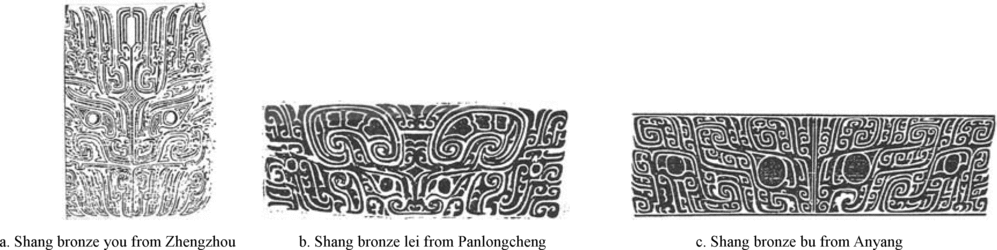
Meanwhile, as more and more scholars have agreed, the face motif of late-Neolithic jades was also assimilated into bronze artifacts and became the taotie motif (generally called animal face motif now), the most common decor in Shang and early Zhou bronze artifacts (Figs. 9a–d).Footnote 76 There are some basic similarities between the iconography of the late-Neolithic face motif and that of the Shang-Zhou taotie motif, such as staring, paired eyes, frontal face, plumed or horned headdress, and thunder patterns.Footnote 77 On the other hand, the taotie motif became more abstract and was confined to a prescribed standard form with striking consistence, which indicates a more unified religious belief system.Footnote 78
Taotie motif.

Now, going back to the two pictographs of shou 首, we find that they are obviously simplified, abstract forms of the face and taotie motifs discussed above. The first graph of frontal face and protruding-topped plumed crown is especially similar to the jade face ornament of Shijiahe culture (Fig. 7b), while the second graph of protruding-topped crown is close to the crown-shaped fittings of Liangzhu culture (Fig. 3f–i). Thus, we may assume that the iconography of the late-Neolithic face motif was actually abstracted into a pictograph at the latest during the Shang dynasty, and the original meaning of the pictograph should be the deities the face motifs symbolised. According to the identification of Dao with the deity of the Pole Star and High God in pre-Qin to Han writings, the deity the graph shou represented might have originally denoted the deity of the Pole Star or High God. The inversely trapezoid-shaped divine face appears consistently in all full forms of Liangzhu face motif (Figs. 3a, b, f, and i). Feng Shi asserts that it resembles the trapezoid-shaped bowl of the Big Dipper and therefore must have represented the deity of the Dipper, which was just possibly regarded as the Pole Star during the Liangzhu period.Footnote 79 Feng's assertion seems quite convincing, as the contour of the Liangzhu divine face is very peculiar, unlike any human and animal face. In the OBI, High God is the supreme deity of the cosmos, residing in the highest heaven and commanding all the natural forces and celestial bodies, including the deities of Wind, Cloud, Thunder, and Rain.Footnote 80 In each of the two or four corners of some Liangzhu face motifs, a bird is engraved (Fig. 3f); this is in accord with the record that “phoenix is the messenger of High God” (Di shi feng 帝 史 鳳) in the OBI.Footnote 81 As discussed above, the face motifs of jade and bronze artifacts are filled with thunder patterns. The grand sounds of thunder and frightening flashes of lightning would easily make ancient people worship them as the manifestation of the heavenly power. In the Liangzhu ritual jade artifacts, the deity's cap and limbs are decorated with thunder patterns, and it grasps a demonic face which is also filled with thunder patterns. Many taotie motifs are also filled with thunder patterns. This may symbolises the supreme deity's command over or possession of the power of thunder and lightning. In the OBI, High God possesses dual personality of good and evil and dual power of reward and punishment: sometimes bestowing a harvest year, while sometimes sending down a draught; sometimes assisting humans, while sometimes bringing disasters to them.Footnote 82 This is in accord with the twofold face motif of divinity and demon. In addition, the Shang and Zhou people often said that High God or Heaven was overlooking their acts from heaven;Footnote 83 this is also in accordance with the bright ‘eye’ of the North Star and the staring eyes of the face motifs.Footnote 84
Then, shou was added the constituent
hang 行 (to walk or move, road) to
indicate the rotational movement and guidance of the Pole
(Star)/Heaven.Footnote 85 As demonstrated by the
shi cosmic-board, ancient Chinese
people imagined the North Pole (Star) as the pivot of
heaven or the chariot of High God, which moved round
itself and also led heaven and other celestial bodies to
rotate around it. Both the first star of the Big Dipper
and the Pole Star during the Han were actually named
Tianshu 天 樞 (Pivot of Heaven), and the North Pole was
named Beijishu 北 極 樞 (North Pole Pivot). The
Zhoubi suanjing 周 髀 算 經 reads, “The
central point of the xuanji area of the
North Pole Pivot is at the central point of the north
heaven”.Footnote 86 Likewise, the
Laozi describes
Dao as “moving round yet never
becoming weary” 周 行 而 不 殆 and “turning back is how
Dao moves” 反 者 道 之 動.Footnote 87 The
Taiyi sheng shui states, “The
‘Great One’ . . . moves with the seasons, circling and
beginning again” 是 故 太 . . . 行 於 時, 周 而 或 〔 始 〕.Footnote 88
The Hanfeizi states, “The sage observed
its darkness and void, applied its cyclical movement, and
forcedly named it ‘Dao’” 聖 人 觀 其 玄 虛, 用 其
周 行, 強 字 之 曰 道.Footnote 89 The use of the word
hang 行 (to move) in these
expressions vividly explains the original signification of
the cyclical movement of the Pole (Star)/Heaven presented
by the compound of shou and
hang in the character
dao.
In addition, as the pivot of heaven, the movement of the Pole never actually strayed from its central position, but rather functioned in the way of guiding and leading the universe to move around it. The Lüshi chunqiu reads, “The Pole Star moves together with the heaven but the Pole of Heaven does not move” 極 星 與 天 俱 遊 而 天 極 不 移.Footnote 90 Thus, dao further derived the meaning ‘to guide’, as the Han dictionary Shiming 釋 名 glosses, “Dao, to guide, to penetrate and guide the myriad things” 道, 導 也, 所 以 通 導 萬 物 也.Footnote 91
When used as a noun, dao first of all denotes the meaning of the course and order of Heaven. Many scholars have indicated that for the Taoists Dao was not the course of life in human society but the course in which the universe worked.Footnote 92 The Wuxing 五 行 from both Guodian and Mawangdui emphasizes: “Dao is the course of Heaven” 道 也 者, 天 道 也.Footnote 93 The Zhuangzi reads, “In the past those who elucidated the ‘Great Dao’ first elucidated Heaven and then way and virtue” 古 之 明 大 道 者, 先 明 天 而 道 德 次 之.Footnote 94 This also indicates that the ‘Great Dao’ is first referred to ‘Heaven's way’ and then extended to connote “human's way and virtue”. The Laozi states that “weakness is the function of Dao” 弱 者, 道 之 用,Footnote 95 while the Taiyi sheng shui reads, “The course of Heaven values weakness” 天 道 貴 弱.Footnote 96 Here Dao and Tiandao are used interchangeably. According to the Zuozhuan, the court historiographers, diviners, physicians and music masters already had a cosmology in which the course of the celestial bodies was called the course of Heaven.Footnote 97 Thus, when the ‘Tuan’ 彖 commentary to the Zhouyi states that “observing the divine Dao of Heaven with the four seasons [proceeding] without error, the sage established the divine Dao as the teaching, and all under Heaven obeyed it” 觀 天 之 神 道 而 四 時 不 忒, 聖 人 以 神 道 設 教 而 天 下 服 矣,Footnote 98 the term ‘divine Dao’ implies the divine nature of the Dao of Heaven/High God. Indeed, in the Laozi and many other early writings, the Dao of Heaven is always set as the fundamental and model for the course of humans.
It is notable that in the OBI, there is a graph
 that comprises
ren 人 (human) and
hang 行, which is sometimes added
the constituent zhi 止 (foot, to walk) or
kou 口 (mouth; (Figs. 10a–c)).Footnote 99 This graph is also
seen in bronze, seal, bamboo, and Stone-drum inscriptions.
Some scholars have asserted that this graph should be
glossed as dao 道.Footnote 100 This assertion is
now verified by the Guodian texts. In the Guodian
Laozi (A) this character is used to
replace dao in the received text, and the
same kind of usage is also seen in the Guodian texts
Xing zi ming chu 性 自 命 出,
Liude 六 德, and Yucong
(A) 語 叢 .Footnote 101 The original meaning of
this character was the movement of humans, or roads for
human traffic, so as to differentiate from the character
dao 道, the movement or course of
Heaven. In addition, in the OBI, the character
dao
 is often used before or after the
character wang 王 (king) to express the
meaning of “to extol the king” or “the king says”.Footnote 102
Thus, another verbal meaning of the character
dao 道, ‘to say’, may have been
derived from the meaning of “to extol the High God” or
“the High God says” expressed in ancient divinations and
sacrificial performances.
Dao
.

In addition, as is a general rule for characters of common
etymon in early writings, the two characters
dao and shou are
used interchangeably. For example, there is a phrase
“shoude” 首 德 in the bronze inscriptions of the Western
Zhou Shihong gui 師 訇 簋. Some scholars define it as
“changde” 常 德 (constant virtue),Footnote 103 but it is more
reasonable to gloss it as “daode” 道 德. The expression “ji
dao” 稽 道 in the Yi Zhoushu 逸 周 書 was
cited as “ji shou” 稽 首 (to kowtow) in the Qunshu
zhiyao 群 書 治 要, and the expression “zhui
shou” 追 首 recorded in the Shiji was
written as “zhui dao” 追 道 (to recall and state) in the
stele inscriptions.Footnote 104 Thus, dao
also connotes the meaning of the supreme deity – the
‘Great One’ or High God. The Laozi states
that Dao “images the forefather of High
God” 象 帝 之 先, and further describes it as a shadowy image,
object, and essence.Footnote 105 If we define the image of
Dao as the face motif which
symbolised the supreme deity and first appeared in
prehistoric period, even before the appearance of the
graph Di 帝 (High God) in the OBI, then the meaning of
these lines would become very clear. After Di or Shangdi
was used to represent the supreme deity, the original
meaning of shou or dao
gradually became blurred, and dao 道 and
dao
gradually intermingled.
In some early texts of pre-Qin to Han, however, the divine
origin of Dao is still mentioned
occasionally. Donald Harper thinks that the Taiyi
shengshui text “provides a Warring States
precedent for a deity in charge of genesis”.Footnote 106 As
mentioned above, the “Tuan” commentary to
the Zhouyi names Dao as
“divine Dao of Heaven”. The
Zhuangzi describes
Dao as “inspiriting demons and gods
and giving birth to heaven and earth” 神 鬼 神 帝, 生 天 生
地.Footnote 107 In the Heguanzi,
Dao is named “the Dao of
the Great One” 泰 之 道 and the “sacred
Dao of divine region” 聖 道 神 方, and
is described as a personified divinity with “the heaven
and earth acting in its chest, and then completing
everything outside” 彼 天 地 動 作 於 胸 中, 然 後 事 成 於 外.Footnote 108 The
Liji records that before the Son of
Heaven departed for an expedition, he would make a
sacrifice to the High God. In another part, the same text
records that before the lord of a state departed to visit
the son of Heaven or other lords, he would make a
sacrifice called Dao.Footnote 109 In the second
case, traditional commentaries gloss the
Dao sacrifice as a sacrifice to the
spirit of the road. In addition, there is a phrase
“dao Dao” 禱 道 (making sacrifice and
praying to the Dao) in the bamboo
inscriptions of Warring-States Chu discovered from Hubei
Jiangling Tianxingguan 江 陵 天 星 觀, which scholars interpret
as “making sacrifice and praying to the spirit of the
road”.Footnote 110 However, the spirit of the
road was actually called ‘Hang’ 行 during
the Warring-States period.Footnote 111 The Dao
sacrifice might have originally been a sacrifice to
Dao/High God as in the first case,
but because the original implication became blurred, later
it was just understood literally.
3. Laozi: Redefining Dao
Starting from the mid-Western Zhou or a little earlier, some fundamental changes in bronze decoration occurred. In general, the face themes became more abstract, simplified, and geometric, and lost their previous effect of solemnity and mystery. The taotie motifs dissolved into an unrecognisable, dismembered pattern or were minimised to a subsidiary role.Footnote 112 As time went on, by the Spring-Autumn and Warring States period, most people seem to have forgotten the original meaning and function of this Shang and early Zhou decor. In the Lüshi chunqiu, the taotie is already described as a monster that devours human.Footnote 113 Correspondingly, in the intellectual writings of this period, interests in the Dao of Heaven (tiandao 天 道), the movement and course of Heaven, and its relationship with the course of human society seem to surpass interests in the High God itself, although it and other celestial divinities were still reverently extolled. Correlative cosmologies of various kinds sprung up. Dao or tiandao became the favourite word to replace di/tian or shangdi/huangtian. These changes may reflect the new development of calendrical and astronomical knowledge. Scholars generally agree that the system of the twenty-eight celestial lodges and the establishment of calendar reached maturity during this period.Footnote 114 People of this period realised that “the movement of heaven has its constant [course]” 天 行 有 常,Footnote 115 and were generally interested in the natural, seasonal cycle of cosmos. On the other hand, as myths faded away, the original religious connotation of Dao, the ‘Great One’, and the Great Pole/Ultimate became blurred and concealed behind the symbols of the progenitor and the course of the universe. “The art of ‘Dao’ is breaking down for all under the heaven” 道 術 將 為 天 下 裂,Footnote 116 and “the disputers of Dao” had to seek and redefine its meaning and nature according to their own calendrical and astronomical knowledge, religious faith, philosophical thinking, and socio-political concern.
The authors of the Laozi were among those enthusiastic searchers, and perhaps the earliest of them. The character dao appears in the Laozi 69 times, and many other names and images are also used to refer to it. The opening lines, “The Dao that can be spoken of is not the constant Dao; the name that can be named is not the constant name”,Footnote 117 and other similar statements in the text, have led many scholars to explore the theme of the ineffability of Dao in the text. “That however is not quite what it wants to say”, A. C. Graham indicates, “The trouble with words is not that they do not fit at all but that they always fit imperfectly”.Footnote 118 With new light shed by the religious origin of the Dao as representing High God and the movement of Heaven, I argue that the central concern of the authors of the Laozi was to redefine the identity of Dao, or in other words, to make this name/term that had become ineffable on the one hand and confused with the ordinary human course on the other, along with the fading of myths, again effable by a new set of discourse common to their time, and also to clarify the confusion concerning the relationship of Dao with the ordinary name of human course. The character ming 名, name, appears 24 times in the received Laozi, which reveals the authors’ eager concern of naming or renaming. Naming or renaming was a general concern of the thinkers of the “Axial Age,” and, as indicated by Graham, they usually did not seek to know what the ultimate reality was in a thing, but rather were concerned with how to name it correctly and comprehensively.Footnote 119 In Chapter Fourteen of the Laozi, after talking about how the Dao cannot be seen, heard, touched, and named, the authors then clearly indicate that if one holds fast to the Dao of antiquity, he can apprehend the thread running through Dao. The remote antiquity here refers to the origin of Dao, as well as the origin of the universe that Dao gave birth to. On the other hand, the authors of the text did not simply return to the age of myth, but also seek to rationalise the age-honoured divinity with all the knowledge of their time − astronomy, astrology, cosmology, life and political philosophy. As a result, the text keeps a balance between religion and philosophy, from which it produces the perpetual, stimulating power of the text: rational yet mystical, philosophical yet religious.
The multiple names, terms, and images in the
Laozi are thus used not to
illustrate ineffable metaphysical entity, but to redefine
the origin, identity, nature, movement, and function of
Dao. As already discussed above,
the Great and One as other names of Dao
imply its origin as the ‘Great One’, the divinity of the
Pole Star or High God, and the images and themes of
returning and circling describe the rotational movement of
cosmos, with the North Pole (Star) as the central pivot
and all other celestial bodies rotating around it. The
names and themes of constant, void, nature, and non-action
also become transparent from this new perspective. Since
the North Pole represents the highest and central pivot
that never moves away, it is the only constant thing in
the cosmos. Both the Chu bamboo-manuscript
Hengxian 恒 先 (Constant Antiquity)
in the Shanghai Museum collection and the Mawangdui
silk-manuscript Daoyuan 道 原 (The Origin
of Dao) use “constant antiquity” to
define dao. The former reads, “In the
constant antiquity, there is non-being but plainness,
still, and void” 恒 先 無 有, 質, 靜, 虛. The latter reads, “At
the beginning of the constant antiquity, totally the same
as the Great Void; vacuous and the same, it was the One;
being the One constantly, it was nothing more” 恒 先 之 初, 迵
同 大 虛, 虛 同 為 , 恒 而 止.Footnote 120 The One refers to
the ‘Great One’, the deity of the North Pole/Pole Star, as
the Huainanzi reads, “When heaven and
earth are totally the same, like a chaotically uncarved
block, and the myriad things have not been made of and
completed, this is called the Great One” 洞 同 天 地, 渾 沌 為 樸,
未 造 而 成 物, 謂 之 太 .Footnote 121 The North Pole is the pivot
of Heaven and the aligner of time and space, but it is a
void region in heaven itself in ancient Chinese
imagination (see below). It is from this void region that
the universe and the myriad things are given birth, so
“the myriad things under heaven were born from Something,
and Something from Nothing” 天 下 萬 物 生 於 有, 有 生 於 無.Footnote 122 The
void pivot of heaven is like the hub in a cart: “adapt the
nothing therein to the purpose in hand, and you will have
the use of the cart” 當 其 無, 有 車 之 用.Footnote 123
Dao/the deity of North Pole (Star) is a cosmic divinity and force. It is the only constant thing and the only progenitor in the cosmos, so it is ‘self-so’ (ziran 自 然) and ‘chaotically formed’(hunching 混 成). Dwelling at the highest and central point of heaven, it naturally attracts the universe and myriad things to move around it, so as to form the celestial and seasonal cycles. The Lunyu reads, “The Master said, ‘To conduct government by virtue may be compared to the North Star: it occupies its place, while the myriad stars revolve around it” 為 政 以 德, 譬 如 北 辰, 居 其 所 而 眾 星 共 之.Footnote 124 Thus, “Dao never acts yet nothing is left undone” 道 常 無 為 而 無 不 為.Footnote 125 As Victor H. Mair indicates, “Wu-wei does not imply absence of action. Rather, it indicates spontaneity and non-interference; that is, letting things follow their own natural course”.Footnote 126
The Laozi is exceptional for its use of feminine names and images. Throughout the text, Dao is explicitly called the Mother in five different chapters,Footnote 127 and many other feminine images and terms such as valley, female, motherly love (ci 慈), water, weakness, and softness are also frequently used. Some modern scholars interpret the feminine images as based on typical feminine attributes in a traditional patriarchal society.Footnote 128 This interpretation, however, can not explain the pervasive and sincere exaltation of the feminine throughout the text. From our new perspective, these feminine images are again based on Dao's original relationship with the North Pole/Pole Star and Heaven, and are also significant in defining the identity and quality of Dao within the framework of naming and renaming.
The Dao/North Pole is void in nature, and thus it is wu 無 (Nothing) and does not need a name. When it gives birth to the universe, however, it becomes you 有 (Something) or the One – the single progenitor of myriad things. The process of production is described as biological ‘sheng’ 生, to give birth, in a genealogical succession: Dao gives birth to the One, the One to the Two, the Two to the Three, and the Three to the myriad things.Footnote 129 This generative process is described concretely in more detail in the Taiyi sheng shui cosmology,Footnote 130 as well as other similar cosmologies presented in the Lüshi chunqiu, Huainanzi, and so forth. More importantly, Dao starts the generative process without another partner. Therefore, the gender of this progenitor is determined as feminine and she is named Mother – “the named is the Mother of the myriad things”; “All under heaven has a beginning, and this beginning is the Mother of all under heaven”.Footnote 131 Mother is thereby the signifier of the existence and function of Dao. After giving birth to myriad things, Dao continues to feed and nourish them with its impartial motherly love.Footnote 132
According to the Zhoubi suanjing 周 髀 算 經, ancient Chinese people believed that the region of the North Pole was hollow and column-shaped, standing between heaven and earth, and protruding to the highest and central position of heaven, in which “the Yang is blocked off and the Yin manifests itself, and nothing is grown there” 陽 絶 陰 彰, 故 不 生 萬 物.Footnote 133 Sunlight never reaches this region, so it is dark, void, still, and cold, filled with Yin.Footnote 134 The images of void valley and dark feminine (xuanbin 玄 牝) in the Laozi resemble this region, which is the ‘root of heaven and earth’ and an inexhaustible source of myriad things.Footnote 135 The ‘Valley Spirit’ (Gushen 谷 神) that has baffled generations of readers becomes quite clear now – it should refer to the deity of the Pole Star, the deity of the valley-like hollow Pole region. Dao never claims merits for what it has done and practices ‘the teaching of wordless’,Footnote 136 because the region of the North Pole is always quiet, and Heaven is forever silent. The Lunyu records, “The Master said, ‘What does Heaven ever say? Yet the four seasons go round and the hundred things are given birth. What does Heaven ever say’ “天 何 言 哉? 四 時 行 焉, 百 物 生 焉, 天 何 言 哉''.Footnote 137 The Mengzi also states: “Heaven does not talk but simply displays its movement and phenomena” 天 不 言, 以 行 與 事 示 之 而 已 矣.Footnote 138 As a result, the authors of the Laozi advocate holding fast to the female, darkness, and stillness, and returning to the root and infancy.Footnote 139 Although Dao/the Pole Star is the progenitor and aligner of the cosmos, it yields itself to an inconspicuous position and never dominates the cosmos – it is not as bright, spectacular, and dominant as the sun, the moon, and many other celestial bodies. Moreover, the heaven which Dao dwells in and represents is more tenuous and soft than the earth, as the Laozi states, “The strong and big takes the low position, while the soft and weak takes the high position”.Footnote 140 Therefore, yieldingness, softness and weakness also become the celebrated qualities of Dao.
4. De: The Impartial Virtue and Power of Heaven
Among all the names, images, and terms used to define dao in the Laozi, the most important one is undoubtedly de 德, yet another difficult term to define. De, translated variously as ‘virtue’, ‘power’, or ‘potency’ in English, appears 33 times in the received text. Many qualities attributed to dao, such as impartiality, humbleness, femininity, non-action, void, and softness, are also attributed to de.Footnote 141 Nevertheless, the text also makes it clear that de is the secondary category which follows and subordinates to dao.Footnote 142
As a matter of fact, the earliest structure of the character
de is quite similar to that of
dao. In the OBI of the Shang period
and the bronze inscriptions of early Western Zhou, the
graph de is comprised of
zhi
 (to erect, upright, impartial
sight) and hang 行 or the left half of
hang (Figs. 11a–c). During the Western
Zhou, de was added the constituent
xin 心 (heart, mind), which was
sometimes added another constituent zhi 止
(Figs.
11d–e). In Warring States scripts,
de was often written as
de 惪, which was sometimes added the
constituent yan 言 (Figs. 11f–g).Footnote 143
De 德.

Both zhi (*drjək) and de
(*tək) belong to the zhi 職 rhyme group
and share the same final in archaic Chinese.Footnote 144
Zhi and de were used
interchangeably; for instance, in the Guodian manuscripts
Wuxing and Tang Yu zhi
dao 唐 虞 之 道, zhi is used
as de, or vice versa,Footnote 145 so
zhi is undoubtedly the etymon.Footnote 146 In
the OBI, zhi depicts an eye surmounted by
a central, vertical line (Fig. 12a);Footnote 147 in the bronze inscriptions,
it is added the constituent  and a dot in the straight line as
decor (Fig. 12b),
which further changed into shi 十 (Fig. 12c).Footnote 148 The
Shuowen jiezi lists
zhi's ancient script as
 , which was added the constituent
mu 木 (Fig. 12d), and glosses
zhi as ‘impartial sight’
(zhengjian 正 見).Footnote 149 However,
‘impartial sight’ is a later derivation, and the original
meaning of zhi should be to erect a
vertical pole (zhimu
木) to observe and measure solar
shadow and other celestial bodies. The
Xunzi reads, “It is like erecting a
vertical pole but fearing its shadow to be curved –
nothing is more bewildered than this”.Footnote 150 “Vertical pole” is
what the Huainanzi called “pole of solar
shadow” (yingzhu 景 柱),Footnote 151 or the
Zhoubi suanjing's record of
“erecting a pole to measure solar shadow” 立 竿 測 影, which
is also called biao 表,
bi 髀,Footnote 152
nie 槷, yi 杙, or
nie 臬,Footnote 153 the earliest
gnomon. Joseph Needham indicates, “The most ancient of all
astronomical instruments, at least in China, was the
simple vertical pole. With this one could measure the
length of the solar shadow by day to determine the
solstices, and the transits of stars by night to observe
the revolution of the sidereal year”.Footnote 154 Ancient people
erected a vertical pole on the floor to observe and
measure its shadow under sunlight, or tied a cord to the
top of the pole and sight on a star along the cord to
observe its revolution. This kind of observation is in
accord with zhi's structure of an eye
surmounted by a vertical line. The template used to
measure the shadow's length was called
tugui 土 圭, which later combined
with the pole to become guibiao 圭 表,
whose shape was just like the constituent
 added to zhi's
original graph (Fig.
12e).Footnote 155 Therefore,
may represent the developed
gnomon.
Zhi
and
gnomon.

As discussed above, the Shuowen lists
zhi’s ancient script as
, i. e. zhi
 . Zhi
and zhi
are homonyms and used
interchangeably. For example, the “Xiaoming” 小 明 poem in
the Shijing reads, “Quietly fulfill the
duties of your offices, loving the just and upright” 靖 共 爾
位, 好 是 正 .Footnote 156 When both the
Ziyi from the Guodian and Shanghai
Museum manuscripts cite this couplet, zhi
is written as zhi
.Footnote 157 In the
Wuxing from Guodian,
zhi
is used as zhi
.Footnote 158 In pre-Qin to Han writings,
zhi
means huzhi 戶
(a vertical wood used to lock
gate), wood pole, to erect, and to establish. The
Shuowen glosses,
“Zhi means huzhi”
, 戶 也.Footnote 159 The Mozi 墨
子 reads, “The vertical wood and transverse wood of the
gate must be strong” 門 關 必 環 錮. Sun Yirang 孫 詒 讓
annotates, “Zhi is a vertical wood to
lock a gate, and guan is a transverse
wood to lock a gate” , 持 門 木; 關, 持 門 橫 木.Footnote 160 The text again
reads, “There are four zhi in each tower”
樓 四 . Sun Yirang glosses, “Four
zhi means four pillars” 四
即 四 柱.Footnote 161 The Lüshi
chunqiu reads, “They zhi
laws and regulations together” 相 與
法 則 也. Gao You 高 誘 glossed,
“Zhi means to establish”
, 立.Footnote 162 These meanings must have
derived from zhi’s original meaning of
erecting a pole to observe solar shadow. Then,
Zhi
and zhi
are further used interchangeably
with zhi
 (to establish, plant, to breed)
and zhi 置 (to erect, to establish, to
arrange), and therefore zhi
must also be the etymon for these
two characters.Footnote 163
When did the Chinese people first “erect a pole to measure solar shadow”? Joseph Needham dates this in the Shang dynasty,Footnote 164 while Feng Shi puts it even earlier to the pre-historic age.Footnote 165 All the astronomical observations recorded in the Zhoubi suanjing are based on that simple pole. For example, the text records the observation of the xuanji 璇 璣 or the North Pole region as follows:
To fix the pivot of the North Pole, the centre of the xuanji, to fix the centre of north heaven, to fix the excursions of the Pole Star: at the winter solstice, at the time when the sun is at you, set up an eight-chi gnomon, tie a cord to its top and sight [along the cord] on the large star in the middle of the North Pole. Lead the cord down to the ground and note [its position]. Again, as it comes to the light of dawn, at the time when the sun is at mao, stretch out another cord and take a sighting with your head against the cord. Take it down to the ground and note [the positions] of the two ends. They are 2 chi 3 cun apart. Therefore, the eastern and western extremes are 23,000 li [apart]. . . . How do we know the times of the southern and northern extremes? From the fact that the northernmost excursion at midnight on the winter solstice goes 11,500 li beyond the centre of heaven, and that the southernmost excursion at midnight on the summer solstice is 11,500 li nearer us than the centre of heaven. All this is found by taking sights with the cord tied to the top of the gnomon.Footnote 166
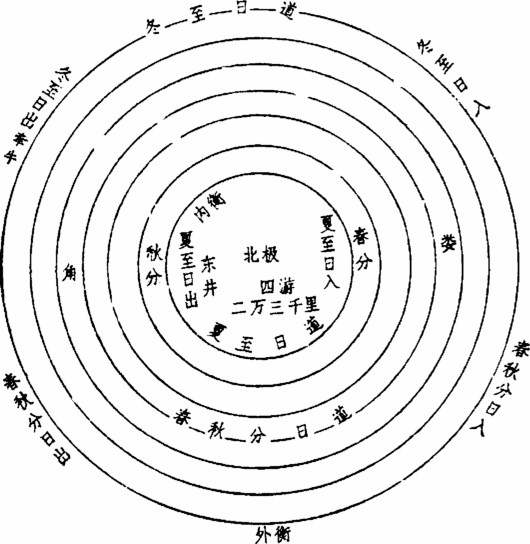
“The large star in the middle of the North Pole” refers to the Pole Star, and the xuanji circle is the circular area drawn by the North Star's circling of the North Pole, which ancient people believed to be the region of the North Pole.Footnote 167 Based on the observations of gnomon, Zhoubi suanjing establishes the model of gaitian 蓋 天 (heaven as a chariot-canopy) cosmography with the North Pole as its core. For example, the diagram of the seven imaginary celestial circles 七 衡 圖 is centred on the pole (Fig. 13).Footnote 168
Diagram of seven celestial circles 七 衡 圖.

In order to obtain correct data of celestial observations,
the pole must be erected vertically and midmostly. The
Zhouli records, “Erect a pole with
cords to observe solar shadow”. Zheng Xuan annotated, “In
the middle of level floor, they erect a pole of eight
chi and use cords to make it
vertical. Then, they observe its shadow to fix the four
directions”. Jia Gongyan commented, “In order to get the
shadow of the pole, they must erect the pole vertically.
In order to erect the pole vertically, they must overhang
cords on the four corners and centres of the pole. They
overhang eight cords, and when all the cords are attached
to the pole, it is vertical”.Footnote 169 The pole erected
in the middle of the observation site is called
zhongzheng biao 中 正 表, the midmost
and upright gnomon.Footnote 170 As a result,
zhi
and zheng 正
(correct, upright), zhongzheng 中 正 (fair
and correct), and gongzheng 公 正 (just,
fair) become synonyms, and zhi and
zheng even combine to form the word
zhengzhi 正
(correct and upright). For
example, the “Shuo shu” 碩 鼠 poem in the
Shijing reads, “Happy state, happy
state, there we shall be dealt with righteously” 樂 國 樂 國,
爰 得 我 . Zheng Xuan glossed,
“Zhi
is the same as
zheng 正.”Footnote 171 The
Wuxing from Guodian reads, “The
central heart is clear and acts uprightly, this is
zhi” 中 心 辯 然 而 正 行 之,
() 也.Footnote 172 The
Hanfeizi reads, “What we call
zhi means to be just, with a
fair-mind without any partiality” 所 謂
者, 義 必 公 正, 公 心 不 偏 黨 也.Footnote 173 The
Shangshu reads, “Without
partiality, without deflection, the royal course is level
and easy. Without perversity, without one-sidedness, the
royal course is just and upright” 無 黨 無 偏, 王 道 平 平. 無 反 無
側, 王 道 正 .Footnote 174
To the ancient Chinese, the Pole Star and other celestial
bodies were all deities, and the observation of those
celestial bodies was sacred, so was the vertical pole used
for the observation. As a result, zhi was
extended to indicate the upright, impartial observation
and quality of High God/Heaven. The Laozi
reads, “To the course of Heaven none is more akin than
another; it is constantly on the side of the good man” 天 道
無 親, 恒 與 善 人.Footnote 175 The Shenzi
申 子 reads, “The course of Heaven is impartial, and this is
what we call constant uprightness” 天 道 無 私, 是 謂 恆 正.Footnote 176 The
‘Tuan’ commentary to the
‘Guan’ 觀 (Observing) hexagram in
the Zhouyi reads, “[Heaven/Ruler]
observes all under heaven with impartial and upright
sight” 中 正 以 觀 天 下.Footnote 177 The “Xiaoming” 小 明 poem in
the Shijing reads, “Quietly fulfill the
duties of your offices, loving the just and upright. When
the spirits listen to this, they will bestow you large
measure of bright happiness” 靖 共 爾 位, 好 是 正
. 神 之 聽 之, 介 爾 景 福.Footnote 178 The
Zuozhuan cites Shi Yin's 史 嚚 words
as follows, “If a state is going to prosper, [the king]
listens to the people; when a state is going to fall, [the
king] listens to the God. The God is bright and upright
and holds the One; its movement follows the people” 國 將 興,
聽 於 民; 將 亡, 聽 於 神. 神, 聰 明 正 而 壹 者 也, 依 人 而 行.Footnote 179
Zhi
and dao 道 are
further combined to form the phrase
zhidao
道 or zhengzhi zhi
dao 正 之 道. The Analects
reads, “These common people are the touchstone by which
the Three Dynasties were kept to the upright course” 斯 民
也, 三 代 之 所 以 道 而 行 也.Footnote 180 The
Hanfeizi reads, “The lord and the
subject are not of blood relations, so if the just and
upright course is beneficial, the subject will do his best
to serve the lord” 夫 君 臣 非 有 骨 肉 之 親, 正
之 道 可 以 得 利, 則 臣 盡 力 以 事 主.Footnote 181
Then, zhi
was added the constituent
hang 行 to form de
德. On one hand, de is used
interchangeably with zhi to represent the
upright, impartial virtue of Heaven; on the other hand, it
carries verbal meaning and represents the movement and
power of the upright, impartial course of Heaven.Footnote 182 Both
the Wuxing texts from Mawangdui and
Guodian read, “Goodness is the course of human, while
impartiality (de) is the course of
Heaven” 善, 人 道 也; 德, 天 道 也.Footnote 183 According to Western Zhou
bronze inscriptions, the ultimate owner of
de was Heaven/High God, who
frequently bestowed de down to selected
people. Those people then reverently preserved,
brightened, held fast and passed it on to their
descendents. For example, the Shi Qiang pan 史 牆 盤
inscription reads, “High God has sent down exemplary
de” 上 帝 降 懿 德. The
Analects reads, “Confucius said,
‘Heaven has endowed de in me’” 天 生 德 於
予.Footnote 184
In the OBI, nevertheless, de is often used
as a verb and related mainly with either military
expeditions or sacrifices. This has confused many scholars
and led them to conclude that this graph bears no direct
relation to the Zhou term de.Footnote 185
However, if we remember Duke Kang of Liu's words recorded
in the Zuozhuan, “The major undertakings
of a state are sacrifice and war” 國 之 大 事, 在 祀 與 戎,Footnote 186 the
signification of de in the OBI will
become understandable. The Guanzi states,
“When initiating major undertakings, they apply the way of
Heaven. For this reason, when the former kings launched
punitive attacks, they attacked only those who opposed
them and not those who were obedient. . . . They attacked
the rebel − this is called wu (military
way), and left the subordinate alone – this is called
wen (civil way). Both
wen and wu are
completely fulfilled – this is called
‘de’ 舉 大 事 用 天 道. 是 故 先 王 之 伐 也, 伐 逆 不 伐
順. . . . . . . 貳 而 伐 之, 武 也; 服 而 舍 之, 文 也. 文 武 具 滿, 德
也.Footnote 187 Both wende 文
德 and wude 武 德 were the most important
‘de’ Heaven bestowed on human
kings. King Wen and King Wu of Zhou, who claimed they had
marvellous de bestowed on them and the
mandate from Heaven,Footnote 188 were traditionally regarded
as representatives of the perfect civil
de and military de
respectively. The Shangshu records, “The
three de [of the perfect sovereign]: the
first is called correctness and uprightness, the second
strong subdual, and the third soft subdual” 三 德 :
曰 正 , 二 曰 剛 克, 三 曰 柔 克.Footnote 189 It
further illustrates that, in times of peace, the perfect
sovereign would naturally take the course of correctness
and uprightness; in times of violence and disorder, the
perfect sovereign would take the course of strong subdual;
in times of harmony, the perfect sovereign would take the
course of soft subdual. Strong subdual is military
de, while soft subdual is civil
de. The de
expeditions recorded in the OBI, especially in cases where
de and fa 伐 (to
send a punish expedition) are combined to form a compound
predicate, may be interpreted as stereotypical
declarations of expeditions with a just cause. For
example:
Cracking made on
wuchen, Que, divining: “The king
will launch the just operation against the tribe
of Tu.” 戊 辰 卜,  , 貞: 王
 土 方.
Cracking made on
gengshen, Que, divining: “This
season the king will launch the just operation to
punish the tribe of Tu.” 庚 申 卜,
 , 貞: 今 者 王
 伐 土 方.Footnote 190
Sometimes, the diviner explicitly expressed that High God would confer assistance on the just expedition:
This season the king will launch
the just operation against the tribe. The High God
will bestow assistance on us.” 今 者 王
 方, 帝 [ 受 ] 我 又.Footnote 191
The
Liji cites the King of Wu's words,
“When dispatching an army, there must be a name (cause)” 師
必 有 名.Footnote 192 “De/Zhi”
德/ may have been the earliest name
for launching a war. According to the
Zuozhuan, King Cheng of Chu cited
the Junzhi 軍 志 (an ancient military
text), saying: “When an army possesses
de, it is invincible” 有 德 不 可 敵. The same
text also records Zifan's 子 犯 words, “When an army is
just, it is strong; when an army is unjust, it is weak” 師
為 壯, 曲 為 老. It again records Han
Wuji's 韓 無 忌 words, “To correct unjust is just” 正 曲 為
.Footnote 193 “Zhi/De war or army” is the
war or army of correcting the unjust; this is a perfect
footnote for “de fa” 德 伐.Footnote 194
This study shows that dao, the focus of
intellectual concerns and disputes of the Spring-Autumn
and Warring States period, was originally a symbol of the
deity of the Pole Star or High God, and it went through an
evolution from supreme deity to cosmic order during this
period. The redefinition of dao by the
authors of the Laozi reveals a balance
between religion and rationality, theistic ideas and
natural philosophy. They implicitly mention the divine
origin of dao from time to time, thus
covering the text with a mystic veil, but more often they
emphasise dao as the heavenly course and
cosmic order, representing a perfect model for human
course and social order. De, in relation
to dao, originally represented the
impartial virtue and power of Heaven. The last chapter of
Zhuangzi describes the authors of
the Laozi as “dwelling alone serenely
with the spirits and numinous” 澹 然 獨 與 神 明 居, and
summarises their “art of dao” (Daoshu 道
術) as “established in constant non-being, dominated by the
‘Great One’, gentleness, weakness, modesty, and humbleness
as its manifestations, and void yet without damaging the
myriad things as its substance” 建 之 以 常 無 有, 主 之 乙 太
, 以 濡 弱 謙 下 為 表, 以 空 虛 不 毀 萬 物 為
實.Footnote 195 The authors of the
Zhuangzi chapter clearly understood
the religious connotations of dao in the
Laozi, and their summary truthfully
conveys the basic ideas of the Laozi.